Original article
Disease named entity recognition by combining
conditional random fields and bidirectional
recurrent neural networks
Qikang Wei
1, Tao Chen
1, Ruifeng Xu
1,*, Yulan He
2and Lin Gui
11
Shenzhen Engineering Laboratory of Performance Robots at Digital Stage, Harbin Institute of
Technology Shenzhen Graduate School, Shenzhen, China and
2School of Engineering and Applied
Science, Aston University, Birmingham, UK
*Corresponding author: Tel:þ86 189-8875-9558; Fax:þ86-755-2603-3283; E-mail: [email protected]
Citation details: Wei,Q., Chen,T., Xu,R.et al.Disease named entity recognition by combining conditional random fields and bidirectional recurrent neural networks.Database(2016) Vol. 2016: article ID baw140; doi:10.1093/database/baw140 Received 4 December 2015; Revised 24 September 2016; Accepted 27 September 2016
Abstract
The recognition of disease and chemical named entities in scientific articles is a very
im-portant subtask in information extraction in the biomedical domain. Due to the diversity
and complexity of disease names, the recognition of named entities of diseases is rather
tougher than those of chemical names. Although there are some remarkable chemical
named entity recognition systems available online such as ChemSpot and tmChem, the
publicly available recognition systems of disease named entities are rare. This article
pre-sents a system for disease named entity recognition (DNER) and normalization. First, two
separate DNER models are developed. One is based on conditional random fields model
with a rule-based post-processing module. The other one is based on the bidirectional
re-current neural networks. Then the named entities recognized by each of the DNER model
are fed into a support vector machine classifier for combining results. Finally, each
rec-ognized disease named entity is normalized to a medical subject heading disease name
by using a vector space model based method. Experimental results show that using 1000
PubMed abstracts for training, our proposed system achieves an F1-measure of 0.8428 at
the mention level and 0.7804 at the concept level, respectively, on the testing data of the
chemical-disease relation task in BioCreative V.
Database URL:
http://219.223.252.210:8080/SS/cdr.html
Introduction
With the rapid increase of biomedical literature, it is cru-cial to facilitate automatic recognition of chemical and dis-ease named entities from text since knowledge discovered
is important to a number of biomedical related applica-tions such as drug discovery, safety surveillance and drug side effect detection. Manual recognition of named entities, though gives high extraction accuracy, is labor intensive.
VCThe Author(s) 2016. Published by Oxford University Press. Page 1 of 8
This is an Open Access article distributed under the terms of the Creative Commons Attribution License (http://creativecommons.org/licenses/by/4.0/), which permits unrestricted reuse, distribution, and reproduction in any medium, provided the original work is properly cited.
(page number not for citation purposes) doi: 10.1093/database/baw140
Therefore, there is an urgent need to develop an automatic annotation system based on natural language processing (NLP) techniques.
Many systems for disease and chemical entity recogni-tion from text were developed (1,2). Some of these relied on biomedical dictionaries. For example, the Jochem dic-tionary (3) employed a lexical approach to recognize the diverse representation of chemical information in litera-tures; a hybrid system called ChemSpot (4) also used the lexical-based approach to locate chemical named entities. Systems based on machine learning and large training cor-pora were also developed. Klingeret al.(5) employed con-ditional random fields (CRFs) to find the International Union of Pure and Applied Chemistry (IUPAC) and IUPAC-like chemical names; Leaman and Gonzalez (6) presented BANNER, which is an open-source biomedical named entity recognition system implemented using CRFs; Leamanet al.(7) developed a high performance chemical named entity recognizer created by combining two inde-pendent machine learning models in an ensemble. Currently, there are some remarkable chemical named en-tity recognition systems available online. However, the publicly available recognition systems of disease named entities are rare mainly due to the diversity and complexity of disease named entities in naming conventions and the lack of appropriate training corpora. Furthermore, the dis-ease name entities often have many naming variations. This further complicates the recognition and normalization of disease entities.
Variants of CRF-based approaches have been success-fully applied to named entity recognition (NER). The main drawback of these models is that many of them focused on designing hand-crafted features which is labor intensive. Also, features defined are often domain- and data-specific. Recently, deep neural network models, which can automat-ically extract features from free-text data, have attracted significant attention. Chiu and Nichols (8) presented a novel neural network architecture that automatically de-tected word- and character-level features using a hybrid bi-directional long short term memory (LSTM) network and a convolutional neural network, eliminating the need for fea-ture engineering. Santos and Guimaraes (9) proposed a CharWNN deep neural network, which used word- and character-level representations (embeddings) to perform se-quential classification. Lample et al.(10) introduced two new neural architectures: one based on bidirectional LSTM and CRFs and the other that constructed and labeled seg-ments using a transition-based approach inspired by shift-reduce parsers. Irsoy and Cardie (11) applied deep stacked bidirectional recurrent neural network (Bi-RNN) to the task of opinion expression extraction formulated as a token-level sequence-labeling task.
The chemical-disease relation (CDR) task (1) in BioCreative V aims to encourage the further development of techniques for recognizing chemical and disease entities and detecting the CDRs. Disease named entity recognition (DNER) and normalization is an intermediate step before the CDR extraction. In this subtask, each participant sys-tem is required to return recognized mentions and their exact locations. Furthermore, the normalized disease con-cept identifiers assigned by medical subject headings (MeSHs) for the given PubMed (12) abstract are also required.
In this article, we introduce a machine learning based DNER and normalization approach. First, two separate DNER models are developed. One model is based on CRFs with a rule-based post-processing module. The other one is based on Bi-RNN. The recognized named entities by each model are fed into a support vector machine (SVM) classi-fier for combining results. Finally, dictionary matching and vector space model (VSM) based normalization method are used to align the recognized mention-level disease named entities with concepts in MeSH.
In the evaluation, using the 1000 PubMed abstracts as the training dataset, our system achieves an F1-measure of 0.8428 at the mention level and 0.7804 at the normalized concept level, respectively, on the testing data of the CDR task in BioCreative V. Furthermore, the achieved perform-ance is higher than any of the CRFs- or Bi-RNN-based DNER models, which shows the benefit of using SVM for combining results. We have made a web service of our sys-tem available at http://219.223.252.210:8080/SS/cdr.html.
Materials and methods
Subtask 1: DNER
For the DNER subtask of the CDR task in BioCreative V, each participant system is required to recognize the disease named entities from given raw PubMed abstracts automat-ically in limited time.
Dataset
To assist the system development and assessment, the or-ganizer has manually annotated all chemicals, diseases and their interactions in 1500 PubMed abstracts. For the CDR task, training (500 abstracts) and development (500 ab-stracts) datasets have been released by the task organizers (13). Besides, 500 raw abstracts are used as the test set for system evaluation. Each dataset contains PubMed ab-stracts, named entity annotations, start-end position and their aligned concept ID from the MeSH database. For the DNER subtask, each participant system is required to
recognize the disease named entities.Table 1gives the sta-tistics of the released data of the DNER subtask.
Architecture
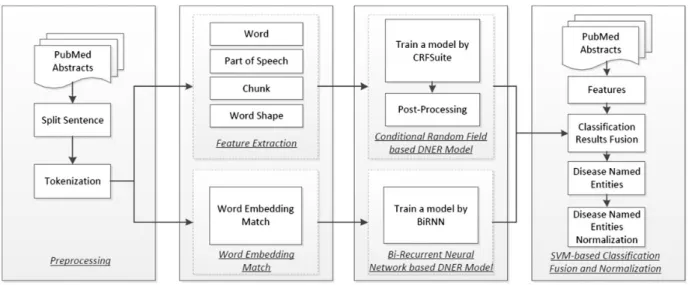
Our system consists of four basic components, as shown in Figure 1: (i) preprocessing of the PubMed corpus: we use a sentence boundary detection tool called ‘Splitta’ (https:// code.google.com/archive/p/splitta/) to split each PubMed abstract into sentences which are subsequently tagged using the GENIA Tagger (14); (ii) feature extraction: this component extracts the features from the preprocessed PubMed text, including words, part-of-speech tags, chunk-ing information, word shape features such as dictionary and morphological features and word embeddings. The first four types of features will be used in the CRFs model, while the word embeddings will be used in the Bi-RNN model; (iii) the base DNER models: two DNER models, based on CRFs with rule-based post-processing and Bi-RNN, respectively, are trained and applied to recognize disease named entity from PubMed text and (iv) recogni-tion outputs combinarecogni-tion and normalizarecogni-tion: the outputs from the two base DNER models and some additional fea-tures are fed into a SVM-based classifier to generate opti-mized outputs. Finally, the named entity normalization component uses dictionary matching and a VSM-based method to align the recognized mention-level disease named entities with concepts in MeSH.
DNER using CRFs
The first DNER model is based on CRFs. The flow chart of the CRF model is described inFigure 2.
In this model, first the chemical named entities and the chemical-induced disease (CID) relations are removed. The PubMed abstracts are then split into sentences by using ‘Splitta’, from which features are extracted for training the CRF-based DNER model.
The feature set is listed below:
Figure 1.System architecture.
• Word: The word itself.
• POS: The part-of-speech tag of each word which is
gen-erated by the GENIA tagger.
• Chunk: The chunking information for each word which
is generated by the GENIA tagger.
• Word Shape: Here, we represent each word by its shape
information. If a character is in upper case, we represent it as ‘U’, lower case as ‘L’ and digit as ‘D’, etc. For ex-ample, a disease name ‘delirium’ will be represented as ‘LLLLLLLL’ (15).
• Type: Classify each word to different types such as ‘All
Digit’, ‘All Symbol’, ‘All Upper and Digit’, ‘All Letter’, etc.
• Prefix and Suffix: The 14 prefix and suffix of each
word are used as feature.
• Dictionary Look-up feature: We extract all the disease
names in the Unified Medical Language System (UMLS) Meta thesaurus MeSH database as a disease dictionary and use it in two different ways: 1) we split all the disease named entities in the corpus into single words. If any of the words can be found in the disease dictionary, we mark a ‘Y’ in its feature representation and ‘N’ other-wise; 2) we traverse the corpus and perform dictionary look-up for each word. Words are annotated with ‘Begin’, ‘In’ and ‘Out’ (BIO) tags based on longest com-mon subsequence matching.
In this model, the(n, n)words are selected as the con-text window of the observing word, wherenvaries from 1 to 3 based on the type of the features.
The CRFSuite (16), which is very fast among the vari-ous implementations of CRFs, is adopted to develop this CRF-based DNER model.
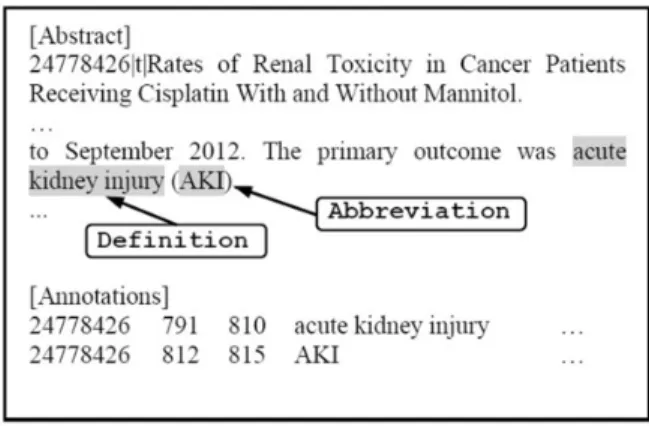
To further improve the performance of the CRF-based DNER model, post-processing techniques are applied. We tag all instances of a certain entity as a disease name men-tion if this entity is tagged by the CRF-based DNER more than twice within an abstract (15). For example, if ‘psych-osis’ is tagged as a disease named entity twice in one ab-stract, it indicates this word is very likely to be a disease named entity. Hence, all of the occurrences of ‘psychosis’ are labeled as disease named entity. We also perform ab-breviation resolution by using the script (Available at: http://www.cnts.ua.ac.be/vincent/scripts/abbreviations. py) developed based on the algorithm proposed by Schwartz and Hearst (17). It detects links between an ab-breviation and its definition, if they are in the form of ‘<definition>(<abbreviation>)’. The process here consists of two steps: (i) traversing the abstract sentences and locat-ing the word sequences in the form of ‘<definition>(< ab-breviation>)’ and (ii) looking up the definition in a custom UMLS disease dictionary. If the definition can be found in
the dictionary, we tag its abbreviation as a disease entity. As illustrated inFigure 3, our CRF model correctly tagged ‘acute kidney injury’ as a disease name but failed to recog-nize that ‘AKI’ is also a disease name. Such an error would be corrected by abbreviation resolution since ‘acute kidney injury (AKI)’ follows the form of ‘<definition>(< abbrevi-ation>)’ and ‘acute kidney injury’ can be found in the dis-ease dictionary. Hence, ‘AKI’ would be tagged as a disdis-ease entity as well. These post-processing techniques are ex-pected to improve the recall of the system.
DNER using Bi-RNN
RNN is a class of artificial neural network where connec-tions between units form a directed cycle (https://en.wikipe dia.org/wiki/Recurrent_neural_network#Bi-directional_ RNN). It takes arbitrary sequences as input, uses its in-ternal memory network to exhibit dynamic temporal be-havior. It was first used in handwriting recognition and speech recognition. With the rapid development of deep neural networks and parallel computing, there are increas-ing interests in usincreas-ing RNNs for NLP tasks includincreas-ing NER.
Bi-RNN, invented by Schuster and Paliwal (18), uses a finite sequence to predict or label each element of the se-quence based on both the past and the future context of the element. This is done by adding the outputs of two RNNs while one processing the sequence from left to right, the other from right to left. The combined outputs are the predictions of the teacher-given target signals.
As illustrated inFigure 4, a Bi-RNN is a neural network that takes sequential data of variable lengthx¼(x1,. . ., xT) as input, consists of a hidden forward layer and a hid-den backward layer with hidhid-den unit functionh, and an optional outputy. At each time stept, the hidden stateht of the hidden forward layer is computed based on the pre-vious hidden stateht1and the input at the current stepxt:
ht¼fðUxtþWht1þbÞ (1)
whereU, W and bare parameter matrices of the net-work.T is the last time stepf()is a non-linear activation function, which can be as simple as an element-wise logis-tic sigmoid function or as complex as a LSTM unit (19) or Gated Rucurrent Unit (GRU) (20).
At each time stept, the hidden state ht of the hidden backward layer is computed based on the future hidden statehtþ1and the input at the current stepxt:
ht¼fðUxtþWhtþ1þbÞ (2)
Afterwards, we add a time distributed fully connected layer with softmax to convert real values to conditional probabilities, which is calculated as follows:
Pi¼
expðxiÞ
PC
i0¼1 expðxi0Þ
(3)
whereCis the class number.
The output at steptis computed as follows:
yt¼softmaxðVhtÞ (4) whereVis another weight parameter of the network.
Note that the forward and backward parts of the net-work are independent of each other until the output layer when they are combined. This means that during training, after back-propagating the error terms from the output layer to the forward and backward hidden layers, the two parts can be thought of as separate and each trained with the classical back-propagation through time (11).
Before training a Bi-RNN for DNER, continuous skip-gram model proposed by Mikolovet al.(21) is used in to train initial word embeddings from a large PubMed (http:// www.ncbi.nlm.nih.gov/pubmed) corpus. It is a data-driven model which takes unstructured text data as input, outputs dense and real-valued vectors in a low-dimensional space (word embeddings) to represent syntactic and semantic word relationships of the words in the input text. The
word2vec (https://code.google.com/p/word2vec/) toolkit is use to build the continuous skip-gram model. Other pre-trained word embeddings, e.g. the public available word embeddings trained from the Google News dataset (100 billion words), can also be used as the initial word vector inputs into Bi-RNN.
For training a Bi-RNN for DNER, we use the tools pro-vided by (11) (https://github.com/oir/deep-recurrent). The input sequencextis set to thet-th word embedding in an input sentence;U,W,Vandh0can be initialized to a ran-dom vector of small values, htþ1 can be initialized to a copy ofhtrecursively. A back-propagation algorithm with Adam stochastic optimization method is used to train the network through time. After each training epoch, the net-work is tested on validation data. The log-likelihood of validation data is computed for convergence detection. To prevent the models from depending on one dataset too strongly, dropout regularization (dropout¼0.25), introduced by Hinton et al. (22), is used on the input sequences.
Combining the outputs of two models by using
SVMs
Bagging outputs from multiple classifiers is commonly used to improve the performance of individual classifiers. In this article, we explore the use of SVMs for combining outputs from the CRF-based DNER and the Bi-RNN-based DNER model. LIBSVM tools provided by Chang and Lin (23) is used in our system.
The classification error rate of each base DNER model on the training data is estimated to generate the weighted confidence scores of the DNER outputs. For a candidate DNER model, its classification results with correspond-ing confidence scores are used as the input to a SVM classi-fier to generate the final output. We take each word as an instance for classification. The feature set is listed below:
• Labels: The prediction labels from each base DNER
model.
• Confidences: The confidence scores of each base DNER
model outputs.
• Error rate: The classification error rate of each base
DNER model.
• POS tags: The part-of-speech tag of each word, which is
generated by the GENIA tagger.
• Dictionary Look-up feature: Same as the dictionary
fea-ture used in the CRF model.
• Word embedding feature: Word embedding generated in
the penultimate layer of the Bi-RNN model.
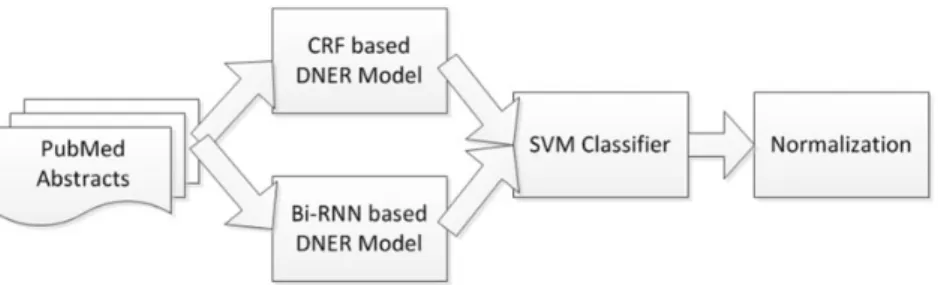
Figure 5shows the architecture of the SVM-based com-ponent for combining results from two DNER models.
Disease named entity normalization module
In the normalization step, we develop a VSM-based method to find the correct MeSH ID for a given entity. The disease entity is used as a query and each MeSH term including its synonyms is considered as one document. Tocollect one concept’s synonyms as many as possible, for each MeSH ID, we first find its Concept Unique Identifier (CUI) ID in UMLS, treat all the English terms that have the same CUI as the MeSH ID’s document term. All of the words in each document and query are stemmed and changed to lower case. We then calculate the term frequency-inverse document frequency (TF-IDF) of these entities and documents, respectively, and use cosine simi-larity measure to rank the candidate documents. Finally, the top ranked MeSH ID is selected as the correct ID of the entity. If there is more than one MeSH ID with the highest similarity score, we randomly select one of them as the cor-rect ID; and if the highest score is 0, we mark ‘1’ as required.
Results
In this evaluation, performance is reported as precision, re-call and F-measure.
Table 2 gives the performance achieved by the CRF-based model on the 500-abstract test set in the DNER subtask.
The difference between Experiments A–C is the use of the dictionary look-up features. In Experiment A, the dic-tionary look-up features come from the disease terms ex-tracted from the MeSH while each single word is tagged as Y or N. In Experiment B, the dictionary features come from the disease terms extracted from the same database, each word is tagged by ‘BIO’ based on a longest common subsequence matching. In Experiment C, we use both the dictionary features in Experiments A and B. The experi-mental results show that the third choice of the dictionary look-up features performs better.
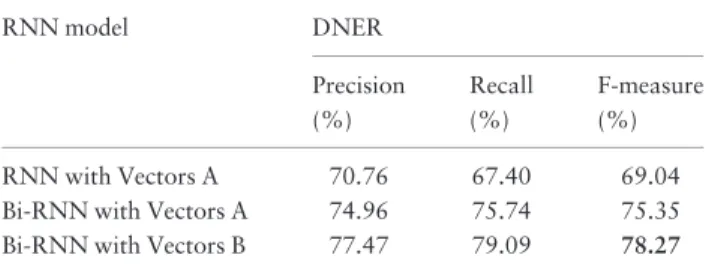
Table 3gives the performance achieved by the Bi-RNN-based model on the 500-abstract test set in the DNER subtask.
The ‘RNN model with Vectors A’ and ‘Bi-RNN model with Vectors A’ utilize word vectors pre-trained on part of the Google News dataset (100 billion words). There are altogether 3 million vectors of words and phrases, each of which contains 300 dimensions. The phrases are obtained Figure 5.Architecture of the SVM-based model.
Table 1.Statistics of the released data of the DNER subtask in the DR task
Dataset Abstract Disease named entity Mentions Concept IDs Training set 500 4182 1965 Development set 500 4244 1865 Test set 500 4424 1988
Table 2.The performance of CRF-based DNER model (The best result is highlighted in bold face)
Different features of CRF model
DNER
Precision (%) Recall (%) F-measure (%) Experiment A 82.52 72.22 77.03 Experiment B 85.01 80.65 82.77 Experiment C 85.11 80.76 82.88
by using a simple data-driven approach described in (21). The hidden layers of both RNN and Bi-RNN are set to 500, and the dropout is set to 0.25.
The ‘Bi-RNN model with Vectors B’ utilizes vectors pre-trained on a large PubMed corpus. The PubMed com-prises>25 million citations for biomedical literature from MEDLINE, life science journals and online books. These word vectors also have 300 dimensions.
The statistical analysis shows that the words in the vec-tors trained by Google News cover around 50% of the vo-cabulary in the CDR corpus while the vectors trained by PubMed articles cover 76% of the vocabulary of the CDR corpus. That is the main reason that ‘Bi-RNN with Vectors B’ performs better. Furthermore, it is also observed from Table 3that, Bi-RNN improves over RNN significantly on the DNER task.
We choose the ‘Experiment C’ setup in CRFs and ‘Bi-RNN using Vectors B’ as the base DNER models. Their out-puts are fed into a SVM classifier for combining results. It is observed fromTable 4that the combined outputs improve over the CRF-based model by 1.40% and the Bi-RNN model by 6.01%, respectively. Finally, our approach achieves 84.28% in F-measure at the mention level which is much higher than the 48.51% in F-measure by the baseline.
We compare the different features used in our system. Word embedding features lead to a significant improve-ment for all the three model of our system on all the three metrics. Dictionary look-up features are also informative for performance improvement. The prediction labels and
confidences features from CRF and Bi-RNN contributed a higher performance enhancement (84.28 vs. 82.88% for CRF, 84.28 vs. 78.27% for Bi-RNN).
The concept-level DNER performance is also evaluated. The obtained results are listed inTable 5. It is observed that our final system achieves F1 performance of 78.04% at the concept level which is higher than the baseline based on dictionary look up by 25.74%.
We have examined the efficiency of each model and the overall system using a computer with 32 GB RAM and a 3.6 GHz 8-core processor. It took <15 min to train CRF model for DNER,8 h to train Bi-RNN model for DNER and15 min to train SVM model. For testing on the overall system, the average processing time for one sentence was <20 s, in which most of time was used to load the trained model.
Error analysis and discussion
In the disease NER task, we develop a CRF and a Bi-RNN-based NER system, and then combines their outputs by SVM. The errors in boundary detection led to a main per-formance loss. Some of the boundary errors come from a re-dundant modifier, e.g. our system recognized ‘intestinal bleeding’ instead of ‘bleeding’, ‘cardiac chest pain’ instead of ‘chest pain’; some come from a missed modifier, e.g. we find ‘depression’ instead of ‘major depression’, ‘vasculitis’ instead of ‘ANCA positive vasculitis’. Beyond that, the limited ability in handling the abbreviations also leads to some errors, espe-cially when the fully spelled mention is not considered as an entity but the abbreviation is. For example, ‘OIH’ is the short form of ‘Opioid-induced hyperalgesia’. In our abbreviation resolution method, if the original phrase, ‘Opioid-induced hyperalgesia’, is not detected as a disease named entity, then the abbreviation ‘OIH’ in the parentheses won’t be detected either. Similarly, the abbreviation of disease named entity ‘HITT’ is also missed.
In the normalization task, the difficulty in dealing with a sequence IDs such as ‘D014786jD034381 vision lossjhearing loss’ for ‘vision and hearing loss’ led to some errors. Besides, if the system fails to find the correct ID, that would also cause a performance drop.
It is worth mentioning that since disambiguation is not critical for DNER, it is not performed in our current experiments.
Table 3.The performance of Bi-RNN-based model (The best result is highlighted in bold face)
RNN model DNER Precision (%) Recall (%) F-measure (%) RNN with Vectors A 70.76 67.40 69.04 Bi-RNN with Vectors A 74.96 75.74 75.35 Bi-RNN with Vectors B 77.47 79.09 78.27
Table 4.The performance of output fusion by SVM (The best result is highlighted in bold face)
Model DNER
Precision (%) Recall (%) F-measure (%) CRF model Experiment C 85.11 80.76 82.88 Bi-RNN using Vectors B 77.47 79.09 78.27 Output fusion by SVM 85.28 83.30 84.28 Baselinea 40.88 59.95 48.61
aThe baseline provided by the organizer is based on dictionary look up.
Table 5.The concept-level DNER performance
Model Disease name entity normalization Precision (%) Recall (%) F-measure (%) Our approach 76.57 79.57 78.04 Baseline 42.71 67.46 52.30
Conclusions
This article presents a system for recognizing and normaliz-ing the disease named entities. First, a CRF-based DNER model is developed for recognizing disease named entities. It employs rich features including orthographic, morpho-logical and domain knowledge from UMLS. Rule-based post-processing techniques are then employed to identify the missed entities. Second, a Bi-RNN-based model with do-main-specific word embeddings is developed. Next, a SVM classifier is applied to combine the results from two individ-ual DNER models to further improve the performance of DNER. Finally, the recognized disease named entity is nor-malized to a MeSH disease name by a VSM-based method. The evaluations on the CDR dataset in BioCreative V shows that our approach achieves 84.28% in F-measure at the mention level which is much higher than the baseline and the results of two individual models. Nevertheless, for concept-level DNER, our approach only gives an F-measure of 78.04%. Further improvements include using other do-main knowledge and optimized features for CRF training, employing better strategies for outputs combination and investigating better methods for normalization.
Funding
This work is supported by the National Natural Science Foundation of China (No. 61370165, No. 61632011); National 863 Program of China (2015AA015405); Shenzhen Fundamental Research Funding (JCYJ20150625142543470); Shenzhen Peacock Plan Research Grant (KQCX20140521144507925) and Guangdong Provincial Engineering Technology Research Center for Data Science (2016KF09). National Natural Science Foundation of China pay for the open access publication.
Conflict of interest. None declared.
References
1. Wei,C.H., Peng,Y., Leaman,R.et al. (2015) Overview of the BioCreative V chemical disease relation (CDR) task. In:
Proceedings of the Fifth BioCreative Challenge Evaluation
Workshop. Sevilla, Spain.
2. Leaman,R., Islamaj Dogan,R. and Lu,Z. (2013) DNorm: disease name normalization with pairwise learning to rank.
Bioinformatics, 29, 2909–2917.
3. Hettne,K.M., Stierum,R.H., Schuemie,M.J.et al. (2009) A dic-tionary to identify small molecules and drugs in free text.
Bioinformatics, 25, 2983–2991.
4. Rockt€aschel,T., Weidlich,M. and Leser,U. (2012) ChemSpot: a hybrid system for chemical named entity recognition.
Bioinformatics, 28, 1633–1640.
5. Klinger,R., Kolarik,C., Fluck,J.et al. (2008) Detection of IUPAC and IUPAC-like chemical names.Bioinformatics, 24, i268–i276. 6. Leaman,R. and Gonzalez,G. (2008, January). BANNER: an
exe-cutable survey of advances in biomedical named entity
recognition. In:Pacific Symposium on Biocomputing, Vol.13, pp. 652–663.
7. Leaman,R., Wei,C.-H. and Lu,Z. (2015) tmChem: a high per-formance approach for chemical named entity recognition and normalization.Journal of cheminformatics., 20157(Suppl 1): S3. 8. Chiu,J.P. and Nichols,E. (2016). Named entity recognition with bidirectional LSTM-CNNs.Transactions of the Association for
Computational Linguistics, 4, 357–370.
9. dos Santos,C.N., Guimaraes,V., Niteroi,R.J. et al. (2015) Boosting named entity recognition with neural character embed-dings. In Proceedings of NEWS 2015 The Fifth Named Entities Workshop, p25.
10. Lample,G., Ballesteros,M., Subramanian,S.et al. (2016) Neural architectures for named entity recognition. In: Proceedings of the HLT-NAACL 2016 Workshop, pp. 260–270.
11. Irsoy,O. and Cardie,C.. (2014) Opinion mining with deep recur-rent neural networks. In:Proceedings of the 2014 Conference on
Empirical Methods in Natural Language Processing (EMNLP),
October 2014, pp. 720–728.
12. Lu,Z. (2010) PubMed and beyond: a survey of web tools for searching biomedical literature.Database, 2011, baq036. 13. Li,J., Sun,Y., Johnson,R.J.et al. (2015) Annotating chemicals,
diseases, and their interactions in biomedical literature. In:
Proceedings of the Fifth BioCreative Challenge Evaluation
Workshop. Sevilla, Spain.
14. Tsuruoka,Y., Tateishi,Y., Kim,J.D.et al. (2005) Developing a robust part-of-speech tagger for biomedical text.Adv. Inform., LNCS 3746, pp. 382–392.
15. Settles,B. (2004) Biomedical named entity recognition using con-ditional random fields and rich feature sets. In: Proceedings of the International Joint Workshop on Natural Language Processing in Biomedicine and Its Applications (JNLPBA ’04), pp. 104–107.
16. Okazaki,N. (2007) CRFsuite: a fast implementation of condi-tional random fields (CRFs). http://www. chokkan.org/software/ crfsuite.
17. Schwartz,A.S. and Hearst,M.A. (2003) A simple algorithm for identifying abbreviation definitions in biomedical text. Pac.
Symp. Biocomput., 451–461.
18. Schuster,M. and Paliwal,K.K. (1997) Bidirectional recurrent neural networks.IEEE Trans. Signal Process., 45, 2673–2681. 19. Hochreiter,S. and Schmidhuber,J. (1997) Long short-term
mem-ory.Neural Comput., 9, 1735–1780.
20. Cho,K., van Merrienboer,B., Gulcehre,C.et al. (2014) Learning phrase representations using RNN encoder-decoder for statis-tical machine translation. In: Proceedings of the 2014 Conference on Empirical Methods in Natural Language Processing (EMNLP), pp. 1724–1734.
21. Mikolov,T., Sutskever,I., Chen,K.et al. (2013) Distributed rep-resentations of words and phrases and their compositionality. In Advances in neural information processing systems, pp. 3111–3119.
22. Hinton,G.E., Srivastava,N., Krizhevsky,A. et al. (2012) Improving neural networks by preventing co-adaptation of fea-ture detectors. CoRR.,abs/1207.0850.
23. Chang,C.-C. and Lin,C.-J. (2011) LIBSVM: a library for sup-port vector machines.ACM Trans. Intell. Syst. Technol. 2(3), article 27.