25/05/2015
Dear Committee,
As former chairs of Wons groups we make this submission with over 100 years combined
experience in agriculture, natural resource management, weeds and pest animals, from the
high rainfall zone to the wet and dry tropics and the pastoral zones of Australia. Without
exception our combined experience is extensive, in the practical application, policy
development, and delivery at the local state and National level.
We note your discussion paper,
Modernising Australia’s approach to managing established
pests and diseases of national significance
says; it outlines a new approach to managing
those weeds, pest animals, plant and animal pest or diseases that become established in
Australia and have a significant impact at the national level. We feel this statement needs
to be changed to a more proactive statement to include those pests that have not yet
arrived but will in the future, In other words we need to manage risk by being more
strategic, and proactive in our approach.
Our response to your discussion paper is not in the format of answering your 10 questions
directly but through the submission of the
Weeds of National Significance Program Business
Plan 2010 – 2025.
This plan was written by the authors of this submission, as an alternative
to the original Wons plan, interestingly it answers all your questions.
We realise now, as we have in the past, the attached plan is not the bee all and end all, but
is a good starting point for the development of a national plan, that will provide
coordination, consistency and an integrated management model that is suitable for the
management of both weeds and pests across the Australian landscape.
To augment our written submission and the business plan we attach the following
documents that help augment our discussion.
1) STATISTICS ON WONS ACTIVITIES PAPER 2003 – 2009 A) Awareness raising activity’s
B) Extension materials delivered
C) Investment leveraged, this shows for every $6million dollars of Australian Government investment $116 million dollars is leveraged
2) PAPER TITLED KEY ACHIEVEMENTS 2003-2006
3) PAPER TITLED LESSONS LEARNT FROM A DECADE OF NATIONAL WEED COORDINATION, NATIONAL GORSE TASK FORCE
4) NATIONAL LANDCARE SURVEY RESULTS 2013
This shows amongst other things where farmers get their information form
5) PAPER TITLED NATIONALLY COORDINATED WEED MANAGEMENT ITS WORKING AT THE LOCAL LEVEL
As past chairs we were, and are still frustrated and critical at the lack of motivation,
governance and leadership by departmental staff and ministers in the management of
weeds programs, and the demonstrated total lack of desire for structural change.
We fully understand and support the need for caution and careful consideration during the
development and roll out of any programme, and the risk management strategy’s needed,
but it seems as though we are working in a leadership vacuum, where decisions are made at
a snail’s pace.
As chairs we made many representations to improve the effectiveness and efficiency of the
business model for national coordination of weed management, we made this to Ministers,
advisors, and the Australian weeds committee, the later were uninterested because the
model removed some power and influence from the members.
Sadly it would seem this culture of limited change is still entrenched with the national
biosecurity committee talking and reporting on discussions on FMD since 2012 and no
concrete policy being developed.
It is clear that for any policy to be developed it has to be done in partnership with those on
the ground, those that own, manage, or derive an income from the land. Weed
management, development, and execution must be done in partnership with stakeholders,
who have the appropriate demonstrated skills.
We urge you as a committee to grasp this opportunity and not be constrained by past
perceptions and culture, but develop a world class programme that is based on the best of
what we have done in the past, so we can manage pest animals and weeds in an effective
efficient measurable way, these opportunity’s do not land in your lap very often.
Efficiency of a program or indeed any business is always affected by both its strategic
direction and the structure of that organisation, it is imperative that thought be given to
who and how any program will be delivered, managed, and monitored. At present the
default fall back for NRM issues is the regional process, to use the regional body’s to deliver
such a programme will fail, for a variety of reasons, some which are articulated in the
Landcare survey attachments.
Our business plan is based on fundamental principles that are listed in no particular order.
National coordination delivers consistency in delivery monitoring and evaluation
Based on determined timeframes and orderly phasing down of Australian
government commitment by handing responsibility back to the States
Australian Government plays a leadership role, but does not have to be main
financier
Education, extension and delivery of decision support tools is a very effective way of
getting effective change on the ground
By having Government, industry and community owning the process you limit risk.
Whatever is done must be achievable, measurable, and value add Government
investment
An engaged community will allow for early prevention and eradication of weeds and
or pests.
For every $1million invested in national coordination $19 million is leveraged
We hope the business plan and attached documents will help you set a direction for a world
class weed and pest plan for Australia.
Furthermore we are willing as a group or individually to be contacted for further
clarification, or to help where ever we can.
Yours sincerely,
IAN SAUER
Past Gorse task force Chair
DREW ENGLISH
Past Willows task force chair, and past chair of chairs
SCOTT CHIRNSIDE
Past Serrated Tussock task force chair
Weeds of National Significance Program –
STATISTICS ON WONS ACTIVITIES 2003 – 2009
Awareness raising activities
WONS Weed Workshops/training No. presentations given Networks General enquiries (phone/email) p/month) TOTAL impact No. Workshops No. People trained No. people(on network lists)
No. different organisations/ groups Alligator Weed 10 180 37 65 55 230 577 Athel Pine 8 48 6 385 200 10 657 Bitou 13 250 18 200 125 10 616 Blackberry 20 152 42 350 150 714 Boneseed 16 300 16 350 200 20 902 Bridal creeper 14 100 20 400 100 17 651 Cabomba 10 180 32 46 40 80 388
Chilean needle grass 80 800 46 264 210 15 1,415
Gorse (stats not available) - - - -
Hymenachne 10 200 40 100 60 10 420 Lantana 25 1500 42 2273 >100 50 3,890 Mesquite 12 280 24 - 40 20 376 Mimosa pigra - - 5 221 151 5 382 Parkinsonia 15 300 24 - 40 20 399 Parthenium 10 600 15 Na 79 - 704 Pond apple 8 100 30 60 40 2 240 Prickly acacia 8 240 16 - 40 20 324 Rubber vine 6 370 15 Na 84 - 475 Salvinia 10 180 34 68 55 130 477 Serrated tussock 18 700 22 550 420 15 1,725 Willows 29 590 25 459 240 10 1,353 TOTAL impact 322 7,070 509 5,791 2,329 664 16,685
Extension Materials (DISTRIBUTED) & Other Communication Activities
WONS Weed Mgt Guides Awareness materials ID info (brochure/ Weedeck/ other) Brochures (info sheets, guides)DVDs/CDs Banners (magnetsPromo /stickers)
Media** Other
Total TV Radio Print No. Type
Alligator Weed 1000 40000 1000 2 42,002 Athel Pine 1000 2000 1500 150 2 3 4,655 Bitou 1800 32000 2800 5100 1500 4 100 TAPs 43,304 Blackberry 2 5 7 Boneseed 2500 90000 300 7500 2 100,302 Bridal creeper 2000 6500 5500 10 000 2 14,002 Cabomba 1000 40000 1000 3000 1000 2 46,002
Chilean needle grass 3730 230 20 6701 2 2105 brochures 12,788
Gorse 7500 2 7,502 Hymenachne 1,200 1,200 2000 2000 200 32 3000 4 6 9,642 Lantana 11,430* 12,000 6,000 2000 4,500 10 10 34 35,984 Mesquite 5,000 9,000 12,000 2000 50 4 200 Acrylic seed pods 28,254 Mimosa pigra 750 5000 1000 3000 0 2 9,752 Parkinsonia 5,000 12,000 12,000 2000 50 4 31,054 Parthenium, rubber vine 15000 11000 15000 25 16,000 400^ 57,425 Pond apple 500 500 1000 1200 100 27 2000 5 5,332 Prickly acacia 5,000 11,000 12,000 2000 50 4 30,054 Salvinia 1000 25000 1000 2 27,002 Serrated tussock 9000 3000 800 2 2 8 10 1 Research forum 12,823 Willows 2200 3300 1250 950 2 4 1 Research forum 7,707 TOTAL 76,610 303,730 75,370 36,501 9,350 134 21,000 419 57 15 2,407 525,593
* Includes Best Practice Manuals and Herbicide Use Guides
Investment in WONS Program (up until June 2009).
WONS Weed Yrs programrunning
AG investment in WONS Program Coordination (up until 08/09)
Investment in WONS weeds from non AG sources (TOTAL)*
Alligator Weed 6 270,000 8,700,000
Athel Pine 4 208,523 Not available
Bitou AND Boneseed 4.5 607,500 16,329,645 (from 06/07 on)
Blackberry 5 666, 306 Not available
Bridal creeper 4 328 000 7,270,000
Cabomba 6 270,000 5,520,000
Chilean needle grass 6 590,000 923,708 (from 07/08 on)
Gorse (stats not avail) Not available Not available Not available
Hymenachne 4 320,000 3,000,000
Lantana 7 784,540 $6,342,000**
Mesquite 7.5 373,000 Not available
Mimosa pigra 6 176,722 Not available
Parkinsonia 7.5 373,000 Not available
Parthenium 7 366,375 6,600,000 (from 03/04 on)
Pond apple 4 200,000 1,500,000
Prickly acacia 7.5 373,000 Not available
Rubber vine 7 366,375 5,700,000 (from 03/04 on)
Salvinia 6 270,000 6,300,000
Serrated tussock 5 464, 800 Not available**
Willows 4.5 636,900 56,000,000 (from 06/07 on)
estimate of TOTAL 5.7 (average) $6,185,935 $116,915,353^
*It is very difficult to accurately determine all investment in WONS due to the huge plethora of agencies, groups and people involved from the national through to the local scale (including volunteers). It is also difficult in the case of some WONS to gain figures where separate out costs attributed to WONS against those that are part of larger landscape or restoration projects. The figures provided are an estimate and have captured only investment that the WoNS Program is aware of and can source. Actual investment is expected to be much higher than what could be sourced.
^ This figure is not directly comparable to the AG investment as it only represents the 8/20 WoNS, it is also over a shorter timeframe. The actual comparable figure would be much higher and highlight an even greater level of leverage, see note*. Note this figure is also exclusive of any other AG investment in WoNS that may be additional to Coordinator funding.
2012
National Gorse Taskforce
Achievements, Experiences and
Lessons from a Decade of
National Weed Coordination
National Gorse Coordination – Achievements, experiences and lessons
from a decade of national weed coordination
National Gorse Taskforce
(Written and edited by Ian Sauer and Michael Noble on behalf of the National
Gorse Taskforce, with significant contributions from former national
coordinators Sandy Leighton and Michael Rowland, and from John Ireson of
the Tasmanian Institute of Agriculture)
Forward
This legacy document is the final output prepared by the National Gorse Taskforce (NGT), it is a “warts and all” review, to:
1. Highlight, celebrate and recognise those who helped with our significant successes;
2. Outline areas where improvements and efficiencies can be made and: 3. Use our successes, failures and learning’s as a reference for new taskforces,
government departments, or others setting up processes to tackle weeds or indeed pest animals on a national scale.
Firstly congratulations to the Australian and State Governments, without a doubt the WoNS programme is one of the standout natural resource management programs Australia has seen. It is implemented in a highly strategic manner, has true national coordination, and leverages huge financial and in-kind support from state governments and the general community.
However, it is incumbent upon us all, to make sure that the investments of the Australian Government through funding; the state governments through housing and hosting; and, more importantly the community’s significant in kind and financial investment are not lost or diluted, but in fact value-added. This legacy document can hopefully help do just that.
It is clear that the WoNs programme is in need of restructuring. This needs to be done in consultation with the people who are on the ground - farmers, industry, researchers, Landcarers - those that are directly impacted by weeds, not just those that administer programmes in capital cities. To not restructure and re focus will set the WoNs programme on a path of ineffectiveness and mediocrity.
We hope our learning’s and recommendations will be taken on-board by those in a position to make change, to make a great programme better, so Australia can lead the way in national coordination of pest weeds.
It should be noted the successes of the National Gorse Taskforce, and indeed the whole WoNS programme, certainly outweigh any negativity, and all Australians should be proud of the Weeds of National Significance (WoNS) program.
Clearly, the success of the National Gorse Taskforce would not have been achieved were it not for the dedication, drive and determination of the national coordinators, and the members of the Taskforce. To the coordinators - Sandy Leighton, Dean Vincent, Michael Rowland, and Mike Noble, a big thank you, as in most things, it is real people on the ground that makes change, not those pulling the purse strings. To the members of the National Gorse Taskforce, we would not have achieved half as much as we did if it were not for your significant direction, thinking outside the square, your willingness to take a risk, and provide considered council. This laid the pathway for our success.
We can justifiably say that the National Gorse Taskforce has been successful, cost effective, and innovative, with an Australian Weeds Committee review saying that by 2009 we achieved 80 % of what we set out to do.
All of this was achieved in a difficult working environment characterised at times by uncertain funding, changing personnel in the Department of Agriculture, Fisheries
and Forestry (DAFF), lack and loss of project-related corporate knowledge from DAFF and Minister’s officers, little understanding of community process, and lengthy recruitment processes at a State level.
There has been a clear need demonstrated to have real structural changes of the management of the programme, not just tinkering at the edges. Structural and management reform of the programme with a more integrated process, perhaps pest weeds and animals together as an example, need to be urgently explored.
I am proud to say the NGT has made a large national impact on gorse. We have in place 20 25 year gorse eradication memoranda of understanding (MOUs) across Australia. This means the work we have done will be monitored and maintained for another 25 years. As far as we know this is the first time an instrument like this has been used to maintain works done.
Subsequently Western Australia and Northern NSW have removed almost all above-ground gorse a great achievement.
On behalf of the NGT I am convinced we have value-added the Australian and State Government investments, and left land managers in every relevant state and territory with the tools, knowledge, and networks to continue eradicating the green cancer on our landscape, gorse.
Ian Sauer
Chair
Table of Contents
Forward ... 3
1.
Introduction ... 7
2.
Overview of key achievements and experiences of the national gorse project
2003–2012 ... 7
3.
Processes used in implementing national coordination of gorse (2003-2012) .... 10
3.1 Hosting of a coordinator by the Tasmanian State Government on contract from
the Australian Government ... 11
3.2 Establishing the National Gorse Taskforce ... 11
3.3 Determining national eradication areas and containment lines and collating
state/ territory data ... 12
3.4 Promoting research on and use of biological control agents ... 12
3.5 Other gorse management research and development activities ... 13
3.6 National funding for on-ground works ... 13
3.7 Improving national mapping ... 14
3.8 National Best Practice Manual ... 14
3.9 Gorse eradication memorandum of understanding ... 15
3.10 Gorse batons and community custodians ... 15
3.11 Nationally outstanding achiever recognition ... 16
3.12 Gorse awareness-raising and management knowledge ... 17
4.
Working with frustrations encountered ... 18
4.1 Lack of certainty in funding and of continuity of a Coordinator ... 18
4.2 Accommodating individual state approaches – Victoria/National Gorse
Taskforce relationship case study ... 19
4.3 NGT meetings/ teleconferences ... 20
4.4 National coordinator meetings ... 21
4.5 Reporting to the Australian Government ... 21
4.6 Inconsistency and leadership void ... 22
5.
Lessons learned ... 23
6.
Conclusions and Recommendations ... 24
7.
References ... 26
8.
Appendices ... 27
Appendix 1 – National gorse eradication areas and containment lines mapping (as
produced for Caring for Our Country business plans) ... 27
Appendix 2 – An Overview of the Australian Gorse Biological Control Programme
(by John Ireson, Tasmanian Institute of Agriculture) ... 29
Appendix 3 – Most recent gorse distribution and MOU location mapping ... 33
Appendix 4 – WoNS Gorse Eradication Memoranda of Understanding Signatory
Locations ... 34
Appendix 5 – Memorandum of Understanding generic document ... 35
Appendix 6 – Criteria for consideration of Nationally Outstanding Gorse
Management Achiever nominations ... 38
Appendix 7 – The WoNS Chairs Business Plan ... 43
1. Introduction
In 1999, through a rigorous scientific process gorse was selected as one of 20 initial Weeds of National Significance (WoNS).
The motivation for the development of WoNS was to attempt to improve coordination among the weed management stakeholders nationally (Thorp and Lynch, 2000). The basis for selection of the 20 WoNS species was intended to reflect the decision-making processes of managers and policy makers in prioritising the importance of individual weeds (Thorp and Lynch, 2000). The four major criteria used were:
Invasiveness
Impacts
Potential for spread
Socioeconomic and environmental values
Development of a Weeds of National Significance Gorse Strategic Plan (or National Strategy) in 2003 provided a basis for national coordination work to begin. From this time til 2012 there has been ongoing national coordination of gorse management related activities. 2012 marks the point where coordination reverts back to the states. The National Gorse Taskforce considers it important that a record of achievements, experiences and lessons be left from this 2003-12 period. That is what this paper seeks to provide, and it is hoped that this information will assist planning for future national coordination of natural resource management related projects.
2. Overview of key achievements and experiences of the national gorse project 2003–2012
In 2003 following research and consultation, the WoNS Gorse National Strategy was published. This Strategy directed the national gorse program be focussed on five key areas. These are:
Best practice management of established infestations implemented across Australia
Prevent spread from established infestations
Eradication of isolated and scattered infestations
Management of at-risk areas to maintain them free of gorse
National Gorse Taskforce (NGT) – be formed so that the strategy for gorse control is effectively managed at the national level
In 2004, a National Gorse Coordinator and subsequently Chair of the National Gorse Taskforce were appointed, and then the National Gorse Taskforce formed.
Sandy Leighton was the initial National Gorse Coordinator (2004-06). Dean Vincent (2006-08), Michael Rowland (2008-09), and Michael Noble (2009-2012) followed. Ian Sauer has remained National Gorse Taskforce Chair from 2004 to 2012.
In 2006, the WoNS Gorse National Best Practice Manual was produced. This was revised and reprinted in 2009, and is being reprinted again in 2012. The content is based on science, very practical, well researched, and with real life case studies as examples. Regular input from the Taskforce members (representing relevant states and industry) provided valuable input, as well as ground-truthing the document. The NGT at an early stage deliberately adopted a philosophy that eradication of gorse can be achieved provided mechanisms to promote long term monitoring and maintenance were adopted. 25 year gorse eradication MOUs emerged from this background.
In 2007, the initiative was taken by the National Gorse Taskforce to develop and sign 25-year memoranda of understanding (MOU) with local government, regional bodies and other relevant organisations. This mechanism binds relevant authorities to commit to an effort to eradicate gorse from specified areas over a period of 25 years. The 25 year MOU may not be a legally binding document if tested in court, but what is more important and more powerful is showing commitment, and a willingness to work in partnership with others.
The MOU document provides background and scope with regard to gorse eradication to be achieved. Commitments by both the National Gorse Taskforce and the other signatory or signatories are outlined in the document. Typically, the NGT will:
Provide best practice advice to ensure that the management approach of the infestations will lead to eradication
Provide coordination and facilitation when requested to assist in the eradication project
Promote and highlight the eradication project in the media for the benefit of both/all MOU parties
Contact the other MOU signatory/signatories annually to seek an update on the eradication of infestations
Typically, the other signatory or signatories commit to:
Facilitate eradication of all living gorse and the seed banks at the infestation sites
Map the infestations to the National Mapping Standard as developed by the Bureau of Rural Science
Ensure that gorse seed from infestations is not moved to infest other areas of the jurisdiction, chiefly through ensuring that hygiene measures are adequate in regard to preventing seed being moved
Undertake annual inspections and destroy any regrowth or seedling germination to ensure that infestations do not produce any further seed
Report annually to the National Gorse Taskforce
The first MOU was signed with Kangaroo Island NRM Board in South Australia. The MOUs cost no money to setup with minimal effort required.
Anecdotal evidence (such as feedback from NGT Western Australia representative John Moore and NSW local government weed officers), suggests that the MOUs are very effective in justifying and drawing funding for ongoing gorse management. Twenty MOUs were signed in five states by 2012. These are listed in Appendix 1. Between 2007 and 2009, an Australian Government funded national Defeating the Weed Menace gorse control project was rolled out across six areas in five states. This was important in achieving the control of almost all above-ground gorse in Western Australia.
25-year MOUs were signed for several localities where works under this program were completed. These included Tumut Shire Council area in NSW, SE NRM Board area in SA, and South Coast NRM area in WA.
In 2009 the Taskforce developed the idea of a yellow gorse baton. These were provided to MOU signatories for storage of MOU-related records. Being large and bright yellow the batons are difficult to lose, or indeed, to forget. A smaller version of the baton was developed to contain MOU information for local community champions. Each MOU co-signatory was asked to nominate a community champion who would remain responsible for providing timely reminders on the MOU and gorse eradication issues such as the need for monitoring and retreatment over the longer term. The first community member to have responsibility for a baton was Mr Chris Gilmour in Western Australia.
In 2009 an Australian Weeds Committee review of the implementation of the National Gorse Strategic Plan found implementation to be 80% complete, and recommended a gradual phase-out of the national project. This recommendation sat well with the NGT as we had been looking for a seamless way to conclude our activities. Sadly though, immediately following this was a time of significant frustration for the Taskforce. The Taskforce sought a rapid conclusion to national coordination, we were of the opinion we had delivered National coordination, delivered the education and tools that would allow the Community to continue the work we had set in train, and our value for money was diminishing.
Frustrating this was inconsistent timing of notifications on annual Australian Government funding (a situation which was significantly improved in 2011), and a total lack of clear direction or understanding from the Australian Government and Australian Weeds Committee (AWC) on how to conclude national coordination of not only the NGT but all the inaugural WoNS. The process was pushed out to the end of 2011.
In 2010 the Taskforce came up with the idea of a Nationally Outstanding Gorse Management Achiever Award to recognise those truly outstanding gorse management achievers around the nation. There was a strong desire on the part of the Taskforce to award and recognise those in the community who, with little recognition, make a huge difference in managing gorse.
Also in 2010, the Taskforce also undertook a review of the National Strategy, including a complex revision of actions and timelines.
The National Gorse Taskforce concluded its tenure in 2012. Prior to this, the Taskforce progressively handed over responsibility for the MOUs and other national coordination roles back to the states.
Events to mark this (and recognise Nationally Outstanding Gorse Management Achievers) were held in Western Australia, South Australia, Victoria, New South Wales and Tasmania.
Prior to conclusion in 2011-12, a double-sided A4 flyer was developed (different versions for each of the five gorse states), and distributed. This was targeted at gorse outlier and potential gorse infestation areas, leaving a legacy of awareness and an additional tool for future awareness-raising.
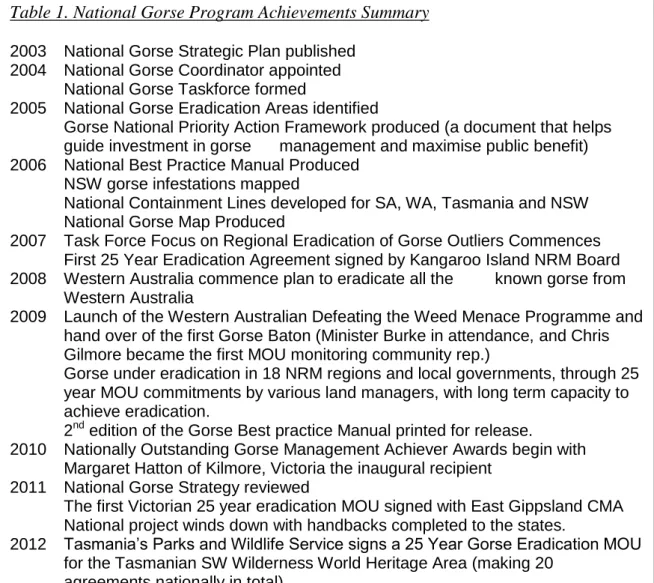
The achievements of the national gorse coordination are summarised in Table 1 below.
3. Processes used in implementing national coordination of gorse (2003-2012)
This section outlines some of the history of means used to implement national
coordination of gorse.
Table 1. National Gorse Program Achievements Summary
2003 National Gorse Strategic Plan published 2004 National Gorse Coordinator appointed
National Gorse Taskforce formed
2005 National Gorse Eradication Areas identified
Gorse National Priority Action Framework produced (a document that helps guide investment in gorse management and maximise public benefit) 2006 National Best Practice Manual Produced
NSW gorse infestations mapped
National Containment Lines developed for SA, WA, Tasmania and NSW National Gorse Map Produced
2007 Task Force Focus on Regional Eradication of Gorse Outliers Commences First 25 Year Eradication Agreement signed by Kangaroo Island NRM Board 2008 Western Australia commence plan to eradicate all the known gorse from
Western Australia
2009 Launch of the Western Australian Defeating the Weed Menace Programme and hand over of the first Gorse Baton (Minister Burke in attendance, and Chris Gilmore became the first MOU monitoring community rep.)
Gorse under eradication in 18 NRM regions and local governments, through 25 year MOU commitments by various land managers, with long term capacity to achieve eradication.
2nd edition of the Gorse Best practice Manual printed for release.
2010 Nationally Outstanding Gorse Management Achiever Awards begin with Margaret Hatton of Kilmore, Victoria the inaugural recipient
2011 National Gorse Strategy reviewed
The first Victorian 25 year eradication MOU signed with East Gippsland CMA National project winds down with handbacks completed to the states.
2012 Tasmania’s Parks and Wildlife Service signs a 25 Year Gorse Eradication MOU for the Tasmanian SW Wilderness World Heritage Area (making 20
3.1 Hosting of a coordinator by the Tasmanian State Government on contract from the Australian Government
Hosting of a national coordinator by the Tasmanian State Government meant that they became part of the State weeds team. They had ready access to resources – such as free GIS and mapping expertise – that may not otherwise have been as available. It also gave them a level of credibility within Tasmania and interstate when approaching governments and organisations.
Where the coordinator would otherwise be working in the weed management field in Tasmania, filling the role had the benefit of allowing a significant expansion of national weed management contacts for that person, and for the Tasmanian Government.
Up to 2011, the Australian Government provided Tasmania with 12 month contracts for hosting the Coordinator. This limited span of contract provided for uncertainty and disruption, particularly for coordinators that didn’t have a permanent role to fall back on. Short contracts did not allow the taskforce to have the clear air to make long term decisions; too much time was spent on risk strategies instead of the main game. This was exacerbated by limited and often very late notice of future intention by the Australian Government.
The disadvantages of this were exacerbated by the State Government not being able to employ any new people or renew contracts at one point. This caused a 3 month delay mid-way through the project causing huge disruption to the program.
It should be in the minds of ministers, bureaucrats and the AWC managing these programs that uncertainty and disruptions cause huge negative impacts and costs to the delivery end of the project.
3.2 Establishing the National Gorse Taskforce
Sandy Leighton was appointed as the first National Gorse Coordinator. Sandy consulted key people in Tasmania for potential nominees for National Gorse Taskforce chair.
“We selected the Chair (Ian Sauer) based on his knowledge, experience & enthusiasm for weed management, together with confidence at public speaking, connections / savvy and also that he was a farmer and not short of a few words!” (Leighton pers. comm., 2011).
In order to determine state representatives for the National Gorse Taskforce, “contact was made with principal weed management officer within each state/ territory. They then nominated a representative. Depending on their workload & enthusiasm, this proved to be a worthwhile approach” (Leighton pers. comm., 2011).
The Taskforce had a conservation representative (Corey Watts from the Australian Conservation Foundation) for a period of years. According to Sandy Leighton, the conservation representative was sourced by approaching the ACF representative on the Australian Landcare Council. “However it was not part of his agreed core work duties so he eventually left the taskforce” (Leighton pers. comm., 2011).
An industry representative was sought from the outset, but proved challenging. Warwick Ragg from the Australian Forest Growers joined the Taskforce in its later
years. A forestry sector representative was considered very appropriate as gorse has a significant impact on this industry.
A “community” representative was never appointed to the Taskforce, but the value of such an appointment might be questionable given that in any case Taskforce members (drawn from five states), are members of communities around Australia. At the close of the National Gorse Taskforce tenure (2012), members of the Taskforce are:
Ian Sauer, Chair Community (TAS based)
John Moore, WA research WA Government representative David Cooke, SA Government representative
Shane Herbertson, VIC Government/ VIC Gorse Taskforce representative Dr Peter Everist, community VIC Gorse Taskforce representative
Karen Stewart, TAS Government representative Michael Michelmore, NSW Government representative
Warwick Ragg, Australian Forest Growers Association representative (ACT based) Jeanine Baker, Australian Government representative
3.3 Determining national eradication areas and containment lines and collating state/ territory data
At the beginning of the project, national mapping of gorse was very preliminary (e.g. map on page 25 of the 2003 National Strategy). Using the existing mapping the Coordinator (Sandy Leighton) and Chair (Ian Sauer) determined strategic national outliers including:
Western Australia (infestations restricted to South Coast);
South Australia - Port Lincoln, Burra, Yorke Peninsula, Kangaroo Island;
NSW Armidale & surrounds (Leighton pers. comm., 2011).
The Coordinator then found key contact people in these areas and made initial personal visits and local field trips to inspect infestations and on-ground works in key outlier areas. “This worked extremely well by providing firsthand knowledge of local situations. It also enabled continued networking with these people over time, via phone and email, including encouraging them to apply for funding” (Leighton pers. comm., 2011).
National eradication areas and containment lines mapping (as produced for Caring for Our Country business plans) is provided in Appendix 1.
3.4 Promoting research on and use of biological control agents
Throughout the project the need for development and distribution of biological control agents has been recognised as a key mechanism for assisting with the management of core areas of gorse.
The NGT and coordinators promoted the use and distribution of bio-control agents, as well as funding applications for ongoing research.
However, Taskforce members (e.g. Ian Sauer and John Moore) feel that the national gorse project could have had more impact on gorse in core infestation, by committing more time and effort to progressing the presence of bio-control agents at an earlier stage in these areas.
Ian Sauer’s observation – “In hindsight we probably missed some opportunities by not concentrating on R&D and bio control at the start of the program. This may have allowed us to make some more advances in this area.
If we had our time again, some concentration on coordinating internationally, especially with New Zealand, on bio control may have paid dividends and given an international focus.”
John Ireson’s (gorse bio control researcher with the Tasmanian Institute of
Agriculture) observations on the bio control aspect - “Historically, a large amount of effort has gone into the research and development of gorse biological control as a long term control option. The gorse seed weevil, (Exapion ulicis), was released in Tasmania in 1939 and was the first gorse biological control agent released in Australia.
Since gorse was officially declared a target for biological control in 1995, four additional agents have been investigated for release. These are the gorse spider mite, (Tetranychus lintearius), the gorse thrips, (Sericothrips staphylinus), the gorse soft shoot moth, (Agonopterix umbellana) and the gorse pod moth, (Cydia
succedana). The first three have been released in Australia, while the gorse pod moth release is still pending additional research.
Extensive surveys for new agents have also been conducted in Europe. All of this work has been co-ordinated by the Tasmanian Institute of Agriculture in association with DPI Victoria, the South Australian Research and Development Institute and CSIRO.”
A detailed overview of the current situation of the Australian gorse biological control programme (as outlined by John Ireson) is provided in Appendix 2.
3.5 Other gorse management research and development activities
Important research has been undertaken by Western Australia-based John Moore (WA representative on the National Gorse Taskforce). John has long recognised the need for improved means of managing gorse soil seed banks.
John has conducted research into a broad variety of factors (including smoked water, hydrocarbons, temperature, solarisation, microwave radiation, and scarification) to better determine their impacts on gorse seed, and potential of these for assisting more rapid seed bank degradation.
Over the life of the National Gorse Taskforce, the critical nature of this work has become more and more clear. For example, in Western Australia the Defeating the Weed Menace gorse project resulted in the 99% completion of above ground gorse management. With this achieved, follow up and destruction of the gorse soil seed bank are the only obstacles to complete eradication of gorse in Western Australia. 3.6 National funding for on-ground works
Despite some initial lack of success, the National Gorse Coordinator and Taskforce successfully applied in 2006 for Australian Government Defeating the Weed Menace funding for dealing with key national gorse outliers. This resulted in extensive gorse works in six areas of five states. These were:
Tumut Shire in NSW
Tasman and Dorset Municipalities in Tasmania
South East NRM in South Australia
South Coast NRM in Western Australia
Tumut Shire (NSW), South East NRM (SA) and South Coast NRM (WA) signed 25 year gorse eradication memoranda of understanding (MOU) with the National Gorse Taskforce.
The finances for the Defeating the Weed Menace gorse project encompassing parts of five states were received, managed and acquitted by the Tasmanian Government (via the National Gorse Coordinator, as an employee). Acquittal was completed in 2010.
The Defeating the Weed Menace money facilitated a realistic shot at regional or local eradication of gorse for several of the recipients. This component of on-ground funding added significant credibility to the national coordination effort.
3.7 Improving national mapping
With states/territories having differing detail and format for weed mapping (or none at all) available, national mapping of WoNS species proved difficult (Leighton pers. Comm., 2011). National consistency was required. The National Core Attributes mapping method was adopted as the only system to be accepted by the NGT. This provides nationally consistent guidelines for weed mapping.
Prior to publication of the Gorse National Best Practice Manual, the Coordinator (Sandy Leighton) and Taskforce worked with the states to produce a much more accurate national map than had existed to date. This map is reproduced on page 15 of the Gorse National Best Practice Manual.
Further mapping has been undertaken by subsequent coordinators. Michael Rowland reflected “the detailed infestation map I found really valuable for identifying the outliers and targeting specific localities. Locality boundaries including NRM regions, weed management districts (NSW), and local government boundaries made identification of jurisdictions responsible for particular infestations easy. I recall spending a lot of time pulling this together and getting the formatting consistent for data from the different states. In many cases authorities had little awareness of the infestations due to staff changes and loss of corporate knowledge of data collected by previous staff” (Rowland pers. comm., 2012).
For most recent distribution mapping see Appendix 3. 3.8 National Best Practice Manual
The first coordinator (Sandy Leighton) and the Taskforce, in cooperation with the Tasmanian Government, gained Australian Government (Defeating the Weed Menace) funding to produce the WoNS Gorse National Best Practice Manual. This involved employing a project officer (Jonah Gouldthorpe), producing, and (in 2006), launching the manual with a field day on a gorse site outside Canberra.
Sandy reflected that the process of producing the manual was quite good and improved the taskforce members’ knowledge on all things gorse. Also that it was good for people working on gorse to have their case study in print in the manual - some were chuffed. She says that the state/ territory contacts she had made were
invaluable, through knowing local on-ground projects, and thus selection of appropriate and differing case studies (Leighton pers. comm., 2011).
In 2009, a second edition of the WoNS Gorse was produced by Taskforce and Coordinator (Michael Rowland by then). This was a “big job, [with] lots of extremely helpful input from the NGT team. Real commitment from those people” (Rowland pers. comm., 2012).The second edition was launched near Seymour, Victoria in early 2010. A third print run of the manual was completed in 2012.
3.9 Gorse eradication memorandum of understanding
The second National Gorse Coordinator was Dean Vincent. In 2007, Dean and the National Gorse Taskforce developed the idea of the 25 year gorse eradication memorandum of understanding (MOU). With a potential seed viability of several decades or more, gorse eradication is a long term prospect. With national coordination resulting in significant sums of Australian Government money being invested in gorse management, a mechanism was needed to secure this investment into the future. The MOU concept was decided upon and in 2007 the first 25 year gorse eradication MOU was signed between the National Gorse Taskforce and the Kangaroo Island NRM Board (please refer to Image 1 – signing of the first 25 year gorse eradication MOU at Kangaroo Island).
In 2012 there are 20 MOUs across five states. These are illustrated on the map in Appendix 3, and listed in Appendix 4. An example of an MOU document is provided in Appendix 5.
3.10 Gorse batons and community custodians Image 1. Signing of the first 25
year gorse eradication MOU with Kangaroo Island NRM
The MOUs were signed primarily with local governments and regional bodies (such as Natural Resource Management and Catchment Management Authority organisations). The Taskforce was concerned at the potential for the MOUs to be filed away by signatories, and forgotten over time. Also, staff turnover in organisations put added limitations on corporate memory.
Michael Rowland became the third National Gorse Coordinator in 2008. The Coordinator and Taskforce developed the concept of gorse batons (a bright yellow painted PVC pipe). Batons (see Image 2) were presented to the MOU signatory organisation and contained the MOU documents and relevant maps, in a conspicuous manner. It was also decided that signatory organisations would be asked to nominate community custodians. These custodians hold a copy of the MOU and associated documents in their own smaller baton. Their role is to remind the signatory organisation, from time to time, of the gorse eradication agreement that is in place.
“The central purpose of the gorse baton was to incorporate and combine the only lasting way of keeping both the memory/data of locations, in the hands of the most affected – the community, with a ‘licensed’ cattle prod. Authorities have demonstrated their shortfall in their quick turn over of staff and consequent loss of corporate memory” (Rowland pers. comm., 2012).
3.11 Nationally outstanding achiever recognition
The National Gorse Taskforce recognised that certain individuals around the nation play an extraordinary role, often over a long period, in not only reducing the presence of gorse in the Australian landscape, but also by enthusing others that eradicating Gorse is achievable. In 2010 the Coordinator (the fourth, Michael Noble) and
Image 2. Gorse batons containing MOU copies for signatory organisations and community champions
Taskforce decided to initiate Nationally Outstanding Gorse Management Achiever recognition.
Basic criteria were established (see Appendix 6), and nominees were considered by the National Gorse Taskforce based on these criteria.
In early 2010, Margaret Hatton of Seymour, Victoria was presented with the inaugural Nationally Outstanding Gorse Management Achiever recognition (see Image 3). Subsequent recognitions have been presented to Anton Kurray and Phil Cramond in South Australia, the Boyd family in NSW, and the Clark family in Tasmania. Award recipients are provided with a certificate contained within a small gorse baton.
3.12 Gorse awareness-raising and management knowledge
In 2007, the National Gorse Taskforce produced an awareness-raising television commercial. This television “weed-Mercial” has been played in Tasmania. The concept is for each state to look for sponsorship, or have the weed mercial played as a community announcement.
All the communication activities and events are part of the communications plan developed by the NGT
Throughout the national gorse project, the coordinators and Chair readily took up all opportunities to speak at various forums including state and national weed conferences, Landcare and natural resource management conferences and events. Topics were not purely gorse-specific, but also the importance of all weeds, especially the WoNs weeds.
Image 3. Margaret Hatton of Kilmore, Victoria received the inaugural national award in early 2010
The memorandum of understanding (MOU) concept was of particular interest to natural resource managers, and during the last couple of years of the project papers were presented on this topic by the coordinator to the South Australian and New South Wales weed management conferences.
From 2006-12 six newsletters were produced by the National Coordinators and Taskforce. These provide a breadth of information from the latest gorse management information and achievements from around the country, to contact names and details for national networking on gorse.
In pursuing the National Strategy’s target areas of keeping at-risk areas free of gorse and eradicating isolated and scattered infestations, in 2011 the Taskforce and National Coordinator had a state by state (five version) double sided A4 flyer produced. This provides two pages of information on gorse and gorse control, as well as a basic map of known gorse infestation areas and areas potentially suitable for
gorse infestation (see them at
www.weeds.org.au/WoNS/gorse/resources.htm#flyers).
Throughout the project and hopefully beyond, the National Strategy, National Best Practice Manual, newsletters, flyers and other awareness-raising and information products of the project are available at www.weeds.org.au/WoNS/gorse/. This provides ongoing access to the products from the years of national gorse coordination.
The National Best Practice Manual and on-ground results around the nation are important lasting legacies of national coordination. A philosophy and means (initiated and carried on across Australia) to achieve eradication of gorse over time are testament to the benefit of trying new ways, such as national coordination.
(Of interest, in January 2012, the WoNS Gorse Best Practice Manual, information from the website, and advice from the National Coordinator were used by a natural resource management specialist in Oregon, USA in developing a gorse management workshop for training staff and volunteers in that state.)
4. Working with frustrations encountered
Despite significant achievements made through national gorse coordination, the program frequently encountered problems and uncertainties. This section outlines some of the issues that were encountered, and which it would be advisable for future programs to learn from and improve on.
4.1 Lack of certainty in funding and of continuity of a Coordinator
Continual lack of certainty for funding of the Coordinator position led to ongoing frustration for not only the coordinator, but made any the Taskforce planning role extremely difficult. Being unable to plan out a three year plan or longer without the knowledge a coordinator was going to be there to implement led to a lot of frustrations, lost time and tail chasing.
By 2007 the successful outcomes of the programme were obvious. Funding for the WoNS programme was tied to political (election) cycles as it was not considered “core business” of government. This caused constant uncertainty in planning and implementation.
The WoNS National Gorse Coordinator role changed hands three times during 2006-2009.
For the new coordinator, getting up to speed with the programme’s history and activities and the nature of the work in the position was not quickly achievable. A new coordinator needed to settle in and that reflected a good deal of lost time to the overall programme.
The contacts address book for example contained over 400 people and organisations. To make contact in a meaningful way with these people required a lot of time on the ground. Whilst a new coordinator needed to break new ground, the role also required re-treading areas where work was already underway to maintain the momentum for gorse eradication. Active weed managers across Australia made it clear they felt supported and thus motivated by the support of coordinators visiting them and encouraging their work.
Added to this, a large percentage of the coordinator’s time was spent winding down or planning the end of any progress rather than the next step. If the programme had an open ended timeframe, the coordinator could have achieved all the work in perhaps half the time; and would not have needed to plan to leave the position and apply for jobs.
For example; during the 12 months of Michael Rowland’s tenure, six months was spent thoroughly familiarising himself with the position and three-four months was spent drafting and planning funding applications, intergovernmental deeds/agreements work plans/proposals and budget planning for his position with Australian Government staff in Canberra. This also included preparing wind-up arrangements and by necessity preparing for handover to the incoming coordinator (Rowland pers. comm., 2012).
Ian Sauer’s observations are that - “the lack of certainty and the stop-start nature of weed funding had an enormous impact on the functions of the NGT, apart from the extra planning, and the continual catch up, there was the inexcusable pressure put on coordinators, in not knowing if they would have a job. Apart from that, it is estimated the NGT could have finished its job 2 years ahead of 2012, if these stop starts did not occur.
These frustrations were communicated on numerous times to Minister’s officers, the Department, and the AWC; each time it seemed these concerns fell on deaf ears.” Fortunately the situation with certainty of funding (and continuity of a coordinator) has improved significantly in the last two years. As of 2010/11, the Australian Government offered the states three year contracts for WoNS national coordination. This provided significant improvement on the system of annual contracts that existed prior.
4.2 Accommodating individual state approaches – Victoria/National Gorse Taskforce relationship case study
States differ significantly in their approaches and prioritising on weed management. During the initial years of the national project, Victoria stood out as the least responsive to the concept of tackling outliers first, despite extensive efforts to consult and inform by the early national coordinators and the Taskforce.
At that time there was a Ballarat centred gorse management strategy, but despite extensive efforts by the first national gorse coordinator, a state-wide strategy was not forthcoming (Leighton pers. comm., 2011).
State priorities and approaches on weed management will almost certainly not all match those of a national project.
Despite different approaches, the national project and Victorian representatives have remained engaged throughout, and both have benefitted from consistent engagement and communication over time.
In 2007 Wimmera Catchment Management Authority (CMA) carried out a project with National Gorse Taskforce as part of the national Defeating the Weed Menace gorse project.
In 2011 a late breakthrough was the signing by the National Gorse Taskforce and East Gippsland CMA of a 25 year gorse eradication memorandum of understanding. In more recent years of the national project, Victoria established a state gorse taskforce and strategy, and is funding outlier gorse management projects with state funds.
Victorian Taskforce representatives Shane Herbertson and Dr Peter Everist provided consistent input and involvement in the Taskforce especially through its latter years. This was important in assisting the national coordinator in directing suitable types of support/involvement in that state.
It is clear that by working together across jurisdictions, huge benefits can be delivered, through shared approaches incorporating state, national and local government as well as regional bodies. National coordination worked best where “doors were open” on national to local coordinated efforts.
The lesson from the gorse experience is to recognise jurisdictional differences and allow flexibility in approach. Give priority to “low hanging fruit” opportunities. Don’t over-invest time in difficult areas, but remain open to progressing opportunities in these places.
4.3 NGT meetings/ teleconferences
The NGT slowly moved away from face to face meetings as the norm once all the planning was done and the NGT moved into a monitoring and evaluating mode. Most of the time we had four teleconferences a year, and regular email updates. This we found to be highly cost effective. However, having face to face interaction allows more time to make decisions and enthuse the participants.
Sandy Leighton’s observations – “I found these useful though a lot of work. Not many state reps were willing to take on extra work unless it was in their area of interest. Also some reps were not that great at reporting annually in to progress report. Face to face meetings went well and field trips were an added benefit, especially when I didn't have to organise them!” (Leighton pers. comm., 2011).
Michael Rowland’s observations – “For me the meetings were good for maintaining momentum, particularly as I was picking up after the previous incumbent. I found the advice of the Taskforce members very helpful and objective. The face to face meetings were by far the most productive. Direction from the Taskforce helped focus
my work on the likely best outcomes. They in fact remained the source of programme continuity when staff was changing due to employment uncertainty.”
John Moore’s (National Gorse Taskforce member) observations – “The field trips and face to face meetings were a good means of keeping up the enthusiasm, seeing what others are doing and generating discussion on alternative strategies.”
4.4 National coordinator meetings
Often, frustrations encountered were common to numerous national coordinators and/or taskforces and committees. Communication within the national coordinator network has proven an often valuable tool for progressing management of common difficulties.
Sandy Leighton’s observations on national coordinator meetings – “OK but a lot of talking and sometimes limited action. Good way to stay current with Australian Government weed policy and network with other coordinators” (Leighton pers. comm., 2011).
Michael Noble’s observations – “becoming involved with the national coordinator network was very important for me as a new coordinator. I gained familiarity with how others carried out the role and was able to readily seek advice from experienced national coordinators. Also, with the existing governance arrangements, there has regularly been a lack of clarity on how goals (e.g. reviews of national strategies) should be achieved. Linking up with other coordinators and workshopping a way forward seems to be the best available way of managing this situation.”
In 2012 there have been quarterly teleconferences involving coordinators, their supervisors, Australian Weeds Committee representatives, and Australian Government representatives. These meetings have provided a useful avenue for communicating and sometimes resolving issues.
4.5 Reporting to the Australian Government
Sandy Leighton’s observations – “Initially we did a massive annual report against each action in the national strategy. Luckily this was eventually streamlined into a much more succinct document, even though it lost the detail” (Leighton pers. comm. 2011).
Michael Rowland’s observations - “ridiculous number of agreements (four in 12 months) drawn up between the Australian Government and DPIWE/DPIPWE [Tasmanian Government] to fund the gorse position (perhaps 30% of desk time ...)”. Michael’s observation from this was the “need for establishment of permanent staffing arrangements to ensure stability of staff, continuity of protocols and service delivery and reliability to stakeholders” (Rowland pers. comm. 2012).
Michael Noble’s observations – over time, reporting to the Australian Government becomes easier (with practice and understanding). However, as a new coordinator coming into an established project, I received minimal guidance on this (at least until a report was late!). I found out at some stage that there was a coordinator induction package, but by that time I had found my own way.
Ian Sauer’s observations - there was an over emphasis on uncoordinated reporting, some may say the programme is process driven not outcome driven. You would
never ever find this amount of meaningless reporting in the private sector. I see no justification for the amount the coordinators had to do.
In the latter part of the national coordination project, Australian Government reporting requirements have eased significantly. Three year contracts introduced in 2010/11 provided clear timelines for reporting, with reporting in a relatively simple template. 4.6 Inconsistency and leadership void
A review of WoNS project progress was undertaken by the Australian Weeds Committee in 2009. This found that the gorse project was overall 80% complete. It proposed a way forward for phasing down the project, something the NGT had been planning and recommended to the AWC.
Time involved in completing the project was lengthened partly due to a lack of provision of uniform guidance and approaches to the national coordinators and taskforces.
For example, in mid-2010 when coordinators and taskforces were required by DAFF and the AWC to review national strategies, no process or nationally consistent template was proposed or put forward. Despite this, some urgency to conclude was presented to us from the Australian Government.
To meet timelines the National Gorse Taskforce in consultation with DAFF and a couple of other taskforces, developed and adopted a procedure and format. However, some months later a previously unannounced template and process was developed and subsequently approved by the Australian Government and/or Australian Weeds Committee.
The Taskforce was completely “wrong-footed” by this. It had met (with DAFF personnel present) and workshopped a review format and content, and timelines for completion.
As a consequence the Taskforce produced a different product, which had been through a different process to the majority of other species projects. There seemed to be a total lack of understanding of the work load this caused, and the poor governance it represented.
There are signs of improvement on this front, such as the provision of a template and across-the-board approach for developing new WoNS species strategies (something that had been sought for some time).
There are many other examples that could highlight these issues of inconsistency, lack of appropriate process, and governance.
Ian Sauer’s comments – “attempting to fill this void, the Chairs of (WoNS) working groups formed a group that was able to speak with one voice on behalf of all groups, coordinators (at times), and the chairs. This group had access to the department and ministers, and played a valuable role in trying to iron out issues.
The Chairs through their frustrations at the lack of appropriate structure and failing governance developed an alternative business plan with DAFF support for the management of weeds. Sadly, this seems to have been ignored. The business plan is attached to this as Appendix 7.
The NGT see this as a positive document that can help future programmes.”
5. Lessons learned
Sandy Leighton (first national gorse coordinator)
“Overall I thoroughly enjoyed my experience as a WoNS coord, especially my stint in the NT. It taught me many skills on tackling national issues, the importance of making face to face contact with people in order to develop a longer-term relationship and the various ways of tackling weeds in various jurisdictions” (Leighton pers. comm., 2011).
Michael Rowland (third national gorse coordinator)
“Significant success of the whole programme achieved through being supported by an extraordinary Chairperson, and a well-chosen team of representatives from the states” (Rowland pers. comm., 2012).
Michael Noble (fourth and final national gorse coordinator)
A dynamic and passionate Chair who is prepared to stick with the role for the long term has been crucial. Ian Sauer being Chair has been critical to what has been achieved over seven or eight years. With the swapping and changing of four coordinators in eight years, if the Chair had departed, the project may have collapsed.
With a weed like gorse (having a seed viability of potentially several decades or more), coming up with an inspiring and innovative way of providing a long term vision for eradication (like the memorandum of understanding) was an important motivator. So too is accessing and distributing funds for on-ground works. The MOU concept and the associated bright yellow gorse batons captured the imaginations of weed stakeholders nationwide.
Mapping support and being part of the state weeds team were very important positive factors that came as part of being a coordinator hosted by the Tasmanian Government.
Ian Sauer Chair of the National Gorse Taskforce
Clearly the leadership being shown by the Australian Government in having a national approach to such a serious problem as weeds is commendable. It works, is cost effective, and should continue with improvements.
However, it is important that we all recognise that it is the people on the ground, those who manage land, who can be characterised as those who get dirt under their finger nails, are the ones on the front line who contribute the most. They are the ones, who make it all happen.
Our successes were only achieved because of the strategic direction set by Taskforce members, who contributed their time in an unselfish manner. They showed consistent capacity to look at the national picture, and not just in their backyard. As with all programs, the delivery side of the equation is the most important and the glue that holds it all together is the coordinators. Without exception all were extraordinary people who achieved huge amounts and are often the unsung heroes. Thank you to all.
6. Conclusions and Recommendations
From the experience of the WoNS national gorse project, the Taskforce and Coordinators over the period of the national project (2003 – 2012), the following conclusions have been reached.
Overall the NGT and the WoNS program have been a success. There are several main reasons for this.
The program has a nationally strategic focus, the coordinators determination knowledge and networks have value added and made the programme work. This has meant there have been significant strategic results delivered.
It needs to be remembered that it is people who are the main drivers especially those on the ground. It is not plans or reports
During the time of the NGT there was significant reduction in funding for the weeds section in DAFF, a huge turnover of staff and fewer people doing more and more with fewer resources.
This led to a nearly complete loss of corporate knowledge with new departmental staff and ministerial staff having trouble coming up to speed on issues. Such issues included the realities of on-ground action, the drivers, timeframes, people’s frustrations, and more importantly appropriate delivery models
Combining the uncertainty in funding and the high turnover of staff, the WoNS program has been restricted because of an unclear functioning/chain of command of the organisational structure it falls within.
Structures that exist are cumbersome and slow with the AWC or DAFF reluctant to change to a more effective delivery model. This needs changing.
There was significant clogging of the system with duplication of reporting; in the end it seemed processes were more important than the outcomes of the project.
Despite the challenges, the important legacies of the national gorse project – the MOUs, best practice management research and information distribution, and national communication on gorse management – have made the eight years long investment by the Australian Government an excellent one.
The NGT recommend the following to value-add and improve the Weeds of National Significance Program
Recommendation 1
There be a continuation of the highly successful WoNS program in Australia that gives national coordination to Australia’s worst weeds
The WoNS program has provided quality national linkages on key weed issues, and led to the development of outstanding national resources such as national best practice manuals. National linkages have driven improved management and consistency of management around Australia.