TCG
Trusted Platform Module Library
Part 2: Structures
Family “2.0”
Level 00 Revision 01.16
October 30, 2014
Published
Contact: [email protected]
TCG Published
Copyright © TCG 2006-2014
Licenses and Notices
1. Copyright Licenses: Trusted Computing Group (TCG) grants to the user of the source code in this specification (the “Source Code”) a worldwide, irrevocable, nonexclusive, royalty free, copyright license to reproduce, create derivative works, distribute, display and perform the Source Code and derivative works thereof, and to grant others the rights granted herein.
The TCG grants to the user of the other parts of the specification (other than the Source Code) the rights to reproduce, distribute, display, and perform the specification solely for the purpose of developing products based on such documents.
2. Source Code Distribution Conditions:
Redistributions of Source Code must retain the above copyright licenses, this list of conditions and the following disclaimers.
Redistributions in binary form must reproduce the above copyright licenses, this list of conditions and the following disclaimers in the documentation and/or other materials provided with the distribution.
3. Disclaimers:
THE COPYRIGHT LICENSES SET FORTH ABOVE DO NOT REPRESENT ANY FORM OF LICENSE OR WAIVER, EXPRESS OR IMPLIED, BY ESTOPPEL OR OTHERWISE, WITH RESPECT TO PATENT RIGHTS HELD BY TCG MEMBERS (OR OTHER THIRD PARTIES) THAT MAY BE NECESSARY TO IMPLEMENT THIS SPECIFICATION OR OTHERWISE. Contact TCG Administration ([email protected]) for information on specification licensing rights available through TCG membership agreements.
THIS SPECIFICATION IS PROVIDED "AS IS" WITH NO EXPRESS OR IMPLIED WARRANTIES WHATSOEVER, INCLUDING ANY WARRANTY OF MERCHANTABILITY OR FITNESS FOR A PARTICULAR PURPOSE, ACCURACY, COMPLETENESS, OR NONINFRINGEMENT OF INTELLECTUAL PROPERTY RIGHTS, OR ANY WARRANTY OTHERWISE ARISING OUT OF ANY PROPOSAL, SPECIFICATION OR SAMPLE.
Without limitation, TCG and its members and licensors disclaim all liability, including liability for infringement of any proprietary rights, relating to use of information in this specification and to the implementation of this specification, and TCG disclaims all liability for cost of procurement of substitute goods or services, lost profits, loss of use, loss of data or any incidental, consequential, direct, indirect, or special damages, whether under contract, tort, warranty or otherwise, arising in any way out of use or reliance upon this specification or any information herein.
CONTENTS
1 Scope ... 1
2 Terms and definitions ... 1
3 Symbols and abbreviated terms ... 1
4 Notation ... 1
4.1 Introduction ... 1
4.2 Named Constants ... 2
4.3 Data Type Aliases (typedefs) ... 3
4.4 Enumerations... 3 4.5 Interface Type ... 4 4.6 Arrays ... 5 4.7 Structure Definitions ... 6 4.8 Conditional Types ... 7 4.9 Unions ... 7 4.9.1 Introduction... 7 4.9.2 Union Definition ... 8 4.9.3 Union Instance ... 9
4.9.4 Union Selector Definition ... 10
4.10 Bit Field Definitions ... 11
4.11 Parameter Limits ... 12
4.12 Algorithm Macros ... 13
4.12.1 Introduction... 13
4.12.2 Algorithm Token Semantics ... 13
4.12.3 Algorithm Tokens in Unions ... 13
4.12.4 Algorithm Tokens in Interface Types ... 14
4.12.5 Algorithm Tokens for Table Replication ... 14
4.13 Size Checking ... 16
4.14 Data Direction ... 16
4.15 Structure Validations ... 18
4.16 Name Prefix Convention ... 18
4.17 Data Alignment ... 19
4.18 Parameter Unmarshaling Errors ... 19
5 Base Types ... 21
5.1 Primitive Types ... 21
5.2 Specification Logic Value Constants ... 21
5.3 Miscellaneous Types ... 22
6 Constants ... 23
6.1 TPM_SPEC (Specification Version Values) ... 23
6.2 TPM_GENERATED ... 23 6.3 TPM_ALG_ID ... 24 6.4 TPM_ECC_CURVE ... 27 6.5 TPM_CC (Command Codes) ... 28 6.5.1 Format ... 28 6.5.2 Description ... 29 6.5.3 TPM_CC Listing ... 30 6.6 TPM_RC (Response Codes) ... 33 6.6.1 Description ... 33
6.6.2 Response Code Formats ... 34
6.6.3 TPM_RC Values ... 36
6.7 TPM_CLOCK_ADJUST ... 42
6.8 TPM_EO (EA Arithmetic Operands) ... 42
6.10 TPM_SU (Startup Type) ... 44
6.11 TPM_SE (Session Type) ... 45
6.12 TPM_CAP (Capabilities) ... 46 6.13 TPM_PT (Property Tag) ... 47 6.14 TPM_PT_PCR (PCR Property Tag) ... 52 6.15 TPM_PS (Platform Specific) ... 54 7 Handles ... 55 7.1 Introduction ... 55 7.2 TPM_HT (Handle Types) ... 55
7.3 Persistent Handle Sub-ranges ... 56
7.4 TPM_RH (Permanent Handles)... 57
7.5 TPM_HC (Handle Value Constants) ... 58
8 Attribute Structures ... 60
8.1 Description ... 60
8.2 TPMA_ALGORITHM ... 60
8.3 TPMA_OBJECT (Object Attributes) ... 61
8.3.1 Introduction... 61 8.3.2 Structure Definition ... 61 8.3.3 Attribute Descriptions ... 62 8.3.3.1 Introduction ... 62 8.3.3.2 Bit[1] – fixedTPM ... 63 8.3.3.3 Bit[2] – stClear ... 63 8.3.3.4 Bit[4] – fixedParent ... 63 8.3.3.5 Bit[5] – sensitiveDataOrigin ... 63 8.3.3.6 Bit[6] – userWithAuth ... 64 8.3.3.7 Bit[7] – adminWithPolicy... 64 8.3.3.8 Bit[10] – noDA ... 65 8.3.3.9 Bit[11] – encryptedDuplication ... 65 8.3.3.10 Bit[16] – restricted ... 65 8.3.3.11 Bit[17] – decrypt ... 66 8.3.3.12 Bit[18] – sign ... 66
8.4 TPMA_SESSION (Session Attributes) ... 67
8.5 TPMA_LOCALITY (Locality Attribute) ... 69
8.6 TPMA_PERMANENT ... 70
8.7 TPMA_STARTUP_CLEAR ... 71
8.8 TPMA_MEMORY ... 72
8.9 TPMA_CC (Command Code Attributes) ... 73
8.9.1 Introduction... 73 8.9.2 Structure Definition ... 73 8.9.3 Field Descriptions ... 73 8.9.3.1 Bits[15:0] – commandIndex ... 73 8.9.3.2 Bit[22] – nv ... 73 8.9.3.3 Bit[23] – extensive ... 74 8.9.3.4 Bit[24] – flushed ... 74 8.9.3.5 Bits[27:25] – cHandles ... 74 8.9.3.6 Bit[28] – rHandle ... 75 8.9.3.7 Bit[29] – V ... 75 8.9.3.8 Bits[31:30] – Res ... 75 9 Interface Types ... 76 9.1 Introduction ... 76 9.2 TPMI_YES_NO ... 76 9.3 TPMI_DH_OBJECT ... 76 9.4 TPMI_DH_PERSISTENT ... 77 9.5 TPMI_DH_ENTITY ... 77 9.6 TPMI_DH_PCR ... 77
9.7 TPMI_SH_AUTH_SESSION ... 78 9.8 TPMI_SH_HMAC ... 78 9.9 TPMI_SH_POLICY ... 78 9.10 TPMI_DH_CONTEXT ... 78 9.11 TPMI_RH_HIERARCHY ... 79 9.12 TPMI_RH_ENABLES ... 79 9.13 TPMI_RH_HIERARCHY_AUTH ... 80 9.14 TPMI_RH_PLATFORM ... 80 9.15 TPMI_RH_OWNER ... 80 9.16 TPMI_RH_ENDORSEMENT ... 81 9.17 TPMI_RH_PROVISION ... 81 9.18 TPMI_RH_CLEAR ... 81 9.19 TPMI_RH_NV_AUTH ... 82 9.20 TPMI_RH_LOCKOUT ... 82 9.21 TPMI_RH_NV_INDEX ... 82 9.22 TPMI_ALG_HASH ... 83
9.23 TPMI_ALG_ASYM (Asymmetric Algorithms) ... 83
9.24 TPMI_ALG_SYM (Symmetric Algorithms) ... 84
9.25 TPMI_ALG_SYM_OBJECT ... 84
9.26 TPMI_ALG_SYM_MODE ... 84
9.27 TPMI_ALG_KDF (Key and Mask Generation Functions) ... 85
9.28 TPMI_ALG_SIG_SCHEME ... 85 9.29 TPMI_ECC_KEY_EXCHANGE ... 85 9.30 TPMI_ST_COMMAND_TAG ... 86 10 Structure Definitions ... 87 10.1 TPMS_EMPTY ... 87 10.2 TPMS_ALGORITHM_DESCRIPTION ... 87 10.3 Hash/Digest Structures ... 87 10.3.1 TPMU_HA (Hash) ... 87 10.3.2 TPMT_HA... 88 10.4 Sized Buffers ... 88 10.4.1 Introduction... 88 10.4.2 TPM2B_DIGEST ... 89 10.4.3 TPM2B_DATA ... 89 10.4.4 TPM2B_NONCE ... 89 10.4.5 TPM2B_AUTH ... 90 10.4.6 TPM2B_OPERAND ... 90 10.4.7 TPM2B_EVENT ... 90 10.4.8 TPM2B_MAX_BUFFER ... 90 10.4.9 TPM2B_MAX_NV_BUFFER ... 91 10.4.10 TPM2B_TIMEOUT ... 91 10.4.11 TPM2B_IV ... 91 10.5 Names ... 92 10.5.1 Introduction... 92 10.5.2 TPMU_NAME ... 92 10.5.3 TPM2B_NAME ... 92 10.6 PCR Structures ... 93 10.6.1 TPMS_PCR_SELECT ... 93 10.6.2 TPMS_PCR_SELECTION ... 94 10.7 Tickets ... 94 10.7.1 Introduction... 94 10.7.2 A NULL Ticket ... 95 10.7.3 TPMT_TK_CREATION ... 95 10.7.4 TPMT_TK_VERIFIED ... 96 10.7.5 TPMT_TK_AUTH ... 97
10.7.6 TPMT_TK_HASHCHECK ... 98 10.8 Property Structures ... 98 10.8.1 TPMS_ALG_PROPERTY ... 98 10.8.2 TPMS_TAGGED_PROPERTY ... 98 10.8.3 TPMS_TAGGED_PCR_SELECT ... 99 10.9 Lists ... 99 10.9.1 TPML_CC... 99 10.9.2 TPML_CCA ... 99 10.9.3 TPML_ALG... 100 10.9.4 TPML_HANDLE ... 100 10.9.5 TPML_DIGEST ... 100 10.9.6 TPML_DIGEST_VALUES ... 101 10.9.7 TPM2B_DIGEST_VALUES... 101 10.9.8 TPML_PCR_SELECTION ... 101 10.9.9 TPML_ALG_PROPERTY ... 102 10.9.10 TPML_TAGGED_TPM_PROPERTY ... 102 10.9.11 TPML_TAGGED_PCR_PROPERTY ... 102 10.9.12 TPML_ECC_CURVE ... 102 10.10 Capabilities Structures ... 103 10.10.1 TPMU_CAPABILITIES ... 103 10.10.2 TPMS_CAPABILITY_DATA ... 103 10.11 Clock/Counter Structures ... 104 10.11.1 TPMS_CLOCK_INFO ... 104 10.11.2 Clock ... 105 10.11.3 ResetCount ... 105 10.11.4 RestartCount ... 105 10.11.5 Safe ... 105 10.11.6 TPMS_TIME_INFO ... 105 10.12 TPM Attestation Structures ... 106 10.12.1 Introduction... 106 10.12.2 TPMS_TIME_ATTEST_INFO ... 106 10.12.3 TPMS_CERTIFY_INFO ... 106 10.12.1 TPMS_QUOTE_INFO ... 106 10.12.2 TPMS_COMMAND_AUDIT_INFO ... 107 10.12.3 TPMS_SESSION_AUDIT_INFO ... 107 10.12.4 TPMS_CREATION_INFO ... 107 10.12.5 TPMS_NV_CERTIFY_INFO ... 107 10.12.6 TPMI_ST_ATTEST ... 108 10.12.7 TPMU_ATTEST ... 108 10.12.8 TPMS_ATTEST ... 109 10.12.9 TPM2B_ATTEST ... 110 10.13 Authorization Structures ... 110 10.13.1 TPMS_AUTH_COMMAND ... 110 10.13.2 TPMS_AUTH_RESPONSE ... 110
11 Algorithm Parameters and Structures ... 111
11.1 Symmetric ... 111 11.1.1 Introduction... 111 11.1.2 TPMI_!ALG.S_KEY_BITS ... 111 11.1.3 TPMU_SYM_KEY_BITS ... 111 11.1.4 TPMU_SYM_MODE ... 112 11.1.5 TPMU_SYM_DETAILS ... 112 11.1.6 TPMT_SYM_DEF ... 112 11.1.7 TPMT_SYM_DEF_OBJECT ... 113 11.1.8 TPM2B_SYM_KEY ... 113
11.1.9 TPMS_SYMCIPHER_PARMS ... 113 11.1.10 TPM2B_SENSITIVE_DATA ... 114 11.1.11 TPMS_SENSITIVE_CREATE ... 114 11.1.12 TPM2B_SENSITIVE_CREATE ... 114 11.1.13 TPMS_SCHEME_HASH ... 115 11.1.14 TPMS_SCHEME_ECDAA ... 115 11.1.15 TPMI_ALG_HASH_SCHEME ... 115 11.1.16 HMAC_SIG_SCHEME ... 115 11.1.17 TPMS_SCHEME_XOR ... 115 11.1.18 TPMU_SCHEME_HMAC ... 116 11.1.19 TPMT_KEYEDHASH_SCHEME ... 116 11.2 Asymmetric ... 117 11.2.1 Signing Schemes ... 117 11.2.1.1 Introduction ... 117
11.2.1.2 RSA Signature Schemes... 117
11.2.1.3 ECC Signature Schemes ... 117
11.2.1.4 TPMU_SIG_SCHEME ... 118
11.2.1.5 TPMT_SIG_SCHEME ... 118
11.2.2 Encryption Schemes ... 118
11.2.2.1 Introduction ... 118
11.2.2.2 RSA Encryption Schemes ... 118
11.2.2.3 ECC Key Exchange Schemes ... 119
11.2.3 Key Derivation Schemes ... 119
11.2.3.1 Introduction ... 119 11.2.3.2 TPMU_KDF_SCHEME ... 119 11.2.3.3 TPMT_KDF_SCHEME ... 119 11.2.3.4 TPMI_ALG_ASYM_SCHEME ... 119 11.2.3.5 TPMU_ASYM_SCHEME... 120 11.2.3.6 TPMT_ASYM_SCHEME ... 120 11.2.4 RSA ... 121 11.2.4.1 TPMI_ALG_RSA_SCHEME ... 121 11.2.4.2 TPMT_RSA_SCHEME ... 121 11.2.4.3 TPMI_ALG_RSA_DECRYPT ... 121 11.2.4.4 TPMT_RSA_DECRYPT ... 121 11.2.4.5 TPM2B_PUBLIC_KEY_RSA ... 122 11.2.4.6 TPMI_RSA_KEY_BITS ... 122 11.2.4.7 TPM2B_PRIVATE_KEY_RSA ... 122 11.2.5 ECC ... 123 11.2.5.1 TPM2B_ECC_PARAMETER ... 123 11.2.5.2 TPMS_ECC_POINT ... 123 11.2.5.3 TPM2B_ECC_POINT ... 123 11.2.5.4 TPMI_ALG_ECC_SCHEME ... 124 11.2.5.5 TPMI_ECC_CURVE ... 124 11.2.5.6 TPMT_ECC_SCHEME ... 124 11.2.5.7 TPMS_ALGORITHM_DETAIL_ECC ... 125 11.3 Signatures ... 125 11.3.1 TPMS_SIGNATURE_RSA ... 125 11.3.2 TPMS_SIGNATURE_ECC ... 126 11.3.3 TPMU_SIGNATURE ... 126 11.3.4 TPMT_SIGNATURE ... 126 11.4 Key/Secret Exchange ... 127 11.4.1 Introduction... 127 11.4.2 TPMU_ENCRYPTED_SECRET ... 127 11.4.3 TPM2B_ENCRYPTED_SECRET ... 127
12 Key/Object Complex ... 128
12.1 Introduction ... 128
12.2 Public Area Structures ... 128
12.2.1 Description ... 128 12.2.2 TPMI_ALG_PUBLIC ... 128 12.2.3 Type-Specific Parameters ... 129 12.2.3.1 Description ... 129 12.2.3.2 TPMU_PUBLIC_ID ... 129 12.2.3.3 TPMS_KEYEDHASH_PARMS ... 129 12.2.3.4 TPMS_ASYM_PARMS ... 130 12.2.3.5 TPMS_RSA_PARMS ... 131 12.2.3.6 TPMS_ECC_PARMS ... 131 12.2.3.7 TPMU_PUBLIC_PARMS ... 132 12.2.3.8 TPMT_PUBLIC_PARMS ... 132 12.2.4 TPMT_PUBLIC ... 133 12.2.5 TPM2B_PUBLIC ... 133
12.3 Private Area Structures ... 134
12.3.1 Introduction... 134
12.3.2 Sensitive Data Structures ... 134
12.3.2.1 Introduction ... 134 12.3.2.2 TPM2B_PRIVATE_VENDOR_SPECIFIC ... 134 12.3.2.3 TPMU_SENSITIVE_COMPOSITE ... 134 12.3.2.4 TPMT_SENSITIVE ... 135 12.3.3 TPM2B_SENSITIVE ... 135 12.3.4 Encryption ... 136 12.3.5 Integrity ... 136 12.3.6 _PRIVATE ... 136 12.3.7 TPM2B_PRIVATE ... 136 12.4 Identity Object ... 137 12.4.1 Description ... 137 12.4.2 _ID_OBJECT ... 137 12.4.3 TPM2B_ID_OBJECT ... 137 13 NV Storage Structures ... 138 13.1 TPM_NV_INDEX ... 138
13.2 TPMA_NV (NV Index Attributes) ... 139
13.3 TPMS_NV_PUBLIC ... 142 13.4 TPM2B_NV_PUBLIC ... 142 14 Context Data ... 143 14.1 Introduction ... 143 14.2 TPM2B_CONTEXT_SENSITIVE... 143 14.3 TPMS_CONTEXT_DATA ... 143 14.4 TPM2B_CONTEXT_DATA ... 143 14.5 TPMS_CONTEXT ... 144 14.6 Parameters of TPMS_CONTEXT ... 144 14.6.1 sequence ... 144 14.6.2 savedHandle ... 145 14.6.3 hierarchy... 146 14.7 Context Protection ... 146 14.7.1 Context Integrity ... 146 14.7.2 Context Confidentiality ... 146 15 Creation Data ... 147 15.1 TPMS_CREATION_DATA ... 147 15.2 TPM2B_CREATION_DATA ... 147
Tables
Table 1 — Name Prefix Convention ... 18
Table 2 — Unmarshaling Errors ... 20
Table 3 — Definition of Base Types ... 21
Table 4 — Defines for Logic Values ... 21
Table 5 — Definition of Types for Documentation Clarity ... 22
Table 6 — Definition of (UINT32) TPM_SPEC Constants <> ... 23
Table 7 — Definition of (UINT32) TPM_GENERATED Constants <O> ... 23
Table 8 — Legend for TPM_ALG_ID Table ... 24
Table 9 — Definition of (UINT16) TPM_ALG_ID Constants <IN/OUT, S> ... 25
Table 10 — Definition of (UINT16) {ECC} TPM_ECC_CURVE Constants <IN/OUT, S> ... 27
Table 11 — TPM Command Format Fields Description ... 28
Table 12 — Legend for Command Code Tables ... 29
Table 13 — Definition of (UINT32) TPM_CC Constants (Numeric Order) <IN/OUT, S> ... 30
Table 14 — Format-Zero Response Codes ... 35
Table 15 — Format-One Response Codes ... 36
Table 16 — Response Code Groupings ... 36
Table 17 — Definition of (UINT32) TPM_RC Constants (Actions) <OUT> ... 36
Table 18 — Definition of (INT8) TPM_CLOCK_ADJUST Constants <IN> ... 42
Table 19 — Definition of (UINT16) TPM_EO Constants <IN/OUT> ... 42
Table 20 — Definition of (UINT16) TPM_ST Constants <IN/OUT, S> ... 43
Table 21 — Definition of (UINT16) TPM_SU Constants <IN> ... 45
Table 22 — Definition of (UINT8) TPM_SE Constants <IN> ... 45
Table 23 — Definition of (UINT32) TPM_CAP Constants ... 46
Table 24 — Definition of (UINT32) TPM_PT Constants <IN/OUT, S> ... 47
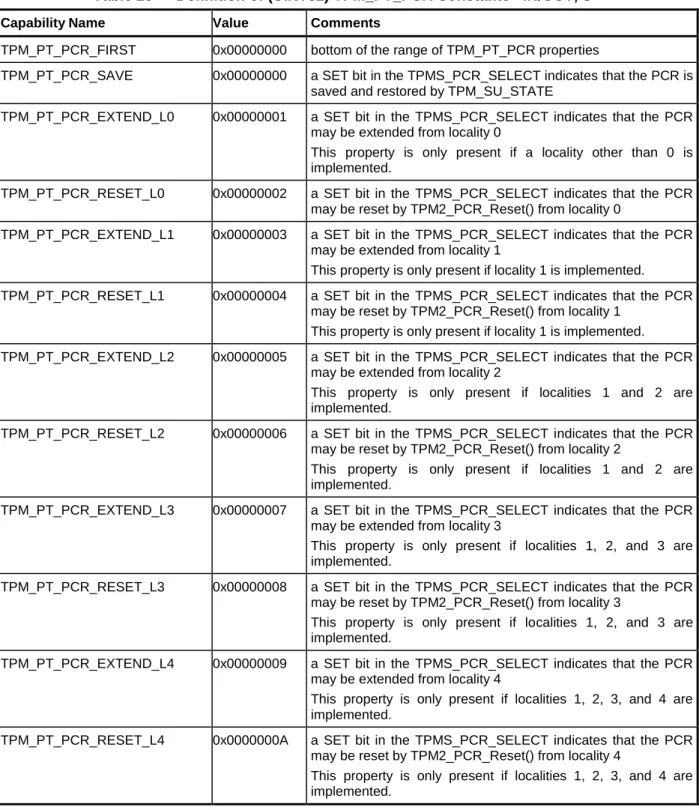
Table 25 — Definition of (UINT32) TPM_PT_PCR Constants <IN/OUT, S> ... 52
Table 26 — Definition of (UINT32) TPM_PS Constants <OUT> ... 54
Table 27 — Definition of Types for Handles ... 55
Table 28 — Definition of (UINT8) TPM_HT Constants <S> ... 55
Table 29 — Definition of (TPM_HANDLE) TPM_RH Constants <S> ... 57
Table 30 — Definition of (TPM_HANDLE) TPM_HC Constants <S> ... 59
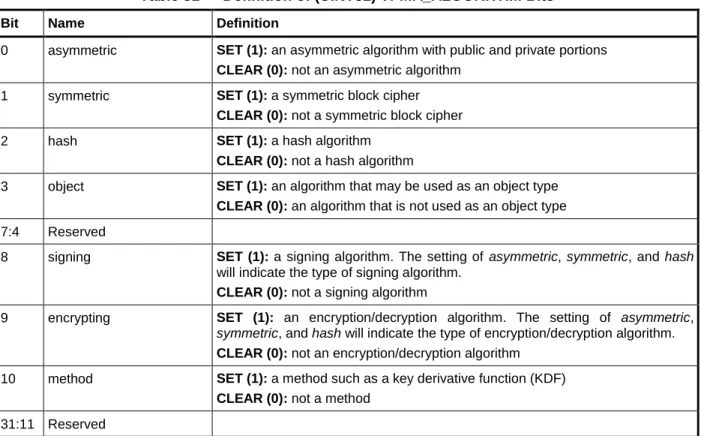
Table 31 — Definition of (UINT32) TPMA_ALGORITHM Bits ... 60
Table 32 — Definition of (UINT32) TPMA_OBJECT Bits ... 61
Table 33 — Definition of (UINT8) TPMA_SESSION Bits <IN/OUT> ... 67
Table 34 — Definition of (UINT8) TPMA_LOCALITY Bits <IN/OUT> ... 69
Table 35 — Definition of (UINT32) TPMA_PERMANENT Bits <OUT> ... 70
Table 36 — Definition of (UINT32) TPMA_STARTUP_CLEAR Bits <OUT> ... 71
Table 38 — Definition of (TPM_CC) TPMA_CC Bits <OUT> ... 73
Table 39 — Definition of (BYTE) TPMI_YES_NO Type ... 76
Table 40 — Definition of (TPM_HANDLE) TPMI_DH_OBJECT Type... 76
Table 41 — Definition of (TPM_HANDLE) TPMI_DH_PERSISTENT Type ... 77
Table 42 — Definition of (TPM_HANDLE) TPMI_DH_ENTITY Type <IN> ... 77
Table 43 — Definition of (TPM_HANDLE) TPMI_DH_PCR Type <IN> ... 77
Table 44 — Definition of (TPM_HANDLE) TPMI_SH_AUTH_SESSION Type <IN/OUT> ... 78
Table 45 — Definition of (TPM_HANDLE) TPMI_SH_HMAC Type <IN/OUT> ... 78
Table 46 — Definition of (TPM_HANDLE) TPMI_SH_POLICY Type <IN/OUT> ... 78
Table 47 — Definition of (TPM_HANDLE) TPMI_DH_CONTEXT Type ... 78
Table 48 — Definition of (TPM_HANDLE) TPMI_RH_HIERARCHY Type ... 79
Table 49 — Definition of (TPM_HANDLE) TPMI_RH_ENABLES Type ... 79
Table 50 — Definition of (TPM_HANDLE) TPMI_RH_HIERARCHY_AUTH Type <IN> ... 80
Table 51 — Definition of (TPM_HANDLE) TPMI_RH_PLATFORM Type <IN> ... 80
Table 52 — Definition of (TPM_HANDLE) TPMI_RH_OWNER Type <IN> ... 80
Table 53 — Definition of (TPM_HANDLE) TPMI_RH_ENDORSEMENT Type <IN> ... 81
Table 54 — Definition of (TPM_HANDLE) TPMI_RH_PROVISION Type <IN> ... 81
Table 55 — Definition of (TPM_HANDLE) TPMI_RH_CLEAR Type <IN> ... 81
Table 56 — Definition of (TPM_HANDLE) TPMI_RH_NV_AUTH Type <IN> ... 82
Table 57 — Definition of (TPM_HANDLE) TPMI_RH_LOCKOUT Type <IN> ... 82
Table 58 — Definition of (TPM_HANDLE) TPMI_RH_NV_INDEX Type <IN/OUT> ... 82
Table 59 — Definition of (TPM_ALG_ID) TPMI_ALG_HASH Type... 83
Table 60 — Definition of (TPM_ALG_ID) TPMI_ALG_ASYM Type ... 83
Table 61 — Definition of (TPM_ALG_ID) TPMI_ALG_SYM Type ... 84
Table 62 — Definition of (TPM_ALG_ID) TPMI_ALG_SYM_OBJECT Type ... 84
Table 63 — Definition of (TPM_ALG_ID) TPMI_ALG_SYM_MODE Type ... 84
Table 64 — Definition of (TPM_ALG_ID) TPMI_ALG_KDF Type ... 85
Table 65 — Definition of (TPM_ALG_ID) TPMI_ALG_SIG_SCHEME Type ... 85
Table 66 — Definition of (TPM_ALG_ID){ECC} TPMI_ECC_KEY_EXCHANGE Type ... 85
Table 67 — Definition of (TPM_ST) TPMI_ST_COMMAND_TAG Type ... 86
Table 68 — Definition of TPMS_EMPTY Structure <IN/OUT> ... 87
Table 69 — Definition of TPMS_ALGORITHM_DESCRIPTION Structure <OUT> ... 87
Table 70 — Definition of TPMU_HA Union <IN/OUT, S> ... 88
Table 71 — Definition of TPMT_HA Structure <IN/OUT> ... 88
Table 72 — Definition of TPM2B_DIGEST Structure ... 89
Table 73 — Definition of TPM2B_DATA Structure ... 89
Table 74 — Definition of Types for TPM2B_NONCE ... 89
Table 75 — Definition of Types for TPM2B_AUTH ... 90
Table 77 — Definition of TPM2B_EVENT Structure ... 90
Table 78 — Definition of TPM2B_MAX_BUFFER Structure ... 90
Table 79 — Definition of TPM2B_MAX_NV_BUFFER Structure ... 91
Table 80 — Definition of TPM2B_TIMEOUT Structure <IN/OUT> ... 91
Table 81 — Definition of TPM2B_IV Structure <IN/OUT> ... 91
Table 82 — Definition of TPMU_NAME Union <> ... 92
Table 83 — Definition of TPM2B_NAME Structure ... 92
Table 84 — Definition of TPMS_PCR_SELECT Structure ... 93
Table 85 — Definition of TPMS_PCR_SELECTION Structure ... 94
Table 86 — Values for proof Used in Tickets ... 94
Table 87 — General Format of a Ticket ... 95
Table 88 — Definition of TPMT_TK_CREATION Structure ... 95
Table 89 — Definition of TPMT_TK_VERIFIED Structure ... 96
Table 90 — Definition of TPMT_TK_AUTH Structure ... 97
Table 91 — Definition of TPMT_TK_HASHCHECK Structure ... 98
Table 92 — Definition of TPMS_ALG_PROPERTY Structure <OUT> ... 98
Table 93 — Definition of TPMS_TAGGED_PROPERTY Structure <OUT> ... 98
Table 94 — Definition of TPMS_TAGGED_PCR_SELECT Structure <OUT> ... 99
Table 95 — Definition of TPML_CC Structure ... 99
Table 96 — Definition of TPML_CCA Structure <OUT> ... 99
Table 97 — Definition of TPML_ALG Structure ... 100
Table 98 — Definition of TPML_HANDLE Structure <OUT> ... 100
Table 99 — Definition of TPML_DIGEST Structure ... 100
Table 100 — Definition of TPML_DIGEST_VALUES Structure ... 101
Table 101 — Definition of TPM2B_DIGEST_VALUES Structure ... 101
Table 102 — Definition of TPML_PCR_SELECTION Structure ... 101
Table 103 — Definition of TPML_ALG_PROPERTY Structure <OUT> ... 102
Table 104 — Definition of TPML_TAGGED_TPM_PROPERTY Structure <OUT> ... 102
Table 105 — Definition of TPML_TAGGED_PCR_PROPERTY Structure <OUT> ... 102
Table 106 — Definition of {ECC} TPML_ECC_CURVE Structure <OUT> ... 102
Table 107 — Definition of TPMU_CAPABILITIES Union <OUT>... 103
Table 108 — Definition of TPMS_CAPABILITY_DATA Structure <OUT> ... 103
Table 109 — Definition of TPMS_CLOCK_INFO Structure ... 104
Table 110 — Definition of TPMS_TIME_INFO Structure ... 105
Table 111 — Definition of TPMS_TIME_ATTEST_INFO Structure <OUT> ... 106
Table 112 — Definition of TPMS_CERTIFY_INFO Structure <OUT> ... 106
Table 113 — Definition of TPMS_QUOTE_INFO Structure <OUT> ... 106
Table 114 — Definition of TPMS_COMMAND_AUDIT_INFO Structure <OUT> ... 107
Table 116 — Definition of TPMS_CREATION_INFO Structure <OUT> ... 107
Table 117 — Definition of TPMS_NV_CERTIFY_INFO Structure <OUT> ... 107
Table 118 — Definition of (TPM_ST) TPMI_ST_ATTEST Type <OUT> ... 108
Table 119 — Definition of TPMU_ATTEST Union <OUT> ... 108
Table 120 — Definition of TPMS_ATTEST Structure <OUT> ... 109
Table 121 — Definition of TPM2B_ATTEST Structure <OUT> ... 110
Table 122 — Definition of TPMS_AUTH_COMMAND Structure <IN> ... 110
Table 123 — Definition of TPMS_AUTH_RESPONSE Structure <OUT> ... 110
Table 124 — Definition of {!ALG.S} (TPM_KEY_BITS) TPMI_!ALG.S_KEY_BITS Type ... 111
Table 125 — Definition of TPMU_SYM_KEY_BITS Union ... 111
Table 126 — Definition of TPMU_SYM_MODE Union ... 112
Table 127 —xDefinition of TPMU_SYM_DETAILS Union ... 112
Table 128 — Definition of TPMT_SYM_DEF Structure ... 112
Table 129 — Definition of TPMT_SYM_DEF_OBJECT Structure ... 113
Table 130 — Definition of TPM2B_SYM_KEY Structure ... 113
Table 131 — Definition of TPMS_SYMCIPHER_PARMS Structure ... 113
Table 132 — Definition of TPM2B_SENSITIVE_DATA Structure ... 114
Table 133 — Definition of TPMS_SENSITIVE_CREATE Structure <IN> ... 114
Table 134 — Definition of TPM2B_SENSITIVE_CREATE Structure <IN, S> ... 114
Table 135 — Definition of TPMS_SCHEME_HASH Structure ... 115
Table 136 — Definition of {ECC} TPMS_SCHEME_ECDAA Structure ... 115
Table 137 — Definition of (TPM_ALG_ID) TPMI_ALG_KEYEDHASH_SCHEME Type ... 115
Table 138 — Definition of Types for HMAC_SIG_SCHEME ... 115
Table 139 — Definition of TPMS_SCHEME_XOR Structure ... 115
Table 140 — Definition of TPMU_SCHEME_KEYEDHASH Union <IN/OUT, S> ... 116
Table 141 — Definition of TPMT_KEYEDHASH_SCHEME Structure ... 116
Table 142 — Definition of {RSA} Types for RSA Signature Schemes ... 117
Table 143 — Definition of {ECC} Types for ECC Signature Schemes ... 117
Table 144 — Definition of TPMU_SIG_SCHEME Union <IN/OUT, S> ... 118
Table 145 — Definition of TPMT_SIG_SCHEME Structure ... 118
Table 146 — Definition of Types for {RSA} Encryption Schemes ... 118
Table 147 — Definition of Types for {ECC} ECC Key Exchange ... 119
Table 148 — Definition of Types for KDF Schemes ... 119
Table 149 — Definition of TPMU_KDF_SCHEME Union <IN/OUT, S> ... 119
Table 150 — Definition of TPMT_KDF_SCHEME Structure ... 119
Table 151 — Definition of (TPM_ALG_ID) TPMI_ALG_ASYM_SCHEME Type <> ... 120
Table 152 — Definition of TPMU_ASYM_SCHEME Union ... 120
Table 153 — Definition of TPMT_ASYM_SCHEME Structure <> ... 120
Table 155 — Definition of {RSA} TPMT_RSA_SCHEME Structure ... 121
Table 156 — Definition of (TPM_ALG_ID) {RSA} TPMI_ALG_RSA_DECRYPT Type ... 121
Table 157 — Definition of {RSA} TPMT_RSA_DECRYPT Structure ... 121
Table 158 — Definition of {RSA} TPM2B_PUBLIC_KEY_RSA Structure ... 122
Table 159 — Definition of {RSA} (TPM_KEY_BITS) TPMI_RSA_KEY_BITS Type ... 122
Table 160 — Definition of {RSA} TPM2B_PRIVATE_KEY_RSA Structure ... 122
Table 161 — Definition of {ECC} TPM2B_ECC_PARAMETER Structure ... 123
Table 162 — Definition of {ECC} TPMS_ECC_POINT Structure ... 123
Table 163 — Definition of {ECC} TPM2B_ECC_POINT Structure ... 123
Table 164 — Definition of (TPM_ALG_ID) {ECC} TPMI_ALG_ECC_SCHEME Type ... 124
Table 165 — Definition of {ECC} (TPM_ECC_CURVE) TPMI_ECC_CURVE Type ... 124
Table 166 — Definition of (TPMT_SIG_SCHEME) {ECC} TPMT_ECC_SCHEME Structure ... 124
Table 167 — Definition of {ECC} TPMS_ALGORITHM_DETAIL_ECC Structure <OUT> ... 125
Table 168 — Definition of {RSA} TPMS_SIGNATURE_RSA Structure ... 125
Table 169 — Definition of Types for {RSA} Signature ... 125
Table 170 — Definition of {ECC} TPMS_SIGNATURE_ECC Structure ... 126
Table 171 — Definition of Types for {ECC} TPMS_SIGNATUE_ECC ... 126
Table 172 — Definition of TPMU_SIGNATURE Union <IN/OUT, S> ... 126
Table 173 — Definition of TPMT_SIGNATURE Structure ... 126
Table 174 — Definition of TPMU_ENCRYPTED_SECRET Union <S> ... 127
Table 175 — Definition of TPM2B_ENCRYPTED_SECRET Structure ... 127
Table 176 — Definition of (TPM_ALG_ID) TPMI_ALG_PUBLIC Type ... 128
Table 177 — Definition of TPMU_PUBLIC_ID Union <IN/OUT, S> ... 129
Table 178 — Definition of TPMS_KEYEDHASH_PARMS Structure... 129
Table 179 — Definition of TPMS_ASYM_PARMS Structure <> ... 130
Table 180 — Definition of {RSA} TPMS_RSA_PARMS Structure ... 131
Table 181 — Definition of {ECC} TPMS_ECC_PARMS Structure ... 131
Table 182 — Definition of TPMU_PUBLIC_PARMS Union <IN/OUT, S> ... 132
Table 183 — Definition of TPMT_PUBLIC_PARMS Structure ... 132
Table 184 — Definition of TPMT_PUBLIC Structure ... 133
Table 185 — Definition of TPM2B_PUBLIC Structure ... 133
Table 186 — Definition of TPM2B_PRIVATE_VENDOR_SPECIFIC Structure<> ... 134
Table 187 — Definition of TPMU_SENSITIVE_COMPOSITE Union <IN/OUT, S> ... 134
Table 188 — Definition of TPMT_SENSITIVE Structure ... 135
Table 189 — Definition of TPM2B_SENSITIVE Structure <IN/OUT> ... 135
Table 190 — Definition of _PRIVATE Structure <> ... 136
Table 191 — Definition of TPM2B_PRIVATE Structure <IN/OUT, S> ... 136
Table 192 — Definition of _ID_OBJECT Structure <> ... 137
Table 194 — Definition of (UINT32) TPM_NV_INDEX Bits <> ... 138
Table 195 — Definition of (UINT32) TPMA_NV Bits ... 140
Table 196 — Definition of TPMS_NV_PUBLIC Structure ... 142
Table 197 — Definition of TPM2B_NV_PUBLIC Structure ... 142
Table 198 — Definition of TPM2B_CONTEXT_SENSITIVE Structure <IN/OUT> ... 143
Table 199 — Definition of TPMS_CONTEXT_DATA Structure <IN/OUT, S> ... 143
Table 200 — Definition of TPM2B_CONTEXT_DATA Structure <IN/OUT> ... 143
Table 201 — Definition of TPMS_CONTEXT Structure ... 144
Table 202 — Context Handle Values ... 145
Table 203 — Definition of TPMS_CREATION_DATA Structure <OUT> ... 147
Figures
Figure 1 — Command Format ... 28
Figure 2 — Format-Zero Response Codes ... 34
Figure 3 — Format-One Response Codes ... 35
Figure 4 — TPM 1.2 TPM_NV_INDEX ... 138
Trusted Platform Module Library
Part 2: Structures
1
Scope
This part of the Trusted Platform Module Library specification contains the definitions of the constants, flags, structure, and union definitions used to communicate with the TPM. Values defined in this document are used by the TPM commands defined in TPM 2.0 Part 3: Commands and by the functions in TPM 2.0 Part 4: Supporting Routines.
NOTE The structures in this document are the canonical form of the structures on the interface. All structures are "packed" with no octets of padding between structure elements. The TPM -internal form of the structures is dependent on the processor and compiler for the TPM implementation.
2
Terms and definitions
For the purposes of this document, the terms and definitions given in TPM 2.0 Part 1 apply. 3
Symbols and abbreviated terms
For the purposes of this document, the symbols and abbreviated terms given in TPM 2.0 Part 1 apply. 4
Notation
4.1 Introduction
The information in this document is formatted so that it may be converted to standard computer-language formats by an automated process. The purpose of this automated process is to minimize the transcription errors that often occur during the conversion process.
For the purposes of this document, the conventions given in TPM 2.0 Part 1 apply.
In addition, the conventions and notations in this clause describe the representation of various data so that it is both human readable and amenable to automated processing.
When a table row contains the keyword “reserved” (all lower case) in columns 1 or 2, the tools will not produce any values for the row in the table.
NOTE 1 In the examples in this clause 4, the unmarshaling routines are shown as returning bool. In the code of the reference implementation, the return value is a TPM_RC. A bool is used in the examples, because the meaning of a TPM_RC is not yet defined.
NOTE 2 The unmarshaling code examples are the actual code that would be produced by the automatic code generator used in the construction of the reference code. The actual code contains additional parameter checking that is omitted for clarity of the principle being illustrated. Actu al examples of the code are found in TPM 2.0 Part 4.
4.2 Named Constants
A named constant is a numeric value to which a name has been assigned. In the C language, this is done with a #define statement. In this specification, a named constant is defined in a table that has a title that starts with “Definition” and ends with “Constants.”
The table title will indicate the name of the class of constants that are being defined in the table. The title will include the data type of the constants in parentheses.
The table in Example 1 names a collection of 16-bit constants and Example 2 shows the C code that might be produced from that table by an automated process.
NOTE A named constant (#define) has no data type in C and an enumeration would be a better choice for many of the defined constants. However, the C language does not allow an enumerated type to have a storage type other than int so the method of using a combination of typedef and #define is used. EXAMPLE 1
Table xx — Definition of (UINT16) COUNTING Constants
Parameter Value Description
first 1 decimal value is implicitly the size of the
second 0x0002 hex value will match the number of bits in the constant third 3
fourth 0x0004
EXAMPLE 2
/* The C language equivalent of the constants from the table above */ typedef UINT16 COUNTING;
#define first 1 #define second 0x0002 #define third 3 #define fourth 0x0004
4.3 Data Type Aliases (typedefs)
When a group of named items is assigned a type, it is placed in a table that has a title starting with “Definition of Types.” In this specification, defined types have names that use all upper-case characters. The table in Example 1 shows how typedefs would be defined in this specification and Example 2 shows the C-compatible code that might be produced from that table by an automated process.
EXAMPLE 1
Table xx — Definition of Types for Some Purpose
Type Name Description
unsigned short UINT16 UINT16 SOME_TYPE unsigned long UINT32 UINT32 LAST_TYPE
EXAMPLE 2
/* C language equivalent of the typedefs from the table above */ typedef unsigned short UINT16;
typedef UINT16 SOME_TYPE; typedef unsigned long UINT32; typedef UINT32 LAST_TYPE;
4.4 Enumerations
A table that defines an enumerated data type will start with the word “Definition” and end with “Values.” A value in parenthesis will denote the intrinsic data size of the value and may have the values "INT8", "UINT8", "INT16", “UINT16”, "INT32", and “UINT32.” If this value is not present, “UINT16” is assumed. Most C compilers set the type of an enumerated value to be an integer on the machine – often 16 bits – but this is not always consistent. To ensure interoperability, the enumeration values may not exceed 32,384.
The table in Example 1 shows how an enumeration would be defined in this specification. Example 2 shows the C code that might be produced from that table by an automated process.
EXAMPLE 1
Table xx — Definition of (UINT16) CARD_SUIT Values
Suit Names Value Description
CLUBS 0x0000 DIAMONDS 0x000D HEARTS 0x001A SPADES 0x0027
EXAMPLE 2
/* C language equivalent of the structure defined in the table above */ typedef enum { CLUBS = 0x0000, DIAMONDS = 0x000D, HEARTS = 0x001A, SPADES = 0x0027 } CARD_SUIT;
4.5 Interface Type
An interface type is used for an enumeration that is checked by the unmarshaling code. This type is defined for purposes of automatic generation of the code that will validate the type. The title will start with the keyword “Definition” and end with the keyword “Type.” A value in parenthesis indicates the base type of the interface. The table may contain an entry that is prefixed with the “#” character to indicate the response code if the validation code determines that the input parameter is the wrong type.
EXAMPLE 1
Table xx — Definition of (CARD_SUIT) RED_SUIT Type
Values Comments
HEARTS DIAMONDS
#TPM_RC_SUIT response code returned when the unmarshaling of this type fails NOTE TPM_RC_SUIT is an example and no such response
code is actually defined in this specification.
EXAMPLE 2
/* Validation code that might be automatically generated from table above */ if((*target != HEARTS) && (*target != DIAMONDS))
return TPM_RC_SUIT;
In some cases, the allowed values are numeric values with no associated mnemonic. In such a case, the list of numeric values may be given a name. Then, when used in an interface definition, the name would have a "$" prefix to indicate that a named list of values should be substituted.
To illustrate, assume that the implementation only supports two sizes (1024 and 2048 bits) for keys associated with some algorithm (MY algorithm).
EXAMPLE 3
Table xx — Defines for MY Algorithm Constants
Name Value Comments
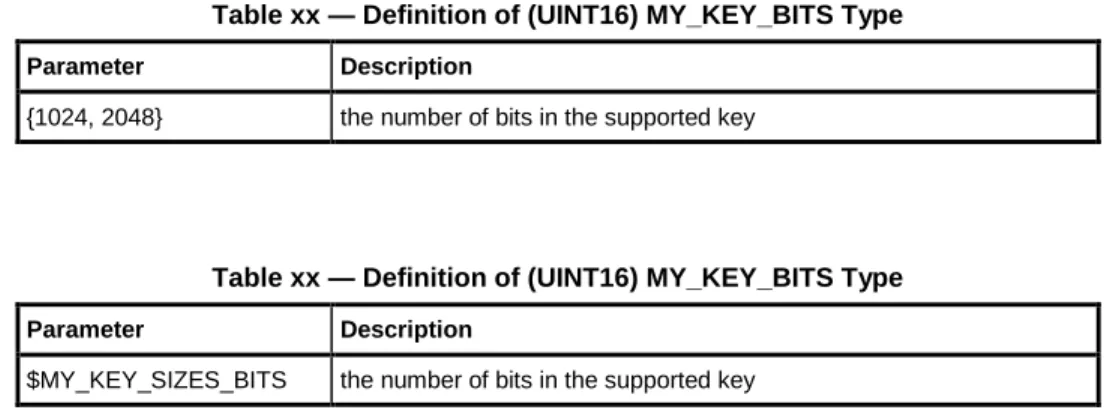
Then, whenever an input value would need to be a valid MY key size for the implementation, the value $MY_KEY_SIZES_BITS could be used. Given the definition for MY_KEY_SIZES_BITS in example 3 above, the tables in example 4 and 5 below, are equivalent.
EXAMPLE 4
Table xx — Definition of (UINT16) MY_KEY_BITS Type
Parameter Description
{1024, 2048} the number of bits in the supported key
EXAMPLE 5
Table xx — Definition of (UINT16) MY_KEY_BITS Type
Parameter Description
$MY_KEY_SIZES_BITS the number of bits in the supported key
4.6 Arrays
Arrays are denoted by a value in square brackets (“[ ]”) following a parameter name. The value in the brackets may be either an integer value such as “[20]” or the name of a component of the same structure that contains the array.
The table in Example 1 shows how a structure containing fixed and variable-length arrays would be defined in this specification. Example 2 shows the C code that might be produced from that table by an automated process.
EXAMPLE 1
Table xx — Definition of A_STRUCT Structure Parameter Type Description
array1[20] UINT16 an array of 20 UINT16s
a_size UINT16
array2[a_size] UINT32 an array of UINT32 values that has a number of elements determined by a_size above
EXAMPLE 2
/* C language equivalent of the typedefs from the table above */ typedef struct {
UINT16 array1[20]; UINT16 a_size; UINT32 array2[]; } A_STRUCT;
4.7 Structure Definitions
The tables used to define structures have a title that starts with the word “Definition” and ends with “Structure.” The first column of the table will denote the reference names for the structure members; the second column the data type of the member; and the third column a synopsis of the use of the element. The table in Example 1 shows an example of how a structure would be defined in this specification and Example 2 shows the C code that might be produced from the table by an automated process. Example 3 illustrates the type of unmarshaling code that could be generated using the information available in the table.
EXAMPLE 1
Table xx — Definition of SIMPLE_STRUCTURE Structure Parameter Type Description
tag TPM_ST
value1 INT32
value2 INT32
EXAMPLE 2
/* C language equivalent of the structure defined in the table above */ typedef struct { TPM_ST tag; INT32 value1 INT32 value2; } SIMPLE_STRUCTURE; EXAMPLE 3
bool SIMPLE_STRUCTURE_Unmarshal(SIMPLE_STRUCTURE *target, BYTE **buffer, INT32 *size) {
// If unmarshal of tag succeeds
if(TPM_ST_Unmarshal((TPM_ST *)&(target->tag), buffer, size)) // then unmarshal value1, and if that succeeds...
if(INT32_Unmarshal((INT32 *)&(target->value1, buffer, size)) // then return the results of unmarshaling values
return(INT32_Unmarshal((INT32 *)&(target->value2, buffer, size)) // if unmarshal of tag or value failed, return failure
return FALSE; }
A table may have a term in {}. This indicates that the table is conditionally compiled. It is commonly used when a table's inclusion is based on the implementation of a cryptographic algorithm. See, for example, Table 156 — Definition of (TPM_ALG_ID) {RSA} TPMI_ALG_RSA_DECRYPT Type, which is dependent on the RSA algorithm.
4.8 Conditional Types
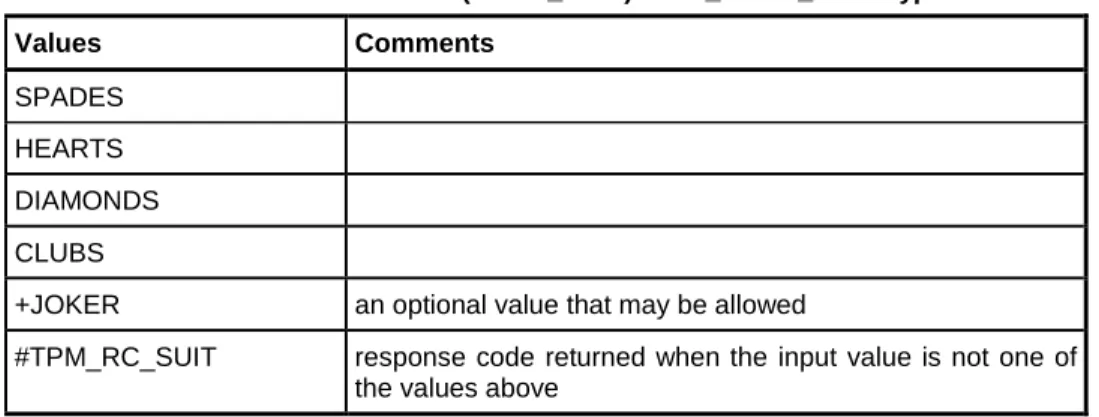
An enumeration may contain an extended value indicated by “+” preceding the name in the "Value" column. This “+” indicates that this is a conditional value that may be allowed in certain situations.
NOTE In many cases, the input values are algorithm IDs. When two collections of algorithm IDs differ only because one collection allows TPM_ALG_NULL and the other does not, it is preferred that there not be two completely different enumerations because this leads to many casts. To avoid this, the “+” can be added to a TPM_ALG_NULL value in the table defining the type. When the use of th at type allows TPM_ALG_NULL to be in the set, the use would append a “+” to the instance.
EXAMPLE
Table xx — Definition of (CARD_SUIT) TPMI_CARD_SUIT Type Values Comments
SPADES HEARTS DIAMONDS CLUBS
+JOKER an optional value that may be allowed
#TPM_RC_SUIT response code returned when the input value is not one of the values above
When an interface type is used, a “+” will be appended to the type specification for the parameter when the conditional value is allowed. If no “+” is present, then the conditional value is not allowed.
EXAMPLE 1
Table xx — Definition of POKER_CARD Structure Parameter Type Description
suit TPMI_CARD_SUIT+ allows joker
number UINT8 the card value
EXAMPLE 2
Table xx — Definition of BRIDGE_CARD Structure Parameter Type Description
suit TPMI_CARD_SUIT does not allow joker
number UINT8 the card value
4.9 Unions
A union allows a structure to contain a variety of structures or types. The union has members, only one of which is present at a time. Three different tables are required to fully characterize a union so that it may be communicated on the TPM interface and used by the TPM:
1) union definition; 2) union instance; and 3) union selector definition. 4.9.2 Union Definition
The table in Example 1 illustrates a union definition. The title of a union definition table starts with “Definition” and ends with “Union.” The “Parameter” column of a union definition lists the different names that are used when referring to a specific type. The “Type” column identifies the data type of the member. The “Selector” column identifies the value that is used by the marshaling and unmarshaling code to determine which case of the union is present.
If a parameter is the keyword “null,” then this denotes a selector with no contents. The table in Example 1 illustrates a union in which a conditional null selector is allowed to indicate an empty union member. Example 2 shows how the table would be converted into C-compatible code.
The expectation is that the unmarshaling code for the union will validate that the selector for the union is one of values in the selector list.
EXAMPLE 1
Table xx — Definition of NUMBER_UNION Union
Parameter Type Selector Description
a_byte BYTE BYTE_SELECT
an_int int INT_SELECT
a_float float FLOAT_SELECT
+null NULL_SELECT the empty branch
EXAMPLE 2
// C-compatible version of the union defined in the table above typedef union { BYTE a_byte; int an_int; float a_float; } NUMBER_UNION; EXAMPLE 3
// Possible auto-generated code to unmarshal a union in Example 2 based on the // input value of selector
bool NUMBER_UNION_Unmarshal(NUMBER_UNION *target, BYTE **buffer, INT32 *size, UINT32 selector)
{
switch (selector) { case BYTE_SELECT:
return BYTE_Unmarshal((BYTE *)&(target->a_byte), buffer, size); case INT_SELECT:
return INT_Unmarshal((int *)&(target->an_int), buffer, size); case FLOAT_SELECT:
return FLOAT_Unmarshal((float *)&(target->a_float), buffer, size); case NULL_SELECT:
return; }
A table may have a type with no selector. This is used when the first part of the structure for all union members is identical. This type is a programming convenience, allowing code to reference the common members without requiring a case statement to determine the specific structure. In object oriented programming terms, this type is a superclass and the types with selectors are subclasses.
4.9.3 Union Instance
When a union is used in a structure that is sent on the interface, the structure will minimally contain a selector and a union. The selector value indicates which of the possible union members is present so that the unmarshaling code can unmarshal the correct type. The selector may be any of the parameters that occur in the structure before the union instance. To denote the structure parameter that is used as the selector, its name is in brackets (“[ ]”) placed before the parameter name associated with the union. The table in Example 1 shows the definition of a structure that contains a union and a selector. Example 2 shows how the table would be converted into C-compatible code and Example 3 shows how the unmarshaling code would handle the selector.
EXAMPLE 1
Table xx — Definition of STRUCTURE_WITH_UNION Structure Parameter Type Description
select NUMBER_SELECT a value indicating the type in number [select] number NUMBER_UNION a union as shown in 4.9.2
EXAMPLE 2
// C-compatible version of the union structure in the table above typedef struct {
NUMBER_SELECT select; NUMBER_UNION number; } STRUCT_WITH_UNION;
// Possible unmarshaling code for the structure above
bool STRUCT_WITH_UNION_Unmarshal(STRUCT_WITH_UNION *target, BYTE **buffer, INT32 *size) {
// Unmarshal the selector value
if(!NUMBER_SELECT_Unmarshal((NUMBER_SELECT *)&target->select, buffer, size)) return FALSE;
// Use the unmarshaled selector value to indicate to the union unmarshal // function which unmarshaling branch to follow.
return(NUMBER_UNION_Unmarshal((NUMBER_UNION *)&(target->number), buffer, size, (UINT32)target->select); }
4.9.4 Union Selector Definition
The selector definition limits the values that are used in unmarshaling a union. Two different selector sets applied to the same union define different types.
For the union in 4.9.2, a selector definition should be limited to no more than four values, one for each of the union members. The selector definition could have fewer than four values.
In Example 1, the table defines a value for each of the union members. EXAMPLE 1
Table xx — Definition of (INT8) NUMBER_SELECT Values <IN> Name Value Comments
BYTE_SELECT 3
INT_SELECT 2
FLOAT_SELECT 1
NULL_SELECT 0
The unmarshaling code would limit the input values to the defined values. When the NUMBER_SELECT is used in the union instance of 4.9.3, any of the allowed union members of NUMBER_UNION could be present.
A different selection could be used to limit the values in a specific instance. To get the different selection, a new structure is defined with a different selector. The table in example 2 illustrates a way to subset the union. The base type of the selection is NUMBER_SELECT so a NUMBER_SELECT will be unmarshaled before the checks are made to see if the value is in the correct range for JUST_INTEGERS types. If the base type had been UINT8, then no checking would occur prior to checking that the value is in the allowed list. In this particular case, the effect is the same in either case since the only values that will be accepted by the unmarshaling code for JUST_INTEGER are BYTE_SELECT and INT_SELECT.
EXAMPLE 2
Table xx — Definition of (NUMBER_SELECT) AN_INTEGER Type <IN>
Values Comments
{BYTE_SELECT, INT_SELECT} list of allowed values
NOTE Since NULL_SELECT is not in the list of values accepted as a JUST_INTEGER, the “+” modifier will have no effect if used for a JUST_INTEGERS type shown in Example 3.
The selector in Example 2 can then be used in a subset union as shown in Example 3. EXAMPLE 3
Table xx — Definition of JUST_INTEGERS Structure Parameter Type Description
select AN_INTEGER a value indicating the type in number [select] number NUMBER_UNION a union as shown in 4.9.2
4.10 Bit Field Definitions
A table that defines a structure containing bit fields has a title that starts with “Definition” and ends with “Bits.” A type identifier in parentheses in the title indicates the size of the datum that contains the bit fields.
When the bit fields do not occupy consecutive locations, a spacer field is defined with a name of “Reserved.” Bits in these spaces are reserved and shall be zero.
The table in Example 1 shows how a structure containing bit fields would be defined in this specification. Example 2 shows the C code that might be produced from that table by an automated process.
When a field has more than one bit, the range is indicated by a pair of numbers separated by a colon (“:”). The numbers will be in high:low order.
EXAMPLE1
Table xx — Definition of (UINT32) SOME_ATTRIBUTE Bits Bit Name Action
0 zeroth_bit SET (1): what to do if bit is 1 CLEAR (0): what to do if bit is 0 1 first_bit SET (1): what to do if bit is 1
CLEAR (0): what to do if bit is 0 6:2 Reserved A placeholder that spans 5 bits 7 third_bit SET (1): what to do if bit is 1
CLEAR (0): what to do if bit is 0 31:8 Reserved Placeholder to fill 32 bits EXAMPLE 2
/* C language equivalent of the attributes structure defined in the table above */ typedef struct { int zeroth_bit : 1; int first_bit : 1; int Reserved3 : 5; int third_bit : 1; int Reserved7 : 24; } SOME_ATTRIBUTE;
NOTE The packing of bit fields into an integer is compiler and tool chain dependent. This C language equivalent is valid for a compiler that packs bit fields from the least significant bit to the most significant bit. It is likely to be correct for a little endian processor and likely to be incorrect for a big endian processor.
4.11 Parameter Limits
A parameter used in a structure may be given a set of values that can be checked by the unmarshaling code. The allowed values for a parameter may be included in the definition of the parameter by appending the values and delimiting them with braces (“{ }”). The values are comma-separated expressions. A range of numbers may be indicated by separating two expressions with a colon (“:”). The first number is an expression that represents the minimum allowed value and the second number indicates the maximum. If the minimum or maximum value expression is omitted, then the range is open-ended.
Parameter limits expressed using braces apply only to inputs to the TPM. Any value returned by the TPM is assumed to be valid.
The maximum size of an array may be indicated by putting a “{}” delimited expression following the square brackets (“[ ]”) that indicate that the value is an array.
EXAMPLE
Table xx — Definition of B_STRUCT Structure Parameter Type Description
value1 {20:25} UINT16 a parameter that must have a value between 20 and 25, inclusive
value2 {20} UINT16 a parameter that must have a value of 20 value3 {:25} INT16 a parameter that may be no larger than 25
Since the parameter is signed, the minimum value is the largest negative integer that may be expressed in 16 bits.
value4 {20:} a parameter that must be at least 20
value5 {1,2,3,5} UINT16 a parameter that may only have one of the four listed values
value6 {1, 2, 10:(10+10)} UINT32 a parameter that may have a value of 1, 2, or be between 10 and 20
array1[value1] BYTE Because the index refers to value1, which is a value limited to be between 20 and 25 inclusive, array1 is an array that may have between 20 and 25 octets. This is not the preferred way to indicate the upper limit for an array as it does not indicate the upper bound of the size.
NOTE This is a limitation of the current parser. A different parser could associate the range of value1 with this value and compute the maximum size of the array.
array2[value4]{:25} BYTE an array that may have between 20 and 25 octets
This arrangement is used to allow the automatic code generation to allocate 25 octets to store the largest array2 that can be unmarshaled. The code generation can determine from this expression that value4 shall have a value of 25 or less. From the definition of value4 above, it can determine that value4 must have a value of at least 20.
4.12 Algorithm Macros 4.12.1 Introduction
This specification is intended to be algorithm agile in two different ways. In the first, agility is provided by allowing different subsets of the algorithms listed in the TCG registry. In the second, agility is provided by allowing the list of algorithms in the TCG registry to change without requiring changes to this specification.
This second form of algorithm agility is accomplished by using placeholder tokens that represent all of the algorithms of a particular type. The type of the algorithm is indicated by the letters in the Type column of the TPM_ALG_ID table in the TCG registry.
The use of these tokens is described in the remainder of this clause 4.12. 4.12.2 Algorithm Token Semantics
The string “!ALG” or “!alg” indicates the algorithm token. This token may be followed by an algorithm type selection. The presence of the type selection is indicated by a period (“.”) following the token. The selection is all alphanumeric characters following the period.
NOTE In this selection context, the underscore character (“_”) is not considered an alphanumeric character. The selection is either an exclusive selection or an inclusive selection. An exclusive selection is one for which the Type entry for the algorithm is required to exactly match the type selection of the token. An inclusive selection is one where the Type entry for the algorithm is required to contain all of the characters of the selection but may contain additional attributes.
EXAMPLE 1 The “!ALG.AX” token would select those algorithms that only have the ‘A’ and ‘X’ types (that is, an asymmetric signing algorithm). The “!ALG.ax” token would select those algorithms that at least have ‘A’ and ‘X’ types but would include algorithms with other types such as ‘ANX’ (as ymmetric signing and anonymous asymmetric signing).
When a replacement is made, the token will be replaced by an algorithm root identifier using either upper or lower case. If the algorithm token is part of another word, then the replacement uses upper case characters, otherwise, lower case is used.
NOTE The root identifier of an algorithm is the name in the TPM_ALG_ID table with “TPM_ALG_” removed. For example TPM_ALG_SHA1 has “SHA1” as its root.
The typical use of these tokens follows. 4.12.3 Algorithm Tokens in Unions
A common place for algorithm tokens is in a union of values that are dependent on the type of the algorithm
EXAMPLE 1 An algorithm token indicating all hashes would be “!ALG.H” and could be used in a table to indicate that a union contains all defined hashes.
Table A — Definition of TPMU_HA Union
Parameter Type Selector Description
!ALG.H [!ALG_DIGEST_SIZE] BYTE TPM_ALG_!ALG all hashes
If the TCG registry only contained SHA1, SHA256, and the SM3_256 hash algorithm identifiers, then the table above would be semantically equivalent to:
Table xx — Definition of TPMU_HA Union
Parameter Type Selector Description
sha1 [SHA1_DIGEST_SIZE] BYTE TPM_ALG_SHA1 sha256 [SHA256_DIGEST_SIZE] BYTE TPM_ALG_SHA256 sm3_256 [SM3_256_DIGEST_SIZE] BYTE TPM_ALG_SM3_256
null TPM_ALG_NULL
As shown in table A, the case of the replacement is determined by context. When !ALG is not an element of a longer name, then lower case characters are used. When !ALG is part of a longer name (indicated by leading or trailing underscore (“_”), then upper case is used for the replacement.
Only one occurrence of the algorithm type (such as !ALG.H) is required for a line. If a line contains multiple list selections they are required to be identical.
If a table contains multiple lines with algorithm tokens, then each line is expanded separately. 4.12.4 Algorithm Tokens in Interface Types
An interface type is often used with a union to create a tagged structure – the structure contains a union and a tag to indicate which of the union elements is actually present. The interface type for a tagged structure will usually contain the same elements as the union.
EXAMPLE If SHA1, SHA256, and SM3_256 are the only defined hash algorithms, then an interface type to select a hash would be:
Table xx — Definition of (TPM_ALG_ID) TPMI_ALG_HASH Type
Values Comments TPM_ALG_SHA1 example TPM_ALG_SHA256 example TPM_ALG_SM3_256 example +TPM_ALG_NULL #TPM_RC_HASH
An equivalent table may be represented using an algorithm macro.
Table xx — Definition of (TPM_ALG_ID) TPMI_ALG_HASH Type
Values Comments
TPM_ALG_!ALG.H all hash algorithms defined by the TCG +TPM_ALG_NULL
#TPM_RC_HASH
4.12.5 Algorithm Tokens for Table Replication
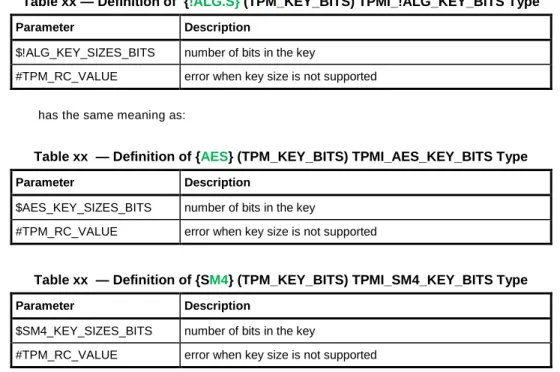
When a table is used to define an algorithm-specific value, that table may be replicated using the algorithm replacement token to create a table with values specific to the algorithm type. This type of replication is indicated by using an algorithm token in the name of the table.
EXAMPLE If AES and SM4 are the only defined symmetric block ciphers, then:
Table xx — Definition of {!ALG.S} (TPM_KEY_BITS) TPMI_!ALG_KEY_BITS Type
Parameter Description
$!ALG_KEY_SIZES_BITS number of bits in the key
#TPM_RC_VALUE error when key size is not supported
has the same meaning as:
Table xx — Definition of {AES} (TPM_KEY_BITS) TPMI_AES_KEY_BITS Type
Parameter Description
$AES_KEY_SIZES_BITS number of bits in the key
#TPM_RC_VALUE error when key size is not supported
Table xx — Definition of {SM4} (TPM_KEY_BITS) TPMI_SM4_KEY_BITS Type
Parameter Description
$SM4_KEY_SIZES_BITS number of bits in the key
4.13 Size Checking
In some structures, a size field is present to indicate the number of octets in some subsequent part of the structure. In the B_STRUCT table in 4.11, value4 indicates how many octets to unmarshal for array2. This semantic applies when the size field determines the number of octets to unmarshal. However, in some cases, the subsequent structure is self-defining. If the size precedes a parameter that is not an octet array, then the unmarshaled size of that parameter is determined by its data type. The table in Example 1 shows a structure where the size parameter would nominally indicate the number of octets in the remainder of the structure.
EXAMPLE 1
Table xx — Definition of C_STRUCT Structure
Parameter Type Comments
size UINT16 the expected size of the remainder of the structure
anInteger UINT32 a 4-octet value
In this particular case, the value of size would be incorrect if it had any value other than 4. So that the table parser is able to know that the purpose of the size parameter is to define the number of octets expected in the remainder of the structure, an equal sign (“=”) is appended to the parameter name. In the example below, the size= causes the parser to generate validation code that will check that the unmarshaled size of someStructure and someData adds to the value unmarshaled for size. When the “=”
decoration is present, a value of zero is not allowed for the size. EXAMPLE 2
Table xx — Definition of D_STRUCT Structure
Parameter Type Comments
size= UINT16 the size of a structure
The “=” indicates that the TPM is required to validate that the remainder of the D_STRUCT structure is exactly the value in size. That is, the number of bytes in the input buffer used to successfully unmarshal someStructure must be the same as size.
someStructure A_STRUCT a structure to be unmarshaled
The size of the structure is computed when it is unmarshaled. Because an “=” is present on the definition of size, the TPM is required to validate that the unmarshaled size exactly matches size.
someData UINT32 a value
4.14 Data Direction
A structure or union may be input (IN), output (OUT), or internal. An input structure is sent to the TPM and is unmarshaled by the TPM. An output structure is sent from the TPM and is marshaled by the TPM. An internal structure is not used outside of the TPM except that it may be included in a saved context. By default, structures are assumed to be both IN and OUT and the code generation tool will generate both marshaling and unmarshaling code for the structure. This default may be changed by using values enclosed in angle brackets (“<>”) as part of the table title. If the angle brackets are empty, then the
structure is internal and neither marshaling nor unmarshaling code is generated. If the angle brackets contain the letter “I” (such as in “IN” or “in” or “i”), then the structure is input and unmarshaling code will be generated. If the angle brackets contain the letter “O” (such as in “OUT” or “out” or “o”), then the structure is output and marshaling code will be generated.
EXAMPLE 1 Both of the following table titles would indicate a structure that is used in both input and output
Table xx — Definition of TPMS_A Structure Table xx — Definition of TPMS_A Structure <IN/OUT>
EXAMPLE 2 The following table title would indicate a structure that is used only for input
Table xx — Definition of TPMS_A Structure <IN>
EXAMPLE 3 The following table title would indicate a structure that is used only for output
4.15 Structure Validations
By default, when a structure is used for input to the TPM, the code generation tool will generate the unmarshaling code for that structure. Auto-generation may be suppressed by adding an “S” within the angle brackets.
EXAMPLE The following table titles indicate a structure for which the auto -generation of the validation code is to be suppressed.
Table xx — Definition of TPMT_A Structure <S> Table xx — Definition of TPMT_A Structure <IN, S> Table xx — Definition of TPMT_A Structure <IN/OUT, S>
4.16 Name Prefix Convention
Parameters are constants, variables, structures, unions, and structure members. Structure members are given a name that is indicative of its use, with no special prefix. The other parameter types are named according to their type with their name starting with “TPMx_”, where “x” is an optional character to indicate the data type.
In some cases, additional qualifying characters will follow the underscore. These are generally used when dealing with an enumerated data type.
Table 1 — Name Prefix Convention Prefix Description
_TPM_ an indication/signal from the TPM’s system interface TPM_ a constant or an enumerated type
TPM2_ a command defined by this specification
TPM2B_ a structure that is a sized buffer where the size of the buffer is contained in a 16-bit, unsigned value
The first parameter is the size in octets of the second parameter. The second parameter may be any type.
TPMA_ a structure where each of the fields defines an attribute and each field is usually a single bit All the attributes in an attribute structure are packed with the overall size of the structure indicated in the heading of the attribute description (UINT8, UINT16, or UINT32).
TPM_ALG_ an enumerated type that indicates an algorithm A TPM_ALG_ is often used as a selector for a union. TPMI_ an interface type
The value is specified for purposes of dynamic type checking when unmarshaled. TPML_ a list length followed by the indicated number of entries of the indicated type
This is an array with a length field.
TPMS_ a structure that is not a size buffer or a tagged buffer or a list
TPMT_ a structure with the first parameter being a structure tag, indicating the type of the structure that follows
A structure tag may be either a TPMT_ST_ or TPM_ALG_ depending on context. TPMU_ a union of structures, lists, or unions
If a union exists, there will normally be a companion TPMT_ that is the expression of the union in a tagged structure, where the tag is the selector indicating which member of the union is present.
TPM_xx_ an enumeration value of a particular type
The value of “xx” will be indicative of the use of the enumerated type. A table of “TPM_xx” constant definitions will exist to define each of the TPM_xx_ values.
EXAMPLE 1 TPM_CC_ indicates that the type is used for a commandCode. The allowed enumeration values will be found in the table defining the TPM_CC constants (Table 13). EXAMPLE 2 TPM_RC_ indicates that the type is used for a responseCode. The allowed enumeration
values are in Table 17.
4.17 Data Alignment
The data structures in this TPM 2.0 Part 2 use octet alignment for all structures. When used in a table to indicate a maximum size, the sizeof() function returns the octet-aligned size of the structure, with no padding.
4.18 Parameter Unmarshaling Errors
The TPM commands are defined in TPM 2.0 Part 3. The command definition includes C code that details the actions performed by that command. The code is written assuming that the parameters of the command have been unmarshaled.
NOTE 1 An implementation is not required to process parameters in this manner or to separate the parameter parsing from the command actions. This method was chosen for the specification so that the normative behavior described by the detailed actions would be clear and unencumbered.
Unmarshaling is the process of processing the parameters in the input buffer and preparing the parameters for use by the command-specific action code. No data movement need take place but it is required that the TPM validate that the parameters meet the requirements of the expected data type as defined in this TPM 2.0 Part 2.
When an error is encountered while unmarshaling a command parameter, an error response code is returned and no command processing occurs. A table defining a data type may have response codes embedded in the table to indicate the error returned when the input value does not match the parameters of the table.
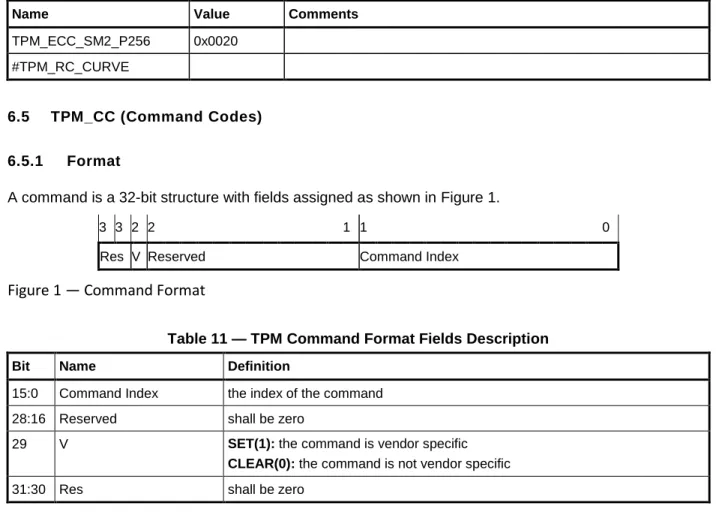
EXAMPLE 1 Table 13 has a listing of TPM command code values. The last row in the table contains "#TPM_RC_COMMAND_CODE" indicating the response code that is returned if the TPM is unmarshaling a value that it expects to be a TPM_CC and the input value is not in the table.
NOTE 2 In the reference implementation, a parameter number is added to the response code so that the offending parameter can be isolated.
In many cases, the table contains no specific response code value and the return code will be determined as defined in Table 2.
Table 2 — Unmarshaling Errors Response code Usage
TPM_RC_INSUFFICIENT the input buffer did not contain enough octets to allow unmarshaling of the expected data type;
TPM_RC_RESERVED a non-zero value was found in a reserved field of an attribute structure (TPMA_) TPM_RC_SIZE the value of a size parameter is larger or smaller than allowed
TPM_RC_VALUE A parameter does not have one of its allowed values
TPM_RC_TAG A parameter that should be a structure tag has a value that is not supported by the TPM
In some commands, a parameter may not be used because of various options of that command. However, the unmarshaling code is required to validate that all parameters have values that are allowed by the TPM 2.0 Part 2 definition of the parameter type even if that parameter is not used in the command actions.
5
Base Types
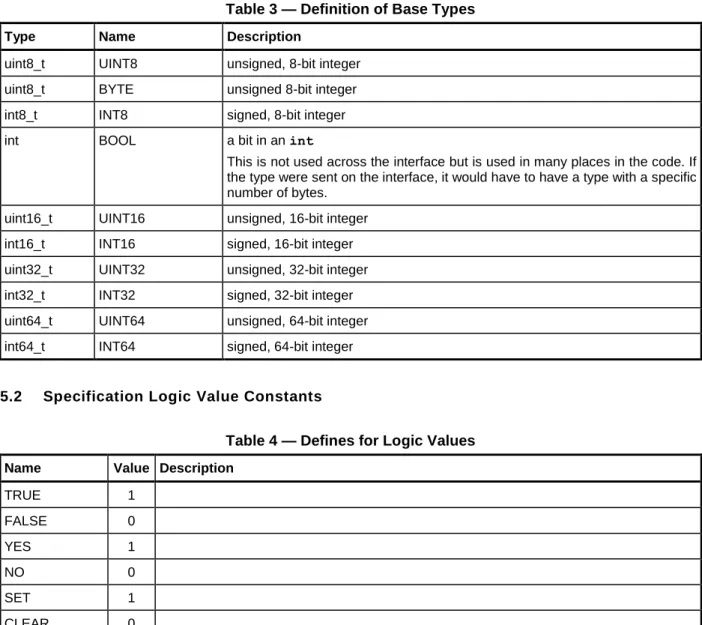
5.1 Primitive TypesThe types listed in Table 3 are the primitive types on which all of the other types and structures are based. The values in the “Type” column should be edited for the compiler and computer on which the TPM is implemented. The values in the “Name” column should remain the same because these values are used in the remainder of the specification.
NOTE The types are compatible with the C99 standard and should be defined in stdint.h that is provided with a C99-compliant compiler;
The parameters in the Name column should remain in the order shown. Table 3 — Definition of Base Types Type Name Description
uint8_t UINT8 unsigned, 8-bit integer uint8_t BYTE unsigned 8-bit integer int8_t INT8 signed, 8-bit integer int BOOL a bit in an int
This is not used across the interface but is used in many places in the code. If the type were sent on the interface, it would have to have a type with a specific number of bytes.
uint16_t UINT16 unsigned, 16-bit integer int16_t INT16 signed, 16-bit integer uint32_t UINT32 unsigned, 32-bit integer int32_t INT32 signed, 32-bit integer uint64_t UINT64 unsigned, 64-bit integer int64_t INT64 signed, 64-bit integer
5.2 Specification Logic Value Constants
Table 4 — Defines for Logic Values Name Value Description
TRUE 1 FALSE 0 YES 1 NO 0 SET 1 CLEAR 0
5.3 Miscellaneous Types
These types are defined either for compatibility with previous versions of this specification or for clarity of this specification.
Table 5 — Definition of Types for Documentation Clarity
Type Name Description
UINT32 TPM_ALGORITHM_ID this is the 1.2 compatible form of the TPM_ALG_ID UINT32 TPM_MODIFIER_INDICATOR
UINT32 TPM_AUTHORIZATION_SIZE the authorizationSize parameter in a command UINT32 TPM_PARAMETER_SIZE the parameterSize parameter in a command UINT16 TPM_KEY_SIZE a key size in octets