Draft: Financing for Basic Private Education
Using the Development Credit Authority Guarantee
December 16, 2007
Taara Chandani
Jorge Balan
Meaghan Smith
Meghan Donahue
STRENGTHENING THE PRIVATE BASIC
EDUCATION SECTOR
A CASE FOR USAID SUPPORT AND FINANCING
THROUGH THE DEVELOPMENT CREDIT AUTHORITY
DEVELOPMENT CREDIT AUTHORITY DAI SUPPORT CONTRACT
January 2007
This publication was produced for review by the United States Agency for International
Development. It was prepared by Banyan Global, a subcontractor to Development Alternatives, Inc. Taara Chandani
Jorge Balan Meaghan Smith Meghan Donahue
TABLE OF CONTENTS
ACRONYMS... 4
EXECUTIVESUMMARY... 5
1. INTRODUCTION: OBJECTIVES ANDBACKGROUND... 9
1.1 Purpose and Scope of the Report ... 9
1.2 Universal Access to Education and the Need for Private Provision ... 10
2. OVERVIEW ANDFRAMEWORK... 14
2.1 Definitions: Private Schools and the Privatization Process ... 14
2.2 Stimulus for Privatization: Public Policy and Unplanned Change ... 16
3. THEMARKET FORPRIVATEBASICEDUCATION: A GLOBALOVERVIEW... 19
3.1 Student Enrollment in the Private Sector... 19
4. RATIONALE FORINVESTING INPRIVATEBASICEDUCATION... 21
4.1 Access and Equity... 21
4.2 Effectiveness and Efficiency... 24
4.3 Accountability and Quality of Education ... 25
5. REGULATIONS ANDCONDITIONS FORPRIVATEINVESTMENT... 26
6. PROMISINGAREAS OFINTERVENTION IN THEPRIVATESECTOR... 28
7. ACCESS TOFINANCING FORBASICEDUCATION... 30
7.1 Access to Finance and the Development of the Private Sector ... 30
7.2 The Current Status of Education Sector Lending ... 31
7.3 The Impact of Lack of Access to Finance on the Private Education Sector... 31
7.4 Past USAID and Other Donor Support to Finance Private Education... 32
7.5 Looking Forward: Addressing the Financing Gap... 34
8. THEDCA GUARANTEE AND THEPRIVATEEDUCATIONSECTOR... 35
8.1 Type of DCA Guarantees and their Potential Use ... 36
8.2 Identifying Appropriate Countries for the DCA Guarantee ... 38
9. ADDITIONALSTRATEGIES TOEXPANDACCESS TOFINANCE FOR THEEDUCATION SECTOR... 42
10. CONCLUSION... 43
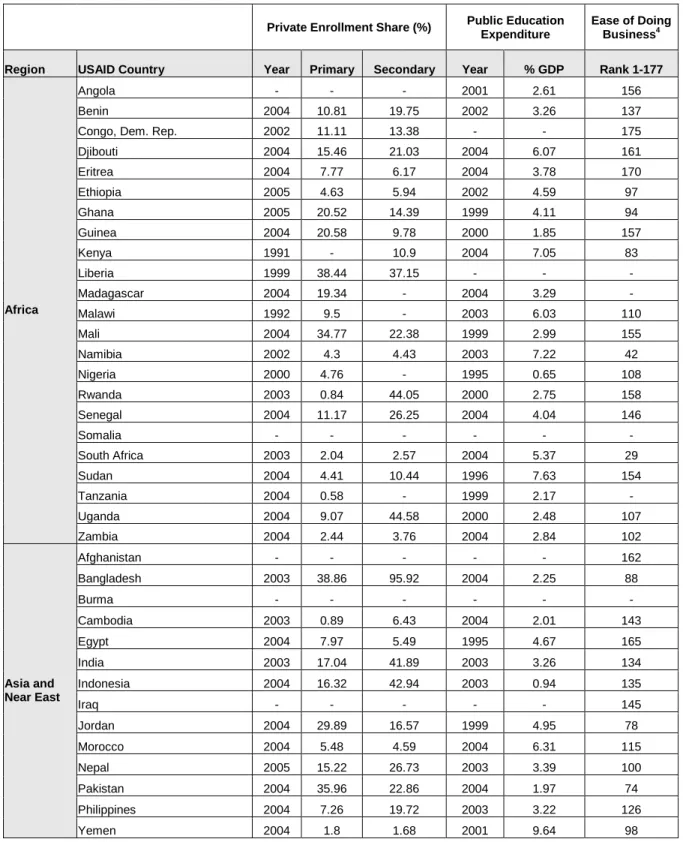
ANNEX1: DISTRIBUTION OFPUBLIC ANDPRIVATEENROLLMENT INSELECT COUNTRIES... 45
ANNEX2. COUNTRIES IN WHICHUSAID CURRENTLY HASBASICEDUCATION
PROGRAMS... 46 ANNEX3: SUGGESTEDGUIDELINES TOASSESS THESTRENGTH OF THEPRIVATEBASIC EDUCATIONSECTOR... 47 REFERENCES... 52
A
CRONYMS
ADB Asian Development Bank
BSS Bodh Shiksha Samiti
DCA Development Credit Authority DPS Delhi Public Schools Society EFA Education for All
GDP Gross domestic product
IDB Inter-American Development Bank IFC International Finance Corporation NGO Nongovernmental organization ODC Office of Development Credit
OECD Organization for Economic Cooperation and Development PROBE Public Report on Basic Education
UNESCO United Nations Educational, Scientific and Cultural Organization USAID United States Agency for International Development
E
XECUTIVE
S
UMMARY
This report develops a case for private sector involvement in the provision of basic education and explores the financing needs of schools and related service providers towards expanding the supply and quality of basic education. It offers guidelines for the United States Agency for International Development (USAID) to invest in the private basic education sector using the Development Credit Authority (DCA), a financial guarantee mechanism through the Office of Development Credit (ODC). This report provides an overview of historical trends in the provision of private education, describes the characteristics of this sector, and presents the main rationale for investing in it. Privately managed and financed schools are becoming more prominent globally in education, even at the level of basic education. Private schools increase efficiency, access, and quality of services, and have the potential to play a more significant role in relation to the public sector. Drawing from literature and past donor experiences in financing for social services, this paper offers recommendations for USAID to use its loan-guarantee mechanism to fill a financing gap and stimulate growth of the basic education sector.
The right to free basic education was included in the United Nations Declaration of Human Rights in the 1940s; since then it has been mandated by national laws and supported by international agreements. The Education for All movement in the 1990s reaffirmed the right to basic education, making it a priority in the development agenda. Many developing countries, however, are struggling to fulfill this commitment and experience shortfalls in providing basic education to the school-age population. Increasingly, many of these countries look toward the private sector to complement public provision and help them to supply education for all.
The concept of private education and privatization in relation to education is complicated, given the nature of education as a social service and public good. This idea typically encompasses both the ownership and management of schools as well as the financing of education, which is increasingly being borne by students and their families. Mixed ownership and financing characteristics are often the rule rather than exception and should be taken into account when considering strategies for working with and financing the private education sector. This report defines private schools as institutions that are not operated by a public authority, but are controlled and managed by a private agency, such as a nongovernmental organization, religious body, special interest group, foundation, or business enterprise. This report is concerned with formal schooling that officially
recognized establishments provide.
In many countries the private education sector is growing to meet demand and address shortfalls in public supply. In some countries, such as Zimbabwe and Chile, it is meeting the basic education needs of a significant portion of the population. The questions for policymakers is whether this growth should be supported and, if so, how? In a climate of diminishing resources, donors must determine the most effective use of their scarce funds. Over the years a number of arguments have been put forward in favor of strengthening the private sector, including:
reducing the burden on government expenditure
improving the efficiency and effectiveness of schools
increasing equity and access in education
increasing diversity and choice in terms of educational provision
making schools more accountable to their clients.
Based on the literature review, the private sector can have an important role in supporting the achievement of Education for All’s goals. Governments are increasingly channeling public funds to the private sector through contracting with private providers to manage educational services, directly covering the cost of private education in the form of teacher salaries or infrastructure, or targeting subsidies directly to students who enroll in the private sector. As a supplier of education, the private sector has the potential to increase access and equity, efficiency and effectiveness, and accountability.
Access and equity: Educational gaps in developing countries are large and are most pronounced in rural areas, among girls, and for culturally diverse groups, including migrant populations. Moreover, the distribution of public subsidies favors urban areas and middle and upper-income groups in many countries and points to embedded inefficiencies in the allocation of public resources. The private sector in a number of countries—including Brazil, India, and much of sub-Saharan Africa—has played a critical role in meeting the needs of disadvantaged groups and has the potential to further increase access and equity.
Efficiency and effectiveness: Private provision of education is more effective in terms of student achievement on standardized tests and is an effective alternative to publicly provided education. The unit costs of private schools are also lower than their public counterparts. Most empirical studies in developing and some middle-income countries support these claims, yet they also note that the effectiveness varies across countries and can be influenced by clientele served, as well as strength of the private sector in terms of the school’s management, teacher quality, pedagogic style, and responsiveness to clients. Accountability and quality:Increased accountability in private schools has the potential to increase the overall quality of education. There is also recognition, however, of the need to institute stronger assessment and accountability systems that cross public and private sectors and address different dimensions of quality, such as teacher training and school management. Policymakers have recognized that increased spending alone does not directly affect the quality of education or student achievement.
Given the potential the private sector has in improving access and equity, efficiency and effectiveness, and accountability and quality, governments and donors should consider them as a partner in achieving Education for All. Working with the private sector to achieve development goals, however, requires a new type of programming. Potential strategies for engaging the private sector include strengthening the investment and regulatory climate to impact the scale, efficiency, and quality of services provided; instituting effective accreditation systems that are focused on providing incentives for quality education in the private sector rather than burdensome regulations; identifying
innovative models for providing private services, such as networks; ensuring that resources are targeted to different population segments through public-private partnerships and targeted vouchers; and facilitating access to finance.
While it is beyond the scope of this paper to fully address all of these strategies, this report does explore how improving access to financing can be used to engage the private sector in the delivery of basic education. Access to finance is an important ingredient in private sector development. While the literature review did not reveal statistics on commercial bank lending to the education sector in developing countries, anecdotal evidence suggests that lending to it is limited because of perceptions of risk, concerns about collateral, lack of market information, and limited understanding of the private education sector business model.
Limited access to financing impedes new entrants to the education sector and negatively affects growth, access, and quality. Schools and related service providers are forced to rely on their savings as well as loans from family and friends to invest in and grow their businesses. These practices have serious implications on both the size of the private education sector and the quality of education. If the private education sector is to meet increasing demand and comply with public-sector regulations, it will need access to financing. In addition, the lack of student loans—with the potential to alleviate household financial pressures, particularly at the secondary level—may further constrict access to basic education.
Donors working to stimulate growth and financing of private education traditionally have targeted their support to higher education; however, in response to the growing need and potential for benefit at the basic education level, there is recent interest among donors to increase access to financing at all levels. Financing basic education is still a nascent market for donors and presents an important opportunity for USAID to have a leadership role in using proven strategies to expand access to financing for this sector. Financing interventions can be developed to contribute to USAID missions’ strategic objectives in education by improving quality, efficiency, and access. On the supply side, financing can be targeted directly at private schools, networks of schools, or related service providers, such as institutes for accreditation, professional development, publishing, or school transport. On the demand side, commercial financing can be targeted to individuals and families to help them cover the costs of their education, particularly at the secondary level.
One important strategy in expanding access to financing for the private basic education sector is USAID’s DCA guarantee. This guarantee stimulates lending to underserved markets. The DCA guarantees up to 50 percent of the loss on a loan or a portfolio of loans and can help banks overcome their concerns about a new market. By sharing risk the DCA can help banks in lending to underserved sectors, such as private primary schools; offer longer terms, which are essential for school construction; and reduce conservative collateral requirements, which have posed a major constraint to education sector loans. The DCA also mobilizes local capital to support the education sector,
leveraging important new resources to complement USAID missions’ education programming.
USAID’s ODC offers four products under a shared-risk guarantee: the individual loan guarantee, loan portfolio guarantee, bond guarantee, and portable commitment guarantee. Loan guarantees and portable guarantees can be used to support specific institutions or projects, especially ones that call for larger-scale investments. Loan portfolio guarantees can be effective in reaching multiple small schools or related service providers in the education sector. Portfolio guarantees also can be used to administer student loans in partnership with local educational institutes. Bond guarantees have the most potential in municipal financing of education sector projects.
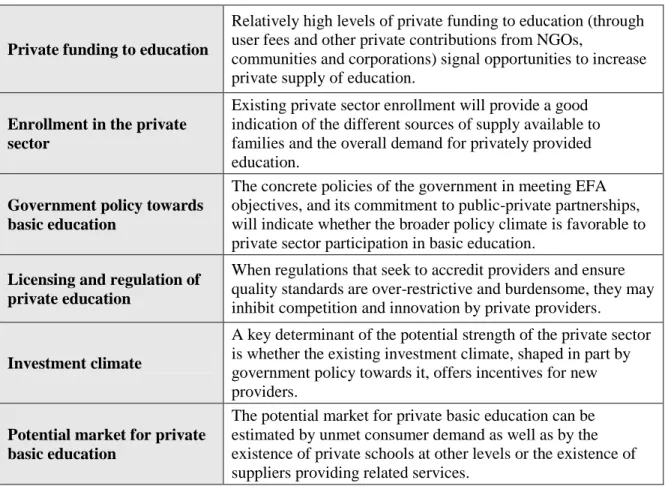
Selecting suitable countries to structure education sector DCAs will depend on a number of factors (assuming USAID already has a strong presence in the basic-education sector). These considerations include whether the country has high levels of private sector
enrollments and private funding to education, a favorable regulatory regime and accreditation and licensing policies, an investment climate that attracts private sector participation (schools and other service providers), and demand for increased access or improved choice in obtaining basic education.
While the DCA is a key mechanism in expanding access to finance for the private education sector, it is a new market for most financial institutions and parallel strategies should be considered in addition to the DCA. Because of the constraints in lending to the education sector, including banks’ perception of higher risk and limited knowledge about the sector, utilization of an education sector DCA would most likely benefit from
technical assistance. Financial institutions can be supported with market research, training in education sector lending, support in developing targeted loan products, and providing market referrals of potential borrowers. Education sector borrowers will benefit from accessing business-development services so that they can prepare a bankable
business plan and manage financing.
In sum, the private sector has an important role to play in achieving the goal of Education for All. The private sector is already contributing to the delivery of basic education in many countries. As donors and governments grapple with identifying the most effective strategies for partnering with the private education sector, it is important to consider the role that financing can have in improving access, efficiencies, and quality. USAID’s DCA guarantee can be an effective tool in stimulating commercial lending to the basic education sector. The DCA can leverage local financial resources in support of USAID missions’ education goals.
1. I
NTRODUCTION
: O
BJECTIVES AND
B
ACKGROUND
1.1
P
URPOSE ANDS
COPE OF THER
EPORTThis report develops a case to strengthen private sector involvement in basic education and explores the financing needs of players in the education market. It discusses the potential for the United States Agency for International Development (USAID) to invest in the private education sector using its Development Credit Authority (DCA) guarantee, a financial guarantee mechanism through the Office of Development Credit (ODC). The paper provides an overview of historical trends in the private education sector, describes characteristics of privately provided education, and presents the main rationale for the emergence and continued growth of private education. Ultimately the purpose of this report is to provide USAID with guidance to strategically invest its resources in the private education market to complement public sector provision and ensure access to quality basic education for all. The paper offers suggestions for the ODC to use the DCA guarantee for the private basic education sector, consisting of formal schools and related educational agencies, such as training institutes or digital technology companies. While the DCA has been used to a limited degree to stimulate growth in higher education, it has not been used for basic education.
This paper makes a case for investing in the private basic education sector and offers approaches for using the guarantee mechanism and other strategies to promote access to financing in different regions and education markets. Promising countries to invest in already will have a strong USAID presence in the basic education sector, high levels of private sector enrollment and private funding for education, a favorable regulatory regime and accreditation and licensing policies, an investment climate that attracts private sector participation (schools and other service providers), and demand for increased access or improved choice in obtaining basic education.
USAID defines basic education broadly to include all program efforts aimed at improving early childhood development, primary education, and secondary education (delivered through formal or informal settings), as well as training for teachers working at any of these levels. In its definition USAID also includes training in literacy, numeracy, and other basic skills for adults and out-of-school youth (USAID Education Strategy 2005). This report provides a synthesis of the literature on private provision of education globally, it explains the trends towards privatization and analyzes the growing market coverage of private educational providers, and it sets forth the main rationale for
investing in private education—including access and equity, efficiency and effectiveness, and increased accountability. The second component of the report is forward looking: it examines how improving access to finance is an important strategy in strengthening the private education sector and suggests potential intervention areas for USAID to use its DCA mechanism to increase the scale and quality of privately provided basic education.
1.2
U
NIVERSALA
CCESS TOE
DUCATION AND THEN
EED FORP
RIVATEP
ROVISIONMost developing countries experience serious shortfalls in providing basic education to the school-age population and increasingly have looked toward the private sector to complement public provision. The right to free basic education (for up to seven years) was included in the United Nations Declaration of Human Rights in the 1940s and since has been mandated by national laws and supported by international agreements. Thus expanding access to basic education for all children is a policy priority for most national governments that receive support from the international community. It is increasingly being recognized, however, that policies supporting universal basic education face serious implementation difficulties unless public sector efforts are complemented with private sector resources (for example, in the form of cost-sharing, management oversight, or infrastructure contributions) from local communities, religious organizations, and private institutions (Kitaev 1999).
Goals of universal access to education
The basis for compulsory mass schooling originated in the Reformation movement and became part of the legal framework in the nation-state building process in 19thcentury Europe and the Americas. Western governments set forth a legal basis for establishing state-administered schools and instituted this same foundation within their colonies. Sixty countries that had gained independence by 1945 had enacted compulsory attendance laws; by 2000, 85 percent of the 125 former colonies that became independent had passed compulsory school laws. The ideology of compulsory education was thus increasingly part of the nation-state model during the 20th century (Benavot and Resnik 2006). There was growing pressure on new states to pass compulsory school laws, but their limited capacity to implement or enforce these laws only became more pronounced after independence.
An education-for-development discourse prevailed during the 1950s and 1960s whereby international organizations embraced the notion of education as a key factor in economic growth. Member states to the United Nations were expected to increase their allocations for public education and use modern planning techniques to improve educational
systems. These efforts resulted in remarkable growth of public educational systems and enrollment rates throughout the developing world. In the 1980s, however, the debt crisis and reduction in international aid towards education forced central governments in most developing countries to cut spending on education and other social sectors. They sought alternative ways to leverage resources and funding, including advocating for
decentralization and privatization policies. In addition to ensuring adequate revenue was devoted to education, governments and policymakers also were recognizing the need to make schools more effective and responsive to the needs of disadvantaged segments of the population.
Responding to education goals in different regions
The ability of countries to achieve goals of universal access to education depended largely on their colonial history, political priorities, governing system, and level of tax
revenue. Governments in Western countries were successful in building unified education systems during the 19th and early 20th centuries, offering only a small role for the private sector. Privatization experiences among Western countries were first inspired by the need to address religious diversity and provide communities with the opportunity to run their own publicly financed schools. Privatization in the West took place under the continued predominance of public funding, government-supported national standards, and
multilevel accountability systems.
Centralized governments under socialist regimes in Eastern Europe, China, Vietnam, and Cuba also were successful in providing universal access to mandatory schooling in public schools, with little or no room for independent or private schools. In recent decades, however, all of those countries except for Cuba and Vietnam have engaged in the
processes of decentralization of their school systems, ensuring a larger role for the private sector in school ownership and management. Privatization experiences among these countries have been tied to the need for devolving decision-making to local governments in order to attend to previously ignored social and cultural diversity and thus improve school quality within market economies. Private schooling, however, appears also as a response to unmet demands given the limitations in public financing for education. This case was particularly true in Russia and other Eastern European countries during the economic crises of the 1990s. In China privately managed community schools have been established to attend to the needs of migrant populations who cannot access education in public urban schools.
The incomplete nature of universal access under free and publicly provided schools is especially evident in most ex-colonial and newly independent countries of Latin America, Asia, and Africa—with some notable exceptions in East Asia (Taiwan and South Korea) and the Latin American Southern Cone (Argentina, Uruguay, southern Brazil, and Chile) –leading governments to increasingly recognize a much greater role for the private sector in achieving the goal of basic education for all. The educational contexts vary
considerably within this large group of countries that includes most low and middle-income ones. Some countries have a strong presence of private religious schools, others have strong community-based movements and many have the presence of
nongovernmental organizations (NGOs) or for-profit institutions. Nonetheless, from the perspective of the public sector, there is widespread recognition of the need to engage with the private sector to meet goals of universal access and increase the efficiency and quality of services provided.
Renewed commitment to basic education for all
In the 1990s the United Nations Educational, Scientific and Cultural Organization (UNESCO) and other international organizations launched the Education for All (EFA) movement and placed basic education as a top priority on the development agenda. Representatives from 160 governments in Dakar reaffirmed their commitment to EFA and produced a set of goals, actions, and monitoring mechanisms to guide national and international efforts in the next decades. Although enrollment rates in primary and secondary education increased throughout the developing world, new concerns emerged about issues related to quality as learning in primary and secondary schools was being
assessed systematically through standardized testing of reading and mathematics in many nations (Baker and LeTendre 2005).
There is consensus today about the need to increase funding, public and private, for education to attend to the rising demands for skills in the new global economy. The 1990 EFA Conference stressed the importance of partnerships to meet the obligations of basic universal education. Its final summary report acknowledged that
National, regional and local education authorities have a unique obligation to provide basic education for all, but they cannot be expected to supply every human, financial or organizational requirement for this task. New and revitalized partnerships at all levels will be necessary…(including) partnerships between government and non-government institutions, the private sector, local communities, religious groups and families. (Cited in Bray 2002).
Donor support to private basic education
Donors and governments, however, grapple with how to work with the private sector to achieve education goals. Donor involvement to support the provision of basic education through the private sector, as well as public subsidies to private schools, is controversial as it falls within the polemic battle between supporters ofeitherprivateorpublic
education. As governments have the fundamental responsibility to fulfill objectives of universal access to basic education, donors traditionally have channeled their support to the public sector to increase access and quality of education at the systemic level. Donor support has played a key role in many governments’ attempts to reform public schools to improve their quality, efficiency, and responsiveness to students’ needs. Reforms in the public sector in the last few decades have focused on providing information on success and failure rates; increasing school autonomy; and encouraging the empowerment of students, families, and communities. Although private schools have a quantitatively minor role in primary and secondary education, many governments seek to stimulate their growth to increase the total effort behind meeting the goal of universal access to basic education.
The following points summarize the primary controversial areas in working with the private sector for many donors:
User fees: Most private schools require user fees, thus making them less
accessible to lower-income groups. As will be discussed later, however, research has shown that user fees are just one of the many costs students and their families bear in both public and private schools. Many low-income families are willing to pay user fees, within limits, when doing so gives them a greater voice in school affairs and encourages school authorities to be more responsive to their needs.
Choice: Private schools, unlike their public counterparts, can exercise choice in student admission. They may limit access to students who have difficulty in paying fees or are perceived as higher academic risks. Public schools thus face higher costs as a result of private school’s skimming students who have more supportive family background. This claim is perhaps the most damaging one
against public subsidies to private providers. Yet, public subsidies and donor support may stimulate greater access by targeting their funds to needy students as well as by working with private providers whose mission includes work with underrepresented or marginal groups (for example, rural and urban poor, ethnic minorities, and girls).
Quality: Private providers are often poorly controlled by governments and enter into asymmetrical relations with students and their families who are unable to assess the quality of educational services. In fact, the quality of learning in both public and private schools has become the focus of concern with the widespread availability of testing in many countries that only recently have achieved
universal access to basic education. While the evidence about public/private advantages is conflicting, recent studies have highlighted the enormous
achievement gaps between different student groups and between schools within each of these sectors.
Segmentation: Public schools traditionally have educated children in
heterogeneous societies, supporting social integration and promoting pluralism, while private schools have been more responsive to interests and ideologies of particular groups, tending to cater to rich families or to those of particular
religious or ethnic backgrounds. Critics thus see the growth of private schools as a further step in social segmentation. The landscape, however, is more complex. Centralized and bureaucratized public school systems currently are blamed for ignoring cultural, ethnic, and religious diversity in complex national societies. Minorities, often large, are poorly represented in the dominant school system, while private schools tend to be more responsive to the needs of local groups. As a recent report from the Inter-American Development Bank (IDB) indicates, countries need both, public education with private efficiency goals and private education that supports social objectives (Castro 2001). The key question is not whether to support one or the other, but rather what kinds of public policies are more likely to promote a greater national effort devoted to education and the expansion of a school system more
responsive to the needs of all students. The main rationale for supporting the private sector in basic education is to complement efforts in the public sector by:
increasing private funding and thus reducing the burden on government expenditure
improving the efficiency and effectiveness of all schools
increasing equity and access in education
increasing diversity and choice in terms of educational provision
making schools more accountable to the public, in particular their clients. This paper explores the literature behind each of these points to further inform the
discussion and contribute to a better understanding of the potential of the private sector in achieving educational goals.
2. O
VERVIEW AND
F
RAMEWORK
2.1
D
EFINITIONS: P
RIVATES
CHOOLS AND THEP
RIVATIZATIONP
ROCESS The concept of private education and privatization in relation to education is complicated given the nature of education as a social service and public good. It is important to begin with definitions to provide a framework for understanding the private education sector. The definition of what constitutes a private school varies but it is generally a function of government regulation in a particular country. Governments worldwide play a major role in shaping national educational systems through the ownership and operation of schools, funding of education (including support to students and to private schools), andregulation of the educational sector as a whole. Although few, if any, regulate teaching or learning, all governments regulate schooling and its formal outcomes in terms of
recognized credentials. Thus, government action always shapes the definition of private schools.
Private schools
This report uses the UNESCO definition of private schools as institutions that are not operated by a public authority but controlled and managed by a private agency, such as an NGO, religious body, special interest group, foundation, or business enterprise. It is concerned with formal schooling officially recognized establishments provide that may be under considerable influence of the state (in terms of financial subsidies, accreditation, or curriculum standards). Private schools take a variety of forms and typically are
categorized according to who operates them, who uses them, and whether or not the state supports or regulates them. In broad terms they can be classified as religious or secular, for-profit or not-for-profit.
The privatization process
In recent years there has been increased privatization in the education sector.
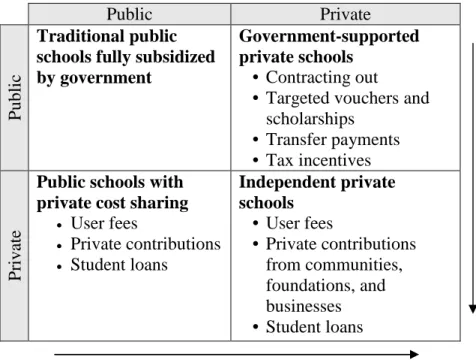
Privatization is usually defined as a process, that is, a trend in education provision and organization observed along parallel yet conceptually different dimensions, school ownership, or management and school financing. Unlike other sectors, mixed ownership and financing are often the rule rather than the exception in the privatization of education and this relationship should be taken into account when developing strategies to work with the private sector. The following graphic offers a visual depiction of the public-private continuum in the privatization process.
Privatizationtypically encompasses two dimensions:
The relative growth of private schools (some strictly privately owned and operated, others with government subsidies)
The growing share of total school costs students and their families bare in payment for services provided by either of these types of schools.
Figure 1. Privatization: Public-Private Mix in Financing and Control
Source: Adapted from IFC 2001.
School ownership and management: who operates the schools?
This dimension is usually based on a dichotomy (the government or a private
organization, such as a church, a for-profit enterprise, or a community-based association, own and operate the schools). Different levels of government, however, may be involved in managing schools. In decentralized systems, when local governments are requested to provide mandatory schooling, school management tends to be mixed, with heavy
involvement of families, local groups, and associations who participate in school governance and management and may even own the school.
School finance: who pays the costs of running a school?
School finance usually relies on a combination of private and public contributions. In most kinds of private schools, governments make financial contributions in different ways alongside private contributions (mostly made by students and their families, but also other parties). Thus, school finance usually is seen in terms of the proportion of funding governments provide through taxation, grants, or subsidies, and the proportion private individuals, associations, and donors contribute.
Privatization as a process usually is defined as the shift along these dimensions towards the nongovernmental side—measured as an increase in the proportion of students
enrolled in schools owned, managed, or financed with greater participation of NGOs and private individuals. Privatization also is used normally to characterize government policies geared to foster this process.
Public Private P u b li c Traditional public schools fully subsidized by government
Government-supported private schools
• Contracting out
• Targeted vouchers and scholarships • Transfer payments • Tax incentives P ri v at e
Public schools with private cost sharing
User fees Private contributions Student loans Independent private schools • User fees • Private contributions from communities, foundations, and businesses • Student loans P riv at iz at io n
F
in
an
ci
n
g
PrivatizationOwnership/Management
Multiple dimensions of ownership, finance and accountability
This multidimensional concept of privatization, including the separation of historical processes from policies aiming to foster them, highlights the difficulties of defining what is a public or a private school in practice. Schools and school systems have different degrees of privateness. Kitaev (1999), for instance, finds that in different African
countries schools are considered private due to funding, ownership, and management, but there are a number of factors creating confusion in the simplistic classifications by type of funding or ownership.
Estelle James (1993) treats funding and ownership/management as two independent dimensions. Thus, she classifies schools and school systems in four roughly defined boxes: publicly owned and funded, publicly owned yet privately funded, privately owned with public funding, and privately owned and funded. In addition to ownership and funding, other authors, including Belfield and Levin (2002), add a third and important dimension, accountability to stakeholders (in particular students and their families), which many assume is characteristic of private schools (or privatized public schools). Given the nature of privatization and the previously described dimensions, opportunities to facilitate financing for schools can be conceptualized in two channels:
to fund educational institutions (schools and related agencies) and expand the supply and quality of education
to target financing for individuals or families who can exercise choice or simply access privately provided education.
2.2
S
TIMULUS FORP
RIVATIZATION: P
UBLICP
OLICY ANDU
NPLANNEDC
HANGETypically the privatization of education occurs as a result of deliberate policy or unplanned change (Bray 1998, 2002). A deliberate policy may emphasize and be based on one or more of the following tools and rationales:
Contracting for economic efficiency: The operations of public schools may be transferred to private owners or managers through a contracting or
sub-contracting mechanism to private providers, but more often it is used for select school functions, such as transportation, food, administration, or special educational services. Contracting is used to increase operational efficiencies, reduce public expenditure on education, and improve quality. In India, for
example, a chain of private schools called the Delhi Public Schools Society (DPS) Box 1.Public Versus Private Financing:The distinction between public and private financing can be blurred. In Cambodia, for example, households provide 60 percent of the resources for public primary education (in the form of fees, transport, supplementary tutoring, and other items), while in Indonesia the government provides 69 percent of the resources for private primary schools (Bray 2002). Similarly, in Mauritius, the government pays for teachers’ salaries as well as most direct expenses of private schools that provide services free of charge (Kitaev 1999).
Box 2.Private Contributions Towards Basic Education:Countries where private payments constitute a large proportion of total educational expenditures include Cambodia, China, Indonesia, South Korea, the Philippines, Thailand, and Vietnam. In South Korea private education spending on schooling and on additional tutoring amounts to approximately the same as that of government expenditures (Levin 2002). Cost sharing for education also can take the form of corporate donations to schools that are tied to government-sponsored tax relief incentives. In the Philippines, the government has instituted an adopt-a-school program for corporations. Three elementary and two secondary schools in Manila have benefited with inputs from an oil refinery, a detergent company, and a multinational hamburger outlet (Bray 2002).
has been contracted to oversee the management of 32 public schools in 11 states using innovative technologies and curricula (Tooley 2001). In the United States, a niche of ancillary business suppliers emerged in the 1990s—educational
management organizations—that enable public schools to contract out services such as student assessment, budgeting, or transportation (Levin 2002).
Competition and school choice: Increased public funding may be channeled to private schools to increase competition through targeted school vouchers, transfer payments in the form of student scholarships, or direct transfers to schools
through payment of teachers’ salaries, extension of tax benefits, or reduced price of public services. For example,education reform in Chile included a universal voucher scheme that gave families the choice of attending public or private schools. Between 1981 and 2002 enrollments in the private sector increased from 15 to over 40 percent of all students and the market of private providers expanded to include a variety of religious and secular for-profit private schools (Levin 2002).
Increased private funding to public schools: Individual and family contributions in the form of regular fees to public schools are intended to decrease
differentiation between public and private schools and to increase community and family commitment towards schools.
Privatization also takes place as a result of unplanned change, which generally occurs in the case of failed public policy to provide universal access through publicly funded and managed schools. It is characterized in the literature as demand-driven, or spontaneous movements, addressing educational needs that are totally or partially unmet by
governments—whether in terms of lack of supply, poor quality schools, or their inability to serve a particular segment of the population. Using public failure as a starting point, the emergence and growth of privately owned and managed schools can be classified under the following three conditions:
Inability to meet overall demand: Limited public spending fails to satisfy growing demand from people who may prefer to use the public schools but are excluded or pushed to the private sector (James 1993). This case is largely true with secondary education that often is characterized by limited supply. When only primary
schooling is available publicly, many motivated students are denied access to secondary education because of limited supply, which commonly results in an expanded private sector role at the secondary level. Moreover, it suggests that government subsidies potentially can be spread across primary, secondary, and higher education levels to ensure increased access across the board.
Differentiated demand of specific population segments: Public schools typically cannot meet differentiated demand tied to cultural or religious identity and may more explicitly deny access to certain groups because of their legal status in a specific territory, such as undocumented migrants and refugees.
Entry of private, especially non-profit, providers to underserved markets: Non-profit suppliers traditionally move into areas where the population is historically underserved, to create or strengthen demand for education, such as in rural areas or in urban slums. This segment traditionally includes schools with religious as well as educational goals, but is increasingly represented by a much greater variety of NGOs, often with international sponsorship.
Box 3.Increased private sector enrollments at the secondary level:In Africa, where government efforts are focused at the primary-education level, secondary education is especially under-funded and demand typically far exceeds supply. Strong increases between 1985 and 1995 in private secondary-school enrollments are attributed to limited supply, as observed in Botswana (50 to 74 percent), Côte d’Ivoire (29 to 36 percent), Chad (5 to 13 percent), Djibouti (3 to 11 percent), and Zimbabwe (67 to 85 percent) (Kitaev 1999).
Box 4.Community schools in Brazil fill the gap to provide education for marginalized
groups.The mainstream public education system in Brazil does not cater to the cultural,
linguistic, or economic needs of the black or Afro-Brazilian communities, particularly those living in informal neighborhoods orfavelas. Community schools initiated by resident associations have responded to meet the demand for basic education in these neighborhoods and some have successfully demanded the transfer of public funds for teachers’ salaries and school materials. For example, community schools in the state of Bahia legally can secure 3 percent of education funds allocated to municipal schools. (De Almeida 2003)
Box 5. NGOs in India play an important function in increasing access to education for
underserved communities.The Bodh Shiksha Samiti (BSS) is one of six NGOs surveyed in a
World Bank study that works in the slums of Jaipur Rajasthan where there is limited access to formal schooling. Based on a UNESCO baseline survey in 1998, 30 percent of the population lived in slums and only 74 of 279 slums had government schools. BSS started its work in the late 1980s to build new community-managed schools. It also developed an innovative model for teacher training in close collaboration with the municipal schools and with support from donors including CARE India and the Joint United Nations Agencies Initiative. Besides increasing access in the target areas, the municipal schools reported a reduction in dropout rates from 60 percent to less than 20 percent after incorporating the BSS approach of providing responsive, quality education (Jagannathan 2002).
Excess demand and limited supply pressures have been well described in the economic literature (Belfield and Levin, 2002). The most striking trend in recent years within the developing world is the overlap between changing public policy, moving towards a more favorable position regarding the private sector out of need (that is, declining public funding) or ideology (that is, market-friendly reforms), on the one hand, and unplanned or spontaneous changes in the form of excess demand, increased recognition of cultural diversity, and the strengthening of a nongovernmental sector in basic education on the other hand. Intergovernmental organizations, such as UNESCO, the Organization for Economic Cooperation and Development (OECD), international development banks, and global NGOs have been playing a key role in promoting a climate favorable to public policy change and the growth of a nongovernmental sector in education.
This growth of the private sector is not confined to schools or educational institutions alone, but comprises a variety of related service providers, including teacher training and professional development institutes, curriculum development specialists, standardized testing and private accreditation bodies, and digital or web-based technology firms. They also can include firms that usually are subcontracted to provide transportation, catering, uniforms, and other non-technical support services. Taken together, this market for education services is growing fast in response to the increasing and diversified demand posed by consumers, favorable government support to enter the market, and increasing recognition of the viability of the sector. While the private market for these services is likely more robust at the secondary and tertiary level, there is indeed overlap in the functions and services these specialized education firms offer that span all educational levels.
3. T
HE
M
ARKET FOR
P
RIVATE
B
ASIC
E
DUCATION
: A
G
LOBAL
O
VERVIEW
3.1
S
TUDENTE
NROLLMENT IN THEP
RIVATES
ECTORThe private sector generally has experienced upward trends in enrollment at the primary, secondary, and tertiary levels, despite the lack of rigorous monitoring or consistent data available about this sector. Studies of the private or nongovernmental sector are based on official statistics and official classifications of schools. As has been shown in many cases, a major pitfall of the latter is that they ignore unrecognized schools operating without official authorization (Kitaev 1999, Kingdon n/d). The total enrollment of students in the private sector is thereby generally underestimated, as these informal schools constitute an important segment of education providers.
Statistics on enrollment in the private and public sectors are highly unreliable due to the varying and unstable definitions of public and private providers around the world. Authors have noticed that many private providers are unregistered (Tooley 2001, 2005), in particular schools or independent teachers serving the poor. They are, in fact, part of the informal economy. As such, they are defined by their exclusion from the formal
sector that prescribes a set of standards unmet by these providers. As it often has been argued regarding the informal economy more broadly, deregulation in some dimensions may enable unregistered educational providers to play a more positive role in serving their current functions and to be counted in national statistics. Furthermore, registered private providers are often classified under legal categories (such as for profit and nonprofit) that do not necessarily reflect their true nature. As nonprofits usually benefit from special taxation and other benefits, and in many countries only nonprofits are legally entitled to issue degrees and diplomas at certain levels, it is common for profit providers to adopt the nonprofit umbrella, but not necessarily the nonprofit mission. With these limitations in mind, a brief review of the recent literature on private enrollments around the world leads to some major conclusions.
Private enrollments tend to be proportionally larger in secondary education, particularly upper secondary leading to higher education, than in primary
education, given the governments’ commitment worldwide to guarantee access to basic education.
Private enrollments tend to be proportionally larger among the recently
independent and ex-colonial countries, where the commitment to universal access is more recent and its implementation has been more difficult.
Private enrollments have grown throughout the world in recent years, in particular as a response to public subsidy to private providers and the shift of international donors’ educational aid to NGOs.
Based on UNESCO surveys conducted for a select number of developing countries under the World Education Indicators (WEI) study, of the 17 participating developing
countries, eight have private schools at the primary and secondary levels that are government dependant, and all except Zimbabwe have some completely independent private schools.1In fact, in 10 out of 17 WEI countries, the share of private sector enrollment exceeds 10 percent and is higher than the average share in OECD countries (see Table 1). In Zimbabwe private community schools cater to as much as 87 percent of the primary school population and close to half in Chile. It is noteworthy that in both countries, private education is almost entirely reliant on government funding. (See Annex 1 for a table complete with figures, including public provision.)
1
Government-dependant schools receive over 50 percent of their funding from public sources; independent schools receive less than 50 percent of their funding from the public sector.
Table 1. WEI Countries in which over 10 Percent of Primary Education is Provided Through the Private Sector.
Primary Education Government Dependent-Private (%) Independent Private (%) Total Private (%) Argentina 16.3 3.5 19.8 Chile 41.4 7.0 48.4 India 6.0 10.7 16.7 Indonesia - 16.1 16.1 Jordan - 29.2 29.2 Paraguay 10.3 5.3 15.6 Peru 3.4 10.3 13.7 Thailand 15.0 - 15.0 Uruguay - 12.9 12.9 Zimbabwe 86.9 - 86.9 OECD Mean 8.2 2.4 10.6
Source: OECD/UNESCO WEI 2005.
4. R
ATIONALE FOR
I
NVESTING IN
P
RIVATE
B
ASIC
E
DUCATION
Private contributions to the education sector play an important role in supporting the achievement of Education for All goals. Governments increasingly are channeling public funds to the private sector through contracting with private providers to manage
educational services, directly covering the cost of private education in the form of teacher salaries or infrastructure, or targeting subsidies directly to students who enroll in the private sector. As a supplier of education, the private sector has the potential to increase access and equity, efficiency and effectiveness, and quality and accountability. These three related but distinct points or rationales for investing in the private sector will be elaborated on in this following section.
4.1
A
CCESS ANDE
QUITYEqual access to education is a basic human right and a component of social and economic well-being. Recent upward trends in enrollment rates and in educational achievement have improved the distribution of education in many countries. Educational gaps in developing countries are still staggering, however, and are most pronounced in rural areas, among girls, and for culturally diverse groups (including migrant populations). The distribution of public subsidies has been shown to favor urban areas and middle and high-income groups in many countries and points to embedded inefficiencies in the allocation of public resources. Meanwhile, the private sector in many countries has played a critical
role in meeting the needs of disadvantaged groups and has the potential to further increase access and equity.
Considerable gaps in educational opportunities exist in all nations, but they tend to be large in developing countries, especially between urban and rural segments and in regions that exhibit a wide gap in wealth and income often aggravated by negative redistributive policies. Because of an inheritance of colonial domination and the economic growth in export enclaves, underdeveloped regions and rural areas remain poorly served by social and economic policies of many central governments. These differences, furthermore, are often associated with cultural cleavages rooted in race, ethnicity, national origin, and religious identity. National educational systems often have overlooked cultural diversity and neglected the needs of some groups. Furthermore, many of these educational gaps between groups defined by location, wealth and income, or cultural identity, overlap with gender gaps.
Many donors and governments are interested in improving access and equity in basic education. To be successful, these efforts must dramatically increase public and private funding to the least developed regions and to the poorest segments of the population, as well as to underprivileged ethnic and racial groups and girls and women. Access policies targeting these groups have been proposed and implemented with unequal success in most developing countries. The gender gap in basic education, for instance, has been greatly reduced in most Latin American countries, although it is still an issue in many rural areas and among the indigenous population. As the process of urbanization accelerates throughout the developing world, much of the wealth and income gap has been transferred to the urban sector. Differences between social strata are increasing as opportunities for publicly subsidized higher education, largely favoring the privileged upper half of the income groups, are not matched with an equal effort to expand public spending in basic education serving the lower-income groups. This point is underscored in the following table listing the distribution of public education subsidies across different expenditure quintile groups in seven countries (Guo, Steele, and Glewwe 1999 in IFC, 2001). The disproportionate allocation of subsidies to the rich—especially in Nicaragua, Vietnam, Côte d’Ivoire, and Pakistan—points to the highly inefficient use of public resources. In Nicaragua students in the highest quintile are receiving 46 percent of the subsidy, whereas students in the lowest quintile only receive 9.1 percent of the subsidy.
Table 2: Distribution of Public Education Subsidies Across Expenditure Quintiles (Percent of Total Subsidy).
Expenditure Quintiles (lowest to highest)
1 2 3 4 5 Côte d'Ivoire 13.5 17.4 17.1 17.2 34.8 Guinea 8.5 13.1 21.1 30.4 26.9 Kenya 16.7 19.9 21.0 21.7 20.7 Nicaragua 9.1 11.8 14.0 17.6 46.0 Pakistan 14.3 16.7 19.4 20.5 29.1 Peru 17.1 25.5 23.4 18.5 15.5 Vietnam 12.2 16.1 17.1 19.2 35.4 Source: IFC 2001.
Expansion of the private sector is often considered as an indirect way of supporting access policies. To the extent that students and families in the middle and upper-income groups finance this expansion, it is expected to free public resources to focus on
enhanced access to underserved groups. Furthermore, the competition with private providers is expected to improve management and accountability within the educational system, a topic discussed later. But perhaps most importantly it has been argued that the private sector often has played an important direct role in improving access to education, serving the educational needs of girls, the urban or rural poor, or particular ethnic groups, and might be expected to do a larger and better job with greater public subsidy or
improved access to finance.
This point is demonstrated differently in the following examples from Colombia and Pakistan:
In Bogotá Colombia, the government explicitly included private providers within its access policy(Uribe et al. 2006). Bogotá’s Department of Education used a two-pronged strategy to meet the growing demand for primary schooling: first, it expanded the public sector through building schools, increasing class sizes, and re-assigning teachers from administrative posts, while also giving preference to low-income students; second, the department offered subsidies to private schools that enrolled low-income students. As a result, 53 percent of the students at the primary school level were enrolled in a private school, 90 percent of which were for-profit and 8 percent were religious schools working under government contract.
In Pakistan, the city of Quetta used private schools to extend access to low-income girls(Kim, Alderman, and Orazen 1998). Public school constraints in serving girls were lifted through a fellowship program that was implemented through private providers. The absence of segregated girls’ schools in poor neighborhoods often means that girls in poor communities do not enjoy any access to education unless alternative arrangements are made with private schools. As a result, the growth of private schools in Pakistan has risen steadily
since 1979 (when a nationalization law was repealed) and private enrollment in rural areas accounts for as much as 45 percent of the total population. Moreover, private schools employ a substantially higher proportion of female teachers than public schools and have a female enrollment rate of 43 percent compared with 37 percent in public schools (Coulson 2003).
4.2
E
FFECTIVENESS ANDE
FFICIENCYPrivate provision of education is shown to be more effective in terms of student
achievement on standardized tests and can be an effective alternative to publicly provided education. Most empirical studies in developing and some middle-income countries support this claim, yet also point to the fact that the effectiveness varies significantly across countries and is determined by factors including the strength of the private sector as well as the management capacity, teacher quality, pedagogic style, and responsiveness of a school to its clients. Socioeconomic status and family and peer characteristics have also shown to contribute to a large portion of the achievement difference.
The first empirical studies providing support to the hypothesis of the greater effectiveness of private as compared to public schools were conducted in the United States in the 1980s (Coleman, Hoffer, and Kilgore 1982; Murnane 1985; Murnane, Newstead, and Olsen 1985). These studies concluded that the average student did better in private than in public schools, after controlling for differences in family background. In the developing world, the first set of rigorous research projects comparing public and private schools as to their costs and educational outcomes was conducted under the sponsorship of the World Bank in the late 1980s, using a common methodology and with comparable results (Jimenez, Lockheed, and Pakeo 1991). The projects looked at secondary school students in five developing countries around the world.2They consistently showed that private school students outperformed public school students in standardized math and language tests.
In terms of efficiency, the same studies found that on average the unit costs of private schools are lower than those for public schools. For the same cost, private schools could provide as much as three times more learning as their public counterparts. The relatively higher efficiency is explained by more streamlined administrative and management practices in private schools. For example, in Thailand private schools make more
efficient use of teachers by recruiting candidates with lower qualifications but providing them with rigorous in-service training and supporting them with better teaching protocols to manage their workload.
The authors, however, were careful in indicating the limitations of this set of studies in offering policy implications of their results: namely, that private schools are an efficient alternative to public schools and over-restrictive regulations (including outright
prohibition) will deny an efficient alternative to public education. Moreover, the authors emphasize the need for governments to encourage private sector participation in
education, while keeping in mind that any efficiency gains are context-specific and dependent on the incentives and institutional environment in which it functions. They argue that the exact choice and design of government subsidies, of deciding to impose a tax exemption for certain schools or to negotiate a performance contract, for example, ultimately will affect the result of the intervention (James 1987).
In 1997 the UNESCO office in Latin America, in collaboration with 13 national
ministries of education, assessed students’ math and language achievement in the fourth year of primary schools using a common sampling methodology and survey instruments. A recent analysis of these data assessed the effectiveness of public and private schools in 10 countries (Somers, McEwan, and Williams 2004). Unlike previous studies, it
controlled for the characteristics of student peer groups, a well-known advantage for private schools as, unlike public schools, they are able to enforce selective admissions. The study found that the achievement advantage of private versus public schools in fact disappeared when controlling for socioeconomic status and peer effects.
A more recent estimate of private school effectiveness uses data on math and language achievement across a sample of upper and middle-income countries (Vanderberghe and Robin, forthcoming). The study’s substantive contribution is to show that private effectiveness varies significantly from country to country. In fact, a significant positive effect was found only in Dutch- and French-speaking Belgium and in Brazil, while there were no statistical differences in Mexico, Denmark, and Spain. In the remaining countries (Austria, France, and Ireland), the authors found divergent results according to the
methods used.
Thus, the effectiveness and efficiency difference of private over public schools may depend finally on the predominant characteristics of the private sector in a given country, which differ widely in management styles, pedagogy, teacher quality, and ability to understand and respond to client needs. It also will depend on the relative strength of the public sector and segmentation of clientele in each sector.
4.3
A
CCOUNTABILITY ANDQ
UALITY OFE
DUCATIONPolicymakers have recognized that increased spending alone does not directly affect the quality of education or student achievement. There is recognition of the need to invest strategically to develop stronger assessment and accountability systems that cross public and private sectors and different dimensions of quality, such as teacher training and school management. Overall, higher accountability in private schools has the potential to increase the quality of education.
There has been a shift towards the achievement of quality schools in developing countries as policymakers are faced with the seemingly unavoidable choice between providing broad access to education and developing quality schools (Hanushek 1995, Hanushek and Raymond 2002). Research, however, shows that this is not an appropriate way to think about human-capital development. Grade repetition and high dropout rates lead to a waste of resources, in such a way that without quality there can be no real quantitative
expansion (Lee and Barro 2000). Producing quality schools became, and still is, a major unachieved goal in many countries.
Differences in student achievement, as shown by the greater variance of testing results within developing countries, are calling the attention of education policy makers to the need to invest scarce resources more strategically and to understand better how quality of schooling (as determined by teacher and management quality, among other things) may be improved. Although the evidence on the efficiency advantage of private over public schools is mixed and context-specific, greater accountability—in part achieved through expanded participation of families, community organizations, and the private sector—has the potential to improve the quality of schooling.
Few studies have expressly surveyed parents on their satisfaction levels with private versus government schools. In 1999 the Public Report on Basic Education study was conducted in five northern states of India. Only 5 percent of the schools in these states are government-funded and the majority are unrecognized private schools. As one indicator of quality, the researchers examined the presence of teachers during regular school hours. They found only one in four teachers actually working in the public schools and one of every three headmasters absent. A higher level of teaching activity was found in private schools in which there was little regulation: teachers were present, more engaged, and actively doing their jobs in these schools (De et al. 1999).
National differences in student performance are not necessarily driven by the level of school spending, but by a host of other factors including the quality or availability of trained teachers. Systematic and standardized learning assessments are becoming a key tool for improving and sustaining quality at the school, district, provincial, and national levels. It is also opening the way for educational stakeholders to become more engaged with achieving higher school performance. Accountability systems are becoming more sophisticated in responding to the view that overall effectiveness and efficiency implies a better understanding of shared responsibilities, including the public and private sectors, different levels of leadership, and the teaching profession.
5. R
EGULATIONS AND
C
ONDITIONS FOR
P
RIVATE
I
NVESTMENT
Typically, governments try to control quality in the private sector through regulation. The regulatory frameworks governments use depend considerably on bureaucratic traditions, the degree of centralization, and the openness to international expertise in the field of education. Government support to private schools through subsidies such as tax exemptions, payment per student enrolled, or salaries for teachers, normally require a certain level of regulation and control over what private schools teach, the quality of their facilities, the competencies of the teachers, and the performance of their students (Kitaev 1999).
As countries developed national curricula for mandatory schooling, often following international standards, they tended to enforce them upon private as well as public providers, in particular under centralized systems. Thus, much regulation had to do with processes and education contents, such as curricula, language of instruction, and time allocated to different topics. Furthermore, educational inputs became strictly regulated in many countries, in particular for teacher credentials and background, as well as building facilities. Increasingly, regulation has focused on outcomes and requires examinations (often under external examiners, sometimes taking place in public schools). New
regulatory frameworks were developed in conjunction with decentralization efforts in the public sector and new subsidies and incentives for the private sector to expand. As part of their decentralization reforms to shift control to the private sector, for example, Argentina and Chile introduced national assessment systems to evaluate and accredit schools and ensure that quality standards in teaching and learning were upheld. Support to private schools, in the form of transfer payments, contracts and vouchers, was conditioned on their provision of quality education. (Benveniste 2002). Based on 1994 data from Argentina, over 65 percent of all private schools received a sizable subsidy from
government to cover either all or a portion of their recurrent costs (such as teacher salary and payroll taxes), suggesting an important financial opportunity for private schools (Tooley 2001).
Investment Conditions
The existing investment climate for private schools is closely tied to the regulatory and legal framework of the particular country. In order to monitor the quality of education and ensure that standards are upheld, governments stipulate barriers and conditions for entry into the market and thus are able to affect the overall supply and quality of education. On the one hand, oversight and control measures are required to protect consumers and ensure that schools focus on providing a quality education and not simply graduating as many students as possible (Wolff and Castro 2001). On the other hand, excessive barriers to entry may not ensure that approved institutions maintain high standards, but instead restrict competition and impede growth of the overall sector. Based on a study of the private sector in 12 countries, Tooley notes that regulations are substantial but mainly ignored, enforced in an ad-hoc manner, or petty and cause
inefficiencies. For example, Argentina has a mandatory national curriculum for primary and secondary schools that restricts competition and innovation in teaching methodology; Turkey prohibits all for-profit private education—including at the higher level—that has had the unforeseen result of corruption and bribery and measures to disguise profits (Tooley 2001). Any donor initiative to work with the private education sector must take into account the regulatory framework that governs private provision. The DCA
mechanism will be the most effective in countries with a pro-private sector policy environment or at least one that does not significantly restrict the private sector.