SOFTWARE/HARDWARE CO-DESIGN TO IMPROVE
PRODUCTIVITY, PORTABILITY, AND PERFORMANCE OF
LOOP-TASK PARALLEL APPLICATIONS
A Dissertation
Presented to the Faculty of the Graduate School of Cornell University
in Partial Fulfillment of the Requirements for the Degree of Doctor of Philosophy
by Ji Yun Kim January 2017
© 2017 Ji Yun Kim ALL RIGHTS RESERVED
SOFTWARE/HARDWARE CO-DESIGN TO IMPROVE
PRODUCTIVITY, PORTABILITY, AND PERFORMANCE OF LOOP-TASK PARALLEL APPLICATIONS
Ji Yun Kim, Ph.D. Cornell University 2017
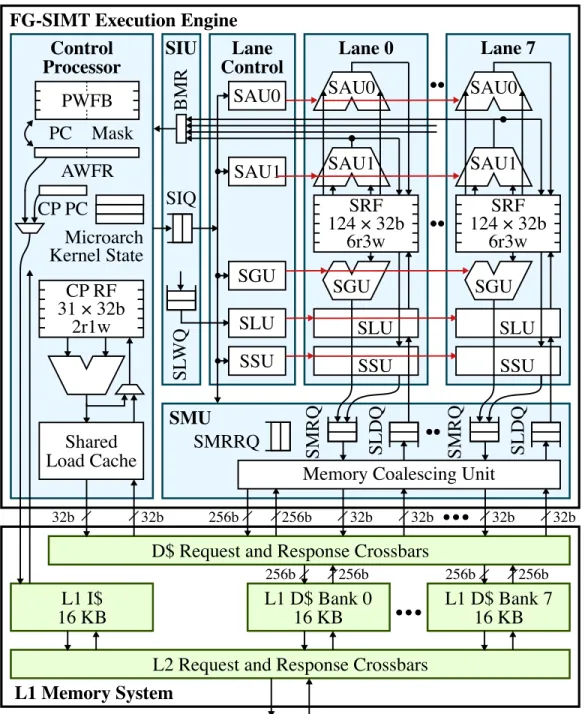
Computer architects are increasingly turning to programmable accelerators tailored for narrower classes of applications in order to achieve high performance and energy efficiency. A continuing challenge with accelerators is enabling the programmer to easily extract maximum performance without intimate knowledge of the underlying microarchitecture. It is important to consider pro-ductivity and portability, in addition to performance, as first-class metrics when developing and evaluating modern computing platforms. Software-centric approaches to achieving 3P comput-ing platforms are compellcomput-ing, but sacrifice efficiency and flexibility by hidcomput-ing parallel abstractions from hardware and limiting the scope of the application domain. This thesis proposes a new software/hardware co-design approach to achieving 3P platforms, called the loop-task accelerator (LTA) platform, that provides high productivity and portability without sacrificing performance or efficiency across a wide range of applications. The LTA platform addresses the weaknesses of ex-isting approaches that are identified through detailed experimentation with and analysis of modern application development. Discussion of an early attempt at a hardware-centric approach to achiev-ing 3P platforms provides insight into area-efficient accelerator designs and highlights the need for innovations in both software and hardware. The LTA platform focuses on exploiting loop-task par-allelism by exposingloop-tasksas a common parallel abstraction at the programming API, runtime, ISA, and microarchitectural levels. The LTA programming API uses theparallel_forconstruct to express loop-tasks that can be exploited both across cores and within a core, the LTA runtime distributes loop-tasks across cores, and a new xpforinstruction explicitly encodes loop-tasks as functions applied to a range of loop iterations. This thesis introduces a novel task-coupling taxon-omy that captures how tasks can be coupled in both space and time. The LTA engine template can be configured at design time with variable spatial and temporal task coupling to accelerate the ex-ecution of both regular and irregular loop-tasks within a core. The LTA platform is evaluated with
respect to the 3P’s using a vertically integrated research methodology. Compared to an in-order multi-core baseline, the LTA platform yields average improvements of 5.5×in raw performance, 2.5×in performance per area, and 1.2×in energy efficiency, while offering high productivity and portability.
BIOGRAPHICAL SKETCH
Ji Yun Kim was born on July 3, 1987 in Seoul, South Korea. He is the eldest son of Dae Kun Kim and Kang In Kim, and has one younger brother, Chang Yun Kim. When he was 6 years old, Ji and his family immigrated to the United States to pursue better education and a brighter future. As a youth, Ji became fascinated with the electronics that his father would bring back from his business trips in Japan. This sparked his interest in electrical and computer engineering and he began learning how to program and building personal computers. Ji attended the University of Pennsylvania for his undergraduate studies where he majored in electrical engineering. Although his background was in digital circuits and his initial intent was to continue his graduate studies researching radios and fiber optic communication systems, two serendipitous events pushed him towards computer architecture. First, a senior-level class in computer organization broadened his perspective on how the circuits he was designing could be utilized in a complex system. Second, his capstone project (enhancing the resiliency of VoIP) was heavily focused on software, which sparked an interest in application development. These events in combination fostered a deeper interest in the software/hardware interface of computer architecture. At Cornell University, Ji began his PhD career with his advisor, Professor Christopher Batten. Under Professor Batten’s tutelage, Ji learned the fundamentals of computer architecture from the ground up, eventually gaining invaluable experience in application development, software runtimes, compilers, as well as microarchitecture and ASIC design.
In his free time Ji enjoys board games, reading, cooking, guitar, biking, and experiencing different cultures abroad. His favorite authors include Haruki Murakami, Kurt Vonnegut, and Paul Auster. His favorite drinks include single-malt whiskey and beers as dark as the night. One day Ji hopes to write a novel of his own and retire to a wood cabin in the wilderness of Maine where he hopes to spend the rest of his days building high-end wooden furniture. Ji is thankful for his PhD experience–through the successes and the failures, the joys and the pains, sometimes it takes seeing your best and your worst to know where to go next.
ACKNOWLEDGEMENTS
It goes without saying that a constant source of inspiration and motivation in my PhD career was my graduate committee consisting of three of the most brilliant people I have ever met: Prof. Christopher Batten, Prof. Jose Martinez, and Prof. Rajit Manohar. This thesis would not be what it is without the invaluable feedback and guidance from these advisors. I would especially like to thank my mentor, Christopher Batten, who not only gave me an opportunity to mature as a researcher, but as a person; for pushing me to be ceaseless in the pursuit of truly great research, and for helping me get through some of the darkest times in my life. One day I hope to be half the researcher he is.
The work in this thesis was built on the foundations laid by my amazing colleagues in the Batten Research Group and I would like to extend a sincere thanks to students both past and present. The technical contributions of each member in the group along with the detailed acknowledgements of other technical collaborators (e.g., Yunsup Lee, Martin Burtscher, Rupesh Nasre, Sripathi Pai, David Bindel) are in Section 1.3, so I would like to use this section for personal thanks. Derek Lockhart guided me as a more experienced graduate student in my early years and I’m thankful for the times that we shared. Shreesha Srinath is a dear friend who has been with me through thick and thin–I would not be here without his council and advice. His passion for research and breadth of knowledge never ceases to impress me. Christopher Torng is a fantastic researcher and is surely destined for success in academia. It was because of Chris I pushed myself to be a better mentor. Berkin Ilbeyi is one of the most gentle and polite human beings I have the pleasure of knowing (he is also a Python wizard). Moyang Wang is a dedicated and outstanding colleague who is already better at C++ than I am at the end of my PhD career. The two newest additions to BRG, Shunning Jiang and Khalid Al-Hawaj, are enthusiastic and talented individuals that make me excited to see the future of BRG. I would also like to acknowledge the tremendous work of the fantastic MEng students I have worked with: Scott McKenzie, Alvin Wijaya, Jason Setter, and Wei Geng.
Aside from my own research group, I would like to thank my friends in the Computer Systems Laboratory at Cornell. KK Yu has been a cherished mentor in my life since I met him, academically and spiritually. KK was always there to listen to me complain, and without him there to give me perspective I would probably have lost my way. Daniel Lo is another great friend who is a joy to be around. His hundreds of hobbies and interests reflect his joy for life and gives me something to strive toward. Ritchie Zhao is my one and only true heir to the throne and, especially in my later
years, was my greatest source of companionship. I will treasure my memories with him and my only regret is not being able to spend more time together. There are many more important people that I will not forget: Rob Karmazin, Saugata Ghose, Jon Tse, Kyle Wecker, Maya Kelner, Janani Mukundan, and the list goes on. A special acknowledgement to the Ward 101 crew of Charles Jeon and Ryan Lee, it was fun while it lasted and thanks for being there during the worst of times.
I would further like to extend my thanks to my undergraduate research advisors, Prof. Jan Van der Spiegel and Prof. Andre DeHon at the University of Pennsylvania, who were willing to take in a inexperienced student into their groups. Without the time I spent in that research environment, I would not have decided to pursue a PhD. In addition, I would like to thank my friend and confidant, Jefferson Wen, who I have known since freshmen year at the University of Pennsylvania, for his support and unwaivering kindness over these many years.
Last but absolutely not least, I would like to thank my family for being loving, supportive, and patient. From a young age, my parents, Dae and Kang Kim, instilled in me the importance of education and pursuing my passion to help others. I hope that what I have learned and experienced during my PhD will help me to succeed in touching people’s lives no matter where I end up. My younger brother and best friend, Chang Kim, inspired me to believe in the best of myself and always manages to cheer me up when I need it. Finally, I would like to extend a special thanks to my grandfather, Hui Sok Kim, who has been my role model since I was a child and supported me in uncountable ways my entire life. His guidance and his belief in me has shaped me into the man I am today.
In terms of funding, this thesis was supported in part by an NDSEG Fellowship, NSF CA-REER Award #1149464, NSF XPS Award #1337240, NSF CRI Award #1512937, NSF SHF Award #1527065, AFOSR YIP Award #FA9550-15-1-0194, and donations from Intel Corpora-tion, NVIDIA CorporaCorpora-tion, and Synopsys, Inc.
TABLE OF CONTENTS
Biographical Sketch . . . iii
Dedication . . . iv
Acknowledgements . . . v
Table of Contents . . . vii
List of Figures . . . ix
List of Tables . . . x
List of Abbreviations . . . xi
1 Introduction 1 1.1 The 3P’s: Productivity, Portability, and Performance . . . 1
1.2 Thesis Overview . . . 3
1.3 Collaboration, Previous Publications, and Funding . . . 6
2 Software/Hardware Platforms for Exploiting Loop-Task Parallelism 8 2.1 CMP Platforms . . . 11
2.1.1 Optimizations for Successful Auto-Vectorization . . . 11
2.1.2 Multi-Threading with Task-Based Runtime . . . 15
2.1.3 Combining Multi-Threading with Auto-Vectorization . . . 18
2.2 MIC Platforms . . . 19
2.3 GPGPU Platforms . . . 21
2.4 Summary and Discussion . . . 24
3 Fine-Grain SIMT 26 3.1 FG-SIMT Overview . . . 26
3.2 FG-SIMT Value Structure . . . 28
3.3 FG-SIMT Microarchitecture . . . 30
3.4 FG-SIMT Evaluation . . . 36
3.4.1 Performance Analysis . . . 36
3.4.2 Area and Cycle Time Analysis . . . 37
3.4.3 Energy Analysis . . . 38
3.5 FG-SIMT Summary . . . 39
4 Loop-Task Accelerator Software 41 4.1 Programming API . . . 42
4.2 Task-Based Runtime . . . 44
4.3 Instruction-Set Architecture . . . 47
5 Loop-Task Accelerator Hardware 50 5.1 Task-Coupling Taxonomy . . . 50
5.2 Loop-Task Accelerator Engine Template . . . 56
5.2.1 Exception Handling . . . 61
6 Loop-Task Accelerator Evaluation Methodology 64
6.1 Application Kernels . . . 64
6.2 Loop-Task Accelerator Runtime . . . 66
6.3 Performance Modeling . . . 67
6.4 Area Modeling . . . 68
6.5 Energy Modeling . . . 70
7 Loop-Task Accelerator Evaluation Results 71 7.1 Loop-Task Accelerator Engine: Spatial Task-Coupling . . . 71
7.2 Loop-Task Accelerator Engine: Temporal Task-Coupling . . . 78
7.3 Loop-Task Accelerator Platform . . . 82
7.3.1 Combining Inter-Core and Intra-Core Mechanisms . . . 83
7.3.2 Productivity and Portability . . . 84
7.4 Loop-Task Accelerator Case Studies . . . 85
7.4.1 Impact of Shared LLFUs on Spatial Task-Coupling . . . 85
7.4.2 Impact of µthread Count on Temporal Task-Coupling . . . 87
7.4.3 Impact of Memory Latency on Temporal Task-Coupling . . . 88
8 Related Works 90 8.1 Software-Centric Approaches . . . 90
8.2 Hardware-Centric Approaches . . . 92
9 Conclusions 95 9.1 Thesis Summary and Contributions . . . 95
9.2 Future Work . . . 98
LIST OF FIGURES
1.1 Vision for Loop-Task Accelerator (LTA) Platform . . . 4
2.1 Example Development Flow for High-Performance Applications . . . 8
2.2 Performance Comparison of Selected SW/HW Platforms . . . 10
2.3 Example Development Flow forrgb2cmykKernel . . . 12
2.4 Using TBB inbfs-ndKernel . . . 14
2.5 Combining TBB and AVX inrgb2cmykKernel . . . 17
2.6 Topology- vs. Data-driven Implementations ofbfs-nd . . . 22
3.1 Example of Value Structure in SIMT Code . . . 29
3.2 Detailed FG-SIMT Microarchitecture . . . 31
3.3 FG-SIMT CP with Compact Affine Execution . . . 34
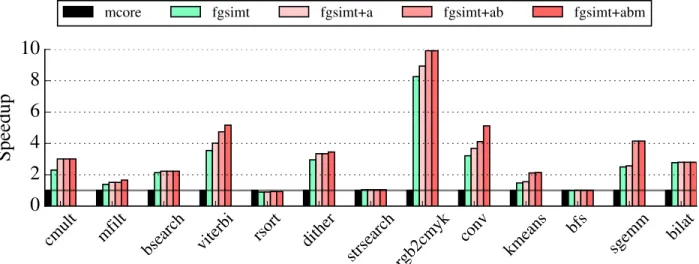
3.4 FG-SIMT Cycle-Level Performance . . . 36
3.5 FG-SIMT Area Breakdown . . . 37
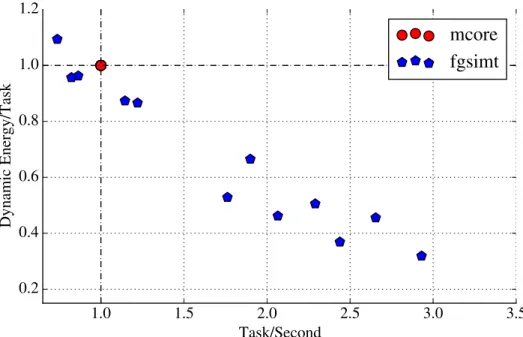
3.6 FG-SIMT Energy vs. Performance . . . 38
4.1 LTA Application Development Flow . . . 41
4.2 Anatomy of a Loop-Task . . . 42
4.3 LTA Programming API . . . 43
4.4 Example LTA Runtime Task Partitioning . . . 44
4.5 LTA-Aware Task Partitioning . . . 46
4.6 Example µtask to µthread Mapping . . . 48
5.1 LTA Engine with Tight Task Coupling . . . 51
5.2 LTA Engine with Loose Task Coupling in Space and Tight Task Coupling in Time 53 5.3 LTA Engine with Loose Task Coupling in Space and Time . . . 53
5.4 Terminology for Task-Coupling Taxonomy . . . 54
5.5 Task-Coupling Taxonomy . . . 55
5.6 Types of Control Divergence . . . 56
5.7 LTA Engine Template . . . 57
6.1 Performance Comparison of Various Runtimes on x86 . . . 67
7.1 Performance of Single-Core LTA Engines with Variable Spatial Task-Coupling . . 72
7.2 Area Breakdown of Single-Core LTA Engines with Variable Spatial Task-Coupling 75 7.3 Spatial Task-Coupling Energy Breakdown . . . 76
7.4 Spatial Task-Coupling Energy Efficiency vs. Performance . . . 76
7.5 Performance of Single-Core LTA Engine with Variable Temporal Task-Coupling . 79 7.6 Temporal Task-Coupling Energy Breakdown . . . 81
7.7 Temporal Task-Coupling Energy Efficiency vs. Performance . . . 81
7.8 Performance of LTA Platform on Multi-Core System . . . 83
7.9 Variable Spatial Task-Coupling with No LLFU Sharing . . . 86
7.10 Variable µthread Count and Temporal Task-Coupling . . . 87
LIST OF TABLES
2.1 Application Kernels for Native Experiments . . . 10
4.1 LTA Instruction-Set Architecture Extensions . . . 47
6.1 Application Kernel Characterization for Simulator Experiments . . . 65
6.2 Cycle-Level Simulator System Configuration . . . 68
7.1 Application Kernel Statistics for Simulator Experiments . . . 73
LIST OF ABBREVIATIONS
CMP chip multiprocessor
MIC many integrated core
GPGPU general-purpose graphics processing unit
SIMD single-instruction multiple-data
SIMT single-instruction multiple-thread
RISC reduced instruction set computer
GPP general-purpose processor
LTA loop-task accelerator
TBB (Intel) threading building blocks
AVX (Intel) advanced vector extensions
CUDA (NVIDIA) compute unified device architecture
API application programming interface
DSL domain-specific language
IR intermediate representation
ISA instruction set architecture
CAD computer aided design
RTL register-transfer level
VLSI very-large-scale integration
ASIC application-specific integrated circuit
TMU task management unit
IMU instruction management unit
PIB pending instruction buffer
DMU data management unit
PDB pending data buffer
FU fetch unit
PC program counter
PFB pending fragment buffer
DU decode/dispatch unit
RT rename table
IU issue unit
IQ issue queue
RF register file
SLFU short-latency functional unit
LLFU long-latency functional unit
LSU load/store unit
WCU writeback/commit unit
WQ writeback queue
SRAM static random access memory
DRAM dynamic random access memory
I$ instruction cache
CHAPTER 1
INTRODUCTION
With Moore’s Law approaching its end [Dub05], architects are increasingly turning to pro-grammable accelerators that can achieve high performance and energy efficiency by specializing for narrower classes of applications. Examples include mainstays like traditional vector proces-sors [EVS98, EV96, Oya99] and packed single-instruction multiple-data (SIMD) engines [Hug15, SS00], but more recently include Intel’s many integrated core architectures [Kan16] (MIC), NVIDI-A/AMD’s general-purpose graphics processing units [nvi16, amd12a] (GPGPU), Movidius’ im-age/vision accelerators [Dem14], and Qualcomm’s mobile-focused accelerators [Gwe14]. Unfor-tunately, the continuing challenge is how much performance and energy efficiency the programmer canactually extract from the hardware. Extracting the highest levels of performance and energy efficiency often requires a significant amount of optimizations based on a deep understanding of the underlying microarchitecture [AJ88,DKH11,JR13,LZH+13,BNP12,HKOO11] and optimized implementations of the same application can be vastly different depending on the target architec-ture [HVS+13, LZH+13, LWH10, MLBP12]. Furthermore, current accelerators primarily address applications with very regular control-flow and memory-access patterns. In this emerging era of computer architecture, it is clear that performance cannot be the sole metric for developing and evaluating computing platforms composed of software frameworks and hardware architectures.
1.1
The 3P’s: Productivity, Portability, and Performance
The challenges described above suggest that computer architects should focus on “the 3P’s” of
productivity, portability, and performanceas the primary metrics in developing and evaluating computing platforms. In fact, recent trends indicate that architects are already placing more value on productivity and portability.
The demand for productivity is evidenced by the increasing popularity of task-based parallel programming frameworks such as Intel’s C++ Threading Building Blocks (TBB) [Rei07, int15], Intel’s Cilk Plus [Lei09, int13], Microsoft’s .NET Task Parallel Library [LSB09, CJMT10], Java’s Fork/Join Framework [Lea00, jav15], and OpenMP [ACD+09, ope13]. This is in contrast to more traditional thread-based frameworks like POSIX threads, C++11 threads, and MPI [mpi13]. Thread-based programming models require explicit thread management and static work
distribu-tion with no dynamic load balancing. On the other hand, task-based programming models implic-itly manage an optimal number of threads for the system in athread pooland dynamically schedule fine-grain tasks across any available threads. This frees the programmer to think at a higher level of abstraction and leaves the lower-level details to a software runtime.
Although tasks can express a wide range of parallel programming patterns, loops remain one of the most popular targets of task-based parallelization. This thesis focuses on a subset of task par-allelism calledloop-task parallelism that is captured by the ubiquitousparallel_forconstruct. Loop-task parallelism can be seen as a more general form of data parallelism, where the operator applied to a range of loop iterations can have enough variability due to data-dependent conditionals that loop iterations are closer to exhibiting task parallelism. Loop-task parallelism can be regular or irregular depending on whether there are structured control-flow and memory-access patterns across loop iterations. Note that data parallelism as exploited by traditional vector processors gen-erally refers toregular data parallelism; loop-task parallelism captures regular data parallelism as well as more irregulartaskparallelism across loop iterations. For the sake of brevity, applications with regular or irregular loop-task parallelism may be referred to as regular or irregular applications throughout this thesis.
The need for portability is indicated by the profusion of research on efficiently mapping both regular and irregular applications to accelerators like Intel’s MICs [PHSJ13, HVS+13, LZH+13, PBV+13] and NVIDIA/AMD’s GPGPUs [NBP13b, BNP12, HKOO11, LWH10]. As this trend continues, it would be desirable to have seamless portability between a more conventional chip multiprocessor (CMP) implementation and MIC/GPGPU implementations. This is especially true for applications with high performance targets since it is not always possible to predict which architecture would yield the best performance and with what cost in productivity [LKC+10].
Although software-centric approaches to achieving 3P platforms exist, they are not without their own tradeoffs. Virtual ISAs, like in AMD’s heterogeneous system architecture [amd12b] (HSA), leverage software frameworks like OpenCL [ope11] and C++AMP [Som11] as a com-mon framework that are lowered to an intermediate representation that can be further lowered to multiple hardware architectures. Domain-specific languages (DSL), like Halide [RKBA+13] and DeLite [BSL+11], focus on expressing highly specialized abstractions for a narrow application domain that the compiler can map to multiple hardware architectures. Unfortunately, in their cur-rent incarnations, both of these approaches fall short of their proposed productivity and portability
goals. For example, a non-trivial amount of architecture-specific optimizations are still required to yield the highest performance, and optimized implementations of the same application differ substantially depending on the target architecture. In addition, the parallel abstractions used by software-centric approaches are never directly exposed to the hardware (i.e., only pushed down to the compiler level), meaning much of the information about available parallelism is never explic-itly communicated to the hardware. If a hardware accelerator were to be fundamentally designed to understand the same abstractions in software, there would be more opportunities to efficiently exploit the available parallelism. It is also important to note that both of these approaches do not support fine-grain inter-core load balancing.
1.2
Thesis Overview
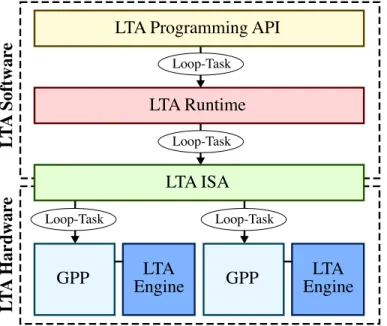
This thesis proposes theloop-task accelerator(LTA) platform, a software/hardware co-design approach for a 3P platform that seeks to maintain high productivity and high portability without sacrificing performance or efficiency across a wide range of applications. The LTA platform ef-ficiently exploits loop-task parallelism by exposingloop-tasksas the common parallel abstraction at the programming API, runtime, ISA, and microarchitectural levels. Figure 1.1 illustrates the overall vision for the LTA platform. Loop-tasks can be exploited acrosscores in software via a task-based work-stealing runtime andwithin a core in hardware via a special accelerator, called an LTA engine, attached to a general-purpose processor (GPP). LTA engines can be configured at design time to be tailored for diverse loop-task parallelism and can be homogeneous or heteroge-neous.
Chapter 2 details my personal experience developing, porting, and optimizing application ker-nels with diverse loop-task parallelism to several platforms consisting of different software frame-works (e.g., TBB, CUDA) and hardware architectures (e.g., CMP, MIC, GPGPU). My findings suggest that no single platform excels at the 3P’s for both regular and irregular loop-task parallel applications. One of the key observations from this study is that a software/hardware co-design approach that innovates across the computing stack may offer the best chance at achieving a true 3P platform.
Chapter 3 describes an early attempt at a hardware-centric approach to achieving a 3P platform called fine-grain SIMT (FG-SIMT). FG-SIMT is a SIMT-like programmable accelerator that is
LTA Runtime
LTA Engine
GPP GPP EngineLTA
LTA Programming API
LTA ISA L T A Softw ar e L T A Hardwar e Loop-Task Loop-Task Loop-Task Loop-Task
Figure 1.1: Vision for Loop-Task Accel-erator (LTA) Platform –The goal of the LTA platform is to efficiently exploit loop-task parallelism both across cores and within a core by exposingloop-tasksas the common abstraction throughout the com-puting stack. The LTA programming API exposes loop tasks using the ubiquitous
parallel_for construct. The LTA run-time generates, partitions, and distributes loop tasks across cores. The LTA ISA is used to explicitly encode loop tasks. The LTA engines accelerate regular or irregu-lar loop tasks within a core.
designed for fine-grain integration into a MIC-like architecture. FG-SIMT addresses productivity by using threads as a common parallel abstraction (similar to CUDA) which are grouped into basic scheduling units calledwarps, addresses portability by using a single ISA on both the GPP and the accelerator, and addresses performance by focusing on exploiting intra-warp parallelism in lieu of inter-warp parallelism like in GPGPUs as well as enabling fine-grain work offloading. Although FG-SIMT is able to achieve impressive performance and energy efficiency on regular applications, it struggles to do so on more irregular applications. In addition, FG-SIMT is only examined in a single-core context and does not provide any major innovations in software. The conclusions from the FG-SIMT study further serve to motivate the need for innovation in both software and hardware, and inspires aspects of the LTA microarchitecture.
Chapters 4 and 5 detail the software and hardware components of the proposed LTA platform that seeks to achieve the 3P’s for both regular and irregular loop-task parallel applications. The key idea is to narrow the scope of the software, broaden the scope of the hardware, and marry these layers by exposing loop-tasks as a common parallel abstraction across the computing stack. The LTA programming API uses the familiarparallel_forconstruct to express loop-tasks that can be exploitedbothacross cores and within a core. The LTA task-based work-stealing runtime, inspired by TBB, distributes tasks across cores in software. The LTA platform extends a RISC-V-like ISA with a newxpforinstruction that explicitly encodes loop-tasks as a function applied over a range of loop iterations. This instruction can be executed on either traditional GPPs or on LTA engines that are designed to accelerate loop-task execution. I introduce a task-coupling taxonomy that
elegantly captures the spectrum of spatial and temporal task coupling within an LTA engine, and describe the impacts of task coupling on performance, area, and energy efficiency when executing regular and irregular loop-task parallel applications. Furthermore, the LTA engine template can be configured at design time with different levels of spatial and temporal task coupling, enabling a deep design-space exploration of this taxonomy.
Chapter 6 outlines the vertically integrated research methodology used to evaluate the LTA platform. My colleague and I have ported 16 C++ application kernels which include a diverse mix of regular (e.g., image/matrix processing), irregular (e.g., string processing, graph analysis), and mixed (e.g., sorting) loop-task parallelism. The LTA runtime is validated against other popular task-based work-stealing runtimes. For performance analysis, I use the gem5 cycle-level simula-tor [BBB+11] and PyMTL, a Python-based hardware modeling framework [LZB14]. For area and energy analysis, I use component/event-based modeling based on VLSI results of similar acceler-ator designs [SIT+14, KLST13] obtained using a commercial ASIC CAD toolflow with a TSMC 40nm standard cell library.
Chapter 7 presents the cycle-level performance, area-normalized performance, and energy ef-ficiency of the LTA platform compared to single-core and multi-core baseline architectures. The results indicate that a moderate amount of both spatial and temporal task coupling offers the best performance across the widest range of applications, and the resulting multi-core LTA platform yields average improvements of 5.5×in raw performance, 2.5×in performance per area, and 1.2× in energy efficiency compared to a in-order multi-core baseline. Compared to a more aggressive out-of-order multi-core baseline, the LTA platform is able to achieve 3.0× improvement in raw performance, 1.7×in performance per area, and 2.5×in energy efficiency. Both the baseline and LTA platforms use the same LTA programming model and runtime. Productivity and portability are improved since a single implementation of any given application can take full advantage of the LTA engines on systems with (or without) any combination of LTA engines.
Chapter 8 catalogues the large body of related work and crystallizes the novelty of the LTA plat-form. Chapter 9 summarizes the contributions of this thesis and highlights interesting directions for extending this thesis.
The primary contributions of this thesis are condensed below:
• Detailed analysis of the3P challenges in modern application development flowsbased on years of computer architecture experience.
• The FG-SIMT architecture, an area-efficient accelerator for regular loop-task parallelism with microarchitectural mechanisms for exploiting value structure, and a detailed evaluation of this architecture with respect to performance, area, and energy based on RTL and gate-level models.
• Software components of the LTA platform including a productive TBB-likeLTA program-ming API, a task-based work-stealing LTA-aware runtimeand lightweight LTA ISA ex-tensions including a newxpforinstruction that explicitly encodes loop-tasks as a common parallel abstraction.
• Atask-coupling taxonomythat describes the spectrum of how tasks can be coupled in space and time, with appropriate terminology.
• Hardware components of the LTA platform including an elegant microarchitectural template for theLTA enginethat can be configured at design time with variable spatial and temporal task coupling to target diverse loop-task parallelism.
• Deep design space exploration of the impacts of task coupling in the LTA engine on perfor-mance, area, and energy, as well as a 3P evaluation of the LTA platform using a vertically integrated research methodology.
1.3
Collaboration, Previous Publications, and Funding
This thesis would not have been possible without the immense effort and dedication of all of the members of the Batten Research Group. My advisor Christopher Batten was the key collaborator in iteratively evolving the concepts behind the LTA platform, such as exploring task coupling in timeas well as space, and helping to refine the narrative to how it is presented in this thesis. Derek Lockhart is the lead developer of PyMTL, the hardware modeling framework used to model the LTA engines, and was integral in establishing the ASIC CAD toolflow used to generate VLSI results for area/energy modeling. Shreesha Srinath developed the gem5-PyMTL co-simulation framework which allowed me to leverage more sophisticated memory system and network models, and ported many application kernels to the LTA platform. Berkin Ilbeyi significantly improved the performance of the aforementioned co-simulator, making the experiments in this thesis viable, and also helped in the development of a couple key components of the LTA engine model. Christopher
Torng and Moyang Wang developed the task-based work-stealing runtime that eventually became the LTA runtime. Chris also authored the event-based energy modeling used in this thesis and was a tremendous resource for VLSI knowledge. Moyang also validated the LTA runtime and helped conduct native experiments. Khalid Al-Hawaj and Shunning Jiang characterized and ported many application kernels used in this thesis. I would also like to acknowledge Scott McKenzie and Alvin Wijaya for their fantastic work and insights on experimenting with early versions of loose spatial task-coupling, as well as Jason Setter and Wei Geng for their equally impressive work on modeling a new scalar processor based on lessons learned from developing the LTA engine.
Collaborators from other research groups are also responsible for making this thesis possible. Yunsup Lee of SiFive was a great resource during the development of early fine-grain SIMT mod-els, especially with establishing the ASIC CAD toolflow and providing me with reference RTL. The entire LonestarGPU benchmark suite team, especially Prof. Martin Burtscher, Prof. Rupesh Nasre, and Sripathi Pai, generously provided additional code and insights into mapping irregular applications to GPGPUs. In addition, Prof. David Bindel at Cornell University graciously granted me access to several Intel Xeon Phi 5110P co-processors which were used in the experiments described in Chapter 2.
Two previous publications have contributed significantly to this thesis. My work on fine-grain SIMT [KLST13] (FG-SIMT) processors was the basis for the lane groups within the LTA engine. The LTA engine implementations of chime sequencing, vector bypassing, density-time, and two-stack reconvergence, amongst many other features, are based off of the RTL model I wrote for FG-SIMT. This RTL model is also the basis for the VLSI results used to build the area/energy modeling in this thesis. My work on integrating hardware worklists [KB14] (HWWL) into GPGPUs helped me to realize the importance of the 3P’s as well as pushing software abstractions down to the physical ISA layer. Results from the HWWL paper also revealed that work is rarely transferred across cores (compared to work generated within a core), which was part of the motivation for using a software inter-core work distribution mechanism in the LTA platform.
In terms of funding, this thesis was supported in part by an NDSEG Fellowship, NSF CA-REER Award #1149464, NSF XPS Award #1337240, NSF CRI Award #1512937, NSF SHF Award #1527065, AFOSR YIP Award #FA9550-15-1-0194, and donations from Intel Corpora-tion, NVIDIA CorporaCorpora-tion, and Synopsys, Inc.
CHAPTER 2
SOFTWARE/HARDWARE PLATFORMS FOR EXPLOITING
LOOP-TASK PARALLELISM
This chapter provides a detailed account of developing, porting, and optimizing seven applica-tion kernels with diverse loop-task parallelism across several existing platforms. These platforms are qualitatively evaluated with respect to productivity and portability, and quantitatively evaluated with respect to performance. The goal here is not to exhaustively survey all existing platforms, but rather to identify generalizable weaknesses that prevent existing platforms from achieving all 3P’s, thereby motivating the need for a new approach for a true 3P platform.
Figure 2.1 illustrates an example development flow for high-performance applications using platforms with various software frameworks and hardware architectures. Specifically, this study examines AVX on CMPs, TBB on CMPs, TBB+AVX on CMPs, TBB/OpenMP+AVX on MICs, and CUDA on GPGPUs. In general, application development begins with a single-threaded scalar implementation on the CMP to verify functionality. At this point, the programmer can extract more performance on a CMP by vectorizing the code on a single thread using packed-SIMD extensions like SSE/AVX, or by parallelizing the code across multiple threads using a parallel programming framework like TBB. In some cases, combining multi-threading across cores and vectorization within a core can achieve multiplicative effects in performance on the CMP. However, as will be seen later in this section, combining these techniques is not as trivial as it may seem and, in certain cases, may actuallyworsenperformance. If the performance target is still not met, the application can be written for accelerators such as the MIC or GPGPU. This may require using a different
scalar TBB AVX TBB+AVX TBB/OMP +AVX CUDA CMP MIC GPGPU
Figure 2.1: Example Development Flow for High-Performance Applications – Application development begins with a single-threaded scalar implementation on a CMP, before proceeding to a single-threaded vectorized implementation us-ing AVX or a multi-threaded non-vectorized im-plementation. Combining multi-threading with vectorization can sometimes improve perfor-mance. Further performance improvements can be achieved by porting the application to accelerators like MICs or GPGPUs, which may require a differ-ent software framework.
software framework such as OpenMP or CUDA. Even if a common software framework is used across all architectures, target-specific optimizations and re-tuning are almost always necessary. Both MICs and GPGPUs use multi-threading across cores, but use different mechanisms for accel-erating execution within a core (i.e., packed-SIMD units for MICs, SIMT engines for GPGPUs). It is also worth noting that due to the fundamental differences in programming models between CMPs and MICs/GPGPUs, the programmer may choose to jump directly from a scalar implemen-tation on CMPs to the MIC/GPGPU implemenimplemen-tation. The caveat is that a careful analysis of the type of parallelism and amount of parallelism available is necessary to ensure the application is suitable for these accelerators.
Figure 2.2 shows the performance of five platforms described in the development flow above on the seven application kernels listed in Table 2.1. CMP experiments were conducted on Intel Xeon E5-2620 v3 (12 cores, 2.40GHz, AVX2, 16MB L3), MIC experiments were conducted on Intel Xeon Phi 5110P (60 cores, 1.05GHz, AVX-512, 30MB L2), and GPGPU experiments were conducted on NVIDIA Tesla C2075 (14 cores, 575MHz, 6GB DRAM). Application kernels are compiled using the Intel compiler (ICC v.14.0.2) as it has been proven to have the greatest success in auto-vectorizing code [MGG+11]. All results are normalized to an optimized scalar implemen-tation of the application kernel on a CMP.
The following includes brief descriptions of the application kernels examined in this study. More details can be found in Section 6.1.sgemmis a regular kernel that performs a single-precision matrix multiplication for square matrices using a standard blocking algorithm; computation is par-allelized across blocks.dct8x8mis a regular kernel that calculates the 8x8 discrete cosine transform on an image; computation is parallelized across 8x8 blocks. mriqis a regular kernel that performs image reconstruction for MRI scanning; computation is parallelized across the output magnetic field gradient vector. rgb2cmyk is a regular kernel that performs color space conversion on an image and computation is parallelized across the rows. bfs-nd is an irregular kernel that gener-ates a breadth-first-search tree from a directed cyclic graph; computation is parallelized across the frontier. maxmatchis an irregular kernel that identifies a maximal matching on an undirected graph; computation is parallelized across edges. strsearchis an irregular kernel that implements the Knuth-Morris-Pratt algorithm to search for a set of substrings in byte streams; computation is parallelized across different streams.
Name Suite Input
sgemm Custom, CUDA SDK 2K×2K float matrix dct8x8m Custom, CUDA SDK 518K 8×8 blocks
mriq Custom 262K-space 2K points
rgb2cmyk Custom 7680×4320 image
bfs-nd PBBS [SBF+12], LSG2.0 [BNP12] rMatG_J5_10M maxmatch PBBS [SBF+12], Custom randLocG_J5_10M
strsearch Custom 512 strs, 512 docs
Table 2.1: Application Kernels for Native Experiments –Benchmarks suites used as the basis for the CMP/MIC/GPGPU implementations may be necessarily different depending on availabil-ity. Every effort was made to use the same parallel algorithm across the various implementations unless otherwise stated in the text. Datasets used for native experiments are larger than those used for simulator experiments to saturate hardware resources. Average execution time for the scalar implementations is∼60 seconds.
sgemm
dct8x8m
mriq
rgb2cmyk
bfs-nd
maxmatch
strsearch
0
5
10
15
20
Speedup
63 165 478 59 132 32 cmp-scalar cmp-avx cmp-tbb cmp-tbb-avx mic-tbb-avx gpgpu-cudaFigure 2.2: Performance Comparison of Selected SW/HW Platforms – Normalized to cmp-scalar, the non-vectorized single-threaded implementation. cmp = Intel Xeon E5-2620 v3 (12 cores, AVX2/256b); mic = Intel Xeon Phi 5110P (60 cores, AVX-512); gpgpu= NVIDIA Tesla C2075 (14 SMs);avx= ICC v15.0.3 with auto-vectorization [MGG+11];tbb= TBB v4.3.3;cuda= CUDA v7.5.17.
2.1
CMP Platforms
The CMP platforms examined in this study use AVX and/or TBB as software frameworks and CMPs with packed-SIMD units as hardware architectures. To clarify, AVX as a software framework is referring to the optimizations for successfully auto-vectorizing code in conjunction with ICC-supported compiler hints, rather than the vector extensions themselves. One key differ-ence between AVX and TBB as software frameworks is the parallel abstraction: AVX operates on lower-level packed data within a core, whereas TBB operates on higher-level tasks across cores. Therefore, one could make a reasonable argument that combining these disjoint abstractions ac-tually changes the programming model enough that TBB+AVX should be treated as a separate software framework.
2.1.1 Optimizations for Successful Auto-Vectorization
Thecmp-avxresults in Figure 2.2 show the performance of the single-threaded vectorized im-plementation using AVX on a CMP. Vectorization is the process of generating special vector in-structions that use packed-SIMD units to operate on packed data (e.g., eight words per vector register in AVX2). Since packed-SIMD units require SIMD groups of packed data to be processed in lock-step, it cannot efficiently handle control-flow or memory-access divergence. As such, ap-plication kernels with regular loop-task parallelism (i.e.,sgemm,dct8x8m,mriq) see a speedup of at least 2.5×, whereas application kernels with irregular loop-task parallelism (i.e., bfs-nd, max-match,strsearch) see negligible benefits.
Since a 256b-wide packed-SIMD unit increases floating-point operation throughput by a factor of eight (not accounting for fused multiply-adds), the ideal speedup for a perfectly compute-bound application would be 8×. Of course, no application is perfectly compute-bound, so it is very diffi-cult to reach this upper bound. However, it is clear that more compute-bound application kernels achieve higher speedups compared to more memory-bound application kernels. For instance, the more compute-boundsgemmyields a speedup of 7×, whereas the more memory-bounddct8x8m has a less pronounced speedup of 2.5×. Although both application kernels use blocking algorithms to improve cache locality and help alleviate memory bottlenecks,dct8x8mhas a lower arithmetic intensity [WWP09] due to operating on smaller 8x8 blocks, which makes it more memory-bound thansgemm.
1 void rgb2cmyk_scalar(
2 RgbPixel** src, CmykPixel** dst, int size) 3 {
4 for (int i = 0; i < size; i++) { 5 for (int j = 0; j < size; j++) { 6
7 // Calculate intermediate values 8 int tmp_c = 255 - src[i][j].r; 9 int tmp_m = 255 - src[i][j].g; 10 int tmp_y = 255 - src[i][j].b; 11 int tmp_k = std::min(
12 tmp_c, std::min(tmp_m, tmp_y)); 13
14 // Store results into output array 15 dst[i][j].k = tmp_k; 16 dst[i][j].c = tmp_c - tmp_k; 17 dst[i][j].m = tmp_m - tmp_k; 18 dst[i][j].y = tmp_y - tmp_k; 19 } 20 } 21 }
(a)Single-Threaded Implementation
1 void rgb2cmyk_avx(
2 RgbPixel** src, CmykPixel** dst, int size) 3 {
4 // Restructure data into structs of arrays. 5 // Copy data to aligned arrays.
6
7 int nvecs_in_row = ceil(size / SIMD_WIDTH); 8 int aligned_size = nvecs_in_row * SIMD_WIDTH; 9
10 byte* __restrict__ aligned_r = 11 (byte*) memalign(
12 aligned_size * sizeof(byte), SIMD_WIDTH); 13 ...
14
15 for (int i = 0; i < size; i++) { 16 for (int j = 0; j < size; j++) { 17 RgbPixel pixel = src[i][j];
18 aligned_r[i*aligned_size+j] = pixel.r;
19 ...
20 }} 21
22 // Vectorize computation across rows 23 for (int i = 0; i < size; i++) {
24 #pragma simd vectorlength(SIMD_WIDTH) 25 for (int j = 0; j < aligned_size; j++) { 26 // Calculate index
27 int idx = i * aligned_size + j; 28
29 // Calculate intermediate values 30 int tmp_c = 255 - aligned_r[idx];
31 ...
32 int tmp_k = min_nobranch( 33 tmp_c, tmp_m, tmp_y); 34
35 // Store results into aligned output 36 aligned_k[idx] = tmp_k;
37 ...
38 }} 39
40 // Copy data to original output 41
42 for (int i = 0; i < size; i++) { 43 for (int j = 0; j < size; j++) { 44 CmykPixel* pixel = &dst[i][j];
45 pixel->c = aligned_c[i*aligned_size+j];
46 ...
47 }} 48 }
(b)Single-Threaded Implementation with AVX
1 void rgb2cmyk_tbb(
2 RgbPixel** src, CmykPixel** dst, int size) 3 {
4 // Flatten matrices
5 RgbPixel* flat_src, flat_dst; 6 flatten(flat_src, src, size); 7 ...
8
9 // Parallelize computation across rows 10 parallel_for(
11 blocked_range(0, size*size, TASK_SIZE), 12 [&] (blocked_range r) {
13 for (int i = r.begin(); 14 i != r.end(); i++) { 15
16 // Calculate intermediate values 17 int tmp_c = 255 - flat_src[i].r;
18 ...
19
20 // Store results into output array 21 flat_dst[i].k = tmp_k;
22 ...
23 }}); 24 ... 25 }
(c)Multi-Threaded Implementation with TBB
Figure 2.3: Example Development Flow for rgb2cmyk Kernel – Various implementations of color-space conversion on sample image for CMP/MIC.
The preferred method of vectorization is auto-vectorization by the compiler, but this term is a bit of a misnomer since naive attempts at auto-vectorization by only annotating loops with
#pragma simd or #pragma ivdep rarely result in any significant speedups. For example, this naive approach yielded speedups of less than 1.10×across all seven application kernels. With cur-rent compiler technology, maximally utilizing the packed-SIMD units requires numerous manual optimizations [AJ88, DKH11], sometimes referred to as explicit vectorization. This is true even for embarrassingly regular loop-task parallel application kernels likesgemm.
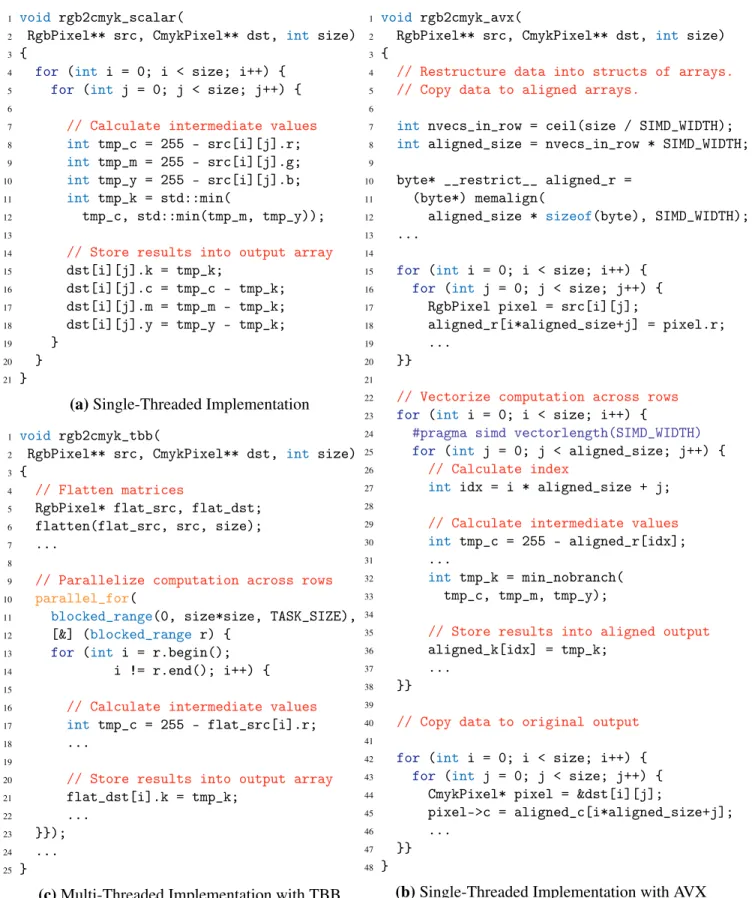
The key objectives of thesevector-optimizationsare to eliminate control flow and enable vector memory accesses. Figure 2.3(a) and Figure 2.3(b) show the single-threaded scalar and vectorized implementations, respectively, of thergb2cmykapplication kernel, which highlights the complex-ities of several vector-optimizations.
Eliminating control flow requires converting branches into arithmetic, often by using bit-level masking and shifting. For example, the expression y = (x < 0) ? -1 : 1 is equivalent to
y = 1 - (x >> 31) * 2. The tradeoff here is that this can reduce work efficiency by forcing the same operation to be applied to all data elements regardless of whether or not useful work is actually required. When branches are unavoidable, a less compute-efficient algorithm that is more amenable for vectorization can be used, but there is no guarantee the benefits of vectorization will outweigh the loss in compute efficiency. This is the case in dct8x8m, where the more compute-efficient Loeffler-Ligtenberg-Moschytz [LLM89] algorithm had unavoidable branches, thus a more naive algorithm was required for vectorization.
Enabling vector memory accesses means the programmer must ensure that memory accesses will be at SIMD-width-aligned boundaries with unit-stride access patterns. This requires explicitly allocating aligned arrays from/to which data needs to be copied before/after computation, and converting arrays of structs into structs of arrays. Lines 4–21 in Figure 2.3(b) showcases these vector-optimizations. Multi-dimensional arrays must be padded with ghost cells such that each row/column, depending on which dimension computation is vectorized across, is a multiple of the SIMD-width in order to ensure alignment persists across rows/columns. Aligning arrays can be complicated by the use of C++ data structures likestd::vector, which require custom allocators to ensure alignment of the underlying array in memory. The tradeoff here is that allocating and transferring aligned data can add a non-trivial performance overhead. This overhead is better amortized as the time spent on the computation relative to the transfer increases.
1 void bfs_nd_tbb(Node* G, int nnodes, int nedges) { 2 vector<int> front (nedges, 0);
3 vector<int> counts (nnodes, 0); 4 ...
5
6 int front_sz = 1; 7 visited[0] = 1; 8
9 // Process nodes in frontier until frontier is empty 10 while (front_sz > 0) {
11
12 // Initialize number of neighbors for nodes in frontier
13 parallel_for(blocked_range(0, front_sz), [&] (blocked_range r) { 14 for (int i = r.begin(); i != r.end(); i++)
15 counts[i] = G[front[i]].degree; 16 });
17
18 // Parallelize computation across nodes in frontier 19 int nremain = get_remaining_nodes(counts, front_sz);
20 parallel_for(blocked_range(0, front_sz), [&] (blocked_range r) { 21 for (int i = r.begin(); i != r.end(); i++) {
22 int k = 0;
23 int v = front[ri]; 24 int c = counts[ri]; 25
26 // Iterate across neighbors and update if lock obtained 27 for (int j = 0; j < G[v].degree; ++j) {
28 int ngh = G[v].neighbors[j];
29 if (visited[ngh] == 0 && CAS(&visited[ngh],0,1)) 30 front_next[c+j] = G[v].neighbors[k++] = ngh; 31 else 32 front_next[c+j] = -1; 33 } 34 35 G[v].degree = k; 36 } 37 }); 38
39 // Determine next frontier
40 front_sz = filter_frontier(front, front_next, nremain); 41 }
42 }
Figure 2.4: Using TBB in bfs-nd Kernel – Multi-threaded implementation using TBB of non-deterministic breadth-first search. This kernel is not suitable for vectorization due to unavoidable control flow and memory-access divergence, as well as the atomic compare-and-swap.
Other vector-optimizations include annotating non-overlapping arrays with the__restrict__
keyword, using__assume_alignedhints when passing aligned array pointers to helper functions, and the aforementioned annotation of vectorizable loops with#pragma simd/ivdep.
Note that the vector-optimizations described above only apply to regular loop-task parallel ap-plications. More irregular loop-task parallel applications may simply have too many unavoidable branches and unpredictable memory-access patterns (i.e., gathers, scatters) that prevent vectoriza-tion. Figure 2.4 shows an example of this case,bfs-nd, where vectorizing across nodes in the fron-tier fails due to the unavoidable control-flow divergence between nodes with different numbers of neighbors as well as the memory-access divergence when accessing nodes inG. Vectorizing across the neighbors for a given node also fails due to the data-dependent branch on visitedand the atomic compare-and-swap for which there is no vector equivalent.
In summary, although AVX on CMPs can improve performance for regular loop-task paral-lel applications, the required vector-optimizations greatly reduce productivity as apparent from the difference between Figure 2.3(a) and Figure 2.3(b). Implementing, testing, and tuning these seven application kernels for AVX on CMPs took an experienced programmer several programmer-weeks, and no amount of manual optimization significantly improved performance for irregular loop-task parallel applications.
2.1.2 Multi-Threading with Task-Based Runtime
Thecmp-tbbresults in Figure 2.2 show the performance of the multi-threaded non-vectorized implementation using TBB with 12 threads on a CMP. The CMP in this study has 12 four-way superscalar out-of-order cores, each capable of executing two virtual threads, but in this study, one thread is assigned per core, so that the impact of scaling can be isolated from the impact of virtualization. Unlike vectorization, multi-threading can improve performance for both regular and irregular loop-task parallel application kernels, as seen by the 2–11×speedup across all application kernels. However, like vectorization, the benefits of multi-threading can be limited by memory bottlenecks. As such, the most memory-bound application kernels (i.e.,dct8x8m, rgb2cmyk, bfs-nd, andmm) see a lower average speedup of 3×. Profiling the multi-threaded implementation of dct8x8m reveals that it is stalled on memory accesses 71% of the execution time, whereasmriq is only stalled on memory accesses 14% of the execution time. The memory bottlenecks of these application kernels are partially due to the size of the datasets as well. For example, the datasets
required to saturate hardware resources on the MIC/GPGPU for dct8x8m and rgb2cmyk are the largest of all the application kernels in this study. Reducing the dataset size by a factor of four yields an average speedup of 10×with TBB. In the case ofbfs-ndandmm, the memory bottleneck is further exacerbated by their reliance on fine-grain locking via atomic memory operations.
TBB is used due to its productive task-based programming model, library-based implementa-tion, and work-stealing runtime for fine-grain dynamic load balancing. Although there are other task-based parallel programming frameworks, the library-based approach is preferred to improve portability as opposed to a compiler-based approach like Cilk or OpenMP. However, preliminary experiments showed that performance trends described below for TBB extended to OpenMP as well.
Figure 2.3(c) shows what the multi-threaded implementation of rgb2cmyk looks like using TBB. One strategy is to parallelize computation across the rows of the image. Although in many cases this is sufficient, depending on the dimensions of the image, such coarse-grain parallelization may limit load balancing, especially across a large number of cores. Instead, it is often worthwhile to flatten any multi-dimensional arrays into a single-dimensional array to generate finer-grain tasks that improve load balancing. For example, in rgb2cmyk, flattening the input matrix improved performance by 14%. Note the parallel_for construct used to implement this strategy. The
blocked_range represents the range of loop iterations to which the function should be applied. TheTASK_SIZEmacro represents the TBBgrain sizewhich determines the minimum number of loop iterations in the range of executed tasks. This is an important parameter that needs to be changed for different application kernels. Smaller tasks improve load balancing, whereas bigger tasks introduce more runtime/loop overhead. If the cache footprint of each task is very small, bigger tasks can improve cache locality by ensuring consecutive blocks in memory are processed by the same core. In this study, grain sizes of 2–32 resulted in the highest performance. In general, relatively minimal changes are required to parallelize the single-threaded implementation shown in Figure 2.3(a).
In summary, TBB was the most productive framework in this study. Approximately one programmer-week was required to develop relatively high-performance parallel implementations of all the application kernels. Unfortunately, TBB is limited to exploiting loop-task parallelism across cores and is not able to leverage packed-SIMD extensions to exploit parallelism within a core without manual intervention.
1 void rgb2cmyk_tbb_avx(RgbPixel** src, CmykPixel** dst, int size) 2 {
3 // Restructure data into structs of arrays. 4 // Copy data to aligned arrays.
5 6 ... 7
8 // Parallelize computation across aligned chunks of rows 9
10 parallel_for(blocked_range(0, size * CHUNKS_IN_ROW, TASK_SIZE), 11 [&] (blocked_range r) {
12 for (int ri = r.begin(); ri != r.end(); ri++) { 13 int i = ri / CHUNKS_IN_ROW;
14 int i_offset = ri % CHUNKS_IN_ROW;
15 int j_start = i_offset * aligned_size / CHUNKS_IN_ROW; 16 int j_end = j_start + aligned_size / CHUNKS_IN_ROW; 17
18 // Vectorize computation within a chunk 19 #pragma simd vectorlength(SIMD_WIDTH) 20 for (int j = j_start; j < j_end; j++) { 21 // Calculate index
22 int idx = i * size + j; 23
24 // Calculate intermediate values 25 int tmp_c = 255 - aligned_r[idx];
26 ...
27
28 // Store results into aligned output 29 aligned_k[idx] = tmp_k; 30 ... 31 } 32 } 33 }); 34
35 // Copy data to original output 36
37 ... 38 }
Figure 2.5: Combining TBB and AVX in rgb2cmykKernel – Code that is restructured to in-crease the number of tasks for better load balancing without hindering auto-vectorization.
2.1.3 Combining Multi-Threading with Auto-Vectorization
The cmp-tbb-avx results in Figure 2.2 show the performance of a multi-threaded vectorized implementation using TBB with 12 threads and AVX on a CMP. Ideally, one would expect to see a multiplicative effect in performance onregularloop-task parallel application kernels by combining multi-threading across cores and vectorization within a core. Irregular loop-task parallel applica-tion kernels would not be expected to yield any improvements in performance from vectorizaapplica-tion as discussed above. Although the 63×speedup on sgemmdoes approach the ideal multiplicative speedup of 77×(7×from TBB, 11×from AVX), bothdct8x8mandmriqsurprisingly result in a slowdown. There are two key reasons why combining these techniques might not always yield a multiplicative effect.
First, task partitioning with TBB can limit auto-vectorization with AVX. Recall that vector memory accesses in AVX can only be generated when the compiler can guarantee memory accesses are SIMD-width-aligned. As such, the grain size in TBB should presumably be set to a multiple of the SIMD-width so that every task accesses SIMD-width-aligned memory. Unfortunately, TBB cannot guarantee exact task sizes at compile time due to the recursive decomposition algorithm the runtime uses to partition tasks. Since the compiler cannot guarantee tasks will access SIMD-width-aligned memory, it cannot safely vectorize a loop which might have been vectorizable without using TBB.
Second, vector-optimizations to enable AVX can limit load balancing with TBB. Specifically, eliminating control-flow divergence can also eliminate opportunities for load balancing by super-ficially equalizing the work across the SIMD group. Consideringcmp-tbb, which has no vector-ization, threads operating on tasks with less work due to control-flow divergence can more quickly steal another task than threads operating on tasks with more work. However, with vectorization, the entire SIMD group always does the maximum amount of work if all branches have been converted into arithmetic.
One easy way to address how task partitioning interferes with auto-vectorization is to par-allelize computation across rows/columns (for multi-dimensional data structures) and ensuring SIMD-width-alignment of each row/column. However, as mentioned above, such coarse-grain parallelization can limit load balancing. Figure 2.5 highlights an optimization that can help im-prove load balancing when combining TBB and AVX. The key here is to split rows into SIMD-width-aligned chunks, then parallelize computation across these chunks. The chunk index is used
to calculate the row and column indices into src and dst. The compiler can safely vectorize the annotate loop becausej_startis guaranteed to be a multiple of the SIMD width as long as the chunk size is also a multiple of the SIMD width. Unfortunately, comparing this code to Fig-ure 2.3(c) shows that combining TBB and AVX further increases the code complexity beyond a pure AVX implementation.
In summary, combining TBB with AVX does not always guarantee improvements in perfor-mance and negates the productivity of TBB. It took an experienced programmer another several programmer-weeks of manual optimizations to develop the multi-threaded vectorized implemen-tations of the application kernels.
2.2
MIC Platforms
The mic-tbb-avxresults in Figure 2.2 show the performance of the multi-threaded vectorized implementation using TBB with 60–240 threads and AVX on a MIC. The MIC in this study has 60 single-issue in-order cores, each capable of multi-threading four physical threads. MICs have longer cache-to-cache latencies than CMPs and do not have a shared L3 cache [Rei12, Bol12]. MICs are designed to accelerate applications with immense regular loop-task parallelism. This is evident from the many lightweight cores with very wide packed-SIMD units (512b wide). There-fore performance on the MIC largely depends on maximally utilizing these packed-SIMD units. The results also validate this claim as application kernels that can be successfully auto-vectorized (i.e., shows performance improves withcmp-avx), exhibit the highest speedups on the MIC. Due to the less aggressive memory system, some regular loop-task parallel application kernels that are memory-bound, like dct8x8mand rgb2cmyk, may struggle to achieve resource-proportional speedups. Resource-proportional speedups refers to performance that is reasonable for the amount of available hardware resources (e.g., closer to achieving maximum instructions per cycle, floating-point operations per second, memory throughput, etc.). Even irregular loop-task parallel applica-tion kernels can achieve high performance on MICs by leveraging the significantly increased core count,as long as they are not memory-bound. For instance,strsearchis able to achieve an impres-sive speedup of 15×even without any vectorization.
MICs support two programming models: a native model and an offload model. The native modelis used to compile code to run directly on the MIC. This approach is generally more
pro-ductive but is limited by the memory available on the MIC (8GB DRAM). Since the code executes natively on the MIC, any dependent libraries must also be cross-compiled for the MIC. Although Intel provides MIC-optimized versions of many of their libraries, like TBB, any custom libraries may need to be separately optimized for the MIC. Theoffload modelis a hybrid approach that is used to compile code to run on both the host and the MIC, where the former acts as the driver that spawns off coarse-grain kernels to the latter. This approach is much less productive, as it requires many manual adjustments common to all offload programming models. The challenges involved with such models, like CUDA, will be discussed in the next section. However, there are intricacies that are specific to the MIC offload model that further decrease productivity. A key example is the need to manually specify which data structures should be allocated, reused, or deleted between kernel launches. This kind of explicit memory management is essential for extracting the highest performance out of the MIC. In this study, all MIC implementations of the application kernels employ the native model.
Even thoughmic-tbb-avxuses the same software framework ascmp-tbb-avxin this study, there is still a non-trivial amount of re-tuning necessary to yield highest performance on the MIC. For example, due to the much higher core count, load balancing becomes even more important on the MIC. The optimal grain size on the MIC is usually smaller than on the CMP, and optimizations as previously shown in Figure 2.5 become even more important on the MIC. Furthermore, the optimal number of threads is different across application kernels. In fact, specifying the maximum number of threads per core is not always the best option, as there is a delicate balance between cache locality and hiding microarchitectural latencies. Finally, the lighter-weight cores also mean system calls are much more expensive on the MIC. In some cases it may be necessary to restructure code to eliminate dynamic memory allocation and TBB thread spawns to reduce performance overheads. As a reminder, the challenges with achieving a multiplicative effect in performance by combining TBB and AVX applies to the MIC as well.
In summary, porting and optimizing CMP implementations for the MIC is a non-trivial pro-cess, even when using the same software framework, and MICs may not always achieve resource-proportional performance for both regular and irregular loop-task parallel applications due to mem-ory bottlenecks and/or lack of vectorization.
2.3
GPGPU Platforms
The gpgpu-cudaresults in Figure 2.2 show the performance of a multi-threaded implementa-tion using CUDA with 448 threads on a GPGPU. GPGPUs have higher computaimplementa-tional throughput than CMPs/MICs, as evident by the 60–165× speedups onregular loop-task parallel application kernels. Irregular loop-task parallel application kernels struggle to achieve resource-proportional performance due to serialized execution and inefficient gathers/scatters. Application kernels that require inter-thread communication, such asbfs-ndandmaxmatch, experience even worse perfor-mance degradation due to atomic memory operations and synchronization barriers.
In terms of productivity, CUDA offers a unified approach to exploiting loop-task parallelism across and within cores, but its offload programming model requires substantial changes [nvi15] which include: explicit allocation/copying of device memory, manual work partitioning into block-s/grids (due to hardware scheduler), effective utilization of texture/shared memory, limitations on kernel arguments (e.g., complex structs with pointers to pointers), and restrictions on standard C++ containers likestd::vector within a kernel. The last point is addressed in part by the external libraries like Thrust [BH12]. In addition, inter-thread communication is especially difficult to ex-press efficiently, which may require barriers (i.e., __syncthreads). Barriers in CUDA should only be used whenallthreads are guaranteed to reach the barrier, otherwise deadlock is possible. If this condition cannot be guaranteed, it might be necessary to change the algorithm itself to avoid this barrier, for example by breaking the kernel into multiple phases as inmaxmatch.
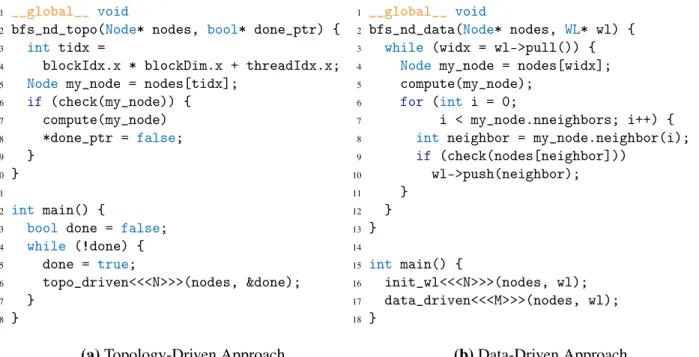
The challenges of mapping irregular loop-task parallel applications to GPGPUs has been in-tensively examined in my previous publication [KB14] as well as many other studies [BNP12, NBP13a, NBP13b, HN07, LWH10, MLNP+10, MLBP12]. Many irregular loop-task parallel appli-cations iteratively apply an operator to nodes in a graph which can modify the graph and generate more work. When mapping such applications to GPGPUs, two common approaches are taken: topology-driven and data-driven. The CUDA pseudo-code for the topology- and data-driven im-plementations of bfs-nd are shown in Figure 2.6. The algorithm iteratively applies a compute operator (i.e.,compute()) on a subset of nodes at which useful work is required, in an undirected, weighted graph. Such nodes are referred to as active nodes, whereas nodes at which no useful work will be done are referred to asinactive nodes. The node ID of an active node is called awork ID. A check operator (i.e.,check()) determines whether a node is active or inactive. The compute
1 __global__ void
2 bfs_nd_topo(Node* nodes, bool* done_ptr) { 3 int tidx =
4 blockIdx.x * blockDim.x + threadIdx.x; 5 Node my_node = nodes[tidx];
6 if (check(my_node)) { 7 compute(my_node) 8 *done_ptr = false; 9 } 10 } 11 12 int main() {
13 bool done = false; 14 while (!done) { 15 done = true;
16 topo_driven<<<N>>>(nodes, &done); 17 }
18 }
(a)Topology-Driven Approach
1 __global__ void
2 bfs_nd_data(Node* nodes, WL* wl) { 3 while (widx = wl->pull()) { 4 Node my_node = nodes[widx]; 5 compute(my_node);
6 for (int i = 0;
7 i < my_node.nneighbors; i++) { 8 int neighbor = my_node.neighbor(i); 9 if (check(nodes[neighbor])) 10 wl->push(neighbor); 11 } 12 } 13 } 14 15 int main() { 16 init_wl<<<N>>>(nodes, wl); 17 data_driven<<<M>>>(nodes, wl); 18 } (b)Data-Driven Approach
Figure 2.6: Topology- vs. Data-driven Implementations ofbfs-nd–Pseudo-code showing two common approaches to mapping irregular loop-task parallel applications to GPGPUs. The check operator determines if nodes are active and the compute operator performs work at these nodes. This can activate previously inactive nodes in the next super-step. Execution completes when all nodes are inactive. N= number of nodes,M = max number of hardware threads,WL= software worklist class. In the topology-driven example, there is an acceptable race condition when updating
done_ptr. In the data-driven implementation,M threads are spawned with the kernel since every thread will stay in the loop until no more work is in the worklist. An initialization kernel populates the worklist with active nodes before the main kernel is called. A pull returns zero when the worklist is empty.
operator often accesses neighboring nodes and can activate inactive nodes to be processed later. Execution completes when all nodes are inactive and will not be activated again. Note that this ker-nel is roughly analogous to the multi-threaded TBB implementation ofbfs-ndin Figure 2.4, except that instead using aparallel_forin software to determine node IDs, the CUDA implementation relies on hardware-assigned thread/block indices to determine the node IDs.
Figure 2.6(a) shows the pseudo-code for the topology-driven implementation ofbfs-nd. During each super-step, every thread checks to see if the node corresponding to its thread index is active. The compute operator is applied to active nodes and threads with inactive nodes exit without doing any useful work. Every kernel call represents a super-step and the kernel is invoked as long as there are active nodes in the next super-step. All nodes, both active and inactive, are visited every super-step and the number of threads is the number of nodes.
Figure 2.6(b) shows the pseudo-code for the data-driven implementation ofbfs-nd. The multi-threaded TBB implementation ofbfs-ndin Figure 2.4 is also data-driven. In this case, an initializa-tion kernel pre-checks all the nodes and populates the worklist with only active nodes. Although checking inactive nodes in the initialization is not useful, this overhead is only incurred once, instead of at every super-step like in the topology-driven implementation. Every thread in the main kernel pulls a work ID from the worklist with an atomic memory operation and applies the compute operator to the corresponding active node. Newly activated nodes are pushed onto the worklist with atomic memory operations, so that only active nodes are ever visited. Even though the check for determining new nodes to be activated is shown separate from the compute in the example, the check is usually combined with useful work in the compute phase. Although this can be done on the topology-driven implementation as well, the difference is that threads operating on inactive nodes in topology-driven implementations must pay this overhead again at the beginning of every super-step. Notice that the super-step loop seen in the topology-driven implementation is moved inside of the kernel in the data-driven implementation so that operations at nodes across multiple super-steps are overlapped. It is sufficient to only spawn a number of threads equal to the maximum number of hardware threads on the GPGPU since every thread stays in the loop until there are no more active nodes. Special consideration must be taken to prevent threads from pre-maturely dropping out of the computation loop. To this end, thepull()function on the worklist is implemented to return a special wait token if there are any threads processing an active node,even if there are no more work IDs in the worklist. More details about this mechanism can be found in [KB14].
The data-driven implementation exposes more parallelism by overlapping operations across multiple super-steps and increases work efficiency by avoiding useless work. However, the data-driven implementation is not without its weaknesses, including: high memory contention from accessing a shared worklist, and high memory-access irregularity from dynamic load balancing. These weaknesses can be addressed to some extent using optimizations that focus on: (1) reduc-ing memory contention on pulls, (2) reducreduc-ing memory contention on pushes, (3) improvreduc-ing load balancing, and (4) further increasing work efficiency. Examples of these optimizations include: worklist double-buffering, work chunking, work donating, variable kernel configuration, and hier-archical worklists. With aggressive software optimizations, data-driven implementations are