HAL Id: hal-01339972
https://hal.archives-ouvertes.fr/hal-01339972
Submitted on 30 Jun 2016
HAL
is a multi-disciplinary open access
archive for the deposit and dissemination of
sci-entific research documents, whether they are
pub-lished or not. The documents may come from
teaching and research institutions in France or
abroad, or from public or private research centers.
L’archive ouverte pluridisciplinaire
HAL
, est
destinée au dépôt et à la diffusion de documents
scientifiques de niveau recherche, publiés ou non,
émanant des établissements d’enseignement et de
recherche français ou étrangers, des laboratoires
publics ou privés.
Distributed under a Creative Commons
Attribution - NonCommercial - NoDerivatives| 4.0
International License
Performance of spatial Multi-LRU caching under traffic
with temporal locality
Apostolos Avranas, Anastasios Giovanidis
To cite this version:
Apostolos Avranas, Anastasios Giovanidis. Performance of spatial Multi-LRU caching under
traf-fic with temporal locality. 9th International Symposium on Turbo Codes & Iterative Information
Processing 2016, Sep 2016, Brest, France. �10.1109/ISTC.2016.7593134�. �hal-01339972�
Performance of spatial Multi-LRU caching under
traffic with temporal locality
Apostolos Avranas
†and Anastasios Giovanidis
∗Abstract—In this work a novel family of decentralised caching policies for wireless networks is introduced, referred to as spatial multi-LRU. These improve cache-hit probability by exploiting
multi-coverage. Two variations are proposed, themulti-LRU-One
and -All, which differ in the number of replicas inserted in
the covering edge-caches. The evaluation is done under spatial traffic that exhibits temporal locality, with varying content catalogue and dependent demands. The performance metric is hit probability and the policies are compared to (1) the single-LRU and (2) an upper bound for all centralised policies with periodic popularity updates. Numerical results show the multi-LRU policies outperform both comparison policies. The reason is their passive adaptability to popularity changes. Between the -One and -All variation, which one is preferable strongly depends on the available storage space and on traffic characteristics. The performance also depends on the popularity shape.
Keywords—Wireless; Cache; LRU; Information Centric Net-working; Multi-Coverage; Hit Probability; Popularity
I. INTRODUCTION
The design of today’s and future networks is characterised by a paradigm shift, from a host-centric communication ar-chitecture, towards an Information Centric Networking (ICN) one. Following this novel concept, network nodes are equipped with storage capacity where data objects can be temporarily cached and retrieved [15]. In this way information can be made available closer to the user, it can be accessed reliably [19] with minimum delay, and possibly with a quality adaptable to the users’ preferences, as envisioned in the case of multimedia files. The principal benefit is the reduction of traffic flow at the core network by serving demands from intermediate nodes [18]. The edge-nodes constitute a very important part of the ICN architecture, since it is where the wireless users directly have access to. When these nodes are equipped with storage capability, download path length is minimised [6].
In this work, we consider the wireless edge of a content centric network, which consists of a set of transmitting nodes taking fixed positions on a planar area, and a set of users dynamically arriving at this area and asking for service. The set of transmitters can refer to base stations (BSs) of a cellular network, small stations of heterogeneous networks, WIFI hotspots, or any other type of wireless nodes that can provide access to users. A user can be covered by multiple of these nodes, but she/he will be served by only one.
An important question is how to best manage the available edge-memories, in order to maximise the hit probability of
†Mathematical and Algorithmic Sciences Lab, France Research Center,
Huawei Technologies Co. Ltd., Arcs de Seine Bt. A, 20 quai du Point du Jour 92100 Boulogne Billancourt, France; [email protected]
∗Universit´e Paris-Saclay, CNRS & T´el´ecom ParisTech, LTCI lab, 23 avenue
d’Italie, 75013 Paris, France; [email protected]
user-demands. We define the hit probability as the probability that a user will find her/his demand cached in the memory of one of the cells she/he is covered from. By managing, we mean to choose a policy that decides which objects to install in each cache and how each cache inventory is updated over time. For the edge-network with storage capability, there exists a consid-erable number of policies proposed in the recent literature. To find the optimal content placement that minimises downlink delay, Golrezaei et al [8] formulate a binary optimisation problem and propose approximation and greedy algorithms for its solution. Błaszczyszyn and Giovanidis [3] provide a randomised strategy that maximises the hit probability using reduced knowledge over the network topology, i.e. just the coverage probability. Poularakis et al [16] formulate a joint content placement and routing problem that maximises the fraction of requests served locally by the deployed small BSs and propose an approximation algorithm for its solution. Other proposals can be found in [5], [12].
In the above works, the proposed caching policies are centralised and result as solutions of optimisation problems. These use as input considerable system information, including exact knowledge over an assumed static catalogue of files and its popularities, as well as the network topology. Since such knowledge is not trivial to be obtained, while centralised optimisation is not very practical, Giovanidis and Avranas have proposed in [9] a novel family of distributed caching policies that profit from multi-coverage, without the need of
the above information. These policies are namedspatial
multi-LRU and constitute an extension of the standard single-cache
Least Recently Used (single-LRU) principle, to the case with several inter-dependent caches. The multi-LRU policies were evaluated in [9] assuming time-stationary traffic of demands, as that in [8], [3], [16]. The Independent Reference Model (IRM) [7] describes such traffic, based on which (a) there is a fixed catalogue of requested objects, (b) the popularity of each object is known and constant over time and, (c) every request is independent of previous ones. With IRM input, the authors of [9] derive approximate Che-like analytical formulas for the hit probability. Evaluation of the novel policies shows that their performance, without use of excess system information, approaches that of centralised ones.
Although the IRM offers tractability, it is not enough to describe real traffic aspects. In real networks new objects (never requested before) keep on appearing, while older ones become obsolete after some time. Furthermore, the popularity of a content does not remain constant but varies over time, and there is dependence between requests of the same object within some time horizon. All these characteristics are described by
the term temporal locality[10], [20], [14]. Generators of such
Shot Noise Model (SNM) is presented in [20], [11], which we make use here as a basis of our own traffic model. Under SNM the demand process is a superposition of independent Poisson processes (not necessarily homogeneous), one for each content. Altogether, in this paper we study the behaviour of spa-tial multi-LRU policies under a traffic model with temporal locality. We evaluate their performance for hit probability metrics. The importance of this study lies in the significant performance gains exhibited for the novel policies under such traffic with evolving catalogue and varying file popularities. These gains are impressive not only when compared to the
single-LRU policy, but also to the family of static policies that periodically need to track popularity changes and appropriately update their catalogue. Since, the newly proposed policies do not use any a-priori knowledge (exact or estimated) of traffic-related information, they can adapt to any type of traffic input and (when multi-coverage is available) they always achieve considerable benefits, something not possible under the same input from static/semi-static policies ([8], [3], [16], [5], [12]). In Section II the spatial multi-LRU policies are introduced. Section III describes the wireless multi-coverage model. A significant part of the work is dedicated to the generation of spatial traffic with temporal locality and its characteristics (Section IV). The numerical evaluation is given in Section V, where a comparison with the single-LRU, and also with semi-static policies that periodically update their catalogue is pro-vided. Final conclusions are drawn in Section VI. Calculations not included in the paper can be found in the extended ArXiv version of the work, with the same title.
II. SPATIAL MULTI-LRU
In the single-LRU policy each user can be connected to a
single station (the one with the strongest signal) and can have access to its cache. For a given cache, we index the files placed
in the inventory. The first position is calledMost Recently Used
(MRU), and the lastLeast Recently Used (LRU). A new request for an object triggers one out of two options. (a. Update) If the object is already in the cache it is moved to the MRU position and is downloaded immediately to the user. (b. Insertion) If the object is not in the cache it is downloaded from the core network and inserted as new at the MRU position, while the object in the LRU position is evicted.
The multi-LRU policies make use of multi-coverage in the following way. A user can check all caches of covering stations for the demanded object and can download it from anyone that has it in its inventory. Hence, they exploit the fact that by searching, the user indirectly informs each covering station over the inventory content of its neighbours. Then, cache updates and object insertions can be done in an efficient
way for hit performance. LetM, with cardinalitym, be the set
of caches (belonging to transmitters) that cover the requesting user. We introduce the following policy variations.
• multi-LRU-One:Action is taken only in one of them
caches. (a. Update) IfMis not empty and the content is found
in a subset of M, only one cache from the subset is used
for download and, for this, the content is moved to the MRU position. (b. Insertion) If the object is not found in any of the
m caches, it is inserted in only one cache from M and its
LRU object is evicted. This one cache can be chosen as the
closest to the user, a random one, or by some other criterion. In this work we choose the closest node.
• multi-LRU-All:(a. Update) If the content is found in a
non-empty subset ofM, all caches of that subset are updated.
(b. Insertion) If the object is not found in any cache ofMthe
object is inserted in all m.
III. WIRELESS MULTI-COVERAGE
We consider the following network model. The transmitter positions form a 2-dimensional square lattice (grid). To every
station we allocate storage space which can contain at mostK
objects (irrespective of the sizes of different files. Equivalently for the model, unit size per object is assumed). Each transmitter has a possibly random area of wireless coverage associated such that, when users arrive within this area they can be served by the transmitter. Neighbouring coverage areas can overlap. Hence, a user arriving at a random location may be covered by multiple BSs, or may not be covered at all.
Let pm be the probability of a randomly located user to be
covered by m stations. Of course it holds P∞
m=0pm = 1.
The expected number of covering stations is denoted by
Nbs:=P∞m=0mpm.
Different coverage models define differently the shapes of coverage cells and as a consequence give different values
for the coverage probabilities pm. Specific models to be
considered are theSINRmodel, and theSNR/Boolean model
[2]. For both, the coverage cell of a station is the set of planar points for which the received signal quality exceeds some given
signal-quality threshold T. The difference between them is
that theSINRmodel refers to networks with interference (e.g.
when BSs serve on the same OFDMA frequency sub-slot),
whereas the SNR model, to networks that are noise-limited
(e.g. by use of frequency reuse, neighbouring stations do not operate on the same bandwidth). For the Boolean model the
covering cell is a disk having center its station and radius Rb.
It coincides with the SNR model, when no randomness of
signal fading over the wireless channel is considered. IV. SPATIAL TRAFFIC WITH TEMPORAL LOCALITY
In what follows we give a detailed description of the traffic model. A central attribute of real traffic is the temporal evolution of the content catalogue. New objects are constantly
born while others become obsolete. We denote by Ct the
catalogue (set) of active objects at time t, with cardinality
C(t) :=|Ct|. The evolution of the catalogue size is a random
process. We assume that the arrival of a new objectcicoincides
with the time of its first request ti. The time instants of first
requests (arrivals) are modelled as a homogeneous Poisson Point Process (PPP)ΦonRwith intensityλc>0[unitobjects−time].
Here we take as unit-time 1 day.
A pair of variables is related to each content as an indepen-dent mark on the arrival process: (a) The first random variable
denoted by Ti is the i’th content’s lifespan, which gives the
length of time period during which it is requested by users, and after the period’s end it becomes obsolete. We could allow
for the realisation τi to take infinite values but in such option
the size of the catalogue would grow indefinitely, unless the popularity of different objects tends to zero fast enough. To
option the catalogue sizeC(t)fluctuates over time and remains finite. The time interval of an object is∆ti:= [ti, ti+τi). (b)
The second random variable attached to the object ci is the
volumeVi i.e. the total number of requests during its lifespan.
The pair of values(τi, vi)per object is chosen independently
of other objects and in the general case should be drawn from a joint probability distribution with a given densityf(T ,V)(τ, v),
whereT andV are the generic variables. This means that in
general the two variables should be dependent, to describe the correlation between the longevity of user interest towards an object and the number of times this object is requested.
To simplify the traffic model it is assumed here that T
and V are random variables independent of each other, i.e.
f(T ,V)(τ, v) =fT(τ)fV(v). This simplification can help with
the calculation of main traffic quantities and can allow for easier manipulation without obvious impact on the perfor-mance of the caching policies. Both variables (lifespan and
volume) follow a Power-law, i.e both T and V are Pareto
distributed. This is in coherence with statistical analysis of traffic measurements in the literature for the lifespan [4] and
the volume V [13]. The Pareto distribution in both cases
has parameter β > 1 (for the expected value to be finite),
and its p.d.f. is given by (here for V) fV(v) =
βVminβ vβ+1. Its
expected value depends on the values of β andVmin through
the expression E[V] = βVβ−min1 . So, for the traffic generation
when one of the valuesβorE[V]is determined, the other one
follows. To guarantee V ∈ N+ for the samples, we choose
Vmin = 0.5 and we round to get discrete values. Sampling
from a Pareto distribution, generates Zipf-like distributed sizes of objects due to the Power-law behaviour.
Having sampled the lifespan and number of requests
(τi, vi) for a specific object arriving at ti, it remains to
determine how these requests are positioned within ∆ti. To
include additional attributes of temporal locality in the traffic model, we let requests be distributed according to a finite
point process (given V < ∞) and more specifically a
(non-homogeneous) binomial point process (BPP)ΨionRvi−1with
density function gi(t, ti, τi)over t,
Ψi ∼Binomial(∆ti, vi−1, gi(t, ti, τi)). (1)
We randomly position only vi−1 requests, because the first
request always coincides with the time of content arrival
ti. The choice of the Binomial distribution further implies
that requests take position independently of each other. Since
gi(t, ti, τi) describes how each of the vi − 1 requests is
distributed within ∆ti according to the function’s shape, the
higher the value ofgi for somet, the more probable it is that
a request will appear at that point. From now on, the triplet
(∆ti, vi−1, gi)will be referred to as the popularity profile,
and the probability density function (p.d.f.) gi(t, ti, τi)as the
popularity shape of content ci. The popularity shape is an
important aspect of the model. For someci it holds
gi(t, ti, τi) = 0 for t /∈∆ti, (2)
and
Z ti+τi
ti
gi(t, ti, τi)dt= 1. (3)
The cumulative distribution function (c.d.f.) is
Gi(s, ti, τi) :=P(t≤s |ti, τi) =
Z s
−∞
gi(t, ti, τi)dt, (4)
with Gi(ti, ti, τi) = 0 and Gi(ti + τi, ti, τi) = 1.
The joint p.d.f. of the vi − 1 requests is their
pro-duct, due to independence, g(vi−1)
i (x1, . . . , xvi−1, ti, τi) =
g(x1, ti, τi)· · ·g(xvi−1, ti, τi).
When the requests follow a homogeneous BPP for some
ci with a given ∆ti, the shape function is uniform and
takes the expression gi(t, ti, τi) = τi−11{t∈∆ti}. For further shape options we refer the reader to [17]. In this reference work, for finite volume per object three shapes are proposed,
namely (i) thelogistic, (ii) theGompertz, and (iii) thenegative
exponential1. Applying this to our traffic generator, when a new
object arrives it is assigned a shape of indexkwith probability
ak, the exact value of which is a tuneable parameter.
The spatial (geographical) aspect of traffic plays an impor-tant role in influencing the performance of the policies studied here. In our work requests are uniformly positioned on a finite 2D plane. However, the traffic model can be easily extended to incorporate spatial locality e.g. by enforcing per content requests to follow a spatial 2-dimensional Gaussian distribution around some specified center.
A. Characteristic Quantities of Traffic
Based on the above description, characteristic quantities of the generated traffic can be derived (see also arXiv version).
•Mean Catalogue SizeE[C].Because of the stationarity of
the arrival PPP the expected number of active contents (hence
catalogue size) does not depend on time s∈R+,
E[C] =E[Nact(s)] = λcP(V >1)E[T]. (5)
• Mean Total Number of Requests within[0, s][days],
Nreq([0, s]) = sλcE[V]. (6)
• Cache-to-(Mean)-Catalogue-Size-Ratio (CCSR) where
we omit P(V >1), which is just a scaling constant,
ρ := K
λcE[T]
. (7)
V. NUMERICAL EVALUATION
For the performance evaluation of the multi-LRU policies extensive simulations are performed. We consider a rectangular
window where Nst = 20 stations are placed on a square
lattice configuration. Assuming a Boolean coverage model
every station can serve users within distance Rb from itself.
The larger theRb, the bigger the coverage area of each station,
and the stronger the multi-coverage effects. Obviously Rb
determines the expected number of stations covering a random
user, i.e.Nbs. In the figures to follow, it isNbs shown to vary
rather than Rb, as the former variable is sensitive to both the
choice of BS density and the coverage model characteristics.
If not mentioned otherwise, λc = 2400 [objects/day],
with expected request volume per content E[V] = 2.1. The
distribution lifespan p.d.f. is truncated Pareto, with T ∈
[τmin, τmax] = [0.1,96] [days], and E[T] = 35. The overall
duration of the simulations is 15 [months]. The popularity
1 By assuming that the lifespan of every content ends when it reaches its
1−εof its total viewsvi,τi can be mapped to the curve parameterλin
[17], which parametrises the speed of a content’s popularity change. In this paper we choseε= 0.02.
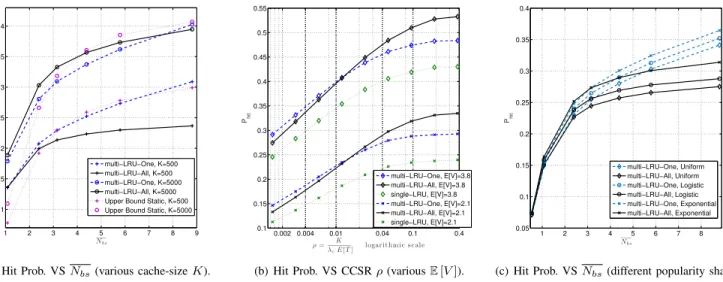
1 2 3 4 5 6 7 8 9 0.1 0.15 0.2 0.25 0.3 0.35 0.4 Nb s Phit multi−LRU−One, K=500 multi−LRU−All, K=500 multi−LRU−One, K=5000 multi−LRU−All, K=5000 Upper Bound Static, K=500 Upper Bound Static, K=5000
(a) Hit Prob. VSNbs(various cache-sizeK).
0.002 0.004 0.01 0.04 0.1 0.4 0.1 0.15 0.2 0.25 0.3 0.35 0.4 0.45 0.5 0.55 ρ= K
λcE[T] logar it hmic s c ale Phit multi−LRU−One, E[V]=3.8 multi−LRU−All, E[V]=3.8 single−LRU, E[V]=3.8 multi−LRU−One, E[V]=2.1 multi−LRU−All, E[V]=2.1 single−LRU, E[V]=2.1
(b) Hit Prob. VS CCSRρ(variousE[V]).
1 2 3 4 5 6 7 8 0.05 0.1 0.15 0.2 0.25 0.3 0.35 0.4 Nb s Phit multi−LRU−One, Uniform multi−LRU−All, Uniform multi−LRU−One, Logistic multi−LRU−All, Logistic multi−LRU−One, Exponential multi−LRU−All, Exponential
(c) Hit Prob. VSNbs(different popularity shapes).
Fig. 1:Evaluation of the hit probability of multi-LRU policies for different system variables. Parameter values in (b)Nbs= 2.4. In (c)K= 1500.
shape gi of content ci is chosen with probability a1 = 0.06
as Logistic, a2 = 0.38 as Gompertz and with a3 = 0.56 as
Exponential. Later we include the Uniform shape.
In each simulation, we keep some variables fixed and let others vary, to evaluate the policy performance and understand their influence. The variables to be varied are categorised into (1) network and (2) traffic variables. The network variables
are the mean coverage numberNbsand the cache sizeK. The
traffic variables are the average request volume per content
E[V], the mean lifespan E[T] and the probability vector for
the shape(a1, a2, a3).
1) Network influence: The studied system has both spatial and temporal dimensions. For a hit to happen, two consecutive requests of the same content should not only be close in time, but should also occur in the coverage area of the same station. So, to increase the hit probability, data-objects should both: stay long-enough in each cache, and be inserted in as many caches as possible. But since storage space per station is limited, a trade-off arises. The multi-LRU-All which for every missed request inserts the object in all user-covering stations, spreads the object geographically wider at the cost of occupying several memory slots. For each object inserted in a station another one is evicted. As a result, in the -All variation contents stay stored for a shorter time period. On the other hand, multi-LRU-One does not spread the object to neighbouring caches, but the objects stay longer in each memory after insertion.
This trade-off between geographical expansion and preser-vation of a content in caches is depicted in Fig. 1(a) for different values of the memory size. The larger the storage space, the longer it takes for an object to be evicted. So, for large memory the geographical expansion of an object is
beneficial. This is shown for K= 5000 in which case
multi-LRU-All surpasses multi-LRU-One. But for each caseKthere
is a value ofNbsafter which the performance of the -All is less
than -One, because after this value further increase of content diversity is at the cost of content variety. The smaller the cache size, the more valuable storage space becomes because an object stays less time in the cache before eviction. Hence,
for smallerK-One shows better performance and exceeds the
-All variation even for small values of multi-coverage Nbs.
In Fig. 1(b) the performance of multi-LRU policies versus
the CCSR ratioρis illustrated. This ratio is equal to the mean
number of memory slots per active content and is a measure of the system’s storage capability, because the smaller it is than one, the less storage resources are available. Of course if it is close or larger than one, the average catalogue size can be cached entirely in each station, and hence the hit probability should be close to the ”cacheability” limit (the hit probability for all objects that appear at least twice). Keeping
the denominator of ρconstant, Fig. 1(b) shows the impact of
the memory size on the policy performance. Obviously, hit
probability increases with K, but for smaller K, the -One
variation is preferable to the -All, as explained also previously.
There is again a critical point in K after which the -All
variation is preferable (for large storage). If the ratio ρ is
further increased, the performance gains are diminishing for both variations, and saturation occurs.
2) Traffic influence: The qualitative impact of the mean lifespan value on the hit probability can be understood by reading Fig. 1(b) in the opposite direction of the x-axis, from
right to left. Keeping the numerator constant, as ρdecreases
E[T] increases. This means that the same storage capacity
serves a larger active catalogue size E[C]. Consequently the
overall performance drops. Moreover, Fig. 1(b) illustrates that the hit probability improves as the average number of requests
per contentE[V]increases. The reason is that for higherE[V]
a content put in storage is requested and hit more times. In Fig. 1(c) each curve corresponds to a scenario where contents are assumed to follow only one particular popularity shape. Specifically, either the logistic, or the negative exponen-tial, or the uniform shape is used. In the negative exponential shape popularity takes big values in a short time period and then drops abruptly. A steep popularity shape implies that consecutive requests of the same content appear close to each other in time. This makes more probable the event that the content is not evicted before its next request happens. With this in mind, it can be understood that the negative exponential can lead to higher hit probabilities than the uniform shape. Interestingly, for isolated caches the authors in [20], [14] state that the shape does not affect significantly the hit probability
small values so every user can connect to at most one station.
This observation is confirmed in Fig 1(c). But asNbsincreases
and multi-coverage effects appear,the multi-LRU performance
depends considerably on the correlation between requests of the same content, and thus the shape of the popularity curves.
3) Comparison with the single-LRU: Under single-LRU a user can access only one (the closest in this work) station’s memory even when covered by more than one. As a result
hit performance is independent of Nbs (provided coverage is
enough so that a user is always covered by at least one station). Depriving the user of the ability to retrieve its content from all covering stations, strongly reduces the overall hit probability.
That’s why in Fig. 1(b) where Nbs = 2.4 is relatively small,
both multi-LRU policies show relative gains compared to the
single-LRU, for every value of ρ. The maximum gains reach
30% when E[V] = 2.1and 20% whenE[V] = 3.8.
4) Comparison with centralised Policies with periodic Pop-ularity updates and prefetching (POP): As mentioned in the introduction, most caching policies proposed in the literature distribute contents to memories in a centralised way [8], [3]. These caching algorithms (POP) use as input the popularity of the contents, assumed known and constant over time. But, when the traffic exhibits temporal locality, popularities change perpetually and should be estimated regularly. Based on every new estimation, memories should be updated. Specifically we
can assume that at time tn =n∆tev, n∈ Z, the caches are
updated by the POP using the estimated popularities during the time interval[tn−∆tpop, tn). LetFx,tn be the set of the
xmost requested contents in [tn−∆tpop, tn).
We propose an upper bound. Let a user requesting contentc
connect tomstations with probabilitypm. Then the user ”sees”
mK memory slots. The most favorable scenario is when all
memory slots are filled at timetnby themKmost popular files
until that time, i.e. the content setFmK,tn. Then the maximum
hit probability within the time interval[tn, tn+ ∆tev)is
Phit(P OP)[tn, tn+ ∆tev)≤
∞ X
m=1
pmP(c∈ FmK,tn). (8)
Clearly this upper bound depends on the intervals ∆tev and
∆tpop. The more regularly the algorithm updates the caches
the better performance it achieves. But considering that a caching update will use backhaul and computational resources
by the controller, ∆tev cannot be too small. We can assume
that ∆tev = 1 day and the caching policy runs every night
when the request load is low. As far as ∆tpop is concerned
there is a ”crisp” optimal choice. If it is too big, FmK,tn will
possibly include outdated contents. On the other hand, small
∆tpop can result in excluding even the popular objects from
FmK,tnbecause they have not been sufficiently requested. The
bound in (8) was evaluated by Monte Carlo simulations. The
optimum ∆tpop number of days was found by increasing it
until Phit(P OP) starts decreasing. Fig. 1(a) depictsPhit(P OP) for
two memory sizes, where ∆tpop was chosen (among a large
set of possibilities) equal to 5 and 10 days, forK= 500 and
5000 respectively.
Fig. 1(a) shows that even the upper bound for POP does not surpass in performance the appropriate multi-LRU policy,
except maybe for a small range of Nbs. In [9] where the
traffic was assumed static (IRM), multi-LRU performed lower than the centralised policies POP. But under a temporal traffic
model (which is also more realistic), the ability of multi-LRU policies to update at each request the caches, without the need to estimate the content popularities, results in a considerable performance boost.
VI. CONCLUSIONS
In this work, the proposed Multi-LRU policies, that update each cache content in a per-demand basis, are evaluated under traffic with temporal locality. Their hit probability is compared to the single-LRU, as well as the family of centralised policies with periodic cache updates based on popularity estimates. It is shown that Multi-LRU outperforms single-LRU as well as the centralised policies for a large range of parameter values. The reason is the fast passive adaptability of the policies to traffic changes. The performance strongly depends on coverage and traffic parameters, and notably the content popularity shape.
REFERENCES
[1] V. Almeida, A. Bestavros, M. Crovella, and A. de Oliveira. Character-izing reference locality in the WWW.IEEE PDIS, 1996.
[2] F. Baccelli, and B. Błaszczyszyn. On a Coverage Process Ranging from the Boolean Model to the Poisson-Voronoi Tessellation with Applications to Wireless Communications.Advances in Applied Probability, Vol. 33, No. 2, pp. 293-323, 2001.
[3] B. Błaszczyszyn and A. Giovanidis. Optimal geographic caching in cellular networks.IEEE ICC, 2015.
[4] X. Cheng, J. Liu, and C. Dale. Understanding the Characteristics of Internet Short Video Sharing: A YouTube-Based Measurement Study. IEEE Trans. on Multimedia, vol. 15, no. 5, pp. 1184-1194, Aug. 2013. [5] M. Dehghan, A. Seetharam, B. Jiang, T. He, T. Salonidis, J. Kurose, D. Towsley, and R. Sitaraman. On the complexity of optimal routing and content caching in heterogeneous networks.INFOCOM, 2015. [6] S. E. Elayoubi and J. Roberts. Performance and cost effectiveness of
caching in the mobile access network.ACM SIGCOMM ICN, 2015. [7] R. Fagin and T.G. Price. Efficient calculation of expected miss ratios in
the independent reference model.SIAM J. Comput., 7:288–297, 1978. [8] N. Golrezaei, K. Shanmugam, A. Dimakis, A. Molisch, and G. Caire.
Femtocaching: Wireless video content delivery through distributed caching helpers.INFOCOM, 2012.
[9] A. Giovanidis, and A. Avranas. Spatial Multi-LRU Caching for Wireless Networks with Coverage Overlaps. ACM SIGMETRICS / IFIP Perfor-mance, 2016.
[10] S. Jin and A. Bestavros. Sources and characteristics of web temporal locality.IEEE MASCOTS, 2000.
[11] E. Leonardi, and G.L. Torrisi. Least recently used caches under the Shot Noise Model. INFOCOM, 2015.
[12] K. Naveen, L. Massoulie, E. Baccelli, A. C. Viana, and D. Towsley. On the interaction between Content Caching and Request Assignment in Cellular Cache Networks.AllThingsCellular’15, 2015.
[13] M. E. J. Newman. Power laws, Pareto distributions and Zipf’s law. Contemporary Physics, 46:323–351, 2005.
[14] F. Olmos, B. Kauffmann, A. Simonian, and Y. Carlinet. Catalog dynam-ics: Impact of content publishing and perishing on the performance of a LRU cache. 26th International Teletraffic Congress, 2014.
[15] G. Paschos, E. Bastug, I. Land, G. Caire, and M. Debbah. Wireless Caching: Technical Misconceptions and Business Barriers. arXiv:1602.00173, 2016.
[16] K. Poularakis, G. Iosifidis, and L. Tassiulas. Approximation algorithms for mobile data caching in small cell networks. IEEE Trans. on Communications, 62(10), October 2014.
[17] C. Richier, E. Altman, R. Elazouzi, T. Altman, G. Linares, and Y. Por-tilla. Modelling View-count Dynamics in YouTube. arXiv:1404.2570. [18] V. Sourlas, P. Flegkas, G.S. Paschos, D. Katsaros, and L. Tassiulas.
Stor-age planning and replica assignment in content-centric publish/subscribe networks.Elsevier Computer Networks, 55(18):4021–4032, Dec. 2011. [19] R. Timo, and M. Wigger. Joint cache-channel coding over erasure
broadcast channels.IEEE ISWCS, Brussels, Belgium, 2015.
[20] S. Traverso, M. Ahmed, M. Garetto, P. Giaccone, E. Leonardi, and S. Niccolini. Unravelling the impact of temporal and geographic locality in content caching systems. IEEE Trans. on Multimedia, 17(10):1839– 1854, 2015.