Open Research Online
The Open University’s repository of research publications
and other research outputs
Lessons learned from the use of the SlideWiki
OpenCourseWare platform in different learning
contexts
Conference or Workshop Item
How to cite:
Mikroyannidis, A.; Pallonetto, F.; Mangina, E.; Pyrini, N.; ˇSadauskas, M.; Trepule, E.; Volungeviciene, A.; Panagiotakopoulos, C.; Karatrantou, A.; Armakolas, S.; Nelson Mauro, A.; Cheniti, L. and Korbaa, O. (2018). Lessons learned from the use of the SlideWiki OpenCourseWare platform in different learning contexts. In: ICERI 2018 Proceedings: 11th annual International Conference of Education, Research and Innovation (G´omez Chova, L.; L´opez Mart´ınez, A. and Candel Torres, I. eds.), IATED, pp. 3213–3221.
For guidance on citations see FAQs.
c
2018 IATED
Version: Accepted Manuscript
Link(s) to article on publisher’s website: http://dx.doi.org/doi:10.21125/iceri.2018.1713
Copyright and Moral Rights for the articles on this site are retained by the individual authors and/or other copyright owners. For more information on Open Research Online’s data policy on reuse of materials please consult the policies page.
LESSONS LEARNED FROM THE USE OF THE SLIDEWIKI
OPENCOURSEWARE PLATFORM IN DIFFERENT LEARNING
CONTEXTS
A. Mikroyannidis
1, F. Pallonetto
2, E. Mangina
2, N. Pyrini
2, M. Sadauskas
3, E.
Trepule
3, A. Volungevičienė
3, C. Panagiotakopoulos
4, A. Karatrantou
4, S.
Armakolas
4, A. Nelson Mauro
5, L. Cheniti
6, O. Korbaa
61The Open University (UNITED KINGDOM) 2University College Dublin (IRELAND) 3Vytautas Magnum University (LITHUANIA)
4University of Patras (GREECE) 5Dataninja srls (ITALY) 6University of Sousse (TUNISIA)
Abstract
The SlideWiki platform is fostering open education by supporting the collaborative authoring, sharing, reusing and remixing of open educational content online. This paper presents the lessons learned from piloting the SlideWiki platform in different learning contexts and scenarios. In particular, we describe the learning scenarios considered in each pilot and how these scenarios have been implemented with the use of SlideWiki. We then describe the methodology followed in each pilot, in terms of the authoring, teaching and learning activities performed by educators and learners using SlideWiki. Finally, the lessons learned from each pilot are discussed, focusing on the challenges faced in each pilot, how these challenges have been addressed, as well as the best practices that have emerged from the pilots regarding the collaborative authoring and sharing of open educational content.
Keywords: collaborative authoring, sharing, reusing, remixing, crowdsourcing, open educational resources, open education.
1 INTRODUCTION
The SlideWiki project1 is a European initiative, creating a platform that facilitates large-scale
collaboration around educational content. Since its launch [1], the SlideWiki platform2 has grown its
user base to hundreds of educators and thousands of learners and has won the OpenCourseWare Consortium’s Excellence Award. Several hundred comprehensive open learning materials are currently available on the SlideWiki platform in different languages.
The SlideWiki platform allows the creation of educational content either by individual authors or collaboratively by groups of authors [2]. Additionally, users can interact with the offered content in various ways, such as via commenting, answering quizzes, as well as by reusing and adapting the content according to their needs. Authors can either upload existing content to the platform in the form of a PowerPoint or OpenOffice presentation, or start creating a slide deck from scratch. They can assign editing permissions to co-authors, who can then start editing their content using a WYSIWYG (what you see is what you get) HTML editor, or by editing the HTML code directly. Authors may also group slide decks together in the form of playlists. The export options available for content in SlideWiki include common formats and standard specifications, such as HTML, PDF, ePUB and SCORM. All content on the SlideWiki platform is published under a Creative Commons Attribution-ShareAlike 4.0 International License,3 which allows it to be reused, repurposed and republished. In order to reuse
a deck or a sub-deck, one can ‘fork’ it thus creating a copy of the content that can be further adapted by the user that forked it. All changes made to content are tracked by the platform and displayed in the
1 https://slidewiki.eu 2 https://slidewiki.org
history tab of the content. Authors can easily track how their content is being reused and repurposed within the platform via the activity feed and the usage tab of their content.
SlideWiki is fostering open education by supporting the authoring and sharing of Open Educational Resources (OERs). OERs can be described as “teaching, learning and research resources that reside in the public domain or have been released under an intellectual property license that permits their free use or repurposing by others depending on which Creative Commons license is used” [3]. The emergence of OERs is facilitating online education through the use and sharing of open and reusable learning resources online. Learners and educators can now access, download, remix, and republish a wide variety of high-quality learning materials [4, 5].
The SlideWiki project is building upon and promoting the OER initiative by introducing the SlideWiki platform to different communities of educators and learners [6]. The SlideWiki project is performing a wide range of trials covering different levels of education (i.e. from secondary to higher education) and different types of learning (i.e. formal learning, informal learning, vocational learning). Each of these large-scale trials is carried out with hundreds of educators and thousands of learners in different countries across Europe.
This paper presents the lessons learned from piloting the SlideWiki platform in a variety of learning contexts and scenarios. The purpose of these ongoing pilots is to raise awareness about SlideWiki, as well as gather valuable feedback about the platform from different communities of learners and educators. The remainder of this paper is organised as follows. First, we introduce the learning scenarios considered for piloting SlideWiki and describe the methodology followed in each pilot, in terms of the authoring, teaching and learning activities performed by educators and learners. The lessons learned from the pilots are then discussed, focusing on the challenges faced in each pilot. Finally, the paper is concluded and the next steps of this work are outlined.
2 LEARNING SCENARIOS & METHODOLOGY
2.1 SlideWiki pilot at the University of Milan
This pilot is conducted in the context of the course “Data Visualisation Skills” offered by the University of Milan in collaboration with the company Dataninja srls. By completing this course, students receive 3 university credits (ECTS). In terms of learning outcomes, the course provides university students with basic knowledge and practical skills in the field of data visualisation. At the end of the course, students are able to run all the steps of the data visualisation process (Find, Verify/Clean, Analyse, Visualise/Present).
The delivery of the course follows an active approach, i.e. ‘learning by doing’, and puts into practice key principles of the various educational paradigms and models covered as part of its content: networked learning [7], participatory cultures [8], connected learning [9], hybrid pedagogy [10-12] and open education [13], among others.
Throughout the programme, participants create digital artefacts of different kinds and develop a rich personal teaching-learning environment on the open web while exploring the Domains of One’s Own (DoOO)4 philosophy and ‘Publish (on your) Own Site, Syndicate Elsewhere’ (POSSE)5 model. Their
own domain (made of a personal and/or project-based website) is a very tangible output that operates as an open portfolio gathering more granular resources.
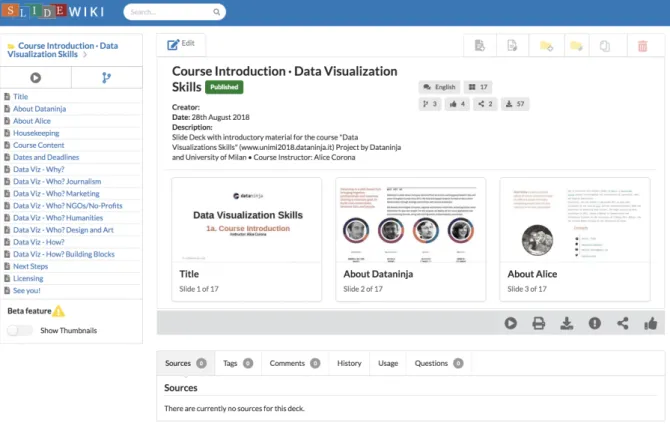
Approximately 1000 students have been reached so far in the context of this pilot and nearly 250 of them have enrolled to the course. Students have been using the SlideWiki platform, both for consuming content and for producing their own content, individually or in groups as part of their course assignments. The educational content for this pilot has been developed in English and has been released under the standard open licence of the SlideWiki platform. Figure 1 shows one of the slide decks developed for this pilot.
4 https://www.wired.com/insights/2012/07/a-domain-of-ones-own/ 5 https://indieweb.org/POSSE
Figure 1. A slide deck introducing the “Data Visualisation Skills” course of the University of Milan pilot.
2.2 SlideWiki pilot at Vytautas Magnus University
The main objectives of this pilot are to promote the usage of OERs and Creative Commons (CC) licensing in the teaching process among Vytautas Magnus University teachers, as well as involve students in the learning process, familiarise them with SlideWiki and encourage further usage of the platform. 15 teachers are participating in this pilot, selected from different faculties and different programmes, both undergraduate and postgraduate ones. All selected teachers have good computer literacy skills and are experienced in the use of the institutional Moodle Learning Management System (LMS) and its tools. Their teaching subjects vary between foreign languages, management, political and social sciences.
Figure 2. The introductory workshop for teachers organized by Vytautas Magnus University.
A workshop was initially organised for teachers, where they were introduced to OERs, Creative Commons licensing and the SlideWiki platform. Figure 2 shows photos from this event, during which teachers registered to the platform, completed their profile page and started developing content.
Throughout the pilot, teachers have been provided with support and guidance for using SlideWiki, for uploading and creating slides, for embedding presentations in the institutional LMS, as well as for engaging students to use SlideWiki for their group presentations and for their further study in the university.
The 15 participating teachers have created 5 lectures each, with each lecture consisting of approximately 20 slides. Figure 3 shows the slide deck developed by a teacher for one of her lectures. Slides have been developed in the Lithuanian and English languages. After developing slides, the teachers were asked to embed them to their courses in the institutional Moodle LMS. Additionally, the teachers developed assignments for students that involved SlideWiki. In this way, students have not only used SlideWiki for viewing slides presented by the teachers, but have also developed their own content in SlideWiki. In total, 1557 slides have been created and 472 students have been involved so far in this pilot.
Figure 3. A slide deck in the Lithuanian language developed for the Vytautas Magnus University pilot.
2.3 SlideWiki pilot at the University of Sousse
This pilot involves 4 faculties at the University of Sousse with diverse learner profiles, including students with backgrounds in engineering, computer science, web design, medicine and management. 5 educators and around 400 students are involved in this pilot by producing and sharing open content via SlideWiki, following the 5 R’s principles:
• Retain: Students and educators have the ability to make their own copies of the content (e.g.,
• Reuse: Students and educators have the ability to use the content in a wide range of ways (e.g., in a class, in a study group, on a website, in a video).
• Revise: Students and educators have the ability to adapt, adjust, modify, or alter the content
itself (e.g., translate the content into another language).
• Remix: Students and educators have the ability to combine the original or revised content with
other material to create something new.
• Redistribute: Students and educators have the ability to share copies of the original content,
revised versions, or remixed versions.
2.4 SlideWiki pilot at University College Dublin
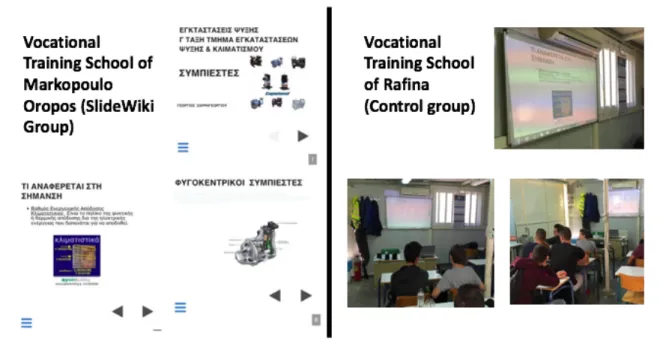
This pilot is conducted in the context of a vocational training course taught to 2 separate classes of students, one of which acts as a control group and the other one as the group exposed to SlideWiki. These classes are taught at the Vocational Training School of Markopoulo (SlideWiki group) and the Vocational Training School of Rafina (control group), both specialising in “Cooling and Air Conditioning Installations”.
The main concept of the course taught during this pilot is “Energy labels”. The students at the end of the course are able to describe the operating features, advantages and disadvantages of devices with different energy labels. As part of the skills development within this module, the following features are being assessed: Students should be able to recognize what appears on the air conditioning labels and how to find the degree of performance of an air-conditioning unit. Through self-assessment, students are evaluating their own efforts. They transfer their new knowledge to examples of everyday life, i.e. by recognising the energy efficiency features of air conditioners in their residences.
A total of 23 students have been involved in this pilot (11 in the control group and 12 in the SlideWiki group). Screenshots of SlideWiki slides and photos taken during this pilot are shown in Figure 4. The methodology followed in this pilot is the development of concepts within the area of energy labels. The students are encouraged to look for and find content through the theoretical presentation from the educator, structure their thoughts and practice the theory through the hands-on activity session in the class. Feedback and revision are the final and equally important parts of the lecture in order to revise and self-reflect on the learning scenario and the teaching strategy.
Figure 4. Course content in SlideWiki and photos from the control group of the University College Dublin pilot.
2.5 SlideWiki pilot at the University of Patras
The pilot is conducted by the Computer and Educational Technology Lab at the Department of Primary Education and is based on an online course with the theme of “Ethics and Technology” using the SlideWiki platform as the main learning and collaboration space. The course is attended by future and in-service teachers of primary and secondary education.
During this pilot, trainees have been studying and interacting with the educational content, which is organised in 4 decks, one for each week of the course. Every week, trainees undertake the following tasks: (a) They study the content of the slides of the deck; (b) they study additional material unloaded under the Sources tab of SlideWiki; (c) they add their comments to contribute to a discussion about the main idea of the content using the commenting functionality of SlideWiki; (d) they add their comments to ask questions or/and express their difficulties with the platform; (e) they assess their knowledge by answering the questions under the Questions tab of SlideWiki. During the 3rd week of
the course, trainees are asked to collaboratively create content in SlideWiki. In the last week, trainees are asked to discuss and express their opinions about their experiences with the SlideWiki platform and the content they have studied.
Figure 5. A playlist of slide decks in the Greek language used in the University of Patras pilot.
The pilot is conducted in the following 3 stages:
1. Educational material production: The educational content (4 decks and additional content) is
produced on the platform collaboratively by 4 members of academic staff. They are coming from 3 different Academic Institutes/Universities (University of Patras, Hellenic Open University, School of Pedagogical and Technological Education-ASPETE). The educational content is delivered to trainees on a weekly basis using a playlist for each group of trainees. One of these playlists is shown in Figure 5.
2. Implementation of the learning scenario: A total of 143 trainees are attending the online course. Among them, 55 are pre-service teachers of secondary education studying at ASPETE, 32 are undergraduate students at the Department of Primary Education of the University of Patras, 13 are postgraduate students at the Department of Primary Education of
the University of Patras, 13 are in-service teachers, 10 are postgraduate students of the Hellenic Open University attending the curriculum ‘Studies in Education’ and 17 are postgraduate students of the Hellenic Open University attending curriculums in the field of ICT.
3. Analysis of the data: Sources of data collection are statistics collected via SlideWiki’s Activity
Feed and History tools, as well as the trainees’ comments/answers. The comments/answers of trainees are analysed and grouped together forming characteristic answers in order to have a feedback with quantitative characteristics.
3 LESSONS LEARNED
As all pilots described in this paper are currently ongoing, no final results can be reported yet. However, by analysing the ways that the learners and educators involved in these pilots have been using the SlideWiki platform, useful information can be derived about the usability of the platform, the educational facilities and opportunities it offers, as well as the difficulties or problems of its use.
Overall, the SlideWiki platform has been positively received by learners and educators in all pilots, despite the technical difficulties that arose in certain cases, mostly attributed to bugs caused by the ongoing development of the platform. These bugs have been reported to the SlideWiki project and have been subsequently addressed by the team of SlideWiki developers. Additionally, valuable feedback has been collected by learners and educators about potential improvements to the platform, both regarding its usability and usefulness as a collaborative authoring tool. Educators participating in the pilots have appreciated the ability to easily reuse, adapt and share educational content. Learners have also been keen to use the collaborative aspects of the platform in order to co-create the educational artefacts required to achieve the learning outcomes of their courses.
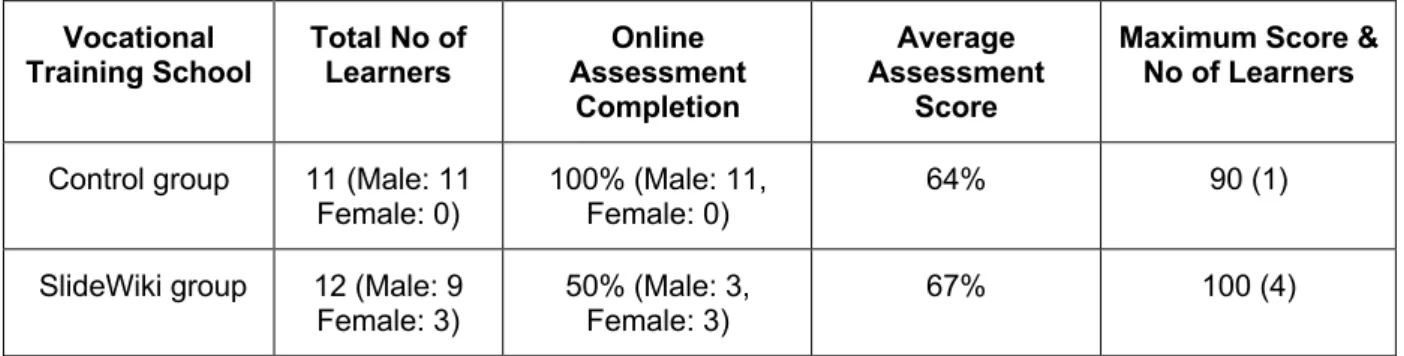
In the context of the University College Dublin pilot, the assessment results of the control group have been compared with the assessment results of the SlideWiki group. Table 1 provides the results from the students’ assessment for each group. In particular, the SlideWiki group had 67% average score on assessment, with female learners 100% success rate. The control group had 64% average score with maximum score one learner at 90%. Although the number of learners is low to statistically prove the positive effect of SlideWiki, further exploration of a class during a whole semester would provide the impact of the reusable digital repositories via SlideWiki.
Table 1. Results from the University College Dublin pilot.
Vocational Training School Total No of Learners Online Assessment Completion Average Assessment Score
Maximum Score & No of Learners
Control group 11 (Male: 11
Female: 0) 100% (Male: 11, Female: 0) 64% 90 (1) SlideWiki group 12 (Male: 9
Female: 3)
50% (Male: 3, Female: 3)
67% 100 (4)
The pilot conducted by the University of Patras has gathered useful feedback from participants in the following questions:
• Can the SlideWiki platform be used for collaborative creation of educational material
efficiently? To what extent and why? Participants responded that the SlideWiki platform can
be used for collaborative creation, editing and management of educational content by teachers (94%) due to its simple and flexible tools. The slides can be created and edited using embedded images, video and other web objects without the need for special technical knowledge (58%). It also can be used by students to work on projects collaboratively in small groups (53%) due to its ease of use and user-friendliness. The commenting functionality offers a tool for discussion and interaction (48%) during deck creation and the activity feed offers important information about deck editing and management (42%).
• What difficulties have you encountered and what interventions do you think should be carried
out to improve the platform? No significant difficulties in using the platform were reported by
the majority of participants (94%) but some trainees asked for a brief guide for the facilities of the platform with examples of good practices (27%). The majority of trainees were interested in the ability to edit and manage their comments after creation (63%), as well as how to delete content (72%). Some formatting problems arose after downloading a deck with overlapping text on slides (98%). The ability for the content creators to manage their comments and discussion without these to be visible to trainees emerged as an important issue (48%). Some features specifically for disabled people were also requested (18%). Finally, the participating trainers asked for more levels of control over the rights of different user groups in the platform, such as creator, tutor, group manager, student, guest.
• What are the most important features of the platform? Participants responded that one of the
most important features of the platform is the access to open educational resources by ensuring appropriate Intellectual Property under Creative Commons (83%). The ability to copy and reuse educational material by referencing the creator of the content is also deemed very important (78%). Participants indicated that the platform enables the creation, organization and storage of material in an easy, flexible and interactive way (76%). The ease of use of the search tool to find material for a wide range of areas is also important to participants of this pilot (54%). Other responses included: the platform provides accessibility at any time of the day, using various media (desktop PC, laptop, smartphone) (43%); the platform supports the interaction between trainer and trainees as well as among trainees (57%). The activity feed (42%), slideshow (58%), download (97%) and share (42%) functionalities were deemed as the most useful ones. Finally, some respondents indicated that the feedback tool can support the interaction between user and the developing team of the platform to report and solve bugs and functional problems (32%).
4 CONCLUSIONS
The SlideWiki platform builds on the wisdom, creativity and productivity of the crowd for the co-creation of educational content. SlideWiki empowers communities of educators and learners to author, share and re-use educational content in a collaborative way. The SlideWiki project is improving the platform and conducting a number of pilots of the platform within different case studies and learning contexts. The purpose of these ongoing pilots is to raise awareness about SlideWiki, as well as collect feedback from different communities of learners and educators. This feedback is being used to further improve the platform in order to better meet the needs of its users.
Feedback received from the pilots so far indicates that the SlideWiki platform offers a particularly promising outlook in the field of web-based learning, and more specifically in the area of OERs. The various functionalities offered by the platform have the potential to promote the wider use of OERs in education. In the context of these pilots, a number of issues have also been identified for further improving the user experience offered by SlideWiki. The SlideWiki project will continue to engage communities of learners and educators in order to acquire further insights into their needs and requirements, as well as how to better accommodate them.
ACKNOWLEDGEMENTS
This work has received funding from the European Union's Horizon 2020 research and innovation programme under grant agreement No 688095 (SlideWiki).
REFERENCES
[1] S. Auer, A. Khalili, and D. Tarasowa, "Crowd-sourced Open Courseware Authoring with SlideWiki. org," International Journal of Emerging Technologies in Learning (iJET), vol. 8, pp. 62-63, 2013.
[2] A. Mikroyannidis, "Collaborative OpenCourseWare Authoring: The SlideWiki Platform," in
Proc. EdMedia: World Conference on Educational Media and Technology, Amsterdam,
[3] D. E. Atkins, J. S. Brown, and A. L. Hammond, "A Review of the Open Educational Resources (OER) Movement: Achievements, Challenges, and New Opportunities," The William and Flora Hewlett Foundation 2007.
[4] A. Lane, T. Connolly, G. Ferreira, P. McAndrew, and T. Wilson, "Reusing, reworking and remixing open educational resources," in Cases 'n' Places: Global Cases in Educational and
Performance Technology, Educational Design and Technology in the Knowledge Society, S.
Marshall and W. Kinuthia, Eds. Charlotte, NC: IAP - Information Age Publishing, 2010.
[5] T. Wilson, R. Schuwer, and P. McAndrew, "Collating global evidence of the design, use, reuse and redesign of open educational content," in Open Educational Resources 2010 (OER10). Cambridge, United Kingdom http://oro.open.ac.uk/21122/, 2010.
[6] A. Mikroyannidis, "Collaborative Authoring of Open Courseware with SlideWiki: A Case Study in Open Education," in Proc. 10th Annual International Conference on Education and New
Learning Technologies (EDULEARN18), Palma de Mallorca, Spain, 2018.
[7] C. Jones, "Theories of learning in a digital age," in Proc. Networked Learning, 2015, pp. 47-78.
[8] H. Jenkins and M. Ito, Participatory culture in a networked era: A conversation on youth,
learning, commerce, and politics: John Wiley & Sons, 2015.
[9] M. Ito, K. Gutiérrez, S. Livingstone, B. Penuel, J. Rhodes, K. Salen, J. Schor, J. Sefton-Green, and S. C. Watkins, Connected learning: An agenda for research and design: BookBaby, 2013. [10] P. Rorabaugh, "Hybridity, pt. 1: Virtuality and Empiricism," Hybrid Pedagogy, 2012.
[11] P. Rorabaugh and J. Stommel, "Hybridity, pt. 3: What Does Hybrid Pedagogy Do?," Hybrid
Pedagogy, 2012.
[12] J. Stommel, "Hybridity, pt. 2: What is Hybrid Pedagogy?," Hybrid Pedagogy, 2012.
[13] M. Weller, Battle for Open: How openness won and why it doesn't feel like victory: Ubiquity Press, 2015.
View publication stats View publication stats