Clemson University Clemson University
TigerPrints
TigerPrints
All Dissertations Dissertations
December 2019
Human-Machine Teamwork: An Exploration of Multi-Agent
Human-Machine Teamwork: An Exploration of Multi-Agent
Systems, Team Cognition, and Collective Intelligence
Systems, Team Cognition, and Collective Intelligence
Lorenzo Barberis CanonicoClemson University, [email protected]
Follow this and additional works at: https://tigerprints.clemson.edu/all_dissertations
Recommended Citation Recommended Citation
Canonico, Lorenzo Barberis, "Human-Machine Teamwork: An Exploration of Multi-Agent Systems, Team Cognition, and Collective Intelligence" (2019). All Dissertations. 2490.
https://tigerprints.clemson.edu/all_dissertations/2490
This Dissertation is brought to you for free and open access by the Dissertations at TigerPrints. It has been accepted for inclusion in All Dissertations by an authorized administrator of TigerPrints. For more information, please contact [email protected].
Human-Machine Teamwork: An Exploration of
Multi-Agent Systems, Team Cognition, and
Collective Intelligence
A Dissertation Presented to the Graduate School of
Clemson University
In Partial Fulfillment
of the Requirements for the Degree Doctor of Philosophy
Human-Centered Computing
by
Lorenzo Barberis Canonico December 2019
Accepted by:
Dr. Nathan McNeese, Committee Chair Dr. Brian Dean
Dr. Kelly Caine Dr. Guo Freeman
Abstract
One of the major ways through which humans overcome complex challenges is teamwork. When humans share knowledge and information, and cooperate and coor-dinate towards shared goals, they overcome their individual limitations and achieve better solutions to difficult problems. The rise of artificial intelligence provides a unique opportunity to study teamwork between humans and machines, and poten-tially discover insights about cognition and collaboration that can set the foundation for a world where humans work with, as opposed to against, artificial intelligence to solve problems that neither human or artificial intelligence can solve on its own.
To better understand human-machine teamwork, it’s important to understand human-human teamwork (humans working together) and multi-agent systems (how artificial intelligence interacts as an agent that’s part of a group) to identify the characteristics that make humans and machines good teammates. This perspective lets us approach human-machine teamwork from the perspective of the human as well as the perspective of the machine. Thus, to reach a more accurate understanding of how humans and machines can work together, we examine human-machine teamwork through a series of studies.
In this dissertation, we conducted 4 studies and developed 2 theoretical models: First, we focused on human-machine cooperation. We paired human partic-ipants with reinforcement learning agents to play two game theory scenarios where
individual interests and collective interests are in conflict to easily detect cooperation. We show that different reinforcement models exhibit different levels of cooperation, and that humans are more likely to cooperate if they believe they are playing with another human as opposed to a machine.
Second, we focused on human-machine coordination. We once again paired humans with machines to create a human-machine team to make them play a game theory scenario that emphasizes convergence towards a mutually beneficial outcome. We also analyzed survey responses from the participants to highlight how many of the principles of human-human teamwork can still occur in human-machine teams even though communication is not possible.
Third, we reviewed the collective intelligence literature and the prediction markets literature to develop a model for a prediction market that enables humans and machines to work together to improve predictions. The model supports artificial intelligence operating as a peer in the prediction market as well as a complementary aggregator.
Fourth, we reviewed the team cognition and collective intelligence literature to develop a model for teamwork that integrates team cognition, collective intelligence, and artificial intelligence. The model provides a new foundation to think about teamwork beyond the forecasting domain.
Next, we used a simulation of emergency response management to test the different teamwork aspects of a variety of machine teams compared to human-human and machine-machine teams. Lastly, we ran another study that used a pre-diction market to examine the impact that having AI operate as a participant rather than an aggregator has on the predictive capacity of the prediction market.
Our research will help identify which principles of human teamwork are appli-cable to human-machine teamwork, the role artificial intelligence can play in
enhanc-ing collective intelligence, and the effectiveness of human-machine teamwork com-pared to single artificial intelligence. In the process, we expect to produce a substan-tial amount of empirical results that can lay the groundwork for future research of human-machine teamwork.
Dedication
This dissertation is dedicated to the people in my life whose support has made and continues to make the American Dream a future I get to passionately chase every day.
Andres, I dedicate this dissertation to you because nothing I will ever do, academic or otherwise, will ever truly be just my own: it will always be something we have accomplished together – as a team! From the moment we’ve met, our friendship has redefined every aspect of our lives by unlocking potential that makes anything feel possible as long we do it together. We are on a mission that is going to demand everything of us, and no one but you could make me feel like we’ve got this because you are and always will be the Hermano.
Mom and Dad, I dedicate this dissertation to you as well. I will never settle until I find a way to honor the tremendous sacrifices you have both made to give me the opportunity to pursue a life in the most exceptional country on the planet. The PhD is just another entry in the long-running list of unique opportunities I will seize for the rest of my life in order to thank you for betting it all on your wild child.
Acknowledgments
Clemson University and the School of Computing, for welcoming me at a time when all doors seemed locked shut. The Human-Centered Computing program has been one of the most creatively empowering experiences of my life, much of which is directly attributable to the interdisciplinary culture that emerges from such interesting people working on helping humans thrive through technology.
My dissertation committee (Brian Dean, Kelly Caine, Guo Freeman and Richard Pak), for committing with me to the wild ride that produced this dissertation. I don’t take that for granted, so I am extremely grateful for your time and support. Specif-ically, thank you for challenging me to consider all the angles: Dr. Pak’s advice on study design set the NeoCITIES studies in motion. Dr. Freeman’s insight into the ubiquity of collective intelligence outside of traditional teamwork areas forced me to tackle a dissertation broader in scope. Dr. Caine’s research philosophy will be something I will carry with me for the rest of my life: you have renewed my faith in science despite the replication crisis and the distorted incentive structures of academia. Finally, Dr. Dean for pushing me to delve deeply into the technical side: whether through our discussions about game theory and matching algorithms or cellular automata and tangles, you have shown me that computer science holds many of the secrets to attaining the technological leverage necessary to tackle some of humanity’s toughest challenges.
Dr. Safro and Dr. Knijnenburg, whose courses have trained me in the complex methodologies behind this dissertation. You were both right: I learned far more than I ever imagined despite my initial struggles.
The TRACE Lab, for creating a culture of continuous improvement that is enabling us to always discover new ways to be more productive. Raf Dejesus, for helping me grow by refusing to settle for anything less than the best version of myself as a leader. Bekk Blando, for teaching me the value of patience, especially when caring about others. Rui Zhang, for showing me how asking the right questions is often just as important as finding the answers. Anurata Hridi, for indulging me far too often in our crazy conversations about game theory and swarm intelligence. Jake Armstrong, for helping me confront the reality that I too easily give up on excellence and attention to detail when pressed for time. Mark Blasko, for always nudging me to exercise: you’ve taught me that exercise is not just a past time, but can be a repeated behavior with which I can shape who I become. Steve Russell, for making me believe in the synergy between graduate students and undergraduate students: you show how real talent engages in multiple domains.
Even though they are also part of the TRACE Lab, Beau Schelble and Chris Flathmann deserve their own special acknowledgement. Whether late night or the day before submitting my dissertation, you both helped follow through on an ambitious goal. Working together on all of our projects has been one of the most energizing parts of my entire time as a PhD student. Our teamwork is the best kind of teamwork: the kind that makes over-promising AND over-delivering possible.
Last but not least, I owe a huge debt of gratitude to the man who made this entire PhD possible: Nathan McNeese. He was a phenomenal advisor, is a first-class teammate, and will be a source of creative inspiration for my entire life. He made me a believer in the underestimated power of human cognition and in the importance
of maturity for leadership. Thank you for taking a chance on me as your first PhD student: hopefully working together changed your life as much as it did mine.
Table of Contents
Title Page . . . i
Abstract . . . ii
Dedication . . . v
Acknowledgments . . . vi
List of Tables . . . xii
List of Figures . . . xiv
1 Introduction . . . 1
1.1 Overview . . . 1
1.2 Problem Motivation . . . 2
1.3 Research Motivations . . . 4
2 Background and Related Work . . . 13
2.1 Overview . . . 13 2.2 Human-Machine Teamwork . . . 14 2.3 Reinforcement Learning . . . 19 2.4 Team Cognition . . . 22 2.5 Collective Intelligence . . . 32 2.6 Conclusion . . . 40
3 Study 1: Game Theory for Teams . . . 42
3.1 Introduction . . . 43
3.2 Methods . . . 46
3.3 Data Collection and Analysis . . . 47
3.4 Game Theory Scenarios . . . 49
3.5 Results . . . 52
3.6 Discussion . . . 59
4 Study 2: Human-Machine Teams as Multi-Agent Systems . . . 63
4.1 Introduction . . . 63
4.2 Hawk-Dove Games and Zero-Sum Mentalities . . . 66
4.3 Experimental Setup . . . 66
4.4 Results of the Game Outcomes and Survey Data . . . 68
4.5 Discussion . . . 73
4.6 Conclusion . . . 75
5 Model A: Human-Centered Prediction Markets . . . 76
5.1 Introduction . . . 76
5.2 Model Design . . . 77
5.3 Discussion . . . 83
5.4 Conclusion . . . 84
6 Model B: Collectively Intelligent Teamwork . . . 85
6.1 Introduction . . . 86
6.2 Model Description . . . 87
6.3 Collectively Intelligent Teams . . . 88
6.4 Discussion . . . 90
6.5 Conclusion . . . 92
7 Study 3: Team Cognition in Human-Machine Teams . . . 93
7.1 Introduction . . . 93 7.2 Overview . . . 94 7.3 Methods . . . 94 7.4 Results . . . 111 7.5 Discussion . . . 118 7.6 Conclusion . . . 121
8 Study 4: Human-Machine Collective Intelligence in Prediction Markets . . . 122 8.1 Introduction . . . 122 8.2 Overview . . . 123 8.3 Methods . . . 124 8.4 Results . . . 129 8.5 Discussion . . . 134 8.6 Conclusion . . . 136
9 Connecting The Studies . . . 137
9.1 Similarities and Differences Between Study 1 and Study 2 . . . 137
9.2 Similarities and Differences Between Model A & Model B . . . 140
9.3 Similarities and Differences Between Study 1 & 2 and Study 3 . . . . 142
9.5 Similarities and Differences Between all Studies . . . 147
10 Conclusion . . . 151
10.1 Research Questions . . . 152
10.2 Overall Study Contributions . . . 158
10.3 Intellectual Contributions to Academic Communities . . . 163
10.4 Future Work . . . 168
10.5 Closing Remarks . . . 171
Appendices . . . 173
A Team Cognition Survey . . . 174
List of Tables
1.1 Research Gaps and Research Questions . . . 8
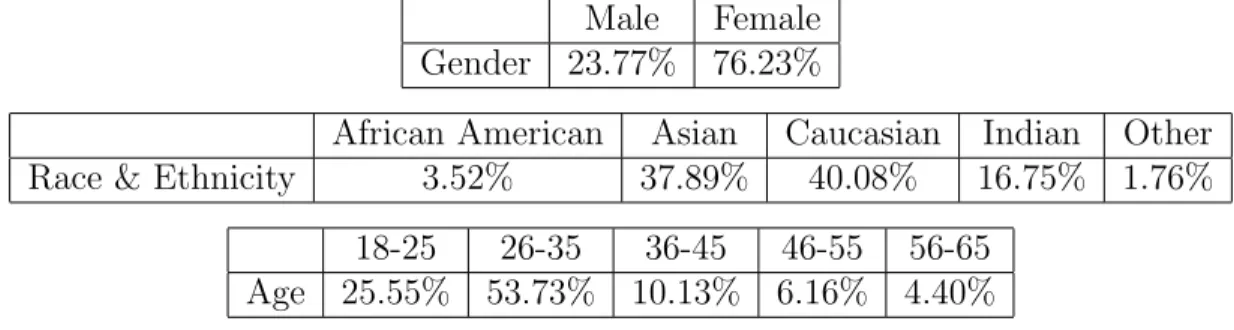
3.1 Demographics . . . 46
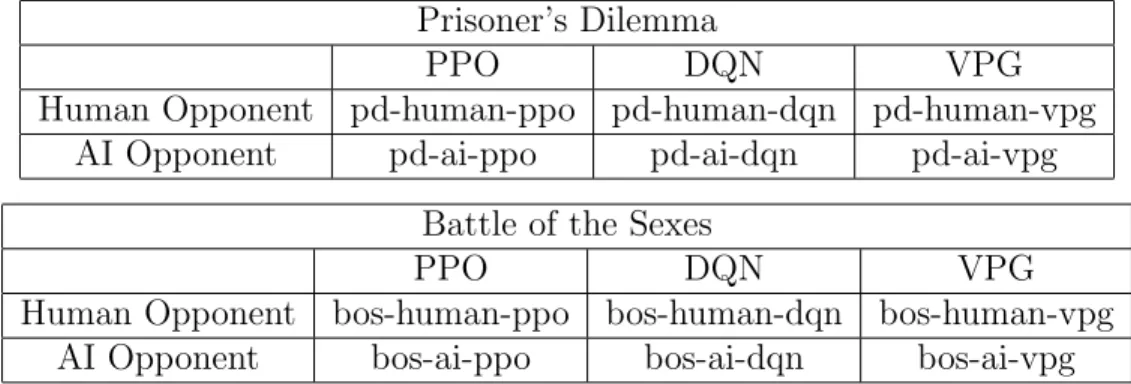
3.2 2x2x3 Experimental Design . . . 48
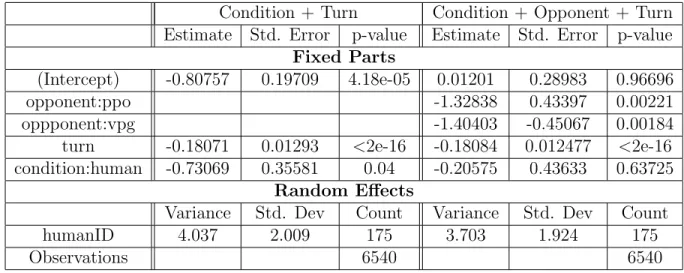
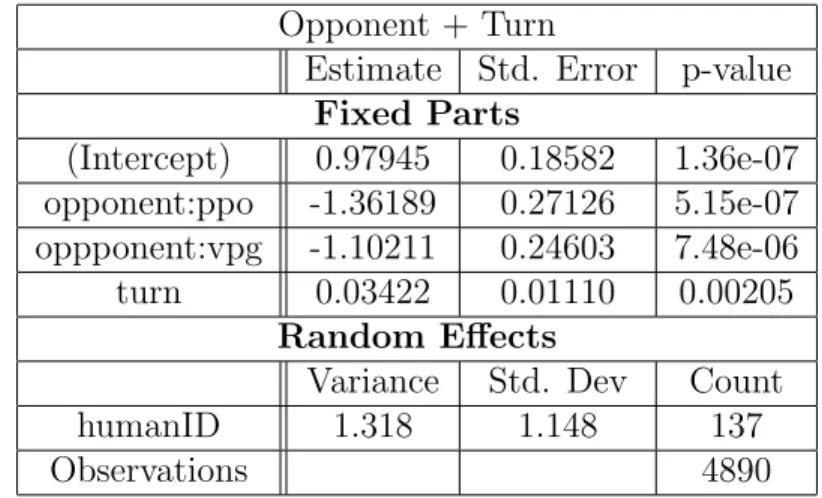
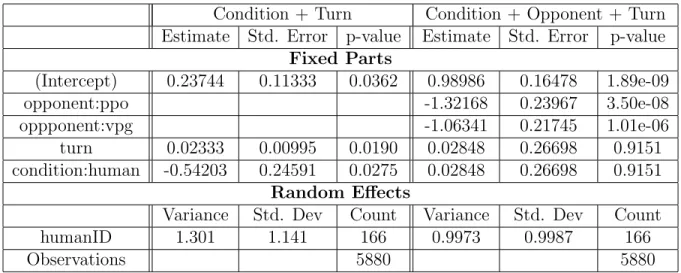
3.3 Generalized Linear Model with Mixed Effects for Prisoners Dilemma . 54 3.4 Generalized Linear Model with Mixed Effects Comparison . . . 55
3.5 Generalized Linear Model with Mixed Effects for Battle of the Sexes . 57 3.6 Generalized Linear Model with Mixed Effects Comparison . . . 58
4.1 Demographics . . . 67
4.2 The relationship between perceived shared understanding and cooper-ation . . . 69
4.3 The relationship between optimism towards AI and cooperation . . . 70
4.4 the relationship between preference towards working with a human and cooperation . . . 72
7.1 NeoCITIES Performance Metrics and their Measurements . . . 104
7.2 NeoCITIES Default Scenario . . . 106
7.3 Demographics . . . 110
7.4 Means Table of Team Scores . . . 112
7.5 Summary of Team Score ANOVA . . . 112
7.6 Bonferroni Pairwise Test of Team Conditions for Team Score . . . 113
7.7 Means Table of Situational Awareness . . . 114
7.8 Summary of Situational Awareness ANOVA . . . 115
7.9 Bonferroni Pairwise Test of Team Conditions for Situational Awareness 115 7.10 Team Cognition Linear Regression for Team Score . . . 117
8.1 Local Knowledge Relative to Ground Truth . . . 124
8.2 Aggregator Types . . . 128
8.3 Error Rates of Aggregators Trained on Price Data in the Human-only Prediction Market . . . 131
8.4 Error Rates of Aggregators Trained on Price Data in the Hybrid Pre-diction Market . . . 131
8.5 Error Rates of Aggregators Trained on Capital Data in the Human-only Prediction Market . . . 132
8.6 Error Rates of Aggregators Trained on Capital Data in the Hybrid Prediction Market . . . 133
List of Figures
2.1 Areas of Team Cognition Research . . . 24
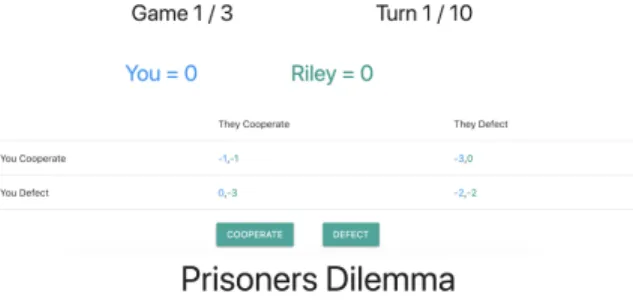
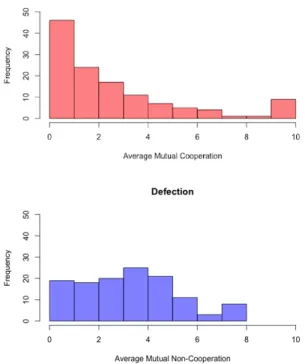
3.1 Human (bottom) and AI(top) views of the Prisoner’s Dilemma Interface 50 3.2 Human (bottom) and AI(top) views of the Battle of the Sexes Interface 52 3.3 Mutual Cooperation and Mutual Defection Frequency Distributions . 53 3.4 Frequency Distributions of Successful Cooperation . . . 56
3.5 Frequency Distributions of Coordination Failure . . . 56
4.1 Hawk-Dove Interface . . . 66
4.2 Mean cooperation based on different levels of shared understanding . 69 4.3 Mean cooperation based on different levels of optimism towards artifi-cial intelligence . . . 71
4.4 Mean cooperation based on different levels of preference towards human 72 5.1 The collective intelligence emerging from humans and AIs in the pre-diction market becomes the input of a neural network . . . 78
6.1 Each teammate shares evidence for a team discussion, and expresses a probability estimate that is then aggregated by the neural network . . 88
7.1 Frontend Interface of the Prior Version of NeoCITIES . . . 97
7.2 Frontend Interface of the Updated NeoCITIES . . . 98
7.3 Event Card . . . 99
7.4 NeoCITIES Map . . . 99
7.5 Training Page . . . 107
7.6 Means Plot of Team Scores . . . 112
7.7 Means Plot of Situational Awareness . . . 113
8.1 The collective intelligence emerging from humans and AIs in the pre-diction market is fed as input into a neural network . . . 126
Chapter 1
Introduction
1.1
Overview
The goal of this dissertation is to advance our understanding of human-machine teamwork by studying coordination and cooperation between humans and artificial intelligence (AI). We examine human-machine teamwork from the perspective of both the human and the machine by exploring the connections between team cognition and collective intelligence as they apply to humans and AIs interacting in various ways (AI as a coordinator, AI as a team-mate, etc) and various scales (small teams, large com-plex systems, dyadic partnerships). We first review the literature on human-human teamwork, reinforcement learning, and collective intelligence in order to identify the key concepts needed to ground human-machine teamwork. Secondly, we implement two different experiments using different models of human-machine teamwork inspired by these principles. Lastly, we use our results to make inferences about the ways in which human-machine teamwork manifests in multiple scales (small teams vs large crowds) and dimensions (AI playing different roles as part of the team).
1.2
Problem Motivation
One of the major forces that will influence the course of humanity in the next century is the development of artificial intelligence (AI). Specifically, the primary objective of contemporary artificial intelligence research is the development of arti-ficial general intelligence (AGI): a strong AI that would theoretically be capable of matching and eventually outperforming human intelligence across a variety of dif-ferent tasks where intelligence plays a decisive role [Goertzel and Pennachin, 2007]. AGI differs from narrow AI in that it holds a true understanding of itself and its envi-ronment that makes it capable of easily transferring learning between different tasks [Pennachin and Goertzel, 2007]. A major unfortunate consequence of this pursuit is the attempt at rendering human effort obsolete by automating away the roles hu-mans play in complex processes. However, more closely examining human-machine partnerships at both the micro and macro level suggests that prioritizing joint ef-forts between humans and AIs will result in much higher degrees of effectiveness and progress.
At the micro level, prior research suggests that effective human-machine part-nerships outperform not just human teams, but also sophisticated AI systems. One of the major areas where this insight is self-evident is the healthcare domain. For example, in cancer detection, teams of doctors partnering with machine learning algo-rithms outperformed both expert teams as well as state-of-the-art neural networks in diagnosing cancer [Wang et al., 2016]. Specifically, although the AI’s error rate was 2.9% when compared to the average pathologist’s 3.5%, the pair working together had a collective error rate of 0.5%. In this context, five times as many effective diag-noses were performed by the human-machine team than by the AI alone, potentially impacting the lives of the many people afflicted with cancer each year. These results
are not outliers, and are part of a broader pattern. For instance, recent studies of children’s infections, which are notoriously challenging to diagnose, showed that an AI processing the patient’s electronic health records had an 86.2% accuracy rate when compared to the average experienced doctor’s 75% rate. However, tuning the algo-rithm to minimize false negatives at the expense of minimizing false positives, and having the doctors integrate their own perception and judgment in the diagnosis led to a 99.4% detection rate of deadly infections that claim the lives of children every year. In both instances, the AI’s performance alone would have justified the incor-rect inference that the doctor was no longer necessary, which would have resulted in massive losses in accurate diagnoses by failing to take into account the possibility of humans and AIs working together.
At the macro-level, the interactions between large groups of humans and AIs give rise to complex systems that can be challenging to manage. For example, in stock markets and financial marketplaces, “Flash Crashes” can have disastrous conse-quences. A ”Flash Crash” occurs when financial security prices collapse rapidly within a short-time window [Bozdog et al., 2011]. On May 6, 2010, all major stock market indexes collapsed within a 36 minute window, with the Dow Jones Industrial Average having its biggest intraday decline in history [Kirilenko et al., 2017]. Prior to the un-precedented rebound, over $1 trillion in market capitalization was lost [Grocer, 2010]. Similarly, on October 7, 2016, the value of the British pound fell over 6%, which put it at its lowest level against the dollar since May 1985 [Ismail and Mnyanda, 2016]. These extreme events were the result of High Frequency Trading (HFT) algorithms reacting to each other’s buy and sell orders, which in turn triggered a negative feed-back loop that exaggerated a downward market move. These kinds of chaotic chain reactions can lead to catastrophic consequences for any complex system that does not take into account the feedback loops between human and machine behavior.
Fur-thermore, whether humans and AIs can cooperate at a larger scale is still an open question. Recent research published in Nature shows how bots attempting to solve a graph coloring problem, a matching task that requires high levels of coordination, fail to achieve a globally optimal solution [Shirado and Christakis, 2017]. Essentially, the bots can successfully coordinate on a micro-level but fail to do so on a macro-level, thereby preventing the collective goal of a stable match to occur. However, the study also points to a way to transcend such limitations: adding humans to the team and nudging attempts at coordination through a separate type of bot that pushes the humans and AIs to communicate even at large scales [Shirado and Christakis, 2017]. All of these examples hold a key characteristic in common: the initial results in AI performance would have justified the erroneous conclusion that human expertise should be disregarded because of superior AI performance, when in fact ensembling the two results in major improvements compared to AI performance alone. These successes in having humans and AIs work together, at both the micro and macro level, can be attributed to the unique advantages that emerge from harvesting human and AI potential in a compatible and integrated way, and should pave the way for more research of this kind. In essence, studying human-machine teamwork enables Human Computer Interaction (HCI) to shape the future of AI development in a human-centered direction.
1.3
Research Motivations
AI has the ability to contribute in many different facets of teamwork by playing a variety of roles such as coordinator, decision-aid, agent, and teammate. Therefore, human-machine teamwork encompasses a wide variety of sub-disciplines that sit at the intersection between cognitive science and computer science. Thus human-machine
teamwork in all of its forms (micro vs macro, autonomous vs automated) can only be understood through an interdisciplinary perspective. To that end, we identify the two core research fields that are needed to understand the role AI can play in teamwork, as well as the theoretical and empirical gaps that exist when it comes to human-machine teamwork specifically.
1.3.1
Human-Human Teamwork
Human teamwork is the obvious starting point to ground research in human-machine teamwork. Decades worth of prior research have begun to understand the principles that govern human teamwork, with concepts such as shared situational awareness, transactive memory, and team cognition [Cooke et al., 2012]. However, human-machine teamwork has been comparatively under-researched because of strong technical limitations that have historically been encountered when building agents [?]. Up until recently, most research was restricted to either the robotic domain or contexts where the human had a supervisory role on an automated system [Gao et al., 2016, Sheridan and Telerobotics, 1992]. Despite those limitations however, breakthroughs in cognitive modeling and artificial intelligence recently opened up the opportunity to study humans interacting with machines at a peer-level [Sun et al., 2006].
Yet, only a limited amount of empirical research has been conducted on hu-mans interacting with autonomous (as opposed to automated) agents in a team set-ting, especially looking at the presence of characteristics of successful human team-work [Demir et al., 2017]. Specifically, whether the assumptions of the human-human teamwork paradigm will end up being validated in human-machine teams is now an open question, as contemporary research has begun to question whether human teamwork should be the model that drives the design and experimentation of
human-machine teams in the first place [McNeese et al., 2019]. Thus, a major gap exists in the literature with regards to empirically testing whether the principles of human-human teamwork will prove as decisive in human-human-machine team performance as they are in human team performance.
1.3.2
Collective Intelligence
Collective intelligence (also known as “the wisdom of the crowd”) refers to the emergence of a globally optimal solution from the proper aggregation of individ-ual information that exceeds what any individindivid-ual would be capable of on their own [Watkins, 2007]. Collective intelligence can emerge in large crowds of humans cor-rectly guessing the number of jelly beans in a jar, in complex multi-agent systems of AIs solving complex resource allocation problems, and in humans and AIs working to-gether to solve graph coloring problems [Surowiecki, 2005, Shirado and Christakis, 2017]. Thus, collective intelligence can be understood as the large scale equivalent of many of the emergent cognitive properties of good teamwork.
The major research avenue for collective intelligence is prediction markets: mechanisms that enable participants to bet on future events in the way stock traders place bets in the stock market in anticipation of corporate earnings [Surowiecki, 2005]. The way collective intelligence manifests itself in prediction markets is through re-markable forecasting accuracy, far above that of individual or expert level judgement. Studies of the use of prediction markets in sports [Goel et al., 2010] and politics [Hanson, 2003] have shown orders of magnitude improvements in forecasting accu-racy between other methodologies and prediction markets.
However, prediction markets are far from perfect. Even though they exhibit high degrees of signal processing by compensating for overconfidence as well as
under-confidence, they still face severe limitations [Hanson, 2003]. Specifically, major biases such as sampling error, market maker bias, and convergence error have been iden-tified as unique barriers to collective intelligence emerging [Dudik et al., 2017]. The majority of prior research has focused on addressing these issues through the design of better calibration methods, which unfortunately have turned out to be unsuccessful [Chen et al., 2005].
Furthermore, comparatively little research exists on the role AI can play in improving the collective intelligence of a prediction market. The few studies that exist on the subject focus on developing randomized bots whose trading patterns induce human participants to improve their forecasts [Malone, 2018]. This gap presents a major research opportunity to integrate the recent advancements in machine learning into prediction markets. Specifically, there are two major ways in which AI can be studied: hybrid prediction markets (where AIs and humans participate at a peer-level) and machine-learning-based aggregators (AI receiving a prediction market’s trading data as its input in order to produce more accurate predictions).
Thus, a major gap exists in the literature with regards to how humans and AI can interact as a team at a large scale in order to produce collective intelligence.
1.3.3
Research Objective & Questions
The main objectives of this dissertation are to (a) identify the similarities and differences between human-machine teamwork, human-human teamwork, and machine-machine teamwork; (b) explore the unique ways in which team cognition emerges in human-machine teams; (c) identify the ways in which AI can enhance col-lective intelligence in human-machine teamwork; and (d) develop empirically-backed design guidelines for the integration of AI in prediction markets;
These following main research areas and research questions will address the gaps in the research and this dissertation’s main objectives:
Understanding team cognition in human-machine teams
RQ1: Which principles of human teamwork are applicable to human-machine teams? RQ2: In what ways do human-machine teams outperform machine-machine teams? RQ3: What are the performance tradeoffs between human-human, human-machine,
and machine-machine teams?
Understanding collective intelligence in human-machine teamwork
RQ4: Do human-machine multi-agent systems exhibit higher degrees of collective in-telligence than human-only systems?
RQ5: Can collective intelligence be used as the input to artificial intelligence? RQ6: Which machine learning approaches are best suited for prediction markets?
Research Gaps Research Questions
There is a lack of understanding with regards to the extent
RQ1 and RQ2 to which team cognition is possible in human-machine teams
There is a lack of clarity as to what principles
RQ1 of human-teamwork apply to human-machine teams
Few guidelines exist as to how to optimally
RQ2 and RQ3 configure human-machine teams
The literature has tended to restrict AI research to
RQ2 and RQ5 the purpose of automating human effort
Very little research exists studying the use of
RQ4, RQ5 and RQ6 artificial intelligence to enhance collective intelligence
of both human crowds as well as human-machine teams
To better understand how these research questions were developed based on the gaps within the literature; the following tables have been constructed 1.1 which links the research questions to the specific research gap.
1.3.4
Overview & Summary of Studies
To achieve the research objectives outlined previously, we conducted 4 studies and developed 2 new models from the literature:
Study 1: Game Theory for Teams. Recent advancements in reinforcement learning have expanded the type of models available to conduct agent-based machine learning research. To that end, many of these models have not been studied from an HCI perspective. This study employs a new methodology that leverages game theory from an HCI perspective to investigate the extent to which both AI and human players alter their strategic behavior when interacting in cooperative and non-cooperative scenarios. After conducting a large scale study of human and AI gameplay across multiple game theory models, the results indicate that different reinforcement learning models cooperate differently with humans, and that human players display biases towards AI that influence the extent to which they end up cooperating in social dilemmas [Barberis Canonico et al., 2019d].
Study 2: Human-Machine Teams as Multi-Agent Systems. Under-standing human-machine teams requires bridging the gap between human teamwork and multi-agent systems. To that end, we conducted a study where human par-ticipants were paired up with reinforcement learning agents to play a game theory scenario that emphasizes cooperation. Results indicate that human biases in favor or against AI have significant effects on aggression and peacefulness, and that shared understanding plays a major role in cooperation [Barberis Canonico et al., 2019b].
Both of these studies served as the foundation for our approach to human-machine teamwork by leveraging game theory models to observe how human-machines change their cooperative behavior when playing with humans and vice versa. Our results in-formed our understanding that many team cognition aspects can emerge from human-machine teams even when communication is not possible.
Model A: Human-Centered Prediction Markets. There is an ever-growing literature on the power of prediction markets to harness “the wisdom of the crowd” from large groups of people; however, traditional prediction markets are not designed in a human-centered way, often restricting their own potential. This creates the opportunity to implement a cognitive science perspective on how to en-hance the collective intelligence of the participants. Thus, we proposed a new model for prediction markets that integrates human factors, cognitive science, game the-ory, and machine learning to maximize collective intelligence. We do this by iden-tifying the connections between prediction markets and collective intelligence, using human factors techniques to analyze our design, and outlining the practical ways with which our design enables artificial intelligence to complement human intelligence [Barberis Canonico et al., 2019c].
Model B: Collectively Intelligent Teamwork. We proposed a new model for teamwork that integrates team cognition, collective intelligence, and artificial in-telligence. We did this by first characterizing what sets team cognition and collective intelligence apart, and then reviewing the literature on “superforecasting” and the ability for effectively coordinated teams to outperform predictions by large groups. Lastly, we delved into the ways in which teamwork can be enhanced by artificial intel-ligence through our model, highlighting the many areas of research worth exploring through interdisciplinary efforts [Barberis Canonico et al., 2019a].
disser-tation empirically tested them through the 2 studies outlined below:
Study 3: Team Cognition in Human-Machine Teams. We tested the team cognition aspects (shared understanding, shared situational awareness, etc) of a variety of humachine teams through a simulation of emergency response man-agement. We also compared human-machine teams’ performance against that of human-only and machine-only teams, while also gaining a qualitative understanding of the factors examined in Study 1 and 2.
Study 4: Human-Machine Collective Intelligence in Prediction Mar-kets. We implemented model A to empirically test the model and gain insight into the role artificial intelligence can play in the enhancement of collective intelligence. We studied prediction markets as a human-machine teamwork problem by looking at the impact that having AI operate as a participant rather than an aggregator has on the predictive capacity of the prediction market.
Overall, we sought to study the cognitive implications of human-machine team-work at the micro level through team cognition and at the macro level through col-lective intelligence. The insight gained through these studies will apply to human teamwork and multi-agent systems by covering both perspectives through the con-ceptual basis of human teamwork and the computational foundation of contemporary reinforcement learning.
1.3.5
Conclusion
Research on human-machine teamwork is critical to alter the trajectory of AI research towards enhancing human potential by leveraging the best features of each cognition: human cognition as well as machine cognition. Given that human-machine interactions can occur at multiple levels of decision-making, as well as in a variety of
goal-oriented settings, it’s important to establish strong methodological foundations that can yield insights into how to develop AI in a way that optimizes the human-machine partnership. In the process, it’s very likely that valuable contributions will be made to multiple areas of science, ranging from HCI to cognitive science.
Chapter 2
Background and Related Work
2.1
Overview
Pursuant of the interdisciplinary nature of this proposal, a wide variety of theoretical constructs need to be established to ground our perspective on machine teamwork. This chapter establishes the theoretical foundations of human-machine teaming (the current state of the research), reinforcement learning (the ma-chine learning paradigm underlying AI in all of our studies), team cognition (the principal concept in Study 3), and collective intelligence (the basis for Study 4). Each theory explains a particular emergent phenomenon from different ensembles of agents (human and AI) as they engage in a shared form of information processing that cannot be understood at the individual level. For each theory, we begin by summa-rizing the literature as it applies to groups of humans, and then identify models and concepts from the theory that can extend and generalize to human-machine teams.
2.2
Human-Machine Teamwork
2.2.1
HAT: Human-Autonomy Teaming vs Human-Automation
Teaming
Traditional perspectives on human-machine teamwork have evolved out of cog-nitive science and human factors research in the interaction design and evaluation of humans interacting with different degrees of automated technology [Vagia et al., 2016, Demir et al., 2017]. A new perspective was introduced when technology reached a point where it could function independently of human action, thus leading to an automation-vs-autonomy divide. The divide is understood to be predicated upon the degree to which human control determines the technology’s actions: automa-tion refers to systems that exactly follow their programmed instrucautoma-tions without independent action, whereas autonomy refers to systems who make their own task-related decisions independently of human control [Vagia et al., 2016]. A more con-temporary definition of autonomy is given by Endsley (2015), as a system with intelligence-based capabilities to respond to situations outside of the range of the possibilities considered at the design phase. Much of the prior work in this area has been related to human-robot teaming and human control of automation in a supervisory role [Gao et al., 2016, Sheridan and Telerobotics, 1992]. However, new technologies have expanded the realm of possible machine teammates humans can interact with (Ex. hazard warning systems, virtual agents, decision-support systems, etc) [McNeese et al., 2019].
From a human teamwork perspective, human-autonomy teaming is most anal-ogous to human-human teamwork because both AI and human teammates interact through a peer-relationship as opposed to a master-subordinate relationship (Adler,
1997). Therefore, human-machine teaming originates from the human-autonomy lit-erature because both conceptual models share the basic characteristic of humans and
machines engaging in interdependent behaviors towards a common goal [McNeese et al., 2019].
2.2.2
Major Results in Human-Machine Teamwork
Prior research has approached the question of human-machine teamwork through several different methodologies. For example, Fan et al (2010) developed an agent based on the naturalistic decision-making model of cognition, and their findings suggest that the agent can help human decision-makers by improving situational awareness albeit at the expense of higher cognitive load. Identifying these trade-offs is an important step to develop a precise understanding of the ways in which human-machine teams differ from human-human teams. Other research by Chiou and Lee (2016) have demonstrated that the cooperative behavior of machine agents in joint resource management and scheduling tasks has a meaningful impact on overall team performance. More recently, comparative studies of human-machine teams and human-human teams in a simulation highlighted team-level communication and co-ordination deficiencies in human-autonomy teams [McNeese et al., 2019]. The same methodology has produced findings highlighting the importance of situational aware-ness and team synchrony in human-autonomy teaming as well [McNeese et al., 2018, Ball et al., 2010].
At a higher level, Klein et al (2004) developed a series of principles to set up robust foundations for human-machine teams:
1. To be a team player, an intelligent agent must fulfill the requirements of a Basic Compact to engage in common-grounding activities
model the other participants’ intentions and actions vis-`a-vis the joint activity’s state and evolution
3. Human-agent team members must be mutually predictable. 4. Agents must be directable
5. Agents must be able to make pertinent aspects of their status and intentions obvious to their teammates
6. Agents must be able to observe and interpret pertinent signals of status and intentions
7. Agents must be able to engage in goal negotiation.
8. Support technologies for planning and autonomy must enable a collaborative approach
9. Agents must be able to participate in managing attention
10. All team members must help control the costs of coordinated activity
They summarized much of the literature on human-machine teamwork not just by identifying these principles, but also delving deeply into why they are so important to the effectiveness of human-machine teams. They point out that team coordination between humans and machines can only occur if there is a commitment to goal align-ment that can facilitate coordination towards shared goals [Klien et al., 2004]. Pre-dictability also plays a major role because many team-related actions rely on a highly interdependent set of activities that are only possible if the team has developed shared knowledge through extended experience in working together [Klien et al., 2004]. Di-rectability on the other hand refers to the ability to assess and change actions to adapt
to a dynamic environment, and it plays a key role in the team’s ability to effectively re-spond to activities that require high levels of coordination [Christoffersen and Woods, 2002]. This principle has led researchers to focus on developing ways for humans to control aspects of agent autonomy in a way that can be dynamically specified and easily understood [Christoffersen and Woods, 2002].
Klein et al’s (2004) model for human-machine teamwork has profoundly shaped many of the design choices of agents for human-machine teams. Specifically, prior research in mixed human-robotics team used these principles to design a general-purpose agent to manage collaboration and support human-agent, human-human, and agent-agent interactions [Allen and Ferguson, 2002]. Yet, despite these results, progress in the area of human-machine teamwork has been limited by several factors.
2.2.3
Limitations and Research Gaps
The primary barrier to human-autonomy research has been technical. The development of highly autonomous agents that can effectively interact with humans and adapt to dynamic environments has proven non-trivial across a variety of domains [Klien et al., 2004]. It’s been particularly challenging to study team-related concepts that involve high degrees of communication because natural language processing, especially at the sophisticated level required to match human-human communication, is still an open problem [Bates and Weischedel, 2006]. However, recent breakthroughs in reinforcement learning (highlighted in the next section) provide a new opportunity to build sophisticated, general-purpose AIs.
On the other hand, many of the research gaps highlighted in the Introduction still exist because our understanding of human-human teamwork grows more sophis-ticated with the passage of time, generating a wealth of concepts, models, and
princi-ples that may or may not apply to human-machine teams and have yet to be studied [McNeese et al., 2019]. Fundamentally, it is still not clear what many of the similar-ities and differences between human-human teams and human-autonomy teams are, and only a small amount of evidence exists actually validating the assumption that human teamwork should be the basis for our understanding and design of human-machine teams [McNeese et al., 2019]. For example, even though team situational awareness and interactive team cognition have been identified as critical components of successful human-human teams, very little empirical evidence suggests this is the case for human-machine teams [Demir et al., 2017]. Prior research in command-and-control environments suggests that it’s very likely that human-machine teamwork requires the human to compensate for the machine’s shortcomings and unpredictabil-ity through specific mental models [Endsley, 2015].
2.2.4
Relationship to the Dissertation
This dissertation addresses many of the historical limitations of HAT research by incorporating reinforcement learning (explained in the next section) as the machine learning paradigm to build teammates for human-machine teams. This decision will establish a methodology that can generalize to a variety of settings, unlike prior research.
Furthermore, the invitation by the current human-machine literature to ex-plore alternatives to the human-human model of teamwork as the reference point is accepted. This dissertation looks at human-machine teamwork at different scales: dyads in Study 1 and Study 2, triads in Study 3, and complex systems in Study 4. Yet, all of these approaches are motivated by the same goal of the current state of the research: this dissertation seeks to identify universal principles of human-machine
teamwork that are broadly applicable to a variety of settings.
2.3
Reinforcement Learning
2.3.1
Background
Reinforcement learning (RL) refers to a class of machine learning algorithms based on behavioral models where behaviors are rewarded and punished until a
reward-maximizing policy mapping situations to actions is discovered [Tuyls and Weiss, 2012]. Furthermore, RL agents have to balance exploration and exploitation: exploration
can lead to the discovery of new actions and better values over time, while ex-ploitation leads to the selection of the best action available at the time to maximize rewards [Tuyls and Weiss, 2012]. Such tradeoffs are optimized through a series of hyper-parameters and algorithms unique to each RL model.
In recent years RL has gained attention for its performance in Go, Chess, soc-cer, and Atari games [Hu et al., 1998, Foerster et al., 2018]. In many of these scenar-ios, such as GO and Dota2, RL proved its usefulness in environments where self-play is possible or where knowledge about other agents is not as important. In both cases, the complexity of the resulting behavior far exceeded that of the environment, and self-play produced a perfectly tuned curriculum for each task [Bansal et al., 2017]. Specifically, DeepMind’s research has shown that Deep Q-Networks (combining con-volutional neural networks for feature representation with Q-learning training) can achieve superhuman performance in Atari games despite only having access to board states and reward signals [Tampuu et al., 2017].
2.3.2
Game Theory and Reinforcement Learning as the
Foun-dation for human-machine Multi-Agent Systems
Game theory is the study of the decision-making behavior of reward-maximizing agents in strategic situations [Von Neumann et al., 2007]. It integrates economics and math to provide a framework that encodes incentive structures in a way that can be understood by both the human (through games) and the AI (through matrices). The fundamental theorem of game theory developed by John Nash guarantees that in every game there will be a set of strategies that each player will converge to as they mutually respond to each other: this is known as the Nash Equilibrium (NE) [Nash et al., 1950].
However, it is often the case that the NE results in an outcome that is either suboptimal or collectively harmful to the players, and yet is inescapable because it emerges from each agent not having a strictly better alternative given their expecta-tion of the behavior of the other players [Bab and Brafman, 2008]. Such dilemmas can only be resolved through coordinated and joint strategies, by all the players, that will result in optimal rewards for the group as a whole [de Cote et al., 2006]. Coor-dination, cooperation, reciprocity, and fairness are always contingent on the players’ preferences, which are in turn systematically influenced by the game’s incentives, and can be designed to tie rewards to collaborative outcomes [Erev and Roth, 1998].
2.3.3
Challenges and Limitations
In situations where multiple NEs exist, learning one NE strategy does not nec-essarily guarantee that the other players will select the same NE strategy, leading to vastly higher levels of complexity [Hu et al., 1998]. Prior research has shown that in a multi-player setting, RL agents converge towards a NE strategy only through
my-opic actions, training with specific trials, or Q-learning-optimizing greedy algorithms. Often, the agents end up stuck in a local optimum because of the associated costs of exploration [Hu et al., 1998]. Thus, despite their prowess, RL agents are susceptible to game-theory induced dilemmas.
Two major results point to the game-theoretical deficiencies of RL agents. First, in zero-sum games, RL agents overestimate their future discounted rewards to be near 0.5 when the expectation between two equally skilled players would make it zero [Tampuu et al., 2017]. Secondly, in infinitely repeated Prisoner’s dilemmas with discounting, randomly initialised RL agents collapse into independent and uncooper-ative strategies with high probability, failing to learn to cooperate reliably over time by not considering the learning process of the other players [Foerster et al., 2018].
However, up until recently it was not possible to explore the strategic behavior of such a huge variety of RL models in a game theory context. Specifically, much empirical research about the behavior of RL agents with human players is missing. RL uniquely lends itself to the study of human-machine cooperation because there are multiple game theory scenarios that enable both types of players to work together as a multi-agent system.
2.3.4
Relationship to the Dissertation
RL is the most useful machine learning paradigm to study human-machine teamwork with because RL agents solve problems by learning through trial and error without pre-assigned models. This characteristic of independence, alongside their demonstrated useful across a variety of problems, makes them perfectly suitable for studies where the human-AI interaction is two-sided as opposed to one-sided. Multi-agent systems are the closest analogues to teams in pure AI settings, thus the insights
we gain from that area are important components to understand machine behavior in human-machine teams. Game theory plays a major role in the cooperative outcomes of multi-agent systems, and provides the perfect interface to encode complex strategic situations and incentive structures in a way that enables humans and RL agents to interact on an even playing field. This insight motivates the methodology employed in Study 1 and Study 2 to precisely visualize how humans and machines change their default strategic behavior when interacting with one another. Game theory especially is an important framework to understand how to design RL agents whose reward structures incentivize cooperation with humans.
2.4
Team Cognition
2.4.1
Overview
The concept of a team naturally lies at the core of team cognition. As opposed to mere groups, teams are composed of members who have specified roles and respon-sibilities related to solving and working on complex tasks. As such, even though all teams are groups, not all groups are teams, making teams a form of highly special-ized groups [McNeese et al., 2014a]. Salas and colleagues (1992) characterize teams as sets of people who interact dynamically, interdependently, and adaptively toward a common and valued goal/object/mission [Salas et al., 1992].
Most of our knowledge pertaining to teamwork is founded on the basis of human- human interactions, including our understanding of situation awareness, teamwork and taskwork knowledge, transactive memory, and team cognition in all-human teams [Cooke et al., 2012].
2.4.2
Human Teamwork
At the heart of team effectiveness is communication, for it’s the foundation of coordination towards the common objective. Variations on how each team communi-cates across interactions in tasks and subtasks are a major predictor of performance [McNeese et al., 2014a]. As the team acquires, shares and processes information, a larger cognitive process occurs, which has led prior researchers to characterize teams as information processing units that allow for the attention, encoding, storage, re-trieval, and processing of information [Hinsz et al., 1997].
One of the most important aspects of teamwork is team cognition. Team cognition is the glue that can hold a team together by improving communication, co-ordination, and awareness of the associated teamwork. In its most simple form, team cognition allows for the development of a shared understanding of both teamwork and taskwork [Mohammed et al., 2010]. Team cognition is both a process (commu-nication and coordination) and an output (shared mental model) [Fiore et al., 2010]. There are two main perspectives that conceptualize team cognition: 1) shared knowl-edge approach, 2) ecological interaction approach [McNeese and Cooke, 2016]. The shared knowledge approach is defined by an input-process-output paradigm where the input is individual team members’ knowledge, the process is the sharing of the knowledge, and the output is shared cognition typically represented in the form of a shared mental model [Mohammed et al., 2010]. The ecological interaction approach states that team cognition is team interaction, thus there is significant focus on com-munication and coordination at the team level [Cooke et al., 2012]. This approach also explicitly notes that context must be taken into account when considering team cognition.
individ-Figure 2.1: Areas of Team Cognition Research
ual cognitions of the team members, but rather the team-level cognition emerging from the interactions of the team members. Many activities team members carry out are done so independently without team-level interactions, thus team cognition is an emergent phenomenon that develops depending on the situation and context [Cooke et al., 2007].
A major finding in team cognition research is that team cognition directly affects team performance. Researchers have noted on multiple occasions that a lack of or breakdown in team cognition may lead to decreased team performance (Wilson et al., 2007). Similarly, it is found that the development of team cognition improves team performance [Cooke et al., 2007, Cooke et al., 2012].
A summary of the different research areas involved in team cognition research are highlighted in Figure 2.1, which has been repurposed with permission from the author [McNeese et al., 2014b]:
2.4.3
Shared Mental Models
A major theory of team cognition is the shared knowledge perspective. This theory is predicated upon shared mental models. Mental models as the mechanisms that enable humans to describe and explain a system’s purpose, form, function, and predictable future states [Rouse and Morris, 1986]. Mental models emerge from in-dividual cognition, and much in the same way shared mental models emerge from individuals interacting at the team level. Team mental models are thus an emer-gent property of team cognition as the team members developed a shared under-standing and mental representations of knowledge about the team’s environment [Cannon-Bowers et al., 1990, McNeese and Cooke, 2016].
Prior research highlights how compatible, shared mental models lie at the foundation of the ability for experienced teams to coordinate, anticipate, predict, and adapt to both the tasks as well as to each other’s needs [Fiore et al., 2010]. Mental models are not merely shared through communication, but also through extended observation. These factors enable each team member to describe, explain, and predict future events at the team level [Graham et al., 2004, Mathieu et al., 2000]. Moreover, team mental models are often evaluated in terms of similarity, which in this context refers to the extent to which a team members’ knowledge structure is akin to that of an experts’ structure [Hamilton et al., 2010]. Related research has highlighted how social network distance and physical distance are major predictors of team mental model similarity, as well as how high levels of communication and strengths of observation magnify the team’s shared understanding of individual responsibility and work habits high levels [Graham et al., 2004].
An alternative perspective on team mental models breaks them down into taskwork and teamwork models. Research under this perspective has shown that
both type of mental models are positively related to team performance, and that team processes fully mediate the relationship between team effectiveness and mental model converge [Mathieu et al., 2000]. However, many researchers have rejected the view that there is a single mental model that is shared among teammates, and instead argue that multiple mental models are shared throughout the team decision-making process [Salas et al., 1992, Klimoski and Mohammed, 1994]. Under this view, there are four primary mental models:
1. The equipment model: the different types of technology and equipment that the team uses to accomplish tasks.
2. The task model: the procedures, environments, and tasks the team perceives. 3. Theteam interactionmodel: the collection of each team member’s assumptions,
perceptions, and understanding of their teammates’ norms, responsibilities, and interactions.
4. The team model: the teammates’ represents teammates’ understanding of each other’s attributes, knowledge, and skills.
Beyond classifying team mental models by their content, the literature outlines two other majors classification criteria for mental models: accuracy and similarity [McNeese et al., 2014b]. The former refers to how precisely the mental model matches the real world, as well as the extent to which the team’s knowledge structure mimics that of an expert [Edwards et al., 2006, Hamilton et al., 2010, Webber et al., 2000]. The latter refers shared knowledge understood as the degree to which the mental models of the team members’ are consistent with each other or converge without becoming identical [Cannon-Bowers et al., 1990, Mohammed et al., 2010]. This ac-curacy is useful in determining the strength of a team’s mental model.
Outside of mental model classification, prior research has focused on investi-gating mental model convergence among teammates. Mental model convergence oc-curs through the continuous interplay between communication and interaction among teammates. As team members collect information and observe their teammates’ be-havior, their individual mental model evolves into a team mental model, thereby shifting the cognitive focus to the team level [McComb, 2007]. This converge pro-cesses occurs through three distinct phases: orientation, differtation, and integration . After these three phases, the team converges towards a shared understanding of the model, which is not static but rather is dynamic as the team cycles through the processes in order to adapt to their environment [McComb et al., 2010].
2.4.4
Multi-level theory and Macrocognition
Shared mental models speak to the team’s cognitive process in the realm of perception. At the decision-making level, the best-known theory is multi-level theory, which identifies four levels of decision-making that are eventually aggregated once a decision happens at the team level [Hollenbeck et al., 1998, Hancock and Szalma, 2008]:
1. Decision Level: at the ground level, the individual team members acquire formation and make local decisions to solve specific problems, yet lack the in-formation to solve global problems.
2. Individual Level: at this level the individual makes recommendations to the leader, which can be degrees away or towards the correct decision for the team. 3. Dyadic Level: at this level, the degree to which a team leader correctly weighs each team member’s recommendation to arrive at a decision for the whole team. 4. Team level: at this level, the team’s hierarchy is tested as the leader seeks to
optimally use and rely on all team member’s lower level of analysis.
The results from 380 individuals arrayed into 95 four- person teams work-ing on a simulated naval command and control task indicated that the constructs specified by this theory accounted for over half of the variance in team performance [Hollenbeck et al., 1998].
The multi-level decision-making process often implies a hierarchy, but this kind of cognitive behavior can also be explained through the lenses of macrocogni-tion, which refers to “the internalized and externalized high-level mental processes employed by teams to create new knowledge during complex, one-of-a-kind, collabo-rative problem solving” [Letsky et al., 2007]. These team processes create new infor-mation that the team then utilizes to solve the problem, and they don’t necessarily occur purely through observable communication. Prior research identifies five key stages along with fourteen cognitive processes [Letsky et al., 2007]:
1. Individual Knowledge Building (a) Iterative Information Collection
(b) Individual Task Knowledge Development (c) Individual Mental Model Development 2. Team Knowledge Building
(a) Pattern recognition and Trend Analysis of Team Mental Model Develop-ment
(b) Recognition of Expertise (c) Sharing Unique Knowledge (d) Uncertainty Reduction
(e) Knowledge Interoperability
3. Developing Shared Problem Conceptualization
(a) Visualization and representation of meaning or Building common ground (b) Knowledge sharing and transfer
(c) Team Shared Understanding 4. Team Consensus Development
(a) Critical thinking (b) Mental simulation
(c) Intuitive Decision Making (d) Iterative Information Collection
(e) Solution Option Generation (f) Storyboarding
(g) Team Pattern Recognition
(h) Negotiation of Solution Alternatives 5. Outcome Appraisal
(a) Feedback structure (b) Replanning
(c) Team Pattern Recognition
These cognitive processes however are not just theoretical constructs useful in understanding how teams operate: they are also observable in the differential per-formance of optimal teams when compared to sub-optimal ones [Letsky et al., 2007].
However, teams are by no means perfect, and often face observable constraints on their cognitive capacity.
2.4.5
Functional Theory
The functional theory of group decision-making focuses on the outcomes of the interactions and processes that make teams effective, and it formalizes a set of assumptions: groups a goal oriented, performance and behavior can be evaluated, group interactions are variable and can be evaluated, and lastly group performance is influenced by both internal and external factors [McNeese et al., 2014b]. Further-more, it attributes improved group decision-making to the effectiveness of the group as a whole.
Most research from the functional perspective focuses on the relationship be-tween group decision-making and the team’s ability to satisfy five primary functions [Orlitzky and Hirokawa, 2001] :
1. Problem Analysis: The group must develop a thorough and accurate under-standing of the nature of, the criticality of, the likely cause of, and consequences of the problem
2. Establishment of Evaluation Criteria: The group must develop standards to define, understand, and evaluate a successful response to the problem among alternatives
3. Generation of Alternative Solutions: The group must develop realistic alter-native solutions to the problem while operating under the assumption that a correct solution exists.
multiple options to select from, it is critical that the group understand and analyze the positive merits of each developed alternative solution.
5. Evaluation of Negative Consequences of Solutions: The group must weigh the negative consequences in the same way it weighs positive consequences in order to work a common understanding.
Under functional theory, performance and group effectiveness are expected to depend on the frequency and quality of the previous five interactions engaged with by the group. A meta-analysis of the empirical results from the functional theory literature underscores that the single most important process to group effectiveness is the team members’ ability to assess the negative consequences of alternative solutions [Orlitzky and Hirokawa, 2001] . Thus, groups who fully understand the problem their asked with and effectively evaluate the merits of alternative solutions with a keen eye for negative consequences are predicted to be effective under the functional theory of group decision-making
2.4.6
Limitations of Teams
Even though teams adapt and respond to complex situations effectively, they often still fall prey to the biases that affect individuals. For example, groups can be primed to over-emphasize solutions from one problem to subsequent ones. Priming in groups can inhibit creativity to solve complicated problems and cause groups to resemble individuals in terms of mental set or habitual routine [Hinsz et al., 1997].
Furthermore, large teams are often inefficient at storing information. It is es-timated that groups use only about 70% of their storage capacity because of the losses incurred from the collaboration required to remember at the group level [Hinsz et al., 1997].
thinking is key to navigating the situation, teams not only fail to escape the base rate fallacy, as the team members reflect a tendency to neglect base-rate information when making a judgement, but they also exaggerate this very tendency [Hinsz et al., 1997]. The research reviewed above indicates that groups appear to exaggerate the tendencies of information processing that occur among individuals. If some bias, error, or tendency predisposes individuals to process information in a particular way, then groups exaggerate this tendency. However, if the bias, error, or tendency is unlikely among individuals processing the information (e.g., less than half of the sample), then groups are even less likely to process information in this fashion [Hinsz et al., 1997].
2.4.7
Relationship to the Dissertation
Teams not only display magnified cognitive capacity, but they also display unique cognitive abilities that emerge from the interaction between the team members. Those abilities however are not unlimited and are often constrained by the very biases that plague individual decision making. However, much in the same way team cognition emerges from individuals to produce intelligence and behaviors beyond the individual, a different type of intelligence emerges from large groups and crowds that cannot be reduced to behaviors of the individual – collective intelligence.
2.5
Collective Intelligence
2.5.1
Overview
Crowdsourcing efforts have produced remarkable insights, findings, and inven-tions that are hardly expected by individuals working alone or together. A primary example is Foldit, a crowdsourcing effort for biochemistry and protein folding that
uncovered in just three weeks the structure of an enzyme related to AIDS that had eluded scientists for 15 years [Malone, 2018]. This type of phenomenon taps into resources and skills needed to perform an activity are distributed widely or reside in places that are not known in advance [Malone et al., 2009].
Such valuable, productive and intelligent behavior emerges from decentral-ized groups of people that explore and aggregate local information into collectively useful knowledge [Surowiecki, 2005]. Even though the decentralized nature of collec-tive intelligence stands in sharp contrast to centralized and interdependent nature of team cognition, the two phenomena can be understood as manifestations of the same emergent properties.
2.5.2
Background
Collective intelligence is the result of the proper aggregation of local informa-tion in generating a global soluinforma-tion to a problem that is more optimal than what any individual could have provided [Watkins, 2007]. However, collective intelligence should not be confused with “groupthink”: it is not merely the sum product of group opinions but is instead a weighed and calibrated end-product of an information ex-change between a group of thinkers. Just because a group convenes and votes on an issue, it does not mean that the “wisdom of the crowd” is occurring.
Specifically, not all groups are good knowledge generators. At the extreme, a crowd morphs into a mob: a dangerous and efficient arrangement to distribute knowledge to members. Even at a micro-level, teams often fail to integrate all rele-vant information about a problem before making a decision due to the kind of pressure towards conformity inherent to group interactions. Social norms can pressure indi-viduals with distinct perspectives to alter their behavior in order to assimilate, which
undermines the kind of diversity that lies at the core of the accuracy gains in collective intelligence [Watkins, 2007].
Prior research has identified four conditions that enable the emergence of col-lective intelligence in a crowd [Surowiecki, 2005]:
1. Diversity of opinion: each person should have some private information, even if it’s just an eccentric interpretation of the known facts
2. Independence: people’s opinions are not determined by the opinions of those around them
3. Decentralization: people are able to specialize and draw on local knowledge 4. Aggregation: some mechanism exists for turning private judgments into a
col-lective decision
Prediction markets succeed because their nature lends itself to support all four factors, as participants have a financial incentive to research and grain private information that is then implicitly shared once they begin trading in the market. Decentralization is especially apparent, as any individual gets to immediately trade with every other participant in the market, enabling information to flow very rapidly because it does not have to go through a hierarchy.
Independence is also extremely important to collective intelligence because the underlying reality of any crowd effort is that no individual has perfect access to all information, and that the estimate of all individuals is always flawed in some way. Independence guarantees that errors in individual judgment won’t wreck the group’s collective judgment as long as those errors aren’t systematically pointing in the same direction. One of the quickest ways to make people’s judgments systematically biased is to make them dependent on each other for information. Furthermore, independent