Automatic Deployment of Software Components in the
Cloud with the Aeolus Blender
Roberto Di Cosmo, Antoine Eiche, Jacopo Mauro, Gianluigi Zavattaro,
Stefano Zacchiroli, Jakub Zwolakowski
To cite this version:
Roberto Di Cosmo, Antoine Eiche, Jacopo Mauro, Gianluigi Zavattaro, Stefano Zacchiroli, et
al.. Automatic Deployment of Software Components in the Cloud with the Aeolus Blender.
[Technical Report] Inria Sophia Antipolis. 2015.
<
hal-01103806
>
HAL Id: hal-01103806
https://hal.inria.fr/hal-01103806
Submitted on 15 Jan 2015
HAL
is a multi-disciplinary open access
archive for the deposit and dissemination of
sci-entific research documents, whether they are
pub-lished or not.
The documents may come from
teaching and research institutions in France or
abroad, or from public or private research centers.
L’archive ouverte pluridisciplinaire
HAL
, est
destin´
ee au d´
epˆ
ot et `
a la diffusion de documents
scientifiques de niveau recherche, publi´
es ou non,
´
emanant des ´
etablissements d’enseignement et de
recherche fran¸
cais ou ´
etrangers, des laboratoires
publics ou priv´
es.
Automatic Deployment of Software Components
in the Cloud with the Aeolus Blender
∗Roberto Di Cosmo
Univ Paris Diderot, SorbonneParis Cité, PPS, UMR 7126, CNRS and INRIA F-75205 Paris, France
[email protected]
Antoine Eiche
Mandriva, FR[email protected]
Jacopo Mauro
Department of Computer Science and Engineering, University of Bologna, Italy[email protected]
Gianluigi Zavattaro
Department of Computer Science and Engineering, University of Bologna, Italy
[email protected]
Stefano Zacchiroli
Univ Paris Diderot, SorbonneParis Cité, PPS, UMR 7126, CNRS, F-75205 Paris, France
[email protected]
Jakub Zwolakowski
Univ Paris Diderot, SorbonneParis Cité, PPS, UMR 7126, CNRS, F-75205 Paris, France
[email protected]
ABSTRACT
Cloud computing allows to build sophisticated software sys-tems on virtualized infrastructures at a fraction of the cost that was necessary just a few years ago. The deployment of such complex systems, though, is still a serious issue due to the need of deploying a large number of packages and services, their elaborated interdependencies, and the need to define the (ideally optimal) allocation of software compo-nents onto available computing resources.
In this paper we present the Aeolus Blender (Blenderin the following), a toolchain that automates the assembly and deployment of complex component-based software systems in the “cloud”. By relying on a configuration optimizer and a deployment planner,Blenderfully automates the deploy-ment of real-life cloud applications on OpenStack infrastruc-tures, by exploiting a knowledge base of software compo-nents defined in the Mandriva Armonic tool-suite. The final deployment is guaranteed to satisfy not only user require-ments and software dependencies, but also to be optimal with respect to the number of used virtual machines.
1.
INTRODUCTION
Automating the deployment of component-based, distri-buted software applications is a critical task for modern IT companies. With the advent of cloud computing, which of-fers the possibility to easily acquire and release computing resources, sophisticated software systems can be deployed
∗This work was supported by the French ANR project
ANR-2010-SEGI-013-01 Aeolus and partially performed at IRILL, center for Free Software Research and Innovation in Paris, France,http://www.irill.org.
Permission to make digital or hard copies of all or part of this work for personal or classroom use is granted without fee provided that copies are not made or distributed for profit or commercial advantage and that copies bear this notice and the full citation on the first page. To copy otherwise, to republish, to post on servers or to redistribute to lists, requires prior specific permission and/or a fee.
Copyright 20XX ACM X-XXXXX-XX-X/XX/XX ...$15.00.
at a fraction of the cost and time that were necessary just a few years ago. Nevertheless, the management of such appli-cations is still a daunting task.
Several tools are used routinely to help system architects and administrators to automate at least some of the de-ployment and configuration phases of such complex systems. For instance, configuration managers like Puppet [24] and Chef [23] are largely used by the “DevOps” community [9] to automate the configuration of package-based applications. Domain specific languages like ConfSolve [16] or Zephyrus [7] can be used to compute—starting from a high-level partial description of the application to be realized—an (optimal) allocation of the needed software components to comput-ing resources. Tools like Engage [11] or Metis [19] synthe-sizes the precise order in which low-level deployment actions should be executed to realize the desired application.
Despite the availability of such tools, the mainstream ap-proach for deploying cloud applications is still to exploit pre-configured virtual machines images, which contain all the needed software packages and services, and that just need to be run on the target cloud system. Some examples are Bento Boxes [12], Cloud Blueprints [6], and AWS CloudForma-tion [1]. This approach is not entirely satisfactory though, because it does not leave room for user customization. The choices of the components to use (e.g., WordPress installed with Apache or Nginx, with NFS or GlusterFS support) lead to an explosion of configurations that can hardly be matched by the offered set of configured images. Moreover, pre-configured images often force the user to run her application on specific cloud providers, inducing an undesirable vendor lock-in effect.
Arguably, the adoption of pre-configured images is still the most popular approach due to the lack ofintegrated so-lutions that support system designers and administrators throughout the entire process, ranging from the high-level declarative description of the application to the low-level deployment and configuration actions. In this paper we de-scribeBlender, which is based on the approach taken in the Aeolus project [5] and strives to overcome this limitation.
High-Level Architecture.
Blenderrealizes a software pipeline that integrates three independent tools:
Zephyrus a tool that automatically generates, starting from a partial and abstract description of the target appli-cation, a fully detailed architecture indicating which components are needed to realize such application, how to distributed them on virtual machines, and how to bind them together [7]. Zephyrus is also capable of pro-ducing optimal architectures, minimizing the amount of needed virtual machines while still guaranteeing that each software component has its needed share of com-puting resources (CPU power, memory, bandwidth, etc.) on the machine where it gets deployed.
Metis a planner that generates a fully detailed deployment plan that will have to be executed to bring the cur-rent state of a deployed application to the new, desired one (e.g., as produced by Zephyrus) [19]. Plans are made of individual deployment actions like installing a software component, changing its state according to its component life-cycle, provisioning virtual machines, etc. Metis relies on anad hocplanning algorithm that exploits component dependencies to prune the search space and produce the needed deployment steps very efficiently (i.e., provably in polynomial time). Metis could produce plans involving hundreds of components in less than one minute.
Armonic a collection of tools that, starting from a knowl-edge base of information about available software com-ponents, allows for the deployment of software applica-tions and services on several Linux distribuapplica-tions [20]. Each component has a list of states, and each state performs actions to deploy and configure the associ-ated component on the target distribution.
Blenderintegrates the above tools, realizing a toolchain that supports system architects and administrators all the way from the design phase down to the deployment.
A declarative approach is adopted throughout Blender, according to which only a minimal amount of information needs to be initially given by the user. For instance, it is suf-ficient to indicate the main services the application should expose to application users, plus some deployment criteria like the level of replication to be used for critical components requiring duplication to guarantee better performances and support fault tolerance. Starting from these initial infor-mation,Blendercomputes the complete architecture of the application and supports the administrator in the deploy-ment phases, during which only some configuration variables needs to be manually instantiated.
Paper structure.
In the next section we present Blenderfrom the point of view of the users, by using it to realize a real-life, moder-ately complex cloud application: a replicated, load-balanced deployment of the WordPress blogging platform. Section3 enters into more details, by showing what happens behind the scenes, at the toolchain level, whenBlenderis used to realize the case study of Section2. Section4points to the open source implementation ofBlender. Before concluding, section5review related literature.
Table 1: Software components used to deploy a WordPress farm
WordPress a blogging tool based on PHP;
Galera Cluster for MySQL: a multi-master cluster of MySQL databases synchronously replicated;
HAProxy a load balancer for TCP and HTTP-based ap-plications spreading requests across multiple servers; Varnish an HTTP accelerator designed for content-heavy
dynamic web sites supporting dynamic load balancing; HTTP Server a software component serving web server
requests;
NFS client/server an application implementing a dis-tributed file system.
2.
CASE STUDY
We consider the deployment of a so-called “WordPress farm”, i.e., a load balanced, replicated blogging service based on WordPress.1 A typical approach to deploy this kind
of applications on cloud infrastructures is to rely on pre-configured virtual machine images, on which someone has pre-installed various components drawn from the list shown in Figure 1, and ad hoc deployment scripts or recipes to realize the full architecture of the final application.
Instead, our component-based approach starts from reusa-ble, abstractdescriptionsof these components, collected in theArmonicknowledge base, plus a limited amount of case-by-case information that the user will have to provide. From these elements,Blendersynthesizes and then deploys a fully detailed architecture.
When executingBlender, the first piece of information the user will need to provide is an indication of the desired front-end service to be deployed, in this case theVarnish compo-nent.
Based on this initial piece of information, Blender will guide the user through an interactive question/answer phase, during which the types of component needed to complete the application design are chosen, and component-dependent additional information are asked to the user. The kind of information requested to the user in this second phase typ-ically deals with desired installation policies, which usually vary on a case by case basis. For instance, as shown in Figure1, onceVarnishandWordPress with NFSis chosen, two different solutions for the database are proposed (i.e., single shared installation or multi-master replication based on Galera). The user can also specify that specific com-ponent pairs can not be co-installed on the same virtual machine (e.g., WordPress can not be installed with Galera for performance reasons) or that two components have to be co-installed (e.g., WordPress and HAProxy are installed on the same machine for fault tolerance reasons). This infor-mation cannot be automatically inferred, as it depends on the expected workload, so user guidance is required.
Once these pieces of information are entered,Blender trans-lates the description of the Armonic components into the Aeolus model representations used by Zephyrus and Metis.
1
Figure 1: User inputs for WordPress installation
In particular, Zephyrus synthesizes the full architecture of the installation, indicates how many and which kind of vir-tual machines are needed, and distributes software compo-nents to such machines. Subsequently, Metis computes the sequence of deployment actions needed to reach the final configuration produced by Zephyrus.
The computed plan is not ready to be executed yet, be-cause some system-level configuration parameters are still missing (e.g., administrative passwords, credentials, etc) and should be provided by the user. Blender asks the user for these information and, once all the configuration data is available, it proceeds to create the virtual machines com-puted by Zephyrus on the target OpenStack infrastructure. Then, Blenderuses Armonic to deploy and configure com-ponents by executing state changes, according to Metis de-ployment plan.
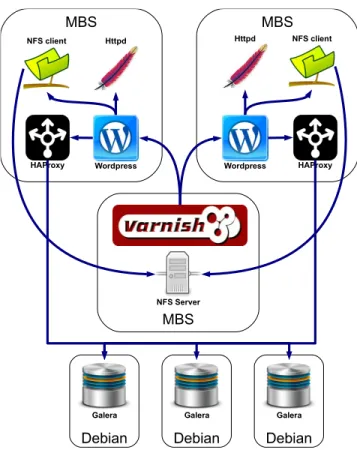
In our example, during the interactive Q/A phase we have chosen Varnish to balance the traffic between 2 WordPress servers, NFS support, and 3 Galera instances. Moreover, we chose to inhibit co-installation of WordPress with Galera or the NFS Server, and to install HAProxy on every machine where WordPress is installed. The only additional piece of information asked byBlenderas configuration data were the admin passwords for the DBs and HAProxy.
The final architecture produced byBlenderis depicted in Figure2. The installation requires 6 machines, 3 running Debian and 3 MBS (Mandriva Business Server).2 It took
≈7 minutes to deploy such architecture on a simple Open-Stack infrastructure deployed on an Intel Xeon server with 4 cores. The computation of the final configuration and the deployment plan was almost instantaneous: 90% of the time was spent waiting for the virtual machines to boot and for package installation.
3.
AEOLUS BLENDER INTERNALS
As depicted in Figure 3, Blenderis intended to be used in combination with an XMPP server and an OpenStack cloud installation. Blender is realized as an XMPP client that wraps and combines the tools Zephyrus, Metis, and Ar-monic and exposes its functionalities viaad hoccommands.3 Basically, such commands are used to launch Zephyrus, view the graph representing the computed final configuration, fill the configuration variables, and perform the deployment ac-tions according to the plan produced by Metis.Blendercan be interacted with via a Web user interface or the command
2http://www.mandriva.com/en/products-services/mbs/ 3 http://xmpp.org/extensions/xep-0050.html MBS Wordpress HAProxy Httpd NFS client Debian Galera MBS NFS Server Debian Galera Debian Galera MBS Wordpress HAProxy Httpd NFS client
Figure 2: Computed WordPress farm architecture
line. An advantage of this architecture is that new elements can be added by wrapping them as simple XMPP clients. For instance, other IaaS offers can easily be added in addi-tion to the currently supported OpenStack.
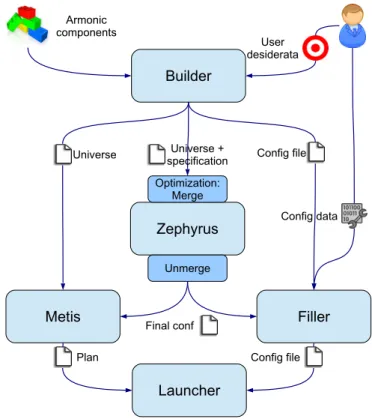
Blenderrelies on scripts that integrate Zephyrus, Metis, and Armonic following the execution flow depicted in Fig-ure 4. Such work-flow requires two distinct inputs: an Ar-monic component repository, and a high-level description of the desired application to be deployed.
In Armonic a software component has an associated life-cycle that can be conceptually viewed as a state machine representing the different steps that need to be performed in order to deploy the component. For example, a component could have an associated state machine with 4 states: not in-stalled,installed,configured, andactive. Each state usually is associated to a collection of actions that need to be per-formed to enter into or exit each state, and actions that can be invoked on the component when a state has been entered. Technically states are implemented as Python classes, and actions are class methods. Each state has at leastenterand
leave hooks that are invoked when a state is entered and exited. Actions to be performed require the instantiation of a group of variables capturing information such as the required services, or the needed configuration values (with their default or optional values). In some cases, the required services should be local when the functionality must be pro-vided in the same host where the component is deployed. For instance, in our running example, the NFS client is a lo-cal dependency of WordPress because an active WordPress
OpenStack Cloud XMPP Server
...
Aeolus Blender UserFigure 3: Blender environment
needs an NFS client to be installed on the same machine.4 The first step of theBlenderexecution flow is querying the user to gather her desiderata. This task is performed by the
Builder that asks the user for the components she wants to install, their desired replication constraints, and information about the need or impossibility to co-install onto the same host specific pairs of components.
When the user has entered all this information, theBuilder
queries the Armonic component repository and generates: specification file containing the encoding of the constraints
that should be satisfied in the final configuration ex-pressed in the specification language used by Zephyrus; universe file containing the Aeolus component representa-tions [8] of available components, in the JSON format used by both Zephyrus and Metis;
configuration data file containing indications about the system-level configured data needed to configure Ar-monic components. Some of them, if not already pro-vided, will have to be entered by the user later on (e.g., credentials). Other data may be inferred from the configuration parameters of other components (e.g., WordPress can suggests a database name to its database dependency).
An excerpt of the specification file generated from user input for the running example is as follows:
Varnish:Active >= 1
and #(_){_ : #Galera:Active > 0 and
#Wordpress:ActiveWithNfs > 0 } = 0
The first line requests a final configuration to have at least one Varnish component in the Active state. The second and third lines forbid the co-installation of Galera with Word-Press. In addition to user defined constraints,Blenderalso requires that every component can not be installed more than once on the same virtual machine; this is currently due to an Armonic limitation that does not allow to install the same component twice on the same machine.
Theuniversefile is generated by encoding Armonic com-ponents into Aeolus comcom-ponents, which faithfully capture
4for more information related to Armonic components we
refer the interested reader to [21]
Builder Armonic components Zephyrus Optimization: Merge Unmerge Metis Filler Launcher Universe + specification
Universe Config file
Config file Plan Final conf Config data User desiderata
Figure 4: Blender execution flow
states and transitions. In Aeolus terminology, methods ex-posed by states become provide ports. These methods and special state methods (e.g., enter and leave) can expose dependencies which become require ports. As an exam-ple, a graphical representation of the Aeolus model for the WordPress component of our example is given in Figure5. WordPress is depicted as a 5 state automaton, requiring the
add database functionality from the HAProxy to be config-ured, the start andget document root functionalities to be active, and themount functionality from the NFS client to support the NFS. When active with NFS support, Word-Press will provide theget websitefunctionality to other com-ponents.
Since the Aeolus model abstracts away from configuration data, these are stored in the configuration data file, which will be later used to perform deployment.
The universe file generated by the Builder is subsequently post-processed in order to merge together components that must be installed on the same machine. For instance, in our example, the WordPress components needs an NFS client to be installed on the same machine. These two components are therefore merged together obtaining a new component that consumes the sum of the resources. This simplifies the input of Zephyrus, reducing the number of components to be managed, thus speeding up the computation of the final optimal configuration, i.e., the one that uses the smallest number of virtual machines.
The solution computed by Zephyrus is then processed to decouple the components that were previously merged to-gether. Indeed, while Zephyrus abstracts away from the internal life-cycles of the component, Metis needs to con-sider individual automata to compute the needed deploy-ment actions. Metis then takes the post-processed output
@Haproxy/Active/add_database Template wordpress @Httpd/Configured/get_document_root Configured Active ActWithNFS @Nfs_client/Active/mount @Httpd/Active/start @Wordpress/ActiveWithNfs/get_website Installed Legend Component State Initial State Provide Port Require Port
Figure 5: Aeolus representation of the WordPress component
of Zephyrus and the original Universe file to compute a de-ployment plan to reach the final configuration.
At this point the user is asked to provide the missing con-figuration data for the final deployment. The concon-figuration data file generated by the Builder is processed together with the output of Zephyrus to detect which components should be installed and then fill the missing data querying the user if needed. This task is performed by a component dubbed
Filler that uses severalArmonic libraries to deduce config-uration variables from default values where possible.
Once all the configuration information are filled, the plan produced by Metis and the configuration data file are passed to theLauncher, a Python tool that acquires and bootstraps the virtual machines indicated in the output of Zephyrus us-ing the OpenStack API, and transforms the abstract deploy-ment actions generated by Metis into concrete actions that are sent to Armonic agents running on individual virtual machines.
4.
IMPLEMENTATION
The complete toolchain presented in this paper is pub-licly available and released as free software, under the GPL license. Blenderconsists of≈5k lines of Python and is avail-able from
git://git.mandriva.com/users/aeiche/aeolus-toolchain. AsBlenderis an integrator, it has as software dependencies the tools it integrates:
• Zephyrus that amounts to about 10k lines of OCaml and is available from
https://github.com/aeolus-project/zephyrus/;
• Metis that amounts to about 3.5k lines of OCaml and is available fromhttps://github.com/aeolus-project/ metis;
• Armonic that amounts to about 5k lines of Python, plus glue code for component life-cycles written in shell script or Augeas and is available fromhttps://github. com/armonic/armonic.
Screencasts showing howBlendercan be used to deploy dif-ferent WordPress installations are available athttp://blog. aeolus-project.org/aeolus-blender/.
5.
RELATED WORK
The Blender toolchain integrates various tools, some of which have been discussed elsewhere. Zephyrus has been presented in [7]; the deployment experimentation done in that paper already took into account Armonic. The present paper extends [7] in several ways: it integrates Metis to drive deployment on the basis of an actual deployment plan; it adds an actual user interface turningBlenderinto a real, production-ready tool; and it offers tighter integration among the three tools. Thanks to Metis, which supports the synthe-sis of infrastructure-independent plans,Blendercould also be used with other deployment engines, while deployment as described in [7] relied on hard-coded internal mechanisms of Armonic. The new user interface supports the user in lively monitor the state of the ongoing deployment, with step-by-step visualization of the effect of each deployment action. This functionality is clearly more effective if actions are ex-ecuted in sequence. For this reason the current version of
Blender serializes the actions synthesized by Metis (which, a priori, are maximally parallel); this limitation is arbitrary though, it could be lifted by further improving the UI.
Metis has been presented in [18]. The tool validation in that paper was done by using automatically generated descriptions of components. The integration of Metis in
Blender described in this paper, on the other hand, repre-sents the validation of Metis on real use-cases.
Different languages with their deployment engines have been proposed [10,13,22], but have seen limited practical adoption thus far. For this reason, as previously mentioned, the most common solution for the deployment of a cloud ap-plication is still to rely on pre-configured virtual machines [1,
6,12]. A common, but more knowledge-intensive solution, is to use on configuration management tools, such as CFEngine [4], Puppet [24], and Chef [23]. Using those tools it is pos-sible to declare the components that should be installed on each machine and their configuration. However, the burden of specifying where components should be deployed, and how to interconnect them is left to the system administrator.
Juju [17], supported by Canonical, includes a GUI that allows the application manager to design a final configura-tion and indicates the steps needed to obtain it. It cannot however compute the final and optimal configuration start-ing from a partial specification, nor devise an optimal or-der in which the deployment actions need to be performed. ConfSolve [16], like Zephyrus, relies on a constraint solver to propose an optimal allocation of virtual machines to servers, and of application components to virtual machines. How-ever, it is unaware of system-level package incompatibilities on individual machines and does not allow to compute the actions needed to reach the computed configuration.
Similarly to Metis, Engage [11] automatically generates the right order in which deployment actions should be gen-erated. In order to do this, Engage avoids circular compo-nent dependencies and simply perform a topological sort on the graph representing the component dependencies. Metis, on the contrary, is able to also deal with circular depen-dencies that can arise in practice when, for instance, con-figuration information flow between components in both di-rections (consider, e.g., a master database that first requires the slave authentication and subsequently provides the slave with a dump of the database).
Saloon [25] computes a final configuration by describing a cloud application using a feature model extended with
fea-ture cardinalities. It automatically detects inconsistencies but, differently from Zephyrus, it does not offer the ability to minimize the number of resources and virtual machines to be used.
Another relevant research direction is to leverage tradi-tional planning techniques and tools coming from artificial intelligence. In [3,14,15] off-the-shelf planning solvers are ex-ploited to automatically generate (re-)configuration actions. To use these tools, however, all the deployment actions with theirs preconditions and effects need to be properly speci-fied in a formalism similar to the Planning Domain Defini-tion Language (thede factostandard language for planners). The Metis approach, on the other hand, relies on simpler and natural descriptions (i.e., state machines describing the temporal order of the component configuration actions).
6.
CONCLUSIONS
We have presentedBlender, a tool exploiting a configura-tor optimizer, anad hocplanner, and a deployment engine to automate installation and deployment of complex cloud applications. Blender does not rely on predefined recipes, but on reusable component descriptions that are used as building blocks to synthesize a fully functional configura-tion satisfying the user desiderata. Blenderis easy to use, comes with a web graphical interface, and requires as in-put just those specific configuration parameters that cannot be deduced from the component descriptions. Blenderhas been validated on common deployment task, such as the in-stallation of aWordPressfarm. It is an open source project maintained by Mandriva that does also provide business ser-vices on top of it.
As future work we plan to testBlenderon larger use cases, creating a first benchmark to be used to evaluate both the improvements of futureBlenderversions and for comparison with possible future competitors. In particular, new versions ofBlenderwill reduce the deployment time by following the maximal parallelizable plan suggested by Metis. Further-more, noticing that replicated servers (e.g., the Debian ma-chines containing the replicated database in ourWordPress
example) share part of their deployment plan, we would like to use live virtual machine cloning instead of re-creating in-stances that will end up being similar from scratch.
We also plan to integrate other IaaS solutions (such as Amazon EC2, RackSpace, or Google Compute Engine) as well as other component libraries (like, e.g., those present in Juju [17] or Apache Brooklyn [2]).
7.
REFERENCES
[1] Amazon. AWS CloudFormation.
http://aws.amazon.com/cloudformation/. [2] Apache Software Foundation. Apache Brooklyn.
https://brooklyn.incubator.apache.org/. [3] N. Arshad, D. Heimbigner, and A. L. Wolf.
Deployment and dynamic reconfiguration planning for distributed software systems.Software Quality Journal, 15(3), 2007.
[4] M. Burgess. A Site Configuration Engine.Computing Systems, 8(2), 1995.
[5] M. Catan, R. D. Cosmo, A. Eiche, T. A. Lascu, M. Lienhardt, J. Mauro, R. Treinen, S. Zacchiroli, G. Zavattaro, and J. Zwolakowski. Aeolus: Mastering
the Complexity of Cloud Application Deployment. In
ESOCC, 2013.
[6] CenturyLink. Cloud Blueprints.
http://www.centurylinkcloud.com/products/ management/blueprints.
[7] R. D. Cosmo, M. Lienhardt, R. Treinen, S. Zacchiroli, J. Zwolakowski, A. Eiche, and A. Agahi. Automated synthesis and deployment of cloud applications. In
ASE, 2014.
[8] R. D. Cosmo, J. Mauro, S. Zacchiroli, and G. Zavattaro. Aeolus: A component model for the cloud.Inf. Comput., 239, 2014.
[9] DevOps.http://devops.com/.
[10] X. Etchevers, T. Coupaye, F. Boyer, and N. D. Palma. Self-Configuration of Distributed Applications in the Cloud. InCLOUD, 2011.
[11] J. Fischer, R. Majumdar, and S. Esmaeilsabzali. Engage: a deployment management system. InPLDI, 2012.
[12] Flexiant. Bento Boxes.http://www.flexiant.com/ 2012/12/03/application-provisioning/.
[13] G. E. Gon¸calves, P. T. Endo, M. A. Santos, D. Sadok, J. Kelner, B. Melander, and J. M˚angs. CloudML: An Integrated Language for Resource, Service and Request Description for D-Clouds. InCloudCom, 2011. [14] H. Herry and P. Anderson. Planning with Global
Constraints for Computing Infrastructure Reconfiguration. InCP4PS, 2012.
[15] H. Herry, P. Anderson, and G. Wickler. Automated Planning for Configuration Changes. InLISA, 2011. [16] J. A. Hewson, P. Anderson, and A. D. Gordon. A
Declarative Approach to Automated Configuration. In
LISA, 2012.
[17] Juju, devops distilled.https://juju.ubuntu.com/. [18] T. A. Lascu, J. Mauro, and G. Zavattaro. A Planning
Tool Supporting the Deployment of Cloud Applications. InICTAI, 2013.
[19] T. A. Lascu, J. Mauro, and G. Zavattaro. Automatic Component Deployment in the Presence of Circular Dependencies. InFACS, 2013.
[20] Mandriva. Armonic.http:
//armonic.readthedocs.org/en/latest/index.html. [21] Mandriva. Armonic, Lifecycle anatomy.
http://armonic.readthedocs.org/en/latest/ lifecycle.html.
[22] OASIS. Topology and Orchestration Specification for Cloud Applications (TOSCA) Version 1.0.
http://docs.oasis-open.org/tosca/TOSCA/v1.0/ cs01/TOSCA-v1.0-cs01.html.
[23] Opscode. Chef.http://www.opscode.com/chef/. [24] Puppetlabs. Puppet.http://puppetlabs.com/. [25] C. Quinton, A. Pleuss, D. L. Berre, L. Duchien, and
G. Botterweck. Consistency checking for the evolution of cardinality-based feature models. InSPLC, 2014.