Computational Causal Behaviour Models
Dissertation
to obtain the academic degree of
Doktor-Ingenieur (Dr.-Ing.)
of the Faculty of Computer Science and Electrical Engineering at the University of Rostock
submitted by
Dipl.-Inf Frank Krüger
born on 19.12.1980 in Rostock, Germany from Rostock
Date of submission: 29.06.2016 Date of defence: 26.09.2016
1st reviewer: Prof. Dr.-Ing. Thomas Kirste, Universität Rostock
2nd reviewer: Prof. Dr. rer. nat. habil Adelinde Uhrmacher, Universität Rostock
As computers are becoming more and more a part of our everyday life, the vision of Mark Weiser about ubiquitous computing becomes true. One of the core tasks of such devices is to assist the users in achieving their goals. To do this, the assistive system has to have knowledge about the current situation as well as the user’s goal. Such knowledge allows the assistive system to provide strategies to support the users in achieving their goals beginning from the current situation. A GPS navigation device is a simple, yet well known instance of such an assistive system. It recommends a route based on the current location and the manually specified goal. Obviously, effective assistance can only be provided if accurate knowledge about the user’s situation and his goal is available. This requires to reason about the actions of the user and to cope with uncertainties that are inherent to human behaviour. The problem becomes even harder, as in real world settings, users cannot be observed directly but through sensors that introduce noise and ambiguity as additional sources of uncertainty. Several applications in the literature showed that probabilistic methods can be used to infer the required information from sensor data. However, massive amounts of training data are needed in order to train classifiers to achieve good recognition rates. This is expensive and prevents trained models from being reused.
Recently, researchers employed models of human behaviour in order to reduce the need for training data. These models are generalisable – they allow the specification of human behaviour without the need for training samples. To this end, these models can be reused in different settings. While these models allow the synthesis of probabilistic models, only few attempts have been made to assess their capabilities with respect to low level sensors such as accelerometers. In fact, different researchers stated that inferring high level knowledge about the user from low level sensor data is an open research topic.
To address the above problems, objective of this thesis is to answer the question “how to achieve efficient sensor-based reconstruction of causal structures of human behaviour in order to provide assistance?”. To achieve that, in the first step the meaning of this question is
ana-lysed and requirements for an inference system are derived. A review of the literature is then conducted and a meta analysis is performed to assess the capabilities of the different approa-ches and the complexity of their evaluation setting. The results of this analysis show that none of the approaches from the literature satisfies all requirements.
To answer the research question, the concept of Computational Causal Behaviour Mo-dels (CCBMs) is introduced. CCBM allows the specification of human behaviour by means of preconditions and effects and employs Bayesian filtering techniques to reconstruct action se-quences from noisy and ambiguous sensor data. Furthermore, a novel approximative inference algorithm – the Marginal Filter – is introduced. The Marginal Filter is specifically tailored for categorical state spaces, which are generated by CCBM. To investigate the capabilities with respect to recognition performance and reusability, different experiments are then conducted. Each experiment addresses different aspects of the research question. A detailed analysis of the results of these experiments shows that CCBM is able to achieve good recognition rates. Moreover, the Marginal Filter is shown to outperform the standard method for approximati-ve Bayesian inference – the Particle Filter. Furthermore, it is shown that CCBM satisfies the requirements.
Die Vision des „Ubiquitous Computing“ von Mark Weiser wird langsam wahr – immer mehr Computer umgeben uns in Alltagsgegenständen. Eine Hauptaufgabe dieser Geräte ist es, Nutzer dabei zu unterstützen ihre Ziele zu erreichen. Dabei ist es notwendig, dass Assistenzsysteme in der Lage sind, Informationen über die aktuelle Situation des Nutzers und seine Ziele zu erfassen. Dieses Wissen wird dann von den Assistenzsystemen verwendet, um Strategien zum Assistieren des Nutzers entwickeln. Ein GPS Navigationsgerät ist ein sehr einfaches Beispiel für solche Assistenzsysteme. Basierend auf der aktuellen Position und einem, wenn auch eingegebenen, Ziel, ist es in der Lage dem Nutzer eine Route vorzuschlagen.
Eine wichtige Voraussetzung für das Umsetzen der Assistenzfunktionalität ist sicheres Wissen um die aktuelle Situation und potentielle Ziele des Nutzers. Um solche Informationen bereitzu-stellen ist es erforderlich, dass das Assistenzsystem Schlussfolgerungen aus den Handlungen des Menschen zieht. In der Realität ist es nicht möglich Menschen, direkt zu beobachten sondern unter Verwendung von Sensoren, deren Daten verrauscht und mehrdeutig sind. Dadurch wird die Erfassung der notwenigen Informationen weiter erschwert. In der Literatur konnte gezeigt werden, dass probabilistische Methoden in der Lage sind, Informationen über die aktuelle Situa-tion und das Ziel des Nutzers aus unscharfen Sensordaten zu schließen. Es sind große Mengen an Trainingsdaten notwendig, um Klassifikatoren so zu trainieren, dass gute Erkennungsra-ten erreicht werden. Das Erzeugen von TrainingsdaErkennungsra-ten ist jedoch teuer. Außerdem lassen sich durch Trainingsdaten keine allgemeingültigen Schlüsse ziehen, was die Wiederverwendbarkeit so trainierter Modell verhindert.
Modelle menschlichen Handeln wurden in letzter Zeit von verschiedenen Forschern verwen-det, um die Notwendigkeit von Trainingsdaten zu reduzieren. Solche Modelle erlauben eine generalisierbare Beschreibung ohne auf Trainingsdaten angewiesen zu sein. Dadurch können die resultierenden Modelle in verschiedenen Szenarien wiederverwendet werden. Obwohl diese Modelle das Erzeugen probabilistischer Modelle erlauben, wurden nur wenige Versuche un-ternommen, ihre Eigenschaften in Hinblick auf die Verwendung von „low-level“ Sensoren wie Akzelerometer zu untersuchen. Verschiedene Forscher halten die Verbindung von „high-level“ Inferenz mit „low-level“ Sensoren für ein offenes Forschungsfeld.
Diese Dissertation zielt auf die Beantwortung der folgenden Frage ab:„Wie kann man die ef-fiziente sensorbasierte Rekonstruktion kausaler Strukturen menschlichen Handelns zum Zwecke der Assistenz erreichen?“. Dazu werden im ersten Schritt Anforderungen an ein
Inferenzsys-tem hergeleitet. Danach wird eine detaillierte Analyse verwandter Arbeiten durchgeführt und mithilfe einer Metaanalyse die Eigenschaften aktueller Ansätze und deren Evaluationsszenarien erfasst. Diese Analyse zeigt, dass keiner der aktuellen Ansätze alle Anforderungen erfüllt.
Um die Forschungsfrage zu beantworten, wird das System der „Computational Causal Be-haviour Models“ vorgestellt. Es erlaubt die Spezifikation menschlichen Verhaltens durch die Verwendung von Vorbedingungen und Effekten. Bayes’sche Inferenz wird verwendet um Akti-onssequenzen aus unscharfen Sensordaten zu rekonstruieren. Darüber hinaus wird ein neuarti-ger Algorithmus zur approximativen Inferenz vorgestellt – der Marginale Filter. Der Marginale Filter ist entworfen, um den speziellen Eigenschaften kategorialer Zustandsräume, wie sie von „CCBM“ erzeugt werden, gerecht zu werden. Mittels verschiedener Experimente wird die Erken-nungsgenauigkeit und die Wiederverwendbarkeit solcher Modelle untersucht. Dabei behandelt jedes der Experimente andere Teilaspekte der Forschungsfrage. Die Analysen der Ergebnis-se der Experimente zeigen, dass „CCBM“ in der Lage ist, gute Erkennungsgenauigkeiten zu erreichen. Außerdem wird gezeigt, dass der Marginale Filter die Standardmethode für approxi-mative Bayes’sche Inferenz in Hinblick auf die Erkennungsgenauigkeit übertrifft. Zuletzt kann auch die Wiederverwendbarkeit in allen Experimenten nachgewiesen werden.
When I joined MMIS almost seven years ago, I had no idea about what it means to do research in artificial intelligence. Since then I learned a lot about this topic and was finally able to write this thesis. During the last years, there were a lot of people who supported me and enabled me to write this thesis. Now, I would like to thank all of them.
In particular, I would like to thank my supervisor Prof. Thomas Kirste who enabled me to write this thesis and provided such a good research atmosphere. I also would like to thank Prof. Lin Uhrmacher and Prof. Frank Ortmeier, who accepted to review this thesis. Furthermore, I would like to thank my colleagues and friends for their support during this time. Special thanks go to my family, my wife, and my daughters.
List of Abbreviations XV
1. Introduction and Motivation 1
1.1. Introduction ... 1
1.2. Motivation and Requirement Analysis ... 3
1.2.1. Motivational Examples... 3
1.2.2. Requirements analysis... 4
1.3. Problem Statement ... 6
1.4. Contribution and Results ... 7
1.5. Outline ... 8
2. Computational State Space Models 9 2.1. Activity and Plan Recognition... 10
2.1.1. The Problem of Behaviour Recognition... 10
2.1.2. Activity Recognition ... 12
2.1.3. Plan Recognition ... 14
2.1.4. Actions and States ... 17
2.1.5. Computational State Space Models ... 19
2.2. Related Work ... 19
2.2.1. Classification Scheme ... 20
2.2.2. Classification Results... 24
2.2.3. Policy Recognition in the Abstract Hidden Markov Model ... 25
2.2.4. Learning and Inferring Transportation Routines... 26
2.2.5. Synthesising Generative Probabilistic Models for High-Level Activity Recog-nition ... 28
2.2.6. Action Understanding as Inverse Planning ... 29
2.2.7. Goal Recognition over POMDP ... 30
2.2.8. Accommodating Human Variability in Human-Robot Teams ... 32
2.2.9. Location-Based Reasoning about Complex Multi-Agent Behavior ... 33
2.2.10. Summary ... 34
3. Computational Causal Behaviour Models 35 3.1. Statistical Model... 36
3.1.1. Action Execution Model ... 38
3.1.2. Action Start Time and Action Duration Models ... 40
3.1.3. Goal Selection Model... 41
3.1.4. Action Selection Model ... 42
3.1.5. Observation Model ... 44
3.2. Inference Algorithms ... 45
3.2.2. The Marginal Filter ... 47
3.3. The Computational Causal Behaviour Model Toolbox ... 50
3.3.1. Modelling Language ... 51
3.3.2. CCBM Inference Tools ... 54
4. Causally Correct Annotation 55 4.1. Annotation of Human Behaviour ... 55
4.2. Model-based Semantic Annotation for Human Behaviour ... 57
5. Methods 63 5.1. Research Questions ... 64
5.2. Empirical Data ... 66
5.3. Experimental Procedure ... 67
5.4. Evaluation Methods ... 70
5.4.1. Different Estimation Tasks ... 70
5.4.2. Evaluation of Action Recognition ... 71
5.4.3. Evaluation of Contextual Information ... 73
5.4.4. Evaluation of Goal Recognition ... 74
5.4.5. Assessing the Size of Effects ... 74
6. Experiments 75 6.1. Experiment X1: Three Person Meeting ... 76
6.1.1. Objective ... 77
6.1.2. Trial Setting ... 77
6.1.3. Experimental Setup ... 80
6.1.4. Results ... 84
6.1.5. Discussion ... 88
6.2. Experiment X2: Kitchen Task ... 90
6.2.1. Objective ... 90
6.2.2. Trial Setting ... 91
6.2.3. Experimental Setup ... 94
6.2.4. Results ... 97
6.2.5. Discussion ... 105
6.3. Experiment X3: Indoor Localisation ... 107
6.3.1. Objective ... 109
6.3.2. Trial Setting ... 109
6.3.3. Experimental Setup ... 112
6.3.4. Results ... 114
6.3.5. Discussion ... 117
7. Discussion and Conclusion 119 7.1. Summary ... 119
7.2. Discussion ... 123
7.3. Limitations ... 124
7.4. Outlook and Future Research... 124
A. Details 151 A.1. Additional Information about Related Work ... 151
A.2. Example ... 153
A.4. Notes on Intention Recognition... 154
B. Additional Information about Experiments 157
B.1. Experiment X1... 157 B.2. Experiment X2... 159 B.3. Experiment X3... 165
2.1. Graphical representation of three different types of classifier... 11
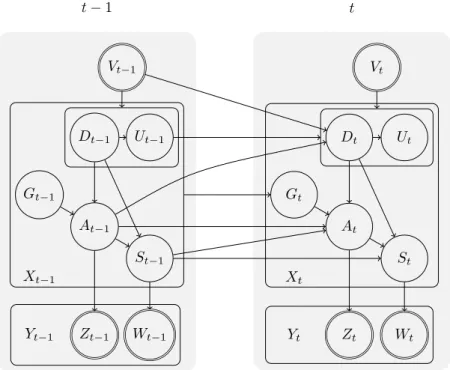
3.1. Graphical model used in CCBM. ... 37
3.2. Example of an action duration PDF and the resulting CDF. ... 41
3.3. Example of an action duration PDF and the resulting action duration function. . 41
3.4. Schematic illustration of theSstate,Xstate and representation unit assignment in Particle Filter and Marginal Filter. ... 49
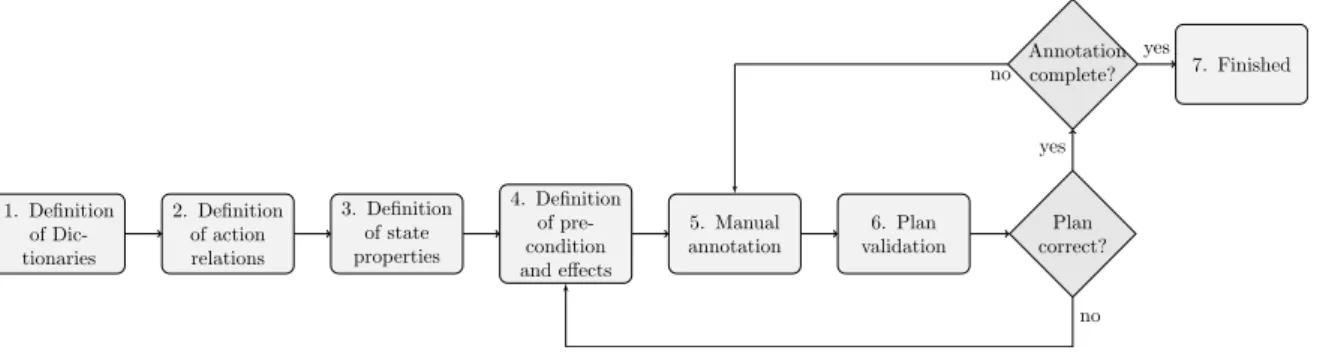
4.1. The proposed workflow for semantic annotations of human behaviour. ... 58
4.2. Specification of the annotation LTS action take. ... 60
4.3. Screenshot of the annotation procedure using ELAN. ... 60
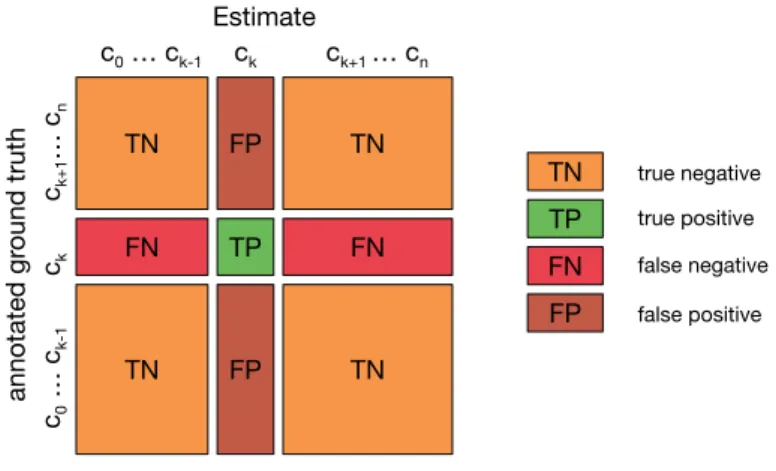
5.1. Confusion matrix for multi-class classification. ... 71
6.1. Overview of the Smart Appliance Lab. ... 78
6.2. Graphical representation of the transition matrix of the baseline HMM for the meeting experiment. ... 81
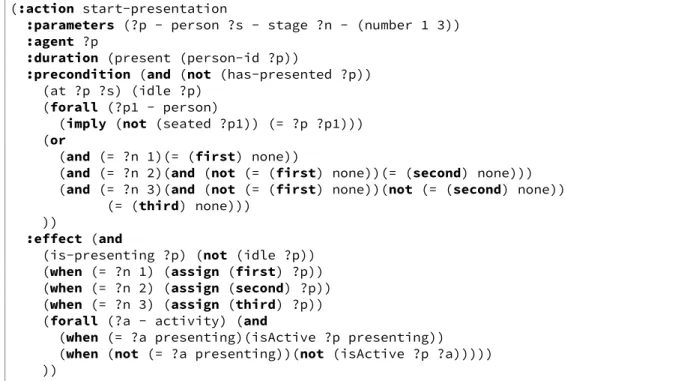
6.3. The action start-presentation. ... 82
6.4. Overview of the accuracies of the baseline HMM for the meeting experiment. .... 84
6.5. Overview of the results of all CCBM configurations for the meeting experiment. . 85
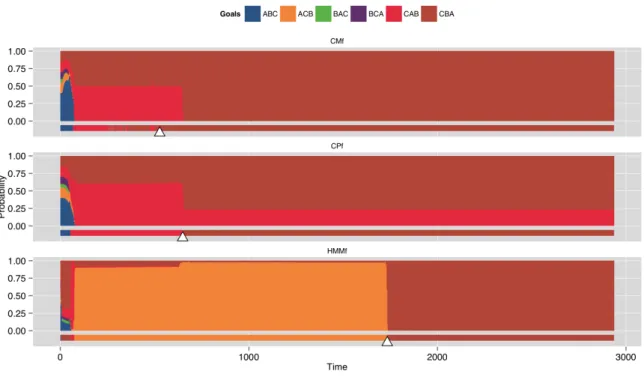
6.6. Convergence points for the baseline HMM and theτc-based CCBM configurations. 86 6.7. The goal PDF for M17 of the HMM baseline classifier and τc-based CCBM classifiers... 87
6.8. Relationship of activity recognition and goal recognition of CCBM and baseline classifiers... 88
6.9. The physical trial setup of the kitchen experiment... 92
6.10. Accuracies of the baseline classifier per subject. ... 98
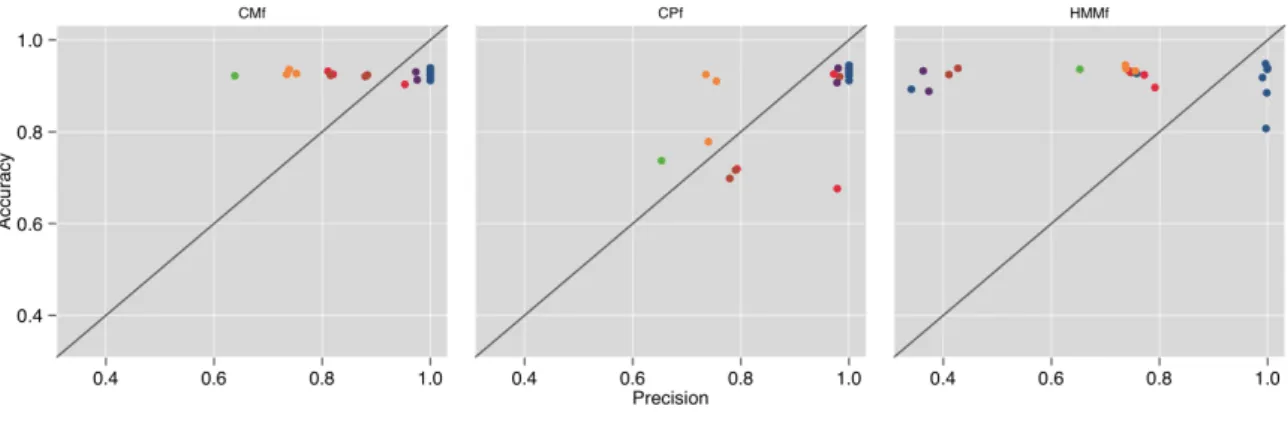
6.11. Boxplots of the accuracies of all CCBM configuration for the kitchen experiment. 99 6.12. Accuracy comparison of selected CCBM configurations to HMM, by subject and filter method. ... 100
6.13. Confusion matrix based performance measures per class. ... 100
6.14. Interaction plots for the significant interactions. ... 102
6.15. Jensen Shannon distance and accuracies for different values forTargetandDistance.104 6.16. Estimating the probability of state properties. ... 105
6.17. Comparison of different performance measures sensitive for causality. ... 105
6.18. The problem of simultaneous identification of multiple persons in partially ob-served environments. ... 108
6.19. The spatial layout of the indoor localisation trial setting... 109
6.20. Graphical illustration of the location sequence of the first repetition of person A1in trial T1... 111
6.21. Overview of the recognition accuracies for the location-based estimate of all
classifiers... 115
6.22. Overview of the activity recognition (AR) accuracies the CCBM-based classifier. 116 6.23. Linear models fitted to predict accuracies of the different classifier from the number of involved persons. ... 117
B.1. The probability of each agent for being seated at each time-step. ... 158
B.2. Frequencies of actions in the dataset. ... 159
B.3. Linear Models fitted to predict the normalised remaining time to goal (RT) from the normalised goal distances for different goal distance approximations. ... 159
B.4. Effect of scrambling on (expected) log probability of observations vs. normalised relative run position. ... 160
B.5. Confusion matrices for QDA, HMM, and CCBM. ... 161
B.6. Interactions between Mode,Distance, and Weight. ... 161
2.1. Factors for analysing related work. ... 21
2.2. Overview of related work and evaluation studies. ... 23
2.3. Evaluation of the requirements of selected related work. ... 34
4.1. Examples of annotation schemes ... 56
4.2. Example of the results of the first annotation step... 58
4.3. Example of the results of the second annotation step. ... 59
4.4. Example of the results of the third step of the annotation process. ... 59
5.1. Overview of the experiments and the research questions. ... 65
5.2. Modelling factors and their meaning for experimental configurations. ... 70
5.3. Overview of different effect size measures and their interpretation. ... 74
6.1. Different types of agendas including their frequencies. ... 78
6.2. Overview of the compliant meeting... 79
6.3. Factors and levels for the Meeting experiment. ... 83
6.4. Performance comparison of different CCBM configurations with corresponding HMM configuration. ... 85
6.5. Mean precision per goal for each classifier. ... 86
6.6. Task script of the kitchen trial ... 93
6.7. Factors and levels for experimental configurations. ... 96
6.8. Cohen’sκ and overall accuracies for selected configurations. ... 101
6.9. Median SpU and XpS values and ratios, across all runs of the kitchen experiment.103 6.10. Median values and IQR (Q1,Q3) forAccuracy and JSDfor predicate estimation. . 104
6.11. Overview of the different agent configuration... 110
6.12. State space size for the different problems. ... 113
6.13. Factors and levels for the indoor localisation experiment. ... 114
6.14. Overview of the mean recognition accuracies of the baseline classifiers... 115
6.15. Linear models to predict the accuracy from the number of involved persons. ... 116
A.1. Overview of plan recognition aproaches. ... 151
A.2. Overview of AR approaches. ... 152
B.1. Extract of the preprocessed position data from the first meeting datasetD1. ... 157
B.2. Selected probability density functions for each action including their parameters. 158 B.3. Performance comparison of different CCBM configurations with appropriate HMM configuration. ... 159
B.4. Value domains of location slot by domain object for the kitchen experiment. ... 160
B.5. The domain objects and their slots for the kitchen experiment. ... 162
B.7. Action sequence of subjectS1 (aLTS annotations). ... 163
B.8. Duration models selected for action classes. ... 164 B.9. Significance of effects of CCBM configuration factors on Accuracy, using 216
CMf / CPf configurations. (2 modes, 3 observations, 3 distances, 6 weights, 2
durations.) ... 164 B.10.Overview of the annotation sequence of the first iteration for one participating
person... 165 B.11.Comparison of the CCBM to the HMM recognition accuracies for the different
ACT-R Adaptive Control of Thought – Rational . . . 20
ADL activity of daily living. . . .12
aLTS annotation LTS . . . 57
AR activity recognition . . . XII CCBM Computational Causal Behaviour Model. . . .I CDF cumulative distribution function . . . 41
CMUMMAC Carnegie Mellon University Multimodel Activity . . . 57
CSSM Computational State Space Model . . . 7
DBN dynamic bayesian network . . . 26
DSL domain specific language . . . 18
DT decision tree. . . .13
DTW dynamic time warping . . . 73
GPS Global Positioning System. . . .3
HMM Hidden Markov Model . . . 11
IMU inertial measurement unit . . . 13
iLTS inference LTS . . . 61
JSD Jensen-Shannon distance . . . 74
LTS labelled transition system. . . .17
MAP maximum a-posteriori . . . 33
MDP Markov Decision Process . . . 29
MF Marginal Filter . . . 8
NB Naïve Bayes . . . 11
PDDL Planning Domain Definition Language. . . .20
PDF probability density function . . . 31
PF Particle Filter. . . .8
PIR passive infrared . . . 25
POMDP Partially Observable Markov Decision Process . . . 31
QDA quadratic discriminate analysis . . . 94
PR plan recognition . . . 10
rANOVA repeated measures analysis of variance . . . 74
RBPF Rao-Blackwellized Particle Filter . . . 26
RFID radio-frequency identification . . . 92
STRIPS Stanford Research Institute Problem Solver. . . .19
1
Introduction and Motivation
“It is a capital mistake to theorise before one has data” – Sherlock Holmes
Synopsis: This first chapter describes the aim of this thesis. For this reason, in the first step a
list of requirements is derived by briefly analysing two instances of assistive systems. In the next step, a detailed problem statement is provided. Finally, it is described how this thesis contributes to addressing the states problems.
Chapter Sources: Parts of this Chapter have been previously published in the following
publi-cation(s):
• Towards Creating Assistive Software by Employing Human Behavior Models [129]
1.1. Introduction
With the rise of ubiquitous computing [246] in our everyday life, the number of devices sur-rounding us is steadily increasing. These devices allow for supporting users in everyday activi-ties without being perceived explicitly. Consequently, the number of context aware applications increases. Knowledge about the user’s activity, goal, and additional contextual information is crucial for such applications [98]. Example applications can be found in the domains of smart environments [55, 260], security and surveillance [84], man-machine-collaboration [95], and personal assistive systems [99, 179].
According to [120], context aware systems consist of two components. The first component is called intention analysis (or “inference system”) and tracks the user’s actions. This means it estimates the user’s current activity, the information about the environment (referred to as contextual information), possible future actions and the final goal the user is actively trying
to achieve. The second component is the strategy synthesis component. This component usually adjusts the environment to the user’s needs. Within this thesis, we focus on the first component, namely the inference system.
More precisely, this thesis addresses the question of:
IQ How to achieve efficient sensor-based reconstruction of causal structures of human be-haviour in order to provide assistance?
To this end, we first analyse the meaning of this question. The wordefficient means that the
inference system under development has to be able to work online. Whenever a new observation about the dynamic system1 arrives, a new estimate about the system’s situation2 has to be
computed. The term “online” does not refer to constraints of actual execution time, as this would require knowledge about the hardware and the application of an realtime operating system, but rather in the sense of computational complexity. Estimating the dynamic system’s state online means that computing the estimate for one time-step has to be independent of the length of the observation sequence so far and of the overall length of the observation sequence. In fact, the complexity of computing an estimate only depends on the belief3 about the current
situation and the number of possible situation changes. Inference complexity for the complete observation sequence has to be linear in the number of time-steps4 T –O(T). In other words,
inference complexity has to be constant for a single observation item. This allows, by adjusting the necessary hardware, to ensure the system’s ability to react in an appropriate time interval. The term sensor-based indicates that the inference system has to draw conclusions about
the human protagonist by means of sensors. Knowledge about actions, executed by a dynamic system, can typically not be obtained directly5, but has to be observed through sensors. Sensors
measure physical properties and their changes, which are affected by the actions of the dynamic system. Sensor data typically does not allow to directly conclude the dynamic system’s state as it is subject to noise. Additionally, sensor data is typically ambiguous. Answering the initial question IQthus means handling the uncertainty inherent to the sensor observation [46, 237].
As sensors typically do not allow to draw conclusions about the actions of a dynamic system directly, reconstruction means estimating the sequence of states or actions of the dynamic
system. Based on sensory observation, the inference system has to compute the most likely sequence of actions.
As the term causal structures indicates, throughout this thesis we focus on causal action
sequences. This means that there are causal links between the actions of the dynamic system and the internal state. Actions, on the one hand, influence the state of the system but are, on the other hand, influenced by the dynamic system’s state. Not all actions can be executed in each state (e.g. a room cannot be left, if the door is closed). Exploiting causal structures allows the definition of restrictions to the dynamic system, which in result can potentially reduce the inference complexity.
This thesis focusses onhuman behaviour. Therefore, the dynamic system under observation is
a human protagonist. Consequently, the answer to the initial questionIQalso includes handling 1Here, we refer to the system under observation as dynamic system, which at each time is in a state s∈S
represented by a point in the state spaceS. A functionf :S→S allows the system to change that state.
In the following this function is referred to as “action”.
2Situation reflects the dynamic system’s overall state.
3Belief, in this context, stands for the inference system’s representation of the current state of the dynamic
system. In the scope of this thesis the belief is represented by a probability distribution over states.
4The number of time-steps
T refers to the number of observation items of the observation sequence rather
than to an actual time.
5Within the scope of this thesis, we use the term “direct observation” to refer to obtaining information about
uncertainties inherent to human behaviour. Additionally, as the term behaviour suggests, we are especially interested in the reconstruction of sequences of actions, the human protagonist executes in order to achieve a goal. Within this thesis, we assume the human to be trying to reach a previously set goal state. However, this does not mean that the human is a completely rational agent [200, p.36], as human protagonists do not always choose the best action with respect to reaching this goal [208].
In the remainder of this chapter, the initial question IQ is further substantiated. Firstly,
requirements for the inference system are derived. Secondly, a detailed description of the problems that are targeted in this thesis is presented. Finally, the contribution and the results of the thesis are highlighted.
1.2. Motivation and Requirement Analysis
This section first introduces two examples of assistive systems. Based on these examples, requirements for an inference system are then identified and later used to derive a classification scheme for related literature.
1.2.1. Motivational Examples
Consider the following example of a Global Positioning System (GPS) navigation device: a GPS navigation device provides a route from the current location to a target location. Before starting, the target location has to be entered in the device. Then, according to the needs of the user, the device computes the most appropriate route from the current location to the defined target location. During the trip, the GPS navigation device keeps track of the current location and checks whether the car is on the correct route or not. Before the car arrives at a street crossing, the navigation device provides assistance to the driver by suggesting further directions. If, either by accident or by the driver’s choice, the car leaves the precomputed route, the GPS navigation device recognises the deviation and provides appropriate assistance. This typically means that the device first suggests the driver to go back to the originally precomputed route and later starts adjusting the route by re-computing it with the current location. Additionally, typical GPS navigation devices are able to inform users about potential issues (e.g. exceeding the speed limit or an upcoming traffic jam).
The GPS navigation device is a very simple example of an assistive system. During the entire trip the device has to keep track of the current situation of the car. This is done by analysing data from the internal GPS tracking module. Although GPS is not able to provide an exact location estimate, the navigation device is able to refine this estimate by assumptions about the current situation (e.g. cars usually move along streets instead of fields or houses). Single measurement errors determined by the GPS system are corrected by the navigation system.
Now, consider the more fictional example of a kitchen assistance device: The device observes the user within the kitchen environment by means of sensors. When the user decides to prepare a meal, he6 has to select the recipe from the list of recipes provided by the device. A sequence
of actions (plan) is precomputed by the device according to the preferences of the user. The device starts providing assistance in executing the selected task. During the entire procedure the kitchen assistant keeps track of the current situation. Whenever a sub-task is completed the device suggests the next task and monitors whether the user executes it correctly. If the user decides to change the order of some sub-tasks, the device notices the deviations from the original plan and adjusts the assistance to the change. If, on the other hand, the user forgets
6To simplify the discussion, the personal pronoun “he”, as well as the possessive pronoun “his” are used as a
to add some necessary ingredients, the device refers the user to the selected recipe and reminds him to add the ingredients. The kitchen assistance device helps novice users as well as impaired users, such as people suffering from cognitive decline, during the execution of tasks in everyday life. A more sophisticated version of the kitchen device might even attempt to recognise the recipe the user is currently trying to follow from the actions the user is executing without requiring the user to select the recipe beforehand.
Similar to the navigation device, the kitchen assistance device requires to observe the user by means of sensors. However, using location estimating sensors only is not enough, as they do not provide enough information about the manipulated objects. Similar to the navigation device, the kitchen device has to cope with uncertainties inherent to sensors.
The provided examples are typical instances of assistive systems. Both can be divided into the inference system, which estimates the current situation, and the strategy component, which actually provides assistance. In the following, these two instances are used to derive general requirements for the inference system component of assistive systems.
1.2.2. Requirements analysis
According to Indulska and Henricksen [105], a context aware system, which assistive systems are a type of, has to fulfil the following five requirements:
IH1 Support for imperfect context information: A context aware system has to cope
with incomplete, imprecise and ambiguous information. The examples provided above use sensors as source of information.
IH2 Support for context histories: A context aware system requires information about
past and future time-steps. Both introductory examples provide a plan from the initial state to the selected goal state. This plan contains both, information about past actions and possible future actions.
IH3 Support for software engineering: A context model should be introduced in early
stages of the software development lifecycle. Based on this context model, runtime context models can be produced by refinement. Thus, such context models have to be reusable. In the above mentioned examples, both, the navigation device and the kitchen device, are refined for the specific application scenario (i.e. the map of roads and the particular kitchen layout).
IH4 Support for runtime querying and reasoning: The runtime context model has to
represent context information at runtime. This, on the one hand, means that the context aware system has to provide the information timely. On the other hand, this means the context aware system has to maintain all necessary information.
IH5 Support for interoperability: The context aware system has to be able to cooperate
with components that were not known at design time. This also includes sensors that can differ in different application scenarios. The context model has to represent the rich state space of the dynamic system to ensure that context information provided by previously unknown components (e.g. sensors) can be incorporated in the runtime model.
Based on this list of requirements for context aware systems introduced by Indulska and Henricksen [105] and an analysis of the introductory examples, the following requirements for the inference system can be derived. Each of these requirements is provided in the following. Furthermore, the method and the criterium used to check whether a considered approach satisfies the respective requirement is provided.
R1 Plan: The inference system has to provide knowledge about the user’s potential future
provide appropriate support [98] in reaching the goal. In the above introduced examples, the goal is provided by the user. The potential action sequence leading to this goal, in contrast, is computed by the inference system. A deviation from the plan is noticed by the system and used to recompute the plan. This requirement is directly related to IH2.
Method: Analysis of the inference approach and evaluation of the recognition performance Criterium: The approach has to be able to estimate the user’s action sequence and the
final goal with similar recognition performance as baseline classifiers.
R2 Online: The system has to be able to provide information online. It is only possible to
provide effective assistance, if the system is capable of providing information about the user online. With respect to the navigation device, if the system provides information about future directions too late, the assistance makes no sense at all. Furthermore, it can produce potentially dangerous situations, as some drivers can turn around even on highways resulting in an increased occurrence of wrong-way drivers. Concerning the kitchen assistance device, assistance provided too late can distract and annoy people. If the assistance has to be provided online, also the user’s state has to be estimated online. This requirement represents one part of requirement IH4.
Method: Analysis of computational complexity
Criterium: The computational complexity must be independent from the length of the
observation sequence to allow the estimation to be online.
R3 Uncertainty: The inference system has to cope with uncertainties inherent to sensory
observations. Sensors are unable to provide exact information about the observed ob-jects but rather provide noisy and ambiguous statements about the current situation. Processing sensor data to estimate information about the user means to cope with such uncertainties. Both, the navigation device and the kitchen assistance device rely on sen-sor observations that cannot be guaranteed to be correct. Furthermore, as in the case of the kitchen assistance device, it is often not possible to directly interpret sensor data. This requirement is directly derived from IH1.
Method: Analysis of the inference method
Criterium: The inference method has to be able to cope with ambiguous and noisy sensor
data.
R4 Latent infinity: The inference system has to cope with a very high (potentially
un-limited) number of possibilities. When considering one specific action sequence of the dynamic system under observation, only a finite number of possibilities actually occur. However, as there is no prior knowledge about the finite part, the dynamic system’s state space can be considered as infinite. The inference system has to be able to handle this latent infinity during inference. With respect to the initial examples, this means that although the number of streets, crossings, and potential locations is very high (possible infinite), the navigation device has to cope with it. For the kitchen example, the drawers or cupboards, for instance, might contain a very high number of kitchen utensils. If for k utensils, it has to be tracked whether they were taken or not, the inference system has to cope with 2k difference possibilities. This further increases with an increase of the number of locations. Also, the number of recipes is potentially unlimited. However, the kitchen assistance device has to cope with this (possibly infinite) state space. This requirement is a consequence of IH4 and IH5.
Method: Analysis of the modelling and the inference methods
Criterium: The modelling approach has to be able to construct infinite state spaces.
Furthermore, the inference method must not rely on the state space to be explored before runtime.
R5 Reusability: The basic functionality of the inference system has to be reusable
have to enable its usage in different settings. For instance, the navigation device has to be able to be reused, even if external conditions, like the map of roads, change. Only by loading an updated map, the navigation system is able to provide assistance in pre-viously unknown regions or countries. Similarly, the kitchen assistance device has to be reusable independently of the actual kitchen layout or the available sensor modalities. A kitchen assistance device that has to be adjusted manually to every change is neither practical from economic nor from usability point of view. Several aspects of reusability are discussed below. This requirement reflects IH5.
Method: Proof by demonstration
Criterium: The approach has to provide a modelling formalism that allows to adjust the
inference model to the specific needs of the experiment by parameters.
Requirement R5 can further be split up into different aspects. With respect to reusability on the level of the human behaviour model, the following three aspects were identified. R5.1 Application domain: A behaviour model developed for a specific scenario of an
appli-cation domain has to allow the reuse in a different setting of the same appliappli-cation domain. While for obvious reasons it is not possible to directly reuse the complete context model,
“simple” changes to the configuration have to be sufficient to adjust the model to the new
setting. According to Indulska and Henricksen [105], the runtime model is a refinement of the context model. Refining the context model for different scenarios of the same application domain should neither require the setup of a training phase nor changes of the context model. With respect to the above described examples, necessary refinements have to include a concretisation of the map of roads or the actual layout of the kitchen only.
R5.2 Sensor data: The inference system has to be able to reconstruct action sequences from
different sources of observations. A change of the sensor modality must neither require the system to be re-developed nor affect the human behaviour model. Especially, the context model has to allow for reuse even if the sensor modality changes from environmental observation (dense sensing)[238, 248] to action observation (wearable sensing)[244, 139] or back. To this end, the human behaviour model should be independent from the actual sensor infrastructure. As described above, fulfilling this requirement demands the usage of rich state spaces.
R5.3 Number of Persons: Often, more than one person is involved in an activity. Thus,
a context model also has to handle multiple persons. The human behaviour model has to be independent of the actual number of persons. If no changes on the causal level are necessary (a conversation, for example, requires at least two persons), the number of persons must not affect the model. Again, a refinement of the context model has to be sufficient in order to adjust the runtime model to the actual needs.
Based on the five requirements a classification scheme is derived in Section 2.2.1. This classification scheme is then used to categorise related work from the literature (see Table 2.2). In the following, a detailed description of the problem targeted in this thesis is provided.
1.3. Problem Statement
As discussed in Section 1.1, this thesis aims at efficiently reconstructing causal human behaviour from sensor observations to eventually provide assistance. To answer the question IQ, an
inference system shall be designed that satisfies the five requirements. To this end, the following questions are addressed and answered in this thesis.
Q1 How do current methods for efficient reconstruction of causal human be-haviour from sensor data address the list of requirements?
Based on the review of the literature, different approaches are identified that satisfy (a subset of) the requirements. To allow comparison of different approaches from the literature with respect to the problem domain targeted within this thesis, a classification scheme is derived. A meta analysis is conducted based on this classification scheme. Then, the most appropriate approaches, with respect to the classification scheme, are selected and discussed in detail. Finally, for each selected approach it is analysed how the satisfaction of the requirements is achieved.
Q2 How to design an inference system to satisfy the requirements?
Based on an analysis of the related work and their drawbacks with respect to the list of requirements, an inference system is developed.
Q3 How can efficient inference be achieved?
Due to the requirement for latent infinity, efficient approximate inference methods have to be applied. In general the framework of Bayesian filtering allows inference to be done efficiently. Particle filters (also known as sequential importance sampling) are typi-cally applied. However, in order to achieve reasonable recognition rates, a novel filtering method has to be developed that focusses on the problem domain of inference of causal sequences of human behaviour.
Q4 Is it possible to ensure the annotation to be causally correct?
To allow an assessment of the quality of the reconstructed action sequences, a comparison with the ground truth has to be performed. When exploiting causal dependencies of actions of human behaviour, it has to be ensured that this ground truth is causally correct. Furthermore, this thesis also targets at the reconstruction of contextual information. For this reason, an annotation methodology is developed that allows to produce a semantic annotation by means of causally correct action sequences.
In the next section, the contributions of this thesis are listed.
1.4. Contribution and Results
The contribution of this thesis is fourfold.
C1 The concept Computational State Space Models (CSSMs) is introduced.
CSSMs are a paradigm that summarise the common statistical structure of several recent modelling approaches. It is discussed that CSSMs are in principle able to answer the question IQ. Additionally, it is shown that no approach to CSSM exists that satisfies
the entire list of requirements. It is argued that, due to the lack of appropriate inference techniques up to now, it could not be shown that CSSMs can handle problems related to question IQ. Based on the concept of CSSM, a classification scheme is derived and
related work is classified accordingly. This contribution addresses question Q1
C2 The concept of CCBM is introduced.
CCBM represents an instance of CSSMs. CCBM employs several aspects of existing related approaches. By using reusable models of human behaviour and the ability of coping with uncertain sensor data and efficient inference, CCBM combines the advantages of recent approaches. It is shown that CCBM satisfies the entire list of requirements. Three different experiments are used to show that the application of CCBM allows to answer the initial question. Here, question Q2 is targeted.
C3 A novel inference algorithm – the Marginal Filter – is introduced.
It is discussed that employing causal models by means of preconditions and effects results in discrete state spaces with sparse transition matrices. Furthermore, it is highlighted that
the Particle Filter (PF) – an approximate inference technique that is used predominantly in the literature – suffers from several disadvantages when employed in categorical state spaces. The Marginal Filter (MF) is then introduced to target these disadvantages. The MF specifically tailored for inference in such state spaces. Question Q3 is addressed by this contribution.
C4 A novel annotation process to semantic annotation is introduced.
It is discussed that exploiting the causal structure of human behaviour requires the an-notation to be causally correct in the first place. For this reason an anan-notation process is introduced allowing the annotation of causally correct action sequences by semantic means. This contribution provides an answer to the question Q4.
The experiments in Chapter 6 show that CCBM is able to reconstruct the action sequence of the human protagonists at the same level as the baseline classifiers while satisfying the requirements at the same time. By providing empirical evidence, it is shown that CCBM allows to handle state spaces that are by orders of magnitude larger than those of related approaches and satisfies the requirements at the same time. In summary, the results of this thesis show that CCBM indeed provides an answer for the initial question IQ.
1.5. Outline
The remainder of this thesis is structured as follows: Chapter 2 provides an overview of the current state of the art. To this end, an overview of both, low-level reasoning as well as high-level reasoning techniques is given. It it argued that both are essential premises for answering the initial research questionIQ. The paradigm of Computational State Space Model
is introduced and used to classify the related work. Finally, selected related work representing preparatory work for this thesis is discussed.
Chapter 3 presents Computational Causal Behaviour Models as method used within this thesis. A detailed description of CCBM, including the statistical model and inference algo-rithms is provided. The extent to which the requirements are fulfilled is shown. Finally, a brief overview of the CCBM toolbox is provided.
Chapter 4 concentrates on the problem of providing annotation of reasonable quality. For this purpose, first, the need for annotation in general and causally correct annotation in particular are discussed. Then, a novel annotation process is introduced that allows to create causally correct annotation.
Chapter 5 gives an overview of the methods used to investigate the initial research question
IQ. In the first step, the questionIQ is subdivided into research questions that target single
aspects of questionIQ, which can be answered by experiments. Then, a brief discussion about
the need of empirical data in favour of simulated data is presented. The general experimental procedure is described. Finally, a list of evaluation methods is presented that are used to answer the research questions.
Chapter 6 provides the experiments that were conducted in order to answer the research questions. For each experiment, methods, results, and discussion are provided.
Finally, the last chapter (Chapter 7) discusses in how far the initial research questionIQ is
2
Computational State Space Models
“All models are wrong, but some are useful.” – George E. P. Box
Synopsis: This chapter provides an overview of related work in the domains of activity and plan
recognition. The basic concepts of activity, goal and plan recognition are introduced. It is argued that neither activity recognition nor plan recognition are sufficient to answer the initial question. The concept of Computational State Space Models is introduced and described. Based on this con-cept, related work on activity, action, context, goal, and plan recognition is classified. Finally, a comprehensive review and classification of related work is presented.
Chapter Sources: Parts of this Chapter have been previously published in the following
publi-cation(s):
• Computational State Space Models for Activity and Intention Recognition. A Feasibility Study [133]
• Where are My Colleagues and Why? Tracking Multiple Persons in Indoor Environ-ments [132]
• Towards Creating Assistive Software by Employing Human Behavior Models [129] • Plan Synthesis for Probabilistic Activity Recognition [131]
The following chapter provides an overview of related work. In the first step an overview of the problem of human behaviour recognition is given and the basic concepts are introduced. Then, the basic principle of AR is introduced and it is argued that for several reasons AR is not able to answer the initial question. Goal and plan recognition are then introduced and it is discussed that these concepts provide mechanisms for high-level reasoning. Again, it is argued that the sole application of such concepts is not sufficient to provide an answer to the initial question IQ. The concept of CSSM is introduced. Based on the requirements, collected
in Section 1.2.2, a classification scheme is derived. It is argued that a combination of both domains, low-level sensors and high-level reasoning, could satisfy these requirements. Based
on the introduced classification scheme, the related work is evaluated. Finally, some selected work is described in detail. It is shown that none of the approaches satisfies all requirements, but each provides relevant groundwork.
Current work distinguishes between AR and plan recognition (PR) [230]. Activity recognition is known as the task of inferring the user’s current action from noisy and ambiguous sensor data. Plan recognition, in contrast, is referred to as inferring the action sequence leading to a goal under question by using (partial) action observations. An integrated approach, recognising the current activity from low-level sensors, the plan (including future actions) being executed and the goal the user tries to achieve, while satisfying the requirements at the same time, is missing. As Sukthankar et al. point out, “bridging the gap between noisy, low-level data and high-level activity models is a core challenge of research in this area.”,([230]). A satisfaction of the initially
stated requirements demands a combination of both domains of research. This chapter’s aim is to, first, introduce the fundamental concepts of activity and plan recognition, then derive a classification scheme, and eventually, classify related work according to this scheme.
2.1. Activity and Plan Recognition
In the following, an overview of the research domains of AR and PR is provided. It is argued that, indeed, a gap between AR and plan/goal recognition exists that prevents the application of PR in the real world. This observation is also supported by Sukthankar et al. [230] and Kautz [114], who explicitly distinguish between low-level sensor data and high-level behaviour recognition. To satisfy the requirements, it is, however, necessary to reason about high-level behaviour on the basis of low-level sensors. Thus, both research domains, AR and PR, have to be combined. For this reason, in the following, an overview of both fields is given. Beside the description of the core problems, an overview of the most prominent work is given.
2.1.1. The Problem of Behaviour Recognition
This section introduces the basic concepts of human behaviour recognition from observation data. As defined by Baxter et al. [21], here, behaviour recognition refers to the overall process of activity, goal, and plan recognition. To this end, a general model is introduced which is then refined incrementally.
Objective of recognising the behaviour of a human protagonist is to label temporal segments by use of observation data. The labels thereby originate from a set of labels A. A can be thought of as the alphabet of activities and a temporal sequence p ∈ A∗ of labels a ∈ A as
words over the alphabet A. In general, no restrictions to the structure of p exist.
From the inference point of view, the aim of behaviour recognition is to conclude a hidden variableXfrom an observable variableY. Figure 2.1 (a) provides a graphical illustration of this task. Here, the hidden variable X represents the activity a of the human protagonist. With respect to the probabilistic structure, two fundamentally different approaches to behaviour recognition exist: discriminative and generative classifiers [167]. In the following, both types are discussed.
Discriminative classifier A discriminative classifier determines the conditional probability P(X|Y) – for an observed y ∼ Y, it determines a probability distribution over X. To this end, discriminative classifiers model the dependence of the hidden variable on the observed variable. Discriminative classifiers are often preferred to generative classifiers, as they directly map the observation data to activity labels [167]. Typical instances of discriminative classifiers are linear regression models or support vector machines (SVMs).
(a) (b) (c) 1 2 T X Y X Y X1 Y1 X2 Y2 XT YT
Figure 2.1.: Graphical representation of three different types of classifier. X represents a hidden state and Y an observation that is used to conclude information about X. (a) discriminative classifier, (b) generative classifier without temporal knowledge, (c) generative classifier with temporal knowledge.
Generative classifier In contrast to the discriminative classifier, generative classifiers provide the joint probability P(X, Y). In other words, the generative classifier determines the
prob-ability of a joint occurrence of X and Y. The graphical model of the generative classifier is depicted in Figure 2.1 (b). By exploiting the causal link betweenXandY, the joint probability can be factored into P(X, Y) = P(Y |X)P(X). Here, P(X) represents the prior probability
of X and P(Y |X) the conditional observation probability. This allows to include knowledge
about the underlying process and to revert the dependency of the hidden variable on the ob-served variable. Providing the sensor model P(Y |X) is typically easy, as it can be based
on experiences [181, p.5]. The Naïve Bayes (NB) classifier is a typical instance of generative models.
Another advantage of generative models is that it is easy to incorporate knowledge about the temporal sequence of activities. This is done by including a transition model P(Xt|Xt−1) to describe temporal dependencies between different activity classes. Figure 2.1 (c) illustrates this graphically. Typical instances of temporal generative classifiers are Hidden Markov Models (HMMs) and Kalman Filters.
While temporal generative models allow to provide temporal smoothed estimates of the sequence of activities, they do not raise any restrictions to the possible sequences of activity labels p. In general, not all possible activity sequences actually happen. In fact, the sequence of activities that may actually happen has to be causally valid. In the following two different approaches to restrict the number of possible sequences of labels to the subset of causally valid activity sequences are discussed.
Explicit enumeration of activity sequences One approach to restrict the number of activity sequences is to explicitly enumerate all valid sequences. Such enumeration is known as plan library [115], where each plan represents a sequence of activities. From the viewpoint of gener-ative models, a plan library can be represented as transition model, generated from supervised label training. An example of a plan library represented as transition model is depicted in Figure 6.2. The advantage of explicit enumeration is that due to the restriction to the set of label sequences plan library based approaches provide good recognition rates. However, the plan library has to be created manually, which is a tedious task due to the high number of
ac-tion sequences [198]. Addiac-tionally, the number of valid activity sequences grows exponentially with the number of time-steps which additionally increases the effort to manually create a plan library.
Plan synthesis Another approach to restrict the number of possible action sequences is to employ a structured state representation for the hidden variableX and generate only causally valid action sequences. Here, the hidden variable represents not only the current activity, but also the current state of context, the activity is executed in. The restriction of the number of plans is implemented by restricting the activities to be executed in a particular state. The execution of activities depends on the current state. The valid action sequences are “generated” incrementally during the inference task. This allows to restrict the number of activity sequences without explicit enumeration to the subset of causally valid activity sequences. This technique is known as inverse planning [17], as it employs ideas from the domain of automated planning to infer the action sequence of a human protagonist. This technique is, for instance, used by Geib and Goldman [77] and Ramírez and Geffner [189].
After having introduced the general concepts of human behaviour recognition, the subsequent sections provide an overview of the specific realisations of these concepts. To this end, in the first step the concept of AR is introduced. AR utilises both discriminative and generative models, but usually do no raise any restrictions to the temporal sequence of labels. In the second step PR – a high level reasoning method that employs restrictions to the temporal structure of activity sequences – is discussed. Finally, the concepts of state and action are further discussed.
2.1.2. Activity Recognition
Activity The literature defines the term“activity” in a heterogeneous way. Rodríguez et al., for
instance, summarise activity as that “what users are doing”,([194]). In contrast, van Kasteren
[237] defines activity in terms of activities of daily living (ADLs) and Sukthankar [228] in terms of low-level motion data.
To abstract from certain settings and types of sensor data, for the scope of this thesis, the term activity is defined as in Definition 1.
Definition 1 (Activity) An activity is the condition of performing an operation by a human protagonist. Performing an activity provides no further information about manipulated objects, intended purpose, or consciousness of the protagonist.
This definition agrees with the implicit notion of activities in stateless AR by Bulling et al. [40]. Activities often comprise basic operations as sitting, standing, or walking [141, 18], but also the execution of gestures [7, 250] can be considered as activity.
Activity recognition Recognising and distinguishing different activities from sensor data is known as “activity recognition”. Analogous to the term activity, several different definitions
exist. Here, we focus on the recognition of the activity executed by the human protagonist.
Definition 2 (Activity Recognition) Activity Recognition is the task of inferring the user’s current activity from noisy and/or contradictory sensor data.
According to Bulling et al. [40], the objective of AR is “to provide information on a user’s behaviour that allows computing systems to proactively assist users with their tasks”,([40]).
Applications of AR arise in different domains, such as video surveillance [84], man-machine collaboration [250, 43] or training assistance in sports [72].
The activity recognition workflow Several approaches to recognise the activity of a (group of) person(s) exist. All of them share a common workflow, which Bulling et al. [40] called the AR chain. Objective of this workflow is to handle the inherent uncertainties of sensor data. This workflow has also been used for processing the sensor data within this thesis. Experiment X2 (see Section 6.2), for instance, applies this workflow on sensor data from wearable sensors.
According to Bulling et al. [40] the AR workflow consists of the following steps: B1 Collection, preprocessing and annotation of raw sensor data,
B2 Sensor data segmentation and feature extraction, B3 Classifier training based on training data subset, and B4 Performance evaluation based on test data subset.
With respect to the first step (B1) – sensor data collection – it has to be noted that sensors differ in the amount of information they provide. Location-based sensors allow almost direct interpretation of the sensor data and thus allow location-based AR to achieve high recognition performances [97, 50]. Motion data, in contrast, for instance from accelerometers, does not allow such direct understanding, but requires sophisticated algorithms such as decision trees (DTs) [18], SVMs [191, 33], or random forests [45, 221]. In fact, Chen et al. state that“wearable sensors are not suitable for monitoring activities that involve complex physical motions and/or multiple interactions with the environment”,([46]).
AR utilises discriminative and generative models to estimate the activity of human protago-nists from a wide variety of sensors. However, AR is not able to provide information beyond the estimated activity class. While knowledge about the user’s current activity allows applications to be enriched, effective assistance can not be provided without knowledge about contextual information such as objects currently manipulated or the state of the environment [98].
Often, the process of AR is extended by including knowledge about the temporal structure. This is done by applying temporal generative models as for instance HMMs. The training of an HMM adds conditions to the sequences by introducing probabilities to the transition matrix. This, on the one hand, allows for temporal reasoning and typically increases the recognition performance, but, on the other hand, requires large amounts of training data to prevent overfitting. However, it is typically not possible to collect enough training data, so that each possible transition appears at least once. Furthermore, according to Chen et al. [46], who use the term data-driven approaches to represent AR approaches in the sense used here, typical AR approaches suffer from reusability and scalability problems.
Related work on activity recognition Activity recognition has successfully been integrated in various applications, ranging from the domain of sports [137, 136] to the domain of construction of automotives [222, 155].
An analysis of the related work on the topic of AR was done based on a review of the surveys on human AR by Bulling et al. [40], Lara and Labrador [139], Chen et al. [46], and Aggarwal and Ryoo [2]. For each work the applied sensors, the number of activity classes to be distinguished, and the utilised classifiers were analysed. Furthermore, the scenario that is used for experimental validation is collected for each work. Finally, it was reviewed whether the accuracy was used for evaluation. The accuracy was found to be the dominating performance metric used in the domain of AR and was therefore selected. Table A.2 gives an overview of the analysed relevant related work in the domain of AR.
The analysis of the relevant related work showed that 23 out of 37 works used inertial measurement units (IMUs). Overall, 13 different types of sensors where used for AR studies. The median number of classes to be distinguished is 8 with IQR = 5−14. Regarding the
classifier is HMM, followed by DT, SVM, and NB. AR is employed in various application domains. The most frequently selected domains are ADL (19) and Location (8).
Evaluation of activity recognition Regarding the evaluation of AR, it can be seen that typical AR approaches distinguish between eight activity classes in median in the domains of ADL and Location. Since objective of this thesis is to reconstruct causal human behaviour sequences from sensor data, which essentially has to combine AR with high-level reasoning, the experimental validation of the proposed approach should at least cover these values. Additionally, as the most common classifiers for AR are HMMs, the use of HMMs as baseline classifier seems reasonable. Also, the choice of the accuracy as evaluation criterium for recognition performance is considered as meaningful.
Activity Recognition for low-level reasoning To conclude, the domain of AR provides differ-ent techniques for low-level reasoning. Several issues, however, prevdiffer-ent AR from being applied for high-level reasoning. Firstly, as there is no restriction to the label sequence A∗, with in-creasing the size ofA, also the intricacy of the recognition process increases. Introducing causal relations between the labels of A, would result in a sparse transition matrix of labels. This, however, requires high-level reasoning.
The process of AR allows an effective temporal labelling by means of sensor data. However, high-level reasoning, as required for assistance, needs to estimate the current activity of the user and also needs to provide knowledge about contextual information and possible future actions. As discussed, plain AR is not able to provide such knowledge.
Another point, raised by Chen et al. [46], is that AR approaches, as discussed here, are not reusable. Thus, for each application, even from the same application domain, large amounts of training data are necessary, in order to successfully recognise activities. This is also true for the other aspects of requirement R5, discussed in Section 1.2.2. The concept of transfer learning [177] provides approaches to target that issue. However, they are according to Pan and Yang [177], currently limited to small scale with limited variety.
2.1.3. Plan Recognition
The previous section showed that AR provides methods to reason about unrestricted activity sequences from noisy and ambiguous sensor data. As described in Section 2.1.1, different op-tions exist to restrict the possible sequences of acop-tions. This section discusses PR – a mechanism to restrict the number of possible action sequences by enumerating all valid plans.
Plan Knowledge about the current activity and additional context information can put ap-plications in the position to provide context sensitive services. However, proactive assistance requires knowledge about the user’s potential future actions and the final goal. The literature typically defines a plan as in Definition 3 in terms of sequences of actions leading to a goal [106, 75].
Definition 3 (Plan) A plan is a sequence of actions starting from an initial state to a goal state. The user actively tries to achieve the goal.
Consequently, the specification of a set of plans can be interpreted as restriction to the possible sequence of actions as described in Section 2.1.1. Furthermore, different plans can be considered as equivalent if they lead to the same goal. In other words, a goal can be regarded as a set of equivalent plans. Goal recognition can thus be considered as sub-task of PR.
Plan recognition PR targets at recognising the action sequence the user is going to execute in order to achieve a goal. PR is typically defined as in Definition 4. Here, the literature distinguishes between the agent that executes the plan and the observer that tries to estimate the agent’s plan.
Definition 4 (Plan Recognition) Plan recognition is the observer’s task to estimate the plan executed by an agent under observation.
Depending on the agent’s knowledge about being observed or not, the literature distinguishes two different types of PR [53]:
Keyhole plan recognition denotes PR, where the observer has no knowledge about being ob-served or does not care about it [15]. “The observer observes the agent by looking through a keyhole.” Different approaches to keyhole PR are proposed by Kautz and Allen [115], Lesh
and Etzioni [143], Bouchard et al. [31] and Avrahami-Zilberbrand and Kaminka [15]. Intended plan recognition means that the observer tries to infer the “intended” plan of the
agent. The agent is aware of being observed and might adapt his behaviour by this knowledge. Thus, in difference to keyhole PR, the intended plan is not necessarily the same as the actually executed plan. According to Carberry [44], this adjustment aids or hinders the recognition. Contributions to the field of intended PR are the works of Sidner [213] and Lis`y et al. [151].
Adversarial PR, where the agent actively tries to prevent recognition by deception [116], often seen as third case [76], can be seen as special case of intended PR. However, here we focus on keyhole PR. It can be seen as the more general case as it makes no assumptions about possible cooperation of the agent being observed [31].
According to Armentano and Amandi [11], PR approaches can be distinguished not only by considering the agent’s knowledge about being observed, but also by considering the output of the PR process. They divide them into:
Consistency based approaches check whether observations made about the behaviour of an agent match known plans. Plans not matching the observations are eliminated whereas matching plans are provided as inferred plan. Examples for such approaches are Kautz and Allen [115], Ramírez and Geffner [187], Levine and Williams [146] and the symbolic PR approach of Avrahami-Zilberbrand and Kaminka [15].
Probabilistic approaches, in contrast, provide a probability distribution of possible plans. Probabilistic approaches do not only respect prior probabilities about possible plans [11], but also enable further usage of decision theoretic approaches to select appropriate as-sistance. Examples are provided by Ramírez and Geffner [189], Geib and Goldman [78], Schwering et al. [206] and Raghavan et al. [186].
Here we focus on probabilistic PR as it allows to provide a basis for assistance.
Related work on plan recognition Apart from the particular PR setting, a large variety of different approaches to PR exists. Blaylock and Allen [25] for example use n-grams to recognise the goal schema and then apply Dempster-Shafer evidence theory to estimate the corresponding goal parameters. The use of uncertain observations require probabilistic methods to be applied. Kiefer and Stein [117] and Geib and Goldman [78], for instance, employ probabilistic grammars to handle such ambiguous information. Raghavan et al. [186] use Bayesian Logic Programming and Markov Logic Networks to account for such uncertainties.
In contrast to AR, most PR approaches assume the agent to be directly observed1. While
this is typically not viable, current PR approaches restrict themselves to the use of datasets that are either artificially constructed or generated from man machine interaction. In fact, Blaylock
![Figure 4.3.: Screenshot of the annotation procedure using ELAN. The ELAN tool used to manually create an annotation sequence from the video log of the CMUMMAC [59]](https://thumb-us.123doks.com/thumbv2/123dok_us/11081294.2994634/80.892.127.790.638.937/figure-screenshot-annotation-procedure-manually-annotation-sequence-cmummac.webp)