A unified pricing of variable annuity guarantees under the
optimal stochastic control framework
Pavel V. Shevchenko
1and Xiaolin Luo
2Draft paper: 16 April 2016
1 CSIRO Australia, e-mail: [email protected] 2 CSIRO Australia, e-mail: [email protected]
Abstract
In this paper, we review pricing of variable annuity living and death guarantees offered to retail investors in many countries. Investors purchase these products to take advantage of market growth and protect savings. We present pricing of these products via an optimal stochastic control frame-work, and review the existing numerical methods. For numerical valuation of these contracts, we develop a direct integration method based on Gauss-Hermite quadrature with a one-dimensional cubic spline for calculation of the expected contract value, and a bi-cubic spline interpolation for applying the jump conditions across the contract cashflow event times. This method is very efficient when compared to the partial differential equation methods if the transition density (or its moments) of the risky asset underlying the contract is known in closed form between the event times. We also present accurate numerical results for pricing of a Guaranteed Minimum Accu-mulation Benefit (GMAB) guarantee available on the market that can serve as a benchmark for practitioners and researchers developing pricing of variable annuity guarantees.
Keywords: variable annuity, guaranteed living and death benefits, guaranteed minimum accumulation benefit, optimal stochastic control, direct integration method.
1
Introduction
Many wealth management and insurance companies worldwide are offering investment prod-ucts known as variable annuities (VA) with some guarantees of living and death benefits to assist investors with managing pre-retirement and post-retirement plans. These products take advantage of market growth while provide protection of the savings against market downturns. Insurers started to offer these products from the 1990s in United States. Later, these products became popular in Europe, UK and Japan and more recently in Australia. The VA contract cashflows received by the policyholder are linked to the investment portfolio choice and per-formance (e.g. the choice of mutual fund and its strategy) while traditional annuities provide a pre-defined income stream in exchange for the lump sum payment. According to LIMRA (Life Insurance and Market Research Association) reports, the VA market is huge: VA sales in United States were $158 billion in 2011, $147 billion in 2012 and $145 billion in 2013.
The types of VA guarantees (referred in the literature as VA riders) offered for investment portfolios are classified asguaranteed minimum withdrawal benefit (GMWB),guaranteed mini-mum accumulation benefit (GMAB),guaranteed minimum income benefit (GMIB) and guaran-teed minimum death benefit (GMDB). These guarantees, generically denoted as GMxB, provide different types of protection against market downturns and policyholder death. GMWB allows withdrawing funds from the VA account up to some pre-defined limit regardless of investment performance during the contract; GMAB and GMIB both provide a guaranteed investment account balance at the contract maturity that can be taken as a lump sum or standard an-nuity respectively. Guaranteed lifelong withdrawal benefit (GLWB), a specific type of GMWB, allows withdrawing funds at the contractual rate as long as the policyholder is alive. GMDB provides a specified payment if the policyholder dies. Precise specifications of the products within each type can vary across companies and some products may include combinations of these guarantees.
A good overview of VA products and the development of their market can be found in Bauer et al. (2008), Ledlie et al. (2008) and Kalberer and Ravindran (2009). There have been a number of papers in academic literature considering pricing of these products. Most of these are focused on pricing VA riders under the pre-determined (static) policyholder behaviour in withdrawal and surrender. Some studies include pricing under the active (dynamic) strategy when the policyholder ‘optimally’ decides the amount of withdrawal at each withdrawal date depending on the information available at that date. Standard Monte Carlo (MC) method can easily be used to estimate price in the case of pre-defined withdrawal strategy but handling the dynamic strategy requires backward in time solution that can be done only via the partial differential equation (PDE), direct integration or regression type MC methods.
In brief, pricing under the static and dynamic withdrawal strategies via PDE based methods has been developed in Milevsky and Salisbury (2006), Dai et al. (2008) and Chen and Forsyth (2008). Bauer et al. (2008) develops a unified approach with numerical estimation via MC and direct integration methods. The direct integration method was developed further in Luo and Shevchenko (2015a,b) using Gauss-Hermite quadrature and cubic interpolations. Bacinello et al. (2011) consider many VA riders under stochastic interest rate and stochastic volatility if the policyholder withdraws at the pre-defined contractual rate or completely surrenders the
contract. Their pricing is accomplished either by the ordinary MC or Least-Squares MC to account for the optimal surrender. Typically, pricing of VA riders is considered under the assumption of geometric Brownian motion for the risky asset underlying the contract, though a few papers looked at extensions such as stochastic interest rate and/or stochastic volatility, see e.g. Forsyth and Vetzal (2014), Luo and Shevchenko (2016), Bacinello et al. (2011), Huang and Kwok (2015).
Azimzadeh and Forsyth (2014) prove the existence of an optimalbang-bang control for GLWB contract when the contract holder can maximize contract writer’s losses by only ever performing non-withdrawal, withdrawal at the contract rate or full surrender. However, they also demon-strate that the related GMWB contract does not satisfy the bang-bang principle other than in certain degenerate cases. Huang and Kwok (2015) developed a regression-based MC method for pricing GLWB under the bang-bang strategy in the case of stochastic volatility. GMWB pricing under the bang-bang strategy was studied in Luo and Shevchenko (2015c). The diffi-culty with applying the well known Least-Squares MC introduced in Longstaff and Schwartz (2001) for pricing VA riders under the optimal strategy is due to the fact that the paths of the underlying VA wealth account are affected by the withdrawals. In principle, one can apply con-trol randomization methods extending Least-Squares MC to handle optimal stochastic control problems with controlled Markov processes recently developed in Kharroubi et al. (2014), but the accuracy and robustness of this method for pricing VA riders have not been studied yet.
One common observation in the above mentioned literature is that pricing under the optimal strategy often leads to prices significantly higher than observed on the market. These studies rely on the option pricing risk-neutral methodology in quantitative finance to find a fair fee. Here, the fundamental idea is to find the cost of a dynamic self-financing replicating portfolio which is designed to provide an amount at least equal to the payoff of the contract. The cost of establishing this hedging strategy is the no-arbitrage price of the contract. This is under the assumption that the contract holder adopts an optimal strategy (exercise strategy maximising the monetary value of the contract). If the purchaser follows any other exercise strategy, the contract writer will generate a guaranteed profit if continuous hedging is performed. Of course the strategy optimal in this sense is not related to the policyholder circumstances. In pricing VA with guarantees, it is reasonable to consider alternative assumptions regarding the investor’s withdrawal strategy. This is because an investor may follow what appears to be asub-optimal
strategy that does not maximise the monetary value of the option. This could be due to reasons such as liquidity needs, tax and other personal circumstances. Moreover, mortality risk is diversified by the contract issuer through selling many contracts to many people while the policyholder cannot do it. Also, there might be no liquid secondary market for VAs on which the policy could be sold (or repurchased) at its fair value. The policyholder may act optimally with respect to his preferences and circumstances but it may be different from the optimal strategy that maximises the monetary value of the contract. In this case we calculate a fair fee to be deducted in order to finance a dynamic replicating portfolio for the guarantees (options) embedded in the contract under the assumption of a particular exercise strategy. The replicating portfolio will provide sufficient funds to meet any future payouts that arise from writing the contract.
max-imise the value of the guarantee does offer an important benchmark because it is a worst case scenario for the contract writer. Also, as noted in Hilpert et al. (2014), secondary markets for equity linked insurance products (where the policyholder can sell their contracts) are growing. Thus, third parties can potentially generate guaranteed profit through hedging strategies from financial products such as VA riders which are not priced under the assumption of the opti-mal withdrawal strategy. Knoller et al. (2015) mentions several companies recently suffering large losses related to increased surrender rates, indicating that either charged fees were not sufficiently large or that hedging program did not perform as expected.
One way to analyze the withdrawal behavior of VA holder and evaluate the need of these products is to solve the life-cycle utility model accounting for consumption, housing, bequest and other real life circumstances. Developing a full life-cycle model with all preferences and required parameters is challenging but there are already several contributions reporting some interesting findings in this direction: Moenig (2012); Horneff et al. (2015); Gao and Ulm (2012); Steinorth and Mitchell (2015). This topic will not be considered in this paper. It is also important to note a recent paper by Moenig and Bauer (2015) considering the pricing under the optimal strategy in the presence of taxes viasubjective risk-neutral valuation methodology. They demonstrated that including taxes significantly affects the value of the VA withdrawal guarantees producing results in line with empirical market prices.
In this paper we review pricing of living and death benefit guarantees offered with VAs, and present a unified optimal stochastic control framework for pricing these contracts. The main ideas have been developed and appeared in some forms in a number of other papers. However, we believe that our presentation is easier to understand and implement. We also present direct integration method based on computing the expected contract values in a backward time-stepping through a high order Gauss-Hermite integration quadrature applied on a cubic spline interpolation. This method can be applied when transition density of the underlying asset between the contract cashflow event dates or its moments are known in closed form. We have used this for pricing specific financial derivatives and some simple versions of VA guarantees in Luo and Shevchenko (2014, 2015a). Here, we adapt and extend the method to handle pricing VA riders in general. As a numerical example, we calculate accurate prices of GMAB with possible annual ratchets (reset of the guaranteed capital to the investment portfolio value if the latter is larger on anniversary dates) and allowing optimal withdrawals. The contract that we consider is very similar in specifications to the real product marketed in Australia, see for example MLC (2014) and AMP (2014). Numerical difficulties encountered in pricing this VA rider are common across other VA guarantees and at the same time comprehensive numerical pricing results for this product are not available in the literature. These results (reported for a range of parameters) can serve as a benchmark for practitioners and researchers developing numerical pricing of VA riders.
In the next section, a general specification of VA riders is given. In Section 3 we discuss stochastic models used for pricing these products. Section 4 provides precise specification for some popular VA riders. In Section 5 we outline the calculation of the fair price and fair fee as a solution of an optimal stochastic control problem. Section 6 presents the numerical methods and algorithms for pricing VA riders. In Section 7 we present numerical results for the fair fees of GMAB rider. Concluding remarks are given in Section 8.
2
VA rider contract specification
Consider a VA contract with some guarantees for living and death benefits purchased by an
x-year old individual at time t0 = 0 with the up-front premium invested in a risky asset (e.g.
a mutual fund), denoted asS(t) at timet≥0. The VA rider specification includes dates when events such as withdrawal, ratchet (step-up), bonus (roll-up), death benefit payment, etc. may occur. Precise definitions of these events depend on the contract and corresponding examples will be provided in Section 4. We assume that the withdrawal can only take place on the set of the orderedevent times T ={t1, . . . , tN}, where T =tN is the contract maturity. Also, the
set of policy anniversaries when the ratchet may occur is denoted as Tr and is assumed to be
a subset of T. For simplicity on notation we assume that all other events may only occur on the withdrawal dates. The value of VA contract with guarantees at timetis determined by the three main state variables.
• Wealth account W(t), value of the investment account which is linked to the risky asset
S(t) and modelled as stochastic process.
• Guarantee account A(t), also referred in the literature as benefit base. It is not changing between event times but can be stochastic via stochasticity in W(t) at the event times depending on the contract features.
• Discrete state variableIn∈ {1,0,−1}corresponding to the states of policyholder is being
alive at tn, died during (tn−1, tn], or died before or at tn−1 correspondingly. Denote the
death probability during (tn−1, tn] as qn= Pr[In = 0|In−1 = 1], i.e. Pr[In = 1|In−1 = 1] =
1−qn. Note that qn depends on the age of the contract holder at tn and thus depends
on the age x at t0 = 0.
Other state variables are needed if the interest rate and/or volatility are stochastic but these are not affected at the contract event times and typically do not enter formulas for the contract cashflows; these will not be considered explicitly. Extra state variable is also required to track a tax free base to account for taxes; this will be considered in Section 5.4. In principle, different guarantees included in VA may have different benefit base state variables. For notational simplicity and also from practical perspective, we assume that all guarantees in VA are linked to the same benefit base account.
Initially,W(0) andA(0) are set equal to the upfront premium. The contract holder is allowed to take withdrawalγn at time tn, n= 1, . . . , N −1. Denote the values of the benefit base just
before and just aftertn as A(t−n) and A(t+n) respectively, and similarly for the wealth account
W(t−n) and W(t+
n).
The contract product specification determines:
• The contractual (guaranteed) withdrawal amount Gn for the period (tn−1, tn] that may
depend on the benefit base A(t−n) and/or W(t−n).
subject to withdrawals γn belonging to an admissible space An: W(t+n) : = hWn W(t−n), A(t−n), γn , (1) A(t+n) : = hAn W(t−n), A(t−n), γn , (2) γn ∈ An W(t−n), A(t − n) , (3) where hW
n (·) and hAn(·) are some functions that may also depend on the fee, penalty and
annual step-up parameters. For example, if only a ratchet is possible at tn ∈ Tr and no
other contract events, then
A(t+n) = max A(t−n), W(t−n)×1tn∈Tr
.
In practice, several events such as withdrawal, ratchet, bonus, etc. may occur at the same time tn, and the contract specification determines the order of this events.
• The payout PT(W, A) at the contract maturity if policyholder is alive at t=T.
• The payout Dn(W, A) to the beneficiary attn in the case of the policyholder death during
(tn−1, tn], n= 1, . . . , N.
• The cashflow received by the policyholder fen(W(t−n), A(t−n), γn) at the event times tn,
n = 1, . . . , N −1, that might be different from γn due to penalties.
The specification details typically vary across different companies and are difficult to extract from the very long product specification documents. Moreover, results for specific GMxB riders presented in academic literature often refer to different specifications.
Once the above conditions, i.e. functions hW
n (·), hAn(·), PT(·), PD(·), fen(γn) and admissible
range for withdrawalAnare specified by the contract design, and a specific stochastic evolution
of the state variables is assumed within (tn−1, tn), n = 1, . . . , N, then pricing of the contract
can be accomplished by numerical methods. In particular, if withdrawals are optimal then pricing can be accomplished by PDE, direct integration or regression based MC methods. If withdrawals are deterministic, then standard MC along with PDE and direct integration meth-ods can be used. The use of a particular numerical technique is determined by the complexity of the underlying stochastic model.
3
Stochastic Model
Commonly in the literature, stochastic models for the financial risky assetS(t) underlying the VA rider assume that there is no arbitrage in the financial market which means that there is a risk-neutral measureQ under which payment streams can be valued as expected discounted values. Moreover, this means that the cost of portfolio replicating the contract is given by its expected discounted value underQ. Hence, the fair price of the contract can be expressed as an expectation of the contract discounted cashflows with respect toQ. Some models considered in the literature assume that the financial market is complete which means that the risk-neutral measure Q is unique. It is also assumed that market has a risk-free asset that accumulates
continuously at risk free interest rate. These are typical assumptions in the academic research literature on pricing financial derivatives, for a good textbook in this area we refer the reader to e.g. Bj¨ork (2004).
Regarding the mortality risk, it is assumed that it is fully diversified via selling the contract to many policyholders. In the case of systemic (undiversified) mortality risk, the risk-neutral fair value can be adjusted using an actuarial premium principle, see e.g. Gaillardetz and Lakhmiri (2011). Another common assumption is that mortality and financial risks are independent.
A benchmark model commonly considered in the literature on pricing VA riders is the well-known Black-Scholes dynamics for the reference portfolio of assets S(t) that under the risk-neutral measureQ is known to be
dS(t) =r(t)S(t)dt+σ(t)S(t)dB(t). (4) Here, B(t) is the standard Wiener process, r(t) is the risk free interest rate and σ(t) is the volatility. Under this model the financial market is complete. Without loss of generality, the model parameters can be assumed to be piecewise constant functions of time for time discretiza-tion 0 = t0 < t1 < · · · < tN = T. Denote corresponding asset values as S(t0), . . . , S(tN) and
risk free interest rate and volatility asr1, . . . , rN and σ1, . . . , σN respectively. That is, σ1 is the
volatility for (t0, t1]; σ2 is the volatility for (t1, t2], etc. and similarly for the interest rate.
Pricing VA riders in the case of extensions of the above model to the stochastic interest rate and/or stochastic volatility have been developed in e.g. Forsyth and Vetzal (2014), Luo and Shevchenko (2016), Bacinello et al. (2011), Huang and Kwok (2015).
Regarding mortality modelling, the standard way is to use official Life Tables to estimate the death probability qn = Pr[In = 0|In−1 = 1] during (tn−1, tn]. Life Tables provide annual death
probabilities for each age and gender in a given country; probabilities for time periods within a year can be found by e.g. linear interpolation, see Luo and Shevchenko (2015b). Instead of a Life Table, stochastic mortality models such as the benchmark Lee-Carter model introduced in Lee and Carter (1992) can also be used to forecasts the required death probabilities (accounting for systematic mortality risk).
For a given process of risky asset S(t),t ≥ 0, the value of the wealth accountW(t) evolves as W(t−n) = W(t + n−1) S(tn−1) S(tn)e−αdtn, W(t+n) = max(W(t−n)−γn,0), n = 1,2, . . . , N, (5)
where dtn = tn−tn−1 and α is the annual fee continuously charged by contract issuer for the
provided guarantee. In the case of S(t) following the geometric Brownian motion process (4), we have S(tn) = S(tn−1)e(rn− 1 2σ 2 n)dtn+σn √ dtnzn ,
wherez1, . . . , zN are independent and identically distributed standard Normal random variables.
In practice, the guarantee fee is charged discretely and proportional to the wealth account that can easily be incorporated into the wealth process (5). Denoting the discretely charged
fee with the annual basis asαe, the wealth process becomes W(t−n) = W(t + n−1) S(tn−1) S(tn), W(t+n) = max W(t−n)(1−αdte n)−γn,0 , n = 1,2, . . . , N. (6)
Typically, the difference between continuously and discretely charged fees is not material as observed in our numerical results given in Section 7.
Another popular fee structure corresponds to fees charged as a proportion of the benefit base, so that W(t−n) = W(t + n−1) S(tn−1) S(tn), W(t+n) = max W(t−n)−A(t−n)αdte n−γn,0 , n= 1,2, . . . , N. (7)
Here, it is assumed that discrete fees are deducted before withdrawal but it can be vice versa depending on the contract specifications.
For simplicity, we do not consider management fees αm charged by a mutual fund for
man-aging the investment portfolio. If management fees αm is given exogenously, then it will have
an impact on the fair fee α that should by charged by the VA guarantee issuer. This can be accomplished as described in e.g. Forsyth and Vetzal (2014) and can be easily incorporated in the framework outlined in our paper. Obviously, α will be larger for given αm >0 comparing
to the case αm = 0. The management fees reduce the performance of the investment account
thus increasing the value of the guarantee as reported in e.g. Chen et al. (2008) for GMWB or Forsyth and Vetzal (2014) for GLWB. They commented that insurers wishing to provide the cheapest guarantee could provide the guarantee on the corresponding inexpensive exchange traded index fund rather than on a managed mutual fund account with extra fees.
4
VA riders
There are many different specifications for GMWB, GLWB, GMAB, GMIB and GMDB in the industry and academic literature. In this section we provide a mathematical formulation for some standard VA rider setups. We assume that the guarantee fee α is charged continuously. If the fee is charged discretely (and before withdrawal and other contract events), then one should make the following adjustment to the formulas in this section:
W(t−n)→W(t−n)(1−αdte n),
if the fee is proportional to the wealth account and
W(t−n)→max(W(t−n)−A(t−n)αdte n,0),
4.1
GMWB
A VA contract with GMWB promises to return at least the entire initial investment through cash withdrawals during the policy life plus the remaining account balance at maturity, regard-less of the portfolio performance. Often in academic literature, the studied GMWB type has a very simple structure, where the penalty is applied to the cashflow paid to the contract holder, while the benefit base is reduced by the full withdrawal amount. Specifically,
A(t+n) := hAn(W(t−n), A(t−n), γn) =A(t−n)−γn, (8)
withγn∈ An,An= [0, A(t−n)]; and cashflow paid to the contract holder is
e fn(W(t−n), A(t − n), γn) = γn, if 0≤γn ≤Gn, Gn+ (1−β)(γn−Gn), ifγn> Gn, (9) where β ∈ [0,1] is the penalty parameter for excess withdrawal. The contractual amount is defined as Gn =W(0)(tn−tn−1)/T and the maturity condition is
PT(W(t−N), A(t
−
N)) = max(W(t
−
N),fen(A(t−N))).
Note that the above specification does not allow early surrender which can be included via extending the withdrawal spaceAn. Also, there is no death benefit; it is assumed that
benefi-ciary will maintain the contract if the case of policyholder death. This contract has only basic features facilitating comparison of results from different academic studies, such as Chen and Forsyth (2008), Dai et al. (2008), Luo and Shevchenko (2015c), Luo and Shevchenko (2015a).
Specifications common in the industry include cases where the contractual amount Gn is
specified to be different from Gn = W(0)(tn−tn−1)/T and a penalty is applied to both the
withdrawn amount and the benefit base. For example, specifications used in Moenig and Bauer (2015) to compare with the industry products include:
e
fn(W(t−n), A(t
−
n), γn) = γn−δexcess−δpenalty,
δexcess =βnemax (γn−min(A(t−n), Gn),0),
δpenalty =βng(γn−δexcess)×1x+tn<59.5,
(10)
wherex is the age of the policyholder in years at t0 = 0, βne and βng are excess withdrawal and
early withdrawal penalty parameters that can change with time, and
γn ∈ An, An=
0,max W(t−n),min(A(t−n), Gn)
.
Moenig and Bauer (2015) also considered several specifications for the benefit base jump con-ditions. • Specification 1: A(t+n) = ( max(A(t−n)−γn,0), if γn ≤Gn, maxminA(t−n)−γn, A(t−n) W(t+n) W(t−n) ,0, if γn > Gn. (11)
• Specification 2: A(t+n) = max(A(t−n)−γn,0), if γn ≤Gn, max (min (A(t−n)−γn, W(t+n)),0), if γn > Gn. (12) • Specification 3: A(t+n) = ( max(A(t−n)−γn,0), if γn ≤Gn, max (A(t−n)−Gn,0) W(t + n) max(W(t−n)−Gn,0), if γn > Gn. (13)
In addition, a ratchet (reset of the benefit base to the wealth account if the latter is higher) can apply at anniversary dates. If it occurs before the withdrawal, then in the above formulas one should make the following adjustment
A(t−n)→max(A(t−n), W(t−n)), if tn∈ Tr.
If the reset is taking place after the withdrawal, then one should have
A(t+n)→max(A(t+n), W(t+n)), if tn∈ Tr.
4.2
GLWB
GLWB is similar to GMWB but provides guaranteed withdrawal for life; upon death the re-maining wealth account value is paid to the beneficiary. The contractual withdrawal amountGn
is typically based on a fixed proportiong of the benefit baseA(t), i.e. Gn=g×A(t−n)(tn−tn−1).
The benefit base can increase via ratchet (step-up) or bonus (roll-up) features. Bonus feature provides an increase of the benefit base if no withdrawal is made on a withdrawal date. Com-plete surrender refers to the withdrawal of the whole policy account. The withdrawal can exceed the contractual amount and in this case the net amount received by the policyholder is subject to a penalty. Under the typical specification considered e.g. in Huang and Kwok (2015), the cashflow received by the policyholder is
e fn(W(t−n), A(t − n), γn) = γn, if 0≤γn ≤Gn, Gn+ (1−β)(γn−Gn), ifγn> Gn, (14) γn ∈ An, An = [0,max(W(t−n), Gn)],
where β is the penalty parameter for excess withdrawal. The benefit base jump condition, including ratchets and bonus features, is given by
A(t+n) = max A(t−n)(1 +bn), W(t−n)1tn∈Tr ×1γn=0 + max A(t−n),max(W(t−n)−γn,0)×1tn∈Tr ×10<γn≤Gn + max A(t−n)W(t − n)−γn W(t− n)−Gn ,(W(t−n)−γn)×1tn∈Tr ×1Gn<γn≤W(t− n), (15)
wherebn is the bonus rate parameter that may change in time. Finally, if the policyholder dies
during (tn−1, tn], the beneficiary receives a death benefit payment Dn(W(t−n), A(t
−
n)) =W(t
−
n)
4.3
GMAB
GMAB rider provides a certainty of capital till some maturity (e.g. 10 or 20 years) and the potential for a capital growth. Typical GMAB products sold on the market do not impose penalty on the policyholder withdrawal amount but can penalise the benefit base (protected capital balance) under some conditions. It is also common to have a ratchet feature, where the protected capital balance increases to the wealth account if the latter is higher on an anniversary date. Withdrawals from the account are allowed subject to a penalty. For example, specifications of the product marketed by MLC (2014) and AMP (2014) in Australia are very close to the following formulation:
e fn(W(t−n), A(t − n), γn) =γn, (16) A(t+n) :=hAn(W(t−n), A(t−n), γn) = max (A(t−n), W(t−n))−Cn(γn), if tn∈ Tr, max (A(t−n)−Cn(γn),0), otherwise, (17) whereCn(γn) is a penalty function that can be larger thanγn as defined below, andγn∈ An =
[0, W(t−n)].
The product is offered for the super and pension account types. The super account is designed for an investor being in an accumulation phase, while the pension account is for a retired investor in an annuitization phase. The difference between the accounts in terms of technical details is only in the penalty applied to the protected capital after withdrawals; the super account discourages withdrawals more than the pension account. In both cases the penalty is in the form of a reduction of the protected capital (benefit base) larger than the withdrawn amount. The penalty only applies if the wealth account balance is below the protected capital amount. A super account penalizes any amount of withdrawals, while the pension account only penalize excessive withdrawals.
Specifically, for asuper account, the function Cn(γn) is given by
Cn(γn) =
γn, ifW(t−n)≥A(t−n),
A(t−n)γn/W(t−n), ifW(t−n)< A(t−n),
(18) and for apension account, the penalty is
Cn(γn) = γn, ifW(t−n)≥A(t − n) or γn ≤Gn, A(t−n)γn/W(t−n), ifW(t − n)< A(t − n) and γn> Gn. (19) That is, the penalty for the pension account applies only if the wealth account balance is below the protected capital amountandthe withdrawal is above a pre-determined amountGn.
Finally, the terminal condition is given by
PT(W(t−N), A(t−N)) = max(W(t−N), A(t−N)).
A total withdrawal of the wealth account balance effectively terminates the contract, as the penalty mechanism ensures the protected capital is always exhausted to zero by a complete withdrawal.
4.4
GMIB
At maturity, the holder of GMIB rider can select to take a lump sum of the wealth account
W(T) or annuitise this amount at annuitization rate ¨aT current at maturity or annuitize the
benefit baseA(T−) at pre-specified annuitization rate ¨ag. Annuitization rate is defined as the
price of an annuity paying one dollar each year. If the account value is below the benefit base, then the customer cannot take A(T−) as a lump sum but only as an annuity at pre-specified rate. Thus, the payoff of VA with GMIB at timeT is
PT(W(t−N), A(t − N)) = max W(t−N), A(t−N)¨aT ¨ ag .
The benefit base may include roll-ups and ratchets. Again, this rider can be offered jointly with other riders. For example, it can be part of GMWB or GMAB contract maturity conditions. For discussion and pricing of GMIB in academic literature, see Marshall et al. (2010) and Bauer et al. (2008).
4.5
GMDB
GMDB rider provides a death benefit if the policy holder death occurs before or at the contract maturity. Assuming that if the policyholder dies during (tn−1, tn], then the beneficiary will be
paid an amount Dn(·) at tn, where some of the common death benefit types are:
Dn(W(t−n), A(t − n)) =
max(A(t−n), W(t−n)), death benefit type 0,
W(0), death benefit type 1,
max(W(0), W(t−n)), death benefit type 2, W(t−n), death benefit type 3.
(20)
Some providers adjust the initial premium W(0) for inflation in the death benefit. For some policies, the death benefit type may change at some age, e.g. death benefit type 1 or type 2 may change to type 0, effectively making the death benefit expiring at some age (e.g. at the age of 75 years). The death benefit can be provided on top of some other guarantees and the contract may provide aspousal continuation option that allows a surviving spouse to continue the contract. The contract may have accumulation phase where the death benefit may increase, and continuation phase where the death benefit remains constant.
Pricing GMDB has been considered in e.g. Milevsky and Posner (2001), B´elanger et al. (2009), Luo and Shevchenko (2015b).
5
Fair Pricing
Denote the state vector at time tn before the withdrawal as Xn = (W(t−n), A(t
−
n), In) and X = (X1, . . . , XN). Given the withdrawal strategyγ = (γ1, . . . , γN−1), the present value of the
overall payoff of the VA contract with a guarantee is a function of the state vector
H0(X,γ) =B0,NHN(XN) + N−1
X
n=1
Here, HN(XN) =PT W(T−), A(T−) ×1In=1+DN W(T−), A(T−) ×1In=0 (22)
is the cashflow at the contract maturity and
fn(Xn, γn) =fen(W(t−n), A(t−n), γn)×1In=1+Dn W(t−n), A(t−n)
×1In=0 (23)
is the cashflow at time tn. Also, Bi,j is the discounting factor from tj toti
Bi,j = exp − Z tj ti r(t)dt , tj > ti. (24)
5.1
Pricing as Stochastic Control Problem
Let Qt(W, A) be the price of the VA contract with a guarantee at time t, when W(t) = W,
A(t) = A and policyholder is alive. For simplicity of notation, if the policyholder is alive, we drop mortality state variableIn= 1 in the function arguments. Assume that financial risk can
be eliminated via continuous hedging. Also assume that mortality risk is fully diversified via selling the contract to many people of the same age, i.e. the average of the contract payoffs
H0(X,γ) over L policyholders converges to EIt0[H0(X,γ)] as L → ∞, where I is the real
probability measure corresponding to the mortality processI1, I2, . . .. Then the contract price
under the given withdrawal strategyγ can be calculated as
Q0(W(0), A(0)) = EQ
,I
t0 [H0(X,γ)]. (25)
Here, EQ,I
t [·] denotes an expectation with respect to the state vector X, conditional on
in-formation available at time t, i.e. with respect to the financial risky asset process under the risk-neutral probability measure Q and with respect to the mortality process under the real probability measure I. Then the fair fee value of α to be charged for VA guarantee corre-sponds to Q0(W(0), A(0)) = W(0). That is, once a pricing of Q0(W(0), A(0)) for a given α is
developed, then a numerical root search algorithm is required to find the fair fee.
The withdrawal strategy γ can depend on time and state variables and is assumed to be given when price of the contract is calculated in (25). The withdrawal strategies are classified asstatic, optimal, and suboptimal.
• Static strategy. Under this strategy, the policyholder decisions are deterministically determined at the beginning of the contract and do not depend on the evolution of the wealth and benefit base accounts. For example, policyholder withdraws at the contractual rate only.
• Optimal strategy. Under the optimal withdrawal strategy, the decision on the with-drawal amount γn depends on the information available at time tn, i.e. depends on the
state variable Xn. The optimal strategy is calculated as γ∗(X) = argsup
γ∈A
EQ,I
t0 [H0(X,γ)], (26)
where the supremum is taken over all admissible strategies γ. Any other strategy γ(X) different from γ∗(X) is called suboptimal.
Given that the state variable X = (X1, . . . , XN) is a Markov process and the contract
payoff is represented by the general formula (21), calculation of the contract value (25) under the optimal withdrawal strategy (26) is a standard optimal stochastic control problem for a
controlled Markov process. Note that, the control variable γn affects the transition law of the
underlying wealth W(t) process from t−n to t−n+1 and thus the process is controlled. For a good textbook treatment of stochastic control problems in finance, see B¨auerle and Rieder (2011). This type of problems can be solved recursively to find the contract value Qtn(x) at tn when
Xn =x for n=N −1, . . . ,0 via the backward induction Bellman equation
Qtn(x) = sup γn∈An fn(x, γn) +Bn,n+1 Z Qtn+1(x0)Ktn(dx0|x, γn) , (27)
starting from the final condition QT(x) =HN(x). Here, Ktn(dx0|x, γn) is the stochastic kernel
representing probability to reach state in dx0 at time tn+1 if the withdrawal (action) γn is
applied in the state x at time tn. Obviously, the above backward induction can also be used
to calculate the fair contract price in the case of static strategy γ; in this case the space of admissible strategies An consists only one pre-defined value and sup(·) becomes redundant.
For clarity, denoteQt−
n(·) and Qt+n(·) the contract values just before and just after the event
time tn respectively. Then, after calculating expectation with respect to the mortality state
variableIn+1 in (27), the required backward recursion can be rewritten explicitly as Qt+ n (W, A) = (1−qn+1)E Q t+n Bn,n+1Qt−n+1 W(t − n+1), A(t − n+1) |W, A +qn+1EQt+ n Bn,n+1Dn+1 W(t−n+1), A(t − n+1) |W, A (28) with the jump condition
Qt− n (W, A) = maxγn∈A n e fn(W, A, γn) +Qt+ n h W n (W, A, γn), hAn(W, A, γn) . (29)
This recursion is solved for n = N −1, N −2, . . . ,0, starting from the maturity condition
Qt−
N(W, A) = PT(W, A).
5.2
Alternative Solution
Given that the mortality and financial asset processes are assumed independent, and the with-drawal decision does not affect mortality process, one can calculate the expected value of the payoff (21) with respect to the mortality process, He0(W,A) = EIt0[H0(X,γ)], and then
cal-culate the price under the optimal strategy supγEQ
t0[He0(W,A)] or under the given strategy
EQ
t0[He0(W,A)]. It is easy to find that
e H0(W,A) = B0,N pNPT W(T−), A(T−) +qNpN−1DN W(T−), A(T−) + N−1 X n=1 B0,n pnfen(W(t−n), A(t−n), γn) +pn−1qnDn W(t−n), A(t − n) , (30)
wherepn = Pr[τ > tn|τ > t0] and qnpn−1 = Pr[tn−1 < τ ≤tn|τ > t0] for random death time τ,
i.e. pn=pn−1(1−qn). Note that, previously we defined qn= Pr[tn−1 < τ ≤tn|τ > tn−1].
The payoff (30) has the same general form as the payoff (21). Thus, the optimal stochastic control problem Ψt0(W(0), A(0)) = supγEt0Q[He0(W,A)] can be solved using Bellman equation
(27) leading to the following explicit recursion Ψt+ n (W, A) = E Q t+n h Bn,n+1Ψt− n+1 W(t − n+1), A(t − n+1) |W, A i , (31) Ψt− n (W, A) = γnmax∈A n pnfen(W, A, γn) +pn−1qnDn(W, A) +Ψt+ n h W n (W, A, γn), hAn(W, A, γn) , (32)
forn =N −1, N −2, . . . ,0, starting from Ψt−
N(W, A) =pNPT(W, A) +pN−1qNDN(W, A).
It is easy to verify that this recursion leads to the same solution Ψt0(W, A) = Qt0(W, A)
and the same optimal strategy for γ as obtained from the recursion (28–29), noting that Ψt−
n(W, A) =pnQt−n(W, A) +pn−1qnDn(W, A). The result is somewhat obvious because
sup γ EQ,I t0 [H0(X,γ)] = sup γ EQ t0 EI t0[H0(X,γ)] . (33)
Note that, supγEQ,I
t0 [H0(X,γ)]6= EIt0
supγEQ
t0[H0(X,γ)]
. That is, one cannot find the price under the optimal strategy conditional on the death time and then average over random death times, that would lead to the result larger thanQt0(W, A), see Luo and Shevchenko (2015b).
5.3
Remarks on Withdrawal Strategy
The guarantee fare fee based on the optimal policyholder withdrawal is the worst case scenario for the issuer, i.e. if the guarantee is hedged then this fee willensure no losses for the issuer (in other words full protection against policyholder strategy and market uncertainty). Of course this is under the given assumptions about stochastic model for the underlying risky asset. If the issuer hedges continuously but investors deviate from the optimal strategy, then the issuer will receive a guaranteed profit.
Any strategy different from the optimal is sup-optimal and will lead to smaller fair fees. Of course the strategy optimal in this sense is not related to the policyholder circumstances. The policyholder may act optimally with respect to his preferences and circumstances but it may be different from the optimal strategy calculated in (29). On the other hand, as noted in Hilpert et al. (2014), secondary markets for equity linked insurance products (where the policyholder can sell their contracts) are growing. Thus, financial third parties can potentially generate guaranteed profit through hedging strategies from financial products such as VA riders which are not priced according to the worst case assumption of the optimal withdrawal strategy. Thus the development of secondary markets for VA riders would lead to an increase in the fees charged by the issuing companies. Knoller et al. (2015) undertakes an empirical study of policyholders behavior in Japanese VA market and they show that the moneyness of the guarantee has the largest explanatory power for the surrender rates.
One way to introduce a reasonable suboptimal withdrawal model is to assume that the policyholder follows a default strategy withdrawing a contractual amount Gn at each event
time tn unless the extra value from optimal withdrawal is greater than θ×Gn, θ ≥0. Setting
θ= 0 corresponds to the optimal strategy, while θ 1 leads to the strategy of withdrawals at the contract rate. This is the approach considered e.g. in Forsyth and Vetzal (2014) and Chen et al. (2008). More complicated approach would specify a life-cycle utility model to determine the strategy optimal for the policyholder with respect to his circumstances and preferences, this is the approach studied in Moenig (2012); Horneff et al. (2015); Gao and Ulm (2012); Steinorth and Mitchell (2015). In any case, once the strategy is specified (estimated empirically or by another model), one can use (29) to calculate the fair price and fair fee with the admissible strategy spaceAn restricted to the specified strategy.
5.4
Tax consideration
Withdrawals from the VA type contracts may attract country and individual specific govern-ment taxes. Moenig and Bauer (2015) demonstrated that including taxes significantly affects the value of VA withdrawal guarantees. They developed a subjective risk-neutral valuation methodology and produced results in line with empirical market prices. Following closely to Moenig and Bauer (2015), we introduce an extra state variable R(t) to present the tax base
which is the amount that may still be drawn tax-free, and assume that all event times tn ∈ T
are the policy anniversary dates. The initial premium is assumed to be post-tax and taxes are applied to future investment gains (not the initial investment).
Denote a marginal income tax rate as κe and marginal capital gain tax from investment outside of VA contract as κ. It is assumed that earnings from VA are treated as ordinary income and withdrawals are taxed on a last-in first-out basis. Thus if the wealth account
W(t−n) exceeds the tax base R(t−n), any withdrawal up to W(t−n)−R(t−n) will be taxed at the rate eκ and will not affect the tax base; larger withdraws will not be subject to tax but will reduce the tax base. Specifically, the tax base will be changed at withdrawal timetn as
R(t+n) = R(t−n)−max γt−max(W(t−n)−R(t
−
n),0),0
.
The cashflow received by the policyholder will be reduced by taxes
tax=eκminfen(W(t−n), A(t−n), γn),max(W(t−n)−R(t−n),0)
,
i.e. one has to make the following change in the contract specifications listed in Section 4
e
fn(W(t−n), A(t
−
n), γn)→fen(W(t−n), A(t−n), γn)−tax.
Using arguments for replicating pre-tax cashlows at tn with post-tax cashflows at tn+1, it
was shown in Moenig and Bauer (2015) that Qt+
n(W, A, R) should be found not as the direct
expectation (28) but should be found as the solution of the following nonlinear equation
Qt+ n(W, A, R) = E Q t+n V(t−n+1)|W, A, R + κ 1−κE Q t+n maxV(t−n+1)−Bn,n+1Qt+n(W, A, R),0 W, A, R , (34)
where V(t−n+1) = (1−qn+1)Bn,n+1Qt− n+1 W(t − n+1), A(t − n+1), R(t − n+1) +qn+1Bn,n+1Dn+1 W(t−n+1), A(t − n+1), R(t − n+1) . (35)
This is referred to assubjective valuation from the policyholder perspective and depends on the investor current position (including possible offset tax responsibilities) and tax rates. Numerical examples in Moenig and Bauer (2015) show that the VA guarantee prices accounting for taxes in the above way are lower than ignoring the taxes (not surprisingly, because it lead to the suboptimal strategy), making the prices overall more aligned with those observed in the market.
6
Numerical Valuation of VA riders
In the case of realistic VA riders with discrete events such as ratchets and optimal withdrawals, there are no closed form solutions and fair price has to calculated numerically, even in the case of simple geometric Brownian motion process for the risky asset. In general, one can use PDE, direct integration or regression type MC methods, where the backward recursion (28–29) is solved numerically. Of course, if the withdrawal strategy is known, then one can always use standard MC to simulate state variables forward in time till the contract maturity or policyholder death and average the payoff cashflows over many independent realizations. This standard procedure is well known and no further discussion is needed.
In this section, we give a brief review of different numerical methods that can be used for valuation of VA riders. Then, we provide detailed description of the direct integration method that can be very efficient and simple to implement, when the transition density of the underlying asset or it’s moments between the event times are known in closed form. Finally, in Section 6.5 we present calculation of hedging parameters (referred in the literature asGreeks).
6.1
Numerical algorithms
Simulation based Least-Squares MC method introduced in Longstaff and Schwartz (2001) is designed for uncontrolled Markov process problems and can be used to account for the contract early surrender, as e.g. in Bacinello et al. (2011). However, it cannot be used if an optimal withdrawal strategy is involved. This is because dynamic withdrawals affect the paths of the underlying wealth account and one cannot carry out a forward simulation step required for the subsequent regression in the backward induction. However, it should be possible to apply control randomization methods extending Least-Squares MC to handle the optimal stochastic control problems with controlled Markov processes, as was recently developed in Kharroubi et al. (2014). The idea is to first simulate the control (withdrawals) and the state variables forward in time, where the control is simulated independently from other variables. Then, use regression on the simulated state variables and control to estimate expected value (28) and find the optimal withdrawal using (29). However, the accuracy and robustness of this method for pricing withdrawal benefit type products have not been studied yet. As usual, it is expected that the choice of the basis functions for the required regression step will have significant impact on
the performance. We also note that in some simple cases of the withdrawal strategy admissible space such as bang-bang (no withdrawal, withdrawal at the contractual rate, or full surrender), it is possible to develop other modifications of Least-Squares MC such as in Huang and Kwok (2015) for pricing of the GLWB rider.
The expected value (28) can also be calculated using PDE or direct integration methods. In both cases, the modeller discretizes the space of the state variables and then calculates the contract value for each grid point. The PDE for calculation of expected value (28) under the assumed risk-neutral process for the risky asset S(t) is easily derived using Feynman-Kac theorem; for a good textbook treatment of this topic, see e.g. Bj¨ork (2004). However, the obtained PDE can be difficult or even not practical to solve in the high-dimensional case. In particular, in the case of geometric Brownian motion process for the risky asset (4), the governing PDE in the period between the event times is the one-dimensional Black-Scholes PDE, with jump conditions at each event time to link the prices at the adjacent periods. Since the benefit base state variableA(t) remains unchanged within the interval (ti−1, ti), i= 1,2, . . . , N,
the contract valueQt(W, A) satisfies the following PDE with no explicit dependence on A,
∂Q ∂t + σ2 2 W 2 ∂2Q ∂W2 + (r−α)W ∂Q ∂W −rQ= 0. (36)
This PDE can be solved numerically using e.g. Crank-Nicholson finite difference scheme for eachAbackward in time with the jump condition (29) applied at the contract event times. This has been done e.g. in Dai et al. (2008) and Chen and Forsyth (2008) for pricing GMWB with discrete optimal withdrawals. Of course, if the volatility or/and interest rate are stochastic, then extra dimensions will be added to the PDE making it more difficult to solve. Forsyth and Vetzal (2014) used PDE approach to calculate VA rider prices in the case of stochastic regime-switching volatility and interest rate.
Under the direct integration approach, the expected value (28) is calculated as an integral approximated by summation over the space grid points, see e.g. Bauer et al. (2008). More efficient quadrature methods (requiring less points to approximate the integral) exist. In par-ticular, in the case of a geometric Brownian motion process for the risky asset, it is very efficient to use the Gauss-Hermite quadrature as developed in Luo and Shevchenko (2014) and applied for GMWB pricing in Luo and Shevchenko (2015a). Section 6.3 provides detailed description of the method for pricing VA riders in general. This method can be applied when the transition density of the underlying asset between the event times or it’s moments are known in closed form. It is relatively easy to implement and computationally faster than PDE method because the latter requires many time steps between the event times. In Luo and Shevchenko (2016), this method was also used to calculate GMWB in the case of stochastic interest rate under the Vasicek model.
In both PDE and direct integration approaches, one needs some interpolation scheme to implement the jump condition (29), because state variables located at the grid points of dis-cretized space do not appear on the grid points after the jump event. This will be discussed in detail in Section 6.4. Of course, if the underlying stochastic process is more complicated than geometric Brownian motion (4) and does not allow efficient calculation of the transition density or its moments, one can always resort to PDE method.
In our numerical examples of GMAB pricing in Section 7, we adapt a direct intergation method based on the Gauss-Hermite integration quadrature applied on a cubic spline inter-polation, hereafter referred to as GHQC. For testing purposes, we also implemented Crank-Nicholson finite difference (FD) scheme solving PDE (36) with the jump condition (29).
6.2
Overall algorithm description
Both PDE and direct integration numerical schemes start from a final condition for the contract value at t = T−. Then, a backward time stepping using (28) or solving corresponding PDE gives solution for the contract value at t = t+N−1. Application of the jump condition (29) to the solution at t = t+N−1 gives the solution at t = t−N−1 from which further backward in time recursion gives solution at t0. For simplicity assume that there are only W(t) and A(t) state
variables. The numerical algorithm then takes the following key steps.
Algorithm 6.1 (Direct Integration or PDE method)
• Step 1. Generate an auxiliary finite grid 0 = A1 < A2 < · · · < AJ to track the benefit
base balance A.
• Step 2. Discretize wealth account balance W space as W0 < W1 <· · ·< WM to generate
the grid for computing the expectation (28).
• Step 3. At t=tN, apply the final condition at each node point (Wm, Aj), j = 1,2, . . . , J,
m = 1,2, . . . , M to get Qt−
N(W, A).
• Step 4. Evaluate integration (28) for each Aj, j = 0, . . . , J, to obtain Qt+N−1(W, A) either
using direct integration or solving PDE. In the case of direct integration method, this involves one-dimensional interpolation in W space to find values of Qt−
N(W, A) at the
guadrature points different from the grid points.
• Step 5. Apply the jump condition (29) to obtainQt−
N−1(W, A)for all possible values ofγN−1
and find γN−1 that maximizes Qt−N−1(W, A). In general, this involves a two-dimensional
interpolation in (W, A) space.
• Step 6. Repeat Step 4 and 5 for t=tN−2, tN−3, . . . , t1.
• Step 7. Evaluate integration (28) for the backward time step from t1 to t0 to obtain
solution Q0(W, A) at W = W(0) and A(0), or may be at several points if these are
needed for calculation of some hedging sensitivities such as Delta and Gamma discussed in Section 6.5.
In our implementation of the direct integration method based on the Gauss-Hermite quadra-ture for numerical examples in Section 7, we use a one-dimensional cubic spline interpolation required to handle integration in Step 4 and bi-cubic spline interpolation to handle jump con-dition Step 5.
If the model has other stochastic state variables (similar to W) changing stochastically between the contract event times, such as stochastic volatility and/or stochastic interest rate, then grids for these extra dimensions should be generated and the required integration or PDE to evaluate (28) will have extra dimensions. Also, extra auxiliary state variables (similar to
A) unchanged between the contract event times, such as tax base and/or extra benefit base, will require extra dimensions in the grid and interpolation for the jump condition at the event times.
We have to consider the possibility of W(t) goes to zero due to withdrawal and market movement, thus one has to use the lower bound W0 = 0. The upper boundWM should be set
sufficiently far from the initial wealth at time zero W(0). A good choice of such a boundary could be based on the high quantiles of distribution of S(T). For example, in the case of geometric Brownian motion process (5), one can set conservatively
WM =W(0)e|mean(ln(S(T)/S(0)))|+5×stdev(ln(S(T)/S(0))).
Often, it is more efficient to use equally spaced grid in lnW space. In this case, W0 cannot
be set to zero and instead should be set to a very small value (e.g. W0 = 10−10). Also, for some
VA riders, using equally spaced grid in lnA space is also more efficient.
6.3
Direct integration method
To compute Q0(W(0), A(0)), we have to evaluate the expectations in the recursion (28).
As-suming the conditional probability density of W(t−n) given W(t+n−1) is known in closed form
e
pn(w|W(t+n−1)), the required expectation (28) can be calculated as
Qt+ n−1 W(t + n−1), A = Z +∞ 0 e pn(w|W(t+n−1))Qet− n(w, A)dw, (37) where e Qt− n(w, A) = Bn−1,n (1−qn)Qt−n(w, A) +qnDn(w, A) .
The above integral can be estimated using various numerical integration (quadrature) meth-ods. Note that, one can always findW(t−n) as a transformation of the standard normal random variableZ as
W(t−n) =ψ(Z) :=Fn−1(Φ(Z)),
where Φ(·) is the standard normal distribution, and Fn(·) and Fn−1(·) are the distribution and
its inverse ofW(t−n). Then, the integral (37) can be rewritten as
Qt+ n−1 W(t + n−1), A = √1 2π Z +∞ −∞ e−12z 2 e Qt− n(ψn(z), A)dz. (38)
This type of integrand is very well suited for the Gauss-Hermite quadrature that for an arbitrary functionf(x) gives the following approximation
Z +∞ −∞ e−x2f(x)dx≈ q X i=1 λ(iq)f(ξi(q)). (39)
Here, q is the order of the Hermite polynomial, ξi(q), i= 1,2, . . . , q are the roots of the Hermite polynomialHq(x), and the associated weights λ
(q) i are given by λ(iq) = 2 q−1q!√π q2[H q−1(ξ (q) i )]2 .
This approximate integration works very well if function f(x) is without singularities and it calculates the integral exactly iff(x) is represented by a polynomial of degree 2q−1 or less.
Note that Qet(w,·) is known only at the grid pointsWm, m = 0,1, . . . , M and interpolation
is required to estimate Qet(w,·) at the quadrature points. From our experience with pricing
different VA guarantees, we recommend the use of the natural cubic spline interpolation which is smooth in the first derivative and continuous in the second derivative; and the second derivative is assumed zero for the extrapolation region above the upper bound.
Of course it can be difficult to find the distribution Fn(·) and its inverse Fn−1(·) in general.
In the case of geometric Brownian motion process (5), the transition density pen(·|·) is just a
lognormal density and
W(t−n) =ψn(Z) :=W(t+n−1) exp (rn−α− 1 2σ 2 n)dtn+σn p dtnZ .
Then, a straightforward application of the Gauss-Hermite quadrature for the evaluation of integral (37) gives Qt+ n−1 W(t + n−1), A ≈ √1 π q X i=1 λ(iq)Qet− n ψn( √ 2ξi(q)), A, (40)
that should be calculated for each grid point W(t+n−1) = Wm, m = 0,1, . . . , M. Often, a
small number of quadrature points is required to achieve very good accuracy; in our numerical examples in the next section we useq = 9 but very good results are also obtained withq= 5.
If the transition density function from W(t+n−1) to W(t−n) is not known in closed form but one can find its moments, then the integration can also be done with similar efficiency and accuracy by method of matching moments as described in Luo and Shevchenko (2014, 2015a). The method also works very well in the two-dimensional case, see e.g. Luo and Shevchenko (2016) where it was applied for GMWB pricing in the case of stochastic interest rate.
6.4
Jump condition application
Either in PDE or direct integration method, one has to apply the jump condition (29) at the event times to obtain Qt−
n(W, A). For the optimal strategy, we chose a value of withdrawal
γn∈ An maximizing the valueQt−n(W, A).
To apply the jump conditions, an auxiliary finite grid 0 =A1 < A2 <· · ·< AJ =WM is used
to track the remaining benefit base state variable A. For each Aj, we associate a continuous
solution using (40) and interpolation. In general, as can be seen from (29), the jump condition makes it impractical, if not impossible, to ensure the values of W and A after the jump to always fall on a grid point. Thus a two-dimensional interpolation is required. In this work we
1 i W ) , , ( i j n W n W A h W j A k A 1 k A 1 j A
W
j AA
A
t
nt
t
nt
W
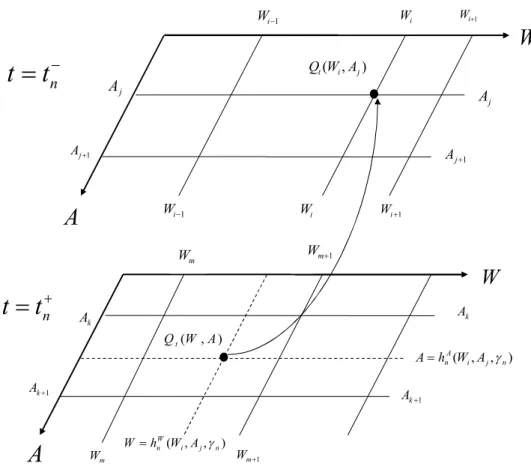
) , (W A Qt ) , ( i j t W A Q 1 j A k A 1 k A i W Wi1 m W Wm1 ) , , ( i j n A n W A h A i W 1 i W 1 m W m W 1 i WFigure 1: Illustration of the application of jump condition. The valueQt(Wi, Aj) att=t−n and at node point (Wi, Aj) equals toQt(W, A) att=t+n withW =Wi−γn and A=Aj−C(γn). The point (W, A) is located inside the grid bounded by (Wm, Wm+1) and (Ak, Ak+1).
adopted the bi-cubic spline interpolation for accuracy and efficiency. Figure 1 illustrates the application of jump conditions.
It is natural to form a uniform grid inA so that optimal withdrawal strategies can be tested on a constant incrementδA=Aj+1−Aj, as has been done successfully in Luo and Shevchenko
(2015a) for pricing of a basic GMWB specified by (8–9). However, extensive numerical tests show that if a uniform grid inAis used for pricing GMAB with ratchets and optimal withdrawals (our numerical example in Section 7), then neither linear interpolation nor cubic interpolation in A can achieve an efficient convergence in pricing results. A very fine mesh has to be used before we see a stable solution, which can take up to several hours to obtain a fair fee, in sharp contrast to basic GMWB where less than one minute computer time is required. On the other hand, if we make the grid inAuniform inY = lnAand use linear or cubic interpolation based on variableY, then we obtain a very good convergence on a moderately fine grid and the CPU time for a fair fee is about 30 minutes (a few minutes for a fair price). The CPU used for all the calculations in this study is Intel(R) Core(TM) i5-2400 @3.1GHz.
As we have already mentioned, a two-dimensional interpolation has to be used for applying the jump condition. We suggest to use either a bi-linear interpolation or a bi-cubic spline inter-polation, e.g. see (Press et al., 1992, section 3.6), in both cases applied on the log-transformed
state variablesX = lnW andY = lnA. For numerical examples in this paper, we have adapted the more accurate bi-cubic spline interpolation for all the numerical results.
For uniform grids, the bi-cubic spline is about five times as expensive in terms of comput-ing time as the one-dimensional cubic spline. Suppose the jump condition requires the value
Q(W, A) at the point (W, A) located inside a grid: Wi ≤W ≤Wi+1andAj ≤A≤Aj+1.
Equiv-alently, the point X = lnW and Y = lnA is inside the grid: lnWi =xi ≤ X ≤xi+1 = lnWi+1
and lnAj = yj ≤ Y ≤ yj+1 = lnAj+1. Because the grid is uniform in both X and Y
vari-ables, the second derivatives ∂2Q/∂X2 and ∂2Q/∂Y2 can be accurately approximated by the three-point central difference, and consequently the one-dimensional cubic spline on a uniform grid involves only four neighboring grid points for any single interpolation. For the bi-cubic spline, we can first obtainQ(·,·) at four pointsQ(W, Aj−1),Q(W, Aj),Q(W, Aj+1),Q(W, Aj+2)
by applying the one-dimensional cubic spline on the dimension X = logW for each point and then we can use these four values to obtain Q(W, A) through a one-dimensional cubic spline in Y = logA. Thus five one-dimensional cubic spline interpolations are required for a single bi-cubic spline interpolation, which involves sixteen grid points neighboring (W, A) point.
6.5
Calculating Greeks for hedging
Calculation of the contract price in (28) under the risk neutral probability measure Q means that one can find a portfolio replicating the VA guarantee, i.e. perform hedging eliminating the financial risk. Finding correct hedging depends on the underlying stochastic model for the risky asset. The basic hedging is the so-called delta hedging eliminating randomness due to stochasticity in the underlying risky asset S(t). Here, we use S(t) as a tradable asset to hedge the exposure of the guarantee to the wealth account W(t). One can construct a portfolio consisting of the money market account and ∆S(t) units of S(t), so that ∆S(t)S(t) =
∆W(t)W(t), where ∆W(t) is the number of units of the wealth account referred asDelta. Denote
the value of the VA guarantee asUt(W, A) which is just a difference between the contract value
with the guaranteeQt(W, A) and the value of the wealth account W, i.e.
Qt(W, A) =Ut(W, A) +W. (41)
Then, under the delta hedging strategy, one has to select ∆W(t) = ∂Ut(W, A) ∂W ⇔∆S(t) = ∂Ut(W, A) ∂S W S
for time t between the contract event times. Of course if there are extra stochasticities in the model such as stochastic interest rate and/or stochastic volatility, delta hedging will not elimi-nate risk completely and hedging with extra assets will be required which is model specific. See e.g. Forsyth and Vetzal (2014), for constructing hedging in the case of regime switching stochas-tic volatility and interest rate. A popular active hedging strategy in the case of extra stochasstochas-tic factors is the minimum variance hedging strategy, where ∆W(t) is selected to minimize the
vari-ance of portfolio’s instantaneous changes, e.g. applied in Huang and Kwok (2015) for hedging GLWM in the case of stochastic volatility model. Practitioners also calculate other sensitivities (partial derivatives) of the contract with respect to the interest rate and volatility (referred to
asRho and V ega) and even second partial derivatives such as Gamma=∂2Ut(W, A)/∂W2 to
improve hedging strategies. Here, we refer the reader to the standard textbooks in the area of pricing financial derivatives such as Wilmott (2013) or Hull (2006).
Numerical estimation of the contract sensitivities (referred to as Greeks) is more difficult than estimation of the contract price. A general standard approach to calculate Greeks is to perturb the relevant parameter and re-calculate the price. Then one can use a two-point central difference to estimate the first derivatives and a three-point central difference for the second derivatives. In general, the finite difference PDE (or direct integration) methods generally produce superior accuracy in calculating Greeks when compared to Monte Carlo method (at least for low dimensions when finite difference method is practical or direct integration is possible). For Delta and Gamma, the finite difference method (or direct integration method) yields second order accurate values without re-calculating price using prices already calculated at the uniform grid points.
More accurate calculation of the main Greeks, Delta and Gamma, can be achieved using the so-called likelihood method as follows. The contract price at t0 is calculated in the last
time step (t0, t1) in backward induction as an integral (37). Differentiating (37) with respect
toW(0) =w0, Delta can be found as ∂Qt+ 0(w0, A) ∂w0 = Z e Qt− 1 (w, A) ∂pe1(w|w0) ∂w0 dw = Z e Qt− 1 (s, A) ∂lnpe1(w|w0) ∂s0 e p1(w|w0)dw = EQ t+0 e Qt− 1(W, A) ∂lnpe1(W|w0) ∂w0 w0, A . (42)
Thus it can be calculated using the same direct integration method as used forQ+t0(s0, A) with
the factor ∂lnpe1(W|w0)/∂w0 added to the integrand. Similarly, the required derivative to
calculate Gamma can be found as
∂2Q t+0(w0, A) ∂w2 0 = Z e Qt− 1(w, A) ∂ ∂w0 ∂lnpe1(w|w0) ∂w0 e p1(w|w0) dw = Z e Qt− 1(w, A) " ∂lnep1(w|w0) ∂w0 2 +∂ 2ln e p1(w|w0) ∂w2 0 # e p1(w|w0)dw = EQ t+0 " e Qt− 1(W, A) " ∂lnep1(w|w0) ∂w0 2 +∂ 2ln e p1(w|w0) ∂w2 0 # w0, A # . (43)
Note, the above integrations for Delta and Gamma are only required for the (t0, t1) time step
and for a single grid point W(0) =w0. Here, t0 should be understood as the current contract
valuation time rather than time when the contract was initiated. Equivalently, for PDE ap-proach using finite difference method, one can sometimes derive the corresponding PDEs for the Greeks and solve these PDEs for the last time step, see e.g. Tavella and Randall (2000). Simi-larly for Monte Carlo method, simulations used to calculate the price can be used to calculate
It is illustrative to show how to derive hedging portfolio under the basic Black-Scholes model. Here, we assume that the underlying risky assetS(t) follows
dS(t) = µ(t)S(t) +σ(t)S(t)dBP(t), (44) where BP(t) is the standard Brownian motion under the physical (real) probability measure,
and µ(t) is the real drift. Then the wealth account evolution is
dW(t) = (µ(t)−α)W(t) +σ(t)W(t)dBP(t).
Here, we assume a continuously charged fee proportional to the wealth account but it is not difficult to deal with the case of discretely charged fees.
To hedge, the guarantee writer takes a long position in ∆S units ofS(t), i.e. forms a portfolio
Πt =−Ut(W, A) + ∆S×S
By Ito’s lemma, the changes of portfolio within (tn−1, tn),n = 1, . . . , N are
dΠt=− ∂Ut ∂t + ∂Ut ∂WdW + 1 2σ 2 S2∂ 2U t ∂W2 dt−∆SdS+αW dt, (45)
where the last term αW dtis the fee amount collected over dt. Setting ∆S = ∂Ut(W, A) ∂W W S = ∂Qt(W, A) ∂W −1 W S (46)
eliminates all the random terms in (45), making the portfolio locally riskless. This means that the portfolio earns at risk free interest rater(t), i.e. dΠt=rΠtdt, leading to the PDE
∂Ut ∂t + (r−α)W ∂Ut ∂W + 1 2σ 2S2∂2Ut ∂W2 −rUt−αW = 0. (47)
SubstitutingUt(W, A) =Qt(W, A)−W in the above gives the PDE forQt(W, A), the total value
for the contract with the guarantee, i.e. the same as (36). Recalling Feynman-Kac theorem, it is easy to see that the stochastic process for W corresponding to this PDE is the risk-neutral process (4).
7
Numerical Example: GMAB pricing
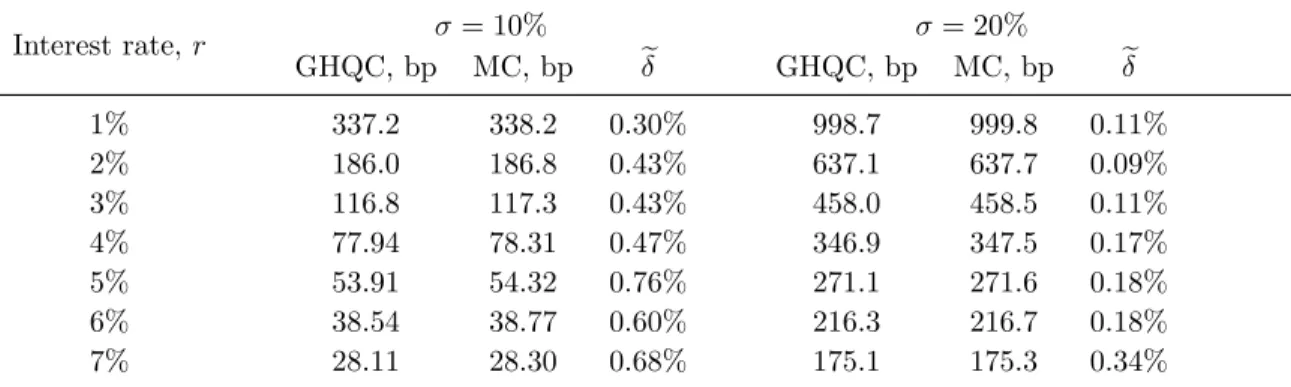
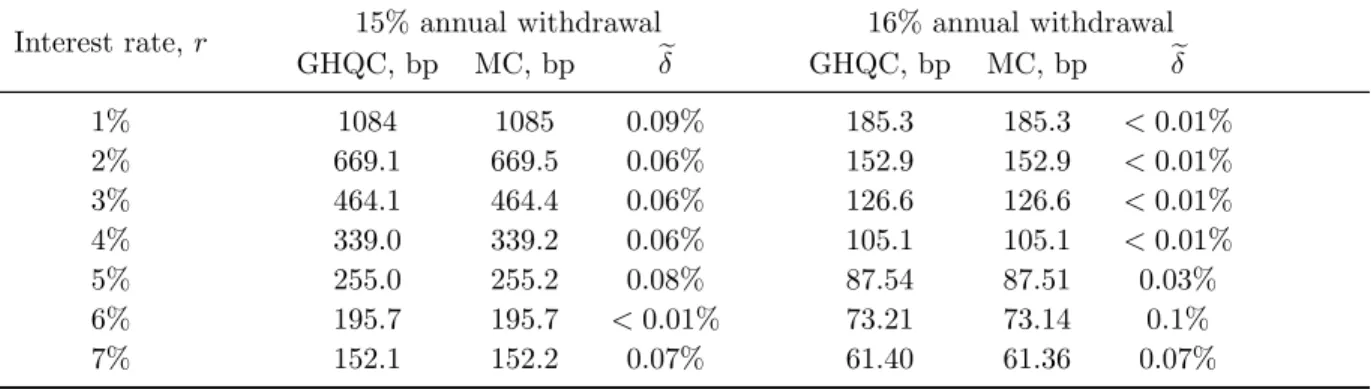
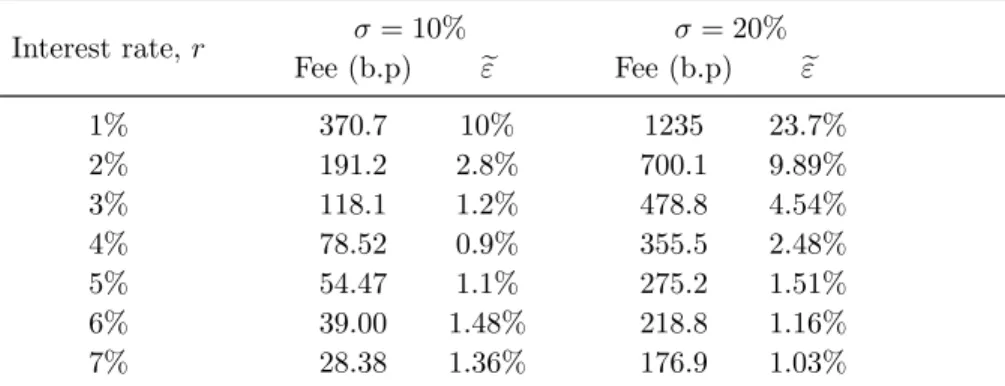
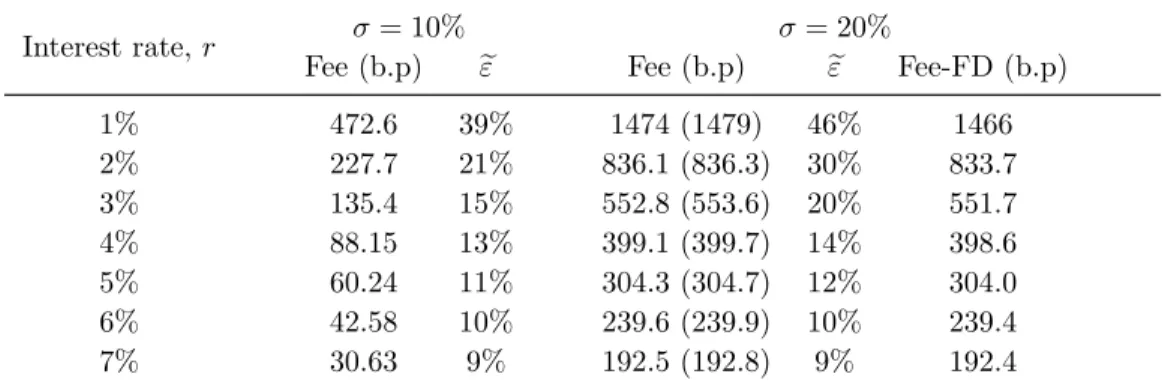
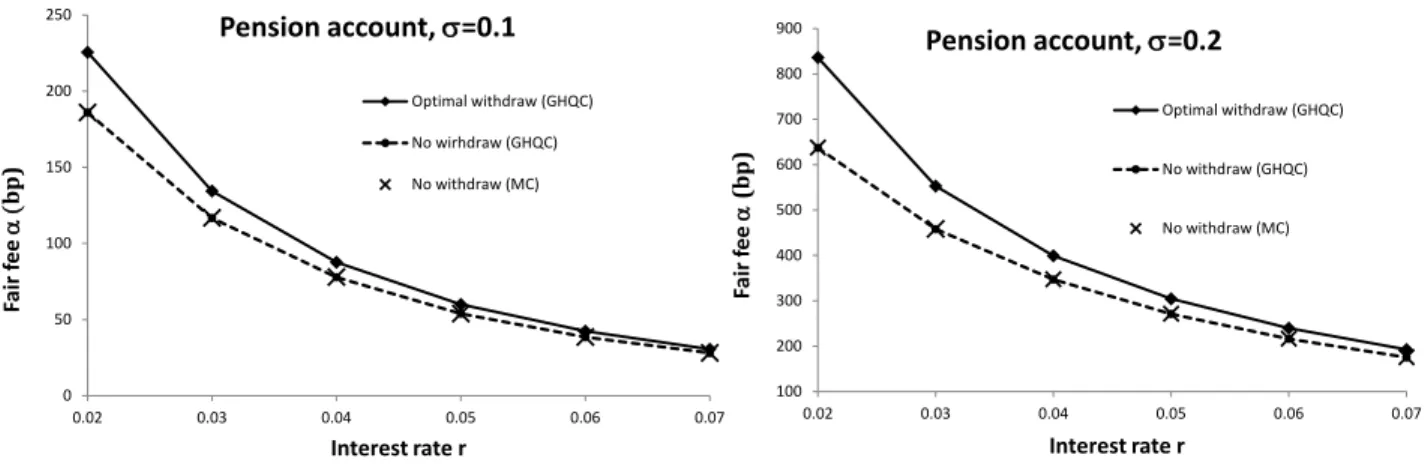
Numerical solutions for pricing VA riders involve many complicated numerical procedures and features. These are more involved when compared to pricing of most exotic derivatives in financial markets. It is important that these solutions are properly tested and validated. As a numerical example for illustration, using direct integration method (GHQC), we calculate accurate prices of GMAB with possible annual ratchets and allowing optimal withdrawals as specified in Section 4.3. With these features, the GMAB is very close to the real product marketed in Australia by e.g. MLC (2014) and AMP (2014). We assume geometric Brownian motion model for the risky asset (4). When applicable, we compare results with MC and finite