Doctor of Nursing Practice Projects Nursing
Spring 2018
Transitioning Experienced General Care Float Pool
Nurses to a Critical Care Float Pool
Troy T. Betts, DNP, MSN, RN-BC George Washington University
Follow this and additional works at:https://hsrc.himmelfarb.gwu.edu/son_dnp
Part of theCritical Care Nursing Commons, and theNursing Administration Commons
This DNP Project is brought to you for free and open access by the Nursing at Health Sciences Research Commons. It has been accepted for inclusion in Doctor of Nursing Practice Projects by an authorized administrator of Health Sciences Research Commons. For more information, please contact [email protected].
Recommended Citation
Betts, DNP, MSN, RN-BC, T. T. (2018). Transitioning Experienced General Care Float Pool Nurses to a Critical Care Float Pool.,(). Retrieved fromhttps://hsrc.himmelfarb.gwu.edu/son_dnp/20
Transitioning Experienced General Care Float Pool Nurses to a Critical Care Float Pool
Presented to the Faculty of the School of Nursing The George Washington University
In partial fulfillment of the requirements for the degree of Doctor of Nursing Practice
Troy T. Betts, MSN, RN-BC
DNP Project Team
Karen Whitt, PhD, AGN-BC, FNP-C Dawn Berndt, DNP, RN, CRNI Jennifer Kooiman-Mohr, MSN, RN-BC
Tracy Moriarty, MSN, RN Steven Sadoff, MSN, RN, NE-BC
Table of Contents Abstract ... 4 Background ... 4 Purpose ... 4 Methods ... 4 Results ... 4 Conclusions ... 4
Transitioning Experienced General Care Float Pool Nurses to a Critical Care Float Pool ... 5
Problems Statement ... 5
Background ... 6
Purpose ... 6
Specific Aims ... 6
Research Questions ... 7
Significance and Literature Review ... 8
Contribution to Nursing ... 8
Existing Knowledge/current State of Science ... 9
Literature Review Aims and Existing Knowledge... 9
Gaps in Literature ... 11
Theoretical Foundation and Variables ... 12
Theoretical Framework ... 12 Methods ... 14 Research Design... 14 Population Sample ... 14 Inclusion Criteria ... 15 Exclusion Criteria ... 16 Setting ... 16 Educational Intervention ... 16
Instruments and Measurement ... 18
Data Collection Procedure and Timeline ... 19
Data Analysis ... 21
Results ... 22
Discussion ... 24
Program Limitations ... 25
Recommendations for Practice and Research ... 27
Conclusions ... 27 References ... 29 Table 1 ... 34 Program Timeline ... 34 Table 2 ... 35 Program Variables ... 35 Table 3 ... 37
Competency for Care of a Lung Transplant Patient in an Intensive Care Unit Setting ... 37
Table 4 ... 39
Critical Thinking Questions for Care of a Lung Transplant Patient ... 39
Table 5 ... 40
Program Evaluation ... 40
Table 6 ... 42
Participant Evaluation of Preceptor Expertise ... 42
Figure 1. ... 44
Figure 2. ... 45
Figure 3. ... 46
Abstract
Background: A nationwide nursing shortage has resulted in a significant reduction in the number of qualified nurse applicants for critical care positions. Additional recruitment solutions for critical care staffing needed to be explored.
Purpose: The purpose of this project was to evaluate the effectiveness of an orientation program designed to transition experienced general care trained float pool nurses to a critical care float pool.
Methods: This descriptive study measured participants’ pre and post critical care orientation knowledge, and completion of core computerized competencies. Critical thinking questions, unit-based competencies, and measurement of participants’ individual perception of competence were also completed. Pre and post intervention data and computerized competencies were entered into SPSS and descriptive statistics were generated to compare pre and post percentages, frequencies and means.
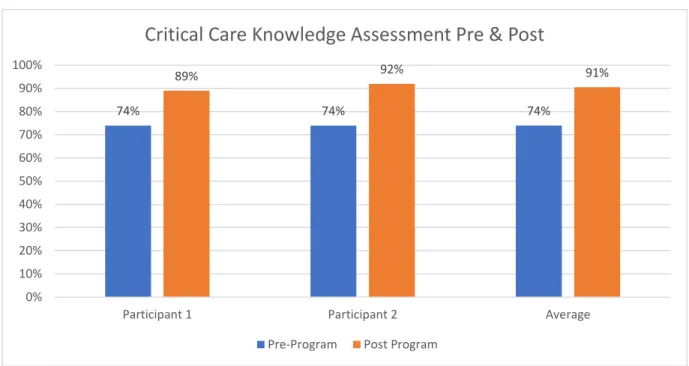
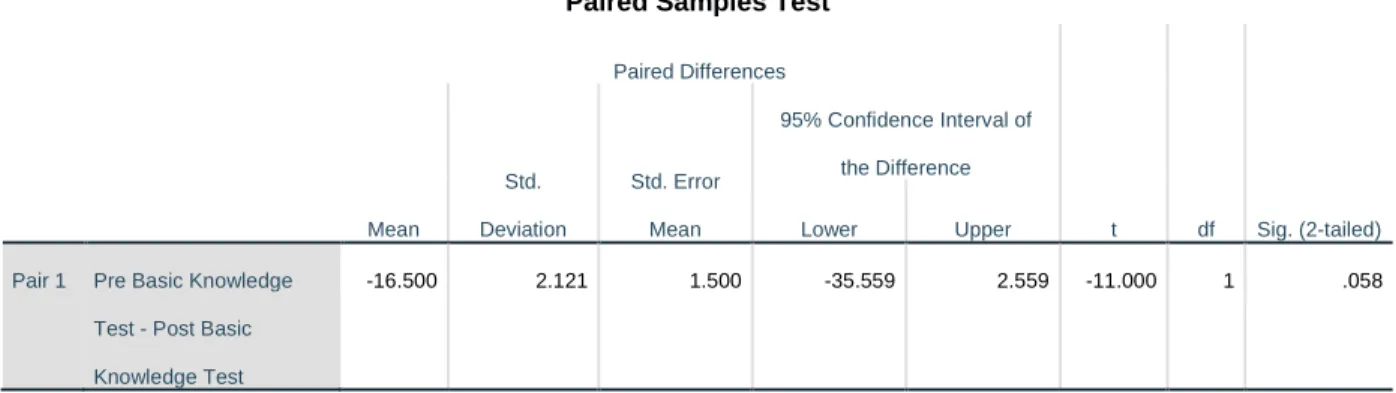
Results: Participants’ ability to function independently as a critical care nurse was demonstrated by an 18% increase in critical care knowledge, passing scores of each ECCO module of 80% or greater and completion of unit-based competencies, classroom, computer based, direct hands-on patient care training, and participant perception of competence. A paired samples t-test showed participants’ pre and post orientation critical care knowledge scores as measured by the BKAT-9r were significantly different with the mean post BKAT-BKAT-9r scores (M=90.5, SD= 0.58)
significantly higher than the mean pre-orientation critical care knowledge scores (M=74, SD=0.00), (t(1)=11.0, p=0.05).
Conclusions: Findings demonstrate the orientation program was effective to prepare an experienced general care float pool nurse to function independently in a critical care float pool.
Transitioning Experienced General Care Float Pool Nurses to a Critical Care Float Pool
Problems Statement
Across the country, including the state of Wisconsin, there is a significant shortage of critical care trained registered nurses (RNs) to provide patient care in the healthcare industry (Public Policy Forum, 2014). This study took place at a level 1 trauma and teaching center in the Midwest experiencing a slow, but steady stream of qualified medical/surgical trained nurses, but very few qualified applicants with experience in critical care. Recruitment time for the Midwest hospital in 2017 showed an average of 150 days to fill a general medical/surgical position, versus 167 days or 17 days longer to fill a critical care nurse staffing position (E. Schenk, personal communication, July 14, 2017).
National data from Nursing Solutions Inc. (NSI), supports the differences with time to fill rates for nurses working in a medical/surgical specialty averaging 69 days compared to 87 days for nurses working in a critical care specialty (NSI, 2017). Adding to the concern is the turnover rate for critical care nurses at the Midwest hospital, which in 2016 was 16.7% compared to the national average turnover in nursing of 14.6% (NSI, 2017). The nurse staffing shortage impacting health care across the United States is attributed to an aging workforce, insufficient staffing, and an increase in stress levels causing more nurses to quit the profession (Rosseter, 2017). With the increased shortage of critical care trained nurses, there is a need to develop additional methods for critical care nurse development.
Background
In February 2016, the central nursing float department at a Midwest hospital was given an additional 25 Registered Nurse (RN) full time equivalent (FTE) to increase nurse staffing levels for both medical/surgical and critical care nursing. Seventy percent of the FTE was given to the general medical & surgical float pool and 30% to the critical care float pool. The
additional FTE was approved as the result of an increase in market share and increased inpatient census. However, a significant reduction in qualified applicants for critical care needs attributed to a national nursing shortage resulted in much of the FTE left unfilled over the course of the following year (Nursing Solutions, Inc., 2016).
Purpose
The purpose of this project was to determine if a program to voluntarily train experienced general medical and surgical care float pool nurses to work with patients in critical care would successfully prepare them with the knowledge and skill necessary to function independently as a critical care float pool nurse. The program’s design allowed the organization to fill critical care nurse shortages and back-fill the vacated general medical and surgical float pool nurse positions which had a larger applicant pool to successfully draw from.
Specific Aims
1) Measure general medical/surgical float pool nurses’ critical care knowledge pre and post orientation using a proven, written, scientifically tested critical care knowledge
assessment tool.
2) Measure critical care knowledge and education outcome of 18 computer-based modules focused on critical care nursing.
3) Perform critical thinking skills using open ended clinical thinking questions completed by participants, reviewed by a Clinical Nurse Specialist, and discussed with the participant throughout the critical care orientation program.
4) Facilitate participant completion of all unit-based competencies, classroom and computer-based training provided throughout the critical care orientation program. 5) Obtain participant evaluations of program interventions to determine which method(s)
participants found most helpful to improve knowledge, critical thinking, and ability to function independently in a critical care float pool.
Research Questions
1. Will a change occur in the nurses’ critical thinking and knowledge of critical care after completion of the orientation program as assessed using a written, scientifically proven assessment of critical care knowledge?
2. After completion of Essentials of Critical Care Orientation (ECCO) modules, will a combined mean measure participants’ knowledge of critical patient care score greater than 80%?
3. Will participants successfully complete all open-ended clinical thinking questions
throughout the orientation program to apply critical thinking skills to critical patient care? 4. Can a comprehensive orientation model of unit-based competencies, classroom
orientation and computer-based training successfully prepare an experienced
medical/surgical float pool nurse to function independently as a critical care float nurse as shown by the participants’ completion of all competencies?
5. Which interactive teaching methods were rated by participants as valuable in improving their knowledge, critical thinking, and ability to function independently following completion of the program?
Significance and Literature Review Contribution to Nursing
An aging nursing workforce in the United States with increased retirement rates contributed to a shortage of nurses (Mayer, 2014). Adding to the shortage are increased demands for other competing healthcare degrees such as pharmacist, physical therapist, and others (Liaw, et al., 2017). The nursing shortage has come at a time when the complexity level of hospitalized patients has steadily increased and the length of stay for most hospitalized patients has steadily decreased (Vogeli, et al., 2007). As a result, many hospitals are having trouble recruiting competent critical care staff to provide quality patient care. For example, a national recruitment firm found it took an average of 18 more days to recruit for a critical care nurse position than a medical/surgical position (Colosi, 2016). While the number of qualified staff has decreased, the need for inpatient critical care between 1985-2000 increased more than 26% and is projected to increase more than 22% in the United States by 2020 (Halpern, Pastores & Greenstein, 2004; Dogra, Dorman, 2016). In Colorado, the Center for Nursing Excellence data shows 32% of practicing nurses are age 55 and above which suggests that many nurses will reach retirement age in the next decade (Bortolotto, 2015). With limited recruitment options, many hospitals are relying heavily on the inexperience of new graduate nurses in nurse resident programs to fill critical staffing needs (Bortolotto, 2015). As nursing recruitment continues to challenge the healthcare industry, there is a need to develop qualified, competent nursing staff
able to provide safe, quality care in critical care units using proven methods with new approaches.
Existing Knowledge/current State of Science
Research on critical care nurse orientation is focused on programs for experienced or new graduate nurses orienting to a single critical care unit using evidence-based approaches. In contrast to a single unit orientation program, hospitals are placing a significant amount of
resources on the flexible and cost-effective staffing options a float pool provides. The result is a need to apply the current body of evidence of single unit orientation principles to a multi-unit orientation to prepare nurses for float pool positions in critical care (Larson, Sendelbach, Missal, Fliss & Gaillard, 2012). Applying proven, evidence-based principles regarding unit specific critical care orientation for a float pool position contributes to the current body of evidence on orientation programs transitioning an experienced general medical and surgical care float pool nurse to a critical care float pool position (Bortolotto, 2015; Morris, et al. 2007).
Literature Review Aims and Existing Knowledge
The orientation of new graduate nurses to critical care is a successful way for hospitals to recruit staff using a nurse resident program to facilitate transition into the work force (AACN, 2017). New graduate nurses are currently the largest pool of resources to recruit for and fill nurse job vacancies (Friedman, Cooper, Click and Fitzpatrick, 2011). Therefore, it makes sense that this is a significant trend occurring in healthcare recruitment. While there is literature supporting proven methods of acquiring knowledge through a unit-based program, little is known about the effectiveness of critical care orientation programs when applied to an
critical care orientation, this orientation program for experienced general care float pool nurses to transition to a critical care float pool measured changes in knowledge and applied critical
thinking skills.
Previous methods for critical care orientation have traditionally focused on instructor-centered programs (pedagogy) versus more recent evidence-based recommendations of an adult-centered learning (andragogy) concept (Lakanmaa, Suominen, Ritmala-Castrén, Vahlberg & Leino-Kilpi, 2015). Assessment of current knowledge has indicated a higher level of satisfaction among nurses orienting to critical care when adult-centered learning principles are incorporated (Forbes, 2011). The most successful methods focused on skill acquisition through a combination of critical thinking questions, classroom, and on-line education, thus increasing the level of confidence using sound evidence-based principles (Morris, 2007).
Most of the research on critical care orientation agrees that critical thinking skills are a key component for successful orientation to critical care (Morris, et al., 2007). However, not every study had a clear method to assess for this skill. For example, some studies used a Basic Knowledge Assessment Tool, (BKAT) to measure knowledge but failed to measure a higher level of decision making skills correlated with critical thinking (Bartels, 2014). When critical thinking development was specifically targeted, the method most often cited as having the best outcome for skill development was the use of case studies with clinical thinking questions (Gracia-Lewis, 2013). One reason critical thinking skills are so important is due to the statement made initially in this literature review that since 1990’s, the length-of-stay (LOS) for patients has continued to decrease even though the complexity of illness seen in hospitals continues to
Review of literature reveals the best methods used in nurses’ critical care training evaluation have come from a combination of written and on-line instruction materials including the BKAT, ECCO, Pulmonary Artery Catheter Education Project (PACEP), case studies,
simulation, and hands-on experience (Morris, et al., 2007). Although the BKAT program allows the learner to gain a significant amount of knowledge, it has not been shown to develop nor assess a higher level of critical thinking (Toth, 1994). Current literature denotes two primary methods to demonstrate critical thinking skills are case studies and the ECCO program (Kaddoura, 2010).
Participants in this program completed a series of unit based competencies and clinical thinking questions centered around core learning topics that included knowledge and skills for managing adult medical patients, surgical patients, post-op cardiac surgeries, lung transplants, altered cerebral perfusions, life threatening arrhythmias, ineffective renal perfusion, stroke, brain mass, subarachnoid hemorrhage, traumatic brain injuries, acute spinal injury, intracranial
pressure and organ donation in an intensive care unit setting. The specialized critical care orientation program evaluated in this project was implemented with the anticipation of training experienced non-critical care float pool RNs to fill critical care vacancies and improve staffing levels.
Gaps in Literature
There are several studies demonstrating successful methods used to orient a nurse to a unit-specific critical care department, but there are very few if any to our knowledge that focus on a program orienting an experienced medical/surgical float pool RN to a critical care float pool position (AACN, 2017). New methods and more avenues for application of critical care
orientation principles and increased recruitment options for flexible staffing resources found among float pool RNs in healthcare organizations around the country need to be explored (Larson, Sendelbach, Missal, Fliss & Gaillard, 2012). This project measured the successful transition of an experienced non-critical care float pool RN to a multi-unit, critical care float pool position using a specialized evidence-based critical care orientation program.
Theoretical Foundation and Variables Theoretical Framework
This study was guided by the novice-to-expert theory by Dr. Patricia Benner, R.N., Ph.D., FAAN, FRCN (Benner, 2015). Although her theory is most often associated with a new graduate nurse entering the nursing profession, Dr. Benner’s novice to expert theory was an appropriate choice when applied to the proposed study of an experienced medical/surgical float pool nurse transitioning to a critical care specialty. In her theory, Dr. Benner discusses the nurses’ exposure and experience with patient care and suggests five stages of experience a nurse goes through (Benner, 2011).
1. Novice
2. Advanced beginner
3. Competent
4. Proficient
5. Expert
The nurses in this program did not begin the orientation program at the ‘novice’ level because they were experienced medical/surgical float pool nurses with core knowledge and skill.
Benner describes a novice nurse as one with no experience that needs to be taught the general rules and beginner tasks (Benner, 2011). Benner’s advanced beginner level was more
appropriate at the beginning of the program because the nurses were starting with a demonstrated level of experience and basic principles to guide their actions.
As the nurse participants in the project oriented through the critical care training, the goal was to transition from an experienced general care float pool nurse to a competent critical care float pool nurse with analytical thinking skills achieving greater efficiency related to critical care nursing (Benner, 2011). This was consistent with the goal of transitioning from an experienced medical/surgical float pool nurse to a critical care nurse. Each participant started at the advanced beginner level and progressed to a competent level during the program.
The fourth stage was the proficient nurse. A proficient nurse is one who understands how individual components of care are compiled into a complete picture for patient care. Orientation programs for a new graduate nurse do not aspire to attain this level in the first six months of orientation, or even the first two years. The self-motivated, experienced medical/surgical float pool nurses in this program did not measure participants’ ability to achieve a proficient level of care during their first three months of training in a critical care environment.
The fifth and final stage is the level of expert nurse. The expert nurse no longer relies on concrete principles or rules and instead develops a confidence and intuitive level of care that is unmatched by a competent nurse (Benner, 2011). This is a long-term goal, often takes years to develop, and was not incorporated into the basic orientation plan for this program.
Methods Research Design
This descriptive study utilized specific education and training interventions to transition experienced medical/surgical float pool nurses into a critical care float pool. The project
measured nurses’ critical care knowledge (pre-and post-intervention), and test scores from 18 on-line modules with specific topics related to critical care nursing. Participants also completed unit-based critical thinking scenarios and competencies, classroom training specific to intermediate patient care along with direct hands-on patient care orientation under the supervision of an experienced preceptor.
The program took place over a five-month period guided by Benner’s Novice to Expert theory (Benner, 2011). Benner’s theory helped guide the experienced medical/surgical float pool nurse from an advanced beginner to a competent stage of Benner’s model in a critical care unit setting (Benner, 2011). Each participant successfully completed the program, its pre and post knowledge assessments, computer based critical care modules, classroom training, competency requirements and clinical thinking questions to function independently in a critical care
environment.
Population Sample
The target population was experienced medical and surgical general care nurses working in an adult inpatient float pool. Fifty-Eight volunteers were recruited through a secure internal email request for interest using a password protected and data encrypted internal email sample, per hospital standards sent to adult inpatient general care nurses working in the float pool department. Of the 58 nurses who were notified, nine nurses, or 16% responded with interest.
Of the nine nurse respondents, two did not meet inclusion criteria due to attendance or discipline on file with the Human Resource Department. The remaining seven nurses met inclusion
criteria. A meeting was scheduled with the primary investigator to review the program aims, duration and requirements. Following these meetings, four nurses voluntarily withdrew their interest citing personal reasons in conflict with the scheduling and mental demands of the program.
Financial and leadership changes also occurred at the organization during the development and recruitment phase of the program. This development resulted in further limitations being placed on the number of candidates approved for the program. Final approval adjusted the total number of possible participants from six to a limited approval for a trial
program of two participants. Two participants, one day shift and one-night shift float pool nurse were enrolled in the program to move from an inpatient general medical and surgical float pool to a critical care float pool position.
Participants were obtained using a convenience sample of volunteer registered nurses who met inclusion criteria, which included working in a general medical/surgical float pool and had interest in voluntary transition to a critical care specialty (Creswell, 2014). Sample inclusion and exclusion criteria for participants are listed below:
Inclusion Criteria
• Greater than one year of RN experience in an inpatient medical/surgical setting
• Successful completion of a six-month probation period
• In good standing without any disciplinary or attendance issues
• A voluntary interest to transition into a critical care position
• Currently employed as a medical/surgical RN in the float pool department.
Exclusion Criteria
• Experienced RNs hired externally within the last six-months
• Poor attendance that did not meet acceptable limits as outlined by hospital policy
• Documented disciplinary issue(s) at a level greater than counseling
The hospital used for the site of this program does not hire new graduates except through a Nurse Residency program. Due to a nursing shortage, there were many nurse residents hired in February and June, and all available preceptors were already being utilized for nurse resident orientation needs. To supplement this problem, volunteer nurses from the current critical care float pool were recruited as preceptors. Each preceptor completed an internal preceptor training course and was paired with a participant to orient to critical care.
Setting
The program took place in adult inpatient critical care units of a 550-bed level I trauma center in the Midwest. The length of time it took to obtain the sample size was two-weeks to allow interested subjects to respond to an email request. Final participant selections were based on seniority and ability to meet the inclusion criteria.
Educational Intervention
There were patient care orientation experiences in multiple inpatient critical and
intermediate care environments, a pre and post program knowledge assessment, an online ECCO computer-based training program completed in weekly increments, unit-based competencies and
clinical thinking questions completed throughout the program. Participant feedback and self-evaluation was also obtained at the end of the program.
The tool used to assess each participants knowledge of critical care was the BKAT-9r, an 85 question, multiple choice written paper assessment for critical care nursing (Toth & Ritchey, 2014). Participants completed the assessment at the start of the program. It was repeated the final week of completion of the orientation program. A Nursing Education Specialist proctored the sessions. The education specialist graded and reviewed the results individually, with each participant before submitting them to the primary investigator (PI). Results were then
maintained in the PIs office in a locked file cabinet.
The ECCO program was a self-proctored, on-line session of 18 individual modules participants completed in 4-hour weekly increments throughout the program. Each module focused on a specific medical area of critical care. Participants started the program 2-weeks after the initial start of their unit orientation. The slight delay to start the ECCO program allowed time for valuable exposure to basic critical care assessments, tools, and interventions so knowledge and understanding of the course content was more familiar and valuable. Participants applied each content module to the specialty areas they were orienting to.
A total of 13 unit-based competencies were completed throughout the program. Competencies focused on key areas of surgical, cardiac, neuroscience and other critical care specialties. Each competency had between three and nine clinical thinking question scenarios designed to apply learnings in the form of hypothetical case studies that complimented each unit-based competency. Participants completed an average of 1-2 unit-unit-based competencies per week throughout the program.
Program evaluation feedback was requested to evaluate each intervention method (i.e. unit orientation, knowledge assessment, ECCO, competencies and clinical thinking questions), what participants thought went well and what could be improved.
The orientation was monitored by the participants’ preceptors and followed closely by a Clinical Nurse Specialist (CNS) and Nursing Education Specialist (NES). Issues or concerns were identified by participants, preceptors, CNS, or NES and brought to the Nurse Manager for discussion and approval of necessary modifications to the orientation. The CNS and NES also helped monitor any preceptor issues through direct observation and direct feedback from the orienting nurse.
Instruments and Measurement
Qualitative measures were assessed by completion of critical thinking questions throughout the orientation and successful completion of each unit’s orientation competencies demonstrating the ability to function independently and competently in a critical care setting (Morris, et al., 2007). Each unit-based competency outlined learning objectives, and specific components the orienting nurse needed to meet the objectives. Additional resources were also included for the orienting nurse or preceptor if they felt they needed them for further study or analysis.
Following completion of the competency, a series of critical thinking questions were completed by participants and reviewed with their preceptor to exercise critical thinking in key patient care situations (See Table 4). An anonymous program evaluation was provided within 2-weeks following the completion of the program. Participants completed a self-reported
addition to their perceptions of the program experience, what they thought went well and what they felt could be improved (See Table 5).
To measure critical care knowledge, the participants completed a BKAT-9r, which is an 85-item written test created in 1984 to fill the absence of “a published valid and reliable
instrument to measure” basic critical care knowledge (Toth, 1994). The BKAT has more than 20 years of reliability and replication of hypothesis testing (Toth, 1994). Using Cronbach’s
coefficient alpha, internal consistency reliability was 0.88 (Toth, 1994).
The ECCO is an interactive, on-line tutorial of 18 separate modules designed to teach nurses the basics of critical patient care (AACN, n.d.). Following completion of each ECCO module, participants were tested on their knowledge and given a percent score.
To exercise critical thinking the participants completed critical thinking questions after each ECCO module on critical care areas of practice. The critical thinking questions were verbally reviewed with participants by the participant’s preceptor and later verified by the CNS.
Data Collection Procedure and Timeline
The program began September 19, 2017 and continued for up to five-months until orientation competencies, clinical thinking questions and ECCO modules were complete and participants were ready to manage patient care independently (see Table I). At the beginning of the program, participants completed the 85-question BKAT-9r test on paper designed to assess basic critical care knowledge. This same test was later completed at the end of the orientation to determine if there was any change in knowledge after completion of the program (see Table I).
Two-months into the program, participants completed an in-house hospital Intermediate care (IMC) course (see Table I). ECCO training began two weeks into the program. Participants completed one of eighteen total modules per week to help with basic critical care knowledge and foundation skills (see Table I). In addition, they completed several case studies, approximately one per month and reviewed them with their preceptor and CNS (see Table I). The case studies allowed the orienting nurses to practice critical thinking throughout their orientation.
Upon completion of the orientation, participants rated the effectiveness of their preceptor on a 5-point Likert scale including the effectiveness of teaching methods, discussion &
development of critical thinking and effectiveness as a preceptor (Table 6). Additionally, participants rated the effectiveness of each interactive teaching method in the orientation program to prepare them to function independently as a critical care nurse (See Table 5)
There were five people with direct access to various sets of data. The primary investigator (PI)/Nurse Manager(NM), Clinical Nurse Specialist (CNS), Nursing Education Specialist (NES), primary advisor (PA) and the nurse’s preceptor. The PI and PA both completed PI Collaborative Institutional Training Initiative (CITI) training (University of Wisconsin, 2015). The NES completed CITI training and under the direction of the PI and proctor, graded and turned over the knowledge assessment tests. The CNS reviewed the case studies with the orienting nurses throughout the program and turned the results in to the PI/NM. All identifying test scores and data were stored in the PI/NMs office in a locked drawer. The PA’s access was limited to de-identified data and did not participate in any data collection activities.
Participants volunteered and therefore, were assumed to be self-motivated. To minimize the possibility of dropping out, participants were monitored by an orientation team consisting of their preceptor, a CNS, NES, and Nurse Manager (NM). Any issues were identified and worked through by the orientation team and participant. Participants had the option to stop participation at any time without personal penalty or risk to them and return to their general care specialty.
Data Analysis
The NES graded the assessment of critical care knowledge. Case studies were reviewed with the preceptor and double checked by the CNS. All on-line testing was automatically calculated and scored. All methods of assessment combined with direct, hands-on patient orientation with a preceptor were designed to accomplish the primary research questions. Pre and post intervention data and individual post ECCO module scores were entered into the Statistical Package for the Social Sciences (SPSS) and descriptive statistics were generated to compare pre and post percentages, frequencies and means (Statistics, 2018). Improvement in knowledge and critical thinking were determined by comparing pre and post orientation mean scores using a paired samples t-test. A median score for participants rating of each intervention during the program was evaluated using a five-question rating scale ranging from strongly agree to strongly disagree (See Table 5).
Ethical Considerations
The program was reviewed by the Institutional Review Board (IRB) where the program took place and The George Washington University. Consistent with a typical new employee orientation, individual scores were known to leadership invested in the direct success of the nurse orienting including the NM, CNS, and NES. All scores, except for case studies were
combined for all participants and reported as generalized results. Individual results were stored in the NMs office in a locked filing drawer. Although facilitators of the study (NM, CNS, NES) had access to data at various times throughout the program, all original scores were kept under lock and key with the PI/NM.
Results
Participants successfully demonstrated the ability to function independently as measured through a 18% increase in critical care knowledge, passing scores of each ECCO module of 80% or greater and through demonstrated completion of unit-based competencies, classroom training, open-ended clinical thinking questions, direct hands-on patient care training, and participants’ perception of competence.
To address research question 1, a paired samples t-test using SPSS data analysis was conducted to evaluate if the participants’ pre and post orientation critical care knowledge scores as measured by the BKAT-9r were significantly different. Pre-program testing resulted in an average score of 74%. Following completion of the program, participants’ average score was 91%. SPSS data analysis results indicate that the mean post BKAT-9r scores (M=90.5,
SD=0.58) were significantly higher than the mean pre-orientation critical care knowledge scores (M=74, SD=0.00), (t (1) =11.0, p=0.05). These results should be interpreted with caution
considering the small sample size (see Figure 1, Figure 2).
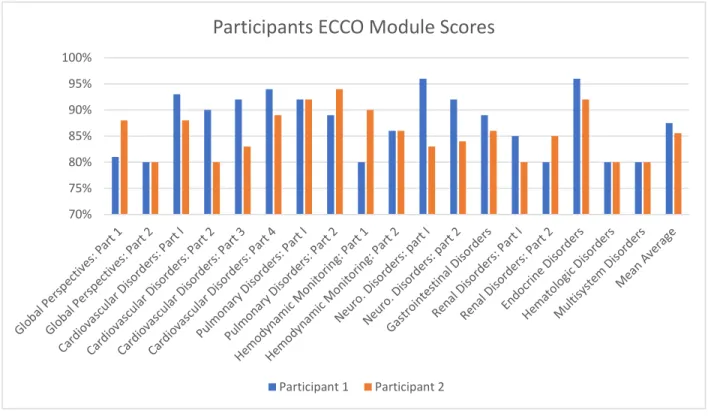
To address research question 2, a combined mean was computed adding the scores on 18 individual ECCO module scores and dividing by 18 to produce an overall average mean score of 88% on the ECCO module (see Figure 3). The overall mean score was compared with the benchmark score of 80%, which is an indicator that participants have adequate critical care
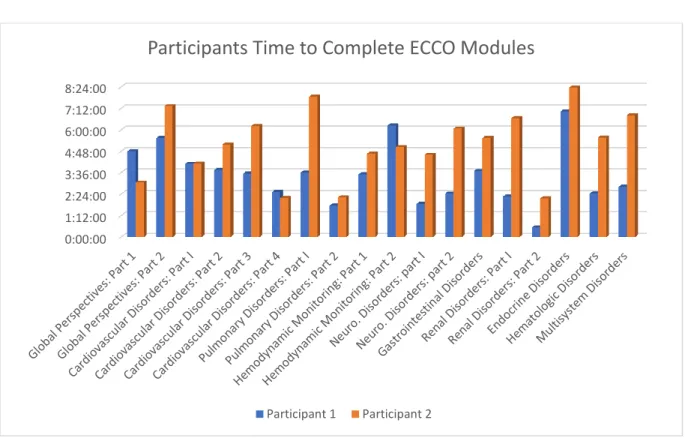
knowledge to care for critical care patients. Participants were given 4-hours of dedicated time each week to work on modules and completion in hours and minutes for each module was recorded (see Figure 4). These results should be interpreted with caution considering the small sample size.
Participants were effective in completing research question number 3 by successfully completing all clinical thinking questions, reviewing them with their preceptor and further evaluation by the CNS for completeness. This evidence-based practice allowed participants to practice critical thinking and apply key concepts learned during their orientation. Clinical thinking questions and unit competencies were aligned with the same topics and completed congruently throughout the orientation.
Research question number 4 was successfully demonstrated by the SPSS data analysis of pre and post knowledge assessments, an overall combined average passing score of 88% on each of the 18 ECCO modules, and completion of all unit based clinical thinking questions, unit competencies, and classroom orientation of intermediate patient care and Advanced Cardiac Life Support (ACLS) training.
To address research question number 5, participants rated each intervention using a five-point satisfaction scale ranging from very satisfied (5) to very unsatisfied (1) to measure their perception of value for unit-based competencies, knowledge assessments, computer-based training, hands-on training, confidence, change in knowledge, ability to function independently, and overall satisfaction with the program (see Table 5). Participants rated all programs as satisfied (4) or very satisfied (5). The combined mean average rating of all program methods
combined was calculated by adding scores from the four key interventions and dividing by four (M=4.5) indicate participants agreed each aspect of the program was of value.
Support throughout the program (M=5.0) was also evaluated by adding each of the ratings for the four support persons (NM, NES, CNS, and preceptors) and dividing by four (see Table 5). Results indicate participants felt well supported throughout the program.
Discussion
Participants’ results from the BKAT-9r demonstrated the average post-orientation score for participants was 91%. This represents an average improvement of 18% in their post
orientation critical care knowledge score after completion of the program. This compares favorably to the published, expected average score of 82-84% following the completion of critical care orientation (Toth, 2017).
ECCO modules showed an average test score of 88% out of 100% which by comparison, exceeded the minimum passing score of 80%. The ECCO program uses a combination of 18 different evidence-based learning modules that take between 2.5-6.25 hours to complete (AACN, n.d.). Verbal and written feedback from participants following completion of the program demonstrated a perceived benefit from the on-line program, although there is no scientific reliability score available for comparison (Kaddoura, 2010). In tandem to the specific content in each ECCO module, participants also completed critical thinking questions developed by the hospital and correlated to ECCO module content throughout the orientation program. The completion of open-ended clinical thinking questions was reviewed with the participants preceptors and later evaluated by the CNS for completeness.
This comprehensive orientation model used a combination of unit-based competencies, classroom, and computer-based training to prepare an experienced general care nurse to function independently as a critical care float pool nurse. Qualitative evaluation from participants at the end of the program established that participants valued the comprehensive orientation methods, deemed their knowledge and critical thinking improved and felt they were able to function independently following completion of the program.
Program Limitations
The program was initially designed to have up to six participants, but staffing constraints, participant interest and a change in executive leadership limited approval to a trial program with two participants. Program results were favorable and mirrored similar program results for larger studies using experienced or new graduate nurses entering a unit specific training program in critical care (Morris, L.L., Pfeifer, P.B., Catalano, R., Fortney, R., Hilton, E.L., McLaughlin, J., …Goldstein, L, 2007; Kaddoura, 2010; Gracia-Lewis, 2013). However, more studies will need to occur to increase validity of the methods used in this program.
In addition to the sample size for this program, several unique barriers were experienced by the night nurse that were not experienced by the participant orienting on the day shift. These included less specific skill opportunities, treatment interventions, and variable changes in patient stability. This was not attributed to the specific patient population because both day and night shift participants often oriented on the same unit and had the same or similar patients. Instead, collaborative investigation and analysis found there were more changes to treatment during the day when providers and ancillary departments such as radiology were present. This resulted in more opportunities for the participant orienting on the day shift to assist with placement or
removal of lines, drains and airways along with more dynamic changes when new treatments were initiated, or current treatments discontinued. Future transition programs for night shift participants should include a day shift rotation requirement for part of the orientation period to insure appropriate learning opportunities are achieved.
Schedule variations between participants and preceptors created additional barriers to a consistent orientation process. For example, the schedule for the night shift nurse and preceptor were different and included opposite weekend rotation resulting in the participant volunteering to switch weekends during the program to help insure consistency. Other obstacles included
different planned vacation periods between participants and preceptors, sick days, low-census days, or unexpected schedule changes with preceptor staff resulting in periods of time where participants had multiple preceptors.
Another factor that posed a challenge but was not as limiting as scheduling and night shift experiences was the competition from new nurse resident hires for a preceptor and for similar patient care experiences. However, feedback from participants throughout the program reflected a collaborative approach between the unit charge nurse, and preceptors that diminished possible limiting factors related to competing needs. This was attributed to proactive meetings initiated by the nurse manager of the float pool with unit specific managers prior to the initial orientation periods to outline the goals of the program, as well as collaborative conversations asserted by participant preceptors with unit charge nurses at the start of a shift. During these conversations, preceptors identified priority needs of participants compared to nurse resident needs and reviewed the number of opportunities expected during a shift. A dual-shared experience between program participants and nurse residents was agreed upon when medical
experiences that were infrequently seen were available to learn from. Although not scientifically measured, the proactive and positive communication at the beginning of the shift took the
potential barrier of competing patient care experience and turned it into a positive and collaborative encounter for all nurses orienting.
Although the ECCO program has documented perceptions of improved skill and critical thinking skills among nurses who’ve completed the program, the program has not been evaluated using a scientific reliability tool (Kaddoura, 2010). Even so, it is highly regarded as a gold-standard for foundational orientation to critical care (Kaddoura, 2010). Whether this is because it is a valid tool, or because there is a lack of alternatives, the ECCO program was an important and documented part of this specialized critical care orientation program.
Recommendations for Practice and Research
Results of this program contribute to a current body of evidence and a growing need for alternative training options for the development of additional critical care trained nurses (Morris, 2007). With a growing number of retirees leaving nursing and limited options for recruitment during a nursing shortage, new and varied alternatives based on sound evidence-based methods are needed. Although this program was designed for an inpatient float pool, it is believed the methods and process used can be applied to a variety of settings for successful orientation of experienced nurses.
Conclusions
A variety of interactive teaching methods and assessments were used during the program period to transition general medical/surgical float pool nurses to a critical care float pool. Orientation methods included a pre and posttest to assess basic critical care knowledge, an
18-module on-line ECCO program to teach and reinforce key knowledge and skills in critical care, direct hands-on training with a preceptor, and unit-based competencies to demonstrate an ability to function independently. Case studies incorporated throughout the orientation allowed
participants to practice critical thinking skills and a self-analysis by participants on their perceived ability to provide critical patient care independently at the end of the program. This combination of evidence-based methods used in the specialized orientation program resulted in a competently trained nurse who was able to function independently in a critical care environment.
References
AACN (n.d.). Essentials of critical care orientation (ECCO). American Association of Critical-Care Nurses. Retrieved from https://www.aacn.org/education/online-courses/essentials-of-critical-care-orientation
AACN (2017). Nurse residency program. American Association of Colleges of Nursing. Retrieved from http://www.aacn.nche.edu/education-resources/nurse-residency-program
Bartels, L. (2014). Can multiple choice tests measure higher-level thinking? Southern Illinois University. Retrieved from
http://www.siue.edu/facultycenter/news/blog/2014/10/15.shtml
Benner, P. (2011). From novice to expert. Nursing Theories. Retrieved from
http://currentnursing.com/nursing_theory/Patricia_Benner_From_Novice_to_Expert.html
Benner, P. (2015). Biography of Patricia Benner. Educating Nurses, L.L.C. Retrieved from
http://www.educatingnurses.com/biography-of-patricia-benner/
Bortolotto, S.J. (2015). Developing a comprehensive critical care orientation program for graduate nurses. Journal for Nurses in Professional Development, 31(4), 203-210. doi: 10.1097/NND.0000000000000139
Colosi, B. (2016). 2016 national healthcare retention & RN staffing report. Nursing Solutions, Incorporated. Retrieved from
http://www.nsinursingsolutions.com/Files/assets/library/retention-institute/NationalHealthcareRNRetentionReport2016.pdf
Creswell, J.W. (2014). Research design: qualitative, quantitative, and mixed methods approaches. Thousand Oaks, California: Sage Publications, Inc. ISBN 978-1-4522-2610-1
Dogra, A.P., Dorman, T. (2016). Critical care implications of the affordable care act. Critical Care Medicine, 44(3): e168-e173, Mar 2016. doi: 10.1097/CCM.0000000000001431
Forbes, J.L. (2011). Preparing the new graduate nurse entering critical or progressive care practice areas: what is the effect of blended orientation approaches on their level of self-confidence and satisfaction with current orientation methods? Gardner-Webb
University. Retrieved from
http://digitalcommons.gardner-webb.edu/cgi/viewcontent.cgi?article=1155&context=nursing_etd
Friedman, M.I., Cooper, A.H., Click, E., Fitzpatrick, J.J. (2011). Specialized new graduate RN critical care orientation: retention and financial impact. Nursing Economics, 29(1): 7-14. Retrieved from
http://search.proquest.com/openview/49bb18ef76ae419f5f25d870d80a6fad/1?pq-origsite=gscholar&cbl=30765
Gracia-Lewis, M. (2013). Developing clinical reasoning in critical care practice (in partial fulfillment of the requirements for the degree of Master of Science in Nursing). Retrieved from
https://scholarworks.csustan.edu/bitstream/handle/011235813/277/Gracia-LewisMSpring2013.pdf?sequence=1 California State University.
Halpern, N.A., Pastores, S.M., Greenstein, R.J. (2004). Critical care medicine in the United States 1985-2000: an analysis of bed numbers, use, and costs. Critical Care Medicine, June, 32(6): 1254-9. Retrieved from https://www.ncbi.nlm.nih.gov/pubmed/15187502
Kaddoura, M. (2010). Effect of the essentials of critical care orientation (ECCO) program on the development of nurses’ critical thinking skills. The Journal of Continuing Education in Nursing, Sept. 41(9), 424-432.
Larson, N., Sendelbach, S., Missal, B., Fliss, J., Gaillard, P. (2012). Staffing patterns of scheduled unit staff nurses vs. float pool nurses: a pilot study. MEDSURG Nursing, 21(1): 27-32. Retrieved from
https://www.amsn.org/sites/default/files/documents/practice-resources/healthy-work-environment/resources/MSNJ-Larson-21-01.pdf
Lakanmaa, R-L., Souminen, T., Ritmala-Castrén, M., Vahlberg, T., Leino-Kilpi, H. (2015).
Basic competency of intensive care unit nurses: cross-sectional survey study. Hindawi Publishing Corporation: BioMed Research International.
http://dx.doi.org/10.1155/2015/536724
Liaw, S.Y., Wu, L.T., Lopez, V., Chow, Y.L., Lim, S., Holroyd, E.,…Wang, W. (2017).
Development and psychometric testing of an instrument to compare career choice influences and perceptions of nursing among healthcare students. BMC Medical Education, 1-11. doi: 10.1186/s12909-017-0910-7
Mayer, D.K. (2014). How can we deliver high-quality cancer care in a healthcare system in crisis? Clinical Journal of Oncology Nursing, Aug. 18 (4): 381-2. doi:
Morris, L.L., Pfeifer, P.B., Catalano, R., Fortney, R., Hilton, E.L., McLaughlin, J., …Goldstein, L (2007). Designing a comprehensive model for critical care orientation. Critical Care Nurse, 27 (6): 37-60. Retrieved from http://ccn.aacnjournals.org/
NSI (2016). 2016 national healthcare retention & RN staffing report. Nursing Solutions, Inc. Retrieved from http://www.nsinursingsolutions.com/Files/assets/library/retention-institute/NationalHealthcareRNRetentionReport2016.pdf
NSI (2017). 2017 national healthcare retention & RN staffing report. Nursing Solutions, Inc. Retrieved from http://www.nsinursingsolutions.com/Files/asset2017 national healthcare retention & RN staffing
reports/library/retention-institute/NationalHealthcareRNRetentionReport2017.pdf
Public Policy Forum, (2014). Seeking strategies to address Wisconsin’s nursing shortage. Public Policy Forum: Research Brief, 102(2). July, 2014. Retrieved from
http://www.wisconsincenterfornursing.org/documents/index_docs/Nursing%20Education %20Research%20Brief.Final%20071814.pdf
Rosseter, R. (2017). Nursing shortage. American Association of Colleges of Nursing, Media Relations. Retrieved from http://www.aacn.nche.edu/media-relations/fact-sheets/nursing-shortage
Statistics (2018). SPSS statistics help. Statistics Solutions: Advancement Through Clarity. Retrieved from http://www.statisticssolutions.com/spss-statistics-help/
Toth, J.C., (2017). The basic knowledge assessment tool, (BKAT-9r) © for adult critical care nursing, version nine, 2015. Retrieved from http://www.bkat-toth.org/BKAT-8.html
Toth, J.C., Ritchey, K.A. (2014). Basic knowledge assessment tool (BKAT)© for adult critical care nursing. Retrieved from http://www.bkat-toth.org
Toth, J.C. (1994). Basic knowledge assessment tool for critical care nursing, version four (BKAT-4): validity, reliability, and replication. Critical Care Nurse, Jun, 111-17.
Vogeli, C., Shields, A.E., Lee, T.A., Gibson, T.B., Marder, W.D., Weiss, K.B., Blumenthal, D (2007). Multiple chronic conditions: prevalence, health consequences, and implications of quality, care management, and costs. Journal of General Internal Medicine, Dec. 22(3): 391-95. doi: 10.1007/s11606-007-0322-1
University of Wisconsin (2015). UW-Madison collaborative institutional training initiative (CITI) portal. The University of Wisconsin-Madison: Office of the Vice Chancellor for Research and Graduate Education, Madison, Wisconsin. Retrieved from
Table 1
Program Timeline
Table 2 Program Variables Variables Variable Form Theoretical Definition Operational Definition Measurement Tool/ Data Collection Methodology Independent Variable Comprehensive orientation model Categorical, nominal Orientation program to transition from a Medical/Surgical environment to a critical care environment 1. Successful completion of orientation program 2. Did not complete orientation training program Completion of combination of unit-based competencies, classroom orientation, and computer-based training. Preceptor Categorical, nominal Success of preceptor to effectively mentor and train Student evaluation of preceptor Likert scale Dependent Variables Independent critical care nurse
Competent management of a critical care patient Successful completion of the transition program Completion of unit-based competencies, Clinical thinking questions, ECCO training Critical care knowledge Knowledge of critical care Score on critical care knowledge test 87 item BKAT-9r
Critical Thinking Higher level of thinking Application of knowledge to influence positive outcomes Clinical thinking questions related to case studies
Demographic Variable Gender Categorical, Binary Self-identified 1. Male 2. Female Employee Records Age Numerical number Age of Med/Srg. RNs wanting to transition into critical care. Employee records Education Categorical, nominal
Degree(s) earned Employee
Records Experience (Med/Srg.) Years of Med/Srg. nursing experience Employee Records Experience (critical care) Years of critical care experience Employee Records
Note: Defining variables chart, by T. Betts, 2017. The George Washington University, Washington, D.C.
Table 3
Note: Example of the lung transplant patient competency completed during the orientation program by participants, 2017.
Table 4
Critical Thinking Questions for Care of a Lung Transplant Patient
Note: Example of clinical thinking questions for lung transplant patient participants completed during the orientation program, 2017.
Table 5
Note: Program evaluation of the orienting nurse perceptions of the program after completion, by J. Kooiman-Mohr, T. Betts, 2017.
Table 6
Figure 1. Pre and Post Basic Knowledge Assessment Tool (BKAT-9r) results show the
percentage of questions answered correctly out of 85 questions on the BKAT-9r tool. A paired samples t-test evaluating participants’ pre and post orientation critical care knowledge scores using SPSS data analysis indicate the mean post BKAT-9r scores (M=90.5, SD=0.58) were significantly higher than the mean pre orientation critical care knowledge scores (M=74,
SD=0.00), (t(1)=11.0, p=0.05) created by T. Betts and K. Whitt, 2018. The George Washington University, Washington, D.C. 74% 74% 74% 89% 92% 91% 0% 10% 20% 30% 40% 50% 60% 70% 80% 90% 100%
Participant 1 Participant 2 Average
Critical Care Knowledge Assessment Pre & Post
Paired Samples Test Paired Differences t df Sig. (2-tailed) Mean Std. Deviation Std. Error Mean 95% Confidence Interval of the Difference Lower Upper
Pair 1 Pre Basic Knowledge Test - Post Basic Knowledge Test
-16.500 2.121 1.500 -35.559 2.559 -11.000 1 .058
Figure 2. Statistical Package for the Social Sciences (SPSS) Data Analysis of Pre & Post Basic Knowledge Assessment Tool (BKAT-9r). A paired samples t-test evaluating participants pre and post orientation critical care knowledge scores using SPSS data analysis indicate the mean post BKAT-9r scores (M=90.5, SD=0.58) were significantly higher than the mean pre orientation critical care knowledge scores (M=74, SD=0.00), (t(1)=11.0, p=0.05) (n=2) created by T. Betts and K. Whitt, 2018. The George Washington University, Washington, D.C.
Figure 3. Participants’ Essentials of Critical Care Orientation (ECCO) Module Scores show the percent score for participants on each of the 18 ECCO modules evaluated. Created by T. Betts, 2018. The George Washington University, Washington, D.C.
70% 75% 80% 85% 90% 95% 100%
Participants ECCO Module Scores
Figure 4. Time to complete each Essentials of Critical Care Orientation (ECCO) on-line module in hours and minutes, created by T. Betts, 2018. The George Washington University,
Washington, D.C. 0:00:00 1:12:00 2:24:00 3:36:00 4:48:00 6:00:00 7:12:00 8:24:00