Author(s) Freuder, Eugene C.; Heffernan, Robert; Wallace, Richard J.; Wilson, Nic Publication date 2010-01
Original citation Freuder, EC; Heffernan, R; Wallace, RJ; Wilson, N; (2010) 'Lexicographically-ordered constraint satisfaction problems'. Constraints, 15 (1):1-28. doi: 10.1007/s10601-009-9069-0 Type of publication Article (peer-reviewed)
Link to publisher's
version http://link.springer.com/article/10.1007%2Fs10601-009-9069-0http://dx.doi.org/10.1007/s10601-009-9069-0 Access to the full text of the published version may require a subscription.
Rights © Springer Science + Business Media, LLC 2009. The final publication is available at
http://link.springer.com/article/10.1007%2Fs10601-009-9069-0 Item downloaded
from http://hdl.handle.net/10468/1105
1 2 3 4 5 6 7 8 9 10 11 12 13 14 15 16 17 18 19 20 21 22 23 24 25 26 27 28 29 30 31 32 33 34 35 36 37 38 39 40 41 42 43 44 45 46 47 48 49 50 51 52
Lexicographically-Ordered Constraint Satisfaction
Problems
?Eugene C. Freuder, Robert Heffernan, Richard J. Wallace, Nic Wilson Cork Constraint Computation Center and Department of Computer Science
University College Cork, Cork, Ireland
email:fe.freuder,r.heffernan,r.wallace,[email protected]
Abstract. We describe a simple CSP formalism for handling multi-attribute
pref-erence problems with hard constraints, one that combines hard constraints and preferences so the two are easily distinguished conceptually and for purposes of problem solving. Preferences are represented as a lexicographic order over com-plete assignments based on variable importance and rankings of values in each domain. Feasibility constraints are treated in the usual manner. Since the prefer-ence representation is ordinal in character, these problems can be solved with al-gorithms that do not require evaluations to be represented explicitly. This includes ordinary CSP algorithms, although these cannot stop searching until all solutions have been checked, with the important exception of heuristics that follow the pref-erence order (lexical variable and value ordering). We describe relations between lexicographic CSPs and more general soft constraint formalisms and show how a full lexicographic ordering can be expressed in the latter. We discuss relations with (T)CP-nets, highlighting the advantages of the present formulation, and we discuss the use of lexicographic ordering in multiobjective optimisation. We also consider strengths and limitations of this form of representation with respect to expressiveness and usability. We then show how the simple structure of lexico-graphic CSPs can support specialised algorithms: a branch and bound algorithm with an implicit cost function, and an iterative algorithm that obtains optimal val-ues for successive variables in the importance ordering, both of which can be combined with appropriate variable ordering heuristics to improve performance. We show experimentally that with these procedures a variety of problems can be solved efficiently, including some for which the basic lexically ordered search is infeasible in practice.
1
Introduction
An important challenge for constraint solving is to incorporate user preferences into the problem representation so that solutions can satisfy these preferences as well as hard constraints. This is necessary if constraint technology is to be used to tackle standard decision making problems with multiple objectives and attributes.
The constraint satisfaction paradigm appears well-suited for representing and solv-ing problems composed of a mixture of ‘hard’ feasibility constraints and ‘soft’
con-?
This work received support from Science Foundation Ireland under Grants 00/PI.1/C075 and 05/IN/1886.
3 4 5 6 7 8 9 10 11 12 13 14 15 16 17 18 19 20 21 22 23 24 25 26 27 28 29 30 31 32 33 34 35 36 37 38 39 40 41 42 43 44 45 46 47 48 49 50 51 52 53
straints, including those that represent user preferences. Such problems are often han-dled by formulations in which constraint elements are associated with evaluations that allow comparisons between these elements [1, 2]. In the present work, we use a special soft-constraint strategy in which a preference ordering is imposed on complete assign-ments, in terms of variables and their assigned values. This ordering is lexicographic in form, which means that a good assignment for a more-preferred variable is more impor-tant than a good assignment for a less-preferred variable in deciding the overall ranking of solutions. The preference ordering is assumed to be independent of any constraints that may hold among these variables. The constraints, therefore, restrict the alternatives given by an ideal preference ordering to those that can actually be realized.
This form of soft constraint system is a special case of the “lexicographic CSP” or “lex-VCSP” defined by [3]. As these authors show, lex-VCSPs are in turn equivalent to a kind of weighted CSP (cf. Section 3). However, because of the character of the ordering in our case, we do not need to represent preferences numerically, and we can build up partial solutions correctly without reference to numerical operations such as addition. In fact, this form of representation is in the spirit of the “ordinalist” view of utility, (i.e. the interpretation of utility functions as representing the quantitative struc-ture of (ordinal) preference relations) [4], as well as qualitative approaches to repre-senting preferences that have emerged in AI [5]. So, while we will follow [3] and refer to the present representation as a “lexicographic CSP”, it is a very special case of the class that they describe, with implications both for its usefulness as a representation in the context of preferences and its ability to support efficient algorithms. For this reason, we will use the term “lex-VCSP” to refer to the more general category of CSPs whose evaluations can be ordered lexicographically.
Lexicographic CSPs (in the present sense) are potentially useful in applications that involve multiple objectives and attributes, where attribute values comprise small finite sets, and where feasibility constraints impose restrictions on assignments that are actu-ally possible. We are particularly concerned with problems in which attributes are either qualitative in nature or take on values from a small discrete set. In these cases, an ordi-nal model requiring stringent but reasonable assumptions may be an effective decision aid.
For example, consider a customer who has the overall objective of buying a good-quality digital camera. This might entail more specific objectives that can be expressed as: “I prefer any camera with 2 megapixels over any camera with 1 megapixel, but if they both have the same number of megapixels, I’ll choose the lighter one”. In other words, pixels has priority over weight, with a larger value preferred in the first case and a smaller in the second. In addition, let us suppose that a digital zoom is preferred to an optical zoom, and this attribute has a priority between pixels and weight. To round out this example, we will introduce some feasibility constraints: we suppose that a larger number of pixels is associated with greater weight, and that there are also restrictions between pixels and zoom-type and zoom-type and weight.
We represent these user requirements using a well-known technique from applied decision analysis, and then show how the same example is represented as a lexico-graphic CSP. The decision analysis involves constructing a hierarchy of objectives, starting with a general and rather ill-defined objective that one desires, and dividing or
2 3 4 5 6 7 8 9 10 11 12 13 14 15 16 17 18 19 20 21 22 23 24 25 26 27 28 29 30 31 32 33 34 35 36 37 38 39 40 41 42 43 44 45 46 47 48 49 50 51 52
specializing it into more specific objectives, which are then associated with measurable attributes. (In the most common forms of decision analysis, numerical preference func-tions would then be constructed that take into account priorities and tradeoffs among these attributes [6, 7].) good camera minimum bulk minimum weight maximum resolution maximum pixels zoom pixel 3,2,1 zoom dig,opt wt 0.5,0.7 A A A A A 3, opt 3, dig 2,dig 1, opt 3, 0.7 2,0.5 2,0.7 1, 0.5 dig,0.5 opt,0.5 opt,0.7
Fig. 1. Multiattribute decision problem, represented by a hierarchy of objectives on the left with
measurable attributes at the lowest level and by a lexicographic CSP on the right, which incor-porates tradeoffs and restrictions as hard constraints. (Constraints are shown as viable tuples.) In this example, the importance ordering over variables is pixel>zoom>weight; also, the values in each domain are ordered from left to right.
Putting this problem in the form of an objectives hierarchy gives the result shown on the left in Figure 1. Both user requirements and tradeoffs due to feasibility constraints can be represented by the lexicographic CSP on the right in Figure 1. An important ben-efit that is immediately evident from this example is that with lexicographic CSPs there is a clean separation between preferences and feasibility constraints, so the two can be incorporated into one system in a way that does not obscure either of them. Another potential benefit is the ease of merging standard preference elicitation techniques with this constraint representation.
The lexicographic CSP as defined here is amenable to certain extensions, each of which enhances the usefulness of this form of representation. In the first place, such an ordering might apply to only a subset of the CSP variables. We call this an “embed-ded preference ordering”. In the second place, as Brewka and others have shown, it is sometimes useful to consider the set of lexicographic orderings that are consistent with a given partial order, which allows more decisive comparisons between alternatives [8, 9]. More generally, it may be useful to consider different importance orderings and their associated solutions [10], and this can be done if we have efficient algorithms.
Some recent approaches to qualitative representation of preferences have focused on “conditional preferences”, where the preference ordering with respect to a given at-tribute is dependent on selection of a value for a different atat-tribute [11]. (Suppose, for example, that our customer prefers the digital to the optical zoom with a 3 megapixel camera, but prefers optical to digital zoom with a 1 megapixel camera.) As it turns out, conditional preferences can also be incorporated into the lexicographic CSP represen-tation; this is especially important because for lexicographic CSPs, comparing
3 4 5 6 7 8 9 10 11 12 13 14 15 16 17 18 19 20 21 22 23 24 25 26 27 28 29 30 31 32 33 34 35 36 37 38 39 40 41 42 43 44 45 46 47 48 49 50 51 52 53
tives with respect to preference is always easy, in contrast to CP-nets. In addition, there are important relations between lexicographic orderings and the ceteris paribus order-ings of “CP-net” representations. In particular, it has been shown that acyclic CP-net orderings are dominated by conditional lexicographic orderings [12, 13].
A distinctive feature of lexicographic CSPs is that these problems can be solved us-ing standard algorithms for ordinary CSPs. This contrasts with the general case for soft constraint systems, where branch and bound techniques must be used to obtain prov-ably optimal solutions. In addition, the structure of lexicographic CSPs allows efficient algorithms to be devised that are specialized for this type of problem.
Junker has emphasized that in qualitative preference systems as opposed to multi-criteria optimisation problems (which use globalized optimisation multi-criteria), preferences can be used to support specific heuristic decisions in order to make search more efficient [14, 9]. This paper demonstrates that this is particularly true for lexicographic CSPs.
Although lexicographic orderings have a venerable history in the study of prefer-ence in such areas as economics and decision making [15], there has been relatively little work on applying this idea to CSPs, and on developing algorithms to solve these problems. [16] introduced the idea of a lexicographic ordering on sets of constraint valu-ations, an idea developed further in [3], as already noted. [14] considered multi-criteria preferences in connection with constrained optimization, and lexical orderings were used in some cases to compare solutions (called “B-preferences”). Work on constraint hierarchies [17] can also be cited, since comparisons between assignments depend on the lexical ordering of the levels of the hierarchy, so that a constraint violation at level k overrides any number of violations at higher levels. [18] have studied consistency (GAC) algorithms for constraints that induce lexicographic orderings on paired vectors of variables. As our introductory example suggests, combining lexicographic orderings with constraint-based reasoning may give a useful representation for many decision problems that is also amenable to the powerful algorithms and heuristics developed in connection with CSPs.
The remainder of the paper is organized as follows. Section 2 gives a formal defi-nition of lexicographic CSPs. Section 3 discusses relations to other formal representa-tions that can be applied to the the kinds of problems we are interested in. Section 4 discusses strengths and limitations of a lexicographically based representation of con-strained preferences. Sections 5 and 6 discuss search strategies for lexicographic CSPs, including experimental comparisons on test problems. Section 5 describes search pro-cedures based on ordinary CSP algorithms. Section 6 describes a branch and bound and a specialized lexical search algorithm. Section 7 summarises the main conclusions.
This paper incorporates and extends some of the results presented in [19].
2
Definition of Lexicographic CSP
Definition 1. Lexicographic CSP. A finite CSP is defined in the usual way as a triple
hV;D;Ci, whereV is a set of variables,Dis a set of domains each of which is asso-ciated with a member ofV, andCis a set of constraints, or relations holding between subsets of variables.
2 3 4 5 6 7 8 9 10 11 12 13 14 15 16 17 18 19 20 21 22 23 24 25 26 27 28 29 30 31 32 33 34 35 36 37 38 39 40 41 42 43 44 45 46 47 48 49 50 51 52
To specify a CSP as lexicographic, we introduce the following definitions. A la-belling of setV is a bijection betweenf1;:::;jVjgandV. A lexicographic structure LoverV is a pairh;f>
X
: X 2 Vgi, where the second component is a family of total orders, with>
X being a total order on the domain of
X, andis a labelling of V. We write the labellingofV asX
1 ;:::;X
n so that for each i,X
i
= (i), and n=jVj. The associated lexicographic order>
Lon (complete) assignments is defined as follows:>
L
if and only if6=and(X i )> X i (X i ), whereX iis the first variable (i.e., with minimumi) such thatanddiffer.
A lexicographic CSP is a tuplehV;D;C ;;f> X
:X2Vgi, wherehV;D;Ciis a finite CSP andh;f>
X
:X 2Vgiis a lexicographic structure overV. A solution to a lexicographic CSP is an assignment
such that (i)
is a satisfying assignment, that is, it is consistent with, or satisfies, all constraints in C.
(ii)
> L
holds for any other satisfying assignment.
3
Comparisons with Other Formulations
3.1 Lexicographic CSPs and soft constraint systems
In constraint-based reasoning, preferences are often modeled as soft constraints, in which failure to satisfy a constraint serves to deprecate the offending values, but does not lead to outright exclusion. The most important formalisms are the valued and semir-ing CSPs, in which evaluations are associated with domain values and with either con-straints or constraint tuples [1, 3]. Under the proper assumptions (especially preferen-tial independence and scale equivalence), these evaluations can be used to represent preferences (in the form of utilities) as well as other scalable features like importance or likelihood. The resulting problems are constraint optimization problems, in which solutions are sought that optimize some function of the evaluations, for example the minimum sum or the largest minimum value associated with any value or tuple in an assignment.
Each soft constraint framework includes several classes that are distinguished by the operators used to combine and compare evaluations. Of greatest relevance here are the fuzzy CSPs and the weighted CSPs. The former uses the max operator to combine evaluations and selects the minimum maximum evaluation associated with a violated constraint. The latter combines by summing evaluations and selects the minimum sum. Lexicographic CSPs can be classified in these terms as a kind of weighted CSP. This can be shown by embedding a lexicographic ordering within the weighted CSP framework as follows:
Lexicographic CSP as a weighted CSP. For each i = 1;:::;n we define a unary weighted constraintW iover variable X i, given by W i (x)=kb n i , wherexis thekth best value in the domain ofX
iand
bis the largest domain size. Then for assignments and, the sum of the weights associated tois less than the sum associated toif and only if>
L .
3 4 5 6 7 8 9 10 11 12 13 14 15 16 17 18 19 20 21 22 23 24 25 26 27 28 29 30 31 32 33 34 35 36 37 38 39 40 41 42 43 44 45 46 47 48 49 50 51 52 53
Within this field of research, some previous work has concerned itself specifically with lexicographic orderings. An evaluation structure for CSPs involving a lexico-graphic ordering was originally developed within the fuzzy CSP context, in order to avoid the limited discriminability between solution values in the normal fuzzy system due to the use of fuzzy min and max operations for combining and comparing evalu-ations [16]. In this formulation, preferences fork-tuples associated with a given con-straint are ordered by increasing magnitude, and two solutions are compared beginning with the first members of each ordering and proceeding through the lists until a dif-ference is found. In addition, constraint priorities are incorporated into this model by associating a priority level with each constraint, and making the evaluation for a tuple the maximum of its preference value and the complement of the priority value, i.e.
S (u 1 ;:::;u k ) = max(1 C ; R (u 1 ;:::;u k )) where S and
Rare evaluations of the fuzzy relations associated with constraint C, and
Cis
C’s priority level. However, lexicographic CSPs as we define them do not fall under this ‘extended’ fuzzy model, in which priorities and preferences are balanced.
A more general formulation falling within the valued CSP framework is the lex-VCSP model, where evaluations (associated with constraint violations) are treated as multi-sets and the combinator is multiset-union. An additional top (>) value acts as an absorbing element and can be used to represent violations of hard constraints. Compar-ison involves sorting the multisets associated with each solution by descending value and comparing them lexicographically, beginning with the highest value and choosing the evaluation with the smaller value for the first difference found [3]. These authors also show that lex-VCSPs are equivalent to weighted CSPs, with positive1serving as the top value. Lexicographic CSPs (in our sense) can, therefore, be subsumed under the lex-VCSP formulation; however, a different form of embedding is required than for weighted CSPs.
Lexicographic CSP as a lex-VCSP. For eachi =1;:::;nand eachx 2 D(X i
), we define a unary soft constraint with associated constraintX
i 6=xand evaluationt i (x)= (n i)b+k nb
, wherexis thekth best value in the domain ofX iand
bis the largest domain size. In a lex-VCSP, each complete assignmentis associated with the multiset of all evaluations of soft constraints whichviolates, that isft
i ((X
i
)):i=1;:::;ng. The lexicographic comparison of two multisets is performed by first comparing the largest element of each set. In this case,is preferred toif and only if the multiset associated withis lexicographically prior to the multiset associated with, as described in the previous paragraph. Note that under this construction, ifi<j thent
i (x) >t
j (y)for all valuesxandy. Also,t
i (x) >t
i
(y)if and only ifxis less-preferred thany. So is preferred to if and only if(X
i
)is a better value than(X i ), whereiis minimal such that(X i )and(X i
)differ. This holds if and only if> L
according to the lexicographic ordering specified in Definition 1.
The procedure involved here can be clarified by a simple example. Suppose we have a lexicographic CSP with three variables and three values. We use the integers 1,2,3 to represent each domain, with the ordering 1>2>3. Similarly, variable 1 is
2 3 4 5 6 7 8 9 10 11 12 13 14 15 16 17 18 19 20 21 22 23 24 25 26 27 28 29 30 31 32 33 34 35 36 37 38 39 40 41 42 43 44 45 46 47 48 49 50 51 52
the most important, variable 3 the least. Then, by the expression just given (split into three components after multiplying out the terms in the numerator), the evaluations associated with successive values are:
values: 1 2 3
var1: 1 1=3+1=9 1 1=3+2=9 1 1=3+3=9 var2: 1 2=3+1=9 1 2=3+2=9 1 2=3+3=9 var3: 1 3=3+1=9 1 3=3+2=9 1 3=3+3=9
Or, with simplified expressions:
7=9 8=9 1
4=9 5=9 6=9
1=9 2=9 3=9
As usual with weighted-constraint formulations, the objective is to minimize the overall valuation using the combinator described earlier. (To simplify we ignore hard constraints, whose violation would override any of these evaluations.) Thus, in forming multisets of evaluations, any feasible assignment in which variable 1 has the value 1 will have a lower maximum value (7/9) than any assignment in which this variable has value 2 or 3, and this comparison will dominate any comparisons of evaluations related to assignments to variables 2 and 3 (all6/9). And so forth.
Lexicographic CSPs can also be associated with the constraint hierarchy framework of [17]. In an embedding of this sort, the feasibility constraints are associated with levelH
0, the level whose constraints must be satisfied in any feasible solution, and the importance ordering is represented by the subsequent levels in the hierarchy. In this case (unlike most constraint hierarchies), the evaluations of feasible solutions collectively form a total order.
Lexicographic CSP as a constraint hierarchy We definen+1 levels in the hierarchy.
H
0 contains all the feasible constraints. For
k = 1;:::;n we define a level H k of the constraint hierarchy containing a single unary constraint related to assignments to variableX
kin the importance ordering. For each level
k, the locally-better comparator (such as<) is based on an error function that returns a different error for each assign-ment toX
k such that an error for value
ais less than that for valuebif and only ifa comes beforebin the total order forD(X
k
). This meets the definition of a constraint hierarchy valuation: that valuation is better than valuation if, for all constraints through some levelk 1, the error associated withis equal to that for, and at level kthe error is strictly less for at least one constraint and less than or equal for all the rest [17]. In addition,is locally-better thanif and only if>
L .
3 4 5 6 7 8 9 10 11 12 13 14 15 16 17 18 19 20 21 22 23 24 25 26 27 28 29 30 31 32 33 34 35 36 37 38 39 40 41 42 43 44 45 46 47 48 49 50 51 52 53
In each of these three cases, embedding a lexicographic CSP within the more gen-eral framework involves making evaluations explicit, either in the form of specific scalar values or as a level in a hierarchy. Thus, in the soft constraint frameworks, the origi-nal n-ary soft constraint is represented by n devaluations. But in making this transformation, the most significant representational feature of the lexicographic CSP - the explicit representation of a lexicographic order - is lost, or at least obscured. In other words, when making evaluations explicit, the more general formulations also do away with the original ordering, at least with respect to the way in which they carry out combinations and comparisons. (Intriguingly, in the lex-VCSP the original lexico-graphic ordering is in a sense ‘rediscovered’ in a lexicolexico-graphic ordering on multisets of evaluations; but this is still a much more roundabout way of representing the original problem.) In addition, by explicitly representing the lexicographic ordering, the lexi-cographic CSP formulation avoids the need to explicitly represent the evaluations as separate elements. Nor is this required in order to search for optimal solutions.
The take-home lesson, then, is that when the assignments form a total order in the fashion of Definition 1, we do not have to represent constraint-weights (or a constraint hierarchy) explicitly. This allows a greatly simplified representation of these problems and supports a variety of specialised procedures for solving them, as described in later sections.
3.2 Lexicographic CSPs and CP-nets
CP-nets are a recently proposed formalism for the qualitative representation of pref-erences among outcomes with multiple attributes [11, 13]. The intention in this case is to represent conditional preferences. Nonetheless, it can be compared to the lexi-cal CSP representation at several points. (And, as shown at the end of this section, the lexicographic CSP framework can be extended to handle conditional preferences, thus providing a further point of comparison.)
Like CSPs, CP-net structures are based on assignments of values to variables, or “features”. As noted, CP-nets encode conditional dependencies, in which the prefer-ence ordering of values in the domain of variableX
i depends on values assigned to other variables, called the “parents” ofX
i. These orderings are stored in a “conditional preference table” (CPT) associated with X
i. A more recent variant, the TCP-net [20, 21], includes elaborations to handle relations of importance between the features of user-selections. This corresponds to the ranking of variables in lexicographic CSPs.
A critical feature of CP-nets is that preferences are only defined under “ceteris paribus” conditions. If, for example, featuresAandBeach have two values,a
1 ;a 2and b 1 ;b
2, respectively, and we have unconditional preferences a 1 > XA a 2and b 1 > XB b 2, then we can deduce from ceteris paribus assumptions thata
1 b 1 > N a 2 b 1, a 2 b 1 > N a 2 b 2, and hence a 1 b 1 > N a 2 b
2, but we cannot order a 1 b 2and a 2 b 1on this basis. As a result of this feature, preference orders can be established on the basis of “flipping sequences” (as illustrated in the last example). This is still true of TCP-nets, although in some cases adjacent outcomes in a sequence can be separated by a change in two variables rather than one.
An important difference between (T)CP-nets and lexicographic orderings (and also soft constraints formalisms) is that while comparisons are easy for lexicographic
2 3 4 5 6 7 8 9 10 11 12 13 14 15 16 17 18 19 20 21 22 23 24 25 26 27 28 29 30 31 32 33 34 35 36 37 38 39 40 41 42 43 44 45 46 47 48 49 50 51 52
ings, since they are based on successive comparisons of indices, they can be extremely hard for (T)CP-nets, since they depend on finding flipping sequences for transforming one alternative into another [22, 23].
Although (T)CP-nets do not encode feasibility constraints directly, the orderings that they represent can be combined with such constraints in much the same way that lexicographic CSPs combine a particular preference ordering with a constraint repre-sentation [24]. With (T)CP-nets, the constrained optimisation problem involves finding the undominated feasible outcomes. For an acyclic CP-net [24], (and similarly, for an acyclic TCP-net [21, 25]) one can use a CSP search algorithm to find a single undom-inated solution, by instantiating variables in an ordering compatible with the parent-child ordering. A “staged lexical” algorithm (see Section 6.2) can also be adapted for this purpose. To find more than one undominated solution can, however, involve com-putationally complex comparisons between solutions (although this is not always so: see e.g., [26]).
Except in some trivial cases, the order on assignments generated by a CP-net, or by a TCP-net, is never a lexicographic order. Therefore, in contrast to the systems discussed in the previous subsection, lexicographic CSPs cannot be embedded in a CP-net, even when the latter is extended to incorporate feasibility constraints as in [24]. (See [27] for a formalism that extends both (T)CP-nets and lexicographic orders.) The reason for this is that flipping sequences require that consecutive elements in the ordering differ by at most one (CP-nets) or two (TCP-nets) elements. However, consecutive elements in a lexicographic ordering can differ by up tojVjelements. More precisely (see [27]),
Theorem 1. Let>
Lbe a lexicographic order (as defined above) on the set of complete assignments, and for allX 2V,jXj>1. Then (a) ifjVj>1, there exists no CP-net N onV with>
N= >
L, (b) if
jVj >2, there exists no TCP-netM onV with> M = >
L.
Proof. Consider anyandwhich are consecutive in the order, N
, but there does not existwith
N
N
. Because N
, there exists some flipping sequence =
1 ;:::;
l
= with
i an improving flip from
i+1. But because and are consecutive,l = 2andis an improving flip from. By definition of an improving flip,anddiffer on precisely one variable.
The same argument can be used to show that ifandare consecutive in the order
Nwhen
Nis a TCP-net, then (using Lemma 5 of [20]),is an improving (TCP-)flip from, so, by definition of a TCP-flip,anddiffer on either one or two variables.
Any lexicographic order on assignments contains consecutive elementsand which differ on all jVj variables (assuming the domain of each variable has at least two elements). For example, if the domain of each variable is the setf1;2gwith the usual ordering, then the assignments(1;2;2;:::;2)and(2;1;1;:::;1)are consecutive assignments in the lexicographic order which differ on every variable. So ifjVj >2 then
Nis not a lexicographic order if
N is either a CP-net or a TCP-net.2
Conditional Lexicographic Orderings. As noted above, the lexicographic representa-tion that we employ can be extended to represent condirepresenta-tional preferences. This subject is treated at greater length in [12] and [28]; here, we briefly summarise the main ideas.
3 4 5 6 7 8 9 10 11 12 13 14 15 16 17 18 19 20 21 22 23 24 25 26 27 28 29 30 31 32 33 34 35 36 37 38 39 40 41 42 43 44 45 46 47 48 49 50 51 52 53
A conditional lexicographic ordering, like a lexicographic ordering, is based on an orderingX
1 ;:::;X
n of the variables, and to compare two assignments we see which is better on the first variableX
i on which they differ. In this case, the ordering of the values of the domain ofX
ican be conditional on values of previous variables. A conditional lexicographic CSP can be defined as follows:
Definition 2. Conditional lexicographic CSP. Define a conditional lexicographic
struc-ture overV to be a tupleK = h;G;CPTi, whereis a labelling ofV, with(i) being writtenX
i,
Gis a directed acyclic graph onV which is compatible with, i.e., (X
i ;X
j
)2Gimpliesi<j.CPT is a function which associates a conditional prefer-ence tableCPT(X)to eachX 2V. Each conditional preference tableCPT(X
i ) as-sociates a total order>
Xi u
with each instantiationuof the parentsU iof
X
i(with respect toG). The associated conditional lexicographic order
Kon assignments is defined as follows:
K
if and only if 6= and(X i ) > X i u (X i ), whereX i is the first variable (i.e., with smallesti) such that(X
i )6=(X i ), andu=(U i )=(U i ). It is easily seen that
Kis a total order on assignments.
Conditional lexicographic structures as defined above have the requirement that the graphGis compatible with the importance ordering of variables, so that the parentsU
i of a variableX
iare more important than the variable X
i. One can relax this assump-tion, however, and consider the more general case where parent-child relations in the conditional preference network do not necessarily conform to importance relations in the variable ordering. This is done by a strategy of indirection that involves a function Qwhich assigns a numberQ(xju)for every value xofX
iand assignment utoU
i. The conditional preference order is then defined as follows: to compare assignments and we find the firstX
iwhere Q((X i )j(U i ))is not equal toQ((X i )j(U i )). If Q((X i )j(U i ))is less thanQ((X i )j(U i
)), we preferto; else we prefer to . Another way of viewing this is that we are converting each assignment = (x
1 ; :::;x n )to ann-tuple of numbers 0 = (Q(x 1 ju 1 );:::;Q(x n ju n )), whereu i is the assignmentmakes to U
i. The conditional lexicographic order >
L is then just the standard lexicographic order on thesen-tuples of numbers:is preferred to if and only if
0
is lexicographically less than 0
. Hence>
Lis still a total order.
This lack of restriction regarding parent-child relations means that a user can ex-press priorities and conditions on preferences independently, without having to be con-cerned with making the relations correspond. Moreover, such problems can still be solved efficiently, using extensions of the algorithms described below [12, 28].
3.3 Lexicographic CSPs and multiobjective optimisation
Multiobjective combinatorial optimisation (MOCO) and multiobjective programming (MOP) are concerned with finding optimal solutions when there are more than one cri-teria or objectives, expressed as functions (typically real-valued) on subsets of decision variables. The problem can be stated in the following general terms:
min x2X f(x) = (f 1 (x);:::;f p (x))
2 3 4 5 6 7 8 9 10 11 12 13 14 15 16 17 18 19 20 21 22 23 24 25 26 27 28 29 30 31 32 33 34 35 36 37 38 39 40 41 42 43 44 45 46 47 48 49 50 51 52 whereX < n
is the feasible set andf is a vector-valued objectivef :< n !< p , wheref i
:X !<are the objectives [29]. In the basic case, the entire Pareto frontier is considered. Recently, this general approach has been carried over to CSPs [30, 31, 9]. In other cases, acceptable aggregation functions can be used, such as a weighted sum, or the objectives can be ordered. One example of the latter is the lexicographic ordering [32]. A feasible solutionx^is lexicographically optimal if there is nox 2 X such thatf(x)<
lex
f(^x), where<
lexcorresponds to >
Lin Definition 1. In most cases, solutions are obtained through some form of weighting scheme (cost functions), similar to that described above in connection with weighted CSPs.
In all these cases, preferences are implicit in that smaller values returned by an ob-jective function are generally considered to be better (e.g. lowest weight, lowest cost). However, in order to deal more explicitly with preferences, especially in the form of utility scales, it is necessary to introduce further specifications and to follow certain restrictions. As an obvious instance of the latter, it is not acceptable to combine objec-tives considered as “utilities” with other functions that are simply physical or monetary objectives. In addition, we cannot simply assume that some weighted additive formula is an additive utility without establishing the necessary independence conditions (e.g. preferential independence) and deriving coefficients (weights) that truly reflect differ-ences of proportion among attributes [6]. (For a concise statement of this issue, see [33], p. 646.)
There are different strategies for introducing explicit preferences into the multiob-jective framework. The first involves relegating multiobmultiob-jective optimisation and multi-criteria decision analysis to different stages. In this case, the output of the MOCO stage is a non-dominated set of solutions; this is then the input used by the multi-criteria deci-sion making technique, e.g. MAUT or AHP, to order the solutions. This is the approach advocated by some authorities [32, 29].
A second approach involves transforming each objective into a utility scale or, more generally a preference ordering, and combining these according to the requirements for valid aggregate preferences. This is the approach taken by Junker (see [9, 10]), who in addition considers ordinal structures for preference representation. In his approach, criteria are defined which are functions of subsets of decision variables; unlike MOCO criteria, these define preference orderings. These criteria are then added to a CSP rep-resentation in the form of extra constraints. (A third approach is also possible, in which MOP search returns a [usually nondominated] solution that is ‘critiqued’ by the decision maker, leading to another bout of combinatorial search under the constraints inferred from the critique, and so forth [33]. Since this approach does not assume an explicit preference ordering at the start, it is outside the scope of the present work.)
In the present work, we also follow the second approach. In this case, a CSP repre-sentation allows us to use a multiobjective approach with a purely ordinal representa-tion. Here, we consider only feasible solutions (hard constraints), but this is not a basic limitation, since our methods can be extended to cases where a lexicographic represen-tation of preferences is combined with other soft constraints.
Lexicographic CSPs can be viewed as a special case of the approach used by Junker. The main difference is that we have explored the ramifications of this special case more extensively, including relations to other soft constraint systems and the development
3 4 5 6 7 8 9 10 11 12 13 14 15 16 17 18 19 20 21 22 23 24 25 26 27 28 29 30 31 32 33 34 35 36 37 38 39 40 41 42 43 44 45 46 47 48 49 50 51 52 53
and testing of specialised algorithms. In addition, the present exposition distinguishes between multiobjective optimisation and multiattribute preference representations and presents a more systematic account of their differences.
In his examples, Junker expresses his criteria as extra variables. They are, therefore, not only distinguished constraints but distinct variables. This is comparable to a version of the lexicographic CSP in which the lexicographic ordering holds for a subset of the variables (what we call an embedded lexicographic ordering). However, in our case we do not declare extra variables; instead we use ak-ary rather than ann-ary constraint to represent the preference ordering.
4
Representing Preferences with Lexicographic Orders
The previous section served to locate lexicographic CSPs within the space of multi-attribute representations. There are further issues concerning the manner in which pref-erences are represented, which are of critical importance for evaluating the applicability of this approach. These are discussed in the present section.
4.1 Representational adequacy and expressiveness
Preferences refer to selections of outcomes from sets of alternatives [34]. (Here, we only consider “riskless choice”, where uncertainty is not represented explicitly.) We follow the usual convention in artificial intelligence in not distinguishing between overt choices and verbal judgments of preference. In either case preferences can be represented by binary relations with properties such as transitivity and reflexivity that reflect basic rationality assumptions. Our definition of lexicographic structure is consistent with a preference relation on the set of full CSP assignments, and there is an associated order-preserving (utility) function by virtue of this relation being both transitive and complete [35]. More precisely, the properties of a lexicographic ordering given in Definition 1 imply that the ordering on full assignments is transitive and complete; this follows from the fact that distinct assignments differ in at least one value and that for any two distinct assignmentsand, the ordering of these assignments depends solely on someX
i, the variable with the minimum labeli on which they differ. Hence, by a well-known theorem (see [35]), there is a real-valued functionusuch that for any two assignments, and:
> L
() u() > u()
Moreover, the axiomatic constructions of Fishburn and Plott, Little and Parks show that, given an ordering on vectors of attribute values that is transitive, antisymmetric and complete, together with an independence condition of the following form:
(x 1 ;:::;x i 1 ;a i ;x i+1 ;:::;x n ) > L (x 1 ;x i 1 ;:::;b i ;x i+1 ;:::;x n ) i(y 1 ;:::;y i 1 ;a i ;y i+1 ;:::;y n ) > L (y 1 ;:::;y i 1 ;b i ;y i+1 ;:::;y n ); and an axiom of noncompensation between attribute domains with the following form (where> X i is the projection of> Lto X i): if(x i > X i y i iz i > X i w i )
2 3 4 5 6 7 8 9 10 11 12 13 14 15 16 17 18 19 20 21 22 23 24 25 26 27 28 29 30 31 32 33 34 35 36 37 38 39 40 41 42 43 44 45 46 47 48 49 50 51 52 and(y i > Xi x i iw i > Xi z i ) then(x> L yiz> L w)and(y> L xiw> L z);
then this ordering must be lexicographic [36, 37].1 2This form of ordinal representa-tion, therefore, can be given a sound axiomatic foundation. In this respect, it can be distinguished from most if not all other ordinal representations.
Lexicographic CSPs are associated with an aggregated utility function, since this function is based on subutilities on individual domains. By using a qualitative repre-sentation in this context, we circumvent many difficult issues regarding the validity of a preference representation that arise when one associates numerical values with CSP elements and combines them according to standard operators such as addition. In par-ticular, we do not have to worry about whether we meet the assumptions that, (i) the aggregate (derived) scale values are consistent with preferences based on full alterna-tives, (ii) the scales for distinct attributes are commensurate, so their values can be meaningfully combined. In the latter case, unless one determines coefficients of pro-portionality by requiring the user to specify equivalent marginal rates of substitution, it is not clear that summed ‘preference values’ are genuine additive utilities (cf. [6]).
In this connection, it should be noted that in our running example, while two of the attributes are quantitative in nature, neither can be associated with marginal rates of substitution without grossly distorting the character of the actual sets of attribute values, which are finite and small. This would seem to rule out or at least severely constrain approaches based on multi-attribute utility theory (MAUT) in such domains. Other approaches to multi-attribute scaling, such as AHP [7], involve equally stringent assumptions. Similar criticisms of approaches that involve numerical scaling have been made in the literature on multi-criteria decision making, e.g. [38].
On the other hand, this form of qualitative preference representation has some obvi-ous limitations. Lexicographic orders are an extreme case where there are no tradeoffs in preference between the values of any two attributes. Referring back to the introduc-tory example, suppose that a 4 megapixel camera is available, but the weight of this camera is 7, a ten-fold increase over the next-highest value. In this case, our customer might decide that the extra megapixel does not compensate for the added weight of the camera; but this of course violates a lexicographic ordering, where any improvement in number of pixels will outweigh any increase in weight.
Because of such situations, the practical importance of lexicographic orderings has sometimes been questioned. Perhaps the best-known critique along these lines is that of Keeney and Raiffa [6] (but see also [15]). We must admit that such criticisms have
1
The axiom of noncompensation says that the ordering on complete assignments depends just on which is better on individual attributes, not on how much better or worse they are on each attribute. This prevents cases where, for example, somew >
X j
z comparison overrides a z >X
i
wcomparison, while the correspondingy>X j
xcomparison does not override the x>
X i
ycomparison. In such cases the consequent may not follow from the antecedents.
2
In the description above, we have substituted our notation for the original notation of [36]. Since the domain and assignment orderings in the present paper have the same properties as andi, respectively, in [36], the theorem on lexicographicity also follows from the axioms in their present form.
3 4 5 6 7 8 9 10 11 12 13 14 15 16 17 18 19 20 21 22 23 24 25 26 27 28 29 30 31 32 33 34 35 36 37 38 39 40 41 42 43 44 45 46 47 48 49 50 51 52 53
merit. Thus, there will be cases, namely those in which tradeoffs of one sort or another are important, where a system based on lexicographic ordering is inappropriate.
At the same time, we contend that there are cases where balancing tradeoffs is either unnecessary or can be finessed. In some cases, the user may order domains and variables in accordance with a lexicographic order as we have defined it. In other cases, the user may be willing to impose such an order in order to obtain the representational and computational benefits. As a special case of this, the user may be able to specify a degree of ordering consistent with a small number of lexicographic orders, so that a small set of optimal solutions can be derived, with selection among them on other grounds. (This strategy has been discussed by Junker [9].) Finally, there are cases, such as the one given above, where tradeoffs can be finessed by imposing additional unary constraints. This is because such cases tend to occur when the values are extreme and, therefore, will have low preference values and may even have a negative valence.
Thus, while it is to be expected that there will be situations where simple lexico-graphic CSPs do not capture all aspects of the preference relation, if they are appropriate or if there is an acceptable total ordering on variables, then, as noted above, a repre-sentation can be provided that is transitive and complete, and has a sound axiomatic foundation.
4.2 Preference elicitation
When comparing alternative representations of preference, we must consider not only the soundness of the formal representation but also the degree to which the assump-tions undergirding the representation can be met in practice. The latter may be called “soundness-in-use” as opposed to “soundness-in-conception”. This issue is significant for the present work because observations of practice and careful empirical assessment both indicate that fewer inconsistencies arise when preference elicitation is based on a representation that is ordinal in character [39] [40] [41]. If inconsistencies occur, this means that the assumptions required by the model have not been met in practice. These results therefore show that even when cardinal representations (such as MAUT) are well grounded formally, it is harder to meet the conditions expressed by the axioms us-ing this form of representation than is the case with ordinal representations, includus-ing lexicographic orderings.
Other empirical studies support the idea that simple rankings of differences and exclusion of alternatives on the basis of a few attributes are more natural activities than value and attribute scaling. Thus, there is a large body of work showing that most people use “noncompensatory” strategies, such as lexicographic ordering or elimination by aspects, when they must choose among alternatives that vary along several attributes [42]. This relative ease of use may explain why lexicographic orderings have been used in the past in decision-making applications, despite their inability to express tradeoffs directly, as noted by the main proponents of MAUT [6].
A useful aspect of the lexicographic CSP framework is that it allows one to represent ideal preference orderings in a clearcut fashion while still indicating why they cannot be realized. In contrast, these two aspects are not clearly distinguished in the usual soft constraint formulation. This is the principle of “decoupling” discussed in [24]. It is significant that, unlike the CP-net with feasibility constraints, which is a composite
2 3 4 5 6 7 8 9 10 11 12 13 14 15 16 17 18 19 20 21 22 23 24 25 26 27 28 29 30 31 32 33 34 35 36 37 38 39 40 41 42 43 44 45 46 47 48 49 50 51 52
system, the lexicographic CSP achieves a kind of “presentational” decoupling while re-taining a representational coupling internally by combining preferences and feasibility constraints into a single (CSP) framework.
5
Solving Lexicographic CSPs with Ordinary CSP Algorithms
In addition to being well-grounded and perspicuous, the lexicographic CSP representa-tion supports a variety of approaches to finding optimal solurepresenta-tions. As noted by Junker, with an ordinal representation such as this, preferences are not compiled into utility scales prior to search; instead, search methods are used that are based directly on the original preference orders [10]. This also obviates the need for global soft constraint representations such as those described in [31].
5.1 Basic strategies
The clear division between hard constraints and preferences in lexicographic CSPs al-lows us to use ordinary CSP search algorithms, which discard assignments that violate the former. This, of course, is not a practical strategy for weighted CSPs when there are no hard constraints, because in most cases if search were not bounded, no partial solutions could be discarded. This is also true for lex-VCSPs, and here one cannot usu-ally order search in terms of constraint evaluations, since a single variable can be in the scope of more than one constraint. Thus, we can make the following statement: If a lexicographic CSP has a solution
(cf. Definition 1), then this solution can be found and identified as optimal using a complete CSP algorithm with any order of instantiation of the variables.
In this case, a CSP algorithm is used to find all feasible solutions, and these can be compared lexicographically to find the optimal one. Essentially, this is a kind of filtered generate-and-test where we generate all feasible solutions in order to find the optimal one.
In addition, we have the following important special case:
If a lexicographic CSP is solved with a complete depth-first CSP algorithm using an ordering of variables and values consistent with the lexicographic ordering (“lexical ordering”), then
will be the first feasible solution found.
These facts give us considerable flexibility with regard to search strategies, so we can tailor search to fit the problem features. In particular, if there are many feasible solutions, then a simple lexical ordering of variables and values may be an excellent strategy. On the other hand, when it is not reasonable to use a lexical ordering, this will be because there are too few feasible solutions, and it is just this condition where good CSP heuristics, i.e. those designed to find feasible solutions quickly, may be useful. For these reasons, we begin our examination of solving methods with a study of ordi-nary CSP algorithms. In addition, since good heuristics should be transferrable to more sophisticated search techniques, results relevant for the latter can also be established.
3 4 5 6 7 8 9 10 11 12 13 14 15 16 17 18 19 20 21 22 23 24 25 26 27 28 29 30 31 32 33 34 35 36 37 38 39 40 41 42 43 44 45 46 47 48 49 50 51 52 53 5.2 Experimental tests
For experimental purposes, a total order can be simulated using random constraint sat-isfaction problems, where variables and values are represented as integers, 1 throughn and 1 throughjd
i
j, respectively, wherejd i
jis the size of theith domain. More specifi-cally, the numerical labels of the variables and values serve as the required indices. In both cases, lower integer values represent preferred elements. Thus the solution, (1/1, 2/1, 3/1, ...,n/1), wherex/yis the variable/value labelling, is the most preferred, (1/1, 2/1, 3/1, ...,n/2) the next-most preferred, etc. In keeping with the definition of a lex-icographic ordering, a shift of value fromktok+1for a given variable represents a greater change in preference than a shift fromktok+rfor any variable with a higher index number.
In random problems of this type, the pattern of hard constraints has no relation to the preference ordering. These problems, therefore, have the usual pattern of difficulty, easy, hard, (relatively) easy, with respect to finding a feasible solution as either den-sity or constraint tightness is varied while the other parameter is held constant [43]. Although we are interested in finding the best acceptable solution, since the number of feasible solutions changes dramatically as either density or tightness increases, we should still see a crossover at some point between lexically-ordered search and search based on ordinary CSP heuristics.
For our initial experiments, we used random problems with fixed values for number of variables, domain size, density and constraint tightness. The number of variables ranged from 10 to 40 in different experiments, and domain sizes were 10, 20, or 30. Although other densities were tested, in this section we restrict ourselves to density 0.5 for varying tightnesses.
In the initial experiments (Figures 2 and 3), algorithms for forward checking (FC) [44] and maintained arc consistency with AC-3 (MAC-3) [45] were written in C++ (by RH). In later experiments (Tables 1-5), MAC algorithms were coded in Lisp (by RJW). Extensive cross-comparisons ensured that results for search nodes and constraint checks were identical for versions of FC and MAC-3 written in the two languages. All experiments were run on a Dell Work Station PWS 330 running at 1.8 GHz. Since times, search nodes and constraint checks were always positively correlated for a given experiment, nodes expanded is used for most comparisons. Run time data is included in the Tables to give a more global measure of effort, since in this case the same measure could be used for both binary and nonbinary problems.
We compared performance of lexically-ordered search with that of two well-known variable and value ordering heuristics: (dynamic) minimum domain size variable order-ing, where selection is based on current domain size, and (dynamic) minimum-conflicts value ordering, where values are selected that have the smallest sum of conflicts with values in adjacent future domains [46]. Although value ordering cannot make the all-solutions problem more efficient, it was of interest to determine whether such heuristics can find good solutions more quickly.
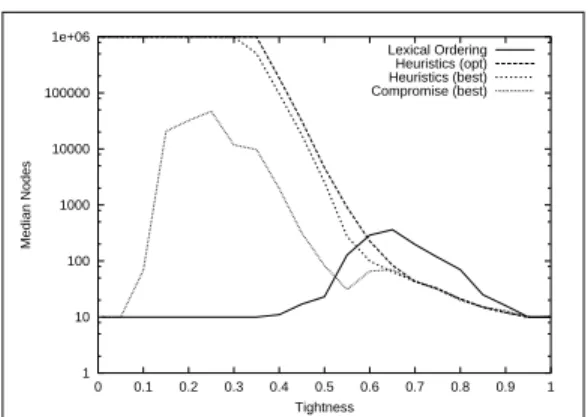
Figure 2 shows the search effort required by lexical ordering versus search with good CSP heuristics for forward checking. As expected, lexical search ordering is su-perior when there are many solutions. However, it was somewhat surprising that high efficiency is maintained over a considerable portion of the tightness range. In these
2 3 4 5 6 7 8 9 10 11 12 13 14 15 16 17 18 19 20 21 22 23 24 25 26 27 28 29 30 31 32 33 34 35 36 37 38 39 40 41 42 43 44 45 46 47 48 49 50 51 52 1 10 100 1000 10000 100000 1e+06 0 0.1 0.2 0.3 0.4 0.5 0.6 0.7 0.8 0.9 1 Median Nodes Tightness Lexical Ordering Heuristics (opt) Heuristics (best) Compromise (best)
Fig. 2. Effort required, (i) to discover the best solution (“best”), (ii) to prove it optimal (“opt”).
Forward checking algorithm, with either lexical ordering or good heuristics for ordinary CSPs. The effort required by a compromise ordering (min domain and lexical value) to discover the best solution is also shown. (The “opt” curve for this strategy is almost identical to that for the good-heuristics case.) Ten-variable problems, with fixed density = 0.5 and tightness varying in steps of 0.05. Sample size at each step is 50 problems. For tightness0.65 problems have no solutions.
cases, ordinary heuristics are grossly inefficient either for finding the best solution or for determining optimality. However, despite the rigorous requirement that all solutions be tested, a crossover effect does occur as the number of solutions decreases, so that al-gorithms with good CSP heuristics can find the best solution and prove optimality with less effort than the lexical ordering. The crossover point occurs before the point where problems no longer have solutions, where lexical ordering must lose any advantage.
Figure 2 also shows the effort required by a compromise strategy (variable order-ing by minimum domain size with ties broken by lexical orderorder-ing and lexically-ordered value selection) to find the best solution (without proving that it is the best). This strat-egy is much better at locating such solutions than the stratstrat-egy based solely on good CSP heuristics, which makes the former suitable for either branch and bound or anytime pro-cedures.
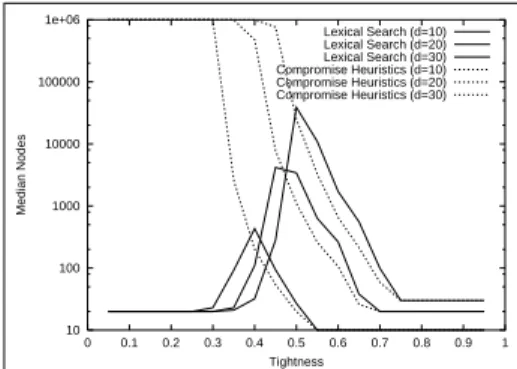
With MAC-3, the efficiency of lexical ordering is improved further, in relation to the other algorithms, so that for these small problems the crossover is no longer ap-parent. This apparent synergy between consistency maintenance and lexically ordered search may occur because arc consistency maintenance confers a greater benefit in the one-solution than the all-solutions case. However, the same crossover effect can be ob-served with larger problems, and becomes more pronounced as domain size increases (Figure 3, Table 1). Note that the y-axis in Figure 3 is logarithmic, so that after two corresponding curves cross, there is an interval of tightness where the heuristic method improves on the lexical ordering by a factor of 2-4.
3 4 5 6 7 8 9 10 11 12 13 14 15 16 17 18 19 20 21 22 23 24 25 26 27 28 29 30 31 32 33 34 35 36 37 38 39 40 41 42 43 44 45 46 47 48 49 50 51 52 53 10 100 1000 10000 100000 1e+06 0 0.1 0.2 0.3 0.4 0.5 0.6 0.7 0.8 0.9 1 Median Nodes Tightness Lexical Search (d=10) Lexical Search (d=20) Lexical Search (d=30) Compromise Heuristics (d=10) Compromise Heuristics (d=20) Compromise Heuristics (d=30)
Fig. 3. Effort required by MAC-3 to obtain provably optimal solutions with lexical and
compro-mise ordering. Twenty-variable problems with density = 0.5 and domain size = 10, 20 and 30. Tightness varied in steps of 0.05 for each curve. Sample size at each step is 50.
6
More Advanced Solving Methods
6.1 Branch and bound with CSP heuristics
An alternative form of search is to combine branch and bound with CSP heuristics involving dynamic variable ordering. (Obviously, lexically ordered search cannot be improved in this manner, since it orders search in terms of an implicit cost function.) We have already described a cost function for the weighted CSP version of lexicographic CSPs that uses base arithmetic, but for lexicographic CSPs we do not need to calculate the actual values of this function, which are quite large for any but small problems. Instead, we simply compare successive values following the lexical variable ordering until we encounter a difference.
Specifically, suppose that variableX
iis the variable currently being considered for instantiation, and this variable is thekth most important variable in the ordering. To evaluate the current partial solution, we start from the first variable in the lexical order-ing. If a variable has an assignment, we check this against its instantiation in the best assignment found so far; if it does not yet have an assignment, we check the best re-maining value in its domain against the best assignment. In either case, if we encounter a value greater than the best found so far, then search can back up. Pseudocode for this algorithm is shown in Figure 4.
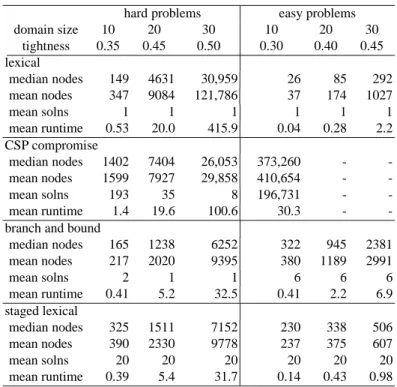
The efficiency of this procedure could suffer when combined with variable ordering heuristics, if variables of high priority occur late in the search order, and good values are still available. Despite this potential limitation, this form of branch and bound does well in comparisons with other methods (Table 1). Not only does it give further im-provements in performance when there are few solutions, but its performance degrades more slowly than the ordinary CSP algorithm when the number of feasible solutions increases, and in these cases it avoids checking a large proportion of solutions. It is also much less sensitive to increases in domain size than lexical ordering. It, therefore, can be used with less concern about the exact properties of the problem.
2 3 4 5 6 7 8 9 10 11 12 13 14 15 16 17 18 19 20 21 22 23 24 25 26 27 28 29 30 31 32 33 34 35 36 37 38 39 40 41 42 43 44 45 46 47 48 49 50 51 52
initialise values in best-solution to BIGVAL lexico-bnb (partial-solution, remaining-variables)
if remaining-variablesnil
save partial-solution as new best-solution and continue //backtrack else
select next-variable and remove from remaining-variables for each value in its ordered domain
if instantiating next-variable with this value leads to an arc consistent problem and
bounds-check(next-variable, next-value) returns true //under bound lexico-bnb (new-partial-solution, remaining-variables) continue //backtrack
bounds-check (candidate-var, candidate-value) underbound = true; comparison-succeeded = false
while variables remain to be compared & not comparison-succeeded select next-variable = most important unchecked variable get value best-value for this variable from current best-solution if next-variable == candidate-var
curr-assign = candidate-value else if next-variable is instantiated
curr-assign = current assignment of next-variable else //smallest value is most-preferred value
curr-assign = smallest value in current domain of next-variable //perform comparisons
if curr-assign>best-value
comparison-succeeded = true underbound = false else if curr-assign<best-value
comparison-succeeded = true if comparison-succeeded if underbound return true else return false else return true
Fig. 4. Branch and bound pseudocode for lexicographic CSPs.
6.2 A specialised lexicographic CSP algorithm
Another strategy for search algorithms in this domain is to devise procedures that are sensitive to the properties of a lexicographic order. In this vein, we have implemented a specialized iterative algorithm for lexicographic CSPs that we call “staged lexical search”. Search is done repeatedly, in each case until the first solution is found, and for each repetition or stage of search, one more variable is chosen in lexical order, i.e. in accordance with the importance ordering. Values for this variable are chosen according to the preference ordering for this domain, starting with the most-preferred value.
Thus, in Stage 1 we first select variableX
1 according to the lexical (importance) ordering, and then use any heuristic to select the others. When we have found a feasible solution, we know that the assignment forX
1is optimal, so we retain it for the remain-der of search. In Stage 2, we first select variableX
2, so the first feasible solution found will include an optimal assignment for this variable. And so forth. Pseudocode for the
3 4 5 6 7 8 9 10 11 12 13 14 15 16 17 18 19 20 21 22 23 24 25 26 27 28 29 30 31 32 33 34 35 36 37 38 39 40 41 42 43 44 45 46 47 48 49 50 51 52 53
staged lexical algorithm is shown in Figure 5. Although developed independently, this algorithm is a special case of preference-based search [14], where the criteria on which search is based form a total order.
As noted earlier, methods for lexicographic ordering in multiobjective optimisation generally use a weighting scheme, in contrast to adding successive constraints accord-ing to the importance orderaccord-ing of the criteria. However, a specialised technique used to find Pareto-optimal solutions, called the epsilon-constraints method, is based on a sim-ilar strategy to that used for preference-based search. The epsilon-constraint problem is defined as follows: minf j (x) subject to f k (x) k ;k=1;:::;n k6=j
For CSPs with ordered domains, this corresponds to finding a minimal value in domain j, while allowing a choice of values in domains j+1;:::;n, subject only to some minimal difference from the optimal. In the present case,
k(
k>j) can be considered to be set high enough to allow any domain value to be chosen. However, since the purpose of the epsilon-constraint method is to find solutions that belong to the Pareto frontier, it does not involve successive addition of constraints in the manner of the CSP methods. (A basic description of this method is in [47]; see [48] for a recent discussion.)
k= 1 whilekn
level =k
while leveln //search for next solution if level ==k
selectkth variable in importance order else
select next-variable according to some heuristic while values remain and viable assignment not found
if level ==k
select value according to preference ordering and propagate else
select value according to some heuristic and propagate if all assignments have failed at this level
//can’t happen if level ==kand there is a solution backtrack and set level = level - 1
else
level = level + 1
save assignment made at levelk //this is optimal k=k+1
2 3 4 5 6 7 8 9 10 11 12 13 14 15 16 17 18 19 20 21 22 23 24 25 26 27 28 29 30 31 32 33 34 35 36 37 38 39 40 41 42 43 44 45 46 47 48 49 50 51 52
In the form just described, this algorithm also compares well with other methods (Table 1). Not only does it do almost as well as branch and bound when there are few solutions, but it never does much worse than simple lexical ordering for problems with many solutions. In addition, mean runtimes for staged lexical were almost identical to those for branch and bound in cases where there were few or no solutions (when there were many solutions, staged lexical was faster). It may, therefore, be the algorithm of choice if only one method is desired for all species of problems. It may also be possible to improve the algorithm somewhat since often after a certain stage, the same solution is found repeatedly.
6.3 Further experimental comparisons
In this section, we present results based on other problem sets. The first set of results is for random problems with a larger number of variables. The second is for problems with heterogeneous structure, consisting of an easy subproblem with loose constraints and a hard subproblem with tighter constraints. To facilitate comparison with previous tests, these problems have similar size and density to the random 20-variable problems. The third set of results is for problems derived from a real-world configuration problem obtained from the Configuration Benchmarks Library maintained by the Computational Logic and Algorithms Group at the University of Copenhagen (ESVS Benchmark #7
3).
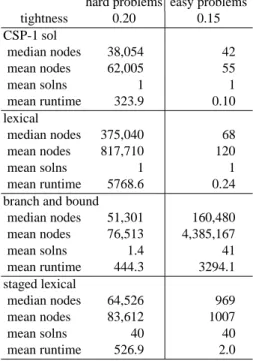
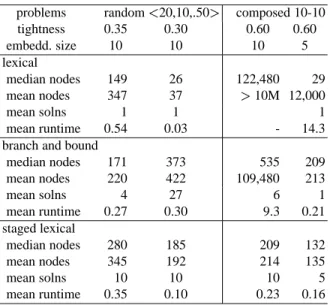
For 40-variable problems with the same domain size and density as before, the same trends appear, but the differences are magnified. In particular, for problems in the critical complexity region, the branch and bound and staged lexical algorithms are an order of magnitude better on average than the basic lexical ordering. Although the compromise method is also better than simple lexical ordering for the hard problems (mean nodes = 280,514, using the min domain heuristic), since it is clearly dominated by the advanced methods, results for this method are omitted from this and later tables. Interestingly, the difference between the two advanced methods is now quite pronounced as soon as one enters the easy portion of the complexity space. (For purposes of comparison, we include data for these problems based on ordinary CSP search for one solution using the same variable ordering heuristic. This serves to show how effective the advanced methods are for problems that are also hard as CSPs.)
Problems with heterogeneous structure were like the original set of homogeneous random problems in having 20 variables, with domains of size 10, and the overall graph density was 0.50. There were two components, each with ten variables: an ‘easy’ com-ponent with very loose constraints (tightness = 0.05) and a ‘hard’ comcom-ponent with tighter constraints (either 0.60 or 0.65). These components were linked by constraints also with a tightness of 0.05. Within each component as well as for the links, the propor-tion of edges was 0.5. These problems were of a type that has been called “composed” problems [49].
For the experiments described here, the importance ordering was such that the ten variables in the easy component were designated as the ten most important. (If the order-ing favored variables in the hard component, the results were similar to those given for
3 4 5 6 7 8 9 10 11 12 13 14 15 16 17 18 19 20 21 22 23 24 25 26 27 28 29 30 31 32 33 34 35 36 37 38 39 40 41 42 43 44 45 46 47 48 49 50 51 52 53
Table 1. Search Efficiency Comparisons
hard problems easy problems
domain size 10 20 30 10 20 30 tightness 0.35 0.45 0.50 0.30 0.40 0.45 lexical median nodes 149 4631 30,959 26 85 292 mean nodes 347 9084 121,786 37 174 1027 mean solns 1 1 1 1 1 1 mean runtime 0.53 20.0 415.9 0.04 0.28 2.2 CSP compromise median nodes 1402 7404 26,053 373,260 - -mean nodes 1599 7927 29,858 410,654 - -mean solns 193 35 8 196,731 - -mean runtime 1.4 19.6 100.6 30.3 -
-branch and bound
median nodes 165 1238 6252 322 945 2381 mean nodes 217 2020 9395 380 1189 2991 mean solns 2 1 1 6 6 6 mean runtime 0.41 5.2 32.5 0.41 2.2 6.9 staged lexical median nodes 325 1511 7152 230 338 506 mean nodes 390 2330 9778 237 375 607 mean solns 20 20 20 20 20 20 mean runtime 0.39 5.4 31.7 0.14 0.43 0.98
Notes. Twenty-variable problems, sample size 100. MAC algorithm. “hard problems” are near the critical complexity peak for lexical ordering. “easy problems” are near the edge of the hard region for lexical (cf. Figure 3). “solns” is number of feasible solutions found during the entire search; for CSP compromise this is the total number of solutions per problem. Branch and bound and staged lexical algorithms employed the compromise ordering. Here and elsewhere run times are in seconds.
random problems.) In this case, search using a basic lexical ordering does very poorly because of excessive thrashing, since conflicts are not uncovered until search is deep in the tree. For this algorithm, search could not be run to completion for all problems, so it was only possible to derive a lower bound (based on total accumulation of nodes across a problem-set). At the same time, the advanced methods when given an appro-priate heuristic were able to solve these problems efficiently. (The heuristic used in this case was the FF2 heuristic of [50], a Brelaz-like heuristic which is sensitive to relative constrainedness of different parts of the problem.) Here, the staged lexical algorithm outperformed branch and bound significantly and did not encounter any difficult prob-lems. As a result, the former sometimes outperformed the standard lexically ordered search by at least five orders of magnitude with respect to the mean.
The success of these algorithms was not simply due to the use of an appropriate heuristic, since when FF2 was used with the all-solutions “compromise” strategy