Worcester Polytechnic Institute
Digital WPI
Doctoral Dissertations (All Dissertations, All Years)
Electronic Theses and Dissertations
2008-03-25
State-Slice: A New Stream Query Optimization
Paradigm for Multi-query and Distributed
Processing
Song Wang
Worcester Polytechnic Institute
Follow this and additional works at:
https://digitalcommons.wpi.edu/etd-dissertations
This dissertation is brought to you for free and open access byDigital WPI. It has been accepted for inclusion in Doctoral Dissertations (All Dissertations, All Years) by an authorized administrator of Digital WPI. For more information, please [email protected].
Repository Citation
Wang, S. (2008).State-Slice: A New Stream Query Optimization Paradigm for Multi-query and Distributed Processing. Retrieved from
State-Slice: A New Stream Query
Optimization Paradigm for Multi-query and
Distributed Processing
by
Song Wang
A Dissertation Submitted to the Facultyof the
WORCESTER POLYTECHNIC INSTITUTE in Partial Fulfillment of the Requirements for the
Degree of Doctor of Philosophy in
Computer Science by
March 17, 2008
APPROVED:
Professor Elke A. Rundensteiner Advisor
Professor Murali Mani Committee Member
Professor Michael Gennert Head of Department
Professor George Heineman Committee Member
Professor Ugur C¸etintemel Brown University
i
Abstract
Continuous queries process real-time streaming data and output results in streams for a wide range of applications. Modern stream applications such as sensor monitoring systems and publish/subscription services necessi-tate the handling of a large number of continuous queries specified over high volume data streams. Continuous queries utilize constraints, such as windows, to unblock stateful and otherwise blocking query operations. The window constraints impose new challenges for effective query process-ing. This dissertation proposes novel solutions to continuous query opti-mization based on state-slicing in three core areas, namely multiple contin-uous query sharing, ring-based multi-way join query distributed process-ing and distributed multi-query optimization.
The first part of the dissertation proposes efficient optimization strate-gies that utilize the novel state-slicing concept to achieve optimal mem-ory and computation sharing for multiple stream join queries with differ-ent window constraints. Extensive analytical and experimdiffer-ental evaluations demonstrate that the proposed strategies can minimize the memory or CPU consumptions for multiple join queries.
ii
The second part of this dissertation proposes a novel scheme for the distributed execution of generic multi-way joins with window constraints. The proposed scheme partitions the states into disjoint slices in the time do-main, and then distributes the fine-grained states in the cluster, forming a virtual computation ring. New challenges to support this distributed state-slicing processing are answered by numerous new techniques, including synchronized processing on slices without locking in asynchronous cluster, maintenance and termination logic in ring-based query plan, interleaving of join runs, cost-based state allocation, and distributed time-slice adap-tation. The extensive experimental evaluations show that the proposed strategies achieve significant performance improvements in terms of re-sponse time and memory usages for a wide range of configurations and workloads on a real system compared to the state-of-the-art distributed processing techniques.
Ring-based distributed stream query processing and multi-query shar-ing both are based on the same state-slice concept. The third part of this dissertation combines the first two parts of this dissertation work and pro-poses a novel distributed multi-query optimization technique.
iii
Acknowledgments
This dissertation and the growth in my knowledge over the last few years owe a great deal to many professors, colleagues, and friends. First, I want to thank my advisor, Professor Elke A. Rundensteiner, for all her support during the process of my Ph.D. study. She inspired my interests in database research and gave me direction on every aspects of research. It has been my luck to have her as my advisor. Her technical and editorial advice was es-sential to the completion of this dissertation. I express my sincere thanks for her support, advice, patience, and encouragement throughout my grad-uate studies. Her persistence in tackling problems, confidence, and great teaching will always be an inspiration.
My thank goes to the members of my Ph.D. committee, Prof. Murali Mani, Prof. George Heineman and Prof. Ugur C¸etintemel, who provided valuable feedback and suggestions to my comprehensive-exam, my disser-tation proposal talk and disserdisser-tation drafts. All these helped to improve the presentation and contents of this dissertation. I thank Prof. Kathi Fisler for her time and efforts discussing with me in my research qualifying exam.
iv
previous and current, in DSRG for their hard work on building the system that we can share together as a team. I would also like to thank the Rainbow and Raindrop team members for their help in my early Ph.D. study. The friendship of Yali Zhu, Ling Wang, Bin Liu, Andreas Koeller, Li Chen, Hong Su, Xin Zhang, Songting Chen, Maged El-Sayed, Luping Ding, Rimma V. Nehme, Jinghui Jian and all the other previous and current DSRG members is much appreciated. They have contributed to many interesting and good-spirited discussions related to this research.
I thank the wonderful professors in the CS department for both their serious lectures and casual chattings. I thank the system support staff in our department and from the school for providing a well-maintained com-puting environment and utilities for our research needs. I am thankful for the financial supports I have received from my advisor, the department, the school and NEC Labs America during my study and research in WPI. My thank also goes to NSF for providing funding for the computing cluster used in my dissertation.
Finally, I would like to thank my wife Mingyu for her understanding and love during the past few years. Her support and encouragement was in the end what made this dissertation possible. My parents receive my deepest gratitude and love for their dedication and the many years of sup-port during my studies. Special thanks also go to my little daughter Alli-sion, her sweet smile comes along with me forever.
v
Contents
1 Introduction 1
1.1 Research Motivation . . . 1 1.1.1 Continuous Query Optimization in General . . . 1
1.1.2 New Challenges in Continuous Query Processing . . 4
1.1.3 Motivation for Operator Granularity Control . . . 6 1.1.4 Relation with State-of-the-Art Stream Query
Process-ing Techniques . . . 8 1.2 Research Focus of This Dissertation . . . 11 1.2.1 Multiple Continuous Query Optimization . . . 13 1.2.2 Distributed Multi-way Stream Join Query Optimization 18 1.2.3 Distributed Multiple Query Processing . . . 24
1.2.4 Overview of the CAPE/D-CAPE System . . . 26
1.3 Dissertation Road Map . . . 28
I State-Slice Multi-query Optimization of Stream Queries 29
2 Introduction 30
2.1 Research Motivation . . . 30 2.2 Proposed Strategies . . . 33 2.3 Road Map . . . 36
3 Background 37
3.1 Stateful Operators in Continuous Queries . . . 37 3.2 Window Constraints and Sliding Window Join . . . 39 3.3 Assumptions and Simplifications . . . 42
4 Review of Existing Strategies for Sharing Continuous Queries 45
4.1 Naive Sharing with Selection Pull-up . . . 47 4.2 Stream Partition with Selection Push-down . . . 49
CONTENTS vi
5 State-Slice Sharing Paradigm 52
5.1 State-Sliced One-Way Window Join . . . 53
5.2 State-Sliced Binary Window Join . . . 59
5.3 Discussion and Analysis . . . 65
6 Case Study: State-Slice Sharing for Join Tree 70 6.1 Continuous Queries and Terms Used in Cost Model . . . 71
6.2 Strategies of Sharing Queries . . . 74
6.2.1 Selection PullUp Sharing . . . 74
6.2.2 State-Slice Sharing . . . 76
6.3 Cost Model for State Memory Consumption . . . 77
6.3.1 Isolated Execution without Sharing . . . 77
6.3.2 Selection PullUp Sharing . . . 79
6.3.3 State-Slice Sharing . . . 80
6.3.4 Comparison and Analysis . . . 81
6.4 Cost Model for CPU Consumption . . . 84
6.4.1 Isolated Execution without Sharing . . . 85
6.4.2 Selection PullUp Sharing . . . 86
6.4.3 State-Slice Sharing . . . 87
6.4.4 Comparison and Analysis . . . 88
7 State-slice: Building the Chain 92 7.1 Memory-Optimal State-Slicing and its Cost Analysis . . . 93
7.2 CPU-Optimal State-Slicing . . . 95
7.3 Online Migration of the State-Slicing Chain . . . 98
7.4 Push Selections into Chain . . . 101
7.4.1 Mem-Opt Chain with Selection Push-down . . . 101
7.4.2 CPU-Opt Chain with Selection Push-down . . . 103
8 Experimental Evaluation 105 8.1 Experimental System Overview . . . 105
8.2 State-Slice vs. Other Sharing Strategies . . . 106
8.3 State-slice: Mem-Opt vs. CPU-Opt . . . 110
9 Related Work 113 II Distributed Multi-way Stream Join Processing 116 10 Introduction 117 10.1 Research Motivation . . . 117
CONTENTS vii
10.2 Proposed Strategies . . . 120
10.3 Our Contributions: . . . 124
10.4 Road Map . . . 125
11 Background 126 11.1 Semantics of Multi-way Window Join . . . 126
11.2 Distributed Continuous Query Processing in DCAPE . . . . 130
12 PSP: State-Slicing for Multi-way Joins 133 12.1 New Challenges in State-slicing for Multi-way Joins . . . 133
12.2 State-Slice Ring with Life Control . . . 137
12.2.1 Coordinated State Maintenance. . . 140
12.2.2 Intermediate Result Propagation and Processing. . . 143
12.2.3 Life Span Control in the Ring. . . 145
12.3 Execution Algorithm and Time Line . . . 148
12.4 PSP with Interleaved Processing . . . 151
12.5 PSP with Dynamic Head and Tail . . . 153
12.6 Interleaving Processing with Dynamic Ring Structure . . . . 155
13 PSP: Cost Analysis and Tuning 157 13.1 Cost Model . . . 157
13.2 Cost-based Tuning . . . 160
13.2.1 Maximize Output Rate. . . 160
13.2.2 Minimize Average Response Latency. . . 161
13.3 Initial State Slicing . . . 162
13.4 Workload Balancing . . . 163
14 PSP: Adaptive Load Diffusion 164 14.1 Workload Smoothing . . . 165
14.2 State Relocation . . . 166
15 Discussion 169 15.1 State Replication Based Distribution . . . 169
15.2 Stream Tuple Processing Order . . . 173
15.2.1 Execution Models . . . 174
15.2.2 State Sliced Join Processing with Semi-Ordered Exe-cution . . . 176
CONTENTS viii
16 Experimental Evaluation 180
16.1 Experiment Settings . . . 180
16.2 Experiment 1: Sensitivity Analysis for PSP . . . 182
16.3 Experiment 2: PSP with Interleaved Processing . . . 185
16.4 Experiment 3: PSP vs. ATR and CTR . . . 187
16.5 Experiment 4: Runtime Adaptation of PSP . . . 190
17 Related Work 192 III Distributed Multiple Multi-way Join Query Optimization194 18 Introduction 195 18.1 Research Motivation . . . 195
18.2 Proposed Strategies . . . 196
18.3 Road Map . . . 199
19 Selection Pushdown for Multi-way Join 200 19.1 Selection Pull Up and Window based State Slicing . . . 201
19.2 Selection Push Down . . . 202
20 Routing the Joined Results 207 20.1 Routing Bitmaps for the Logical Window Slices . . . 208
20.2 Bitmaps for Evaluation of the Selections . . . 210
21 Logical Query Plan Deployment in the Cluster 211 21.1 Extended Cost Model . . . 212
21.2 Minimize Average Response Latency . . . 213
21.3 Workload Balancing . . . 213
IV Conclusions and Future Work 215 22 Conclusions of This Dissertation 216 23 Future Work 221 23.1 State Slicing Aware Continuous Query Optimization . . . . 221
23.2 Computation Sharing for Complex Event Query Processing 222 23.3 Approximate Continuous Query Processing . . . 223
ix
List of Figures
1.1 Continuous Query Plan Network. . . 4
1.2 Overall Research Focus. . . 12
1.3 D-CAPE System Architecture. . . 27
2.1 A Brute Force State Slicing with Incomplete Result . . . 34
3.1 Sliding Window Join Operators and Their States . . . 38
3.2 Execution of Sliding-window join. . . 41
4.1 Query Plans forQ1 andQ2. . . 46
4.2 Selection Pull-up. . . 48
4.3 Selection Push-down. . . 50
5.1 Sliced One-Way Window Join. . . 54
5.2 Execution ofA[Wstart, Wend]ns B. . . . 54
5.3 Chain of 1-way Sliced Window Joins. . . 55
5.4 Chain of Binary Sliced Window Joins. . . 60
5.5 Execution of Binary Sliced Window Join. . . 61
5.6 State-Slice Sharing forQ1andQ2. . . 64
5.7 The Processing of the Union Operator. . . 67
5.8 Memory Consumption Comparison . . . 67
5.9 CPU Cost Comparison: State-Slice vs. Selection PullUp . . . 68
5.10 CPU Cost Comparison: State-Slice vs. Selection PushDown. 68 6.1 Query Plans forQ1 andQ2. . . 71
6.2 Selection PullUp Sharing Query Plan. . . 75
6.3 State-Slice Sharing forQ1andQ2. . . 76
6.4 Memory Consumption Comparison: State-Slice Sharing vs. Selection PullUp Sharing. . . 83
LIST OF FIGURES x
6.5 Memory Consumption Comparison: State-Slice Sharing vs.
Isolated Execution. . . 83
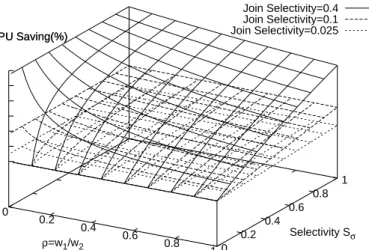
6.6 CPU Cost Comparison: State-Slice Sharing vs. Selection PullUp Sharing. . . 90
6.7 CPU Cost Comparison: State-Slice Sharing vs. Isolated Exe-cution. . . 91
7.1 Mem-Opt State-Slice Sharing. . . 93
7.2 Merging Two Sliced Joins by Introducing Router Operator. . 96
7.3 Directed Graph of State-Slice Sharing. . . 97
7.4 Online Splitting of the Sliced JoinJi. . . 98
7.5 Online Merging of the Sliced JoinJiandJi+1. . . 100
7.6 Selection Push-down for Mem-Opt State-Slice Sharing. . . . 102
7.7 Merging Sliced Joins with Selections. . . 104
8.1 Memory Comparison with Various Parameters . . . 108
8.2 Service Rate Comparison with Various Parameters . . . 109
8.3 Service Rate Comparison of Mem-Opt. Chain vs. CPU-Opt. Chain . . . 111
11.1 Binary Join Trees . . . 128
11.2 Multi-way Join Operator for QueryA ./ B ./ C ./ D ./ E . . 129
11.3 Pipelined parallelism and Partitioned Parallelism . . . 130
11.4 Example of Data Partitioned Plan Distribution . . . 132
12.1 Ring-based Query Plan with Multi-way State-slice Joins. . . 136
12.2 Snapshot of Runtime State Deployment in the Ring-based Query Plan. The Current Sliding Window is Composed of the Colorful/Gray Slots for Each Stream. . . 139
12.3 Execution Steps of Sliced Joinopi . . . 149
12.4 Execution Time Line of the PSP . . . 150
12.5 Purge Steps with StateStart and StateEnd innodei,1≤i≤n 152 12.6 PSP with Dynamic Head and Tail. . . 154
12.7 PSP-D with Multiple Heads and Tails. . . 156
14.1 Aggressive State Relocation. . . 167
15.1 CPU Consumption Comparison . . . 172
16.1 Cost Breakdown for an Example 3-Way Join Query. . . 183
LIST OF FIGURES xi
16.3 Performance Analysis of the PSP-Int scheme . . . 186
16.4 Performance Analysis of the ATR scheme . . . 188
16.5 Performance Analysis of the CTR scheme . . . 189
16.6 Experimental Results of Adaptation . . . 190
xii
List of Tables
4.1 System Settings Used in Chapter 4. . . 47
5.1 Execution of the Chain:J1,J2. . . 56
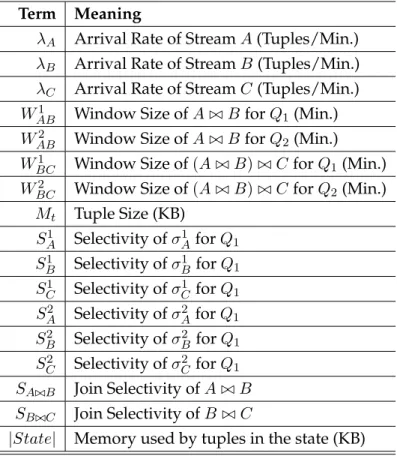
6.1 Terms Used in Cost Model . . . 73
6.2 Value of Terms Used in Cost Model . . . 78
8.1 System Settings Used in Chapter 8.2. . . 107
8.2 Window Distributions Used for 12 Queries. . . 110
1
Chapter 1
Introduction
1.1 Research Motivation
1.1.1 Continuous Query Optimization in General
Over the past decades, database systems have emerged as the core tech-nology for managing data [RG00]. After many years of development, re-lational database technology has matured and contributed significantly to the rapid growth of various industries. Relational database management systems (DBMS) are a proven technology for managing business data [RG00]. Commercial relational database products, such as Oracle, DB2, Microsoft SQL Server, Sybase, PostgreSQL, MySQL and etc., embody years of re-search and development in areas as diverse as modeling, storage, retrieval, update, indexing, transaction processing, and concurrency control, to just name a few. Work continues to add capabilities to a DBMS to address new kinds of data in the past decade, such as multimedia [MS96],
object-1.1. RESEARCH MOTIVATION 2
oriented [CA93], spatial-temporal data types [PdBG94, JCE+94], XML and
semistructured data [BPSM97], and most recently stream data types [BW01]. Recently, the development of the web and network techniques also has necessitated the widely used stream data processing. Recent years have witnessed a rapidly increasing attention on streaming database systems [MWA+03, BBMW02, ACC+03, AH00, DTW00, VN02, ILW+00, AAB+05a].
Different from traditional database systems with statically stored data and one-time queries, in a streaming database, data are streaming in as time goes by. User queries are generally long-running or even continuous, and the results of the queries are also in the format of streams. This type of query is generally referred to as acontinuous query. Many applications re-quire the processing of continuous queries on streaming data, including sensor networks, online financial tickers and medical monitoring systems. Hence a database system that specialized in processing streaming data and continuous queries is likely to be beneficial for a large range of applications. Efficiency is the key point in all these above data processing systems because of the tremendous data size. Modern relational databases usu-ally host several TB data. Query optimization is a core component of any database system. Query optimization has been intensively studied for decades for the now mature relational databases [RG00, Cha98, Ioa96]. The well known optimization techniques include query plan rewriting, answering queries using materialized views, sharing computation for multi-queries and others [Cha98]. These optimizations are generally cost-based and algebraic-based [Cha98]. Query optimization aims to produce an efficient execution plan.
1.1. RESEARCH MOTIVATION 3
Continuous queries significantly differ from traditional static queries in several aspects. (1) Data availability. For traditional relational queries, data is storeda priorion disk; while the stream data arrives at the system on-the-fly. This means that various data access methods with well-studied indices existing for relational databases may not be valid for stream data. (2) Query execution mode. Users of relational databases submit one-time queries against the data in the tables. A valid relational query should not run indefinitely on finite data. On the contrary, users register a set of con-tinuous queries on the incoming streams. These queries will be running in the query engine until the user explicitly deactivates them. (3) Result generation. Generation of query results for relational queries are driven by the execution steps in a pull-based fashion, which is usually defined by the
iteratorinterfaces of the operators. However, when stream data arrives at runtime, the query processing will be driven by the data and output the update of results in a push-based fashion.
Figure 1.1 shows a simplified architecture of a continuous query engine. As illustrated, the stream data arrives on the fly, while the result is also streaming out of the system at runtime. A streaming continuous query sys-tem usually hosts multiple registered continuous queries having the same input streams. Since all these queries are continuous queries, they have to be executed simultaneously instead of sequentially. The corresponding query operators of the registered query form a query network, which is a
directed acyclic graphof operators. All the operators in the query network will be connected with queues to buffer intermediate results temporarily. The final result will be sent out as streaming result.
1.1. RESEARCH MOTIVATION 4 Streaming Data Streaming Result σ П σ σ U Agg Query Network w1 w2 w3 Agg Q1 Q2 Q3 …
Figure 1.1: Continuous Query Plan Network.
The stream data model is different from the well-studied relational data model in the sense of on-the-fly arrival. The corresponding query mod-els bring new semantics, such as timestamps and window constraints. All these differences require us to revisit the traditional database processing techniques in the streaming database scenario, since the former was not initially designed to deal with on-the-fly real-time data. This calls for a new set of methodologies and algorithms tailored for streaming database technologies to process continuous queries.
1.1.2 New Challenges in Continuous Query Processing
The optimization of continuous query processing [MWA+03, MSHR02, CCC+02]
differs from traditional query optimization in several aspects. Below we list several aspects of the differences and illustrate the new challenges for continuous query processing.
First, the quality of a continuous query plan is typically judged by its runtime performance measurements, including output rate [VN02] and re-sponse time. In a static database, the quality of a query plan is often judged by its total estimated execution cost measured in terms of CPU
process-1.1. RESEARCH MOTIVATION 5
ing and disk I/O costs [SMK97]. Since ideally the estimated execution cost might be a “good” indication of actual query execution time in a real sys-tem, the query optimizer usually picks the query plan that has the minimal estimated cost. However for a stream query, the query execution time is not essential because of the long running nature. New performance indicators are defined then for continuous query processing. As observed in [AN04], a continuous query plan produces the optimal throughput without shed-ding as long as the system can process all incoming stream data within the stream arrival rates. When the continuous query engine faces high-volume input streams, it is thus critical to devise methods to catch up with the stream speed.
Second, continuous queries are usually main-memory-resident to sat-isfy the often rather stringent real-time output requirements [MWA+03,
MSHR02, CCC+02]. Due to the existence of stateful operators, such as join
or group-by, which may store large amount of tuples in operator states, con-tinuous query processing tends to be CPU-intensive and memory-intensive. When the system is overloaded, we have to either spill in-memory data to disk [LZR06, UF00, VNB03], which can further delay the processing, or we could apply load shedding [TcZ+03] to delete data, which incurs approx-imate results. Clearly, for applications that demand accurate real-time re-sults, the query optimizer instead should aim to generate query plans with minimal memory and CPU costs.
Third, continuous query must be aware of constraints such as the win-dow constraints, which is new semantics of stream queries. Winwin-dow con-straints for stream data can be time-based [BW01], tuple-based [BW01] or
1.1. RESEARCH MOTIVATION 6
punctuation-based [TMSF03]. The window constraints are used to unblock the stateful operators from infinite waiting time before generation of any result. The window constraints determine the memory consumption of the stateful operators, and along with it the CPU resources needed to process the tuples in the states. Usually the CPU cost is proportional, quadratic or even higher degree to the window constraints, since the complexity of the operators are usually not linear.
Lastly, the statistics of the streams are usually unknown before a query starts. In fact they may continue to change during the query execution. Thus a query plan that is currently optimal can become sub-optimal at a later time. Therefore, runtime optimization is critical and inevitable. Thus the initial generated query plan must be flexible for adaptive continuous query processing. More importantly, effective runtime query optimization methods must be developed.
1.1.3 Motivation for Operator Granularity Control
Query optimization is one of the most critical techniques for improving query performance in any database system. Among these techniques the optimization of join queries, especially for the multi-way joins with arbi-trary join graphs, is essential since join operations tend to dominate the CPU and memory usage in a database system [Gra93, KRB85]. For stream query optimization, the real-time query response requirement and in-memory processing of stream operators exacerbate the situation.
In stream processing, the CPU and memory usage is directly related to the window constraints. The join and group-by operators arestateful
opera-1.1. RESEARCH MOTIVATION 7
tors. A stateful operator must store all tuples that have been processed thus far from input streams so to be able to join or group them with future in-coming tuples from the other input streams. For a long-running query as in the case of continuous queries, the number of tuples stored inside a stateful operator can potentially be quite large for large window constraints. Such operators are serious obstacles for stream query optimizations.
• First, a huge operator limits the granularity of query optimization, since an operator is the basic unit for query rewriting. Window con-straints for the stateful operators add semantics beyond the relational query model. Since the operator is the basic unit for the query opti-mizer to work on, a huge stateful operator limits the scope and effec-tiveness of the query optimizer in terms of rule based query rewrit-ing. Localized intra micro operator optimization may be possible but cannot achieve plan level optimality.
• Second, a huge stateful operator brings new issues for operator schedul-ing strategies, since an operator is the minimal unit for an execution thread scheduled in a continuous query engine. In the case when huge stateful operators exist in the query plan and consume most of the CPU time at runtime, special care must be taken to avoid starva-tion of other operators.
• Third, a huge stateful operator is not suitable for distributed query processing, since an operator is the basic unit for parallelism. Dis-tributed stream query processing is a natural direction when the in-put stream arrival rates and stream query processing requirements
1.1. RESEARCH MOTIVATION 8
go beyond the ability of a single processor. However, huge stateful operators may be too large to fit into any single processor and thus they must be split.
In summary, the size of the operators determines the granularity of query processing in almost all aspects. Operators of fine granularity pro-vide potentially more opportunities for the runtime query optimizer and query execution engine.
In this dissertation, I propose a novel solution of slicing the states in the time domain calledstate slicing, designed to split a huge stateful opera-tors into a group of smaller stateful operaopera-tors at the optimizer’s will. Our proposed method is generic in the sense that the key idea of state slicing does not rely on the query semantics such as type of predicates, attribute domain and attribute distribution. Our solution is versatile and generic for arbitrary join predicates, with minimal extra cost. Based on the state slicing concept, we show solutions of two important problems, namely, computa-tion sharing among stream queries with overlapped window constraints and distributed query processing of generic stateful join queries.
1.1.4 Relation with State-of-the-Art Stream Query Processing Tech-niques
Many aspects of stream query processing techniques have been proposed and studied recently. Listed below are the most commonly used techniques in current continuous query systems [MWA+03, BBD+02, ACC+03, AH00, DTW00, VN02, ILW+00, AAB+05a].
1.1. RESEARCH MOTIVATION 9
• Adaptive continuous query processing. Since several important param-eters (such as characteristics of the incoming streams, system work-load and registered queries) may change during the usually long ex-ecution of a continuous query, runtime query optimization is nec-essary for stream query processing. Existing adaptations including: (1) dynamic tuple routing through operators such as Eddies [AH00, TD03] and content based routing [BBDW05], (2) dynamic operator scheduling such as Chain [DBBM03] and [CCea03, L. 00, PSR03], (3) intra-operator adaptation such as XJoin [UF00] and PJoin [DMRH04], (4) run-time operator scheduling [WW94, MWA+03, CCea03, SZDR05],
(5) query plan re-optimization and migration [ZRH04], and (6) query run-time re-distribution [LZJ+05]. These techniques in general work
as follows: (1) collect runtime stream and system statistics, (2) run-time optimize to minimize or maximize certain performance mea-surements, and (3) execute the evolved query plan with any neces-sary compensation. State-slicing based stream query optimization support runtime adaptation and can be combined with other adap-tive query processing techniques.
• Distributed stream query processing. A share-nothing cluster has been used widely for distributed query processing in the contexts of both relational and continuous query processing. A streaming query en-gine may take several input streams and execute multiple continuous queries at the same time. The workload such a system needs to deal with can be tremendous. The system resources on a single machine
1.1. RESEARCH MOTIVATION 10
such as memory and CPU resources can be consumed quickly. A con-tinuous query engine that does not have enough system resources to handle the query execution may have to apply load shedding, which incurs inexact query results, or push some data to disk for later pro-cessing, which can further delay the query results. Hence a stream-ing system needs to scale well in regards to its potentially very large workload, which cannot be achieved by a centralized system with a single machine. For distributed stream query processing, several generic challenges have been tackled: (1) operator deployment in a distributed network environment, such as [Ac04], (2) distributed plan migration, such as [ZR07], (3) fault tolerance architecture, such as [HXcZ07], (4) robust query plan deployment, such as [XHcZ06]. State slicing based operator splitting provides a novel pipeline con-struction approach for distributed stream query processing. State slicing is a network-aware query optimization method, which con-siders both the query plan optimization and operator distribution of stream join queries in one cost model. The proposed state slicing tech-nique extends the above techtech-niques in the sense that it provides new opportunities for dynamic operator deployment.
• Load-shedding and Quality of Service (QoS).In the case of bursty input streams that exceed the current system resource limitations, some re-search has proposed to apply load shedding [TcZ+03, BDM04, TcZ07]
in order to decrease the workload that the system needs to handle. The basic idea is to drop workload that has the minimal possible
im-1.2. RESEARCH FOCUS OF THIS DISSERTATION 11
pact on the quality of the output. As a side effect, this introduces approximation of the results that the continuous query processing engine produces, which by itself is another important research area in the streaming database field. Practically, end users would need to provide parameters to describe their requirement of the result in terms of response time, accuracy or other preferences (all these are QoS parameters). Load-shedding, especiallysemantic load-shedding, is usually considered with such QoS specifications [TcZ+03, TcZ07].
However for a streaming database application that needs to get ex-act results, approximation techniques such as load shedding are not applicable. The proposed state slicing techniques aim to provide ac-curate answers assuming the availability of a set of computing re-sources. However if the total workload goes beyond the computa-tional resources of the cluster, load-shedding or other approximate processing approaches have to be involved to avoid system crashes.
1.2 Research Focus of This Dissertation
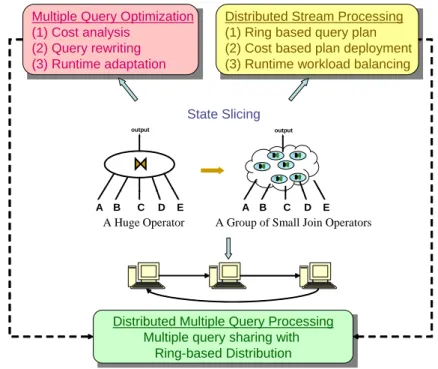
The overall goal of this dissertation is to build a continuous query process-ing system that can effectively scale up to tens of registered queries and large window constraints (¿30 minutes) with high-volume streams (¿300 tuples/second). As depicted in Figure 1.2, the main techniques discussed in this dissertation are multiple query computation sharing and distributed multi-way join query processing. The core concept of our proposed so-lutions is the state slicing method, which enables the split of multi-way
1.2. RESEARCH FOCUS OF THIS DISSERTATION 12
Multiple Query Optimization (1) Cost analysis
(2) Query rewriting (3) Runtime adaptation
Multiple Query Optimization (1) Cost analysis
(2) Query rewriting (3) Runtime adaptation
Distributed Stream Processing (1) Ring based query plan (2) Cost based plan deployment (3) Runtime workload balancing Distributed Stream Processing (1) Ring based query plan (2) Cost based plan deployment (3) Runtime workload balancing
Distributed Multiple Query Processing Multiple query sharing with
Ring-based Distribution
Distributed Multiple Query Processing Multiple query sharing with
Ring-based Distribution
A B C D E
A Huge Operator
output
A Group of Small Join Operators
A B C D E
output
State Slicing
Figure 1.2: Overall Research Focus.
join operators at the optimizer’s will. As discussed in Section 1.1.3, macro stream operators may be inefficient for dynamic stream processing. Intu-itively if the stream query optimizer can split macro-operators into smaller micro-operators according to an optimization goal, the resulting query plan tends to be more suitable for fine grained query processing. Additionally, operator splitting may bring more optimization opportunities to the stream query. The state slicing method can transform a huge multi-way join op-erator into a group of small join opop-erators inter-connected, which each im-poses its own challeges with much smaller and thus more manageable CPU and memory requirements.
1.2. RESEARCH FOCUS OF THIS DISSERTATION 13
the state slicing method to solve the multiple query optimization problem. State slicing is applied to achieve fine grained sharing of state memory and join computation among multiple stream queries that join the same streams with arbitrary window constraints. As a result, after cost-based query rewriting with state slicing, multiple stream queries can achieve maximum computation sharing with minimal extra cost.
TheDistributed Stream Processingprovides a novel paradigm for pipelined join processing with partitioning of the states into manageable slices to be distributed across multiple processing nodes in a shared-nothing cluster environment. This technique generates a ring shape state sliced join query plan based on a cost model. We then deploy the query plan in a cluster, with one state sliced join assigned to a processing node.
Both the above two solutions support runtime query plan optimization in terms of further slicing of the sliced joins or merging connected sliced joins. For the distributed state slicing processing, it also includes state relo-cation with additional or reduced processing nodes at runtime.
Lastly theDistributed Multiple Query Processing combines the multiple query optimization and distributed query processing techniques to pro-vide an integrated solution for scalable stream query processing of a set of queries.
1.2.1 Multiple Continuous Query Optimization
In the first part of this dissertation, we focus on the problem of sharing of window join operators across multiple continuous queries. The win-dow constraints may vary according to the semantics of each query. The
1.2. RESEARCH FOCUS OF THIS DISSERTATION 14
sharing solutions employed in existing streaming systems, such as Nia-garaCQ [CDN02], CACQ [MSHR02] and PSoup [CF02], focus on exploiting common sub-expressions in queries, that is, they closely follow the tradi-tional multi-query optimization strategies from relatradi-tional technology [Sel88, RSSB00]. Their shared processing of joins ignores window constraints. That is, their approaches will treat joins with distinct window sizes as dif-ferent joins and not share them.
New Challenges in Multiple Stream Query Optimization
The problem of sharing the work between multiple queries is not new. For traditional relational databases, multiple-query optimization [Sel88] seeks to exhaustively find an optimal shared query plan. Recent work, such as [RSSB00, MRSR01], provides heuristics for reducing the search space for the optimally shared query plan for a set of SQL queries. These works dif-fer from this dissertation work in that we focus on the computation sharing for window-based continuous queries. The traditional SQL queries do not have window semantics.
Continuous query based applications involving hundreds of, or even thousands of, concurrent queries over high volume data streams are emerg-ing in a large variety of scientific and engineeremerg-ing domains. Examples of such applications include environmental monitoring systems [AAB+05b]
that allow multiple continuous queries over sensor data streams, with each query issued for independent monitoring purposes. Another example is the publish-subscribe service [BBDW05, Pc05] that hosts a large number of subscriptions monitoring published information from data sources. The
1.2. RESEARCH FOCUS OF THIS DISSERTATION 15
number of input data streams is usually much smaller than the number of continuous queries issued on them. Thus commonly many continuous queries are similar in flavor against the same input streams.
Processing each such compute-intensive query separately is inefficient and certainly not scalable to the huge number of queries encountered in these applications. One promising approach in the database literature to support large numbers of queries iscomputation sharing. Efficient sharing of computations among multiple continuous queries is equally paramount.
Many previous works [CCC+02, MSHR02, CDN02, HFAE03] have
high-lighted the importance of computation sharing in continuous queries. The previous work in the early stage, e.g. [CCC+02], has focused primarily on sharing of filters with overlapping predicates, which are stateless and have simple semantics.
However in practice, stateful operators such as joins and aggregations tend to dominate the usage of critical resources such as memory and CPU in a DSMS. These stateful operators tend to be bounded using window con-straints on the otherwise infinite input streams. Efficient sharing of these stateful operators with possibly different window constraints thus becomes critical, offering the promise of major reductions in resource consumption. Compared to traditional multi-query optimization, one new challenge in the sharing of stateful operators comes from the preference of in-memory processing of stream queries. Frequent access to hard disk will be too slow when arrival rates are high. Any sharing blind to the window constraints might keep tuples unnecessarily long in the system. A carefully designed sharing paradigm beyond traditional sharing of common sub-expressions
1.2. RESEARCH FOCUS OF THIS DISSERTATION 16
is thus needed.
Recent works [AW04, ZKOS05] have focused on sharing computations of stateful aggregations. The work in [AW04], addressing operator-level sharing of multiple aggregations, has considered the effect of different slid-ing windows constraints. The work in [ZKOS05] discusses shared compu-tation among aggregations with fine-grainedphantoms, which is the small-est unit for sharing the aggregations. However, efficient sharing of window-based join operators has thus far been ignored in the literature until our work [WRGB06].
The Proposed Approach
In order to efficiently share computations of window-based join operators, we propose a new paradigm for sharing join queries with different window constraints and filters. The two key ideas of the approach arestate-slicing
andpipelining.
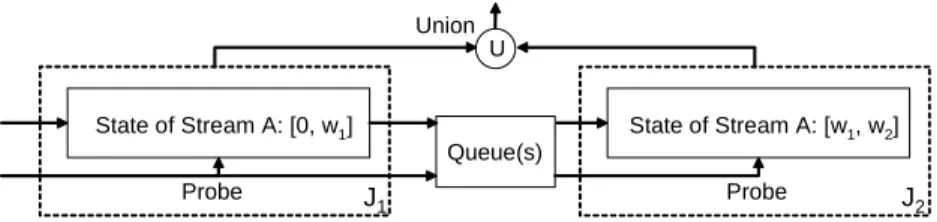
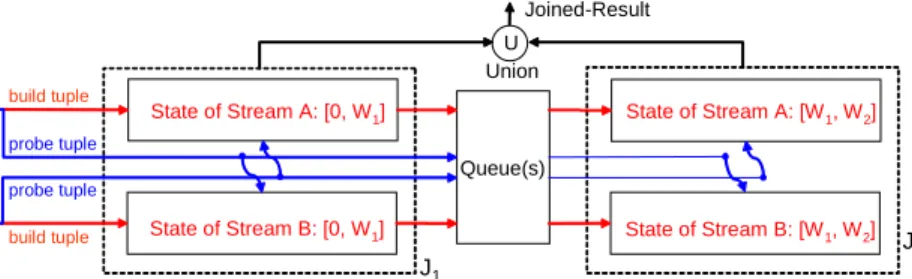
The window states of the shared join operator are sliced into fine-grained pieces based on the window constraints of individual queries. Multiple sliced window join operators, with each joining a distinct pair of sliced window states, can be formed into a chain. Selections now can be pushed down between the appropriate sliced window joins to avoid unnecessary computation and memory usage shown above.
Based on the state-slice sharing paradigm, two algorithms are proposed for the chain buildup, one that minimizes the memory consumption and the other that minimizes the CPU usage. The algorithms are guaranteed to always find the optimal chain with respect to their targeted resource of
1.2. RESEARCH FOCUS OF THIS DISSERTATION 17
either minimizing memory or CPU costs, for a given query workload and statistic estimations. Chains in the “middle” can also be built consider-ing tradeoffs between the system memory consumption and CPU usage. The experimental results show that our strategy achieves respected opti-mization goals for memory or CPU costs over a diverse range of workload settings among alternate solutions in the literature.
Dissertation Contributions to Multiple Stream Query Sharing
• We categorize the existing sharing strategies in the literature, high-lighting their memory and CPU consumptions.
• We introduce the concept of a chain of pipelining sliced window join operators, and prove its equivalence to the regular window-based join.
• The memory and CPU costs of the chain of sliced window join oper-ators are evaluated and analytically compared with the existing solu-tions.
• Based on the insights gained from this analysis, we propose two al-gorithms to build the chain that minimizes the CPU or the memory cost of the shared query plan, respectively. We prove the optimality of both algorithms.
• We provide methods for the online adaptation of the shared slice join plan. Such optimization can be done dynamically at run time. Ac-cording to run time statistics, adjacent state sliced join operators can
1.2. RESEARCH FOCUS OF THIS DISSERTATION 18
be merged by combining the corresponding states and adding neces-sary routing operators. The online splitting of operator is also sup-ported by further splitting the states.
• The proposed techniques are implemented in an actual DSMS (CAPE). Results of performance comparison of our proposed techniques with state-of-the-art sharing strategies are reported. Our solution has been shown to be more efficient than other sharing strategies for various workloads of stream queries.
1.2.2 Distributed Multi-way Stream Join Query Optimization New Challenges in Distributed Multi-way Join Processing
Stream applications such as scientific sensor network infrastructures re-quire filtering, aggregation and correlation of high-volume stream data. The data streams can include text data, multimedia data and other complex objects such as network packets and sensor data. Multi-way window-based Join operations (MJ) are commonly used to explore the correlation among multiple such stream tuples in scientific and engineering domains [AAB+05b,
RRWM07, JAA+06, KDY+06]. For example, environmental monitoring
sys-tems use sensor networks that analyze data streams with possibly complex pattern matching methodologies [AAB+05b, RRWM07]. Network
monitor-ing systems use deep packet inspection queries to evaluate network traffic flows with content-based analysis methods [KDY+06]. The multi-way joins
in such applications tend to have complex join conditions on high volume input stream data.
1.2. RESEARCH FOCUS OF THIS DISSERTATION 19
Stream applications can be time critical, which causes additional chal-lenges for the processing of stream joins among multiple high-speed streams. Stateful operators such as MJs tend to dominate the critical resources such as memory and CPU in a DSMS. When facing high-volume input streams, the in-memory processing may at times be beyond the capacity of a sin-gle machine [GYW07]. The resource pressure includes not only CPU pro-cessing power, but also memory used for the stateful MJ operations, given that processing tends to be main memory resident to ensure timely re-sponse. To scale such memory- and CPU-intensive applications without violating result accuracy nor real-time response requirements, resorting to a shared-nothing cluster has been recognized as one of the most practical solutions [ABcea05].
The basic distribution techniques used in the relational database sys-tems can be classified aspipelined parallelismandpartitioned parallelism[Kun00]. By streaming the output of one operator into the next operator, the two op-erators can work in series, termed pipelined parallelism. By partitioning the input data among multiple processors, an operator can often be instan-tiated as many independent instances each working on a part of the data, termed partitioned parallelism.
Distributed continuous query processing has been considered in recent years, such as distributed Eddies [TD03], Borealis [Ac04, ABcea05], System S [JAA+06] and D-CAPE [LZJ+05]. Correspondingly two distribution
tech-niques are usually supported: operator distribution and data distribution. Using operator distribution, disjoint sub-plans of the query plan are exe-cuted on different machines with the intermediate results being routed
be-1.2. RESEARCH FOCUS OF THIS DISSERTATION 20
tween the machines. Data distribution instead installs instances of the same operator into multiple machines, each then processing a different partitions of the input data on its respective machine. Both methods are orthogonal and can in fact be combined.
However direct application of these distribution methods is not always guaranteed to be effective for distributing MJs with arbitrary join condi-tions. 1) For pipelined parallelism, the macro MJ operator must fit into one single machine — which is not always feasible when large window constraints and high volume input streams are encountered. Though we could translate an MJ operator into a join tree composed of a sequence of smaller binary join operators, such method would lose the flexibility of join orderings shown to be extremely useful for MJ processing in dynamic en-vironments [VNB03]. Moreover such join tree distribution will scale to at mostk−1 machines for a k-way MJ operator, while the number of ma-chines available may be much larger thank. 2) On the other hand, par-titioned parallelism only supports equi-joins, since it requires some hash function for disjoint partitioning of tuples. For non-equi-joins, value-based data partitioning cannot be applied without potentially huge data dupli-cation, as shown in [GYW07]. Data duplication may abuse memory and cause increased data shipping and processing costs. Moreover, data parti-tioning [SHea03] assumes that every partition is small enough to be pro-cessed by one single machine. This assumption may not always be valid or could rapidly be violated at run-time, especially when processing skewed data.
process-1.2. RESEARCH FOCUS OF THIS DISSERTATION 21
ing of generic MJs with arbitrary join predicates, especially of MJs with large window constraints. Generic stream joins occur in many practical sit-uations, from simple range (or band) join queries to complicated scientific queries with equation-based predicates [AAB+05b, RRWM07]. Such join
operators tend to be complex and CPU intensive. Our goal is to minimize the query response time to meet the real-time response requirement of the stream applications.
Applying a data-replication based distribution approach [GYW07] for window-based MJ operators with generic join predicates can be inefficient, because: 1) the state memory used for the MJ operators dominates the memory consumption, and thus data replication would further exacerbate the memory shortage; 2) An extra cost for state management with data replication arises, including cost for duplication elimination. Such cost can be rather significant for large window constraints and high volume data streams.
The Proposed Approach
A novel MJ operator distribution scheme called Pipelined State Partition-ing (PSP) is proposed in this dissertation. The PSP scheme is a new form of pipelined parallelism. Our solution is based on the state-slicing concept introduced for query sharing in Chapter 5. We propose a novel solution to split a macro MJ operator into a series of smaller state-sliced MJ operators. Different from value-based partitioning, the PSP scheme is join predicate agnostic and thus general. It slices the states into disjoint slices in the time domain, and then distributes these fine-grained state slices among
process-1.2. RESEARCH FOCUS OF THIS DISSERTATION 22
ing nodes in the cluster. Different from traditional plan-based pipelined parallelism, whose degree of parallelism is bounded by the longest se-quence of operators in the query plan, PSP instead can split the MJ to any number of state-sliced MJ operators at the optimizer’s will to achieve max-imum parallelism.
Beyond this basic PSP scheme, we design two extensions. One, PSP-I (with PSP-I for PSP-Interleaving) introduces a delayed purging technique for the states to enable interleaved processing of multiple stream tuples with asyn-chronous processor coordination. Such interleaved processing is used to avoid idle processors which exist in the synchronized basic PSP scheme. Two, beyond interleaved processing, PSP-D (with D for Dynamic) further incorporates a dynamic state ring structure to avoid repeated maintenance cost of sliced states, which comes from the standard tuple insertion and state purging routines.
A cost model is developed to achieve the optimal state slicing and allo-cation, in terms of query response latency. The tradeoff between employing more processing nodes and having more transmission hops is considered. Runtime adaptive state relocation are also employed for achieving load bal-ancing and re-optimization in a fluctuating environment by smoothing the sliced state size and adding/removing processing nodes dynamically.
Compared to existing work on distributed generic MJ processing in [GYW07], the PSP scheme has the following benefits: 1) no state duplication and thus no repeated computations during PSP distribution; 2) applicable for any window constraints; 3) arbitrary number of sliced operators at the opti-mizer’s will to achieve optimality with given statistics; and 4) controllable
1.2. RESEARCH FOCUS OF THIS DISSERTATION 23
adaptive state partitioning and allocation in the time domain.
To illustrate the benefits of our PSP scheme, we have implemented the proposed PSP scheme within theD-CAPEDSMS. Since the operator distri-bution has been supported in D-CAPE, we reuse this part of D-CAPE to dis-tribute the generated state sliced joins among multiple processing nodes. A series of experimental studies are conducted to illustrate the performance of the PSP scheme (in term of response time and state memory usage) un-der various workloads. Comparisons with other distributed generic MJ processing approaches in [GYW07] are also discussed. The experimental results show that our strategy provides significant performance improve-ments under diverse workload settings.
Dissertation Contributions to Distributed Stream Query Processing
• We introduce the novel ring architecture of sliced window join oper-ators, and prove its equivalence to the regular window-based join.
• We extend the based PSP model with two key features: interleaved tuple processing and dynamic ring structure to improve the response time.
• The memory and CPU costs of PSP ring are analytically evaluated based on a cost model.
• Based on insights gained from this analysis, a cost-based optimizer is proposed that achieves optimal state slicing in terms of maximum output rate and minimal query response latency. The optimality is proved.
1.2. RESEARCH FOCUS OF THIS DISSERTATION 24
• The runtime state migration algorithms in terms of slice allocation and relocation is described.
• The proposed techniques are implemented in the D-CAPE DSMS.
Performance of the PSP scheme under various workloads, in term of response time and state memory usage is reported. The effect of runtime adaptation is also illustrated in the experimental study.
• Results of performance comparison of our proposed PSP scheme with state-of-the-art distributed generic MJ processing approached in [GYW07] are also conducted.
1.2.3 Distributed Multiple Query Processing Challenges in Distributed Multiple Query Sharing
In the first two parts of the dissertation, we discussed the state slicing based binary stream join query sharing and distributed multi-way join query pro-cessing. In the third part of dissertation work, we will integrate these two solutions to tackle the problem of multiple query optimization in a dis-tributed system. The common state slicing concept behind these two parts makes the seamless integration possible. Based on the approaches pro-posed in the first two parts of dissertation work, we need to solve following issues.
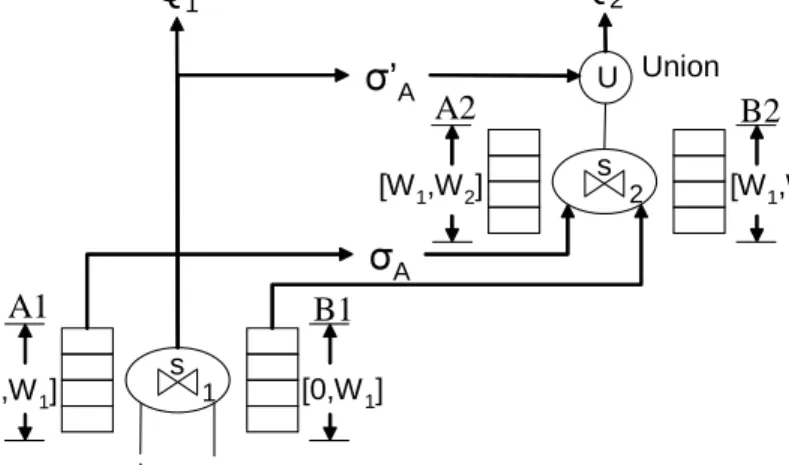
• Extend the selection pushdown algorithm to multi-way state sliced join ring.
1.2. RESEARCH FOCUS OF THIS DISSERTATION 25
• Fast routing strategy is needed to send the joined results to the cor-responding users. Each state sliced join operator can generate joined result for different queries. A fast routing method is necessary to dis-patch the joined result to serve multiple queries.
• Deploy the state sliced join ring with selections in a cluster of process-ing nodes with consideration of workload balancprocess-ing.
The Proposed Approach
We propose a two phase query plan generation to share the computation of multi-way stream joins in a cluster. In the first phase, the selections are pushed into the ring and the state sliced joins based on the selection pred-icates are formed. In the second phase, the ring of query plan is deployed in the processing nodes with consideration of balanced workload in each node. To achieve balanced workload, the state sliced joins generated in the first phase may be further sliced. Also one processing node may host mul-tiple state sliced joins together with the selections between them. A cost based deployment is used to achieve the balanced workload.
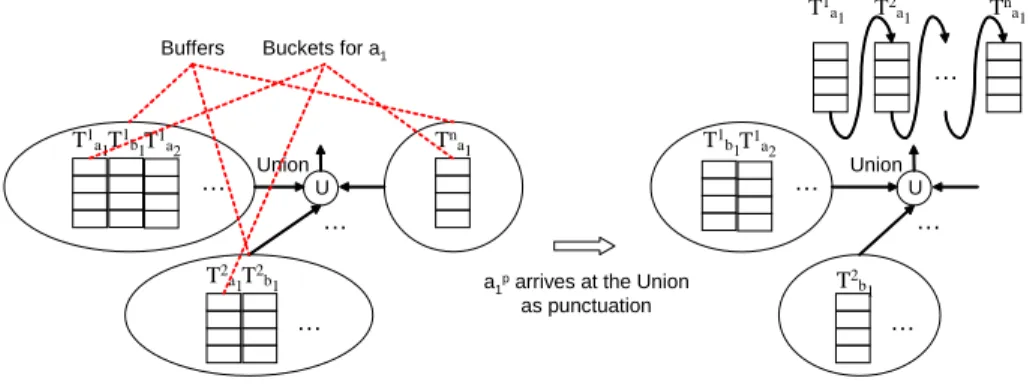
To achieve fast routing of the joined result, we propose a bitmap based routing strategy. Since the number of distinct sub-joins between sliced states may be huge for multi-way join sharing, we use one routing oper-ator to dispatch all the joined results instead of using one routing operoper-ator for the joined results from each sub-joins. Based on the bitmap in the joined result, it can be routed to the corresponding query user.
1.2. RESEARCH FOCUS OF THIS DISSERTATION 26
1.2.4 Overview of the CAPE/D-CAPE System
The techniques in this dissertation have been implemented in a prototype continuous query system namedCAPE/D-CAPE[RDS+04, LZJ+05]
devel-oped at WPI as a team effort to serve as the testbed for our research of continuous query processing. D-CAPE stands forDistributedContinuous
AdaptiveProcessingEngine). The D-CAPE system is a prototype stream-ing database system designed to effectively evaluate continuous queries in highly dynamic stream environments. The system has been demonstrated in VLDB 2004 conference [RDS+04] and VLDB 2005 conference [LZJ+05].
D-CAPE adopts a novel architecture that enables adaptive services at all levels of query processing, including reactive operator execution [RDS+04],
adaptive operator scheduling [SZDR05], runtime query plan re-optimization [ZRH04] and across-machine plan redistribution [ZR07].
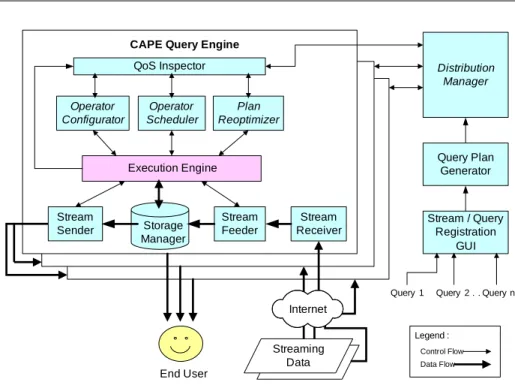
The D-CAPE system architecture is depicted in Figure 1.3. The sys-tem can be degraded to run on a single machine as well as across multi-ple machines. Each machine (processor) can run an instance of the CAPE query engine. If the system is run on multiple machines, a distributed manager overlooks these multiple CAPE query engines and makes system-wide adaptation decisions according to runtime statistics collected by the QoS Inspector. The key adaptive components in D-CAPE are Operator Configurator, Operator Scheduler, Plan Reoptimizer and Distribution Man-ager. Once the Execution Engine starts executing the query plan, the QoS Inspector component, which serves as the statistics monitor, will regularly collect statistics from the Execution Engine at each sampling point. This
1.2. RESEARCH FOCUS OF THIS DISSERTATION 27 Operator Configurator Operator Scheduler Plan Reoptimizer
CAPE Query Engine QoS Inspector Execution Engine Storage Manager Stream Sender Stream Feeder Stream Receiver Internet Control Flow Data Flow Legend : Distribution Manager Query Plan Generator Stream / Query Registration GUI Query 2 . . Query n Query 1 Streaming Data End User
Figure 1.3: D-CAPE System Architecture.
run time statistics gathering component is critical to continuous query pro-cessing, as any adaptation technique relies on the statistics gathered at run time to make informed decisions.
The components in the D-CAPE architecture that are directly related to this dissertation are Plan Generator, Plan Reoptimizer and Distribution Manager, which are in charge of the static query plan generation for multi-ple query optimization and ring based distribution, adaptive re-optimization of the state sliced query plans, and state relocation in the distributed sys-tem, respectively.
1.3. DISSERTATION ROAD MAP 28
1.3 Dissertation Road Map
The rest of this dissertation is organized as follows: The research topics are discussed in detail in Part I, Part II and Part III in this dissertation respec-tively. The discussions of each of the three research topics include the rele-vant motivation, problem introduction, background, solution description, experimental evaluation and discussions of related work. Finally Part IV concludes this dissertation and discusses possible future work.
29
Part I
State-Slice Multi-query
Optimization of Stream
30
Chapter 2
Introduction
2.1 Research Motivation
Modern stream applications such as sensor monitoring systems and pub-lish/subscription services necessitate the handling of large numbers of con-tinuous queries specified over high volume data streams. Examples of such applications include environmental monitoring systems [AAB+05b]
that allow multiple continuous queries over sensor data streams, with each query issued for independent monitoring purposes. Another example is the publish-subscribe services [BBDW05, Pc05] that host a large number of subscriptions monitoring published information from data sources. Such systems often process a variety of continuous queries that are similar in flavor on the same input streams.
Efficient sharing of computations among multiple continuous queries, especially for the memory- and CPU-intensive window-based operations, is critical. Many papers [CCC+02, MSHR02, CDN02, HFAE03] have
high-2.1. RESEARCH MOTIVATION 31
lighted the importance of computation sharing in continuous queries. In practice, stateful operators such as joins and aggregations tend to domi-nate the usage of critical resources such as memory and CPU in a DSMS. These stateful operators tend to be bounded using window constraints on the otherwise infinite input streams. A novel challenge in this scenario is to allow resource sharing among similar queries, even if they employ win-dows of different lengths.
The intuitive sharing method for joins [HFAE03] with different window sizes employs the join having the largest window among all given joins, and a routing operator which dispatches the joined result to each output. Such method suffers from significant shortcomings as shown using the mo-tivation example below. The reason is two folds, (1) the per-tuple cost of routing results among multiple queries can be significant; and (2) the selec-tion pull-up (see [CDN02] for detailed discussions of selecselec-tion pull-up and push-down) for matching query plans may waste large amounts of mem-ory and CPU resources.
Motivation Example: Consider the following two continuous queries in a sensor network expressed using CQL [AAB+05b], an SQL-like language
with window extension.
Q1: SELECT A.* FROM Temperature A, Humidity B WHERE A.LocationId=B.LocationId
WINDOW 1 min
Q2: SELECT A.* FROM Temperature A, Humidity B WHERE A.LocationId=B.LocationId AND
2.1. RESEARCH MOTIVATION 32
A.Value>Threshold WINDOW 60 min
Q1 andQ2 join the data streams coming from temperature and humidity sensors by their respective locations. The WINDOW clause indicates the size of the sliding windows of each query. The join operators inQ1andQ2
are identical except for the filter condition and window constraints. The naive shared query plan will join the two streams first with the larger win-dow constraint (60 min). The routing operator then splits the joined results and dispatches them to Q1 and Q2 respectively according to the tuples’
timestamps and the filter. The routing step of the joined tuples may take a significant chunk of CPU time if the fanout of the routing operator is much greater than one. If the join selectivity is high, the situation may further escalate since such cost is a per-tuple cost on every joined result tuple. Fur-ther, the state of the shared join operator requires a huge amount of mem-ory to hold the tuples in the larger window without any early filtering of the input tuples. Suppose the selectivity of the filter inQ2 is 1%, a simple
calculation reveals that the naive shared plan requires a state size that is 60 times larger than the state used byQ1, or 100 times larger than the state
used byQ2 each by themselves. In the case of high volume data stream
inputs, such wasteful memory consumption is unaffordable and renders inefficient computation sharing.
The problem of multiple continuous query optimization with window constraints contains two sub-problems:
2.2. PROPOSED STRATEGIES 33
join query plans into equivalent plans with identical join signatures, including predicates and window constraints.
• Second, we need cost based optimization algorithms to determine how to optimize the overall shared query plan, considering other op-erators such as selection.
2.2 Proposed Strategies
In order to efficiently share computations of window-based join operators, I propose a new paradigm for sharing join queries with different window constraints and filters. The two key ideas of my approach are:state-slicing
andpipelining.
We slice the window states of the shared join operator into fine-grained pieces based on the window constraints of individual queries. Multiple sliced window join operators, with each joining a distinct pair of sliced window states, can be formed. Selections now can be pushed down be-low any of the sliced window joins to avoid unnecessary computation and memory usage shown above.
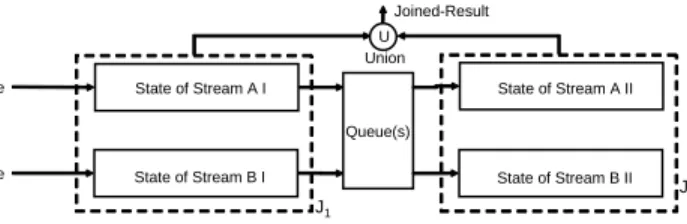
State slicing is not trivial. Let’s consider a brute force state slicing as follows. Figure 2.1 shows a possible state slicing solution for stateful join operators with window constraints. The original join operator now can be split to connectedJ1 andJ2 withJ2 as the down stream operator. J2 will
accept the up stream tuples fromJ1. Assume that the queues between J1
andJ2are empty, then at any time, the snapshot of the combined state
2.2. PROPOSED STRATEGIES 34
sliced states are disjoint forJ1andJ2. Such state slicing is very
straightfor-ward and seems achieving our goals for operator splitting. However such naive state slicing can not produce the same result as the original join op-erator. Apparently, the possible results coming from crossing probings of bothJ1andJ2are lost. Eventually an incomplete joined result is generated.
State of Stream A I State of Stream B I Queue(s) A Tuple B Tuple J1 J2 U Union Joined-Result State of Stream B II State of Stream A II
Figure 2.1: A Brute Force State Slicing with Incomplete Result
It seems that N2 joins appear to be needed to provide a complete
an-swer if each of the window states were to be sliced intoN pieces and each join works on one combination of sliced states. The number of distinct join operators needed would then be too large for a DSMS to hold for a largeN. We overcome this hurdle by elegantly pipelining the slices. This enables us to build a chain of onlyN sliced window joins to compute the complete join result. This also enables us to selectively share a subsequence of such a chain of sliced window join operators among queries with different win-dow constraints.
Based on the state-slice sharing paradigm, two algorithms are proposed for the chain buildup, one that minimizes the memory consumption and the other that minimizes the CPU usage. The algorithms are guaranteed to always find the optimal chain with respect to either memory or CPU cost, for a given query workload.
2.2. PROPOSED STRATEGIES 35
Those two algorithms are based on the cost model developed for the state slicing paradigm. The cost model can be used to estimate the CPU and memory usage of the shared query plans. After comparing with alter-natives, the optimal state slicing query plan can be achieved.
This part of the dissertation work contributes to research in continuous multiple query optimization in the following ways:
• First, I review the existing sharing strategies in the literature with consideration of the new window constraints. By comparing their memory and CPU consumptions, their drawbacks are illustrated and motivate my research.
• Second, I propose a novel paradigm for splitting large window join operators with window constraints. By introduce the state slicing concept, the CPU and memory consumptions can be split accord-ingly into small pieces. I also prove its equivalence to the semantics of regular stream window join operator. To the best of my knowledge, this work is the first in multiple continuous query optimization to 1) consider both predicates and window constraints, 2) utilize chain of pipelining sliced window join operators to rewrite join query plan.
• Third, I develop a set of cost models to analytically compare the mem-ory and CPU costs of the chain of sliced window join operators with other existing solutions.
• Fourth, based on the insights gained from the cost base analysis, I propose two algorithms to build the chain that minimizes the CPU or
2.3. ROAD MAP 36
the memory cost of the shared query plan, respectively. I prove the optimality of both algorithms.
• Methods for the online adaptation of the shared slice join plan are provided and discussed. Such optimization can be done dynamically at running time.
• The proposed techniques are implemented in an actual DSMS (CAPE). A thorough experimental evaluation is conducted. Results of per-formance comparison of our proposed techniques with state-of-the-art sharing strategies are reported. I compare the CPU and memory consumptions of different sharing strategies with various workload queries. The experimental results show that the proposed solutions are the best among them.
2.3 Road Map
The rest of the part I is organized as follows. Chapter 3 presents the back-ground and preliminaries used in this paper. Chapter 4 shows the mo-tivation example with detailed analytical performance comparisons of al-ternative sharing strategies of window-based joins. Chapter 5 describes the proposed chain of sliced window join operators. Chapter 6 provides a detailed case study on stream query join trees applying the state slicing concept. Chapter 7 presents the algorithms to build the chain. Chapter 8 presents the experimental results. Chapter 9 contains related work.
37
Chapter 3
Background
3.1 Stateful Operators in Continuous Queries
Continuous queries generally require real time responses. Query results need to be sent to the downstream user in a pipelined manner. This re-quires that all operators in the query plans need to be operated in a un-blocked fashion: the operator needs to be able to generate results based on the data that it has received so far. This promotes the usage of stateful op-erators. Astatefuloperator, such as join or group-by, must store all tuples that have been processed and relate to future processing. Operator stateis some data structure inside stateful operators, such as joins and group-bys, that stores tuples received so far for future processing. An operator may output partial results based on the already received tuples. To make block-ing operators, such as joins or group-bys, become non-blockblock-ing, we can store tuples received so far in thisstatedata structure. For a long-running query as in the case of continuous queries, the number of tuples stored