AMNet: Memorability Estimation with Attention
Jiri Fajtl
1, Vasileios Argyriou
1, Dorothy Monekosso
2, Paolo Remagnino
1 1Kingston University, London, UK
2
Leeds Beckett University, Leeds, UK
Abstract
In this paper we present the design and evaluation of an end-to-end trainable, deep neural network with a visual at-tention mechanism for memorability estimation in still im-ages. We analyze the suitability of transfer learning of deep models from image classification to the memorability task. Further on we study the impact of the attention mechanism on the memorability estimation and evaluate our network on the SUN Memorability and the LaMem datasets. Our network outperforms the existing state of the art models on both datasets in terms of the Spearman’s rank correlation as well as the mean squared error, closely matching human consistency.
1. Introduction
The ability of man cognition to recall as well as forget visual content after viewing it is very important to the way we acquire new information and interact with our environ-ment. This is becoming increasingly significant as creating and consuming visual content dominates other forms of in-formation exchange. Moreover, low cost, automated image and video capture systems are rapidly surfacing as the norm in the Internet of the Things (IoT) domain, also contributing to the visual information flow.
To which degree an image is later remembered or forgot-ten is expressed as image memorability. It is an important cognitive measure to be taken into account while processing visual content, whether for human to human or machine to human communication or for storage.
Memorability estimation has a large variety of practical applications, such as selecting or designing highly memo-rable advertising material, organizing and tagging of pho-tos in albums, introducing a real-time, image memorabil-ity measure built into consumer digital cameras, helping to make highly memorable presentations and data visualiza-tions, improving memorability of specific parts of a graph-ical user interface (GUI) or helping to illustrate education material. An application of a great interest is to measure a decline in memory capacity of patients affected by
de-LSTM Attention LSTM Attention LSTM Attention h0 h1 h2 ∑ Memorability score 0 1 ResNet 50 [14x14x1024] hinit
Figure 1: AMNet iteratively generates attention maps
linked to the image regions correlated with the memorabil-ity. After three iterations the memorability scores are added and presented on the output.
mentia (such as Alzheimer’s and Parkinson’s diseases) and forms of mild cognitive impairment (MCI).
Prior research [13] has shown that image memorability has a stable property, that is, individuals tend to remem-ber the same images with the same probability regardless of delays, and that it can be quantified and measured. This research has led to first attempts to learn and predict memo-rability with machine learning freameworks, initially with low-level, global image features [12], reaching moderate success. To improve such a solution would, however, re-quire the design of new features, which demands a strong domain knowledge not well understood in the specific case of memorability.
In [37], [2] and recently [14] has been shown that this problem can be mitigated by applying deep learning tech-niques to the memorability domain. Deep learning, how-ever, requires large training dataset which was not available until A. Khosla et al. [18] introduced a large memorability dataset LaMem with 60K images and subsequently used it
to train the MemNet, which is based on the AlexNet [21] initialized on the ImageNet [30] and Places [39] datasets. MemNet achieves Spearman’s rank correlationρ = 0.64 compared with the human consistencyρ = 0.68 as mea-sured by [18].
Intuitively, image regions immediately drawing our at-tention would appear to be linked with highly memorable visual content. Indeed, this assumption was confirmed to be correct in the works of [24], [19] and [13] who already very early indicated a potential relationship between the vi-sual attention and memorability but did not further investi-gate their correlation. To that end, we propose the Attention based Memorability estimation Network-AMNet, a novel, deep neural network architecture with a recurrent, visual at-tention mechanism with the primary goal to improve on the state of the art for the memorability prediction task. We also show advantages of the visualization of the generated atten-tion maps and their connecatten-tion to the memorability prop-erty. Our approach is extensively evaluated on the LaMem [18] and SUN Memorability [13] datasets. The main con-tributions of our work are:
• AMNet as a generic architecture for regression tasks with deep CNN, visual attention mechanism and re-current neural network.
• application of the proposed AMNet to the image mem-orability estimation.
• introduction of the incremental memorability estima-tion with the recurrent network and demonstraestima-tion of the achieved performance gain.
• introduction of the visual attention technique for the memorability estimation and presentation of the per-formance gain.
• demonstration that transfer learning from deep models, trained for image classification, is particularly benefi-cial for the memorability estimation.
The paper is organized as follows: Section 2 provides background material on image memorability, its properties, measurement and prediction. In section 3 we propose the AMNet and discuss the theoretical framework behind this architecture and the training procedure. The performance of AMNet is studied in the section 4, with section 5 concluding this work.
2. Previous Work
In a pioneering work on image memorability, Isola et al. [13], [11] demonstrated that the ability of our cogni-tion system to remember certain images and forget other is congruent among independent observers, despite large vari-ability in the image content, concluding memorvari-ability is a
stable property, intrinsic to images. Based on this premise, Isola et al. [13] investigated factors that give rise to the age memorability effect, which was then used to predict im-age memorability scores with a machine learning program, based on global image features GIST [26], SIFT [22], HOG [5], SSIM [33] and pixel histogram.
In order to build better computational models to learn and predict memorability, researchers analyzed the relation-ship between memorability and various visual factors [19], image classes [12] and saliency [7]. Bylinskii et al. [3] con-ducted a number of experiments to better understand the intrinsic and extrinsic effects on image memorability, con-cluding that the primary substrate of memorability lies in the intrinsic properties of images and all extrinsic effects contribute only marginally.
Deep learning was first applied to the memorability prob-lem by Baveye et al. [2] who proposed a MemoNet model based on GoogLeNet [34] trained on the ImageNet [30] dataset. [37] used CNN features with SVR [6] to predict memorability with accuracy comparable to MemoNet [2].
To achieve higher accuracy with deep learning tech-niques Khosla et al. [18] collected a large memorability dataset LaMem with 60K images and introduced MemNet model based on the Hybrid-CNN, which is the AlexNet [21] CNN pretrained on the ImageNet [30] and the Places [39] datasets (∼3.6 million images in total). Researchers also tried to improve memorability prediction by other tech-niques, such as the adaptive transfer learning from external sources [14] or predicting image memorability by multi-view adaptive regression [27], none exceeding the perfor-mance of the MemNet [18].
Relationship between the visual attention and memora-bility was already suggested by Isola et al. [13] but was not further investigated. Mancas and Le Meur [24] studied the link between saliency and memorability and found that the most memorable images have uniquely localized regions, while less memorable either do not have precise regions of interest or have several of them. Based on these findings, [24] devised new attention-related features that improved the memorability prediction by 2% compared to the non attention based models from [13]. In a similar work, Ce-likkale et al. [4] applied an attention driven spatial pool-ing pipeline based on SIFT [22] and HOG [5] features and bottom-up and object-level saliency detectors. Their results, albeit only moderate, still indicate a benefit of the atten-tion based approach. Importance of the memorability re-gions was explored by Khosla et al. [19] who introduced the concept of attention maps that relate image regions to memorability. These maps are learnt directly as clusters of gradients, textures and color features with the SVM-Rank solver [15] with results showing benefits of the attention on memorability prediction.
learn-ing methods with visual attention and recurrent network to learn and predict image memorability. To our knowledge the presented approach has not been attempted before.
3. Method
The idea behind the AMNet architecture is based on four main components a deep CNN trained on large-scale image classification task, a soft attention network, a Long Short Term Memory (LSTM) [9] recurrent neural network fol-lowed by a fully connected neural network for memorability score regression.
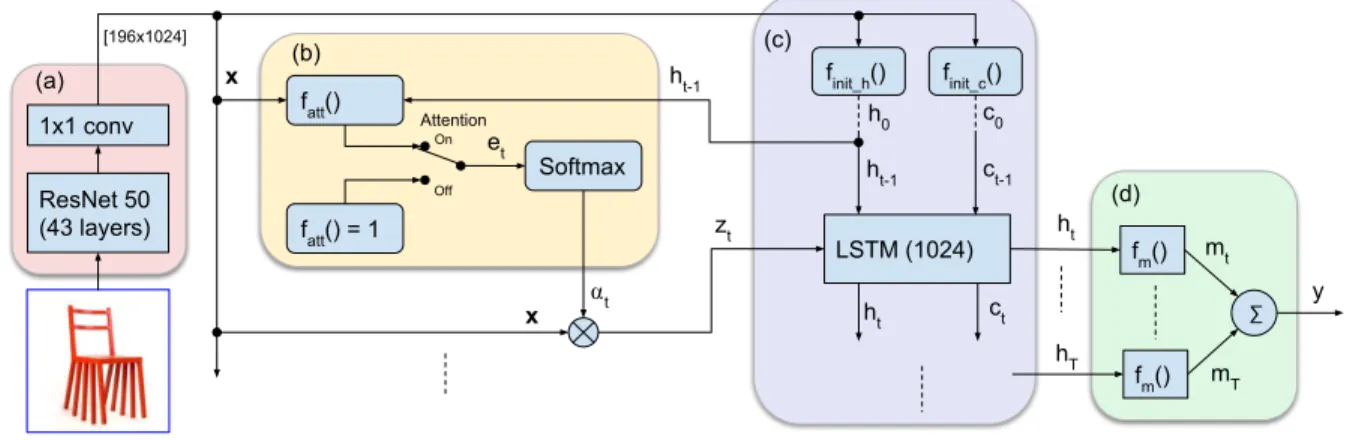
In the following section we introduce the details of the AMNet architecture as shown in Figure 2, starting with the pre-trained CNN(a)for transfer learning. Subsequently we show the working of the visual, soft attention mechanism (b), the LSTM and network for the memorability regression (c)and(d). Finally we outline the training procedure and finish with the data augmentation process.
3.1. Transfer Learning for Memorability
Estima-tion
It is common practice to use a pretrained CNN as a fixed feature extractor or to fine tune it for a similar application [32], mainly to reduce training time and overfitting on tasks with small datasets.
This technique is readily applied to computer vision problems centered around semantic features such as objects detection and segmentation, however little is known about such transfer learning for the image memorability estima-tion since there is no clear understanding of what visual features trigger the effects of remembering and forgetting.
Khosla et al. [18] has already shown the benefits of fine tuning of pretrained CNN for this domain, however we de-cided to evaluate a much deeper model as a fixed feature extractor. Our results show that the features learnt for im-age classification are highly suitable for the memorability task. In our work we use ResNet50 [10] model trained on ImageNet where it achieves the top 1 error 24.7%.
3.2. Soft Attention Mechanism
The ability of a neural network to learn which discrete in-formation elements to focus on within a given training sam-ple was first applied in machine translation by Bahdanau et al. [1]. This mechanism is called soft attention due to the fact that it produces a probability weight for every infor-mation element rather than a hard decision boundary. The benefit of soft attention is that it can be learnt end-to-end
with a gradient based optimization method.
The soft attention mechanism has two components, a network that learns probabilities for each information ele-ment within the input data and a gating function that uses these probabilities to weigh data for further processing.
3.3. AMNet Details
The AMNet estimates the image memorability by taking a single imageXand generating a memorability scorey.
y=f(X), y= [0,1] (1)
The process of memorability estimation is summarized in algorithm 1.
Algorithm 1AMNet algorithm
1: procedureMEMORABILITY(X) . y=f(X) 2: x=get cnn features(X) .ResNet50 fwd pass
3: h0=finitc(x) .Eq. 12 4: c0=finith(x) .Eq. 12 5: lstm init(h0,c0) 6: y= 0 7: fort= 0toT do .att= 0→ht=h0 8: e=fatt(x,ht) .Eq. 8
9: α=sof tmax(e) .Eq. 6
10: z= []
11: fori= 0toLdo .for all locations, Eq. 4
12: z=z+αixi .z∈RD
13: ht,ct=lstm step(z,ht,ct) .Eq. 3
14: y=y+fm(ht) .Eq. 11
15: returny .Memorability score[0,1]
Formally, let the image features, extracted by a CNN,
be a tensor with dimensions (W, H, D)whereW andH
represent the spatial resolution whileDa length of feature vectors, one for each location within the (W, H) region. Specifically, in the case of AMNet the feature tensor has di-mensions14×14×1024. In general there areL=W×H locations, represented as a vectorx:
x={x1, ...,xL} xi∈RD (2)
All vectors are column vectors, unless stated otherwise. The memorability is estimated with LSTM [9] over a three steps long sequenceT = 3. The LSTM is defined as:
ht=φ(ht−1,zt) t= [0, T), h∈RB (3) wherehtis the LSTM state at timetwith sizeB = 1024.
The vector zt represents a new image features produced
at the stept as a result of the application of the attention weightsαton the input image featuresxand is calculated as a simple weighted sum such that
zt= L
X
i=1
αt,ixi zt∈RD (4)
whereαare the attention probabilities conditioned on the entire image feature vector xand previous LSTM hidden stateht−1
[196x1024] h0 ResNet 50 (43 layers) LSTM (1024) fm() Softmax ht-1 ct-1 c0 zt ⍺t ht ct x y 1x1 conv ht mt ht-1 fatt() = 1 Attention mT fm() hT fatt() x ∑ On Off et finit_c() finit_h() (a) (b) (d) (c)
Figure 2: A pretrained RestNet50(a)is followed by the soft attention mechanism(b)with LSTM(c), which over a sequence of three stepsT = 3produces attention maps, each conditioned on the previous LSTM stateht−1 and the entire image
feature vectorx. Memorabilityyis then calculated as a sum of discrete memorability scores in the regression network(d).
The attention probabilities, as well as other functions are parameterised with neural networks. The attention is then represented as a vector of weights produced by a softmax function αt,i= exp(et,i) PL k=1exp(et,k) (6) The attention weights vectoret is a product of the image
feature vectorxand the LSTM hidden stateht−1
et,i =fatt(xi,ht−1) (7)
fatt()is s simple sum of two affine transformations
fol-lowed by logistic function
fatt(xi,ht−1) =Mitanh(Uht−1+Kxi+b) (8)
where ML×D,UD×B,KD×D and bD×1 are network
weights and biases respectively, estimated together with other parameters of the network during optimization.
In order to experiment with the effects of the attention we can conditionally disable it by defining thefatt()as a
constant function with unit output such that:
fatt(xi,ht−1) = 1 (9)
The results it that all feature vectors in x are considered equally, thus disabling the attention mechanism.
At each steptthe network produces one discrete memo-rability scoremtcalculated as:
mt=fm(ht) (10)
The functionfm()maps the LSTM hidden statehtto the
memorability score mt = [0,1]. It is implemented as a
two-layer neural network for regression with a single out-put neuron and linear activation function. Finally, the total
image memorability score y is calculated as a sum of the discrete memorabilitiesmt y= T X t mt (11)
In the first step, the LSTM hiddenh0and memoryc0states
are initialized from the image feature vectorxas follows:
c0=finitc 1 L L X i xi h0=finith 1 L L X i xi (12)
where thefinit()functions are single, fully connected
neu-ral networks withtanh()activation.
3.4. Training Procedure
The AMNet model is trained by minimizing the follow-ing loss function:
L= (ˆy−y)2+λLα (13)
The first term represents a mean squared error between the ground truthyˆand predicted image memorabilityy. In or-der to encourage the attention model to explore all image re-gions over all time steps, we add a second termλLαwhich performs a joint`1-`2penalty as a function of activations of
all attention maps in the LSTM sequenceT, introduced by Xu et al. [36]. The hyper-parameterλspecifies the impact of this penalty. Lsα= L X i s2i (14)
si represents the`1penalty, which enforces sparsity along
strong activation for only one of the attention maps at loca-tioni. si= 1− T X t αt,i (15)
Finally, the`2penalty in the form ofPis
2
i in Eq. 14
fur-ther promotes an even distribution of activations over all locations. The value of the λparameter was experimen-tally determined as 10−4 for which the network achieved
the highest performance.
The entire model if fully differentiable and trained end-to-end with the ADAM [20] optimizer with a fixed learning rate 10−3. The input image feature vector xis extracted
from the43rdlayer of the RestNet50 [10] with dimensions
[14×14×1024]. The ResNet50 is trained for image clas-sification on the ImageNet dataset and its weights are not updated during the AMNet training.
The AMNet network is heavily regularized with dropout and with small`2weights regularization10−6. We found
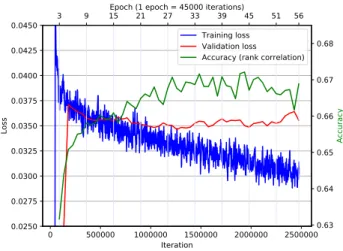
that the dropout was critical to stop the network from over-fitting. The training was carried out in minibatches of 256 images and terminated by early stopping when the ob-served Spearman’s rank correlation on the validation dataset reached its maximum, which was between epoch 30 and 50 depending on the split and the training dataset (LaMem or SUN). Training and validation losses as well as the mem-orability rank correlation on the validation dataset in the LaMem, split 1 is shown in Figure 3.
3.5. Data Preprocessing and Augmentation
Common augmentation techniques are applied to the ages during the training stage to reduce overfitting and im-prove generalization. A crop of random size of (0.08 to 1.0) of the original size and a random aspect ratio of 3/4 to 4/3 of the original aspect ratio is made and then resized to224×224and randomly, horizontally flipped. For the evaluation only a center crop224×224was selected for the input.
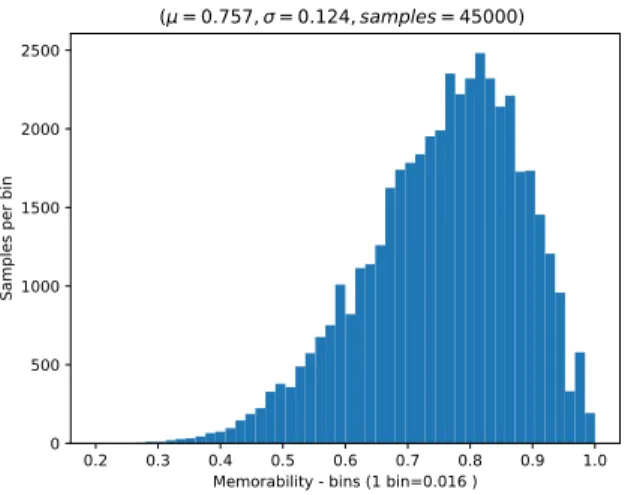
Memorability scores in the LaMem dataset are in the range [0,1] with distribution shown in Figure 4. For the training purpose the memorability scores were zero mean centered and scaled to range[−1,1].
4. Experimental Results
In this sections we evaluate the AMNet on the LaMem [18] and SUN Memorability [13] datasets. First we briefly describe the datasets and used evaluation metrics, and then present our qualitative and quantitative results with the comparison against the state of the art.
4.1. Datasets
Main focus of this research work is on the LaMem [18] dataset due to its large size which makes it suitable for
train-0 500000 1000000 1500000 2000000 2500000 Iteration 0.0250 0.0275 0.0300 0.0325 0.0350 0.0375 0.0400 0.0425 0.0450 Loss
3 9 15Epoch (1 epoch = 45000 iterations)21 27 33 39 45 51 56
0.63 0.64 0.65 0.66 0.67 0.68 Accuracy Training loss Validation loss Accuracy (rank correlation)
Figure 3: Training/validation losses and memorability rank correlation on the validation dataset in the LaMem split1.
ing deep neural networks. The LaMem is the largest anno-tated image memorability dataset to this date with total of 58741 images. The images cover a wide range of indoor and outdoor environments, objects and people and were ob-tained from other labeled datasets such as MIR Flicker, AVA dataset [25], affective images dataset [16], image saliency datasets [23], [29], SUN [35], image popularity dataset [17], Abnormal Objects dataset [31] and a Pascal dataset [8]. The memorability scores were collected manually on the Amazon Mechanical Turk (AMT) by means of a memo-rability game introduced by [13] and improved by [18]. Ap-proximately 80 measurements (memorable=yes/no) were collected per image. There are 5 random splits each with 45000 images for training, 3741 for evaluation and 10000 for testing.
As a second dataset for evaluation we chose the SUN Memorability dataset pioneered by Isola et al. [13]. There are 2222 images in total, originating from the SUN [35] dataset with memorability scores collected similarly to the LaMem. There are 25 random splits with equal number of 1111 images for training and testing.
4.2. Evaluation Metrics
Following the previous work, we report on the perfor-mance in terms of rank correlation, specifically a Spear-man’s rank correlation coefficient [28]ρand mean squared errorMSE.
The Spearman’s rank correlation coefficient measures consistency between the predicted and ground truth rank-ing, within the range [−1,+1] where zero represents no correlation. Higherρ values indicate better memorability prediction method:
0.2 0.3 0.4 0.5 0.6 0.7 0.8 0.9 1.0 Memorability - bins (1 bin=0.016 )
0 500 1000 1500 2000 2500
Samples per bin
( = 0.757, = 0.124, samples = 45000)
Figure 4: Histogram of ground truth memorability scores in the LaMem [18] training dataset split1.
ρs(ˆr, r) = 1−
6PN
i ( ˆri−ri)2
N(N2−1) (16)
whereN is a number of samples, rˆi is a rank of theith
ground truth memorability score, andritheithprediction.
MSEis used as a secondary metric, not always presented in previous work. The Spearman’s rank correlation shows a monotonic relationships between the reference and obser-vations but does not reflect the absolute numerical errors between them, which is then presented byMSEaccording to: MSE(ˆy, y) = 1 N N X i=1 ( ˆyi−yi)2 (17)
whereyˆi is the ground truth memorability score, whileyi
the prediction andNnumber of tested samples.
4.3. Performance Evaluation
In order to obtain results that are fully comparable with the previous work, we used the same training and evaluation protocol as in the [18] for the LaMem dataset and [13] for the SUN memorability dataset.
Evaluation on the LaMem dataset was performed by training one model on each of the five random splits as suggested by the authors [18] and then reporting the final memorability rank correlation andMSE, averaged over the results from five corresponding test datasets.
In Table 1 we show that the AMNet model with the ac-tive attention achievesρ= 0.677, or a 5.8% improvement over the best known method MemNet [18]. Even with-out attention the AMNet with-outperforms prior work by 3.6% which demonstrates that the pretrained, deep CNN with our recurrent and regression network layers still achieve high
Method(LaMem dataset) ρ↑ MSE↓
AMNet 0.677 0.0082
AMNet (no attention) 0.663 0.0085
MemNet [18] 0.64 NA
CNN-MTLES [14]
(different train/test (50/50) split) 0.5025 NA
Table 1: Average Spearman’s rank correlationρandMSE over 5 test splits of the LaMem dataset.
Method(SUN Memorability dataset) ρ↑ MSE↓
Isola [13] 0.462 0.017
Mancas & Le Meur [24] 0.479 NA
AMNet 0.649 0.011
AMNet (no attention) 0.62 0.012
MemNet [18] 0.63 NA
MemoNet 30k [2] 0.636 0.012
Hybrid-CNN+SVR [37] 0.6202 0.013
Table 2: Evaluation on the SUN Memorability dataset. All models were trained and tested on the 25 train/val splits.
accuracy. The comparatively low performance of the CNN-MTLES [14] method can be attributed to the fact that this model uses various, specifically engineered visual features and features extracted from CNN networks trained on Im-ageNet [30] and Places [39]. Thus it does not leverage the end-to-end deep learning. The CNN-MTLES, however, uses the LaMem dataset, which indicates that even a large dataset does not significantly improve the performance of models based on engineered visual features.
To train the deep AMNet model on the rather small SUN dataset we had to increase regularization to avoid overfit-ting. We found that in this specific case`2= 10−4weights
regularization performed better than a stronger dropout or
the combination of both. Table 2 shows that the
AM-Net with attention performs 2% better than the current best model. By disabling the attention the performance declined toρ= 0.62, demonstrating the advantages of visual atten-tion for this task.
We found that during training MSE on the validation
datasets follows a similar trend with the rank correlation ρ, however theρpeaks after the model starts overfitting as seen in Figure 3. It is conceivable to assume that the slightly higher variance at the maximumρimproves generalization in terms of the predicted and ground truth monotonic rela-tionships, even thoughMSEstarts increasing. For example, during the training on the LaMem split 1, as seen in Figure 3, we attained maximumρ= 0.6721andMSE = 0.00848 whileρ= 0.6676for minimumMSE = 0.00844.
Tables 1 and 2 show that the AMNet exhibits the best performance in terms of the Spearman’s rank correlation as
well as MSEon both, the LaMem and the SUN datasets.
The best performance attains ρ = 0.677 on the LaMem
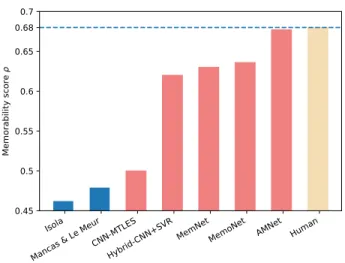
dataset, approaching99.6%of the human performanceρ= 0.68as measured by Khosla et al. [18]. Comparison against the state of the art can be seeing in Figure 7.
4.4. The Role of Attention on Memorability
The significant performance gain is achieved by the fact that the neural network learns to focus its attention to spe-cific regions most relevant to memorability. The improve-ment is close to 2% on the LaMem and almost 5% on the SUN dataset. AMNet learns to explore the image content by producing three visual attention maps, each conditioned on the image content obtained by exploiting the previous map. We have experimented with 2,3,4,5 and 6 LSTM steps and found that three steps are sufficient to achieve the reported performance.
In order to interpret the relation between the attention maps and corresponding discrete memorability estimations in each LSTM step, we converted the attention maps to heat maps and visualized them along with the memorabil-ity scores. In Figure 5 we show selected images from the LaMem, split 2 test dataset. Images(a),(b)and(c)have low memorability, image(d)a medium one and(e)and(f)high memorability. Images of the attention maps are obtained by taking the output of the softmax function Eq. 6, scaled to range[0,255]and resized from14×14to244×244.
As we can see in images (a), (c) and(d) in Figure 5, most of the first attention weights gravitate towards the im-age center, which is most likely caused by the Center Bias, studied in [16], [38] and attributed primarily to the photog-rapher bias. In the subsequent LSTM steps, however, the attention usually moves to the regions responsible for mem-orability.
After a close inspection, we found that the attention maps for low memorability images tend to be sparser with few small peaks, while for higher image memorability, the attention maps display sharper focus covering larger regions around the activation peaks. Core image memorability usu-ally originates in regions with people and human faces as evident in images(c)and(f)in Figure 5.
Moreover, we found that the estimates of discrete mem-orabilitiesmt in Eq. 10 decrease with each LSTM stept
for low memorability images, while for high memorability images they grow. This relation is shown in Figure 6. This effects is consistent within the LaMem test datasets across all splits and can be seen in Figure 5.
Initially, we experimented with additional penalty func-tion that would encourage the optimizer to estimate the discrete memorabilities in ascending or descending order, however this always caused a drop in the performance. The
0.3 0.4 0.5 0.6 0.7 0.8 0.9 1.0 Memorability bins 0.020 0.015 0.010 0.005 0.000 0.005 0.010 Gradient
Figure 6: Histogram of gradients of discrete memorabilities over the LSTM steps. The gradient is directly proportional to the total image memorability.
Isola
Mancas & Le MeurCNN-MTLESHybrid-CNN+SVRMemNetMemoNet AMNet Human 0.45 0.5 0.55 0.6 0.65 0.7 0.68 Me m or ab ilit y s co re
Figure 7: Comparison against the state of the art methods. Red depicts deep learning based methods. AMNet, Mem-Net and CNN-MTLES [14] where trained on the LaMem, the rest on the SUN Memorability dataset.
above observation explains this effect, that is, the gradient of the discrete memorabilities over the LSTM steps differs depending on the core image memorability. Thus forcing the optimizer to maintain positive or negative gradient has a detrimental effect on the model convergence.
a) 0.453 (0.45) b) 0.453 (0.44) c) 0.78 (0.794) d) 0.881 (0.892) e) 0.9 (0.894) f) 0.887 (0.896) t1 0.165 0.167 0.256 0.289 0.293 0.290 t2 0.148 0.148 0.262 0.295 0.302 0.297 t3 0.140 0.128 0.262 0.298 0.306 0.300 1 2 3 1 2 3 1 2 3 1 2 3 1 2 3 1 2 3
Figure 5: Examples of attention maps for low and high memorability images from LaMem test dataset split 2. Tested images, their estimated and ground truth memorabilities (in brackets) are shown in the top raw. Bellow each image is a discrete memorability score estimated at the stepst1, t2andt3. Plots at the bottom row show gradients over three LSTM steps.
5. Conclusion
In this work we propose AMNet, a novel deep neural network with visual attention component for image memo-rability estimation. This network consists of a pre-trained, deep CNN followed by a modified visual attention mecha-nism with a recurrent network and network for memorabil-ity regression. By design the AMNet is generic and could be employed for other regression, computer vision tasks.
We show that a deep CNN, trained on large-scale image classification is beneficial for the memorability estimation task, indicating that the feature hierarchies extracted for the
image classification are suitable to express the composition underlying the memorability effect.
Finally, we demonstrate that our recurrent visual atten-tion network significantly improves performance of the im-age memorability learning and inference.
The proposed method outperforms previous state of the art work by 5.8% (from ρ = 0.64toρ = 0.677) on the Spearman’s rank correlation and closely approaches the hu-man perforhu-manceρ= 0.68with a 99.6% consistency. The AMNet implementation in PyTorch is available athttps: //github.com/ok1zjf/amnet/
References
[1] D. Bahdanau, K. Cho, and Y. Bengio. Neural machine translation by jointly learning to align and translate. arXiv preprint arXiv:1409.0473, 2014.
[2] Y. Baveye, R. Cohendet, M. Perreira Da Silva, and P. Le Cal-let. Deep learning for image memorability prediction: The emotional bias. InProceedings of the ACM International Conference on Multimedia, pages 491–495, New York, NY, USA, 2016. ACM.
[3] Z. Bylinskii, P. Isola, C. Bainbridge, A. Torralba, and A. Oliva. Intrinsic and extrinsic effects on image memora-bility. Vision Research, 116(Part B):165–178, 2015. Com-putational Models of Visual Attention.
[4] B. Celikkale, A. Erdem, and E. Erdem. Visual attention-driven spatial pooling for image memorability. In Proceed-ings of the IEEE Conference on Computer Vision and Pattern Recognition Workshops, pages 976–983, 2013.
[5] N. Dalal and B. Triggs. Histograms of oriented gradients for human detection. InProceedings of the Computer Vision and Pattern Recognition, volume 1, pages 886–893. IEEE, 2005. [6] H. Drucker, C. J. C. Burges, L. Kaufman, A. Smola, and V. Vapnik. Support vector regression machines. InAdvances in Neural Information Processing Systems 9, pages 155–161. MIT Press, 1997.
[7] R. Dubey, J. Peterson, A. Khosla, M.-H. Yang, and B. Ghanem. What makes an object memorable? In Pro-ceedings of the IEEE International Conference on Computer Vision, pages 1089–1097, 2015.
[8] A. Farhadi, I. Endres, D. Hoiem, and D. Forsyth. Describing objects by their attributes. InIEEE Conference on Computer Vision and Pattern Recognition, pages 1778–1785. IEEE, 2009.
[9] K. Greff, R. K. Srivastava, J. Koutn’ik, B. R. Steunebrink, and J. Schmidhuber. LSTM: A search space odyssey. IEEE transactions on neural networks and learning systems, 2017. [10] K. He, X. Zhang, S. Ren, and J. Sun. Deep residual learn-ing for image recognition. InProceedings of the IEEE Con-ference on Computer Vision and Pattern Recognition, pages 770–778, 2016.
[11] P. Isola, D. Parikh, A. Torralba, and A. Oliva. Understanding the intrinsic memorability of images. InAdvances in Neural Information Processing Systems, pages 2429–2437, 2011. [12] P. Isola, J. Xiao, D. Parikh, A. Torralba, and A. Oliva. What
makes a photograph memorable?IEEE Transactions on Pat-tern Analysis and Machine Intelligence, 36(7):1469–1482, July 2014.
[13] P. Isola, J. Xiao, A. Torralba, and A. Oliva. What makes an image memorable? InProceedings of the IEEE Con-ference on Computer Vision and Pattern Recognition, pages 145–152. IEEE, 2011.
[14] P. Jing, Y. Su, L. Nie, and H. Gu. Predicting image mem-orability through adaptive transfer learning from external sources. IEEE Transactions on Multimedia, 19(5):1050– 1062, 2017.
[15] T. Joachims. Training linear SVMs in linear time. In Pro-ceedings of the 12th ACM SIGKDD international conference
on Knowledge discovery and data mining, pages 217–226. ACM, 2006.
[16] Judd, K. Ehinger, F. Durand, and A. Torralba. Learning to predict where humans look. InInternational Conference on Computer Vision (ICCV), pages 2106–2113, 2009.
[17] A. Khosla, A. Das Sarma, and R. Hamid. What makes an im-age popular? InProceedings of the international conference on World wide Web, pages 867–876. ACM, 2014.
[18] A. Khosla, A. S. Raju, A. Torralba, and A. Oliva. Un-derstanding and predicting image memorability at a large scale. InProceedings of the IEEE International Conference on Computer Vision, pages 2390–2398, 2015.
[19] A. Khosla, J. Xiao, A. Torralba, and A. Oliva. Memorability of image regions. InAdvances in Neural Information Pro-cessing Systems, pages 296–304, 2012.
[20] D. Kingma and J. Ba. Adam: A method for stochastic opti-mization.arXiv preprint arXiv:1412.6980, 2014.
[21] A. Krizhevsky, I. Sutskever, and G. E. Hinton. Imagenet classification with deep convolutional neural networks. In
Advances in Neural Information Processing Systems, vol-ume 25, 2012.
[22] D. G. Lowe. Distinctive image features from Scale-Invariant keypoints. International Journal of Computer Vi-sion, 60(2):91–110, 2004.
[23] J. Machajdik and A. Hanbury. Affective image classifica-tion using features inspired by psychology and art theory. In
Proceedings of the 18th ACM international conference on Multimedia, pages 83–92. ACM, 2010.
[24] M. Mancas and O. Le Meur. Memorability of natural scenes: The role of attention. InInternational Conference on Image Processing, pages 196–200. IEEE, 2013.
[25] N. Murray, L. Marchesotti, and F. Perronnin. AVA: A large-scale database for aesthetic visual analysis. In Computer Vision and Pattern Recognition, pages 2408–2415. IEEE, 2012.
[26] A. Oliva and A. Torralba. Modeling the shape of the scene: A holistic representation of the spatial envelope. International journal of computer vision, 42(3):145–175, 2001.
[27] H. Peng, K. Li, B. Li, H. Ling, W. Xiong, and W. Hu. Predict-ing image memorability by multi-view adaptive regression. InProceedings of the 23rd ACM international conference on Multimedia, pages 1147–1150. ACM, 2015.
[28] W. Pirie. Spearman rank correlation coefficient. Encyclope-dia of statistical sciences, 1988.
[29] S. Ramanathan, H. Katti, N. Sebe, M. Kankanhalli, and T.-S. Chua. An eye fixation database for saliency detection in images. European Conference on Computer Vision, pages 30–43, 2010.
[30] O. Russakovsky, J. Deng, H. Su, J. Krause, S. Satheesh, S. Ma, Z. Huang, A. Karpathy, A. Khosla, M. Bernstein, and Others. Imagenet large scale visual recognition challenge.
International Journal of Computer Vision, 115(3):211–252, 2015.
[31] B. Saleh, A. Farhadi, and A. Elgammal. Object-centric anomaly detection by attribute-based reasoning. In Proceed-ings of the IEEE Conference on Computer Vision and Pattern Recognition, pages 787–794, 2013.
[32] A. Sharif Razavian, H. Azizpour, J. Sullivan, and S. Carls-son. CNN features off-the-shelf: an astounding baseline for recognition. InProceedings of the IEEE Conference on Com-puter Vision and Pattern Recognition workshops, pages 806– 813, 2014.
[33] E. Shechtman and M. Irani. Matching local self-similarities across images and videos. InComputer Vision and Pattern Recognition, pages 1–8. IEEE, 2007.
[34] C. Szegedy, W. Liu, Y. Jia, P. Sermanet, S. Reed, D. Anguelov, D. Erhan, V. Vanhoucke, and A. Rabinovich. Going deeper with convolutions. InProceedings of the IEEE Conference on Computer Vision and Pattern Recognition, pages 1–9. IEEE, 2015.
[35] J. Xiao, J. Hays, K. A. Ehinger, A. Oliva, and A. Torralba. Sun database: Large-scale scene recognition from abbey to zoo. InProceedings of the IEEE Conference on Computer Vision and Pattern Recognition, pages 3485–3492. IEEE, 2010.
[36] K. Xu, J. Ba, R. Kiros, K. Cho, A. Courville, R. Salakhudi-nov, R. Zemel, and Y. Bengio. Show, attend and tell: Neural image caption generation with visual attention. In Interna-tional Conference on Machine Learning, pages 2048–2057, 2015.
[37] S. Zarezadeh, M. Rezaeian, and M. T. Sadeghi. Image mem-orability prediction using deep features. InIranian Confer-ence on Electrical Engineering (ICEE), pages 2176–2181. IEEE, 2017.
[38] L. Zhang, M. H. Tong, T. K. Marks, H. Shan, and G. W. Cot-trell. SUN: A bayesian framework for saliency using natural statistics.Journal of vision, 8(7):32, 2008.
[39] B. Zhou, A. Lapedriza, J. Xiao, A. Torralba, and A. Oliva. Learning deep features for scene recognition using places database. InProceedings of the 27th International Confer-ence on Neural Information Processing Systems, NIPS’14, pages 487–495, Cambridge, MA, USA, 2014. MIT Press.