Udo Westermann
Sustainability Reporting in Germany
Summary of the Results and Trends
of the 2005 Ranking
Jens Clausen, Thomas Loew, Udo Westermann:
Sustainability Reporting in Germany: Summary of the Results and Trends of the 2005 Ranking. Berlin, Hanover 2005 pdf-download: www.ranking-nachhaltigkeitsberichte.de
future e.V. – Umweltinitiative von Unternehme(r)n Am Hof Schultmann 63, D-48163 Munster Tel: +49 (0)251/973 1634 [email protected] Institute for Ecological Economy Research (IÖW) gGmbH
Potsdamer Straße 105, D-10785 Berlin Tel: +49 (0)30/884 594-0 [email protected]
Contacts authors
Jens Clausen, phone: +49 (0)511/164 0345, [email protected] Thomas Loew, phone: +49 (0)30/4435 2094, [email protected] Udo Westermann, phone: +49 (0)251/973 1634, [email protected]
2 Evaluation methodology... 4
2.1 Criteria and weighting... 4
2.2 Evaluation and calculation... 6
2.3 Platform approach ... 7
2.4 Evaluation focus ... 7
3 Ranking results... 8
4 Sector results... 12
5 Non-reporters... 12
6 From environmental reporting to sustainability reporting ... 13
1 Introduction
The ranking of sustainability reports is a follow up of former rankings of environmental reports carried out in 1994, 1996, 1998 and 2000. Against the background of the ongoing discussion on sustainability management and CSR as well as considering the increasing number of sus-tainability reports the existing criteria of the past ranking of environmental reports were ex-tended by social and economic criteria.
The 2005 ranking criteria reflect activities of many organisations as well as our own research1. In particular the following activities and documents have been considered:
GRI Reporting Guidelines (2002)
World Business Council for Sustainable Development (WBCSD) Sustainability Performance Indicators
Reporting Guidelines of the European Association of the Chemical Industry (CEFIC) SA 8000 Standard (and some other activities on social aspects in the supply chain) AA 1000 Standards
The Global Reporters Survey of UNEP and SustainAbility
Within the process of developing the evaluation criteria stakeholder representatives were invited to critically review our set of criteria. Comments of industry representatives as well as industry associations and the German Council for Sustainable Development were included in the set of criteria.
The results of the ranking have been published in the German business magazine CAPITAL in February 2005. Background information as well as the detailed ranking criteria are made available to the public on our project website www.ranking-nachhaltigkeitsberichte.de. By doing so we strive for transparency in order to promote the quality of future sustainability reports and to contribute to the discussion on sustainability reporting and Corporate Social Responsibility (CSR). We also apply the same demand for transparency on ranking processes which we demand from the companies.
Due to its relevance for both the quality of reporting and the discussion on sustainability in business Volker Hauff, chairman of the German Council for Sustainable Development, gave auspices to the ranking 2005. In the 1980ies Volker Hauff became member of the UN-World Commission On Environment And Development (Brundtland Commission).
2 Evaluation methodology
2.1 Criteria and weighting
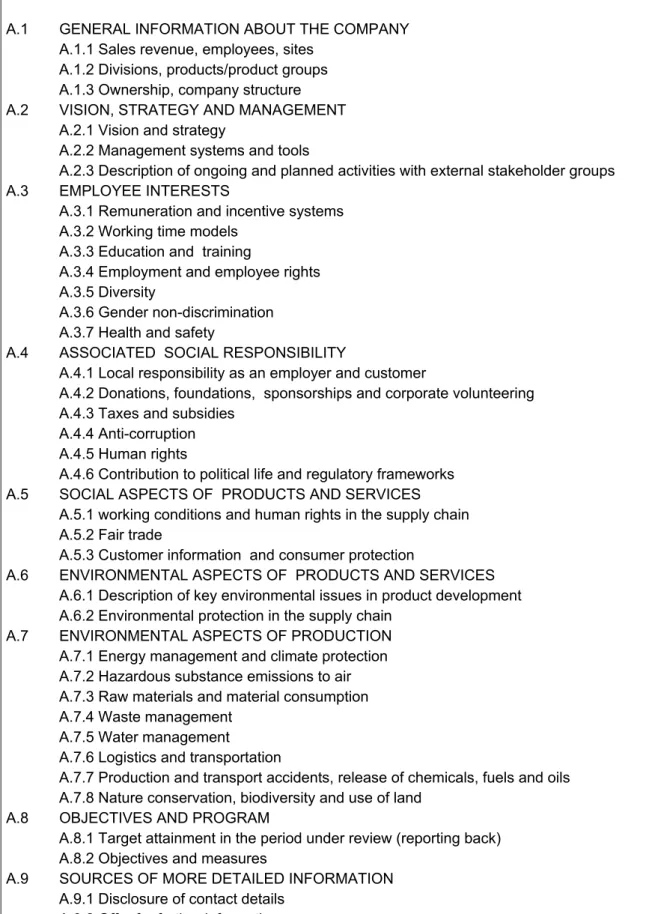
The evaluation is made according to 13 main criteria and 48 sub-criteria. The main criteria and their weighting are displayed in figure 1.
Figure 1: Weighting of Criteria
Type Main criteria Weight
Environmental requirements
Environmental aspects of products and services
Environmental aspects of production 30% Social requirements Employee interests
Associated social responsibility Social aspects of products and services
30% Integrated requirements
ecological, social and
Vision, strategy and management Objectives and program
40% (20%) general requirements General information about the company
Sources of more detailed information Credibility
Comparability Materiality and clarity Communicative quality
(20%)
The maximum score possible was 700. The contribution to the score of social and environmental criteria was 200, respectively. Integrated management and reporting requirements contributed a maximum score of 300.
Figure 2: List of main and sub criteria
A.1 GENERAL INFORMATION ABOUT THE COMPANY
A.1.1 Sales revenue, employees, sites A.1.2 Divisions, products/product groups A.1.3 Ownership, company structure
A.2 VISION, STRATEGY AND MANAGEMENT
A.2.1 Vision and strategy
A.2.2 Management systems and tools
A.2.3 Description of ongoing and planned activities with external stakeholder groups
A.3 EMPLOYEE INTERESTS
A.3.1 Remuneration and incentive systems A.3.2 Working time models
A.3.3 Education and training
A.3.4 Employment and employee rights A.3.5 Diversity
A.3.6 Gender non-discrimination A.3.7 Health and safety
A.4 ASSOCIATED SOCIAL RESPONSIBILITY
A.4.1 Local responsibility as an employer and customer
A.4.2 Donations, foundations, sponsorships and corporate volunteering A.4.3 Taxes and subsidies
A.4.4 Anti-corruption A.4.5 Human rights
A.4.6 Contribution to political life and regulatory frameworks A.5 SOCIAL ASPECTS OF PRODUCTS AND SERVICES
A.5.1 working conditions and human rights in the supply chain A.5.2 Fair trade
A.5.3 Customer information and consumer protection
A.6 ENVIRONMENTAL ASPECTS OF PRODUCTS AND SERVICES A.6.1 Description of key environmental issues in product development A.6.2 Environmental protection in the supply chain
A.7 ENVIRONMENTAL ASPECTS OF PRODUCTION
A.7.1 Energy management and climate protection A.7.2 Hazardous substance emissions to air A.7.3 Raw materials and material consumption A.7.4 Waste management
A.7.5 Water management
A.7.6 Logistics and transportation
A.7.7 Production and transport accidents, release of chemicals, fuels and oils A.7.8 Nature conservation, biodiversity and use of land
A.8 OBJECTIVES AND PROGRAM
A.8.1 Target attainment in the period under review (reporting back) A.8.2 Objectives and measures
A.9 SOURCES OF MORE DETAILED INFORMATION A.9.1 Disclosure of contact details
B.1 CREDIBILITY
B.1.1 Statement of the board of management B.1.2 Audits
B.1.3 Compliance
B.1.4 Disclosure of unresolved problems B.1.5 Evaluation by external bodies B.2 COMPARABILITY
B.2.1 Details on the scope of the report
B.2.2 Details of how information was ascertained and is to be interpreted B.2.3 Significant developments during the period under review
B.3 MATERIALITY AND CLARITY
B.3.1 Focus on key quantitative and qualitative aspects
B.3.2 Clarity of the reporting structure and accessibility of the information and the selected data
B.4 COMMUNICATIVE QUALITY
B.4.1 Layout B.4.2 Text B.4.3 Figures
The detailed description of the requirements is available in German. See Loew, Thomas; Clausen, Jens (2005): Kriterien und Bewertungsskala für das Ranking der Nachhaltigkeits-berichte, <Criteria and evaluation scale for the ranking of sustainability reports 2005> Berlin, Munster (pdf-download: http://www.ranking-nachhaltigkeitsberichte.de/pdf/rankingkriterien.pdf).
2.2 Evaluation and calculation
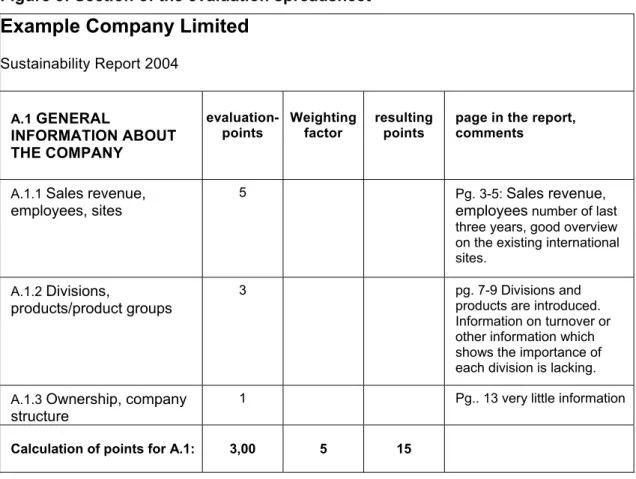
Evaluation and weighting is performed for each main criterion. The evaluation draws an the detailed set of requirements for each sub-criterion. Points will be given for:
5 = exceptional fulfilment of requirements 3 = good fulfilment of requirements 1 = poor fulfilment of requirements 0 = no fulfilment of requirements
The points for all sub-criteria will be added and divided by the number of sub criteria. The resulting value is multiplied by the weighting factor and gives the score of the main criterion.
Figure 3: Section of the evaluation spreadsheet
Example Company Limited
Sustainability Report 2004
A.1 GENERAL
INFORMATION ABOUT THE COMPANY
evaluation-points Weighting factor resultingpoints page in the report, comments
A.1.1 Sales revenue, employees, sites
5 Pg. 3-5: Sales revenue, employees number of last three years, good overview on the existing international sites.
A.1.2 Divisions,
products/product groups
3 pg. 7-9 Divisions and products are introduced. Information on turnover or other information which shows the importance of each division is lacking. A.1.3 Ownership, company
structure
1 Pg.. 13 very little information
Calculation of points for A.1: 3,00 5 15
2.3 Platform approach
Our general requirement is, that a report has got a clear scope of reporting, e.g. all activities of a TNC, and a clear reporting time, e.g. a report for the year 2004. Homepages which are continually updated do usually not fulfil the requirement for a clear reporting time. Generally, printed reports and pdf-reports most often fulfil the requirement.
But we do not only value information within a printed report or pdf-report. If within these reports a clear reference is given to further information, e.g. “Our complete emission data is available on our website under `environmental data`”, we will value this information as if it were included in the report. The requirement for this is a clear reference. We would not accept “Further information on social and environmental matters is available from our website”, which gives the reader no concrete idea which information he or she may find where.
2.4 Evaluation focus
In the German ranking of sustainability reports, the reports of the 100 largest German industrial and service enterprises were included, as well as the reports of the 50 largest enterprises in retail, banking and insurance. This selection is made using a list of the German top 500 companies set up by F.A.Z, a leading German business newspaper. Environmental, sustainability, CSR, social reports or comparable reports of German enterprises were included. Of these 150 companies, 53 publish a stand alone sustainability report in Germany. These reports were evaluated. Another 25 companies are equipped with a sustainability report by their international mother company. This is responsible and reasonable, but these foreign reports were not inluded in the German ranking. Some other companies only have got reports for subsiduaries available, include information in their annual report or their website. All this shows, that business is striving for sustainability transparence, but it is not considered a stand alone reporting activity.
Figure 4: Reporters and non-reporters of the top 150 companies in Germany ow n report 36% no information at all 28% report of the international parent company 17% information in the annual report 9% only information in the internet 3% reports of subsidaries 7%
3 Ranking
results
The winner of the 2005 German ranking of sustainability reports is the sustainability report of Henkel scoring 494 of 700 possible points. The report includes exceptional information on product safety and employee issues and scores best in general reporting requirements. Very good is also Henkel´s methodology of references into their special sustainability homepage. The second best report is issued by the retailer KarstadtQuelle closely followed by another retailer, Otto. Both reports scored best in the fulfilment of social criteria and were rather good in environmental issues. Rank four was taken by the publisher Axel Springer AG, who fulfilled 79% of the environmental requirements and scored best in this respect. Adidas-Salomon (rank 5) presented a credible and fair description of problems and achievements in social supply chain aspects.
The Environmental Report of Volkswagen was indeed a good sustainability report and the best of automotive industry. Within the TOP 10 we find also the energy company RWE, the bank HVB Group, BMW Group, Deutsche Telekom and BSH Bosch Siemens Household Appliances.
Re sults a nd Tren ds of the 2005 Ran kin g
Figure 5: The best 35 sustainability
repo rts in German y Inte gra te d re quire me nt s So cial req u iremen ts En vi ronme n tal requirements A.1 Company Information A.2 Strategy Manageme nt A.8 Targets, Progamm A.9 Further Information B.1 Credibil ity B.2 Compariab ility B.3 Materiality B.4 Communica tive Quality Score Gene ral Require ments A.3 Employee Interests A.4 Social Responsi bility
A.5 Social Product Aspects
Score So cial
Require ments
A.6 Env. Aspects. Products
A.7 Env. Aspects. Production Score En viron men t Require ments O verall sco re Points per Rank Company We ighti n g Report title 5 15 15 5 5 5 5 5 15 10 15 15 25 1 Henk el KGaA Nachhaltigkeitsb ericht 2003 3,6 5,0 4,0 5,0 3,8 5,0 5,0 4,4 269 3,0 3,0 3,0 120 3,0 2,4 105 494 2 KarstadtQuel le AG
Besser miteinander - Nachhaltigkeitsb
ericht 2003 5,0 4,3 2,5 5,0 2,2 2,6 5,0 3,6 220 3,3 2,0 4,3 134 4,0 3,0 136 490 3 OTT O (GmbH & Co KG) Bewus st se in (s ) formen - Nachhaltigkeitsb ericht 2004 3,6 3,7 4,0 5,0 3,4 2,6 3,0 3,6 221 3,3 3,0 3,7 134 4,0 2,5 123 478 4 Axe l Spri nger Verlag AG Nachhaltigkeitsb ericht 2003 2,4 3,7 3,0 5,0 4,2 5,0 3,0 1,6 206 2,9 3,0 1,7 98 5,0 3,3 158 462 5 Adid as-Sal omo n AG
Das Ziel vor Aug
en Sozial- und Um w eltbe richt 2003 3,0 5,0 5,0 4,0 4,6 1,6 3,0 4,4 253 2,3 1,6 4,3 115 5,0 0,4 86 454 6 RWE AG Unsere Vera nt wortung -Bericht 2003 5,0 4,3 3,0 4,0 2,6 3,6 4,0 3,6 224 2,7 2,2 2,3 98 4,0 2,7 127 449 7 HVB Group Nachhaltigkeit bew e gt 2002 vom Um w eltbericht zum Nachhaltigkeitsb ericht 1,6 4,3 3,0 5,0 3,8 3,0 4,0 3,6 215 3,0 2,8 2,5 110 3,5 2,8 123 448 7 Vo lk sw ag en AG Um w eltbericht 2 003/2004 3,6 4,3 4,0 5,0 3,0 4,4 4,0 3,6 243 3,0 2,6 1,7 96 4,0 2,0 109 448 9 BMW Group
Sustainable Value Report 2003/2004
2,4 3,0 3,0 4,0 3,2 3,0 3,0 3,0 183 3,3 1,8 3,7 122 4,0 2,1 112 417 10
BSH - Bosch und Siemens Haus
geräte GmbH Verant w o rtung fü r Um w elt und Gesellschaft 2003/2004 3,0 4,3 3,0 5,0 3,0 3,6 3,0 3,6 216 1,3 1,0 1,7 54 5,0 2,7 142 412 10 Deutsch e T elekom AG Neue Wege. N eu e Ideen.
Eine neue Zeit. Der
un d Nachhaltigkeitsb ericht 2004 3,0 4,3 1,0 4,0 3,8 3,6 3,0 3,6 185 2,7 3,4 2,3 110 4,0 2,3 117 412
10 Loe w, Clau se n, Weste rma Inte gra te d re quire me nt s So cial req u iremen ts En vi ronme n tal requirements A.1 Company Information A.2 Strategy Manageme nt A.8 Targets, Progamme A.9 Further Information B.1 Credibil ity B.2 Comparabi lity B.3 Materiality B.4 Communica tive Quality Score Gene ral Require ments A.3 Employee Interests A.4 Social Responsi bility
A.5 Social Product Aspects
Score So cial
Require ments
A.6 Env. Aspects. Products
A.7 Env. Aspects. Production Score En viron men t Require ments O verall sco re
Points per pag (infor- mation dens
Rank Company weighti n g Report title 5 15 15 5 5 5 5 5 15 10 15 15 25 12 Rob ert Bosch GmbH Weltw eite Ver ant w o rtung 4,4 4,3 2,0 5,0 3,0 4,4 4,0 3,6 217 1,7 1,6 1,7 67 4,0 2,3 118 402 8,4 13 BASF AG Unterneh mensbe richt 2003 3,6 3,7 1,0 3,0 3,0 3,0 3,0 3,0 163 3,0 3,4 3,0 124 4,0 2,0 110 397 5,8 14 Daiml erChr ys le r AG 360 Grad Um weltbericht 2004 1,6 3,7 3,0 4,0 2,0 3,0 3,0 3,0 183 2,4 2,4 2,3 95 4,0 2,3 118 396 15 Degussa AG Corpo
rate Citizenship Report
2003 3,6 1,7 4,0 3,0 3,0 4,4 1,0 4,4 182 2,7 2,6 1,7 92 3,0 2,9 117 391 3,4 16 KfW Banke ngr upp e Um w eltbericht 2 003 2,4 4,3 4,0 4,0 2,6 5,0 2,0 2,4 217 0,1 1,0 1,1 29 3,5 3,6 142 388 4,8 17 Miele & Ci e. KG Nachhaltigkeitsb ericht 2004 2,0 3,0 1,0 3,0 3,4 3,6 3,0 3,0 150 3,0 1,4 2,3 94 4,0 3,1 137 381 3,9 18 Deutsch e Lufthans a AG Balance 2004. D as Lufthansa Journal für Luftv erkehr, Um w
elt und Nac
hhaltigkeit 3,6 1,0 4,0 4,0 2,2 3,6 3,0 3,0 172 3,4 1,8 1,3 89 2,5 3,1 115 376 4,0 19 Wacker-Chem ie GmbH Nachhaltigkeitsb ericht Wacker -C hemie 1,4 3,0 3,0 1,0 2,6 3,0 2,0 3,6 158 3,3 1,8 0,3 72 3,0 3,2 126 356 3,7 20 Z F Friedrichs-hafen AG Um w eltbericht 2 002 4,4 3,0 4,0 3,0 2,4 3,6 3,0 3,6 205 1,0 0,8 0,0 23 5,0 1,8 120 348 9,2 21 T U I AG Nachhaltig w irtsc haften in der World of TUI 0,6 5,0 3,0 5,0 2,8 2,6 4,0 2,4 207 0,1 1,8 1,7 45 3,0 2,0 94 346 5,2 22 MET R O AG Nachhaltigkeitsb ericht 2004 3,0 3,0 1,5 4,0 1,0 3,4 3,0 3,6 158 2,1 0,8 1,7 65 3,0 2,6 111 334 3,8 23 Münch ener R ü ck
Perspektiven - Ideen von heute für die Wel
t von morgen 2003 3,6 3,7 2,0 5,0 3,0 3,6 3,0 3,6 194 0,1 1,2 1,8 41 2,5 2,3 96 331 4,1 24 Adam Opel AG Nachhaltigkeitsb ericht 2002 2,4 3,7 2,0 1,0 1,6 2,6 2,0 2,4 145 2,6 2,0 1,3 79 4,0 1,8 105 329 3,0 25 Heid el berg er Druckmaschinen AG Nachhaltigkeitsb ericht 2003/2004 3,6 1,7 3,0 5,0 2,0 3,6 4,0 3,0 176 2,4 0,6 0,3 47 3,0 2,2 100 323 9,5
Re sults a nd Tren ds of the 2005 Ran kin g Inte gra te d re quire me nt s So cial req u iremen ts En vi ronme n tal requirements A.1 Company Information A.2 Strategy Manageme nt A.8 Targets, Progamme A.9 Further Information B.1 Credibil ity B.2 Comparabi lity B.3 Materiality B.4 Communica tive Quality Score Gene ral Require ments A.3 Employee Interests A.4 Social Responsi bility
A.5 Social Product Aspects
Score So cial
Require ments
A.6 Env. Aspects. Products
A.7 Env. Aspects. Production Score Enviro nm ent Require ments O verall sco re Rank Company We ighti n g Report title 5 15 15 5 5 5 5 5 15 10 15 15 25 26 HOCHT IEF Aktieng esel l-schaft Um w eltber icht.
Arbeitssicherheit und Gesundheitsschutz 2003.
3,0 3,7 2,0 3,0 2,6 2,4 1,0 3,0 160 2,7 2,6 2,3 102 1,5 1,3 56 318 26 Merck KGaA Verant w o rtung fü r Mitarbeiter, Um w elt 3,6 2,3 1,5 3,0 3,0 1,6 3,0 3,6 147 3,3 2,8 3,0 122 2,0 0,8 49 318 28 Ba yerisc he Lan des bank Um w elterklärung 2002 3,6 3,7 3,0 4,0 2,0 2,6 3,0 2,0 186 0,0 1,4 1,1 31 1,5 3,0 99 316 29 Scheri ng AG Berlin Konzernum w eltb ericht - Nachhaltigkeit ist 2,4 3,7 3,0 3,0 2,2 2,4 2,0 3,6 178 2,1 1,6 1,7 73 1,5 1,5 61 312 30
Dr. August Oetker Nahr
ungsm
ittel
KG
Ökonomische, ökologische und soziale Verantwortun
g 2,4 2,3 3,0 1,0 2,6 1,6 3,0 3,0 148 3,0 1,2 0,7 67 3,0 2,0 96 311 31 Bay er AG Nachhaltigkeitsb ericht 2004 0,6 2,3 2,0 3,0 2,4 3,0 3,0 2,4 137 2,6 1,0 1,3 69 2,0 2,9 102 308 32 Infineo n T echnolog ies AG Um w eltbericht 2 002 3,0 3,7 3,0 0,6 2,6 3,0 3,0 2,4 173 0,9 1,0 0,3 28 3,0 2,1 97 298 33 Lan des bank Bade n-W ürttemberg Um w eltbericht 2 002 mit aktualisierter Um w elterklärung 2004 1,6 2,3 4,0 2,0 1,0 3,6 3,0 2,4 163 0,1 0,2 1,1 21 1,5 3,6 112 296 34 Deutsche Post AG Natürlich vernetzt. Um w eltbericht 2 003 1,6 1,7 5,0 1,6 1,4 3,6 2,0 3,0 166 0,4 1,2 0,3 23 2,5 2,7 105 294 35 Dresd ner Bank AG
Zukunft Gestalten Stakeholder Rep
ort der Dresdner Ba nk 0,6 2,3 1,0 5,0 2,0 1,0 3,0 3,6 126 1,7 1,6 1,8 69 2,5 2,2 93 288 Statististical Va lues Mean (Po ints) 2,5 3,1 2,2 3,2 2,3 2,7 2,9 3,1 163,5 1,8 1,6 1,6 66,3 2,7 2,2 95,2 325 F or all 53 R ep orts: Mean (% of ma x. ) 50,6 62,4 43,5 65,0 45,9 54,8 57,4 62,6 54,5 % 36,2 31,9 31,0 33,2 % 54,0 43,8 47,6 % 46,4 % Maximum 5 5 5 5 4,6 5 5 4,4 269 3,4 3,4 4,3 134 5 3,6 158 494 Minimum 0 1 0 0 0,8 0,6 1 1,4 88 0 0 0 4 0,5 0,4 22 130 Standar d dev ia tion 1,24 1,02 1,37 1,46 0,91 1,17 0,96 0,77 45,76 1,14 0,88 1,12 35,79 1,26 0,79 30,36 91,31
4 Sector
results
The highest degree of professional reporting we found in the sectors automotive, paper and printing, transport and communication as well as chemicals. In these sectors, sustainability reporting is practiced by a high number of companies and generally in a good quality.
In the automotive sector all companies publish a sustainability report and on average these have a high quality (mean score automotive: 359, mean score all companies: 325). Only Porsche published a report of rather poor quality.
Performing as good as the automotive companies, all three of those paper and printing companies which we found in the group of the biggest 150 German companies published sustainability reports.
Within transport and communication the best report came from Deutsche Telekom. But there is also Thomas Cook AG, were we did not find the smallest bit of environmental or social information in the public domain.
In the chemical sector (incl. pharma) ¾ of the companies issue a report. The quality of these reports is quite different. Very good reports come from Henkel, BASF and Degussa while Braun Melsungen and Beiersdorf present a rather poor reporting. Concerning the DAX 30 Altana AG, sustainability information on the website only focuses on some aspects of philanthropic engagement in science and culture and a very brief vision on social and environmental responsibilities. It is regrettable, that also one of the best stock market performers nearly totally ignores sustainability transparency demands.
Half of the German banks issues environmental or sustainability reports. The quality of these reports represents an average level. The best report was issued by the Bavarian Hypovereinsbank (HVB-Group). But 6 of Germanys largest banks do not at all report on social responsibilities.
In the group of the 17 biggest insurance companies only four provide an stand alone report. Two of them are published by international mother companies, leaves two German reports of Münchner Rück and Allianz. While further 3 insurers offer at least some little information on social and environmental issues, 10 companies in this sector provide no information at all.
5 Non-reporters
Reporting is seen as a major element of corporate social responsibility not only by the EU. Reporting has got several aspects: On one hand it reflects the accountability of industry towards society in certain issues, on the other hand it is a voluntary contribution to the dialog between companies and their stakeholders. Furthermore the process of preparing those reports has a significant impact on the internal learning processes of a company.
But still nearly half of the TOP 150 German companies do not participate in the reporting exercise. This includes some fo the DAX 30 companies, the best German performers on the stock market: Commerzbank, Eon, Altana und Thyssen-Krupp.
And in 28% of the cases we could not find any piece of information concerning social or environmental issues. These black sheep include HUK-Coburg, R&V Insurance, Rheinmetall and the retailers, Aldi, REWE und Schlecker. These companies refuse to account for their activities, as far as they have a non-financial impact.
Really criticised should therefore not be the companies, which have average or poor sustainability reports, but those companies, who do not issue a report on social and environmental issues or do not make any information at all on these issues public.
6 From
environmental
reporting
to sustainability reporting
Since 1990 a lot of experience has been gained in environmental reporting. This reflects in the results of the 2005 ranking. The environmental requirements have been fulfilled on average by 48%, while only one third of the social requirements has been met.
It is interesting that the degree of fulfilment has been nearly identical for all three main criteria: Employee interests (36%)
(including remuneration and incentive systems, working time models, education and training, employment and employee rights, diversity, gender non-discrimination and health and safety
associated social responsibility (32%)
(including local responsibility as an employer and customer, donations, foundations, sponsorships and corporate volunteering, taxes and subsidies, anti-corruption, human rights, contribution to political life and regulatory frameworks)
Social aspects of products and services (31%)
(including working conditions and human rights in the supply chain, fair trade, customer information and consumer protection)
For the two main criteria “employee interests” and “associated social responsibility” the best report met 68% of the maximum score.
For the main criterion “Social Aspects of Products and Services” no report scored better than 43% of the maximum achievable points. Especially “Social Aspects of Products and Services” still wait for good pioneers of high quality reporting.
The results show that today’s sustainability reporting very often is generally an environmental reporting with added on social aspects. Although modern social reporting goes back into the 70th, some of the experience gained seems to be buried and also new issues like diversity or the social aspects of the supply chain have emerged, which have to be dealt with. It is important, that companies focus on social aspects in the years to come and develop not only reporting, but as well underlying management systems and performance.
Literature
Accountability (Hrsg.) (1999): AA1000 Assurance Standard, no place. (PDF -download: http://www.accountability.org.uk/uploadstore/cms/docs/Assurance%20Standard%20for
%20Web.pdf).
CEFIC (1993): Guidelines on environmental reporting for the European chemical industry. Brussels.
Clausen, Jens, Loew Thomas (2005): Internationale Analyse des Nutzens von Testaten in der Umwelt- und Nachhaltigkeitsberichterstattung <international analysis of the benefits of assurance statements in sustainability reports>, Berlin 2005 (to be published 2005) Clausen, Jens; Loew, Thomas; Klaffke, Kathrin; Raupach, Michaela; Schoenheit, Ingo (2001):
Der Nachhaltigkeitsbericht – ein Leitfaden zur Praxis glaubwürdiger Kommunikation für zukunftsfähige Unternehmen. < The INEM Sustainability Reporting Guideline > Berlin, Hamburg. (PDF-download: www.nachhaltigkeitsberichte.net and www.inem.org). Clausen, Jens; Fichter, Klaus; Loew, Thomas (1998) Die Bewertungsskala für das Ranking der
Umweltberichte, Diskussionspapier des IÖW DP41/98, Berlin
Europäische Kommission (Ed.) (2001): Green Paper: Promoting a European framework for Corporate Social Responsibility, European Commission. Brüssel
Europäische Kommission (Ed.) (2001a): Mitteilung der Kommission. Nachhaltige Entwicklung in Europa für eine bessere Welt. Strategie der Europäischen Union für die nachhaltige Entwicklung, Brüssel, (PDF-Download:
http://www.bba.de/mitteil/aktuelles/forumpfs/nachhaltentweu.pdf)
Europäische Kommission (Ed.) (2002): Auf dem Weg zu einer globalen Partnerschaft für nachhaltige Entwicklung, Brüssel, (PDF-Download: http://europa.eu.int/eur-lex/de/com/cnc/2002/com2002_0082de01.pdf)
future e.V. (Ed.) (2000): Nachhaltigkeit. Jetzt! Anregungen, Kriterien und Projekte für Unternehmen. München
Future e.V. Institut für ökologische Wirtschaftsforschung (Eds.) (2000): Ranking der Umweltberichte 2000 (online) www.ranking-umweltberichte.de (1.2.2005)
Global Reporting Initiative (GRI) (Ed.)(2002): Sustainability Reporting Guidelines 2002. Boston (PDF-Download: www.globalreporting.org)
Hockerts, Kai (2001): What Does Corporate Sustainability Actually Mean from a Business Strategy Point of View?, St. Gallen, (PDF-Download:
www.oikos-stiftung.unisg.ch/campus2001/hockerts.pdf)
Loew, Thomas; Ankele, Kathrin; Braun, Sabine; Clausen, Jens (2004): Significance of the CSR Debate for Sustainability and the Requirements for Companies, English Summary, Berlin, Münster (pdf download http://www.future-ev.de/projekte/csrsummary.pdf) (Full Report in German http://www.ioew.de/home/downloaddateien/
bedeutung%20der%20csr%20diskussion.pdf
Loew, Thomas; Clausen, Jens (2003): Monitoring von Umweltleistung und
Umweltmanagementsystem, 5. abschließende Panelbefragung 2002. Endbericht an die Hessische Landsanstalt für Umwelt und Geologie (To be published 2005.)
Loew, Thomas; Clausen, Jens (2005): Kriterien und Bewertungsskala für das Ranking der Nachhaltigkeitsberichte. (pdf-download: www.ranking-nachhaltigkeitsberichte.de) oekom research (Ed.) (2003): Corporate Responsibility Rating. Questionnaire. General Part.
München
SAM Research (Ed.) (2003): Corporate Sustainability Assessment Questionnaire. General Part. Zürich
Social Accountability International (Ed.)(2001): Social Accountability 8000 – SA 8000, New York SustainAbility/UNEP (Ed.) (2002): Trust Us. The Global Reporters 2002 Survey of Corporate
Sustainability Reporting. London
SustainAbility/UNEP (Ed.) (2004): Risk & Opportunity Best Practice in Non Financial Reporting. London (pdf-download: www:sustainability.com)