Compositional Synthesis
and
Most General Controllers
Dissertation
zur Erlangung des akademischen Grades
Doktor rerum naturalium (Dr. rer. nat.)
vorgelegt an der
Technischen Universit¨at Dresden
Fakult¨at Informatik
eingereicht von
Dipl.-Inform. Joachim Klein
geboren am 7. Februar 1979 in Bonn
Gutachter:
Prof. Dr. rer. nat. Christel Baier
Technische Universit¨at Dresden
Prof. Dr.-Ing. Martin Steffen
Universitetet i Oslo
Abstract
Given a formal model of the behavior of a system, an objective and some notion of control the goal ofcontroller synthesis [RW87, Won89] is to construct a (finite-state) controller that ensures that the system always satisfies the objective. Often, the controller can base its decisions only on limited observations of the system. This notion of limited observability induces a partial-information game between the controller and the uncontrollable part of the system. A successful controller then realizes an observation-based strategy that enforces the objective.
In this thesis we consider the controller synthesis problem in the linear-time setting where the behavior of the system is given as a nondeterministic, labeled transitions system A, where the controller can only partially observe and control the behavior of A. The goal of the thesis is to develop acompositionalapproach for constructing controllers, suitable to treat conjunctive cascades of linear-time objectivesΦ1,Φ2, . . . ,Φkin an online manner.
We iteratively construct a controllerC1 for systemAenforcingΦ1, then a controllerC2
en-forcingΦ2for the parallel composition of the first controller with the system, i.e.,C1 ./A,
and so on. It is crucial for this approach that each controllerCienforcesΦiin amost
gen-eralmanner, being as permissive as possible. Otherwise, behavior that is needed to enforce subsequent objectives could be prematurely removed.
Standard notions of strategies and controllers only allow the most general treatment for the limited class of safety objectives. We introduce a novel concept of most general strate-gies and controllers suited for the compositional treatment of objectives beyond safety. We demonstrate the existence of most general controllers for all enforceable, observation-based
ω-regular objectives and provide algorithms for the construction of such most general con-trollers, with specialized variants for the subclass of safety and co-safety objectives. We furthermore adapt and apply our general framework for the compositional synthe-sis of most general controllers to the setting ofexogenous coordination in the context of the channel-based coordination language Reo [Arb04] and the constraint automata frame-work [BSAR06] and report on our implementation in the verification toolsetVereofy. The construction of most general controllers inVereofyforω-regular objectives relies on our toolltl2dstar for generating deterministicω-automata from Linear Temporal Logic (LTL) formulas. We introduce a generic improvement for exploiting insensitiveness to stuttering during the determinization construction and evaluate its effectiveness in practice. We fur-ther investigate the performance of recently proposed variants of Safra’s determinization construction in practice.
Acknowledgements
First and foremost I am immensely grateful to Christel Baier for her supervision of this thesis and everything else. Little did I know as a young and naive student during the first lecture on algorithms and data structures that she would manage to lure me, lecture by lec-ture, into the realms of theoretical computer science. Immediately apparent however was the astonishing amount of effort spent for the preparation of her lectures, with hand drawn, colored slides and a true interest and gift for teaching. In the process I discovered that this commitment is matched by a similar devotion to research, allowing me to profit from her knowledge, experience, advice and patience. Thank you for making it possible.
I furthermore would like to thank my colleagues Sascha, Frank, Marcus, Manu, Clemens, the other Marcus, Steffen, Michael and Nathalie for making work at TU Dresden so enjoy-able and entertaining. I miss Tobias, he would surely have a snappy comment right now. During my research activities I have been fortunate to meet so many different smart and cre-ative people, with special thanks to Christian Krause at the CWI for his help in integrating our model checker into the Eclipse Coordination Tools and to Farhad Arbab for inventing Reo in the first place. I also would like to thank Martin Steffen and the other members of the Promotionskommission.
My family deserves thanks as well, for their support and for not asking the wrong ques-tions at the wrong time. And finally I would like to thank my girlfriend Johanna for being awesome and supportive from the first to the last step of this thesis.
Contents
CHAPTER1 Introduction 1
CHAPTER2 Preliminaries 7
2.1. Linear Temporal Logic (LTL) . . . 7
2.2. Automata over finite and infinite words . . . 8
2.3. Transition systems, observation and control . . . 10
CHAPTER3 Strategies and Controllers 19 3.1. Strategies . . . 20
3.2. Controllers . . . 24
CHAPTER4 Compositional Synthesis 29 4.1. Compositional treatment of conjunctive objectives . . . 34
4.2. Structural properties of decision functions . . . 38
CHAPTER5 Game-based synthesis 41 5.1. Observation-based and complete-information game . . . 45
5.2. Relating plays in the game and executions in the system . . . 49
CHAPTER6 Safety and co-safety objectives 57 6.1. Reachability objectives . . . 57
6.2. Invariance objectives . . . 66
6.3. Reachability with fairness . . . 68
6.4. Invariance objectives with finitary fairness . . . 70
6.6. Complexity . . . 74
CHAPTER7 Most general controllers forω-regular objectives 79 7.1. Observation-basedω-regular objectives . . . 80
7.2. The complete-informationω-regular game . . . 81
7.3. Constructing most general controllers for Streett objectives . . . 83
7.4. Complexity . . . 91
7.5. ω-regular objectives with other acceptance conditions . . . 92
7.6. Comparison with the specialized constructions . . . 93
CHAPTER8 Synthesis in the Reo and constraint automata framework 97 8.1. Constraint automata . . . 99
8.2. The coordination language Reo . . . 103
8.3. The modeling languages CARML and RSL . . . 106
8.4. Synthesis of most general controllers in Vereofy . . . 110
8.4.1. Objectives . . . 111
8.4.2. Most general CARML controllers . . . 113
8.4.3. Connecting most general controllers in Reo and RSL . . . 115
8.4.4. Constructing most general controllers in practice . . . 117
8.5. Most general controllers for a robot game . . . 123
CHAPTER9 Deterministicω-automata for LTL formulas 133 9.1. Stuttering during the determinization . . . 135
9.1.1. Stuttering . . . 136
9.1.2. Checking for closure under stuttering . . . 137
9.1.3. Stuttered deterministic Rabin automata . . . 138
9.2. Variants of Safra’s determinization construction . . . 142
9.3. Evaluation usingltl2dstar . . . 145
Chapter 1
Introduction
Formal verification techniques such as model checking (e.g. [CE81, QS82, CGP99, BK08]) allow the automatic verification of a given system modelAagainst a specificationΦ, usu-ally given in the form of some temporal logic formula [Pnu77, Pnu79, CE81]. As long as the system exhibits behavior that does not satisfy the specification, the system designer typically modifies the system in an iterative fashion until the specification is met or re-fines the specification. A complementary approach is thesynthesis problem, which asks, starting just from the specification, to automatically construct a system that fulfills the spec-ification. The synthesis approach thus has the potential to simplify the design process, as the generated system is guaranteed to meet the specification by construction. The orig-inal formulation of the synthesis problem goes back to a realizability problem posed by Church [Chu63] and was solved by B¨uchi and Landweber [BL69] and by Rabin [Rab72]. The modern formulation of the synthesis problem for linear time specifications is due to Pnueli and Rosner [PR89]. Starting with a specification Φformulated in Linear Tempo-ral Logic (LTL), the goal is to construct a finite-state transducer AΦ that models a
re-active system and meets the specification for all possible behaviors of the environment. This universal quantification over the actions of the environment can be seen as induc-ing a game of infinite duration played by the transducer against the environment, where the transducer implements a strategy that enforces the specification. The synthesis prob-lem from temporal logic specifications has been extensively treated in the literature, e.g. [ALW89, Var95, FJR10, KV97, JB06, JGWB07, MS10, Mor10].
A closely related problem is thesynthesis of a controller for a system [RW87, Won89]. Given a model of the potential behavior of the system (sometimes called a plant) as well as an objective and some notion of control the goal is to construct a finite-state controller that ensures that the system always satisfies the objective. Assumptions about the environment can be integrated into the system model as uncontrollable parts. Often, the controller can base its decisions only on a limited amount of information about the current state and his-tory of the system. This notion of limited observability induces a partial-information game between the controller and the uncontrollable part of the system. A successful controller then realizes an observation-based strategy that enforces the objective. The controller syn-thesis approach is useful for example in the case that the system already exists and can not be modified or replaced but only (partially) controlled. A system designer might find
Chapter 1. Introduction
it easier as well to provide a straightforward model of the generic behavior of the system and then just specify the particular objectives that should be enforced. In contrast, the temporal logic synthesis approach requires a full specification of both the generic behavior and the objectives in the temporal logic, constructing the system from scratch. The con-troller synthesis problem has been studied in a wide variety of contexts, for example for discrete event systems [Won89], hybrid systems [ABD+00] and timed systems [AMP95], in the linear-time [RW87] and in the branching-time setting [KMTV00] and for distributed settings [PR90, MW03].
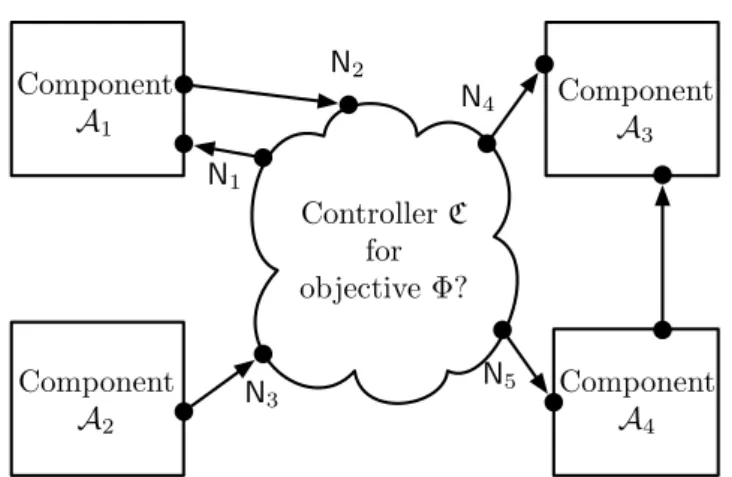
In this thesis we consider the controller synthesis problem in the linear-time setting for the case where the behavior of the system as well as the assumptions about the environment are given as a nondeterministic, labeled transitions system (LTS)A. The controllerCcan again be seen as a labeled transition system that is put in parallel withAand decides on the “legal” actions thatAis allowed to perform to ensure that the objective is satisfied. We consider a notion of partial control, which corresponds to restrictions on the actions ofAthat can be influenced by the controller. A notion of partial observability [Rei84, RCDH07, KvdP09a] forces the controller to make its decisions solely on the basis of the observable history. This setting is quite general and arises naturally for example in the context of component-based systems withexogenous coordination. In this approach the coordination, e.g., synchroniza-tion or buffering of communicasynchroniza-tion of the various parts of a system, is not hard-coded but imposed externally in the form of coordination glue-code. This separates the concern of computation, carried out by the components, and the concern of coordination, the task of orchestrating the various components to achieve a common objective. The components pro-vide a well-defined interface for communication but remain unaware of the context of their usage. The orchestration is then performed for example by coordination glue-code specified in a channel-based coordination language such as Reo [Arb04]. It transfers several strong points of component-based design to the area of coordination, such as the reuse of compo-nents and coordination patterns, providing information hiding, independence from imple-mentation and allowing for the distributed deployment of the components and coordination mechanism. In the context of exogenous coordination the controller synthesis problem cor-responds to the construction of a controller that performs the required orchestration of the components to achieve the objective.
Our focus is to develop a compositionalapproach for constructing controllers. Compo-sitionality means that our approach is suitable to treat cascades of linear-time objectives Φ1,Φ2, . . . ,Φkin an online manner. First, we construct a controllerC1for systemA
enforc-ingΦ1such that the parallel composition ofC1andAsatisfies the objective,C1./A |= Φ1.
We then construct a controllerC2for the systemC1 ./Aenforcing objectiveΦ2, and so on,
such that in the end the conjunction ofΦ1, . . . ,Φkis enforced,
Ck./ . . . ./C2./C1./A |= Φ1∧Φ2∧. . .∧Φk
or the construction fails in the case that the conjunction cannot actually be enforced for system A. Such a compositional approach allows a system designer to iteratively refine the objectives and can be beneficial in the treatment of complex conjunctive specifications that can be difficult to handle in a single step. For the compositionality it is crucial that each controllerCi enforcesΦi in amost generalmanner, being as permissive as possible.
Chapter 1. Introduction
q
0β
q
1α
Figure 1.1: Illustrating example for the problem of permissive strategies for reachability objectives
This avoids the problematic case of prematurely removing system behavior that may be necessary to enforce subsequent objectives.
For the class ofsafety objectives, i.e., objectives that specify that “nothing bad ever hap-pens”, a controller can straightforwardly behave in a most general manner and thus allow compositionality. It suffices for the controller to allow all the possible “legal” actions, i.e., those where the controller can ensure that the bad outcome can be avoided. To ensure permissiveness the controller does not restrict itself by choosing only a single action but provides a choice of multiple actions. This corresponds in the induced game to the concept of a multi-strategy, sometimes called nondeterministic strategy as well. Such a strategy provides a set of allowed moves instead of a single move, with the opponent selecting the actual move that will be performed. Kuijper and van de Pol [KvdP09a, KvdP09b] consider the synthesis of such most general controllers in a partial observation setting for safety objectives. In the context of games, Bernet et al. [BJW02] introduce a related notion of permissive strategies in a complete-information setting, which subsume all (nondeterminis-tic) positional winning strategies in the game, and show that such permissive strategies only exist for safety objectives.
Beyond safety objectives, this simple permissive approach fails, which we illustrate with the well-known example depicted in Figure 1.1. We assume here that both actionsαand
βin the system are controllable and observable, i.e., that the controller has full control and information. The goal is then to synthesize a most general controller for the reachability objective “eventually stateq1”. Clearly, this objective can be enforced by first scheduling
actionαa finite amount of times and then scheduling only actionβ. Thus, both actionsα
andβare “legal” in stateq0for the objective. However, being permissive and offering both αandβ in stateq0 does not guarantee that eventually stateq1 is reached, as the opponent
can then always select actionαwith the resulting execution staying forever in stateq0.
Neider et al. [NRZ12] recently extended the notion of permissive strategies by Bernet et al. [BJW02] to Muller games, where such strategies subsume all winning strategies that permit visiting a losing loop in the game at most twice. In the reachability example above this corresponds to all strategies that allow the actionαto occur in stateq0 at most twice.
It is easy to see that this notion of permissiveness is not most general and fails in a com-positional setting, as for example the objective “three timesα, thenβ” is not subsumed. Similarly, approaches for the compositional treatment of the (quite often rather large) con-junctive specifications in the context of temporal logic synthesis [KPV06, FJR10] rely on an iterative approach, increasing a boundkfor the maximal number of steps that the liveness aspects of the specification can be postponed. This iteration is repeated until the full spec-ification can be realized, requiring knowledge about all the objectives of the conjunction
Chapter 1. Introduction
Φ1∧. . .∧Φkbeforehand and is tailored only to those objectives. In contrast, we are
inter-ested in a truly compositional approach where we can synthesize most general controllers that subsume all possible subsequent objectives.
Contribution. In this thesis, we propose a compositional framework for the synthesis of most general controllers for linear time objectives beyond safety, relying on a novel no-tion of strategies as generators of decision funcno-tions. Each decision funcno-tion represents one particular way in which an objective can be enforced in an observation-based manner, cor-responding to the notion of an observation-based multi-strategy in the standard setting. A strategy is then amost generalstrategy if it generates all the decision functions that enforce a given objective, with controllers being finite memory realizations of strategies. To allow for a distinction between choices for a decision function that are “legal” in principle and those choices that are allowed or disallowed in the long run, strategies and controllers in our framework are equipped with fairness conditions on the choices. The decision functions are then generated by choosing from all the sets of “legal” choices in a fair way.
Reconsider the example in Figure 1.1. In stateq0 allowing the choice{α}, the choice{β}
and allowing the choice{α, β}are all “legal” for the objective “eventually stateq1”.
How-ever, a decision function that enforces the objective has to eventually offer the choice{β}
to ensure that the transition to q1 is actually taken. The fairness condition of the strategy
or controller is thus used to require that the generated decision functions eventually have to schedule{β}.
Note that in our case the fairness conditions only locally restrict the choices of the controller, i.e., they do not impose constraints on the environment as in [CHJ08] and can not be used to require a fair resolution of the nondeterminism in the system as in [Var95]. Furthermore, the fairness conditions are always realizable for a controller, as at any moment where a fair choice is required it can simply select such a fair choice.
As a second contribution we show the compositionality of most general strategies and con-trollers for arbitrary linear-time objectives that can be enforced by most general concon-trollers and investigate structural properties of the choices of decision functions. One of the chal-lenges in any compositional approach is the treatment of termination, as requiring synchro-nization between parts in the system and controllers can lead to blocking even in the case where individually every part could continue. In our framework we propose the explicit use ofsuspend actionsthat facilitate an explicit synchronization between the controllers to determine whether or not a controller may be the cause of termination.
As a third contribution we adapt well-known techniques for the algorithmic treatment of observation-based games [Rei84, RCDH07, Puc10] by means of a powerset construction to our setting. In the literature it is often assumed in the observation-based setting that the en-abledness of the actions in the system can be inferred just from the observation available to the controller or that all actions are always enabled, simplifying the algorithmic treatment. We drop this assumption as it is rather restrictive in the context of exogenous controllers. Consider for example the transition system in Figure 1.2. We assume here that the controller can decide which actions are allowed but has no influence on the resolution of the nonde-terminism for actionαin stateq0. Furthermore, the controller can only base its decision on
Chapter 1. Introduction q0 q1 q2 α α β1 β2 q3
Figure 1.2: Illustrating example for the increased power of multi-strategies in the partial observation setting
has no knowledge whether the system is actually in stateq1 orq2. Here, the enabledness
ofβ1 andβ2can not be deduced from the observation. However, in our setting a decision
function can safely offer the choice{β1, β2}to ensure that stateq3is reached.
As a fourth contribution we then provide algorithms for the construction of most general controllers by extraction from the solution of the games for several classes of linear-time objectives. We provide specialized constructions for most general controllers for invariance and reachability objectives as well as for safety and co-safety objectives specified via reg-ular languages over the observations of the system. We furthermore provide a construction for most general controllers for the full spectrum ofω-regular, observation-based objec-tives given as a deterministicω-automaton. This allows the construction of most general controllers for observation-based LTL objectives.
These constructions are complete in the sense that whenever an objective can be enforced for the system we can construct a most general controller for the objective. We investigate the complexity of the related decision problems for the considered classes of objectives, i.e., whether a given objective can be most generally enforced, and show the EXPTIME-hardness, which is to be expected due to the partial observability setting.
As a fifth contribution we then adapt our general framework to the exogenous, component-based framework of Reo [Arb04] and constraint automata [BSAR06] and detail our im-plementation of most general controller synthesis in this context. The imim-plementation is part of the modeling and verification tool Vereofy [BBKK08, BBKK09, BBK+10, KKSB11, BKK11b]. Our implementation complements the research and implementa-tion on Alternating-time Stream Logic (ASL) model checking in Vereofy by Kl¨uppel-holz [KB10, Kl¨u12]. ASL allows reasoning about the existence of strategies for coalitions of components to achieve a common branching-time objective. The implementation of the ASL model checker Vereofy can be used to generate controllers for such strategies in a complete-information and non-compositional context.
As a sixth contribution we address aspects of the generation of deterministicω-automata from LTL formulas, which are used inVereofy for the construction of most general con-trollers forω-regular objectives specified in the form of LTL formulas. ω-automata, fi-nite automata on infifi-nite words, serve as a powerful mechanism for the algorithmic treat-ment [VW86, Var96] of linear-time properties. Often, nondeterministic variants with simple acceptance conditions such as B¨uchi acceptance suffice, but there are several ar-eas where deterministic variants are used, such as the quantitative analysis of Markov decision processes [dA97, BK98, Var99] or in the context of games and synthesis, e.g. [PR89, GTW02] and this thesis. While determinization of nondeterministic B¨uchi au-tomata can lead to an exponential blow-up in the number of states, previous research and
Chapter 1. Introduction
experiments [Kle05, KB06] using our implementation of Safra’s determinization construc-tion [Saf88, Saf89] in the tool ltl2dstar suggested that for formulas of limited size often used in practice for verification automata of manageable size can be constructed.
We expand this research and propose in this thesis a generic modification of the determiniza-tion construcdeterminiza-tion that exploits insensitiveness to stuttering in the language of the automaton. We furthermore consider alternatives to Safra’s standard determinization construction pro-posed in recent years by Piterman [Pit07] and Schewe [Sch09]. We have implemented both the stuttered determinization construction and the variants of Safra’s construction and report on our experiments, demonstrating that our proposed heuristic as well as the alterna-tive constructions provide significant and mutually reinforcing reductions in the size of the generated automata in practice.
Outline.Chapter 2 formalizes our setting and the basic concepts of decision functions, their admissibility and partial observability and control. Chapter 3 then introduces the concept of strategies and controllers as generators of decision functions and establishes our notion of most general strategies and controllers. Chapter 4 details our compositional framework for the construction of most general controllers. In Chapter 5 we then adapt the algorithmic treatment of observation-based games to our setting, with Chapter 6 detailing the construc-tion of most general controllers for invariance, reachability, safety and co-safety objectives. In Chapter 7 we then provide an algorithm for the synthesis of most general controllers for the full class of observation-based,ω-regular objectives. In Chapter 8 we adapt our general framework for the compositional synthesis of most general controllers to the Reo and con-straint automata setting and report on our implementation inVereofy. In Chapter 9 we detail our improvements in the determinization ofω-automata and report on our experiments with variants of Safra’s construction.
The results on the compositional framework for the construction of most general controllers have been partially published in [BKK11a]. The stuttering construction for the determiniza-tion ofω-automata has been published in [KB07]. Our publications on the modeling and verification approach [BBKK08, BBKK09, BBK+10, KKSB11] implemented in Vereofy are indirect precursors of this thesis, allowing the practical application of the composi-tional controller synthesis techniques developed in this thesis in a rich setting. The ar-ticle [BKK14] details a construction to transform constraint automata into Reo networks built from basic channels, which can be adapted for most general controllers.
Chapter 2
Preliminaries
Notations. Let Σ be an alphabet. Then Σ∗ denotes the set of finite words overΣ and Σω denotes the set of infinite words overΣ. The set of finite and infinite words overΣis
then denoted byΣ∞ = Σ∗ ∪Σω. The length of a wordw ∈Σ∞ is denoted by|w|, with |w|=∞forw ∈Σω. For two wordsv ∈Σ∗ andw∈(Σ∗∪Σω), we denote byv·wthe
concatenation ofvandw, or simplyvwif the context is clear. For a lettera∈Σ, the word
aiconsists of thei-times repetition of the lettera, witha0being the empty wordεand with aωbeing the infinite word consisting entirely of the lettera. For a finite wordw∈Σ∗ with length|w|>1,last(w)denotes the last letter ofw.
For a partial functionf, we denote byf(x) =⊥thatf is undefined for argumentx. For a setSwe denote the powerset ofS, i.e., the set of all subsets ofS, by2S.
2.1
Linear Temporal Logic (LTL)
In this thesis we use formulas of Linear Temporal Logic (LTL) [Pnu77, Pnu79] in several different contexts. We provide here a general definition and remark upon special consider-ations or restrictions at the point of use.
The set of LTL formulas over an alphabetΣis defined by the grammar
ϕ::=true|A| ¬ϕ|ϕ∨ϕ| ϕ|ϕUϕ,
withA⊆Σ. In addition to the standard propositional operators there are two basic temporal operators, where is called “next step” andUis called “until”.
Often, LTL is used to formalize infinite behavior, with the semantics of an LTL formula provided for infinite words inΣωonly. As we consider infinite behavior as well as finite
be-havior that is maximal, i.e., that can not be extended further, we use the standard semantics of LTL over finite and infinite wordsΣ∞instead of variants that are used to reason about truncated words as discussed for example in [EFH+03, BLS10, BLS11].
2.2. Automata over finite and infinite words Chapter 2. Preliminaries
Σ. We denote byw|i =aiai+1ai+2. . .the suffix ofwstarting atai. We further denote by w[0]the first letter ofw. Satisfaction ofϕbyw, denoted byw|=ϕ, is defined as follows:
w|=true
w|=A iff |w|>1andw[0]∈A w|=¬ϕ iff w6|=ϕ
w|=ϕ1∨ϕ2 iff w|=ϕ1orw|=ϕ2 w|=ϕ iff |w|>1andw|1 |=ϕ
w|=ϕ1Uϕ2 iff ∃kwith06k6|w|:w|k|=ϕ2and∀06i < k:w|i|=ϕ1
From the basic operators defined above, we derive the usual propositional operators, e.g., conjunction (∧) and implication (−→), as well as the usual temporal operators “eventually” (♦ϕ≡true Uϕ) and “always” (ϕ≡ ¬♦¬ϕ).
Note that the “next step” operator used is “strong” in the sense that it requires the exis-tence of the next step. A “weak” variant of the “next stepϕ” operator, which only requires
ϕ to hold in the case that a next step actually exists, can be obtained from the “strong” variant by the formula¬ ¬ϕ. The existence of a next step can be specified using the for-mulatrue, and consequently the absence of a next step can be specified by the formula ¬ true.
Often, the alphabetΣhas a special structure defined over a set ofatomic propositionsAP, with each symbol of Σrepresenting the subset of the atomic propositions that hold at a given point in time, i.e.,Σ = 2AP. In this case, for reasons of conciseness, the LTL formula
is defined over the setAP and alphabetΣ = 2AP and the atomsA ⊆ Σin the syntax of
LTL are replaced by atomsp∈AP. A wordw=a0a1. . .∈Σ∞then satisfiespifpis an
element ofa0, i.e.,w|=piff|w|>0andp∈a0.
The language of an LTL formulaϕisL(ϕ) ={w∈Σ∞:w|=ϕ}.
2.2
Automata over finite and infinite words
We use finite automata over an alphabetΣto recognize languages of finite and infinite words overΣ. Automata that recognize infinite words are calledω-automata.
A finite automaton over an alphabetΣis a tupleZ= (Z,Σ, δ, Z0,Acc)with a finite setZof
states, a set of initial statesZ0∈Zand transition functionδ:Z×Σ→2Z. An automaton
Z isdeterministic (and total) iff the set of initial statesZ0 = {z0}is a singleton set and
the transition function associates exactly one successor state (|δ(z, a)| = 1) per symbol. Hence, it can be considered in this case to be a functionδ:Z×Σ→Z. For deterministic automata, we naturally extendδ to a functionδ:Z∗ → Z by applyingδ successively on each letter.
Arunof an automaton Z over a word w = a0a1. . . ∈ Σ∞ is a sequence of statesπ = z0z1z2. . .with|π|=|w|+1,z0 ∈Z0andzi+1∈δ(zi, αi)for alli∈N. For a deterministic
Chapter 2. Preliminaries 2.2. Automata over finite and infinite words
The acceptance conditionAccis used to determine which of the runs of an automatonZis accepting and varies between the different automata types considered in the sequel.
Deterministic finite automaton. [RS59]
To recognize regular languages of finite words, we use standard deterministic finite au-tomata (DFA), i.e., whereAcc=F withF ⊆Q. A finite runπ=z0z1. . . znof a DFAZ
over a finite wordwis accepting iffzn∈F. The languageL(Z)⊆Σ∗then consists of all
finite words that have an accepting run inZ.
To recognize languages of infinite words, a variety of acceptance conditions have been pro-posed. We consider here B¨uchi, Rabin, Streett and parity acceptance.
B ¨uchi acceptance.
For B¨uchi automata [B¨uc62], the acceptance condition consists of a subset of the states,
Acc = F with F ⊆ Q as for DFA. An infinite runπ ∈ Zω in a B¨uchi automaton is
accepting iff infinitely often a state fromF is visited, i.e.,π|=♦F.
Rabin acceptance.
For Rabin automata [Rab69], the acceptance condition consists of a finite set of pairs of states,Acc={(U1, L1), . . . ,(Uk, Lk)}whereUi, Li ⊆Qfor all1 6i6k. A runπin a
Rabin automaton is accepting iff there exists a pair(Ui, Li)such thatUiis visited infinitely
often alongπandLiis visited only finitely often, i.e.,
π|= _
16i6k
♦Ui ∧ ♦¬Li.
Streett acceptance.
Streett acceptance [Str82] is the dual of Rabin acceptance and can be seen as a conjunction of strong fairness conditions. The acceptance condition consists again of a finite set of pairs of states1, Acc = {(R1, G1), . . . ,(Rk, Gk)} where Ri, Gi ⊆ Q for all 1 6 i 6 k. A
runπin a Streett automaton is accepting iff for all pairs(Ri, Gi)the fact thatRi is visited infinitely often alongπimplies thatGiis visited infinitely often as well, i.e.,
π |= ^
16i6k
♦Ri −→ ♦Gi.
As Rabin and Streett acceptance are duals, a run in a Rabin automatonZis accepting if it is not accepting in the Streett automaton obtained fromZby identifyingUiwithRiandLi
withGiand vice versa.
Parity acceptance.
For a parity automaton [Mos84], the acceptance condition is given as a priority function
c: Q → {0,1, . . . , k}, assigning each state a priority or color in the form of an integer in the range0tok. A run in a parity automatonπ = z0z1z2. . .is accepting if the minimal
1In the literature, there is a certain variety in the names given to the setsR
iandGifor Streett acceptance
as well asUiandLifor Rabin acceptance. Here, we use the abbreviationsRandGwith the intuitive notion of Requests andGrants, respectively.
2.3. Transition systems, observation and control Chapter 2. Preliminaries
priority that occurs infinitely often along the run is even2. Formally, letc(π) =c0c1c2. . .∈
{0,1, . . . , k}ω be the sequence of colors for π, with c
i = c(zi). π is then accepting iff
mini∈ {0, . . . , k}:c(π)|=♦i is even.
The parity acceptance condition can be regarded as a special form of Rabin and Streett acceptance. A parity acceptance condition as above, withk+ 1colors, can be transformed into a Rabin condition withdk+1
2 eRabin pairs and into a Streett condition withd k
2eStreett
pairs (e.g., [L¨od99]).
Language. The language L(Z) of a (non-)deterministic ω-automaton is then the set of wordsw ∈ Σω for which there exists an accepting run inZ. Two automataZ
1, Z2 are
calledequivalentif they recognize the same language,L(Z1) =L(Z2).
In this thesis, we use nondeterministic B¨uchi automata (NBA), and deterministic Rabin, Streett and Parity automata, abbreviated DRA, DSA and DPA, respectively. It is well known that NBA, DRA, DSA and DPA are equally expressive, they recognize theω-regular lan-guages (e.g. [Tho97]).
2.3
Transition systems, observation and control
Definition 2.1 (Transition system).
A(labeled) transition systemis a tupleA= (Q,Act,−→, Q0), where
• Qis a finite set of states,
• Q0 ⊆Qis the set of initial states,
• Act is a finite set of actions and
• −→ ⊆ Q×Act ×Q is the transition relation. We writeq −→α q0 as short-hand for (q, α, q0)∈−→.
The size of a transition systemA is the sum of the cardinalities ofQ, Act and−→. An actionαisenabledin stateq ∈Qiff there exists at least one transitionq −→α q0with action
αfor some successor stateq0∈Q.Act(q)denotes the set of enabled actions in stateq ∈Q. AnexecutioninAis a finite or infinite sequence built by consecutive transitions ofA,
π=q0 α1 −→q1 α2 −→q2 α3 −→. . .
If an executionπis finite thenlast(π)denotes the last state ofπ. The length|π|of an exe-cutionπis the total number of transitions taken inπ, with|π|=∞for an infinite execution
π. An executionπis calledinitialif its first state is an initial state,q0 ∈Q0.
Transition systems provide a formalization of the step-wise evolution of the state of a sys-tem. In the context of this thesis, transition systems are used to formalize the potential behavior of the controllable part of a system as well as its environment.
2In the literature, there are again a variety of definitions of the priority function, taking either the maximum
or the minimum, accepting on an even or an odd priority or starting with0or1. It is easy to see that all these definitions can be transformed into the others.
Chapter 2. Preliminaries 2.3. Transition systems, observation and control makeCoffee suspend takeCoffee p1 suspend suspend suspend takeTea makeTea makeCoffee takeCoffee p2 p3 p4 makeTea takeTea clean wantCoffee requestCoffee requestTea takeTea takeCoffee complain work takeCoffee takeTea wantTea q1 q4 q2 q3 q5 q6
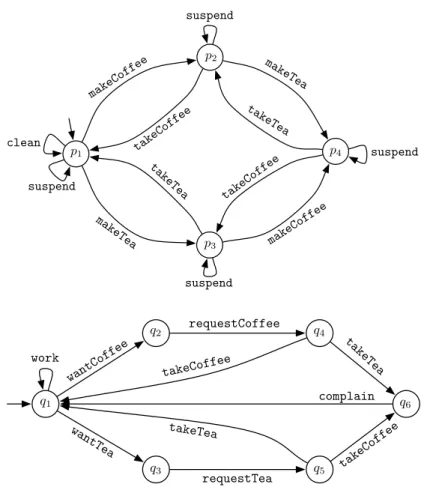
Figure 2.1: Transition systems of a beverage production machine (A1, above) and a
cus-tomer (A2, below)
Example 2.2. As an example, consider the transition systems in Figure 2.1. The first tran-sition system,A1, represents a beverage production machine capable of producing coffee
and tea. The states ofA1 represent the four different configurations of the machine, with
either no cup of beverage ready (statep1), a cup of coffee ready (statep2), a cup of tea ready
(statep3) or a cup of both tea and coffee ready (statep4). The transitions between the states
represent the production of a fresh cup of beverage (actionsmakeCoffeeandmakeTea), the removal of a cup by a customer (actionstakeCoffeeandtakeTea), the self-cleaning of the machine (actionclean) and a suspension of the machine (actionsuspend).
The other transition system in Figure 2.1,A2, represents the potential behavior of a
cus-tomer. After doing some work (action work), he may decide to either want a coffee or a tea (actions wantCoffee and wantTea). Then, he announces his choice (actions
requestCoffeeandrequestTea) and then grabs a cup of beverage (actionstakeCoffee
andtakeTea). If the cup contains a beverage that does not corresponds to his request, he will complain and go back to work. Otherwise, he is satisfied and goes back to work without complaining.
Combining bothA1 andA2 with the usual interleaving parallel construction for transition
2.3. Transition systems, observation and control Chapter 2. Preliminaries
systemA1k A2. The states ofA1 k A2are pairs of the state ofA1and the state ofA2and
the set of actionsActofA1k A2corresponds to the union of the actions ofA1andA2, i.e.,
Act ={work,wantCoffee,wantTea,requestCoffee,requestTea,
makeCoffee,makeTea,takeCoffee,takeTea,clean,suspend}.
The systemA1 k A2 then represents the potential behavior of the controllable part (the
beverage machine) as well as its environment (the customer).
To formalize the mechanism of control for the controllable part of the system and the inter-action with its environment, we provide a classification of the inter-actions in the system accord-ing to theircontrollabilityand theirvisibility.
LetActvis ⊆Act be the set of visible actions and letActctr⊆Actvisbe the set of control-lable actions. Here, we assume that all controlcontrol-lable actions are visible.
The subsetAct# ⊆ Actctr of the controllable actions contains the actions that signal the suspension of the controllable part of the system. The effect of the suspend action will be the deactivation of all the controllable actions until an uncontrollable, visible action occurs, “waking up” the controllable part of the system.
Observables, observations. The occurrence of visible actions can be observed and pro-vides knowledge about the state and history of the system that can be used in the decision making for controlling the system. It is useful to allow for a finer distinction than an action either being perfectly visible or not visible at all, i.e., to allow for the case that it may not be possible to distinguish between two visible actions. This is formalized by a mechanism that allows visible action to only be observed via theirobservables. LetObs be a finite set of observables and letobs : Actvis → Obs be a function assigning an observable to each visible actionα∈Actvis.
We assume that there are setsObs#⊆Obsctr ⊆Obswithobs(α)∈Obsctriffα ∈Actctr andobs(α)∈Obs#iffα∈Act#, i.e., that it is possible to ascertain whether a given action αhappens to be controllable or not and whether it is a suspend action or not by only taking into account the associated observablesobs(α).
We naturally extend the observation functionobs from individual, visible actions to finite or infinite sequences of visible and invisible actions by concatenating the observables, i.e.,
obs:Act∞→Obs∞withobs(α1α2α3. . .) =obs(α1)obs(α2)obs(α3). . . ,
where obs(α) is the empty word ε for invisible actions α. We refer to the elements of
Obs∞ as observations. The observation obs(π) of a finite or infinite execution π in A is the observation obs(α1α2α3. . .)of its action sequence. An observationσ ∈ Obs∞is
calledA-schedulable, briefly schedulable, if there exists an initial executionπ inAwith
obs(π) =σ.
We likewise extend the observation function to sets of actions, i.e.,obs : 2Act →2Obswith
obs(A) ={obs(α) :α∈A∩Actvis}.
Example 2.3. Reconsider the systemA1 k A2from Example 2.2 and Figure 2.1. We
Chapter 2. Preliminaries 2.3. Transition systems, observation and control
customer providing the environment for the machine and formalize the visibility and con-trollability of the actions in the system. The controllable actions correspond to the actions ofA1, the controllable part of the system, i.e.,
Actctr={makeCoffee,makeTea,takeCoffee,takeTea,clean,suspend}. For this example, we consider the requests of the customer to be visible, for example be-cause he pushes corresponding buttons that can be observed. The complaint is considered observable as well. Thus, the visible actions are the controllable actions combined with the actions representing the customer’s request and complaint, i.e.,
Actvis=Actctr ∪ {requestCoffee,requestTea,complain}. There is a single suspend action, i.e.,Act#={suspend}.
We consider here a scenario where all visible actions can be distinguished, i.e., where
Obs = Actvis and obs(α) = α for all α ∈ Actvis. An alternative scenario arises for example if the two visible request actionsrequestCoffeeandrequestTeabecome in-distinguishable, by mapping both actions to a single observablerequest. Then, a decision function can detect the occurrence of a customer’s request, but gains no knowledge of the specific choice of the customer, perhaps because there is only a single request button.
Decision functionsserve as a formalization of control. They describe observation-based scheduling policies for the controllable part of the system by offering sets of interactions.
Definition 2.4 (Decision function). Adecision function is a functiond : Obs∗ → 2Obs,
which provides a choice of permitted observables O ⊆ Obs for a given observation
σ∈Obs∗.
Via its choice, a decision function determines a subset of actions that are allowed to fire given a particular observable history. For a choiceO ∈2Obs, an actionαis calledcompliant
and thus permitted to fire ifαis either visible with its observable obs(α) ∈ O or ifα is invisible. For a stateq ∈ Qand choiceO ∈2Obs, the actions that are both compliant and
actually enabled in stateqis denoted by
Act(q, O) =α∈Act(q) :obs(α)∈Oorα /∈Actvis .
Ad-execution, i.e., an execution that is consistent with decision functiond, then arises by only choosing transitions with actions that are compliant with the choice of d given the observable history of the execution prefix up to that point.
Definition 2.5 (d-execution of a decision function). Let d be a decision function. An execution π=q0 α1 −→Aq1 α2 −→A q2 α3 −→A . . . inAis ad-executionif, for alli <|π|,
2.3. Transition systems, observation and control Chapter 2. Preliminaries
An observationσ = β1β2. . . ∈ Obs∞ is said to bed-schedulable ifβi ∈ d(β1. . . βi−1)
for all 0 6 i 6 |σ|. The set of initiald-executions thus coincides with the set of initial executions ofAthat haved-schedulable observations.
Note that a decision function is only able to partly influence the system. In particular, a decision function can not avoid that invisible actions fire. Likewise, if there are multiple enabled actions with the same observable in a state then the decision function only has the choice of allowing the observable and thus enabling all these actions or of disallowing the observable and thus disabling all these actions. Furthermore, the choice of the action that actually fires from the compliant actions and the concrete transition with a particular suc-cessor state for that action, i.e., resolution of the nondeterminism, happens outside the scope of the decision function.
A decision function in its pure form may exhibit a range of undesirable behaviors, which we address by requiring that well-behaved decision functions adhere to the notion of ad-missibility, dealing with three cases. In the first case, a decision function could counter-intuitively influence whether non-controllable actions are enabled by refusing to offer ob-servables for visible but non-controllable actions. For example, in the system considered in Example 2.3, a decision function could refuse to permit the observables of the visible actions requestCoffeeor requestTea, violating the assumption that these actions are visible but not controllable. In the second case, a decision function could disrespect a sus-pend signal by subsequently offering controllable actions even though the controllable part of the system (and thus all controllable actions) should be suspended. In the example, such a decision function would, e.g., allow the production of further beverage even though the machine is supposed to be suspended. The third case provides a mechanism that requires decision functions to only be the cause of termination of an execution explicitly via the suspend signal. This will later allow a coordinated, compositional decision making of mul-tiple decision functions whether termination is allowed by enabling or disabling the suspend signal. In the example, if the system state ishp4, q3i, i.e., there is both coffee and tea
avail-able and the customer is poised to take a beverage, the decision function could provide a restrictive choice that does not contain eithertakeCoffeeortakeTea, which would cause termination even though there was no suspend signal.
Non-blocking choice. To ensure that a decision function can not refuse enabled non-controllable actionsActvis\Actctr, the choice offered by the decision function must contain observables for these actions. As a result, these actions are compliant actions and remain enabled. This condition can be understood as “input enabledness” for the visible, but un-controllable actions. For a stateqand a choiceO ⊆Obs, this requirement translates to the condition that
obs(Act(q))∩(Obs\Obsctr) =obs(Act(q, O))∩(Obs\Obsctr),
i.e., that the set of observables of the non-controllable, visible and enabled actions in q
is preserved by the choice O. It will prove useful to partially relax this requirement by allowing the grouping of non-controllable actions that can be considered equivalent for the purposes of “input enabledness” and requiring that a decision function offers at least one observable for each group. For this purpose, we use a partitionUObs = {U1, . . . , Uk} of
Chapter 2. Preliminaries 2.3. Transition systems, observation and control
stateq ∈Q, a choiceO ∈2Obsis then considered to benon-blockingiff for eachU ∈ U Obs
obs Act(q)∩U 6=∅ =⇒ obs Act(q, O)∩U 6=∅,
i.e., if there are one or more enabled observables inqbelonging toU then the choiceOhas to preserve at least one of them. In contrast, we say a choiceOisblockingfor stateq ∈Q
iff the choice is not non-blocking forq.
Initially, the visible, but uncontrollable actions are simply grouped by their observables, i.e.,UObs =
{obs(α)}:α∈Actvis\Actctr . For this partition, a non-blocking choiceO ensures thatα ∈Act(q)∩(Actvis\Actctr)impliesα ∈ Act(q, O). Later, when building the product of a transition system with controllers, we will iteratively adaptUObs to ensure
on the one hand that the visible but uncontrollable actions are not blocked but on the other hand that the choices are not restricted unnecessarily.
Passive choice. To denote choices that are consistent with a decision function respecting that the controllable part of the system has been suspended, we say a choiceO ∈ 2Obs is
passiveifO∩Obsctr=∅, i.e.,Ocontains only observables of uncontrollable actions.
Progressive choice. A well-behaved decision function should honor a maximal progress assumption, i.e., as long as there are enabled actions inA, the decision function should ensure via its choice that there remains at least one enabled compliant action unless the controllable part of the system has been suspended. For a stateq, a choice O ∈ 2Obs is
consideredprogressiveifAct(q)6=∅impliesAct(q, O)6=∅.
Definition 2.6 (Admissibility). A decision functiondisadmissibleiff it satisfies all of the following three conditions:
(A1) For all finite, initial d-executionsπ = q0 α1
−→A . . . −→αn A qn, the choiced obs(π) of the decision function is non-blocking for stateqn.
(A2) d(σ)is passive for allσ ∈Obs∗Obs#, i.e., where the last observable in the
observa-tion signals the suspension of the controllable part of the system. (A3) For all finite, initial d-executions π = q0
α1
−→A . . . −→αnA qn with an observation
obs(π)∈/ Obs∗Obs#, i.e., where the controllable part of the system is not suspended,
the choiced obs(π)is progressive for stateqn.
We will later adapt the notion of admissibility (and the notions that rely on admissibility) to take fairness conditions ofAinto account.
The admissibility of a decision function with regard to conditions (A1) and (A3) depends on the transition systemA, while condition (A2) is a purely syntactical requirement. We say a decision functiondrespects suspendif it satisfies condition (A2), i.e., its choices for observations ending with an observable inObs#are passive.
Remark 2.7. It is always possible to specify an admissible decision function for a given system. Consider the decision functiond, with
d(σ) =
(
Obs iflast(σ)6∈Obs#orσ =ε
2.3. Transition systems, observation and control Chapter 2. Preliminaries
for allσ∈Obs∗. It satisfies conditions (A1) and (A3) by always scheduling all observables for the observations that do not end in a suspend signal and satisfies (A2) by not scheduling the controllable observables for those observations that do end in a suspend signal.
Path.Refining the notion of an execution, a path captures “complete” behavior, relying on the maximal progress assumption both for the controllable part of the system as well as for the environment, with special treatment for the suspend mode.
Definition 2.8 (Path inA). An executionπ inA is called a path if one of the following three conditions holds:
• πis infinite, or
• πis finite and ends in a terminal state, i.e.,Act(last(π)) =∅, or
• πis finite, the last observable is a suspend signal,obs(π)∈Obs∗Obs#, and there are
no enabled uncontrollable actions in the last state ofπ,Act(last(π))\Actctr=∅. The third condition captures the case where termination occurs because the controllable part of the system and thus all controllable actions are suspended.
Later, in Section 4, we will augment the transition systems with a suitable fairness condition and will update the definition of paths to take this fairness into account.
Definition 2.9 (d-path). A d-execution π is called a d-path if π is either an infinite d -execution or a finited-execution ending in a state where no compliant actions are enabled, i.e.,Act(last(π),d(obs(π))) =∅.
Ad-path is thus ad-execution that only terminates if there are no more compliant actions. Note that clearlyd-executions are executions inA. Furthermore, by satisfying conditions (A2) and (A3) of Definition 2.6, admissible decision functionsdensure that alld-paths are paths inA.
Enforcing objectives. In this thesis, we consider linear time objectives Φ, which can be formalized in its most general form as a subset of the potential finite and infinite executions of the system, i.e.,Φ⊆Q×(Act ×Q)∞. For a pathπofA, we sayπsatisfiesΦ, denoted byπ |= Φ, ifπ ∈Φ. Likewise, a transition system satisfies objectiveΦ,A |= Φ, if all paths ofAsatisfyΦ.
Definition 2.10 (Enforcing objective). A decision functiondenforcesan objectiveΦifd
is admissible and if alld-paths satisfyΦ.
The requirement of admissibility ensures that only well-behaved decision functions can successfully enforce an objective.
Example 2.11. To illustrate enforcement of objectives, we return to the system of the bev-erage machine and the customer. Let us consider as the objective that the customer should never complain, i.e.,
Chapter 2. Preliminaries 2.3. Transition systems, observation and control
The following decision function is an example that enforces objectiveΦ, withσ ∈Obs∗.
d(σ) =
{requestCoffee,requestTea,produceCoffee} iflast(σ) =requestCoffee
{requestCoffee,requestTea,produceTea} iflast(σ) =requestTea
{requestCoffee,requestTea,takeTea} iflast(σ) =produceTea
{requestCoffee,requestTea,takeCoffee} iflast(σ) =produceCoffee
{requestCoffee,requestTea} else
By always permitting the visible but not controllable observables requestCoffee and
requestTea, the decision function ensures that condition (A1) of admissibility is always satisfied. It then ensures that the objective is satisfied by responding to the customer’s re-quest by producing the appropriate beverage and allowing the customer to take it. An alter-native would be to always produce both beverages, but to only allow the customer to take the correct beverage, refusing to schedule thetakeCoffeeaction if the last customer’s request wasrequestTeaand vice versa. Another decision function that enforces the objectiveΦ is the following “lazy” decision functiondwhich always tries to suspend the machine,
d(σ) =
(
{requestCoffee,requestTea,suspend} iflast(σ)6=suspend
{requestCoffee,requestTea} iflast(σ) =suspend
By refusing to produce any coffee,davoids triggering the complaint of the customer but nonetheless leaves him unsatisfied. A similar situation arises for a decision function that continuously cleans the machine instead of producing coffee or tee. We could therefore refine the objective by requiring that, in addition, every request for a beverage is eventually followed by the customer taking a beverage.
We can see that there are a myriad of other decision functions, perhaps ensuring other objec-tives in addition, e.g., that the machine should always be cleaned before producing a fresh beverage, should be cleaned every other coffee, etc. On the other hand, certain objectives have no decision function that can enforce them. For example the objective that eventually the customer takes a beverage can not be enforced, as it is possible that he will continuously work and never want a beverage, which can not be influenced by any decision function. Likewise, the objective that the customer may never request a tea can not be enforced, as the corresponding observable is not controllable.
The ability to enforce an objective crucially depends on the knowledge about the state of the system given an observable history. For example, if we change the visibility of the request actions by making requestCoffee and requestTea indistinguishable, there is no decision function that can serve a beverage while ensuring that the customer will never complain.
Equivalence modulo unschedulable choices.Two decision functionsd1andd2may differ
in some of their choices, but these differences may nevertheless be irrelevant in their effect onA, as the corresponding observations can never be scheduled.
2.3. Transition systems, observation and control Chapter 2. Preliminaries
Definition 2.12 (Equivalent modulo unschedulable choices).
Two decision functionsd1,d2:Obs∗ →2Obsareequivalent modulo unschedulable choices
if, for each observationσ ∈Obs∗that is bothd1-schedulable andd2-schedulable and each
observableβ∈Obs, the following condition holds:
IfσβisA-schedulable thenβ ∈d1(σ)iffβ ∈d2(σ).
As a consequence, ifd1 andd2 are equivalent modulo unschedulable choices, the sets of d1-executions andd2-executions inAcoincide, as well as the sets of their paths. The notion
of equivalence modulo unschedulable choices allows for a more concise representation of a set of decision functions that only differ syntactically in an irrelevant manner by identifying them. By stripping the unschedulable observables from the choices of a decision function
d, we obtain a decision function d0 that is equivalent modulo unschedulable choices and schedules only schedulable observables:
Definition 2.13. A decision functiond:Obs∗ →2Obs schedules only schedulable
observ-ables(inA) if, for each observationσ ∈Obs∗ that isd-schedulable,β ∈d(σ)implies that the observationσβisA-schedulable.
Chapter 3
Strategies and Controllers
To support synthesis in a compositional manner it is crucial that all the different ways how an objective can be enforced are not ruled out prematurely. We reconsider the example Figure 1.1 in the introduction, now in the context of the beverage machine example and using the formalism of decision functions. Consider the small fragment in Figure 3.1 of the beverage machine from our running example and the objective that eventually coffee is produced, i.e., the reachability objective “eventually statep2”.
p
1p
2clean
produceCoffee
Figure 3.1: A small fragment of the transition system of the beverage machine
We assume here that all actions are controllable and visible and identify observables and actions. A straightforward decision function enforcing the objective would bedwith
d(ε) ={produceCoffee}andd(produceCoffee) =∅.
This decision function is very restrictive and rules out other ways to enforce the objective, for example ones that require that some cleaning happens before making a coffee, such as the decision functionsdkwith
dk(cleani) ={clean}for06i6kanddk(cleank+1) ={produceCoffee}
which enforce the objective as well, schedulingkcleanings before producing the coffee. A variant that usesdk(cleani) ={clean,produceCoffee}for06i6k, i.e., that
sched-ules up tokcleanings before producing the coffee, likewise enforces the objective. There-fore, all three choices{produceCoffee},{clean}as well as{clean,produceCoffee}
are legal choices for the observable histories cleani, i ∈ N, for some decision
func-tion that enforces the objective. On the other hand, a decision funcfunc-tion that tries to be as permissive as possible by combining all the legal choices, i.e., that offers the choice
3.1. Strategies Chapter 3. Strategies and Controllers
{clean,produceCoffee}for all observable historiescleani,i∈N, does not enforce the objective, as it is possible given that choice that alwayscleanis chosen. This demonstrates that the notion of a decision function is too limited to allow decision functions that are truly as permissive as possible, even for relatively simple objectives such as the reachability objective used in the example.
To overcome this limitation, we introduce a notion of strategies as generators of decision functions. The notion of a most general strategy for some objective then corresponds to the inclusion of all decision functions enforcing the objective in the strategy. A strategy consists of two main parts, adecision function template, which specifies all the legal choices for a given observable history as well as a fairness condition that restricts the generation of a decision function from the legal choices. In the example above, the fairness condition can be used to ensure that from the legal choices eventually the choice{produceCoffe}has to be picked. We demonstrate later that a third ingredient, the concept of annotating choices and observations, is required in our notion of strategy to obtain most general strategies for some objectives.
3.1
Strategies
Annotated observables, observations. Given a finite, non-empty set of annotationsAnn, we allow the observables in Obs to be annotated with elements from Ann, yielding the set of annotated observables Obs = Obs ×Ann. For an observable β ∈ Obs and an annotation a ∈ Ann we write hβ,ai or βa to denote the annotated observable,
depend-ing on convenience. An annotation function represents a policy to decorate observables with annotations in a history-dependent manner. Formally, an annotation function is a function ann : Obs∗ ×Obs → Ann. It induces an inductively defined transformation
ann∗ : Obs∗
→ Obs∗ of observations into their annotated versions: ann∗(ε) = ε and
ann∗(σβ) =ann∗(σ)hβ,ann(σ, β)ifor allσ∈Obs∗andβ∈Obs.
We use annotated versions of the concepts related to decision functions, such as annotated decision functionsd0 :Obs∗ →2Obs, mapping annotated observations to annotated choices O ∈ 2Obs, etc. To strip the annotations, we write hβ,ai|
Obs = β for annotated
observ-ables,σ0|Obs =β1β2. . .for annotated observationsσ0 =hβ1,a1ihβ2,a2i. . .∈Obs∞and O|Obs ={β :hβ,ai ∈O}for annotated choicesO∈2Obs.
Definition 3.1 (Strategy). A strategy is a tupleS= (D,Fair,Ann)where
• D:Obs∗ →22Obs
is a decision function template, providing a set of annotated legal choices for given annotated observations, such that the following conditions (i) and (ii) hold for all annotated observationsσ0 ∈Obs∗:
(i) D(σ0)6=∅,
(ii) O|Obs is passive for allO∈D(σ0)ifσ0|Obs ∈Obs∗Obs#.
• Fair=F1, . . . ,F` is a fairness condition consisting of finitely many subsetsFj of Obs∗×2Obs such thatO∈D(σ0)for all(σ0,O)∈F1∪. . .∪F`.
Chapter 3. Strategies and Controllers 3.1. Strategies
ForF∈Fairandσ0 ∈Obs∗, we writeF(σ0)for the setO∈2Obs : (σ0,O)∈F . Condition (i) in the definition of a strategy ensures that the decision function template al-ways offers at least one choice, while condition (ii) ensures that only passive choices are offered for observations ending with a suspend signal, i.e., that conform to condition (A2) of admissibility.
A strategy serves as a generator for decision functions, calledinstancesof a strategy. We begin with the set ofannotated instances, i.e., decision functions overObsthat are gen-erated from the decision function template of the strategy in a fair way. Plain instances, decision functions overObs, are then obtained from the annotated instances by stripping the annotations.
Definition 3.2 (Annotated instance). A decision function d0 : Obs∗
→ 2Obs is called
anannotated instanceofSifd0 can be generated by the templateDin a fair way, i.e., if conditions (I1) and (I2) hold:
(I1) d0(σ0)∈D(σ0)for alld0-schedulable annotated observationsσ0 ∈Obs∗ (I2) d0 respectsFair, i.e., for each infinited0-schedulable annotated observation
σ0 =β10β20β30 . . .∈Obsω and for eachF∈Fair, either (I2.1) or (I2.2) holds:
(I2.1) There are only finitely many positionsi>1whereF(β10 . . . βi0)6=∅.
(I2.2) There are infinitely manyi>1withd0(β10 . . . βi0)∈F(β10 . . . βi0).
EachF ∈ Fair thus imposes a strong fairness condition on selecting a choice from the decision function template, requiring that during the generation ofd0 for an observation, if it is infinitely often possible to pick a fair choice,F(σ0) 6= ∅, then such a fair choice is infinitely often picked,d0(σ0) ∈ F(σ0). The definition of the fairness condition in Defini-tion 3.1, requiring that, for allσ0 ∈Obs∗, eitherF(σ0) =∅orF(σ0)⊆D(σ0)ensures that the fair choices are actually legal choices of the decision function template. In aggregate, the fairness condition Fair imposes the conjunction of the individual fairness conditions
F∈Fairand thus represents a conjunction of strong fairness conditions for the generation of the annotated instances.
Definition 3.3 (Plain instance). A decision functiond : Obs∗ → 2Obs is called aplain
instanceof a strategySif there exists an annotated instanced0 : Obs∗ → 2Obs ofSand an annotation functionann: Obs∗ ×Obs → Annsuch that dis generated by d0 via the annotation functionann, i.e., for alld-schedulable observationsσ ∈ Obs∗ the choice ofd
is obtained from the corresponding annotated choice ofd0by stripping the annotations,
d σ=d0 ann∗(σ)|Obs.
Plain instances are thus obtained from the annotated instances of a strategy by stripping away the annotations, as the annotations are only needed during the generation from the decision function template.
3.1. Strategies Chapter 3. Strategies and Controllers
q0 β q1
α β
α
Figure 3.2: Example transition system for the objective “eventuallyq1”
Often, to provide a more concise definition of a strategy, it is useful to not only consider the plain instances directly generated by the strategy but all the decision functions that are equivalent modulo unschedulable choices to the plain instances (see Definition 2.12).
Definition 3.4 (A-instance). A decision function d : Obs∗ → 2Obs is said to be an A
-instance, or briefly instance, of a strategy S, if it is equivalent modulo unschedulable choices to a plain instance ofS.
Executions, paths, admissibility, enforcement for strategies. The notions of an execu-tion and path of a strategy as well as the admissibility and enforcement of an objective by a strategy are obtained by considering the generated instances of a strategy. An execution inAis called anS-executionif it is ad-execution for some instancedofS. S-paths are defined accordingly.Sis calledadmissibleif all instances ofSare admissible. A strategy
SenforcesΦif all instancesdofSenforceΦ. An objectiveΦis calledenforceableif there is a decision function/strategy that enforcesΦ.
Remark 3.5 (Plain strategy). Some strategies do not actually have a need for annotations and use a singleton set of annotations Ann. In this case, the annotations are irrelevant as there is exactly one way to annotate the observables. We call strategies with a single an-notation aplain strategy S= (D,Fair)and omit the setAnn, identifyingObs andObs. For plain strategies, the notions of annotated instance and plain instance coincide, the de-cision function templates have the formD:Obs∗ →22Obs and the fairness conditionFair
consisting of finitely many subsets ofObs∗×2Obs.
Example 3.6. To provide an example for strategies, consider the transition system A in Figure 3.2. We assume both actionsα andβ to be visible and controllable (non-suspend) actions and consider the objective♦q1(“eventuallyq1”). We identify the visible actions and
their observables. A strategy that enforces♦q1is the plain strategyS1= (D,Fair)with the
decision function template given byD(σ) ={β} for all observationsσ ∈Obs∗ and an empty fairness conditionFair =∅. The instances dofS1 are then the decision functions dwith d(β∗) = {β}. Observationsσ that are not of the formβ∗ are notS
1-schedulable
and thus irrelevant, the instances can offer any subset of Obs for those observations, i.e.,
d(σ)⊆ {α, β}forσ /∈β∗.
Consider as another example the following strategyS2 = (D,Fair,Ann) with the set of
annotationsAnn={1,2}. The decision function template is given by
D(σ) =
(
{α1},{α2} ifσ =εorlast(σ) =α1
{β2} iflast(σ) =α2orlast(σ) =β2
The annotated instances ofS2are then those annotated decision function that either

![Table 5.1: Properties of the fairness condition of the product automaton Fair[ A ./ C] given input fairness condition Fair[ A] for a most general controller C enforcing an objective and constructed by the algorithms considered in Chapters 6 and 7](https://thumb-us.123doks.com/thumbv2/123dok_us/10216300.2925475/53.892.213.702.193.297/properties-condition-automaton-condition-controller-constructed-algorithms-considered.webp)