DATA PLACEMENT AND MIGRATION STRATEGIES FOR VIRTUALISED
DATA STORAGE SYSTEMS
H.A. Bond N.J. Dingle F. Franciosi P.G. Harrison W.J. Knottenbelt
Department of Computing, Imperial College London, South Kensington Campus, London SW7 2AZ
Email: {hab06,njd200,ozzy,pgh,wjk}@doc.ic.ac.uk
KEYWORDS
Storage virtualisation, Data placement and migration
ABSTRACT
This paper details a simulation intended to explore the viability of storage systems where data is placed in-telligently depending on data-specific quality of service requirements and the characteristics of the underlying storage devices. Our implementation provides a frame-work for the automatic profiling of a virtualised storage system, specification of data-level quality of service re-quirements, simulation of data streams acting on the
storage system and visualisation of the results. We
demonstrate that an intelligent data placement algo-rithm can achieve a good match between desired and offered storage system quality of service.
INTRODUCTION
The volume of data produced world-wide continues to grow. In the second quarter of 2008, shipped disk stor-age capacity was 1 777 petabytes, representing growth
of 43.7% year on year1. Indeed, the International Data
Corporation (IDC) forecasts that shipped disk storage capacity will increase at a compound annual rate of 38% for the next three years (Rydning and Reinsel, 2009). Recently there has been a trend towards centralised stor-age systems, with the aim of reducing manstor-agement over-head and lowering total cost of ownership. These sys-tems are usually implemented in the form of a Virtu-alised Storage System (VSS), i.e. a contiguous logical volume where the underlying storage devices (e.g. solid
state disks, RAID arrays, etc.) are abstracted away.
Different devices provide very different storage charac-teristics, however, and their abstraction makes the job of efficiently placing data far more complex.
Performance is key to many users, but it is not the only characteristic to take into account when using VSSs. Reliability is another very important aspect, as is space efficiency. Throughout this paper we refer to these data considerations as Quality of Service (QoS). For exam-ple, a bank’s transaction records have to be stored in a fashion that guarantees high reliability. A temporary
1Source: IDC press release, 5 September 2008 (http://www.
idc.com/getdoc.jsp?containerId=prUS21411908)
file, by contrast, probably needs only high performance. Data placement is a very important aspect of this prob-lem, but the QoS attributes and the patterns in which data is accessed are not static and might change over time for different data streams. This implies that not only initial allocation must be considered but also mi-gration, to ensure delivered QoS remains as close to that required by the user as possible on a sustained basis. A number of other projects have investigated similar
ideas in terms of intelligent data placement. BORG
(Block-reORGanization and Self-optimization in Stor-age Systems) (Bhadkamkar et al., 2009) is a module for the Linux kernel which sits between the file system layer (e.g. ext3, JFS, NTFS etc) and the I/O scheduler. It constantly evaluates process access patterns based on temporal, process-level, and block-level attributes and constructs access pattern graphs.
In Franciosi and Knottenbelt (2009), the authors present a modification of the well-known ext3 file system to in-clude QoS attributes, which exploits redundant bits in the individual inodes to mark QoS attributes for sets of data. The system will use these attributes along with a performance profile of the underlying storage devices to intelligently place data.
This paper describes a simulation of a system which allocates and migrates data depending on a set of user-specified QoS requirements and the characteristics of the underlying VSS. We begin with a brief overview of modern storage systems, before detailing the design and implementation of our simulator. We describe how our simulation automatically profiles a VSS’s logical address space to create a multi-attribute QoS model of the de-vice, and then outline how the user specifies their QoS requirements and the characteristics of the data streams that will be used to drive the simulation. We further present the allocation and migration techniques that we have implemented, and show how the simulator visu-alises the resulting data layout and performance for the user. Finally, we present a number of case studies of the use of the simulator before concluding.
BACKGROUND
Today the most common storage medium is the hard disk drive. This device consists of a mechanical read/ write head which moves over a spinning disk made of
fer-romagnetic material. Multiple hard disks can be used to improve performance and reliability, typically using one of the Redundant Array of Inexpensive Disks (RAID) levels. In this work we focus on the most commonly used configurations: RAID 0 (striping without redundancy), RAID 1 (mirroring), RAID 5 (distributed parity) and RAID 10 (stripes of mirrors). We note that our work could easily be extended to model additional schemes such as RAID 6 (double distributed parity).
RAID Performance Data Space
Level Read Write Reliability Efficiency
0 H H L H
1 H L H L
5 M L/M M M
10 M/H L/M H L
Table 1: Summary of RAID characteristics. Each RAID level offers different trade-offs between per-formance, reliability and space efficiency, as summarised in Table 1. For example, RAID 0 offers very high per-formance as disk accesses can be performed in parallel and its space efficiency is also very good since it stores no redundant data. Its reliability is, however, poor as if one drive fails then data will be lost. On the other hand, RAID 1 offers very good reliability as it maintains a copy of all data so that if one drive is lost, all data on it can be recovered from the mirror. It also offers very good read performance as either disk can be ac-cessed for a particular piece of data. Write performance is degraded, however, as a request must be serviced by both disks, and it is not particularly space-efficient as it requires twice the number of drives to store the same volume of data as RAID 0.
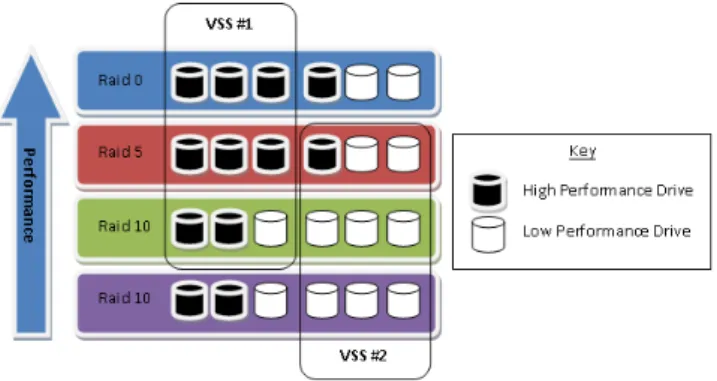
Figure 1: Two VSSs spread over four different storage tiers ordered by performance
It is not as easy to characterise VSSs in these terms, however. Figure 1 shows two VSSs spread over an in-frastructure consisting of four different tiers, and that consequently provide different QoS attributes. VSS #1 will have a very good performance profile due to the majority of its underlying storage devices being of high performance and in fast RAID configurations. VSS #2,
by contrast, does not provide such good performance but does provide good data reliability, as every single tier keeps redundancy data.
Data Stream Characteristics
Data Stream A Data Stream B
System critical Non-critical
>50% read requests 100% write requests
100% sequential 100% non-sequential
Requests typically small Requests typically large
Table 2: Example QoS requirements for 2 data streams. The central concept of this work is that if we know the characteristics of the requests made to a VSS on a
per-application basis (which we term adata stream) and also
the user’s QoS requirements for that stream, we can exploit intelligent data placement strategies to deliver better QoS. Consider the situation where Stream A and Stream B both want to access data on the same VSS. The QoS requirements for the two streams are given in Table 2. The most suitable place on the logical partition for data from Stream A is very likely to be different from the most suitable place for the data from Stream B. We consider three QoS requirements:
• Performance
• Reliability
• Space efficiency.
It is important to note that the QoS attributes for data are not static. We therefore consider not just the initial placement of data according to its requirements and the attributes of the underlying storage system, but also its migration within the storage system in response to changing access patterns and QoS requirements. Ideally this migration should be done automatically to minimise the management overhead of the VSS.
PROFILING
In order to simulate a VSS faithfully, it is necessary to quantify the performance, reliability and space efficiency of every one of its (logical) block groups.
We characterise performance by throughput, which we measure in KB/s. We have implemented an automatic profiler which runs on a real VSS and issues block group-level requests and records the time that they take to complete. As input, we consider sequential and random accesses of two different request sizes (large and small) for both reads and writes, for a total of 8 possible combi-nations. The resulting times are then processed to yield the average throughput for each block group under each of these I/O patterns.
It is then necessary to classify the performance of ar-eas of the underlying storage as either Low, Medium or High. These classifications should be relative to the underlying storage and not absolute since the profiler should not be dependent on the system it runs. We first
find the throughput which lies on the 33rd percentile
and the 66th percentile. Any throughput which lies
be-low the 33rdpercentile is classified as Low, between the
33rd percentile and the 66th percentile is classified as
Medium and anything greater than the 66th percentile
is classified as High.
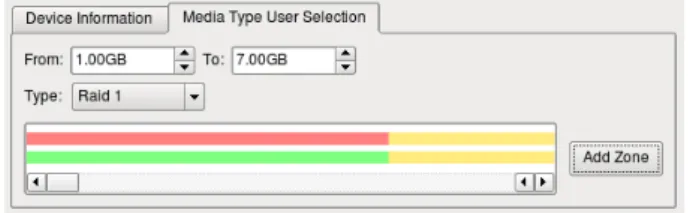
Figure 2: The GUI for selecting device types within logical address ranges.
When profiling reliability and space efficiency, the ab-straction of devices within a VSS is a problem since the profiler cannot automatically gather the required infor-mation. Instead we must rely on the user’s knowledge of the makeup of the VSS, and we thus provide a tool to enable the user to manually choose the types of devices comprising the VSS and to specify the logical address range to which they correspond. Figure 2 shows an ex-ample of a VSS where the range 1GB-7GB describes a RAID 1 device and 7GB onwards describes a RAID 5 device. The coloured strips represent space efficiency (upper) and reliability (lower), where red corresponds to Low, yellow to Medium and green to High. From this and the RAID characteristics in Table 1, we automati-cally create a per block group classification of reliability and space efficiency in terms of High, Medium and Low.
SIMULATION
In real systems a ‘sea’ of requests will be made to the storage from a variety of sources. For example, the sys-tem may be a file server containing users’ home directo-ries, while at the same time it may also house a database
server storing experimental data. In order to
simu-late such situations we introduce the concept of data streams, and for each of these in a simulation the user must identify the following characteristics:
• Arrival Rate: the average number of I/O
opera-tions per unit time (assumed to arrive according to a Poisson process).
• Performance Required: High, Medium or Low
• Reliability Required: High, Medium or Low
• Space Efficiency Required: High, Medium or Low
• Data Size: The expected proportion of Small:Large
data accesses
• Order of Access: The expected proportion of
Se-quential:Random data accesses
• I/O Type: The expected proportion of Read:Write
data accesses
Events and Event Generation
In order to achieve realistic simulation results there are three main points to consider:
• Which stream triggers the event
• What type of event (read or write) is triggered
• Amount of time until the next event
The likelihood of a particular stream being chosen
de-pends on its arrival rate, and is calculated as rateP(stream)
irate(i)
. After the stream has been selected, the type of I/O op-eration issued by that stream needs to be generated. These can be either reads or writes; we further distin-guish between three types of write event: data creation, data deletion and data modification.
To drive the utilised capacity of the file system towards
a target capacity, t, given space usagec, we require:
c > t −→ P(delete)> P(create)
c=t −→ P(delete) =P(create)
c < t −→ P(delete)< P(create)
We therefore use the following probabilities to calculate if a write operation is a modify, a create or a delete:
P(modify) = kmodify P(create) = 1−P(delete) P(delete) = (xk delete 2t c≤t (x−t)kdelete 2(1−t) + kdelete 2 otherwise
The constantskmodify,kcreate andkdelete are set to 23, 16
and 16 respectively in the implementation.
It is assumed that events occur with
exponentially-distributed inter-arrival times, with rateλ=P
irate(i). Intelligent Data Placement and Migration
The result of the profiling step is that we have a char-acterisation of every block group on the VSS in terms of performance, reliability and space efficiency. We also have matching QoS requirements for each data stream under the same three headings. The key challenge now is to place the data from the input streams on the VSS in such a way that these requirements are met as far as
is possible. To achieve this we define and use a
LLL LLM LLH LML LMM LMH LHL LHM LHH MLL MLM MLH MMLMMMMMH MHLMHM MHH HLL HLM HLH HMLHMM HMH HHL HHM HHH LLL 0 -4 -8 -2 -6 -10 -4 -8 -12 -1 -5 -9 -3 -7 -11 -5 -9 -13 -2 -6 -10 -4 -8 -12 -6 -10 -14 LLM 4 0 -4 2 -2 -6 0 -4 -8 3 -1 -5 1 -3 -7 -1 -5 -9 2 -2 -6 0 -4 -8 -2 -6 -10 LLH 8 4 0 6 2 -2 4 0 -4 7 3 -1 5 1 -3 3 -1 -5 6 2 -2 4 0 -4 2 -2 -6 LML 2 -2 -6 0 -4 -8 -2 -6 -10 1 -3 -7 -1 -5 -9 -3 -7 -11 0 -4 -8 -2 -6 -10 -4 -8 -12 LMM 6 2 -2 4 0 -4 2 -2 -6 5 1 -3 3 -1 -5 1 -3 -7 4 0 -4 2 -2 -6 0 -4 -8 LMH 10 6 2 8 4 0 6 2 -2 9 5 1 7 3 -1 5 1 -3 8 4 0 6 2 -2 4 0 -4 LHL 4 0 -4 2 -2 -6 0 -4 -8 3 -1 -5 1 -3 -7 -1 -5 -9 2 -2 -6 0 -4 -8 -2 -6 -10 LHM 8 4 0 6 2 -2 4 0 -4 7 3 -1 5 1 -3 3 -1 -5 6 2 -2 4 0 -4 2 -2 -6 LHH 12 8 4 10 6 2 8 4 0 11 7 3 9 5 1 7 3 -1 10 6 2 8 4 0 6 2 -2 MLL 1 -3 -7 -1 -5 -9 -3 -7 -11 0 -4 -8 -2 -6 -10 -4 -8 -12 -1 -5 -9 -3 -7 -11 -5 -9 -13 MLM 5 1 -3 3 -1 -5 1 -3 -7 4 0 -4 2 -2 -6 0 -4 -8 3 -1 -5 1 -3 -7 -1 -5 -9 MLH 9 5 1 7 3 -1 5 1 -3 8 4 0 6 2 -2 4 0 -4 7 3 -1 5 1 -3 3 -1 -5 MML 3 -1 -5 1 -3 -7 -1 -5 -9 2 -2 -6 0 -4 -8 -2 -6 -10 1 -3 -7 -1 -5 -9 -3 -7 -11 MMM 7 3 -1 5 1 -3 3 -1 -5 6 2 -2 4 0 -4 2 -2 -6 5 1 -3 3 -1 -5 1 -3 -7 MMH 11 7 3 9 5 1 7 3 -1 10 6 2 8 4 0 6 2 -2 9 5 1 7 3 -1 5 1 -3 MHL 5 1 -3 3 -1 -5 1 -3 -7 4 0 -4 2 -2 -6 0 -4 -8 3 -1 -5 1 -3 -7 -1 -5 -9 MHM 9 5 1 7 3 -1 5 1 -3 8 4 0 6 2 -2 4 0 -4 7 3 -1 5 1 -3 3 -1 -5 MHH 13 9 5 11 7 3 9 5 1 12 8 4 10 6 2 8 4 0 11 7 3 9 5 1 7 3 -1 HLL 2 -2 -6 0 -4 -8 -2 -6 -10 1 -3 -7 -1 -5 -9 -3 -7 -11 0 -4 -8 -2 -6 -10 -4 -8 -12 HLM 6 2 -2 4 0 -4 2 -2 -6 5 1 -3 3 -1 -5 1 -3 -7 4 0 -4 2 -2 -6 0 -4 -8 HLH 10 6 2 8 4 0 6 2 -2 9 5 1 7 3 -1 5 1 -3 8 4 0 6 2 -2 4 0 -4 HML 4 0 -4 2 -2 -6 0 -4 -8 3 -1 -5 1 -3 -7 -1 -5 -9 2 -2 -6 0 -4 -8 -2 -6 -10 HMM 8 4 0 6 2 -2 4 0 -4 7 3 -1 5 1 -3 3 -1 -5 6 2 -2 4 0 -4 2 -2 -6 HMH 12 8 4 10 6 2 8 4 0 11 7 3 9 5 1 7 3 -1 10 6 2 8 4 0 6 2 -2 HHL 6 2 -2 4 0 -4 2 -2 -6 5 1 -3 3 -1 -5 1 -3 -7 4 0 -4 2 -2 -6 0 -4 -8 HHM 10 6 2 8 4 0 6 2 -2 9 5 1 7 3 -1 5 1 -3 8 4 0 6 2 -2 4 0 -4 HHH 14 10 6 12 8 4 10 6 2 13 9 5 11 7 3 9 5 1 12 8 4 10 6 2 8 4 0
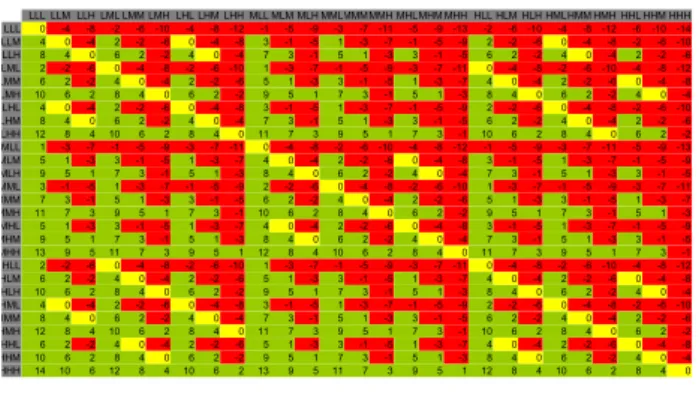
Figure 3: Request-Receive matrix displaying scores for
requested and delivered QoS.
Figure 3 is an example of a Request-Receive matrix.
The columns represent the possible QoS requirements of a data stream (high, medium or low in each of the three categories of performance, reliability and space ef-ficiency), and the rows represent the possible attributes of the block groups of the VSS. The values in the matrix encode the match between the QoS required by the data stream and offered by locations on the VSS, where zero implies perfect match, positive numbers imply delivered QoS is better than requested QoS, and negative scores that delivered QoS is worse than requested QoS. To calculate this matrix the user is asked to specify how much they value performance over reliability over space
efficiency by choosing three integer constantskP,kRand
kS respectively. The rating for a particular combination
of QoS requirements against those offered by the VSS is then calculated as:
kP×(Precv−Preq)+kR×(Rrecv−Rreq)+kS×(Srece−Sreq)
where Px,Rx andSx are 3 for high, 2 for medium and
1 for low. The constants used in Figure 3 werekP = 1,
kR= 2 andkS = 4. LLL HHH MHH HMH LHH MMH HLH HHM LMH MLH MHM HMM LLHLHM MMM LMM HHL HLM MHL MLM HML LLM LHL MML LML HLL MLL LLL LLM HHH MHH LHH HMH MMH LMH HHM HLH MLH MHM HMM LHM LLH MMM HLM LMM HHL MLM MHL HML LLM LHL MML LML HLL MLL LLL LLH HHH MHH HMH LHH MMH HLH HHM LMH MLH MHM HMM LLHLHM MMM LMM HLM HHL MLM MHL HML LLM LHL MML LML HLL MLL LLL LML HHH MHH LHH HMH MMH HHM HLH LMH MLH MHM HMM LLHLHM MMM HLM HHL LMM MLM MHL HML LHL LLM MML HLL LML MLL LLL LMM HHH MHH HMH LHH MMH LMH HLH HHM MLH MHM HMM LHM LLH MMM HLM LMM HHL MLM MHL LLM HML LHL MML HLL LML MLL LLL LMH HHH MHH HMH LHH MMH HLH HHM LMH MHM MLH HMM LHM LLH MMM HHL HLM LMM MHL MLM LHL HML LLM MML LML HLL MLL LLL LHL HHH MHH LHH HMH MMH LMH HLH HHM MLH MHM HMM LHM LLH MMM HLM LMM HHL MLM MHL HML LLM LHL MML HLL LML MLL LLL LHM HHH MHH HMH LHH MMH HLH HHM LMH MHM MLH HMM LHM LLH MMM LMM HLM HHL MLM MHL LHL HML LLM MML LML HLL MLL LLL LHH HHH MHH LHH HMH MMH LMH HHM HLH MLH MHM LLH HMM LHM MMM HLM LMM HHL MHL MLM HML LLM LHL MML HLL LML MLL LLL MLL HHH MHH HMH LHH MMH HHM HLH LMH MLH MHM LLH LHM HMM MMM HLM HHL LMM MLM MHL LHL HML LLM MML LML HLL MLL LLL MLM HHH MHH LHH HMH MMH LMH HHM HLH MLH MHM HMM LHM LLH MMM HLM HHL LMM MHL MLM LLM HML LHL MML LML HLL MLL LLL MLH HHH MHH HMH LHH MMH HHM HLH LMH MLH MHM LLHLHM HMM MMM LMM HHL HLM MHL MLM HML LHL LLM MML LML HLL MLL LLL MML HHH MHH LHH HMH MMH HLH HHM LMH MLH MHM LLHLHM HMM MMM LMM HHL HLM MLM MHL HML LLM LHL MML LML HLL MLL LLL MMM HHH MHH HMH LHH MMH HLH HHM LMH MHM MLH LHM LLH HMM MMM HHL HLM LMM MLM MHL HML LHL LLM MML LML HLL MLL LLL MMH HHH MHH HMH LHH MMH HLH HHM LMH MHM MLH HMM LLHLHM MMM HLM HHL LMM MLM MHL LHL HML LLM MML LML HLL MLL LLL MHL HHH MHH HMH LHH MMH HHM HLH LMH MLH MHM HMM LLHLHM MMM LMM HLM HHL MLM MHL HML LLM LHL MML LML HLL MLL LLL MHM HHH MHH LHH HMH MMH HLH HHM LMH MLH MHM LLH HMM LHM MMM HLM LMM HHL MHL MLM HML LLM LHL MML LML HLL MLL LLL MHH HHH MHH LHH HMH MMH HLH HHM LMH MLH MHM LLHLHM HMM MMM HLM HHL LMM MLM MHL HML LHL LLM MML LML HLL MLL LLL HLL HHH MHH HMH LHH MMH HLH HHM LMH MLH MHM LHM LLH HMM MMM HHL HLM LMM MLM MHL LLM HML LHL MML LML HLL MLL LLL HLM HHH MHH HMH LHH MMH LMH HHM HLH MLH MHM LLHLHM HMM MMM HHL LMM HLM MHL MLM LLM HML LHL MML LML HLL MLL LLL HLH HHH MHH HMH LHH MMH LMH HLH HHM MLH MHM LHM LLH HMM MMM HHL LMM HLM MLM MHL HML LHL LLM MML LML HLL MLL LLL HML HHH MHH HMH LHH MMH HLH LMH HHM MLH MHM LLH HMM LHM MMM HLM HHL LMM MLM MHL HML LHL LLM MML LML HLL MLL LLL HMM HHH MHH LHH HMH MMH HLH HHM LMH MLH MHM LLHLHM HMM MMM LMM HLM HHL MLM MHL HML LLM LHL MML LML HLL MLL LLL HMH HHH MHH HMH LHH MMH HHM HLH LMH MLH MHM LLHLHM HMM MMM HHL LMM HLM MLM MHL LLM HML LHL MML LML HLL MLL LLL HHL HHH MHH HMH LHH MMH HLH LMH HHM MHM MLH LHM HMM LLH MMM HLM HHL LMM MLM MHL HML LHL LLM MML LML HLL MLL LLL HHM HHH MHH HMH LHH MMH HLH LMH HHM MHM MLH LLHLHM HMM MMM HHL HLM LMM MLM MHL LHL HML LLM MML LML HLL MLL LLL HHH HHH MHH LHH HMH MMH HLH HHM LMH MHM MLH HMM LHM LLH MMM LMM HLM HHL MLM MHL LHL HML LLM MML HLL LML MLL LLL
Figure 4: Matrix showing the ordering of suitable stor-age locations against data stream QoS requirements. We can then use this to form an ordering for matching the service levels of blocks on a VSS to a data stream’s
QoS requirements. For example, if a particular stream has the QoS requirements Low, Medium and High for performance, reliability and space efficiency (abbrevi-ated to LMH in Figures 3 and 4), which VSS service lev-els would satisfy these and in what order? Figure 4 sug-gests an ordering of [HHH, MHH, HMH, LHH, MMH, HLH, HHM,....] in descending order of suitability. This ordering is used by our simulator to intelligently place data. When a request is made by a stream to write data, the simulator traverses the address space of the VSS in the order specified by the column of the
Request-Receive matrix which corresponds to the QoS requirements of the stream making that request until it finds sufficient free space to accommodate the data. We also consider the migration of data from its initially allocated location. Such migration can occur in response to two situations: newly available capacity and changing stream characteristics.
Newly Available Capacity If the system gets to a high space utilisation, new data will most likely be placed in less satisfactory locations. However, should more satisfactory locations become available due to the deletion of data, data currently residing in less suitable locations can be migrated there.
Changing Stream Characteristics Migration is also required because streams are not static entities and their characteristics can change with time. Data may have been placed in one location according to the stream’s initial access patterns or QoS requirements, but if these change it is necessary to move this data to areas which more closely match the new requirements.
VISUALISATION
We have created a visualisation engine in Java for the simulation to show how the well the current data place-ment meets the user’s QoS requireplace-ments. The visuali-sation consists of 3 main views: Stream View, Storage View and Graph View.
Figure 5: Stream View
Figure 5 shows how Stream View displays the placement and QoS requirement satisfaction of an individual data stream. The upper strip indicates where data currently resides, with a fully white bar meaning that a location is empty and a fully black bar that it is full. The lower strip represents how each area of the storage rates rela-tive to the stream’s requirements (Green – Better than required, Yellow – As required, Red – Underperforms).
Figure 6: Storage View
An additional panel known as the Storage View is avail-able which visualises the storage as a whole (stream in-dependent). Storage View is similar to an aggregated Stream View with the exception that is does not have the lower strip representing the storage system’s offered QoS. This view is demonstrated in Figure 6.
Figure 7: Graph View
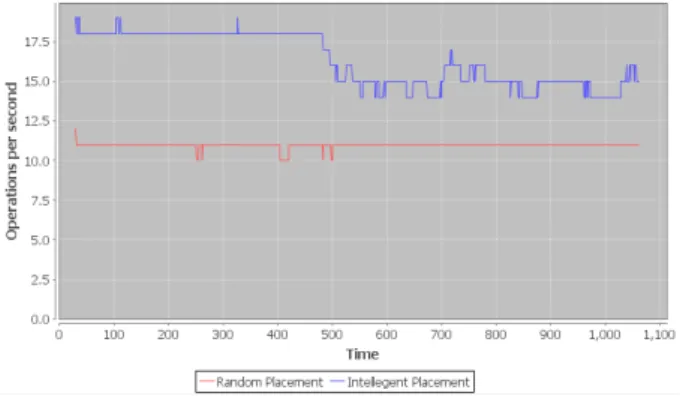
Graph View is used to display the performance bene-fit of the intelligent placement technique, as shown in Figure 7. It displays in real-time a graph of the I/O op-erations per second achieved under the intelligent place-ment scheme, and also provides for comparison a graph of the performance of a random placement technique.
EVALUATION
Figure 8: Graphical representation of the 8 profiles used for the case studies. The graph plots logical block ad-dress against throughput in bytes/second.
We demonstrate the applicability of our simulation through a number of case studies. Since the simula-tion requires an underlying profile of a VSS, we use a
fabricated profile in order show some interesting char-acteristics of our techniques. This is shown in Figure 8,
which plots logical address (x-axis) against throughput
(y-axis), and is intended to simulate a VSS consisting of
the following components:
1. Standard Magnetic Hard Disk 2. RAID 0 System
3. RAID 1 System
4. Read-Biased Flash Memory 5. Write-Biased Flash Memory 6. RAID 5 System
7. RAID 10 System
We will describe the characteristics of the streams used to drive the case studies using a 7-tuple of the form {[1,H,M,L,50%,50%,50%]}. This example has an Ar-rival Rate of 1 I/O operation per second, High Perfor-mance requirements, Medium Reliability requirements and Low Space Efficiency requirements, with equal parts Small Sequential Reads to Large Random Writes. We
use the QoS constants kP = 2, kR = 3 and kS = 1
for all case studies. Videos of the case studies are at
http://www.doc.ic.ac.uk/~njd200/studies.html.
Case Study: Order of placement
t=300 t=1000 t=1600 t=2600 t=6000
Figure 9: Sequential animation time-line showing cor-rect placement ordering.
In order to verify the order in which the simula-tion places data, we executed the simulator with a single input data stream with the characteristics {[1,M,M,M,50%,50%,50%]}. As shown in Figure 9, the green (better than required) portions of the storage are
the first to be filled. Next (att= 6 000) the yellow (as
required) portions of the storage start to be filled since there are no more green areas. In this example, since the simulation was only asked to fill 80% of the space, the red portions of the storage will never be used since no more space is needed.
Case Study: Performance Comparison
The next experiment is to measure the performance of the placement method in terms of rate of I/O opera-tions. In order to provide a basis for comparison we will also investigate the case where a random place-ment algorithm is employed. We explore two scenar-ios, both with a single input stream with characteristics {[1,M,M,M,50%,50%,50%]}:
• Scenario A: 80% free space aim
• Scenario B: 20% free space aim
Figure 10: Performance of the VSS in Scenario A.
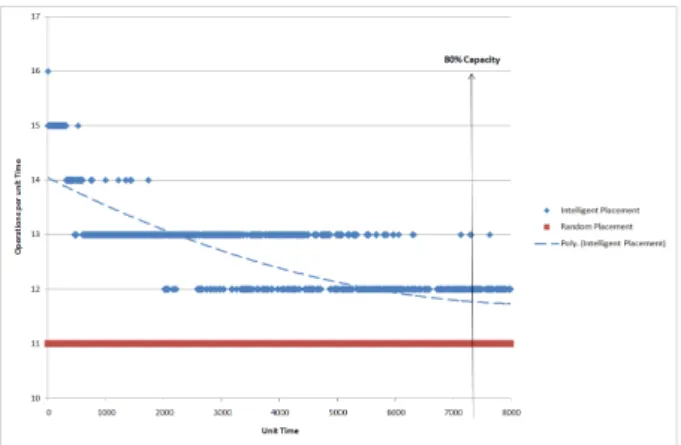
Figure 11: Performance of the VSS in Scenario B. The graph for Scenario A (Figure 10) demonstrates that by using the intelligent placement technique over the random placement technique there is a performance in-crease of nearly 2.5 disk operation per unit time. Sce-nario B (Figure 11) only yields a performance increase of 0.75 disk operations per unit time. This is because when the system is kept at 20% of storage space in use, the probability of finding high performance areas of storage is high since they would not yet have been filled. This means that the majority of the data will be placed in
these areas yielding very good performance for the sys-tem as a whole. When the percentage of storage space in use is set at 80%, the chance of finding a high perfor-mance area is far lower.
Case Study: Multiple Streams
Since in reality many data streams will be com-peting with each other to allocate space, we now explore the case of multiple concurrent streams. Fig-ure 12 shows the animation of a run with 3 streams: {[1,H,M,L,17%,18%,84%], [3,L,M,H,78%,81%,13%], [1,M,M,M,50%,50%,50%]}. Stream 0 Stream 1 Stream 2 Storage View
Figure 12: Multiple streams acting on one VSS. Figure 12 demonstrates the multiple stream simulation. An interesting thing to notice about this run of the sim-ulation is that, because each stream was given very dif-ferent characteristics, the way each values its underlying storage is very different. There are certain areas of the storage that are preferred by all streams; this can lead to conflict between the streams.
Figure 13: Performance profile when multiple streams are acting on the same storage.
In Figure 13 we observe that our intelligent placement scheme succeeds in allocating storage space such that performance is improved over results from a random al-location scheme.
Case Study: Changing Stream Characteristics
We demonstrate the extent to which our simulation is capable of responding to changing access pattern charac-teristics by migrating data in a case study with a single
a) b) c) d)
Figure 14: Changing QoS stream characteristics.
Figure 14 shows an example of a simulation where there is a change in the stream’s characteristics mid run. The four snapshots correspond to the follow situations:
a): Shortly before stream characteristics change.
b): The point at which the stream’s characteristics
change. Note that portions of the storage that were unsuitable are now classified as good.
c): The simulation in mid-migration.
d): The final resting place of the data post-migration.
Figure 15: Performance where a stream’s characteristics have been changed in mid-simulation.
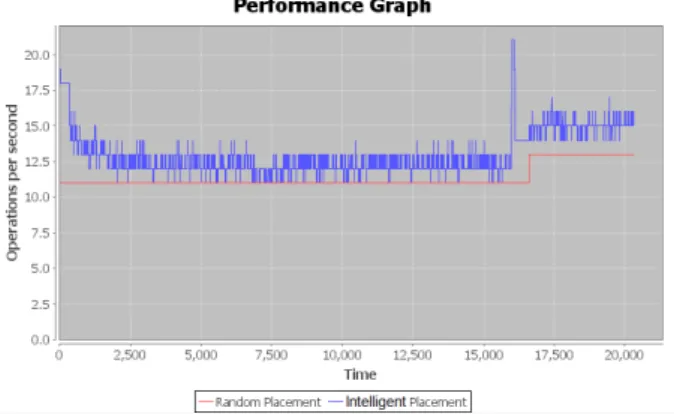
Figure 15 shows a performance graph of this run of the simulation. The most noticeable aspect of the graph is
the spike at t = 16 000, caused by the migration
pro-cess writing the poorly placed data to the best available space, which is very high performance. Also note the system’s performance is higher post migration.
Case Study: Changing Space Consumption
It is to be expected that with time a system’s space
utilisation will grow and shrink. In this context
we investigate the extent to which migration can be
applied successfully. Figure 16 shows an example
of the simulation with a single stream with settings {[1,M,M,M,50%,50%,50%]}.
a): The file system reaches its highest space utilisation.
b): The file system at its lowest space utilisation.
a) b) c) d)
Figure 16: Example of a simulation when the file system grows and then shrinks.
c): Migration is 50% complete.
d): The post-migration layout of the data.
Once again, performance is higher post migration.
CONCLUSION
This paper has described methods of profiling and char-acterising a storage device under different conditions to achieve an in-depth picture of how the device will per-form. We have then discussed the placement and mi-gration of data on such a storage device to best meet users’ performance, reliability and space efficiency re-quirements. This has been implemented in a simulation where data streams can be specified to operate on the storage, and we have demonstrated this in operation through a number of case studies.
There are many opportunities for further work. One at-tractive feature of VSSs is the ability to add new devices dynamically. This requires a mechanism for detecting when such an event has occurred and automatically re-profiling the VSS. We have also not modelled the failure of hard drives and the operation of RAID systems in de-graded mode, but these would obviously have a major effect on performance and would complicate placement and migration. Finally, real-life processes often antici-pate the amount of storage they will require and provi-sionally pre-allocate space to ensure that their data is not fragmented, but this is not currently supported.
REFERENCES
M. Bhadkamkar, J. Guerra, L. Useche, S. Burnett, J. Liptak, R. Rangaswami, and V. Hristidis. BORG: Block-reORGanization for Self-Optimizing Storage
Systems. In Proc. 7th USENIX Conference on File
and Storage Technologies (FAST’09), pages 183–196, San Fransisco, CA, February 2009.
F. Franciosi and W.J. Knottenbelt. Towards a
QoS-aware virtualised storage system. In Proc. 25th UK
Performance Engineering Workshop (UKPEW’09), pages 49–60, Leeds, July 2009.
J. Rydning and D. Reinsel. Worldwide hard disk drive 2009–2012 forecast: Navigating the transitions for en-terprise applications. IDC Market Analysis, Docu-ment 216394, February 2009.