Grand Valley State University
ScholarWorks@GVSU
Funded Articles
Open Access Publishing Support Fund
11-7-2017
Improving Outcomes in Adults with Diabetes
Through an Interprofessional Collaborative
Practice Program
Jean Nagelkerk
Grand Valley State University, [email protected]
Margaret Thompson
Michigan State University
Michael Bouthillier
Ferris State University
Amy Tompkins
Cherry Health
Lawrence Baer
See next page for additional authors
Follow this and additional works at:
https://scholarworks.gvsu.edu/oapsf_articles
Part of the
Medicine and Health Sciences Commons
This Article is brought to you for free and open access by the Open Access Publishing Support Fund at ScholarWorks@GVSU. It has been accepted for inclusion in Funded Articles by an authorized administrator of ScholarWorks@GVSU. For more information, please [email protected].
ScholarWorks Citation
Nagelkerk, Jean; Thompson, Margaret; Bouthillier, Michael; Tompkins, Amy; Baer, Lawrence; Trytko, Jeff; Booth, Andrew; Stevens, Adam; and Groeneveld, Kayleah, "Improving Outcomes in Adults with Diabetes Through an Interprofessional Collaborative Practice Program" (2017).Funded Articles. 86.
Authors
Jean Nagelkerk, Margaret Thompson, Michael Bouthillier, Amy Tompkins, Lawrence Baer, Jeff Trytko, Andrew Booth, Adam Stevens, and Kayleah Groeneveld
Full Terms & Conditions of access and use can be found at
http://www.tandfonline.com/action/journalInformation?journalCode=ijic20
Download by: [Grand Valley State University] Date: 04 December 2017, At: 05:26
Journal of Interprofessional Care
ISSN: 1356-1820 (Print) 1469-9567 (Online) Journal homepage: http://www.tandfonline.com/loi/ijic20
Improving outcomes in adults with diabetes
through an interprofessional collaborative practice
program
Jean Nagelkerk, Margaret E. Thompson, Michael Bouthillier, Amy Tompkins,
Lawrence J. Baer, Jeff Trytko, Andrew Booth, Adam Stevens & Kayleah
Groeneveld
To cite this article: Jean Nagelkerk, Margaret E. Thompson, Michael Bouthillier, Amy Tompkins, Lawrence J. Baer, Jeff Trytko, Andrew Booth, Adam Stevens & Kayleah Groeneveld (2018) Improving outcomes in adults with diabetes through an interprofessional collaborative practice program, Journal of Interprofessional Care, 32:1, 4-13, DOI: 10.1080/13561820.2017.1372395
To link to this article: https://doi.org/10.1080/13561820.2017.1372395
Published with license by Taylor &Francis Group, LLC© 2017 [Jean Nagelkerk, Margaret E Thompson, Michael Bouthillier, Amy Tompkins, Lawrence J Baer, Jeff Trytko, Andrew Booth, Adam Stevens, and Kayleah Groeneveld]
Published online: 07 Nov 2017.
Submit your article to this journal Article views: 392
ORIGINAL ARTICLE
Improving outcomes in adults with diabetes through an interprofessional
collaborative practice program
Jean Nagelkerka, Margaret E. Thompsonb, Michael Bouthillierc, Amy Tompkinsd, Lawrence J. Baere, Jeff Trytkof,
Andrew Boothg, Adam Stevensh, and Kayleah Groeneveldi
aGrand Valley State University, Office of the Vice Provost for Health, Grand Rapids, USA;bMichigan State University College of Human Medicine, Family Medicine, Grand Rapids, USA;cDepartment of Pharmacy Practice, Ferris State University College of Pharmacy, Grand Rapids, USA;dCherry Health, Cherry Street Health Center I Belknap, Grand Rapids, USA;eIndependent, Belmont, USA;fGrand Valley State University, Office of the Vice Provost for Health, Grand Rapids, USA;gGrand Valley State University, Physician Assistant Studies, Grand Rapids, USA;hMontcalm Care Network, Data Analytics, Greenville, USA;iNeurocore, Research and Development, Grand Rapids, USA
ABSTRACT
In 2014, the Midwest Interprofessional Practice, Education and Research Center partnered with a Federally Qualified Health Center (FQHC) to implement an interprofessional collaborative practice (IPCP) education program to improve the health of adult patients with diabetes and to improve practice efficiency. This partnership included integrating an interprofessional team of students with the practice team. Twenty-five students and 20 staff engaged in the IPCP program, which included completion of educational modules on IPCP and implementation of daily huddles, focus patient visits, phone calls, team-based case presentations, medication reconciliation, and student-led group diabetes education classes. This study used a sequential mixed methods design. Tools used for collecting data from staff and students included demographic forms, the Interdisciplinary Education Perception Scale (IEPS), the Entry-level Interprofessional Questionnaire, the Collaborative Practice Assessment Tool, and pre/post module knowledge tests completed at baseline and at one-year post implementation. Patient clinical indicators included HgbA1c, glucose, lipid panel laboratory assessments, body mass index, blood pressure, and documentation of annual dental, foot, and eye examina-tions. Practice efficiency was measured by the average number of patients seen per provider per hour. Both students and staff showed significant knowledge gains in IPCP on Team Dynamics and Tips for Behavioural Changes knowledge tests (p< .05). Patients who had an HgbA1c of≥7% significantly decreased their HgbA1c (p< .05) and glucose (p< .01). However, BMI and annual dental and eye examinations did not improve. Providers demonstrated an increase in the number of patients seen per hour. This IPCP intervention showed improvement in practice efficiencies and select patient outcomes in a family practice clinic.
ARTICLE HISTORY Received 11 May 2016 Revised 22 June 2017 Accepted 19 August 2017 KEYWORDS Interprofessional Education; Student Teams; Clinical Placement; Collaborative Practice; Patient Outcomes
Introduction
In the United States (U.S.) healthcare system, some professionals practice and deliver care in silos in which different practitioners work in parallel (Institute of Medicine [IOM],2001). The silo model creates communication barriers between healthcare pro-fessionals potentially resulting in patient safety issues, loss of efficiency, and rising healthcare costs (Towle, 2016; Watson, Heatley, Gallois, & Kruske,2016; Williams,2017).
Recent policy changes related to the Affordable Care Act encourage restructuring of the U.S. healthcare system and rewarding practitioners who work as part of teams (Patient Protection and Affordable Care Act, 2010). With an increased emphasis on patient care quality and safety for all populations, providers and policymakers recognise that healthcare workforce shortages, particularly in pri-mary care settings, necessitate increased collaboration
and teamwork across health professions
(Interprofessional Education Collaborative Expert Panel, 2011). To optimally educate the next generation of
healthcare practitioners and improve the collaborative practice of practitioners, gleaning evidence-based best practices from real world practice utilizing interprofes-sional collaborative practice (IPCP) is essential (e.g. Reeves, Perrier, Goldman, Freeth, & Zwarenstein, 2013).
Complex, multifaceted medical problems, such as diabetes, often require management from multiple health care profes-sions. The risk for death among people with diabetes is approximately twice that of people in similar age groups without diabetes (Centers for Disease Control and Prevention [CDC], 2011). The estimated cost of care for diabetics in the U.S. is $245 billion annually, with $176 billion in direct medical costs and $69 billion in reduced productivity (American Diabetes Association,2013). This patient popula-tion may benefit from IPCP to optimise team-based approaches for more efficient and effective healthcare delivery and optimal patient outcomes. In the U.S., to date, there is little research linking the effects of IPCP with outcomes related to the Triple Aim’s goals, to improve the patients’
CONTACTJean Nagelkerk [email protected] Grand Valley State University, Office of the Vice Provost for Health, 301 Michigan Street NE, Cook DeVos Center for Health Sciences, Grand Rapids, 49503, United States.
Colour versions of one or more of the figures in the article can be found online atwww.tandfonline.com/ijic. JOURNAL OF INTERPROFESSIONAL CARE
2018, VOL. 32, NO. 1, 4–13
https://doi.org/10.1080/13561820.2017.1372395
Published with license by Taylor &Francis Group, LLC © 2018 [Jean Nagelkerk, Margaret E Thompson, Michael Bouthillier, Amy Tompkins, Lawrence J Baer, Jeff Trytko, Andrew Booth, Adam Stevens, and Kayleah Groeneveld]
This is an Open Access article distributed under the terms of the Creative Commons Attribution-NonCommercial-NoDerivatives License (http://creativecommons.org/licenses/by-nc-nd/4.0/), which permits non-commercial re-use, distribution, and reproduction in any medium, provided the original work is properly cited, and is not altered, transformed, or built upon in any way.
experience of care (including quality and satisfaction), enhance the health of populations, and reduce the per capita cost of healthcare (Brandt, Lutfiyya, King, & Chioreso,2014; Greiner, Knebel & Institute of Medicine (U.S.),2003; Reeves et al.,2011). This study was intended to assist in filling the gap by providing outcome data, which aligns with the research agenda for IPCP put forth by the National Center for Interprofessional Education and Practice (Lutfiyya, Brandt, Delaney, Pechacek, & Cerra,2016).
To evaluate the effectiveness of an IPCP intervention on provider efficiencies, student learning and clinical outcomes of diabetic patients, the Midwest Interprofessional Practice, Education, and Research Center (MIPERC) partnered with a large Federally Qualified Health Center (FQHC), Cherry Street Health Services (CSHS), located in urban South East Grand Rapids, Michigan. Participating students were enrolled in Grand Valley State University’s Physician Assistant Program, Ferris State University’s Pharmacy Program, and Michigan State University’s Medical School Program. Participating staff included physicians, nurses, dieticians, community health workers, medical assistants, and a schedu-ler. The team carefully considered the potential impact of the students on preceptors’efficiency in the primary care setting, as one systematic review found that although students improved job satisfaction, they negatively impacted preceptor workload and productivity (Turkeshi, Michels, Hendrickx, & Remmen, 2015).
Background
In the U.S., healthcare delivery is being restructured to meet the Triple Aim and is stimulated, in part, by the increasing complex-ity of patient care, safety issues in care provision, problems in accessing care, and rising healthcare costs. Concurrently, due to changes required in healthcare delivery, many health profes-sionals and students are being taught an interprofessional team-based approach to care. In 2003, the IOM defined five core competencies that all health professional students should obtain and maintain competency in: patient-centered care, inter-professional teams, evidence based practice, quality improve-ment, and informatics. This new paradigm of interprofessional education and practice replaces the historical silo approach to the provision of patient care, in which professionals provide care in parallel practice with other professionals.
As health care’s complexity increases, new models to deliver safe, accessible, patient centered care are essential. Multiple factors influence changes in care delivery and the culture of health professional education, including safety issues (Jones, Skinner, High, & Reiter-Palmon,2013; Leape et al.,2009), frag-mentation of healthcare delivery (Cebul, Rebitzer, Taylor, & Votruba,2008; Körner et al.,2016), breakdown in communica-tions among health professionals (Coiera, 2006; Marcu,2016), rising health care costs, and health professionals working in silos (MacStravic, 2007). Two IOM reports (Greiner, Knebel, & Institute of Medicine (U.S.), 2003; Kohn, Corrigan, & Donaldson, 2000), the Interdisciplinary Nursing Quality Research Initiative (Clancy, 2009), and the Interprofessional Education Collaborative Expert Panel (2011) have emphasised the importance of IPCP in providing safe, high quality care.
IPCP involves a team of providers and patients developing and implementing integrated care strategies to work toward a com-mon goal. Thus, new models should emphasise collaborative team delivery methods in practice environments.
Midwest interprofessional practice, education, and research center
MIPERC was established in 2007 as a regional, inter-institu-tional infrastructure to transform healthcare education and practice (Nagelkerk, Coggan, Pawl, & Thompson, 2017). MIPERC, along with its 24 member organisations, provides leadership and resources to fulfill its mission of infusing interprofessional practice and education into participating communities to improve safety and quality care as well as providing IPCP learning experiences for health professional students. A major focus of MIPERC is to strengthen the linkages among educators and practitioners who model IPCP in clinical practice and integrate IPCP in formal educa-tional settings. In response to needs in the healthcare envir-onment, MIPERC designed an IPCP educational program to: (a) foster increased communication and shared decision-mak-ing among practitioners; (b) promote mutual respect and effective dialogue among all members of the care team in care planning and problem solving; (c) create more efficient and integrated practices; (d) utilise students as part of the care team to increase access; and (e) improve patient outcomes.
Before our study was initiated, MIPERC had implemented an IPCP program in two nurse-managed centers. Students, staff and faculty showed statistically significant knowledge gains in the following online learning modules: Introduction to IPE, Motivational Interviewing, Safety Behaviours, and Team Dynamics (Nagelkerk, & Pawl, 2015). The next step was to test this IPCP program in a family practice clinic by placing a team of students in an IPCP environment. At the same time, CSHS was interested in implementing a model of team-based care to increase access for patients, increase effi-ciencies, and improve patient outcomes. As a result, MIPERC and CSHS leadership developed a partnership to implement the IPCP program. The partnership was considered ideal as CSHS is a MIPERC member and also Michigan’s largest FQHC, serving over 70,000 individuals annually. Fifty-five percent of the clinic’s patients are uninsured, while approxi-mately 28% are insured by Medicaid and 10% by Medicare. Nearly 4,000 of the clients are homeless, with over 80% of the CSHS population having incomes below 200% of the poverty level.
IPCP program implementation
The MIPERC member-developed on-line IPCP educational program for staff and students contains foundational infor-mation on IPCP in four modules. Two additional modules were required for staff. All of the modules had been reviewed by national IPE and IPCP experts (Nagelkerk, & Pawl,2015). The core modules included an introduction to IPE and IPCP, patient safety, team dynamics and conflict resolution, and tips for implementing health care behavioural changes. The two additional required modules for staff included preceptor
JOURNAL OF INTERPROFESSIONAL CARE 5
development in interprofessional education and information on providing interprofessional preceptor clinical experiences. After completion of the modules, staff and students were oriented by a MIPERC staff member on IPCP program activ-ities including daily huddles, collaborative care plans, team visits, patient phone call follow-up, medication reconcilia-tions, and student-led group diabetic visit guidelines. Staff members received information from the MIPERC interprofes-sional preceptor manual to assist with designing and assigning student interprofessional clinical learning experiences. Staff and students received all tools and guidelines in hard copy form and through an internet-based learning management system.
Implementation of student participation
Medical, pharmacy, and physician assistant students were integrated into the CSHS care teams. Each student had an identified staff preceptor to guide the clinical experience. Three physicians served as primary preceptors for direct patient care, a dietician served as the supervisor for the group diabetic education classes, and two registered nurses served as supervisors for patient call backs. Medical assistants and registration specialists provided students with informa-tion and guidance on patient flow. Over the course of the grant period, students participated according to their pro-gram’s usual rotation duration, medical students for 4 weeks, pharmacy students for 6 weeks, and physician assis-tant students for 8 weeks. The students were assigned patients for whom they would develop and present the plan of care to their CSHS preceptor. They then engaged in daily huddles with their assigned care team to discuss patient care plans for selected patients. At least once per day, the student team met together with a patient to elicit the chief complaint and health history, perform the pertinent physical examination, and report this information/results to their preceptor with poten-tial diagnoses and proposed plan of care. In addition, the student team spent time with the nursing staff who supervised students during patient phone encounters as assigned during their rotations. Students also led group diabetic classes monthly with the guidance of the dietician, conducted med-ication reconciliation audits with selected patients, provided recommendations and findings to their staff preceptors, and presented a patient case weekly. The student assignments were designed to provide rich interprofessional learning experi-ences and increase provider efficiencies.
Methods
This study used a sequential mixed methods design. The purposive sample included all staff and students assigned to a FQHC clinic during the 2014–2015 academic year, as well as patients with a diagnosis of diabetes who enrolled in October 2014 through the following 12 months. University faculty assisted with designing the IPCP student experiences and were provided with the IPCP program materials. They facili-tated student placements, conducted site visits, and provided guidance on assignments. Pre-implementation baseline clini-cal information was taken from cliniclini-cal records covering the previous 12 months. The independent variables were imple-mentation of the IPCP program and assignment of a team of students to the FQHC family practice clinic.
This study sought to answer the following questions: 1. Does the implementation of an IPCP program in a FQHC family practice clinic improve diabetic patient health outcomes? 2. Does placing a team of students in an IPCP environment increase access to care by increasing the number of patients that can be seen in the clinic? 3. Does implementation of an IPCP program increase staff and patient satisfaction? 4. Does implementation of the IPCP program increase knowledge gain in staff and students? The primary outcome measures were: knowledge gain by learners, patient outcomes, patient and staff satisfaction, and provider productivity. This article describes the IPCP program and team of learners with resulting evaluation.
Participants
The sample included 20 staff, 22 students, and 250 patients (Table 1). The study began with 20 staff; however, two resigned during the study, and another did not finish the program, thus varying numbers of staff members completed each component. Five staff and 11 students had prior IPCP experience.
Patient participants (n= 250) were adults with a diagnosis of diabetes. Most were female, Black/African American or White,with a mean age of 57 years. Insurance providers included Medicare (33.8%), other insurance (32.5%), no insurance (22.4%), and Medicaid (11.3%).
All staff and students were trained in IPCP. Based on stu-dent’s schedules, school breaks, holidays, and length of rota-tions, all students had experiences with at least one, but most had learning experiences with at least two other health profes-sional students. Students had scheduled interprofesprofes-sional
Table 1.Demographics of study participants. Age
Gender Frequency (%)
Race Frequency (%)
Group N Mean (SD) Male Female White Black Asian Other
Students 22a 27.0 (3.8) 11 (50.0) 11 (50.0) 20 (90.9) 0 2 (9.1) 0
Staff 20b 41.4 (14.3) 2 (10) 18 (90) 12 (66.7) 2 (11.1) 2 (11.1) 2 (11.1)
Patients 250 57.3 (12.1) 96 (38.4) 154 (61.1) 96 (38.4) 120 (48.0) 22 (8.8) 12 (4.8)
aFive students did not complete end of rotation surveys b
Two staff did not report Race.
Notes. Staff included seven medical assistants, three physicians, three registered nurses, two patient registration specialists, one administrator, one community health worker, one dietician, one licensed practical nurse and one social worker.
6 J. NAGELKERK ET AL.
assignments, sat in a common space with their preceptors, shared treatment plans, and informally discussed patient cases. Students had interprofessional experiences when caring for patients. Preceptors selected patients for collaborative care planning to include student teams during the daily huddle. All patients were treated by IPCP trained staff, and exposure to student teams and composition varied from no student participation to a student team visit. There were at least two professions comprising a student team throughout the year, except during Winter Break when no students were placed (Figure 1).
Data collection
Tools used for data collection for staff and students included demographic forms, the Interdisciplinary Education Perception Scale (IEPS; Leucht, Madsen, Taugher, & Patterson, 1990), the Entry-level Interprofessional Questionnaire (ELIQ), the Collaborative Practice Assessment Tool (CPAT), the National Center Data Repository Network Users Survey, pre and post module knowledge tests, and program evaluation surveys. Staff completed the tools at base-line and at the end of the implementation year; students completed the assessments before and after their clinical rotations.
Focus groups were conducted monthly for preceptors, staff, and students to discuss the IPCP program implementation. Structured questions were developed by the principal investigator and MIPERC members, and session responses were recorded by the research staff. Questions were designed to elicit the partici-pant’s perception of the benefits and challenges of IPCP imple-mentation, descriptions of efficiencies or communication changes, and ideas for improving patient care processes and work flow. Monthly focus group attendance for preceptors included 3 to 5 per session, staff focus groups included between 23 to 35, and students ranged from 2–3 per session. Staff and patients also completed satisfaction surveys at baseline and at the completion of the year-long study. Data were collected on patient clinical outcomes which included: HgbA1c, BMI, diastolic and systolic blood pressure, glucose, lipid panel and annual dental, eye, and foot exams.
The IEPS was used to assess staff and student perceptions of interprofessional care and validity and reliability were established by McFadyen, Maclaren, and Webster (2007). This is an 18-item tool with four subscales including competency and autonomy (CA;α= .82), perceived need for cooperation (PNfC; α= .40), perception of actual cooperation (PAC;α= .83), and understand-ing others’ values (UOV). The questions in the CA subscale
include items such as“Individuals in other professions respect the work done in my profession.”The PNfC subscale addresses the perceptions of the collaborative environment, while the PAC sub-scale measures the actual cooperation of the team. The UOV subscale items capture the perceived values of other health professions.
The ELIQ was used to measure dimensions of team commu-nications and teamwork for staff and students and was tested for validity and reliability (Pollard, Miers, & Gilchrist,2004). This tool comprises three subscales: communication and teamwork scale (CTS;r= .78,α= 0.76), interprofessional learning (ILS;r= 0.86, α= 0.84), and interprofessional interaction (IPIS;r= 0.76,α= 0.82) split among 27 items using a 5-point Likert-type scale. The tool categorises scores for each section into three groups, Positive, Neutral, and Negative. The CTS subscale includes items on com-munication style and comfort. The ILS subscale is focused on the respondent’s experience learning with other health professions students. The IPIS subscale includes items on perceptions of collaborative practice and communication among health professions.
The CPAT was used to measure staff perceptions and readiness for IPCP teamwork and was validated by Schroder et al. (2011). It is a 57-item tool using a 7-point Likert-type scale with eight subscales including mission, meaningful purpose and goals (α = .88), general relationships(α = .89), team leadership (α= .80), general role, responsibilities and autonomy (α= .81), communication and information exchange (α= .84), community linkages and coordination of care (α= .76), decision-making and conflict management (α= .67) and patient involvement (α= .87). The principal investigator and a MIPERC member created the pre and post knowledge tests. All tests were reviewed for content and face validity by an expert panel including MIPERC members and IPCP national leaders. The staff and student module pre- and post-knowledge tests covered topics on introduction to IPE and IPCP, patient safety, team dynamics, and tips for implementing healthcare behavioural changes. Staff had additional testing for the modules on preceptor development and the preceptor manual. All tests contained 15 or fewer items, each mixed with multiple choice, true/false and essay questions.
Satisfaction surveys for the patients are proprietary to CSHS where face and content validity were assessed by clinic staff. The survey contained 12 items on a 4-point Likert-type scale and was administered in person or by phone, both at study start and at year end. Patient versions were available in English, Spanish, and Vietnamese lan-guages and were translated by a certified translation professional.
1 2 3 4 5 6 7 8 9 10 11 12 13 14 15 16 17 18 19 20 21 22 23 24 25 26 a MD
b PA c PharmD
Black cells = students absent from clinical placement a ten medical students all in their third rotation b
five physician assistants, three in second rotation and two in their third rotation c seven pharmacy students, all in their fourth rotation
Figure 1.Student clinical placement schedule (2 week intervals).
JOURNAL OF INTERPROFESSIONAL CARE 7
Diabetic patient clinical indicators included patient satisfaction and clinical outcomes. Outcome indicators were collected at baseline and again at year end. In this article, authors provide an analysis for the entire diabetic patient sample as well as for a subset of higher risk patients with HgbA1c laboratory measurments equal to or greater than 7.0 mg/dl at baseline (American Diabetes Association, 2016).
An efficiency measure was assessed using the average number of clinic patient visits per hour per staff provider (for all patients, not just the subset of study patients) at base-line and then at the end of the study.
Data analysis
Descriptive statistics were used for the demographic data. Percentages were calculated for the knowledge tests. Qualitative data from focus groups were used to examine emer-ging themes. For the IPCP assessment tools, sample size, nor-mality, and symmetry of the differences between pairs were all assessed in determining appropriate statistical analyses.
For each IPCP module, as well as the IEPS, ELIQ and CPAT tools, paired t-test or Wilcoxon matched Pairs Signed Rank tests were used where appropriate and two-sided p-values were reported. Likert-type responses were quantified by scoring per subsections within tools.
The possible impact of directed IPCP intervention on patient outcomes was examined by using select clinical out-come indicators, which were captured at baseline and again at year end. Interval data collected allowed for pairedt-tests and descriptive statistics. For practice efficiencies, mean patient encounters per month were collected for the three physician staff members. The means of the months were then grouped into pre-intervention and post-intervention categories. The Wilcoxon Rank Sum test was used to compare the distribu-tions of the two groups. Additionally, to account for the sequential nature of the data, a statistical process control chart was used.
Baseline and study year clinical indicators for diabetes were recorded, and their changes were assessed using pairedt-tests. Compliance with suggested annual dental, eye, and foot exams was assessed by comparing the proportion of comply-ing patients in the baseline year to the study year. Frequencies for each exam type were reported and McNemar’s Test for Dependent Proportions was used.
Patients completed satisfaction surveys both before and after implementation of the program. Wilcoxon Matched Pairs Signed Rank test was used to assess whether there was a change in the distribution of satisfaction scores from pre to post. Open ended responses were used to draw out emerging themes from the Survey data. Monthly focus group meeting notes were compiled and themes identified and categorised by members of the authorship team. Themes that emerged from the data were verified by sharing them with staff and students and confirming their feedback to triangulate the data.
Statistical significance was defined asp ≤0.05 for all tests. Bonferroni corrections were implemented for groups with small sample sizes although this may have obscured important findings (Nakagawa,2004).
Ethical considerations
Participation in this study was part of the students’ curri-cula; approval for their participation was reviewed and approved by the respective universities’ human subjects internal review boards and waiver of documentation of consent was granted for the staff and students. Staff and students were informed that their participation in the research would help evaluate the effectiveness of an IPCP program, and that responses would not affect student grades or staff evaluations. The GVSU Human Research Review Committee served as the IRB of record for CSHS and approved this study. Patients were told that their par-ticipation in the research would test a team care model. Patients were informed that they had a choice of participa-tion and their decisions would not affect their care. Results
Student and staff IPCP perceptions
Students and staff had high baseline scores for three of the four subscales of the IEPS, leaving little room for improve-ment and no statistically significant changes were seen.
The ELIQ tool’s average scores for CTS and ILS for both students and staff both began and remained in the positive range. Although for students, the IPIS showed improvement (p =0.023, negative to neutral), for staff, scores for the IPIS began and remained in the neutral range. A Bonferroni cor-rection resulted in a non-statistically significant change in the student IPIS subscale. All other subscales for both students and staff remained in the same category without significant changes.
The CPAT median for each subscale’s pre score was at least 5.0, which corresponds to Somewhat Agree response and remained so for the post scores. Because staff had high scores at the pre-assessment, little improvement was possible, and none of the eight subscales showed a statistically significant change.
IPCP knowledge
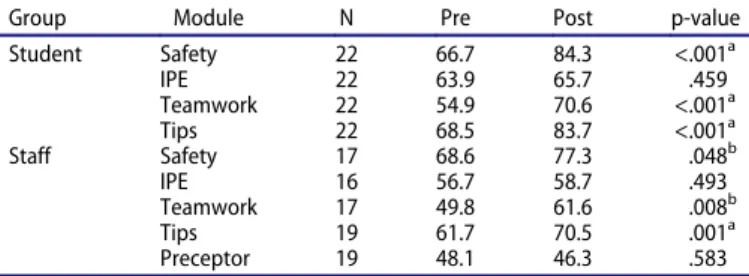
Significant increases for all learners were noted after partici-pation in the MIPERC online IPCP program in Team Dynamics and Tips for Implementing Healthcare Behavioural Changes modules (Table 2). The Patient Safety module showed a statistically significant improvement for students and a smaller, though not significant increase for staff . However, knowledge gains related to the Introduction to IPE module were not found for staff or students, nor were changes for the staff Preceptor module.
Focus group data
A common theme cited by students was benefits from hear-ing other professionals’questions to the patient. The focused patient visits created space for learners to experience other professionals’ examination techniques, which changed their perspective of other professions. As this research focused on one disease type, some students expressed interest in
8 J. NAGELKERK ET AL.
applying the team interview procedure to patients with other diagnoses. Initially staff expressed concern about the length of time for the IPCP focused patient visits, and staff united to share suggestions on how to best schedule the patient visits. To address the initial concern, one preceptor reported
“students were told to focus on the 1 or 2 primary concerns of the patient”. The change was effective as evidence by one medical assistant saying, “team visits used to keep the patients there for 1 hour or longer and they are pretty efficient now”.
Staff and providers shared that the daily huddles (a new tool in this practice), including students, medical assistants, and other professional staff, improved clinic flow and benefited their prac-tice. A manager said, “implementation of the daily huddle improved communication, efficiency and staff satisfaction”.
Preceptors voiced concerns about included the short dura-tion of student rotadura-tions, which was considered inadequate for students to become efficient.
The staff shared how daily huddles helped them gain workflow efficiencies. For example, previously one medical assistant put the patient in a room and another would come in later for the vital signs assessments, a practice assessed as being inefficient. The huddle provided the team time to problem solve. Now one medical assistant stays with each patient the duration of the visit. This change improved communications and efficiency with decreased wait times for patients.
Access to care
Provider productivity, as represented by the number of patients seen per staff provider per hour, was compared between the study year and the preceding year (baseline). Provider efficiency continued to rise after student interprofessional collaborative care teams were added during the study year (Figure 2).
Patient data
The last recorded value for each outcome variable for patient laboratory data and vital signs were measured at baseline and at the conclusion of the study year. Pairedt-tests were used to assess changes in clinical indicators (from baseline year to intervention year). Most patient clinical indicators showed
no significant improvement. Triglycerides and lipid ratios showed statistically significant improvements (Table 3). However, blood pressure showed upward trend, as did BMI.
In order to explore more targeted results, data for a sub-group of higher-risk patients was examined (A1C of ≥7%, American Diabetes Association, 2016; Table 3). For these patients, laboratory values improved between pre- and post-intervention. Statistically significance improvements were seen in A1c, triglyceride, lipid ratio, and blood glucose labora-tory assessments.
Patient annual dental, eye, and foot exams
Participation in annual dental, eye, and foot exams were recorded for the baseline and study years. Each patient was assigned a yes or no, as to whether they received dental, eye, and foot exams. McNemar’s Test for dependent pro-portions was used to assess whether there was a difference in proportions between the baseline and study years. Differences in the proportion of patients completing eye and dental exams were small. However, there was a signifi-cant increase in the proportion of patients for whom foot exams were completed (Table 4), with a completion rate of 21.1% in the baseline year rising to 67.8% during the study year.
Patient satisfaction surveys
Interprofessional team care provided the opportunity for extended care provider-patient sessions. For instance, what were once 15 to 30 minute visits with one doctor or nurse prior to implementation, became longer visits with teams of personnel after implementation. To determine whether implementation of interprofessional teams may have affected a patient’s satisfaction with care, results from the clinic’s proprietary assessment tool were used to compare patient satisfaction before and a year after interprofes-sional team implementation. This assessment tool was comprised of 12 questions scored on a 4-point Likert-type scale with higher scores indicating more positive ratings. The survey covered a range of topics such as: how the administrative staff interacted with the patients, the patients’ understanding of and role in shaping their own care plans, the competency of the staff, and impres-sion of the overall quality of care received.
For the 118 patients providing satisfaction data before and 1 year after implementation, the median value for all ques-tions was three or greater at both times. Comparison of pre-vs. post-interprofessional care indicated a statistically signifi-cant difference in one question addressing prescription drug information, (a 0.15 point difference,p < .05). As with fixed choice questions, responses requests for comments were mostly positive both before and after interprofessional team care. Negative comments before care were related to tele-phone communication, delays, and short appointments. The only negative comment post-implementation addressed phone communication.
Table 2.Average online module knowledge scores by learner group.
Group Module N Pre Post p-value
Student Safety 22 66.7 84.3 <.001a IPE 22 63.9 65.7 .459 Teamwork 22 54.9 70.6 <.001a Tips 22 68.5 83.7 <.001a Staff Safety 17 68.6 77.3 .048b IPE 16 56.7 58.7 .493 Teamwork 17 49.8 61.6 .008b Tips 19 61.7 70.5 .001a Preceptor 19 48.1 46.3 .583 a
statistically significant at Bonferroni corrected level bnot statistically significant at Bonferroni corrected level
Notes. Safety = Patient Safety Module; IPE = Intro to IPE Module; Teamwork = Team Dynamics Module; Tips = Tips for Implementing Healthcare Behavioural Changes Module; Preceptor Development Module
JOURNAL OF INTERPROFESSIONAL CARE 9
Discussion
The purpose of the research was to test the implementation of an IPCP program in a family practice FQHC that included interprofessional teams of students in the provision of care to determine if IPCP activities and student team members improved patient outcomes and staff productivity. IPCP assessment tools were used to assess staff and student changes in the perceptions of and readiness for interprofessional work. Students and staff responded positively at baseline on the IEPS, with the exception of one subscale, “understanding other’s values” that demonstrated no gains. McFadyen et al. (2007), suggested removing this subscale from the tool based on content analysis using 19 IPCP-minded health professional from different professional backgrouns. One reason could be respondents’ difficulty to generalise the perceived values of a
group of professionals from encounters with specific indivi-duals. A review of interprofessional tools used to assess inter-professional perceptions and attiudes showed a large proportion of studies not showing statistical significance from pre- to post-testing. Oates and Davidson (2015) shared there may be poor sensitivity with the IEPS, as pre-IPCP implementation scores high creating a ceiling making it diffi-cult to parse distinctions over time.
Staff learners at CSHS provided positive scores at baseline on the ELIQ except for the student group that rated negative for interprofessional interactions and then neutral at end of rotation. Pollard et al. (2004) discovered similar findings with the IPIS subscale at baseline. This change in readiness finding is complementary to the experiences described by students in the focus groups, in which they discussed how IPCP was integrated into patient care management. The rich immersive interactive interprofessional environment during their clinical experience at CSHS may have positively affected their percep-tions of team-based care practice. The staff had prior exposure to IPCP by the nature of their interprofessional work and rated positivly for all three subscales at baseline and at year end.
The CPAT tool was administered to all learners initially, but students expressed difficulty to assess the clinic team
0.00 0.50 1.00 1.50 2.00 2.50 3.00 1 2 3 4 5 6 7 8 9 10 11 12 13 14 15 16 17 18 19 20 21 22 23 24 Intervention Start Study Year
Patients/Hr (average)
Baseline Year
Figure 2.Average physician per hour before and after implementation.
Table 3.Clinical indicators.
All Study Patients - Mean High Risk Study Patients - Mean
Outcome Indicator N Pre Post Diff p-value N Pre Post Diff p-value
A1c 221 7.3 7.2 0.10 0.346 91 8.9 8.3 0.6 .011* BMI 230 33.6 33.9 (0.3) 0.025* 89 33.4 33.9 (0.5) .054 BP–Systolic 238 136.0 136.9 (1.0) 0.217 91 136.9 138.2 (1.3) .206 BP - Diastolic 238 81.3 82.0 (0.8) 0.073 91 81.3 82.4 (1.1) .086 Cholesterol 121 186.0 180.1 5.9 0.135 45 192.5 182.4 10.2 .126 Glucose 229 156.7 148.7 8.1 0.110 89 199.0 172.8 26.2 < .01** HDL 120 49.7 50.8 (1.1) 0.126 45 45.6 47.6 (2.0) .063 LDL 116 102.3 97.6 4.7 0.171 44 107.2 101.2 6.0 .315 Ratio (Total/HDL) 105 4.0 3.7 0.3 0.016* 38 4.5 4.0 0.5 .017* Triglyceride 120 175.3 158.5 16.9 0.048* 45 196.8 165.5 31.3 .006** * p≤.05*, **p≤.01
Pre = baseline year value; Post = intervention year value
Table 4.Annual dental, eye, and foot exams results. Examinations Performed
Exam Type Na Pre Post p-value
Dental 242 26 34 .312
Eye 242 45 37 .396
Foot 242 51 164 <.001*
aof 250 patients enrolled, no baseline year data were available for 8 * p≤.001 (McNemar Test)
10 J. NAGELKERK ET AL.
when new to CSHS. Overall, the staff reported high scores at baseline and at the end of the year. This may be due in part to survey fatigue. Also, Jacob, Boshoff, Stanley, Stewart, and Wiles (2017) recently reviewed interprofessional measure-ment tools and noted that the CPAT had low critical appraisal scores for reliability and validity.
The clinical placement coordinators from each participat-ing educational program selected students who were inter-ested in completing their clinical rotation in an interprofessional environment; thus, selection bias may have affected students’ results on their perception of interprofes-sional work; however, some students experienced challenges in working within teams. The first medical and physician assistant students grappled with role blurring and worked through professional roles and common core skills. Later students, when oriented, were prompted to collaborate, dis-cuss, and explore their respective professional roles during focus patients and case presentations.
For students, the knowledge tests results showed significant increases in three of the four modules; with no difference in the Introduction to IPE module. Most of the students, enrolled from the three institutions, reported prior exposure to IPCP concepts as part of their program competencies. The focus groups revealed that practicing IPCP in the“real world” reinforced the importance of this work, but did not change interprofessional perspectives much. Likewise, the staff results also showed statistical improvement in three of the five areas. Introduction to IPE and teamwork showed no significant gains, likely resulting from prior interprofessional team work with the initiatives already in place at the clinic or from prior work experience. However, in the focus groups, many staff commented that the IPE and teamwork modules reinforced the work that they were doing with patients and students. The monthly staff focus groups confirmed these results where staff expressed feeling more secure sharing their ideas, and con-fident that their suggestions were being heard. Additionally, staff commented that effective communication had improved in their work environment.
CSHS has been proactive in changing organisational sys-tems to meet increased patient demand for care. Two years prior to the study, they integrated a care team focusing on at-risk diabetic patients comprised of a part-time pharmacist, care manager nurse, and community health worker through the Michigan Primary Care Transformation program. The com-munity health worker was enrolled in this study, while the case manager and pharmacist were both part-time and unable to dedicate the necessary time to this project or training. CSHS administration was concerned about impact of the team-based model, huddles and student teams on productivity. Barriers to implementation of IPCP by administrators have been noted in the literature with multiple factors identified including work-load and time pressure to maintain productivity benchmarks, and known and unknown administration costs (Müller, Zimmerman, & Körner, 2014). Another systematic review found that although students improved job satisfaction, they negatively impacted preceptor workload and productivity (Turkeshi, Michels, Hendrickx, & Remmen,2015).
Despite these concerns, our data showed a trend in improved provider productivity. All staff were integrated
with the student teams during patient consultations and case presentations, thus contributing to the health provider and student perception of“team”.
An important tool for creating a sense of team was the implementation of consistent daily huddles. Staff and provi-ders appreciated the opportunity to address patient challenges and identiftying patients for student focused patients. At first, the student teams slowed down the patient flow, but with the use of huddles (both formal and informal), the team problem solved and came up with solitions to improve efficiency. The appropriate use of interprofessional daily huddles to include all staff and students was the turning point for the team and improved communication, efficiency and safety. Our work supports the increased efficiencies gained by the implementa-tiohn of consistent huddles in clinical practice (Criscitelli, 2015; McQuaid-Hanson & Pian-Smith, 2017; Myers,2017).
Analysis of patients with at-risk clinical indicators per the ADA (American Diabetes Association,2016), showed statisti-cally significant improvements in HgbA1c, blood glucose, ratio (Total/HDL) and triglyceride. However, BMI and com-pliance with dental and eye exams was problematic. Although patients’ HgbA1cs improved, other behaviours need further encouragement to address obesity among other co-morbid-ities. This is consistant with findings in the literature showing the need for interventions other than medications to improve diabetes related outcomes (Ahn et al., 2017; Boinapally, Fussman, & Imes, 2011; CDC, 2012). The dental exams showed a slight upward trend with foot exams increasing even more. The higher frequency of documented foot exams may be attributed to the ability to conduct this exam in the office, whereas patients needed to schedule a separate appointment for the dental exam (located in the same build-ing) and eye exam (external referral). A Brittish study also showed improvement with patients with low risk HgbA1cs and foot exams after IPE implementation, and decreased HgbA1c values among the higher risk group (Ching, Forte, Aitchison, & Earle,2016). The Tips for Behavioural Changes module was well received among the providers and staff, and similar approaches like motivational interviewing have shown to improve patients with diabetes outcomes. The impact of change may be related to dosing of motivational interviewing and the frequency of patient visits (Christie & Channon, 2014). Future research may consider focusing on the high-risk patient population and integrating more behaviour inter-ventions as part of the IPCP.
Although the patient satisfaction scores at baseline and at the end of one year were similar, one question involving information about prescription medication was statistically significant, which may be partly attributed to having a pharmacy student working with individual patients on medications and the interprofes-sional student teams conducting medication reconciliations. Mathys, Neyland-Turner, Hamouie, and Kim (2015) also found that pharmacy students were instrumental in educating patients on their prescription medications. Pharmacy students were also well appreciated by staff, students and preceptors as expressed in focus groups. A comment on the baseline patient satisfaction survey complained of short visits, which was not reported on the 1 year surveys. In our study, individual student and student team visits often lengthened a patient’s visit time.
JOURNAL OF INTERPROFESSIONAL CARE 11
Study limitations included the difficulty of implementing an IPCP program in a comlex healthcare environment, mak-ing it difficult to control patient exposure to IPCP student teams and compositions. Additionally, the innovative changes at CSHS FQHC to improve processes along with the student team intervention both may have contributed to the move-ment of diabetes outcomes and provider productivity. For future studies, we would limit the number of instruments participants completed at this may have created participant fatigue and increased the number of variables creating chal-lenges with analysis. We also changed the data collection method through the course of our project for patient satisfac-tion assessment from face to face to over the phone, with diferent research staff doing each set of data collection. These variations may have caused differences in the responses that limited the findings.
Concluding comments
Study findings indicated that IPCP interventions including edu-cation, daily huddles, team visits, case presentations, and med-ication reconciliations improved communmed-ication, team care, improved outcomes for a subgroup of higher-risk patients and increased provider productivity. Interprofessional perceptions showed little change as participants had high measures at base-line with little improvement at the end of the study. Monthly focus groups with staff, students, and preceptors also provided rich information regarding staff productivity, student team composition, space considerations, and interprofessional experiences. IPCP education feedback from staff and students emphasised importance of consistent education on IPCP foun-dations for all students and staff for complimentary delivery of care and impact of clinical outcomes. The investigators recom-mend longitudinal IPCP studies to evaluate changes in staff, student and preceptor perceptions, and diabetes patient clinical indicators over time.
Future research is needed on the composition and number of student learners comprising interprofessional student teams. The type of clinical practices student teams are placed may have an impact on practice efficiency, patient satisfac-tion, and patient outcomes. Research examining the type of IPCP program, the length of time, the delivery modality, and accompanying educational resources to train staff in colla-borative practice is needed to identify efficient and effective IPCP programs.
Acknowledgments
The authors recognize the Cherry Street preceptors for including stu-dents in their interprofessional practice while maintaining busy patient schedules and productivity benchmarks. Without them, this project would not have been possible.
Declaration of interest
The authors report no conflicts of interest. The authors alone are responsible for the content and writing of the article.
Funding
This project received financial and intellectual support from the National Center for Interprofessional Practice and Education at the University of Minnesota, Twin Cities Campus. Financial support was also received from the Blue Cross Blue Shield of Michigan Foundation.
References
Ahn, S., Lee, J., Bartlett-Prescott, J., Carson, L., Post, L., & Ward, K. D. (2017). Evaluation of a behavioral intervention with multiple compo-nents among low-income and uninsured adults with obesity and diabetes. American Journal of Health Promotion, 89011711769625. doi:10.1177/0890117117696250
American Diabetes Association. (2013). Economic costs of diabetes in the U.S. in 2012.Diabetes Care,36(4), 1033–1046. doi: 10.2337/dc12-2625
American Diabetes Association. (2016). Standards of medical care in diabetes—2016 abridged for primary care providers. Clinical Diabetes,34(1), 3–21. doi:10.2337/diaclin.34.1.3
Boinapally, P., Fussman, C., & Imes, G. (2011).Overweight and obesity facts in Michigan adults. Michigan’s nutrition, physical activity and obesity program surveillance brief. Michigan Department of Community Health, Division of Genomics, Perinatal Health and Chronic Disease Epidemiology. Retrieved from http://www.michi gan.gov/documents/mdch/Final_MI_OW_and_Obesity_booklet__ 356714_7.pdf
Brandt, B., Lutfiyya, M. N., King, J. A., & Chioreso, C. (2014). A scoping review of interprofessional collaborative practice and education using the lens of the triple aim.Journal of Interprofessional Care,28(5), 393– 399. doi:10.3109/13561820.2014.906391
Cebul, R., Rebitzer, J., Taylor, L., & Votruba, M. (2008).Organizational fragmentation and care quality in the U.S. health care system (No. w14212). Cambridge, MA: National Bureau of Economic Research. doi:10.3386/w14212
Centers for Disease Control. (n.d.).CDC Behavioral risk factor surveil-lance system: Prevalence and trend data–Overweight and obesity, U.S. Obesity trends, Trends by state 2012. https://www.cdc.gov/obesity/ data/prevalencemaps.html(accessed October 9, 2017).
Centers for Disease Control and Prevention. (2011).National diabetes fact sheet: National estimates and general information on diabetes and pre-diabetes in the United States. Atlanta, GA: Author. Retrieved from
https://www.cdc.gov/diabetes/pubs/pdf/ndfs_2011.pdf
Ching, D., Forte, D., Aitchison, E., & Earle, K. (2016). Are there long-term benefits of experiential, interprofessional education for non-specialists on clinical behaviours and outcomes in diabetes care? A cohort study. BMJ Open,6(1), e009083. doi: 10.1136/bmjopen-2015-009083
Christie, D., & Channon, S. (2014). The potential for motivational inter-viewing to improve outcomes in the management of diabetes and obesity in paediatric and adult populations: A clinical review.
Diabetes, Obesity and Metabolism, 16(5), 381–387. doi:10.1111/ dom.12195
Clancy, C. M. (2009). Ten years after to err is human.American Journal of Medical Quality,24(6), 525–528. doi:10.1177/1062860609349728
Coiera, E. (2006). Communication systems in healthcare. Clinical Biochemistry Reviews,27(2), 89–98.
Criscitelli, T. (2015). Fostering a culture of safety: The OR huddle.AORN Journal,102(6), 656–659. doi:10.1016/j.aorn.2015.10.002
Greiner, A., Knebel, E., & Institute of Medicine (U.S.). ((Eds.)). (2003).
Health professions education: A bridge to quality. Washington, D.C: National Academies Press.
Institute of Medicine. (2001).Crossing the quality chasm: A new health system for the 21st century. Washington, D.C.: National Academies Press. doi:10.17226/10027
Interprofessional Education Collaborative Expert Panel. (2011). Core competencies for interprofessional collaborative practice: Report of an expert panel. Washington, D.C.: Interprofessional Education Collaborative. Retrieved from http://www.aacn.nche.edu/education-resources/ipecreport.pdf
12 J. NAGELKERK ET AL.
Jacob, J., Boshoff, K., Stanley, R., Stewart, H., & Wiles, L. (2017). Interprofessional collaboration within teams comprised of health and other professionals: A systematic review of measurement tools and their psychometric properties. The Internet Journal of Allied Health Sciences and Practice,15(2), Article 8.
Jones, K. J., Skinner, A. M., High, R., & Reiter-Palmon, R. (2013). A theory-driven, longitudinal evaluation of the impact of team training on safety culture in 24 hospitals.BMJ Quality & Safety,22(5), 394– 404. doi:10.1136/bmjqs-2012-000939
Kohn, K. T., Corrigan, J. M., & Donaldson, M. S. (2000).To err is human: Building a safer health system. Washington, DC: National Academy Press. Körner, M., Bütof, S., Müller, C., Zimmermann, L., Becker, S., & Bengel, J. (2016). Interprofessional teamwork and team interventions in chronic care: A systematic review. Journal of Interprofessional Care,
30(1), 15–28. doi:10.3109/13561820.2015.1051616
Leape, L., Berwick, D., Clancy, C., Conway, J., Gluck, P., Guest, J., . . . Isaac, T.; for the Lucian Leape Institute at the National Patient Safety Foundation. (2009). Transforming healthcare: A safety imperative.
Quality and Safety in Health Care,18(6), 424–428.
Luecht, R., Madsen, M., Taugher, M., & Petterson, B. (1990). Assessing Professional Perceptions: Design and Validation of an Interdisciplinary Education Perception Scale.Journal of Allied Health,19(2), 181–191. Lutfiyya, M. N., Brandt, B., Delaney, C., Pechacek, J., & Cerra, F. (2016).
Setting a research agenda for interprofessional education and collaborative practice in the context of United States health system reform.Journal of Interprofessional Care,30(1), 7–14. doi:10.3109/13561820.2015.1040875
MacStravic, S. (2007). The other silos in healthcare organizations.
Healthcare Financial Management: Journal of the Healthcare Financial Management Association,61(5), 108, 110.
Marcu, G. (2016).Breaking down silos to promote collaborative reflection in healthcare (pp. 617–618). Presented at the 2016 International Conference on Collaboration Technologies and Systems (CTS), Orlando, Florida. doi.org/10.1109/CTS.2016.0116
Mathys, M., Neyland-Turner, E., Hamouie, K., & Kim, E. (2015). Effect of pharmacy students as primary pharmacy members on inpatient interdisciplinary mental health teams. American Journal of Health-System Pharmacy,72(8), 663–667. doi:10.2146/ajhp140411
McFadyen, A. K., Maclaren, W. M., & Webster, V. S. (2007). The Interdisciplinary Education Perception Scale (IEPS): An alternative remodelled sub-scale structure and its reliability. Journal of Interprofessional Care, 21(4), 433–443. doi:10.1080/ 13561820701352531
McQuaid-Hanson, E., & Pian-Smith, M. C. M. (2017). Huddles and debrief-ings.Anesthesiology Clinics,35(1), 59–67. doi:10.1016/j.anclin.2016.09.006
Müller, C., Zimmerman, L., & Körner, M. (2014). Facilitators and barriers to interprofessional collaboration in rehabilitation clinics—A survey of clinical executive managers.Die Rehabilitation,53(6), 390–395. Myers, J. M. (2017). Interprofessional team management: Partnering to
opti-mize outcomes in diabetes. The Journal for Nurse Practitioners, 13(3), e147–e150. doi:10.1016/j.nurpra.2016.11.012
Nagelkerk, J., Coggan, P., Pawl, B., & Thompson, M. E. (2017). The midwest interprofessional practice, education, and research center: A regional approach to innovations in interprofessional education and practice. Journal of Interprofessional Education & Practice,7, 47–52. doi:10.1016/j.xjep.2017.02.001
Nagelkerk, J., & Pawl, B. (2015). Testing an interprofessional collabora-tive practice model to improve obesity-related health outcomes with a statewide consortium. Journal of Interprofessional Education & Practice,1(2), 66. doi:10.1016/j.xjep.2015.07.044
Nakagawa, S. (2004). A farewell to Bonferroni: The problems of low statistical power and publication bias. Behavioral Ecology, 15(6), 1044–1045. doi:10.1093/beheco/arh107
Oates, M., & Davidson, M. (2015). A critical appraisal of instruments to measure outcomes of interprofessional education.Medical Education,
49(4), 386–398. doi:10.1111/medu.12681
Patient Protection Affordable Care Act, Pub. L. No. 18001, 42 U.S.C. (2010).
Pollard, K. C., Miers, M. E., & Gilchrist, M. (2004). Collaborative learn-ing for collaborative worklearn-ing? Initial findlearn-ings from a longitudinal study of health and social care students.Health and Social Care in the Community,12(4), 346–358. doi:10.1111/j.1365-2524.2004.00504.x
Reeves, S., Goldman, J., Gilbert, J., Tepper, J., Silver, I., Suter, E., & Zwarenstein, M. (2011). A scoping review to improve conceptual clarity of interprofessional interventions.Journal of Interprofessional Care,25(3), 167–174. doi:10.3109/13561820.2010.529960
Reeves, S., Perrier, L., Goldman, J., Freeth, D., & Zwarenstein, M. (2013). Interprofessional education: Effects on professional practice and healthcare outcomes (update). In The Cochrane Collaboration (Ed.),
Cochrane database of systematic reviews. Chichester, UK: John Wiley & Sons, Ltd. doi:10.1002/14651858.CD002213.pub3
Schroder, C., Medves, J., Paterson, M., Byrnes, V., Chapman, C., O’Riordan, A., . . . Kelly, C. (2011). Development and pilot testing of the collaborative practice assessment tool.Journal of Interprofessional Care,25(3), 189–195. doi:10.3109/13561820.2010.532620
Towle, A. (2016). Nurses must knock down professional“Silos” and create quality, safe and effective interprofessional teams. From the inside looking out: A healthcare providers experience being the family member. Journal of Nursing & Care, 5(3). doi:10.4172/ 2167-1168.1000341
Turkeshi, E., Michels, N. R., Hendrickx, K., & Remmen, R. (2015). Impact of family medicine clerkships in undergraduate medical edu-cation: A systematic review.BMJ Open,5(8), e008265. doi:10.1136/ bmjopen-2015-008265
Watson, B. M., Heatley, M. L., Gallois, C., & Kruske, S. (2016). The importance of effective communication in interprofessional practice: Perspectives of maternity clinicians. Health Communication, 31(4), 400–407. doi:10.1080/10410236.2014.960992
Williams, S. J. (2017). Improving healthcare systems. In S. J. Williams (Ed.), Improving healthcare operations (pp. 15–27). Swansea, UK: Springer International Publishing. doi:10.1007/978-3-319-46913-3_2
JOURNAL OF INTERPROFESSIONAL CARE 13