IOS Press
The OWL API: A Java API for OWL
Ontologies
Matthew Horridge
a, Sean Bechhofer
a,∗aSchool of Computer Science, Kilburn Building, Oxford Road, University of Manchester, M13 9PL,
United Kingdom
email: [email protected]
Abstract.We present the OWL API, a high level Application Programming Interface (API) for working with OWL ontologies. The OWL API is closely aligned with the OWL 2 structural specification. It supports parsing and rendering in the syntaxes defined in the W3C specification (Functional Syntax, RDF/XML, OWL/XML and the Manchester OWL Syntax); manipulation of ontological structures; and the use of reasoning engines. The reference implementation of the OWL API, written in Java, includes validators for the various OWL 2 profiles - OWL 2 QL, OWL 2 EL and OWL 2 RL. The OWL API has widespread usage in a variety of tools and applications.
Keywords: OWL, API, Java, reasoning, application development
1. Introduction
The Web Ontology Language OWL has been a W3C Recommendation [32] since 2004, with OWL 2 [41] refining and extending the original specification. A pre-requisite for the success and adoption of languages is the existence of tooling, and OWL is no exception, with a wide range of (free, open-source and commer-cial) tools now available. These tools support the cre-ation and editing of OWL ontologies, reasoning over ontologies, and the use of ontologies in applications.
In this paper, we discuss the OWL API, a high level Application Programming Interface (API) that sup-ports the creation and manipulation of OWL Ontolo-gies. The OWL API has been available since 2003, and has undergone a number of design revisions, in partic-ular tracking the evolution of OWL itself. Key aspects of the OWL API include an axiom-centric abstraction, first class change support, general purpose reasoner in-terfaces, validators for the various OWL 2 profiles, and support for parsing and serialising ontologies in a va-riety of syntaxes. The OWL API also has a flexible
*Corresponding author
design that allows third parties to provide alternative implementations for all major components. The OWL API is implemented in Java and is available as open
source under an LGPL licence1.
Since its initial development in 2003 [8], the OWL API has been used in multiple development projects, including Protégé-4 [25], SWOOP [23], the NeOn
Toolkit [17]2, OWLSight3, OntoTrack [26], the Pellet
reasoner [36]4and a number of online validation and
conversion services5. Work on early versions of the
OWL API contributed valuable implementation
expe-rience [3] to the WebOnt Working Group6, facilitating
the production of the OWL Recommendation. Across all versions, the OWL API has over 34,000 downloads (with 500+ downloads per month over the last year), reinforcing our view that it has played, and continues to play, a key role in promoting the uptake and use of OWL. 1http://owlapi.sourceforge.net 2http://www.neon-toolkit.org/ 3http://pellet.owldl.com/ontology-browser/ 4http://clarkparsia.com/pellet 5http://owl.cs.manchester.ac.uk 6http://www.w3.org/2001/sw/WebOnt
2. OWL API Design Philosophy
The original inspiration for the OWL API came from observations of the impact made by the provision of the XML Document Object Model (DOM) [40]. The DOM, along with freely available implementa-tions (such as the Java implementaimplementa-tions in Sun’s JDK [38]) allowed a large number of developers to use and manipulate XML in applications, which turn facili-tated the widespread adoption of XML. Our belief was that a similar effort would prove of great benefit to the adoption of OWL.
The provision of an OWL API can allow developers to work at an appropriate level of abstractions, isolat-ing them from potential issues related to, for example, serialisation and parsing of data structures. This was a particular consideration with OWL, given OWL’s close relationship with RDF [24] and its triple-based repre-sentation.
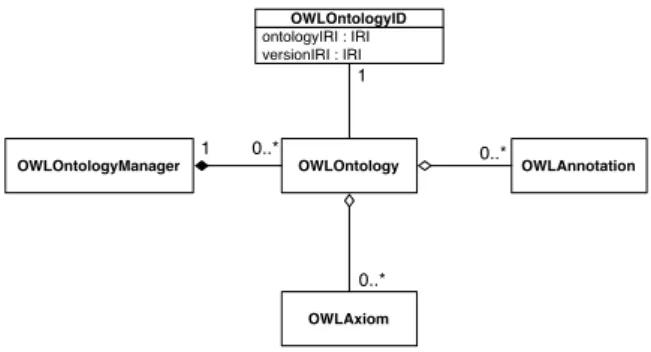
In order to provide this “high level view”, the de-sign of the OWL API is directly based on the OWL 2 Structural Specification [30]. An ontology is sim-ply viewed as a set of axioms and annotations as de-picted in Figure 1. The names and hierarchies of inter-faces for entities, class expressions and axioms in the OWL API correspond closely to the structural specifi-cation, relating the high level OWL 2 specification di-rectly to the design of the OWL API. The OWL API supports loading and saving ontologies is a variety of syntaxes. However, none of the model interfaces in the OWL API reflect, or are biased to any particular con-crete syntax or model. For example, unlike other APIs such as Jena [12], or the Protégé 3.X API, the
repre-sentation of class expressions and axioms isnotat the
level of RDF triples.
3. Detailed Design Principles
Although aspects of the API design have evolved since its original inception and implementation, a num-ber of basic design principles have endured. These are outlined below, but can be summarised as:
– Read-only model interfaces with explicit change
operations.
– Independence from concrete serialisations (in
particular triple based representations).
– A clear separation between components
provid-ing particular functionalities, such as representa-tion, manipularepresenta-tion, parsing, rendering.
– Separation of assertion and inference.
OWLOntologyManager OWLOntology 0..* 1 OWLAxiom 0..* ontologyIRI : IRI versionIRI : IRI OWLOntologyID 1 OWLAnnotation 0..*
Fig. 1. A UML diagram showing the management of ontologies in the OWL API. TheOWLOntologyinterface provides accessors for efficiently obtaining the axioms contained within an ontology. The method of storing axioms is provided by different implementa-tions of theOWLOntologyinterface. The design of the API makes it possible to mix and match implementations, for example, an in--memory ontology could be used together with one that is stored in a database and one that is stored in some kind of triple store. The OWL API reference implementation provides an efficient in-mem-ory storage solution.
3.1. Model
The OWL API’s model provides access to an OWL ontology through a number of Interfaces and Class
def-initions. The model interfaces are read-only, in that
they do not provide explicit functionality for change of the underlying data structures (see Section 3.2).
Following the OWL 2 Structural Specification, the
model provides anaxiom-centric view on OWL
on-tologies (see Figure 1), with anOWLOntology
con-taining a number ofOWLAxiomobjects. Convenience
methods are also available that will answer questions of containment such as “does Ontology O contain class C?”, where containment is taken to mean that the on-tology contains an axiom referring to C. This supports
what we might calllocality of information, in that all
assertions about classes are associated with a particu-lar ontology. As OWL operates in an open web con-text, different ontologies can make different assertions about the same classes and properties.
Although this “axiom-centric” view differs from the original OWL API design, which provided a “frame-oriented” model, the desire to provide a level of ab-straction that insulates developers and applications from underlying syntactic presentations, in particular RDF or triple-based representations has been a corner-stone of the OWL API’s approach.
The model data structures make extensive use of the Visitor pattern [14] which allows separation of data structure from functionality. The Visitor makes it eas-ier to add functionality to a class heas-ierarchy (and is
par-ticularly suited to situations where data structures rep-resent abstract syntax). The Visitor pattern does, how-ever, have the drawback that changes to the data struc-ture can be expensive as it may require changes to the Visitor implementations. For the OWL API, however, where the data structures are stable, the pattern is a good fit.
The specification of the data model is largely through Java Interfaces, enabling the use of alternative implementation strategies. The reference implementa-tion provides data structures for efficient in-memory representations of ontologies. For many purposes this is sufficient. For example, recent versions of the Na-tional Cancer Institute (NCI) ontology can comfort-ably fit into around 700MB of memory (100MB of memory without annotations). However, the API has been designed so that it is possible to provide other storage mechanisms for ontologies such as relational databases or triple stores and to “mix and match” stor-age implementations, so that an ontology imports clo-sure could contain in-memory representations of on-tologies, ontologies persisted in secondary storage in the form of a custom database, and ontologies stored in triple stores.
While the API does not include these alterna-tive storage mechanisms out of the box, third par-ties have developed such solutions. An exemplar so-lution, called OWLDB, has been developed by Henss et al [20]. Their solution stores ontologies in a rela-tional database, using a “native” mapping of OWL constructs (as opposed to a mapping to triples) to a custom database schema. A similar approach is taken by Redmond in [34].
3.1.1. Ontology Management
Besides the model interfaces for representing en-tities, class expressions and axioms, it is necessary to allow applications to manage ontologies. Figure 1 shows a high level overview of this picture. The
OWLOntology interface provides a point for
ac-cessing the axioms contained in an ontology. As discussed above, different implementations of the
OWLOntologyinterface can provide different
stor-age mechanisms for ontologies.
The OWLOntologyManager provides a central
point for creating, loading, changing and saving
on-tologies, which are instances of theOWLOntology
interface. Each ontology is created or loaded by an ontology manager. Each instance of an ontology is unique to a particular manager, and all changes to an ontology are applied via its manager.
This centralised management design allows client applications to have a single access point to ontolo-gies, to provide redirection mechanisms and other cus-tomisations for loading ontologies, and allows client applications to monitor all changes that are applied to any loaded ontologies. The manager also hides much of the complexity associated with choosing the appro-priate parsers and renderers for loading and saving on-tologies.
3.2. Change
The core Ontology model interfaces areread-only,
with issues of change (additions and removals of ax-ioms) handled through the use of explicit change
ob-jects. Class OWLOntologyChange provides a top
level change object with further subclasses defined that encapsulate particular changes. Change enactment is then provided through a further use of the Visitor
pat-tern, withOWLOntologyChangeVisitorobjects
enacting changes.
This use of explicit change objects follows the Com-mand design pattern [14] which encapsulates a change request as an object. Changes are then enacted by a Visitor object.
This use of the Command pattern facilitates sup-port for operations such as undo or redo, and the en-capsulation of changes as operations provides a mech-anism with which to track changes and support ver-sion management. Change objects also provide a con-venient place for storing metadata about the changes, for example the user who requested the change – in-formation which is again crucial in supporting the on-tology management and editing process.
All ontology changes are applied through an ontol-ogy manager. This means that it is possible to apply a list of ontology changes, which make multiple changes to multiple ontologies, as a single unit. This works well for applications such as ontology editors, where an edit operation such as entity name change (entity IRI change) can involve the addition and removal of multiple axioms from multiple ontologies—it is possi-ble to group the changes together to form one “editor operation” and apply these changes at one time.
3.3. Inference and Reasoning
A key aspect of OWL is the provision of a seman-tics that defines precisely what entailment means with respect to OWL ontologies, and provides formal de-scriptions of properties such as consistency. The
im-plementation of these semantics is a non-trivial mat-ter. By separating reasoning functionality, we can re-lieve implementors of the burden of this, while allow-ing those who do provide such implementations to be explicit about this in their advertised functionality. In addition, as is discussed in some detail in [8], separa-tion of assersepara-tion and inference is important in the im-plementation of OWL, particularly when developing user applications, as users may need explicit indication as to why, for example, hierarchical relationships are present.
The OWLReasoner interface provides access to
functionality relating to the process ofreasoningwith
OWL ontologies, supporting tasks such as tasks such as consistency checking, computation of class or prop-erty hierarchies and axiom entailment. Of course, pro-viding method signatures does not go all the way to advertising the functionality of an implementation – there is no guarantee that a component implement-ing the interface necessarily implements the seman-tics correctly. However, signatures and extensive de-tailed documentation of reasoner interfaces go some way towards providing an expectation of the opera-tions that are being supported. From a client perspec-tive, the benefits of having a well defined reasoner in-terface cannot be overstated. The ability to exchange one reasoner implementation for another in a client ap-plication, and know that, in terms of query answering, each reasoner implementation should exhibit the same behaviour is a major advantage. Collections of test data (such as the OWL Test Cases [11]) can allow system-atic testing and a level of confidence as to whether the implementation is, in fact, performing correctly.
The reasoner interfaces have been designed so as to enable reasoners to expose functionality that provides
incrementalreasoning support. The OWL API allows a reasoner to be initialised so that it listens for on-tology changes and either immediately processes the changes or queues them in a buffer which can later be processed. This design caters for the scenario where a reasoner is used within an ontology editor and, at some point, must respond when prompted to edits of the on-tology, or situations where a reasoner should respond to ontology changes as they arrive.
A number of existing implementations including the CEL [1], FaCT++ [39], HermiT [29], Pellet [36], and Racer Pro [16] and SnoRocket reasoners provide OWL API wrappers. These reasoning engines are thus easily integrated into OWL API based applications such as Protégé-4 or the NeOn Toolkit.
3.4. Parsing and Rendering OWL Ontologies
A benefit of aligning the OWL API with the OWL 2 structural specification is that there is no commitment to a particular concrete syntax. Conforming [37] OWL
implementations or toolsmustsupport RDF/XML, but
there are several other syntaxes that exist which are optimised for different purposes. For example, Tur-tle syntax [9] provides a “compact and natural text form” of RDF serialisation. The Manchester OWL Syntax [18] provides a human readable serialisation for OWL ontologies.
The OWL API includes out of the box support for reading and writing ontologies in several syntaxes, in-cluding RDF/XML, Turtle, OWL/XML, OWL Func-tional Syntax, The Manchester OWL Syntax, KRSS
Syntax7 and the OBO flat file format8. Due to the
un-derlying design of the API, it is possible for the im-ports closure of an ontology to contain ontologies that were parsed from ontology documents written in dif-ferent syntaxes.
The reference implementation of the OWL API uses a registry of parsers and renderers, supporting the ad-dition of custom syntaxes. The appropriate parser is
automatically selectedat runtime when an ontology is loaded. By default, ontologies are saved back into the format from which they were parsed, but it is possible to override this in order to perform syntax conversion tasks and “save as” operations in editors for example.
4. Evolution
Three versions of the OWL API have been devel-oped. The first version [8] drew on earlier experiences in the implementation of OilEd [5], one of the first user tools to use Description Logic reasoning services (through use of the DIG protocol) to assist users in the construction of OIL and DAML+OIL ontologies. Although OilEd was widely used (with over 10,000 download requests), the underlying implementation suffered from problems, not least of which was the lack of a separation between interface and implementation. The first version of the OWL API addressed a num-ber of these concerns, while carrying forward other de-sign decisions such as extensive use of the Visitor pat-tern [14].
7http://dl.kr.org/krss-spec.ps
8http://www.geneontology.org/GO.format.
A key change in Version 2 of the OWL API was the
introduction of Java Generics9, which enabled tighter
control over method typing, ensuring that, for exam-ple the result of a query for equivalent classes is re-turned as a set of class expressions. Version 2 also tracked proposed changes in OWL (known at that point as OWL 1.1 [33]), arising from the work of the OWL Working Group including the addition of qualified car-dinality restrictions. In particular, there was a shift from frame-based data structures to an axiom oriented model.
Version 3, the latest release, sees an alignment of method and class names with those used in the OWL 2 Structural Specification[30]. This potentially introduces backwards compatibility issues with ear-lier releases of the OWL API, but our decision was that alignment with the specification brought suffi-cient benefits to outweigh these. For example, the W3C specifications can now themselves serve as addi-tional documentation for the codebase. After reading the OWL 2 specification documents, users should be able to easily identify the correspondence between the OWL API and the specification. Although then name changes are largely syntactic, allowing the use of find and replace scripts to address most incompatibilities, one area of substantive change is in the modelling of axiom annotations, which has been changed to keep in line with the OWL 2 specification. In particular
ax-iom annotations are nowembeddedaxioms, thus
hav-ing an effect on structural identity. In keephav-ing with the OWL 2 Recommendation, entities in OWL ontologies are now identified using IRIs.
5. Additional Functionality
Here we discuss some of the enhanced functional-ity that is available in the core OWL API download supporting tasks such as profile validation, explanation and modularity.
5.1. Profile Validation
The OWL 2 specification defines OWL profiles that correspond to syntactic subsets of the OWL 2 lan-guage. The profiles are defined in the OWL 2 profiles document, namely OWL 2 EL, OWL 2 QL and OWL 2 RL. Each profile is designed to trade some expressive
9http://download.oracle.com/javase/1.5.0/
docs/guide/language/generics.html
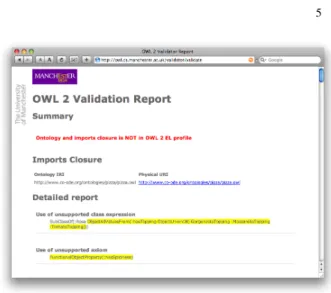
Fig. 2. A Screenshot of the OWL 2 Profile Validator. The validator is written using the Profiles API which is part of the OWL API
power for efficiency of reasoning. For example, the OWL 2 EL profile trades expressivity for the benefit of polynomial time subsumption testing. Similarly, rea-soning for the OWL 2 RL profile can be implemented using a rule engine.
For those using these profiles, and tools that sup-port them, it can be necessary to determine whether or not an ontology falls into one of the profiles or not. The OWL API contains an API to deal with on-tology profiles. Various profile related interfaces are available that provide functionality to ask whether an ontology is within a profile. When doing this a profile report is generated that specifies whether an ontology and its imports closure fall into a given profile, and if
not detailswhythis is the case. The profile API allows
complete programmatic access by client software, with fine-grained objects that represent specific reasons for profile violations.
A Web based application that performs profile vali-dation on an ontology and its imports closure was
writ-ten with the OWL API is available online10. A screen
shot of a report generated by the validator is shown in Figure 2. Each item in the detailed report can be ac-cessed programmatically, which means that client soft-ware can customise report rendering, or offer more ad-vanced functionality such as repair suggestions that would take an ontology back into the desired profile.
5.2. Explanation
In recent years, explanation of entailments has been a “hot topic”. Many of the afore mentioned ontology development environments now feature the ability to generate explanations for unwanted or surprising en-tailments that arise during editing or browsing ontolo-gies. Many of these explanation facilities are based on justifications [35,2,22], which are minimal sets of ax-ioms that are sufficient for an entailment to hold. The OWL API ships with code for generating these expla-nations, making it easy to add basic explanation ser-vices to client applications.
5.3. Modularity
Many applications require the ability to work with well defined portions of an ontology, that are usually called modules. The OWL API contains basic func-tionality for extracting syntactic-locality based mod-ules [13] from ontologies. These kinds of modmod-ules are based on the notion of conservative-extensions [15], and guarantee to preserve entailments from an ontol-ogy over a given signature.
6. Other Frameworks
There have been a number of similar initiatives to provide application interfaces aimed at OWL. HP’s Jena Toolkit [12] supplies ontology interfaces that pro-vides convenience wrappers around RDF interfaces. Comparisons of the OWL API and Jena’s triple-based approach for some tasks are explored in [4].
The KAON [10] toolkit is an open-source ontology management infrastructure targeted for business
appli-cations11. The ontology model supported in KAON is
less expressive than that described by OWL since an important focus of KAON is performance reasoning on knowledge bases with simple ontologies and large ABoxes [28]. Despite this, many of our underlying sign considerations conceptually follow the KAON de-sign.
7. Download, Takeup and Usage
The OWL API is available as open source under the LGPL licence and can be downloaded from
Source-11Available athttp://kaon.semanticweb.org
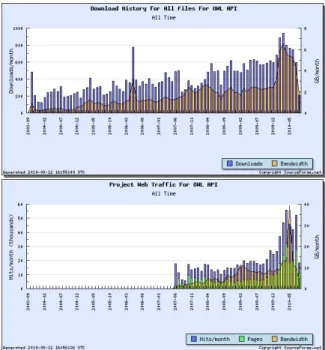
forge12. Statistics taken from sourceforge shown in
Figure 3 indicate a steady increase in downloads and
web traffic13. Since version 1 was released, the OWL
API has had over 34,000 downloads from the Source-forge website. It should be noted that this count does not include copies of the API that are now distributed with widely used tools such as Protégé-4, the NeOn Toolkit, Pellet and HermiT.
Fig. 3. Sourceforge statistics for downloads and web traffic
Some examples of the kinds of applications and ser-vices that have been developed using the OWL API are discussed below. As the codebase is freely available, we fully expect there to be further third-party usage of the OWL API that we are not explicitly aware of.
Protégé-4 [25] is an open source OWL ontology editor that was initially designed and developed at the University of Manchester. Protégé-4 uses the OWL API to underpin all ontology management tasks, from loading and saving ontologies, to manipulating ontolo-gies during editing, to interacting and offering a choice of OWL reasoners. Virtually all of the functionality provided by the OWL API is utilised by Protégé-4.
The NeOn Toolkit2 [17] is an Eclipse based
on-tology development environment that was developed as part of the 14.7 million Euro EU funded project.
12http://owlapi.sourceforge.net
13Note that the figures for project web traffic are only available
While early versions of the toolkit were written on top
of KAON214, in 2010, the project moved to the OWL
API15.
OWLSight3is a web based ontology browser
writ-ten by Clark & Parsia that uses the Pellet reasoner. The browser is written using the Google Web Toolkit, with the OWL API being used to read and access ontolo-gies.
The Ontology Browser16 dynamically generates documentation for ontologies and is based on the OWLDoc software. The OWL API is used for load-ing and accessload-ing ontologies and interfacload-ing with the FaCT++ reasoner.
OntoTrack[26] is a browsing and editing tool for OWL ontologies that is developed at Ulm University. The OWL API is used for loading and accessing on-tologies for rending into a graph.
TheSKOS API17 [21] is a Java interface and
im-plementation for SKOS [27], built on top of the OWL API. It adopts a similar approach to the OWL API, providing an abstract data model for SKOS that avoids commitment to particular concrete syntaxes. SKOSEd, a SKOS editor is implemented as a plugin in to Protégé-4.
TheOWLlink API[31] implements the OWLlink protocol on top of the OWL API. Besides providing an API to access remote OWLlink reasoning engines, it turns any OWL API aware reasoner into an OWLlink server. In essence OWLlink and the OWLlink API re-place the DIG [6] protocol.
A number of online services18are implemented
us-ing the OWL API.
Syntax Converter A web based application that converts ontologies written in one OWL syntax to an-other OWL syntax. Syntax is converted from one for-mat to another forfor-mat by loading and saving ontologies using the OWL API.
Ontology Repository A repository of ontologies used for reasoner and tools testing. The loading and se-rialising makes use of the OWL API parsers and ren-derers, while the metrics for each ontology are com-puted by the OWL API’s Metrics API.
ValidatorUses the various profile validators to de-termine if an ontology and its imports closure is within
14http://kaon2.semanticweb.org 15http://www.neon-project.org/nw/NeOn_ Toolkit_-_Latest_Major_Release 16http://owl.cs.manchester.ac.uk/browser 17http://skosapi.sourceforge.net/ 18http://owl.cs.manchester.ac.uk
a specific profile. The validator returns valdiation re-ports in a variety of human readable syntaxes. The val-idator makes use of the Profiles API, which is part of the OWL API.
Module Extractor Allows locality based mod-ules to be extracted from ontologies. The extractor makes usedt of OWL API modularisation code, which currently provides Syntactic Locality Based Mod-ules [19].
MetricsAllows ontologies to be submitted and re-turns a report about the number and types of axioms in an ontology and its imports closure. This application uses the Metrics API, which is part of the OWL API.
8. Limitations
As discussed above, the OWL API has proved to be a popular and useful code library. The design de-cisions made in the development of the OWL API do, however, impact on its suitability for application us-age. The most crucial of these is that the OWL API is primarily designed to be an application that supports manipulation of OWL ontologies at a particular level of abstraction – which is not the RDF level. Thus the API is perhaps less suitable for those wishing to explic-itly exploit the layering of OWL on RDF. In addition, the original design of the OWL API was “tuned” to tar-get the OWL DL species. Although OWL Full ontolo-gies can be manipulated using the OWL API, alterna-tive frameworks such as Jena may be more suitable if OWL Full aspects are to be exploited in an application. The reference implementation supplied with the OWL API downloads uses an in-memory representa-tion. This places some restriction on the size of on-tologies that can be processed using the OWL API. In practice, we have not found this to be a serious issue. Table 1 shows load times (in seconds) and memory consumption (in megabytes) after loading for several well known large ontologies. For comparison, the load times and memory consumption for the Jena API are also given, showing comparable performance.
9. Summary
The OWL API provides a collection of powerful and flexible interfaces supporting the use of OWL ontolo-gies within applications. The model explicitly supports the recent OWL 2 Recommendation. Common inter-faces to reasoning engines are defined, facilitating the
Ontology Axioms Triples Load Time Mem. NCI 1,093,733 1,449,558 19.0 s 638 Mb O/A 36.3 s 600 Mb Jen. FMA 1,651,533 1,686,457 26.5 s 831 Mb O/A 43.8 s 482 Mb Jen. SNOMED 1,036,800 3,355,279 30.1 s 770 Mb O/A 59.4 s 875 Mb Jen. Table 1
Load times and memory usage for well known large ontologies. The OWL API (O/A) is compared with Jena (Je.)
use of inference within applications. The distribution includes a reference, main-memory implementation, and provides support for parsing and rendering ontolo-gies in a variety of concrete syntaxes along with OWL 2 Profile validators. The API is in widespread usage, with a growing user community.
The overview presented here is necessarily brief – space constraints prevent us from providing in depth descriptions of the design and details of the code base. Further detailed documentation is available from the
OWL API Sourceforge site12 along with tutorial
pre-sentations, examples and full javadoc
documenta-tion for the code base. There is also an active mailing
list for developers19.
10. Acknowledgements
The OWL API has required extensive programming and design effort, and the level of sophistication and robustness acheived would have been difficult, if not impossible, without key contributions from a num-ber of people. The authors would like to acknowledge those who have contributed to the OWL API since the first version was designed and developed by Sean Bechhofer, Raphael Volz and Philip Lord in 2003 [7]. In particular, those who have made significant
contri-butions (in alphabetical order) include: Ron Alford20,
Nick Drummond21, Birte Glimm22(reasoner interface
design), Luigi Iannone21, Aditya Kalyanpur23, Pavel
Klinov21, Boris Motik22 (reasoner interface and
gen-eral design), Olaf Noppens24 (reasoner interface
de-sign and parsing contributions), Ignazio Palmisano21
19http://sourceforge.net/mailarchive/forum.
php?forum_name=owlapi-developer
20Clark & Parsia
21The University of Manchester 22Oxford University
23IBM TJ Watson Research Center, New York 24Ulm University
(concurrency support), Timothy Redmond25, Angus
Roberts21, Nicolas Rouquette26, Thomas Schneider21
(modularity support), Evren Sirin20(reasoner interface
design, explanation code), Mike Smith20, and Daniele
Turi21
Thanks also go to past and present members of the Information Management Group (IMG) and the Bio-Health Informatics Group (BHIG) at the University of Manchester, and all of the OWL API users who have posted bug reports and feedback on the OWL API pub-lic mailing list.
Development of the OWL API has been funded from a number of sources, including the EU funded
Wonderweb project27; the JISC funded CO-ODE project28
and the EU funded TONES project29.
References
[1] F. Baader, C. Lutz, and B. Suntisrivaraporn. CEL—a polynomial-time reasoner for life science ontologies. In U. Furbach and N. Shankar, editors,Proceedings of the 3rd International Joint Conference on Automated Reasoning (IJ-CAR’06), volume 4130 ofLecture Notes in Artificial Intelli-gence, pages 287–291. Springer-Verlag, 2006.
[2] Franz Baader and Bernhard Hollunder. Embedding defaults into terminological knowledge representation formalisms. Journal of Automated Reasoning, 14(1):149–180, 1995. [3] Sean Bechhofer. OWL Web Ontology Language Parsing OWL
in RDF/XML. W3C Working Group Note, World Wide Web Consortium, January 2004. http://www.w3.org/TR/
owl-parsing.
[4] Sean Bechhofer and Jeremy J. Carroll. Parsing OWL DL: Trees or Triples? InProceedings of the World Wide Web Conference, WWW2004, pages 266–275. ACM Press, 2004.
[5] Sean Bechhofer, Ian Horrocks, Carole Goble, and Robert Stevens. OilEd: a Reason-able Ontology Editor for the Seman-tic Web. InProceedings of KI2001, Joint German/Austrian conference on Artificial Intelligence, volume 2174 of LNAI, pages 396–408. Springer-Verlage, Sep 2001.
[6] Sean Bechhofer, Ralf Möller, and Peter Crowther. The DIG Description Logic Interface. InProceedings of DL2003 Inter-national Workshop on Description Logics, September 2003. [7] Sean Bechhofer, Raphael Volz, and Philip Lord. Cooking the
semantic web with the OWL API. In Dieter Fensel, Katia Sycara, and John Mylopoulos, editors,The Semantic Web -ISWC 2003. The Second International Semantic Web Confer-ence, Sanibel Island, Florida, USA, volume 2870/2003 of Lec-ture Notes in Computer Science, pages 659–675, Sanibel Is-land, Florida, USA, October 2003. Springer.
25Stanford University 26JPL, NASA 27http://wonderweb.semanticweb.org/ EU IST-2201-33052 28http://www.co-ode.org 29http://www.tonesproject.org/FP6-7603
[8] Sean Bechhofer, Raphael Volz, and Phillip Lord. Cooking the Semantic Web with the OWL API. In Dieter Fensel, Katia Sycara, and John Mylopoulos, editors,2nd International Se-mantic Web Conference, ISWC, volume 2870 ofLecture Notes in Computer Science. Springer, October 2003.
[9] David Beckett and Tim Berners-Lee. Turtle - Terse RDF Triple Language. Team Submission, World Wide Web Consor-tium, 2008. http://www.w3.org/TeamSubmission/
turtle/.
[10] Erol Bozsak, Marc Ehrig, Siegfried Handschuh, Andreas Hotho, Alexander Maedche, Boris Motik, Daniel Oberle, Christoph Schmitz, Steffen Staab, Ljiljana Stojanovic, Ne-nad Stojanovic, Rudi Studer, Gerd Stumme, York Sure, Julien Tane, Raphael Volz, and Valentin Zacharias. KAON - Towards a Large Scale Semantic Web. In K. Bauknecht, A. Min Tjoa, and G. Quirchmayr, editors,EC-Web 2002, volume 2455 of Lecture Notes in Computer Science, pages 304–313. Springer, September 2002.
[11] J. Carroll and J. De Roo. OWL Web Ontology Language Test Cases. W3C Recommendation, World Wide Web Consortium, 2004.http://www.w3.org/TR/owl-test/. [12] Jeremy J. Carroll, Ian Dickinson, Chris Dollin, Dave Reynolds,
Andy Seaborne, and Kevin Wilkinson. Jena: implementing the semantic web recommendations. In Stuart Feldman, Mike Uretsky, Mark Najork, and Craig Wills, editors,Proceedings of the 13th international World Wide Web conference on Al-ternate track papers & posters, pages 74–83, New York, NY, USA, May 2004. ACM.
[13] Bernardo Cuenca Grau, Ian Horrocks, Yevgeny Kazakov, and Ulrike Sattler. Just the right amount: Extracting modules from ontologies. InWWW 2007, Proceedings of the 16th Interna-tional World Wide Web Conference, Banff, Canada, May 8-12, 2007, pages 717–727, 2007.
[14] Erich Gamma, Richard Helm, Ralph Johnson, and John Vlis-sides.Design Patterns: Elements of Reusable Object-Oriented Software. Professional Computing Series. Addison-Wesley, 1995.
[15] Silvio Ghilardi, Carsten Lutz, and Frank Wolter. Did i dam-age my ontology? a case for conservative extensions in de-scription logic. In Patrick Doherty, John Mylopoulos, and Christopher A. Welty, editors,The 10th International Confer-ence on Principles of Knowledge Representation and Reason-ing (KR 2006), Lake District, United KReason-ingdom. AAAI Press, June 2006.
[16] Volker Haarslev and Ralf Möller. RACER system descrip-tion. InInternational Joint Conference on Automated Reason-ing (IJCAR 2001), volume 2083 ofLecture Notes In Computer Science, pages 701–705, 2001.
[17] Peter Haase, Holger Lewen, Rudi Studer, Duc Thanh Tran, Michael Erdmann, Mathieu d’Aquin, and Enrico Motta. The neon ontology engineering toolkit. In Jeff Korn, editor,WWW 2008 Developers Track, April 2008.
[18] Matthew Horridge and Peter F. Patel-Schneider. OWL 2 Web Ontology Language Manchester Syntax. W3C Working Group Note, World Wide Web Consortium, 2009. http://www.
w3.org/TR/owl2-manchester-syntax/.
[19] Ernesto Jiménez-Ruiz, Bernardo Cuenca Grau, Ulrike Sattler, Thomas Schneider, and Raphael Berlanga Llavori. Safe and economic re-use of ontologies: A logic-based methodology and tool support. In Sean Bechhofer, Manfred Hauswirth, Jo-erg Hoffmann, and Manolis Koubarakis, editors,The Semantic
Web: Research and Applications, 5th European Semantic Web Conference, ESWC 2008, Tenerife, Canary Islands, Spain, vol-ume 5021 ofLecture Notes in Computer Science, pages 185– 199. Springer, June 2008.
[20] Joachim Kleb Jörg Henss and Stephan Grimm. A database backend for OWL. In Rinke Hoeksta and Pe-ter F. Patel-Schneider, editors,OWL: Experiences and Direc-tions (OWLED 2009), CEUR Workshop Proceedings. CEUR-WS.org, October 2009.
[21] Simon Jupp, Sean Bechhofer, and Robert Stevens. A flexible API and editor for SKOS. InProceedings of the 6th European Semantic Web Conference (ESWC), Heraklion, Crete, volume 5554 ofLecture Notes in Computer Science, pages 506–520. Springer, 2009.
[22] Aditya Kalyanpur.Debugging and Repair of OWL Ontologies. PhD thesis, The Graduate School of the University of Mary-land, 2006.
[23] Aditya Kalyanpur, Bijan Parsia, Evren Sirin, Bernardo Cuenca Grau, and James Hendler. Swoop: A web ontology editing browser.Web Semantics: Science, Services and Agents on the World Wide Web, 4(2):144 – 153, 2006. Semantic Grid –The Convergence of Technologies.
[24] Graham Klyne and Jeremy J. Carroll. Resource Description Framework (RDF): Concepts and Abstract Syntax. W3C Rec-ommendation, World Wide Web Consortium, 2004. http:
//www.w3.org/TR/owl-guide/.
[25] Holger Knublauch, Ray W. Fergerson, Natalya F. Noy, and Mark A. Musen. The protégé owl plugin: An open develop-ment environdevelop-ment for semantic web applications. In Sheila A. McIlraith, Dimitris Plexousakis, and Frank van Harmelen, edi-tors,The Semantic Web – ISWC 2004, volume 3298 ofLecture Notes in Computer Science, pages 229–243. Springer Berlin / Heidelberg, 2004.
[26] Thorsten Liebig and Olaf Noppens. Ontotrack: Combining browsing and editing with reasoning and explaining for owl lite ontologies. In Sheila A. McIlraith, Dimitris Plexousakis, and Frank van Harmelen, editors,he Semantic Web – ISWC 2004, volume 3298 ofLecture Notes in Computer Science, pages 244–258. Springer Berlin / Heidelberg, 2004.
[27] Alistair Miles and Sean Bechhofer. SKOS Simple Knowl-edge Organization System Reference. W3C Recommenda-tion, World Wide Web Consortium, 2009. http://www.
w3.org/TR/skos-reference/.
[28] Boris Motik, Alexander Maedche, and Raphael Volz. A con-ceptual modeling approach for building semantics-driven en-terprise applications. InProc. of the International Confer-ence on Ontologies, Databases and Applications of SEmantics ODBASE 2002. Springer, LNCS, 2002.
[29] Boris Motik, Rob Shearer, and Ian Horrocks. Optimized rea-soning in description logics using hypertableaux. InProc. of the 21st Int. Conf. on Automated Deduction (CADE-21), vol-ume 4603 ofLecture Notes in Artificial Intelligence, pages 67– 83. Springer, 2007.
[30] Motik, Boris and Patel-Schneider, Peter F. and Parsia, Bi-jan. OWL 2 Web Ontology Language Structural Specification and Functional-Style Syntax. W3C Recommendation, World Wide Web Consortium, 2009.http://www.w3.org/TR/
owl2-syntax/.
[31] Olaf Noppens, Marko Luther, and Thorsten Liebig. The OWLlink api teaching owl components a common proto-col. In Evren Sirin, editor,OWL: Experiences and Directions
(OWLED 2010), 2010.
[32] Peter F. Patel-Schneider, Patrick Hayes, and Ian Horrocks. OWL Web Ontology Language semantics and abstract syntax. W3C Recommendation, 10 February 2004.
[33] Peter F. Patel-Schneider and Ian Horrocks. OWL 1.1 Web Ontology Language Overview. Member Submission, World Wide Web Consortium, 2006. http://www.w3.org/
Submission/owl1-overview/.
[34] Timothy Redmond. An open source database backend for the OWL API and protégé 4. In Evren Sirin, editor,OWL: Experi-ences and Directions (OWLED 2010), 2010.
[35] Stefan Schlobach and Ronald Cornet. Non-standard reasoning services for the debugging of description logic terminologies. InIJCAI International Joint Conference on Artificial Intelli-gence, 2003.
[36] Evren Sirin, Bijan Parsia, Bernardo Cuenca Grau, Aditya Kalyanpur, and Yarden Katz. Pellet: A practical OWL-DL rea-soner.Journal of Web Semantics, 5(2), 2007.
[37] Michael Smith, Ian Horrocks, Markus Krötzsch, and Birte Glimm. OWL 2 Web Ontology Language Conformance. W3C Recommendation, World Wide Web Consortium, 2009.
http://www.w3.org/TR/owl2-conformance/.
[38] Sun Microsystems, Inc. JavaTMPlatform. http://java.
sun.com/j2se/.
[39] Dmitry Tsarkov and Ian Horrocks. FaCT++ description logic reasoner: System description. InProc. of the Int. Joint Conf. on Automated Reasoning (IJCAR 2006), volume 4130 ofLecture Notes in Artificial Intelligence, pages 292–297. Springer, 2006. [40] W3C DOM Working Group. Document Object Model.http:
//www.w3.org/DOM/.
[41] W3C OWL Working Group. OWL 2 Web Ontology Lan-guage Document Overview. W3C Recommendation, World Wide Web Consortium, 2009.http://www.w3.org/TR/