Concepts, trends and recommendations for German development cooperation
As a federally owned enterprise, GIZ supports the German Government in achieving its objectives in the field of international cooperation for sustainable development.
Published by:
Deutsche Gesellschaft für
Internationale Zusammenarbeit (GIZ) GmbH Registered offices:
Bonn and Eschborn
Friedrich-Ebert-Allee 36 + 40 53113 Bonn, Germany T +49 (0) 228 4460 - 0 F +49 (0) 228 4460 - 17 66 Dag-Hammarskjöld-Weg 1–5 65760 Eschborn, Germany T +49 (0) 61 96 79 - 0 F +49 (0) 61 96 79 - 11 15 E [email protected] I www.giz.de
On behalf of the German Federal Ministry for Economic Cooperation and Development (BMZ) Division 303, Education and the digital world
Dr Katrin Bornemann
Dahlmannstraße 4, 53113 Bonn, Germany T +49 (0) 228 995 35 - 0
F +49 (0) 228 995 35 - 35 00 Programme/project description: Sector Project Digital Development Strategic Project Digital Change Authors:
Andreas Pawelke, Michael Cañares, World Wide Web Foundation Kevin Hernandez, Pedro Prieto Martin, Institute of Development Studies Supported by Ben Ramalingam, Institute of Development Studies Responsible:
Björn Richter, Sector Project Digital Development Lea Gimpel, Strategic Project Digital Change Editor:
Balthas Seibold, Elisabeth Hobl, Sector Project Digital Development Design/layout, etc.:
Crolla Lowis, Aachen
GIZ is responsible for the content of this publication.
The views expressed in this paper are those of the authors and do not necessarily represent those of the German Federal Ministry for Economic Cooperation and Development, the Deutsche Gesellschaft für Internationale Zusammenarbeit (GIZ) GmbH, the Institute of Development Studies, or the World Wide Web Foundation.
URL links:
This publication contains links to external websites. Responsibility for the content of the listed external sites always lies with their respective publishers.
When the links to these sites were first posted, GIZ checked the third-party content to establish whether it could give rise to civil or criminal liability.
However, the constant review of the links to external sites cannot reasonably be expected without concrete indication of a violation of rights. If GIZ itself becomes aware or is notified by a third party that an external site it has provided a link to gives rise to civil or criminal liability, it will remove the link to this site immediately. GIZ expressly dissociates itself from such content.
Maps:
The maps printed here are intended only for information purposes and in no way constitute recognition under international law of boundaries and territories. GIZ accepts no responsibility for these maps being entirely up to date, correct or complete. All liability for any damage, direct or indirect, resulting from their use is excluded.
Printing and distribution: bonnprint.com GmbH, Siegburg
Printed on 100% recycled paper, certified to FSC standards. November 2017
Data for
development:
What’s next?
Concepts, trends and recommendations for German
development cooperation
The state of affairs
18
2.1. Big data 20 2.2. Open data 26 2.3. Citizen-generated data 32 2.4. Real-time data 36 2.5. Summary 41Trends
42
3.1. More data and new data sources create opportunities 44
3.2. New technologies improve data analysis 47
3.3. New types of actors, partnerships and ways of working emerge 50
3.4. Balancing access to personal data and privacy 53
3.5. The value of contextual, granular information 56
3.6. Information inequality is likely to persist 58
3.7. Summary 61
Recommen dations
62
4.1. Maximise the potential of data, but do not treat it as a ‘silver bullet’ 66
4.2. Build internal data capacity 67
4.3. Leverage partnerships for a strategic advantage 68
4.4. Support strong technological and legal data privacy frameworks 71 4.5. Be experimental and focus on a few sectors and geographies 73
4.6. Address data inequalities 74
4.7. Summary 76
The way forward
78
Annex
80
About this report
82
2
3
4
5
6
Executive
summary
Big Data
Recommendations
Recommendations
‘Inequality and poverty are
about more than income –
they are also about information.’
Web inventor Sir Tim Berners-LeeNinety per cent of all data ever created has been produced in the past two years. This includes data generated by people as well as the billions of sensors all over the world that are creating data every second and communicating with servers over the internet, creating what is called the Internet of Things.
Enabled by the rapid spread of technology and a more affordable access to the internet and mobile networks, the availability of digital data, in new and differ-ent forms, has grown at massive scale. Several initiatives have been launched in recent years that have explored diverse ways to leverage these new types of digi-tal data for more targeted, effective and efficient development interventions. In this report, we look at the state of digital data for development and emerg-ing trends. We aim to support German development cooperation in integratemerg-ing and prioritising data approaches and investments in their work. In this study we focus on four data categories: big data, open data, citizen-generated data and real-time data. The selection of these categories considered two key dimensions: (1) the growing use in development-related policy discussions, and (2) the abil-ity to capture key characteristics of interest, including size, access, source, and timeliness of data. We believe these categories provide a good starting point to explore how digital data production and use might lead to better development outcomes.
Big data
Basic definition
Value
Example
Open data
Citizen-generated data
Real-time data
High-volume, high-variety and high-velocity data that can contain both structured datasets and flows of unstruc-tured data, often created and collected by the private sector.
Data that can be freely used, reused, and redistributed by anyone.
Data actively produced by citizens with a specific purpose in mind.
Data that is gathered and analysed quickly enough to make timely decisions.
Understand on-the-ground conditions, document and map incidents and sentiment, especially when data from other sources is unavailable, inaccessible or of poor quality.
Quickly make data-based decisions, for example in health or humanitarian crises.
Using drones to collect data for land rights advocacy in Indonesia.
(see Box 2.f. on p. 35)
Using real-time data on birth registration in Tanzania to improve policy-making. (see Box 2.h. on p. 40) Strengthen (government)
transparency, accountability and responsiveness, and spur social and business innovation.
Identifying lower-priced generic medicines through open data in South Africa. (see Box 2.e. on p. 31) Quickly analyse situations,
diagnose and understand underlying problems, predict likely scenarios and even prescribe the most beneficial potential actions.
Tackling the spread of malaria using mobile phone data. (see Box 2.a. on p. 23)
What is the current state of
data for development?
Big data
Generally, big data increases an organisation’s capacity to describe and visualise situations, diagnose and understand underlying problems, predict likely scenar-ios and even prescribe beneficial potential actions. In the data for development space, actors like UN Global Pulse and the Data-Pop Alliance seek to promote a people-centred approach to big data, undertaking research and projects that use big data to solve persistent development problems, such as combating malaria. To date, big data for development projects have mainly been pilots and proof of concepts showing the potential of using big data to tackle development prob-lems. While these pilots have helped garner interest and hype around big data, so far there is no clear indication that they have led to data-based decision-making. However, there is reason to remain hopeful as these pilots enable the interna-tional development sector to start integrating long-term big data applications into development programming.
Open data
The global open data movement began by advocating for openly available gov-ernment data. For open data to make a real impact, however, there are at least three key building blocks: the publication of open data by governments, the conversion of data to actionable information by intermediaries, and the use of this information by government officials, citizens, and others.
Case studies of open data initiatives in developing countries revealed at least three emerging impacts: increased government transparency and accountabil-ity; innovation and economic development; and greater inclusion and citizen empowerment. These impacts, however, are dependent on a number of factors, the availability of open data being just one. It has become clear that open data impacts depend on partnerships and collaboration, the quality of public open data infrastructure, clear open data policies, and government responsiveness.
Citizen-generated data
The idea behind citizen-generated data is for citizens to be not only passive con-sumers of information, but also active data producers, users and intermediaries. There is evidence of the value of citizen-generated data for improved delivery of development projects. Crowdmapping initiatives have contributed to a better understanding of the nature and scale of social issues such as corruption, harass-ment and voter turnout. Granular and real-time data provided by citizens have enabled governments to take more evidence-based decisions, for example in regard to urban infrastructure. Moreover, research has documented the impact of citizen-generated data projects on government policy and practice in areas including measuring education outcomes and improving community water sup-ply. However, citizen-generated data initiatives often face significant barriers to scaling, including the requirement for a robust data collection infrastructure and ensuring that data production is sustainable and citizens are committed to contributing data.
Real-time data
Digital real-time data requires employing digital technology to enable and accelerate collection, sharing, management, analysis, and reporting of data to enable timely decision-making. The expected impacts of using real-time data in development programmes are related to increasing their capacity to respond to changes in their operating contexts and to learn from constant evaluations of the effectiveness of their actions. Real-time data has the potential to give devel-opment actors the means to uncover anomalies, respond to issues as they arise, improve internal coordination, optimise resource allocation, react to citizen feedback, and anticipate trends and future events.
There is still little evidence that real-time data leads to adaptive decision-making, as there are many barriers to ensuring that data is used by decision-makers. Some of the hindrances include competing data sources, distrust in data quality, lack of awareness of available data, data not adequately turned into information, lack of visualisation, and information that is not tailored to the end user’s needs.
What emerging trends do we
see?
Our research has uncovered six main trends impacting the digital data for development space that could shape or magnify the role and impact of data for development.
1
More data and new data sources
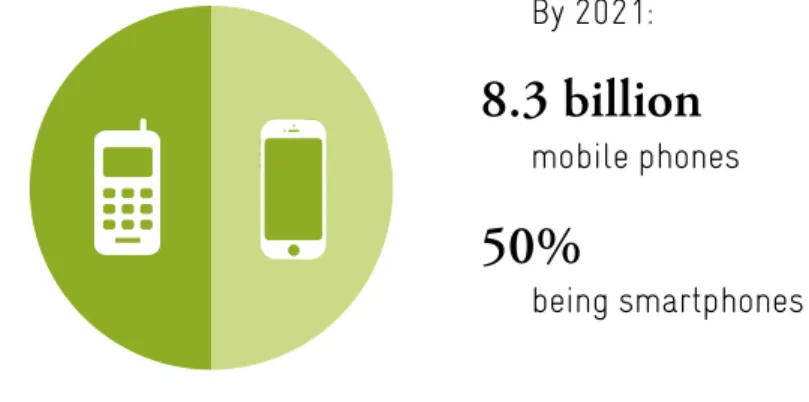
The quantity of data available is increasing at an exponential rate, a trend likely to continue in years to come. By 2021, 8.3 billion mobile phones are expected to be in use with over 50 per cent being smartphones.
The Internet of Things might increase from 8.4 billion objects in 2017 to 20 billion in 2020. All these devices will generate an ever growing flow of data. If adopted effectively by the development sector, new data sources and technologies could help overcome data gaps and allow development practi-tioners to gain a better understanding of contexts before, during and after interventions. However, digital data over-represents those already connected, and more data does not automatically translate to use. The challenge is to ensure inclusiveness, especially in triggering data demand and use. 2
New powerful technology to analyse data
An increase in data availability and the speed at which it is collected, pro-cessed and visualised with analytical tools is providing us with new ways to make sense of development problems and opportunities. Machine learning algorithms can identify patterns in observed data, build explanatory mod-els and make predictions quicker and with more accuracy than humans do. These developments enable practitioners to better understand problems through data and have encouraged some agencies to introduce agile and adaptive programming. However, algorithmic transparency remains a challenge.
3
New types of actors and partnerships
The complexity of challenges in development requires not only new data sources and tools, but also new actors and partnerships. In data for devel-opment, at least two kinds of partnerships have emerged: data philanthropy and data collaboratives. Data philanthropy encompasses corporations that share their data for the public good, while data collaboratives share data assets and combine their expertise and/or tools to solve specific public problems. Non-traditional actors have also emerged, such as data and inno-vation labs, and data analytics companies, which increasingly play a role in the development sector.
4
Balancing access to data and privacy
Privacy protection is likely to receive growing attention in the coming years. Key players in the data for development domain will realise that protecting individual privacy while using personal data to tackle development chal-lenges is virtually impossible. Meanwhile, the protection of personal privacy may be used as an excuse to withhold public sector data that could be made open for citizens to advocate for better public services, hold governments accountable and tackle corruption in the public sector. The hope is that an inclusive multi-stakeholder approach will emerge to identify workable solu-tions to privacy challenges.
5
The importance of contextual, granular information
The growing recognition of the importance of contextual information and of the need to integrate local knowledge into data for development initia-tives has multiple implications. Future data initiainitia-tives are likely to move from current technology-driven top-down approaches towards becoming more bottom-up, problem-driven interventions. These initiatives will increas-ingly be ‘human-centric’ and aim for long-term empowerment of local com-munities, governments and civil society organisations, in ways that enable them to cooperate in using data to improve their situations.
6
Information inequality is likely to persist
The current system of data production and ownership rests primarily in the hands of private sector players, and to a lesser extent governments. Exist-ing information inequalities are likely to be exacerbated in the comExist-ing years as some actors are in a better position than others to harness the positive developments arising from data. Unless there is a drive to diminish this data inequality, those with the capacity to handle large volumes of data will be in an advantageous position, while others will lose out.
What role could German
development cooperation play?
There are negative and positive potential scenarios for these six trends as they unfold within the next five years and beyond. More sources of data can make the development sector more agile, but may open opportunities for surveil-lance and threats to individual privacy. Artificial intelligence offers novel ways of tackling development problems, but in some cases, algorithms have proven to be biased, opaque and out of reach of scrutiny. While new partnerships emerge between development and private sector actors to facilitate collaborative data-driven approaches, these partnerships could create silos, excluding other actors. Finally, while opening and sharing data between partners can serve the public good, this can also threaten citizen privacy due to the technical chal-lenges of fully anonymising data.
These opportunities and challenges are not set in stone. The actions taken by those working in the sector will shape whether we amplify the positive trends, and mitigate the negative. The following recommendations on how to harness data – big, open, citizen-generated, or real-time – can contribute to global devel-opment goals and affirm the role of German develdevel-opment cooperation in inter-national development.
1
Maximise the potential of data, but do not treat it as a ‘silver
bullet’
German development actors should embrace the potential of digital data to drive development, while being conscious that data is only a means to an end, and acknowledging that the political economy of decision-making and the demand for data are as important as the supply of data. When estab-lishing data for development initiatives, they should ensure that an enabling environment to incorporate data into decision-making already exists, or that one will be developed alongside the initiative.
2
Build internal data capacity
Organisations will need to invest in internal capacity building to develop the data literacy needed to leverage data-driven approaches. They should promote the emergence of multi-disciplinary teams to work in these initia-tives. An assessment of current capacities vis-à-vis the role German devel-opment organisations would like to play is necessary to determine how the demand for domain experts, social scientists, data scientists and technolo-gists can be met.
3
Leverage partnerships for a strategic advantage
There is a need to consider actions to reinforce Germany’s commitment to data in achieving the Sustainable Development Goals (SDGs), such as par-ticipating in the Global Partnership for Sustainable Development Data and endorsing the International Open Data Charter. German development actors should review their engagement strategy with other sectoral partners, especially the ‘development mutants’ – those emerging actors that are revo-lutionising the way development is done.
4
Support strong legal and technological data privacy
frameworks
We suggest German development organisations support partner govern-ments in strengthening their data privacy frameworks, work with busi-ness and civic organisations to better understand the risks of data collection and use, and champion responsible data approaches in global initiatives. Through existing networks, these organisations could help mobilise voices from the global South to contribute to global debates on data privacy issues, conduct targeted capacity building for actors in partner countries to main-stream responsible and secure data practices, and help shape the debate on the role of artificial intelligence and algorithms in data analysis.
5
Be experimental and focus on a few sectors and geographies
German development actors should be taking an experimental, iterative and flexible approach to data for development, targeted at specific problems, sectors and geographies instead of cross-cutting data initiatives. They could combine their strong sectoral expertise with the opportunities that new types of digital data provide, and help nurture data ecosystems in sectors like procurement, extractives and health.
6
Tackle data inequalities
German development organisations should help reduce data and informa-tion inequalities through targeted research and empowerment of local stake-holders given their strong track record of empowerment through capacity building and the financing of social and economic infrastructure. With a reputation of being able to work across government, civil society and the private sector, and with expertise in a range of thematic areas such as food security, financial inclusion and disaster preparedness, they are well posi-tioned to occupy the niche of human-centred, privacy-aware data skills development. This also applies to the financing of the necessary invest-ments into software, hardware and up-to-date telecommunication infra-structure required for wide-spread data access and use. Public institutions and citizens, including marginalised people and those living in remote areas in developing countries, need to have access to technology and the internet to avail of the benefits derived from using data for improved decision-mak-ing, strengthened transparency and accountability, and better public service delivery.
Digital data offers manifold opportunities to development by enabling develop-ment actors to strengthen decision-making processes, improve service delivery, elicit meaningful citizen participation, and increase responsiveness in humani-tarian services, among others. At the same time, it generates new forms of exclu-sion, new methods of surveillance and threatens individual privacy.
Promising that digital data will solve development challenges is an overstate-ment. Data is just one of the ingredients that can help solve a given problem. There are people, partners, communities, gatekeepers and leaders that make up the whole enabling mechanism for digital data to work best in development. This is why the recommendations identified in this paper emphasise the role of stakeholders along the development value chain – building individual and organisational capacities, protecting personal privacy, building collaborations across sectors, and empowering the powerless. This is in recognition that data is useless in development without people, that technology is useless without civic engagement, and that efforts to engage technology with no regard to communi-ties and their culture will gain no ground.
Examples of data usage in international development cooperation
Nigeria: The German Federal Ministry for Economic Cooperation and Development supported the development of the open source plat-form ‘Surveillance, Outbreak Response Management and Analysis System’ that uses real-time data. The platform serves as a disease out-break early warning and management system and was used during the West African Ebola outbreak in 2014/2015.
Tanzania: UNICEF and the Tanzanian government use real-time data for birth registration in Tanzania to improve policy-making and planning.
Indonesia: Incomplete data about land type, usage and ownership has led to frequent conflicts between businesses and local communi-ties over territorial rights in Indonesia. Now citizen-generated data via drones is used to create cartographic material that can be used to solve disputes over land use.
Kenya: A Kenyan initiative is using citizen-generated data via the platform ‘Una Hakika?’ – Swahili for ‘Are you sure?’. People can report potentially harmful rumours, which are then quickly validated to mitigate the escalation of ethnic conflicts based on misinforma-tion.
Global: ‘FinTechs’ and ‘InsureTechs’ tap into data to develop finan-cial products and innovative ways of making finanfinan-cial services avail-able. Big data can help with removing traditional bottlenecks for financial inclusion by taking advantage of new technology, analytical tools and data access.
Global: Actors like the Humanitarian OpenStreetMap Team and Missing Maps work across the globe to enable data collection and provide detailed and accurate maps for humanitarian response and economic development.
Introduction
Data has been used extensively in international development for
many years. It has helped development organisations define the
most appropriate and relevant intervention, assess progress of
proj-ects over time and evaluate the effectiveness of the global
develop-ment agenda, among others.
Enabled by the rapid spread of technology and a more affordable
access to the internet and mobile networks, the availability of data,
in new and different forms, has grown at massive scale. A number
of initiatives have been launched in recent years that explore diverse
ways to leverage these new types of digital data coming from cell
phones, social media or sensors for more targeted, effective and
efficient development interventions.
In this report, we look at the current state of data for
develop-ment. We review the state of affairs and explore emerging trends to
indicate potential areas of interest that various actors involved in
German development cooperation may want to explore in
mak-ing choices on priorities, approaches and investments in their
future development agenda. By presenting key concepts, actors and
achievements and by identifying key trends that we believe will
shape and influence the work of development organisations in the
next five years, we hope to provide a foundation for decision-makers
of German development actors to help them explore in more depth
the various opportunities and risks.
The report is structured as follows.
The ‘state of affairs’
chapter explores four digital data for development concepts,
namely big data, open data, citizen-generated data and real-time
data. In this report, we focus on these relatively new and emerging
data for development concepts
1rather than more traditional
devel-opment data that includes household surveys and censuses. For
1 Unless otherwise noted, in this report the term ‘data’ refers to digitally generated or digitally processed data.
The ‘trends’ chapter presents six trends that we believe will shape
the data for development space
over the next five years. Through
these trends – identified through literature review, interviews with
experts, and workshop discussions with staff from German
devel-opment organisations – we seek to capture not only technical
advancements, but also social, political and legal aspects that will
impact future data for development work.
The ‘recommendations’ chapter seeks to respond to the identified
trends.
While we have made an effort to tailor the
recommenda-tions to the German government’s specific development
coopera-tion agenda, they should be understood as suggescoopera-tions for a general
direction of travel rather than as immediate, concrete and
action-able. This is largely due to the variety of actors involved in German
development cooperation, which include funders,
implement-ing organisations workimplement-ing in financial and technical cooperation,
media development and faith-based institutions as well as political
foundations. Spelling out customised, context-specific advice would
require in-depth organisational assessments, review of priorities and
analyses of project portfolios, all of which was beyond the scope of
this research. Nonetheless, we are confident that the exploration
of the trends and the presentation of key recommendations, albeit
broad, will help German development actors identify a niche in the
data for development field.
The state of
affairs
Over the last decade or so, several data concepts, ways of
categoris-ing data, and patterns of data collection and use have emerged.
While for a long time data collection and use debates have focused
on quantitative versus qualitative data or paper-based versus
elec-tronic, new forms of comparisons have dominated the data
discourse recently. This is also thanks to new types of digital data
finding their way into the development sector: closed versus open,
big versus small, thick versus thin, real-time versus right-time,
machine-readable versus human-readable, downstream versus
upstream, and so on.
While these categories have enriched and shaped our understanding
and appreciation of data, there are also significant overlaps between
them. For example, fiscal budget data is quantitative, non-personal
and public, and can be closed or open depending on publication
processes, while citizen-generated data can also be shared as open
data, and real-time data can be threshed out from big data sources.
The boundaries among these categories are wide and selecting
which of these categorisations to study is a daunting task.
In this study,
we focus on four data categories: big data, open
data, citizen-generated data and real-time data.
The selection
of these categories, while conditioned by the practicalities of the
research, considered at least two dimensions: (1) a growing evidence
of their use in development-related discourses, and (2) the ability to
capture key characteristics of interest, namely size, access, source,
and timeliness of data. We believe these categories are good starting
points to explore the relationship of digital data production and use
for better development outcomes.
2.1. Big data
Informally, big data could be described as data that is too big to fit into a stan-dard computer drive and too complex to be analysed using Excel sheets. In fact, big data includes both structured datasets and flows of different unstructured data, like emails, social media, photos, videos and data streams produced by sensors and devices. Data from these sources is often collected, analysed, and turned into actionable information in real time, to provide enhanced awareness, understanding and forecasting capabilities.2 The insights provided by big data have enabled transformations in many domains like health care, transportation and financial services.
The most recognised definition is the one coined in 2012 by the Gartner corpo-ration that defines big data as ‘high-volume, high-velocity, and/or high-variety information assets that demand cost-effective, innovative forms of information processing that enable enhanced insight, decision-making, and process auto-mation’.3 Big data thus requires not only access to large data assets, but also the competence and infrastructure to process them in a timely manner, and the capacity to realise the valuable insights extracted from it.4 The three V’s that characterise the data assets are:
Volume: the sheer volume of data available nowadays is enormous and growing. 90 per cent of all data ever created has been produced in the past two years.5 This includes data generated by people as well as the billions of sensors all over the world that are creating data every second and communicating with servers over the internet, creating what is called the Internet of Things.
Velocity: the speed at which the data is created, stored, processed, analysed, visualised and acted upon has increased to up to real time. Big data usually involves collating data generated at various speeds and moments, and accommodating bursts of activity.
Variety: there are a growing variety of data assets. These include structured and unstructured data from databases, devices and sen-sors, logs, social media, websites and posts, images, email commu-nications, and audio and video streams (like radio and television), among others.
Beyond the technical aspects of big data
From a development perspective, however, it is important to look not only at the technical aspects of big data, but also consider its positive and negative poten-tial impacts. Big data has thus been described as the ‘growing ability to generate, manage, analyse and synthesise data to create or destroy different forms of value in the economic, environmental, rights and human development domains’.6
2 Coppola, A.; Calvo-Gonzalez, O.; Sabet, E.; Arjomand, N.; Siegel, R.; Freeman, C. and Massarrat, N. (2014) Big Data in Action for Development, Washington DC: World Bank, understandrisk.org/wp-content/uploads/ Big-Data-for-Development-Report_final-version.pdf
3 research.gartner.com/definition-whatis-big-data
4 Ali, A.; Qadir, J.; Rasool, R. ur; Sathiaseelan, A.; Zwitter, A. and Crowcroft, J. (2016) Big Data for Develop-ment: Applications and Techniques, Big Data Analytics 1: 2
5 IBM (2017) 10 Key Marketing Trends for 2017 and Ideas for Exceeding Customer Expectations, IBM, ibm.com/common/ssi/cgi-bin/ssialias?htmlfid=WRL12345USEN
6 Spratt, S. and Baker, J. (2015) Big Data and International Development: Impacts, Scenarios and Policy Options, IDS Evidence Report 163,
ids.ac.uk/publication/big-data-and-international-development-im-Big data could be described as
data that is too big to fit into
a standard computer drive and
too complex to be analysed
using Excel sheets.
The Data-Pop Alliance, a global coalition bringing together researchers, practi-tioners, and activists to promote a people-centred approach to big data, consid-ers big data for development as an ecosystem with three main elements:7
Crumbs of data: the new digital information from ubiquitous data sources that become available and enable alternative approaches to development challenges. In the development context what matters is not so much the sheer size, speed or variety, but the nature of the new data, which is passively emitted by people as they interact with digital technology.
Capacities: the expansion of tools and methods to collect,
aggregate, analyse, and visualise data by development actors. They include things like algorithms and parallel computing, which are able to analyse in seconds what would in the past have taken years.
Communities: it is extremely important to look not just at the tech-nology, but at all organisations and communities taking part in data generation, governance, and usage. This includes those pro-ducing the data, policy-makers, privacy advocates and end users.
Evolving actors and emerging initiatives
Two prominent actors in the big data for development space on a global level are UN Global Pulse, a flagship UN Secretary-General initiative, and the
Data-Pop Alliance. However, several smaller and new actors and partnerships have emerged in recent years.
The UN Statistical Commission has created the Global Working Group on Big Data for Official Statistics,8 which looks into the potential benefits and chal-lenges of big data to complement and improve traditional statistical sources and to monitor progress around the Sustainable Development Goals. Moreover, the International Telecommunications Union has recently launched the Artificial Intelligence for Good Global Summit,9 which every year will gather government officials, UN agencies, civil society organisations, industry leaders and artificial intelligence experts to look into how big data and artificial intelligence can be applied for social good and help achieve the SDGs. Some other actors and ini-tiatives worth mentioning include: The World Bank’s big data innovation challenge,10 the Data2X initiative on partnering for a gender data revolution,11 the platform for big data in agriculture from the International Center for Tropi-cal Agriculture,12 LIRNEasia’s work including their big data initiative analysing land usage patterns from space,13 and Paris21’s programme on the data revolution.14
pacts-scenarios-and-policy-options
7 Letouzé, E. and Sangokoya, D. (2015) Leveraging Algorithms for Positive Disruption: On Data, Democracy, Society and Statistics, Data-Pop Alliance, datapopalliance.org/wp-content/uploads/2016/03/DataPopAl-liance_LeveragingAlgorithms.pdf 8 unstats.un.org/bigdata 9 itu.int/en/ITU-T/AI 10 bigdatainnovationchallenge.org 11 data2x.org 12 blog.ciat.cgiar.org/cgiar-platform-for-big-data-in-agriculture 13 lirneasia.net/2017/05/big-data-igf-presentation-athuraliya 14 datarevolution.paris21.org/
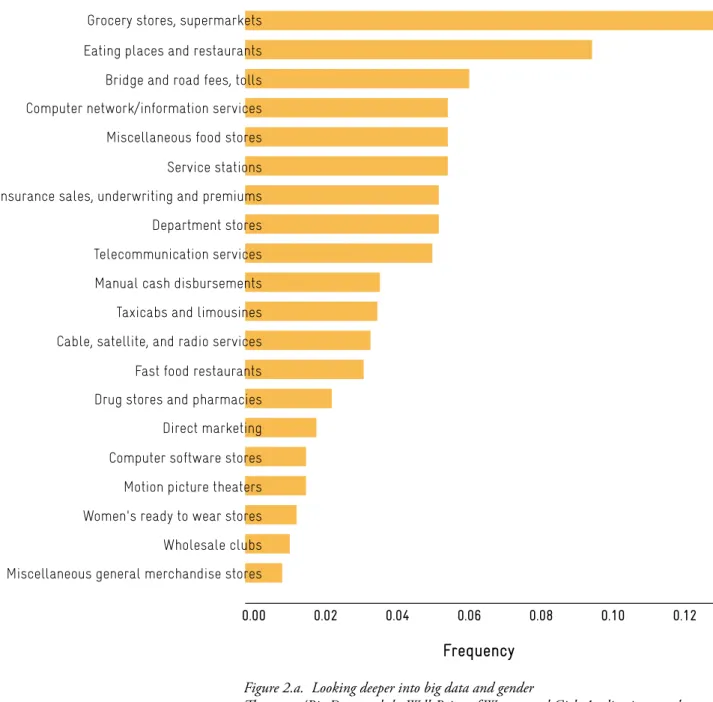
Figure 2.a. Looking deeper into big data and gender
The report ‘Big Data and the Well-Being of Women and Girls Applications on the Social Scientific Frontier’ 15 by the organisation Data2X16 describes various
approa-ches of using different kinds of big data in order to fill the global gender data gap. One example from the study is shown in the diagram above: The diagram shows the frequency of transactions in different expenditure categories, as assessed by anonymized credit card data and cell phone data of women living in a major Latin-American metropolis. Thus behavior patterns are portrayed and illustrate needs and priorities.
15 http://data2x.org/wp-content/uploads/2017/03/Big-Data-and-the-Well-Being-of-Women-and-Girls.pdf 16 Data2X is a collaborative technical and advocacy platform dedicated to improving the quality, availability,
and use of gender data in order to make a practical difference in the lives of women and girls worldwide: www.data2x.org
The state of affairs - 2.1. Big data
Frequency
Grocery stores, supermarketsDepartment stores
Direct marketing Bridge and road fees, tolls
Manual cash disbursements
Motion picture theaters Miscellaneous food stores
Cable, satellite, and radio services
Wholesale clubs Insurance sales, underwriting and premiums
Drug stores and pharmacies Eating places and restaurants
Telecommunication services
Computer software stores Computer network/information services
Taxicabs and limousines
Women's ready to wear stores Service stations
Fast food restaurants
Miscellaneous general merchandise stores
Credit
The value of big data
The ability to quickly analyse very large and diverse data streams potentially enables the extraction of insights that would have been unattainable using tra-ditional methods. Generally, big data increases an organisation’s capacity to describe and visualise situations, diagnose and understand underlying problems, predict likely scenarios and even prescribe the most beneficial potential actions. This disruptive capacity also affects the development sector, where actors are figuring out how to incorporate big data into their strategy, programming and operations. Some proponents of the use of big data in development argue that big data and artificial intelligence provide an opportunity to shift from biased, inefficient and unjust decision-making towards more objective and evidence-based decisions.17 However, that does not mean that new insights will be used as it is well documented that evidence does not necessarily lead to action,18 especially for controversial issues.
Others argue that big data’s largest contribution is its provision of new ways to visualise development and thus guide – and to some extent also limit – its responses.19 Traditionally, survey data including censuses provided static visu-alisations of data which was updated infrequently. Because big data is collected continuously, information can be disseminated through more fluid visualisation techniques20 such as dashboards providing panoptic views of operations, word clouds capturing citizen sentiment and exposure to shocks, and maps that cap-ture movements of people and the intensity of these movements.
Box 2.a. Precision farming using big data and algorithmic
decision-making for more targeted manuring and soil irrigation
Algorithmic decision-making refers to instances where algorithms make auto-matic decisions based on the analysis of data, or at least present decision choices to humans. One such example is precision farming, which mixes data from weather forecasts with data from sensors measuring the humidity and tempera-ture of air and soil, aerial photography from drones or satellites measuring crop maturity, and data on the nearness of equipment and human labour. This data is then used to generate predictive models that enable farmers to apply inputs to specific areas of land as needed rather than applying inputs uniformly across the farm as done in traditional farming.
17 Letouzé, E. and Sangokoya, D. (2015) Leveraging Algorithms for Positive Disruption: On Data, Democracy, Society and Statistics, Data-Pop Alliance, datapopalliance.org/wp-content/uploads/2016/03/DataPopAlli-ance_LeveragingAlgorithms.pdf
18 Georgalakis, J.; Jessani, N.; Oronje, R. and Ramalingam, B. (Eds) (2017) The Social Realities of Knowledge for Development, Brighton: IDS, www.ids.ac.uk/publication/the-social-realities-of-knowledge-for-devel-opment-sharing-lessons-of-improving-development-processes-with-evidence
19 Flyverbom, M.; Madsen, A.K. and Rasche, A. (2017) Big Data as Governmentality in International Develop-ment: Digital Traces, Algorithms, and Altered Visibilities, The Information Society: An International Journal 33.1: 35–42
20 Robinson, I. (2016) Data Visualisation: Contributions to Evidence-Based Decision-Making, SciDev.Net, www.scidev.net/filemanager/root/site_assets/leanring_reports/data_visualisation_learning_report_sci-devnet.pdf
Big data increases an
organisation’s capacity
to describe and visualise
situations, diagnose and
understand problems, predict
scenarios and prescribe
Being able to visualise problems in new ways allows development actors to tackle them differently. Big data is promoting a shift in what is considered actionable knowledge, that gives more prominence to correlations analysis that unearths patterns even if these are not fully understood.21 The rationale is that sometimes knowing ‘what’ is happening is enough to take action, even if the ‘why’ remains undiscovered. Besides, big data analysis can provide the ‘digital smoke signals’ that uncover anomalies, allowing actors to follow up quickly and investigate why it is happening. Diverse tests, including methods from other research disciplines, can be carried out to validate the correlations before taking action in cases where knowing ‘why’ is important.
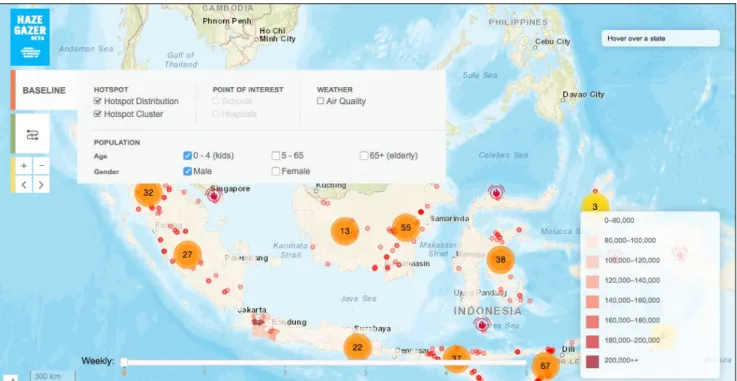
Figure 2.b. Pulse Lab Jakarta is enabling public access to Haze Gazer, which is a crisis analysis and visualization tool that provides real-time information on fire and haze hotspots in Indonesia.22
Big data’s potential is yet to be realised
Although big data algorithms could generate new ways of looking at develop-ment and tackling problems, they are very much limited depending on which data is available. For example, algorithms that rely on mobile phone data will not be inclusive of people living in areas with low mobile phone penetration or poor network connectivity/availability as well as those less likely to own mobile phones (e.g. the poor, women, the elderly). Moreover, using Twitter data can help to gain useful insights about what is currently happening,23 but could also be limiting in other situations: Twitter only makes a small subset of its data available and tweets are generally short outbursts devoid of background contex-tual information, making it difficult to tell complete stories.24 Thus, taking a
21 Flyverbom, M.; Madsen, A.K. and Rasche, A. (2017) Big Data as Governmentality in International Develop-ment: Digital Traces, Algorithms, and Altered Visibilities, The Information Society: An International Journal 33.1: 35–42
22 hazegazer.org
23 fastcompany.com/3007178/how-uns-new-data-lab-indonesia-uses-twitter-preempt-disaster 24 Flyverbom, M.; Madsen, A.K. and Rasche, A. (2017) Big Data as Governmentality in International
Develop-ment: Digital Traces, Algorithms, and Altered Visibilities, The Information Society: An International Journal 33.1: 35–42
Big data algorithms are very
much limited depending on
which data is available.
problem- and user-centric approach to big data for development – which is com-plemented by traditional data sources when possible – is essential to ensure that the right data from the right people is analysed to tackle the right problem. To date, big data for development projects have mainly been pilots and proof of concepts showing the potential to use big data to tackle development prob-lems. These pilots have helped garner interest and hype around big data for development. Although there is no clear indication that any of these pilots have resulted in significant impacts, there is reason to remain hopeful. Several data for development experts have told us that thanks to pilots and proof of concepts, the development sector is ready to start integrating long-term big data applica-tions.
Box 2.b. Tackling the spread of malaria using mobile phone data
The World Health Organization estimates that nearly half the world’s popula-tion is at risk of getting malaria, with roughly 212 million cases and 429,000 deaths from the disease in 2015. Children under five are especially vulnera-ble, making up 70 per cent of all deaths.25 The mosquito species responsible for spreading the disease does not innately produce malaria, but acquires it by bit-ing already infected humans and then passes it to humans through subsequent bites. Since one or two weeks can pass without symptoms showing, people often carry the disease and unknowingly contribute to the infection of others. When people become infected while travelling, it can lead to new outbreaks.
Wesolowski et al.26 combined malaria incidence data collected by health offi-cials (pre-existing data) with anonymised call record data from 15 million Ken-yan mobile subscribers disaggregated at the cell tower level, to understand how travel patterns contribute to spreading malaria. Using this data allowed them to uncover ‘sources’ from which humans typically picked up the disease and ‘sinks’ to which they were likely to travel and put others at risk. They were able to predict on a daily basis which communities were likely to import the disease and the probability that visitors to a given community would get sick. Such an understanding provides insights on where and when prevention efforts should be focused, at a much more granular level. However, past experience shows that current ‘efforts’ to tackle malaria such as distributing bed nets do not automati-cally lead to the behavioural change that would make them effective.27 Thus, it is uncertain that big data-backed efforts will lead to take-up either.
There are other more recent initiatives that use big data and machine
learning to tackle malaria and other infectious diseases such as Zika, Dengue or Ebola. These initiatives illustrate the wide diversity of approaches available: from integrating infection cases data with satellite, environmental and clima-tological variables to produce disease outbreak risk maps and recommenda-tions for action,28 to using drones that autonomously locate mosquito hotspots, robotic traps to identify and collect interesting specimens, and
machine-learning algorithms to search for pathogens in the genetic material obtained from mosquitoes.29
25 WHO (2016) World Malaria Report 2016, Geneva: World Health Organization, who.int/malaria/publica-tions/world-malaria-report-2016/report/en
26 Wesolowski, A.; Buckee, C.O.; Pindolia, D.K.; Eagle, N.; Smith, D.L.; Garcia, A.J. and Tatem, A.J. (2013) The Use of Census Migration Data to Approximate Human Movement Patterns across Temporal Scales, PLoS One 8.1 27 nyti.ms/2kqTm8M
28 disarm.io
29 microsoft.com/en-us/research/project/project-premonition
Researchers were able to
predict which communities
were likely to import malaria
and the probability that
visitors to a given community
would get sick.
2.2. Open data
The earliest widely accepted definition characterises open data as ‘data that can be freely used, reused, and redistributed by anyone – subject only, at most, to the requirement to attribute and share-alike’.30 This definition points to at least three characteristics, namely accessibility, machine-readability, and reusability, but hinges on the use of technology not only to produce and publish data, but also to access it.
Box 2.c. Eight characteristics of open government data
The Sebastopol Principles emphasise eight characteristics of open government data:31
1 Complete – all public data not subject to valid privacy, security or other limitations is made available;
2 Primary – at source, not aggregated, and granular; 3 Timely – available at the earliest possible time;
4 Accessible – available to widest range of users and purposes; 5 Machine-processable – structured to allow automated processing; 6 Non-discriminatory – available to anyone, without registration;
7 Non-proprietary – in a format over which no entity has exclusive control; 8 Licence free – not subject to any copyright, patent, trademark or trade
secret regulation.
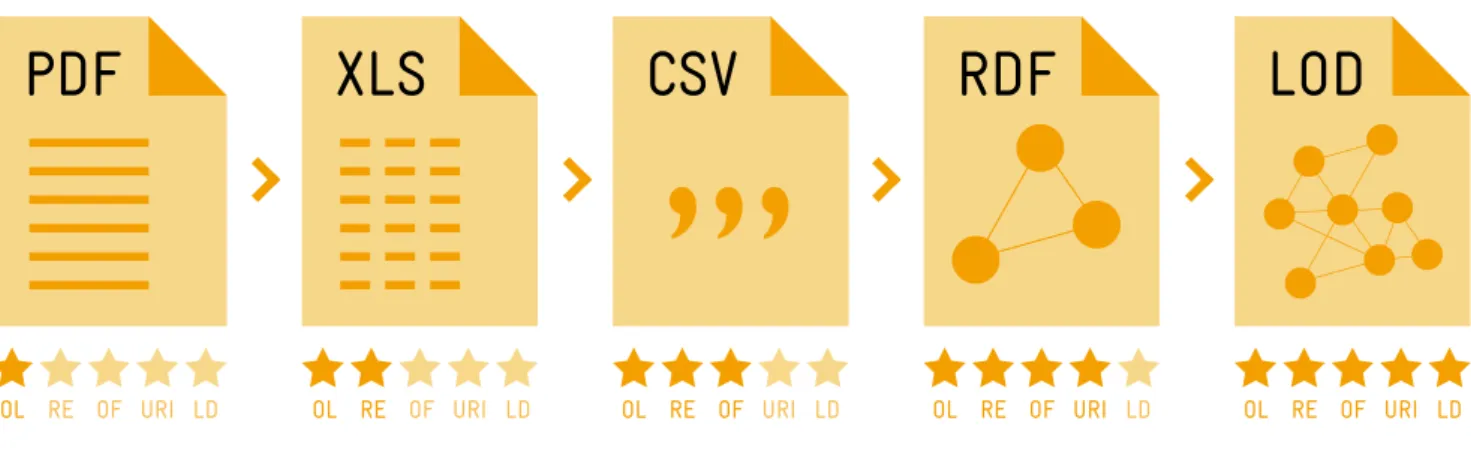
Acknowledging that moving towards this level of data openness is a process rather than an end state, a graduated system of deployment has been formu-lated32 so that it will capture the progression from closed to open data, and acknowledge the efforts of different actors in opening up datasets. The Five Star Deployment Scheme for Open Data considers, for example, an openly licensed PDF file containing structured data with sufficient level of granularity and pub-lished online as a move towards data openness (see also Figure 2.c.).
30 opendefinition.org/od/2.1/en 31 public.resource.org/8_principles.html 32 5stardata.info
Open data is data that can
be freely used, reused, and
redistributed by anyone.
Figure 2.c. Progressing from closed to open data: The Five Star Deployment Scheme for Open Data. OL: open license, RE: machine readable, OF: open format, URI: uniform resource identifier, LD: linked data
PDF, XLS, CSV, RDF und LOD are file formats and related standards. LOD: linked open data, RDF: resource description format, CSV: comma-separated values
From government-driven to multi-stakeholder collaboration
The global open data movement started off focusing on advocating for openly available government data more than any other type of data. Country govern-ments, more particularly the US and the UK, led the early pack of reformers in open government data, with the US launching its open data portal in 2009 and the UK in 2010. A wave of similar initiatives was launched in the developing world, including in Kenya, Moldova and the Philippines, many of which were supported by the World Bank which also made public previously internal data on its platform in 2010.
Open data became a primary advocacy target of the Open Government Part-nership (OGP), ‘a multilateral initiative that aims to secure concrete commit-ments from governcommit-ments to promote transparency, empower citizens, fight corruption, and harness new technologies to strengthen governance’.33 The OGP Open Data Working Group, composed of representatives from govern-ment and civil society, coordinated the process of promoting open data practices globally that led to the eventual launch of the International Open Data Char-ter34 in 2015, a manifesto and a commitment on how governments should pub-lish government data.
Currently, the open data landscape is made up of a very diverse set of actors from across the globe. It includes non-profits, philanthropic organisations, mul-tilaterals, think tanks and regional organisations (see Box 2.d. for examples). These actors are members of different networks that promote open data globally, more notably, the Open Government Partnership, the International Open Data Charter, the Open Data for Development Network,35 the Global Open Data for Agriculture and Nutrition,36 and loose alliances of researchers like the Open Data Research Network.37
33 opengovpartnership.org/about/about-ogp 34 opendatacharter.net
35 od4d.net 36 godan.info 37 opendataresearch.org
A diverse set of actors
promotes open data globally
– non-profits, philanthropic
organisations, multilaterals,
think tanks and regional
organisations.
XLS
CSV
,,,
RDF
LOD
OL RE OF URI LD OL RE OF URI LD OL RE OF URI LD OL RE OF URI LD OL RE OF URI LDBox 2.d. Open data actors
» Non-profit organisations such as Open Knowledge, the Open Data Institute, and the World Wide Web Foundation;
» Philanthropic organisations like the Omidyar Network;
» Multilateral organisations including UNDESA and the World Bank; » Think tanks like NYU GovLab and the International Development
Research Centre;
» Regional organisations like Iniciativa Latinoamericana por los Datos Abi-ertos and Code for Africa.
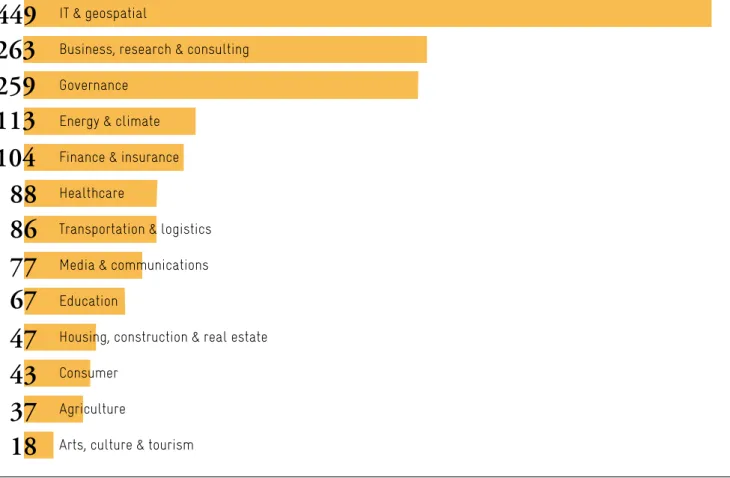
A review of open data initiatives across the globe38 found that several of the open data initiatives focused on capacity building and training, advocacy and lobbying for data disclosure, and data dissemination and reuse. This indicates not only the nascent nature of the field, but also the theory of change that those engaged in the initiatives propose (see discussion on theorised impacts below). To date, major initiatives work on standard-setting (e.g. the Open Contracting Data Standard), implementation and practice (e.g. Open Data Lab Jakarta39), and research and measurement (e.g. the Open Data Barometer, see also Figure 2.e.). Thematically, open data is used largely in programmes or projects in mapping, business, research and consulting, governance, energy and climate, finance and insurance (see Figure 2.d.). Emerging fields, in terms of open data use are health, transportation and logistics, and education.40
38 Boyera, S. and Iglesias, C. (2014) Open Data in Developing Countries: State of the Art, London: Open Data Institute, https://docs.google.com/document/d/1FMyfLu-jouL7j7Pw0kEwUn_B07aZ9IX3vlFGqPO0gX0/edit 39 labs.webfoundation.org
40 opendataimpactmap.org/map.html The state of affairs - 2.2. Open data
Figure 2.d. Number of projects using open data across the globe according to sector.41
Open data cannot achieve impact alone
For open data to result in actual impact, there needs to be at least three building blocks in place: (1) the publication of open data by governments, (2) the conver-sion of data to actionable information by intermediaries, and (3) the use of data by citizens, government officials and other stakeholders to achieve development outcomes.
In a review of more than 15 case studies of open data initiatives in developing countries, Davies and Perini42 argue that at least three emerging impacts can be identified: increasing government transparency and accountability, innova-tion and economic development, as well as greater inclusion and citizen empow-erment. Verhulst and Young43 arrived at a similar conclusion on the positive effect that open data can have on governments, citizens, public problems, and economic opportunities. The evidence, however, is limited to a few cases only. Nevertheless, the impacts, while they are achieved, are dependent on different factors, the availability of open data being just one of them. What has become clear is that open data impacts depend on partnerships and collaborations, the
41 opendataimpactmap.org
42 Davies, T. and Perini, F. (2016) Researching the Emerging Impacts of Open Data: Revisiting the ODDC Conceptual Framework, The Journal of Community Informatics 12.2, ci-journal.net/index.php/ciej/article/ view/1281
43 Verhulst, S. and Young, A. (2016) Open Data Impact: When Demand and Supply Meet, New York: GobLab, thegovlab.org/static/files/publications/open-data-impact-key-findings.pdf
Emerging impacts of open
data include government
transparency and
accountability, innovation
and economic development,
greater inclusion and citizen
empowerment.
IT & geospatial
Business, research & consulting Governance
Energy & climate
Education
Finance & insurance
Housing, construction & real estate Healthcare
Consumer
Transportation & logistics
Agriculture
Media & communications
Arts, culture & tourism
449
113
86
263
104
77
259
88
67
47
43
37
18
quality of open data public infrastructure, clear open data policies, and the degree to which a government responds to a problem or issue.44,45
This realisation is not new. The Open Data Barometer, a comprehensive assess-ment of the state of open data globally, acknowledges that data is just one part of the equation to make open data result in positive outcomes. Among these are the conducive political, economic, and social context that largely influences the disclosure and use of data. The provision of open data does not automatically result in impact, indicating that the journey from open data to impact needs several intermediary steps, and intermediary stakeholders.46
Figure 2.e. The Open Data Barometer Rank measures how governments around the world are publishing and using open data for accountability, innovation and social impact.
44 Verhulst, S. and Young, A. (2016) Open Data Impact: When Demand and Supply Meet, New York: GobLab, thegovlab.org/static/files/publications/open-data-impact-key-findings.pdf
45 Heusser, F. (2012) Understanding Open Government Data and Addressing its Impact, Background Papers, ODDC
46 Davies, T. (2014) Open Data in Developing Countries: Emerging Insights from Phase 1, World Wide Web Foundation, opendataresearch.org/sites/default/files/publications/Phase 1 - Synthesis - Full Report-print. pdf
The provision of open data
does not automatically result
in impact. A conducive
political, economic and
social context influences the
disclosure and use of data.
South Africa
Sub-Saharan
Africa
Open Data Barometer Rank
India
South Asia
Sub-Saharan
Kenya
Africa
Indonesia
East Asia &
Pacific
Ukraine
Europe &
Central Asia
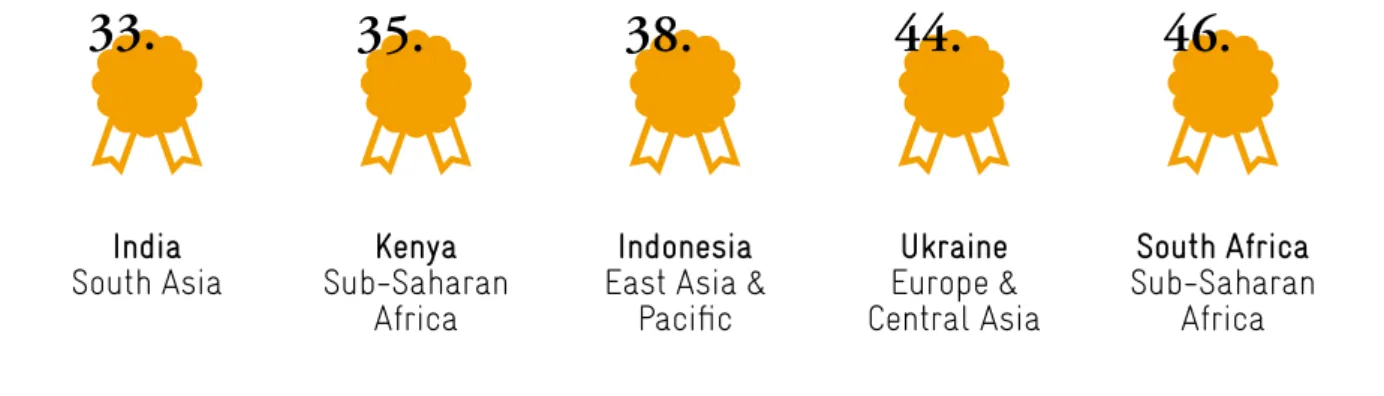
Figure 2.f. Top five developing partner countries of German development
cooperation ranked according to the Open Data Barometer Rank (115 countries and jurisdictions ranked in 2016).47
Box 2.e. Identifying lower-priced generic medicines through open
data in South Africa
In South Africa, the prices of medicines are regulated by the government, which requires that pharmacists offer private patients the lower-priced generic med-icine for prescriptions issued by doctors. However, this does not always hap-pen, despite the fact that generic drugs are 40 per cent cheaper than branded ones. While data about medicines and their prices are published regularly by the country’s health ministry, it is not easy to find the data and difficult to under-stand and use it. A little-known open dataset from the website of the Depart-ment of Health shows a registry of medicines, their generic names and their costs.
Using this data, in 2014 Adi Eyal of Open Up (formerly Code for South Africa)48 developed an application called the Medicine Price Registry Applica-tion49and an online database50 of medicines. This app enables patients to iden-tify and request lower-priced generic medicines and check that they are not being overcharged by their local pharmacies.
This online tool is now used by citizens to source cheaper alternatives of pre-scription medicine as well as by doctors who work in mixed-income commu-nities to provide the best medical advice to patients with due consideration of their health budget or income. The initiative has been widely appreciated by its users for its cost-saving effects without compromising efficacy.
47 opendatabarometer.org
48 openup.org.za/articles/cheaper-medicines-unexpected-user.html 49 mpr.code4sa.org
50 data.code4sa.org/Government/Database-Of-Medicine-Prices/mba4-xngh
2.3. Citizen-generated data
The idea behind citizen-generated data is for citizens to be not only passive con-sumers of information, but also active data producers, users and intermediaries. Employing a citizen-generated data approach can be effective in situations where no data from other sources is available to affected stakeholders as it is either not collected by government or the private sector, or not made accessible. Like-wise, data actively generated by citizens can be useful when the available data is incomplete, inaccurate or not timely enough. What is more, in rural areas where limited internet access makes accessing official data difficult, citizen-generated data collected at the local level and shared with relevant target groups through offline channels could be an effective response to the lack of accessible informa-tion.51 While the citizen-generated data concept can be used to describe the use of both digital and traditional data sources, this section focuses on digital data sources and digital data collection and management tools.
How citizens shape data collection
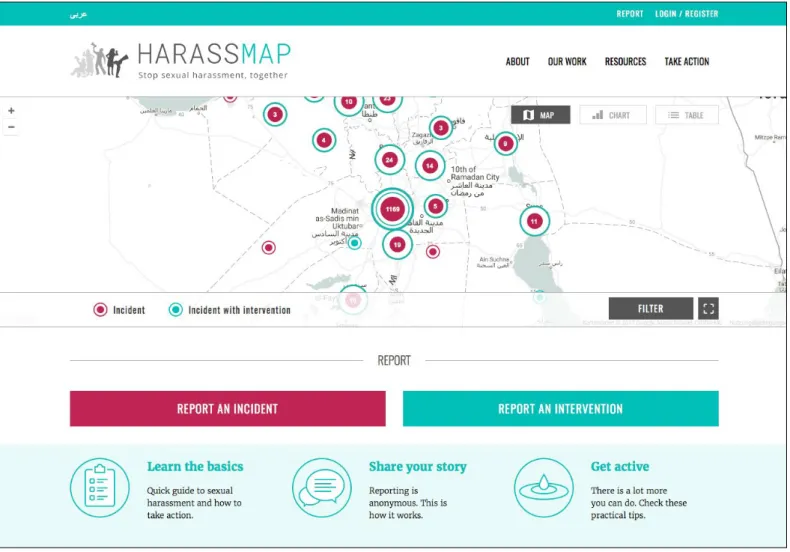
Proponents of the concept argue that data actively produced by citizens with a specific purpose in mind can provide a direct representation of citizens and enable them to ‘directly monitor, demand or drive change on issues that affect them’.52Citizen-generated data approaches give people agency over decisions on what data is collected, what it is used for, and how it is used. Initiatives like I Paid A Bribe,53 an online corruption-reporting platform run by an Indian civil society group, or HarassMap,54 a collection of crowdsourced SMS and online reports on sexual harassment in Egypt, were launched to tackle issues that affected citizens, for which no public data was available.
What distinguishes the citizen-generated data concept from the more traditional citizen participation approaches is the strong emphasis on the role of citizens as data producers compared to mere consumers of information.55 Moreover, the concept highlights the importance of the data in question being collected with a specific usage in mind. Thus, unlike data that is passively generated through the use of technology devices, often referred to in the literature as ‘data bread-crumbs’,56 citizen-generated data is consciously produced for a specific purpose by a group of citizens who normally retain ownership of the data collected. In many cases the data is made publicly available with no restrictions in terms of usage.
As is the case with the other three data for development concepts discussed in this report, definitions of citizen-generated data can be broad and sometimes include cases where data is produced by citizens but collected and owned by third parties. Private firms like Premise or Findyr have pioneered remote data collection through cell phones, largely for commercial interests. Other
51 data4sdgs.org/guide-making-use-of-citizen-generated-data
52 Wilson, C. and Rahman, Z. (2015) Citizen-Generated Data and Governments: Towards a Collaborative Model, DataShift, civicus.org/thedatashift/wp-content/uploads/2015/07/statistical-perspectives-on-cgd_ web_single-page.pdf
53 ipaidabribe.com 54 harassmap.org/en
55 Rebecca, S.; Rono-Bett, K. and Kenei, S. (2017) Citizen-Generated Data and Sustainable Development: Evidence from Case Studies in Kenya and Uganda, Nairobi: DevInit and DRT, makingallvoicescount.org/ publication/citizen-generated-data-sustainable-development
56 Letouzé, E. and Sangokoya, D. (2015) Leveraging Algorithms for Positive Disruption: On Data, Democracy, Society and Statistics, Data-Pop Alliance, datapopalliance.org/wp-content/uploads/2016/03/DataPopAlli-ance_LeveragingAlgorithms.pdf
The idea behind
citizen-generated data is for
citizens to be not only passive
consumers of information,
but also active data producers,
users and intermediaries.
initiatives under the broad umbrella of citizen-generated data use terms like ‘user-generated data’57 to refer to any digital data created by individuals online, such as social media platforms.
Many actors, but little coordination
Unlike in the open data and big data spaces, there are no large coordinated international networks or initiatives that promote the citizen-generated data approach in development. The only exception is DataShift,58 which seeks to explore and promote the concept through research and capacity building of civic groups to engage in citizen-generated data projects.
Key players in the field include Ushahidi59 whose open source software pow-ers a great number of crowdmapping initiatives. Actors like the Humanitar-ian OpenStreetMap Team60 and Missing Maps61 that work across the globe to provide detailed and accurate maps for humanitarian response and economic development, have focused on maps as a tool in enabling citizens to provide data. In addition, several smaller initiatives have contributed to the advance-ment of the citizen-generated data field through practical experiadvance-mentation with various forms of data collection techniques, tools and platforms. PetaJakarta,62 for instance, has been exploring the combination of crowdsourced data through social media networks with government data to tackle the problem of flooding in the Indonesian capital of Jakarta.
Other projects include crowdmapping projects like the aforementioned I Paid A Bribe63 and HarassMap.64 Depending on the conceptual definition of citizen-generated data, initiatives such as U-Report,65 a reporting and polling portal for social issues, and Wefarm,66 an information-sharing platform for small-scale farmers, could be subsumed under citizen-generated data initiatives.
57 devpolicy.org/bridging-data-gaps-policymaking-crowdsourcing-big-data-development-20160708 58 civicus.org/thedatashift 59 ushahidi.com 60 hotosm.org 61 missingmaps.org 62 petajakarta.org 63 ipaidabribe.com 64 harassmap.org/en 65 ureport.in 66 wefarm.org
Open source software
powers a great number of
crowdmapping initiatives.
Figure 2.g. HarassMap is a collection of crowdsourced SMS and online reports on sexual harassment in Egypt.67
Scaling remains a challenge
While much of it is anecdotal in nature, there is evidence of the value of citi-zen-generated data for improved delivery of development projects.68 Crowdmap-ping initiatives have contributed to a better understanding of the nature and scale of social issues such as corruption, harassment, or voter turnout.69 Gran-ular and real-time data provided by citizens has enabled government authori-ties to take more evidence-based decisions about urban infrastructure such as in the case of PetaJakarta. Moreover, some research has documented the impact of citizen-generated data projects on government policy and practice such as adjustments of measuring education outcomes in Uganda and improvements in community water supply in Malawi.70
67 harassmap.org/en
68 Rebecca, S.; Rono-Bett, K. and Kenei, S. (2017) Citizen-Generated Data and Sustainable Development: Evidence from Case Studies in Kenya and Uganda, Nairobi: DevInit and DRT, www.makingallvoicescount. org/publication/citizen-generated-data-sustainable-development
69 Bailard, C.S. and Livingston, S. (2014) Crowdsourcing Accountability in a Nigerian Election, Journal of Information Technology and Politics 11.4: 349–367
70 Rebecca, S.; Rono-Bett, K. and Kenei, S. (2017) Citizen-Generated Data and Sustainable Development: Evidence from Case Studies in Kenya and Uganda, Nairobi: DevInit and DRT, makingallvoicescount.org/ publication/citizen-generated-data-sustainable-development