Intentionally left blank
May 2014
For more information contact: Headquarters, Department of the Army, Office of the Deputy Chief of Staff, G-8 Future Force Division (FDF), 700 Army Pentagon, Washington, D.C. 20310. Electronic copies of the strategy are available
1 | P a g e
TABLE OF CONTENTS
FOREWORDTABLE OF CONTENTS ... 1
EXECUTIVE SUMMARY ... 2
LINKING RESOURCE DECISIONS TO ARMY STRATEGY ... 4
ARMY FISCAL YEAR 2015 BUDGET OBJECTIVES AND CRITICAL PROGRAMS .... 11
CONCLUSION ... 16 SOLDIER ... 18 MISSION COMMAND ... 22 INTELLIGENCE ... 27 MANEUVER ... 32 AVIATION ... 35 FIRES ... 42
AIR AND MISSILE DEFENSE ... 46
PROTECTION (ASSURED MOBILITY) ... 52
PROTECTION (FORCE PROTECTION AND CHEMICAL, BIOLOGICAL, RADIOLOGICAL, NUCLEAR AND HIGH YEILD EXPLOSIVE (CBRNE)) ... 55
SUSTAINMENT (TRANSPORT) ... 58
SUSTAINMENT (SERVICE SUPPORT) ... 62
SCIENCE AND TECHNOLOGY PROGRAM ... 68
References ... 79
Acronym List ... 80
List of Figures: Figure 1. Cornerstone Capabilities ... 5
Figure 2. Soldier ... 18
Figure 3. Mission Command ... 23
Figure 4. Intelligence ... 27 Figure 5. Maneuver ... 32 Figure 6. Aviation ... 36 Figure 7, Aviation ... 37 Figure 8, Aviation ... 38 Figure 9. Fires ... 42
Figure 10. Air and Missile Defense... 47
Figure 11. Protection (Assured Mobility) ... 53
Figure 12. Protection (Force Protection and CBRNE) ... 56
Figure 13. Sustainment (Transport)... 59
Figure 14, Sustainment (Service Support) ... 63
2 | P a g e Executive Summary
EXECUTIVE SUMMARY
“As our potential adversaries invest in more sophisticated capabilities and seek to frustrate our military's traditional advantages, including our freedom of action and
access, it will be important to maintain our decisive technological edge.”1 The Army Equipment Program in support of the President’s Budget 2015 (AEP PB 15) describes the Army Research, Development and Acquisition (RDA) budget for key capability portfolio areas and the Science and Technology portion of the Fiscal Year 2015 (FY 2015) President’s Budget request. The AEP PB 15 is renamed this year to better reflect the focus of the Army’s portfolio management and equipment descriptions, but flows from the previous Army Equipment Modernization Strategy and 2014 Army Equipment Modernization Plan. This document delineates RDA investments into 11 capability portfolio areas, highlights the portfolio accomplishments over the last two years and provides intent for FY 2015 investments. The dollars and quantities in this document reflect President’s Budget 2015.
The objective of Army equipment modernization is to enable our Soldiers to fight and win across the entire range of military operations by developing and fielding versatile and tailorable equipment that is affordable, sustainable and cost-effective. The Army has developed several initiatives to guide equipment modernization during this period of fiscal constraint. The Total Army focuses equipping modernization on the Soldier and squad providing them with the Network and key enablers. We use incremental
improvements to improve existing systems as our first option and build new systems only by exception. The Army is divesting older systems and niche capabilities to decrease sustainment costs and generate additional resources for modernization and readiness. Next, we are developing smaller procurement objectives because the Army cannot afford to equip and sustain the entire force with the most advanced equipment. Our procurements are to insert needed technologies and capability improvements, leveraging commercial investment where we are “technology-takers” (e.g., information technology, fixed wing aviation) and our own focused investments in technology where we are “technology-makers” (e.g., lethality, armor, rotary wing aviation). Finally, each equipment decision is reviewed to ensure it is both affordable within the overall budget and is cost-effective in addressing the capability gap.
The portfolio annexes to this document detail where we have applied our resources in FY 2015. We will prioritize our efforts to modernize the Network to facilitate the decision-making of Soldiers with information and connectivity across all tactical echelons for Unified Land Operations in support of the Joint Force. Likewise,
programming for ground vehicles such as the Army’s critical Armored Multi-Purpose
3 | P a g e Executive Summary Vehicle (AMPV), Paladin Integrated Management (PIM) and Joint Light Tactical Vehicle (JLTV) are significant priorities. Similarly, Aviation reflects priorities for Apache, Black Hawk and Chinook helicopters as our most capable and survivable combat-proven aircraft. Additionally, we protect critical Science and Technology investments as the seed corn for the future. However, achieving the Army’s priority efforts will take more time due to the decline in resources for the Research, Development and Acquisition accounts. The Army will begin to recover the balance among modernization, readiness and manpower in FY 2020 as manpower end strength stabilizes. At this point, we will renew our investment in new programs impacted by recent budget constraints after assessing existing or new capability gaps and updating our requirements.
Our Total Army is the best in the world today. It has unique capabilities to provide regionally aligned, expeditionary, and decisive land power; however, its capacity and capability overmatch is being eroded. Adding impetus for modernization, there is uncertainty in the international security environment which provides an opportunity for potential adversaries to develop destructive technologies and weapons of there own. Furthermore, the demand for Army units is on the rise to meet combatant commander requirements for regional engagements across the range of military operations to prevent, shape and win in support of national interests. Ultimately, the ability to
modernize Army equipment relies on stable, consistent, and flexible budget authority. Adequate resources are essential to meet Defense Strategic Guidance and defense budget priorities. The Bipartisan Budget Act 2013 provides greater budget certainty for FYs 2014 and 2015; however investment reductions in equipment modernization
continues to challenge the Army in delivering capabilities to our Soldiers now and into the future.
4 | P a g e Linking Resource Decisions to Army Strategy
LINKING RESOURCE DECISIONS TO ARMY STRATEGY
“This time, however, we are drawing down our Army before the war is over and at a time when there is grave uncertainty in the international security environment.”2
Overview:
The Army continues to plan for a period of dynamic uncertainty. In FY 2014 the Army planned on a complex operational environment, declining resources, and
continued threats to U.S. interests. More than 32,000 Soldiers are currently serving in Afghanistan and an additional 114,000 are either forward stationed or deployed in nearly 150 countries. The Army continues to support Soldiers conducting operations in Afghanistan and other locations in Asia, Europe, Africa and the Middle East. World events such as an erratic and bellicose North Korea, Egyptian political turmoil, continued unrest in Iraq, a belligerent Russia, employment of chemical weapons in Syria, and the tragic attack on a civilian shopping mall in Kenya are harbingers of serious threats to people across the globe. These events present a compelling
challenge for the unforeseeable future, yet this year the Army continues to experience a further decline in resources. The unpredictability, so prominent in the contemporary security environment, will almost certainly remain a characteristic of future environments and will require integrated strategic land power to protect and advance vital U.S.
interests. The Army will meet these challenges by becoming smaller while prioritizing equipment modernization and recovering readiness to ensure Army units are prepared to meet these challenges.
History teaches us that a future crisis is inevitable, requiring a versatile, tailorable and expeditionary Army able to provide decisive land power across the range of military operations. A crisis will likely come at an unanticipated time and place. It will develop at a surprising pace and will require the commitment of expeditionary Army forces. This country will expect a quick and decisive victory with minimal casualties. The Army can only meet that expectation with a manned, modernized, trained and ready Total Army. Anything less creates risk of increased casualties or mission failure.
The Army’s Equipment Modernization strategy calls for a mix of divestiture, incremental upgrades to existing platforms, modernization of aging systems, and prioritized science & technology investments to mature and develop next-generation technologies in support of future modernization efforts. The Budget Control Act of 2011 (BCA) created an opportunity for the Army to make a hard self-assessment and critically review equipment modernization. The Army continues to use its strategic
2 General Raymond T. Odierno, Chief of Staff United States Army, House Armed Services Committee, September 18, 2013
5 | P a g e Linking Resource Decisions to Army Strategy modernization plan to look beyond the program years and take a much longer view of equipment modernization. In 2012, the Army implemented a Long-range Investment Requirements Analysis (LIRA) process, which takes a holistic look at the investment in Science and Technology and the life cycle management of equipment and systems projected over a 30 year period. This 30 year long-range planning process provides focus for program reviews, and identifies cost saving opportunities such as multi-year buys, reduces procurements as the Army downsizes, and facilitates incremental improvements over time. Sustainment strategies are incorporated to ensure the costs to support programs are considered over the life of the system. This long term planning also better identifies opportunities for divestment of obsolete inventory and ensures life-cycle costs, such as software sustainment, are reviewed as system platforms evolve from stand alone systems to networked systems.
Strategic Priorities for a Ready and Modern Army3:
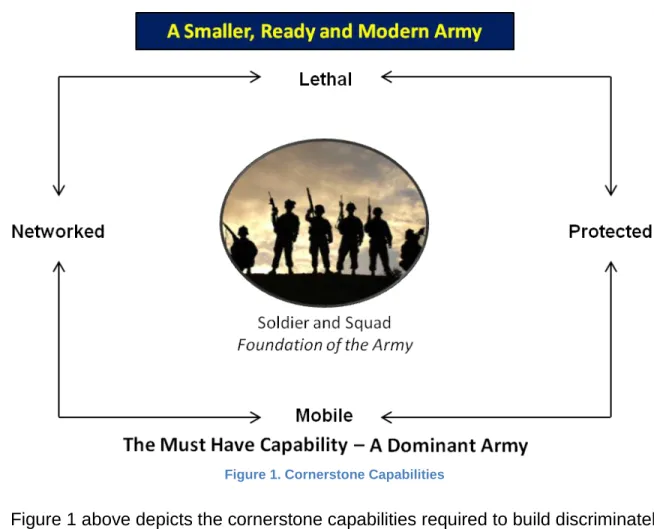
Figure 1. Cornerstone Capabilities
Figure 1 above depicts the cornerstone capabilities required to build discriminately lethal squads and small units. Our strategic intent is to modernize and equip the Total Army with equipment that is affordable, sustainable, and cost-effective to provide ready
3
6 | P a g e Linking Resource Decisions to Army Strategy and tailorable land power supporting the full range of combatant command
requirements. To achieve those strategic priorities the Army will focus on the following: Prioritize Soldier-centered modernization and procurement of proven
technologies so that Soldiers have the best weapons, equipment and protection to accomplish every mission.
Seek fundamental improvements to Soldier and unit system lethality,
survivability, mobility, and network functionality to ensure that the American Soldier remains the most discriminately lethal force on the battlefield.
Focus Science and Technology investment to maximize the potential of emerging game-changing land power technologies to counter emerging threats and to ensure that Army formations retain a decisive materiel edge and tactical
overmatch across the range of military operations, to include missions such as cyber, space, Counter-Weapons of Mass Destruction and Weapons of Mass Destruction-Elimination.
Ensure that Army units are prepared for new, emerging, and evolving missions in areas such as space, cyberspace, missile defense, and countering weapons of mass destruction.
Equip the Total Army to rapidly deploy, fight, sustain itself, and win against complex state and non-state threats in austere environments and rugged terrain (the expeditionary mindset).
Resource Linkage: “Versatile and Tailorable, yet Affordable and Cost-Effective”4
The Army goal is to develop and field the mix of equipment needed to ensure that our Soldiers have the right equipment, for the right missions, at the right time. However, the Army is accepting risk by temporarily curtailing equipment modernization efforts to balance unit readiness until we complete force structure reductions allowing us to restore resources to reestablish our modernization tempo. The Army’s core capability rests in its Soldiers. Rather than acquire equipment first, then man those systems, the Army organizes its Soldiers first, then trains and equips them to prevail against the challenges they will face.
The Army has an established framework to guide equipment modernization. The strategy focuses our efforts on the Soldier and squad as the foundation of our Army. This means building from the Soldier out and equipping our squads for tactical
overmatch in all situations by ensuring they are connected to an integrated network and that they are in vehicles that are survivable, mobile and lethal.
7 | P a g e Linking Resource Decisions to Army Strategy In general terms, we will improve and procure equipment that is versatile and
tailorable, yet cost-effective and affordable. We are prioritizing declining resources against our planned programs while investing in future capabilities through science and technology. This approach calls for carefully planned investment strategies across all Army equipment portfolios. These strategies involve a mix of incrementally upgrading existing platforms, investing in key technologies to support future modernization efforts and development of new capabilities only by exception.
Budget reductions in FYs 2013 and 2014 limited the Army’s ability to reset and repair equipment returning from Afghanistan. This returning equipment is critical to rebuilding unit readiness. Even after our combat involvement in Afghanistan is complete, the Army will require supplemental funding for three years to reset our equipment from the harsh demands of war. This continued reset will also assist in maintaining important capabilities in the Army's organic industrial base. Eleven years of war led to a proliferation of non-standard equipment. The Army Requirements
Oversight Council reviews non-standard systems and determines the actions necessary for retention, disposal or other disposition of this equipment. These decisions help the Army to bridge between current equipping posture and future modernization
requirements while addressing sustainment cost concerns.
The Army continues to support and use Network Integration Evaluations (NIE). The NIE is a series of evaluations designed to put new technologies in the hands of Soldiers early in the development process. The Army executes NIEs to assure continued
integration as the network evolves and to evaluate emerging technologies from
government and industry sources. The Army uses NIEs to incorporate Soldier feedback into the acquisition process resulting in better capability development. The Army
developed the Organic Industrial Base Strategic Plan 2012-2022 to provide the strategy and management framework needed to ensure the organic industrial base remains viable, effective and efficient as the Army draws down from a decade of combat operations. The plan provides a forward looking management framework capable of identifying critical risk areas within area functional groups and establishes a common framework to develop mitigating strategies.
The Bipartisan Budget Act of 2013 (BBA) provides the Army temporary relief from BCA defense spending caps and provides the predictability needed to effectively plan within changing fiscal parameters during FYs 2014 and 2015. Historically, the Army’s RDA account has averaged 21.9 percent of its obligation authority. For FY 2015 the RDA account is 17 percent ($20.1B) of obligation authority. The long-term effect of fewer resources will be additional stress on current vehicle fleets, reduced replacement
8 | P a g e Linking Resource Decisions to Army Strategy of war-worn equipment, increased challenges sustaining the industrial base and
reduced investment in the modernization of critical capabilities. We will begin efforts to restart the next Infantry Fighting Vehicle when resources are available and restore other high priority modernization programs as the Army achieves a steady state force
structure.
President’s Budget 2015 Overview and Main Effort.
The Army’s planned RDA investments in FY 2015 have declined 39 percent since the FY 2012 budget planning cycle. We will not transition four programs to the
acquisition phase, to include the Ground Combat Vehicle and Armed Aerial Scout. Additionally, we will end four programs, restructure 30 programs, and delay 50 programs. A notable delay is the Warfighter Information Network Tactical (WIN-T)
Increment 3. While reductions occurred across all portfolios we were able to protect the
core of our Science and Technology (S&T) investments for the future.
Previous investments in modern equipment for combat operations in Iraq and Afghanistan has improved overall modernization levels. Yet, the Army still has aging systems that need replacement and systems that can no longer be cost-effectively modified to meet future operational and force protection requirements. The Army will prioritize available resources against these shortfalls during future reviews.
There are three main efforts this year that characterize equipment modernization. These efforts are:
The Network
LandWarNet is the Army’s globally interconnected network. It enables mission command by carrying the data, voice and video every Soldier and leader needs to act decisively and effectively. LandWarNet supports all Army operations, from
administrative activities in garrison to operations conducted by our deployed and forward stationed Soldiers. Additionally, it forms the basis of our live, virtual,
constructive and gamingtraining. The Mission Command portfolio is impacted by
constrained budgets this year resulting in fewer and delayed capabilities. The realities of reduced funding has delayed the Warfighter Information Network – Tactical (WIN-T) Increment 3 and reduced the focus of development to Network Operations and
waveform development. We will build Network capacity by continuing to field
Operational Capability Sets, focusing on Soldier reach back from the forward edge to higher headquarters, continuing efforts to implement a Common Operating Environment framework for rapid development, and deployment of software products and resourcing
9 | P a g e Linking Resource Decisions to Army Strategy NIEs to evaluate and field an integrated network. The Army continues efforts to achieve an end state of a coherent and intuitive network of sensors, Soldiers, platforms and command posts linked by a robust transport network with an enabling suite of command and control applications and the necessary Network Operational tools, all to provide our Soldiers better access to network capabilities.
Combat Vehicles
The Army is committed to developing and fielding the Armored Multi-Purpose Vehicle to replace our obsolete M113 family of vehicles and augmenting our wheeled vehicle fleet with the Joint Light Tactical Vehicle. The Army will also continue to fund a third brigade's set of Double V-Hull (DVH) Stryker vehicles, while supporting an
incremental upgrade to DVH Strykers for power and mobility improvements. We will fund network integration as well as survivability, lethality, and protection improvements to our Abrams tank and Bradley Infantry Fighting Vehicle fleets. A new Infantry Fighting Vehicle (IFV) remains a key requirement for the Army. However, due to significant fiscal constraints, the Department has determined that the Ground Combat Vehicle (GCV) program will conclude upon completion of the technology development phase, expected in June 2014, and will not continue further development. In the near-term, the Army will focus on refining concepts, requirements, and key technologies in support of a future IFV modernization program. This will include investment in vehicle components, sub-system prototypes, and technology demonstrators to inform IFV requirements and future strategies for developing a Bradley Fighting Vehicle replacement. Over the long-term, the Army anticipates initiating a new IFV modernization program, informed by these efforts as resources become available.
Aviation
Following a comprehensive aviation strategy review, the Army will restructure aviation formations to achieve a leaner, more efficient and capable force that balances operational capability and flexibility across the Total Force. The Army will divest legacy systems and fund the modernization and sustainment of our most capable and
survivable combat-proven aircraft: the AH-64 Apache, the UH-60 Black Hawk, and the CH-47 Chinook helicopters. The Army will divest almost 900 legacy helicopters
including the entire single engine OH-58A/C Kiowa, TH-67 (training), and OH-58D Kiowa Warrior helicopter fleets. With divestment of the TH-67 (training) helicopter, the Army transitions to a dual engine, glass cockpit training helicopter fleet. In FY 2015, the Army will procure 55 UH-72A Lakota light utility helicopters to assume the initial entry rotary wing training helicopter requirement and to assist in the transition to the
restructured aviation force. The Army continues to maintain a valid manned Armed Aerial Scout requirement. In the interim, with the implementation of the Aviation
10 | P a g e Linking Resource Decisions to Army Strategy Restructure Initiative (ARI), Apache helicopters will be teamed with unmanned systems that exist in the current inventory to provide an armed aerial scout capability to meet that requirement.
Summary:
As lower funding levels for the Army continue, we are concerned about the health of the industrial base and the subsequent consequences for the Army and our Nation. Shrinking demands for new combat platforms and smaller production rates lead to higher proportional costs. A smaller defense industrial complex may reflect a workforce with reduced design, development, and manufacturing expertise. Diminished capacity in our industrial base may decrease competitiveness and increase response time to future requirements.
Over the next several years, as we continue to draw down and restructure the Army into a smaller force, the Army will continue to have degraded readiness, limited
sustainment of existing equipment and modernization program shortfalls. The Army will begin to restore modernization programs late this decade as modernization balances with force structure and readiness, but won’t be able to fully recover to a modernized Total Force until FY 2023.
Our equipment modernization efforts reflect the priorities of a relatively modern Army with constrained resources. Affordability and cost-effectiveness are prime factors in planning resources to modernize our equipment and close capability gaps in this fiscal environment.
11 | P a g e Army Fiscal Year 2015 Budget Objectives and Critical Programs
ARMY FISCAL YEAR 2015 BUDGET OBJECTIVES AND CRITICAL
PROGRAMS
Over the past three years, the Army has absorbed several budgetary reductions in the midst of conducting operations overseas and rebalancing the force to the wider array of missions called for in the 2012 Defense Strategy Guidance. The FY 2015 budget unbalances Army equipment modernization through program terminations, procurement delays and program restructures. Overall, Research, Development and Acquisition funding is reduced from FY 2014 and the long term effect will be additional stress on current fleets, reduced replacement of war worn equipment, challenges sustaining the industrial base and modernization of only the most critical capabilities.
The Army focuses on effectively using constrained resources for near-term
requirements and tailoring our long-term investments to provide the right capabilities for Soldiers in the future. This approach calls for carefully planned investment strategies across all Army equipment portfolios, which will involve a mix of limiting the
development of new capabilities, incrementally upgrading existing platforms and investing in key technologies to support future modernization efforts. The Army has established overarching equipment budget priorities and objectives to help guide our investment strategies, as described below.
Equipment Budget Priorities and Objectives
Enhance the Soldier for Broad Joint Mission Support.
The centerpiece of the Army's Modernization Strategy continues to be the Soldier and the squad. The Army’s objective is to facilitate incremental improvements by rapidly integrating technologies and applications that empower, protect, and unburden the Soldier and our formations, thus providing the Soldier with the right equipment, at the right time, to accomplish the assigned mission. The FY 2015 budget supports this priority by investing in technologies that provide the Soldier and squad with advanced war fighting capabilities such as enhanced weapon effects, next generation optics and night vision devices, advanced body armor and individual protection equipment, unmanned aerial systems, ground based robots, and Soldier power systems. Enable Mission Command.
The Army’s objective is to facilitate the decision-making of leaders and Soldiers with networked real-time data and connectivity across the Joint Force down to the Soldier and across platforms through commodity-like procurement and rapid innovation. The
12 | P a g e Army Fiscal Year 2015 Budget Objectives and Critical Programs FY 2015 budget supports this priority by resourcing enhanced mission command
capabilities and platform integration of network components through Operational Capability Sets, software applications for the Common Operating Environment,
operations/intelligence network convergence efforts and platform integration of network components in support of Operational Capability Sets.
Remain Prepared for Decisive Action.
The Army’s objective is to facilitate fleet capabilities to increase lethality and mobility while optimizing survivability by managing the full suite of capabilities to enable the most stressing joint war fights. The FY 2015 budget supports this priority by resourcing the Armored Multi-Purpose Vehicle (AMPV), Paladin Integrated Management (PIM) program, Joint Light Tactical Vehicle (JLTV) and critical Aviation programs.
The Army has identified ten critical programs that synchronize equipment modernization. These critical programs are:
The Network
Warfighter Information Network-Tactical (WIN-T) $1.058B($803.1M Other Procurement, Army (OPA)/$138.3M Operation and Maintenance, Army
(OMA)/$116.4M Research, Development, Test and Evaluation (RDTE)) is the Army’s deployed mobile network, providing intranet and telephone service to command posts from Theater to Company level. It extends an Internet Protocol (IP) based satellite and line-of-sight communication networks, throughout the tactical force, supporting telephone, data and video. Increment 2 provides an initial on-the-move capability as well as a robust line-of-sight transmission network and greater satellite throughput down to company level for maneuver brigades and division headquarters. Increment 3 focuses on improvements in throughput for the line of sight transmission network through development of a high capacity waveform and development and delivery of an integrated set of Network Operation Tools.
Family of Networked Tactical Radios $211.8M ($185.4M OPA/$26.4M RDTE) is the Army’s future family of tactical radio systems providing advanced joint tactical end-to-end networking data and voice communications to dismounted troops, ground and aircraft platforms. Formally known as the Joint Tactical Radio Systems (JTRS), these multi-band/multi-mode radio capabilities leverage IP based technologies. Additionally, these radios provide network routing,
13 | P a g e Army Fiscal Year 2015 Budget Objectives and Critical Programs embedded information assurance and simultaneous exchange of voice, data, and video.
Joint Battle Command-Platform (JBC-P) $102.3M ($97.9M OPA/$4.4M RDTE) is the next generation of Force XXI Battle Command Brigade and Below/Blue Force Tracking and is the foundation for achieving affordable information interoperability and superiority on current and future battlefields. JBC-P is the principal command and control/situation awareness (C2/SA) system for the Army and Marine Corps at the brigade level and-below.
Distributed Common Ground System-Army (DCGS-A) $148.4M ($128.2M OPA/$20.2M RDTE) provides integrated Intelligence, Surveillance,
Reconnaissance (ISR) Processing, Exploitation, and Dissemination (PED) of airborne and ground sensor platforms providing commanders, at all levels, access to the Defense Intelligence Information Enterprise and leverages the entire national, joint, tactical, and coalition ISR community. The DCGS-A program modernizes and procures components for fixed sites and data centers setting conditions for the Army’s ISR component of the Common Operating Environment (COE). The DCGS-A hardware and software will be integrated into select ISR current force Programs of Record (POR) systems to enable
networked PED capabilities.
Nett Warrior $90.0M ($84.8M OPA/$5.2M RDTE) is a dismounted Soldier mission command system that provides unprecedented command and control and situational awareness capabilities for dismounted combat leaders at the squad level. The design leverages commercial technology, while incorporating operational unit mission needs, and provides assured power in austere
environments. Nett Warrior is also the foundational program to converge a myriad of handheld devices onto one technology – the Handheld Computing Environment within the Common Operating Environment.
Combat Vehicles
Armored Multi-Purpose Vehicle (AMPV) $92.4M (RDTE) replaces the M113 family of vehicles and provides required protection, mobility, and networking for the Army’s critical enablers including mortars, medical evacuation, and command and control vehicles.
Paladin Integrated Management (PIM) $330.7M ($247.4M Weapons and Tracked Combat Vehicles (WTCV)/$83.3M RDTE) is an important part of the
14 | P a g e Army Fiscal Year 2015 Budget Objectives and Critical Programs Army’s Ground Combat Vehicle Modernization Strategy. It provides readily available low risk upgrades which enhance the responsiveness, force protection, survivability and mobility of the self-propelled howitzer fleet. The PIM replaces the current M109A6 Paladin and M992A2 Field Artillery Ammunition Supply Vehicle with a more robust platform that incorporates Bradley common drive train and suspension components in a newly designed hull.
Light Tactical Vehicles
Joint Light Tactical Vehicle (JLTV) $210.3M ($164.6M OPA/$45.7M RDTE) is the centerpiece of the Army’s Tactical Wheeled Vehicle modernization strategy. The Army will procure 49,099 JLTVs by 2041. The JLTV family of vehicles is being designed to provide the necessary leap in protection, performance and payload to fill the capability gap remaining between the High Mobility
Multipurpose Wheeled Vehicle (HMMWV) and the Mine Resistant Ambush Protected (MRAP) family of vehicles. This multi-mission vehicle will provide protected, sustained and networked mobility for personnel and payloads across the full range of military operations. The Army anticipates selection of one manufacturer in 4th Qtr FY 2015 following a milestone decision.
Aviation5
AH-64 Apache $972.5M ($833.2M Aircraft Procurement, Army (ACFT)/$124.1M RDTE/$15.2M OMA) is the Army's world class heavy attack helicopter for the current and future force, assigned to Attack Helicopter Battalions and Armed Reconnaissance Squadrons. The AH-64E provides the capability to
simultaneously conduct close combat, mobile strike, armed reconnaissance, security and vertical maneuver missions across the full spectrum of warfare, whether required in day, night, obscured battlefield or adverse weather
conditions. AH-64E enhancements consist of several technical insertions, which include level IV Unmanned Aircraft System Control, Cognitive Decision Aiding, improved drive system, composite rotor blades, new fuselage and open system architecture. Apache investment is a key facet of the Army Aviation Restructure Initiative as maturation of manned-unmanned teaming capability provides options for divestment of legacy OH-58D Kiowa Warrior Armed Aerial Scout aircraft.
5
In accordance with guidance provided by the Deputy Secretary of Defense, the Aviation Portfolio contained in the Army Equipment Program is structured on the briefed Army Aviation Restructure Initiative.
15 | P a g e Army Fiscal Year 2015 Budget Objectives and Critical Programs UH-60 Black Hawk $1.55B ($1.45B ACFT/$104.5M RDTE/$.45M OMA) is a
utility aircraft and the Army's largest helicopter fleet. The Black Hawk fulfills its role by supporting maneuver commanders through air assault, general support, command and control and aero-medical evacuation missions. The Black Hawk is vital in supporting lift and medical evacuation missions in the current and future force theater operational plans. The Black Hawk is also critical to the homeland defense mission. With its day, night and adverse weather capability, it is a key component of the Army National Guard's forest fire, tornado, hurricane and earthquake state relief missions. As a result of state support requirements, the new Army Aviation Restructure Initiative will provide flexibility to address aging training fleet concerns and will provide the Army National Guard with an
16 | P a g e Conclusion
CONCLUSION
“In reviewing U.S. defense priorities, tempered by our fiscal realities; it's clear that our military must place an even greater strategic emphasis on working with our allies and
partners around the world”6
More than 32,000 Soldiers are currently serving in Afghanistan and an additional 114,000 are either forward stationed or deployed in nearly 150 countries. Combatant commander requirements for Army units are increasing. The Army must be ready to perform the full range of military operations in support of combatant commanders—to prevent conflict, shape the environment, and when necessary win decisively—to defend the Nation and its interests at home and abroad. The Army is incredibly busy and will continue to be in the future.
Budget reductions have placed Army equipment modernization at risk through
program terminations, procurement delays and program restructures. The Bipartisan Budget Act of 2013 provides greater budget certainty for FY 2015, however, reduced investment in equipment modernization continues to challenge the Army in delivering capabilities to our Soldiers now and into the future. Reduced resources impacted the Network resulting in a delay of WIN-T Increment 3 and reduced investments in tactical radio systems. While a new IFV remains a key requirement, due to significant fiscal constraints, the GCV program will conclude upon completion of the technology
development phase, expected in June 2014, and will not continue further development. The Army will also divest legacy Aviation systems and will only fund the modernization and sustainment of our most capable and survivable combat-proven aircraft: the AH-64 Apache, UH-60 Black Hawk and CH-47 Chinook helicopters.
The Army’s equipment modernization strategy and FY 2015 plan focuses on effectively using constrained resources for near-term requirements and tailoring our long-term investments to provide the right capabilities for Soldiers in the future. For FY 2015, the Army's equipment modernization efforts reflect the priorities of an Army with constrained resources. We will continue to focus on enhancing the Soldier for broad Joint mission support by empowering and enabling squads with improved lethality, protection and situational awareness; enabling mission command by facilitating command and control with networked real-time data and connectivity with the Joint Force; and remaining prepared for decisive action by increasing lethality and mobility, while optimizing the survivability of our vehicle fleets. However, without Congressional support, Sequestration level budget caps will return in FY 2016 and will impose
additional risk on Army equipment modernization, leaving our Soldiers less prepared for future conflicts.
6
17 | P a g e
18 | P a g e Soldier Portfolio
SOLDIER
Section I. Overview
The squad (with its enablers) is the foundation of the decisive force and the
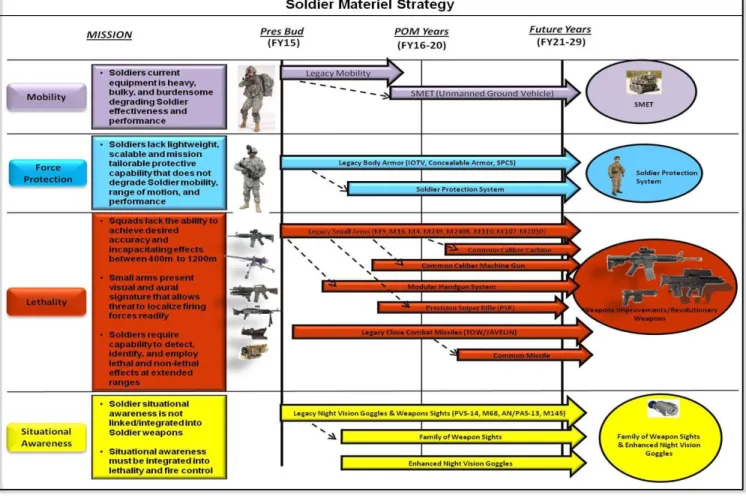
cornerstone of all units. Ensuring our squads have overmatch in the future, the Soldier Portfolio focuses on equipping the individual Soldier and squad for success. Soldier and squad equipment and weapons include: individual and crew-served weapons, shoulder-fired and vehicle-mounted close combat missiles, mortars, Soldier sensors and lasers, night vision devices, body armor, Soldier clothing, individual equipment, parachutes, limited tactical communications equipment and unmanned ground systems (see figure 2). Collectively, these systems enable lethality, protection, situational
awareness and mobility for the individual Soldier and squad. Operational overmatch provides Soldiers with a combined arms capability to effectively detect, recognize, acquire, engage and neutralize or destroy targets more effectively at all ranges.
19 | P a g e Soldier Portfolio
Section II. Strategy Update
To meet the readiness and modernization objectives of the Army Campaign Plan, the Soldier and Squad portfolio objectives for FY 2015 are:
Initiate a common caliber and configuration study to inform small arms
modernization decisions to determine the best caliber/configuration for desired effects/ranges, or allow for trades as appropriate.
Support the extended Engineering and Manufacturing Development (EMD) phase of the XM-25, Counter Defilade Target Engagement System which is the next step in employing this revolutionary Soldier-level precision weapon system. The intent of extending the EMD phase is to improve system lethality and reduce system weight.
Continue the fielding of Enhanced Night Vision Devices to deploying Special Operation Forces (SOF) and Brigade Combat Teams (BCT).
Continue replacement of the conventional force parachute inventory with the Advanced Tactical Parachute System.
Continue to improve Soldier/Squad mobility and load reduction efforts through research and development in body armor, weapons and selected energy
solutions to extend dismounted Soldiers’ range and endurance. Additionally, in the future, the Soldier Portfolio will include unmanned ground systems (UGS). One of the principal UGS applications will be the development of the Squad Multipurpose Equipment Transport (SMET).
Provide the Fire Resistant Environmental Ensemble to aircrews improving their protection and comfort.
Section III. Key Soldier and Squad Portfolio Accomplishments (FY 2013/2014)
Reduced Soldier load in Afghanistan by replacing Outer Tactical Vests with plate carriers (3.2 pounds). Additionally, the weight of the 81mm Mortar was reduced by 20 pounds and the 60mm Mortar was reduced by 8.8 pounds.
Provided Soldiers with the best possible carbine by procuring improved M4A1s (rather than M4 Carbines) and converting existing M4 Carbines into improved M4A1s. Capability improvements include a heavier barrel for greater barrel life, fully automatic trigger and selector switch, ambidextrous controls, improved sustained rate of fire, a consistent trigger pull and improved ergonomics and handling characteristics.
Continued procuring the following small arms weapon initiatives with:
o 48,000 M4A1 Carbines from new production to support the industrial base,
20 | P a g e Soldier Portfolio
o 11,191 kits to convert .50 caliber machine guns to enhanced .50 caliber
Heavy Machine Gun (HMG) to eliminate the need to set head space and timing.
Limited procurement and increased research and development of Soldier night vision equipment for current and future contingencies enhancing Soldier lethality and situational awareness across the full range of missions:
o 2,195 Sniper Night Sights for SOF, BCTs and Battlefield Surveillance
Brigades (BfSBs).
o 27,765 Thermal Weapon Sights for deploying BCTs, Combat Support (CS)
and SOF units.
o 1,245 Laser Target Locators for BCTs.
o 3,040 Small Tactical Optical Rifle-Mounted (STORM) (micro laser range
finders) for dismounted infantry and scouts in BCTs.
o 12,974 Enhanced Night Vision Goggles for deploying BCTs and SOF units.
Section IV. Key FY 2015 Soldier and Squad Portfolio Investments
The FY 2015 Soldier investments total $843.7M ($134.9M Weapons and Tracked Combat Vehicles (WTCV)/$76.5M Research, Development, Test and Evaluation
(RDTE)/$329.1M Other Procurement, Army (OPA)/$167.7M Missile Procurement, Army (MSLS)/$132.3M Operation & Maintenance, Army (OMA)/$3.2M Procurement,
Ammunition (AMMO)). Includes small arms (individual and crew-served weapons), night vision, Soldier sensors, body armor, individual networked command and control, Soldier clothing and individual equipment and parachutes. Specific investments in this portfolio include:
$134.4M (OPA) procures 9,030 Enhanced Night Vision Goggles for deploying SOF units and BCTs.
$32.8M (WTCV) continues small arms investment consisting of M4A1
procurement which supports the industrial base; converting M4s to M4A1s; and procuring carbine accessories (Close Combat Optics, M4 Rails, Close Quarters Battle Kits, cleaning kits and magazines). The M4A1 provides Soldiers with close quarters capability at extended ranges with accurate lethal fire.
$26.5M (OPA) procures 508 Laser Target Locators.
$18.5M (OPA) procures 1904 STORM (micro laser range finders).
$26.0M7
(OPA) fields new personnel parachutes and accessories for three BCTs and SOF units.
$28.4M (WTCV) to buy 8,959 M320A1 40MM Grenade Launchers.
7 Funding amount only for personnel parachutes; cargo parachutes addressed in Sustainment (Service Support) Portfolio.
21 | P a g e Soldier Portfolio
$8.4M (WTCV) for Common Remotely Operated Weapon Station (CROWS) supports upgrades to existing systems, fielding and training.
$25.3M (WTCV) to buy 907 Quick Change Barrel (QCB) Kits to convert M2 (.50 Cal) machine guns to the enhanced .50 Cal HMG configuration by incorporating fixed headspace and timing.
$4.2M (RDTE) to begin development of Lightweight Command Launch Unit (CLU) to lighten Soldier Load.
22 | P a g e Mission Command Portfolio
MISSION COMMAND
Section I. Overview
LandWarNet (LWN) 2020 And Beyond is the Army’s end-to-end network that supports all Army mission areas and is the Army’s portion of the Joint Information
Environment (JIE). The MissionCommand portfolio resources the operational segment
of this network which supports Army, Joint, Coalition and Interagency operations. This portfolio consists of four capability areas: Transport, Applications, Enablers and
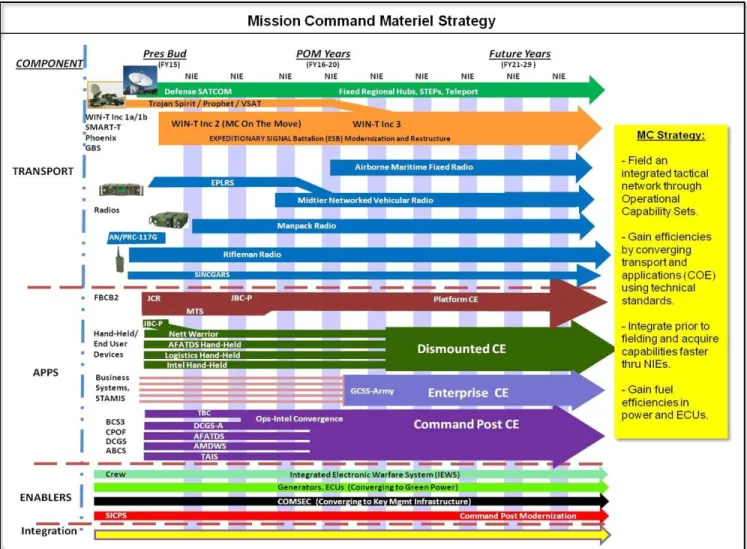
Integration (see figure 3). The primary Transport programs are Warfighter Information Network – Tactical (WIN-T) and the Family of Networked Tactical Radios. The key Application programs are Tactical Mission Command (TMC), Joint Battle Command – Platform (JBC-P), Global Combat Support System – Army (GCSS-A) and migration to the Common Operating Environment (COE). The key Network Enabler programs are Communication Security (COMSEC) with Key Management Infrastructure and Power Generation. The Network Integration Evaluation (NIE) is the principal integration effort.
The end state is a coherent, intuitive network of sensors, Soldiers, platforms and command posts linked by a robust transport network with an enabling suite of command and control applications and the necessary Network Operational (NetOps) tools
providing our Soldiers improved interfaces to manage and defend the network. Key characteristics of the objective network are: intuitive user interfaces and ease of use; seamless Unit Task Reorganization (UTR); fully integrated horizontally and vertically; operational resilience; and a single converged transport across all functional
capabilities.
The Army continues progress towards building the COE. The COE is a set of agreed upon standards, software components and computing technologies that will enable the Army to produce and field capability more rapidly, reducing costs for
development, test and sustainment. Successful COE development has the potential to provide the Army with a leap ahead in how we provide network security and how the Army meets its “big data” challenge.
The network supports both the operating and generating force, shares information across levels of classification and with the implementation of the COE, enables
efficiencies, effectiveness and information security. The network is the combat multiplier for our globally responsive and regionally engaged Army.
23 | P a g e Mission Command Portfolio Figure 3. Mission Command (see acronym glossary)
Section II. Strategy Update
Declining budgets impacted the Mission Command portfolio. To support an effective and efficient network with fewer resources, several programmatic delays and accepted risks were adopted. The goal is to continue fielding critical capabilities in Operational Capability Sets to Brigade Combat Teams; continue with a leaner NIE focused on the most critical gaps; take risk by delaying the WIN-T Increment 3 aerial layer and an improved radio; but complete the highband waveform and a common NetOps tool for integration across the network. Additional risk was accepted by delaying a wideband mid tier radio for both the ground and aerial forces and delaying the development of an electronic warfare planning tool and electronic warfare offensive capability.
24 | P a g e Mission Command Portfolio
Section III. Key Mission Command Portfolio Accomplishments (FY 2013/2014)
Fielding of Operational Capability Set 13 (CS13) to five Brigade Combat Teams and two Division headquarters and fielding Operational Capability Set 14 (CS14) to four Brigade Combat teams and two Division Headquarters. CS13/14
provides the integrated networking on-the-move capability through networking radios, satellite systems, software applications and smart phone like devices developed as a result of Soldier-driven evaluations during the NIE process. In FY 2013 we began the modification work order to upgrade all WIN-T
Increment 1 and Increment 1b units providing enhanced networking at the halt capabilities by introducing the Net Centric Waveform modem and the colorless core for interoperability. As of April 2014 we have completed 27 percent of the modifications.
Conducted the Follow-on Operational Test and Evaluation (FOTE) for WIN-T Increment 2, providing an initial on-the-move capability and extending the
network to the company level. Fielded initial Increment 2 to support CS13 Units. In FY 2014, under WIN-T Increment 3, completed development of the Highband
Networking Waveform (HNW) 3.0 which supports the Joint Aerial Layer Network (JALN).
Conducted the Initial Operational Test and Evaluation (IOTE) for JBC-P providing increased mission command capability and more accurate situational awareness for joint forces.
Executed fielding of Rifleman Radio (RR) and initial fielding of Handheld,
Manpack and Small Form Fit (HMS) Manpack in support of CS13. Conducted
follow on NIE assessments to support additional Low Rate Initial Production and fielding of HMS Manpack and transition of RR to a secret and below capability. Continued fielding of Advanced Medium Mobile Power Sources (AMMPS),
Improved Environmental Control Units (IECUs) and Power Distribution
Illumination System Electrical (PDISE) systems to combat outposts and village stability platforms throughout Afghanistan, with 438 AMMPS, 400 IECUs and 408 PDISE systems fielded as of October 2013. Fielding of these systems to
Afghanistan concluded in December 2013. AMMPS generators replace Tactical Quiet Generators, are Environmental Protection Agency (EPA) compliant and provide the DOD a 21 percent improvement fleet-wide in fuel efficiency.
Completed development of Command Post of the Future (CPOF) version 7.0 that supports continuous operations in all network environments and sets conditions for the Command Post Computing Environment (CP CE) which is part of the COE. Conducted an operational evaluation at NIE 14.2 in support of a fielding decision. Beginning with fielding in FY 2014, CPOF V 7.0 provides the ability to operate in disconnected, intermittent and latent network environments and
25 | P a g e Mission Command Portfolio
automatically re-synchronizes offline data changes when the network becomes available.
Continued development of the CP CE under the COE, which provides a significantly enhanced Common Operating Picture (COP) and collaboration through a common web interface on a consolidated Mission Command
workstation for intelligence, fires, logistics and airspace management tools and applications in a more intuitive and cost effective manner. This COE effort was formalized by assigning lead responsibilities for various Computing Environments (CEs), including the CP CE as well as the Mounted and Mobile/Hand Held CEs. Continued twice annual NIE events that test program of record systems, validate integration of the Operational Capability Sets and demonstrate new technologies in accordance with the Army’s Agile Process standardized operating procedure. During NIE 13.1, 13.2 and 14.1 conducted 13 Systems Under Test (SUTs), 40 Systems Under Evaluation (SUEs) and 26 Demonstrations. Conducted planning for NIE 14.2 which partners with Joint Exercise Bold Quest to integrate joint forces and capabilities into the evaluation.
Section IV. Key FY 2015 Mission Command Investments
The FY 2015 Mission Command investments total $2.7B ($2.0B OPA/$421.7M RDTE/$306.1M OMA) and include communications transport, applications and network services capabilities. Specific investments in this portfolio include:
$211.7M (OPA) procures WIN-T Increment 1b, upgrading 31 Brigades and provides engineering and integration for the Regional Hub Nodes.
$460.7M (OPA) procures WIN-T Increment 2, equipping one BCT, nine battalions realigned to BCTs as part of force structure changes, one Division headquarters and fields and supports previously procured assets.
$113.2M (RDTE) continues the development of WIN-T Increment 3 integrated NetOps. Extends the aerial layer and improved transmission radio to beyond the Program Objective Memorandum (POM).
$9.7M (RDTE) supports Mid-Tier Networking Vehicular Radio (MNVR) systems testing to support future production and fielding decisions/timelines.
$140.5M (OPA) procures integrates and fields 438 HMS Manpack radio systems for three Operational Capability Set BCTs in FY 2016.
$35.2M (OPA) procures 2,236 RR to support Nett Warrior fielding to meet dismounted leader command and control/situation awareness networking requirements for FY 2016 Operational Capability Set BCTs.
$97.9M (OPA) procures JBC-P for BCTs and Brigades to include replacement of Enhanced Position Location and Reporting System (EPLRS) in BCTs.
26 | P a g e Mission Command Portfolio
$4.4M (RDTE) supports implementation of Mounted Computing Environment (MCE) as part of COE.
$50.9M (RDTE) resources development efforts for Command Post COE server infrastructure/common software, interoperability, COE mission command
application migration to widgets, operations/intelligence convergence and the rich collaboration web client/command web capability.
$47.6M (OPA) provides continued procurement of AMMPS.
$105.3M (RDTE) resources the size and scope of the two annual NIEs. $4.5M (RDTE) and $118.6M (OPA) continues training and fielding of Global
Combat Support System – Army (GCSS-A) Wave 1 to all Supply Support
Activities Army wide; finishes development and begins fielding of GCSS-A Wave 2 consisting of unit supply, ground maintenance and property book functionality.
27 | P a g e Intelligence Portfolio
INTELLIGENCE
Section I. Overview
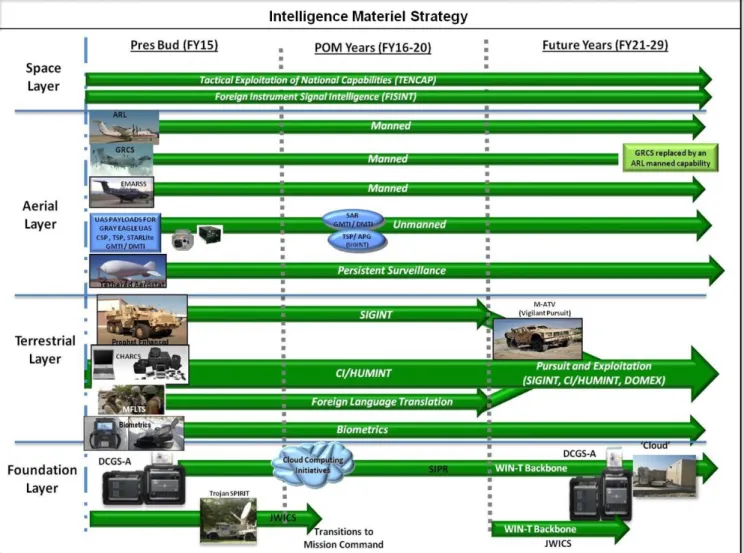
The Intelligence Portfolio incorporates key components of intelligence collection, exploitation and analysis across four primary layers: Foundation, Terrestrial, Aerial and Space. The goal of the portfolio is to fully integrate the core intelligence capabilities, including Signals Intelligence (SIGINT) collection, Counterintelligence (CI)/Human Intelligence (HUMINT) interrogation and source operations and Geospatial Intelligence (GEOINT), including Full Motion Video (FMV). The portfolio also includes secure intelligence communications architecture, synchronized and integrated with the Army’s network initiatives. This architecture supports all aspects of processing, exploitation, analysis and dissemination of intelligence to meet the readiness and modernization objectives of the Army Campaign Plan.
28 | P a g e Intelligence Portfolio
As depicted in figure 4, the Intelligence portfolio provides essential modernization to keep pace with the evolving threat and rapid technological advancements.
Section II. Strategy update
Based on fiscal constraints, the Intelligence Portfolio procurement strategy has been modified to take minimal risk in aerial assets, moderate risk through reduced fielding of unmanned sensors for the MQ-1 Gray Eagle Unmanned Aircraft System (UAS) and increased risk with the Distributed Common Ground System – Army (DCGS-A) through reduced software releases. The Army’s manned Aerial Intelligence, Surveillance and Reconnaissance (ISR) capabilities have been maintained and aligned with the Army’s Military Intelligence (MI) 2020 strategy. The Tactical SIGINT Payload (TSP) and Common Sensor Payload (CSP) FMV High Definition (HD) capabilities for the MQ-1 Gray Eagle UAS capability have been reduced to only provide to the Special Operations Forces (SOF) and Aerial Exploitation Battalions (AEB). If required, Aerial Unmanned SIGINT support for the Combat Aviation Brigades (CAB) will be provided via Concept of Operations (CONOPS) through the AEBs. DCGS-A training and fielding has been extended from three to five years, software releases from 12-18 months to 36-48 months and hardware refresh to five plus years.
Section III. Portfolio Accomplishments (FY 2013/2014)
Fielded and trained Increment 1, Release 1 of the Army’s advanced analytics
capability, DCGS-A to units in theater and next deployers in FY 2013.
Hunte received a Full Materiel Release (FMR) in 3rd Qtr FY 2013 and is being fielded to the force on the Secret Internet Protocol Router (SIPR) network. Hunte is a software baseline (V3.1.7) that provides enhanced ISR software Processing, Exploitation and Dissemination (PED) capabilities and incorporates ease of use aspects. Hunte is the foundation for software that will be tested in 3rd Qtr FY 2015.
DCGS-A began Operations/Intelligence Convergence development for the Command Post Computing Environment (CP CE) with incremental assessments at the Network Integration Evaluation events in FY 2013/2014.
DCGS-A began the fielding of the GEOINT Workstation in FY 2014 which integrated Geospatial Intelligence and Topographic engineer capabilities in a reduced footprint to initiate displacement of the Digital Topographical Support System – Light (DTSS-L).
Achieved Milestone B for the Army’s manned Aerial ISR capability, the Enhanced
Medium Altitude Reconnaissance and Surveillance System (EMARSS) program in FY 2013.
29 | P a g e Intelligence Portfolio
Entered the Engineering, Manufacturing and Design (EMD) phase with contract award for four EMD EMARSS aircraft in FY 2013.
Continued development and initial testing of the four EMD EMARSS aircraft in preparation for Milestone C in FY 2014.
Testing EMD EMARSS aircraft (systems #1, #2, #3) is ongoing with testing of EMD #4 scheduled for March 2014. Scheduled delivery date for all four EMD systems is April 2014.
Completed the integration of the Enhanced Situational Awareness (ESA) and High Band Communications Intelligence (HBC) capabilities for the Army’s airborne SIGINT and Electronic Intelligence (ELINT), GUARDRAIL Common Sensor (GRCS) fleet in FY 2013.
Continued to prepare the GRCS program for the FMV testing and integration on 14 RC-12X GRCS systems in FY 2014.
Provided interoperable data links and workstation architecture software to improve workstation performance for the Army’s manned multi-intelligence Airborne ISR system, Airborne Reconnaissance – Low (ARL) in FY 2013.
Maintained and upgraded system software, system payloads and workstations to sustain ARL ISR collection capability and relevance in FY 2014.
Began preparation for ARL-Enhanced (ARL-E) and will leverage Quick Reaction Capabilities (QRC) currently supporting Operation Enduring Freedom (OEF) while increasing multi-intelligence capabilities and system modularity in FY 2014.
Equipped the MQ-1 Gray Eagle UAS platform with CSP and the Small TacticalRadar-Lightweight (STARLite) sensors in FY 2013 and FY 2014. CSP is a
turreted, multi-sensor Electro-Optic/Infrared/Laser Designator (EO/IR/LD) system that provides day/night FMV imaging. STARLite is a Synthetic Aperture
Radar/Ground Moving Target Indicator (SAR/GMTI) capability that provides imagery through weather and detects moving target indicators. Production has commenced on HD CSP, an upgrade that will be fielded to the US Army SOF and AEBs. Development provided software to improve STARLite sensor
processing and exploitation and TSP Block I and test activities. TSP is an Aerial SIGINT collection sensor under development for the MQ-1 Gray Eagle UAS that detects radio frequency emitters.
Fielded the Army’s ground SIGINT collection capability, Prophet Enhanced, amore modular and vehicle-agnostic version to BCTs and Battlefield Surveillance Brigades (BfSBs) operating in combat theaters in FY 2013 and FY 2014.
30 | P a g e Intelligence Portfolio
Section IV. Key FY 2015 Intelligence Investments
The FY 2015 Intelligence portfolio investments total $691M ($358M Aircraft Procurement, Army (ACFT)/$124M RDTE/$209M OPA) and include the key
components of ISR tasking, collection, exploitation and analysis. Specific investments in this portfolio include:
$148.4M ($20.2M RDTE/$128.2M OPA) funds DCGS-A development and procurement to modernize and procure components for the DCGS-A systems and fixed sites setting conditions for the Army’s ISR component of the COE. DCGS-A hardware and software will be integrated into select ISR current force platforms to network enable and provide enhanced ISR PED capabilities. DCGS-A RDTE provides development and testing of DCGS-A multi-intelligence capable software baselines and the CP CE as it fits into the Army’s overarching COE construct. Additionally, development provides for iterative software
releases that increase the PED the Army requires and continue critical updates and overarching intelligence processing capability to the Army through the cloud computing capability. The approach will achieve information technology
efficiencies through the alignment with Intelligence Community Information Technology Environment. DCGS-A procurement provides 1,362 DCGS-A Portable Multi-Function Workstations, 119 GEOINT Workstations, 135 Intelligence Fusion Servers and Commercial off the Shelf (COTS) software licenses to enhance performance of fielded systems and supports integration of Intelligence Community investments. These systems will support one Corps, three Divisions, 12 BCTs, two SOF units, four Maneuver Enhancement Brigades, four CABs, three Fires Brigades and other Combat Support (CS) and Combat Service Support (CSS) units entering the force generation available pool. $202.8M ($17.7M RDTE/$185.1M ACFT) funds development and procurement
for EMARSS to provide a real-time, networked multi-sensor intelligence collection capability throughout the joint battle space, with focus on support to BCT
operations. Development provided sensor related Engineering Change Proposals (ECPs) and contractor subsystem support for EMARSS and a long range radar prototype to replace the current Airborne Reconnaissance Low (ARL) Phoenix Eye to meet requirements for increased performance for ARL-E. Funding provides design of Communications Intelligence (COMINT) Direction Finding (DF) antenna array for integration on the replacement aircraft for ARL-E. EMARSS procurement provides Government Furnished Equipment (GFE),
training support, initial spares, aircraft integration for Quick QRC to Program of Record (PoR) modifications, Mission Equipment Packages (MEP)/PED for QRC to PoR modifications and EMARSS Maintenance Vehicles (EMV).
31 | P a g e Intelligence Portfolio
$131.9M (ACFT) supports funding for the ARL-E through procurement of three DHC-8 300 aircraft, DCGS-A workstations, communications equipment, COMINT subsystems and radar subsystems. Funding also supports non-recurring
engineering, integration and test efforts for the first system.
$45.1M ($18.2M RDTE/$26.9M ACFT) for UAS ISR Payloads, providing the Gray Eagle platform with day and night capability to collect and display FMV
continuous imagery, wide-area all-weather search capability, persistent stare, GMTI and SAR capabilities. Provides development of UAS payloads and
procurement to retrofit CSP EO/IR/LD with HD sensors, two TSP sensors, initial spares, contractor logistics support, integration and fielding support to SOF and AEBs. Provides first year of fielding support to CSP and STARLite. RDTE facilitates continued improvements to CSP and STARLite and baseline development of TSP.
$60.3M ($4.4M RDTE/$55.9M OPA) for Prophet Ground SIGINT. Development provides product upgrades for next-generation signals for pre-planned product improvement requirements for Prophet Enhanced sensors. Modernizes 11 Prophet Enhanced sensors for training and fielding to BCTs and BfSBs. Funding will also procure eight next generation receivers and hardware/software
improvements to keep pace with rapidly changing threat technology, tactics, techniques and procedures.
32 | P a g e Maneuver Portfolio
MANEUVER
Section I. Overview
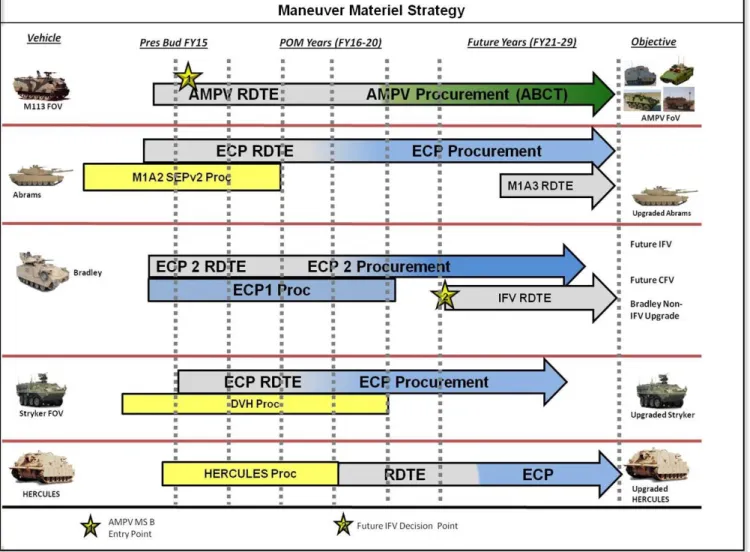
The Ground Movement and Maneuver Portfolio’s goal is to develop and field an integrated combined team, linked by the network and capable of dominating across the range of missions today and into the future. Key to this effort is our Combat Vehicle Modernization Strategy which transforms the capability of the Brigade Combat Team. The strategy as depicted in figure 5, replaces the M113 Family of Vehicles with an Armored-Multi Purpose Vehicle (AMPV), and also improves the Abrams tank; the Bradley Cavalry, Fire Support and Engineer Vehicles; and the Stryker by increasing protection, mobility and network integration, while deferring development of a new Fighting Vehicle.
33 | P a g e Maneuver Portfolio
Section II. Strategy Update
Based on current fiscal constraints, the Combat Vehicle Portfolio Strategy modified its strategy by deferring the Ground Combat Vehicle (GCV) until resources are available to focus funding on the Army’s proven platforms (Abrams, Bradley and Stryker) and the development of the AMPV. This strategy keeps the AMPV program funded to the Army’s cost position to insure the AMPV is fielded to the force as rapidly as possible. Proven platforms will receive much needed Engineering Change Proposals (ECP) to regain lost Size, Weight, Power and Cooling (SWaP-C) and integrate the network.
Section III. Portfolio Accomplishments (FY 2013/2014)
The Army approved the procurement of a third brigade set of Double V-Hull (DVH) Strykers. The DVH procurement leverages the DVH exchange program that converts flat bottom hull Strykers into DVHs at a significant cost savings to the Army. The DVH significantly improves crew protection in Improvised Explosive Device (IED) environments.
The AMPV program continues to move forward and released a Request for Proposal (RFP) to industry to gain feedback and bring the Army closer to replacing the venerable M113 Family of Vehicles. The program will enter the Engineering and Manufacturing Development Phase (EMD) beginning in FY 2015.
Section IV. Key FY 2015 Maneuver Investments
The FY 2015 Ground Movement and Maneuver investments total $1.3B ($821.7M WTCV/$473.0M RDTE/$0.6M OMA) including the AMPV to replace the legacy M113 family of vehicles. In addition to developing the critical replacement to the M113, the Army is restoring capabilities to the Army’s proven combat platforms such as Abrams, Bradley and Stryker. Specific investments in this portfolio include:
$92.4M (RDTE) funds AMPV. The RFP for EMD phase has been released and a contract award is planned for 1st Qtr FY 2015. The AMPV program is focused on replacing the legacy M113s within the Armored Brigade Combat Team
(ABCT) first with a future decision point for replacement of the remaining echelon above brigade M113s in the Army. Maintaining the program schedule to replace the legacy M113 fleet is critical to meeting future operational needs exposed by the operationally obsolete M113 fleet.
34 | P a g e Maneuver Portfolio
$199.9M ($107.5M WTCV/$92.4M RDTE) completes Bradley fielding to the Army National Guard (ARNG) and continues production of ECP 1 for suspension and track upgrades. RDTE funds ECP 2 development, focused on network
integration and enabling SWaP-C improvements for the Bradley A3 fleet.
$90.2M (RDTE) funds a Stryker ECP that addresses future network integration, mobility and SWaP-C. The Stryker ECP provides growth in electrical,
mechanical and engine power.
$424.8M (WTCV) funds Stryker ECP and a 3rd Double-V-Hull (DVH) brigade through the Stryker Exchange Program. DVH provides enhanced underbelly protection against IED threat environments.
$349.6M ($237.0M WTCV/$112.5M RDTE)WTCV continues with Armor
production, safety modifications, training devices and operational field
modifications. RDTE funds the Technology Development phase for Abrams ECP improvements.
35 | P a g e Aviation Portfolio
AVIATION
Section I. Overview
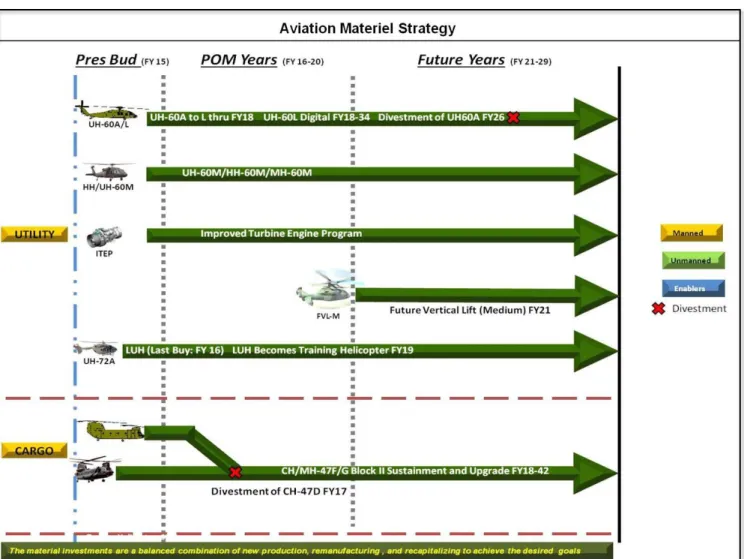
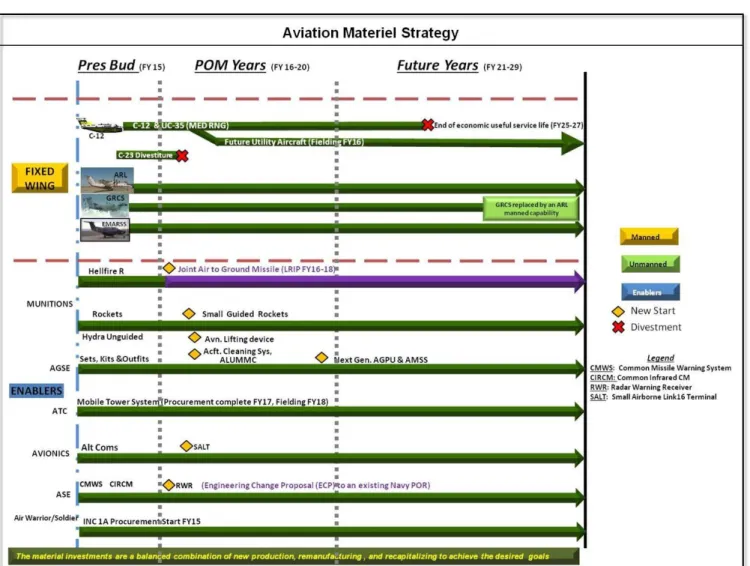
The Aviation portfolio consists of core aviation programs, including utility and cargo, fixed wing mission profiles, reconnaissance/attack, Intelligence, Surveillance and Reconnaissance (ISR) and Unmanned Aircraft Systems (UAS) which meet readiness and modernization objectives of the Army Campaign Plan.
As depicted in figures 6, 7 and 8, key objectives and decision points are: Fully fund the Apache AH-64E (Apache Block III) program.
Continue to fully fund Gray Eagle UAS procurement through FY 2015.
Fully fund UH-60 production meeting 4th Infantry Division (ID) Combat Aviation Brigade (CAB) growth and Special Operations increased aircraft requirement. Fully funds remaining aviation equipping requirements for the 4th ID CAB.
36 | P a g e Aviation Portfolio Figure 6. Aviation (see acronym glossary)
37 | P a g e Aviation Portfolio Figure 7. Aviation (see acronym glossary)
38 | P a g e Aviation Portfolio Figure 8. Aviation (see acronym glossary)
Section II. Strategy Update
As the Army downsizes and prioritizes incremental improvements in an environment of competing priorities and limited resources, it is necessary to restructure Army
Aviation. The equipping strategy contained in the Army Aviation Restructure Initiative is designed to retain its most modernized aircraft while divesting all models of its legacy single engine aircraft in the conventional force. The plan equips its reconnaissance and attack units with the AH-64E Apache and equips the training base with the UH-72A Lakota in lieu of the legacy Kiowa aircraft. All components will receive the modernized Black Hawk UH/HH-60M, UH-60L digital cockpit aircraft and the CH-47F Chinook to fill their lift and cargo aviation structure requirements. The restructure places all AH-64 Apache requirements in the Active Component. The restructure also allows the Reserve Component to retain a 12 aviation brigade structure, retain its entire 12