BotSniffer: Detecting Botnet Command and Control Channels
in Network Traffic
Guofei Gu, Junjie Zhang, and Wenke Lee
School of Computer Science, College of Computing
Georgia Institute of Technology
Atlanta, GA 30332
{
guofei, jjzhang, wenke
}
@cc.gatech.edu
Abstract
Botnets are now recognized as one of the most serious security threats. In contrast to previous malware, botnets have the characteristic of a command and control (C&C) channel. Botnets also often use existing common protocols, e.g., IRC, HTTP, and in protocol-conforming manners. This makes the detection of botnet C&C a challenging problem. In this paper, we propose an approach that uses network-based anomaly detection to identify botnet C&C channels in a local area network without any prior knowl-edge of signatures or C&C server addresses. This detection approach can identify both the C&C servers and infected hosts in the network. Our approach is based on the observa-tion that, because of the pre-programmed activities related to C&C, bots within the same botnet will likely demonstrate spatial-temporal correlation and similarity. For example, they engage in coordinated communication, propagation, and attack and fraudulent activities. Our prototype system, BotSniffer, can capture this spatial-temporal correlation in network traffic and utilize statistical algorithms to detect botnets with theoretical bounds on the false positive and false negative rates. We evaluated BotSniffer using many real-world network traces. The results show that BotSniffer can detect real-world botnets with high accuracy and has a very low false positive rate.
1
Introduction
Botnets (or, networks of zombies) are recognized as one of the most serious security threats today. Botnets are different from other forms of malware such as worms in that they use command and control (C&C) channels. It is important to study this botnet characteristic so as to develop effective countermeasures. First, a botnet C&C channel is relatively stable and unlikely to change among bots and
their variants. Second, it is the essential mechanism that allows a “botmaster” (who controls the botnet) to direct the actions of bots in a botnet. As such, the C&C channel can be considered the weakest link of a botnet. That is, if we can take down an active C&C or simply interrupt the communication to the C&C, the botmaster will not be able to control his botnet. Moreover, the detection of the C&C channel will reveal both the C&C servers and the bots in a monitored network. Therefore, understanding and detecting the C&Cs has great value in the battle against botnets.
Many existing botnet C&Cs are based onIRC(Internet Relay Chat) protocol, which provides a centralized com-mand and control mechanism. The botmaster can interact with the bots (e.g., issuing commands and receiving re-sponses) in real-time by usingIRC PRIVMSGmessages. This simpleIRC-based C&C mechanism has proven to be highly successful and has been adopted by many botnets. There are also a few botnets that use the HTTPprotocol for C&C. HTTP-based C&C is still centralized, but the botmaster does not directly interact with the bots using chat-like mechanisms. Instead, the bots periodically contact the C&C server(s) to obtain their commands. Because of its proven effectiveness and efficiency, we expect that centralized C&C (e.g., using IRC orHTTP) will still be widely used by botnets in the near future. In this paper, we study the problem of detecting centralized botnet C&C channels using network anomaly detection techniques. In particular, we focus on the two commonly used botnet C&C mechanisms, namely,IRCandHTTPbased C&C channels. Our goal is to develop a detection approach that does not require prior knowledge of a botnet, e.g., signatures of C&C patterns including the name orIPaddress of a C&C server. We leave the problem of detection of P2P botnets (e.g., Nugache [19], and Peacomm [14]) as our future work.
Botnet C&C traffic is difficult to detect because: (1) it follows normal protocol usage and is similar to normal traffic, (2) the traffic volume is low, (3) there may be very
few bots in the monitored network, and (4) may contain encrypted communication. However, we observe that the bots of a botnet demonstrate spatial-temporal correlation and similarities due to the nature of their pre-programmed response activities to control commands. This invariant helps us identify C&C within network traffic. For in-stance, at a similar time, the bots within a botnet will execute the same command (e.g., obtain system informa-tion, scan the network), and report to the C&C server with the progress/result of the task (and these reports are likely to be similar in structure and content). Normal network activities are unlikely to demonstrate such asynchronizedor correlatedbehavior. Using a sequential hypothesis testing algorithm, when we observe multiple instances of corre-lated and similar behaviors, we can conclude that a botnet is detected.
Our research makes several contributions. First, we study two typical styles of control used in centralized botnet C&C. The first is the “push” style, where commands are pushed or sent to bots. IRC-based C&C is an example of the push style. The second is the “pull” style, where commands are pulled or downloaded by bots.HTTP-based C&C is an example of the pull style. Observing the spatial-temporal correlation and similarity nature of these botnet C&Cs, we provide a set of heuristics that distinguish C&C traffic from normal traffic.
Second, we propose anomaly-based detection algorithms to identify both IRC and HTTP based C&Cs in a port-independent manner. The advantages of our algorithms include: (1) they do not require prior knowledge of C&C servers or content signatures, (2) they are able to detect encrypted C&C, (3) they do not require a large number of bots to be present in the monitored network, and may even be able to detect a botnet with just a single member in the monitored network in some cases, (4) they have bounded false positive and false negative rates, and do not require a large number of C&C communication packets.
Third, we develop a system,BotSniffer, which is based on our proposed anomaly detection algorithms and is im-plemented as several plug-ins for the open-source Snort [24]. We have evaluated BotSniffer using real-world net-work traces. The results show that it has high accuracy in detecting botnet C&Cs with a very low false positive rate.
The rest of the paper is organized as follows. In Section 2 we provide a background on botnet C&C and the motivation of our botnet detection approach. In Section 3, we describe the architecture of BotSniffer and describe in detail its detection algorithms. In Section 4, we report our evalu-ation of BotSniffer on various datasets. In Section 5, we discuss possible evasions to BotSniffer, the corresponding solutions, and future work. We review the related work in Section 6 and conclude in Section 7.
2
Background and Motivation
In this section, we first use case studies to provide a background on botnet C&C mechanisms. We then discuss the intuitions behind our detection algorithms.
2.1
Case Study of Botnet C&C
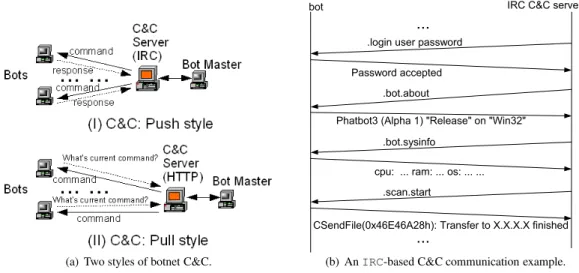
As shown in Figure 1(a), centralized C&C architecture can be categorized into “push” or “pull” style, depending on how a botmaster’s commands reach the bots.
In a push style C&C, the bots are connected to the C&C server, e.g.,IRCserver, and wait for commands from botmaster. The botmaster issues a command in the channel, and all the bots connected to the channel can receive it in real-time. That is, in a push style C&C the botmaster has real-time control over the botnet. IRC-based C&C is the representative example of push style. Many existing botnets use IRC, including the most common bot fami-lies such as Phatbot, Spybot, Sdbot, Rbot/Rxbot, GTBot [5]. A botmaster sets up an (or a set of)IRCserver(s) as C&C hosts. After a bot is newly infected, it will connect to the C&C server, join a certain IRC channel and wait for commands from the botmaster. Commands will be sent in IRC PRIVMSGmessages (like a regular chatting message) or a TOPIC message. The bots receive com-mands, understand what the botmaster wants them to do, and execute and then reply with the results. Figure 1(b) shows a sample command and control session. The botmas-ter first authenticates himself using a username/password. Once the password is accepted, he can issue commands to obtain some information from the bot. For example, “.bot.about” gets some basic bot information such as version. “.sysinfo” obtains the system information of the bot infected machine, “.scan.start” instructs the bots to begin scanning for other vulnerable machines. The bots respond to the commands in pre-programmed fashions. The botmaster has a rich command library to use [5], which enables the botmaster to fully control and utilize the in-fected machines.
In a pull style C&C, the botmaster simply sets the command in a file at a C&C server (e.g., aHTTPserver). The bots frequently connect back to read the command file. This style of command and control is relatively loose in that the botmaster typically does not have real-time control over the bots because there is a delay between the time when he “issues” a command and the time when a bot gets the command. There are several botnets using HTTPprotocol for C&C, for example, Bobax [25], which is designed mainly to send spams. The bots of this botnet periodically connect to the C&C server with anURLsuch as http://hostname/reg?u=[8-digit-hex-id] &v=114, and receive the command in a HTTPresponse.
(a) Two styles of botnet C&C. (b) AnIRC-based C&C communication example.
Figure 1. Botnet command and control.
The command is in one of the six types, e.g.,prj (send spams),scn(scan others), upd(update binary). Botnets can have fairly frequent C&C traffic. For example, in a CERT report [16], researchers report a Web based bot that queries for the command file every 5 seconds and then executes the commands.
2.2
Botnet C&C: Spatial-Temporal Correlation
and Similarity
There are several invariants in botnet C&C regardless of the push or pull style.
First, bots need to connect to C&C servers in order to obtain commands. They may either keep a long connection or frequently connect back. In either case, we can consider that there is a (virtually) long-lived session of C&C chan-nel.1
Second, bots need to perform certain tasks and respond to the received commands. We can define two types of responses observable in network traffic, namely, message response andactivityresponse. A typical example of mes-sage response isIRC-basedPRIVMSGreply as shown in Figure 1(b). When a bot receives a command, it will execute and reply in the sameIRCchannel with the execution result (or status/progress). The activity responses are the network activities the bots exhibit when they perform the malicious tasks (e.g., scanning, spamming, binary update) as directed by the botmaster’s commands. According to [31], about 53% of botnet commands observed in thousands of real-worldIRC-based botnets are scan related (for spreading or DDoS purpose), about 14.4% are binary download related (for malware updating purpose). Also, manyHTTP-based
1We consider a session live if the TCP connection is live, or within a
certain time window, there is at least one connection to the server.
botnets are mainly used to send spams [25]. Thus, we will observe these malicious activity responses with a high probability [8].
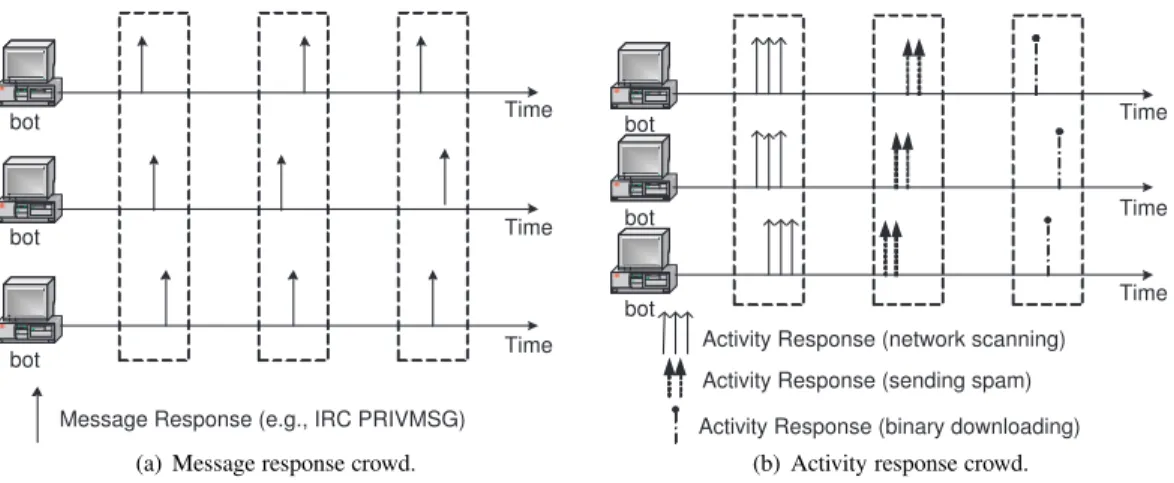
If there are multiple bots in the channel to respond to commands, most of them are likely to respond in a similar fashion. For example, the bots send similar message or activity traffic at a similar time window, e.g., sending spam as in [23]. Thus, we can observe a response crowd of botnet members responding to a command, as shown in Figure 2. Such crowd-like behaviors are consistent with all botnet C&C commands and throughout the life-cycle of a botnet. On the other hand, for a normal network service (e.g., an IRC chatting channel), it is unlikely that many clients consistently respond similarly and at a similar time. That is, the bots have much stronger (and more consistent) synchronization and correlation in their responses than nor-mal (human) users do.
Based on the above observation, our botnet C&C detec-tion approach is aimed at recognizing the spatial-temporal correlation and similarities in bot responses. When monitor-ing network traffic, as the detection system observes multi-ple crowd-like behaviors, it can declare that the machines in the crowd are bots of a botnet when the accumulated degree of synchronization/correlation (and hence the likelihood of bot traffic) is above a given threshold.
3
BotSniffer: Architecture and Algorithms
Figure 3 shows the architecture of BotSniffer. There are two main components, i.e., the monitor engine and the correlation engine. The monitor engine is deployed at the perimeter of a monitored network. It examines network traffic, generates connection record of suspicious C&C pro-tocols, and detects activity response behavior (e.g.,scan-bot bot bot Time Time Time
Message Response (e.g., IRC PRIVMSG)
(a) Message response crowd.
bot bot bot Time Time Time
Activity Response (network scanning) Activity Response (sending spam) Activity Response (binary downloading)
(b) Activity response crowd.
Figure 2. Spatial-temporal correlation and similarity in bot responses (message response and activity response). Preprocessing (WhiteList WatchList) HTTP IRC Protocol Matcher Scan Spam Activity Response Detection Binary Downloading Incoming PRIVMSG Analyzer Message Response Detection Outgoing PRIVMSG Analyzer Activity Log Correlation Engine Reports Reports Network Traffic of IRC PRIVMSG Malicious Activity Events HTTP/IRC Connection Records Network Traffic Monitor Engine Message Records
Figure 3. BotSniffer Architecture.
ning, spamming) and message response behavior (e.g.,IRC PRIVMSG) in the monitored network. The events observed by the monitor engine are analyzed by the correlation en-gine. It performsgroup analysisof spatial-temporal cor-relation and similarity of activity or message response be-haviors of the clients that connect to the same IRC or HTTP server. We implemented the monitor engines as several preprocessor plug-ins on top of the open-source system Snort [24], and implemented the correlation engine in Java. We also implemented a real-timemessage response correlation engine (in C), which can be integrated in the monitor engine. The monitor engines can be distributed on several networks, and collect information to a central
repository to perform correlation analysis. We describe each BotSniffer component in the following sections.
3.1
Monitor Engine
3.1.1 Preprocessing
When network traffic enters the BotSniffer monitor engine, BotSniffer first performs preprocessing to filter out irrele-vant traffic to reduce the traffic volume. Preprocessing is notessential to the detection accuracy of BotSniffer but can improve the efficiency of BotSniffer.
For C&C-like protocol matching, protocols that are un-likely (or at least not yet) used for C&C communications,
such asICMPandUDP, are filtered. We can use a (hard) whitelist to filter out traffic to normal servers (e.g.,Google andYahoo!) that are less likely to serve as botnet C&C servers. A soft whitelist is generated for those addresses declared “normal” in the analysis stage, i.e., those clearly declared “not botnet”. The difference from a hard list is that a soft list is dynamically generated, while a soft white address is valid only for a certain time window, after which it will be removed from the list.
For activity response detection, BotSniffer can monitor all local hosts or a “watch list” of local clients that are using C&C-like protocols. The watch list is dynamically updated from protocol matchers. The watch list is not required, but if one is available it can improve the efficiency of BotSnif-fer because its activity response detection component only needs to monitor the network behaviors of the local clients on the list.
3.1.2 C&C-like Protocol Matcher
We need to keep a record on the clients that are using C&C-like protocols for correlation purpose. Currently, we focus on two most commonly used protocols in botnet C&C, namely, IRC and HTTP. We developed port-independent protocol matchers to find all suspicious IRC and HTTP traffic. This port-independent property is important because many botnet C&Cs may not use the regular ports. We discuss in Section 5 the possible extensions.
IRCandHTTPconnections are relatively simple to rec-ognize. For example, an IRC session begins with con-nection registration (defined in RFC1459) that usually has three messages, i.e.,PASS,NICK, andUSER. We can easily recognize an IRC connection using light-weight payload inspection, e.g., only inspecting the first few bytes of the payload at the beginning of a connection. This is similar to HiPPIE [1]. HTTPprotocol is even easier to recognize because the first few bytes of a HTTPrequest have to be “GET”, “POST”, or “HEAD”.
3.1.3 Activity/Message Response Detection
For the clients that are involved in IRC or HTTP com-munications, BotSniffer monitors their network activities for signs of bot response (message response and activity response). For message response, BotSniffer monitors the IRC PRIVMSGmessages for further correlation analysis. For scan activity detection, BotSniffer uses approaches sim-ilar to SCADE (Statistical sCan Anomaly Detection En-gine) that we have developed for BotHunter [15]. Specif-ically, BotSniffer mainly uses two anomaly detection mod-ules, namely, the abnormally high scan rate and weighted failed connection rate. BotSniffer uses a new detector for spam behavior detection, focusing on detectingMX DNS
query (looking for mail servers) andSMTPconnections (be-cause normal clients are unlikely to act as SMTP servers). We note that more malicious activity response behaviors can be defined and utilized in BotSniffer. For example, binary downloading behavior can be detected using the same approach as the egg detection method in BotHunter [15].
3.2
Correlation Engine
In the correlation stage, BotSniffer first groups the clients according to their destination IP and port pair. That is, clients that connect to the same server will be put into the same group. BotSniffer then performs a group analysis of spatial-temporal correlation and similarity. If BotSniffer detects any suspicious C&C, it will issue botnet alerts. In the current implementation, BotSniffer uses the Response-Crowd-Density-Check algorithm (discussed in Section 3.2.1) for group activity response analysis, and the Response-Crowd-Homogeneity-Check algorithm (discussed in Section 3.2.2) for group message response analysis. Any alarm from either of these two algorithms will trigger a botnet alert/report.
BotSniffer also has the ability to detect botnet C&C even when there is only one bot in the monitored network, if certain conditions are satisfied. This is discussed in Section 3.3.
3.2.1 Response-Crowd-Density-CheckAlgorithm
The intuition behind this basic algorithm is as follows. For each time window, we check if there is adense response crowd2. Recall that a group is a set of clients that connect to the same server. Within this group, we look for any message or activity response behavior. If the fraction of clients with message/activity behavior within the group is larger than a threshold (e.g., 50%), then we say these responding clients form adenseresponse crowd. We use a binary random vari-ableYito denote whether theith response crowd is dense or not. Let us denoteH1as the hypothesis “botnet”,H0as “not botnet”. We defineP r(Yi|H1) =θ1andP r(Yi|H0) =θ0, i.e., the probability of the ith observed response crowd is dense when the hypothesis “botnet” is true and false, respectively. Clearly, for a botnet, the probability of a dense crowd (θ1) is high because bots are more synchronized than humans. On the other hand, for a normal (non-botnet) case, this probability (θ0) is really low. If we observe multiple response crowds, we can have a high confidence that the group is very likely part of a botnet or not part of a botnet.
The next question is how many response crowds are needed in order to make a final decision. To reduce the
2We only check when there is at least one client (within the group) that
number of crowds required, we utilize a SPRT (Sequential Probability Ration Testing [27]) algorithm, which is also known as TRW (Threshold Random Walk [17]), to calculate a comprehensive anomaly score when observing a sequence of crowds. TRW is a powerful tool in statistics and has been used in port scan detection [17] and spam laundering detection [29]. By using this technique, one can reach a decision within a small number of rounds, and with a bounded false positive rate and false negative rate.
TRW is essentially a hypothesis testing technique. That is, we want to calculate the likelihood ratioΛn given a se-quence of crowds observedY1, ..., Yn. Assume the crowds Yis’ are i.i.d. (independent and identically-distributed), we have Λn= ln P r(Y1, ..., Yn|H1) P r(Y1, ..., Yn|H0) = ln Q iP r(Yi|H1) Q iP r(Yi|H0) =X i lnP r(Yi|H1) P r(Yi|H0)
According to the TRW algorithm [17, 27], to calculate this likelihoodΛn, we are essentially performing a thresh-old random walk. The walk starts from the origin (0), goes up with step lengthlnθ1
θ0 whenYi= 1, and goes down with
step lengthln1−θ1
1−θ0 when Yi = 0. Let us denoteαandβ
the user-chosen false positive rate and false negative rate, respectively. If the random walk goes up and reaches the thresholdB= ln1−αβ, this is likely a botnet, and we accept the hypothesis “botnet”, output an alert, and stop. If it goes down and hits the thresholdA = ln1−βα, it is likely not a botnet. Otherwise, it is pending and we just watch for the next round of crowd.
There are some possible problems that may affect the accuracy of this algorithm.
First, it requires observing multiple rounds of response crowds. If there are only a few response behaviors, the accuracy of the algorithm may suffer. In practice, we find that many common commands will have a long lasting effect on the activities of bots. For example, a single scan command will cause the bots to scan for a long time, and a spam-sending “campaign” can last for a long time [8, 23]. Thus, at least for activity response detection, we can expect to observe sufficient response behaviors to have good detection accuracy.
Second, sometimes not all bots in the group will respond within the similar time window, especially when there is a relatively loose C&C. One solution is simply to increase the time window for each round of TRW. Section 3.2.2 presents an enhanced algorithm that solves this problem.
To conclude, in practice, we find this basic algorithm works well, especially foractivityresponse correlation. To further address the possible limitations above, we next pro-pose an enhanced algorithm.
3.2.2 Response-Crowd-Homogeneity-CheckAlgorithm
The intuition of this algorithm is that, instead of looking at the density of response crowd, it is important to consider thehomogeneityof a crowd. Ahomogeneouscrowd means that within a crowd, most of the members have very similar responses. For example, the members of a homogeneous crowd have message response with similar structure and content, or they have scan activities with similarIPaddress distribution and port range. We note that we currently implement this algorithm only formessage response anal-ysis. But activity response analysis can also utilize this algorithm, as discussed in Section 5. In this section, we usemessage responseanalysis as an example to describe the algorithm.
In this enhanced algorithm,Yi denotes whether theith crowd ishomogeneousor not. We use a clustering technique to obtain the largest cluster of similar messages in the crowd, and calculate the ratio of the size of the cluster over the size of the crowd. If this ratio is greater than a certain threshold, we sayYi= 1; otherwiseYi= 0.
There are several ways to measure the similarity between two messages (strings) for clustering. For example, we can use edit distance (or ED, which is defined as the minimum number of elementary edit operations needed to transform one string into another), longest common subsequence, and DICE coefficient [7]. We require that the similarity metric take into account the structure and context of messages. Thus, we choose DICE coefficient (or DICE distance) [7] as our similarity function. DICE coefficient is based on n-gram analysis, which uses a sliding window of lengthn to extract substrings from the entire string. For a string X with lengthl, the number of n-grams is|ngrams(X)| =
l−n+ 1. Dice coefficient is defined as the ratio of the number of n-grams that are shared by two strings over the total number of n-grams in both strings:
Dice(X, Y) = 2|ngrams(X)∩ngrams(Y)| |ngrams(X)|+|ngrams(Y)|
We choosen = 2 in our system, i.e., we use bi-gram analysis. We also use a simple variant of hierarchical clustering technique. If there areqclients in the crowd3,
we compare each of the q2unique pairs using DICE, and calculate the percentage of DICE distances that are greater than a threshold (i.e., the percentage of similar messages). If this percentage is above a threshold (e.g., 50%), we say the ith crowd is homogeneous, andYi= 1; otherwise,Yi= 0.
Now we need to set θ1 and θ0. These probabilities should vary with the number of clients (q) in the crowd. Thus, we denote themθ1(q)andθ0(q), or more generally
3Within a certain time window, if a client sends more than one message,
θ(q). For example, for a homogeneous crowd with 100 clients sending similar messages, its probability of being part of a botnet should be higher than that of a homogeneous crowd of 10 clients. This is because with more clients, it is less likely that by chance they form a homogeneous crowd. Let us denotep = θ(2)as the basic probability that two messages are similar. Now we have a crowd of qclients, there arem = q
2
distinct pairs, the probability of havingisimilar pairs follows the Binomial distribution, i.e.,P r(X =i) = mi
pi(1−p)m−i. Then the probability of having more than k similar pairs is P r(X ≥ k) =
Pm i=k m i pi(1−p)m−i . If we pick k = mtwheret is the threshold to decide whether a crowd is homogeneous, we obtain the probabilityθ(q) =P r(X ≥mt).
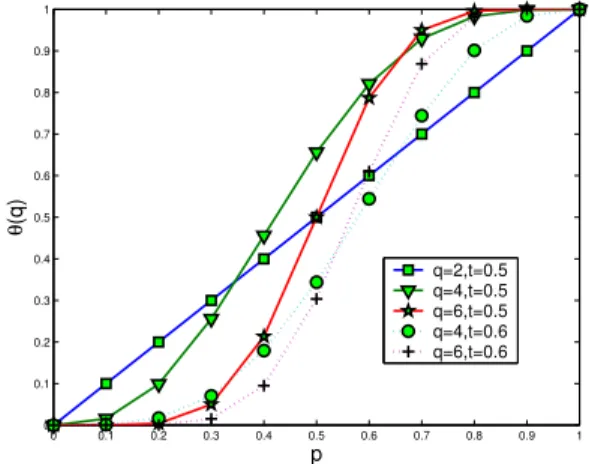
0 0.1 0.2 0.3 0.4 0.5 0.6 0.7 0.8 0.9 1 0 0.1 0.2 0.3 0.4 0.5 0.6 0.7 0.8 0.9 1 p θ (q) q=2,t=0.5 q=4,t=0.5 q=6,t=0.5 q=4,t=0.6 q=6,t=0.6
Figure 4. θ(q), the probability of crowd ho-mogeneity with q responding clients, and thresholdt.
As Figure 4 shows, when there are more than two mes-sages in the crowd, and we pickp ≥ 0.6, the probability θ(q) is above the diagonal line, indicating that the value is larger thanp. This suggests that when we useθ1(2) >
0.6, we have θ1(q) > θ1(2). That is, if there are more messages, we will more likely have a higher probability ofθ1. This confirms our intuition that, if it is a botnet, then having more clients (messages) is more likely to form a clustered message group (homogeneous crowd). Also, from the figure, if we pick a smallp ≤ 0.3, we will have θ(q) < p. This suggests that when choosingθ0(2) <0.3, we will have much lower probability θ0(q) when having multiple messages. Again this confirms the intuition that, for independent users (not a botnet), it is very unlikely for them to send similar messages. If there are more users, then it is less unlikely they will form a homogeneous crowd be-cause essentially more users will involve more randomness in the messages. In order to avoid calculatingθ(q)all the time, in practice one can pre-compute these probabilities for differentqvalues and store the probabilities in a table for
lookup. It may be sufficient to calculate the probabilities for only a fewqvalues (e.g.,q = 3, . . . ,10). Forq > 10, we can conservatively use the probability withq= 10.
For the hypothesis “not botnet”, for a pair of users, the probability of typing similar messages is very low. Ap-pendix A provides an analysis of the probability of having two similar length (size) messages from two users. Essen-tially, the probability of having two similar length messages is low, and the probability of having two similar content is even much lower. In correlation analysis, we pick a reasonable value (e.g., 0.15) for this probability. Even though this value is not precise, the only effect is that the TRW algorithm takes more rounds to make a decision [17, 27].
In order to make a decision that a crowd is part of a botnet, the expected number of crowd message response rounds we need to observe is:
E[N|H1] =
βln1−βα+ (1−β) ln1−αβ
θ1lnθθ10 + (1−θ1) ln
1−θ1
1−θ0
where α and β are user-chosen false positive and false negative probabilities, respectively. Similarly, if the crowd is not part of a botnet, the expected number of crowd message response rounds to make a decision is:
E[N|H0] =
(1−α) ln1−βα+αln1−αβ
θ0lnθθ10 + (1−θ0) ln
1−θ1
1−θ0
These numbers are derived according to [27].
0.050 0.1 0.15 0.2 0.25 0.3 0.35 0.4 2 4 6 8 10 12 14 16 θ 0(2) E[N|H 1 ] θ 1(2)=0.8,q=2,α=0.005 θ 1(2)=0.7,q=4,α=0.005 θ 1(2)=0.8,q=4,α=0.005 θ 1(2)=0.7,q=6,α=0.005 θ 1(2)=0.8,q=6,α=0.005 θ 1(2)=0.8,q=6,α=0.0001
Figure 5. E[N|H1], the expected number of crowd rounds in case of a botnet (varyθ0(2), q,αand fixβ = 0.01).
Figure 5 illustrates the expected number of walks (E[N|H1]) (i.e., the number of crowd response rounds need to observe) when the crowd is part of a botnet. Here we fixβ = 0.01 and varyθ0(2), θ1(2), andα. We can
see that even when we have only two clients, and have a conservative setting of θ0(2) = 0.2 andθ0(2) = 0.7, it only takes around 6 walks to reach the decision. When we increaseθ1(2) and decreaseθ0(2), we can achieve better performance, i.e., fewer rounds of walks. If there are more than two messages (clients), we can have shorter detection time than the case of having only two messages. It is obvious that having more clients in the botnet means that we can make a decision quicker. For example, whenq= 4, θ1(2) = 0.7, andθ0(2) < 0.15, the expected number of crowd rounds is less than two.
3.3
Single Client C&C Detection Under Certain
Conditions
Group correlation analysis typically requires having multiple members in a group. In some cases, there is only one client (e.g., the first infected victim) in the group. We recommend a distributed deployment of BotSniffer (as discussed in Section 5) to cover a larger network space, and thus potentially have more clients in a group. Orthogonally, we can use techniques that are effective even if there is only one member in the group, if certain conditions are satisfied. ForIRCcommunication, a chatting message is usually broadcast in the channel. That is, every client can see the messages sent from other clients in the same channel (which is the normal operation of IRC chatting service). Thus, ev-ery bot should expect to receive the response messages from all other clients. This is essentially similar to the case when we can monitor multiple message responses from multiple clients in the group. We can use the same TRW algorithm here. The only difference is that, instead of estimating the homogeneity of the outgoing message responses from multiple clients, we estimate the homogeneity of incoming messages (from different users) to a single client. We also implemented BotSniffer to perform this analysis because it complements the algorithms we described in Section 3.2.1 and Section 3.2.2, especially if there is only one client in the monitored network. Of course, this will not work if the botmaster uses a modified IRC softwares to disable broadcasting messages to every clients in the channel.
ForHTTP-based C&C, we notice that bots have strong periodical visiting patterns (to connect back and retrieve commands). Under this condition, we can include a new signal encoding and autocorrelation (or self-correlation) ap-proach in BotSniffer to detect such kind of C&C. Appendix B describes this approach.
Finally, we note that although these two single client detection schemes work well on existing botnet C&C, they are not as robust (evasion-resilient) as the group analysis algorithms discussed in Section 3.2.1 and Section 3.2.2.
4
Experimental Evaluation
To evaluate the performance of BotSniffer, we tested it on several network traces.
4.1
Datasets
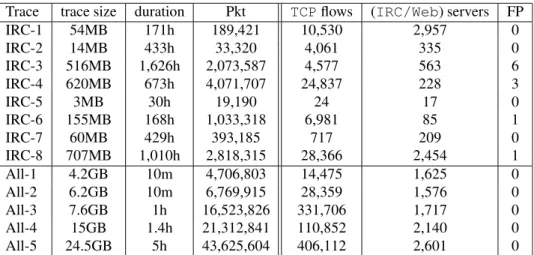
We have multiple network traces captured from our uni-versity campus network. Among those, eight are just port 6667IRCtraffic captured in 2005, 2006, and 2007. Each IRCtrace lasts from several days to several months. The total duration of these traces is about 189 days. They were labeled as IRC-n (n =1, . . . ,8). The other five traces are complete packet captures of all network traffic. Two of them were collected in 2004, each lasting about ten minutes. The other three were captured in May and December 2007, each lasting 1 to 5 hours. We labeled them as All-n (n =1, . . . ,5). The primary purpose of using these traces was to test the false positive rate of BotSniffer. We list the basic statistics (e.g., size, duration, number of packets) of these traces in the left part of Table 1.
We also obtained several real-worldIRC-based botnet C&C traces from several different sources. One was cap-tured at our honeynet in June 2006. This trace contains about eight hours of traffic (mainlyIRC). We labeled it as B-IRC-G. TheIRCchannel has broadcast on and we can observe the messages sent from other bots in the channel. The trace does not contain the initial traffic, so we did not have the command. From the replies of the clients, it seems like a DDoS attack because bots reported current bandwidth usage and total offered traffic. Besides B-IRC-G, we also obtained two botnetIRClogs (not network traces) recorded by anIRC tracker in 2006 [22]. In these logs, there are two distinctIRCservers, so there are two different botnets. We labeled them as B-IRC-J-n (n = 1, 2). In each log, the tracker joined the channel, and sat there watching the messages. Fortunately, the botmaster here did not disable the broadcast, thus, all the messages sent by other bots in the channel were observable.
In addition to these IRC botnet traces, we modified the source codes of three common bots [5] (Rbot, Spybot, Sdbot) and created our version of binaries (so that the bots would only connect to our controlled IRC server). We set up a virtual network environment using VMware and launched the modified bots in several Windows XP/2K virtual machines. We instructed the bots to connect our controlled C&C server and captured the traces in the virtual network. For Rbot, we used five Windows XP virtual machines to generate the trace. For Spybot and Sdbot, we used four clients. We labeled these three traces as V-Rbot, V-Spybot, and V-Sdbot, respectively. These traces contain both bot message responses and activity responses.
Trace trace size duration Pkt TCPflows (IRC/Web) servers FP IRC-1 54MB 171h 189,421 10,530 2,957 0 IRC-2 14MB 433h 33,320 4,061 335 0 IRC-3 516MB 1,626h 2,073,587 4,577 563 6 IRC-4 620MB 673h 4,071,707 24,837 228 3 IRC-5 3MB 30h 19,190 24 17 0 IRC-6 155MB 168h 1,033,318 6,981 85 1 IRC-7 60MB 429h 393,185 717 209 0 IRC-8 707MB 1,010h 2,818,315 28,366 2,454 1 All-1 4.2GB 10m 4,706,803 14,475 1,625 0 All-2 6.2GB 10m 6,769,915 28,359 1,576 0 All-3 7.6GB 1h 16,523,826 331,706 1,717 0 All-4 15GB 1.4h 21,312,841 110,852 2,140 0 All-5 24.5GB 5h 43,625,604 406,112 2,601 0
Table 1. Normal traces statistics (left part) and detection results (right columns).
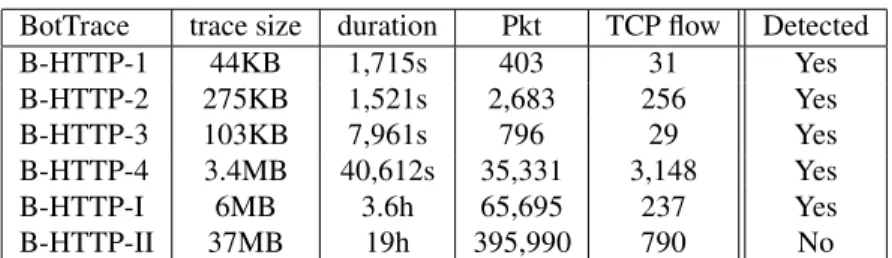
C&C communication according to the description in [16, 25]. In the first botnet trace, B-HTTP-I, bots regularly connects back to the C&C server every five minutes for commands. We ran four clients in the virtual network to connect to a HTTPserver that acted as a C&C server providing commands such as scan and spam. The four clients are interleaved in time to connect to C&C, i.e., although they periodically connect, the exact time is different because they are infected at different time. In the second trace, B-HTTP-II, we implemented a more stealthy C&C communication. The bot waits a random amount of time for the next connection to C&C server. This may easily evades simple autocorrelation based approach on single client analysis. We wanted to see how it can affect the detection performance of group correlation analysis. These two traces contain bot activity responses.
Table 2 lists some basic statistics of these botnet traces in the left part. Because B-IRC-J-1/2 are not network traces, we only report the number of lines (packets) in the logs.
4.2
Experimental Results and Analysis
4.2.1 False Positives and Analysis
We first report our experience on the normal traces. We list our detection results in the right part of Table 1. Basically, we list the number of TCP flows (other than TCPflows, we did not countUDPor other flows) and distinct servers (onlyIRC/HTTP servers are counted) in the traces. We show the number ofIPaddresses identified as botnet C&C servers by BotSniffer (i.e., the numbers of false positives) in the rightmost column. Since these traces were collected from well administrated networks, we presumed that there should be no botnet traffic in the traces. We manually verified the raw alerts generated by BotSniffer’s monitor engine and also ran BotHunter [15] to confirm that these
are clean traces.
The detection results on theIRCtraces are very good. Since these traces only containIRCtraffic, we only enabled message responsecorrelation analysis engine. On all eight traces (around 189 days’ of IRCtraffic), BotSniffer only generated a total of 11 FPs on four of the IRC traces. We investigated these alerts and found them all real false positives. There was no false positive (FP) resulted from group analysis. All were generated due to single client incoming message response analysis (Section 3.3). The main reason of causing false positives was that, there is still a small probability of receiving very similar messages in a crowd from different users engaging in normal IRC activity. For example, we noticed that in anIRCchannel, several users (not in the monitored network) were send-ing “@@@@@@@@...” messages at similar time (and the messages were broadcast at the channel). This resulted in several homogeneous message response crowds. Thus, our TRW algorithm walked to the hypothesis of “botnet”, resulting a FP. While our TRW algorithm cannot guarantee no FP, it can provide a pretty good bound of FP. We set α = 0.005, β = 0.01in our evaluation and our detection results confirmed the bounds are satisfied because the false positive rate was 0.0016 (i.e., 11 out of 6,848 servers), which is less thanα= 0.005).
On the network traces All-n, we enabled bothactivity responseandmessage responsegroup analysis engine, and we did not observe false positives. For 1 and All-2, since the duration is relatively short, we set the time window to one and two minutes, respectively. None of them caused a false positive, because there were very few random scanning activities, which did not cause TRW to make a decision on “botnet”. For All-3, All-4 and All-5, we set the time window to 5, 10, and 15 minutes, respectively. Again, we did not observe any false positive. These results showed that our activity response correlation analysis is relatively
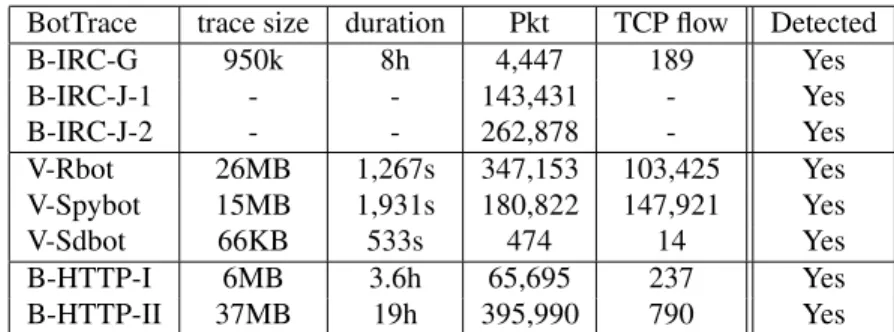
BotTrace trace size duration Pkt TCP flow Detected B-IRC-G 950k 8h 4,447 189 Yes B-IRC-J-1 - - 143,431 - Yes B-IRC-J-2 - - 262,878 - Yes V-Rbot 26MB 1,267s 347,153 103,425 Yes V-Spybot 15MB 1,931s 180,822 147,921 Yes V-Sdbot 66KB 533s 474 14 Yes B-HTTP-I 6MB 3.6h 65,695 237 Yes B-HTTP-II 37MB 19h 395,990 790 Yes
Table 2. Botnet traces statistics and detection results. robust.
4.2.2 Detection Accuracy and Analysis
Next, we ran BotSniffer on the botnet traces in two modes, stand alone and mixed with normal traces. It successfully detected all botnet C&C channels in the datasets. That is, it has a detection rate of100%in our evaluation.
BotSniffer detected B-IRC-G using only message re-sponse crowd homogeneity evidences because the trace did not contain activity responses. Since the bots kept sending reports of the attack (which were similar in structure and content) to the C&C server, BotSniffer observed continuous homogeneous message response crowds.
On twoIRClogs, we had to adapt our detection algo-rithms to take a text line as packet. In trace B-IRC-J-1, there were a lot of bots sending similar response messages and these were broadcast in theIRCchannel. BotSniffer easily detected the C&C channel. In trace B-IRC-J-2, although the messages were less often, there were hundred of bots responded almost at the same time, and thus, BotSniffer was able to detect the C&C channels.
On trace V-Rbot, BotSniffer reported botnet alerts be-cause of the groupmessage responsehomogeneity detection and activity response (scanning) density detection. Ac-tually, even only one client is monitored in the network, BotSniffer could still detect the botnet C&C because in this case each client could observe messages from other clients in the same botnets. Similarly, BtSniffer also successfully detected C&C channels in traces V-Spybot and V-Sdbot with both message responses and activity responses.
For traces B-HTTP-I and B-HTTP-II, BotSniffer de-tected all of the botnets according to activity response group analysis. The randomization of connection periods did not cause a problem as long as there were still several clients performing activity responses at the time window.
We also conducted autocorrelation detection (at single client level) forHTTP-based C&C detection. The results and discussions are reported in Appendix B. In short, the autocorrelation analysis incurred higher false positives than group analysis, but still provided some interesting
information. It was able to detectHTTP-based C&C with regular visiting patterns, but failed on B-HTTP-II where the visiting pattern was randomized.
4.2.3 Summary
In our experiments, BotSniffer successfully detected all botnets and generated very few false positives. In addition, its correlation engine generated accurate and concise report rather than producing alerts of malicious events (e.g., scan-ning, spamming) as a traditional IDS does. For instance, in trace All-4, the monitor engine produced over 100 activity events, none of which is the indication of actual botnets (e.g., they are false positives), while the correlation engine did not generate a false positive. In another case, e.g., in V-Spybot, there were over 800 scanning activity events produced by the monitor engine, and the correlation engine only generated one botnet report (true positive), which was a great reduction of work for administrators.
In terms of performance comparison with existing botnet detection systems, we can mainly do a paper-and-pencil study here because we could not obtain these tools, except BotHunter [15]. Rishi [13] is a relevant system but it is signature-based (using known knowledge of bot nicknames). Thus, if IRC bots simply change their nickname pattern (for example, many of botnets in our data do not have regular nickname patterns), Rishi will miss them. However, such changes will not affect BotSniffer because it is based on the response behaviors. Another relevant work is the BBN system [20, 26]. Its detection approach is based on clustering of some general network-level traffic features (such as duration, bytes per packet). Such approach is easy to evade by simply changing the network flows. It can potentially have more false positives because it does not consider the temporal synchronization and correlation of responses. BotHunter [15] is a bot detection system using IDS (intrusion detection system) based dialog correlation according to a user-defined bot infection live-cycle model. It cannot detect bots given only IRC communication. Its current C&C detection module relies on known signatures, and thus, it fails on some botnet
traces (e.g., B-IRC-G, B-HTTP-I). The anomaly basedIRC botnet detection system in [6] has the similar problem as BotHunter. Without considering thegroup spatial-temporal correlation and similarity, these systems may also have a higher false positive rate than BotSniffer.
Although BotSniffer performed well in our evaluation, it can fail to detect botnets in several cases. We next discuss these issues and the possible solutions, as well as future work on improving BotSniffer.
5
Discussion and Future Work
5.1
Possible Evasions and Solutions
Evasion by misusing the whitelist. If a botmaster knows our hard whitelist, he may attempt to misuse these white addresses. For example, he can use them as third-party proxies for C&C purpose to bypass the detection of Bot-Sniffer. However, as we discussed earlier, a whitelist is not essential to BotSniffer and mainly serves to improve its efficiency. Thus, whitelists can be removed to avoid such evasions. In another evasion case, an adversary controlling the C&C server may attempt to first behave normally and trick BotSniffer to decide that the C&C server is a nor-mal server and put the server address in the soft whitelist. After that, the adversary begins to use the C&C server to command the bots to perform real malicious activities. To defeat this evasion, for each address being added to soft whitelist, we can keep arandomand short timer so that the address will be removed when the timer expires. Thus, the adversary’s evasion attempt will not succeed consistently.
Evasion by encryption. Botnets may still use known protocols (IRCandHTTP) that BotSniffer can recognize, but the botmasters can encrypt the communication content to attempt to evade detection. First of all, this mayonly mislead message response correlation analysis, but can-not evade activity responsecorrelation analysis. Second, we can improvemessage responsecorrelation analysis to deal with encrypted traffic. For example, instead of using simple DICE distance to calculate the similarity of two messages, we can use information-theoretic metrics that are relatively resilient to encryption, such as entropy, or normalized compression distance (NCD [4, 28]), which is based on Kolmogorov complexity.
Evading protocol matcher. Although botnets tend to use existing common protocols to build their C&C, they may use some obscure protocols or even create their own protocols4. It is worth noting that “push” and “pull” are
4However, a brand new protocol itself is suspicious already. A botnet
could also exploit the implementation vulnerability of protocol matchers. For example, if anIRCmatcher only checks the first ten packets in a connection to identify the existence ofIRCkeywords, the botmaster may have these keywords occur after the first ten packets in order to evade this
the two representative C&C styles. Even when botnets use other protocols, the spatial-temporal correlation and simi-larity properties in “push” and “pull” will remain. Thus, our detection algorithms can still be used after new pro-tocol matchers are added. We are developing a generic C&C-like protocol matcher that uses traffic features such as BPP (bytes per packet), BPS (bytes per second), and PPS (packet per second) [20, 26] instead of relying on protocol keywords. This protocol matching approach is based on the observation that there are generic patterns in botnet C&C traffic regardless of the protocol being used. For example, C&C traffic is typically low volume with a just a few packets in a session and a few bytes in a packet. Ultimately, to overcome the limitations of protocol matching and protocol-specific detection techniques, we are developing a next-generation botnet detection system that is independent of the protocol and network structure used for botnet C&C.
Evasion by using very long response delay. A botmaster may command his bots to wait for a very long time (e.g., days or weeks) before performing message or malicious activity response. In order to detect such bots using Bot-Sniffer, we have to correlate IRC or HTTP connection records and activity events within a relatively long time window. In practice, we can perform correlation analysis using multiple time windows (e.g., one hour, one day, one week, etc.). However, we believe that if bots are forced to use avery longresponse delay, the utility of the botnet to botmaster is reduced or limited because the botmaster can no longer command his bots promptly and reliably. For example, the bot infected machines may be powered off or disconnected from the Internet by the human users/owners during the delay and become unavailable to the botmaster. We can also use the analysis of activity response crowd homogeneity(see Section 5.2) to defeat this evasion. For example, if we can observe over a relatively long time window that several clients are sending spam messages with very similarcontents, we may conclude that the clients are part of a botnets.
Evasion by injecting random noise packet, injecting ran-dom garbage in the packet, or using ranran-dom response delay. Injecting random noise packet and/or random garbage in a packet may affect the analysis ofmessageresponse crowd homogeneity. However, it is unlikely to affect theactivity response crowd analysis as long as the bots still need to per-form the required tasks. Using random message/activity re-sponse delay may cause problems to the Response-Crowd-Density-Check algorithm because there may not be suffi-cient number of responses seen within a time window for one round of TRW. However, the botmaster may lose the reliability in controlling and coordinating the bots promptly if random response delay is used. We can use a larger time
window to capture more responses. Similar to evasion by long response delay discussed above, for evasion by random response delay, a better solution is to use the analysis of activity response crowd homogeneity(see Section 5.2).
In summary, although it is not perfect, BotSniffer greatly enhances and complements the capabilities of existing bot-net detection approaches. Further research is needed to improve its effectiveness against the more advanced and evasive botnets.
5.2
Improvements to BotSniffer
Activity response crowd homogeneity check. We have al-ready discussed homogeneity analysis ofmessage response crowdin Section 3.2.2. We can perform similar check on the homogeneity ofactivity response crowd. For instance, for scanning activity, we consider two scans to be similar if they have similar distribution or entropy of the target IP addresses and similar ports. A similarity function of two spam activities can be based on the number of common mail servers being used, the number of spam messages being sent, and the similarity of spam structure and content (e.g., the URLs in the messages). A similarity function of two bi-nary downloading activities can be based on the byte value distribution or entropy of the binary or binary string dis-tance. By includingResponse-Crowd-Homogeneity-Check on activity responses, in addition to the similar check on message responses, we can improve the detection accuracy of BotSniffer and its resilience to evasion.
Combine more features in analysis. As with other de-tection problems, including more features can improve the accuracy of a botnet detection algorithm. For example, we can check whether there are any user-initiated queries, e.g.,WHO,WHOIS,LIST, andNAMESmessages, in anIRC channel. The intuition is that a bot is unlikely to use these commands like a real user. To detect anIRCchannel that disables broadcast (as in the more recent botnets), we can consider the message exchange ratio, defined as mi
mo, i.e.,
the ration between the number of incomingPRIVMSG mes-sages (mi) and the number of outgoingPRIVMSGmessages (mo). The intuition is that for a normal (broadcasting)IRC channel, most likely there are multiple users/clients in the chatting channel, and a user usually receives more messages (from all other users) than he sends. On the other hand, in the botnet case with broadcast disabled, the number of incoming messages can be close to the number of outgoing messages because a client cannot see/receive the messages sent by other clients. The number of incoming messages can also be smaller than the number of outgoing messages, for example, when there are several packets/responses from a bot corresponding to one botmaster command, or when the botmaster is not currently on-line sending commands. In addition, we can consider other group similarity measures
on traffic features, e.g., duration, bytes per second, and packets per second.
Distributed deployment on Internet. Ideally, BotSniffer deployment should be scalable, i.e., it should be able to handle a large volume of traffic and cover a large range of network addresses. We envision that BotSniffer can be distributed in that many monitor sensors can be deployed in distributed networks and report to a central repository that also performs correlation and similarity analysis.
6
Related Work
Much of the research on botnets has been on gaining a basic understanding of the botnet threats. Honeypot tech-niques are widely used to collect and analyze bots [3, 22, 30]. Freilinget al.[30] used honeypots to study the problem of botnets. Nepenthes [3] is a honeypot tool for auto-matically harvesting malware samples directly from the Internet. Rajabet al. [22] employed a longitudinal multi-faceted approach to collect bots, track botnets, and provided an in-depth study of botnet activities. Cooke et al. [9] studied several basic dynamics of botnets. Dagonet al.[10] studied the global diurnal behavior of botnets usingDNS based detection and sink-holing technique. Barford and Yegneswaran [5] investigated the internals of bot instances to examine the structural similarities, defense mechanisms, and command and control capabilities of the major bot families. Collinset al.[8] observed a relationship between botnets and scanning/spamming activities.
There are also several very recent efforts on botnet de-tection. Binkley and Singh [6] proposed to combineIRC statistics andTCPwork weight for detection ofIRC-based botnets. Rishi [13] is a signature-basedIRCbotnet detec-tion system. Livadaset al. [20, 26] proposed a machine learning based approach for botnet detection using some general network-level traffic features. Karasaridiset al.[18] studied network flow level detection of IRC botnet con-trollers for backbone networks. SpamTracker[23] is a spam filtering system using behavioral blacklisting to classify email senders based on their sending behavior rather than their identities. BotSniffer is different from all of the above work. The novel idea in BotSniffer is to detect spatial-temporal correlation and similarity patterns in network traf-fic that are resulted from pre-programmed activities related to botnet C&C. BotSniffer works for bothIRCandHTTP based botnets, and can be easily extended to include other protocols; whereas previous systems mainly dealt withIRC based botnets. Another recent work, BotHunter [15], is a botnet detection system that uses IDS-driven dialog corre-lation according to a user-defined bot infection live-cycle model. Different from BotHunter’s “vertical” correlation angle, which examines the behavior history of eachdistinct host independently, BotSniffer provides a “horizontal”
cor-relation analysis across several hosts. In addition, BotSnif-fer can be a very useful component, i.e., an anomaly based C&C detector, for BotHunter.
7
Conclusion
Botnet detection is a relatively new and a very chal-lenging research area. In this paper, we presented Bot-Sniffer, a network anomaly based botnet detection system that explores the spatial-temporal correlation and similarity properties of botnet command and control activities. Our detection approach is based on the intuition that since bots of the same botnet run the same bot program, they are likely to respond to the botmaster’s commands and conduct attack/fraudulent activities in a similar fashion. BotSniffer employs several correlation and similarity analysis algo-rithms to examine network traffic, identifies the crowd of hosts that exhibit very strong synchronization/correlation in their responses/activities as bots of the same botnet. We reported experimental evaluation of BotSniffer on many real-world network traces, and showed that it has very promising detection accuracy with very low false positive rate. Our ongoing work involves improving the detection accuracy of BotSniffer and its resilience to evasion, and performing more evaluation and deploying BotSniffer in the real-world. We are also developing a next-generation detection system that is independent of the protocol and network structure used for botnet C&C.
Acknowledgments
We would like to thank David Dagon, Fabian Monrose, and Chris Lee for their help in providing some of the evaluation data in our experiments. We also wish to thank the anonymous reviewers for their insightful comments and feedback. This material is based upon work supported in part by the National Science Foundation under Grants CCR-0133629, CNS-0627477, and CNS-0716570, and by the U.S. Army Research Office under Grant W911NF0610042. Any opinions, findings, and conclusions or recommenda-tions expressed in this material are those of the author(s) and do not necessarily reflect the views of the National Science Foundation and the U.S. Army Research Office.
References
[1] Hi-performance protocol identification engine. http://hippie.oofle.com/, 2007.
[2] Quick analysis of a proxy/zombie network.http:// lowkeysoft.com/proxy/client.php, 2007.
[3] P. Baecher, M. Koetter, T. Holz, M. Dornseif, and F. Freiling. The nepenthes platform: An efficient approach to collect malware. InProceedings of Recent Advances in Intrusion Detection, Hamburg, Septem-ber 2006.
[4] M. Bailey, J. Oberheide, J. Andersen, M. Mao, F. Ja-hanian, and J. Nazario. Automated classification and analysis of internet malware. InProceedings of Recent Advances in Intrusion Detection (RAID’07), 2007. [5] P. Barford and V. Yegneswaran. An Inside Look at
Botnets. Special Workshop on Malware Detection, Advances in Information Security, Springer Verlag, 2006.
[6] J. R. Binkley and S. Singh. An algorithm for anomaly-based botnet detection. In Proceedings of USENIX Steps to Reducing Unwanted Traffic on the Internet Workshop (SRUTI), pages 43–48, July 2006.
[7] C. Brew and D. McKelvie. Word-pair extraction for lexicography, 1996.
[8] M. Collins, T. Shimeall, S. Faber, J. Janies, R. Weaver, M. D. Shon, and J. Kadane. Using uncleanliness to predict future botnet addresses,. In Proceedings of the 2007 Internet MeasurementConference (IMC’07), 2007.
[9] E. Cooke, F. Jahanian, and D. McPherson. The zombie roundup: Understanding, detecting, and disrupting botnets. InProceedings of Workshop on Steps to Re-ducing Unwanted Traffic on the Internet (SRUTI’05), 2005.
[10] D. Dagon, C. Zou, and W. Lee. Modeling bot-net propagation using timezones. InProceedings of Network and Distributed Security Symposium (NDSS ’06), January 2006.
[11] N. Daswani and M. Stoppelman. The anatomy of clickbot.a. InUSENIX Hotbots’07, 2007.
[12] M. H. Degroot and M. J. Schervish. Probability and Statistics. Addison-Wesley, 2002.
[13] J. Goebel and T. Holz. Rishi: Identify bot contami-nated hosts by irc nickname evaluation. In USENIX Workshop on Hot Topics in Understanding Botnets (HotBots’07), 2007.
[14] J. B. Grizzard, V. Sharma, C. Nunnery, B. B. Kang, and D. Dagon. Peer-to-peer botnets: Overview and case study. In USENIX Workshop on Hot Topics in Understanding Botnets (HotBots’07), 2007.
[15] G. Gu, P. Porras, V. Yegneswaran, M. Fong, and W. Lee. Bothunter: Detecting malware infection through ids-driven dialog correlation. In16th USENIX Security Symposium (Security’07), 2007.
[16] N. Ianelli and A. Hackworth. Botnets as a vehi-cle for online crime. http://www.cert.org/ archive/pdf/Botnets.pdf, 2005.
[17] J. Jung, V. Paxson, A. W. Berger, and H. Balakrishnan. Fast Portscan Detection Using Sequential Hypothesis Testing. InIEEE Symposium on Security and Privacy 2004, Oakland, CA, May 2004.
[18] A. Karasaridis, B. Rexroad, and D. Hoeflin. Wide-scale botnet detection and characterization. In USENIX Hotbots’07, 2007.
[19] R. Lemos. Bot software looks to improve peerage. Http://www.securityfocus.com/ news/11390, 2006.
[20] C. Livadas, R. Walsh, D. Lapsley, and W. T. Strayer. Using machine learning techniques to identify botnet traffic. In 2nd IEEE LCN Workshop on Network Security (WoNS’2006), 2006.
[21] M. Priestley. Spectral analysis and time series. Aca-demic Press, 1982.
[22] M. Rajab, J. Zarfoss, F. Monrose, and A. Terzis. A multi-faceted approach to understanding the bot-net phenomenon. In Proceedings of ACM SIG-COMM/USENIX Internet Measurement Conference, Brazil, October 2006.
[23] A. Ramachandran, N. Feamster, and S. Vempala. Fil-tering spam with behavioral blacklisting. In Proc. ACM Conference on Computer and Communications Security (CCS’07), 2007.
[24] M. Roesch. Snort - lightweight intrusion detection for networks. InProceedings of USENIX LISA’99, 1999. [25] J. Stewart. Bobax trojan analysis. http:
//www.secureworks.com/research/ threats/bobax/, 2004.
[26] W. T. Strayer, R. Walsh, C. Livadas, and D. Lapsley. Detecting botnets with tight command and control. In 31st IEEE Conference on Local Computer Networks (LCN’06), 2006.
[27] A. Wald. Sequential Analysis. Dover Publications, 2004.
[28] S. Wehner. Analyzing worms and network traffic using compression. Journal of Computer Security, 15(3):303–320, 2007.
[29] M. Xie, H. Yin, and H. Wang. An effective defense against email spam laundering. InACM Computer and Communications Security (CCS’06), 2006.
[30] V. Yegneswaran, P. Barford, and V. Paxson. Using honeynets for internet situational awareness. In Pro-ceedings of the Fourth Workshop on Hot Topics in Networks (HotNets IV), College Park, MD, November 2005.
[31] J. Zhuge, T. Holz, X. Han, J. Guo, and W. Zou. Char-acterizing the irc-based botnet phenomenon. Peking University & University of Mannheim Technical Re-port, 2007.
A
Analysis of the Similarity Probability of
Typing Similar Length Messages
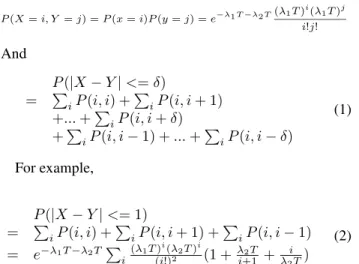
In this section, we show the probability of typing two similar length (size) messages from two chatting users. Let us use the common assumption of Poisson distribution for the length of messages typed by the user [12] at duration T,P(X =i) =e−λ1T(λ1T)i
i! . Then for two independent users, their joint distribution
P(X=i, Y =j) =P(x=i)P(y=j) =e−λ1T−λ2T(λ1T)i(λ1T)j i!j! And P(|X−Y|<=δ) = P iP(i, i) + P iP(i, i+ 1) +...+P iP(i, i+δ) +P iP(i, i−1) +...+ P iP(i, i−δ) (1) For example, P(|X−Y|<= 1) = P iP(i, i) + P iP(i, i+ 1) + P iP(i, i−1) = e−λ1T−λ2TP i (λ1T)i(λ2T)i (i!)2 (1 + λ2T i+1 + i λ2T) (2)
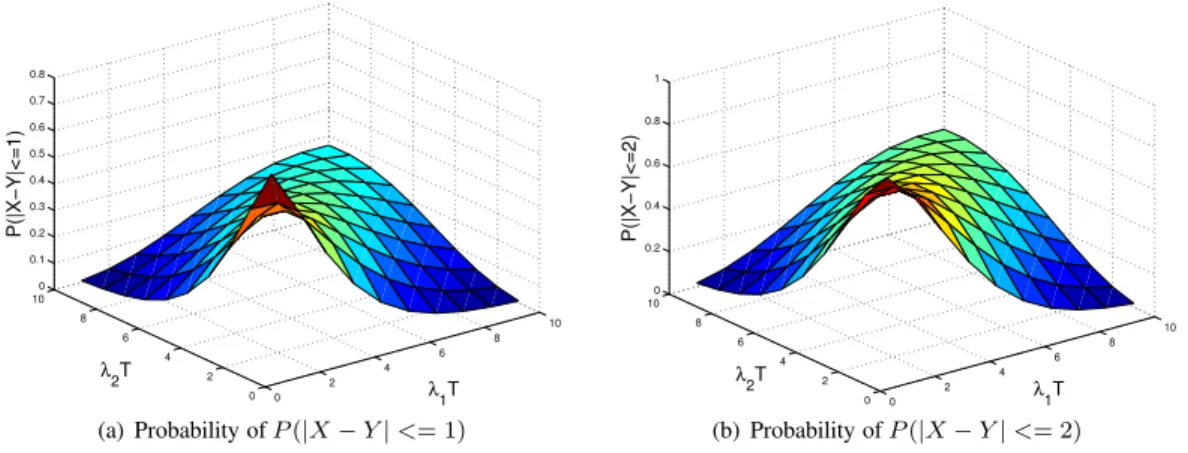
Figure 6 illustrates the probability of having two sim-ilar length messages from two different users at different settings ofλT, the average length of message a user types duringT. Figures 6(a) and (b) show the probabilities when two messages have length difference within one character and two characters, respectively. In general, this probability will decrease quickly if the difference betweenλ1 andλ2 increases. Even if two users have the sameλ, the probability will also decrease (but slower than the previous case) with the increase ofλ. Since two independent users are likely to have differentλvalues, the probability of typing similar length messages for them is low. For example, ifλ1T = 5 andλ2T = 10, the probabilityP(|X −Y| <= 2)is only around0.24. Ifλ1T = 5andλ2T = 20, this probability will further decrease to0.0044.
B
HTTP
-Based C&C AutoCorrelation
Anal-ysis (for a Single Client)
HTTP-based C&C does not require that the botmaster directly interact with the bots. That is, the botmaster does not need to be on-line all the time to instruct the bots. Instead, the bots only need to periodically check the com-mand file (or perform a set of inquiries) that is prepared and maintained by the botmaster. We can identify such kind of C&C by detecting a repeating and regular visiting pattern. A simple approach is to count the variance of inter-arrival time of outgoing packets. If the variance is small (i.e., close
to zero), we have a repeating and regular pattern. However, this method is only suitable for the simplest case (i.e., with only one request per period). It cannot handle more complex scenarios, e.g., when there are a set of queries per period, or there are some noise packets sent (e.g., users randomly visit the target by chance). In this section, we introduce a new signal encoding and autocorrelation (or self-correlation) approach that is able to handle the general and complex scenarios.
B.1
Autocorrelation Analysis
A packet stream from a client to a target service (identified by < ClientIP, ServerIP, ServerP ort >) is P~ = {P1, P2, ..., Pi, ...}, and each packet Pi can be denoted as< ti, si >5, where ti is the timestamp when
the packet is sent, si is the packet payload size with a direction sign (positive or negative, positive ”+” indicates outgoing packet, negative ”-” indicates incoming packet). Further more, we use a time window to abstract packet stream within the window into a four-element vector < OutP kt#, OutP ktT otalSize, InP kt#, InP ktT otalSize >, we can get a time series signal Xi for every client i. To illustrate the encoding scheme, we show an example. Assume the client is silent in the first time window, and in the second time window the client sends one packet with payload size 70 and received two packets with a total payload size of 100, and then becomes silent again in the third time window. We can encode this series as X= [0,0,0,0,1,70,−2,−100,0,0,0,0].
Before introducing autocorrelation, we first introduce the concept of correlation. In probability theory and statistics [12], correlation, also called correlation coefficient, is an indication of the strength of a linear relationship between two random variables. For any pair of two random variables Xi and Xj, the covariance is defined as cov(Xi, Xj) =
E[(Xi−µi)(Xj−µj)]whereµiandµjare the means ofXi andXj, respectively. The covariance measures how much two random variables vary from each other. It is symmet-rical, i.e.,cov(Xi, Xj) = cov(Xj, Xi). The magnitude of a covariance also depends on the standard deviation. Thus, we can scale covariance to obtain a normalized correlation, i.e., correlation coefficient, which serves as a more direct indication of how two components co-vary. Denoteσas the standard deviations (σ2=E(X−µ)2=E(X2)−E2(X)), we can calculate the correlation coefficient of two random variablesXi, Xjas:
ρi,j =cov(Xi, Xj)
σiσj = P[( Xi−µi)(Xj−µj)] pP (Xi−µi)2pP (Xj−µj)2
5For simplicity, here we ignore the detailed payload content, and ignore
0 2 4 6 8 10 0 2 4 6 8 10 0 0.1 0.2 0.3 0.4 0.5 0.6 0.7 0.8 λ 1T λ 2T P(|X−Y|<=1) (a) Probability ofP(|X−Y|<= 1) 0 2 4 6 8 10 0 2 4 6 8 10 0 0.2 0.4 0.6 0.8 1 λ 1T λ 2T P(|X−Y|<=2) (b) Probability ofP(|X−Y|<= 2)
Figure 6. Probability of two independent users typing similar length of messages.
We know−1 ≤ ρ≤ 1. If there is an increasing linear relationship (e.g., [1 2 3 4] with [2 4 6 8]),ρ= 1; if there is a deceasing linear relation (e.g., [1 2 3 4] with [8 6 4 2]), ρ=−1. Having coefficient that is closer to either -1 or 1 means that the correlation between the variables is stronger. Correlation inherits the symmetry property of covariance. A random variable should co-vary perfectly with itself. If XiandXj are independent, their correlation is 0.
In signal processing [21], to measure the similarity of two signals, we usually use cross-covariance, or more com-monly called cross-correlation. This is a function of the relative time between the signals, sometimes also called the sliding dot product, which has many applications in pattern recognition. Assume two real valued functionsf andg only differ by a shift along the x-axis. We can calculate the cross-correlation to find out how much one functionf must be shifted along the x-axis in order to be identical to another functiong. We slide thef function along the x-axis, and calculate a dot product for each possible amount of sliding. The value of cross-correlation is maximized when the two functions match at certain sliding. The reason for this is that when lumps (positives areas) are aligned, they contribute to making the dot product larger. Also, when the troughs (negative areas) align, they also make a positive contribution to the dot product. In the time series, the sliding is a time shift, or lagd. For two discrete time series Xi(t)andXj(t), the cross correlation at lagdis calculated as R(d) = P t[(Xi(t)−µi)(Xj(t−d)−µj)] pP t(Xi(t)−µi)2 pP t(Xj(t−d)−µj)2 For a single time serial signal, autocorrelation (or self-correlation) is a mathematical tool used frequently for an-alyzing some spatial-time property in signal processing. Intuitively, it is a measure of how well a signal matches a time-shifted version of itself, as a function of the amount of
time shift (lag). More precisely, it is the cross-correlation of a signal with itself. Thus, autocorrelation is useful for finding repeating patterns in a signal, such as determining the presence of a periodic signal which may be buried under noise, or identifying the missing fundamental frequency in a signal. The autocorrelation at lagdof a series signalXis normally calculated as R(d) = P t[(X(t)−µ)(X(t−d)−µ)] P( X(t)−µ)2
If we calculate autocorrelations for all lags, we get a resulting autocorrelation series. The autocorrelation series can be computed directly as above. Or we can use Fourier transform by transforming the series into the frequency do-main. This method of computing the autocorrelation series is particularly useful for long series where the efficiency of the FFT (Fast Fourier transform) can significantly reduce the computation time.
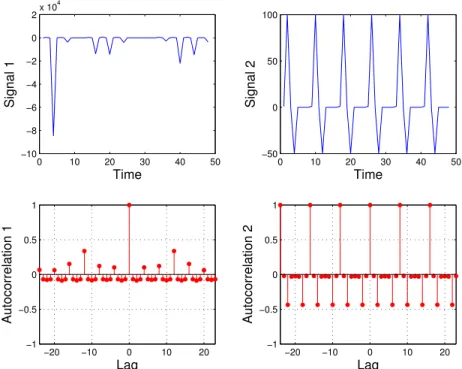
To illustrate the idea, we show an example. In the left part of Figure 7, the signal encodes a packet stream taken from a normalHTTPsession (as captured in a real network trace). We can see that there are very few peak points (except at lag 0) in autocorrelation series. The right part of Figure 7 shows aHTTPbased bot periodically connects to a C&C server. In its autocorrelation serials, we observe many peak points (large correlation coefficient). This means the right signal has a strong autocorrelation.
We use autocorrelation to identify whether the HTTP visiting activity of a client has repeating patterns, i.g., the signal is periodical or not. The algorithm evaluates the strength of autocorrelation based on the number of the peak points, and outputs whether aHTTP client is sufficiently autocorrelated.