Document details
4 of 21Development of omni-wheeled mobile robot based-on inverse kinematics and
odometry
(Conference Paper), , ,
Universitas Diponegoro, Departement of Electrical Engineering, Jl. Prof. Soedarto, SH, Tembalang, Semarang, Jawa Tengah, Indonesia
Universitas Diponegoro, Center for Biomechanics Biomaterial, Biomechatronics, and Biosignal Processing (CBIOM3S), Departement of Electrical Engineering, Tembalang, Semarang, Jawa Tengah, Indonesia Abstract
This paper presents the development of an omni-wheeled mobile robot based on inverse kinematics and odometry for local and indoor navigation purposes, such as for automatic warehousing in industry or healthcare environment. The robot uses four-wheeled diagonal configuration to conform directional angles of pmbα1=45o, α2=135o, α3=225o, and α4=315o Inverse kinematics is utilized to drive the robot to a point with specific trajectory and heading angle. Internal wheeled-encoders mounted in each DC-motors are used to read the angular speed and position. This research utilizes odometry technique to estimate the robot's position relative to the initial position. In order to develop a more precise odometry result, we combine the use of wheeled-encoders and an IMU. In order to maintain robot's position relative to the desired position, a PID control is applied to the algorithm. The result of the tests show that the developed omni-wheeled mobile robot is capable of performing locomotion to the desired position and to follow a controlled trajectory by maintaining a minimum error relative to the referenced trajectory. © 2019 IEEE.
Author keywords
Inverse kinematics Mobile robot Odometry Omni wheel PID control Indexed keywords
Engineering controlled terms:
DC motors Inverse kinematics Signal encoding Three term control systems Trajectories
Engineering uncontrolled terms
Angular speed Desired position Heading angles Healthcare environments In-door navigations Odometry Omni-wheel Wheeled mobile robot Engineering main
heading:
Mobile robots
◅ Back to results ◅ Previous Next ▻
Export Download Print E-mail Save to PDF ⋆ Save to list More...▻ View at Publisher
2019 6th International Conference on Information Technology, Computer and Electrical Engineering, ICITACEE 2019
September 2019, Article number 8904418
6th International Conference on Information Technology, Computer and Electrical Engineering, ICITACEE 2019; Semarang; Indonesia; 26 September 2019 through 27 September 2019; Category numberCFP1989Z-ART; Code 155026
Sofwan, A.a Mulyana, H.R.a Afrisal, H.b Goni, A.a Save all to author list
a
b
View references (10)
PlumX Metrics Usage, Captures, Mentions, Social Media and Citations beyond Scopus. Metrics
Cited by 0 documents
Inform me when this document is cited in Scopus:
Related documents
, ,
(2016) ISMA 2015 - 10th International Symposium on Mechatronics and its Applications
, ,
(2019) Proceedings - 2019 3rd International Conference on Recent Advances in Signal Processing, Telecommunications and Computing, SigTelCom 2019
, ,
(2019) Proceeding - 2018 5th International Conference on Electric Vehicular Technology, ICEVT 2018
❓ View all metrics ▻
Set citation alert ▻ ▻ Set citation feed
Multiple sensor fusion for mobile robot localization and navigation using the Extended Kalman Filter Al Khatib, E.I. Jaradat, M.A. Abdel-Hafez, M.
Improving the accuracy of the autonomous mobile robot localization systems based on the multiple sensor fusion methods Nguyen, L.A. Dung, P.T. Ngo, T.D.
Port Container Truck Localization Using Sensor Fusion Technique Suparyanto, A. Fatimah, R.N. Widyotriatmo, A.
Brought to you by Universitas Diponegoro
AS Search Sources Lists SciVal ↗
References (10)
Bogue, R.
(2016) Industrial Robot, 43 (6), pp. 583-587. . doi: 10.1108/IR-07-2016-0194
Li, J.-T., Liu, H.-J.
(2016) Design Optimization of Amazon Robotics, Automation, Control and Intelligent Systems, 4 (2), pp.
48-52. .
Chamberland, S., Beaudry, É., Clavien, L., Kabanza, F., Michaud, F., Lauria, M.
(2010) IEEE/RSJ 2010 International Conference on Intelligent Robots and Systems, IROS 2010 - Conference Proceedings, art. no. 5648987, pp. 4305-4310. .
ISBN: 978-142446675-7 doi: 10.1109/IROS.2010.5648987
Hamid, T., Qiao, B., Ghaeminezhad, N.
Kinematic Model of a Four Mecanum Wheeled Mobile Robot
(2015) International Journal of Computer Applications (0975-8887), Volume 113-3 March
Tatar, M.O.
(2014) Design and Development of An Autonomous Omni-Directional Mobile Ro Bot with Mecanum Wheels
978-1-4799-3732-5
Yunan, Z., Shuangsung, W., Jian, Z.
Research on Motion Characteristic of Omnidirectional Robot based on Mechanum Wheel (2010) 2010 International Conference on Digital Manufacturing & Automation Research 978-0-7695-4286-7/10
ISBN: 978-172812689-0
Source Type: Conference Proceeding Original language: English
DOI: 10.1109/ICITACEE.2019.8904418 Document Type: Conference Paper
Sponsors: Department of Computer Engineering, Diponegoro University
Publisher: Institute of Electrical and Electronics Engineers Inc. ▻ View in search results format All Export Print E-mail Save to PDF Create bibliography
1
Growth in e-commerce boosts innovation in the warehouse robot market Cited 20 times http://www.emeraldinsight.com/info/journals/ir/ir.jsp View at Publisher 2 Cited 13 times 3
Motion planning for an omnidirectional robot with steering constraints
Cited 14 times
View at Publisher
4
5
6
Find more related documents in Scopus based on:
View all related documents based on references
▻
4 of 21 ParkJ, KimS
Driving Control of Mobile Robot with Mecanum Wheel using Fuzzy Inference System (2010) Word Academy of Science Engineering Technology, 6, pp. 2519-2523.
Malyavej, V., Kumkeaw, W., Aorpimai, M.
(2013) 2013 10th International Conference on Electrical Engineering/Electronics, Computer, Telecommunications and Information Technology, ECTI-CON 2013, art. no. 6559517. . ISBN: 978-147990545-4
doi: 10.1109/ECTICon.2013.6559517
Jaradat, M.A.K., Abdel-Hafez, M.F.
(2014) IEEE Sensors Journal, 14 (5), art. no. 6705577, pp. 1545-1554. . doi: 10.1109/JSEN.2014.2298896
Lee, T., Shirr, J., Cho, D.
(2009) IEEE International Symposium on Industrial Electronics, art. no. 5214363, pp. 1956-1961. .
ISBN: 978-142444349-9 doi: 10.1109/ISIE.2009.5214363
© Copyright 2019 Elsevier B.V., All rights reserved. 7
8
Indoor robot localization by RSSI/IMU sensor fusion
Cited 38 times
View at Publisher
9
Enhanced, delay dependent, intelligent fusion for ins/gps navigation system Cited 35 times
View at Publisher
10
Position estimation for mobile robot using in-plane 3-axis IMU and active beacon Cited 18 times
View at Publisher
◅ Back to results ◅ Previous Next ▻ Top of page
About Scopus What is Scopus Content coverage Scopus blog Scopus API Privacy matters Language ⽇本語に切り替える 切换到简体中文 切換到繁體中文 Русский язык Customer Service Help Contact us
Copyright © . All rights reserved. Scopus® is a registered trademark of Elsevier B.V. We use cookies to help provide and enhance our service and tailor content. By continuing, you agree to the
. ↗
Terms and conditions Privacy policy ↗ ↗
Elsevier B.V
Keynotes
“Cyber-Electronic Warfare: Roles and Challenges in IR 4.0”
Assoc. Prof. Maj Ir Dr Kamaruddin Abdul Ghani (R) BSEE, MEE, PhD,
P.Eng. MIEM
Universiti Pertahanan Nasional Malaysia (UPNM)
Area of expertise: Electronic Warfare, Electronic Intelligence, radar system
engineering, ELINT signal analysis, spacecraft system development & testing,
and cybersecurity
“Lightning Modeling, Protection and EMC Issues”
Professor Dr. Zulkurnain Abdul-Malek
Institute of High Voltage and High Current
Universiti Teknologi Malaysia
Area of expertise: High voltage tests, lightning and grounding, nanodielectrics
“Backward Compatible Low PAPR Preamble for Very High
Throughput WLAN IEEE802.11ac”
Assoc. Prof. Wahyul Amien Syafei
Diponegoro University
Area of expertise : wireless communication, VHT, WLAN, MIMO, OFDM,
LDPC
Technical Program Committee
Zuriani Hayati Abdullah Universiti Kebangsaan Malaysia Malaysia
Muhamad Iradat Achmad Universitas Gadjah Mada Indonesia
Wibawa Adhi Institut Teknologi Sepuluh Nopember (ITS) Surabaya Indonesia
Hanung Adi Nugroho Universitas Gadjah Mada Indonesia
Widyawardana
Adiprawita Institut Teknologi Bandung Indonesia
A Adiwijaya Telkom University Indonesia
Adnan Adnan Universitas Hasanuddin Indonesia
Achmad Affandi Institut Teknologi Sepuluh Nopember Indonesia
Hadha Afrisal Universitas Diponegoro Indonesia
Trihastuti Agustinah Institut Teknologi Sepuluh Nopember Indonesia
Tohari Ahmad Institut Teknologi Sepuluh Nopember (ITS) Indonesia
Lessy Sutiyono Aji Ministry of Communications Indonesia
Amiruddin Amiruddin Sekolah Tinggi Sandi Negara Indonesia
Mukhammad Andri
Setiawan Universitas Islam Indonesia Indonesia
Trias Andromeda Universitas Diponegoro Indonesia
Nur Afny Andryani Tanri Abeng University Indonesia
Muhammad Anshari Universiti Brunei Darussalam Brunei Darussalam
Izza Anshory Institute Teknologi Sepuluh Nopember Surabaya Indonesia Indonesia
Khoirul Anwar Telkom University Indonesia
M Arfan Diponegoro University Indonesia
Muh Arfan Universitas Diponegoro Indonesia
Zainal Arif Politeknik Elektronika Negeri Surabaya Indonesia
Dhany Arifianto Institut Teknologi Sepuluh Nopember Indonesia
Achmad Arifin Institut Teknologi Sepuluh Nopember Indonesia
Achmad Arifin Sepuluh Nopember Institute of Technology Indonesia
Agus Arifin Institut Teknologi Sepuluh Nopember Indonesia
Dimas Asfani INSTITUT TEKNOLOGI SEPULUH NOPEMBER Indonesia
Mochamad Ashari Sepuluh November Institute of Technology Indonesia
Rosa Asmara Politeknik Negeri Malang Indonesia
I Gede Puja Astawa Politeknik Elektronika Negeri Surabaya Indonesia
Muhamad Asvial Universitas Indonesia Indonesia
Muhammad Azad Newcastle University United Kingdom (Great
Britain) Tessy Badriyah Electronic Engineering Polytechnic Institute of Surabaya Indonesia
Nazrulazhar Bahaman Univeristi Teknikal Malaysia Melaka Malaysia
Yoanes Bandung Institut Teknologi Bandung Indonesia
Ali Barakbah Politeknik Elektronika Negeri Surabaya Indonesia
Basari Basari Universitas Indonesia Indonesia
Achmad Basuki Brawijaya University Indonesia
Achmad Basuki Politeknik Elektronika Negeri Surabya Indonesia
Ruri Basuki University of Dian Nuswantoro Indonesia
Saiful Bukhori Universitas Jember Indonesia
Elin Cahyaningsih University of Indonesia Indonesia
Dikpride Despa University of Lampung Indonesia
Raden Dewanto Electronic Engineering Polytechnic Institute of Surabaya
(EEPIS) Indonesia
Harishchandra Dubey Microsoft Corporation USA
E Endroyono ITS Indonesia
Dania Eridani Diponegoro University Indonesia
Mochammad Facta Diponegoro University Indonesia
Mochammad Facta Electrical Enginnering Indonesia
Fahmi Fahmi Universitas Sumatera Utara Indonesia
Irmalia Faradisa Institut Teknologi Sepuluh Nopember Indonesia
Adnan Fauzi Diponegoro University Indonesia
Soni Gumilang Telkom University Indonesia
Dadang Gunawan Universitas Indonesia Indonesia
Sasongko Hadi Gadjah Mada University Indonesia
Anik Handayani Malang State University Indonesia
Puji Handayani Institut Teknologi Sepuluh Nopember Indonesia
Susatyo Handoko Universitas Diponegoro Indonesia
Eko Handoyo Diponegoro University Indonesia
Dedid Happyanto Politeknik Elektronika Negeri Surabaya Indonesia
Triwahju Hardianto University of Jember Indonesia
Fajar Hardoyono Universitas Gadjah Mada Indonesia
Mochamad Hariadi Sepuluh Nopember Institute of Technology Indonesia
Mochamad Hariadi Sepuluh Nopember Institute of Tech. Surabaya Indonesia
Fakhriy Hario Universitas Brawijaya Indonesia
Tri Harsono Politeknik Elektronika Negeri Surabaya Indonesia
M. Udin Harun Al Rasyid Politeknik Elektronika Negeri Surabaya (PENS) Indonesia
Zulfatman Has University of Muhammadiyah Malang Indonesia
Iswadi Hasyim Rosma Universitas Riau Indonesia
Gamantyo Hendrantoro Institut Teknologi Sepuluh Nopember Indonesia
Dwiana Hendrawati Institut Teknologi Sepuluh Nopember Indonesia
Hermawan Hermawan Diponegoro University Indonesia
Darlis Herumurti Institut Teknologi Sepuluh Nopember Indonesia
Achmad Hidayanto University of Indonesia Indonesia
Achmad Hidayatno Diponegoro University Indonesia
Hindarto Hindarto University Muhammadiyah Of Sidoarjo Indonesia
Amil Ahmad Ilham Hasanuddin University Indonesia
Agus Indra Gunawan Politeknik Elektronika Negeri Surabaya (PENS) Indonesia
Paulus Insap Santosa Universitas Gadjah Mada Indonesia
Muhamad Syamsu Iqbal University of Mataram Indonesia
Ferry Irawan University of Jember Indonesia
R Rizal Isnanto Diponegoro University Indonesia
Iswandi Iswandi Gadjah Mada University Indonesia
Lie Jasa Udayana University Indonesia
Arman Jaya Electronics Engineering Polytechnic Institute of Surabaya Indonesia
Jiuchun Jiang University of Beijing Jiaotong P.R. China
Endra Joelianto Institut Teknologi Bandung Indonesia
Moh Khairudin Universitas Negeri Yogyakarta Indonesia
Prima Kristalina Politeknik Elektronika Negeri Surabaya (PENS) Indonesia
Kurnianingsih
Kurnianingsih Politeknik Negeri Semarang Indonesia
Adit Kurniawan ITB Indonesia
Sri Suning
Kusumawardani Universitas Gadjah Mada Indonesia
Benyamin Kusumoputro Universitas Indonesia Indonesia
Son Kuswadi Politeknik Elektronika Negeri Surabaya Indonesia
Magfirawaty Magfirawaty Universitas Indonesia Indonesia
Kurniawan Martono Diponegoro University Indonesia
Intan Mat Darus Universiti Teknologi Malaysia Malaysia
Norshita Mat Nayan National University of Malaysia Malaysia
Achmad Mauludiyanto ITS Indonesia
Melinda Melinda Department of Electrical Engineering, Syiah Kuala University,
Banda Aceh Indonesia
Misbahuddin
Misbahuddin University of Mataram Indonesia
Misbahuddin
Misbahuddin Universitas Indonesia Indonesia
Izzati Muhimmah Universitas Islam Indonesia Indonesia
Abdul Muis Universitas Indonesia Indonesia
Rizal Munadi Syiah Kuala University Indonesia
Arif Muntasa Trunojoyo University Indonesia
Wayan Mus UGM Indonesia
Khabib Mustofa UGM Indonesia
Imamul Muttakin CTECH Labs Edwar Technology Co. Indonesia
Haniza Nahar Universiti Teknikal Malaysia Malaysia
Muhammad Niswar Universitas Hasanuddin Indonesia
Kartiko Nugroho Universiti Teknologi Malaysia Malaysia
Kuntoro Nugroho Universitas Diponegoro Indonesia
Lukito Nugroho Universitas Gadjah Mada Indonesia
Prapto Nugroho Universitas Gadjah Mada Indonesia
Oky Nurhayati Diponegoro University Indonesia
Yoyok Pambudi University of Indonesia Indonesia
Ontoseno Penangsang Institut Teknologi Sepuluh Nopember Surabaya Indonesia
Endra Pitowarno Electronic Engineering Polytechnic Institute of Surabaya Indonesia
Teguh Prakoso Diponegoro University Indonesia
Subuh Pramono Universitas Sebelas Maret Indonesia
Agung Prasetijo Universitas Diponegoro Saudi Arabia
Istas Pratomo Institut Teknologi Sepuluh Nopember Surabaya Indonesia
Ardyono Priyadi ITS Indonesia
Rachmad Firdhaus
Pujiantara ITS Indonesia
I Ketut Eddy Purnama Institut Teknologi Sepuluh Nopember Indonesia
Mauridhi Purnomo Institut of Technology Sepuluh Nopember Indonesia
Djoko Purwanto Institut Teknologi Sepuluh Nopember Indonesia
Era Purwanto Electronic Engineering Polytechnic Institute Of Surabaya Indonesia
Gusti Putri Universitas Gadjah Mada Indonesia
Muhammad Qomaruddin Universitas Islam Sultan Agung (UNISSULA) Indonesia
Radi Radi Universitas Gadjah Mada Indonesia
Cahya Rahmad Politeknik Negeri Malang Indonesia
Mochammad Rameli Institut Teknologi Sepuluh Nopember Surabaya Indonesia
Nathalie Raveu University of Toulouse - UPS - INPT - LAPLACE -CNRS France
Dedet Riawan Sepuluh Nopember Institute of Technology Indonesia
Estiko Rijanto Indonesian Institute of Sciences Indonesia
Muhammad Rivai Institut Teknologi Sepuluh Nopember Indonesia
Munawar Riyadi Diponegoro University Indonesia
Munawar Riyadi Diponegoro University Indonesia
Munawar Riyadi Diponegoro University Indonesia
Imam Robandi Sepuluh November Institute of Technology Indonesia
Adian Rochim Diponegoro University Indonesia
Siti Rochimah Institut Teknologi Sepuluh Nopember Indonesia
Ferdian Ronilaya State Polytechnic of Malang Indonesia
Lukman Rosyidi University of Indonesia Indonesia
Azmi Saleh Jember University Indonesia
Ali Samoud Science Tunisia
Paulus Santosa Universitas Gadjah Mada Indonesia
Imam Santoso University of Diponegoro Indonesia
Tri Arief Sardjono Institut Teknologi Sepuluh Nopember (ITS) Surabaya Indonesia
Riyanarto Sarno Institut Teknologi Sepuluh Nopember Indonesia
Moechammad Sarosa State Polytechnic of Malang Indonesia
I Nyoman Wahyu
Satiawan Mataram University - West Nusa Tenggara Indonesia
Haikal Satria Universiti Teknologi Malaysia Malaysia
Dian Sawitri UDINUS Indonesia
Eko Sediyono Satyawacana Christian University Indonesia
Siti Sendari Universitas Negeri Malang Indonesia
Risma Septiana Diponegoro University Indonesia
Rudy Setiabudy Universitas Indonesia (UI) Indonesia
Florentinus Setiawan Soegijapranata Catholic University Indonesia
Iwan Setiawan Universitas Diponegoro Indonesia
Iwan Setiawan Universitas Diponegoro Indonesia
Noor Ahmad Setiawan UGM Indonesia
Eko Setijadi Institut Teknologi Sepuluh Nopember Indonesia
Budi Setiyanto Universitas Gadjah Mada Indonesia
Arief Setyanto Universitas AMIKOM Yogyakarta Indonesia
Indrazno Siradjuddin State Polytechnic of Malang Indonesia
Simon Siregar Telkom University Indonesia
Soedibyo Soedibyo Institut Teknologi Sepuluh Nopember Indonesia
Aghus Sofwan Diponegoro University Indonesia
Maman Somantri Diponegoro University Indonesia
Bambang Srikaloko Jember University Indonesia
Amang Sudarsono Politeknik Elektronika Negeri Surabaya (PENS) Indonesia
Lipur Sugiyanta State University of Jakarta Indonesia
Suharyanto Suharyanto Gadjah Mada University Indonesia
I Nyoman Sukajaya Universitas Pendidikan Ganesha, Singaraja Indonesia
Sritrusta Sukaridhoto Politeknik Elektronika Negeri Surabaya Indonesia
Irrine Sulistiawati Institut Teknologi Sepuluh Nopember Surabaya Indonesia Indonesia
Indra Adji Sulistijono Politeknik Elektronika Negeri Surabaya (PENS) Indonesia
Bambang Sumantri Politeknik Elektronika Negeri Surabaya Indonesia
Yoyon Suprapto Sepuluh Nopember Institute of Technology Indonesia
Titiek Suryani Institut Teknologi Sepuluh Nopember Indonesia
Heri Suryoatmojo Institut Teknologi Sepuluh Nopember Indonesia
Suryono Suryono Faculty of Science and Mathematics Diponegoro University Indonesia
Suryono Suryono Diponegoro University Indonesia
Heru Susanto The Indonesian Institute of Sciences Indonesia
Supeno Mardi Susiki
Nugroho Institut Teknologi Sepuluh Nopember Indonesia
Suwadi Suwadi ITS Indonesia
Addin Suwastono Universitas Gadjah Mada Indonesia
Wahyul Syafei Diponegoro University, Semarang Indonesia
Muhammad Syafrullah Universitas Budi Luhur Indonesia
Abdul Syakur Diponegoro University Indonesia
Iwan Syarif Politeknik Elektronika Negeri Surabaya (PENS) Indonesia
Taufik Taufik California Polytechnic State University, San Luis Obispo USA
Tibyani Tibyani Waseda University Japan
Herman Tolle Universitas Brawijaya Indonesia
Bambang Trilaksono Bandung Institute of Technology Indonesia
Aris Triwiyatno Diponegoro University Indonesia
Tsuyoshi Usagawa Kumamoto University Japan
Sparisoma Viridi Institut Teknologi Bandung Indonesia
Herlina Wahab Sriwijaya University Indonesia
Wahidin Wahab University of Indonesia Indonesia
Fathul Wahid Universitas Islam Indonesia Indonesia
Wahyudi Wahyudi Diponegoro University Indonesia
Wahyudi Wahyudi Departemen Teknik Elektro UNDIP Indonesia
Adhi Wibawa Institut Teknologi Sepuluh Nopember Indonesia
Gunawan Wibisono University of Indonesia Indonesia
Rony Wibowo Institut Teknologi Sepuluh Nopember Indonesia
Sapto Wibowo State Polytechnic of Malang Indonesia
Sigit Wibowo Gadjah Mada University Indonesia
Eko Didik Widianto Diponegoro University Indonesia
Widjonarko Widjonarko University of Jember Indonesia
Rusminto Widodo Politeknik Elektronika Negeri Surabaya Indonesia
Danang Wijaya UGM Indonesia
I Gede Pasek Suta
Wijaya Mataram University Indonesia
Edi Winarko Universitas Gadjah Mada Indonesia
Novie Windarko Politeknik Elektronika Negeri Surabaya Indonesia
Ike Windasari Diponegoro University Indonesia
Iwan Wirawan ITS Indonesia
I Made Yulistya Negara ITS Indonesia
Eko Yuniarno Institut Teknologi Sepuluh November Indonesia
Arbai Yusuf Universitas Indonesia Indonesia
Program Schedule of 6
thICITACEE 2019
(Venue: Grand Candi Hotel Semarang, Amarta 2 and Amarta 3)
Thursday, 26
thSeptember 2019
No
Time
Event
1
07.30 - 08.00
Registration
(Include : Indonesia Raya Song)
2
08.00 - 08.10
Welcoming Speech by General Chair of ICITACEE 2019
By Dr. Adian Fatchur Rochim
(Amarta 3)
3
08.10 – 08.20
Welcoming Speech by IEEE Indonesia Section
By Vice Chair of IEEE Indonesia Section Dr Kurnianingsih
(Amarta 3)
4
08.20 - 08.40
Welcoming Speech and Opening by Dean of Engineering
Faculty, Diponegoro University
By Prof. M. Agung Wibowo
(Amarta 3)
5
08.40 - 08.50
Photo session
(Amarta 3)
6
08.50 – 09.00
Saman Dance
7
09.00 -09.15
IEEE at glance by Vice Chair of IEEE Indonesia Section
By Dr. Kurnianingsih
(Amarta 3)
8
09.15 - 09.30
Coffee Break
9
09.30 - 10.00
Invited Speaker 1 : “Cyber-Electronic Warfare: Role and
Challenges in IR 4.0”
By Prof. Kamaruddin Abdul Ghani
Moderator : Dr. Trias Andromeda
(Amarta 3)
10
10.00 - 10.30
Ivited Speaker 2 : “Lightning Modeling, Protection and EMC
Issues”
By Prof Zulkurnain Abdul-Malek
Moderator : Dr. M. Facta
(Amarta 3)
11
10.30 - 11.00
Invited Speaker 3 : “Backward Compatible Low PAPR
Preamble for Very High Throughput WLAN IEEE802.11ac”
By Dr Wahyul Amien Syafei
Moderator : Dr Agung Budi P.
(Amarta 3)
12
11.00 - 12.00
Parallel Session 1
13
12.00 - 13.00
Lunch Break
14
13.00 - 14.20
Parallel Session 2
15
14.20 - 14.30
Coffee Break
16
14.30 - 16.00
Parallel Session 3
17
16.00 - 18.30
Break
18
18.30 - 20.00
Gala Dinner
Friday, 27
thSeptember 2019
08.00 – Finish : City Tour
Parallel Session
(Room: Amarta 2)
Session 1 Moderator : Mr. M. Facta
No Track Time First Author Tittle
1 Power Systems 11.00-11.10 Alif Luqman Performance Improvement of Scalar Feedback Control for Induction Motors by Using Third Harmony Injection SPWM
2 Power Systems 11.10-11.20 Muhammad
Kuncoro
Dynamic Power Injection for Solar PV Constant Power Generation
3 Power Systems 11.20-11.30 Anggakara
Syagata
Fast-Charging LTO 18650 Batteries Using a DC PS-3005D Power Supply
4 Power Systems 11.30-11.40 Mochammad
Facta Power Consumption Analysis in Resonant Converter 5 Power Systems 11.40-11.50 Abdul Syakur Design of Temperature and Humidity Control Devices in the
Leakage Current Test Chamber of 20kV Insulator
6 Power Systems 11.50-12.00 Fikri
Shalahudin
Design of Monitoring Remote Terminal Unit(RTU) Panel Supply Based on IOT Case Study at PLN Session 2 Moderator : Mr. Agung B.P.
No Track Time First Author Tittle
1 Telecommunications and Vehicular Technologies 13.00-13.10 Soraya Mustika
Uplink Boost Eliminate User in Massive MIMO System Using Reinsch Algorithm
2 Telecommunications and Vehicular Technologies 13.10-13.20 Kartiko Nugroho
Accuracy Comparison of Radio Direction Finder with 6 and 4 of Log Periodic Dipole Array Antennas
3
Telecommunications and Vehicular Technologies
13.20-13.30 Samrat Patel UAV and IoT Based Micro UGV Platform Applications for Forest Monitoring and Climate Change
4
Telecommunications and Vehicular Technologies
13.30-13.40 Yuli
Christyono Design and Construction of Helical Antenna in GSM 900
5 Telecommunications and Vehicular Technologies 13.40-13.50 Subuh Pramono
Bandwidth Enhancement Using Stacked Patch MIMO Antenna with Low Mutual Coupling for 3.5 GHz
6 Telecommunications and Vehicular Technologies 13.50-14.00 Elfira Nureza Ardina
The Track Characteristics and the Propagation Model in Train Traffic for Automatic Traffic Door System
7 Telecommunications and Vehicular Technologies 14.00-14.10 Misbahuddin Misbahuddin
Multi-hop Uplink for Low Power Wide Area Networks Using LoRa Technology
8
Telecommunications and Vehicular Technologies
14.10-14.20 Arif Nursyahid Automatic Sprinkler System for Water Efficiency Based on LoRa Network
Session 3 Moderator : Mr. Iwan S.
No Track Time First Author Tittle
1 Control and Circuits 14.30-14.40 Rifky Ismail Design of Fabric-Based Soft Robotic Glove for Hand Function Assistence
2 Control and Circuits 14.40-14-50 Betantya
Nugroho Spark Gap System of Electrical Discharge Machining (EDM) 3 Control and Circuits 14.50-15.00 Aghus Sofwan Development of Omni-Wheeled Mobile Robot Based-on
Invers Kinematic and Odometry 4 Control and Circuits 15.00-15.10 Mochammad
Ariyanto
Three-Fingered Soft Robotic Gripper Based on Pneumatic Network Actuator
5 Control and Circuits 15.10-15.20 Siti Yusuf MFCC Feature Extraction and KNN Classification in ECG Signal
6 Control and Circuits 15.20-15.30 Syahril Ardi Design Semi-Automatic Control System Using PLC for Stalling Materials in the Forming Machine
7 Control and Circuits 15.30-15.40 Enda Sinuraya Designing a Fuzzy Controller of Crude Oil Dilution in Palm Oil Mills
8 Control and Circuits 15.40-15.50 Sumardi
Inertial Navigation System of Quadrotor Based on 10-DOF IMU and GPS Sensors
9 Control and Circuits 15.50-16.00
Aris Triwiyatno
Design of Data Acquisition System for Position and Attitude Quadcopter
Spark Gap System of Electrical Discharge
Machining (EDM)
Betantya Nugroho School of Electrical Engineering
Universiti Teknologi Malaysia Skudai Johor 81310, Malaysia
Azli Yahya
School of Electrical Engineering Universiti Teknologi Malaysia Skudai Johor 81310, Malaysia
Abd. Rahim Mat Sidek Mindmatics Sdn Bhd Kajang Selangor 43000, Malaysia
Trias Andromeda
Department of Electrical Engineering Universitas Diponegoro Semarang 50275, Indonesia
Nor Hisham H Khamis School of Electrical Engineering
Universiti Teknologi Malaysia Skudai Johor 8130, Malaysia
Abstract - EDM is a process of machining electrically conductive materials by precisely controlled electrical discharge through a small clearance gap that occur between an electrode and a workpiece in the presence of a dielectric fluid. Through EDM process, the material of workpiece are melted and gap distance will increase. In order to maintain a stable spark, the gap must be controlled. This paper presents control spark gap system of EDM using PID controller with voltage and position feedbacks. The results show Time Rise (Tr) of PID control with voltage feedback has a value about 75 seconds and Time Rise (Tr) of PID control with voltage and position feedbacks has a value about 18.6 seconds. The average error of gap distance in PID control with voltage feedback is 55.56 and the average error of gap distance in PID control with voltage and position feedbacks is 48.53. Addition of the position feedback is used to increase the rise time and stabilize distance the electrode and the workpiece.
Keywords –Electrical Discharge Machining, PID Control; Position Feedbacks
I. Introduction
EDM is a process of machining electrically conductive materials by precisely controlled electrical discharge (sparks) through a small clearance gap
(approximately 10 to 50 μs) that occur between an electrode
and a workpiece in the presence of a dielectric fluid [1-4]. EDM system consists of power generator, workpiece positioning system and flushing system[1-3].
Through EDM process, the material is melted and gap distance decreases. In order to maintain a stable spark, the gap must be controlled[5,6]. The gap distance is adjusted by DC motor linear system and controlled by a digital control system. This control system uses voltage sensor to sense the voltage and encoder sensor to sense the distance. The information from the sensor is related to voltage gap and waveform of the pulse.
Andromeda, T [7] explained the control of electrode gap in EDM with encoder to monitor the electrode position. The system limits the position of the electrode, so that it is within the distance control of the workpiece. The additional position sensor increases the Material Removal Rate (MRR).
Jawaad, S. A. A [8] discussed the control of servo system with digital PID controller and close loop to control the speed and position of DC Motor using ARM mbed microcontroller.
This paper presents a gap control of Electrical Discharge Machining servomechanism system using RC-Generator as a power generator. A PID control with voltage and position feedbacks is used to control the gap.
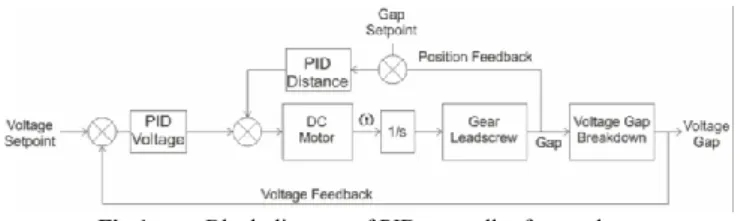
II. Spark Gap System Model and Simulation The spark gap system is accomplished by the servo mechanism system. The PID control uses a two types loop feedback consisting of a voltage gap loop and position loop as shown in block diagram of figure 1.
Fig 1. Block diagram of PID controller for spark gap The DC motor consists of electrical equivalent components: resistive (R), inductive (L), supply voltage (v) and motor voltage (e), mechanical equivalent components: torque (T), inertia (J) and friction constant (𝐾𝑓). The parameters for the model DC motor are obtained from
manufacturer’s datasheet are listed in table 1. Table 1. Parameters of DC Motor
Parameter Symbol Value
Armature Resistance R 6.8 Ω Armature Inductance L 4.2 mH Back EMF constant 𝐾𝑒 0.01434 V.s/rad
Torque constant 𝐾𝑡 0.01434 N.m/A
Friction coefficient 𝐾𝑓 1.08 × 10⁻⁵ N.m.s/rad Inertia of Rotor J 2.1 × 10⁻⁶ Kg.m2 Gear (G) Ngm/Ngl 1/300 Leadscrew (L) dls 8 × 10⁻³ m 978-1-7281-2689-0/19/$31.00 ©2019 IEEE 138
Parallel Session
(Room: Amarta 3)
Session 1 Moderator : Mr. Aghus S.
No Track Time First Author Tittle
1 Telecommunications and Vehicular Technologies 11.00-11.10 Wahyul Syafei
Centralized Dynamic Host Configuration Protocol and Relay Agent for Smart Wireless Router
2 Green Applications and
Interdisciplinary Topic 11.10-11.20 Ratna Aminah
Diabetes Prediction System Based on Iridology Using Machine Learning
3 Green Applications and
Interdisciplinary Topic 11.20-11.30 Risti Putri
Analysis of the Effect of the Wax Coating on Firmness Prediction Model in Malang Apples Based on Visible and
Near-Infrared (VNIR) Imaging 4 Green Applications and
Interdisciplinary Topic 11.30-11.40
Erick Fernando
Development Conceptual Model Smartphone Adoption for Use Mobile Banking
Session 2 Moderator : Mr R. Rizal Isnanto
No Track Time First Author Tittle
1 Information and
Computer Technologies 13.00-13.10 Nurdin Nurdin
Understanding Digital Skill Use from the Technology Continuance Theory (TCT)
2 Information and
Computer Technologies 13.10-13.20
Surjandy Surjandy
Analysis Social Media Application Message Trust Factor a Case Study University Student in Indonesia 3 Information and
Computer Technologies 13.20-13.30 Aghus Sofwan
Early Warning System of Landslide Disaster Using Generalized Neural Network Algorithm 4 Information and
Computer Technologies 13.30-13.40
Agung Prasetijo
Intelligent Multiple-Vehicular-Attributes (iMVA) Broadcast Protocol for VANETs
5 Information and
Computer Technologies 13.40-13.50
Surjandy Surjandy
Data Privacy Factor of Female Passenger's Data in Indonesia Online Transportation System
6 Information and
Computer Technologies 13.50-14.00
Erick Fernando
Success Factor of the Implementation Blockchain Technology in Pharmaceutical Industry: A Literature Review 7 Information and
Computer Technologies 14.00-14.10
Faizal Prabowo
Hierarchical Multi-label Classification to Identify Hate Speech and Abusive Language on Indonesian Twitter
Session 3 Moderator : Mrs. Oky DN
No Track Time First Author Tittle
1 Information and
Computer Technologies 14.30-14.40 Dina Murad
Towards Smart LMS to Improve Learning Outcomes Students Using LenoBot with Natural Language Processing 2 Information and
Computer Technologies 14.40-14-50
Salam Hamdan
Using Minimum Distance to Classify Uttered Arabic Words into Subject - Object Name
3 Information and
Computer Technologies 14.50-15.00
Andika Hairuman
MEC Deployment with Distributed Cloud in 4G Network for 5G Success
4 Information and
Computer Technologies 15.00-15.10 Iwan Binanto
LC-MS Analysis: Mini Review Frequently Used Open Source Softwares 5 Information and Computer Technologies 15.10-15.20 I Gede Putra Kusuma Negara
Geometric Verification Method of Best Score Increasing Subsequence for Object Instance Recognition
6 Information and
Computer Technologies 15.20-15.30
Kurniawan Martono
Augmented Reality Technology as One of the Media in Therapy for Children with Special Needs 7 Information and
Computer Technologies 15.30-15.40
Rievanda Putri
Implementation of Neural Network Classification for Diabetes Mellitus Prediction System Through Iridology Image
Intelligent Multiple-Vehicular-Attributes (iMVA)
Broadcast Protocol for VANETs
Agung B. Prasetijo
Department of Computer Engineering Fac of Eng. – Diponegoro University
Semarang, Indonesia [email protected]
Sami S. Alwakeel
Department of Computer Engineering CCIS – King Saud University
Riyadh, Saudi Arabia [email protected]
Hesham A. Altwaijry
Department of Computer Engineering CCIS – King Saud University
Riyadh, Saudi Arabia [email protected]
Abstract— Any vehicular network attributes in VANETs (e.g., sender-receiver distance, number of similar messages heard) can be used to determine candidate rebroadcast vehicles. The use of only limited number of attributes, however, may rule out potential broadcast candidates. For example, a counter-based scheme broadcast will never take specific rebroadcast nodes into consideration even though they have great sender-receiver distance. Hence, this research employs multiple vehicular attributes to tackle such an issue. The use of naïve-Bayes probability in our protocol combines the individual strengths of the incorporated vehicular attributes to obtain a broadcast decision. The results suggest that the proposed method is intelligent to the variation of network density and its performance outperformed both the distance-based scheme and the Efficient Counter-based Scheme (ECS) broadcast scheme at any network densities. Our algorithm contributes to the increase of 1.8% average reachability, 30.3% saving on rebroadcast tries, 5% drops on delivery cost and shortens the total delay time by about 19.6% over the ECS scheme. The analytical model justifies the simulated reachability and saved-rebroadcast results, showing similar trends over network density experimented.
Keywords—Broadcast-storm, naïve-Bayes, VANET attributes, network density, back-off
I. INTRODUCTION
Simple broadcast in a dense network may result in a massive message redundancy, contention and collision, the so-called broadcast storm problem [1, 2, 3, 4]. Initial schemes for alleviating broadcast storm problem are either by redundant broadcast reduction or timing differentiation. Probabilistic schemes use probability to inhibit some hosts from rebroadcast; therefore, the number of redundant messages transmitted is reduced. A counter-based scheme reduces message redundancy by listening for duplicates that arrive during back-off time. If similar messages are received multiple times reaching a threshold before the expiry of the timer, the message will be dropped. Distance-based scheme uses distance between the sending and receiving vehicles to make rebroadcast decision based on a set threshold as the greater the distance, the larger the additional coverage can be obtained. Location-based scheme provides more precise information on a vehicle's contribution to the new coverage. If the additional coverage exceeds the set threshold, the vehicle will immediately rebroadcast the message after the count-down timer reaches zero. In cluster-based system, reduction of duplicates is by assigning few vehicles as cluster-heads and gateway vehicles while letting the other vehicles as members that are not responsible for message rebroadcast. Details on such schemes can be found in [2, 4].
Our approach to the broadcast-storm problem is to employ a more comprehensive set of VANET's vehicular attributes to make rebroadcast decision. Whilst, to the best of our knowledge, the available solutions to the broadcast-storm problem employ only a limited number of attributes, e.g., the
distance-based and the counter-based broadcast. The reason behind our proposed method was that selectively picking the rebroadcast vehicles will give a better performance than merely picking them blindly. For example, the distance-based broadcast offers better overall performance compared to the probabilistic-based broadcast. In addition, the inclusion of various vehicular attributes of VANETs means a better and more selective mechanism for choosing more accurate rebroadcast vehicles. As an advantage of our protocol, the attributes employed in this study require only one-hop information. No two-hop or global knowledge are employed.
Discussion on this research will be as follows. Section 2 discusses the broadcast-storm problem mitigation from literature. Section 3 presents the selected attributes and performance measures of VANETs and section 4 discusses our intelligent multiple-vehicular-attributes (iMVA) broadcast scheme. Following this, results and discussions and conclusion can be seen in Section 5 and 6.
II. LITERATURE REVIEW
As vehicle’s radio coverage is limited, routing is deemed fundamental for messages delivered to other vehicles beyond the radio coverage. Broadcasting is a common operation for delivering messages over networks. It is also useful for route finding as the underlying mechanism for unicast and multicast routing protocols. When dealing with broadcasting messages, the broadcast-storm problem is most likely to arise when a simple-flooding scheme is used. Available solutions to such a problem available in literature usually employ one or more (local or global) attributes/entities that selection on rebroadcast vehicles or cancellation on an assigned rebroadcast can be relied with. This incurs less accurate selection of broadcast candidates, hence the performance offered might not optimal.
Literature [1, 2, 3, 4] provides legacy single-attribute broadcast schemes (e.g. distance-based, location-based, and counter-based) that demonstrate the sender-to-receiver distance or number of message copies can be used to select the broadcast candidates. The use of speed differential between the sender and the receiver is also proposed. In [5], the speed is considered as a representation of vehicle density. Lower speed implies higher vehicle density. Literature [6] combined the use of the counter-based and the probabilistic schemes. The number of message copies heard during the waiting period is used to determine the vehicle's broadcast probability. In [7], local node density is used in DECA protocol to select broadcast candidates. Vehicles will be selected to broadcast a message if they have the highest number of neighbors. Upon a message has been received, every node checks if it is the selected rebroadcast node. If so, it broadcasts the message, otherwise it stores the message for future needs.
Multiple-attributes based broadcast protocols are also available: Literature [8] uses neighbor density and the
Using Minimum Distance to Classify Uttered Arabic
Words into Subject - Object Name
Salam Hamdan, Arafat Awajan, Akram Al-kouz
Computer Science Department King Hussein School of Computing Sciences
Princess Sumaya University for Technology
Amman, Jordan
[email protected], [email protected], [email protected] Abstract— due to the improvement in technology, smart
devices and smart applications are included in most of human life aspects, and in order to make the interconnection between human and these applications and devices simpler, making these devices and applications understand the spoken language is essential. Speech recognition is the field that is meant to analyze and understand the spoken language. In this paper a new model is proposed to classify the Arabic words into two classes: subject name class or object name class. The Mel Frequency Cepstral Coefficient transformation is used to extract the features from the uttered words, and finally a MAHALANOBIS DISTANCE is used to classify the words using MATLAB tool. The data set that is used contained of 100 Arabic words 50 are subject names and 50 are object names. The results show that the accuracy of detecting subject and object name is 96%. (Abstract)
Keywords— Arabic speech recognition, pattern recognition, signal processing
I. INTRODUCTION
Pattern recognition is an attracting research area [1], examples of pattern recognition applications are: speech recognition and face recognition [2]. For the time being, a massive improvement on technology is leading to great demand on making digital applications understand the natural spoken language. Multi stages should be done to achieve this; following are the steps that should be done [3], the speech signal must be converted from analogue form to digital form then it must be preprocessed because it is infeasible to work with a speech signal inasmuch the size of speech signal is very large [4], in order to be ready for features extraction step from the spoken language. After extracting features, preprocessed words will be entered into the machine learning model to be learned. Afterwards, the model will be trained according to these uttered words. The trained model will be tested using the test dataset. Thus, the speech Recognition is the process of converting the signal of the speech into a sequence of words, using an algorithm implemented in the computer.
Most of Arabic language is constructed according to predefined patterns. The most used and useful patterns in Arabic language are those related to subject name (لعافلامسا) as (براض). Sense (لعافلا مسا) carries information about the action and who made the action like (براض,لكآ). And object name( مسا
لوعفملا) carries the information about on whom the action is
done on. This makes the identification of the word build according to this pattern important in many applications. In this paper a new model is proposed to recognize the spoken words belonging to these categories.
Speech recognition systems can be separated into several different classes by describing what types of utterances they have the ability to recognize. These classes are classified as the following:
• Isolated Words: in this type of speech recognition the training data set and tested data set are separated words, in which the speaker will uttered the sample word then pause [5].
• Connected Words: it is as the same as the isolated words but it is a Connected word systems (or more correctly 'connected utterances') are similar to isolated words, but allows separate utterances to be 'run-together' with a minimal pause between them [6].
• Continuous Speech: in this type of the recognition the speakers speak naturally and the computer will recognize the words, this type of the recognition is considered the hardest one in order that the computer must determine the boundaries of the words [7].
Most of subject names are constructed from specific patterns which is Fa’el (لعاف) and most of object name are constructed from specific pattern which is Mafoal (لوعفم). In this paper a new model is proposed to classify the uttered words into subject name (لعافمسا) and object name (لوعفممسا), in which the subject name will be in a specific pattern which is (لعاف) and object name will be also on a specific pattern which
is (لوعفم). The uttered words are preprocessed using the Mel
Frequency Cepstral Coefficient MFCC transformation then a function called Mahalanobis distance [8, 9] which computes the difference between the samples to find the class that the sample belong to.
This paper is organized as follows, section 2 will describe the techniques that have been proposed so far, section 3 describes the dataset used in this paper, section 4 describes the proposed technique, section 5 evaluate the performance, and finally section 6 conclude the paper.
Implementation of Neural Network Classification for
Diabetes Mellitus
Prediction System through
Iridology Image
1st Rievanda PutriDepartment of Physics,
Faculty of Mathematics and Natural Sciences Universitas Indonesia
Depok, Indonesia [email protected]
2nd Adhi Harmoko Saputro Department of Physics,
Faculty of Mathematics and Natural Sciences Universitas Indonesia
Depok, Indonesia [email protected]
Abstract—One alternative and a non-invasive method named iridology, has been developed to find more effective way of detecting diabetes mellitus. Iridology is the method of mapping the human organs, and it has corresponded in iris’ zone. It can be used to detect damaged tissues, particularly in the pancreas where it holds the primary role of producing insulin. This study focuses on developing a non-invasive diabetes mellitus prediction system through an iris image using an image processing algorithm and neural network model. The processing starts with image enhancement using FFT filter and grayscaling, iris localization using Circular Hough Transform (CHT), and normalization using rubber sheet normalization. Segmentation on pancreas in iris image then resulted as followed, one ROI of right-eye image and two ROIs of left-eye image. The image database is collected with maximum of three images taken from 15 healthy subjects and 11 diabetes subjects, resulted in 201 data images. Feature extraction method that has been used is the Gabor filter, using the texture feature of the segmented iris image. The evaluation method we use for the system is the confusion matrix to obtain its accuracy and other parameters. Classification model of Feed-Forward Neural Network (FNN) is implemented to classify between diabetes and healthy subjects with the best results of accuracy number 95.74% and 92.57% for training and testing data respectively. The result shows that this system can be proposed as a complementary tool for therapeutic methods for diabetes prediction.
Keywords—diabetes mellitus; Gabor filter; image processing; iris image; neural network
I. INTRODUCTION
Diabetes is one of the causes of the death-related case in the world. To detect if someone has Diabetes by measuring the blood glucose level, it can be done through other body fluid such as urine, sweat, saliva, and ocular system fluid [1]. Measuring the blood glucose using biosensor strip on a small amount of blood drawn is the most used method, which is an invasive way to do. In this study, we implement one of an alternative and non-invasive method to more effectively detect diabetes, which is called an iridology method. It is a method to detect and predict the condition of one’s organ that is represented and mapped respectively on the human iris, by looking at its characteristics such as dark spot, structure, and
color of the iris [2]. The method has been recognized as one of an alternative method that increased in usage number as a complementary medical method to predict several diseases in the human body [3]. We focused on the iridology zone of the pancreas, which is an organ that has the primary function of producing insulin hormone and controlling the blood glucose affecting diabetes.
In medical application, the development of machine learning has helped a lot in predicting and analyzing the symptoms along with image processing implementation to predict and detect a disease [4]. Algorithms that have been used to detect diseases through iris image include Fast Fourier Transform filtering, Circular Hough Transform (CHT), rubber sheet normalization, and feature extraction such Gabor filter, Discrete Wavelet Transform (DWT), or Gray Level Co-Occurance Matrix (GLCM). The method we use, Gabor filter, is a method that can analyze an image using its frequency domain with a sinusoidal plane wave modulated of Gaussian function [5].
Several topologies and training functions of Neural Network (NN) model are used and compared to establish a better system using the extracted features, as it has been applied in previous research of detecting particular disease through medical images [6]. The NN model is implemented using MATLAB to build a prediction model which based on the reference data of diabetes and healthy subjects.
II. SYSTEM DESIGN AND IMPLEMENTATION
A. Data Preparation
The iris image dataset is obtained from diabetes and healthy subjects. The healthy subject here means that they have never been diagnosed with diabetes disease. The age range of subjects is from 20 to 60 years old, and the ratio for diabetes and the healthy subject is 11:15 people. We acquire the images from each subject with a maximum number of three shots, each left, and right eye. Eye images then are selected to get the best ones, which are not blurred, and the iris captured utterly, that will be processed further.