Communications of the Association for Information Systems
Volume 34
Article 35
1-2014
Moving Toward the Next Generation of Graduate
Degree Programs in Information Systems
Heikki Topi
Bentley University, [email protected]
Kieran Conboy
University of New South Wales
Brian Donnellan
NUI Maynooth
V. Ramesh
Indiana University
Christine Van Toorn
University of New South Wales
See next page for additional authors
Follow this and additional works at:
https://aisel.aisnet.org/cais
This material is brought to you by the AIS Journals at AIS Electronic Library (AISeL). It has been accepted for inclusion in Communications of the Association for Information Systems by an authorized administrator of AIS Electronic Library (AISeL). For more information, please contact
Recommended Citation
Topi, Heikki; Conboy, Kieran; Donnellan, Brian; Ramesh, V.; Van Toorn, Christine; and Wright, Ryan T. (2014) "Moving Toward the Next Generation of Graduate Degree Programs in Information Systems,"Communications of the Association for Information Systems: Vol. 34 , Article 35.
DOI: 10.17705/1CAIS.03435
Moving Toward the Next Generation of Graduate Degree Programs in
Information Systems
Authors
Heikki Topi, Kieran Conboy, Brian Donnellan, V. Ramesh, Christine Van Toorn, and Ryan T. Wright
Volume 34 Article 35
Moving Toward the Next Generation of Graduate Degree Programs in
Information Systems
Heikki Topi
Bentley University [email protected]
Kieran Conboy
University of New South Wales
Brian Donnellan
NUI Maynooth
V. Ramesh
Indiana University
Christine Van Toorn
University of New South Wales
Ryan T. Wright
University of Massachusetts Amherst
The curriculum recommendations for master’s level degree programs in Information Systems (most recently, MSIS 2006) have served the IS community well and formed a strong foundation on which many departments have built their graduate programs. Changes in technology, the way in which IS/IT solutions are procured and provided, and the need to raise the profile of master’s programs in IS, however, have created a need to review the master’s level model curriculum. This article builds on recent discussion on this topic within the IS community and is intended to move the conversation regarding the curriculum revision forward. Through three program exemplars and integrative discussion, the article identifies and addresses key questions related to the curriculum revision and provides guidance for any department that is currently in the process of modifying its degree program.
Keywords: IS education, curriculum recommendations, master’s programs in IS
Editor’s Note: The article was handled by the Department Editors for Information Technology and Systems
Moving Toward the Next Generation of Graduate Degree Programs in
Information Systems
Moving Toward the Next Generation of Graduate Degree Programs in
Information Systems
694
Volume 34 Article 35
I. INTRODUCTION
Master’s level degree programs in Information Systems (IS) serve an important purpose for a variety of stakeholders, including students, schools, IS departments offering the degrees, and employers who hire the graduates of the programs. The IS community (together with the broader computing education community) has recognized the significance of these programs and supported them by developing model curricula for them. These curricula are intended to capture and disseminate best practices and share the discipline’s joint idea of what constitutes a specialized graduate degree program. The latest graduate level IS model curriculum is MSIS 2006 [Gorgone, Gray, Stohr, Valacich, and Wigand, 2006].
During the last few years, a conversation has started within the IS community regarding the need to revise the graduate level curriculum, following the recent launch of the new undergraduate model curriculum IS 2010 [Topi, Valacich, Wright, Kaiser, Nunamaker, Sipior, and de Vreede , 2010]. Some elements of this dialogue have been captured in recent panel discussions at AMCIS 2010 and AIS SIG-ED (IAIM) 2011 conferences and in an earlier CAIS article [Topi, Helfert, Ramesh, and Wigand, 2011] based on the AMCIS 2010 panel. Another related discussion, although not specifically focused on the master’s level, took place at ICIS 2011 and is reported in Gefen, Ragowsky, McLean, Markus, Rivard, and Rossi [2012]. The purpose of this article is to build on these earlier efforts, capture the key elements of an AIS SIG-ED 2011 panel discussion on this topic, analyze the changing landscape of master’s programs in IS, highlight several high-quality master’s programs from around the globe, and summarize key findings that have the potential to benefit IS departments globally. It is our hope that the ideas presented here will both contribute directly to the master’s level curriculum recommendation revision process and encourage further discussion regarding this important topic.
The reasons why this discussion is particularly relevant at this time include the following (see, for example, Gefen et al., 2012):
Technology changes have continued at a very high rate, affecting the capabilities that master’s level graduates in IS need to acquire.
The models for procuring and providing IT capabilities have significantly changed since MSIS 2006 and its predecessor were created because of, for example, the move toward virtualization, cloud-based services, and the increasingly dominant role of mobile devices. These and other contextual changes may warrant the reconsideration of the master’s level target competencies.
There is significant and sometimes even overheated interest in industry on topics and phenomena that are highly relevant for master’s level studies in Information Systems, such as Big Data [Rooney, 2012], virtualization, and cloud computing. As a discipline, it is essential that we understand what role these topics should have in the preparation of master’s graduates.
The specialized master’s degree in Information Systems still does not have the same brand recognition as many other professional master’s degrees (such as the MBA) have. Many employers still do not have a clear understanding of the capabilities MSIS graduates bring to the enterprise, dampening employer demand which, in turn, has an impact on interest by prospective students. A recent, globally recognized model curriculum could be used as an important tool in the process of communicating about the master’s level programs in IS to various stakeholders.
Our focus is on specialized master’s degrees and not on MBA offerings. In this article, we will refer to these master’s programs with the title Master of Science in Information Systems (MSIS), fully recognizing that the names of the programs vary significantly in practice. The programs featured in this article as exemplars demonstrate the variety of names used; they include Information Systems Management Master’s, Master’s in IT Management, and MS in Information Systems.
The core of this article consists of contributions by six academics from five universities and three continents, representing different perspectives on specialized master’s programs in Information Systems. The authors come from different geographic, educational, and business contexts (Australia, Ireland, U.S. Midwest, and U.S. East Coast). They all have a strong background as IS practitioners before and/or concurrently with their academic careers, and all are actively involved in developing and managing master’s level programs in IS.
Volume 34 Article 35
695 One of the goals of this article is to provide exemplars of leading master’s programs from around the world. Three of
the contributors use their own programs as case examples illustrating general principles and specific details relevant for a master’s curriculum revision. The perspectives vary but several of the topics are covered by multiple authors. The issues addressed include the following:
The target competencies of an MSIS degree program addressing questions such as: What should the graduates be able to do at the time of graduation? What skills should they have? [Bowden, 2004] Recent changes in the environment in which most MSIS graduates will be working
The key differences between MSIS programs and other master’s degree programs in computing (such as those in Computer Science and Software Engineering)
The importance of clearly articulating the differences between MSIS programs and undergraduate programs in computing
Career management support for MSIS students
The opportunities that a program’s affiliation with a major collaborative initiative between industry and academia create
The article starts with a section that explores more closely the changes in the business context in which the graduates of master’s programs in IS will be working. It continues with sections describing innovative features of specific programs. The article ends with an integrated overview that summarizes the key issues and presents a set of recommendations for the next stage in the MSIS development process.
II. NEW CONTEXT FOR MASTER’S LEVEL PROGRAMS IN INFORMATION SYSTEMS
The information systems discipline is again struggling to understand its role in the modern organization. The contemporary IT function as we know it is undergoing a change within and outside the boundaries of traditional organizations. Gone are the days where corporate IT infrastructures were wholly designed, housed, and operated within the container of a functional unit following the classic IT department model. The changes in how technology is appropriated in organizations highlight the need for IS education, and specifically master’s level degrees in IS, to be reevaluated.
The major change in the IT function was foreshadowed in the 1990s. Ciborra [1996] wrote about the changing role of IS in the platform organizations. Davenport [1990] saw how strategy is now driven by IT and business processes, which no longer could be supported by a functional IT unit. Carr’s [2003] controversial arguments posit a movement away from IT as value-adding activity and toward a utility. Although Carr’s arguments are provocative and interesting, it is clear that IT does and can add value to the organization. However, what is not equally clear is what form IS should take within the organization. The classic IT function (focusing on, for example, the need to keep the lights on the boxes, the database normalized, and systems coded in-house running) is a thing of the past as an organizational unit. This, in turn, needs to be reflected in the current MSIS curriculum. First, let’s examine the impetus for this change.
IT is changing substantially because of a new wave of IT commoditization. There is a movement away from direct ownership of IT assets to the constellation of digital services designed and run by third-party vendors [Gartner, 2012]. This makes the physical location of the hardware and basic infrastructure design issues irrelevant. Technologies such as virtualization and cloud computing now offer the ability to run services from anywhere to do just about anything. For example, Garter predicts that over 80 percent of server operating system instances will be virtual by 2016 [Wu, Tian, and Atwal , 2012]. Cloud computing is now piggybacking on virtualization to offer organizations the unique ability to focus on business processes rather than infrastructure issues. Cisco forecasts that almost two-thirds of server workload processing will be cloud-based by 2016 [Cisco, 2013]. Data management and analytics are becoming increasingly intertwined, and technologies for big data analytics are enabling scalable processing of very large quantities of non-relational data.
New technologies and technology architectures enable new ways of doing business and lead to a new value proposition for IS. To reflect this shift we need to reconsider how IS knowledge and skills are being deployed to our master’s students. Further, this change in the IT paradigm must be reflected in a contemporary MSIS curriculum. In moving away (although not completely) from the IT functional area, we now have the ability to address the contemporary IS questions firms have, while also offering timeless high-level capabilities.
696
Volume 34 Article 35
III. INFORMATION SYSTEMS MANAGEMENT (ISM) MASTER’S, UNIVERSITY OF NEW
SOUTH WALES, AUSTRALIA
The School of Information Systems, Technology and Management (ISTM) at the University of New South Wales launched its revamped MIS (Master of Information Systems) degree program in 2004. The degree was developed in conjunction with an Industry Reference Group―comprised of CIO’s across a variety of industries―as well as the ACS (Australian Computer Society), in order to serve the needs of industry specialists in the field of IS. The MIS was one of the first in the Australian landscape to adopt innovative modes of presentation, with face-to-face classes and seminars being scheduled on a fortnightly basis as well as on weekends. This initiative was to accommodate busy IS professionals wishing to update their technical skills as well as to further develop their management skills in order to enable them to advance in their careers and attain IS executive positions (such as CIO/CTO). Although enrollments in MIS have fluctuated over the past six years―as experienced worldwide across the IS discipline―the program’s strong industry links and industry focus have facilitated its success.
In 2012, the ISTM IS master’s offering underwent a number of significant changes, largely prompted by research determining how IS executive programs should be delivered within contemporary management schools. As suggested by King [2011], “… it is time for management educators, starting with people in the information systems field, to look beyond orthodoxy to a risky but engaging new world.” With this in mind, the Information Systems Management master’s degree at UNSW has been redesigned, the major focus being the development of a curriculum specifically linked to IS executive competencies and capabilities.
A Program Based on IS/IT Competencies
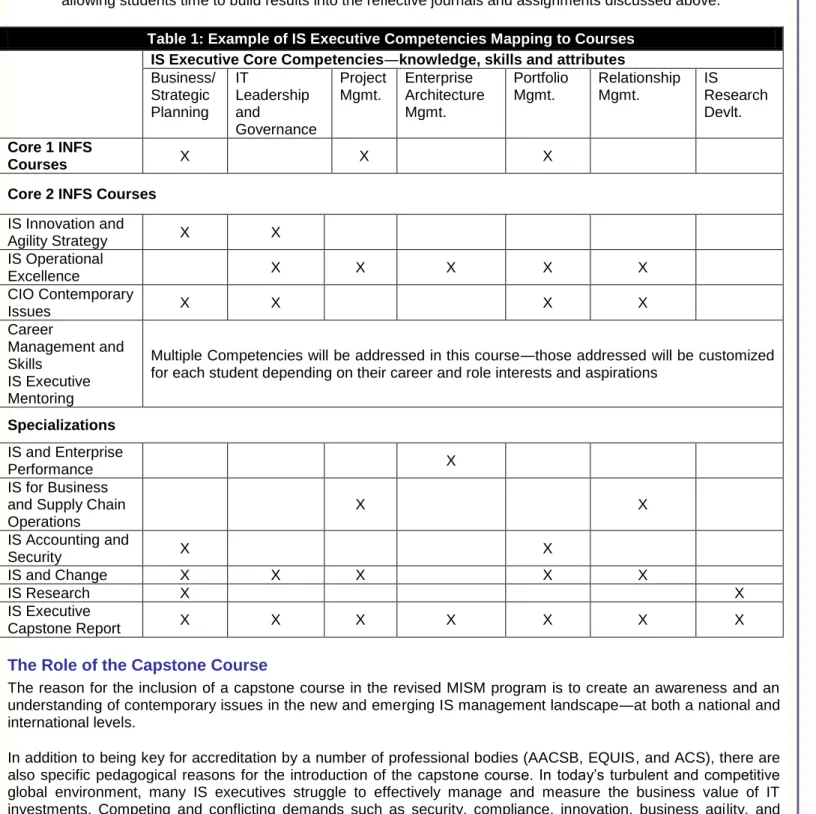
Bowden’s [2004] pedagogical model for curriculum design contrasted content-and-competency or capability-focused curriculum designs. The competency-based approach emphasizes learning outcomes that connect to skills and capabilities. The starting point for program design is questions such as: What should the students be able to do upon graduation? What skills should they possess? This focus on competencies and capabilities has been discussed in earlier work on master’s curriculum design (e.g., Topi et al., 2011) and underpins all other programs discussed in this article, too. In terms of UNSW’s Master’s of Information Systems Management program, Table 1 shows mapping between each of these competencies and the courses that will be offered. As can be seen, each course contributes to multiple competencies. The 12 UoC (units of credit) capstone course, as would be expected, examines all relevant competencies across the program.
The Introduction of IS Specific Career Development and Executive Mentoring Courses
The task of educating today’s students and tomorrow’s executives and equipping them with appropriate skills is perhaps more challenging in the information systems discipline than in other areas [Lee and Mirchandani, 2010]. IS educators have to produce graduates who have the skills to operate at C-level, but also possess the technical, hands-on expertise needed when they first enter the workforce. In addition, the future role of the IS student is ambiguous, multidimensional, and most critically, in an ongoing state of flux [Lee and Mirchandani, 2010]. This is particularly true where the role of the Chief Information Officer (CIO) and other IS executives is concerned, with many debating vehemently the future of these roles [Rothfeder and Driscoll, 1990; King and Lyytinen, 2004; Lyytinen and King, 2004, 2006; Weber, 2006; Teo and Srivastava, 2007]. In fact, King [2011] questions not just the nature or complexities related to the CIO role, but its very existence. We have introduced career development courses into the Master’s of Information Systems Management (MISM) program at UNSW to address this issue.
1. Students enter an IS Executive Career Development program involving ongoing mentoring from leading C-Level professionals and other leading functional or technical IS experts in their field. The assignment of a mentor to students is based on a careful match between the profiles of the mentor and the career plan and skill gaps of the student. The delivery of the mentor program is balanced between seminars by the mentors and ongoing meetings between mentors and their assigned students. The mentoring facility is particularly useful for allowing students to (i) hone in on specific skills beyond those of the program, (ii) develop an understanding of what career paths are available and how they can be achieved, and (iii) get access to leading edge developments and trends in their specific area.
2. Student assignments involve the development of a career plan and skill portfolio. Assignments also require attendance at various career expos as well as research into career options, opportunities, required skills, and challenges in their specific areas of interest. A reflective journal is also developed and assessed. The objective of this is to encourage the student to map his or her career goals and progress toward achieving these goals throughout the academic year.
3. Students have the option to take psychometric assessments similar to those regularly used as part of graduate recruitment programs by major IS professional services organizations such as consulting firms. They cover several important career-related areas: numeracy, literacy, and general ability. Not
Volume 34 Article 35
697 only is the practice of these tests useful, but these reports also are scheduled early in the program, thus
allowing students time to build results into the reflective journals and assignments discussed above. Table 1: Example of IS Executive Competencies Mapping to Courses
IS Executive Core Competencies―knowledge, skills and attributes Business/ Strategic Planning IT Leadership and Governance Project Mgmt. Enterprise Architecture Mgmt. Portfolio Mgmt. Relationship Mgmt. IS Research Devlt. Core 1 INFS Courses X X X
Core 2 INFS Courses IS Innovation and Agility Strategy X X IS Operational Excellence X X X X X CIO Contemporary Issues X X X X Career Management and Skills IS Executive Mentoring
Multiple Competencies will be addressed in this course―those addressed will be customized for each student depending on their career and role interests and aspirations
Specializations IS and Enterprise
Performance X
IS for Business and Supply Chain Operations X X IS Accounting and Security X X IS and Change X X X X X IS Research X X IS Executive Capstone Report X X X X X X X
The Role of the Capstone Course
The reason for the inclusion of a capstone course in the revised MISM program is to create an awareness and an understanding of contemporary issues in the new and emerging IS management landscape―at both a national and international levels.
In addition to being key for accreditation by a number of professional bodies (AACSB, EQUIS, and ACS), there are also specific pedagogical reasons for the introduction of the capstone course. In today’s turbulent and competitive global environment, many IS executives struggle to effectively manage and measure the business value of IT investments. Competing and conflicting demands such as security, compliance, innovation, business agility, and budget pressures make the role of the IS professional inherently complex, multifaceted, and ultimately multidisciplinary. The outcome will be to provide master’s students with multidisciplinary knowledge and tools to manage IS and IT in a sustainable and coherent fashion while optimizing the value contribution to the organization. Our aim at UNSW is to ensure that the inclusion of the capstone course in the revised MISM program will reflect the findings in Keller, Chan, and Parker’s [2010] qualitative study. This study presented very positive findings from students about their perceptions of the generic skills they developed during the IS capstone course. Students reported a vast improvement in their collaborative teamwork, presentation skills, and ability to apply skills/knowledge to new situations and in ways which were both valued and highly praised by their industry mentors/partners. In particular, the introduction of workshops gave “… students practical hands-on experience … with particular emphasis on how they relate to their role as IS professionals” [Keller et al., 2010, p. 385]. This is a key component of the revised MISM program.
698
Volume 34 Article 35
The aim of the final year capstone course in the MISM program at UNSW is to provide students with the opportunity to apply knowledge and related skills acquired during their studies to real-world situations and, thus, help to bridge the gap between industry and academia in the IS discipline.
IV. MSC IN IT MANAGEMENT (NUI MAYNOOTH, INNOVATION VALUE INSTITUTE,
IRELAND)
Program Background
Over the past decade, it has become clear that Ireland’s international competitiveness depends increasingly on goods and services that have a high knowledge content. There has also been a recognition that Ireland needs to shift into more knowledge-based activities, transforming existing enterprises (both Irish and foreign-owned) and attracting a new wave of investment in areas such as information and communications technology (ICT). The MSc program is aimed at addressing the need for educational offerings in the management of ICT. It also leverages the expertise and educational content of the Innovation Value Institute (IVI), a research institute in the National University of Ireland Maynooth. The IVI has produced a wealth of knowledge on the critical IT Management challenges today and the manifestation of these challenges in the workplace. The IVI is heavily involved in the development, design, and implementation of this program.
Aims and Design of the Program
This program focuses on IT practitioners and graduates from non-IT disciplines who wish to further develop their careers toward IT management. The program assumes no prior knowledge of IT management topics. The program is extensive and fast paced, offering the students a high growth-learning experience across twelve months. Underpinning the proposal is the belief that IT is immersed in the business environment, and it cannot be separated from work, processes, and the systemic properties of intra- and inter-organizational processes and relationships. This view stresses work context and systemic relationships and mutual interdependencies. In this fusion view, IT is within the business environment, such that business and IT are almost indistinguishable. Hence, IT-enabled work and processes are treated as one. Steven Alter [2006] has argued for broadening the IT field to be a work-centered systemic interconnected view. El Sawy’s [2003] and Alter’s views and positions influenced the development of the program. These views have implications for the curriculum and the expectations regarding the knowledge, skills, and capabilities students should have after finishing the program.
There are two fundamental guiding principles regarding the structure of the program: (1) “design” and (2) “capabilities.”
1. A “design” perspective
The notion of design as planning and determination of form and qualities of IT is a focal point for the proposed program. IS designers devise three kinds of plans [Carlsson, 2010, adapted from van Aken, 2004]:
An object-design: the plan of the IT solution
A realization-design: the plan for the implementation of the IT solution
A process-design: the professional’s own plan for the problem-solving cycle and includes the methods and techniques to be used in object- and realization-design
The IT-CMF is developed using a Design Science approach. The IT-CMF is a key element of the program. 2. A “capabilities” perspective
Bowden’s [2004] pedagogical model for curriculum design contrasts content- and capability-focused curriculum design. The capability-based approach emphasizes learning outcomes that connect to skills and capabilities. The starting point for program design includes questions such as: What should the students be able to do? What should their skills be? Peppard, Lambert, and Edwards [2000] examined the problem of value creation from IS investments from an organizational, as opposed to an IS functional perspective. Drawing on resource-based theory, the authors argued that the effective deployment and exploitation of information should be viewed as a “strategic asset.” To leverage value from IS, the authors proposed that organizations must recognize and develop information management competencies and that the elements of these competencies should be distributed throughout the organization and not reside solely in the IS function. They characterized these competencies as three types: information strategy, information exploitation, and IT/IS supply. Furthermore, Peppard and Ward [2004] developed a model linking the IS capability with IS competencies and resources (see Figure 1).
Volume 34 Article 35
699 In the context of this program, the identification of the critical IT Management capabilities was done in collaboration
with the Innovation Value Institute. The IVI’s Capability Maturity Framework represents an integrated and comprehensive view of all the IT capabilities relevant for today’s IT function and was used as the reference model for capability identification and definition.
Figure 1. A Model Linking the IS Capability with IS Competencies and Resources [Peppard and Ward, 2004]
Program Development and Objectives
Nordberg [2008] proposed a model for program development aimed at retaining the best features of peer review to ensure academic purpose of a plan while providing a clearer business justification for the effort. The model is particularly aimed at the development of professional programs that aspire to combine excellent theoretical content with a grounded approach. Nordberg [2008] points out the model used for curriculum development draws heavily on the business world, though set in the context of the purpose of higher education, going beyond the business requirement for any project to demonstrate a positive lifetime net present value. It expands on ideas proposed by Toohey [1999] with more explicit consideration of matching the external requirements (regarding both content and values) with the internal requirements of the university’s mission and standards, as well as its capabilities.
The resulting objectives of the program are:
To provide learners with a thorough grasp of the conceptual, theoretical, and practical frameworks underpinning a broad range of IT management functions
To provide learners with an ability to critically analyze and synthesize concepts, theories, and practice relating to the new and emerging IT management landscape in Ireland and internationally
To provide learners with a learning environment which will enable them to compare and evaluate IT management problems and identify solutions where necessary
To provide learners with an opportunity to work in a team-based environment focused on IT management issues and performance
To provide learners with the knowledge, skills, and competence to better contribute as ethical members of an organization’s management team
To provide learners with the capability to conduct independent research
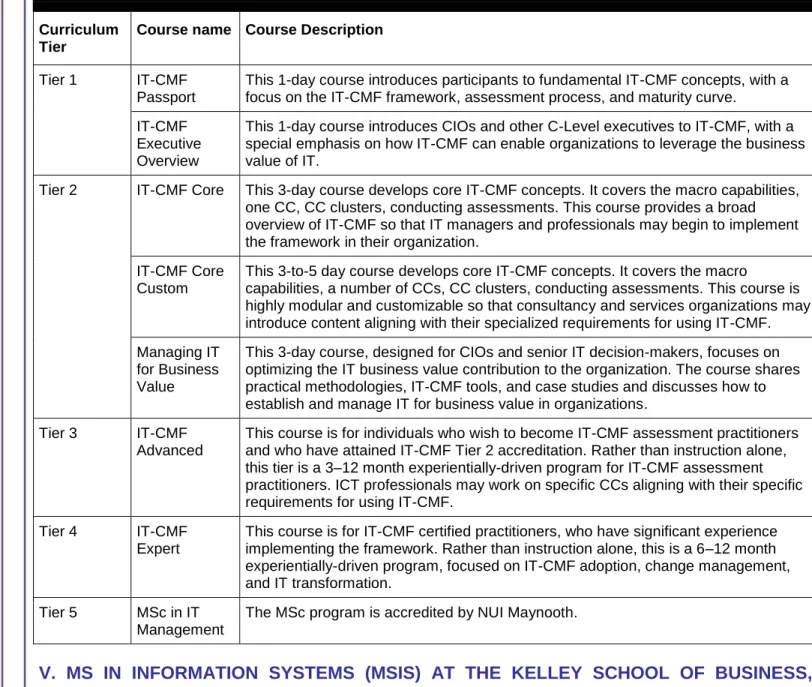
IVI’s education model (see below) supports graduated “tiers” of training and is based on a well-established adult learning models. Each tier of the IVI training model builds on knowledge and skills acquired at a lower tier and earlier stage of education.
700
Volume 34 Article 35
Table 2: IVI’s Education Model Curriculum
Tier
Course name Course Description
Tier 1 IT-CMF
Passport
This 1-day course introduces participants to fundamental IT-CMF concepts, with a focus on the IT-CMF framework, assessment process, and maturity curve.
IT-CMF Executive Overview
This 1-day course introduces CIOs and other C-Level executives to IT-CMF, with a special emphasis on how IT-CMF can enable organizations to leverage the business value of IT.
Tier 2 IT-CMF Core This 3-day course develops core IT-CMF concepts. It covers the macro capabilities, one CC, CC clusters, conducting assessments. This course provides a broad overview of IT-CMF so that IT managers and professionals may begin to implement the framework in their organization.
IT-CMF Core Custom
This 3-to-5 day course develops core IT-CMF concepts. It covers the macro
capabilities, a number of CCs, CC clusters, conducting assessments. This course is highly modular and customizable so that consultancy and services organizations may introduce content aligning with their specialized requirements for using IT-CMF. Managing IT
for Business Value
This 3-day course, designed for CIOs and senior IT decision-makers, focuses on optimizing the IT business value contribution to the organization. The course shares practical methodologies, IT-CMF tools, and case studies and discusses how to establish and manage IT for business value in organizations.
Tier 3 IT-CMF
Advanced
This course is for individuals who wish to become IT-CMF assessment practitioners and who have attained IT-CMF Tier 2 accreditation. Rather than instruction alone, this tier is a 3–12 month experientially-driven program for IT-CMF assessment practitioners. ICT professionals may work on specific CCs aligning with their specific requirements for using IT-CMF.
Tier 4 IT-CMF
Expert
This course is for IT-CMF certified practitioners, who have significant experience implementing the framework. Rather than instruction alone, this is a 6–12 month experientially-driven program, focused on IT-CMF adoption, change management, and IT transformation.
Tier 5 MSc in IT
Management
The MSc program is accredited by NUI Maynooth.
V. MS IN INFORMATION SYSTEMS (MSIS) AT THE KELLEY SCHOOL OF BUSINESS,
INDIANA UNIVERSITY, USA
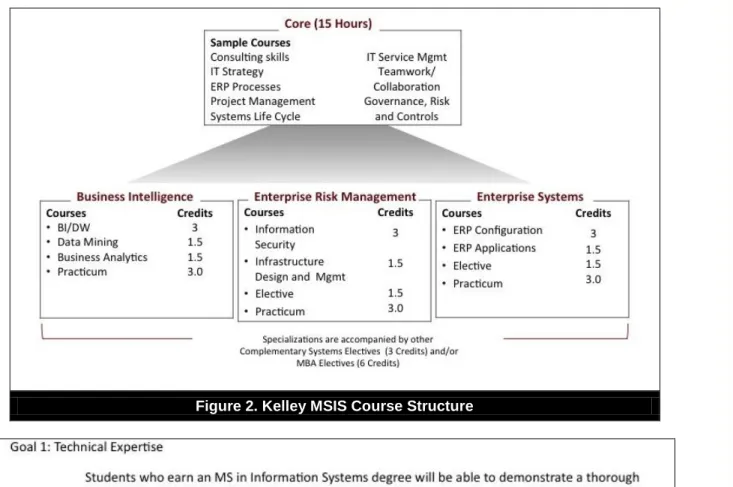
The Kelley School’s MS in Information Systems (MSIS) program strives to provide a blend between the technical and managerial aspects of Information Systems with the goal of producing business technologists. The program is primarily targeted at students with 0–4 years of full-time experience and can successfully accommodate a variety of undergraduate majors. The structure of the MSIS program is presented in Figure 2. The learning goals and outcomes of the program can be seen in Figure 3. It is worth noting that, because the program is designed as a professional master’s program, it exhibits the holistic transformational perspective, one that focuses on the balance among technical, managerial, and professional development components that are found in other professional master’s programs, such as the MBA.
Volume 34 Article 35
701 Figure 2. Kelley MSIS Course Structure
Figure 3. Learning Goals and Outcomes of the Kelley MSIS Program
Let us examine the information provided in Figures 2 and 3 to answer two key questions that are at the forefront of MS programs across the world:
1. How do the learning outcomes of an MSIS program differ from that of other computing programs? 2. How do the learning outcomes of an MSIS program differ from that of undergraduate programs?
702
Volume 34 Article 35
Differentiating MSIS Programs from Other Computing Programs
An examination of Figures 2 and 3 should present some relatively straightforward differences between MSIS program and other computing programs.
1. We believe that the core of the difference lies in the holistic perspective of IT that is provided through a program like the Kelley MSIS. If we examine the framework presented in Figure 3, it is likely that other computing programs will address Goal 1 (Technical Aspects) and, to a lesser extent, Goal 4 (Critical Thinking), and Goal 6 (Teamwork and Collaboration). In addition to these important goals, MSIS programs, such as the Kelley program, are able to thoroughly address Goals 2 (Managerial and Organizational Frameworks), 3 (Integration with Other Areas of Business), and 5 (Risk and Ethical Considerations). This is what provides the unique differentiation that MSIS programs can bring to the table.
2. Kelley MSIS graduates are able to get a deep focus through electives in one of three key tracks: Enterprise Risk Management, Business Intelligence/Analytics, and Enterprise Systems. However, it is worth noting that, in keeping with the theme of the program, each track balances out the technical aspects and the managerial aspects of these technologies. For example, the Enterprise Risk management track has a course on the legal aspects of managing risk that is taught by faculty from the business law department at Kelley.
3. Finally, another key differentiation of Kelley’s MSIS program compared to other computing programs is the ability to round off the managerial skills of the graduate through exposure to traditional MBA electives. At Kelley, they include courses such as Game Theory, Power, Persuasion and Negotiations, Spreadsheet Modeling, Supply Chain Management, Sourcing, Managing a Client Engagement, and others.
MSIS Programs Versus Undergraduate Programs in IS
To many readers, it may be surprising that the question of grad vs. undergrad levels is even worth addressing; the differences between a master’s degree and an undergraduate degree should be self-evident. However, this question emerges because, in some cases, there is significant overlap in content areas in typical undergraduate MIS programs and MSIS programs. For example, courses such as programming concepts, database management, networking and infrastructure, and systems analysis and design (all considered to be in the intellectual core of IS education) are often taught at both the undergraduate and MSIS levels. This often results in students with (US) undergraduate majors in technology (MIS, CS, IT, etc.) not wanting to pursue MS programs in Information Systems. Further, the overlap in content (albeit one could argue that coverage is at a deeper level in the MS programs) means that employers are not quite sure why they should hire an MS student over an undergraduate major in IS (and pay a premium for them).
At Kelley, the goal is to reduce the overlap between a typical undergraduate IS curriculum and the MS program. Out of the thirty credits in the program, three credits, at most, cover concepts from a typical core undergraduate IS curriculum. Even here, the coverage is at a significantly higher level than the UG program. This, of course, means that the rest of the curriculum is sufficiently different and value-adding beyond undergraduate programs.1
With respect to the learning goals and outcomes (Figure 3), Kelley’s MSIS program clearly differs from UG programs to varying degrees. We examine some of the differences as they relate to the learning goals below:
1. Technical Expertise: The MSIS program provides significantly deeper exposure to the technical areas via the nine-hour elective tracks.
2. Managerial and Organizational Frameworks: The program provides significant coverage of industry frameworks such as CoBIT, ITIL, ValIT, RiskIT, PMBOK, etc. There is likely very little coverage of these in typical UG programs.
3. Integration with Other Functional Areas: While most undergraduate programs (in business schools) will have good coverage of the functional areas of business, Kelley’s MSIS program’s focus is on connecting the dots between the areas of business and the role of technology in each of those areas. 4. Risk, Compliance, and Ethical Considerations: In this dimension, the MSIS program’s role in terms of a
general business context is similar to Goal 4 (Reinforcement of Existing Knowledge and Skills).
1
Since the Kelley MSIS does not require all the students to have an undergraduate degree in IS, the program smoothes out the differences in knowledge from people of different backgrounds by requiring a different set of prerequisites, depending on their background.
Volume 34 Article 35
703 However, it is likely that most undergraduate programs do not spend sufficient time on aspects of IT
Governance, Risk, and Controls. This represents a key differentiator for the Kelley MSIS program. 5. Teamwork and Collaboration: Another key differentiator between Kelley’s MSIS program and
undergraduate MIS programs is that the program’s diverse profile of students enables the creation of diverse teams (in terms of gender, work experience, undergraduate background, and nationality). The heavy team-based nature of the core allows the students to hone their existing teamwork skills and develop new competencies around how to work effectively in diverse teams.
VI. INTEGRATED PERSPECTIVE: OPPORTUNITIES FOR CHANGE
The program exemplars and the articulation of the changing organizational context collectively identify a number of opportunities for change, which offer exciting new opportunities for specialized master’s programs in IS and for global curriculum development efforts at the master’s level. Many of them are shared with the perspectives offered earlier in this article, but others rise only from one context. The nine points below capture integrated observations from the program exemplars and the contextual discussion. They are summarized in Table 3. Collectively, they reflect the increasingly close integration of IT and business and the need for IT professionals to be effective business and technology professionals simultaneously. Their core capabilities contribute to the ability to integrate business and IT innovatively in a way that provides value for the business.
1. Competency-based Design: The University of New South Wales has implemented a competency-based approach that emphasizes well-defined learning outcomes connected to specific skills and capabilities. In general, we recommend that MSIS program designers first should understand the desired skill set of their graduates. This is possible only if programs have strong linkages to their key industry partners; active connections with them also ensure that the industry partners have a good understanding of the skills that graduates can offer their organizations. For example, the Kelley MSIS program focuses heavily on placing graduates in the consulting industry. As a result, it has a consulting skills class in its core and has mirrored its tracks to align with key growth areas in these firms. The competency-based design should be an important starting point for any curriculum revision process. 2. IT Immersed in Business: Clearly, the role of IT within business has rapidly transformed and
fundamentally changed since the MSIS 2006 curriculum was published. IT, and, therefore, the skills needed to manage IT, is moving away from a technology functionalist focus to one where the capabilities of a business/IT generalist are needed. By employing a philosophy that IT must be immersed into the business as a whole, we can address many of the current needs and challenges of
Table 3: Summary Observations Based on Program Exemplars
Observation Summary Description
Competency-based design
Effective curriculum design processes should start with a thorough analysis of the desired graduate competencies conducted in collaboration with key stakeholder groups.
Immersion of IT in business
MSIS programs should prepare their graduates for professional roles that bring IT capabilities to the core of the business.
Appropriate balance between IT and business
Every MSIS program should actively seek for the locally appropriate curriculum balance between IT and business, without forgetting that the essence of IS is in the integration between the two.
New realities of business and IT
MSIS programs should help their students internalize the importance of understanding the current new realities of business and IT at any time.
Foundational skills MSIS graduates should demonstrate excellent mastery of foundational professional capabilities: critical thinking, communication skills, ethical and moral reasoning, and collaboration capabilities, both virtually and face-to-face.
Career-focused orientation
MSIS is a professional degree that should prepare its students for long-term career success.
Career tracks Career tracks are an excellent mechanism with which an MSIS program can address
local needs and differentiate a program from its competitors.
Capstone experience A well-designed and implemented capstone course can be a highly effective culminating experience for MSIS students.
Local vs. global and national perspectives
For most MSIS programs, it is essential to find a good balance between the needs of local stakeholders and the program’s global and national identity.
704
Volume 34 Article 35
business. All three sample MSIS programs have this shared philosophy, which increases the appeal of their respective graduates among prospective employers.
3. Balance: Immersion in business is important to the success of the MSIS graduate; however, curriculum designers must proceed with caution. Specifically, there needs to be an ongoing focus on finding the right balance between technology and business capabilities. We do need to include general business principles to the curriculum; however, the emphasis needs to be on the integration of IT and business. Without a clear focus on integration, it is possible to offer a program that would be “light” on business and “light” on IT; therefore, graduates would have a hard time positioning their skills within organizations. The National University of Ireland’s MSc in IT Management and Kelley’s MSIS program provide two different examples of how business and management theories can be integrated into contemporary IT management practices, even doing so for different audiences.
4. New Realities of Business: The current capabilities of IT are constantly changing, which directly affects what organizations can achieve with IT. It is of utmost importance that MSIS graduates understand the new organizational reality, which consists of IT-based challenges. The practitioner journals are full of articles that discuss how cloud computing and virtualization can transform organizations. The new constellation of technologies impacts the required IT management capabilities. For example, managing a physical cluster of data servers is very different from managing virtualized and third-party-hosted applications. The IT management frameworks have evolved and continue to develop, providing guidance to the new realities of doing business. It is important for curricula to draw on these frameworks to help guide the content of their classes. Again, the three example programs above have integrated the importance of emerging IT and business realities within their respective curriculum.
An interesting perspective that informs this discussion is related to the role of technology as an enabler of entrepreneurism, as discussed by Del Giudice and Straub [2011]. Based on See [2004], Del Giudice and Straub suggest that there are two essential conditions that are required to enable and strengthen entrepreneurial activity: (1) access to architectural level IT-based tools that enhance the exploitation of existing business knowledge (through knowledge sharing, knowledge continuity, and knowledge mining) and (2) sufficient understanding of technology to create an ability to identify new business opportunities. Modern master’s level programs in IS should build capabilities that enable their graduates to act effectively in roles that benefit from strong business knowledge sharing and mining capabilities and to translate their understanding of IT into business opportunities.
Figure 4. IS 2010 Basic Conceptualization of Exit Characteristics [Topi et al., 2010]
Volume 34 Article 35
705 5. Foundational Skills: Foundational and professional skills continue to be as essential also at the
master’s level as they are at the undergraduate level (IS 2010 identifies them as one of the three key elements of the curriculum; see Figure 4). These include critical thinking, communication skills, ethics and moral reasoning, and collaboration capabilities, both virtually and face to face. This again signals how important it is that the MSIS graduates have capabilities that immediately allow them to be embedded in businesses (instead of the old and tired stereotype of them being stuck in the basement with the servers). The Kelley MSIS program, for example, explicitly acknowledges this reality in its learning goals. Like other specialized master’s programs in management (e.g., financial, accountancy, human resources, business analytics, and so on), we must assume that MSIS graduates will be primarily embedded in the business.
6. Career-focused Orientation: Collaboration with local and national industry partners also can provide an understanding of the IT careers, those that are currently available, those in short supply, and those that are forthcoming. Further, an important part of the MSIS pedagogy should focus on career goals. As with good management degrees, MSIS should support career trajectories rather than just entry-level skills. If we look again at our three example programs, we see topics and classes about IT leadership and people management, not just technical skills. For our graduates to be competitive, there must be an incorporation of career objectives and goals within the MSIS curriculum. In addition, any strong MSIS program must work in close collaboration with the business school or university’s career services professionals.
7. Career Tracks: Along with being in tune with the industry partners is the understanding that not all MSIS programs should be identical. Each program draws on different local and national forces to offer graduates who can compete in their marketplace. The concept of career-focused, domain specific tracks allows particular programs to be nimble and to address marketplace needs and to offer courses that reflect the faculty’s strength, while staying true to the model curriculum, which may be mandated by administration. Carefully considering the role and importance of career-focused tracks offers a market-focused approach that can be customized by each organization offering MSIS. For example, University of New South Wales focuse is MISM program on experienced students with a clear career goal in executive management of IT. On the other hand, Indiana University’s MSIS accepts students with little experience and trains them for IT consulting/management careers.
8. Capstone Experience: The importance of a capstone experience in an integrated MSIS curriculum cannot be understated. Practical experience utilizing business and IT skills and integrating the conceptual knowledge acquired throughout the program is an ideal final preparation for any MSIS graduate. The capstone experience should include:
a. A goal of addressing a multidimensional organizational problem or opportunity that requires a multidisciplinary approach
b. Bringing together a variety of individual capabilities to address a joint goal c. Focus on the value of organization
d. A structured approach that ensures that the students will develop their skills in collaborative teamwork, presentations, and application of technical and organizational knowledge to a new situation
9. Local vs. Global and National Perspectives: Although programs must be cognizant of local market forces and local organizations that employ their graduates, there must be a balance among global, national, regional, and local perspectives. Again, balance and integration are key terms in designing and implementation a MSIS curriculum. Focusing only on local perspectives or only on national perspectives may limit the ability of graduates to move between these constituents. Care must be taken to discuss these biases and design elements within the curriculum to address the bias. For example, the program objectives at the National University of Ireland, presented above, explicitly address the local and national practices.
VII. SUMMARY AND GENERAL RECOMMENDATIONS
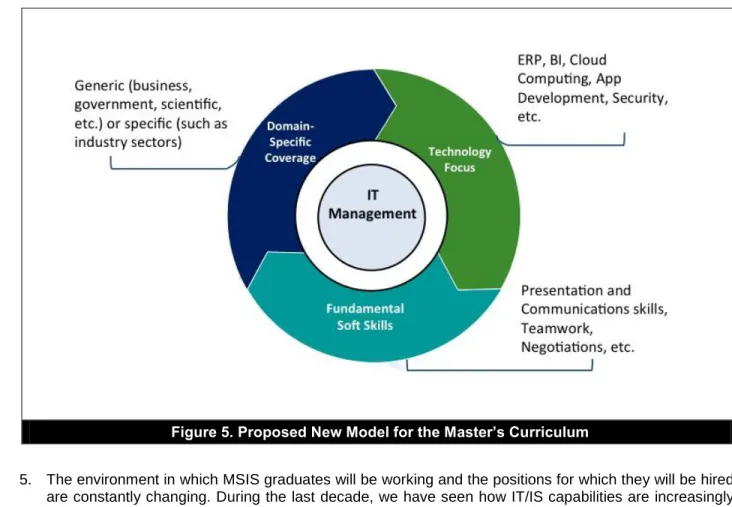
The programs featured in this article illustrate well the exciting opportunities that master’s degree programs in IS offer for the field. We believe that these program exemplars, together with the broader perspectives discussed above, provide a good foundation for a set of general recommendations for the next MSIS revision process. This conversation suggests that a model such as the one presented in Figure 5 could serve as a foundation for a master’s level curriculum revision. We propose the following:
1. IT Management and Strategy should form the core of master’s degree programs in Information Systems. The focus around this core should be built around three key themes: value delivery from IT, cost reduction/optimization, and IT risk management.
706
Volume 34 Article 35
2. Technical skills continue to be an important part of the capability set that MSIS programs offer. The technological focus areas should suit the demands of the local marketplace, and this should be recognized in the model curriculum. The coverage of emerging technologies would benefit from being integrated across the curriculum, instead of being offered within a separate course. Even more than at the undergraduate level, however, the focus should be on individual managerial and leadership capabilities, understanding and managing the key issues of the domain with which the program is affiliated (such as business) and high-level IS issues (such as architectural design and IS/IT management frameworks).
3. Collaboration among industry stakeholders either directly or through separate research organizations can lead to significant benefits to MSIS programs, as illustrated by examples such as the Innovation Value Institute at NUI Maynooth and UNSW’s IS Executive Career Development Program featured in this article. Closer collaboration with employer partners often has a significant positive impact on continuous curriculum improvement, recruitment for permanent positions and internships, access to relevant experts as guest lecturers, and availability of real-world project opportunities, among others. Key industry partners would have a very significant role in vetting domain-specific coverage. This component should continue to be an essential part of any master’s program in Information Systems (whether the domain is more generic, such as business or government, or more specific, such as health informatics or IT in the context of financial markets; see also Figure 5).
4. It is essential that the next revision of the graduate level model curriculum in Information Systems has a strong emphasis on the specification of the outcome expectations, that is, the capabilities that the graduates of the programs should be expected to have [Bowden, 2004]. It is clear that we will not be able to specify a single capability set that all programs should strive to achieve. Factors such as the experience level of the students, the local employer needs, and the specific roles for which the programs prepare their students vary significantly and have a direct impact on the capability needs. These types of differences are clearly illustrated by the programs featured in this article. Still, specifying expected graduate capabilities provides a concrete and effective way to position the MSIS programs as a group in the broader space of computing and business programs. Consequently, the IS community should be able to identify a core group of capabilities that all specialized master’s programs in IS are designed to provide to their students.
5. The environment in which MSIS graduates will be working and the positions for which they will be hired are constantly changing. During the last decade, we have seen how IT/IS capabilities are increasingly often provisioned by third parties and through large-scale packaged solutions, IS management and
Volume 34 Article 35
707 governance have become significantly better specified through various frameworks, expectations
regarding ubiquitous access to IS applications have become a norm, and the importance of articulating the benefits of IS/IT in business terms has increased very significantly. The impact of these and many other similar factors on the capability needs of MSIS graduates have to be carefully evaluated.
6. As emphasized in Topi et al. [2011] and discussed above, it is essential that we as a community find a way to clearly articulate the identity and positioning of MSIS programs in comparison with other computing programs and undergraduate programs in IS. MSIS needs a strong, well-defined brand identity that both prospective students and employers understand and value. The similarities between the examples from around the world featured in this article demonstrate the opportunities to move toward a globally understood concept.
MSIS 2000 [Gorgone and Gray, 2000] and MSIS 2006 [Gorgone et al., 2006] have been collaborative efforts between ACM and AIS. This collaboration has anchored the master’s degree programs in information systems in the broader space of computing education, following the longstanding model used in the context of the undergraduate programs. This collaboration also has significantly expanded the visibility of the MSIS curriculum among the more than 100,000 members of the ACM. At the time of writing this summary, both ACM Education Board and AIS Council are considering a proposal to provide funding for a comprehensive review and revision of MSIS 2006. It is our hope that the cases presented in this article and the recommendations derived from them will be useful for a future revision process and serve a role in generating an active discussion among the members of the IS community regarding the role of specialized graduate programs in IS and the opportunities they offer to the community and its major stakeholders.
ACKNOWLEDGMENTS
This work was supported, in part, by Science Foundation Ireland grant 10/CE/I1855 to Lero ― the Irish Software Engineering Research Centre (www.lero.ie).
REFERENCES
Editor’s Note: The following reference list contains hyperlinks to World Wide Web pages. Readers who have the ability to access the Web directly from their word processor or are reading the article on the Web, can gain direct access to these linked references. Readers are warned, however, that:
1. These links existed as of the date of publication but are not guaranteed to be working thereafter. 2. The contents of Web pages may change over time. Where version information is provided in the
References, different versions may not contain the information or the conclusions referenced. 3. The author(s) of the Web pages, not AIS, is (are) responsible for the accuracy of their content. 4. The author(s) of this article, not AIS, is (are) responsible for the accuracy of the URL and version
information.
Alter, S. (2006) The Work System Method: Connecting People, Processes, and IT for Business Results, first edition, Larkspur, CA: Work System Press.
Bowden, J.A. (2004) “Capabilities-driven Curriculum Design”, in Baille, C., and I. Moore (eds.), Effective Learning and Teaching in Engineering, New York: Routledge, pp. 36–47.
Burrows, P. (2009) “Will Cisco’s Project California Rock the IT Sector”, Bloomberg Businessweek, March 2009. Carlsson, S.A. (2010) “Design Science Research in Information Systems: A Critical Realist Approach” in Hevner, A.,
and S. Chatterjee (eds.), Design Research in Information Systems: Theory & Practice, Berlin: Springer. Carr, N.G. (2003) “IT Doesn't Matter”, Harvard Business Review, (81)5, pp. 41–49.
Chesbrough, H.W. (2007) “Business Model Innovation: It’s Not Just About Technology Anymore”, Strategy and Leadership, (35), pp. 12–17.
Ciborra, C. (1996) “The Platform Organization: Recombining Strategies, Structures, and Surprises”, Organization Science, (7), pp. 103–118.
Cisco. (2013) “Cisco Global Cloud Index: Forecast and Methodology, 2011–2016”,Cisco Systems White Paper, from
http://www.cisco.com/en/US/solutions/collateral/ns341/ns525/ns537/ns705/ns1175/Cloud_Index_White_ Paper.html (current August 19, 2013).
Davenport, T.H., and J.E. Short (1990) “The New Industrial Engineering: Information Technology and Business Process Design”, Sloan Management Review, (31)4, pp. 11–27.
708
Volume 34 Article 35
Del Giudice, M., and D. Straub (2011) “IT and Entrepreneurism: An On-again, Off-again Love Affair or a Marriage”, MIS Quarterly, (35)4, pp. iii–vii.
El Sawy, O.A. (2003) “The 3 Faces of IS Identity: Connection, Immersion, and Fusion”, Communications of the Association for Information Systems, (12), Article 39.
Gartner (2012) “Predicts 2012: Four Forces Combine to Transform the IT Landscape”, http://www.gartner .com/id=1871420 (current October 12, 2012).
Gefen, D., A. Ragowsky, E.R. McLean, M.L. Markus, S. Rivard, and M. Rossi (2012) “ICIS 2011 Panel Report: Are We on the Wrong Track and Do MIS Curricula Need to Be Reengineered?”, Communications of the Association for Information Systems, (30), Article 11.
Gorgone, J.T., and P. Gray (2000) “MSIS 2000: Model Curriculum and Guidelines for Graduate Degree Programs in Information Systems”, Communications of the Association for Information Systems, (3) Article 1, pp. 1–52. Gorgone, J.T., P. Gray, E.A. Stohr, J.S. Valacich, and R.T. Wigand (2006) “MSIS 2006. Model Curriculum and
Guidelines for Graduate Degree Programs in Information Systems”, Communications of the Association for Information Systems, (17)1, pp. 122–196.
Keller, S., C. Chan, and C. Parker (2010) “Generic Skills: Do Capstone Courses Deliver?” in Devlin, M., J. Nagy, and A. Lichtenberg (eds.), Research and Development in Higher Education: Reshaping Higher Education, (33), pp. 383–393.
King, J.L. (2011) “CIO: Concept Is Over”, Journal of Information Technology, (26), pp. 129–138. King, J.L., and K. Lyytinen (2004) “Reach and Grasp”, MIS Quarterly, (28), pp. 539–551.
Lee, K., and D. Mirchandani (2010) “Dynamics of the Importance of IS/IT Skills”, Journal of Computer Information Systems, (50)4, pp. 67–78.
Luftman, J., R. Kempaiah, and E. Henrique (2009) “Key Issues for IT Executives”, MIS Quarterly Executive, (8)3, pp. 151–159.
Lyytinen, K., and J.L. King (2004) “Nothing at the Center? Academic Legitimacy in the Information Systems Field”, Journal of the Association for Information Systems, (5)6, pp. 220–246.
Lyytinen, K., and J.L. King (2006) “The Theoretical Core and Academic Legitimacy: A Response to Professor Weber”, Journal of the Association for Information Systems, (7), Article 27.
Nordberg, D. (2008) “Designing Business Curricula: Building Relevance into Higher Education”, International Journal of Management Education, (7), pp 81–86.
Peppard, J., R. Lambert, and C. Edwards (2000) “Whose Job Is It Anyway? Organizational Information Competencies for Value Creation”, Information Systems Journal, (10), pp. 291–322.
Peppard J., and J. Ward (2004) “Beyond Strategic Information Systems: Towards an IS Capability”, Journal of Strategic Information Systems, (13), pp. 167–194.
Rooney, B. (2012) “Big Data’s Big Problem: Little Talent”, The Wall Street Journal, April 26, p. 19.
Rothfeder, J., and L. Driscoll (1990) “CIOIis Starting to Stand for Career Is Over”, Business Week, February 26, pp. 47–48.
See, S.L. (2004) “Corporate Entrepreneurship: Exploiting Technologies for Innovation Discovery and Breakthrough”, Proceedings of the Engineering Management Conference IEMC 2004 (Volume 2), October 18–21, pp. 692– 702.
Teo, T., and S. Srivastava (2007) “Information Systems (IS) Discipline Identity: A Review and Framework”, Communications of the Association for Information Systems, (20), Article 33.
Toohey, S. (1999) Designing Courses for Higher Education, Buckingham, UK: Society for Research into Higher Education and the Open University Press.
Topi, H., J.S. Valacich, R.T. Wright, K.M. Kaiser, J.F. Nunamaker Jr., J.C. Sipior, and G.J. de Vreede (2010) “IS 2010: Curriculum Guidelines for Undergraduate Degree Programs in Information Systems’, Communications of the Association for Information Systems, (26), pp. 359–428.
Topi, H., M. Helfert, V. Ramesh, and R.T. Wigand (2011) “Future of Master’s Level Education in Information Systems”, Communications of the Association for Information Systems, (28), Article 27, pp. 437–452.
Volume 34 Article 35
709 van Aken, J.E. (2004) “Management Research Based on the Paradigm of Design Sciences: The Quest for
Field-tested and Grounded Technological Rules”, Journal of Management Studies, (41)2, pp. 219–246.
Weber, R. (2006). “Reach and Grasp in the Debate over the IS Core: An Empty Hand?”, Journal of the Association for Information Systems, (7), Article 28.
Wu, J., U. Tian, and R. Atwal (2012) “Forecast: x86 Server Virtualization, Worldwide, 3Q12 Update”, Stamford, CT: Gartner, http://www.gartner.com/id=2210316 (current August 19, 2013).
ABOUT THE AUTHORS
Heikki Topi is a Professor of Computer Information Systems at Bentley University in Waltham, MA. He earned his Ph.D. in MIS at Indiana University Graduate School of Business. His teaching interests cover a range of topics including advanced systems analysis and design, systems modeling, data management, and IT infrastructure. His current research focuses on usability issues in the context of enterprise systems, information search, and data management. His research has been published in journals such as the European Journal of Information Systems, ournal of the American Society for Information Science and Technology, Information Processing & Management, International Journal of Human-Computer Studies, Journal of Database Management, Small Group Research and others. He is a co-author of Modern Database Management and Essentials of Database Management, together with Jeff Hoffer and V. Ramesh. He has been actively involved in national computing curriculum development and evaluation efforts (including IS 2002, CC2005, and as co-chair of IS 2010, the latest undergraduate IS curriculum revision) since the early 2000s. He serves on ACM’s Education Board and is a member of CSAB’s Board of Directors and Teradata University Network’s Executive Board.
Kieran Conboy is an Associate Professor in the University of New South Wales and also works with the Lero software engineering research center at NUI Galway, Ireland. His research focuses on agile systems development approaches as well as agility across other disciplines. Kieran is involved in numerous national and international projects in this area, and has worked with many companies on their agile initiatives including Intel, Microsoft, Accenture, HP, and Fidelity Investments. Some of his research has been published in leading journals and conferences such as Information Systems Research, the European Journal of Information Systems, the International Conference in Information Systems (ICIS), the European Conference in Information Systems (ECIS), IFIP 8.6 and the XP200n conference series. He is also associate editor of the European Journal of Information Systems and has chaired related conferences. Prior to joining academia, Kieran was a management consultant with Accenture, working across Europe and the US.
Brian Donnellan holds the Chair of Information Systems Innovation at the National University of Ireland Maynooth (www.nuim.ie) and is co-director of the Innovation Value Institute (www.ivi.ie). Prior to joining NUI Maynooth, Prof. Donnellan was a faculty member in the National University of Ireland, Galway. He has spent twenty years working in the ICT industry where he was responsible for the provision of IS to support Product Development. He is an expert evaluator for the European Commission and has been guest and associate editor of several leading IS journals including Journal of Information Technology, Journal of Strategic Information Systems, and MIS Quarterly.
V. Ramesh is an Associate Professor of Information Systems and Lawrence D. Glaubinger Professor of Business Administration at Indiana University's Kelley School of Business. He is also Chair of the Undergraduate Program and former Chair of the MS in Information Systems (MSIS) program. As Chair of the MSIS program, he successfully grew the program from fourteen students in 2002 to more than 130 entering students in fall 2013. He has published over twenty-five papers in leading journals, such as Information Systems Research, MIS Quarterly, ACM Transactions on Information Systems, Communications of the ACM, Journal of Management Information Systems, etc. Ramesh is also a co-author on one of the leading database books, Modern Database Management 10e, along with Jeff Hoffer and Heikki Topi. He is the Editor-in-Chief of e-Service Journal and serves as Associate Editor for leading journals such as Information Systems Research and MIS Quarterly. Ramesh holds the ITIL v3 Expert certificate and is an active participant in both the ISACA and the IT Service Management Forum (itSMF) communities.
Christine Van Toorn is Lecturer and Director of the IS and IT Co-op Scholarship Programs at the University of New South Wales. Her commercial background is diverse and she has considerable experience across a wide variety of industries. Christine’s research interests span across the areas of eLearning and CIO skill sets and capabilities and the role of the University in meeting industry demands in this area. Some of her research has been published in various leading peer-reviewed journals and conferences such as IEEE Software, Australian Educational Computing, ECIS, AMCIS and ACIS. Christine has broad industry experience in the fields of information systems, information technology and accounting. Prior to joining UNSW she was a consultant with Deloitte. Christine is a CPA and a CISA and her appointment as Director of the University’s exclusive and highly sought after IS and IT Co-operative Scholarship Programs complements her experience both within industry and academia.
710
Volume 34 Article 35
Ryan T. Wright is an Assistant Brofessor at University of Massachusetts Amherst. He holds a Ph.D. from Washington State University in Management Information Systems and an MBA and Bachelor of Science in Business from the University of Montana. Ryan’s research interests take a behavioral approach to understanding how current technologies can be used to enable secure and efficient e-business transactions. He is published in the MIS Quarterly, Journal of MIS, Communications of the AIS, and other peer-reviewed publications. In addition to academic achievements, Ryan's professional experience includes tenure as CTO of a successful startup, time in management at Amoco Oil (now BP), consulting projects for the U.S. Department of Commerce and expert testimony on IS privacy and security. Ryan was in the 2008 ICIS Doctoral Consortium.
Copyright © 2014 by the Association for Information Systems. Permission to make digital or hard copies of all or part of this work for personal or classroom use is granted without fee provided that copies are not made or distributed for profit or commercial advantage and that copies bear this notice and full citation on the first page. Copyright for components of this work owned by others than the Association for Information Systems must be honored. Abstracting with credit is permitted. To copy otherwise, to republish, to post on servers, or to redistribute to lists requires prior specific permission and/or fee. Request permission to publish from: AIS Administrative Office, P.O. Box 2712 Atlanta, GA, 30301-2712, Attn: Reprints; or via e-mail from [email protected].
![Figure 1. A Model Linking the IS Capability with IS Competencies and Resources [Peppard and Ward, 2004]](https://thumb-us.123doks.com/thumbv2/123dok_us/11020802.2989367/9.918.53.723.132.547/figure-model-linking-capability-competencies-resources-peppard-ward.webp)
![Figure 4. IS 2010 Basic Conceptualization of Exit Characteristics [Topi et al., 2010]](https://thumb-us.123doks.com/thumbv2/123dok_us/11020802.2989367/14.918.156.673.633.1050/figure-basic-conceptualization-exit-characteristics-topi-et-al.webp)