Efficacy of Communicative Task-Based Language Learning in
Developing Listening Skills of Elementary Stage Students
Dr. Esha Sekhri1 Prof. Nandita Singh2
1. Adjunct Faculty – Lecturer, Faculty of Engineering and Information Sciences, University of Wollongong in Dubai, United Arab Emirates
2. Professor, Department of Education, Panjab University, Chandigarh, India Abstract
The current research paper is the second and the concluding research paper that aims at addressing the lacunae found in listening comprehension of elementary school students discussed in ‘Listening: An overlooked dimension in second language acquisition’ (Sekhri & Singh, 2017). Of various methods proposed by various linguists and scholars in the area, the researcher picked grammar-translation method (still very popular in Indian schools) and task-based language learning (found to be very successful in enhancing the listening skills of students) to examine their effect on listening skills of elementary school students. The study was delimited to students studying in private schools of Ambala district. The duration of the study was 9 weeks and it was experimental in nature following pretest-posttest control group design. A total of 140 randomly selected students were equally allocated to experimental (taught using and task-based language learning (TBLL)) and control groups (taught using grammar-translation method (GTM)). It was hypothesized that there won’t be any significant difference between the mean gain scores of students in either group. The researcher developed both instructional material and listening test. Independent samples T-test was employed on pre-test scores to compare the means and to match the groups taught through TBLL and GTM. Finally, parametric statistics viz. 2 X 3 ANOVA was employed to study the impact of teaching methods on dependent variable. The listening skills of students taught through TBLL were found improving during the treatment. It was also found that traditional way (GTM) of transmitting knowledge to young brains mars their creativity as well as interest in the subject. Further, since TBLL demands working in groups and pairs hence, it was found that the said method not only had an impact on students’ linguistic skills but also life skills including team work, cooperation, critical thinking and social-competence.
Keywords: task-based language learning, grammar-translation method, listening skills, life skills, elementary school students
1. Introduction
In the ambit of second language acquisition, one of the principal concerns of researchers, educators, practitioners and teachers revolve around finding a one-size-fits-all methodology that has the potential to equip the students with skills that substantially improve their linguistic competence. Up until the mid 20th century, Grammar-Translation Method (GTM) held the highest regards of all the practitioners (Shabani & Ghasemi, 2014). A little while later, due to the advances in both psychology and linguistics, more innovative approaches like Terrell’s Natural Approach, Gattegno’s Silent Way, Communicative Language Teaching (CLT) approach started gaining precedence. The communicative teaching approaches premised that language learning is possible only through communication in target language. CLT and its offshoots – content-based language teaching (CBLT) and task-based language learning (TBLL) pays systematic attention to functional as well as structural aspects of language over only structural aspects viz. grammar and vocabulary as advocated by grammar-translation approach (Littlewood, 1981). Although TBLL is a derivative of CLT but it is seen as an approach that makes up for the inadequacies of CLT and is in fact, considered a logical development of it (Richards & Rodgers, 2001). Recent years have witnessed an enormous growth of attention in TBLL. Plethora of published monographs, edited volumes, special issues, books and articles, since past three decades, bear testimony to the surge of interest in the method (Ahmadian, 2016). Furthermore, considering an escalating demand for English proficiency (Ho & Wong, 2004) many governments, policy makers, and curriculum frame workers around the globe have turned to TBLL as a potential solution to curricula that are perceived to lack an authentic and meaningful engagement with language learning and that fail to motivate and engage contemporary learners as a result (cited in Thomas, 2015). TBLL first appeared in the 1980s in seminal papers by Breen & Candlin (1980) and Long (1985). However, the first large-scale attempt to implement TBLL and to develop a theoretical rationale for it arose in Bangalore, India, from a professional debate of effectiveness of communicative language teaching (Thomas, 2015). N. S. Prabhu, the proponent of the method, believed that formal instructions (focusing on grammar and accuracy), was not only unprofitable but also potentially harmful (cited in Mystkowska-Wiertelak & Pawlak, 2012). The aim of Prabhu’s ‘Bangalore Communicational Teaching Project’ was to enable students achieve an acceptable level of competency in target language (Willis, 2004) and this can be achieved by placing due emphasis on interacting in target language, as this is seen as the precondition for learning to communicate in second language (Nunan,
2007). Furthermore, since the use of target language needs to be naturalistic hence the usage of authentic texts is necessitated. Such texts connect the language inside the classroom to language outside it (Nunan, 2007). This can be deduced from the fact that tasks used in this method involve visiting a doctor, negotiating with a shopkeeper, conducting an interview, or calling customer service for help, which are quite meaningful and worthwhile to the students in their day-to-day routine (Sekhri & Singh, 2017). In other words, this method delivers comprehensive and wholesome vocabulary, structures and sentences that are of immediate importance to the students over providing them with grammatical rules and isolated chunks of information that cannot be used appropriately or flexibly in communication.
The second method chosen for the current experimental study was grammar-translation method (GTM). GTM was first introduced to teach modern languages viz. Greek and Latin in public schools in Prussia at the end of the eighteenth century (Coady & Huckin, 1997). The purpose of this method was to help students read and understand foreign language literature (Larsen-Freeman, 2000). This method is a way of studying a language that approaches the language first through detailed analysis of its grammar rules, followed by application of this knowledge to the task of translating sentences and texts into and out of target language (Richards & Rodgers, 2014). The first language is maintained as the reference system in the acquisition of second language (Stern, 1983).
GTM is teacher-centered wherein a major portion of classroom time is spent on teacher’s elaborate explanation of grammar rules, while the students are either listening or taking notes (Brooks, 2015). Students accept the knowledge passively in procedures set ahead of time by the teacher. In short, grammar translation method aims at ‘knowing everything about something without knowing the thing itself’ (W.H.D. Rouse, quoted in Kelly, 1969). Sentence is the basic unit of teaching and language practice. Most of the classroom time is devoted to translating sentences and henceforth, students are expected to attain accuracy and high standard in translation. GTM is said to be outdone, but is still very often used especially in Indian schools (Grover, 2014). Some of the probable reasons of the popularity include: this method makes few demands on teachers; limited command of spoken English by language teachers; the fact that this method was used by teachers’ teachers and finally that it works well in large classrooms (Richards and Rodgers, 2014).
This experimental research was designed to study the efficacy of both the aforementioned teaching methods in developing listening skills of elementary school students. Listening is the most essential skill of language learning. It is the primary means by which incoming ideas are taken in (Goh, 2000). Krashen (1985) argues that people acquire language by understanding linguistic information that they hear. Further, it enables language learners to receive and interact with language input and facilitates the emergence of other language skills (Vandergrift & Goh, 2012). Listening, therefore, is essential not only as a receptive skill but also to the development of spoken language proficiency. Listening skills comprise of many sub-skills including listening for general understanding, predictive listening, evaluative listening, intensive and extensive listening (Ioannou-Georgiou & Pavlou, 2003). In academic listening, impetus is given to intensive and extensive listening skills, as both these entail almost all other sub-skills.
The goal of intensive listening is to raise learner’s ability to understand spoken language and focus their attention on specific features (Pilott, 2013). Each and every spoken word is important and hence, learners listen with maximum accuracy (Verma, n.d.). Extensive listening on the other hand necessitates listening for general understanding and requires high level of comprehension at the learners’ end. For the current research, the dimensions selected for development and validation of listening skills tool were intensive and extensive listening skills.
The classifying variable used in the study was language creativity, which was operationally defined as the multi-dimensional attitude that is differently distributed among the people and includes mainly the factors of fluency, flexibility, originality and elaboration. Fluency is a quantitative aspect of creativity, i.e. coming up with large quantity of ideas, words, and ways of expressing them. Flexibility is referred to as thinking up a variety of ideas and new way of dealing with situation. Originality is designated as uncommon with respect to figural, verbal or symbolic transformation. Elaboration is referred to as the ability to explain a complex object or given situation by adding details to it. The current operational definition was derived from the tool used to measure it, developed by Malhotra & Kumari (1990).
1.1 Literature Review
Many people believe that TBLL focuses entirely on spoken skills. This actually is indubitable as there is certainly a lot of talking in a task-oriented class (Seedhouse, 1999) but TBLL has also been proven effective in honing listening skills of students (Sarıçoban & Karakurt, 2016). Many studies have predominantly revealed that TBLL augments the listening skills of students (Chou, 2017; Maghsoudi & Golshan, 2017; Noshad & Zamanian, 2017; Rahmah, 2016; Sarani, Behtash, Arani & Moslemi, 2014; Motallebzadeh & Defaei, 2013; Nasirian, 2012; Tavil, 2010; Graham, 2006), this in turn facilitates second language learning. Maghsoudi & Golshan (2017) in their study the impact of task-based language teaching on listening skill of Iranian EFL learners attempted to
examine the influence of two task types (labeling and form-filling) on listening ability among Iranian EFL learners. The results indicated that labeling task had an effect on listening ability of the learners. Furthermore, the result of paired samples t-tests revealed that the students in the experimental group showed a better performance in their post-test than their pre-test. A similar study by Nasirian (2012) aimed at investigating the correlation between four specific task-types (matching, form-filling, labeling, and selecting) and listening ability of the students. The results of this study also indicated a significant positive relationship between listening ability and all four tasks. In another research by Rahmah (2016) on the use of task-based language learning to improve students’ listening skill in the nine grade of SMPN 8 Yogyakarta in the academic year 2016/17 it was found that the students’ listening skill improved through the use of task-based language learning. In addition to the aforementioned studies, some studies indicated that only certain tasks aid in improving listening skills of students whilst no significant improvement occurs when other tasks like selecting was used (Bahrami, 2010; Khoshsima &Tasuj, 2014). All this leads to an inconclusive trend, which demands further exploration in the area. The studies that have investigated the role of grammar-translation method in enhancing listening skills are fairly sparse and this can be attributed to the fact that impetus in a grammar-translation class is on reading and writing whilst no systematic attention is paid to oral form (Richard & Rodgers, 2001). Boulfelfel (n.d.) in his research indicated that in a grammar-translation class focus is on grammar, rote learning and translation, and listening is not mentioned at all. He further states that the only listening students would have to do, would be to listen to the description of rules of second language in first language. Kim (2008) also stated that the method does not include spoken communication or listening comprehension. However, despite its short-comings grammar-translation method, in some modified form, continues to be used widely used in many parts of the world (Boulfelfel, n.d.) and also in many parts of India (Grover, 2014). Because of its widespread use in Indian schools and because of scarcity of research in the area the researchers decided to probe in and investigate the efficacy of GTM in improving listening skills of students.
1.2 Research Questions and Hypotheses
The problem statement for which the current study was undertaken was to investigate the impact of task-based language learning and grammar translation method on listening skills of elementary schools students, and also to see if any significant interaction occurs between teaching methods and language creativity in effecting the listening skills score of students. To this end, following research questions were framed:
1. Do significant differences exist in listening skills scores of VII grade students studying in public schools of Ambala, India based on teaching method used?
2. Do significant differences exist in listening skills scores of VII grade students studying in public schools of Ambala, India based on their language creativity level?
3. Does any significant interaction occur between teaching method used and language creativity in
effecting the listening skills score of VII grade students studying in public schools of Ambala, India. Aligned with above research questions, following research hypotheses were formulated:
H01. No significant difference exists in listening skills scores of VII grade students studying in public schools of Ambala, India based on teaching method (task-based language learning and grammar-translation method) they are exposed to.
H02. No significant difference exists in listening skills scores of VII grade students studying in public schools of Ambala, India based on their language creativity level.
H03. No significant interaction occurs between teaching method used and language creativity in effecting the
listening skills score of VII grade students studying in public schools of Ambala, India. 2. Methodology
2.1 Research Design
The design selected for the study was pre-test post-test control group design, where the subjects were assigned to control and experimental groups by the process of random selection. The independent variables in the study were teaching methods – task-based language learning and grammar-translation method while listening skills was the dependent variable. The students were further classified on the basis of their scores in language creativity test developed by Malhotra & Kumari (1990) and adapted by the researcher.
2.2 Participants
The sample in present investigation was drawn at two levels – the school sample and the student sample. Since, for the present research English medium public schools of Ambala, India, who were ready to cooperate, were desirable. Hence, the sample for selecting potential schools was primarily purposive in nature. The student selection, however, was randomly derived. A total of 140 students participated in the present investigation of which 70 each were randomly drawn to be a part of experimental and control groups. The age of boys and girls in this sample ranged from 11-13 years. The participants of both the groups had same level of listening
proficiency at the beginning of the study and both learnt English as second language. The participants in control group were taught using GTM and the ones in experimental group were instructed using TBLL.
2.3 Materials and Instruments
In the present study, two instruments were used at data collection phase. Initially, in order to choose participants and place them in relevant groups, Language Creativity Test developed by Malhotra & Kumari (1990) and adapted by the researcher was used. The test and its criteria were used to place students in three groups viz. high language creative, average language creative and low language creative group. In total, there are 27 items in the said test and these items are divided into five sub tests namely i) plot building; ii) dialogue writing; iii) poetic diction; iv) descriptive style; and v) vocabulary test. The total time required for completion of the test is 147 minutes. The factors measured by the tests are fluency, flexibility, originality and elaboration. The reliability and validity of the test are quite high for it to be considered an effective instrument for categorizing students in accordance to their language creativity level. Nevertheless, it was essential to measure the reliability and validity of the test for those who participated in the study. Reliability was established by using split-half method and Cronbach’s alpha, which were calculated to be 0.83 and 0.792 respectively ensuring that the tool was reliable in present context. Five experts including one psychologist, one linguist, one professor from department of education and two teachers ascertained the content validity of the test; component validity was calculated by running Pearson Product Moment correlation, which again was found to be fairly high indicating that the test is valid.
A researcher-made listening skills test was designed to assess the listening skills of VII grade students studying in CBSE affiliated public schools of Ambala, India. 98 items distributed between two domains viz. intensive and extensive listening skills were included in preliminary draft of the test. The same was piloted on a representative sample of 385 students who shared same demographics with those participating in actual study. Based on the results of pilot study, 32 items were rejected and four were modified. Therefore, the revised test contained 66 items and was used for experimental and control groups, both pre and post-instruction. The reliability of the test was ascertained using test-retest reliability (conducted after 25 working days from first administration), split-half reliability (odd-even grouping of items) and by calculating alpha coefficient. The coefficients were found to be 0.876, 0.942 and 0.927 respectively, proving that the test was fairly reliable. Further, six experts (from department of education (format expert), department of English (language experts) and language teachers teaching elementary classes (content expert)) having more than 14 years of experience in their respective areas evaluated the content validity of the test.
2.4 Procedure
In order to conduct the research and to test the hypotheses following steps were taken. Initially, consent was taken from participant schools, teachers as well as students to partake the study. The initial student sample comprised of 407 students chosen from two CBSE affiliated public schools of Ambala, India. Language creativity test developed by Malhotra & Kumari (1990) and adapted by researcher was administered on all these students. According to the standard set by the manual, students were divided into three groups. Students’ whose z-scores were more than +1.26 were considered to be high in language creativity, students with z-scores between -1.25 to +1.25 were classified as average in language creativity and students who scored less than -1.26 were classified as extremely low in language creativity. After grading all the 407 papers, it was found that in chosen sample 82 were highly creative, 79 were in low creative group and 246 were found to be average in language creativity. Afterwards, from the selected sample, 140 students were randomly drawn to be part of the present investigation. Of 70 participants each in experimental and control groups 14 were highly language creative, 14 were low in language creativity and 42 were average in language creativity. Furthermore, since TBLL necessitates working in groups for the successful completion of tasks hence additional groupings were done. In this grouping, five members each comprising one highly creative in languages, one low in creative potential and three students with average scores in language creativity test were teamed together.
Once all the groupings were done, the experiment was further administered in three phases – pre-testing, administering instructional program and post-testing. In the pre-testing phase the researcher-developed listening skills test was administered on both the control and experimental groups. The purpose of this test was to assess the listening proficiency of the students before receiving instructions.
In the second phase, the experiment was conducted for approximately nine weeks, 46 sessions, each lasting 50 minutes. The students in experimental group were instructed using task-based learning and the students in control group received usual classroom instruction. The researchers taught both the groups. A total of 11 major teaching episodes were designed in accordance with TBLL framework and each teaching episode was divided into three stages – pre-test (preparation for main-task), during task (main task) and post-task (replication of what has been done). At pre-task stage the students were familiarized with both topic and activities and were also exposed to topic specific vocabulary. In pre-task, many audio recordings were designed, framed and utilized in
accordance with students’ personal experiences, previous knowledge and content of the textbook. This phase aimed at arousing students’ curiosity and motivation for language acquisition to occur. During the task-cycle, learners got on to the stage because it was their chance to perform and produce whatever they learnt. Doing the task provided an opportunity to the learners to integrate their existing repertoire of language with newly acquired vocabulary. It is at this stage, the researchers provided all the necessary inputs required for language acquisition. A note of learners’ mistakes was also made at this stage and these mistakes were discussed with the whole class without mentioning any names. The final phase of the task-cycle is reporting in which the learners communicated their findings to the whole class using newly learnt vocabulary. In the final stage viz. the post-task phase the learners were encouraged to reflect and evaluate their own performance of the post-task; they were also invited to comment on which aspect of language (fluency, complexity and accuracy) they gave primacy to and why; they were asked to make a list of words that they learnt and finally; they were advised to reflect on how they might improve their performance. Students listened to the recordings, they listened to their peers as well as the instructor at every stage of the task-based lesson and this meant a lot of input that might aid listening comprehension.
The participants in control group were taught through traditional grammar-translation method with particular emphasis on reported speech and active-passive voice. Rules of active-passive voice and reported speech were taught to the learners deductively. Whenever there was a need, the researchers translated difficult words in mother tongue. The students in control group were taught three sessions a week for 9 weeks. A normal class started with a ten minutes of previous knowledge testing followed by a new lesson, which consisted of functional grammar with a few written and oral tasks. These tasks required the students to use already learnt grammar structures and vocabulary in their own examples.
The last and the final phase of the whole procedure was administration of post-test to both experimental and control groups. The purpose of post-testing was to determine whether TBLL and GTM brought about any statistically significant difference in learners’ listening ability. The same test (the one used in pre-testing) was again administered in posttest phase and the collected data was analyzed using SPSS 24.00.
2.5 Statistical Techniques
To understand the general nature of sample, descriptive statistics like arithmetic mean, median, standard deviation, skewness and kurtosis were studied using SPSS 24.00. Independent samples T-test was then employed on pre-test scores to compare the means and to match the groups taught through TBLL and GTM. Finally, inferential statistics viz. 2 X 3 ANOVA was employed to study the impact of learning methods on listening skills. Since, F ratio for interaction turned out to be significant, simple main effects were studied first and then post-hoc procedures were followed for pairwise comparisons using appropriate effect sizes and error term.
2.6 Data Analysis
An analysis of descriptive data indicated that the data were normally distributed and had no extreme values (outliers). The t-ratio, as inferred from independent sample t-test, was found to be statistically non-significant, t (138)= 0.21, p > 0.05 for listening skills (t =1.96 at 0.05 level and t = 2.58 at 0.01 level for 138 degrees of freedom). This result suggested that groups taught through grammar-translation method and task-based language learning didn’t differ significantly on pre-test mean scores. In other words, the groups were quite homogeneous in this regard and hence, any possible differences in the listening scores at the end of intervention program will be a result of efficacy or inefficacy of treatment.
For testing the hypotheses a two-factor ANOVA was conducted to evaluate the effects of two teaching methods on dependent variable viz. listening skills of high, average and low language creative students. The means and standard deviations for listening skills as a function of two-factors are presented in table 1 below. Letter C here represents the control group and E experimental group.
Table 1. Descriptive Statistics for Mean Gain Scores on Listening Skills for Control Group, Experimental Group and Total Sample
Dependent Variable: Listening Skills
Group Language Creativity Level Mean Std. Deviation N
C Av 3.55 2.166 42 H 3.79 1.311 14 L 2.64 1.598 14 Total 3.41 1.937 70 E Av 14.33 2.505 42 H 16.00 2.746 14 L 9.71 1.383 14 Total 13.74 3.170 70 Total Av 8.94 5.904 84 H 9.89 6.568 28 L 6.18 3.888 28 Total 8.58 5.806 140
The test of homogeneity of variances was not significant, Levene F (5,134)=1.586, p= .168, indicating that assumption underlying the application of two-way ANOVA was met. An alpha level of 0.05 was used for initial analyses. The result for two-way ANOVA indicated a significant main effect for teaching methods F (1,134) = 578.708, p < 0.05 as well for language creativity levels F (2,134) = 23.534, p <0.05; refer to table 2.
Table 2. Tests of Between-Subjects Effects for Mean Gain scores on Listening Skills
Tests of Between-Subjects Effects
Dependent Variable: Listening Skills
Source Type III Sum of Squares df Mean Square F Sig. Partial Eta Squared
Corrected Model 4057.969a 5 811.594 173.129 .000 .866 Intercept 7507.145 1 7507.145 1601.418 .000 .923 Group 2712.872 1 2712.872 578.708 .000 .812 LClevel 220.648 2 110.324 23.534 .000 .260 Group * LClevel 103.543 2 51.771 11.044 .000 .142 Error 628.167 134 4.688 Total 14989.000 140 Corrected Total 4686.136 139
a. R Squared = .866 (Adjusted R Squared = .861)
Additionally, the results also indicated a significant interaction between teaching method and language creativity levels, F (2,134) = 11.044, p = 0.000 (<0.05). Figure 1 below describes the interaction between teaching methods and language creativity levels on listening skills.
Figure 1. Indicating Interaction between Language Creativity Levels and Teaching Method on Mean Gain Scores on Listening Skills
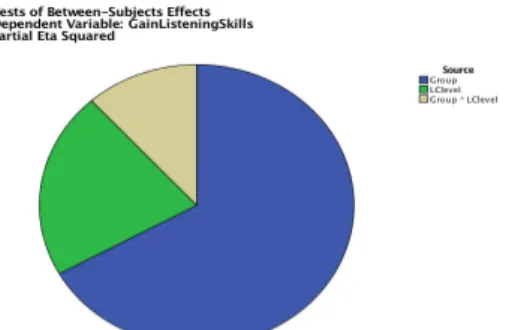
The analyses of effect sizes (from table 2) reveal that 81.2% (partial eta squared = .812) of the total variance for gain in listening skills scores could be attributed to main effect of teaching method; 26.0% variance was due to main effect of language creativity level of the students; and 14.2% of the variance was an effect of interaction between teaching methods and language creativity levels. This first two, according to Pallant (2007) criterion, were large effects whereas the last one (of interaction) was a moderate one. Figure 2 below describes the effect sizes for teaching method, language creativity level and interaction for mean gain scores on listening skills.
Figure 2. Indicating Effect Sizes for Teaching Strategy, Language Creativity Level and Interaction for Mean Gain Scores on Listening Skills
Since, there was a significant interaction between language creativity levels and teaching methods hence, simple main effects were studied first (Pedhazur & Schmelkin, 2013). Simple main effect here, is the difference in scores of listening skills attributed to two teaching methods for each of the high language creative, average language creative and low language creative groups. To control type I error rate (family-wise error) across the three simple effects, alpha level was set at 0.0167 (0.05/3) (Conrath, 2007; Riazi, 2016). Significant differences between control and experimental groups were found in all the three groups viz. high language creative, average language creative and low language creative. A review of group means (table 1) indicated that average language creative students in experimental group (M=14.33) displayed significantly enhanced listening skills than their counterparts in control group (M = 3.55), F (1,134)= 521.131, p <0.001, ES = .795, see table 3. Similarly, the high language creative students in experimental group (M=16.00) had significantly better listening skills than their peers in control group (M=3.79), F (1,134) = 222.774, p <0.001, ES =.624. Likewise, the low language creative students in experimental group (M= 9.71) outperformed their counterparts in control group (M=2.64), F (1,134) =74.669, p < 0.001, ES= .358. This analysis is a clear indication of TBLL being an effective method capable of significantly enhancing listening skills of students.
Table 3. Univariate Tests for High, Average and Low Language Creative groups on Listening Skills Dependent Variable: Listening Skills
LClevel Sum of Squares df Mean Square F Sig. Partial Eta Squared
AvContrast 2442.964 1 2442.964521.131.000 .795 Error 628.167134 4.688 H Contrast 1044.321 1 1044.321222.774.000 .624 Error 628.167134 4.688 L Contrast 350.036 1 350.036 74.669.000 .358 Error 628.167134 4.688
Next, simple main effects for three levels of language creativity for control and experimental groups were also examined separately. To control family-wise error rate across two simple main effects, alpha level was set at 0.025 (0.05/2) (Conrath, 2007). As is evident from table 4, there was a significant difference on listening skills among the three levels of creativity for experimental group, F (2,134)= 33.404, p<0.001, ES= 0.333, but not for control group, F (2,134)= 1.174, p > 0.001, ES= .017. Letter C and E represent control and experimental group respectively.
Table 4. Univariate Tests for Control and Experimental Groups on Listening Skills Dependent Variable: Listening Skills
Group Sum of Squares df Mean Square F Sig. Partial Eta Squared
C Contrast 11.010 2 5.505 1.174.312 .017
Error 628.167134 4.688
E Contrast 313.181 2 156.59033.404.000 .333
Error 628.167134 4.688
Follow-up tests were conducted to evaluate the levels of language creativity pairwise differences for experimental group. The alpha level was set at .0083 (.025/3) to control for type I error over three pairwise comparisons (Riazi, 2016). The students in high language creativity group of experimental group (M=16.00) had significantly better listening skills compared to average language creative group (M=14.33) and low language creative group (M=9.71). Table 5 indicates that the difference was significant between average and low language creativity groups (p<0.001) and also for high and low language creativity groups (p<0.001) but not for average and high language creativity groups (p>0.001).
Table 5. Pairwise Comparisons For Mean Gain Scores on Listening Skills of High, Average and Low Language Creative Groups
Dependent Variable: Listening Skills
Group (I) LClevel (J) LClevel Mean Difference (I-J) Std. Error Sig.b 95% Confidence Interval for Difference b
Lower Bound Upper Bound
C Av H -.238 .668 .722 -1.560 1.083 L .905 .668 .178 -.417 2.226 H Av .238 .668 .722 -1.083 1.560 L 1.143 .818 .165 -.476 2.761 L Av -.905 .668 .178 -2.226 .417 H -1.143 .818 .165 -2.761 .476 E Av H -1.667* .668 .014 -2.988 -.345 L 4.619* .668 .000 3.298 5.941 H Av 1.667* .668 .014 .345 2.988 L 6.286* .818 .000 4.667 7.904 L Av -4.619* .668 .000 -5.941 -3.298 H -6.286* .818 .000 -7.904 -4.667
*. The mean difference is significant at the .05 level.
Conclusively, all the above analyses indicate that there was a significant difference between the scores of
students taught through GTM and TBLL, in favor of TBLL indicating rejection of 1st null hypothesis. As far as
second research hypothesis is concerned, TBLL worked well with students belonging to all three groups viz. high, average and low language creative groups but more specifically with average and low language creative groups. The reason for such finding can be attributed to the fact that both these groups had more room for improvement than the ones in high language creative groups. All this illustrates that our second hypothesis was also rejected. Lastly, a significant interaction was found between teaching methods and language creativity levels signifying that the effect of teaching method at one level of language creativity was different from its effect at other level of language creativity. Hence, our third hypothesis was also rejected.
3. Discussion of results
The current study was designed to study the effectiveness of task-based language learning and grammar-translation method in improving listening skills of VII graders studying in CBSE affiliated public schools of Ambala, India. The design employed in the study was pre-test posttest control group design. Statistical package, SPSS 24.00 was used to analyze the data. Results indicated that the students in experimental group considered tasks to be an important medium of input enhancement for improving listening ability. The results can be explained by the fact that task-based instructions offer more room for interaction and discussion; and provide a more holistic picture of language rather than presenting fragmented pieces of linguistic competence. Findings emerging from the study confirm the findings of Nasirian, (2012); Promruang, (2012); Motallebzadeh and Defaei, (2013); Sarani, Behtash, Arani and Moslemi (2014) who proved that task-based language learning is a successful strategy to augment students’ listening skills. The overall results of this study indicate that tasks can serve as effective tools for improvement of communicative competence in general and listening skills, in particular.
Besides the result of quantitative data analysis, the results of informal observation by the researcher indicated that task-based language learning was not only useful in honing the listening skills of students but also their life skills. When the students were engaged in various pair or group tasks, not only did they accomplish a task, but also learnt to work as a team, they learnt leadership, initiation, tolerance, decision-making, critical thinking, cooperation, social-competence, inter as well as intrapersonal skills.
Findings of the said study intend to inspire the policy makers, curriculum designers and teachers to make a move to frame curriculum in a way that makes English a real means of interaction and sharing among people and not merely a key to pass the exam. To accomplish this, appropriate changes in timetable are anticipated. Timetabling authority must keep at least one lecture per day to sharpen communication skills of students where they should be taught through task-based language learning. Grammar and literature must also be taught but in separate language classes. For this methodological shift, corresponding changes in syllabi, teaching strategies, seating arrangements and assessment of learning would be essential. To this end, the current study aims at convincing Governmental bodies like NCERT, SCERT, DTERT and RIE to allocate funds for the successful implementation of task-based constructivist approach.
Another implication spins out to the curriculum, which needs to be re-conceptualized. From textbook being the linchpin of the curriculum to being just a part of it is the need of the hour. Further textbooks needs to be redesigned. It is argued that if the content of textbooks is presented in a boring way the learners lose both
enthusiasm and interest in the subject. Allwright & Bailey (1991) suggest that even if everything else seems favorable learners can ‘switch-off’ because they don’t like the way content of their course is presented. Language textbooks need to be designed on the basis of TBLL framework, as the research indicates that TBLL stimulates the interest of learners and keeps them glued to their work. In the current study, researcher observed a willingness to learn every time students were given tasks to perform.
Most of the current educational policies in India, especially in the field of language learning, are quite up-to-date however, the implementation of these practices and policies continue to be disappointing. These current policies along with some new policies need to be introduced and be implemented in letter and spirit so that the gap between the outside world and classroom environment be bridged. Last but not the least, legislation of a development program for both in-service and pre-service teachers can be a good move in the direction. The focus of this program must be on changing the vision of teachers about teaching from a job to do towards a profession to master.
Inspired by the findings, a number of recommendations are put forward. The study can be replicated in other parts of country and even world wide to elevate the generalizability of findings. Then, only the effect of GTM was studied along with TBLL in present study, effect of other new strategies can also be compared. Investigating teachers’ interest in task-based language teaching can be other area that can be explored. Furthermore, the study utilized researcher’s own experience and quantitative data to reach to conclusions. In further researches, experiences of students who are taught through task-based language learning can be used to provide insights and valuable information i.e. a post-positivist study is proposed for further study.
References
Ahmadian, M. J. (2016). Task-based language teaching and learning. The Language Learning Journal, 44(4), 377-380.
Allwright, D., & Bailey, K. M. (1991). Focus on the language classroom: An introduction to classroom research for language teachers. Cambridge, New York: Cambridge University Press.
Bahrami, M. (2010). The effect of task types on EFL learners’ listening ability. Undergraduate Research Journal for the Human Sciences, 9 (2010).
Boulfelfel, A. (n.d.). An investigation of second year students’ view about studies, listening comprehension, motivation, and teachers’ styles. Unpublished doctoral dissertation, Mentouri University, Constantine, The
People’s Democratic Republic of Algeria. Retrieved from
https://bu.umc.edu.dz/theses/anglais/BOU1297.pdf
Breen, M. P., & Candlin, C. N. (1980). The essentials of a communicative curriculum in language teaching. Applied Linguistics, 1(2), 89-110.
Brooks, K. W. (2015). Introduction to TESOL: A beginners approach to teaching speakers of other languages.
Lulu.com
Chou, M. (2016). A task-based language teaching approach to developing metacognitive strategies for listening comprehension. International Journal of Listening, 31 (1), 51-70. Doi: 10.1080/10904018.2015.1098542 Coady, J., & Huckin, T. (1997). Second language vocabulary acquisition: A rationale for pedagogy. Cambridge:
Cambridge University Press.
Conrath, R. A. (2007). A comparative study of effects of a supplemental reading program on 8th grade students’ reading comprehension growth. Proquest.
Goh, C. (2000). A cognitive perspective on language learners' listening comprehension problems. System, 28(1), 55-75. Doi: http://dx.doi.org/10.1016/S0346-251X(99)00060-3
Graham, S. (2006). Listening comprehension: The learner’s perspective. System, 34(2), 165-182. DOI:
10.1016/j.system.2005.11.001
Grover, P. (2014). Teaching of English in Indian Schools through Grammar Translation Method―Low Performance―A Field Study. Open Access Library Journal, 1(5), 1-4. Doi: 10.4236/oalib.1100731. Ho, W.K., & Wong. R. Y. L. (2004). English language teaching in East Asia today: Changing policies and
practices (2nd ed.). Singapore: Marshall Cavendish International.
Ioannou-Georgiou, S., & Pavlou, P. (2003). Assessing young learners. Teaching English as a Second or Foreign Language, 8(1), 183.
Kelly, L. (1969). 25 centuries of language teaching: An inquiry into the science, art and development of language teaching methodology. Rowley, MA: Newbury House.
Khoshsima, H., & Tasuj, Z. S. (2014). The impact of task types on listening comprehension of Iranian intermediate EFL learners. International Journal of Applied Linguistics & English Literature, 3(3), 97-103.
Kim, H.J. (2008). Grammar-Translation Method. In Josué M. González (Ed.), Encyclopedia of Bilingual
Education, Vol. 1 (pp. 330-332). Thousand Oaks, CA: SAGE Publications. Krashen, S. D. (1985). The input hypothesis. London: Longman.
Littlewood, W. (1981). Communicative Language Teaching. Cambridge: Cambridge University Press.
Long, M. (1985). A role for instruction in second language acquisition: Task-based language teaching. In K.
Hyltenstam and M. Pienemann (Eds.), Modelling and assessing second language acquisition (pp. 77-79).
Clevedon: Multilingual Matters.
Maghsoudi, N., & Golshan, M. (2017). The impact of task-based language teaching on listening skill of Iranian EFL learners. Journal of Applied Linguistics and Language Research, 4(6), 241-253. Retrieved from http://www.jallr.com/index.php/JALLR/article/view /668/pdf668
Malhotra, S. P., & Kumari, S. (1990). Language creativity test. New Delhi: National Psychological Corporation. Motallebzadeh, K., & Defaei, S. (2013). The effect of task-based listening activities on improvement of listening self-efficacy among Iranian intermediate EFL learners. International Journal of Linguistics, 5(2), 24-33. Doi: https://doi.org/10.5296/ijl.v5i2.3560
Mystkowska-Wiertelak, A., & Pawlak, M. (2012). Production-oriented and comprehension-based grammar
teaching in foreign language classroom. London: Springer Heidelberg New York Dordrecht.
Nasirian, M. R. (2012). Task-type and listening ability of Iranian male learners. Journal of Language Teaching and Research, 3(6), 1144-1149. Doi:10.4304/jltr.3.6.1144-1149
Noshad, A. A., & Zamanian, M. (2017). The effect of task-based activities on Iranian beginner EFL learners’
listening comprehension. Journal of Studies in Learning and Teaching English, 6(1), 1-22. Retrieved from
http://jslte.iaushiraz.ac.ir/article_532360_ 6fd3e107b4f33bb8a2f9d9257ca71fe6.pdf Nunan, D. (2007). What is thing called language? London: Palgrave Macmillan.
Pallant, J. (2007). SPSS survival manual: A step by step guide to data analysis using SPSS for windows (3rd Ed.). Maidenhead, New York: Open University Press.
Pedhazur, E. J., & Schmelkin, L. P. (2013). Measurement, design and analysis. Hove, United Kingdom: Psychology Press.
Pilott, M. (2013). How to teach a language. New Zealand: Xlibris Corporation.
Promruang, J. (2012). The use of task-based learning to improve English listening and speaking abilities of Mattayomsuksa 1 students at Piboonprachasan School. Unpublished master’s thesis, Srinakharinwirot University, Thailand. Retrieved from http://it.hu.swu.ac.th/hu/updoc/Jidapa_P1.pdf
Rahmah, A. D. (2016). The use of task-based language learning to improve students’ listening skill in the nine grade of SMPN 8 Yogyakarta in the academic year of 2016/2017. English Language Teaching Journal, 5(10).
Riazi, A. M. (2016). The Routledge encyclopedia of research methods in applied linguistics. New York: Routledge.
Richards, J. C., & Rodgers, T. S. (2001). Approaches and methods in language teaching (2nd Ed.). Cambridge: Cambridge University Press.
Richards, J. C., & Rodgers, T. S. (2014). Approaches and methods in language teaching (3rd Ed.). Cambridge: Cambridge University Press.
Sarani, A., Behtash. E.Z., Arani, N., & Moslemi, S. (2014). The effect of video-based tasks in listening comprehension of Iranian pre-intermediate EFL learners. GIST Education and Learning Research Journal, 8, 29-47.
Sarıçoban, A., & Karakurt, L. (2016). The Use of task-based activities to improve listening and speaking skills in EFL context. Sino-US English Teaching, 13(6), 445-449. Doi: 10.17265/1539-8072/2016.06.003
Seedhouse, P. (1999). Task-based interaction. ELT Journal, 53(3), 149-156.
Sekhri, E., & Singh, N. (2017). Effectiveness of task-based instructions in changing the attitudes of young learners towards English language. International Education and Research Journal, 3(4), 20-21.
Sekhri, E., & Singh, N. (2018). Listening an overlooked dimension in second language acquisition. Scholars Journal of Arts, Humanities and Social Sciences, 6(1A), 34-42.
Shabani, M. B., & Ghasemi, A. (2014). The effect of task-based language teaching (TBLT) and content-based language teaching (CBLT) on the Iranian intermediate ESP learners’ reading comprehension. Social and Behavioral Sciences, 98, 1713-1721. doi:10.1016/j.sbspro.2014.03.598
Stern, H. H. (1983). Fundamental concepts of language teaching: Historical and interdisciplinary perspectives of applied linguistic research. Oxford: Oxford University Press.
Tavil, Z. M. (2010). Integrating listening and speaking skills to facilitate English. Procedia – Social and Behavioral Sciences, 9 (2017), 765-770. Doi:10.1016/j.sbspro.2010.12.231
Thomas, M. (2015). Introduction to contemporary task-based language teaching in Asia. In: M. Thomas & H. Reiders (Eds.), Contemporary Task-Based Language Teaching in Asia (pp. 1-5). London: Bloomsbury. Vandergrift, L., & Goh, C. (2012). Teaching and learning second language listening: Metacognition in action.
New York: Routledge.
Verma, S. (n.d.). Technical communication for Engineers. Noida: Vikas Publishing House PVT LTD.
practices. In B. L. Leaver & J. Willis (Eds.), Task-based instruction in foreign language education: Practices and programs (pp. 3-46). Washington D.C.: Georgetown University Press.
Brief Biography: Dr. Esha Sekhri
Dr. Sekhri has a Ph.D. in education and M.Phil in English. She is working as an adjunct faculty with University of Wollongong in Dubai since fall semester of 2014. From 2010-2014, she worked as a senior research fellow with Panjab University, Chandigarh, India. She has also worked as a lecturer of education in teaching of English from 2009-2010 and a primary school teacher from 2004-05.
Brief Biography: Prof. Nandita Singh
Prof. Singh is a professor in department of education, Panjab University, Chandigarh. She is also the coordinator and chief coordinator for Interdisciplinary centre for Swami Vivekananda studies and Institute of educational technology and vocational education respectively. She has more than 31 years of teaching experience, of which 27 years are devoted to postgraduate classes in Panjab University. She has her Ph.D. in education.