On the Validity
of Value-at-Risk:
Comparative Analyses
with Expected Shortfall
Yasuhiro Yamai and Toshinao Yoshiba
Research Division I, Institute for Monetary and Economic Studies, Bank of Japan (E-mail: [email protected], [email protected])
The authors would like to thank Professor Hiroshi Konno (Chuo University) for his helpful comments. The views expressed herein are those of the authors, and do not necessarily reflect those of the Bank of Japan.
Value-at-risk (VaR) has become a standard measure used in finan-cial risk management due to its conceptual simplicity, computational facility, and ready applicability. However, many authors claim that VaR has several conceptual problems. Artzner et al. (1997, 1999), for example, have cited the following shortcomings of VaR: (1) VaR measures only percentiles of profit-loss distributions, and thus disregards any loss beyond the VaR level (“tail risk”), and (2) VaR is not coherent since it is not sub-additive. To alleviate the problems inherent in VaR, the use of expected shortfall is proposed. In this paper, we provide an overview of studies comparing VaR and expected shortfall to draw practical implications for financial risk management. In particular, we illustrate how tail risk can bring serious practical problems in some cases.
Key words: Value-at-risk; Expected shortfall; Tail risk; Sub-additivity
I. Introduction
Value-at-risk (VaR) has become a standard measure used in financial risk manage-ment due to its conceptual simplicity, computational facility, and ready applicability. However, many authors claim that VaR has several conceptual problems.1 Artzner
et al. (1997, 1999), for example, have cited the following shortcomings of VaR: (1) VaR measures only percentiles of profit-loss distributions, and thus disregards any loss beyond the VaR level (we call this problem “tail risk”2), and (2) VaR is not coherent since it is not sub-additive.3
To alleviate the problems inherent in VaR, Artzner et al.(1997) have proposed the use of expected shortfall.4Expected shortfall is defined as the conditional expectation of loss given that the loss is beyond the VaR level. Thus, by its definition, expected shortfall considers the loss beyond the VaR level. Also, expected shortfall is proved to be sub-additive,5 which assures its coherence as a risk measure. On these grounds, some practitioners have been turning their attention toward expected shortfall and away from VaR.
In this paper, we provide an overview of studies comparing VaR and expected shortfall to draw practical implications for financial risk management. Focusing on tail risk, we illustrate how it can bring serious practical problems in some cases.
Our main findings are summarized as follows:
(1) Information given by VaR may mislead rational investors who maximize their expected utility. In particular, rational investors employing only VaR as a risk measure are likely to construct a perverse position that would result in a larger loss in the states beyond the VaR level.
(2) Investors can alleviate this problem by adopting expected shortfall as their conceptual viewpoint, since, by definition, it also takes into account the loss beyond the VaR level.
(3) The effectiveness of expected shortfall, however, depends on the stability of estimation and the choice of efficient backtesting methods.
The rest of the paper is organized as follows. Section II gives our definitions and concepts of VaR and expected shortfall. Section III summarizes the criticisms of VaR made by Artzner et al. (1997). Section IV investigates the problem of tail risk in three cases: a portfolio with put options, a credit portfolio, and a portfolio
1. For other criticisms of VaR, see Artzner et al.(1999), Basak and Shapiro (2001), Danielsson (2001), and Rootzén and Klüppelberg (1999).
2. We have followed the terminology of the BIS Committee on the Global Financial System (2000).
3. A risk measure ρis sub-additive when the risk of the total position is less than or equal to the sum of the risk of individual portfolios. Intuitively, sub-additivity requires that “risk measures should consider risk reduction by portfolio diversification effects.”
Sub-additivity can be defined as follows. Let XandYbe random variables denoting the losses of two individual positions. A risk measure ρis sub-additive if the following equation is satisfied.
ρ(X+Y) ≤ρ(X) + ρ(Y).
4. The concept of expected shortfall is also mentioned in Artzner et al.(1999), Kim and Mina (2000), and Ulmer (2000).
dynamically traded in continuous time. Section V examines the applicability of expected shortfall to the practice of financial risk management. Section VI lists some cautions when using VaR for risk management. Section VII concludes the paper.
II. Value-at-Risk and Expected Shortfall
This section provides our definitions and concepts of VaR and expected shortfall. A. Definition of Value-at-Risk
VaR is generally defined as “possible maximum loss over a given holding period within a fixed confidence level.” That is, mathematically, VaR at the 100(1 – α) percent confidence level is defined as the lower 100α percentile6 of the profit-loss distribution (Figure 1).
6. Artzner et al.(1999) define VaR at the 100(1 – α) percent confidence level (VaRα(X)) as follows.
VaRα(X) = –inf{x|P[X≤x] >α},
whereXis the profit-loss of a given portfolio. inf{x|A} is the lower limit of xgiven event A, and inf{x|P[X≤x] >α}
indicates the lower 100αpercentile of profit-loss distribution. This definition can be applied to discrete profit-loss distributions as well as to continuous ones. Since the loss is defined to be negative (profit positive), –1 is multiplied to obtain a positive VaR number when one incurs a loss within a given confidence interval.
Using this definition, VaR can be negative when no loss is incurred within the confidence interval because the 100αpercentile is positive in this case.
Loss Profit-loss distribution VaR α 100 percentileα Profit
B. Definition of Expected Shortfall
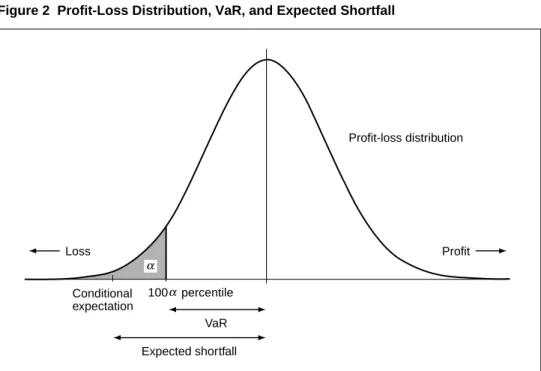
Artzner et al. (1997) have proposed the use of expected shortfall (also called “con-ditional VaR,” “mean excess loss,” “beyond VaR,” or “tail VaR”) to alleviate the problems inherent in VaR.7Expected shortfall is the conditional expectation of loss given that the loss is beyond the VaR level (Figure 2). The expected shortfall is defined as follows.
The definition of expected shortfall
Suppose X is a random variable denoting the profit-loss of a given portfolio and VaRα(X) is the VaR at the 100(1 – α) percent confidence level. ESα(X) is
defined by the following equation.8
ESα(X) = E[–X|–X ≥VaRα(X)]. (1) Loss Profit-loss distribution VaR α 100 percentileα Expected shortfall Profit Conditional expectation
Figure 2 Profit-Loss Distribution, VaR, and Expected Shortfall
7. Fishburn (1977), more than 20 years ago, proposed a risk measure similar to expected shortfall. The risk measure proposed by Fishburn (1977) is defined as follows.
Fγ(t) = ∫
t
–∞(t– x)γdF(x) γ >0,
where F(x) is the distribution function of a random variable denoting profit-loss, t is the target, and γ is the number of moments.
Expected shortfall corresponds to this value if divided by (1 – confidence level) and added to VaRwhere γ= 1 and t= –VaR.
8.E[–X|B] is the conditional expectation of the random variable –Xgiven event B. Since the profit-loss Xis usually negative given that the loss is beyond VaR, –Xis used for the definition to make expected shortfall a positive number.
C. Calculation of Economic Capital Using VaR and Expected Shortfall
VaR is the most popular measure used to calculate economic capital in financial risk management. Furthermore, financial regulators adopt VaR partly to set regulatory requirements for capital. The widespread use of VaR for economic capital calculation may be due to its conceptual simplicity; the economic capital calculated by using VaR at the 100(1 – α) percent confidence level corresponds to the capital needed to keep the firm’s default probability below 100α percent. Thus, risk managers can control the firm’s default probability through the use of VaR for risk management.
On the other hand, expected shortfall is defined as “the conditional expectation of loss given that the loss is beyond the VaR level,” and measures how much one can lose on average in the states beyond the VaR level. Since expected shortfall is by definition more than VaR, economic capital calculation using expected shortfall is more conservative than that using VaR. However, the figure for economic capital calculated by using expected shortfall is hard to interpret with respect to the firm’s default probability. Unlike VaR, expected shortfall does not necessarily correspond to the capital needed to keep the firm’s default probability below some specified level.
III. Non-Normality and Problems of VaR
Artzner et al.(1997) have cited the following shortcomings of VaR: (1) VaR measures only percentiles of profit-loss distributions, and thus it disregards any loss beyond the VaR level, and (2) VaR is not coherent since it is not sub-additive. This section summarizes these criticisms by Artzner et al.(1997). We show that these problems can be serious when the profit-loss does not obey normal distribution.
A. Risk Measurement with VaR When the Profit-Loss Distribution Is Normal When the profit-loss distribution is normal, VaR does not have the problems pointed out by Artzner et al.(1997). First, with the normality assumption, VaR does not have the problem of tail risk. When the profit-loss distribution is normal, expected shortfall and VaR are scalar multiples of each other, because they are scalar multiples of the standard deviation.9Therefore, VaR provides the same information about the tail loss as does expected shortfall. For example, VaR at the 99 percent confidence level is the standard deviation multiplied by 2.33, while expected shortfall at the same confidence level is the standard deviation multiplied by 2.67.
9. When the profit-loss distribution is normal, expected shortfall is calculated as follows.
where I{A}is the indicator function whose value is 1 when A is true and 0 when Ais false, and qαis the upper
100αpercentile of standard normal distribution.
For example, from this equation, expected shortfall at the 99 percent confidence level is the standard deviation multiplied by 2.67, which is the same level as VaR at the 99.6 percent confidence level.
E[–X•I{X≤–VaR α(X)}] 1 t 2 ESα(X) = E[–X|–X≥VaRα(X)] = ——————— = – ————∫–∞ –VaRα(X) t•e – —— 2σ2 Xdt α ασX√–—2π 1 t2 –VaRα(X) σ X VaRα(X) 2 σX qα2σX2 e– ——2 qα2 = – ————
[
–σX 2 e– ——2σ2 X]
= ———e – —–— 2σ2 X —— = ———e– ——–2σ2 X = ———σX, ασX√–—2π –∞ α√–—2π α√–—2π α√–—2πSecond, sub-additivity of VaR can be shown as follows. Suppose that there are two portfolios whose profit-loss obeys multivariate normal distribution. With the normality assumption, as we mentioned earlier, VaR is a scalar multiple of the standard deviation, which satisfies sub-additivity.10 Thus, VaR also satisfies sub-additivity.11
Therefore, with the normality assumption, expected shortfall has no advantage over VaR, since VaR satisfies sub-additivity and provides the same information about the tail loss as does expected shortfall.
B. Risk Measurement with VaR When the Profit-Loss Distribution Is NOT Normal
If the profit-loss distribution is not normal, the problems inherent in VaR can be serious. When we cannot assume normality, expected shortfall cannot be generally represented by a function of the standard deviation. Thus, it is not certain whether VaR provides the same information of the tail loss as does expected shortfall. We should calculate expected shortfall as well as VaR to measure the loss beyond the VaR level. Furthermore, VaR is not sub-additive in general without normality assumption. Artzner et al.(1997, 1999) provide two simple cases where the problems inherent in VaR are serious. The first is a short position on digital options, the second is a concentrated credit portfolio.
Example 1: Short position on digital options12
Consider the following two digital options on a stock, with the same exercise date
T. The first option denoted by A (initial premiumu) pays 1,000 if the value of the stock at timeT is more than a givenU, and nothing otherwise. The second option denoted by B (initial premiuml) pays 1,000 if the value of the stock at
10. If two random variables have finite standard deviations, the standard deviations are shown to be sub-additive as follows.
Let σXand σYbe standard deviations of random variables XandY, and let σXYbe covariance of XandY. Since
σX Y≤σXσY, the standard deviation σX+Yof the random variable X+Ysatisfies sub-additivity as follows.
——————– ———————
σX+Y≡ √σX2+ σY2+ 2σXY ≤ √σX2+ σY2+ 2σXσY = σX+ σY.
σXY≤σXσY can be proved as follows. Let Z be (Y– µY) – t(X – µX) for a real value t, where µX and µY are
expectations of XandY. E[Z2] = t2E[(X– µ X) 2] – 2tE[(X– µ X)(Y– µY)] + E[(Y– µY) 2 ]. = σX2t2– 2σXYt + σY2
Here, let tbe σX Y/σX2, then,
σX2σY2– σXY2 E[Z2] = ————— . σX 2 Since E[Z2 ]≥0, σX Y≤σXσYfollows.
11. To put it more precisely, when the profit-loss distribution is one of the elliptical distribution family and has finite variance (see Ingersoll [1987] for the definition of the elliptical distribution family), VaR is sub-additive (see Embrechts et al. [1999]). The elliptical distribution family includes normal, t, and Pareto distributions. However, for simplicity, we explain the problems of VaR according to whether the distribution is normal. 12. The digital option (also called the binary option) is the right to earn a fixed amount of payment conditional on
timeT is less than L(with L <U), and nothing otherwise. Since the payoffs of those options are not linear, it is clear that the profit-loss distributions are not normal even though the price of the underlying assets obeys normal distribution.
Suppose L and U are chosen such that Pr(ST < L) = Pr(ST >U) = 0.008, where ST is the stock price at time T. Consider two traders, trader A and trader B, writing one unit of option A and option B, respectively. VaR at the 99 percent confidence level of trader A is –u, because the probability that ST is more than U
is 0.8 percent, which is beyond the confidence level.13 Similarly, VaR at the 99 percent confidence level of trader B is –l. This is a clear example of the tail risk. VaR disregards the loss of options A and B, because the probability of the loss is less than one minus the confidence level.
Now consider the combined position on options A and B to show that VaR is not sub-additive. VaR at the 99 percent confidence level of this combined position (option A plus option B) is 1,000 – u–l, because the probability that ST
is more thanU or less thanL is 0.016, which is more than one minus the con-fidence level (0.01). Therefore, since the sum of VaR of individual positions (option A and B) is –u–l, it is clear that VaR is not sub-additive (Table 1).
Table 1 Payoff and VaR of Digital Options
Stock price Probability(percent) Option A Option B Option A + B
ST< L 00.8 u –1,000 + l –1,000 + u + l
L≤ST≤U 98.4 u l u + l
U < ST 00.8 –1,000 + u l –1,000 + u + l
VaR –u –l 1,000 – u – l
Example 2: Concentrated credit portfolio
Suppose that there are 100 corporate bonds, all with the same maturity of one year. Also suppose that all bonds have a coupon rate of 2 percent, a yield-to-maturity of 2 percent, a default probability of 1 percent, and a recovery rate of zero.14 Furthermore, it is assumed that the occurrences of defaults are mutually independent.
First, we consider investing US$1 million into 100 corporate bonds, each with an equal amount of US$10,000. Since this portfolio results in a loss if more than one bond defaults in one year,15the probability of loss is approximately 26 percent (1 – the probability that all bonds do not default – the probability that only one bond defaults = 1 – 100•0.99100– 100•0.9999•0.01). Thus, for this diversified investment, VaR at the 95 percent confidence level is positive since the probability of loss is more than 5 percent.
13. See Footnote 6. In this case, VaR is negative because the profit uis guaranteed at the 99 percent confidence level. 14. We assume that we incur loss only when the corporate bonds default within the holding period of one year. 15. When two corporate bonds default, we lose US$20,000 in principal payments from those two defaulted bonds.
However, we earn US$19,600 in coupon payments from the other 98 non-defaulted bonds. Therefore, the net loss is US$400. If more than two bonds default, the loss is more than US$400.
Second, we consider investing US$1 million into only one of those corporate bonds. For this concentrated investment, we are 95 percent sure that this investment will earn US$20,000, because the default probability is 1 percent. Therefore, VaR at the 95 percent confidence level is –US$20,000. This exemplifies the tail risk of VaR, since VaR disregards the potential loss of default. Furthermore, VaR is not sub-additive, because the VaR of the diversified portfolio is larger than the VaR of the concentrated portfolio.
As we mentioned earlier, expected shortfall considers the loss beyond the VaR level as a conditional expectation. Furthermore, expected shortfall is coherent since it is proved to be sub-additive (Artzner et al.[1997, 1999], Acerbi and Tasche [2001], and Acerbi, Nordio, and Sirtori [2001]). Artzner et al.(1997) have proposed the use of expected shortfall on these grounds.
C. Relevance of the Problems of VaR
In this subsection, we consider whether the problems inherent in VaR are relevant to the practice of risk management. Our main idea is that, while the relevance of sub-additivity may depend on the preferences of risk managers, the tail risk is relevant because it is related to the insolvency of financial institutions, which is among the central issues of financial risk management.
1. Sub-additivity
Whether VaR is valid as a risk measure depends on which aspects of risk are relevant to risk managers. A risk measure that considers all relevant aspects of risk while ignoring irrelevant ones should be considered appropriate from a practical standpoint, because a single risk measure cannot consider all aspects of the profit-loss distribution. Therefore, one should not conclude that VaR is inappropriate only because it is not sub-additive,16 since sub-additivity itself may be irrelevant for risk managers.
For example, suppose that a firm with total assets of ¥100 million invests all of its assets in two catastrophe bonds:17 bond A, linked to earthquakes in Tokyo, and bond B, linked to earthquakes in Los Angeles. We also assume that all principal and coupon payments of bond A and bond B will be lost in the event of those catastrophes. The question is whether the firm should invest all of its assets in bond A or invest ¥50 million each in bonds A and B. If sub-additivity, or risk reduction by portfolio diversification effect, is considered important, investing ¥50 million each in bond A and bond B is preferred. On the other hand, suppose the firm’s equity capital is less than ¥50 million and the risk manager regards the probability of default as the most relevant aspect of risk. In this case, investing all of its assets in bond A is preferred, because the probability that an earthquake will occur
16. Rootzén and Klüppelberg (1999) provide a similar view on sub-additivity.
17. Catastrophe bonds are bonds whose coupon and/or principal payments depend on the loss of, or the occurrence of, a natural catastrophe. Holders of catastrophe bonds can earn a higher coupon because of the inherent reinsurance fee. However, if a predefined catastrophe occurs, all or a part of coupon and principal payments are lost to the bondholders.
either in Tokyo or in Los Angeles is higher than the probability that an earthquake will occur only in Tokyo.18For this risk manager, sub-additivity is irrelevant.
However, sub-additivity may be relevant in some cases. For example, Artzner et al.
(1997) have cited that, if sub-additivity is not satisfied, a financial institution will only be able to reduce its required capital by dividing itself into separate institutions. Furthermore, if an initial margin requirement by a futures exchange fails to satisfy sub-additivity, futures traders can reduce their initial margin only by dividing their accounts into separate accounts. This can be a problem for the futures exchange, because it can be considered a loophole open to futures traders. Moreover, suppose there exists a “conservative” way of aggregating risk simply by summing the VaR of individual positions. If VaR is not sub-additive, this “conservative” way is no longer conservative, because the VaR of the total position can be more than the sum of the VaR of individual positions.
2. The problem of tail risk
On the other hand, the problem of tail risk is relevant to the practice of risk man-agement, because the loss beyond the VaR level corresponds to the institutional insolvency caused by adverse market conditions. Since the institutional insolvency is the central concern for risk managers and financial regulators, disregarding the loss beyond the VaR level is disregarding the central concern of risk managers and financial regulators.19
This leads us to focus on the problem of tail risk in the next section. We emphasize that the problem of tail risk can bring serious practical problems.
IV. Tail Risk of VaR
Basak and Shapiro (2001)20show that the problem of tail risk can bring the following practical problems:
(1) Information given by VaR may mislead investors, because it disregards the loss beyond the VaR level.
(2) Rational investors employing only VaR as a risk measure are likely to con-struct a perverse position that would result in a larger loss in the states beyond the VaR level.
They also show that these problems can be especially serious for option portfolios and credit portfolios. This section illustrates how the tail risk of VaR brings serious practical problems in three cases: an option portfolio, a credit portfolio, and a portfolio dynamically traded in continuous time.
18. For example, if the probability that an earthquake occurs in Tokyo and the probability that an earthquake occurs in Los Angeles are 1 percent, respectively, and the occurrences are mutually independent, the probability that an earthquake occurs in at least one city, i.e., either Tokyo or Los Angeles, is about 2 percent. Since the firm’s equity capital is less than ¥50 million, the default probability of the firm when it invests its assets in bonds A and B is 2 percent, while the default probability when it invests all its assets in bond A is 1 percent.
19. See the BIS Committee on the Global Financial System (2000). Furthermore, Federal Reserve Chairman Greenspan (2000) noted, “In estimating necessary levels of risk capital, the primary concern should be to address those disturbances that occasionally do stress institutional solvency—the negative tail of the loss distribution that is so central to modern risk management.”
A. Option Portfolio
This subsection illustrates the tail risk of VaR with a simple position on a European option. Suppose that an investor constructs a short position on a European option whose maturity is one year. The underlying asset of the option is a stock whose current price and volatility are 100 and 30 percent, respectively. The price of the stock follows a binomial tree process with individual steps of 1/30 year and a probability of upward movement of 0.6. The premium on the European option is the expected payoff at maturity with respect to the risk-neutral probability discounted by the risk-free interest rate.
For simplicity, the investor does not have any financial position other than this short position on the one option. The initial premium received from the short posi-tion is invested in a risk-free bond that earns an annual risk-free rate of 5.0 percent. The investor can control only two variables: the strike price of the option and the amount of the option position.
The final profit of this position is the sum of the payoff at maturity of this option and the future value of the initial premium. Letp(K) be the put option premium with strike price K, Si the stock price at state i, and Pi the subjective probability of state i. Furthermore, assume that the utility u(W) of the investor is represented by
u(W) = lnW, where W is the final wealth, which is the sum of the final profit and the initial wealth (we assume here that the investor’s initial wealth W0 is 3,000).
Then, the expected utility E[u(W)] of the investor is as follows.21
E[u(W)] =
∑
Pi•ln{W0+ x•er•p(K) – x•max[K– Si, 0]}. (2)W: Final wealth
W0: Initial wealth
VaR is the lower αpercentile of the profit-loss distribution of this position,22 and expected shortfall is the conditional expectation of loss given that the loss is beyond the VaR level.
We analyze the effect of risk management with VaR and expected shortfall on the rational investor’s optimal decisions by solving the following five optimization problems.23
(1) No constraint maxE[u(W)].
{x,K}
21.E[•] is the expectation operator with respect to the subjective probability.
22. Since the profit-loss distribution in this model is discrete, there may not be any event whose cumulative proba-bility is equal to 5 percent. Therefore, from the definition in Footnote 6, VaR is calculated as the maximum loss of the states whose cumulative probability is over 5 percent.
23. The minimum and maximum of the strike price are set at 35 and 288, respectively. Those values correspond to the minimum and maximum of the final stock price in our binomial tree model. Furthermore, we constrained the amount of the short position to be less than 60 units so that the final wealth would not be negative in any state.
(2) Constraint with VaR at the 95 percent confidence level maxE[u(W)],
{x,K}
subject to VaR(95 percent confidence level) ≤5.
(3) Constraint with expected shortfall at the 95 percent confidence level maxE[u(W)],
{x,K}
subject to expected shortfall(95 percent confidence level) ≤7. (4) Constraint with VaR at the 99 percent confidence level
maxE[u(W)], {x,K}
subject to VaR(99 percent confidence level) ≤5.
(5) Constraint with expected shortfall at the 99 percent confidence level maxE[u(W)],
{x,K}
subject to expected shortfall(99 percent confidence level) ≤7.
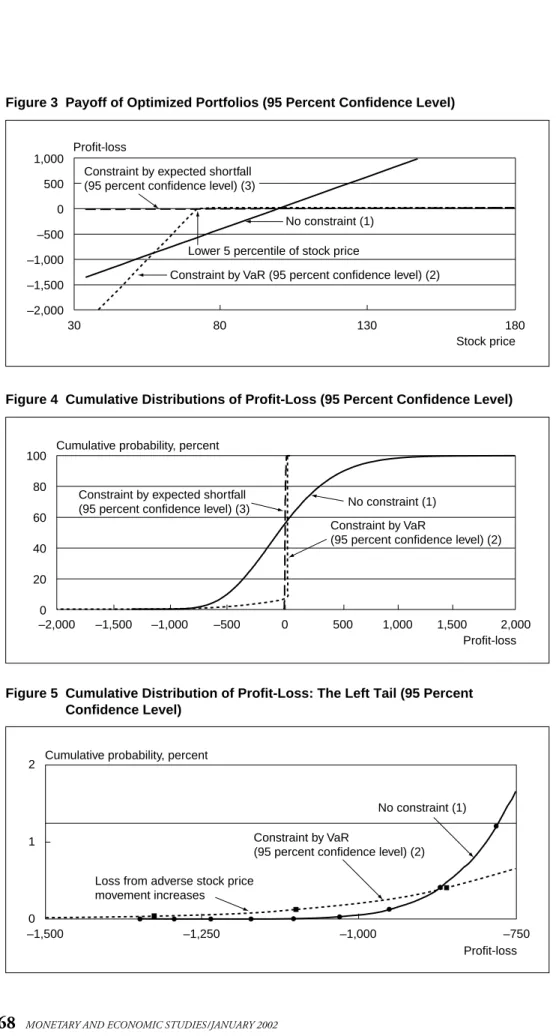
Table 2 shows the results of the optimization problems (1), (2), and (3). The solution with no constraint ([1] in Table 2) consists of selling 21 units of a deep-in-the-money option, while the solution with a 95 percent VaR constraint ([2] in Table 2) consists of selling 60 units of a far-out-of-the-money option. When constrained by VaR, the strike price is set just outside the 95 percent confidence interval so that the investor does not incur a large loss within the 95 percent con-fidence interval. However, the loss beyond the VaR level increases due to the increase in the amount of the short position (Figure 3). This implies that, when constrained by VaR, rational investors optimally construct a perverse position that would result in a larger loss in the states beyond the VaR level.24 On the other hand, the solution with a 95 percent expected shortfall constraint ([3] in Table 2) involves little risk, since it consists of selling an insignificant amount of the deep-in-the-money option.
Figures 4 and 5, which show the cumulative profit-loss distribution of solutions (1), (2), and (3), provide further illustrations. With the VaR constraint, the side of the distributions (the area between the center and the tail of the distribution) becomes thin to limit VaR by insuring the loss in the normal states. However, the tail of the distributions becomes fat because the investor increases the amount of the
24. Ahn, Boudoukh, and Richardson (1999) show that, to minimize the VaR of an option portfolio, it is optimal to write an out-of-the-money option.
Table 2 Portfolio Profiles (95 Percent Confidence Level)
No constraint (1) Constraint byVaR* (2) Constraint by expectedshortfall** (3)
Position Selling volume 021 060 000.23
Strike price 288 072 288.00
Risk measure VaR 570 005 006.00
Expected shortfall 643 213 007.00
** Optimize with the constraint that VaR at the 95 percent confidence level is less than or equal to 5. ** Optimize with the constraint that expected shortfall at the 95 percent confidence level is less than or equal
1,000 500 0 –500 –1,000 –1,500 –2,000 Profit-loss 30 80 130 180 Stock price Constraint by expected shortfall
(95 percent confidence level) (3)
No constraint (1)
Constraint by VaR (95 percent confidence level) (2) Lower 5 percentile of stock price
Figure 3 Payoff of Optimized Portfolios (95 Percent Confidence Level)
100 80 60 40 20 0
Cumulative probability, percent
–2,000 –1,500 –1,000 –500 0 500 1,000 1,500 2,000
Profit-loss Constraint by expected shortfall
(95 percent confidence level) (3) No constraint (1) Constraint by VaR
(95 percent confidence level) (2)
Figure 4 Cumulative Distributions of Profit-Loss (95 Percent Confidence Level)
2
1
0
Cumulative probability, percent
–1,500 –1,250 –1,000 –750
Profit-loss No constraint (1)
Loss from adverse stock price movement increases
Constraint by VaR
(95 percent confidence level) (2)
Figure 5 Cumulative Distribution of Profit-Loss: The Left Tail (95 Percent Confidence Level)
short position. On the other hand, with the constraint with expected shortfall, the tail of the distributions becomes thin because the investor decreases the amount of the short position to limit the loss beyond the VaR level.
Let us consider whether raising the confidence level of VaR to 99 percent can alleviate this problem. Table 3 shows the results of the optimization problems when the confidence levels are raised to 99 percent. The solution with a 99 percent VaR constraint ([4] in Table 3) consists of selling 60 units of the far-out-of-the-money option, whose strike price is set just outside the 99 percent confidence interval. Again, the loss beyond the VaR level is increased due to the increase in the amount of the short position. Therefore, we cannot mitigate the problem of VaR merely by raising VaR’s confidence level (Figures 3 and 6).
1,000 500 0 –500 –1,000 –1,500 –2,000 Profit-loss 30 80 130 180 Stock price Constraint by expected shortfall
(99 percent confidence level) (5)
No constraint (1)
Constraint by VaR (99 percent confidence level) (4) Lower 1 percentile of stock price
Figure 6 Payoff of Optimized Portfolios (99 Percent Confidence Level) Table 3 Portfolio Profiles (99 Percent Confidence Level)
No constraint (1) Constraint byVaR* (4) Constraint by expectedshortfall** (5)
Position Selling volume 021 060 000.18
Strike price 288 062 288.00
Risk measure VaR 774 005 007.00
Expected shortfall 816 123 007.00
** Optimize with the constraint that VaR at the 99 percent confidence level is less than or equal to 5. ** Optimize with the constraint that expected shortfall at the 99 percent confidence level is less than or equal
to 7.
This subsection shows how the problem of tail risk brings serious practical problems in a simple option position. Investors can evade risk management with VaR by manipulating the strike price and the amount of the option position. We cannot alleviate this problem merely by raising VaR’s confidence level.
B. Credit Portfolio
This subsection provides a simple illustration of how the tail risk of VaR can bring serious practical problems in credit portfolios. Risk management with VaR may
enhance credit concentration, because VaR disregards the increase of the tail loss due to credit concentration.
Suppose that an investor invests ¥100 million in the following four mutual funds: (1) concentrated portfolio A, consisting of only one defaultable bond with a 4 percent default rate, (2) concentrated portfolio B, consisting of only one defaultable bond with a 0.5 percent default rate, (3) a diversified portfolio that consists of 100 defaultable bonds with a 5 percent default rate, and (4) a risk-free asset. For simplicity, we assume that the profiles of all bonds in those funds are specified as follows: the maturity is one year, the occurrences of default events are mutually independent, the recovery rate is 10 percent, and the yield to maturity is equal to the coupon rate. We further assume that the yield to maturity, the default rate, and the recovery rate are fixed until maturity. Table 4 shows the specific profiles of bonds included in these mutual funds.
25. The probability that concentrated portfolio A does not default is 0.96 (1 – 0.04), and the probability that concentrated portfolio B does not default is 0.995. Furthermore, the probability that nbonds of the diversified portfolio default is 0.05n
•0.95100 –n• 100Cn, where mCnis the number of combinations choosing nout of m. The
probability that both of the concentrated portfolios A and B do not default and nbonds of the diversified portfolio default is the product of those probabilities.
Table 4 Profiles of Bonds Included in the Mutual Funds
Number of Coupon Default rate* Recovery rate bonds included (percent) (percent) (percent)
Concentrated portfolio A 001 4.75 4.00 10
Concentrated portfolio B 001 0.75 0.50 10
Diversified portfolio 100 5.50 5.00 10
Risk-free asset 001 0.25 0.00 —
*The occurrences of defaults are mutually independent.
The probability that both of the concentrated portfolios A and B do not default and n bonds of the diversified portfolio do actually default is 0.96•0.995•0.05n• 0.95100 –n•
100Cn.25 The probability that both of the concentrated portfolios A and B default and n bonds of the diversified portfolio default is 0.04•0.005•0.05n• 0.95100 –n•
100Cn. Therefore, assuming log utility, the expected utility of the investor is as follows. 100 E[u(W)] =
∑
0.96•0.995•0.05n• 0.95100 –n• 100Cn n=1 1.0475•X 1+ 1.0075•X2 •ln 100 – 0.9n + 1.055•X 3• ————— + 1.0025•(W0– X1– X2– X3) 100 100 E[u(W)]+∑
0.04•0.995•0.05n•0.95100 –n•100Cn n=1 1.0475•0.1X1+ 1.0075•X2 •ln 100 – 0.9n + 1.055•X3• ————— + 1.0025•(W0– X1– X2– X3) 100100 E[u(W)]+
∑
0.96•0.005•0.05n• 0.95100 –n• 100Cn n=1 1.0475•X 1+ 1.0075•0.1X2 •ln 100 – 0.9n + 1.055•X 3• ————— + 1.0025•(W0– X1– X2– X3) 100 100 E[u(W)]+∑
0.04•0.005•0.05n•0.95100 –n•100Cn n=1 1.0475•0.1X1+ 1.0075•0.1X2 •ln 100 – 0.9n , + 1.055•X3• ————— + 1.0025•(W0– X1– X2– X3) 100 (3) W : Final wealth W0: Initial wealthX1 : Amount invested in concentrated portfolio A
X2 : Amount invested in concentrated portfolio B
X3 : Amount invested in the diversified portfolio
VaR and expected shortfall are calculated according to the definitions in Footnote 6 and Subsection II.B, respectively.
We analyze the impact of risk management with VaR and expected shortfall on the rational investor’s optimal decisions by solving the following five optimization problems.
(1) No constraint maxE[u(W)]. {X1,X2, X3}
(2) Constraint with VaR at the 95 percent confidence level maxE[u(W)],
{X1,X2, X3}
subject to VaR (95 percent confidence level) ≤3.
(3) Constraint with expected shortfall at the 95 percent confidence level maxE[u(W)],
{X1,X2, X3}
subject to expected shortfall (95 percent confidence level) ≤3.5. (4) Constraint with VaR at the 99 percent confidence level
maxE[u(W)], {X1,X2, X3}
subject to VaR (99 percent confidence level) ≤3.
(5) Constraint with expected shortfall at the 99 percent confidence level maxE[u(W)],
{X1,X2, X3}
Tables 5–6 and Figures 7–10 show the results of these optimization problems. We analyze the effect of risk management with VaR and expected shortfall by comparing solutions (2)–(5) with solution (1).
100 80 60 40 20 0
Cumulative probability, percent
–20 –15 –10 –5 0 5
Profit-loss No constraint (1)
Constraint by expected shortfall (3) Constraint by VaR (2)
Figure 7 Cumulative Distribution of Profit-Loss (95 Percent Confidence Level) Table 5 Optimal Portfolios by Each Type of Risk Management
(95 Percent Confidence Level)
Risk management Risk management No constraint (1) with VaR* (2) with expected
shortfall** (3) Portfolio Concentrated portfolio A 07.40 20.10 02.90
(percent) (default rate: 4 percent)
Concentrated portfolio B 00.00 00.00 02.00
(default rate: 0.5 percent)
Diversified portfolio 92.60 79.90 95.10
Risk-free asset 00.00 00.00 00.00
Risk measure VaR 03.35 03.00 02.75
(¥ millions) Expected shortfall 05.26 14.35 03.50
** Optimize with the constraint that VaR at the 95 percent confidence level is less than or equal to 3.
** Optimize with the constraint that expected shortfall at the 95 percent confidence level is less than or equal to 3.5.
Table 6 Optimal Portfolios by Each Type of Risk Management (99 Percent Confidence Level)
Risk management Risk management No constraint (1) with VaR* (4) with expected
shortfall** (5) Portfolio Concentrated portfolio A 07.40 00.70 00.70
(percent) (default rate: 4 percent)
Concentrated portfolio B 00.00 18.80 00.50
(default rate: 0.5 percent)
Diversified portfolio 92.60 64.90 65.60
Risk-free asset 00.00 15.60 33.20
Risk measure VaR 06.77 03.00 03.13
(¥ millions) Expected shortfall 07.83 07.33 03.50
** Optimize with the constraint that VaR at the 99 percent confidence level is less than or equal to 3.
10
5
0
Cumulative probability, percent
–20 –15 –10 –5
Profit-loss No constraint (1)
Constraint by expected shortfall (3) Constraint by VaR (2)
Figure 8 Cumulative Distribution of Profit-Loss: The Left Tail (95 Percent Confidence Level) 100 80 60 40 20 0
Cumulative distribution, percent
–20 –15 –10 –5 0 5
Profit-loss No constraint (1)
Constraint by expected shortfall (5)
Constraint by VaR (4)
Figure 9 Cumulative Distribution of Profit-Loss (99 Percent Confidence Level)
5 4 3 2 1 0
Cumulative probability, percent
–20 –15 –10 –5 0
Profit-loss No constraint (1)
Constraint by expected shortfall (5) Constraint by VaR (4)
Figure 10 Cumulative Distribution of Profit-Loss: The Left Tail (99 Percent Confidence Level)
First, we examine the solution of the optimization problem with a 95 percent VaR constraint ([2] in Table 5). The amount invested in concentrated portfolio A is greater than that of solution (1), that is, the portfolio concentration is enhanced as a result of risk management with VaR. The cumulative probability distributions of the profit-loss of the portfolios in Figures 7 and 8 show how risk management with VaR brings about this perverse result. When constrained by VaR, the investor has to decrease his investment in the diversified portfolio to reduce the maximum loss with a 95 percent confidence level. The proceeds of the sales of the diversified portfolio should be invested either in concentrated portfolios or in a risk-free asset. Concentrated portfolio A has little effect on VaR since the probability of default is outside the 95 percent confidence interval. Thus, the investor optimally chooses to invest the proceeds in concentrated portfolio A, because this investment ensures a higher return26 and has little effect on VaR. Although VaR is reduced, this result would be considered perverse because of its enhanced concentration and a larger loss in the states beyond the VaR level.
Second, we examine the solution with a 95 percent expected shortfall constraint ([3] in Table 5). When constrained by expected shortfall, the investor optimally reallocates his investment to a risk-free asset, substantially reducing the risk of the portfolio. The investor cannot increase his investment in the concentrated portfolio without affecting expected shortfall, which considers the loss beyond the VaR level as a conditional expectation. Therefore, unlike risk management with VaR, risk management with expected shortfall does not enhance credit concentration.
The next question we consider is whether raising the confidence level of VaR can be a solution to the problem. Table 6 shows that, when constrained by VaR at the 99 percent confidence level, the investor optimally chooses to increase his investment in concentrated portfolio B because the default rate of concentrated portfolio B is 0.5 percent, which is outside the confidence level of VaR. Furthermore, the cumula-tive probability distributions of profit-loss of optimized portfolios (Figures 9 and 10) show that risk management with VaR increases the loss beyond the VaR level. On the other hand, risk management with expected shortfall reduces the potential loss beyond the VaR level by reducing credit concentration.
This subsection showed that the tail risk of VaR causes failure of credit risk man-agement. VaR can enhance credit concentration, because it disregards the loss beyond the VaR level. On the other hand, expected shortfall reduces credit concentration, because it considers the loss beyond the VaR level as a conditional expectation. C. Dynamically Traded Portfolio
This subsection provides the third example, where investors trade two securities (a stock and a bond) dynamically in continuous time. The results and the illustrations in this subsection are completely dependent on Basak and Shapiro (2001).27
26. The result depends on the return of the concentrated portfolio. If the return of the concentrated portfolio is low, the proceeds are invested in a risk-free asset. That is, whether the risk management with VaR enhances credit concentration depends on the return of concentrated credits.
27. For the purpose of simple illustration, we have substantially simplified the setting of Basak and Shapiro (2001) and do not provide the detailed derivations of the solutions. See Basak and Shapiro (2001) for further details.
In a general setting where investors trade assets dynamically in continuous time, Basak and Shapiro (2001) show that, if investors are constrained to limit VaR to a specified level, they optimally choose to construct a position that would result in a larger loss in the states beyond the VaR level. Even though the prices of stocks in this model are assumed to follow a geometric Brownian motion (or obey a log-normal distribution), the profit-loss of the portfolio does not obey a log-normal distribution, because dynamic adjustment of the portfolio creates non-linearity of the final payoff.
Suppose that an investor has initial wealth W(0) at t = 0, and maximizes his expected utility. The utility function is the logarithm of the final wealth W(T) at
t =T, or u(W(T)) = lnW(T). Because the utility is solely determined by the final wealth, the investor has no incentive to consume his wealth until time t = T. The investor trades two assets, a risk-free bond B and a stock S, dynamically in continuous time. We further assume that the investor’s trading strategy is self-financing; no money is added to or withdrawn from the portfolio between times 0 and T. Therefore, as there is no consumption, the final value of the portfolio results entirely from net gains or losses realized on the investment. The dynamics of the prices of those assets are given by the following stochastic differential equations.
dB(t) = B(t)rdt, (4)
dS(t) = S(t)[µdt+ σdw(t)], (5)
where w(t) is a standard Brownian motion and r, µ, and σare constants. We consider the following state-price density ξ(t).
1 µ– r µ– r
ξ(t) ≡exp
(
–r+ —(
——–)
2t – ——–w(t))
. (6) 2 σ σ
Since the trading strategy is self-financing and there is no consumption, the budget constraint for the investor can be represented by the following equation.
E[ξ(T)W(T)]≤W(0). (7)
Therefore, the optimization problem for the investor is formulated as follows. maxE[lnW(T)],
W(T)
subject to E[ξ(T)W(T)]≤W(0). (8) The solution for this problem is
W(0)
W(T) = ——–. (9)
Using equations (5), (6), and (9), we obtain W(0) W(0) ——µσ–r W(T) = ——– = ———— = A–1• W(0)•S(T) , (10) ξ(T) – ——µσ–r A•S(T) where A >0 is constant.
Equation (10) shows that the optimal final wealth is a function of the stock price at maturity. Figure 11 shows the relationship between the optimal final wealth and the stock price at maturity.
W (T ) S (T ) 0 W (T ) = A W (0) S (T ) –r µ σ
Optimal final wealth
Stock price at maturity
Figure 11 Optimal Final Wealth
Let us consider the effect of risk management with VaR on this optimization problem. Since VaR is defined as “possible maximum loss over a given holding period within a fixed confidence level,” VaR(α) with a holding period of T at the 100(1 – α) percent confidence level is defined as follows.
P(W(0) – W(T) ≤VaR(α)) ≡1 – α. (11) Here, we formulate risk management with VaR as limiting VaR to being less than or equal to the equity capital.
Let W–– be the difference between the initial wealth and the equity capital. W–– denotes
the minimum level of final wealth given that the loss is less than the equity capital and the investor remains solvent. Equation (12) can be reformulated as
VaR(α) ≤W(0) –W–– . (13)
From equations (11) and (13), we obtain
P(W(T) ≥W–– ) ≥1 – α. (14)
This condition shows that to manage risk with VaR is to constrain the probability of solvency to be more than 100(1 – α) percent. Therefore, the optimization problem with VaR risk management is formulated as follows.
maxE[u(W(T))],
W(T)
subject to E[ξ(T)W(T)] ≤W(0), (15)
P(W(T) ≥W–– ) ≥1 – α.
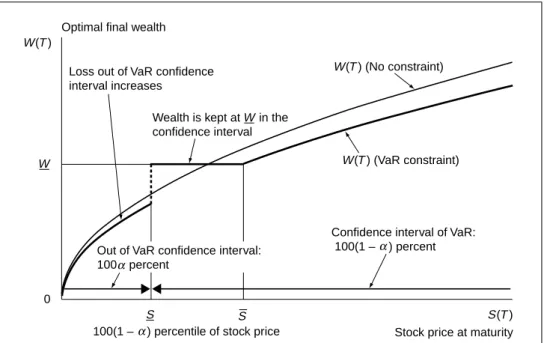
Figure 12 illustrates the solution of this optimization problem. To satisfy the VaR constraint, the final wealth should be more than W–– within a given confidence interval.
However, to satisfy the budget constraint, the improvement of final wealth in those states must be compensated for by the reduction of final wealth in other states. This would lead to a decrease in final wealth in the states outside the confidence interval compared with the optimal solution without a VaR constraint.
S (T ) Stock price at maturity W (T )
0
Optimal final wealth
W
S S
Out of VaR confidence interval: 100 percentα
100(1 – ) percentile of stock priceα
Confidence interval of VaR: 100(1 – ) percentα
W (T ) (VaR constraint) W (T ) (No constraint) Loss out of VaR confidence
interval increases
Wealth is kept at W in the confidence interval
Therefore, rational investors employing VaR as their sole risk measure take a position that would result in a larger loss when the stock price falls below the confidence interval.28
Let us consider the effect of risk management with expected shortfall on the investor’s rational decision. For simplicity, we redefine expected shortfall as the conditional expectation of loss given that the loss is beyond some threshold W––.29 We define risk management with expected shortfall as limiting this conditional expectation to being less than or equal to some specific constant η, which can be interpreted as the level of the investor’s equity capital. The formulation is given by
E[W(0) – W(T)|W(T) ≤W–– ] ≤η. (16) Let ε ≡ η–W(0) +W–– , then
E[W–– – W(T)|W(T) ≤W–– ] ≤ε. (17) For simplicity, Basak and Shapiro (2001) modify equation (17) as follows.30
E[ξ(T)(W–– –W(T))1{W(T)≤W–– }] ≤ε. (18)
From the definition of the conditional expectation,
E[ξ(T)(W–– –W(T))1{W(T)≤W–– }]
=E[ξ(T)(W–– –W(T))|W(T) ≤W–– ]P(W(T) ≤W–– ). (19) This equation shows that the left-hand side of equation (18) is the conditional expectation (adjusted by the state price density) multiplied by the probability of loss beyond the threshold. Basak and Shapiro (2001) call the left-hand side of equation (18) “limited expected loss (LEL).” We consider this a variant of expected shortfall. The optimization problem with constraint by limited expected loss can be formulated as follows.
maxE[u(W(T))],
W(T)
subject to E[ξ(T)W(T)]≤W(0), (20)
E[ξ(T)(W–– –W(T))1{W(T)≤W–– }] ≤ε.
28. Using the general equilibrium framework, Basak and Shapiro (2001) show that the introduction of risk management with VaR would increase stock price volatility in the worst states.
29. If we let W–– =W(0) –VaR(α), this value corresponds to expected shortfall. However, since VaR(α) changes
according to the investor’s trading strategy, the optimization problem becomes intractable if we use original expected shortfall as a side constraint. Thus, we set this threshold at a constant W––.
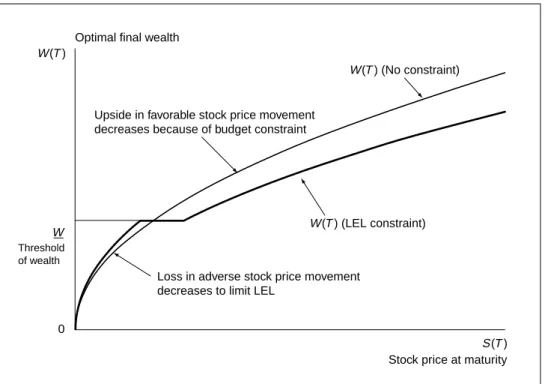
Figure 13 illustrates the solution of this optimization problem. The investor optimally chooses to decrease the loss beyond the threshold to limit the expected shortfall. However, with the budget constraint, the final wealth in the better states decreases to compensate for the decrease in the loss beyond the threshold. Therefore, risk management with limited expected loss, a variant of expected shortfall, prevents investors from taking perverse positions that would result in a larger loss beyond the VaR level.
The result of this subsection implies that the tail risk can bring serious problems when investors trade assets dynamically, since they can manipulate the final payoffs of their portfolios through dynamic trading. Furthermore, this shows that the result in Subsection IV. A of a static option trading strategy generally applies to broad types of European option instruments, because the payoff of any European-type option can be replicated by dynamic trading strategies.
W (T )
0 W
Optimal final wealth
S (T ) W (T ) (LEL constraint)
W (T ) (No constraint)
Loss in adverse stock price movement decreases to limit LEL
Upside in favorable stock price movement decreases because of budget constraint
Threshold of wealth
Stock price at maturity
Figure 13 Optimal Final Wealth with a Constraint by LEL
D. Manipulation of the Tail of Distribution
The illustrations in the previous subsections imply that, if investors can invest in assets whose loss is infrequent but large (such as far-out-of-the-money options or concentrated credit), the problem of tail risk can be serious. Furthermore, investors can manipulate the profit-loss distribution using those assets, so that the side becomes thin and the tail becomes fat (Figure 14). This manipulation of the profit-loss distributions enables investors to decrease VaR without decreasing their investment in risky assets.
Moreover, raising the confidence level of VaR does not solve the problem, because investors can construct positions that would result in a large loss beyond the new confidence level. On the other hand, expected shortfall is less likely to provide perverse incentives, since expected shortfall considers the loss beyond the VaR level.
V. Applicability of Expected Shortfall
As we mentioned earlier, at least conceptually, expected shortfall is superior to VaR because expected shortfall is less likely to provide perverse incentives to investors. Moreover, Rockafeller and Uryasev (2000) show that portfolio optimization is easier with expected shortfall than with VaR, because expected shortfall is convex while VaR is not.
However, to apply expected shortfall to the practice of risk management, risk managers should weigh the strength and weakness of expected shortfall compared with those of VaR (Table 7). From the practical point of view, the effectiveness of expected shortfall depends on the stability of estimation and the choice of efficient backtesting methods.
First, the accurate estimation of the tail of the distribution is especially important for the effectiveness of expected shortfall, because expected shortfall considers the loss beyond the VaR level as a conditional expectation.31However, the accurate estimation
100 percent α Cumulative probability Expected shortfall (Conditional expectation) VaR (100 percentile)α The side of the distribution becomes thin
The tail of the distribution becomes fat
Figure 14 Cumulative Distribution of Profit-Loss When the Tail Risk Occurs
31. Extreme value theory (EVT) can be applied to estimate the tail of distributions. For numerical calculations of expected shortfall using EVT, see Neftci (2000) and Scaillet (2000).
of the tail of the distribution is difficult with conventional estimation methods. For example, the correlation among asset prices observed in normal market condi-tions may break down in extreme market condicondi-tions. This correlation breakdown would make it impossible for risk managers to estimate the tail of the portfolio profit-loss distribution with only conventional Monte Carlo simulations with constant correlation.32
Second, the backtesting of expected shortfall is difficult. The backtesting using VaR tests the validity of a given model by comparing the frequency of the loss beyond estimated VaR with the confidence level of VaR. On the other hand, the backtesting using expected shortfall must compare the average of realized losses beyond the VaR level with the estimated expected shortfall. This requires more data than the backtesting using VaR, since the loss beyond the VaR level is infrequent, thus the average of them is hard to estimate accurately.
VI. Notes of Caution When Using VaR for Risk Management
Although expected shortfall is a conceptually superior risk measure to VaR, the stability of estimation and the choice of efficient backtesting methods are yet to be established. Therefore, we presume that VaR will be used as the standard measure in the finance industry. If this is the case, users of VaR such as risk managers and financial regulators should be well cautioned concerning the problems of tail risk. This section lists some notes of caution when using VaR for risk management. A. Relevance of Tail Risk Depends on the Property of the Portfolio
Generally, a single measure cannot represent all aspects of risk. Therefore, risk managers should watch whether the aspects of risk missed by risk measures are relevant to the practice of risk management. We emphasized the problem of tail risk
32. Historical simulations may not be able to ensure stable estimation because of insufficient historical data for tail loss.
Table 7 Strength and Weakness of VaR and Expected Shortfall
VaR is:
Strength — Related to the firm’s own default probability
— Easily applied to backtesting — Established as the standard risk
measure and equipped with sufficient infrastructure (including software and system)
Weakness — Unable to consider loss beyond the VaR level (tail risk)
— Likely to give perverse incentives to investors if manipulation of the profit-loss distribution is possible — Not sub-additive
— Difficult to apply to portfolio optimizations
Expected shortfall is: — Able to consider loss beyond the VaR
level
— Less likely to give perverse incentives to investors
— Sub-additive
— Easily applied to portfolio optimizations — Not related to the firm’s own default
probability
— Not easily applied to efficient backtest-ing method
— Not ensured with stable estimation — Insufficient in infrastructure (including
because tail risk can bring serious practical problems both for risk managers and financial regulators.
Section IV shows that the tail risk is serious when investors have an opportunity to invest in assets whose loss is infrequent but large. Option and credit portfolios are typical of such vulnerable portfolios. Risk managers and financial regulators should be cautioned when dealing with those kinds of portfolios.
B. Risk Management with VaR May Give a Perverse Incentive to Rational Investors
Section IV showed that, if investors have an opportunity to invest in assets whose loss is infrequent but large, the investors can reduce VaR by manipulating the profit-loss distributions. Furthermore, rational investors employing only VaR as a risk measure are likely to construct a perverse position that would result in a larger loss in the states beyond the VaR level. Raising the confidence level of VaR cannot solve this problem.
Therefore, users of VaR, such as risk managers and financial regulators, should be always reminded of the perverse incentives provided by VaR, and should implement complementary measures if necessary.
C. Implications for Stress Tests
The BIS Committee on the Global Financial System (2000) summarizes how stress tests are used in internationally active financial institutions as follows.
(1) Comparative analyses between the firm’s risk-taking and risk appetite
“Stress tests produce information summarising the firm’s exposure to extreme, but possible, circumstances. Risk managers at interviewed firms frequently described their roles within firms as assembling and summarising information to enable senior management to understand the strategic relationship between the firm’s risk-taking (such as the extent and character of financial leverage employed) and risk appetite.”
(2) Measurement of tail risk
“If large losses carry an especially heavy cost to the firm, senior management may use stress tests to guide the firm away from risk profiles with excessive tail risk.”
Conventional practices of stress tests such as calculating VaR at a high confidence level (for example, 99.99 percent) or calculating extreme loss with historical or hypothetical stress scenarios may be appropriate for the first purpose (i.e., analyses comparing the firm’s risk-taking and risk appetite). However, those conventional methods are not appropriate for the second purpose (measuring tail risk), because they are based solely on the single point of profit-loss distributions. Traders can evade risk limits calculated by the conventional stress tests by taking an excessive risk beyond this point. To measure the portfolio’s vulnerability to tail risk, risk managers should adopt risk measurement methods that can incorporate information concerning the tail, typically risk measurement with expected shortfall.
D. Importance of Adequate Risk Management at the Desk Level
Some practitioners may counter the criticisms of VaR, saying, “At the trading desk level, we do not rely solely on VaR. Risks are managed with numerous quantitative and qualitative measures such as detailed monitoring of the profit-loss diagrams of individual positions. Thus, the tail risk can be managed adequately with those conventional risk management practice at the desk level.”
The validity of this view depends on whether adequate tail risk management at the desk level ensures adequate tail risk management at the companywide level. If this does not hold, the validity of the practitioner’s view would be seriously questioned. We can infer the validity of this view using sub-additivity of expected shortfall. Since expected shortfall is sub-additive, expected shortfall of the total position is no more than the sum of expected shortfall of the individual positions. If we can consider expected shortfall to represent the tail risk, adequate risk management at the desk level ensures appropriate risk management at the companywide level. This suggests the necessity and the effectiveness of adequate risk management at the desk level. E. Importance of Managing Credit Concentration
Subsection IV.B showed that credit concentration plays the main role in the tail risk of credit portfolios. Credit Suisse Financial Products (1997) notes that credit risk management beyond the VaR level should be “quantified using scenario analysis and controlled with concentration limits.” When we use VaR for the risk management of credit portfolios, we should ensure that credit concentration is limited by complementary measures, since VaR disregards the increase of the potential loss due to credit concentration.
VII. Concluding Remarks
We considered the validity of VaR as a risk measure by comparing it with expected shortfall. We emphasized the problem of tail risk, or the problem that VaR disregards the loss beyond the VaR level. This problem can bring serious practical problems, because information provided by VaR may mislead investors. Investors can alleviate this problem by adopting expected shortfall, since it also considers the loss beyond the VaR level. However, the effectiveness of expected shortfall depends on the stability of estimation and the choice of efficient backtesting methods. Risk managers should weigh the strength and weakness of expected shortfall before adopting it as part of the practice of risk management.
There are several outstanding issues for further research other than the problems of the stable estimation and the efficient backtesting of expected shortfall. Among the most important issues is how to identify portfolios vulnerable to the tail risk efficiently. If we know how to identify vulnerable portfolios, we are able to manage tail risk efficiently by implementing complementary measures such as calculation of expected shortfall only to those vulnerable portfolios. Section IV provides an intuitive answer to this question; a portfolio that includes assets whose loss is large but infrequent is vulnerable to tail risk because investors can manipulate the
profit-loss distributions. This answer may not be sufficient for risk managers, because it does not answer how large is “large” enough or how infrequent is “infrequent” enough for tail risk to bring serious practical problems. Therefore, we hope that future research will provide us with more rigorous guidance on how to identify vulnerable portfolios.
Acerbi, C., C. Nordio, and C. Sirtori, “Expected Shortfall as a Tool for Financial Risk Management,” working paper, Italian Association for Financial Risk Management, 2001.
———, and D. Tasche, “On the Coherence of Expected Shortfall,” working paper, Center for Mathematical Sciences, Munich University of Technology, 2001.
Ahn, D., J. Boudoukh, and M. Richardson, “Optimal Risk Management Using Options,” The Journal of Finance, 54 (1), 1999, pp. 359–375.
Artzner, P., F. Delbaen, J. M. Eber, and D. Heath, “Thinking Coherently,” Risk, 10 (11), 1997, pp. 68–71.
———, ———, ———, and ———, “Coherent Measures of Risk,” Mathematical Finance, 9 (3), 1999, pp. 203–228.
Basak, S., and A. Shapiro, “Value-at-Risk Based Risk Management: Optimal Policies and Asset Prices,” The Review of Financial Studies, 14 (2), 2001, pp. 371–405.
BIS Committee on the Global Financial System, “Stress Testing by Large Financial Institutions: Current Practice and Aggregation Issues,” No. 14, 2000.
Credit Suisse Financial Products, Credit Risk+: A Credit Risk Management Framework, 1997.
Danielsson, J., “The Emperor Has No Clothes: Limits to Risk Modelling,” working paper, Financial Markets Group, London School of Economics, 2001.
Embrechts, P., A. McNeil, and D. Straumann, “Correlation and Dependency in Risk Management: Properties and Pitfalls,” preprint, ETH Zürich, 1999.
Fishburn, P. C., “Mean-Risk Analysis with Risk Associated with Below-Target Returns,” American Economic Review, 67 (2), 1977, pp. 116–126.
Greenspan, A., “Banking Evolution,” remarks at the 36th Annual Conference on Bank Structure and Competition of the Federal Reserve Bank of Chicago (http://www.federalreserve.gov/ boarddocs/speeches/2000/20000504.htm), 2000.
Ingersoll, J. E., Jr., Theory of Financial Decision Making, Rowman & Littlefield Publishers, 1987. Kim, J., and J. Mina, RiskGrades Technical Document, RiskMetrics Group, 2000.
Neftci, S. N., “Value at Risk Calculations, Extreme Events, and Tail Estimation,” Journal of Derivatives, 7 (3), 2000, pp. 23–37.
Rockafeller R. T., and S. Uryasev, “Optimization of Conditional Value-at-Risk,” Journal of Risk, 2 (3), 2000, pp. 21–41.
Rootzén, H., and C. Klüppelberg, “A Single Number Can’t Hedge against Economic Catastrophes,” Ambio, 26 (6), 1999, pp. 550–555.
Scaillet, O., “Nonparametric Estimation and Sensitivity Analysis of Expected Shortfall,” working paper, IRES, 2000.
Ulmer, A., “Picture of Risk,” technical document, RiskMetrics Group, 2000.

![Table 2 shows the results of the optimization problems (1), (2), and (3). The solution with no constraint ([1] in Table 2) consists of selling 21 units of a deep-in-the-money option, while the solution with a 95 percent VaR constraint ([2]](https://thumb-us.123doks.com/thumbv2/123dok_us/11030465.2990285/11.772.142.692.798.905/results-optimization-problems-solution-constraint-consists-solution-constraint.webp)