Meccawy, Maram (2009) A service-orientated
architecture for adaptive and collaborative e-learning
systems. PhD thesis, University of Nottingham.
Access from the University of Nottingham repository:
http://eprints.nottingham.ac.uk/10684/1/Maram_Meccawy_PhD_eThesis.pdf
Copyright and reuse:
The Nottingham ePrints service makes this work by researchers of the University of Nottingham available open access under the following conditions.
· Copyright and all moral rights to the version of the paper presented here belong to
the individual author(s) and/or other copyright owners.
· To the extent reasonable and practicable the material made available in Nottingham
ePrints has been checked for eligibility before being made available.
· Copies of full items can be used for personal research or study, educational, or
not-for-profit purposes without prior permission or charge provided that the authors, title and full bibliographic details are credited, a hyperlink and/or URL is given for the original metadata page and the content is not changed in any way.
· Quotations or similar reproductions must be sufficiently acknowledged.
Please see our full end user licence at:
http://eprints.nottingham.ac.uk/end_user_agreement.pdf
A note on versions:
The version presented here may differ from the published version or from the version of record. If you wish to cite this item you are advised to consult the publisher’s version. Please see the repository url above for details on accessing the published version and note that access may require a subscription.
A SERVICE-ORIENTED ARCHITECTURE FOR
ADAPTIVE AND COLLABORATIVE E-LEARNING
SYSTEMS
Maram Meccawy, MSc, BSc
Thesis submitted to the University of Nottingham
for the degree of Doctor of Philosophy
Dedication
ABSTRACT
This research proposes a new architecture for Adaptive Educational Hypermedia Systems (AEHS). Architectures in the context of this thesis refer to the components of
the system and their communications and interactions. The architecture addresses the
limitations of AEHS regarding interoperability, reusability, openness, flexibility, and
limited tools for collaborative and social learning. It presents an integrated adaptive and
collaborative Web-based learning environment.
The new e-learning environment is implemented as a set of independent Web services
within a service-oriented architecture (SOA). Moreover, it uses a modern Learning
Management System (LMS) as the delivery service and the user interface for this
environment. This is a two-way solution, whereby adaptive learning is introduced via a
widely adopted LMS, and the LMS itself is enriched with an external - yet integrated -
adaptation layer.
To test the relevance of the new architecture, practical experiments were undertaken.
The interoperability, reusability and openness test revealed that the user could easily
switch between various LMS to access the personalised lessons. In addition, the system
was tested by students at the University of Nottingham as a revision guide to a Software
Engineering module. This test showed that the system was robust; it automatically
handled a large number of students and produced the desired adaptive content. However,
regarding the use of the collaborative learning tools, the test showed low levels of such
ACKNOWLEDGMENTS
Firstly, all thanks to Allah, The Most Gracious, Most Merciful, for all the blessings
that I continue to receive and for the strength that He gave me to complete this PhD.
Secondly, I would like to express my gratitude to those who have supported me during
this challenging journey of research for without their presence in my life reaching my
destination would have been more difficult.
I start by thanking my parents: Dr. Abdulrahman Meccawy and Mrs. Hayat Hemdi;
thanks Mum for your love, support and prayers, and thanks Dad for your encouragement
and for believing in me all the way.
Also, many thanks to my supervisors, Dr. Peter Blanchfield, who although had agreed
to supervise me rather late in this journey, yet his continuous advise and support helped
me to move forward and achieve my research goals. In addition, I would like to thank
Dr. Helen Ashman and Dr. Tim Brailsford, whom I have begun this research with for
many valuable discussions.
Moreover, I would like to thank those who have helped during the initial proof-reading
stage. The list includes: my best friend Eva Martinez, who had spent a lot of her precious
time reading many of my chapters, my sister Zilal Meccawy as well as my friends: Marta
Ray-Lopez, Hala Obiedat and Asni Taher. Thanks girls, your comments and feedback
were invaluable and much appreciated.
Last but not least, I want to express my gratitude to the Ministry of Higher Education
in Saudi Arabia for their financial support. This also includes the Saudi Cultural Bureau
in London, especially Dr. Mohammed Diaa, who has offered me all the possible help,
CONTENT
LIST OF FIGURES...VIII LIST OF TABLES... XI LIST OF PUBLICATIONS...XII NOTE...XIII
Chapter 1: INTRODUCTION... 14
1.1 Overview... 14
1.2 Research Motivation & Background Overview... 15
1.3 Problem Under Study... 18
1.4 Aims, Objectives and Methodologies ... 19
1.4.1 Aims... 19 1.4.2 Objectives ... 20 1.4.3 Methodologies... 20 1.5 Thesis Contributions ... 21 1.6 Thesis Structure ... 22 1.7 Summary... 23
Chapter 2: ADAPTIVE EDUCATIONAL HYPERMEDIA: OVERVIEW AND CURRENT CHALLENGES... 25
2.1 Overview... 25
2.2 Adaptive Hypermedia ... 26
2.2.1 User Modelling ... 28
2.2.2 Adaptation Types ... 31
2.2.3 Adaptation Methods and Techniques... 31
2.2.4 Disadvantages of Adaptive Hypermedia ... 34
2.4.5 Open Adaptive Hypermedia Systems ... 34
2.3 Adaptive Educational Hypermedia Systems (AEHS), An Overview... 35
2.4 Three Generations of AEHS and the Current Challenges ... 37
2.5 Interoperability and Reusability in Adaptive Educational Hypermedia Systems.. 41
2.6 Architectural Solutions for Modern e-Learning Systems ... 44
2.7 E-learning Standards and Adaptation ... 52
2.7.1 SCORM: An Overview... 53
2.7.2 A Brief Overview of SCORM characteristics ... 54
2.7.3 SCORM, AEH and Interoperability... 56
2.8 The Semantic Web role for interoperability in e-learning... 59
2.9 Modern SOA Adaptive E-learning Frameworks: A Brief Survey... 62
2.9.1 ADAPT² ... 62 2.9.2 APeLS ... 62 2.9.3 Personalization Services ... 63 2.9.4 MEDEA ... 64 2.9.5 AdeLE ... 66 2.9.6 DIOGENE... 67 2.10 Summary... 68
Chapter 3: PERSONALISATION, COLLABORATION AND E-LEARNING 2.0 70
3.1 Overview... 70
3.2 Web 2.0 and E-learning 2.0 ... 71
3.3 Learning Management Systems (LMS) ... 76
3.3.1 MOODLE ... 80
3.3.2 ATUTOR ... 85
3.4 Fostering Adaptation within Learning Management Systems... 89
3.5 Collaborative Learning and Group–Level Adaptation ... 92
3.6 Summary... 95
Chapter 4: SERVICE ORIENTED ARCHITECTURES AND WEB SERVICES.. 97
4.1 Overview... 97
4.2 The Platform ... 98
4.2.1 Why XML? ... 98
4.2.2 PHP v4.3.1 and NuSOAP ... 100
4.3 Distributed Computing and Middleware ... 102
4.4 Service Oriented Architectures (SOA) ... 104
4.5 Web Services ... 107
4.5.1 Overview... 107
4.5.2 Web Services Advantages Over Middleware Technologies... 113
4.6 Approaches to Deploying and Consuming Web Services ... 116
4.6.1 XML-RPC... 116
4.6.2 Representational State Transfer (REST)... 117
4.6.3 SOAP ... 118
4.6.4 Comparing XML-RPC, SOAP and REST... 121
4.7 Multiple Web Service ... 123
4.8 Summary... 125
Chapter 5: INVESTIGATING INTEROPERABILITY... 126
5.1 Overview... 126
5.2 CASE STUDY 1: Interoperability Of Learning Content And The MOT To WHURLE Conversion, A Web Service Approach... 127
5.2.1 Introduction ... 127
5.2.2 The MOT to WHURLE Conversion... 129
5.2.3 MOT To WHURLE Conversion: A Web Service Approach ... 130
5.2.4 Discussion... 135
5.2.5 Conclusion ... 136
5.3 CASE STUDY 2: Interoperability of Rich Content ... 137
5.3.1 Introduction... 137
5.3.2 ADAPT² and APeLS... 139
5.3.3 Integrating Boolean Query with ADAPT2 and APeLS... 143
5.3.4 User Trace... 145
5.3.5 Lessons Learned... 146
Chapter 6: FROM WHURLE TO WHURLE 2.0: A SERVICE ORIENTED
ARCHITECTURAL DESIGN... 149
6.1 Overview:... 149
6.2 The WHURLE Framework... 150
6.2.1 WHURLE’s Architecture... 151
6.2.2 The Limitations of WHURLE ... 154
6.3 WHURLE 2.0 Specifications and Description ... 155
6.3.1 The Architecture: An Introduction... 155
6.3.2 Aggregation Service (AGS)... 157
6.3.3 User Modelling Service (UMS) ... 157
6.3.4 Lesson Plan Service (LPS)... 158
6.3.5 Adaptation Filter Service (AFS) ... 159
6.3.6 Chunk Management Service (CMS)... 159
6.3.7 A Learning Management System: A Portal and Delivery Service ... 160
6.4 Discussion ... 161
6.5 WHURLE 2.0 and WHURLE: A Design Comparison... 162
6.6 Summary... 163
Chapter 7: IMPLEMENTATION... 165
7.1 Overview... 165
7.2 Developing WHURLE 2.0... 166
7.2.1 Introduction... 166
7.2.2 Moodle: Register, Login, Quiz Activity, Lesson Activity and Profile Updates ... 167
7.2.3 Aggregation Service (AGS)... 171
7.2.4 User Modelling Service (UMS) ... 173
7.2.5 Lesson Plan Service (LPS)... 176
7.2.6 Adaptation Filter Service (AFS) ... 177
7.2.7 Chunk Management Service (CMS)... 179
7.3 Summary... 181
Chapter 8: An Evaluation Framework for WHURLE 2.0... 182
8.1 Overview... 182 8.2 Interoperability... 182 8.2.1 Introduction... 182 8.2.2 Methodology... 183 8.2.3 Results... 186 8.3 Reusability ... 187
8.4 System’s Flexibility and Openness... 188
8.5 Robustness and Stability... 190
8.5.1 Introduction to the Case Study... 190
8.5.2 Methodology... 191
8.5.3 Results... 194
8.6 Collaborative e-Learning Enabled via WHURLE 2.0 ... 195
8.6.1 Introduction... 195
8.6.3 Results... 196
8.6.4 Collaborative Learning and Group-Adaptation: A Brief Discussion ... 198
8.7 Summary... 199
Chapter 9: DISCUSSION & CONCLUSION... 201
9.1 Discussion ... 201
9.2 Summarised Contribution ... 207
9.3 Remaining Issues and Future Work... 208
9.4 Conclusion ... 209
BIBLIOGRAPHY... 211
APPENDICES... 226
APPENDIX-A: Moodle’s Client ... 227
LIST OF FIGURES
Figure 2.1: “Classic loop ‘user modeling – adaptation’ in adaptive systems” ... 27
Figure 2.2: “The updated taxonomy of adaptive hypermedia technologies” ... 33
Figure 2.3: “The AHAM Model” ... 46
Figure 2.4: The LAOS Model... 47
Figure 2.5: SCORM………...55
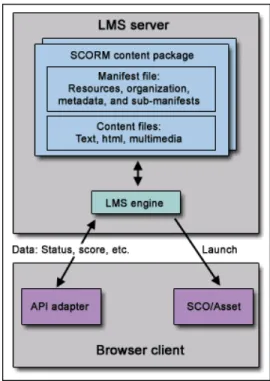
Figure 2.6: Launching SCORM-compliant content by a LMS………...……..56
Figure 2.7: An architecture for personalization services………64
Figure 2.8: Architecture of MEDEA……….……..65
Figure 2.9: Overview of the AdeLE Architecture………...…66
Figure 2.10: DIOGENE’s Architecture………..……….67
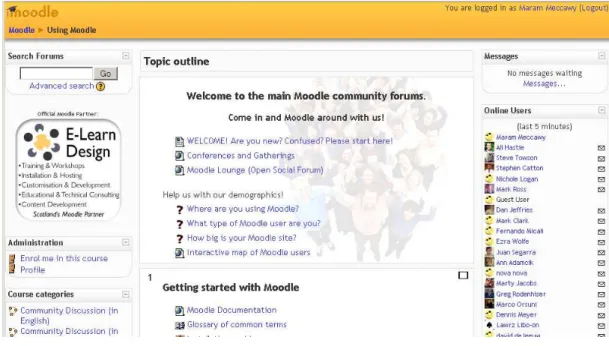
Figure 3.1: Moodle Learning space as it appears in the course Using Moodle…………80
Figure 3.2: ATutor’s Course Demo ………...85
Figure 3.3: ATutor: Tabs and Hyperlinks………...……….…86
Figure 4.1: A Service Online Interface as produced by NuSOAP... 101
Figure 4.2: A WSDL Interface as produced by NuSOAP ... 101
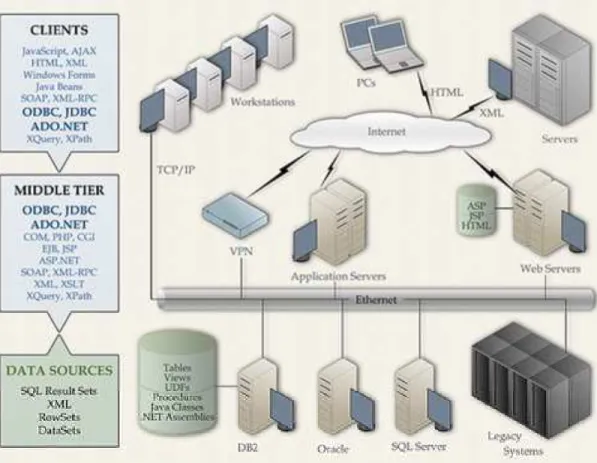
Figure 4.3: A Multi-tier distributed application architectures provide performance and scalability. ... 103
Figure 4.4: The Service Interaction Model... 105
Figure 4.5: SOA versus 3-tier distributed architecture ... 106
Figure 4.6: Web Services... 108
Figure 4.7: An Architecture View based on SOAP, WSDL and UDDI” ... 109
Figure 4.8: WSDL... 111
Figure 4.9: A typical Web Service invocation... 112
Figure 4.10: The Web Service architecture ... 113
Figure 4.11: XML-RPC, Taken from... 116
Figure 4.13: Structure of a SOAP Message. ... 120
Figure 5.1: A snapshot MOT lesson in WSDL... 131
Figure 5.2: A snapshot WHURLE lesson plan in WSDL... 132
Figure 5.3 : WSDL Adaptive Lesson’s Conversion messages ... 132
Figure 5.4: A snapshot for the "Mlesson_Wlessonplan_conversion" operation ... 133
Figure 5.5: A snapshot of a soap request (printLM)... 134
Figure 5.6: ADAPT2 Architecture. ... 141
Figure 5.7: APeLS Architecture. ... 141
Figure 5.8: The process of integrating an adaptive portal and the learning activity (BQ) ... 144
Figure 5.9: The learning activity as it appears within ADAPT² portal... 145
Figure 5.10: The learning activity as it appears within APeLS portal... 145
Figure 6.1: The architecture of WHURLE ... 152
Figure 6.2: The adaptation filter in WHURLE. ... 153
Figure 6.3: A snapshot of a WHURLE’s lesson... 153
Figure 6.4: WHURLE2.0 Conceptual Design ... 156
Figure 7.1: WHURLE 2.0: Integrating the services with Moodle... 167
Figure 7.2: Client1: calls the AGS to register the student with the UMS and assign a level of knowledge according to the grade, which is in this case obtained from the student’s Pre-Test (Quiz) Results………169
Figure 7.3: One of Moodle’s database tables: mdl_quiz_grade, where the student quiz grades are stored and then used as a parameter in client’s call to the AGS... 169
Figure 7.4: Client2: calls AGS to prepare an adaptive lesson for the current student according to the level. Then pushes the result into the Lesson’s table………170
Figure 7.5: The Aggregation Service’s (AGS) Front-page, showing its three available functions and providing the description of one of those functions (right), which is the AGS_update function ... 173
Figure 7.6: The User Modelling Service (UMS): the second function in AGS (AGS) calls
the second function in UMS (Get_User_Level) in UMS.php, this functions applies the
UMS2.xsl to the UMS.xml database and returns the result to AGS.php... 176
Figure 7.7: Lesson Plan Service (LPS): a lesson plan’s snapshot ... 177
Figure 7.8: The Adaption Filter Service (AFS): A snapshot of the WSDL file ... 178
Figure 7.9: The Chunk Management Service: A snapshot of a Chunk ... 180
Figure 8.1: WHURLE 2.0 Learning Environment: ATutor as the delivery service that provides both adaptive learning content (through Content feature pointed out here by the small arrow) and social tools ... 185
Figure 8.2: An adaptive Lesson about Use Cases as it appears for a learner that has been modelled as a Beginner Learner in ATutor (compare it with the same content presented in Moodle in figure 8.5.b)………185
Figure 8.3: An Authoring service added to the WHURLE 2.0 architecture…………..189
Figure 8.4: Registering to the backend User Modelling Service (UMS) by clicking on the Moodle’s Resource link………...………192
Figure 8.5 a: An adaptive Lesson about Use Cases as it appears for a learner that has been modelled (after taking the Pre-Test) as Advanced……….……….193
Figure 8.5 b: An adaptive Lesson about Use Cases as it appears for a learner that has been modelled as a Beginner Learner and so would have more introductory information and content than the Advanced learner in the preceding figure…………...………193
Figure 8.6: WHURLE 2.0 Learning Environment: Moodle as the delivery system that provides both adaptive learning content and social tools………....196
LIST OF TABLES
Table 3.1: Moodle & ATutor Comparison Tables: Similarities and Differences….. .89 Table 4.1: Web Service compared with other proceeding middleware technologies115
Table 4.2: Comparison of SOAP, XML-RPC and REST………...123
LIST OF PUBLICATIONS
11. Meccawy, M., and Blanchfield, P. Combining Adaptive and Collaborative Learning: A Case Study. In: Proc. IGACLE: Individual and Group Adaptation in Collaborative Learning Environments Workshop at EC-TEL 08: 3rd European Conference on Technology-Enhanced Learning. Maastricht, The Netherlands, September 16-19. 2008.
2. Meccawy, M., Blanchfield, P., Ashman, H., Brailsford, T., and Moore, A. WHURLE 2.0: Adaptive Learning Meets Web 2.0. In: Proc. EC-TEL 08: 3rd European Conference on Technology-Enhanced Learning Maastricht, The Netherlands: Springer Verlag, September 16-19. 2008.
3. Meccawy, M., Brusilovsky, P., Ashman, H., Yudelson, M. and Scherbinina, O. Integrating Interactive Learning Content into an Adaptive E-Learning System: Lessons Learned. In: Proc. World Conference on E-Learning in Corporate, Government, Health Care, & Higher Education (e-Learn 2007). Quebec City, Canada Oct. 15-19. 2007.
4. Rey López, M., Brusilovsky, P., Meccawy, M., Díaz Redondo, R., Fernández Vilas, A., and Ashman, H. Resolving the Problem of Intelligent Learning Content in Learning Management Systems. International Journal on E-Learning (IJEL).
2007. 7 (3).
5. Meccawy, M., Stewart, C., and Ashman, H., Adaptive Educational Hypermedia Interoperability and Content Creation with a Web Service-based Architecture.
International Journal of Learning Technology (IJLT).2007. 7 (3): p. 269 - 285.
6. Meccawy, M. WHURLE 2.0: An Adaptive Web Service e-Learning Environment for the Web. In: Proc. Saudi Innovation Conference (SIC 2007). Newcastle upon Tyne, UK May 11-12. 2007.
7. Meccawy, M., Stewart, C., and Ashman, H. Adaptive Educational Hypermedia Content Creation: A Web Service Based Architecture In: Proc. Adaptive Hypermedia (Ah2006) Workshop on Authoring for Adaptive Hypermedia. Dublin, Ireland, June 20. 2006.
8. Meccawy, M., Celik, I., Cristea, A., Stewart, C., and Ashman, H. Interoperable Adaptive Educational Hypermedia: A Web Service Definition. In: Proc. 6th IEEE International Conference on Advanced Learning Technologies (ICALT 2006). Kerkrade, The Netherlands: IEEE Computer Society, July 5-7. 2006.
NOTE
In this thesis some abbreviations have been used to refer to both the singular and plural
noun(s). Examples are listed below.
• LMS represents both Learning Management Systems and a
Leaning Management System.
• AEHS stands for Adaptive Educational Hypermedia Systems and
an Adaptive Educational Hypermedia System. In addition, AEH
stands for Adaptive Educational Hypermedia.
• SOA is the abbreviation for Service-Oriented Architectures or a
CHAPTER 1
“The beginning of knowledge is the discovery of something we do not understand”
Frank Herbert (1920 - 1986)
INTRODUCTION
1.1 Overview
In its relatively short existence, the Web has had an unprecedented impact on our lives.
The many barriers that it removed and the almost endless opportunities that it has brought
are inarguable.
‘One-size-fits-all’, was the case in those early days when the Web was in its infancy.
Given the technology at that time, the Web’s content, as well as its navigational paths,
were almost identical to all users. As the Web started to mature and the number of its
users increased and became more diverse, this unified approach faced criticism. Web
users are unique individuals each with their own backgrounds, experiences, cultures,
goals, abilities or interests. Moreover, they could be browsing using different devices.
Hence the search began to identify a Web that follows a more flexible approach; a Web
that adapts or an Adaptive Web. In this Web the users’ data is collected to build a model
in order to provide a tailored or personalised Web experience. Personalisation and
adaptation on the Web attracted wider attention from researches and new applications
such as recommender systems became available to end users.
In the field of e-learning, seen as one of the pillars of the modern knowledge-based
personalised learning needed to accommodate students with different knowledge,
experiences, goals or learning styles? Realising the uniqueness of each individual student
has resulted in an answer that is in favour of adaptation (Brusilovsky 2007a). This
chapter provides an introduction to the research presented in this thesis which is placed in
the field of adaptive and personalised Web-based learning.
1.2 Research Motivation and Background Overview
Adaptive Educational Hypermedia Systems (AEHS) (Brusilovsky 2001a) adapt to
different models to provide a personalised learning experience for each student. A
number of studies have suggested their value for online learning (Boyle and Encarnacion
1994; Eklund and Brusilovsky 1998; Brusilovsky 1998 ; Conlan and Wade 2004 b). With
Adaptive Educational Hypermedia (AEH), online learning is able to achieve the tutors’ or
learners’ goals with techniques that are difficult to apply in a traditional classroom with a
large number of students due to time, cost and effort constraints. It is cumbersome for a
teacher to repeat each lesson to suit the needs of every student. For example, how could
he/she hide or show information from or to a particular student? How could the same
lesson be presented at the same time to accommodate different learning styles? However,
it is possible to implement such learning scenarios through adaptive hypermedia systems.
Moreover, the significant impact of personalised learning can be seen in the case of
Web-based distance learning courses where the absence of the teacher/tutor advocates the need
of some sort of guidance for the student to assist his/her learning needs.
AEH can be seen as a user-centred design approach in e-learning that is driven by the
methodologies address issues of quality, usability and evaluation of systems by ensuring
that the users are considered at all stages of the course’s development (Hussein 2005).
However, the poor presence of adaptive systems in real world e-learning has encouraged
researchers to investigate its own problems and limitations such as in (Brusilovsky
2004b). This shows that the majority of AEHS are not designed for the modern e-learning
context which prompts services and reusability of learning content (Brusilovsky 2008). In
terms of easy user-level content authoring tools and course administration, they are
usually limited and require in-depth technical knowledge lacked by the majority of
non-IT teachers (Stewart et al. 2005). Any teacher who is considering authoring an adaptive
lesson need to decide which AEHS should he/she use? Then he/she may select a specific
system to learn how to use and spend time creating materials for this system. But if the
chosen system stops being developed or maintained, the author can either continue to
develop content for a system that will eventually go out of date, or can move to a new
system that the previously created content is likely to be incompatible with. This means a
whole new cycle of learning and content-development which results in a huge loss of
resources.
Since the authoring for such systems remains expensive, complex and time consuming,
reusability of this content becomes essential. However, the majority of early AEHS were
built as monolithic systems that cannot share their content to allow reusability, or are
limited in doing so. Nor can they share user profiles, adaptation rules, or any other AEHS
components, hence each system has to be used as a whole, even if the interest concerns
only one function or component (Brusilovsky 2008). These limitations have encouraged
adaptive systems. Interoperability here is the ability of a system or a product to work with
other differt systems or products (inter-operate). Extensive research has been done on
interoperability and usability of adaptive learning content, which includes using different
approaches, some of which use standards, others provide new research solutions (Rey
López et al. 2007).
Research exists on generating a new authoring paradigm, one that moves away from
the ‘create once, use once’ approach to the ‘create once, use many’ approach (Stewart et
al. 2005). It has stated that only interoperability between AEHS could address these
authoring issues. When an author is able to develop learning materials in one system and
then have them delivered in another, AEHS would begin to enter the mainstream of
education.
Another key issue with AEHS is that they often have very limited social and
collaborative learning activities although learning is believed to be a social activity
according to Bandura’s Social Learning Theory (1977) as cited in (Tu 2000).
Providing a one-purpose adaptive system that isolates the learners would not be able to
compete with other e-learning systems such Learning Management Systems (LMS),
which are currently dominating Web-based learning. LMS are equipped with a number of
essential tools and activities that take into account different stakeholders in the e-learning
processes: administrators, teachers and students, and hence provide a general purpose and
easy to use learning environment with appealing user-interfaces.
In recent years new paradigms have emerged on the Web whereby communities rather
than documents are paramount. This new approach to hypermedia, which has been
prompted the redesign of an online educational system to become a complete learning
environment where students can socialise and interact. The online learning process is
transformed from one that is considered to provide a passive learning experience where
students only receive information from the system without being able to interact or
contribute, into one where they learn by doing, interacting and socialising. This new
generation of e-Learning which is evolving with the new generation of the Web and the
Internet as a whole is known as e-Learning 2.0 (Downes 2005). Modern LMS are
designedto provide these types of interactive and social e-learning environments (Millard
and Essex 2007)
The success of LMS and the poor presence of AEHS have driven some researchers in
Adaptive Educational Hypermedia (AEH) to reconsider the designs of their systems.
They believe that the problem for AEHS arises from their architectural design failing to
answer the overall needs of modern Web-enhanced learning rather than the actual
adaptation and personalisation functionality failing to perform (Brusilovsky 2008). This
thesis presents work which focuses on this research area as will be explained in detail in
the next section.
1.3 Problem Under Study
The aforementioned state of AEHS leads to the conclusion that their major drawback
appears to be their architectures (Brusilovsky 2004b), implementations or delivery
systems failing to answer the needs of today’s e-Learning requirements. The research
presented in this thesis shares this belief and hence reconsiders such designs of AEHS in
technologies. Such technologies include Web services (WSG 2004 ), which are sets of
technologies and standards that are designed to allow for more interoperability and
flexibility between Web-based distributed applications.
The focus of the research presented here is on how to improve these architectures and
enable adaptation delivery through a reliable, flexible, and collaborative learning
environment, which can be widely adopted in the e-learning community. Therefore, these
improvements would eventually help in lifting AEHS from their current undesirable
position and allow them to penetrate into the main stream e-learning.
Would the new architecture work? And would it address the current limitations of
Adaptive Educational Hypermedia Systems and satisfy the requirements of modern
Web-based learning environments?
Research presented in this thesis investigates these questions in order to provide a
sustainable solution for adaptive Web-based learning.
1.4 Aims, Objectives and Methodologies
1.4.1 Aims
The overall aim of this research is to promote a wider use of adaptive e-learning by
improving the architectures of Adaptive Educational Hypermedia Systems, overcoming
limitations of the existing systems. Such shortcomings include: limited interoperability
and reusability between different adaptive systems especially when compared with what
is provided through using a Learning Management System. In addition, the research
endeavours to provide an enhanced e-learning environment that satisfies the requirements
adaptive learning with collaborative learning concepts and tools, and presenting learning
content through appealing (non-prototypic) user-interface.
1.4.2 Objectives
1. To identify the problems which are limiting the use of Adaptive Educational
Hypermedia Systems, and to analyse requirements of the new generation of
e-learning systems.
2. To investigate the problem of interoperability and reusability of adaptive and
interactive e-learning content.
3. To design an architecture for Web-based learning that has adaptation as one of its
core features; this architecture also provides an environment for collaborative
learning.
4. To develop and implement this architecture.
5. To test the implemented architecture for its interoperability, reusability, flexibility
and openness, robustness and reliability and collaborative learning features.
1.4.3 Methodologies
Throughout this research different methods are used to collect data and test the
conceptual design. These methods include analysis of the literature, investigations of the
issue of interoperability of content through case studies, development of a new
architecture, and applying technical experimental tests to the developed system. In
addition, a case study for users’ trials which also involved an online questionnaire is
designed to test the system’s validity, reliability and monitor the students’ use of social
1.5 Thesis Contributions
This thesis presents an innovative Web servicoriented architecture for an adaptive
e-learning framework. It is designed to address the aforementioned limitations encountered
in former adaptive Educational Hypermedia Systems. Moreover, takes into consideration
the current advances of the Web in addition to the demands of modern Web-based
education. The architecture’s flexibility allows for the adaptive content to be delivered in
any Learning Management System, which is used as delivery services (portal) for this
integrated e-learning environment. This results in an integrated Web-based learning
environment that is enhanced with both adaptation and social learning. The new
architecture is known as WHURLE 2.0.
Since limited interoperability is a significant challenge in AEHS, different approaches
have been proposed in the literature to address this issue. As a result of examining these
approaches a new classification that groups those proposals into four different categories
is introduced by this thesis. The four categories are: the Conversion approach, the
Lingua-franca approach, the Universal language approach and the Languages-specifier
approach. Details and definitions of those four categories can be found in chapter 2
(section 2.5).
The research described here investigates (through case studies) two different methods
for achieving interoperability and reusability of learning content in adaptive systems. The
first case study explains work that extended the conversion approach by applying Web
services technologies. It suggests that Web services, when applied to the conversion
approach, resulted in the conversion program being more flexible and accessible, leading
the second case study explores the reusability of rich adaptive or interactive content using
one adaptive system’s original protocols. It shows practically that the interoperability of
rich, intelligent or adaptive content is still a problem that needs to be resolved to allow
different LMS to launch this type of learning content. In addition, this study highlighted
that the use of proprietary protocols might not be feasible solution for interoperability.
Finally, the evaluation case study reveals some interesting findings regarding students’
collaboration online; the results show a low degree of interaction among students using
the available Web 2.0 or collaboration tools such as Blogs or Wikis.
To date, 8 peer-reviewed publications have arisen from this research (See page XII).
1.6 Thesis Structure
The thesis is composed of nine chapters. Chapter 2 describes in greater detail Adaptive
Educational Hypermedia, its advantages, limitations and the current state of the art in
terms of research that aims to address those limitations using a number of approaches.
Chapter 3 focuses on another important aspect of e-learning which is almost absent from
AEHS - that is, collaborative and social learning - and analyses how this is achieved by
LMS and how the AEH community recognises this shortcoming and what proposals are
made to tackle it.
Chapter 4 discusses the technical aspects of the architecture proposed in this thesis and
justifies the use of certain technologies as its platform. Chapter 5 presents two case
studies where interoperability of learning content in the context of AEHS has been
explored, highlighting the learned lessons from each case. In chapter 6, the proposed
previous monolithic system, from which this system evolved, is described. After that, the
development of this new architectural design is reported in chapter 7. The evaluation
process is then presented in chapter 8 through a definition of an evaluation framework.
Lastly, chapter 9 discusses different aspects of this research focusing on the newly
designed architecture. The chapter ends with conclusions and proposals for future work.
1.7 Summary
Personalised solutions in e-learning are needed to cater for students representing the
realities of a wide spectrum of online users. A task that might be difficult to achieve
through traditional classroom settings by teachers, could be well within the great
capabilities of Web-based learning. Here the added values of e-learning are recognised,
where the aim is to not just to deliver learning content online, but to improve the overall
learning experiences. Adaptive learning as provided by Adaptive Educational
Hypermedia aims to serve this need. However, its own limitations have not allowed it to
take the lead or even become a recognised competitor to its rivals such as Learning
Management Systems. On the other hand, the lack of adaptation is also limiting the LMS
online capabilities and experiences.
Recent developments in the Web are focusing more on the interaction, communication
and sharing between its users. This applies to online learning, which is one of the Web’s
rapidly developing applications. Therefore, those requirements were taken into
consideration when designing a new e-learning environment that promotes both
adaptation and social learning. This environment is built using a service-oriented
The next chapter presents online adaptation in the context of e-learning through a
CHAPTER 2
“If I have seen further, it is by standing on the shoulders of giants”
Isaac Newton (1642 - 1727)
ADAPTIVE EDUCATIONAL HYPERMEDIA: OVERVIEW
AND CURRENT CHALLENGES
2.1
Overview
For most people their main interaction with a hypermedia system is their daily use of the
World Wide Web which has given users the experience of navigating freely between
decentralised networks of nodes of information connected by different links. Although this
freedom of mobility is one of the Web's key advantages, it might not be, in some cases, the
best it can offer to everyone.
A problem concerning current hypermedia systems, and the Web in particular, is the
huge number of users with different interests, goals, preferences and needs, who are
presented with the same information (content), navigation paths or presentation styles.
Moreover, the number of users who browse using different devices is growing, and each of
those devices has its own requirements, for example in terms of interfaces and resolution.
One of the limitations of the traditional static hypermedia applications is that they provide
almost the same surfing experience to all users, which could be a problem if the population
Adaptive Hypermedia (AH) is an alternative to traditional hypermedia systems that
aims to overcome those problems by providing some help and guidance to users. In an
educational context this is achieved through Adaptive Educational Hypermedia (AEH),
which is where the research presented in this thesis is placed. AEH treats learners as
distinct individuals that require personalised assistance and guidance during their online
learning process. Despite the benefits and great potential of AEH, its implemented
systems suffer from disadvantages that have limited their usage.
This chapter provides an overview of Adaptive Hypermedia and its importance in
e-learning through Adaptive Educational Hypermedia Systems (AEHS). It investigates its
advances as well as its current challenges that have resulted in its poor presence in the
e-learning community. In addition, the chapter explores different approaches and proposals
that try to address these challenges.
2.2
Adaptive Hypermedia
Adaptive hypermedia provides tailored content and navigation paths by adapting to the
user model, which is a model that stores the distinct feature of the user (section 2.2.1). AH
is a direction of research that can be traced back to the early 1990s which originated from
research on both hypermedia and user modelling and aims to improve the usability of
hypermedia. While classical hypermedia delivers the same page to every user, adaptive
hypermedia stores the user’s goal, preferences or knowledge and presents different pages to
different users making it possible to deliver modified personalised views of a hypermedia
Although research on this field started a few years before the great breakthrough of the
Internet in the 1990s, the emergence of the Web led to a rapid growth of research activity
on adaptive hypermedia. Brusilovsky defines Adaptive Hypermedia (AH) as:
“all hypertext and hypermedia systems which reflect some features of the
user in the user model and apply this model to adapt various visible aspects of the system to the user” (Brusilovsky 1996).
According to the previous definition, a system must have three characteristics to be
considered an adaptive hypermedia system: first, to be a hypermedia system, second, to
have a user model and third, to provide a distinct hypermedia view to a specific user (or
group of users) based on this model. This is demonstrated by the following figure (2.1):
Figure 2.1:“Classic loop ‘user modeling – adaptation’ in adaptive systems”, taken from
(Brusilovsky 1996).
As can be concluded from this figure, the system collects some specific data about the user
either explicitly (for example by asking them to fill a questionnaire) or implicitly (by
observing their interactions with the system). The system then processes the collected
progresses or continues to use the system. Finally, the model is processed using an
adaptation engine or inference engine and then the adaptation effect will take place.
Before moving further in AH, a distinction between two types of adaptive systems needs
to be highlighted. Those two types are adaptive systems and adaptable systems. Adaptive
systems are designed to adapt automatically without the need for the user’s input, while an
adaptable system provides the user with tools used to specify exactly how the system
should be altered, allowing for more control to be delegated to the user (Oppermann 1994;
Fumero 2006).
Research on adaptive hypermedia is taking place in many different Web applications
such as learning, commerce and stores, museums, tourisms, media (news),
e-health and others. Six types of adaptive hypermedia systems have been identified in (Mette
and Thomas 1994): educational hypermedia, on-line information systems, on-line help
systems, information retrieval hypermedia, institutional hypermedia and systems that
manage personalised views in the information space. The application of AH in education is
the field that is most relevant to the goals and objectives of this thesis and thus will receive
greater attention.
When considering adaptation, there are important questions to be asked: 1) adapting to
what? 2) What could be adapted? And 3) how is this adaptation effect presented? The
following sections look for answers to these questions.
2.2.1 User Modelling
As has been mentioned earlier in this section, in order for adaptation to take place,
information about the users should be stored in a user profile. Having the right
element in order to achieve any kind of adaptivity. A user model is the user’s state of
mind as represented by the adaptive system(De Bra 2004).User modelling is the process
that results in having a user model. Each user will have a unique user profile that reflects
a certain user’s characteristics according to user model of that specific system. Therefore,
a user model can also be defined as:
“a well-organized database which comprises information about the user and guides the system's inference engine” (Mylonakis and
Cullough 2003) .
A user’s profile is aimed not to be static; in fact, it should be dynamically updated
according to the user's interaction with the system to guide the adaptation engine.
Different researchers have chosen to make their system adapt to different aspects such
as user’s data or characteristics. In other systems, the adaptation has been built according
to the usage data and environmental data. User’s data is about the different characteristics
of a user such as his/her interest or goals. As for the goals, they can be local, aiming, for
example, to solve a specific task, or global, set towards long term objectives such as
passing a course. Moreover, in the context of e-learning, for example, user’s data can
include his/her knowledge level about the subject domain, learning styles, cognitive
styles (the preferred way for an individual to process information e.g.: analytical) or
backgrounds (profession, language, prospect, capabilities or culture) (Santos et al. 2003).
In this thesis, the focus is on the user’s knowledge level, which has been implemented in
the user modelling service (chapters 6 & 7).
On the other hand, usage data captures data about the users’ interaction with the
users’ information that are not specifically related to the user, such as their location or
platform, for example, or the network’s bandwidth, hardware, software and so forth
(Paramythis and Loidl-Reisinger 2004). Hence, the difference between adaptation and
personalisation could be distinguished as the former including adapting to all three types
of adaptation (user, usage, environment), while personalisation focuses on user’s data or
needs (Graf and List 2005).
There are many types (or techniques) of user models, two of the well-known models
being the overlay model and the stereotype model. The overlay model (Mette and
Thomas 1994), is based on the structural model of the subject domain. It is a widely-used
technique for user modelling which measures the user’s knowledge level in any given
topic or domain. In other words, an overlay model is a selected subset of the original
domain model (Mylonakis and Cullough 2003). On the other hand, the stereotype model
customises the knowledge for a specific group and then assigns a user to one group in
which this user shares the same background, knowledge, goals or any other ‘shared’ data.
It is a collection or cluster of user traits (Mette and Thomas 1994). Users cannot change
from one group to another until their model has been updated according to their
interaction with the system, resulting in their previous state changing so that it now
satisfies the conditions for another group. In addition, a hybrid user model, which is a
combination of both the overlay and the stereotype models, has been introduced in
(Zakaria et al. 2002). Examples of two of the well-known user models’ implementations
2.2.2 Adaptation Types
Hypermedia consists primarily of nodes (content pages) and links. In Adaptive
Hypermedia, the links, the pages (content) or both are adapted or personalised to suit an
individual’s (or a small group’s) requirements. This introduces two types of adaptation
technologies that deliver the adaptation or personalisation effect to the user; those are:
adaptive presentation and adaptive navigation support (Brusilovsky 2001b). Adaptive
presentation is adapting the content (information) of the page, for example, an expert user
is provided with more detailed information than is a novice user or vice versa. Adaptive
navigational support is about adapting the way the links are presented to the user on each
webpage, as well as the navigational freedom or guidance through such links. It aims to
help the user find an optimal path through a given hyperspace (Mylonakis and Cullough
2003).
Different types or categories of adaptation are presented in (Paramythis and
Loidl-Reisinger 2004), which in addition to those mentioned above lists another category: the
adaptive interaction type (adaptive interface), which is adaptation that takes place at the
system’s interface, to facilitate or support the user’s interaction with the system without
modifying the learning content.
2.2.3 Adaptation Methods and Techniques
Before presenting different methods and techniques for each type of adaptation, some
terminology is worth clarifying. Adaptation Techniquesare defined as:
“…methods of providing adaptation in existing AH systems. These techniques are a part of the implementation level of an AH system. Each technique can be characterized by a specific kind of knowledge
representation and by a specific adaptation algorithm” (Brusilovsky
1996)
Adaptation methodsare defined as:
“…generalization of existing adaptation techniques. Each method is based on a clear adaptation idea which can be presented at the conceptual level.” (Brusilovsky 1996)
When applying both the adaptation methods and techniques to the two main categories
or types of adaptation, the following results are obtained:
• Adaptive Presentation Technique examples are conditional text, stretch-text,
fragment variants and page variants techniques, frame-based techniques, and a
combination of stretch-text and frame-based adaptation.
• Adaptive Presentation Method examples include: additional (prerequisite or
comparative) explanations, explanation variants or sorting.
• Adaptive Navigation Support Techniques include: direct guidance, restricting
access, sorting links, removing, disabling or hiding links, annotation and map
adaptation.
• Adaptive Navigation Support Methods examples are: guidance methods (global
and local) or orientation support methods (global and local).
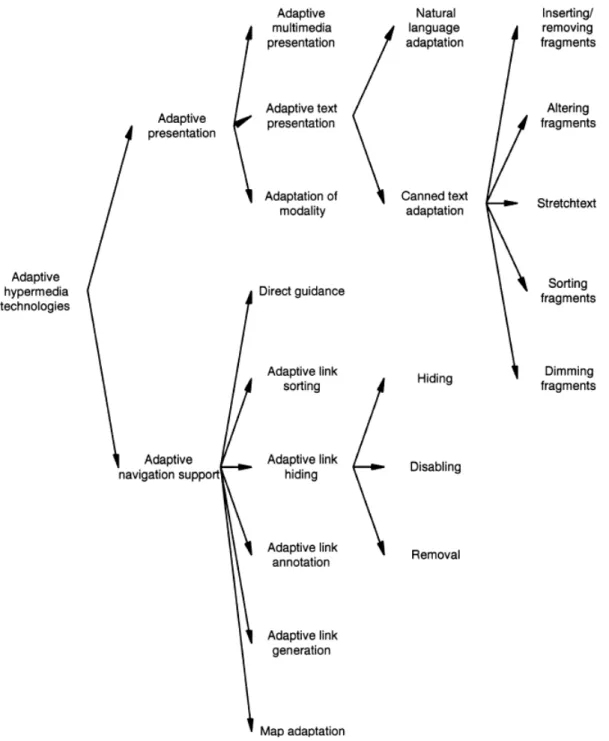
The following figure (2.2) provides an overview of some of those adaptive hypermedia
Figure 2.2:“The updated taxonomy of adaptive hypermedia technologies”, taken from
2.2.4 Disadvantages of Adaptive Hypermedia
Despite all the interesting features of adaptive hypermedia systems (Brusilovsky
1999), and the promising future that has been predicted regarding its applications and
development (De Bra 2004), AH has its own limitations and there are some issues
surrounding even the evaluation of these systems (De Bra 2000). The evaluations of AH
systems have been criticised because most of them were performed to justify the use of
adaptive hypermedia (AH) in a give application. This is done usually by comparing
adaptive and non-adaptive versions of the same system. However, the evaluation is
performed under testing conditions that favour the adaptive version.
One of AH’s limitations is that the user is sometimes presented with irrelevant
information through misguidance. Following a bad advice might result in worse
performance than trying your best without getting any guidance. Moreover, the
adaptation effects can confuse the users instead of accommodating their needs. For
example, the removal of some links or sections after a certain number of visits can cause
confusion or dissatisfaction. Therefore, it is advised to have a history option that will
allow the user to track different versions of the page; this might be similar to what is
provided by wikipedia2 for instance.
2.4.5 Open Adaptive Hypermedia Systems
Open Adaptive Hypermedia Systems are systems that can respond to the individual
needs regardless of where the users are, or where the content resides and what
characteristics they bring in an open environment such as the Web. They use documents
that belong to open databases or repositories of content (learning materials) and they are
open to all users (Mylonakis and Cullough 2003). The difference between open and
closed adaptive hypermedia systems can be seen in the following definitions:
“Definition 1 (Closed Corpus Adaptive Hypermedia System)
A closed corpus adaptive hypermedia system is an adaptive hypermedia system which operates on a closed corpus of documents, where documents and relationships between the documents are known to the system at design time.
Definition 2 (Open Corpus Adaptive Hypermedia System)
An open corpus adaptive hypermedia system is an adaptive hypermedia system which operates on an open corpus of documents, e.g., a set of documents that is not known at design time and, moreover, can constantly change and expand…” (Brusilovsky 2007 ).
In the current state of AH, openness is considered as one of the key requirements for
adaptive systems, as will be seen in the context of adaptive learning in the coming
sections. This thesis presents an approach to AH that although it operates on a closed
corpus, it aims to move forward towards such openness and flexibility by removing
unnecessary boundaries and obstacles at least on a technical level.
2.3
Adaptive Educational Hypermedia Systems (AEHS), An Overview
Adaptive Educational Hypermedia Systems (AEHS) aim to overcome the lack of
interpersonal interaction in online and distance learning by providing tailored learning
experiences. The challenge is to make the system know and understand the learner’s
complexity of the design, authoring and implementation of adaptive educational
hypermedia systems in comparison with traditional Web-based educational systems. It is
the price for getting the adaptation effects (Brusilovsky 2003b). The research described
in this thesis lies in this area of adaptive Web-based learning and hence a greater
emphasis is given to this application of AH from this point onward.
In adaptive educational hypermedia, the domain of a learning application can be
represented as a hierarchy of concepts. The user model stores values for each concept for
each user in the profile. In some cases it assumes that when a student logs into a page and
reads it or passes an online test, he/she has learned the topic and the user profile is
updated accordingly. Those applications also use a set of prerequisite relationships
between these concepts, which together with the concept hierarchy and the concept
values, allow the system to decide if the learner is ready for the new concept. For the
links that are presented on each page, the system can also let a user know whether it leads
to a page containing knowledge that is already known, or to new knowledge or advanced
knowledge that is not ready to be taken by this user at his/her current level (De Bra
2002).
A learning environment can be considered adaptive if it is capable of achieving three
tasks; these are: 1) monitoring the learners’ activities and interpreting those activities
based on specific models, 2) inferring a learner’s requirements and preferences from
those models, and 3) acting upon this available knowledge about the learner and the
subject matter to facilitate dynamically the learning process (Paramythis and
Many empirical studies (Boyle and Encarnacion 1994; Eklund and Brusilovsky 1998;
Brusilovsky 1998 ; Conlan and Wade 2004b) showed the added value that adaptation
brings to the Web, especially in the context of e-learning. More precisely, adaptive
navigational support could accelerate the user’s navigation and learning while adaptive
presentation can improve understanding of the content (Boyle and Encarnacion 1994).
However, it is not the magical wand that solves all the Web-based e-learning problems,
as stated below:
“creating ‘good’ content, a sound concept hierarchy, and the right prerequisite relationship still requires (pedagogically skilled) authors and teachers.” (De Bra 2002).
Hence, learning good practice in educational content development is still a key element
for the success of AEHS.
2.4
Three Generations of AEHS and the Current Challenges
The development of adaptive educational hypermedia can be classified into three
generations (Brusilovsky 2004a). The first generation systems (1990 – 1995), were
pre-Web systems, whereby two main streams existed (Brusilovsky 2001a). In the first stream,
researchers in the area of intelligent tutoring systems (ITS) were trying to extend student
modelling and adaptation approaches developed in (ITS) with hypermedia components.
In the second stream, researchers were working on educational hypermedia as an attempt
to make their systems adapt to individual students. Examples of this generation’s systems
The majority of the next generation systems (1996 – 2002) were Web-based and more
mature (as adaptive systems) than were the first generation. Examples of systems
developed during this period included: ELM-ART, Interbook, PT, TANGOW, AHA!,
KBS-Hyperbook, AST and Multibook (see (Brusilovsky 2004a)).
The third or current generation, starting from 2002 onwards, has been defined by the
challenge of integrating adaptive hypermedia technologies into the regular educational
process. Examples of this generation included: WHURLE (Brailsford 2002b) (chapter 6,
section 6.2), APeLS (Conlan 2002) (section 2.9.2), ADAPT² (Brusilovsky 2005) (section
2.9.1), and MEDEA (Trella et al. 2005) (section 2.9.4).
Those systems demonstrated many different ways to integrate adaptation technologies
but they also had many limitations, as described in (Brusilovsky 2004a). Brusilovsky
claims that almost every function that is performed by a Learning Management System
(LMS), such as WebCT or Blackboard3, could be done more effectively through an
adaptive Web-based hypermedia system. However, LMS is dominating the field of
e-learning over adaptive hypermedia systems. The reason for this is that AEHS does not
answer the demands of modern e-learning; he states:
“It seems obvious that the problem of modern adaptive systems is not their performance, but their ability to answer the needs of practical Web-enhanced education” (Brusilovsky 2004a).
Some limitations of AEHS are considered responsible for their absence compared to
LMS or other e-learning systems despite the great functionality, personalisation, and
guidance that they provide. A number of reasons have been stated in (Brusilovsky
2004b). One reason is the lack of integration, This means that unlike the single login
environment provided by LMS where teachers, administrators and learners use only one
system that incorporates a number of ICT4 functionalities, in AEH each system has so far
focused on a specific aspect or feature of an e-learning system, requiring the use of
multiple e-learning systems by a single teacher or institute.
Another problem is the limited support for the reusability of learning content as well as
for the reusability of the systems’ components. If a teacher is interested in the user
modelling functionality of the system, this component could not be approached on its
own; the system has to be used as a whole. Moreover, adding a new content fragment to
an LMS is straightforward, while in AEHS it would require this fragment to be indexed
with regard to the domain model concept. Even as AEHS continue to develop to
overcome those limitations, full reusability as presented in courseware reusability
systems and repositories, remains an issue. This limited interoperability between different
adaptive systems or techniques has lead to the problem of open and closed corpus
(section 2.2.4) which results in the high costs of AEHS (Brusilovsky 2007 ).
These aforementioned limitations indicate that the majority of AEHS were not
designed for the modern e-learning context, which demands reusability of content from
multiple resources. On the contrary, the adaptation is largely embedded with the content
itself and the goals and objectives are pre-defined for a specific course during design
time. On the other hand, reusability frameworks that have been developed to allow this
open access to learning content focus on reusing static content and not on dynamic
activities and changeable content such as AEH content (Brusilovsky 2007b).
The issue of interoperability and reusability is in the focus of many researchers in the
AEH community. Conlan, for example stresses the importance of reusability of adaptive
content given that the development of new adaptive learning content is expensive and
time-consuming (Conlan and Wade 2004b). This is due to the authoring of adaptive
content being complex and above the level of ordinary users, who include the majority of
non-IT teachers. In some cases this authoring process requires creating multiple versions
of the same lesson as in the Felder-Solomon (Felder and Soloman; Felder 1988)
(visual-verbal) learning style adaptation. Hence, the authoring problem (Stewart et al. 2005) is
another key issue that is preventing AEHS from being part of mainstream education.
Therefore, researchers have tried to address this by either introducing new authoring tools
such as NetCoach (Weber et al. 2002) or alternatively by allowing the reusability of
adaptive content (Stewart et al. 2005). This will not remove the initial authoring costs but
will limit this expensive and complex content development process to a single attempt for
any given course, which is known as the ‘create once and use many’ approach.
In addition, AEHS are often criticised for the way they were implemented and
delivered; their prototypic interfaces and experimental designs would not gain them any
credit especially when compared with both open source and commercial LMS (chapter 3,
section 3.3). Moreover, they lag behind the latter in providing tools for collaborative
learning and keeping up with new Web 2.0 tools and technologies. This issue is
addressed in greater detail in chapter 3.
The new research direction in adaptive hypermedia and e-learning is to allow the user
to construct their own learning environment from a selection of services. This involves
service. The ability to use external content or to expose content prepared for internal use
with local systems for external use is not an easy task in AEH. While the packaging of
simple and static content has long been addressed by industry e-learning standards such
as SCORM5(ADL 2004), which is described in section (2.7.1) of this chapter,
interoperability of adaptive learning content is more complex (Rey López et al. 2007)
due to its dynamic and transitive nature and hence requires a lot of effort and
consideration, technically and semantically. Although the focus so far was on reusing the
content, which is also the focus of this thesis, nevertheless the same is valid for the users’
information and hence the importance of interoperability of users’ models (Zakaria 2003;
Stewart et al. 2006). Reusability of learning materials and portability of user information
are key requirements for all modern e-learning systems.
Since reusability of adaptive learning content and interoperability of AEHS
components and functionality are two of the key challenges responsible for the low
adoption of AEHS, greater attention is given to them throughout this thesis. The
following sections analyse the different approaches used to address those issues.
2.5
Interoperability and Reusability in Adaptive Educational
Hypermedia Systems
Interoperability allows adaptive systems to communicate with each other and exchange
user’s data, system’s functionalities, and learning content. As explained in the previous
section, it is one of the big challenges facing the AEH community. Interoperability in
general is required at three levels: the technical level (making it possible technically), the
semantic level (understanding the other system), and the structural level (components and
their interdependencies). Many AEH research groups are trying to tackle this issue using
a variety of approaches. This thesis provides a new classification for different approaches
to achieve interoperability in AEH. Four categories have been introduced which are: the
Conversion or Translation approach, the Lingua-franca approach, the Universal
Language approach and the Language-Specifier approach6. Each of these approaches is
briefly explained below:
• The Conversion Approach: explicitly defines mappings between individual
pairs of adaptive hypermedia systems. Examples could be seen in the
conversion between the two adaptive systems: MOT and WHURLE (Stewart
et al. 2004; Cristea 2005). Here the commonalities between two given systems
need to be identified before the conversion occurs.
• The Lingua Franca Approach: this involves translating each adaptive
hypermedia system to an intermediate exchange format, such as CAF (The
Common Format) (Cristea 2005) and LAG (Layered Adaptive Granulation)
(Stash et al. 2006 ). This then implicitly defines a translation between any two
adaptive hypermedia systems, via the common format.
• The Universal Language Approach: this is an approach where differences
between adaptive hypermedia systems either do not exist or every adaptive
hypermedia system can directly make use of data specified in the universal
6 This classification has been published in the International Journal of Learning Technologies as shown by the following reference:
Meccawy, M., Stewart, C., and Ashman, H. Adaptive Educational Hypermedia Interoperability and Content Creation with a Web Service-based Architecture. International Journal of Learning Technology (IJLT).2007. 7 (3): p. 269 - 285.
language without further translation. This is similar in principle to a global
ontology, with all applications subscribing to a common data structure and
collection of operations. Although no such language exists for AEH, research
on using e-learning industrial standards (Rey López et al. 2006) (section 2.7),
or using Semantic Web technologies (Henze 2005) (section 2.8) could fall into
this category since they are often working towards the same goal. However,
they often require expansions and extensions to suit different requirements.
• The Language-Specifier Approach: a language specifier (for example XML)
is a more flexible and lightweight approach. It prescribes how each
application’s language should be interpreted, to enable, for example,
automatic translation of content or user’s data, at least on a technical level,
although often not on a semantic or interdependency level. The use of Web
services that provide open APIs (such as WSDL7) can be seen as an example
such as in MEDEA (Trella et al. 2005). Other research initiatives that could
be classified as following the same approach provide APIs to access their
adaptive systems but use proprietary (original) protocols for communications
instead of agreed standards such as SOAP or WSDL. ADAPT² (Brusilovsky
2005) can been seen as an example of these research initiatives or solutions.
The last two options are a more Web-centric approach, and indeed the Web itself is
based on a small number of universal languages and language-specifier such as HTML
and XML. As reported earlier, there have been experiments with the conversion
approach, translating MOT to WHURLE (Stewart et al. 2004). Moreover, an