Chris K. Karlof
Electrical Engineering and Computer Sciences
University of California at Berkeley
Technical Report No. UCB/EECS-2009-26
http://www.eecs.berkeley.edu/Pubs/TechRpts/2009/EECS-2009-26.html
February 6, 2009
Permission to make digital or hard copies of all or part of this work for
personal or classroom use is granted without fee provided that copies are
not made or distributed for profit or commercial advantage and that copies
bear this notice and the full citation on the first page. To copy otherwise, to
republish, to post on servers or to redistribute to lists, requires prior specific
permission.
by
Chris K. Karlof
B.S. (North Carolina State University) 1995
A dissertation submitted in partial satisfaction of the requirements for the degree of
Doctor of Philosophy in Computer Science in the GRADUATE DIVISION of the
UNIVERSITY OF CALIFORNIA, BERKELEY
Committee in charge: Professor Doug Tygar, Co-Chair Professor David Wagner, Co-Chair
Professor Schmuel S. Oren
Co-Chair Date
Co-Chair Date
Date
University of California, Berkeley
Copyright 2009 by Chris K. Karlof
Portions of this work drawn with permission from [68, 69, 70]:
Chris Karlof, Umesh Shankar, J.D. Tygar, and David Wagner. “Dynamic Pharming Attacks and Locked Same-origin Policies for Web Browsers.” InProceedings of the Four-teenth ACM Conference on Computer and Communications Security (CCS 2007), pages 58-71, October 2007.
Chris Karlof, J.D. Tygar, and David Wagner. “A User Study Design for Comparing the Security of Registration Protocols.” InProceedings of the First USENIX Workshop on Usability, Psychology, and Security (UPSEC 2008), April 2008.
Chris Karlof, J.D. Tygar, and David Wagner. “Conditioned-safe Ceremonies and a User Study of an Application to Web Authentication,” In Proceedings of the Sixteenth Annual Network and Distributed Systems Security Symposium (NDSS 2009), February 2009.
Abstract
Human Factors in Web Authentication
by
Chris K. Karlof
Doctor of Philosophy in Computer Science
University of California, Berkeley
Professor Doug Tygar, Co-Chair
Professor David Wagner, Co-Chair
This dissertation endeavors to improve the security of user authentication on the World Wide Web. One threat to Web authentication is phishing, a social engineering attack that solicits users’ authentication credentials by spoofing the login page of a trusted Web site. We identify human psychological tendencies that make users susceptible to phishing at-tacks and apply these insights to develop design principles forconditioned-safe ceremonies. Conditioned-safe ceremonies are security protocols that deliberately condition users to re-flexively act in ways that protect them from attacks. Our formulation of conditioned-safe ceremonies draws on several ideas and lessons learned from the human factors and human reliability community: forcing functions, defense in depth, and the use of human tenden-cies, such as rule-based decision making.
We apply these principles to develop a conditioned-safe ceremony based on email for initializing credentials in machine authentication schemes. We evaluated our email cere-mony with a user study of 200 participants. We simulated attacks against the users and found that our email ceremony was significantly more secure than a comparable one based on challenge questions. We found evidence that conditioning helped the email users resist attacks, but contributed towards making challenge question users more vulnerable.
We also address stronger social engineering threats against Web authentication, e.g., pharming. We describe a new attack against Web authentication we calldynamic
pharm-ing. Dynamic pharming works by hijacking DNS and sending the victim’s browser ma-licious Javascript, which then exploits DNS rebinding vulnerabilities and the name-based same-origin policy to hijack a legitimate session after authentication has taken place. To resist dynamic pharming attacks, we propose two locked same-origin policies for Web browsers. In contrast to the legacy same-origin policy, which enforces access control in browsers using domain names, the locked same-origin policies enforce access control us-ing servers’ X.509 certificates and public keys. We evaluate the security and deployability of our approaches and show how browsers can deploy these policies today to substantially increase their resistance to pharming attacks and provide a foundation for the development of pharming resistant authentication mechanisms.
Professor Doug Tygar
Dissertation Committee Co-Chair
Professor David Wagner
Contents
List of Figures iv
List of Tables v
1 Introduction 1
1.1 Conditioned-safe ceremonies . . . 3
1.2 Securing machine authentication . . . 4
1.2.1 The registration problem . . . 5
1.2.2 Dynamic pharming attacks and the locked same-origin policies . . . 6
2 Preliminaries 9 2.1 Background . . . 9
2.1.1 HTTP cookies . . . 9
2.1.2 The legacy same-origin policy . . . 10
2.1.3 Secure Sockets Layer (SSL) and X.509 certificates . . . 11
2.2 Threat models . . . 12 2.2.1 Phishers . . . 12 2.2.2 Pharmers . . . 13 2.2.3 Active attackers . . . 14 2.2.4 Other assumptions . . . 15 3 Conditioned-safe ceremonies 16 3.1 Why users are vulnerable . . . 16
3.1.1 Automatic decision making strategies are exploitable . . . 17
3.1.2 Web browser security indicators condition users to satisfice . . . 17
3.1.3 Users are not good at recognizing attacks . . . 18
3.2 Modeling user decision making during attacks . . . 20
3.2.1 Skill, rule, and knowledge based performance . . . 20
3.2.2 Human error and the Generic Error-Modeling System (GEMS) . . . 21
3.2.3 Applying GEMS to user behavior during social engineering attacks 23 3.3 Conditioned-safe ceremonies . . . 24
3.3.1 Forcing functions . . . 25
3.3.2 Analysis and discussion . . . 27
3.3.3 Limitations . . . 29
4 Registration ceremonies 30 4.1 Current practice: Challenge questions . . . 30
4.2 A conditioned-safe registration ceremony using email . . . 32
4.2.1 Security analysis. . . 32
4.2.2 Implications and limitations of email based registration . . . 34
5 A user study of registration ceremonies 36 5.1 Design challenges . . . 36 5.2 Study design . . . 38 5.2.1 Overview . . . 38 5.2.2 Recruitment . . . 39 5.2.3 Registration procedures . . . 40 5.2.4 Simulated attacks . . . 46 5.2.5 Warnings . . . 47
5.2.6 Attack success metrics . . . 47
5.2.7 Debriefing and exit survey . . . 48
5.2.8 Ethics . . . 48
5.3 Study results . . . 49
5.3.1 User demographics . . . 49
5.3.2 Success of simulated attacks . . . 52
5.3.3 Efficacy of our warnings . . . 52
5.3.4 User suspicion of our attacks . . . 54
5.3.5 User reasoning during our attacks . . . 56
5.3.6 Usability and security opinions of registration mechanisms . . . 58
5.3.7 Ecological validity . . . 58
5.4 Analysis and discussion . . . 62
5.4.1 Ineffectiveness of our warnings . . . 62
5.4.2 Lack of user suspicion . . . 63
5.4.3 The power of user conditioning and forcing functions . . . 64
5.4.4 Ecological validity . . . 66
5.4.5 Study limitations . . . 67
6 Dynamic pharming attacks 70 6.1 Overview . . . 70
6.2 Attack details . . . 73
6.2.1 Method 1: Proxying . . . 73
6.2.2 Method 2: DNS rebinding . . . 73
6.2.4 Proof of concept implementation . . . 77
6.3 Library import and data export pharming vulnerabilities . . . 77
7 The locked same-origin policies 79 7.1 The weak locked same-origin policy . . . 81
7.2 The strong locked same-origin policy . . . 81
7.3 Security analysis . . . 83
7.3.1 Weak locked same-origin policy . . . 83
7.3.2 Strong locked same-origin policy . . . 84
7.4 Deployability analysis . . . 85
7.4.1 An SSL server survey . . . 85
7.4.2 Certificate chain validation: Firefox and IE . . . 86
7.4.3 Evaluation results . . . 88
7.5 Policy files for supporting multiple keys and key updates . . . 90
7.6 Support for subdomain object sharing . . . 92
7.7 Support for library import and data export . . . 93
7.7.1 With the weak locked same-origin policy . . . 93
7.7.2 With the strong locked same-origin policy . . . 95
7.8 Caching . . . 95
7.9 Limitations . . . 95
7.10 Applications to Web authentication . . . 96
7.10.1 Client-side SSL . . . 96
7.10.2 SSL-only cookies . . . 97
7.10.3 Other authentication mechanisms . . . 97
8 Related work 98 8.1 Anti-phishing mechanisms . . . 98
8.2 Phishing and pharming resistant authentication . . . 98
8.3 Key Continuity Management and applications . . . 100
8.4 DNS rebinding . . . 100
8.5 Email for authentication . . . 101
8.6 Studies that attack users . . . 101
8.7 User conditioning and education . . . 102
9 Conclusion 104
Bibliography 106
A User study exit survey questions 121
List of Figures
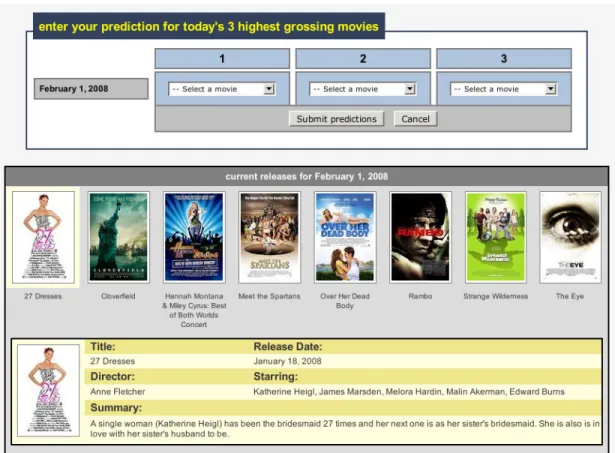
5.1 User interface for making predictions at our study Web site. . . 39
5.2 User interface for confirming registration. . . 42
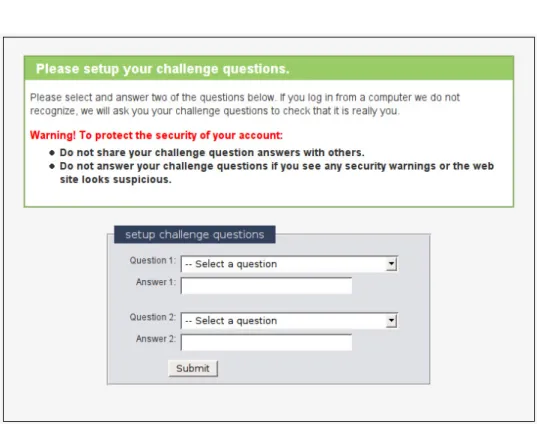
5.3 User interface for setting up challenge questions. . . 42
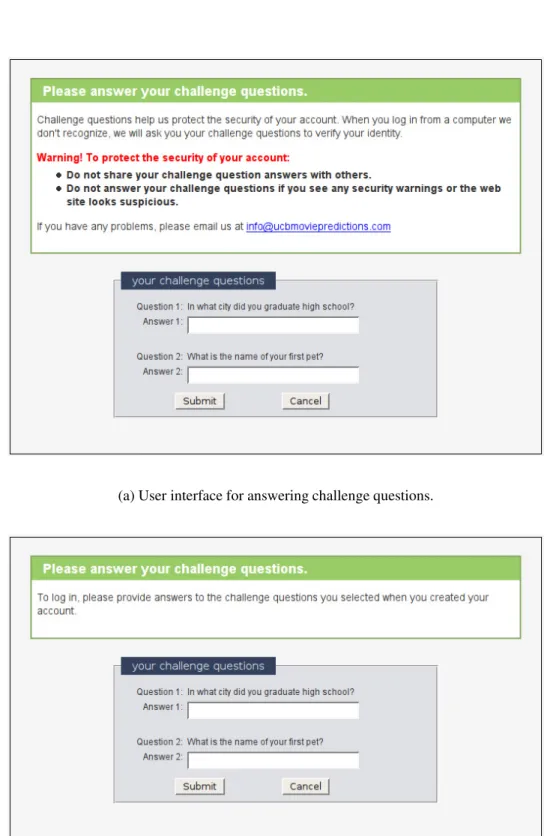
5.4 Normal challenge questions interface vs. simulated attack instructions. 43
5.5 Registration emails. . . 44
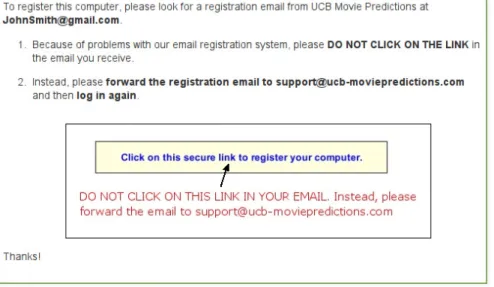
5.6 Our simulated attacks against email registration. . . 45
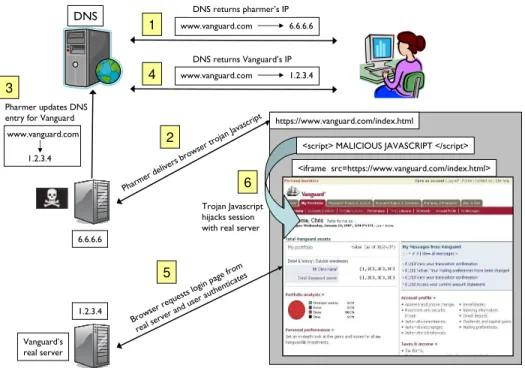
6.1 An example of a dynamic pharming attack. (1) Initially, the pharmer
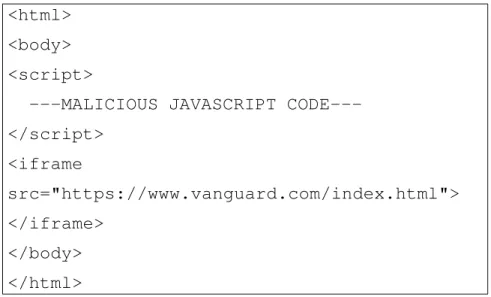
arranges for the victim’s DNS queries for www.vanguard.com to resolve to the pharmer’s IP address, 6.6.6.6. (2) Then, when the victim visits www.vanguard.com, the pharmer returns a trojan document containing ma-licious Javascript and a iframe referencing Vanguard’s home page. (3) The pharmer then updates the DNS entry for www.vanguard.com to the IP ad-dress of Vanguard’s legitimate server and denies subsequent connections from the victim. (4) This causes the victim’s browser to renew its DNS entry for www.vanguard.com, and (5) load Vanguard’s legitimate home page in the iframe. (6) After the user authenticates herself, the malicious Javascript in the trojan document hijacks her session with the legitimate server. . . 71
List of Tables
5.1 Summary of study groups. . . 40
5.2 User demographics by group number. Some percentages may not add to
100% due to rounding. . . 50
5.3 User demographics by group number. Some percentages may not add to
100% due to rounding. . . 51
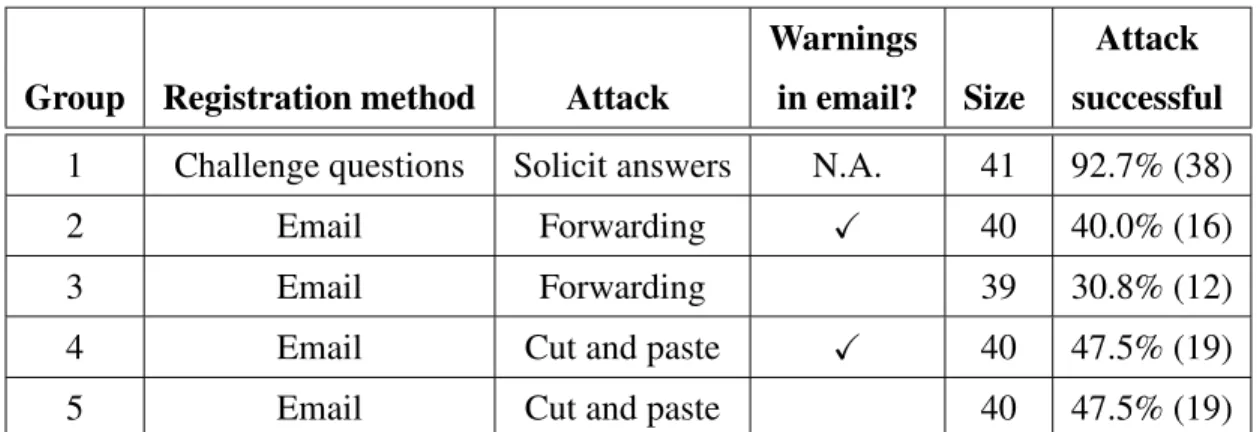
5.4 Success rates of our simulated attacks against registration procedures
in our user study. Users in groups 2 and 4 received contextual warnings
in registration emails against our simulated attacks, but users in groups 3 and 5 did not. . . 53
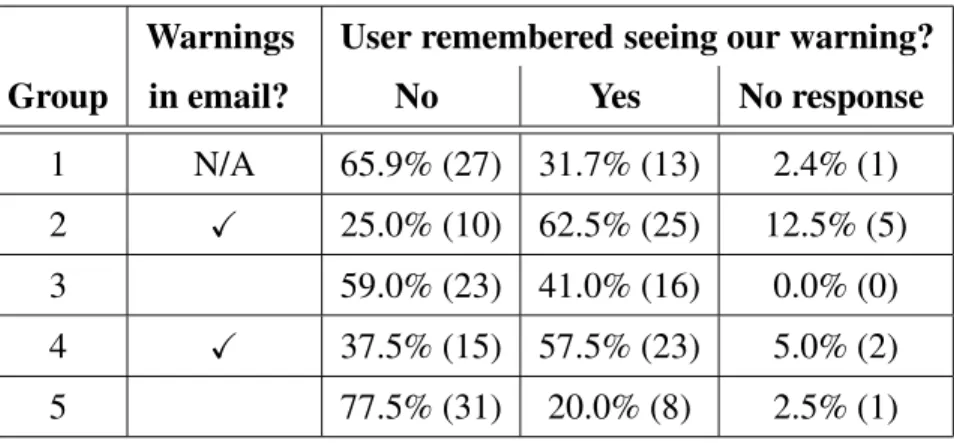
5.5 Number of users who reported remembering seeing our warnings. . . 54
5.6 Effect of warning recall on resisting our simulated attacks. Of the 200
users in our study, 9 users did not respond to this question. . . 54
5.7 Self-reported effects of our warnings on users who remembered seeing
them. . . 55
5.8 Users’ opinions of the security benefits of registration. . . 59
5.9 Users’ opinions of the convenience of registration. For space constraint
reasons, some of the answer choices have been shortened. Refer to Ap-pendix A for the full text of the answer choices. . . 60
5.10 Risk ratings. This table summarizes how thoroughly and often the users
reported applying security precautions when logging into various types of Web sites. . . 61
7.1 Comparison of our locked origin policies with the legacy
same-origin policy. This table shows the strongest threat model under which
each policy can isolate a legitimate server’s Web objects (e.g., cookies, HTML documents, etc.) from adversaries. Locked Web objects refer to objects retrieved over SSL. Shared locked Web objectsrefer to objects re-trieved over SSL which are intended to be shared among subdomains of a higher-level domain (e.g., domain cookies). Untrusted certs refer to a legitimate server using a self-signed certificate or a certificate issued by a root CA untrusted by browsers. . . 82
7.2 Summary of browser mechanisms used to address missing and expired
intermediate CA certificates. AIA refers to the optional Authority
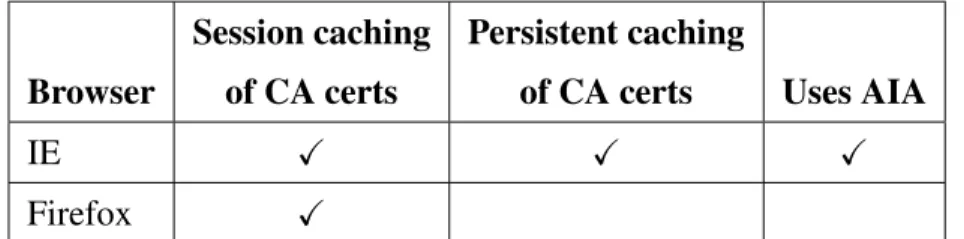
Infor-mation Access X.509 extension. . . 87
7.3 Summary of our deployability analysis of the locked same-origin
poli-cies using a sample of 14651 SSL domains.This table shows the
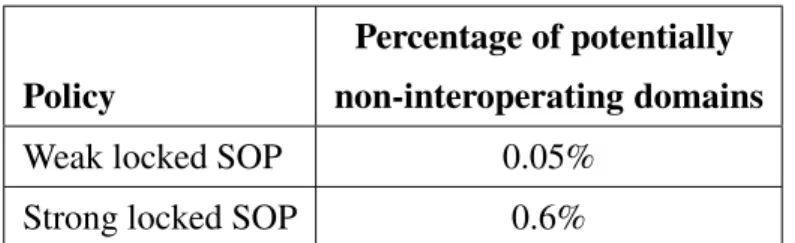
percent-age of domains in our survey which may not correctly interoperate with the locked same-origin policies. . . 89
Acknowledgments
It is a pleasure to thank the many people who made this thesis possible.
I owe immense gratitude to my advisers, Doug Tygar and David Wagner. Doug and David co-advised me, and they made my studies at Berkeley enlightening, fruitful, and enjoyable. Doug and David time and again removed obstacles of all types to help keep me focused on my research. Their advice was complementary and insightful, and rarely conflicted. Doug taught me how to pick interesting and rewarding research problems, and repeatedly helped me uncover the “bigger picture” when I became too focused on the de-tails. David listened patiently to my unrefined and flawed ideas, and helped me polish them into the final works I am now proud of. Most of all, I am thankful to Doug and David for continually improving my writing skills. I could not have had a better experience as a graduate student.
I am indebted to my many fellow graduate students and other colleagues for providing a stimulating and fun environment in which to learn and grow. I particularly would like to thank Yaping Li, Adrian Perrig, Dawn Song, Adam Barth, Rachna Dhamija, Kamin Whitehouse, AJ Shankar, Marco Barreno, David Molnar, Adrian Mettler, and Karl Chen. I am especially grateful to my frequent co-authors, Naveen Sastry and Umesh Shankar. We learned many things together, and I was lucky to have the opportunity to collaborate with them.
I would like to thank the many funding agencies who helped make my work at Berkeley possible: the Defense Advanced Research Projects Agency, the National Science Founda-tion, the US Postal Service, the iCast Project, the Army Research Office, Bosch, Intel, KDD, and Honda.
I can not end without graciously thanking my family, John, Gidget, and Kristie, and my loving partner, Monica Chew. My family has been a solid and reliable source of support my entire life, and without them, I would have not accomplished nearly as much as I have. My partner Monica deserves my deepest gratitude. She is a tremendous source of love, joy, soothing, encouragement, and insight, and gently helped me navigate the many potholes and bumps on the road to graduation.
Chapter 1
Introduction
This dissertation argues that since computer security mechanisms can have strong ef-fects on users’ behavior and choices, we must judiciously design these mechanisms such that human psychological tendencies help users resist attacks, rather than make them more vulnerable, as many current mechanisms do. Our focus is on user authentication schemes on World Wide Web. Despite the development of numerous cryptographic authentication mechanisms, user authentication on the World Wide Web remains firmly saddled in the 1970s: the vast majority of users authenticate themselves to Web sites by sending a plain-text password over the network. Although widespread deployment of the Secure Sockets Layer (SSL) helps protect password authentication against passive eavesdropping attacks, it does little to help users resist more devious threats, such as phishing [6]. A phishing attack is a type of social engineering attack, where an adversary lures an unsuspecting In-ternet user to a Web site posing as a trustworthy business with the goal of stealing sensitive personal information, e.g., the user’s password. Phishers commonly lure victims by send-ing an email containsend-ing a warnsend-ing about a “problem” which requires immediate attention, along with a link the user can click to take action. If a user clicks on the link, she will reach the phishing site. A phishing attack typically prompts the user to enter some per-sonal information, such as a login name, password, or social security number, before the “problem” with her account can be addressed. Phishing attacks have become widespread over the last decade, and their success has created a multi-million dollar underground econ-omy [33, 117]. Our goal is to develop authentication mechanisms resistant to phishing and
other social engineering attacks that target users’ Web accounts.
One explanation for the success of phishing attacks is a human psychological tendency to develop automatic responses to situations we encounter more than once. Our brains tend to classify stimuli according to a few key features, and if one or more features match stimuli we have encountered in the past, we often respond mindlessly with the action that we learned was most appropriate. Psychologist Robert Cialdini calls these click-whirr responses [16]. Cialdini compares these automatic responses to pre-recorded tapes in our head, and uses “click-whirr” to evoke the sound a tape machine makes after pressing “play”. As the world becomes more intricate and variable, we increasingly rely on click-whirr responses. Without click-whirr responses, we would spend most of our time appraising and analyzing mundane situations in our daily lives. Philosopher Alfred North Whitehead recognized this when he asserted “civilization advances by the extending the number of operations we can perform without thinking about them [131].”
As we become more dependent on click-whirr responses to navigate our daily lives, some have learned to exploit this behavior. Stored schemas of past recollections and sen-sory inputs tend to only contain evidence of how a previously encountered situationshould appear – they rarely store information about how that situation should not appear [100]. Salesman, fund raisers, and con men can create situations containing the stimuli necessary to trigger the desired click-whirr response, even though less visible features may differ substantially from past situations. For example, people tend to obey a person in a uniform, regardless of whether that person has any real authority.
The designers of many current Web authentication mechanisms, such as passwords, have all but ignored this fundamental psychological phenomenon. The most common Web authentication technique in use today is password authentication via an HTML form, where a user types her password directly into a Web page from the site to which she wishes to au-thenticate herself. Social engineering attacks on the Internet, such as phishing, have largely been successful because the Web is fertile ground for mimicry, and password authentication can condition users to fall for these attacks. Since a wide range of Web sites require a user to log in before she can do something interesting, many users have developed a click-whirr response to login forms and will automatically enter their login credentials on any page which on the surface appears familiar, legitimate, or trustworthy.
This dissertation makes two main contributions to the development of Web authen-tication mechanisms that resist phishing and other social engineering attacks. First, we introduce the notion of aconditioned-safe ceremony, a new approach for developing user-centric authentication and security mechanisms. Second, we address two security issues withmachine authentication, a procedure that authenticates a user’s computer, as opposed to herself. We discuss these contributions further in the following sections.
1.1
Conditioned-safe ceremonies
Web authentication is an example of a ceremony. A ceremony is similar to the con-ventional notion of a network protocol, except that a ceremony explicitly includes human participants as nodes in the network, distinct from the computers and devices they use [29].1
Communications between human nodes and other nodes in the ceremony are usually not via network connections, but instead through user interfaces, face-to-face interactions, or peripheral devices.
Although current Web authentication ceremonies, such as password authentication, are vulnerable to attacks that exploit human psychological tendencies such as click-whirr re-sponses, we argue that these tendencies are not something that we necessarily must avoid or suppress in ceremony design. Instead, in Chapter 3, we hypothesize that we can build ceremonies that turn the tables on adversaries and take advantage of these psychologi-cal tendencies to help users resist social engineering attacks. We identify several ways in which many current security mechanisms and ceremonies have disregarded human ten-dencies, and present a model for user behavior during social engineering attacks based on psychological research on human performance and error, such as Jens Rasmussen’s skill-rule-knowledge framework [99] and James Reason’s Generic Error-Modeling Sys-tem [100]. Based on this model, we introduce the notion of aconditioned-safe ceremony. A conditioned-safe ceremony is one that deliberately conditions users to reflexively act in ways that protect them from attacks. Many existing ceremonies require users to make dif-ficult and subtle security decisions or respond to exceptional situations to resist attacks. In
1
contrast, if a user of a conditioned-safe ceremony simply performs the same actions during an attack as she usually performs under normal conditions, she will resist – even if she is unaware of the threat. Our formulation of conditioned-safe ceremonies in Section 3.3 draws on several ideas and lessons learned from the human factors and human reliability community: forcing functions, defense in depth, and the use of human tendencies, such as rule-based decision making.
1.2
Securing machine authentication
To address the precipitous rise in social engineering attacks on the Internet, the Fed-eral Financial Institutions Examination Council declared in October 2005 that passwords alone are “inadequate for high-risk transactions” [20]. In response, many institutions use machine authentication, which authenticates a user’scomputer, in addition to password au-thentication, which authenticates the user herself. For example, one widely used approach for machine authentication is to set a persistent cookie; since the user’s browser will send that cookie every time the user returns to the Web site from that computer, the Web site can recognize the user’s computer. To successfully log in, the user must provide her password and the user’s browser must present a valid cookie. The intention is to take the human “out of the loop” and reduce the system’s dependency on humans’ abilities to detect at-tacks. Web sites currently using machine authentication include Bank of America [9], ING Direct [52] and Vanguard [123].
One potential advantage of machine authentication is that it increases the difficulty of social engineering attacks against users’ accounts. The problem with password authenti-cation is that it is too easy for users to reveal their passwords to phishers and other adver-saries. In one standard classification of authentication schemes, passwords are “something you know”; but the problem with using “something you know” for authentication is that anything the user knows, she can—and in a nontrivial fraction of cases, will—reveal to an adversary. Instead, machine authentication relies on “something your computer knows.” This is roughly equivalent to “something you have,” except implemented in software, with-out requiring the physical hardware tokens normally used to fill that role.
To compromise a user’s account, an attacker not only needs to phish the user’s pass-word, but must also steal the user’s authentication cookie. Although simply requesting a user’s password has proven to be a relatively successful attack, pilfering a user’s cookie from her machine is not as straightforward; computers are not fooled by social engineering attacks. Browsers automatically determine the appropriate cookies for Web requests and require little to no user involvement to make security decisions, reducing the chance of human error.
We address two security issues with machine authentication: 1) initializing machine authentication credentials on users’ computers, i.e., the registration problem, and 2) se-curing machine authentication against stronger threat models, such as pharming and active attackers.
1.2.1
The registration problem
Since users may use more than one computer, machine authentication systems must have aregistrationceremony to authorize and set authentication cookies on multiple ma-chines. Unfortunately, this additional functionality potentially brings the human back “in the loop” and exposes machine authentication systems to an alternative attack vector. In-stead of trying to steal authentication cookies directly from a user’s machine, an attacker can try to subvert the registration ceremony in a way that grants the attacker a valid cookie for the user’s account. Consequently, registration ceremonies must resist these kinds of bootstrapping attacks.
Many machine authentication systems currently deployed by financial Web sites use challenge questionbased registration [9, 52, 123]. A challenge question is a user-specific question to which an adversary is unlikely to be able to guess an answer, e.g., “What is the name of your favorite teacher?” [30, 65]. Registration based on challenge questions is vulnerable to man-in-the-middle (MITM) attacks [113, 144]. Since these attacks exploit similar human tendencies as attacks against passwords, the security benefits of challenge questions over passwords alone may be minimal.
An email-based registration ceremony. We apply our design principles for conditioned-safe ceremonies to develop a registration ceremony for machine authentication based on email (Section 4.2). When a user attempts to log in from an unregistered computer, the Web site sends her an email containing a single-use HTTPS URL. When the user clicks on the registration link, the Web site sets a persistent authentication cookie on the user’s com-puter. For subsequent logins from that computer, she only needs to complete any supple-mentary login procedures, e.g., enter her username and password. We discuss email-based registration further in Section 4.2.
A user study of registration ceremonies. To evaluate our email based registration
cer-emony, we conducted a user study with 200 participants to compare the security of email registration to the security of registration based on challenge questions (Chapter 5). We designed our study to be as ecologically valid as possible: we employed deception, did not use a laboratory environment, and attempted to create an experience of risk. We sim-ulated social engineering attacks against the users and found email based registration was significantly more secure against our attacks (Table 5.4). Our simulated attacks succeeded against 93% of challenge question users, but succeeded against only 41% of email users. We also found evidence that conditioning helped email registration users resist our sim-ulated attacks, but contributed towards making challenge question users more vulnerable. We asked users to complete an exit survey after they finished the study, and we analyze the results in Sections 5.3 and 5.4.
1.2.2
Dynamic pharming attacks and the locked same-origin policies
Although phishing has been one of the most prevalent types of social engineering at-tacks on the Web, stronger atat-tacks, such aspharming, are a growing threat [4, 66, 97, 115, 120, 121]. In apharmingattack [91], the adversary subverts the domain-name lookup sys-tem (DNS), which is used to resolve domain names to IP addresses. In this attack, the DNS infrastructure is compromised so that DNS queries for the victim site’s domain (say, google.com) return an attacker-controlled IP address. Pharming attacks are particularly devious because the browser’s URL bar will display the domain name of the site the user
intended to visit.
Dynamic pharming attacks. We describe a new type of DNS attack against Web
au-thentication we calldynamic pharming. In a dynamic pharming attack, the adversary ini-tially delivers a Web document containing malicious Javascript code to the victim, and then forces the victim’s browser to connect to the legitimate server in a separate window or frame. The adversary waits for the victim to authenticate herself to the legitimate server, and then uses the malicious Javascript to hijack the victim’s authenticated session.
Dynamic pharming takes advantage of how browsers currently implement the same-origin policy. The same-same-origin policy prohibits a Web object from one site from accessing Web objects served from a different site. Browsers currently enforce this by checking that the two objects’ originating domain names, ports, and protocols match. However, when an adversary controls the domain name mapping, the legacy same-origin policy does not provide strong isolation between Web objects co-executing in a user’s browser. In a dy-namic pharming attack, malicious Javascript from the pharmer and content from the legiti-mate server both appear to have the same “origin” (i.e., same domain, port, and protocol), and the browser allows the Javascript to access to the user’s authenticated session. As a result, the attacker can gain complete control of the session, enabling her to eavesdrop on sensitive content, forge transactions, sniff secondary passwords, etc. Since dynamic pharming hijacks users’ sessions after authentication completes, irrespective of the authen-tication mechanism, it can be used to compromise even the strongest Web authenauthen-tication schemes currently known, including all forms of machine authentication. We present dy-namic pharming in more detail in Chapter 6.
The locked same-origin policies. Since dynamic pharming hijacks a user’s session
af-ter initial authentication completes, it is unlikely any future Web authentication ceremony developed for currently deployed browsers will resist dynamic pharming either. To resist dynamic pharming, we address the root of the problem: we upgrade the browser’s same-origin policy. We propose twolocked same-origin policies: instead of comparing domain names to enforce access control, our policies enforce access control for Web objects re-trieved over SSL by using servers’ public keys and X.509 certificates. We refer to Web
objects retrieved over SSL as locked Web objects because the browser can clearly asso-ciate the public key and X.509 certificate of server hosting the object with the object. Our first proposal, theweak locked same-origin policy, isolates a domain’s locked Web objects with valid certificate chains from objects with invalid chains. This enables browsers to distinguish a legitimate server using a valid certificate from pharmers using invalid cer-tificates, such as self-signed certificates or certificates with CN/domain mismatches. Our second proposal, thestrong locked same-origin policy, enforces access control using cryp-tographic identity, namely Web sites’ public SSL keys. In the strong locked same-origin policy, the browser compares the public keys it associates with locked Web objects; access is granted only if they match. In Chapter 7, show how our policies substantially increase browsers’ resistance to pharming attacks and provide a solid foundation for developing pharming resistant machine authentication.
We evaluate our policies in terms of deployability, meaning how well they interoperate with existing Web servers. Based on the results of a study of 14651 SSL domains, we found strong evidence that the weak locked same-origin policy can replace the legacy same-origin policy today with minimal risk of breaking existing Web sites (Section 7.4). Although we did not find similar evidence for the strong locked same-origin policy, we propose a simple, incrementally deployable and backwards compatible mechanism for Web sites to opt in using policy files (Section 7.5). To opt in, we propose that a Web site should post a policy file which enables the site to specify how it would like the browser to enforce the strong locked same-origin policy. Policy files also support flexible server configurations and key updates. In contrast to the weak locked same-origin policy, the strong locked same-origin policy has better security properties, is compatible with sites using self-signed or untrusted certificates, and supports subdomain object sharing.
Chapter 2
Preliminaries
2.1
Background
2.1.1
HTTP cookies
HTTP cookies are a general mechanism for Web servers to store and retrieve persis-tent state on Web clients [94]. When a client makes an HTTP request to a server, the server has the option of including one or moreSet-Cookieheaders in its response. The Set-Cookie HTTP header allows several optional attributes. The expires attribute indicates when a browser should delete the cookie. If theexpiresattribute is omitted, then the cookie is called asession cookie and should be deleted when the user closes the Web browser. Cookies with anexpiresattribute are calledpersistent cookies.
The domainattribute specifies the set of HTTP requests for which a browser should include the cookie. For example, if the user requests the URLhttp://www.foo.com/ index.html, then a cookie withdomain=foobar.comordomain=www.foo.com would be included with this request, but a cookie withdomain=pics.foo.comwould not. The default value of the domainattribute is the host name of the server which gen-erated the cookie response. We refer to a cookie with an explicit domainattribute as a domain cookieand a cookie which omits it as ahost cookie.
Thesecureattribute indicates that the browser should only send the cookie over SSL connections. We refer to a cookie including thesecureattribute as anSSL-only cookie.
Javascript may also access cookies through thedocument.cookie property. For this mode of access, Web browsers use the URL of the document executing the Javascript to determine the appropriate cookies.
Recent browsers support more structured persistent storage mechanisms with function-ality similar to cookies. Some browser plugin architectures also provide persistent storage mechanisms, e.g., Adobe Flash and Google Gears.
2.1.2
The legacy same-origin policy
The same-origin policy (SOP) in Web browsers governs access control among different Web objects and prohibits a Web object from one origin from reading or modifying Web objects from a different origin [87]. By Web objects, we mean HTTP cookies, HTML documents, images, Javascript, CSS files, XML files, etc. A common example of “access” is Javascript referencing another object. In the remainder of this dissertation, we will use “SOP” as an abbreviation for “same-origin policy”.
Browsers currently consider two objects to have the same origin if the originating host, port, and protocol are the same for both Web objects. A Web object can read and modify another object only if they have the same origin. For example, Javascript execut-ing onhttp://www.foo.com/index.htmlis allowed to read and modifyhttp: //www.foo.com/other.html, but is not allowed to access https://www.foo. com/secure.html (different protocol) or http://www.xyz.com/index.html (different host). Other examples of “Web object accesses” subject to the SOP include de-termining which cookies to append to an HTTP request, Javascriptdocument.cookie references, and XMLHTTPRequest.
Note there is a distinction between “access” and “causing to load”. After the browser receives an HTML page, it processes dependent requests necessary to render the page, such as images, style sheets, etc. These requests can cause the browser to fetch and load a Web object from a different domain. However, these requests are not considered violations of the SOP. The document can read certain metaproperties of the object (e.g., height, width), but the SOP prevents the document from reading or modifying the content of the loaded object.
2.1.3
Secure Sockets Layer (SSL) and X.509 certificates
The Secure Sockets Layer (SSL) and its successor, Transport Layer Security (TLS), are cryptographic protocols for establishing end-to-end secure channels for Internet traffic [34, 119]. HTTP over SSL is also known as HTTPS.
SSL uses X.509 certificates [50] to identify the server participating in the SSL connec-tion. An X.509 certificate contains the server’s public key, the domain name of the Web site (specified in theCNsubfield of the certificate), the public key of the issuer of the certificate, the time period for which the certificate is valid, and the issuer’s signature over these fields. The private key corresponding to a X.509 certificate can be used to sign another certificate, and so on, creating a chain of trust. The root of this trust chain is typically a certificate authority (CA); Web browsers ship with the certificates of some CAs that are deemed to be trusted.
When the client’s Web browser makes a connection to an SSL enabled Web server over HTTPS, the browser must verify the server’s certificate is valid. This involves numerous checks, but at a high level the browser must:
• Verify that every certificate in the chain has a valid signature from its predecessor, using the public key of the predecessor, and that the last certificate in the chain is from a trusted CA.
• Verify that theCNfield of the first certificate in the chain matches the domain name of the Web site the browser intended to visit.
• Verify every certificate has not expired.
If any of these checks fail, the browser warns the user and asks the user if it is safe to continue. If the user chooses, the user may permit the SSL connection to continue even though any or all of these checks have failed. The reason is to ensure compatibility with misconfigured certificates and SSL servers. Also, this behavior by browsers allows Web sites to use self-signed certificates if they choose, instead of paying a CA for a certificate. Unfortunately, asking users whether to continue in such cases is a serious security vulnera-bility. Researchers have shown that users routinely ignore such security warnings and just
click “OK” [11, 24, 135]. In fact, users have become so ambivalent to security warnings, one vendor has developed “mouse auto-clicker” software, aptly titled “Press the Freakin Button” [95], to automatically click through dialogs like these. Instead of a dialog box, IE 7.0 and Firefox 3 use a full page warning within the browser window offering similar options (i.e., accept certificate and continue, or cancel connection), although bypassing the Firefox 3 warning requires several steps. Unfortunately, studies and anecdotal evidence suggest that users will ignore a full page warning as well [12, 108]. Accordingly, we con-sider a certificate that does not generate any warnings as valid. Otherwise, we consider it invalid.
After the browser validates the server’s certificate, it participates in a cryptographic protocol with the server where: 1) the server proves knowledge of the private key corre-sponding to the public key in the certificate, and 2) they negotiate a session key to encrypt and authenticate subsequent traffic between them. Unlike the certificate validation step, if there are any errors in this protocol, the browser closes the connection with no chance of user override.
Client-side SSL. The most common usage of SSL is for server authentication, but in the
SSL specification, a server can also request client-side authentication, where the client also presents an X.509 certificate and proves knowledge of the corresponding private key. Using client-side SSL, servers can identify a user with her SSL public key and authenticate her using the SSL protocol.
2.2
Threat models
We consider three broad classes of adversaries, classified according to their capabilities.
2.2.1
Phishers
Phishing is a social engineering attack in which an adversary lures an unsuspecting Internet user to a Web site posing as a trustworthy business with which the user has a rela-tionship [6]. The broad goal is identity theft; phishers try to fool Web visitors into revealing
their login credentials, sensitive personal information, or credit card numbers with the in-tent of impersonating their victims for financial gain. Phishers commonly lure victims by sending an email containing a warning about a “problem” which requires immediate atten-tion, along with a link the user can click to take action. If a user clicks on the link, she will reach the phishing site. Typically a phishing attack prompts the user to enter some personal information, such as a login name, password, or social security number, before the “problem” with her account can be addressed. We assume a phisher has the following capabilities:
• Complete control of a Web server with a public IP address. We assume a phisher uses a different domain name from the target domain.
• The ability to send communications such as emails and instant messages to potential victims.
• Mount application-layer man-in-the-middle attacks, representing a legitimate server to the victim and proxying input from the victim to the real server as needed.
There have been relatively few documented cases of application-layer man-in-the-middle attacks [7, 127, 128], most likely because of the extra effort required to implement the attack. However, researchers have discovered a “Universal Man-in-the-Middle Phishing Kit” [75], a hacker toolkit which enables a phisher to easily set up a MITM proxy attack against any site she wishes.
To date, phishers have been the most prevalent class of attacker; however, looking to the future, stronger attackers are a growing threat [4, 66, 97, 115, 120, 121], and it seems prudent to defend against these more powerful attackers as well, to the extent possible. We discuss these stronger threat models next.
2.2.2
Pharmers
In a pharming attack [91], the adversary subverts the domain-name lookup system (DNS), which is used to resolve domain names to IP addresses. In this attack, the DNS infrastructure is compromised so that DNS queries for the victim site’s domain (say,
google.com) return an attacker-controlled IP address. We assume a pharmer has all the abilities of a phisher, plus:
• The ability to change DNS records for the target site, such that the victim will resolve the target site’s name to the attacker’s IP address.
We assume the server under the pharmer’s control does not have the same IP address as the victim and cannot receive packets destined to the victim’s IP address.
Pharming can be accomplished via several techniques, including DNS cache poisoning, DNS response forgery, modifying a user’s/etc/hostsfile, tricking a user to modify her DNS settings, or by social engineering attacks against a domain name registry. Pharming attacks are particularly devious because the browser’s URL bar will display the domain name of the legitimate site, potentially fooling even the most meticulous users.
Although pharming attacks have been relatively rare in practice, evidence suggests they may become a more serious threat in the near future. Recent research has exposed complex and subtle dependencies between names and name servers [97] and weaknesses in the DNS protocol [66], suggesting the DNS infrastructure is more vulnerable to DNS poisoning attacks than previously thought.
2.2.3
Active attackers
We assume an active attacker has all the abilities of a pharmer, plus
• The ability to modify, re-route, drop, and delay all traffic to and from the victim’s IP address.
• The ability to eavesdrop on all traffic to and from the victim’s IP address.
• The ability to mount active, network-layer, man-in-the-middle attacks against the victim.
The ubiquity of public wireless access points and wireless home routers introduces new opportunities for launching active attacks. Users are becoming accustomed to accessing wireless routers in airports, restaurants, conferences, libraries, and other public spaces. Ad-versaries can set up malicious wireless routers in these areas that offer free Internet access
but redirect users to spoofed Web sites [4]. Also, many users leave the default password and security settings on their wireless home routers unchanged [110]. This enables warkit-ting attacks [120, 121], a combination of wardriving and rootkitting, where an adversary maliciously alters a router’s configuration over a wireless connection. A related attack is where a malicious Web site serves content that scans a visitor’s internal network and com-promises home routers with default passwords. After the adversary has compromised the victim’s router, she can change the router’s settings or overwrite the router’s firmware to intercept the victim’s traffic [115].
2.2.4
Other assumptions
For the attacks we present in Chapter 6, we assume that many users will ignore certifi-cate warnings. Several studies suggest that users routinely ignore and dismiss such warn-ings [11, 24, 108, 135]. For the defenses we present in Chapter 7, we assume that attackers do not have access to the target site’s server machines or any secrets, such as private keys, contained thereon.
Chapter 3
Conditioned-safe ceremonies
In this chapter, we propose design principles for conditioned-safe ceremonies. At the high level, a conditioned-safe ceremony is one that deliberately conditions users to only perform safe actions during social engineering attacks and reflexively respond in ways that thwart attacks. Before discussing conditioned-safe ceremonies in detail, we first examine psychological tendencies that make users vulnerable to social engineering attacks on the Web and model user behavior during attacks with seminal psychological frameworks for human performance and error. In Chapter 4, apply our design principles to develop a conditioned-safe registration ceremony based on email.
3.1
Why users are vulnerable
Over the last decade, the success of Web based social engineering attacks, e.g., phish-ing, has created a multi-million dollar underground economy, largely by exploiting weak-nesses in password authentication and other Web authentication ceremonies [33, 117]. Al-though it is tempting to blame the success of these attacks on the ignorance of users, re-searchers have offered an alternative explanation: computer security mechanisms such as passwords and browser security indicators are poorly suited for human use [2, 22, 24, 25, 46, 108, 129].
3.1.1
Automatic decision making strategies are exploitable
A recurring theme in the psychological literature is that humans tend to vastly prefer rule-based decision makingover more tedious analytical approaches [99, 100]. The the-ory of rule-based decision making is based on psychological studies that suggest humans tend to learn and aggressively apply problem-solving rules of the form “if (situation) then (action)” for frequently encountered situations. When a user encounters a problem in a task, she matches the most prominent cues in the environment with the calling conditions of previously learned rules to find most appropriate one to apply.
Although rule-based decision making helps us navigate the minutia of our daily lives and reserve our time and energy for tasks requiring more detailed analysis, adversaries can exploit rule-based decision making in social engineering attacks [16]. Human relia-bility expert James Reason observed that frequently used rules, i.e., strong rules, may be “misapplied in environment conditions that share some common features with the appro-priate states, but also possess elements demanding a different set of actions [100].” In other words, a rule which has been frequently useful in the past can become astrong-but-wrong rule when the situational cues change subtly. This helps explains why phishing attacks have been so successful. Since a wide range of Web sites require a user to log in before she can do something interesting, many users have developed a rule of the form “if (login form) then (enter username/password)” and will aggressively apply it when they encounter login prompts on Web pages which on the surface appear familiar, legitimate, or trustworthy. We discuss rule-based decision making further in Section 3.2.
3.1.2
Web browser security indicators condition users to satisfice
A frequently recommended defense against phishing attacks is for a user to verify a Web page’s domain and SSL certificate before entering her password on that page; otherwise, she might inadvertently reveal her credentials to an attacker. However, research has shown that users often omit these checks [24, 25, 35, 37, 49, 56, 108, 130, 135]. Although some users ignore these indicators because they do not understand them, a more fundamental problem is that browser security indicators condition users tosatisfice.
as one that is good enough”, i.e., one that both satisfies and suffices [101]. Checking se-curity indicators is easy to skip because it distracts the user from her primary focus, and there are rarely any immediate visible consequences for skipping these checks or rewards for making them. Since the vast majority of a user’s login attempts are probably not under attack (or at least do not obviously appear to be under attack), routinely skipping secu-rity checks and ignoring warnings seems deceivingly acceptable. Over time, users learn to quickly and instinctively perform a security task’s required actions (e.g., entering their passwords) and optimize out the optional actions (e.g., checking security indicators, re-sponding to security warnings). Once a user has become conditioned into a satisficed be-havior, psychologists have found it is difficult for her to change it, even if she recognizes overwhelming evidence that her behavior is wrong [16].
3.1.3
Users are not good at recognizing attacks
A recurring theme in the field of human reliability and error is that users often have difficulty in recognizing risky or dangerous situations, and as a result, users may be less vigilant of their choices in these situations than they should. For example, in a review of 100 maritime shipping accidents, Wagenaar and Groeneweg concluded: “Accidents do not occur because people gamble and lose, they occur because people do not believe that the accident that is about to occur is at all possible [126].” This suggests that we cannot rely on users’ abilities to detect social engineering attacks and respond appropriately either, and we must design defenses accordingly.
Several human tendencies contribute to this phenomenon. Psychological studies have shown that people are generally poor at evaluating risk and tend to believe they are less vul-nerable to risks than others [112]. For example, many people believe they are better than average drivers and they will live longer than the average life expectancy. It stands to reason these tendencies also influence user behavior on the Internet, leading users to believe they are less likely to be the targets of attacks. One might respond that security mechanisms, such as warnings, can raise awareness and help users recognize attacks. However, not only are security tasks rarely users’ primary goal, but they often inhibit users from completing tasks. Security mechanisms often present users with two options: 1) terminate, or 2)
pro-ceed insecurely. Task failure is guaranteed by choosing option 1, but the probability of a security compromise is unclear with option 2. Since task failure is unsatisfying, there is a strong incentive to choose option 2. Decades of buggy software have conditioned users to expect errors, failures, and other incomprehensible system behavior, particularly with hastily developed and continually updated Web applications. Users routinely encounter warnings and errors messages, but rarely experience any immediate negative consequences for dismissing them, even during a real attack. This creates the (accurate) impression that false positives are the norm, and actual attacks are rare.
Unfortunately, frequent false alarms and errors may be molding recklessly obstinate users. Studies suggest that once someone adopts a particular belief, e.g., “it’s unlikely I would be the victim of an attack”, it is hard to change her mind, even in the face of strong disconfirmatory evidence [105]. In the psychology community, this is known as belief perseverance. Belief perseverance is often sustained byconfirmation bias [89], a human tendency to overweight confirming evidence for one’s belief and underweight disconfirm-ing evidence. Researchers have observed evidence of confirmation bias in users’ strategies for determining a Web site’s trustworthiness. Studies suggest users tend to rely more on a Web site’s look-and-feel, logos, their past experience at site, and personalized information to determine trustworthiness than standard browser security indicators such as the lock icon or URL bar [24, 25, 32, 59, 135]. Since adversaries can easily spoof look-and-feel, logos, and personalized information, these strategies are not likely to falsify her hypothesis, only confirm it.
Underweighting disconfirming evidence often manifests itself as “explaining away” the inconsistencies [133]. Studies suggest that users will readily “explain away” attack instructions, broken images, strange URLs, and security warnings as errors rather than potential attack cues [24, 25, 28, 135]. Since users have been forced to develop strategies to work around computer system errors, it’s understandably tempting for user to interpret potential attack indicators as errors. Instead of having to terminate her task in response to an attack, by reclassifying the attack as an error, she can instead try to “work around” it by complying with the attacker’s “helpful” instructions.
3.2
Modeling user decision making during attacks
3.2.1
Skill, rule, and knowledge based performance
To help understand users’ decision making processes during social engineering attacks, we look to Jen Rasmussen’s seminal skill-rule-knowledge classification of human perfor-mance [99]. Rasmussen’s skill-rule-knowledge framework has been used within the sys-tems reliability community to model human error [100]. Rasmussen’s framework models human performance at three levels: skill-based, rule-based, and knowledge-based. Ras-mussen distinguishes performance levels based on whether the user is actively engaged in problem solving. The rule-based and knowledge-based levels are typically associated with problem solving activities, while the skill-based level is not. Behavior at the skill-based level generally encompasses routine and highly practiced sensorimotor actions which re-quire little conscious control after initiation. Although users may employ skill-based ac-tions to achieve local goals in problem solving tasks, skills are primarily invoked during routine and nonproblematic tasks in familiar situations. For example, consider the task of browsing a Web site. To navigate Web pages, a user commonly employs skill-based actions such as clicking URLs and scrolling until she encounters an unexpected problem or new situation.
After identifying the existence of a problem, Rasumessen conjectures that users enter the rule-based level. The rule-based level applies to common, familiar problems for which the user has previously learned a successful solution. A recurring theme in the psycholog-ical literature is that humans are aggressive pattern matchers, and when they encounter a problem, they tend to search for a solution by matching prominent cues in the current sit-uation against learned problem-solving rules of the form “if (sitsit-uation) then (action)”. For example, since many interesting Web sites require authentication, this framework suggests users will quickly learn a rule of the form “if (login form) then (enter username/password)” and aggressively apply it when they encounter login prompts on Web pages. Solutions generated at the rule-based level are analogous to Cialdini’s click-whirr responses.
The knowledge-based level only comes into play during novel situations where a solu-tion must be planned online, using conscious analytical processes and stored knowledge.
Operating at the knowledge-based level is expensive; it often requires the user to inter-rupt her primary task, switch her attention, analyze the situation, form a mental model, and hypothesize and evaluate solutions. While browsing the Web, a user might enter the knowledge-based level if after attempting to log in, she receives an incomprehensible error message or her browser crashes. Psychological studies suggest that human strongly prefer to pattern match and will only resort to detailed analysis at the knowledge-based level after exhausting all potential prepackaged solutions at the rule-based level. Users are often so overwhelmed at the knowledge-based level that problem solving resorts to “sticking their head in the data stream until a recognizable pattern appears”, allowing them revert back to the rule-based level [100].
3.2.2
Human error and the Generic Error-Modeling System (GEMS)
The Generic Error-Modeling System (GEMS) is a framework developed by James Rea-son for understanding human error during decision making and problem solving [100]. GEMS relies heavily on Jen Rasmussen’s skill-rule-knowledge framework and categorizes errors according to the performance level at which they occur. Errors at skill-based level are called slips, and errors at the rule-based and knowledge-based levels are called mis-takes. Slips are execution failures, where the user decides on an action, but the resulting action is not what was intended. For example, a user commits a slip if she decides to left click the mouse to follow a HTML link, but accidentally right clicks instead. In contrast, mistakes are planning failures, where the user decides on a course of action, but the action is not appropriate. For example, if a user has different passwords for different Web sites, she commits a mistake if she enters the wrong one.
A frequent cause of rule-based mistakes is the misapplication of agoodrule, i.e., a rule which has proven itself useful in the past. For example, “if (legitimate looking login form) then (enter username/password)” is usually a good rule in non-adversarial situations; its application allows a user to quickly authenticate herself and continue her primary task with minimal interruption. This rule is alsostrongfor many users, meaning that it easily comes to mind due to repeated use. “Gambling” with strong rules makes sense if applying the rule frequently results in a winning solution. However, since users often match the calling
conditions of rules with the most prominent cues in the environment, Reason observes that strong, good rules may be “misapplied in environment conditions that share some common features with the appropriate states, but also possess elements demanding a different set of actions” [100]. A rule which has been frequently useful in the past can become a strong-but-wrong rulewhen the situational cues change subtly. As Taylor and Crocker put it [116], “Like all gamblers, cognitive gamblers sometime lose.” Phishers can create a severely rigged game for cognitive gamblers. Phishers provide situational cues which closely match the calling conditions “if (legitimate looking login form) then (enter username/password)”, and applying this rule in the presence of an attacker results in an security failure, i.e., the compromise of the user’s password.
Alternatively, a rule-based mistake may also occur if the user applies a bad rule. Bad rules are exactly that, but often do not cause accidents unless users apply them in risky situations. Reason terms this type of bad rule aninadvisable rule. Inadvisable rules may be perfectly adequate to achieve goals under normal conditions, but under risky conditions they may cause accidents. Reason explains that inadvisable rules “arise when an individual or organization is required to satisfy discrepant goals, among which the maintenance of safety is often a very feeble contender.” Ignoring security warnings is excellent example of an inadvisable rule that many users have adopted. Carefully reading warnings is like “security maintenance” that users will quickly satisfice away if it becomes too burdensome. At the knowledge-based level, mistakes occur because the user is essentially flounder-ing. The fact that the user has reached the knowledge-based level means the situation is not immediately familiar to her and she has already exhausted any immediately applicable rules. The user must either form a mental model on-the-fly or reformulate the problem as a more familiar one. These tactics are highly prone to error, and confirmation bias and the tendency to explain away inconsistencies befog the decision making process. A faulty mental model or inappropriate problem reformulation may lead to the application of strong-but-wrong and inadvisable rules, further increasing the likelihood of errors.
3.2.3
Applying GEMS to user behavior during social engineering
at-tacks
Although GEMS was originally conceived for modeling human errors which lead to ac-cidents, researchers have observed GEMS is also useful for modeling human errors which lead to security failures [13, 21]. In particular, we argue that GEMS is useful for under-standing human behavior during social engineering attacks on the Internet. By casting social engineering attacks in the context of GEMS, we can hopefully apply lessons learned by human reliability specialists to help users resist these attacks.
Generally, for an accident to occur, unsafe acts must combine with risky or unusual environmental conditions. During a social engineering attack, the presence of an adversary is the risky condition, and the adversary’s goal is to intentionally trigger human errors, typically through a combination of environmental manipulation and active encouragement. Current Web ceremonies such as password authentication create a lose-lose situation for users. A common modus operandi of adversaries is to mimic trusted Web sites, and if the charade succeeds, an adversary gains the opportunity to exploit strong-but-wrong and inadvisable rules. Alternatively, if the user is suspicious, she is all but forced to proceed at the knowledge-based level to ultimately decide if the site is trustworthy. Attacks are an exceptional situation for most users, and users are ill-equipped to address them. Users are most likely to make mistakes at the knowledge-based level, and studies suggest that many users have erroneous mental models of Web security mechanisms and have a wide variety of faulty defense strategies for phishing attacks [24, 25, 135]. For example, a user in one phishing study believed that she could enter her username/password to authenticate a Web site, assuming that only the legitimate site would be able to respond correctly [24].
In summary, we hypothesize that social engineering attacks on the Internet succeed mostly due a combination of two tactics: 1) tricking users into applying strong-but-wrong and inadvisable rules, and 2) forcing users to make security decisions at the knowledge-based level, where they are most likely to make mistakes. To help users resist social engi-neering attacks on the Internet, we argue that ceremonies should condition users to apply rules that serve them well and help them thwart attacks. In the next section, we introduce the notion of aconditioned-safe ceremony, an approach for designing ceremonies that takes
these observations into consideration.
3.3
Conditioned-safe ceremonies
One natural response to the weaknesses of current Web ceremonies such as challenge questions and passwords is to design ceremonies which try to eliminate user condition-ing, click-whirr responses, and rule-based decision making. This approach is problematic. Rule-based decision making is fundamental to human behavior: it helps us complete rou-tine tasks quickly and easily. Users may be willing to invest extra time and effort to learn a new security mechanism, but if they cannot learn how to use it efficiently, they will become frustrated and disable or circumvent the offending mechanism [41, 46, 141]. Some degree of conditioning may be necessary for the psychological acceptance of security mechanisms by users.
Since users will tend to adopt rules for completing a ceremony that minimize conscious effort, we should not fight users’ tendencies to use rule-based decision making, but take advantage of these tendencies to help users resist social engineering attacks. We should prudently design ceremonies to condition rules that benefit security rather than undermine it. Towards achieving this goal, we introduce the notion of aconditioned-safe ceremony. A conditioned-safe ceremony is one that deliberately conditions users to reflexively act in ways that protect them from attacks. We propose two design principles for building conditioned-safe ceremonies:
• Conditioned-safe ceremonies should only condition safe rules, i.e., rules that are harmless to apply in the presence of an adversary.
• Conditioned-safe ceremonies should condition at least one immunizingrule, i.e., a rule which when applied during an attack causes the attack to fail. We discuss im-munizing rules further in Section 3.3.1.
These principles also have important consequences on what conditioned-safe ceremonies shouldnotdo:
• Conditioned-safe ceremonies should not condition rules that require users to decide whether it is safe to apply them. Since many users are unreliable at recognizing risky situations, users should not need to refrain from conditioned behavior to resist attacks.
• Conditioned-safe ceremonies should not assume users will reliably perform actions that: 1) the ceremony has not conditioned her to perform, or 2) are voluntary. Satis-ficing users will learn to omit optional and voluntary actions, so ceremonies should not rely upon users to perform such actions.
For example, a ceremony should not condition the rule “if (legitimate looking login form) then (enter username/password)” because it causes a security failure when applied in the presence of an adversary. To determine if it is safe to apply this rule, a user must first verify the URL bar, the site’s SSL certificate, and other security indicators. Burdening users with these decisions is unsatisfactory. Ideally, in a conditioned-safe ceremony, a user should be able to resist an attack even if she has no idea she is at risk and performs the same actions as she usually performs under benign conditions.
However, user behavior is unpredictable and an adversary may try to trick users into deviating from their normal, conditioned behavior in a way that causes a security failure. Conditioned-safe ceremonies need safeguards to resist these attacks. In the human reli-ability community, designers often introduce constraints called forcing functions to help prevent errors in safety-critical environments. We argue that forcing functions can also be useful for conditioned-safe ceremonies, and we discuss them further in the next section.
3.3.1
Forcing functions
Aforcing functionis a type of behavior-shaping constraint designed to prevent human error [90]. Forcing functions usually work by preventing a user from progressing in her task until she performs a particular action whose omission would result in a failure or accident. Because users must take this action during every instance of the task, the forcing function conditions users to always perform this action. With an effective forcing function, after a user performs the function’s associated action, many mistakes become difficult or
impossible to make. For example, consider the error of locking your keys in your residence. A potential forcing function in this situation is a door that can only be locked from the outside, keys in hand. This trains you to take your keys with you whenever you leave home, making it less likely you will be locked out in the future.
Forcing functions often have two benefits: 1) they help prevent errors of omission, where a user skips an important, protective step in a task, and 2) they condition correct, safe behavior, since users cannot normally proceed otherwise. To be effective, the cognitive and physical effort required to comply with a forcing function must be less than the effort required to circumvent it. Otherwise, users may routinely attempt to circumvent the forcing function, diminishing its benefits.
Since forcing functions have been useful for preventing errors in safety-critical environ-ments, we hypothesize they can also help prevent errors during social engineering attacks. However, designing forcing functions that resist social engineering attacks is challenging. In conventional safety-critical environments, the risk elements rarely try to intentionally subvert protection mechanisms and cause errors. Designing electrical safety equipment would be a much trickier business if electricity had malicious intent. Also, deployability considerations for many ceremonies, e.g., no custom hardware, often require forcing func-tions to be implemented entirely in software. Software environments afford attackers many opportunities for mimicry.
One previous application of software-based forcing functions in computer security is the concept of a secure attention key (SAK). A SAK is a mandatory special key combina-tion users must type before they can take a security-critical accombina-tion, e.g., submitting their password. On Window NT systems, users must type Control-Alt-Delete to get a login prompt. The SAK diverts control to the OS kernel, foiling any user-level spoofed login prompts. Since typing the SAK is mandatory, the hope is that users will learn to always enter the SAK before submitting their password.
Unfortunately, a simple attack against many SAKs is to induce an error of omission. On Windows NT systems, an adversary can display a spoofed login prompt and hope users skip the SAK before entering their passwords. This attack creates a conflict between two click-whirr responses: SAK systems condition users to first type the SAK, but all password systems condition users to enter their passwords when they see a login form. Whether the
attack succeeds depends on which click-whirr response is stronger in a particular user. Since social engineering attacks can often misrepresent the state of a system and create the illusion that a forcing function has already been activated or disabled, ceremonies which fail solely due to errors of omission are suboptimal. Errors of omission are easy to make and hard to detect, even during routine tasks. Research suggests that users frequently do not notice when they have omitted routine procedural steps [5], and omission errors represent one of the most common causes of human performance problems [98].
To resist social engineering attacks, we argue that conditioned-safe ceremonies need defense in depth. Designers should build conditioned-safe ceremonies that have two levels of protection: an attack should fail unless a user both omits the conditioned action required by a forcing function and makes anerror of commission. We consider an error of commis-sion to be an anomalous user action not normally used in the ceremony. If the user omits the action required by the forcing function, but does not otherwise deviate from the ceremony, an attack should fail. Likewise, if the user performs the required action, but then makes an error of commission, the attack should also fail. With this approach, the action conditioned by the forcing function acquires an immunizing quality, since after a user performs this action, subsequent errors of commission will not compromise the ceremony.
We emphasize that the conditioned action required by the forcing function must be easy for users to perform; in particular, it should easier to perform than any unsafe error of commission. Since humans have been conditioned to work around buggy software, a user may willingly make an effortless error of commission if she feels it will complete the security task and allow her to continue with her primary task.
3.3.2
Analysis and discussion
Although a designer can choose the rules conditioned by a ceremony, an attacker can affect which rules a user chooses to apply by manipulating the environmental stimuli. Re-search by psychologists and human reliability specialists suggests that users mainly rely on two processes to determine the most appropriate rule to apply in a given situation: similarity-matchingandfrequency-gambling[100]. With similarity-matching, a user com-pares the situation’s environmental cues against cues contained in the calling conditions of