Statement of editorial PurPoSe
The Hospital Physician Hematology Board Review Manual is a study guide for fellows and prac ticing physicians preparing for board exami nations in hematology. Each manual reviews a topic essential to the current practice of hematology.
PuBliSHinG Staff
PRESIDENT, GRouP PuBLISHER Bruce M. White EDIToRIaL DIREcToR Debra Dreger aSSocIaTE EDIToR Rita E. Gould aSSISTaNT EDIToR Farrawh Charles ExEcuTIvE vIcE PRESIDENT
Barbara T. White ExEcuTIvE DIREcToR of oPERaTIoNS Jean M. Gaul PRoDucTIoN DIREcToR Suzanne S. Banish PRoDucTIoN aSSISTaNT Nadja V. Frist aDvERTISING/PRoJEcT DIREcToR Patricia Payne Castle SaLES & maRkETING maNaGER
Deborah D. Chavis
Copyright 2009, Turner White Communications, Inc., Strafford Avenue, Suite 220, Wayne, PA 19087-3391, www.turner-white.com. All rights reserved. No part of this publication may be reproduced, stored in a retrieval system, or transmitted in any form or by any means, mechanical, electronic, photocopying, recording, or otherwise, without the prior written permission of Turner White Communications. The preparation and distribution of this publication are supported by sponsorship subject to written agreements that stipulate and ensure the editorial independence of Turner White Communications. Turner White Communications retains full control over the design and production of all published materials, including selection of topics and preparation of editorial content. The authors are solely respon-sible for substantive content. Statements expressed reflect the views of the authors and not necessarily the opinions or policies of Turner White Communications.
NoTE fRom THE PuBLISHER: This publication has been developed with out involvement of or review by the Amer ican Board of Internal Medicine.
acute myeloid leukemia
Series editor:
eric d. Jacobsen, md
Instructor of Medicine, Harvard Medical School, Boston, MA; Attending Physician, Dana-Farber Cancer Institute, Boston, MA
Contributors:
Brian t. hill, md, Phd
Hematology/Oncology Fellow, Taussig Cancer Institute, Cleveland Clinic, Cleveland, OH
mikkael a. Sekeres, md, mS
Associate Professor of Medicine; Staff Physician, Hematologic Oncology and Blood Disorders; and Co-Director, Hematology-Oncology Fellowship Program; Cleveland Clinic, Lerner College of Medicine, Case Western Reserve University, Cleveland, OH
introduction . . . .2
epidemiology and Pathogenesis . . . .2
Clinical evaluation and treatment of aml . . . .3
Conclusion . . . .8
references . . . .8
table of Contents
introduCtion
Acute myeloid leukemia (AML), also known as acute nonlymphocytic leukemia, represents a group of clonal hematopoietic stem cell disorders in which both failure to differentiate into mature cells and excessive prolif-eration in the bone marrow stem cell compartment result in the accumulation of myeloblasts.1 For over 3
decades, the French-American-British (FAB) classifica-tion system has been used to describe the different cate-gories of AML. In 2001, the World Health Organization (WHO) published a new classification system for AML incorporating morphologic, genetic, immunopheno-typic, biologic, and clinical features.2 This system was
established in an attempt to more accurately predict the prognosis and biologic properties of the subcat-egories of AML. Intensive treatment entails remission induction followed by post-remission chemotherapy. For patients who have poor-risk disease or who relapse, this treatment approach may be followed by hemato-poietic stem cell transplantation. However, treatment recommendations vary, and factors such as patient age, cytogenetics, performance status, and prognosis must be considered when choosing treatment options. This review will discuss epidemiology, pathogenesis, evalua-tion, and treatment of patients with AML.
ePidemioloGY and PatHoGeneSiS
Contrary to the popular impression that AML is a disease of children and young adults, the median age at diagnosis of AML is approximately 67 years in the Unit-ed States.3,4 Prognostic and therapeutic information is
determined by whether a patient is considered younger (< 60 yr) or older (≥ 60 yr). AML is the most common leukemia, with approximately 12,000 new diagnoses each year in the United States, and its incidence has increased from 1992 through 1998.5 It represents 1.2%
of all new cancer diagnoses and 1.3% of estimated cancer deaths.6
Similar to other malignancies, the pathogenesis of
AML involves a combination of environmental insults and genetic predisposition leading to DNA damage or epigenetic changes in affected cells. In AML, the normal process of myeloid stem cell differentiation is interrupted, with a maturation block occurring at a granulocytic cell precursor stage. This transformation can occur either as a de novo event or be associated with previous therapy or an antecedent hematologic disor-der. This transformation results in the clonal expansion of an immature precursor blast of myeloid lineage. The malignant myeloblasts are unable to differentiate into mature cells and disrupt normal bone marrow func-tion, leading to impaired hematopoiesis.7
• what are the known risk factors for aml?
Several risk factors for AML have been identified. Germline mutations in the AML1 gene, chromosomal instability in certain autosomal dominant conditions (eg, Fanconi’s anemia, ataxia telangiectasia, neurofibro-matosis, and Bloom syndrome) as well as congenital im-munodeficiency disorders (including infantile X-linked agammaglobulinemia and Down syndrome) have been associated with an increased incidence of AML.8
Envi-ronmental exposures have also been implicated. Ion-izing radiation9 and organic solvents such as benzene
and other petroleum products have been associated with a higher risk of developing AML.10,11 Both RAS
mu-tations and polymorphisms resulting in inactivation of NAD(P)H:quinone oxidoreductase have been found in patients with these exposures.12
Other risk factors for AML may involve treatment of hematologic malignancies. Therapy-related AML typi-cally develops following alkylating agent–induced dam-age at a median of 5 to 7 years following therapy for the primary malignancy. It usually is associated with an an-tecedent myelodysplastic disorder and abnormalities of chromosomes 5 and 7.13 DNA-topoisomerase II agents
have also been shown to produce gene rearrange-ments leading to AML, typically involving an 11q23 abnormality (the MLL gene), with a short latency of 12 to 18 months following treatment.14 Secondary AML
may also develop in patients with various hematologic disorders, including aplastic anemia, myelodysplastic
hematology Board review manual
acute myeloid leukemia
syndromes, myeloproliferative disorders, and severe congenital neutropenia. Other inherited hematologic conditions, such as Bloom syndrome and Fanconi’s anemia, have also been implicated.15 Finally, the
inci-dence of AML increases with age. In the United States, the median age of patients with AML is 67 years. Age-adjusted population incidence is 17.6 per 100,000 for people aged 65 years or older, as compared with 1.8 per 100,000 for patients younger than age 65 years.4
Simi-larly, chromosomal abnormalities occur with greater frequency among this population of patients.16
CliniCal eValuation and treatment of aml
CaSe PreSentation
A previously healthy 47-year-old man presents to his primary care physician with generalized fatigue over several weeks. The patient’s past medical history is notable only for essential hypertension and an episode of acute cholecystitis 10 years ago that required laparoscopic cholecystectomy. He has not undergone any other surgeries. There is no family history of malig-nancy. He is a retired pesticide sales representative but had no significant exposure to organic chemicals. He lives with his wife of 45 years. He has never smoked and drinks alcohol only socially. Review of systems is nega-tive for recurrent infections, weight loss, night sweats, fevers, bleeding, and dyspnea on exertion.
Physical examination and laboratory Studies
Other than fatigue, the patient has no other local-izing symptoms. He is afebrile. With the exception of mild pallor, the physical examination is unremarkable. Specifically, there is no lymphadenopathy, hepatosple-nomegaly, or rash. A complete blood count (CBC) performed reveals a hematocrit of 26% (normal, 41%–50%), platelet count of 48,000 cells/µL (normal, 150–450 cells/µL), and a total white blood cell (WBC) count of 55,000 cells/µL (normal < 10,000 cells/µL). A peripheral blood smear reveals 95% blasts, 4% lympho-cytes, and 1% neutrophils.
• what is a typical presentation for patients with aml?
AML often presents with the clinical sequelae at-tributable to pancytopenia. The deficient production of red blood cells can lead to patient complaints of weakness, fatigue, dyspnea on exertion, and even chest
pain. Pallor is a common physical examination finding. Infection can result from insufficient numbers of WBCs or impaired WBC function. Collections of leukemic cells (seen in leukemia cutis, granulocytic sarcomas, or chloromas) also may occur rarely. These collections represent extramedullary sites of disease and may in-volve cutaneous as well as visceral tissues. In a minority of cases (5%–20%),17 hyperleukocytosis can lead to
oc-ular or cerebral dysfunction. Low numbers of platelets can lead to petechiae, gingival bleeding, ecchymosis, epistaxis, or menorrhagia. Acute promyelocytic leu-kemia is a distinct variant of AML that often presents with hemorrhagic complications, including diffuse intravascular coagulation. Palpable lymphadenopathy and hepatosplenomegaly are rare findings in AML. It is typical for patients to complain of flu-like symptoms for 4 to 6 weeks prior to diagnosis.18–21
CaSe Continued
The patient is admitted to the hospital for diag-nostic evaluation of his abnormal blood count. Comprehensive metabolic panel, prothrombin time, and activated partial thromboplastin time are normal. Both the uric acid and lactate dehydrogenase levels are elevated at 8.6 mg/dL (normal, 2.5–8.0 mg/dL) and 378 U/L (normal, 60–100 U/L), respectively. Iron levels and total iron binding capacity are within normal limits, but ferritin is elevated at 472 mg/L (normal, 15– 200 mg/L). A repeat CBC performed approximately 18 hours after the patient’s initial CBC test reveals that the WBC count has increased from 55,000 cells/µL to 69,000 cells/µL with 98% blasts. Staining of peripheral blasts for myeloperoxidase is strongly positive. The pa-tient is diagnosed with AML.
• when does the diagnosis of aml constitute a medi-cal emergency?
In some patients, particularly younger adults and those with higher presenting WBC counts, the diagnosis of AML can constitute a medical emergency, making prompt referral to a medical hematologist/oncologist requisite.22 Hyperleukocytosis and/or leukostasis can
cause impairment of blood flow, most often resulting in central nervous system, cardiac, or pulmonary symptoms. Rapid lowering of the WBC count can be achieved with the institution of cytotoxic chemotherapy, leukaphere-sis, or low-dose cranial radiation. Central nervous system leukemia is not commonly seen in AML but may present as headache, lethargy, or cranial nerve signs. For these patients, intrathecal chemotherapy or, less commonly,
A c u t e M y e l o i d L e u k e m i a
cranial radiation are treatment options. Additionally, metabolic abnormalities (including those associated with tumor lysis syndrome) can occur either spontane-ously due to high tumor burden or due to cytotoxic che-motherapy. Many patients will present with neutrope-nia; fever in this population should prompt immediate hospital admission and institution of appropriate anti-biotic agents. Severe thrombocytopenia (platelet count < 10,000 cells/µL) requires prompt platelet transfusions to avoid spontaneous bleeding episodes.
CaSe Continued
A double lumen central venous catheter is placed in the femoral vein, and the patient un-dergoes emergent leukapheresis. Hydroxyurea therapy is initiated at 0.75 g every 6 hours (total daily dose, 3 g). Aggressive intravenous fluid repletion is instituted with a 5% dextrose solution supplemented with 3 ampules of sodium bicarbonate and titrated to maintain a urine output greater than 60 mL/hr. In addition, allopurinol (300 mg/day) is initiated in order to minimize hyper-uricemia. The patient undergoes a bone marrow biop-sy and aspirate with cytogenetic analysis, flow cytometry measurements, and specific genetic testing (described below) on hospital day 1. Electrolyte, lactate dehy-drogenase, and uric acid values are measured every 12 hours during the first several days of hospitalization. On hospital day 3, the patient’s electrolytes normal-ize and his WBC count stabilnormal-izes at approximately 8000 cells/µL. Renal function is preserved, and the pa-tient is clinically stable.
• what laboratory and imaging studies should be ob-tained for patients with an initial diagnosis of aml?
A complete evaluation of a patient with newly diag-nosed AML requires CBC and assessment of renal and hepatic function and electrolyte levels. Surveillance for spontaneous tumor lysis syndrome is essential. In addition, disseminated intravascular coagulation must be evaluated by d-dimer levels, fibrinogen levels, and
standard coagulation screening. Baseline cardiac stud-ies including electrocardiogram, chest radiograph, and echocardiogram should be obtained, as therapeutic ap-proaches may involve cardiotoxic anthracycline drugs. For most patients, the diagnosis of AML requires a bone marrow biopsy and aspirate. Within the aspirate specimen, the identification of at least 20% leukemic blasts confirms the diagnosis of acute leukemia.23 To
determine commitment along the myeloid lineage, immunohistochemical staining for myeloperoxidase
is performed, along with flow cytometry to identify myeloid-specific antigens on the myeloblast cell surface. The leukemic clone that gives rise to AML can occur at any point along differentiation of the myeloid cell, creating pathologic heterogeneity among patients. Cy-togenetics and fluorescent in situ hybridization (FISH) testing may further differentiate the various AML sub-types. table 1 shows a list of suggested tests that should be performed in newly diagnosed AML patients.
• how is aml classified?
The FAB classification system divided AML into 8 subtypes, M0 through M7.24 In 2001, however, the
WHO reclassified AML into 4 categories (table 2).23
This change in classification was made (1) to reflect entities with similar biologic features; (2) to incorpo-rate the prognostic and therapeutic importance of cytogenetic distinctions and clinical history of anteced-ent hematologic disorders or previous treatmanteced-ent with radiation and/or chemotherapy; and (3) to enhance the clinical relevance of the system.25 In addition to
these biologic and clinical features, the system also takes into account the morphologic and immunophe-notypic features of the disease entities. The 4 categories include AML with recurrent genetic abnormalities, AML with multilineage dysplasia, AML-therapy related, and AML not otherwise categorized, which roughly correlates with the FAB classification. The WHO clas-sification system also differs from the FAB system in that the previous blast cell threshold of 30% for diagnosis of AML was reduced to 20%, and patients with recurring cytogenetic abnormalities are now classified as AML regardless of blast percentage.23
CaSe Continued
The patient’s bone marrow examination reveals a relatively hypercellular marrow (60%) with a high preponderance of immature myeloblasts. There is impairment of normal hematopoiesis. Cytogenetic and FISH analyses identify the presence of transloca-tion of portransloca-tions of chromosome 8 to chromosome 21 (t[8;21]—involving the AML1-ETO genes). Polymerase chain reaction does not reveal the presence of an in-ternal tandem duplication or tyrosine kinase domain mutation in the FMS-like tyrosine kinase 3 (FLT3) gene; however, a common mutation in nucleophosmin (NPM1) gene is detected.
• what is the role of cytogenetics and other genetic testing in the treatment of aml?
There are a number of well-described genetic varia-tions that commonly occur in AML that confer impor-tant prognostic information. Cytogenetic prognostic risk schemas have been developed by the Medical Research Council, the Cancer and Leukemia Group B (CALGB), and the Southwest Oncology and Eastern Cooperative Oncology Groups (SWOG/ECOG).26 For instance, AML
patients with abnormalities that include t(8;21), inv(16), and t(16;16) (associated with the transcription factor
AML1-CBFβ) are placed in a favorable risk group.27,28 In
contrast, 6% to 8% of AML patients harbor structural alterations of 11q23, leading to MLL rearrangement, which portends a worse outcome.29 A well-documented
chromosomal abnormality in AML is the t(15;17), which results in acute promyelocytic leukemia. In this case, translocation of these chromosomes results in the fusion of the retinoic acid receptor gene alpha on chromosome 15 with the PML gene on chromosome 17, giving rise to a fusion product that prevents differentiation to mature granulocytes.30 Therapy specific for acute promyelocytic
leukemia will be discussed later (see page 7).
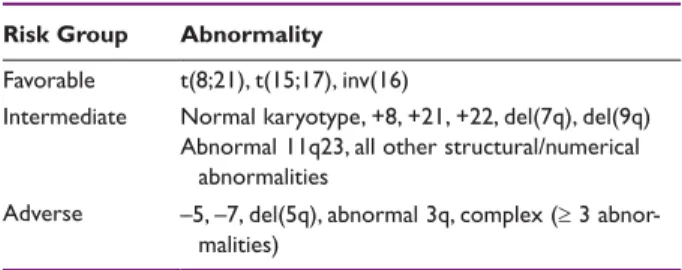
Patients can be separated into 3 categories based on response to induction treatment, relapse risk, and overall survival: favorable, intermediate, and adverse cytogenetic groups.31 Typically, patients with favorable
cytogenetic features have core binding factor (CBF) ab-normalities, while those with adverse features include complex (≥ 3 abnormalities) cytogenetics or chromo-some 7 abnormalities. Some of the more common cy-togenetic abnormalities are shown in table 3 according to their risk category.
More recently, gene-expression profiling has also been shown to improve the molecular classification and outcome prediction in patients with AML.32 In
particular, testing for FLT3 and NPM1 has become increasingly common. The NPM1 gene encodes a nucleolar protein termed nucleophosmin. Wild-type nucleophosmin normally shuttles between the nucleus and cytoplasm, whereas a mutant version commonly found in AML localizes to the cytoplasm.33 NPM1 is
the most commonly mutated gene in AML, occur-ring in approximately 50% to 60% of cases.34 Patients
who have AML containing mutant NPM1 have a more favorable outcome than those who do not.35 Recently,
the German-Austrian Acute Myeloid Leukemia Study Group published data on the impact of molecular le-sions on outcome in 872 adults with cytogenetically normal AML. The investigators found that patients with a mutant CEBPA or NPM1 (without the FLT3 inter-nal tandem duplication) were significantly more likely
Table 1. Recommended Laboratory Testing and Imaging for Patients Undergoing Initial Evaluation for Acute Myeloid Leukemia
Test Indication
Complete blood count Assess degree of leukocytosis and monitor for anemia, thrombo
cytopenia
Comprehensive metabolic panel including phosphorous and uric acid Evaluate for tumor burden and spontaneous tumor lysis syndrome
Prothrombin time Assess for coagulopathy
Activated partial thromboplastin time Assess for coagulopathy
Screen for diffuse intravascular coagulation including fibrinogen and ddimer levels
Assess for diffuse intravascular coagulation
Chest radiograph Evaluate for pulmonary congestion secondary to leukostasis
Cardiac evaluation with electrocardiogram and either echocardiogram or multiple uptake gated acquisition scan
Baseline evaluation prior to administration of potentially cardiotoxic chemotherapy agents (ie, anthracycline drugs)
Tunneled multilumen central venous catheter (eg, Hickman) Central administration of chemotherapy and reduces frequent phlebotomy
Bone marrow biopsy/aspirate including:
• Flow cytometry
• Cytogenetics
• Special studies for FLT3 and NPM1 gene mutations
• FISH for CBF abnormalities
Essential for the diagnosis of acute myeloid leukemia and subse quent risk stratification and prognosis
HLA typing of patient and available siblings Indicated prior to administration of induction chemotherapy if allo genic bone marrow transplant is to be considered in the future CBF = core binding factor; FISH = fluorescent in situ hybridization; FLT3 = FMSlike tyrosine kinase 3; HLA = humanleukocyte antigen; NPM1 = nucleophosmin.
A c u t e M y e l o i d L e u k e m i a
to attain a complete remission (with odds ratios of 1.33 and 1.48, respectively) and have improved disease-free and overall survival (P < 0.001 for both) as compared with other genotypes.36
The FLT3 gene encodes a receptor tyrosine kinase that is involved in cell proliferation and differentiation signaling. In approximately 30% of AML patients, the malignant clone harbors an FLT3 mutation. In general, these patients have a poorer clinical outcome than pa-tients in whom AML expresses normal copies of FLT3.37
Thus, it is crucial to test for cytogenetics and FISH for the t(15;17) or CBF abnormalities as well as mutations
in FLT3 and NPM1 at the time of diagnosis, as the re-sults of these studies may help dictate therapy.
CaSe Continued
After confirming the diagnosis of AML with recurrent genetic abnormalities by bone mar-row biopsy and aspirate, induction chemotherapy is initiated with a 7-day continuous infusion of cytara-bine in addition to daunorubicin on days 1 through 3. There are no acute complications during chemothera-py administration. As anticipated, the patient develops progressive pancytopenia with a nadir in his neutro-phil count (absolute neutroneutro-phil count, 40 cells/µL) occurring approximately 2 weeks after the first day of treatment. He is treated with supportive care consisting of periodic packed red blood cells and platelet transfu-sions. The patient experiences a fever associated with profound neutropenia 15 days after the initiation of treatment. He is treated with a broad-spectrum anti-pseudomonal β-lactam, and blood cultures do not grow any organisms. After 28 days, the patient’s neutropenia resolves and he is discharged. Two weeks later, the patient reports to his hematologist for a repeat bone marrow examination. The peripheral blood smear reveals improving hematocrit (43%), a platelet count of 175,000 cells/µL, and a normal absolute neutrophil count. Bone marrow examination demonstrates nor-mal hematopoiesis with blasts numbering less than 5%, indicating a complete remission.
• what is the role of induction chemotherapy in aml?
Therapy for AML includes remission induction fol-lowed by post-remission chemotherapy. The goal of induction chemotherapy is to reduce the number of leukemic cells as well as return proper function of the
Table 3. Acute Myeloid Leukemia Cytogenetic Risk Groups
Risk Group abnormality Favorable t(8;21), t(15;17), inv(16)
Intermediate Normal karyotype, +8, +21, +22, del(7q), del(9q) Abnormal 11q23, all other structural/numerical
abnormalities
Adverse –5, –7, del(5q), abnormal 3q, complex (≥ 3 abnor malities)
Adapted with permission from Grimwade D, Walker H, Oliver F, et al. The importance of diagnostic cytogenetics on outcome in AML: analy sis of 1,612 patients entered into the MRC AML 10 trial. The Medical Research Council Adult and Children’s Leukaemia Working Parties. Blood 1998;92:2325. © The American Society of Hematology.
Table 2. World Health Organization Classification of Acute Myeloid Leukemia
Acute myeloid leukemia with recurrent genetic abnormalities Acute myeloid leukemia with t(8;21)(q22;q22), (AML1/ETO) Acute myeloid leukemia with abnormal bone marrow eosinophils
and inv(16)(p13q22) or t(16;16)(p13;q22), (CBFβ/MYH11) Acute promyelocytic leukemia with t(15;17)(q22;q12), (PML/
RARα) and variants
Acute myeloid leukemia with 11q23 (MLL) abnormalities Acute myeloid leukemia with multilineage dysplasia
Following MDS or MDS/MPD
Without antecedent MDS or MDS/MPD, but with dysplasia in
≤ 50% of cells in ≥ 2 myeloid lineages Acute myeloid leukemia and MDS, therapy related
Alkylating agent/radiation–related type
Topoisomerase II inhibitor–related type (some may be lymphoid) Others
Acute myeloid leukemia, not otherwise categorized, classify as: Acute myeloid leukemia, minimally differentiated
Acute myeloid leukemia without maturation Acute myeloid leukemia with maturation Acute myelomonocytic leukemia
Acute monoblastic/acute monocytic leukemia
Acute erythroid leukemia (erythroid/myeloid and pure erythro leukemia)
Acute megakaryoblastic leukemia Acute basophilic leukemia
Acute panmyelosis with myelofibrosis Myeloid sarcoma
Adapted with permission from Vardiman JW, Harris NL, Brunning RD. The World Health Organization (WHO) classification of the myeloid neoplasms. Blood 2002;100:2293. © The American Society of Hema tology.
bone marrow. Treatment recommendations for AML are often divided into those for patients younger than age 60 years (“younger” adults) and those aged 60 years and older (“older” adults). The most common induc-tion regimen for both age-groups is cytarabine admin-istered on days 1 through 7 plus an anthracycline or anthracenedione (daunorubicin, idarubicin, or mito-xantrone) administered on days 1 through 3.38–43
• what is the role of post-remission chemotherapy in aml?
Post-remission chemotherapy aims to eradicate any residual disease in an attempt to obtain a cure. Post- remission chemotherapy includes high-dose cytarabine (HiDAC) for patients younger than age 60 years, given every 12 hours on days 1, 3, and 5 of a 28-day cycle for up to 3 or 4 cycles, while cytarabine administered by continuous infusion over 5 days with or without an anthracycline or anthracenedione given by bolus for 2 days is preferred for patients age 60 years and older for 1 to 2 cycles. HiDAC has proven to be quite efficacious in younger patients, particularly those with
CBF abnormalities.29 In patients younger than age
60 years, HiDAC yields a 44% 4-year disease-free sur-vival with relatively few relapses but carries with it a 5% treatment-related mortality rate.44 In contrast, HiDAC
failed to improve the outcome of patients aged 60 years and older and was associated with higher toxicities in-cluding severe neurologic complications.45
• what other therapies are being studied?
Gemtuzumab ozogamicin, an anti-CD33 immuno-toxin conjugate, has been approved by the US Food and Drug Administration for use in refractory AML. It was shown to have a 30% response rate (complete response as well as pathologic complete response) in AML patients in first relapse with previous first remis-sion duration of 6 months or longer.46 To determine if
upfront chemotherapy plus gemtuzumab ozogamicin has a role in previously untreated patients, a phase 3 Medical Research Council trial compared cytarabine-based therapy with gemtuzumab to standard cytarabine- based induction therapy in 1115 younger AML patients. Patients randomized to the gemtuzumab arm had a similar complete remission rate and rates of induc-tion death and resistant disease but higher disease-free survival at 3 years of follow-up when compared with patients randomized to standard therapy (51% versus 40%; P = 0.008).47
Clofarabine is a purine nucleoside analogue with
several purported mechanisms of action that has shown promise in older AML patients. Inhibition of ribo-nucleotide reductase, incorporation into DNA, and induction of apoptosis are all thought to underlie clofarabine’s action. Data from 1 trial that used single-agent clofarabine in newly diagnosed older adults demonstrated a complete remission rate of 59%.48 It
is being studied alone and in combination with cytara-bine in the upfront and refractory setting.49
CaSe Continued
Because of the patient’s age, good underlying functional status, and his CBF cytogenetic ab-normality, his best chance for long-term survival is to receive 4 cycles of HiDAC. He completes all 4 cycles but develops febrile neutropenia during the secondand fourthcycles, requiring readmission for therapy with intravenous antibiotic drugs. Following his fourthcycle, he undergoes a repeat bone marrow biopsy and aspi-rate, which demonstrates that he remains in complete response, and cytogenetic analysis and FISH studies for the t(8;21) are negative.
• what is the role of bone marrow transplantation in aml patients?
Allogenic bone marrow transplantation is an ad-ditional option for post-remission therapy. For some patients under age 60 years with poor-risk cytoge-netic abnormalities and for whom a human leukocyte antigen–matched sibling or matched-unrelated donor is available, allogenic stem cell transplantation may follow induction chemotherapy. This procedure is not with-out risk and has an associated 20% to 25% treatment- related mortality rate and a 1-year mortality rate that may approach 40%.50 It also represents the only
po-tentially curative therapy for patients with relapsed or refractory disease. Because of the patient’s relatively young age, favorable cytogenetic status, and achieve-ment of complete response, he does not undergo hematopoietic stem cell transplant as it is unlikely to provide survival benefit. Older patients and those with suboptimal performance statuses may undergo reduced intensity (nonmyeloablative) bone marrow transplantation.
• how is treatment of acute promyelocytic leukemia different from aml?
A discussion of AML would not be complete without reviewing the unique characteristics of acute promy-elocytic leukemia. Much like other leukemias, acute
A c u t e M y e l o i d L e u k e m i a
promyelocytic leukemia is treated using remission in-duction therapy but with the addition of differentiation therapy with all-trans retinoic acid (ATRA), a vitamin A derivative.51–53 ATRA promotes differentiation of
leu-kemic promyelocytes into mature cells and has been shown to improve both disease-free and overall survival as compared with chemotherapy alone.54 ATRA, along
with an anthracycline, is currently the standard of care for patients with acute promyelocytic leukemia. Arsenic trioxide, another differentiation agent, has been shown in a large intergroup trial to improve survival when administered in the post-remission setting and may become a standard part of therapy for acute promyelo-cytic leukemia.55
outComeS
Success in the treatment of patients with AML has only modestly improved for patients under age 60 years over the past few decades. In 1966, the median survival of patients with AML was 40 days.56 Today, AML patients
younger than age 60 years have complete response rates of 70% to 80% after induction chemotherapy.40 Overall
survival, however, remains at approximately 50% for those whom attain a complete response, which translates into 30% overall survival when all patients under age 60 years are considered.57 In 1998, the Medical Research
Council AML 10 trial found that patients could be separated into 3 prognostic groups: favorable, intermedi-ate, and adverse, defined by pretreatment cytogenetics. Overall survival at 5 years was found to be 65%, 41%, and 14%, respectively.31 If a patient undergoes an
allo-genetic hematopoietic stem cell transplant while in first remission, the complete response rate has been shown to range from 45% to 65%, although patient selection influences these numbers.58 In relapsed AML, however,
complete response after allogenic hematopoietic stem cell transplant was shown to be 35% or less.59
The prognosis for older patients with AML remains poor. In the Medical Research Council AML 8 trial, the remission rate was 70% for patients under age 50 years, 52% for those aged 60 to 69 years, but only 26% for those over age 70 years.60 One theory for such disparity
in results is that neutropenia after chemotherapy lasts longer and is less well-tolerated among older adults as compared with younger patients.16 Another possible
answer is the finding that hematopoietic cells of older patients are derived from a leukemic clone at diagnosis, in contrast to normal stem cells found in their younger counterparts.61 The use of colony-stimulating factors
following the completion of induction chemotherapy
has been shown to reduce the period of neutropenia and the duration of hospitalization by approximately 2 days; unfortunately, this has not translated into improved overall survival or a decrease in infectious complications; hence, the use of these agents is not indicated in this patient population.16,62
ConCluSion
Although the diagnosis of leukemia is frequently suggested by routine laboratory evaluation, prompt recognition of AML is required to prevent early com-plications. Rapid cytoreduction and attention to the patient’s clinical status is essential while establishing the diagnosis. Bone marrow biopsy specimens should routinely be analyzed for cytogenetic abnormalities in addition to specific gene mutations, as these studies have significant bearing on prognosis and course of treatment. Chemotherapy with standard regimens for AML is intense and requires prolonged hospitaliza-tion but is reasonably effective at achieving a complete response, particularly in younger patients. For older patients, standard chemotherapy is often less effec-tive. The role of hematopoietic stem cell transplant in AML continues to be defined but represents the best chance for long-term survival for many patients. As new drugs are developed, future treatment of AML may be tailored to the specific genetic defect(s) found in indi-vidual patients.
referenCeS
1. Stone RM, O’Donnell MR, Sekeres MA. Acute myeloid leu-kemia. Hematology Am Soc Hematol Educ Program 2004: 98–117.
2. Vardiman JW, Harris NL, Brunning RD. The World Health Organization (WHO) classification of the myeloid neo-plasms. Blood 2002;100:2292–302.
3. Heath C. Epidemiology and hereditary aspects of acute leukemia. In: Wiernik P, Canellos G, Dutcher J, Kyle R, edi-tors. Neoplastic diseases of the blood. New York: Churchill-Livingstone; 1996:177.
4. Ries L, Eisner M, Kosary C, et al. SEER Cancer Statistics Review, 1975–2001, National Cancer Institute. Available at http://seer.cancer.gov/csr/1975_2001. Accessed 25 Aug 2008.
5. Howe HL, Wingo PA, Thun MJ, et al. Annual report to the nation on the status of cancer (1973 through 1998),
featuring cancers with recent increasing trends. J Natl Can-cer Inst 2001;93:824–42.
6. Greenlee RT, Hill-Harmon MB, Murray T, Thun M. Can-cer statistics, 2001. CA CanCan-cer J Clin 51;2001:15–36. 7. Giles FJ, Koeffler HP. Secondary myelodysplastic syndromes
and leukemias. Curr Opin Hematol 1994;1:256–60. 8. Sandler DP, Ross JA. Epidemiology of acute leukemia in
children and adults. Semin Oncol 1997;24:3–16.
9. Levine EG, Bloomfield CD. Leukemias and myelodysplas-tic syndromes secondary to drug, radiation, and environ-mental exposure. Semin Oncol 1992;19:47–84.
10. Brandt L, Nilsson PG, Mitelman F. Occupational exposure to petroleum products in men with acute nonlymphocytic leukemia. Br Med J 1978;1:553.
11. Austin H, Delzell E, Cole P. Benzene and leukemia. A review of the literature and a risk assessment. Am J Epide-miol 1988;127:419–39.
12. Smith MT, Wang Y, Kane E, et al. Low NAD(P)H:quinone oxidoreductase 1 activity is associated with increased risk of acute leukemia in adults. Blood 2001;97:1422–6.
13. Le Beau MM, Albain KS, Larson RA, et al. Clinical and cytogenetic correlations in 63 patients with therapy-related myelodysplastic syndromes and acute nonlymphocytic leu-kemia: further evidence for characteristic abnormalities of chromosomes no. 5 and 7. J Clin Oncol 1986;4:325–45. 14. Albain KS, Le Beau MM, Ullirsch R, Schumacher H.
Implication of prior treatment with drug combinations including inhibitors of topoisomerase II in therapy- related monocytic leukemia with a 9;11 translocation. Genes Chromosomes Cancer 1990;2:53–8.
15. Lowenberg B, Downing JR, Burnett A. Acute myeloid leukemia [published erratum appears in N Engl J Med 1999;341:1484]. N Engl J Med 1999;341:1051–62. 16. Stone RM, Berg DT, George SL, et al. Granulocyte-
macrophage colony-stimulating factor after initial chemo-therapy for elderly patients with primary acute myelog-enous leukemia. Cancer and Leukemia Group B. N Engl J Med 1995;332:1671–7.
17. Lichtman MA, Heal J, Rowe JM. Hyperleukocytic leukae-mia: rheological and clinical features and management. Baillieres Clin Haematol 1987;1:725–46.
18. Colman RW, Rubin RN. Disseminated intravascular coagu-lation due to malignancy. Semin Oncol 1990;17:172–86. 19. Stone RM, Mayer RJ. The unique aspects of acute
promy-elocytic leukemia. J Clin Oncol 1990;8:1913–21.
20. Gralnick HR, Sultan C. Acute promyelocytic leukaemia: haemorrhagic manifestation and morphologic criteria. Br J Haematol 1975;29:373–6.
21. Sica S, Salutari P, d’Onofrio G, et al. Bulky lymphadenopa-thy in acute myeloid leukemia. Ann Hematol 1998;77:
65–7.
22. Sekeres MA, Elson P, Wang, X, et al. Time from diagnosis to treatment initiation predicts survival in acute myeloid leukemia (AML) [abstract]. American Society of Hematol-ogy Annual Meeting Abstracts. Blood 2007;110:598. 23. Vardiman JW, Harris NL, Brunning RD. The World Health
Organization (WHO) classification of the myeloid neo-plasms. Blood 2002;100:2292–302.
24. Bennett JM, Catovsky D, Daniel MT, et al. Proposals for the classification of the acute leukaemias. French-American-British Cooperative Group. Br J Haematol 1976;33:451–8. 25. Brunning RD, Matutes E, Harris NL, Flandrin G. Acute
my-eloid leukemia. In: Jaffe ES, Harrie NL, Stein H, Vardiman JW. World Health Organization classification of tumours. Pathology and genetics of tumours of haematopoietic and lymphoid tissues. Lyon (France): IARC Press; 2001. 26. Slovak ML, Kopecky KJ, Cassileth PA, et al. Karyotypic
analysis predicts outcome of preremission and postremis-sion therapy in adult acute myeloid leukemia: a Southwest Oncology Group/Eastern Cooperative Oncology Group study. Blood 2000:96;4075–83.
27. Erickson P, Gao J, Chang KS, et al. Identification of breakpoints in t(8;21) acute myelogenous leukemia and isolation of a fusion transcript, AML1/ETO, with similarity to Drosophilia segmentation gene, runt. Blood 1992;80: 1825–31.
28. Liu P, Tarle SA, Hajra A, et al. Fusion between transcription factor CBF beta/PEBP2 beta and a myosin heavy chain in acute myeloid leukemia. Science 1993;261:1041–4. 29. Byrd JC, Mrozek K, Dodge RK, et al; Cancer and Leukemia
Group B (CALGB 8461). Pretreatment cytogenetic abnor-malities are predictive of induction success, cumulative incidence of relapse, and overall survival in adult patients with de novo acute myeloid leukemia: results from Cancer and Leukemia Group B (CALGB 8461). Blood 2002; 100:4325–36.
30. de The H, Chomienne C, Lanotte M, et al. The t(15;17) translocation of acute promyelocytic leukaemia fuses the retinoic acid receptor alpha gene to a novel transcribed locus. Nature 1990;347:558–61.
31. Grimwade D, Walker H, Oliver F, et al. The importance of diagnostic cytogenetics on outcome in AML: analysis of 1,612 patients entered into the MRC AML 10 trial. The Medical Research Council Adult and Children’s Leukae-mia Working Parties. Blood 1998;92:2322–33.
32. Bullinger L, Dohner K, Bair E, et al. Use of gene-expression profiling to identify prognostic subclasses in adult acute myeloid leukemia. N Engl J Med 2004;350:1605–16. 33. Falini B, Nicoletti I, Martelli MF, Mecucci C. Acute myeloid
leukemia carrying cytoplasmic/mutated nucleophosmin (NPMc+ AML): biologic and clinical features. Blood 2007;
A c u t e M y e l o i d L e u k e m i a
109:874–85.
34. Falini B, Mecucci C, Tiacci E, et al; GIMEMA Acute Leukemia Working Party. Cytoplasmic nucleophosmin in acute myelogenous leukemia with a normal karyotype [published erratum appears in N Engl J Med 2005;352: 740]. N Engl J Med 2005;352:254–66.
35. Verhaak RG, Goudswaard CS, van Putten W, et al. Muta-tions in nucleophosmin (NPM1) in acute myeloid leu-kemia (AML): association with other gene abnormalities and previously established gene expression signatures and their favorable prognostic significance. Blood 2005;106: 3747–54.
36. Schlenk RF, Dohner K, Krauter J, et al; German-Austrian Acute Myeloid Leukemia Study Group. Mutations and treatment outcome in cytogenetically normal acute my-eloid leukemia. N Engl J Med 2008;358:1909–18. 37. Yanada M, Matsuo K, Suzuki T, et al. Prognostic
signifi-cance of FLT3 internal tandem duplication and tyrosine kinase domain mutations for acute myeloid leukemia: a meta-analysis. Leukemia 2005;19:1345–9.
38. Bishop JF, Lowenthal RM, Joshua D, et al. Etoposide in acute nonlymphocytic leukemia. Australian Leukemia Study Group. Blood 1990;75:27–32.
39. Bishop JF, Matthews JP, Young GA, et al. A randomized study of high-dose cytarabine in induction in acute my-eloid leukemia. Blood 1996;87:1710–7.
40. Mayer RJ, Davis RB, Schiffer CA, et al. Intensive postremis-sion chemotherapy in adults with acute myeloid leukemia. Cancer and Leukemia Group B. N Engl J Med 1994;331: 896–903.
41. Rees JK, Gray RG, Wheatley K. Dose intensification in acute myeloid leukaemia: greater effectiveness at lower cost. Principal report of the Medical Research Council’s AML9 study. MRC Leukaemia in Adults Working Party. Br J Haematol 1996;94:89–98.
42. Weick JK, Kopecky KJ, Appelbaum FR, et al. A randomized investigation of high-dose versus standard-dose cytosine arabinoside with daunorubicin in patients with previously untreated acute myeloid leukemia: a Southwest Oncology Group study. Blood 1996;88:2841–51.
43. Burnett A. Tailoring the treatment of acute myeloid leuke-mia. Curr Opin Oncol 1999;11:14–9.
44. Byrd JC, Ruppert AS, Mrozek K, et al. Repetitive cycles of high-dose cytarabine benefit patients with acute myeloid leukemia and inv(16)(p13q22) or t(16;16)(p13;q22): re-sults from CALGB 8461. J Clin Oncol 2004;22:1087–94. 45. Mayer RJ, Davis RB, Schiffer CA, et al. Intensive
postremis-sion chemotherapy in adults with acute myeloid leukemia. Cancer and Leukemia Group B. N Engl J Med 1994;331: 896–903.
46. Sievers EL, Larson RA, Stadtmauer EA, et al; Mylotarg
Study Group. Efficacy and safety of gemtuzumab ozogami-cin in patients with CD33-positive acute myeloid leukemia in first relapse. J Clin Oncol 2001;19:3244–54.
47. Burnett AK, Kell WJ, Goldstone AH, et al. The addition of gemtuzumab ozogamicin to induction chemotherapy for AML improves disease free survival without extra toxicity: preliminary analysis of 1115 patients in the MRC AML15 trial [abstract]. American Society of Hematology Annual Meeting Abstracts. Blood 2006;108:13.
48. Bunett AK, Baccarani M, Johnson P, et al. Clofarabine in previously untreated elderly (> 65 yrs) AML patients with an unfavourable cytogenetic profile who are considered unfit for standard intensive chemotherapy. ASCO Meeting Abstracts. J Clin Oncol 2006;24(Suppl):6513.
49. Faderl A, Ravandi F, Huang X, et al. A randomized study of clofarabine versus clofarabine plus low-dose cytarabine as frontline therapy for patients age >= 60 years with acute myeloid leukemia and high-risk myelodysplastic syndrome Blood 18 Jun 2008 [Epub ahead of print].
50. Gorin NC. Autologous stem cell transplantation in acute myelocytic leukemia. Blood 1998;92:1073–90.
51. Fenaux P, Chastang C, Chevret S, et al. A randomized com-parison of all transretinoic acid (ATRA) followed by che-motherapy and ATRA plus cheche-motherapy and the role of maintenance therapy in newly diagnosed acute promyelo-cytic leukemia. The European APL Group. Blood 1999;94: 1192–200.
52. Castaigne S, Chomienne C, Daniel MT, et al. All-trans reti-noic acid as a differentiation therapy for acute promyelo-cytic leukemia. I. Clinical results. Blood 1990;76:1704–9. 53. Fenaux P, Le Deley MC, Castaigne S, et al. Effect of all
transretinoic acid in newly diagnosed acute promyelocytic leukemia. Results of a multicenter randomized trial. Euro-pean APL 91 Group. Blood 1993;82:3241–9.
54. Tallman MS, Andersen JW, Schiffer CA, et al. All-trans-retinoic acid in acute promyelocytic leukemia [published erratum appears in N Engl J Med 1997;337:1639]. N Engl J Med 1997;337:1021–8.
55. Powell BL, Moser B, Stock W, et al. Effect of consolidation with arsenic trioxide (As2O3) on event-free survival (EFS) and overall survival (OS) among patients with newly diag-nosed acute promyelocytic leukemia (APL): North Ameri-can Intergroup Protocol C9710. J Clin Oncol 2007;25:2. 56. Treatment of acute leukaemia in adults: comparison of
ste-roid and mercaptopurine therapy, alone and in conjunc-tion. Second report to the Medical Research Council of the Working Party on the evaluation of different methods of therapy in leukaemia. Br Med J 1966;1:1383–9. 57. Appelbaum FR, Rowe JM, Radich J, Dick JE. Acute
my-eloid leukemia. Hematology Am Soc Hematol Educ Pro-gram 2001:62–86.
teSt YourSelf witH Self-aSSeSSment queStionS
Questions for self-assessment in selected specialties are available on Hospital Physician’s Web site. Go to www.turner-white.com, click on Hospital Physician, then click on “Self-Assessment Questions.”
58. Grigg AP, Szer J, Beresford J, et al. Factors affecting the outcome of allogeneic bone marrow transplantation for adult patients with refractory or relapsed acute leukaemia. Br J Haematol 1999;107:409–18.
59. Edenfield WJ, Gore SD. Stage-specific application of al-logeneic and autologous bone marrow transplantation in the management of acute myeloid leukemia. Semin Oncol 1999;26:21–34.
60. Rees JK, Gray RG, Swirsky D, Hayhoe FG. Principal results of the Medical Research Council’s 8th acute myeloid
leu-kaemia trial. Lancet 1986;2:1236–41.
61. Fialkow PJ, Singer JW, Raskind WH, et al. Clonal develop-ment, stem-cell differentiation, and clinical remissions in acute nonlymphocytic leukemia. N Engl J Med 1987;317: 468–73.
62. Dombret H, Chastang C, Fenaux P, et al. A controlled study of recombinant human granulocyte colony-stimulating factor in elderly patients after treatment for acute myelog-enous leukemia. AML Cooperative Study Group. N Engl J Med 1995;332:1678–83.