Characterising Learners in Online Communities
Based on Actor-Artefact Relations
Von der Fakultät für Ingenieurwissenschaften,
Abteilung Informatik und Angewandte Kognitionswissenschaft
der Universität Duisburg-Essen
zur Erlangung des akademischen Grades
Doktor der Naturwissenschaften (Dr. rer. nat.)
genehmigte kumulative Dissertation
von
Tobias Ludger Hecking
aus
Arnsberg
1.
Gutachter: Prof. Dr. Heinz Ulrich Hoppe
2.
Gutachter: Prof. Dr. Pierre Dillenbourg
Datum der mündlichen Prüfung: 08.12.2016
iii
Abstract
Online communities are of huge interest in terms of learning and knowledge creation because of the potential to distribute knowledge among possibly large audience independently from time and place. In this context, various forms of online learning have developed over time ranging from small learning groups to massive open online courses (MOOCs) with thousands of participants. In order to support learning in those settings an increased understanding of specific characteristics of learners in online communities is necessary. Thus, dedicated means to gather valuable information from data produced in online learning environments have to be developed. This cumulative dissertation includes five publications aiming to make progress in this direction with a particular focus on the advancement of methods to analyse activity and interaction data of learners.
The methodological foundation of the work is (social) network analysis, which provides a well-grounded set of methods for structural analysis of relational data. Network analysis is especially suited since the collected data about actors (in this thesis mostly learners) who create and consume digital content (artefacts) can be modelled as artefact networks. Those actor-artefact networks denote the starting point of all analyses presented in this dissertation, which target different aspects of learning in online communities, in particular the usage of learning resources, emergence of interest profiles, and information exchange between learners.
In the course of this work, stable artefacts that are not assumed to have changing content over time are distinguished from time-evolving dynamic artefacts (typically user generated content). In the case of stable artefacts, affiliations of learners to learning resources in online courses are analysed by identifying mixed clusters of learners and resources using network clustering algorithms. The evolution of these learner-resource clusters over time is investigated in detail leading to discoveries of typical resource access patterns that characterise learners regarding their interests in provided learning materials. The approach is further extended and combined with content analysis techniques to analyse thematic development in discussion forums.
Discussion forums are also the subject of two other studies investigating information exchange between learners in MOOCs. The evolving discussion threads are considered as dynamically evolving artefacts that are used to extract social networks reflecting information exchange between forum users. These networks are analysed to uncover different roles of forum users with respect to their positions in the network. For this task different approaches are described that are capable of modelling structural characteristics of the information exchange network over time and further take discussion topics as additional information into account.
iv
List of Included Publications
Chapter 2
Hecking, T., Ziebarth S., & Hoppe H. U. (2014). Analysis of Dynamic Resource Access Patterns in Online Courses. Journal of Learning Analytics (JLA). 1(3), 34-60.
Chapter 3
Hecking, T., Steinert L., Göhnert T., & Hoppe H. U. (2014). Incremental Clustering of Dynamic Bipartite Networks. In Proceedings of the 1st European Network Intelligence Conference (pp. 9-16), Wroclaw, Poland, IEEE. doi: 10.1109/ENIC.2014.15
Chapter 4
Hecking, T., Chounta I. - A., & Hoppe H. U. (2015). Analysis of User Roles and the Emergence of Themes in Discussion Forums. In Proceedings of the 2nd European Network Intelligence Conference (pp. 114-121), Karlskrona, Sweden, IEEE. doi: 10.1109/ENIC.2015.24
Chapter 5
Hecking, T., Hoppe H. U., Harrer, A. (2016) Discovery of Structural and Temporal Patterns in MOOC Discussion Forums. Preprint of chapter in J, Kawash, N. Agarwal, T. Özyer (Eds.) Prediction and Inference from Social Networks and Social Media (pp. 153-180), LNSN, Springer. doi: 10.1007/978-3-319-51049-1_8
Chapter 6
Hecking, T., Chounta I. - A., & Hoppe H. U. (2016). Investigating Social and Semantic User Roles in MOOC Discussion Forums. In Proceedings of the 6th International Conference on Learning Analytics & Knowledge
(pp. 198–207), Edinburgh, UK, ACM. doi: 10.1145/2883851.2883924
Auxiliary Works
The publications listed below describe works that are relevant in the context of this thesis, but these are not included as dedicated chapters.
Hecking, T., Göhnert, T., Zeini, S., & Hoppe, H. U. (2013). Task and Time Aware Community Detection in Dynamically Evolving Social Networks. Procedia Computer Science, 18, 2066-2075.
Zeini, S., Göhnert, T., Hecking, T., Krempel, L., & Hoppe, H. U. (2014). The Impact of Measurement Time on Subgroup Detection in Online Communities. In F. Can, T. Özyer, & F. Polat (Eds.), State of the Art Applications of Social Network Analysis (pp. 249-268). LNSN, Springer, Cham.
Göhnert, T., Harrer, A., Hecking, T., & Hoppe, H. U. (2014). A Workbench for Visual Design of Executable and Re-usable Network Analysis Workflows. In J. Kawash (Eds.), Online Social Media Analysis and Visualization (pp. 181-199). LNSN, Springer, Cham.
Halatchliyski, I., Hecking, T., Goehnert, T., & Hoppe, H. U. (2014). Analyzing the Path of Ideas and Activity of Contributors in an Open Learning Community. Journal of Learning Analytics, JLA, 1(2), 72-93. Ziebarth, S., Neubaum, G., Kyewski, E., Krämer, N., Hoppe, H. U., Hecking, T., & Eimler, S. (2015). Resource
Usage in Online Courses: Analyzing Learner’s Active and Passive Participation Patterns. In 11th International Conference on Computer Supported Collaborative Learning. (pp. 395-402) Gothenburg, Sweden. International Society of the Learning Sciences (ISLS).
Wichmann, A., Hecking, T., Elson, M., Christmann, N., Herrmann, T., & Hoppe, H. U. (2016). Group Formation for Small-Group Learning: Are Heterogeneous Groups More Productive? In Proceedings of the International Symposium on Open Collaboration (OpenSym '16). Berlin, Germany.
v
Contents
Abstract ... iii
List of Included Publications ... iv
1 Introduction ... 1
1.1 Context and Research Objectives ... 2
1.1.1 Actors, Communities, and Artefacts ... 2
1.1.2 Characterising learners in online communities ... 6
1.1.3 Exploration of analytics methods ... 10
1.2 Synopsis of Included Publications ... 15
1.2.1 Relations of actors and stable artefacts ... 16
1.2.2 Social relations between actors and dynamic artefacts ... 20
1.2.3 Combination of semantic and social structures ... 22
2 Analysis of Dynamic Resource Access Patterns in Online Courses ... 25
3 Incremental Clustering of Dynamic Bipartite Networks ... 53
4 Analysis of User Roles and the Emergence of Themes in Discussion Forums ... 63
5 Discovery of Structural and Temporal Patterns in MOOC Discussion Forums ... 73
6 Investigating Social and Semantic User Roles in MOOC Discussion Forums ... 103
7 Summary and Future Perspectives ... 115
7.1 Summary ... 115
7.2 Future Perspectives ... 116
7.2.1 Advancing online learning environments ... 116
7.2.2 Widening the scope of applications ... 117
Introduction
1
1
Introduction
With growing scalability of information technology in education and knowledge management, learning and knowledge acquisition have undergone a shift from physical into virtual environments. Various forms of knowledge building in large and heterogeneous online communities have emerged that rely on information creation and distribution in digital spaces. In addition to self-directed search in ubiquitously available information sources, online courses offer the opportunity to get a more guided access to knowledge provided and maintained by experts. In this context, a recent development are massive open online courses (MOOCs), which are university level courses that solely take place in online environments and target a broad audience of learners. Presence lectures are replaced by videos and digital reading material. Activities such as quizzes and peer-reviewing are used to assess the learning outcome of a possibly large amount of users. Apart from the extreme case of MOOCs, different types of online courses have been developed also on smaller scale focussing on different aspects of online learning. Some regular university courses have been enriched by additional online activities inspired by MOOCs (Volk, Reinhardt, & Osterwalder, 2014; Ziebarth & Hoppe, 2014). In these settings, the main process of knowledge acquisition can take place in an online learning environment accompanied by presence classes that can be used for discussions and assistance. These are typically referred to as “Flipped Classroom” models (Bishop & Verleger, 2013).
Common to all these forms of learning environments is the use of rich multimedia content accessible independently of time and place. The intention is to enable learners to acquire knowledge in a self-directed manner utilising various types of learning resources and tools. Despite the chances large scale and open online learning environments offer for learning and distribution of knowledge there are also several challenges. The openness of online platforms goes along with the need for adaptation to a heterogeneous and possibly large population of users in terms of personal backgrounds, interests, and goals. In the absence of immediate social interaction in a physical space, support for individuals is limited. Typical problems of collaborative learning in physical learning spaces such as motivational deficits, lack of individual accountability of learners, time management, and coordination issues have to be addressed differently in digital environments since interaction with learners in usually mediated and limited by technology. Adaptation and personalisation of those learning environments is considered as a key concept to improve the learning experience (Brusilovsky & Millán, 2007). In order to achieve this, a better understanding of the specific characteristics of individuals as well as the function of learning related online communities as a whole is necessary. The processes of knowledge acquisition in online communities, and in particular open in online courses, are not yet fully understood and computational methods to gather valuable information are not exhaustively explored. This includes questions on how individuals access and consume information artefacts and how information exchange and diffusion among learners takes place. The work outlined in the following chapters aims at making progress in this direction. It can be located in the context of the emerging field of learning analytics that utilise the growing availability of machine readable data produced in different contexts to optimise learning environments (Ferguson, 2012). The focus of
2
the presented work, thereby, is not on the explicit development of dedicated support mechanisms that directly target learners or tutors. Instead, a primary goal is to gain knowledge about phenomena and properties of learning in online communities in a more general sense that can be used by practitioners and researchers for the redesign and development of online learning environments. In this aspect, the large amount of available data produced by online learning communities introduce new opportunities to study learning, knowledge creation, and knowledge diffusion processes on a large scale. Along with the emergence of knowledge discovery from large amounts of data using computational methods as a scientific paradigm (Hey, Tansley, & Tolle, 2009), large online courses can be considered as “massive research laboratories” (Diver & Martinez, 2015) that allow for conducting experiments and to observe different characteristics of online learning. However, in order to gain insights beyond obvious properties of those learning environments, adequate research instruments have yet to be developed. In this regard, the methodological objective of this thesis is the development and exploration of computational approaches, which are primarily rooted in the field of social network analysis (Brandes & Erlebach, 2005; Wasserman & Faust, 1994) in combination with analysis of time dependent data and produced content.
The following Section 1.1 provides the context of this research work and outlines the research objectives more concretely. Section 1.2 summarises the included publications (Chapters 2-6), highlights relations and differences among them, and positions them in a contextual framework. Chapter 7 summarises the main outcome of this thesis and gives an outlook on ongoing and future developments.
1.1
Context and Research Objectives
This section outlines preliminaries and research objectives of this thesis. It provides a framework to contextualise the following chapters and to locate them in relevant fields of research. First, the meaning of actors, communities, and artefacts for this work is outlined against the background of existing work. Second, important considerations and objectives regarding the investigations of online communities are described. The third subsection focuses on the envisaged methodological contribution to the fields of learning analytics and social network analysis.
1.1.1
Actors, Communities, and Artefacts
Actors. In this work, the term actor generally refers to all human beings who actively interact with and within a virtual learning environment. By the scope of this thesis the actors of interest are mostly learners, i.e. the actual users of an online learning environment. However, most of the methods described later on can be applied in a more general context including other individuals participating in a knowledge creation process such as tutors, scientists in scientific communities, or editors of publicly available information resources.
Introduction
3 Online Communities. The notion of (online) community is used very differently in the literature (Porter, 2004). In the most general sense Porter (2004) defines an online (or virtual community) as:
“… an aggregation of individuals or business partners who interact around a shared interest, where the interaction is at least partially supported and/or mediated by technology and guided by some protocols or norms.”
Common notions of communities are “communities of interest” and “communities of practice”. Communities of interests (CoIs) are gatherings of people with a common topic of interest, for example, news groups (Fischer, 2001). Communities of practice (CoPs) (Wenger, 1998) are communities of actors with similar professions who share a collective identity and constantly collaborate to collectively gain knowledge and improve professional practice.
While the definitions of CoIs and CoPs are not necessarily coupled to learning Carlen and Jobring (2005) relate these concepts to the case of online learning communities (OLCs) and provide a typology incorporating different existing definitions. They derive three types of OLCs that are found in purely online but also blended settings where face-to-face meeting mix with online activities. Professional OLCs are related to CoPs and comprise of members who have a special interest in sharing knowledge about their work practices, and thus, can be seen as a form of advanced vocational training. In contrast, online interest communities do not necessarily share the same profession. This type of OLC especially emerges in forums and discussion boards on specific topics of the members’ interest. Apart from communities that are constituted from common professions or interests of its members the typology of Carlen and Jobring (2005) also introduces a notion of educational OLCs that is especially important for this work. Educational OLCs differ from the other types in the sense that they are established in a virtual environment that intentionally supports learning. Those communities exist within formal educational systems such as online courses that are created by educational managers for distance education and are structured around pre-defined tasks. Since educational OLCs are managed by instructors, they can be self-organised only to certain extent, and consequently, a data driven evaluation and development of support mechanisms can only be valuable if it explicitly takes into account the conditions set by educational design. The online courses investigated in this thesis can be seen as particular realisations of educational OLCs. However, regarding studies on knowledge sharing in MOOCs that will be described later on, properties of interest based communities are relevant as well. For example, many MOOC participants only use parts of the courses driven by a common interest to gain specific knowledge on certain subtopics or just out of curiosity, and thus, do not adhere to the originally intended use of such courses (Ferguson & Clow, 2015).
Rather than suggesting a strict categorisation, it is reasonable to highlight different aspects of communities that are important for the rationale of this thesis. In this sense, online communities can be placed in different contexts, i.e. production, socialising, and the aspect of common affiliations.
The production aspect is in the focus of communities in which people collaborate with the primary purpose of creating digital artefacts. Typical examples are groups of authors who
4
contribute to wiki articles (Bryant, Forte, & Bruckman, 2005) or open source software developer communities (Gacek & Arief, 2004). While the educational online communities investigated in this work are not primarily productive communities, the production aspect is still present with respect to learner generated content. The characterisation of actors regarding the creation of digital artefacts often requires computational methods for the analysis of the produced content, which will be described in Section 1.1.3.
In the view of socialising between actors, the primary purpose of online communities is interaction and exchange between its members. Dedicated social media platforms are used by actors to maintain social contacts that they have established in physical spaces (Ellison, Steinfield, & Lampe, 2007). This aspect is particularly important in the theory of social learning (Bandura & McClelland, 1977) that builds upon the basic assumption that learning always takes place in some sort of social context. In addition, it was shown that communities forming on online social media platforms have the potential to spread information very quickly among a large audience (Bakshy, Rosenn, Marlow, & Adamic, 2012; Romero, Meeder, & Kleinberg, 2011). In online courses, information spreads over interpersonal relations between actors, for example in chats, forums and discussion boards. Social network analysis provides a rich set of methods that are especially suited for analysing social aspects of online communities, which is also used extensively throughout this thesis.
An online community is not only denoted by socialising and collaborative content production but also by the affiliations of its members. Especially in interest based communities, the strength of social bonds can be low and the members identify themselves more with the topic of interest than with the community itself (Henri & Pudelko, 2003). In this sense, the typical activities, available resources, and the interests of the actors can be seen as the affiliation aspect of a community. Henri and Pudelko (2003) further point out that the emergence of intention in an online community is coupled with an increasing awareness of its existence, which is materialised by the online environment and provided resources. This view is especially important in educational online learning communities that are in first place shaped by the learning environment and the interest of its members. A large proportion of the work described in the following chapters deals especially with the affiliation aspect of online learning communities by investigating actors’ affiliations to learning resources or themes utilising network analysis techniques.
Artefacts. In this work, an artefact can be any type of digital object that contains externalised information relevant for the purpose of the online (learning) environment. In digital environments the log protocols of actors’ usage or modifications of artefacts constitute actor-artefact relations. Those log protocols are often the only data source that can be used for the purpose of analysis and characterisation of learners in online communities. In online learning communities artefacts play a major role as information containers, in communication processes, and for collaborative knowledge building for the externalisation of information (Belanger & Thornton, 2013; Cress & Kimmerle, 2008).
Introduction
5 On the one hand there are stable artefacts, for example, learning resources such as videos and reading materials. These types of artefacts are stable in the sense that the content usually cannot be edited by learners, and thus, does not change over time. Stable artefacts are usually provided by a tutor or a platform manager. The main purpose of stable artefacts is to function as information sources providing relevant content for the learning objective. Resource based learning environments (RBLs) (Hill & Hannafin, 2001) were proposed as a design principle that utilises the high variety and availability of digital learning resources. In those environments learners have to be supported by tools and scaffolds that enable them to deal with the amount of available information depending on different contexts or learning goals. Tools incorporate facilities for effective search, processing, manipulation, for example, note taking and communication. Furthermore, scaffolding mechanisms have to be applied to assist learners in gathering dedicated knowledge from the available resources. Conceptual scaffolds provide guidance on how to use resources to achieve a specific goal, for example, how to write a survey on a specific topic. On the procedural level, scaffolds can be helping mechanisms for learners how to use specific resources. Other types of scaffolds are metacognitive scaffolds to support reflection of the learning process and strategic scaffolds outlining different ways to solve a task, for example, recommendations. More recently, the role of stable artefacts related to resource based learning has been emphasised in the context of online courses where various types of resources co-exist to support multiple learning styles (Grünewald, Meinel, Totschnig, & Willems, 2013). At the extreme end, connectivist approaches (Siemens, 2014) consider the entire learning process as building networks between different information sources, often in form of digital resources. This concept is adapted in connectivist MOOCS (cMOOCs) (Fini, 2009) and personal learning environments (PLEs) (Dabbagh & Kitsantas, 2012) that support learners and their learning processes in terms of management and retrieval of collections of relevant artefacts using social media and cloud computing technologies.
Apart from the view on artefacts as potentially stable information sources, there are also dynamic artefacts such as Wiki articles, blogs, and discussions threads in forums that play a role in communities of learners. The content is usually user generated and evolves over time. Cress and Kimmerle (2008) see collaborative editing of dynamic artefacts as an interleaved process in which externalised information and the knowledge state of contributors co-evolves. In this aspect, the collaborative creation of content is considered as an important concept for learning.
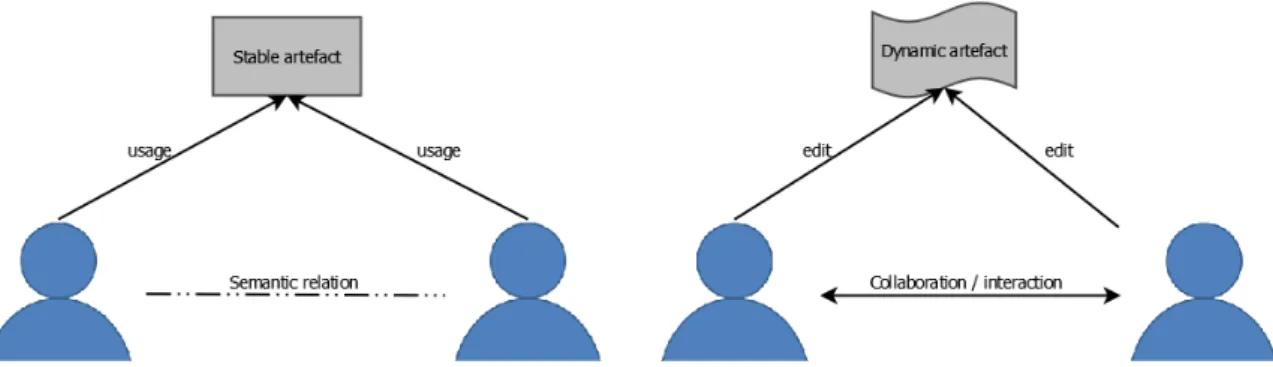
The distinction between stable and dynamic artefacts is crucial for the information one can acquire from the analysis of actor-artefact relations. Relations between actors and stable artefacts are typically derived from resource access protocols and can be used to infer semantic relations between actors, such as common interests or experiences. These hidden semantic relations can be used for community support mechanisms, for example, recommendations of social contacts and facilitation of thematic navigation in a virtual community (Hoppe et al., 2005). On the contrary collaboratively edited dynamic artefacts can be used to infer social relations between the actors since these processes typically require reactions to actions previously performed by others. In contrast to semantic relations, these relations are typically knows to actors since the collaborative editing of an artefact usually creates awareness of the other person.
6
This leads to communication through artefacts which is particularly important in asynchronous settings since communication can only be established through some shared representations that can constantly modified by actors (Hoppe, 2009; Hoppe et al., 2005). Figure 1 depicts a schema of relations between actors derived from actor-artefact relations.
Figure 1 Inferring interpersonal relations from actor-artefact relations.
Technically, there are several ways to model relations between actors and artefacts and to transform these relations into social and semantic relations between actors. This includes semantic approaches that utilise the type of actor-artefact relations inducing directionality, for example, production and consumption (Reinhardt, Moi, & Varlemann, 2009; Suthers & Rosen, 2011). The combination of both perspectives – the social relations between actors and semantic relations based on common interests – has also been investigated in contexts not directly related to learning (Mika, 2007; Roth & Cointet, 2010). The potential of this combination in the learning and knowledge management domain, especially for recommendation of actor and artefact relations, has been outlined clearly by Harrer, Malzahn, Zeini, and Hoppe (2007). However, the integrated view on social and semantic relations is widely unexplored in the analysis of learners in online communities. Advances in this direction are among the contributions of this thesis that will be described explicitly later on.
1.1.2
Characterising learners in online communities
This subsection first provides the general background of the task of characterising learners in online communities by introducing a general scheme community analysis on different levels. After that, the expected outcome of this thesis with respect to decision support of online learning communities will be discussed.
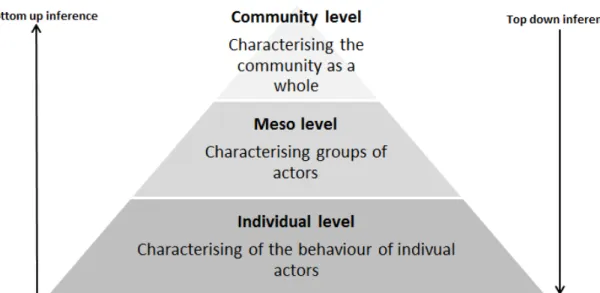
Granularity of analysis. The function and specific characteristics of online learning communities and individual learners can be analysed on different levels of granularity. Primarily three layers can be distinguished that are not strictly separated, namely the individual-, the meso-, and the community level. Analytical models on one layer can also contribute to gain information on an adjacent layer via top down or bottom up inference. Figure 2 depicts this basic scheme and the information transfer between levels graphically, which will be described in more detail in the following.
Introduction
7
Figure 2 Levels of community analysis and types of inference.
The top level is referred to as the community level. Analyses on this level provide information about the structure and functionality of a community in a global view. This includes, for example, simple descriptive statistics on the number of actors or the social or semantic structure of the whole community. For example, in social network analysis a global measure is the clustering coefficient (Watts & Strogatz, 1998) which measures the extent of transitivity of network connections, i.e. the fraction of closed triangles (clique of three actors) and the number of open triangles. If this value is high, one can infer that the community is likely to bear subcommunities of densely connected regions in the network on a meso-level. In the context of learning communities it is then worth to identify such subcommunities and to characterise them in terms of social cohesion and information exchange.
Meso-level analyses often deal with the aggregation of individual actors into groups. Clustering is a typical approach to reduce the complex structure of a community to an interpretable macro-structure of the aforementioned subcommunities (Fortunato, 2010). The distributions and characteristics of groups of actors can then be transformed to statements about the whole community on the top level of analysis. For example, Palla, Barabasi, and Vicsek (2007) identify the evolution overlapping subcommunities of actors and generalise these meso-level observations to statements about the social dynamics in large collaboration and communication networks. However, clustering of actors is not the only task on the meso-level. There can also be meso-level representations of process data, such as process models that are discovered from atomic action logs of several individuals. These models reflect inherent strategies or workflows that are not directly visible from the individual activity traces (Reimann, Markauskaite, & Bannert, 2014). Bottom up inference can then be used to link the meso-level processes to more general rules and functions of the community as a whole. Apart from inferences from the meso-level to the community level, the assignment of actors to groups naturally leads to a characterisation on the level of individuals. Examples are role models that group actors based on certain notions of
8
similarity of their positions in a social network. These groups are often interpreted as sets of actors with similar roles (Doreian, Batagelj, Ferligoj, & Granovetter, 2004). A large proportion of the work described later on relies on community analysis on the meso-level, while the results are used to analyse the community itself, but also to characterise individual learners.
Community analysis on the level of individuals is mostly concerned with measures to describe properties and behaviour of particular actors. A proper characterisation of individual actors is important to make learning environments adaptive in the sense of personalisation and to create tailored support mechanisms. Typical characterisations for learners in online communities are quantifications of the learners’ activities within a learning platform, like engagement patterns (Ferguson & Clow, 2015), measures of performance and affective states (Baradwaj & Pal, 2012), or demographics (Guo & Reinecke, 2014). Most prominent in social network analysis are centrality measures that are frequently used as indicators for the importance of actors in a networked community depending on their position in the social network (Koschützki et al., 2005). Analysis of a community on the individual level often precedes analyses on the meso-level since the grouping of actors, for example based on a notion of similarity, usually requires a previous characterisation individuals.
Enabling effective community support. A major objective of this thesis is to provide information to facilitate the evaluation and design of learning in online communities. Thereby, analytics and in particular learning analytics can contribute to community support in numerous ways. One can distinguish three interleaved areas, reflection and monitoring, predictions, and exploratory data analysis (Baker & Inventado, 2014). As mentioned in the beginning, the focus of this work is on inductive approaches and explorations for post-hoc evaluation of learning activities. This objective will be contrasted with related areas in the following.
Reflection support aims to help learners to become aware of their own learning processes as well as the learning processes of others, and thus, triggers reasoning about certain activities. In this sense, reflection mechanisms support the actors in a community by enabling them to adapt and to improve their learning processes on their own. This can be, for example, achieved by awareness tools that provide learners with easily interpretable representations, for example, concept clouds reflecting their coverage of a particular knowledge domain based on analysis of learner generated content (Manske & Hoppe, 2016). In contrast to self-reflection support for learners, monitoring tools enable tutors to keep track of the activities and learning progress of learners with the goal of more informed interventions (Lockyer, Heathcote, & Dawson, 2013). Reflection and monitoring techniques are especially concerned with data visualisations and understandable placement of information, which is usually established through the use of dashboards (Verbert et al., 2014).
In contrast to reflection and monitoring where the actors (learners and tutors) are provided with necessary information to actively improve individual and community learning processes, predictions (e.g. of course performance) can be used to create system interventions that support an online learning community without explicit involvement of human actors. Typical forms of system generated feedback are recommendations of resources, people, or activities (Verbert et
Introduction
9 al., 2012). Approaches originating in intelligent tutoring systems denote an extreme case where knowledge estimation and hint generation is completely automatized (Rivers & Koedinger, 2015). Learning analytics for reflection, monitoring, and predictions explicitly targets students and tutors as stakeholders and the analysis results are directly fed back into the learning environment. This can be referred to as the short cycle of learning analytics (Clow, 2012). Apart from the intervention centric view on learning analytics there is also a need for inductive approaches that explore learning in online communities in order to acquire general insights into their special characteristics contributing to the development of theories and concepts (Diver & Martinez, 2015). A proper understanding of the roles of learners and the processes that take place within a community on all described levels of granularity is crucial for the development of novel concepts that improve learning in online environments in the long run. However, the rapid development of platforms and concepts for online learning such as MOOCs often precedes insights into the characteristics of the communities that emerge in this context. For this reason, one goal of this thesis is to contribute to a reduction of this information deficit of different stakeholders including researchers.
The importance of digital learning resources as static and dynamic artefacts for storing and distribution of knowledge was outlined previously in Section 1.1.1. Therefore, substantial parts of this work aim to acquire detailed knowledge about the usage of learning resources that goes beyond counting the number of accesses for each provided resource. Moreover, characterising learners based on their affiliations to available learning resources can help to adjust online learning environments to the needs and preferences of a heterogeneous audience. In the affiliation aspect of online communities it is also desirable to create an overview about the learners’ general thematic interests instead of affiliations to concrete artefacts. This can be a valuable to gain knowledge about the general mindset of a community and to estimate competencies of learners in particular domains.
Furthermore, another important element in very large educational learning communities, such as the audience of MOOCs, is information exchange between peers since tutor assistance for individual learners is limited given the number participants. Thereby, it is of interest how the exchange between individuals takes place and whether the provided means of communication are sufficient to support collaborative knowledge construction. To this end, another objective that will be targeted in throughout this work is to gain insights into information brokerage between learners when communication only takes place asynchronously and mediated by artefacts. Observations made on the previously mentioned levels of granularity are supposed to be brought into the scientific discourse to facilitate advances in the improvement of online learning concepts in terms of personalisation, provided content, and short cycle interventions. In this aspect, it is crucial to develop advanced analytics methods that help to acquire meaningful information from data and enable observations of non-obvious characteristics of learners in online communities.
10
1.1.3
Exploration of analytics methods
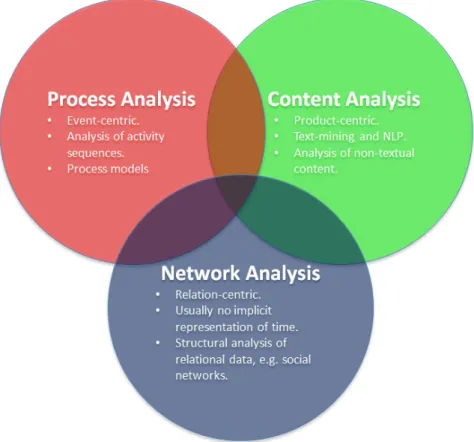
Ferguson (2012) outlined several challenges for learning analytics, particularly the need for advanced methodology to utilise increasingly challenging and complex datasets. While other fields such as business intelligence (Albright & Winston, 2014) and social computing (Macy & Willer, 2002) can build upon a rich and consolidated foundation of computational methods, in learning analytics a methodological discourse on how approaches from different can be utilised is about to emerge. To structure the range of computational methods for learning analytics a classification scheme is introduced by Hoppe (2016), which is depicted in Figure 3. In the following, this scheme is used to give an overview on different approaches used in learning analytics before the methodological objective of this thesis is explained in detail at the end of this section.
Figure 3 “Trinity” of computational methods for learning analytics.
Process Analysis. Techniques that can be used to investigate temporal activities of learners based on timestamped activity logs can be subsumed as “Process Analysis”. It has been argued that this event centric perspective is especially suited for the usually temporal data produced in collaborative learning (Reimann, 2009). In contrast to variable and variance based approaches, which are usually very restrictive on the type of data and further ignoring the ordering of events, process analysis can be used to link quantitative methods with qualitative process models to capture developments over time. Sequential pattern mining as a typical approach can be applied
Introduction
11 to identify characteristic temporal patterns in the activity traces of actors recorded on web platforms (Srivastava, Cooley, Deshpande, & Tan, 2000), particularly in online learning environments (Perera, Kay, Koprinska, Yacef, & Zaïane, 2009). The main goal is to discover the typical order in which certain activities are performed to gain insights into learning processes and for comparison of actual with expected learner behaviour. A related approach is process mining (van der Aalst et al., 2007). In process mining, the goal is to generalise multiple event sequences, activity traces to a process model, i.e. a state transition system that can be represented as a Petri net or a probabilistic Markov chain model. Originally developed for process discovery and modelling in business applications, process mining has also been adapted in the educational domain to identify general learning processes from fine-grained log protocols or messages in group discussions (Bannert, Reimann, & Sonnenberg, 2014). While there are limited degrees of freedom in the actual model creation and sophisticated algorithms are available (van Dongen, de Medeiros, Verbeek, Weijters, & van der Aalst, 2005), a major challenge is to pre-process the input data, which is in the extreme case a detailed clickstream, such that the result can be related to the actual learning process. This requires the filtering and aggregation of atomic actions to higher-order tasks which is difficult since it requires detailed knowledge about the interaction patterns of learners with the system. This information, however, is necessarily incomplete since otherwise there would be no need for data analysis on the process level. Sequential pattern mining and process mining are not part of the work included in this thesis, however, temporal and process aspects are explicitly considered in conjunction with network analysis methods described later on. Content analysis. As already stated in Section 1.1.1, dynamic and static artefacts can be considered as a building block of most virtual environments for learning and knowledge creation. Thus, another important methodological aspect is content analysis, especially of learner generated artefacts. While the range of available methods is very broad, in learning analytics content analysis mostly deals with the application of text-mining techniques to acquire information from textual data. Only a few studies consider other types of artefacts such as concept maps, for example the work of Clariana, Engelmann, and Yu (2013). An important application is discourse analysis, which is concerned with collaborative knowledge construction through participation in dialogues (De Wever, Schellens, Valcke, & Van Keer, 2006; Liddo, Shum, Quinto, Bachler, & Cannavacciuolo, 2011). Discourse analysis is a relevant subject for the work on analysing information sharing in discussion forums presented later on in Chapters 4, 5, and 6. Another important goal of the analysis of textual data in online learning communities is to model thematic contributions of learners in collaborative writing tasks which can be used for role modelling of contributors and estimation of individual knowledge domains (Southavilay, Yacef, Reimann, & Calvo, 2013). The recently developed concept of meaningful purposive interaction analysis (Wild, 2016) combines latent semantic analysis (LSA) (Deerwester, Dumais, Furnas, Landauer, & Harshman, 1990) and relations between actors and learning opportunities (e.g. online courses) to model competencies and conceptual development. Among other applications, this framework allows for comparison of the actors’ competencies as well as combined visualisations of concepts and assessment of the actors’ knowledge. Chapters 4 and 6 in this thesis
12
also deal with thematic modelling as a means to identify essential concepts from textual contributions of actors for the identification of interests and expertise.
Content analysis is further applied in text classification tasks to extract characteristic features from written language that can be used to train classification models. In the field of learning analytics text classification is often used to link textual contributions to theoretical constructs from learning sciences, such as taxonomies of cognitive learning levels (Wong, Pursel, Divinsky, & Jansen, 2015b) and collaborative knowledge construction activities (Rosé et al., 2008). Text classification is particularly important for the work described in Chapters 6 and 7 for the identification of meaningful discourse elements such as forum posts that are relevant for the exchange of information.
Apart from methods that consider documents as “bag of words” ignoring the position of words in a text, network text analysis aims to preserve the conceptual structure of texts. In those approaches words are mapped to concepts and connected based on the proximity of their positions in a text to establish a concept network. An application of network text analysis is the modelling and visual mapping of the conceptual structure of a knowledge domain of the authors of a text (Daems, Erkens, Malzahn, & Hoppe, 2014). This aspect of content analysis, however, is only peripherally covered in the following.
Network analysis. The third category of methods is (social) network analysis. These approaches explicitly deal with relational data by investigating networks of interconnected entities (represented as nodes). These entities are often actors in a social network. In this thesis, however, multipartite (also multi-mode) networks (Wasserman & Faust, 1994) with edges between nodes of different types are especially important since large proportions deal with bipartite actor-artefact networks. A basic property of these networks is that edges cannot exist of between nodes of the same type. This poses some restrictions on the length of cycles and paths between node types, which often creates the need to adapt methods designed for the unipartite case. This issue will be handled especially in Chapters 2-4. Network representations enable the application of methods rooted in the well-founded graph theory, and thus, network analysis is especially suited for structural analyses of networked communities on all three levels described in Section 1.1.2, cf. (Brandes & Erlebach, 2005). Related fields are graph data mining and statistical relational learning that have a stronger focus on data intensive classification and inference problems on networks such as link prediction and entity resolution (Getoor & Diehl, 2005).
Individual actors in a network are often characterised by centrality measures indicating their importance with respect to their connections to others. The up to day most comprehensive reviews of different notions of centrality can be found in (Friedl & Heidemann, 2010) and (Koschützki et al., 2005). It is widely assumed that the position an actor has in a social network has a strong influence on the ability to spread and receive information and to accumulate social capital (Borgatti, Mehra, Brass, & Labianca, 2009), and thus, centrality indices of special interest in learning contexts (de Laat, Lally, Lipponen, & Simons, 2007).
As mentioned in Section 1.1.2, social network analysis can be applied for community analysis on the meso-level by identifying densely connected groups of actors (Fortunato, 2010). Those,
Introduction
13 densely connected regions in a social network are often called subcommunities or modules and play a crucial role in information spreading processes. Information can circulate very quickly within those modules since there are typically many connection paths between actors of the same subcommunity. However, the addition of new information to a subcommunity heavily relies on relations between actors of different subcommunities. These weak ties were described and studied intensively by Granovetter (1973). Subcommunity detection methods are not restricted to social networks in the original sense. The discovery of densely connected cohesive parts also matters in affiliation networks such as bipartite actor-artefact networks, as a special type of network clustering. These affiliation clusters can be used in various ways to characterise an educational online community and will be one of the main topics of the research described later in Chapters 2-4 of this thesis. In addition to clustering actors into cohesive subcommunities, actors can also be grouped based on the similarity of their connection patterns which does not necessarily imply cohesiveness of a cluster (Doreian et al., 2004). This type of network modelling is an important building block for role modelling in information exchange networks and will also be discussed explicitly in Chapters 5-6.
Apart from actor centric measures and grouping of actors, global properties of networked structures on the community level are also intensively studied in different ways. The aim is to find general rules explaining the emergence of various phenomena in networks such as short average path lengths which is known as the small-world property (Watts & Strogatz, 1998) or the evolution of highly connected nodes (hubs) in scale-free networks (Barabási & Albert, 1999). In the domain of knowledge related online communities an important task on the community level is to investigate the capability of different network configurations for spreading information among interconnected actors (Liben-Nowell & Kleinberg, 2008).
In the works reported later on temporal aspects of network evolution are of particular interest. Although real-world networks are often dynamic in the sense that nodes and edges are constantly added and deleted over time, network representations usually do not implicitly reflect the history these events. For example, when one creates a network of actors who communicate over a certain period, it is necessary to aggregate all communication events that occurred during a specified time window losing the temporal order of events in favour to map the structural relationships between the actors. However, the evolution of networked structures over time is an important aspect of network analysis. Thus, different techniques exist for handling this issue depending on the nature of the available data.
Most commonly, sequential approaches aggregate nodes and edges created in successive or overlapping time windows of specified size into a sequence networks. The choice of an appropriate time window size, thereby, has a huge effect on the result and is far from being trivial. It could be shown that the duration of typical production cycles of a community is a proper heuristic for making this choice (Zeini, Göhnert, Hecking, Krempel, & Hoppe, 2014), but the applied techniques and analysis goals have to be considered carefully as well (Hecking, Göhnert, Zeini, & Hoppe, 2013). In the case of online courses that will be discussed in the following
14
chapters, a “production cycle” is typically given by the frequency of course sessions (usually weeks).
In contrast to sequential modelling of dynamic networks, streaming approaches represent an evolving network as a stream of temporally ordered events of node/edge creation and deletion (McGregor, 2014). Starting with an initial state of the network, the structure is constantly modified by adding and removing elements when such events occur. This modelling technique keeps the order of node and edge creation events and no aggregation is necessary. Thus, properties of nodes or the network as a whole can be modelled as a continuous function over time. However, this method is only applicable if nodes and edges have a lifespan larger than the typical arrival time of events. This is, for example, the case in power grids or friendships in online social networks where nodes and edges once created are likely to persist over a longer time span. In the actor-artefact networks or communication networks relevant for this thesis, edges are typically observable only at the exact point in time when they are created, usually recorded as a timestamped event without duration. A streaming approach would boil down to a sequence of events (represented as networks with only one or very few edges) without being able to capture structure.
Concerning temporal dynamics, networks that model information flow over time denote a special case since these types of networks implicitly represent time. Assuming that nodes are activated by information passed between them over directed edges only forward in time, the edges that lead to new node activations induce a partial temporal order of the nodes with respect to their activation times. Citation networks of scientific publications are prototypical examples of such information flow networks. Since new publications can only take information from already existing publications they cannot contain cycles and the partial temporal order of publication dates is preserved in the partial topological order of nodes. Every directed network with time dependent edges can be transformed into a network with a partial temporal order of nodes if different versions of nodes are introduced such that the timestamp of ingoing edges of all nodes are always smaller than the timestamps of outgoing edges. For example, Halatchliyski, Hecking, Goehnert, and Hoppe (2014) transform the typically cyclic hyperlink network between wiki articles into a directed acyclic graph by representing each article revision as a single node. In this way directed acyclic graphs between interlinked revisions are derived enabling to application of network based approaches to investigate the flow of ideas between articles over time.
Methodological objective. Apart from the research objective outlined in the previous Section 1.1.2 that is more oriented towards the expected outcome of investigations of online learning communities with respect to community support, this work also aims to expand the methodological spectrum of learning analytics and social network analysis in a more general sense. The methodological contribution of this thesis can be subsumed as development and exploration of analytics methods to characterise learners in online communities in terms of content production and usage, and information sharing.
Although the nature of the data produced by learners in online communities such as forum communication, collaborative content production, and artefact consumption is inherently of
Introduction
15 relational nature, in many existing studies the full potential of the rich body of research in network analysis (sometimes referred to as network science) is not fully exploited. As pointed out by Hoppe, Harrer, Göhnert, and Hecking (2016) advanced network analysis methods applied to evaluate online learning scenarios can open up new perspectives in community analysis and support. From this point of view, a productive discourse on the exploration and application of computational methods beyond descriptive and inference statistics applied in the learning domain is considered as desirable for enabling more informed decisions in community support. In order to proceed in this direction, adaptations of network analysis methods as well as new approaches are described that take into account the different perspectives described before. While the primary approaches in this work are based on network analysis, concepts from process and content analysis are incorporated, as well, leading to mixed method approaches. A special focus is on the application of network analysis techniques to temporal data. Explicit consideration of time allows for getting a more complete picture on dynamic processes of individual and community behaviour. This incorporates the process oriented perspective described above that considers timestamped events as the basic entity of analysis. As outlined before, the combination of the advantages of network analysis and temporal aspects to investigate structural dynamics is still a challenge in research in social network analysis that will be particularly addressed in the following chapters.
1.2
Synopsis of Included Publications
This section outlines the main contributions of the publications that constitute the following chapters. The chapters can be contextualised according to the investigated aspect of online communities and types of actor-artefact relations described in Section 1.1.1, the research objective according to different scopes and levels of community analysis as outlined in Section 1.1.2, and the methodological contributions with respect to the development and application of mixed method approaches discussed in Section 1.1.3.
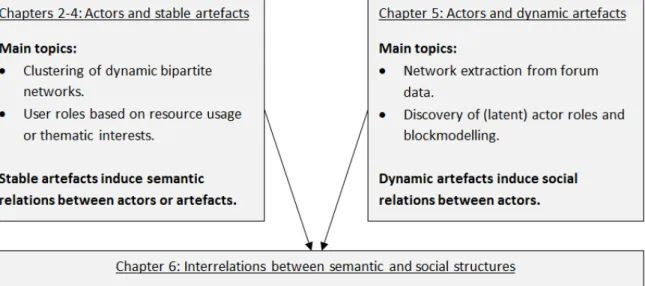
As described in Section 1.1.1 different aspects of an online community can be analysed depending on the type of actor-artefact relations that are investigated. Particularly important is whether the artefacts are considered to be static (relations indicate actors’ information consumption or interests), or dynamic (actors manipulate artefacts). Applying this scheme to the following chapters leads to the graphical outline depicted in Figure 4.
Relations between actors and stable artefacts are analysed by applying network analysis techniques for dynamic bipartite networks that are capable to discover meaningful patterns even if only limited data, i.e. resource access logs of actors are available (Chapters 2-4). The focus in these chapters is on the affiliation aspect and information consumption of actors in the investigated learning communities. As mentioned earlier the actors’ relations to static artefacts can then be used to infer semantic relations between actors based on common affiliations. Social actor-actor relations originating from co-editing dynamic artefacts are used to develop role models from forum communication between learners in large scale online courses (Chapter 5). Consequently, the social and content production aspect of communities is much more salient
16
than in Chapters 2-3. The combination of semantic relations between actors based on common interests and social communication relations among them will be discussed explicitly in Chapter 6 using mixed method approaches comprising of network and content analysis.
Figure 4 Graphical outline of content of selected papers and their interdependencies.
1.2.1
Relations of actors and stable artefacts
The chapters subsumed in the following report the development of methods for the analysis of bipartite networks of actors connected to artefacts. The described works serve the objectives of characterising learners according to resource usage and thematic interests outlined in Section 1.1.2 as decision support for community management. Furthermore, the challenge of combining network analysis with temporal aspects described in Section 1.1.3 is particularly addressed. Chapter 2. The next chapter presents a study on learning resource usage of learners in online courses adapting methods from network analysis. In contrast to often used descriptive statistics on resource usage, the goal is to find more sophisticated patterns and regularities of the resource access of learners in such courses over time. The conducted analysis is solely based on the log data of resource accesses which is often the only available information about the learning processes of participants. Two studies were conducted; the first on a blended educational online learning community forming during a master-level university course with possible unobserved interactions outside the system, and the second on a course with sole online activities. Although the communities are productive to some extend since creating wiki articles as part of regular exercises, the focus is on the affiliation aspect and information consumption rather than on content production and social interactions. This poses the question whether there are emergent
Introduction
17 patterns of resource usage in these courses even if direct social influence between the learners is limited. Learning resources are considered as stable artefacts that are used by the course participants as information sources. In this sense, actor-artefact relations are represented as a bipartite network of learners who are connected to learning resources they accessed according to activity log protocols. By applying “Biclique Communities” method for network clustering introduced by Lehmann, Schwartz, and Hansen (2008), overlapping clusters of learners and learning resources are derived. Each of these clusters is constituted by a group of learners who establish common relations to a set of learning resources while this set of learning resources is also more densely connected to the learner group than to learners outside the cluster. This duality allows for a differentiated interpretation. The learners in such clusters can be seen as a group of learners with similar interests (or resource usage behaviour). According to Section 1.1.1 a hidden or semantic relation between the learners can be assumed even if direct social relations are not present, which allows for a categorisation of the learners based on their association to such clusters. To this end, in an optimistic learner model even similar potential knowledge can be assumed for learners in the same cluster. In the same way, the artefacts that are associated with the same cluster can also be considered as related. The applied methodology relies on the notion of bicliques which are maximally connected subgraphs in bipartite networks. Consequently, sparsely connected actors and artefacts are inherently filtered by the clustering methods since they cannot be part of a biclique of a specified minimum size. The strict notion of bicliques further allows for discovery of structural patterns even in very densely connected networks of leaners and learning resources.
In addition, a framework is developed for tracking the evolution of the discovered actor-artefact clusters over time, which has not been considered much in existing work on dynamic bipartite networks. The incorporation of time combines structural analysis with the process aspect described in Section 1.1.3 supporting an in-depth view on the changing roles of learners and resources during an online course. This enables the discovery of prior non-observable patterns of the evolution of relational structures of learners and learning resources. Groups of learners with similar learning processes manifested in their resource usage are likely to be part of the same bipartite clusters over time. On the other hand, learning resources that frequently occur in the same clusters because they are used by the same course participants have a potential overall importance for the particular subgroup. More complex patterns of diversification of resource usage in certain periods of the investigated courses, especially in the exam preparation phase, can be discovered as well.
According to the scheme introduced in Section 1.1.2, the approach can be seen as a characterisation of learners (actors) on the meso-level since it operates on subgroups of actors. However, the interpretation of the results can also characterise the community as a whole in terms of diversity of resource usage and importance of different types of material. The presented research of the evolution of bipartite clusters over time has been taken up by Ziebarth et al. (2015) to further characterise individual participants of an online course. Based on the observation that a majority of course participants occur in large clusters over time that contain the main learning resources, they can be classified according to the number and sizes of clusters
18
they were associated with to during the course. Participants who mainly occur in large clusters with the main course material can be seen as “mainstreamers” whereas others can be identified who show more diverse resource access behaviour. Triangulation of resource access pattern discovery with statistical evaluations further revealed relations between mainstreaming behaviour and exam preparation strategies.
Chapter 3. The analysis methods for dynamic bipartite networks used in Chapter 2 are well suited for very dense networks since the notion of bicliques poses strict requirements on the formation of bipartite clusters. It accounts for possible multiple memberships of actors or artefacts in more than one cluster by allowing overlaps between the clusters. However, there can be application scenarios in which a partitioning of a bipartite actor-artefact network into non-overlapping groups of nodes is more desirable, especially in sparse networks in which bicliques only rarely exist. Chapter 3 focuses on algorithmic aspects of network clustering and describes a new method for partitioning bipartite networks into densely connected components that accomplishes the possibilities of clustering dynamic actor-artefact networks described in Chapter 2.
The notion of modularity (Newman, 2006) for networks defines a measure that can be used to quantify how separated different modules in a partitioned network are. In general, modularity measures for each partition (or module) the difference of the edges that connect nodes of the partition and the number of such connections that are statistically expected under the given degree distribution of the network. Consequently, modularity can be used as an optimisation criterion for network clustering algorithms. Finding an optimal partitioning of a network with respect to maximum modularity is an NP-complete problem (Brandes et al., 2008) but there exist various modularity optimisation methods for networks in the general case that approximate the optimal solution (Fortunato, 2010). However, methods that are tailored for bipartite networks are not well explored. Since the number of expected edges within a partition of a bipartite network is different from the expected number of edges in the general case, existing modularity optimisation methods do not necessarily produce a good partitioning in the bipartite case. For this reason, the developed method adapts the Louvaine algorithm introduced by Blondel, Guillaume, Lambiotte, and Lefebvre (2008) to the bipartite case. Thus, it is named “bipartite Louvaine”. It produces better results than general modularity optimisation and other clustering methods for bipartite networks on different datasets. Bipartite Louvaine adapts local updates of the overall modularity similar to the original method if nodes are moved from one cluster to another which avoids costly global re-calculations of the modularity. Therefore, the algorithm is capable of clustering larger networks than methods that rely on bicliques.
With respect to dynamic bipartite networks, Chapter 3 also introduces a method to compute bipartite clusters of successive time slices of dynamic networks in an incremental fashion. In particular, the clustering of a time slice of an evolving bipartite network is used to compute the clustering of the next time slice. This does not necessarily produce the best clustering for each time slice as it would be the case if the partitioning of each time slice of a network were built independently. However, the transitions between evolving clusters are much smoother using incremental cluster updates since clusterings of successive time slices are more similar than in
Introduction
19 sequential clustering, if the changes in the network structure are not too big. This makes it easier to track the evolution of the clusters over time that do not change much and further takes into account the assumption that actors remember former affiliations to different artefacts for a certain amount of time.
In general, Chapter 2 and 3 provide complementary methods that can be used to analyse dynamic bipartite actor-artefact networks on the meso-level. Which method is eventually applied very much depends on the use case and the information need. The Biclique Communities method used in Chapter 2 using sequential clustering of time slices is especially suited for dense networks as they are derived from resource access protocols where heavy structural changes are expected due to the agenda of an online course. The strict definition of bicliques as building blocks of bipartite clusters allows for identifying meaningful substructures even in those networks and accounts for the potentially large overlaps of clusters. In contrast, the bipartite Louvaine method with incremental cluster updates across time slices of an evolving actor-artefact network is better suited for large and sparse networks where a partitioning into cohesive components that can be further investigated often is the better choice.
Chapter 4. This chapter widens the scope of application of the bipartite clustering approach in dynamic actor-artefact networks. In contrast to Chapters 2 and 3 the analysed community comprise of participants of a publicly available MOOC who contribute to the discussion forum of the course. Thus, the focus is much more on self-organised information acquisition and sharing in a loosely connected forum community. To this end, the goal is not to characterise actors in terms of their usage of learning resources but to map the coevolution of discussions themes and the interests of actors. Thus, the production aspect of online communities is more present than in Chapters 2 and 3. The approach can be used for, both, getting a better understanding of the use of discussion forums in large online courses, as well as the development of adaptive community support mechanisms such as recommendations. The basic artefacts are the discussion threads. Although discussion threads are dynamic artefacts that change over time, they are not used to infer social relations between the actors, as stated in Section 1.1.1. Instead, the discussion threads are replaced by keywords extracted from the text content yielding networks between actors and keywords extracted from the discussions they participated in. This accounts for a mapping of forum users and their thematic interests. The combination of network analysis with content analysis allows for the identification of emergent structural patterns of thematic affiliations of users.
A strong focus of this chapter is to use the clustering method from Chapter 2 as a typical meso-level analysis to infer characteristics of particular actors on the individual meso-level. Since a cluster is considered as a set of actors with common interests connected to a set of related keywords, the overlaps between those clusters are of particular interest. Actors who are part of multiple actor -keyword clusters in certain time periods during the course can be considered as having more diverse interests and bridge between different thematic areas. Those actors have a higher potential to spread information across discussions on different topics than actors who are active only in a little number of thematic areas. It will be shown that the group of actors who occur in
20
overlaps between clusters have different characteristics regarding their posting activities and in extreme cases behave like instructors even if they are regular participants.
On the community level, the approach is further used to characterise the evolution of themes. The chapter, thereby, takes a user centric view on the emergence of themes. In particular, a topic is established as a set of keywords that is of common interest for set of actors as a result of bipartite clustering applied to actor-keyword networks. This covers a different aspect of thematic modelling of actors’ contributions in collaborative learning settings (cf. Section 1.1.3 “Content Analysis”) and can be contrasted to pure content related topic modelling such as Latent Dirichlet Allocation (Blei, Ng, & Jordan, 2003). From this point of view, the identification of evolution patterns of bipartite clusters over time as described in Chapter 2 and 3 can be used to map the coevolution of the actors’ interest and themes simultaneously in an interpretable framework. In the outline of this thesis, Chapter 4 can be considered as a transition towards a second line of research that investigates the direct communication relations between actors inferred from dynamic artefacts, namely forum discussions as depicted on the right site of Figure 4. This will be described in the following.
1.2.2
Social relations between actors and dynamic artefacts
In Section 1.1.1 the important role of constantly modified dynamic artefacts as mediating objects for asynchronous collaboration and communication in online communities was described. As stated in Section 1.1.2, one goal is to contribute to a better understanding of the mechanisms behind artefact mediated information exchange between peers. To that end, the chapters outlined in the following analyse social relations between actors manifesting from their contributions to forum discussions (considered as dynamic artefacts) in large scale online courses with respect to the information exchange, as well as collective knowledge building. The developed methods and the outcome of the conducted studies are considered to be valuable for the design of community support mechanisms for information exchange that takes into account different roles of actors in the social aspect of online learning communities.
Chapter 5. This chapter addresses several problems of modelling roles of actors with respect to information exchange with a focus on methodological aspects. As in Chapter 4, the work is in the context are MOOC discussion forums, but here the particular discussion threads are considered as dynamic artefacts that establish social relations between actors. While in Chapter 4 the view was more on the affiliation aspect of the forum community, Chapter 5 focuses on the interpersonal aspect of content production and information exchange through social relations. While it is known that many course participants use discussion forums passively as information source (Anderson, Huttenlocher, Kleinberg, & Leskovec, 2014), the reported studies focus on those who actively contribute in discussions and knowledge sharing to contribute to a better understanding collaboration in large scale online courses.
First the problem of transforming the relations between forum users and discussion threads into social relations between the users is addressed. This task is not trivial since the applied transformation has a fundamental impact on the information that can be gathered by following