‘NOT RECORDING A CONVICTION’
AS A SENTENCING OPTION
FINAL REPORT No. 3
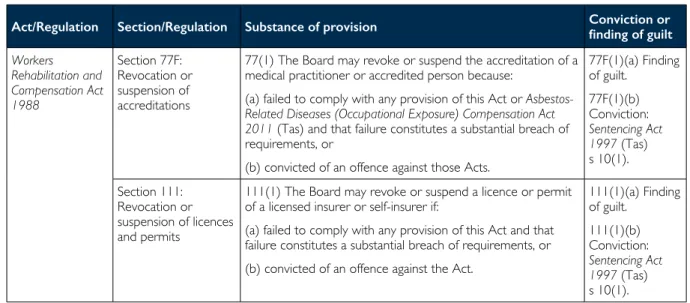
August 2014
NON–
CONVICTION
SENTENCES
‘NOT RECORDING A CONVICTION’
AS A SENTENCING OPTION
FINAL REPORT No. 3
August 2014
NON–
CONVICTION
SENTENCES
ISBN: 978-0-9873492-6-2 (print) ISBN: 978-0-9873492-7-9 (ebook)
Copyright © State of Tasmania – Department of Justice, 2014. This work is copyright; however, material from this publication may be copied and published by state or federal government agencies without permission of the Department on the condition that the meaning of the material is not altered and the Tasmanian Department of Justice is acknowledged as the source of the material. Any other persons or bodies wishing to use material
Information on
the Sentencing
Advisory Council
The Sentencing Advisory Council was established in June 2010 by the then Attorney-General and Minister for Justice, the Hon. Lara Giddings MP. The Council was established, in part, as an advisory body to the Attorney-General. Its other functions are to bridge the gap between the community, the courts and the Government by informing, educating and advising on sentencing issues in Tasmania. At the time this reference was concluded, the Council members were Professor Arie Freiberg AM (Chair), Professor Kate Warner, Dr Jeremy Prichard, Mr Phil Wilkinson (until 2nd June 2014), Ms Kim Baumeler, Mr Norman Reaburn, Mr Chris Gunson, Professor Rob White, Ms Sue Robertson and Ms Linda Mason.
Acknowledgments
The Council would like to thank all those who provided information in relation to this reference, in particular the Chief Justice of the Supreme Court of Tasmania, the Chief Magistrate, Tasmania Police, the Monetary Penalties Enforcement Unit, and the Department of Justice. This Final Advice was written by Dr Rebecca Bradfield.
About this
Final Advice
The reference to the Sentencing Advisory Council was made by the then Attorney-General and Minister for Justice, the Hon. Brian Wightman MP in October 2013.
This Advice makes recommendation to the Attorney-General in relation to the sentencing option of ‘not recording a conviction’. Under the Sentencing Act 1997 (Tas) and the Youth Justice Act 1997 (Tas), there are several sanctions that can be imposed by judges and magistrates without recording a conviction. However, there is no power to impose a fine on an adult offender without recording a conviction.
This Advice considers the implication for an offender of a court not recording a conviction following a finding of guilt, and specifically whether a fine should be able to be imposed if a conviction is not recorded.
As part of the preparation for this Advice, the Sentencing Advisory Council provided a copy of the paper to the Chief Justice of the Supreme Court of Tasmania, the Chief Magistrate, and the Commissioner of Police (Tas). The feedback received has been incorporated in this Advice.
This Advice reflects the law as at November 2013.
Contents
Executive Summary v
List of Recommendations x
1. Introduction 1
1.1 Background to this paper 1
1.2 Terms of reference 1
1.3 Overview of the Tasmanian sentencing legislation 2 1.4 Key terminology: Conviction, guilt and sentence 3
1.4.1 Guilt 3
1.4.2 Conviction 4
1.4.3 Sentence 5
1.5 Scope of the paper 6
2. Conviction within the modern Tasmanian criminal justice system 7
2.1 Conviction or non-conviction under the Sentencing Act 1997 (Tas)
and the Youth Justice Act (Tas) 7
2.2 What is the significance of a conviction? 10 2.3 Exercise of a court’s discretion whether or not to record a conviction 10 2.3.1 The nature and circumstances of the offence 13
2.3.2 Antecedents and character 14
2.3.3 The impact on economic or social well-being or employment 14
2.4 Spent conviction schemes 15
2.5 Criminal history record 16
2.5.1 Who can access a person’s criminal record held by the police? 17 2.5.2 What information is disclosed? 18
3. Consequences of recording a conviction or a finding of guilt 19
3.1 The legislative framework 19
3.1.1 Finding of guilt under the Sentencing Act 1997 (Tas): What orders can be made and in what circumstances is a finding of guilt equated with a
conviction? 20
3.1.2 Finding of guilt under the Youth Justice Act 1997(Tas): What orders can be made and in what circumstances is a finding of guilt equated with a
conviction? 21
3.2 Prior criminality 22
3.2.1 The exercise of the sentencing discretion for a subsequent offence 22 3.2.2 Statutory consequences of prior offending 23
3.3 Disqualification 25
3.4 Occupational and employment rights 26 3.4.1 Government bodies and appointments 26 3.4.2 Licensing and registration 27 3.4.3 Other consequences for employment 29
3.5 Loss of licences to drive 33
3.5.1 Mandatory disqualification 34
3.5.2 Discretionary disqualification 35
3.6 Sex offender registration 35
3.7 Retention of forensic samples 36
3.8 Political rights 36
3.9 Citizenship 37
3.10 Travel restrictions 38
3.11 Capacity to serve on jury and testify 39 3.12 Orders in addition to sentence: restitution, compensation and costs 40 3.13 Appeals and proceedings for variation or breach of sentence 42
3.16 Other court orders 45
3.17 Other provisions 45
3.18 Summary 46
4. The future of non-conviction orders 48
4.1 Should non-conviction orders continue to be a sentencing option under section 7 of the Sentencing Act 1997 (Tas)? 48 4.1.1 Justification for non-conviction sentences 48 4.1.2 What are the criticisms of non-conviction sentences? 50 4.1.3 Options and recommendations 53 4.2 What should be the legal consequences of a finding of guilt where a conviction
is not recorded? 54
4.2.1 Occupational and employment rights 55
4.2.2 Sex offender registration 71
4.2.3 Travel restrictions 72
4.2.4 Increased penalty provisions for subsequent offending 72 4.2.5 Licence disqualification and demerit points 73 4.2.6 Restitution, compensation and costs 76 4.2.7 Forfeiture and confiscation 77
4.2.8 Appeal against sentence 79
4.2.9 Other court orders 80
4.2.10 Other provisions 81
4.3 Should section 7 of the Sentencing Act 1997(Tas) be amended to allow
a fine to be imposed without a conviction being recorded? 82
4.3.1 Arguments in favour 82
4.3.2 Arguments against 84
4.3.3 Discussion and recommendations 85 4.3.4 Consequences of removing the reference to deemed convictions in the
Monetary Penalties Enforcement Act 2005 (Tas), section 20. 89
References 94
Appendix 1
Comments on passing sentence, Tasmanian Supreme Court 2008 –
1 November 2013: Non-conviction sentences. 98
Appendix 2
Prior Criminality 104
Appendix 3
Disqualification 115
Appendix 4
Loss of licences to drive 163
Appendix 5
Political rights 167
Appendix 6
Orders for compensation, restitution and costs 168
Appendix 7
Forfeiture of property 176
Appendix 8
Other court orders 184
Appendix 9
Other provisions 186
Appendix 10
Executive Summary
TERMS OF REFERENCE
On 22 October 2013, the then Attorney-General and Minister for Justice, the Hon. Brian Wightman MP, wrote to the Sentencing Advisory Council asking it for advice on the implications for an offender of a court not recording a conviction following a finding of guilt, and specifically whether a fine should be able to be imposed if a conviction is not recorded.
In particular, the Attorney-General requested the Council to consider:
• What purpose or purposes does the pronouncement/recording of an order of conviction serve in the modern criminal justice system?
• To what extent has the concept of ‘conviction’ been kept separate from the concept of ‘guilt’ both in statute and at common law in Tasmania?
• Should the two concepts remain separate?
• Is there a need to clarify any legislative provisions to maintain this distinction?
• What is the actual effect of the exercise by a Court of the sentencing option to ‘not record a conviction’ on an offender’s economic or social wellbeing or employment prospects in light of the fact that criminal history records are kept by and obtained from Tasmania Police and not the Courts? • What should be the legal consequences of
a finding of guilt where a conviction is not recorded? If there is a subsequent finding of guilt or conviction of the offender for a similar offence should that subsequent offence be regarded as a second offence for the purpose of sentencing?
• Should ‘not recording a conviction’ continue to be a sentencing option under section 7 of the
Sentencing Act 1997 (Tas)?If so should the section
be amended to allow for a fine to be imposed without a conviction being recorded? If the amendment is made how will it relate to section 20 of the Monetary Penalties Enforcement Act 2005
(Tas) where an offender is ‘taken to be convicted’ of an offence if an infringement notice is paid or if no election to have the matter decided by the court is made within 28 days?
PURPOSES OF AN ORDER OF
CONVICTION IN THE MODERN
CRIMINAL JUSTICE SYSTEM
Although the public conception of the criminal justice system is primarily centred on guilt (whether by trial or plea) and sentence, the foundations of sentencing are built upon three concepts: guilt, conviction and sentence. Conviction has traditionally been viewed as an important safeguard of the rights of the accused person as it was considered to provide the basis for the court’s power to exercise its sentencing powers. While the traditional sequential approach (guilt, conviction, sentence) has been weakened by the adoption of a statutory sentencing regime in Tasmania that provides that the recording of a conviction is, in some cases, optional or prohibited, it is the Council’s view that conviction still has an important role in the modern criminal justice system. A key purpose of the recording of a conviction in the modern criminal justice system is that it serves as a mark of social condemnation and stigmatisation – in this way a conviction is a punishment in itself.
A conviction also has significant and long-term legal consequences for the convicted person by altering a person’s legal status. Collateral consequences may include loss of office, licence or right, restrictions on employment and travel opportunities. These repercussions can cause long-term detriment and extend far beyond the time of
THE SEPARATION OF CONVICTION
AND GUILT
The terms of reference ask the Council to consider the extent to which the concept of ‘conviction’ has been kept separate from a finding of guilt in the current framework of the criminal justice system.
Conviction is a term with a dual meaning – one associated with a finding of guilt and the other
concerned with the recording of a conviction as part of the sentencing process. At common law, the meaning of conviction has been obscure because its precise meaning was dependent on the context in which it is used and, on occasion, there has been no separation from guilt as conviction has been conflated with the notion of guilt. In contrast, under the Sentencing Act 1997 (Tas) and the Youth Justice Act 1997 (Tas), it is made clear that
guilt and the recording of a conviction are distinct stages of the court process. When sentencing a person who is found guilty or who has entered a plea of guilty in relation to an offence, the court may or may not make an order recording a conviction. This allows the court to exercise its discretion to shield an offender (in the appropriate case) from the collateral consequences of a conviction, particularly in the area of employment. This recognises that the imposition of a conviction is a punishment in itself and, having regard to its long-term legal and social consequences, the recording of a conviction may, in the circumstances of the case, be disproportionate to the offence.
However, despite the intention of Parliament (as demonstrated in the Sentencing Act 1997 (Tas) and the Youth Justice Act 1997 (Tas)) to maintain a distinction between conviction and guilt, the review has found that other legislative and policy priorities have blurred the boundaries between findings of guilt and the recording of a conviction.
Various legal consequences may follow from a finding of guilt where a conviction is not recorded and the Council has identified a number of deficiencies in the current law in this respect. In particular, the review has highlighted the complexities and inconsistencies in the consequences that follow from a finding of guilt as compared with the consequences that follow from the recording of a conviction.
The Council’s view is that the distinction between guilt and conviction should be retained and the Council makes recommendations in relation to the legislative provisions that need to be amended to maintain the distinction between conviction and guilt.
The Council also makes recommendations, in relation to the legal consequences that should attach to a finding of guilt without a conviction, to ensure that there are different consequences that attach to a finding of guilt without a conviction and a finding of guilt with a conviction recorded.
THE ACTUAL EFFECT OF THE
EXERCISE BY A COURT OF THE
SENTENCING OPTION TO ‘NOT
RECORD A CONVICTION’ ON
AN OFFENDER’S ECONOMIC
OR SOCIAL WELLBEING OR
EMPLOYMENT PROSPECTS
A central concern of this review has been on whether the sentencing option of not recording a conviction has any practical effect for an offender, particularly in view of the increased use of police history record checks as part of the employment process.
Non-conviction sentences have been criticised on the basis that they waste considerable court resources, given the time involved in making the decision about whether to record a conviction (as well as appeals against the decision), when there is little practical benefit to the offender. This criticism recognises that the actual effect of the exercise by a court of the sentencing option to ‘not record a conviction’ on an offender’s economic or social wellbeing or employment prospects is contingent on whether the offence appears on an offender’s criminal record for employment and licensing purposes. In Tasmania, this criticism has partly been addressed by changes in the information release guidelines of Tasmania Police where information is now released in a criminal record check according to the accepted definition of conviction, which is a conviction that is recorded in accordance with the Sentencing Act 1997
(Tas) or the Youth Justice Act 1997 (Tas). Tasmania Police draw a distinction between the circumstances in which findings of guilt and convictions are disclosed in a criminal record check, with there being more limited disclosure of findings of guilt. Nevertheless, non-convictions orders are disclosed in police checks for quite a wide variety of occupations including relatively unskilled occupations such as taxi-driving. In addition, protections for offenders also exist under the anti-discrimination and privacy laws.
Despite the changes to information release guidelines, there is still a broad category of employment and licensing purposes where findings of guilt are treated in the same way as convictions for the purposes of employment or licensing. The Council considers that there is still a need to make legislative changes to ensure that the benefits of the sentencing option to ‘not record a conviction’ are enjoyed by an offender.
In its review, the Council has also identified confusion in relation to what is contained in a criminal record and the nature of the information that is disclosed in a police record check. This has undesirable consequences for offenders, employers, licensing and regulatory bodies and courts.
The Council recommends that the law should be simplified and clarified so it is possible to give a clear explanation of the legal consequences of a finding of guilt where a conviction is not recorded.
‘NOT RECORDING A CONVICTION’
AS A SENTENCING OPTION UNDER
SECTION 7 OF THE SENTENCING ACT
1997
(TAS)
The terms of reference ask the Council to consider whether ‘not recording a conviction’ should continue to be a sentencing option under section 7 of the Sentencing Act 1997 (Tas).
The Council considers that, regardless of other sanctions imposed by the court, the recording of a conviction remains an act of significant punishment – both as a symbolic mark of censure and because of the consequences that attach to a conviction. The sentencing option of ‘not recording a conviction’ allows a sentencer to have regard to the circumstances of the individual case, and to decline to impose a conviction because of the adverse impact that a conviction would have on the offender’s economic or social wellbeing or employment prospects. The Council stresses that maintaining the distinction between guilt and conviction not only provides a benefit to those offenders who are found guilty without a conviction being recorded (who avoid the stigma and adverse consequences of a conviction), it also has the potential to improve community safety through the rehabilitation of offenders. It is also significant that the Chief Justice of the Supreme Court of Tasmania and the Chief Magistrate support the retention of the sentencing option.
The Council recommends that ‘not recording a conviction’ should continue to be a sentencing option under section 7 of the Sentencing Act 1997 (Tas). The Council was also asked to provide advice as to whether section 7 of the Sentencing Act 1997 (Tas)be amended to allow for a fine to be imposed without a conviction being recorded.
A fine is the most frequently used sanction in Tasmania. As a sanction, a fine has many perceived advantages including its flexibility, its effectiveness as a sanction and its economic benefits (that is, its production of revenue). Unlike other jurisdictions, there is currently no power in Tasmania for courts to impose a fine without recording a conviction and there is a suggestion that, in some cases, fines are not being imposed because of the requirement to record a conviction. Magistrates have expressed the view that they sometimes decline to impose a fine, when it would otherwise be appropriate, because of the adverse impact a conviction would have on the offender’s economic or social wellbeing or employment prospect.
Both the Chief Justice of the Supreme Court of Tasmania and the Chief Magistrate have supported the extension of section 7 of the Sentencing Act 1997 (Tas) to allow for a fine to be imposed without a conviction being recorded.
It is the Council’s recommendation that section 7 of the
Sentencing Act 1997 (Tas)be amended to allow for a fine to be imposed without a conviction being recorded. The terms of reference also asked the Council to consider the relationship between providing the court with the ability to impose a fine without recording a conviction and section 20 of the Monetary Penalties Enforcement Act 2005 where an offender is ‘taken to be convicted’ of an offence if an infringement notice is paid or if no election to have the matter decided by the court is made within 28 days.
The Council considers that it is inappropriate for an infringement notice to result in a conviction. It is the Council’s view that conviction should be reserved for judicial determination given its significance as an act of social and legal stigma, and that it should not be used for the infringement notice scheme, which is an administrative procedure. The use of conviction in the Monetary Penalties Enforcement Act 1997 (Tas) is inconsistent with the significance attached to conviction as a sanction in its own right by the Sentencing Act 1997
The Council recommends that the Monetary Penalties Enforcement Act 1997 (Tas) be amended to remove the reference to deemed conviction in section 20, and that the enforcement procedure under the Act be grounded on the failure to pay the amount specified in the infringement notice within a specified time.
LEGAL CONSEQUENCES OF A
FINDING OF GUILT WHERE A
CONVICTION IS NOT RECORDED
The Council was asked to consider what should be the legal consequences of a finding of guilt where a conviction is not recorded.
A finding of guilt may have consequences for an offender in a range of areas including: disqualification (including employment and licensing), subsequent offending, sex offender registration, political rights, citizenship, travel, jury service, capacity to testify as a witness, have forensic samples taken and retained, orders in addition to sentence (restitution, compensation and costs, and forfeiture and confiscation). Beyond these areas, a criminal record may be relevant for making insurance claims, credit applications, applying for adoption or accommodation. This review highlights the range of potential consequences of criminal offending – some of which are immediate and known (such as a court order imposed as part of sentence) and others long term and changeable (such as employment/licensing or travel restrictions).
The Council considers that the legal consequences for a finding of guilt without conviction should be different to a finding of guilt where a conviction is recorded and should have meaning for an offender. Further, the Council’s view is that there is a need to reconcile the consequences that attach to a finding of guilt without a conviction recorded with the purposes of a non-conviction sentence – to facilitate the offender’s employment prospects with a view to rehabilitation and the need to impose a proportionate punishment – to ensure that the judicial objective in exercising the discretion is not frustrated.
Consistent with the view of the Council that the discretion of the court not to record a conviction should have meaning for the employment and economic prospects of the offender, it is the Council’s view that as a general rule non-conviction sentences should not be disclosed and should not appear on a person’s criminal record for employment and licensing purposes.
However, the Council endorses the view that restrictions on disclosure cannot be absolute and that in appropriate (and limited) circumstances, the judicial objective of imposing a non-conviction sentence must give way to the competing goal of decision makers having access to all relevant criminal offending (including findings of guilt without a recorded conviction).
The Council recommends that greater restrictions be imposed on the disclosure of findings of guilt without a conviction than apply for recorded convictions.
The Council also recommends that there be appropriate exemptions to the general rule that findings of guilt without conviction should not be disclosed. The recommended exemptions are in relation to:
• court proceedings
• law enforcement
• teaching and persons working with vulnerable persons
• adoption
• health practitioners
• appointment as a judicial officer or with a justice agency
• legal practitioners.
This means that findings of guilt without conviction will still be disclosed and taken into account in the context of decisions about sentence and proceedings of the Parole Board. There is also an exemption to enable law enforcement agencies (such as Tasmania Police) to disclose information as part of legitimate law enforcement functions. Findings of guilt will also be disclosed in context where persons may have close contact with children and/or vulnerable persons. The establishment of clear exemptions (when findings of guilt can be disclosed) means that courts will have greater certainty in relation to the future implications for an offender of making an order that a conviction not be recorded. It will also provide greater certainty for the community (including offenders and employers) and increase consistency across different regulatory areas by providing guidance to government department and legislative drafters in the development of new legislation. The terms of reference particularly asked the Council to consider, where there is a subsequent finding of guilt or conviction of the offender for a similar offence, whether that subsequent offence should be regarded as a second offence for the purposes of offending.
The Council considers that increased penalty provisions for a second or subsequent offence should apply to a finding of guilt without a conviction. Higher penalties for subsequent offending are an attempt to deal with recidivism, and this applies equally to offenders who have been found guilty without a conviction recorded. A finding of guilt without a conviction recorded is not the same as finding a person not guilty; there is still a finding that the person has committed the offence. Therefore, the Council recommends that the legislative amendments be made to provide that a finding of guilt without the recording of a conviction has the same effect as if one had been recorded for the purposes of proceedings against the offender for a subsequent offence.
The Council also makes recommendations in relation to the application of driver licence disqualification and demerit points, restitution, compensation and costs orders, forfeiture and confiscation, and other court orders to an offender who is found guilty without a conviction being recorded.
List of Recommendations
Chapter 4: The future of
non-conviction sentences
Should non-conviction orders continue
to be a sentencing option under section
7 of the Sentencing Act 1997 (Tas)?
Recommendation 1
page 54
That ‘not recording a conviction’ should continue to be a sentencing option under section 7 of the Sentencing Act 1997 (Tas).
Recommendation 2
page 54
The law should be simplified and clarified so that a clear explanation is possible.
Recommendation 3
page 54
Clear explanation should be provided to offenders who receive a non-conviction sentence about the consequences of the sentence at the sentencing hearing.
What should be the approach to the
disclosure of findings of guilt without a
conviction?
Recommendation 4
page 61
That greater restrictions be imposed on the disclosure of findings of guilt without a conviction than apply for a recorded conviction under the provisions of the Annulled Convictions Act 2003 (Tas).
Recommendation 5
page 61
That the following categories of exemptions to the restrictions on disclosure of findings of guilt without conviction are appropriate:
• the proceedings of a court or the making of a decision by a court, including a decision about sentence
• the legitimate enforcement, prosecution, administrative, penal, rehabilitative or other functions of a Justice Agency
• registration and employment for teachers and for persons working with vulnerable persons
• adoption
• registration for health practitioners under the Health Practitioner Regulation National Law (Tasmania)
• appointment as a judicial officer or employment or consultancy with a Justice Agency
• under the Legal Profession Act 1997 (Tas).
Recommendation 6
page 61
If an exemption exists in relation to findings of guilt without a conviction recorded (in other words a finding of guilt can be disclosed), the decision maker should be directed to take account of the fact that court considered that it was appropriate not to record a conviction in making its determination.
Recommendation 7
page 61
For the purposes of a decision in relation to registration relevant to employment, the applicant should be provided with an opportunity to provide further information in relation to the finding of guilt without a conviction recorded, in support of his/her application.
How should the recommendation
that greater restrictions be imposed
on the disclosure of findings of guilt
without a conviction than apply
for a recorded conviction under the
Annulled Convictions Act 2003 (Tas)
(Recommendation 4) be implemented?
Recommendation 8
page 63
A finding of guilt without a conviction recorded should continue to be included within the meaning of conviction in the Annulled Convictions Act 2003 (Tas) but the exemptions from annulment that apply for findings of guilt without a conviction recorded should be more limited.
What should be the consequences of a
finding of guilt without a conviction
for licensing or registration relevant to
employment?
Recommendation 9
page 65
A finding of guilt without a conviction should not be relevant to licencing or registration for employment or for obtaining or retaining a licence or permit relevant to a person’s ability to earn income unless a specific exemption (see Recommendation 5) applies.
Recommendation 10
page 65
Discretionary judgments based on character (such as the ‘fit and proper person’ test) or other broad discretionary powers concerning licensing or registration should not include consideration of a finding of guilt without a conviction unless a specific exemption (see Recommendation 5) applies.
Recommendation 11
page 65
Banning or prohibition orders in relation to employment or licences/permits relevant to employment not be made on the basis of a finding of guilt without conviction unless a specific exemption (see Recommendation 5) applies.
What other changes are necessary to
clarify the relationship between a finding
of guilt without a conviction and a
recorded conviction for employment
purposes?
Recommendation 12
page 67
Legislation be enacted that sets out the obligations of a person to provide information about a finding of guilt without a conviction, its effect for employment purposes, and consequences for improper disclosure.
Recommendation 13
page 67
Consideration be given to amending the Anti-Discrimination Act 1998 (Tas) by expanding the definition of ‘irrelevant criminal record’ to include a finding of guilt without a conviction unless a specific exemption (see Recommendation 5) applies.
What changes are necessary to give
effect to Recommendation 12 (that is,
to set out the obligations of a person
to provide information about a finding
of guilt without a conviction, its
effect for employment purposes, and
consequences for improper disclosure)?
Recommendation 14
page 70
That a finding of guilt without a conviction be clearly included within the framework of the Annulled Convictions Act 2003 (Tas) by inserting a provision that specifies that a finding of guilt without conviction in relation to all offences is immediately annulled. In effect this means that the mechanism for making a distinction between a recorded conviction and a finding of guilt without a conviction recorded is the immediate annulment of a finding of guilt without a conviction.
Recommendation 15
page 70
That the title of the Annulled Convictions Act 2003 (Tas) should be amended to reflect its treatment of both convictions and findings of guilt without conviction.
Recommendation 16
page 70
That a community education campaign be undertaken to inform the public generally, and employers in particular, about the distinction between a finding of guilt without a conviction and a recorded conviction and the legal obligations on employers in relation to an offender’s criminal history.
How should the competing purposes
of the registration and reporting
requirements for sex offenders pursuant
to the Community Protection (Offender
Reporting Act) 2005 (Tas) be reconciled
with the purposes of a non-conviction
sentence?
Recommendation 17
page 71
That the Community Protection (Offender Reporting Act) 2005 (Tas) be amended to provide the court with a broad discretion to make a reporting order if the person is a person in respect of whom the court has made an order without recording a conviction under section 7 of the Sentencing Act 1997 (Tas) or section 47 of the Youth Justice Act 1997 (Tas).
Should increased penalty provisions for
subsequent offending apply to finding
of guilty without the recording of a
conviction?
Recommendation 18
page 73
The Sentencing Act 1997 (Tas) s 10(2) and the Youth Justice Act 1997 (Tas) s 49 be amended to provide that a finding of guilt without the recording of a conviction has the same effect as if one had been recorded for the purposes of proceedings against the offender for a subsequent offence.
What should be the consequences of a
finding of guilt without a conviction for
driver licence disqualification?
Recommendation 19
page 75
Mandatory driver licence disqualifications should apply to a finding of guilt without a conviction recorded for adult and youth offenders.
Recommendation 20
page 75
Where licence disqualification is an available option, a court should have a discretion to impose a period of disqualification from driving on an offender who is found guilty without a conviction being recorded for adult and youth offenders.
What should be the consequences of a
finding of guilt without a conviction
for compensation, restitution and costs
orders?
Recommendation 21
page 77
The court should have the power to make an order for compensation or restitution following a finding of guilt without recording a conviction.
Recommendation 22
page 77
The court should have a power to make an order for costs following a finding of guilt without recording a conviction.
What should be the consequences of a
finding of guilt without a conviction for
forfeiture and confiscation orders?
Recommendation 23
page 78
A finding of guilt should provide the foundation for further orders in relation to forfeiture of items connected to the offence.
Recommendation 24
page 78
Mandatory forfeiture provisions in Tasmanian legislation should apply to a finding of guilt for adult and youth offenders.
Recommendation 25
page 78
A court should have the same discretion, in relation to adult and youth offenders, to order forfeiture in relation to any item that is the subject matter of the charge or is used in the commission of the offence on an offender who is found guilty without a conviction being recorded as if a conviction had been recorded.
How should the concept of ‘sentence’
be clarified?
Recommendation 26
page 80
A revised definition of sentence be inserted in the Criminal Code (Tas) to reflect the range of dispositive orders that a court can make on a finding of guilt. A model for the amendment can be found in the Criminal Procedure Act 2009 (Vic) s 3, which can be adapted for the Tasmanian context as follows: ‘sentence’ includes –
(a) the recording of a conviction
(b) an order made under Parts 3; 4; 5; 6; 6A; 7; 8; 9; or 10 of the Sentencing Act 1997 (Tas)
(c) an order made under the Community Protection (Offender Reporting) Act 2005
(d) an order made under the Crime (Confiscation of Profits) Act 1993 (Tas).
What should be the consequences of a
finding of guilt without a conviction in
relation to other orders that the court
can make at sentencing?
Recommendation 27
page 80
Discretionary orders that can be made by the sentencing court on conviction should also be available following a finding of guilt.
Recommendation 28
page 80
Mandatory special penalties should apply to an offender who is found guilty without a conviction recorded.
What other legislative changes are
necessary to ensure consistency with the
modern understanding of conviction in
Australia?
Recommendation 29
page 81
The use of the term ‘conviction’ in the Criminal Code (Tas),the Justices Act 1959 (Tas),the Evidence Act 2001 (Tas) and the Police Offences Act 1935 (Tas) be reviewed to ensure consistency with the modern understanding of conviction, as used in the Sentencing Act 1997 (Tas), that is the recording (or not recording) of a conviction as part of the imposition of sentence.
Should section 7 of the Sentencing Act
1997 (Tas) be amended to allow a fine
to be imposed without a conviction
being recorded?
Recommendation 30
page 88
Section 7 of the Sentencing Act 1997 (Tas) should be amended to allow for a fine to be imposed without a conviction being recorded.
If section 7 of the Sentencing Act 1997
(Tas) is amended to allow a fine to be
imposed without a conviction being
recorded, should the Monetary Penalties
Enforcement Act 2005 (Tas) be amended?
Recommendation 31
page 89
The Monetary Penalties Enforcement Act 2005 (Tas) should be amended to remove the reference in section 20 to deemed conviction, and the enforcement procedure be grounded on the failure to pay within a specified period of time.
What are the consequences for repeat
offenders of removing the deemed
conviction provision in the Monetary
Penalties Enforcement Act 2005 (Tas)?
Recommendation 32
page 91
Guidelines should be developed to allow infringement notice history to be made available to the court in sentencing an offender for a subsequent offence in appropriate cases.
Recommendation 33
page 91
Increased penalty provisions applicable for subsequent offending should not apply to offenders who are issued with an infringement notice and do not elect to have the matter determined by a court.
Should infringement notices be
disclosed in a criminal history check for
employment and licensing purposes?
Recommendation 34
page 91
Infringement notices should not appear on a criminal record check.
What are the consequences of removing
the deemed conviction provision in the
Monetary Penalties Enforcement Act 2005
(Tas) for the allocation of demerit points
and driver’s licence disqualification?
Recommendation 35
page 92
That legislative changes be made to ensure that demerit points for infringement notices for driving offences and driver’s licence disqualification still occur despite the removal of the deemed conviction provision in the Monetary Penalties Enforcement Act 2005 (Tas).
What are the consequences of removing
the deemed conviction provision in
the Monetary Penalties Enforcement Act
2005 (Tas) for the allocation of demerit
points and the application of forfeiture
provisions?
Recommendation 36
page 93
That legislative changes be made to ensure that demerit points and forfeiture arising from the issue of infringement notices still occur despite the removal of the deemed conviction provision in the Monetary Penalties Enforcement Act 2005 (Tas).
1.
Introduction
1.1 BACKGROUND TO THIS PAPER
Under the Sentencing Act 1997 (Tas)and the Youth Justice Act 1997 (Tas), there are several sanctions that can be imposed by judges and magistrates without recording a conviction. However, there is no power to impose a fine on an adult offender without recording a conviction. This Paper considers the implications for an offender of a Court not recording a conviction following a finding of guilt, and specifically whether a fine should be able to be imposed if a conviction is not recorded. This reflects concerns expressed by Tasmanian magistrates, over many years, that it is desirable that the sentencing discretion be enlarged to allow for the courts to impose a fine without recording a conviction. This was the recommendation of a Legislative Council Select Committee (the Wing Committee) in 1999.1 This issue has continued to been raised in other forums2 and in 2008, the Tasmania Law Reform Institute recommended that courts be provided with the power to fine an offender with or without recording a conviction.3 In 2012, the issue was raised with the Attorney-General by the Chief Magistrate and in 2013 the Attorney-General requested that the Sentencing Advisory Council conduct an inquiry into the matter.
1.2 TERMS OF REFERENCE
By a letter dated 22 October 2013, the Attorney-General, the Hon. Brian Wightman MP, sought advice from the Sentencing Advisory Council (‘the Council’) on the implications for an offender of a Court not recording a conviction following a finding of guilt, and specifically whether a fine should be able to be imposed if a conviction is not
recorded. The terms of reference for this inquiry were as follows:
• What purpose or purposes does the pronouncement/recording of an order of conviction serve in the modern criminal justice system?
• To what extent has the concept of ‘conviction’ been kept separate from the concept of ‘guilt’ both in statute and at common law in Tasmania?
• Should the two concepts remain separate?
• Is there a need to clarify any legislative provisions to maintain this distinction?
• What is the actual effect of the exercise by a Court of the sentencing option to ‘not record a conviction’ on an offender’s economic or social wellbeing or employment prospects in light of the fact that criminal history records are kept by and obtained from Tasmania Police and not the Courts?
• What should be the legal consequences of a finding of guilt where a conviction is not recorded? If there is a subsequent finding of guilt or conviction of the offender for a similar offence should that subsequent offence be regarded as a second offence for the purpose of sentencing?
1 Parliament of Tasmania, Correctional Services and Sentencing in Tasmania, (1999) 119.
2 For example, in Bartels’ study of suspended sentences it was raised by a judge and a magistrate who criticised the restrictions on imposing penalties without conviction, in particular the inability to impose a fine or community service without a conviction. Lorana Bartels, Sword or Feather? The Use and Utility of Suspended Sentences in Tasmania (PhD thesis, University of Tasmania, 2008) [3.4.9].
• Should ‘not recording a conviction’ continue to be a sentencing option under section 7 of the Sentencing Act 1997 (Tas)? If so should the sectionbe amended to allow for a fine to be imposed without a conviction being recorded? If the amendment is made how will it relate to section 20 of the Monetary Penalties Enforcement Act 2005 (Tas)where an offender is ‘taken to be convicted’ of an offence if an infringement notice is paid or if no election to have the matter decided by the court is made within 28 days?
1.3 OVERVIEW OF THE TASMANIAN SENTENCING LEGISLATION
Courts (judges and magistrates) are central to the sentencing process and have the responsibility for imposing sentence on persons found guilty of offences. The imposition of sentence involves the exercise of judicial discretion in individual cases within the constraints of the established sentencing principles of the common law and the legislative framework.4
The Sentencing Act 1997 (Tas) and the Youth Justice Act 1997 (Tas) consolidate the sentencing powers of courts in relation to adult and youth offenders. The Sentencing Act 1997 (Tas) applies to matters heard in the Supreme Court and the Magistrates Court in relation to adult offenders.5
Different sentencing principles and sentencing options generally apply for young offenders with greater emphasis placed on the rehabilitation of the young person.6 A youth is a person who is aged 10 or more7 and under the age of 18 at the time that the offence was committed.8 Most offences committed by youths are heard in the Magistrates Court (Youth Justice Division) and the sentencing options and principles that apply are set out in the provisions of the Youth Justice Act 1997 (Tas). Youth offenders are dealt with in the Supreme Court for ‘prescribed offences’, which are listed offences that vary depending on the age of the offender.9 A youth aged 15 years or older who is charged with an indictable offence that is not a prescribed offence has the option of having the matter heard by a jury in the Supreme Court.10 If the matter is heard in the Supreme Court, the Supreme Court has a discretion as to whether to sentence the youth under the Youth Justice Act 1997 (Tas) or the Sentencing Act 1997 (Tas).11
Legislation creating criminal offences also includes an indication of the penalty for persons who are found guilty of the offence(s). The Criminal Code (Tas) contains most of the indictable (serious) offences created by the Tasmanian Parliament and specifies a general maximum of 21 years imprisonment or a fine of no specific maximum for all offences, except murder and treason where the penalty is imprisonment for natural life or such other term as the court decides.12 There is an array of other legislation creating summary offences in Tasmania. It has been estimated that there are over two hundred such Acts.13 These statutes ordinarily specify the maximum penalty or a minimum and maximum penalty and may also provide for an increased penalty for a second (and subsequent) offence.
4 See Kate Warner, Sentencing in Tasmania (Federation Press, 2nd ed, 2002) [1.2].
5 Sentencing Act 1997 (Tas) s 5. The authority of a court to make an area restriction order, under the Sentencing Act 1997 (Tas) div 3 pt 9, applies to offenders regardless of their age or the court hearing the matter.
6 For detailed consideration of the principles relevant to the sentencing of young offenders see Sentencing Advisory Council [Victoria], Sentencing Children and Young People in Victoria, Report (2012) ch 3 <https://sentencingcouncil.vic.gov.au/>.
7 This is the age of criminal responsibility, Criminal Code s 18(1). 8 Youth Justice Act 1997 (Tas) s 3.
9 Youth Justice Act 1997 (Tas) ss 3, 161. For an offender less than 14, the offences are murder, manslaughter and attempted murder; for an offender aged 14, 15 or 16, in addition to the offences for under 14, aggravated sexual assault, armed robbery, aggravated armed robbery and being found prepared for the commission of a crime under ch XXVII of the Criminal Code armed with a dangerous or offensive weapon or instrument; for an offender aged 17, in addition to the offences already specified, offences under the Police Offences Act 1935 (Tas) s 37J (excessive noise, smoke from vehicles), offences under the Marine Safety (Misuse of Alcohol) Act 2006 (Tas), the Road Safety (Alcohol and Drugs) Act 1970 (Tas), the Traffic Act 1925 (Tas), or the Vehicle and Traffic Act 1999 (Tas) except where proceedings for that offence are, or are to be determined in conjunction with proceedings for an offence that is not a prescribed offence.
10 Youth Justice Act 1997 (Tas) s 161(2).
11 Sentencing Act 1997 (Tas) s 107. For an example of a youth offender sentenced under the Sentencing Act 1997 (Tas), see Tasmania v BWJK, Tennant J, 5 September 2012, (Sentence).
12 Criminal Code s 389 (general sentence), s 158 (murder), s 56 (treason). Other indictable offences are contained in Misuse of Drugs Act 2001 (Tas), Environmental Management and Pollution Control Act 1994 (Tas), Firearms Act 1996 (Tas), Legal Profession Act 2007 (Tas), Living Marine Resources Management Act 1995 (Tas), Meat Hygiene Act 1985 (Tas), Petroleum (Submerged Lands) Act 1982 (Tas).
1.4 KEY TERMINOLOGY: CONVICTION, GUILT AND SENTENCE
Although the public conception of the criminal justice system is primarily centred on guilt (whether by trial or plea) and sentence, the foundations of sentencing are built upon three concepts: guilt, conviction and sentence.14 Traditionally, a successful prosecution was viewed as having four sequential features: ‘first, an admission or jury finding of guilty; second, judicial acceptance of that finding by recording of a conviction; third, the announcement of the judgment (that is, the sentence); and finally, its execution’.15 This reflected the long held view that a court could not exercise its sentencing powers until a ‘formal judicial determination of guilt, usually manifested by the recording of a conviction’ as this was fundamental to the protection of the rights of accused persons.16 The traditional sequential approach (guilt, conviction, sentence and execution) has been weakened by the adoption of a statutory sentencing regime in Tasmania (and other Australian jurisdictions) that provides that the recording of a conviction is, in some cases, optional or prohibited.17
Central to this inquiry is the meaning of the concepts of guilt, conviction and sentence and the relationship between them. This section provides an overview of this key terminology. These issues are problematic and have given rise to uncertainty.18
1.4.1 Guilt
A person is guilty of an offence if either the person admits, by way of a plea of guilty, that he/she has committed the offence19 or a tribunal of fact (usually a jury or a magistrate) is satisfied that the prosecution has established, beyond reasonable doubt, the matters that must be proved to establish the offence and delivers a verdict of guilty.20 A finding of guilt serves two important functions in the sentencing process. Under current sentencing legislation, it provides the jurisdictional basis for imposing a sentence – a person must be found guilty before the court can proceed to impose sentence.21 It is not necessary for the court to record a conviction to impose sanctions on an offender who has been found guilty. This differs from the position that existed at common law where it was the conviction or the finality of the order that provided the basis for the court’s dispositive powers.22
The second role of the finding of guilt is that it operates to determine some of the facts that form the basis for the sentence imposed by the judge or the magistrate. In the exercise of the sentencing discretion, a judge or magistrate must determine the factual basis for the imposition of sentence that reflects the circumstances of both the offence and the offender23 and a fundamental principle is that a judge or magistrate is not entitled to sentence an offender on a basis inconsistent with the verdict24 or a plea.25 In some cases the factual implications arising from a finding of guilt may be clear, such as in cases heard in the Magistrates’ Court where the magistrate is both the fact-finder and the sentencer.26 In other cases, such as pleas of guilty (which is an admission of the ‘bare ingredients of the offence’)27 or a jury verdict where there is more than one factual basis for the verdict, greater difficulties may arise.28
14 Arie Freiberg, Fox and Freiberg’s Sentencing: State and Federal Law in Victoria (Thomson, 3rd ed, 2014) [1.250]. 15 Ibid.
16 Ibid; Maxwell (1996) 184 CLR 501. 17 See at [2.1].
18 Freiberg, above n 14, [1.250]. 19 Criminal Code (Tas) s 355. 20 Criminal Code (Tas) s 383.
21 See Freiberg, above n 14, [1.255]. See Sentencing Act 1997 (Tas) s 7; Youth Justice Act 1997 (Tas), s 47. Although note older offences in the Police Offences Act 1935 (Tas) provide that a person who contravenes the section is guilty of an offence and is liable on summary conviction to a penalty. See for example Police Offences Act 1935 (Tas) s 35 (common assault and aggravated assault).
22 Freiberg, ibid [1.250]. 23 Warner, above n 4, [2.301].
24 Ibid [2.316]. See Webb [1971] VR 147; West [1979] Tas R 1. 25 De Simoni (1981) 147 CLR 383, 389; R v Olbrich (1999) 199 CLR 272. 26 Freiberg, above n 14, [1.255].
27 Warner, above n 4, [2.311].
28 Freiberg, above n 14, [1.255]. For more information about the determination of the factual basis of sentencing, see Freiberg, [2.55]; Warner, ibid [2.3]. Note that the Criminal Code (Tas) s 383(3) provides that a judge has the power to ask questions of the jury in
1.4.2 Conviction
The meaning of a conviction is more obscure and its precise meaning has been difficult to identify because the meaning shifts depending on the context in which it is used.29 The potential for confusion is highlighted by Bagaric & Edney, where they explain the two distinct meaning of conviction – one meaning related to the finding of guilt and one meaning connected with the sentencing options for the court:
When discussing the concept of the conviction a fundamental distinction has to be made between two interrelated – but distinct – meanings of the word ‘conviction’. First, the word ‘conviction’ may be used as describing a part of the adjudicatory aspect of the criminal process where the court finds the charge or offence alleged against the accused proved. In this sense, ‘conviction’ refers to a positive finding that the charge or offence has been proved and the accused has been found guilty beyond reasonable doubt. Thus ‘conviction’ is confined here solely for the purpose of describing the final outcome of the adjudicatory stage of the proceeding that results in a finding of guilty.
The word ‘conviction’ also has a meaning in respect of the dispositional stage of the proceedings. In jurisdictions where a court may impose a sanction with or without conviction, the word describes a process where a court may in its discretion impose a conviction upon the offender.30
This ambiguity and dual meaning was perpetuated in The Attorney-General v Smith, where Crawford J cited the observation in R v Hannan; Ex parte Abbott31that ‘sometimes [conviction is] used in the narrow sense as indicating merely that an accused has been made the subject of a finding of guilt. Sometimes it is used in the wider sense of the finding of guilt combined with the sentence of the court’.32
In a thorough survey of the diverse interpretations of ‘conviction’ found in case law, Freiberg33 observes that it has been treated as:
• denoting the jury’s verdict of guilt34
• a determination that an offence has been proved or a final adjudication of guilt35 • the court’s sentence or judgment36
• the court’s acceptance of the return of a guilty verdict or the offering of a guilty plea37 • the acceptance of a plea of guilty and a remand for sentence38
• occurring on the administration of the allocutus39
29 Freiberg, ibid; Maxwell (1996) 184 CLR 501.
30 Richard Edney and Mirko Bagaric, Australian Sentencing: Principles and Practice (Cambridge University Press, 2007) [11.4.1]. 31 (1986) 41 NTR 37, 40.
32 [2002] TASSC 10, 23 per Crawford J with whom the other members of the court agreed. 33 This list and the associated references are taken from Freiberg, above n 14, [1.260]. 34 De Marchi [1983] 1 VR 619.
35 Kinney v Green (1992) 29 NSWLR 137, 139 per Carruthers J.
36 Tonks and Goss [1963] VR 121, 124; S (an infant) v Manchester City Recorder [1969] 3 All ER 1230, 1246; Re Stubbs (1947) 47 SR (NSW) 329, 335; Cobiac v Liddy [HCA] 26 at [4]-[7] per Windeyer J (1969) 119 CLR 257; Hannan; Ex partner Abbott (1986) NTR 37, 39; Muscatt (1996) SASR 367.
37 Griffiths [1977] HCA 44 at [24] per Barwick CJ and [11]-[13] per Aicken J (1977) 137 CLR 293. See also Maxwell (1996) 184 CLR 501; Elliott; Blessington v The Queen (2007) 234 CLR 38; DPP (Cth) v Helou (2003) 58 NSWLR 574. Freiberg writes that ‘such acceptance might be expressed, more usually it is implicit in the subsequent imposition of sentence, or the calling for reports preparatory of sentence’, Freiberg, above n 14, [1.260] fn 612.
38 McCoid and Parsons [1988] VR 982 approved in Della Patrona v DPP (Cth) (No 2) (1995) 38 NSWLR 257.
39 Shillingworth [1985] 1 Qd R 537; Verrall [2013] 1 Qd R 587. Freiberg describes the common law procedure as ‘[a]dministering the allocutus is the step in a criminal proceeding which occurs when, after a plea of guilty or a finding of guilt by the jury, the court asks the accused whether there is any reason why the court should not proceed to pass judgment according to law’, Freiberg, above n 14, [1.260] fn 614. In Tasmania, the allocutus is contained in the Criminal Code, s 385(1) and is ‘now put in terms that the person has been found guilty, or has pleaded guilty’. In contrast, before the Sentencing Act 1997 (Tas), ‘the practice of the Supreme Court of Tasmania when putting the allocutus to a person who had been found guilty by jury verdict was to recite that the person stood convicted by the verdict. With a guilty plea, the
• conviction (in the sense of a finding of guilt) and sentence (in the sense of a final disposal of the case)40 • a ‘bare finding of guilt’ for the purpose of an ex parte proceeding.41
As stated, the meaning of conviction is determined by the statutory context in which it is used and in explaining the meaning of the conviction in the context of the Sentencing Act 1997 (Tas), in The Attorney-General v Smith, Crawford J stated that:
[W]ithout a determination of guilt, there cannot be a conviction, but a determination of guilt will not in all cases amount to a conviction. That has been emphasised for the courts of this State by s10 [of the Sentencing Act 1997
(Tas)]. It follows from it that in this State, notwithstanding a finding of guilt combined with the sentence of the court, for most purposes the offender is not to be taken to have been convicted unless the court announces that it records the conviction.42
In this inquiry, conviction is generally to be understood in the sense of the recording (or not recording) of a conviction as part of the imposition of sentence under the Sentencing Act 1997 (Tas),following a finding of guilt.
1.4.3 Sentence
As with conviction, the boundaries of the concept of ‘sentence’ are fluid and dependent on the context in which the term is used.43 Although the Sentencing Act 1997 (Tas) contains ‘sentencing orders’ that a court may make following a finding of guilt,44 Tasmanian legislation does not provide a definition of ‘sentence’ that is of general application. Instead, ‘sentence’ is statutorily defined for specific (and limited) purposes, such as:
• the correction of a sentence under the Sentencing Act 1997 (Tas) where it is broadly defined in section
94(1) to include ‘a forfeiture, compensation levy, compensation order, restitution order, exclusion order, disqualification and loss or suspension of a licence or privilege’
• an appeal against sentence under the Criminal Code (Tas) where sentence is defined in section 399 to include any order made by the court of trial: (a) for the keeping in custody of the person convicted;45 (b) with reference to any property; or (c) with reference to any moneys to be paid by a person convicted. In relation to Crown appeals, sentence also includes a probation order under the Sentencing Act 1997 (Tas).46 An order must fall within either the statutory definition of a sentence or within the ordinary meaning of sentence, which is ‘in the strict common law sense, … the judgment of the court consequence upon conviction. To constitute judgment, the order or determination of the court must definitively dispose of the consequences of conviction’47
• other legislative provisions extend the concept of ‘sentence’, by providing that orders of the court (that would not otherwise fall within the meaning of sentence) can be appealed against as if that order were a sentence imposed on conviction. These provisions are found in relation to dangerous criminal declarations,48 the registration of sex offenders,49 and forfeiture orders.50
40 This is for the purposes of autrefois convict: Stone (2005) NSWLR 413; Keys v West [2006] NSWSC 136. Autrefois convict is a plea of a defendant that he/she has already been convicted of the offence alleged. See Criminal Code (Tas) s 358.
41 Keys v West (2006) 65 NSWLR 668. See further Freiberg, above n 14, [1.260] fn 616.
42 [2002] TASSC 10, [23]. The principles expressed in this decision have been applied to the provisions in relation to the recording of a conviction in the Youth Justice Act 1997 (Tas), see DPP v NOP [2011] TASCCA 15, [26] Evans J.
43 See further Richard Fox and Arie Freiberg, ‘Sentences Without Convictions: From Status to Contract in Sentencing’ (1989) 13(5) Criminal Law Journal 297; Freiberg, above n 14, [1.270]; Warner, above n 4, [15.204]-[15.208].
44 Section 7. The Youth Justice Act 1997 (Tas) s 47 refers to ‘sentencing and other orders that may be imposed’.
45 Note the Sentencing Act 1997 (Tas) s 10(2)(b)(i) provides that a finding of guilt without the recording of a conviction has the same effect as if a conviction was recorded for the purposes of appeals against sentence.
46 Criminal Code (Tas) s 401(2)(3).
47 Warner, above n 4, [15.206] relying on the meaning of ‘sentence’ in Griffith (1997) 137 CLR 293, 307 per Barwick CJ; 345 per Aickin J. For this reason, Warner suggests that an order under Sentencing Act 1997 (Tas) s 7(f) does not seem to be a sentence, at [15.208]. In relation to summary matters, appeal from penalties, sentences or orders imposed to the Supreme Court is, by way of motion, to review under the Justice Act 1959 (Tas) s 107. In relation to appeals from a sentence or order of the Youth Justice Division of the Magistrates Court, the Justice Act 1959 (Tas) applies, Youth Justice Act 1997 (Tas) s 163.
48 Sentencing Act 1997 (Tas) s 23.
49 Community Protection (Offender Reporting) Act 2005 (Tas) s 50A. Prior to the amendment of the Act, a reporting order was not appealable as a sentence of the court, S v Tasmania [2007] TASSC 62.
In the context of this inquiry, a key concern is the exercise of the discretion whether or not to record a conviction following a finding of guilt. A conviction is a sanction in its own right and, accordingly, is part of the sentence of court and the recording or failure to record a conviction can be the subject of an appeal against sentence.51
In addition to sanctions that are ‘sentences’, courts have the power to make other orders in relation to persons found guilty such as orders for restitution, compensation and area restrictions.52 In addition, courts have the power to disqualify offenders from holding licences, make costs orders, order forfeiture of property, and make other orders ancillary to a finding of guilt or conviction.53
1.5 SCOPE OF THE PAPER
This paper outlines the sentencing powers of a court in Tasmania to impose sanctions with or without recording a conviction for adult and youth offenders. It also considers the exercise of the court’s discretion as to whether to record a conviction. A related area of law is the operation of legislation that exists to ameliorate the effect of past conviction by providing that certain convictions are annulled after a certain period of time.54 This also raises the issue of the scope of information contained in an offender’s criminal history record. These topics are addressed in Chapter 2.
A key concern is whether the distinction between a finding of guilt and the imposition (or recording) of a conviction has been maintained in the current framework of the criminal justice system in Tasmania and whether the sentencing option of not recording a conviction has any practical effect. It has long been recognised that a conviction has an immediate effect on an offender’s legal and social status, and may also have long-term detriments.55 Yet, these consequences are difficult to determine due to a multitude of law and regulations (state, federal and overseas).56 Uncertainty also exists about how the status of being a convicted person differs from being a person who has been found guilty. A crucial question addressed by this inquiry is the extent to which the legal and social consequences of a conviction now extend, or should extend, to an offender who has been found guilty and not convicted. This is a significant issue in view of the increased use of police history record checks as part of the employment process. The consequences of a conviction and a finding of guilt are considered in detail in Chapter 3.
The future of non-conviction orders is explored in Chapter 4. Consideration is given to the issue of whether ‘not recording a conviction’ should continue to be a sentencing option under section 7 of the Sentencing Act 1997 (Tas) and the nature of the legal consequences that should attach to a finding of guilt without recording a conviction. This paper only addresses the use of non-convictions orders in relation to Tasmanian legislation. Although criminal law is principally a state responsibility, both the Tasmanian and Commonwealth Parliaments have the power to make criminal laws.57 In relation to federal offenders, the Crimes Act 1914 (Cth) section 19B provides the court with powers to discharge an offender without recording a conviction. The powers contained in the Crimes Act 1914 (Cth) are a matter of Commonwealth jurisdiction and beyond the scope of the inquiry.
51 In some cases, the failure to record a conviction is the basis for the submission that the sentence was manifestly inadequate: The Attorney-General v Smith [2002] TASSC 10; DPP v NOP [2011] TASCCA 15. In others, the recording of the conviction is grounds for a submission that the sentence was manifestly excessive: Higgins v McCulloch [2013] TASSC 49; Badcock v White [2004] TASSC 59; Traynor v McCullough (2011) 218 A Crim R 177.
52 Sentencing Act 1997 (Tas) pt 9; Youth Justice Act 1997 (Tas) pt 4 divs 13, 14. These are discussed further in Chapter 3. 53 See Chapter 3.
54 Annulled Convictions Act 2003 (Tas). 55 This is discussed at [2.2].
56 Fox and Freiberg, above n 43, 301.
[1.145]-Conviction within the
modern Tasmanian
criminal justice system
As indicated in Chapter 1, the meaning of conviction is a fluid concept and the precise moment of ‘conviction’ is dependent on the context in which it is used. While it was accepted that, at common law, ‘in the absence of a statutory provision, a guilty plea or equivalent verdict does not amount to a conviction [and that] something more is required’,58 case law indicates that ‘notions of guilt and conviction were both conflated and separated depending upon the purpose of the legislation in relation to the dispositional outcome’.59Under the Sentencing Act 1997 (Tas) section 7 and the Youth Justice Act 1997 (Tas) sections 47 and 49, a person must be found guilty of an offence, and then the court may record (or not record) a conviction and impose a sentencing order. This legislation makes it clear that guilt and the recording of a conviction are distinct stages of the court process. It also highlights the importance of a conviction as a sanction in its own right.60 The separation of guilt from conviction is reinforced by the Sentencing Act 1997 (Tas) section 10 that stipulates that a finding of guilt without the recording of a conviction is not to be taken to be a conviction for any purpose (apart from the exceptions listed).61 This separation of a finding of guilt from a conviction was affirmed in Attorney-General v Smith where the court stated that ‘notwithstanding a finding of guilt combined with a sentence of the court, for most purposes the offender is not to be taken to have been convicted unless the court announces that it records the conviction’.62 The Youth Justice Act 1997 (Tas) section 49(6) also specifies that except as otherwise provided ‘a finding of guilty without the recording of a conviction is not taken to be a conviction for any purpose’.63
2.1 CONVICTION OR NON-CONVICTION UNDER THE SENTENCING ACT
1997
(TAS) AND THE YOUTH JUSTICE ACT (TAS)
The Sentencing Act 1991 (Tas), s 7 sets out sentencing orders that may be imposed if a person is found guilty of an offence and specifically provides for sanctions that may be imposed with or without a record of conviction:
7. Sentencing orders
A court that finds a person guilty of an offence may, in accordance with this Act and subject to any enactment
relating specifically to the offence –
(a) record a conviction and order that the offender serve a term of imprisonment; or
(ab) if the court is constituted by a magistrate, record a conviction and make a drug treatment order under Part 3A in respect of the offender; or
58 Freiberg, ibid [1.260]. See also Tonks and Goss [1963] VR 121; Maxwell (1996) 184 CLR 501. 59 Freiberg, ibid [1.255]. See Chapter 1.
60 Ibid.
61 See further [3.1.1].
62 [2002] TASSC 10, [23] per Crawford J.
63 This has the opposite effect to the position under its predecessor, the Child Welfare Act 1960 (Tas), where section 20(2) provided that