Iranian Chemical Society
Anal. Bioanal. Chem. Res., Vol. 1, No. 2, 108-116, December 2014.
Chemically Modified Eggshell Membrane as an Adsorbent for
Solid-Phase-Extraction of Morphine Followed by High Performance Liquid Chromatography
Analysis
F. Momenbeik* and F. Tajmir Riahi
Department of Chemistry, University of Isfahan, Isfahan 81746-73441, Iran (Received 27 November 2013, Accepted 15 October 2014)
In this project, eggshell membrane was used as a solid phase extraction sorbent for extraction of morphine followed by HPLC analysis. At first, raw eggshell membrane was used and then, because of low adsorption of morphine on untreated eggshell membrane (<70%), modification of eggshell membrane surface was carried out using different surfactants and amines. The amine modified eggshells characterized by Furrier transform infrared spectroscopy and UV-Vis diffuse reflectance spectroscopy resulted in better adsorption of morphine. The effects of different factors on extraction efficiencies were investigated. Based on experimental results 20 ml of glutaraldehyde (35% V/V) and 2 mmoles of normal hexane amine have been chosen as the best condition for chemical modification. The optimum pH values for sample solution and washing buffer were 8. Application of 300.0 mg sorbent, 6 ml methanol as desorbing solvent, 0.5 ml of 5 mg l-1 morphine sample solution and 6 min for sorption and desorption times were among the best conditions for morphine pre-concentration. At the optimum conditions, the calibration plot of morphine was obtained with good linearity (R2 = 0.9990) and using this
plot, figures of merit of the proposed method were evaluated. The proposed method presents suitable working linear ranges (0.5-10, mg l-1), good limit of detection (0.095 mg l-1), acceptable repeatability (%RSD ≤ 4.50) and good accuracy (recovery = 101.6%). Finally, the amount of spiked morphine to saliva as a real sample was determined using this method.
Keywords: High performance liquid chromatography, Solid phase extraction, Eggshell membrane, Morphine
INTRODUCTION
Morphine is a potent opiate analgesic drug that is used to relieve severe pain, especially for patients undergoing surgical procedures [1]. It is the most potent painkiller and hence is the reference by which analgesics are assessed [2]. Large or repeated doses of morphine can induce prolonged sedation, nausea, vomiting, apathy, reduced physical activity, dysphoria, constipation, hypotension and respiratory depression, which can lead to death [2]. Therefore its extraction and determination is of great importance [3,4]. Also, due to the fact that it has so many structurally similar analogs, morphine is an ideal model for developing extraction and analysis methods for metabolite identification/profiling [5].
*Corresponding author. E-mail: [email protected]
It is obvious that since the end of the twentieth century solid-phase extraction (SPE) has been the most popular sample preparation method and also a very active area in the field of separation science . It has several advantages over some conventional techniques such as liquid-liquid extraction and soxhlet extraction including high enrichment performance, low solvent-cost and easy automation [6-8]. Recently, significant efforts have been devoted to the development of new SPE adsorbents to improve selectivity or specificity towards target analytes, higher sorptive capacity and enhanced chemical, physical or mechanical stability [9]. Among the all adsorbents, alkyl bonded silicas (C8, C18) or styrene divinylbenzyl copolymers [7,10,11],
with low or high pH values [9]. However, application of this SPE synthetic adsorbent leads to cost effective in a large-scale production. Therefore, it is interesting to use natural adsorbent or bio-sorbent. ‘Natural adsorbent’ is a material that is not synthetically produced and has adsorptive properties in terms of chemical species of inorganic and organic origins [16].
Eggshell membrane (ESM) is one of the natural biomaterials with an intricate lattice of stable and water insoluble fibers and excellent gas and water-permeability [17]. It has a very high surface area with special functional groups such as hydroxyl (-OH), sulfhydryl (-SH), carboxyl (-COOH), amino (-NH2) etc., which strongly interact with
some species. Due to the presence of various surface functional groups, ESM has potential to be a good SPE adsorbent. It is a biocompatible material which is easily degraded, resulting in little secondary pollution for environmental and biological safety [18]. Significant progress has been made for the utilization of ESM as SPE sorbent in the extraction and pre-concentration of linear alkylbenzene sulfonates [18], As(V) [19], Cr(VI) [20], and Se(IV) and Se(VI) [21] as well as a platform for the immobilization of enzymes in biosensors [22-24].
The aim of this work was to evaluate the performance of ESM as a natural sorbent for extraction of morphine in biological samples in a SPE-based format followed by HPLC analysis.
MATERIALS AND METHODS
Chemicals and Reagents
The ESM was obtained easily from the eggshell wastes of local confectioneries. Firstly, the ESM was cut into a small piece (about 0.5 cm × 0.5 cm) by hand and immersed in the 5% hydrochloric acid solution for 30 min to remove the residual impurities [18], and then it was washed with adequate ultrapure water. To dry the ESM, it was kept at 60 C for 2 h and then grinded by an electric mills. Morphine was supplied by Daru pakhsh (Iran). HPLC-grade acetonitrile and methanol were purchased from Merck (Darmstadt, Germany). Doubly-distilled deionized water was used in all experiments. All other solvents and reagents used were of analytical regent grade unless otherwise stated. All mobile phases and solutions were filtered through 0.45
μm pore size Nylon membranes (Millipore, Bedford, MA, USA).
Instruments
The HPLC instrument used was composed of a Series 200 Crystal HPLC Pump (ATIUnicam, USA), Model PU4225 Absorbance Detector (Unicam, UK) and Model 7125 manual injector with 20 µl loop (Rheodyne, USA). Chromatographic separation was performed on a Spherisorb cyano column (5 µm, 250 × 4.6 mm) from Unicam and cyano guard columns (7 μm, 15 mm × 3.2 mm) from Applied Biosystems (San Jose, CL, USA). The mobile phase used was a mixture of water, acetonitrile and three ethyl amine with the ratio of (95.9:4:0.1) adjusted to pH 3.2 with orthophosphoric acid at a flow rate of 1 ml min-1 [25]. The column temperature was ambient, and the chromatographic data were acquired at 226 nm. Unicam 4880 Chromatography Data Handling System (ATIUnicam, USA) was used to acquire and process chromatographic data.
Sample Preparation
In this study, saliva samples were used as real samples. Before experiment, saliva samples taken from a healthy and not addicted volunteer were filtered through 0.45 µm membrane and used without further treatments.
SPE Procedure
of phosphate buffer with pH = 8 and was injected into the HPLC.
Preparation of Chemically Modified ESM (CM-ESM)
Chauhan et al. method [26] with some modifications was used for preparation of CM-ESM, 20 ml of 35% glutaraldehyde solution was added to 1 g of dried ESM and sonicated for 15 min at room temperature. Then, the active ESM was treated with at least 1.5 mmol of selected amine for 2 h and resultant CM-ESM was washed with enough water and dried.
RESULTS AND DISCUSSION
Uses of Untreated Eggshell Membrane for Extraction of Morphine
At first, ability of untreated ESM was examined for extraction of morphine. Despite the high diversity of functional groups on the surface of ESM, unfortunately extraction of morphine on untreated ESM was low (about 72%). Obviously, there is not a reasonable trend in adsorption of morphine on raw ESM and our efforts for improvement of extraction efficiency were failed. Also the results of desorption step using different solvents (Table 1)
Table 1. Evaluation of Desorption Efficiency by Different Solvents
Entry Sorbent Desorption solvent Desorption percent
1 Raw ESM 0.1 M NH3 24.24
2 Raw ESM Water 17.94
3 Raw ESM Methanol 25.39
4 Raw ESM Acetonitril 15.44
5 Raw ESM 0.1 M HC1 26.62
6 Raw ESM 0.1 M HC1O 20.17
7 Raw ESM 0.1 M HNO3 Oxidized
8 Raw ESM 0.1 M H2SO4 21.97
9 Raw ESM 0.1 M CH3CO2H 27.90
10 Raw ESM Phosphate buffer, pH = 2 24.66
11 Raw ESM Phosphate buffer, pH = 3 27.55
12 Raw ESM Phosphate buffer, pH = 4 25.00
13 Raw ESM Phosphate buffer, pH = 5 20.38
14 Raw ESM Phosphate buffer, pH = 6 18.17
15 Raw ESM Phosphate buffer, pH = 7 21.19
16 Raw ESM Phosphate buffer, pH = 8 25.03
17 Raw ESM Phosphate buffer, pH = 9 26.31
18 SA modified ESM Methanol 6.34
19 SA modified ESM Acetonitril 2.56
20 SA modified ESM THF 8.28
21 SA modified ESM 0.01 M HCl 19.05
22 n-HA modified ESM Methanol 27.83
23 n-HA modified ESM Acetonitril 15.26
24 n-HA modified ESM THF 12.71
25 n-HA modified ESM Acetone 13.90
were not satisfactory and even showed poor precision (RSD > 12%).
Modification of ESM with Surfactants
To improve extraction efficiency of ESM, the effect of surface modification was investigated through addition of different anionic (sodium dodecyl sulfate, SDS), cationic (cetyltrimethyl amonium bromide, CTAB) and nonionic (Brij35 and Tween80) surfactants to the standard morphine solution. The results showed that the maximum adsorption of morphine on SDS, CTAB, Tween80 and Brij35 modified ESMs were 68%, 60%, 49% and 44%, respectively. As you see, none of the selected surfactants could increase the amount of extracted morphine indicating that electrostatic and hydrogen bonding interactions are not responsible for adsorption of morphine. These results were confirmed via
examination of different pHs for morphine solutions with constant amount of SDS and CTAB.
Chemical Modification of ESM with Amines
The morphine extraction efficiency may be improved by increasing the hydrophobicity of ESM. As an alternative and regarding the successful modification of ESM with enzyme [22-24, 26], the chemical modification of ESM was examined. CM-ESM was obtained based on reaction of surface amino groups of ESM with glutaraldehyde (GA) followed by subsequent functionalization using an amine. Four amines including p-methyl aniline, 4-amino benzoic acid, sulfanilic acid (SA) and normal hexane amine (n-HA) were used, which represented the morphine extraction efficiencies equal to 77.23, 80.31, 85.84 and 88.93, respectively. This was in quite agreement with our prediction and performance of CM-ESM was increased by increasing hydrophobicity. Since SA and n-HA had the higher levels of extraction of morphine, they were chose for next steps.
The effect of various parameters of the modification on extraction efficiency including glutaraldehyde amount, amine amount and their reaction times were optimized. The results showed (Fig. 1) that application of a cross linker agent like glutaraldehyde was necessary and performance of sorbent increased with amounts of GA in the range of 15-50%. The optimum amount of GA was 35% and higher amount of it had low effect on the extraction of morphine.
Fig. 1. Effect of glutaraldehyde concentration on modification and extraction efficiency of morphine.
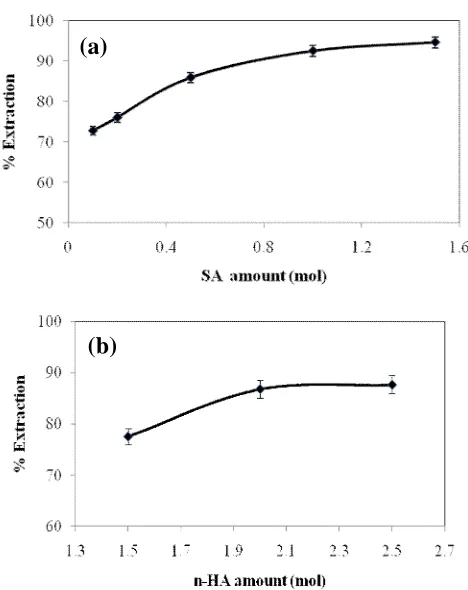
Fig. 2. Effect of amount of (a) SA and (b) n-HA amount on modification and extraction efficiency of morphine.
Also, 20 min was selected as optimum time for this reaction. Functionalization of ESM-GA with different amounts of amines in the range of 1.5-2.5 mmol was also
(a)
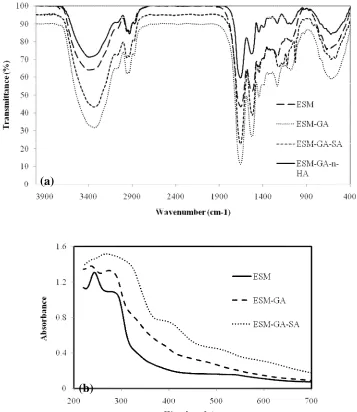
checked and results showed (Fig. 2) that at least 1.5 mmol of amine was enough for quantitative extraction of morphine. In lower amounts of amines, all of the sites on surface of ESM was not functionalized which result in low extraction efficiency and in higher amounts of amine extraction efficiency remained constant. Also, the optimum time of reaction with amines was 2 h. Figures 3a and 3b represent the infrared spectra and UV-Vis diffuse reflectance spectra of the raw ESM, GA modified ESM and
SA and n-HA modified ESMs, respectively. Because of the complex structure of ESM, it was very hard to characterize the modified ESMs. The absorbance bands in 1034 cm-1 (Fig. 3a) and 256 and 400 nm (Fig. 3b) can be attributed to presence of SA molecules in SA modified ESM.
Optimization of SPE Procedure
The effect of important parameters such as pH of sample solution, amount of sorbent and analyte, type and volume of
Fig. 3. (a) The infrared spectra of the raw ESM, GA modified, SA modified and n-HA modified ESMs. (b) The UV-Vis diffuse reflectance spectra of the raw ESM, GA modified and SA modified ESMs.
(b)
(a)
desorption solvent and time of adsorption and desorption steps were optimized. pH is one of the important factors affecting the adsorption behavior in SPE format, because it determines the charge density of adsorbent and the present state of analyte in solution as charged or uncharged states. The effect of pH on the extraction efficiency of analyte over the range of 2.0-9.0 was investigated using SA modified ESM as model. As can be found in Fig. 4, the retention of analyte on modified ESM was high when solution pH was more than 7.0. The effect of solution pH can be explained by considering the surface charge of the ESM and the degree of ionization of the sorbent. Wang et al. [18] reported that the isoelectric point (IEP) of ESM is about 5.6 ± 0.2. When the pH level was below its IEP, the morphine recoveries are low. This can be attributed to the fact that the surface of ESM was positively charged when the pH level
was below its IEP and the morphine molecules were easily excluded from the surface of ESM, suggesting that the electrostatic interactions between negatively charged sulfonic groups and positively charged morphine do not have a significant role in morphine retention on ESM. With increases the pH value above IEP of ESM, the morphine adsorption onto ESM increased. This phenomenon further confirms the hydrophobic interaction mechanism between morphine and ESM, because the ESM surface becomes neutral when pH value is equal to its IEP. Finally, in the present study the optimum pH was 8.0.
Weight of sorbents is another important factor in SPE and when there is not appropriate amount of sorbent in access of analytes, they could not be loaded successfully on the surface. The results of standard solution of morphine extracted with 100-400 mg of sorbent (Fig. 5) show that
Fig. 4. Effect of pH on extraction efficiency of morphine with CM-ESM.
300 mg l-1 of sorbent is proper for quantitative extraction of morphine. Sorbent amounts less than 300 mg are not enough for complete extraction and higher amounts make the separation of sorbent and desorbing solvent difficult. Also, the solution volume and amount of analyte in samples were evaluated and the optimum values were 500 µl of 2.5 mg l-1 of morphine.
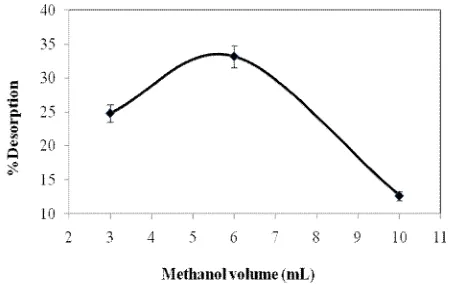
Organic solvents are known to have great effect on desorption of analytes retained on the SPE cartridge. With regard to morphine, great efforts have been made to choose the optimal type and volume of eluents for obtaining quantitative elution of the analyte. In the present study, different kinds of organic solvents (acetonitrile, methanol, ammonia, etc.) were used to desorb the analytes from ESM (Table 1). Unfortunately, the desorption amount was low in the all the cases which can be attributed to morphine destruction by sorbent and irreversible adsorption of analyte. The experimental results indicated that using n-HA modified ESM, desorption ability of methanol was better than that of other solvents and finally n-HA modified ESM and methanol were chosen as the best sorbent and eluent for further investigation, respectively. Then, the volume of eluent was studied over range of 3-10 ml of methanol to get a higher enrichment factor. As can be seen from Fig. 6,
Fig. 6. Effect of volume of methanol on extraction efficiency of morphine with CM-ESM.
desorption of morphine is increased up to a volume of 6 ml, and then decreased due to dilution effect. Finally, 6 ml methanol was selected as optimal eluent. Also, time of adsorption and desorption were optimized and 6 min was a good time for the both steps.
Performance of the Analytical Procedure
Using optimum conditions of extraction, the calibration plot for morphine obtained using standard solution of it in
Table 2. Analytical Performance Parameter for the Morphine Extracted by ESM
Amount Parameter
35.2590 Slope
1.886 Intercept
0.9996 R2
0.5-10 Linear range (mg l-1)
0.095 Detection limit (mg l-1)
4.50 RSD (%)
101.6 Recovery (%)
Table 3. Results of Morphine Analysis in Saliva Using CM-ESM as SPE Sorbent
Morphine content (mg l-1) Calculated concentration (mg l-1)
RSD (%)
3.000 3.040
range of concentration between 0.5-10 mg l-1. The calibration plot shows excellent linearity with the correlation coefficients (R2) equal to 0.9990. Under optimum conditions, the obtained results (Table 2) showed that, precisions (expressed as relative standard deviation, %RSD) are less than 4.50%, indicating relatively high precision of the proposed method for determination of the morphine. The average recovery (101.6%) is good and detection limits of 0.095 mg l-1 (calculated based on 3σ criterion using Sy/x instead of σ and intercept instead of
blank signal [27]) are well below those required for the analysis of the morphine in biological samples [28-31]. Complete analytical performance parameters are presented in Table 2.
Application of Sorbents to the Analysis of Saliva Samples
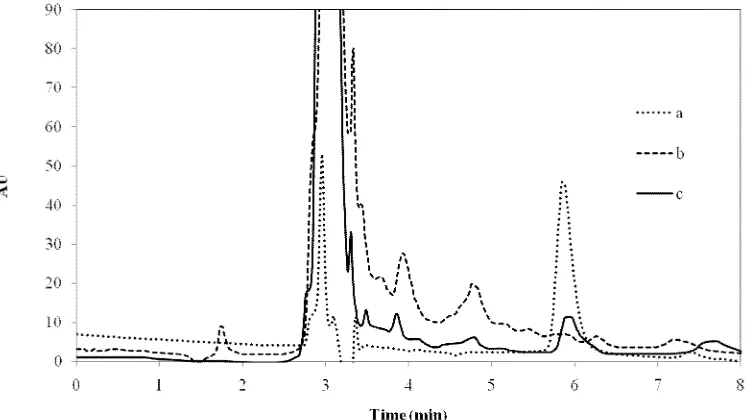
Firstly, a sample of saliva was extracted with n-HA modified ESM and the resulting chromatogram showed that saliva did not have potential interference for morphine peak (Fig. 7). Then, a sample of saliva containing 3 mg l-1 of
morphine were extracted and injected to HPLC. Figure 7 shows the chromatogram of morphine extracted from saliva sample. According to Table 3, it was clearly observed that ESM exhibited good extraction recoveries for morphine in real sample.
CONCLUSIONS
ESM, a bio-compatible material that could be acquired easily from by-product of food industry, was evaluated for the extraction of morphine from biological samples. The experimental results demonstrate that the chemically modified ESM adsorbent can be used for extracting morphine from saliva samples with low LOD, wide linear range, good recoveries and precision under the optimal SPE conditions.
ACKNOWLEDGMENTS
Financial support for this work by University of Isfahan is gratefully acknowledged. The authors have declared no
Fig. 7. Chromatograms of (a) standard morphine solution, (b) extracted blank saliva sample and (c) spiked saliva sample. Conditions: Column, Spherisorb CN column (5 μ, 250 × 4.6 mm); mobile phase, water:
conflict of interests.
REFERENCES
[1] F. Shamsa, H. Monsef, R. Ghamooshi, M. Verdian-rizi, Thai J. Pharm. Sci. 32 (2008) 17.
[2] T.L. Yaksh, M.S. Wallace, in: L. Brunton, B. Chabner, B. Knollman (Eds.), Goodman and Gilman's The Pharmacological Basis of Therapeutics, Mcgraw-hill, 2010.
[3] H.J. McQuay, D. Carroll, C.C. Faura, D.J. Gavaghan, C.W. Hand, R.A. Moore, Clin Pharmacol. Ther. 48 (1990) 236.
[4] P.I. Thompson, S.P. Joel, L. John, J.A. Wedzicha, M. Maclean, M.L. Slevin, Br J. Clin. Pharmacol. 40 (1995) 145.
[5] K.J. Fountain, Z. Yin, D.M. Diehl, J. Sep. Sci. 32 (2009) 2319.
[6] R. Dams, T. Benijts, W.E. Lambert, A.P. De Leenheer, J. Chromatogr. B Analyt Technol. Biomed. Life Sci. 773 (2002) 53.
[7] J. Bones, K. Thomas, P.N. Nesterenko, B. Paull, Talanta 70 (2006) 1117.
[8] A.I. Bouquillon, D. Freeman, D.E. Moulin, J. Chromatogr. 577 (1992) 354.
[9] F. Augusto, L.W. Hantao, N.G.S. Mogollón, S.C.G.N. Braga, Trends Anal. Chem. 43 (2013) 14.
[10] S. Rodriguez-Mozaz, M.J. Lopez de Alda, D. Barcelo, J. Chromatogr. A 1152 (2007) 97.
[11] F. Rezaei, Y. Yamini, M. Moradi, B. Ebrahimpour, Talanta 105 (2013) 173.
[12] Y. Cai, G. Jiang, J. Liu, Q. Zhou, Anal. Chem. 75 (2003) 2517.
[13] A. Rajabi, Y. Yamini, M. Faraji, S. Seidi, Med. Chem. Res. 22 (2013) 1570.
[14] H. Ebrahimzadeh, K. Molaei, A.A. Asgharinezhad, N. Shekari, Z. Dehghani, Anal. Chim. Acta 767 (2013) 155.
[15] H. Ebrahimzadeh, Z. Dehghani, A.A. Asgharinezhad, N. Shekari, K. Molaei, Int. J. Pharm. 453 (2013) 601. [16] V.N. Alves, R. Mosquetta, N.M. Coelho, J.N.
Bianchin, K.C. Di Pietro Roux, E. Martendal, E. Carasek, Talanta 80 (2010) 1133.
[17] J.W.W. Liong, J.F. Frank, S. Bailey, J. Food Prot. 60 (1997) 1022.
[18] W. Wang, B. Chen, Y. Huang, J. Cao, J. Chromatogr. A 1217 (2010) 5659.
[19] Y. Zhang, W. Wang, L. Li, Y. Huang, J. Cao, Talanta 80 (2010) 1907.
[20] A.-M. Zou, X.-W. Chen, M.-L. Chen, J.-H. Wang, J. Anal. At. Spectrom. 23 (2008) 412.
[21] T. Yang, M.-L. Chen, X.-W. Hu, Z.-W. Wang, J.-H. Wang, P.K. Dasgupta, Analyst 136 (2011) 83.
[22] J. Tang, J. Li, J. Kang, L. Zhong, Y. Zhang, Sens Actuators, B 140 (2009) 200.
[23] B. Wu, G. Zhang, S. Shuang, M.M.F. Choi, Talanta 64 (2004) 546.
[24] G. Wen, Y. Zhang, Y. Zhou, S. Shuang, C. Dong, M.M.F. Choi, Anal. Lett. 38 (2005) 1519.
[25] Z.R. Chen, F. Bochner, A. Somogyi, J. Chromatogr. B: Biomed. Sci. Appl. 491 (1989) 367.
[26] N. Chauhan, T. Dahiya, Priyanka, C.S. Pundir, J. Mol. Catal. B: Enzym. 67 (2010) 66.
[27] J.N. Miller, J.C. Miller, Statistics and Chemometrics for Analytical Chemistry, Prentice Hall/Pearson, 2010.
[28] D. Szkutnik-Fiedler, E. Grześkowiak, M. Gaca, M. Borowicz, Acta Pol. Pharm. 68 (2010) 473.
[29] T. Nema, E. Chan, P. Ho, J. Mass Spectrom. 46 (2011) 891.
[30] K. Javidnia, R. Miri, D. Miri, Iran. J. Med. Sci. 31 (2006) 213.