Volume 67, 2019, Pages 63–72
Proceedings of the 7th OpenSky Workshop 2019
Integrating pyModeS and OpenSky Historical Database
Junzi Sun and Jacco M. Hoekstra
CNS/ATM, Control and Simulation Research Group Aerospace Engineering Faculty
Delft University of Technology, the Netherlands Abstract
A large quantity of Mode S data is being gathered by the OpenSky receiver network every day. Information regarding common flight states, such as position, ground speed, and the vertical rate is broadcast by ADS-B and has already been decoded and made available for researchers via the OpenSky historical database. However, there is still a large amount of Mode S communication data that has not yet been fully explored. Specifically, the information contained in Enhanced Mode S Surveillance downlink messages can be utilized to better support ATM research. The challenge of decoding such information lies in the implicit inference process for Mode S Comm-B messages. This paper presents a new open library, pymodes-opensky, which connects the existing open-source pyModeS decoder to the raw Mode S messages from the OpenSky historical database through the Impala shell. It also presents a convenient workflow that can be used to obtain additional information regarding airspeeds, flight intentions, and meteorological conditions of a given flight from the OpenSky database. An analysis based on a global dataset from OpenSky is conducted, and the associated Mode S interrogation statistics in different regions are shown.
1
Introduction
Aircraft surveillance in the early days relied on primary radar, which can only determine the slant distance and azimuth angle of aircraft. Commonly, civil primary radars are not designed to provide the elevation angle of the object. Hence, air traffic controllers had to rely on other methods to determine the altitude (and identity) of aircraft. The secondary surveillance radar was thus developed to acquire additional information from aircraft. The early version of aircraft transponders complied with Mode A and Mode C communication protocols. These protocols allow the identity and the pressure altitude of an aircraft to be downlinked through transponder interrogations. Later on, the Mode S selective interrogation protocol was developed to enable more types of information to be transmitted upon request of secondary surveillance radar.
Information broadcast by ADS-B can be easily received and decoded with a simple ground receiver setup. Several crowd-source receiver networks exist providing aggregated flight in-formation with extended coverage. In Europe, two of these networks are FlightRadar24 and OpenSky. While FlightRadar24 is focused on commercial service, OpenSky [8] is a research-oriented network, which provides easy access to historical flight data for ATM researchers and other players in the aviation industry.
Many studies have explored the decoded ADS-B data from the OpenSky network. There is also an existing tool, traffic, that enables easy access to the derived ADS-B data [7]. Still, a large amount of recorded raw Mode S data has not been efficiently utilized. Unlike ADS-B, where all messages contain identifiers regarding the message types, messages related to Mode S service do not always contain such information. Thus, decoding becomes a challenging task for third-party observers.
The inference of Mode S messages types has been investigated by our recent study [11], which produced an open-source library (pyModeS1) that makes the decoding of these messages
convenient for third-party observers. In addition to decoding ADS-B messages, pyModeS can identify and decode many common categories of Mode S messages. The ability to obtain more valuable data from Mode S communications allows several of our studies to be conducted with higher accuracy [9, 10]. These capabilities make pyModeSa good candidate to decode a large number of raw Mode S messages in the OpenSky historical database. Once information contained in Mode S signals has been extracted, the aircraft airspeeds, target altitudes, and meteorological condition information can serve as a valuable addition to open ADS-B data when conducting ATM studies.
This paper focuses on a practical approach for researchers to combinepyModeSlibrary and OpenSky raw Mode S data, which can, in turn, provide more flight state information for ATM studies. An open-source library, pymodes-opensky,2 is made public along with this paper, which is primarily focused on extracting information from EHS messages, including selected vertical intention reports, track and turn reports, and heading and speed reports. It also provides the possibility to extract weather information from meteorological routine air reports and meteorological hazard reports whenever they are available. With a lower-level interface, the library can also be used to query both ADS-B and Mode S raw messages directly from OpenSky historical database through the Impala shell.
2
Mode S information and inference
The original design of aircraft transponders supports two primary modes for surveillance (Mode A and Mode C). These two protocols allow aircraft to report their identities (squawk codes) and barometric altitudes to air traffic controllers upon the interrogation of secondary surveillance radar (SSR). The information contained in these communications is very limited, and there are significant drawbacks when applying them in high-density air traffic situations.
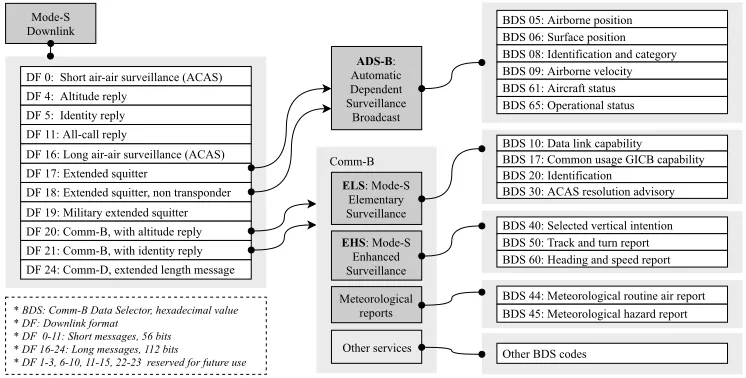
Compared to Mode A/C, Mode S is a newer system that was designed in the 1980s [1] to enable SSR to selectively interrogate more information from aircraft. Mode S provides different types of information distinguished by the uplink (or downlink) format code. Currently, 11 out of 24 Downlink Formats (DF) are defined and implemented. Among these 11 DF codes, DF 17 (civil), 18 (civil) and 19 (military) are defined as Mode S extended squitter, and the correspond-ing messages are broadcast automatically without the need for SSR interrogation. For example,
the well known Automatic Dependent Surveillance-Broadcast (ADS-B) is an application that builds upon the Mode S extended squitter.
Besides ADS-B, two main surveillance services are formed using messages of DF 20 and 21, by groups of different message types that are known as Comm-B Data Selector (BDS) codes. These services are Mode S Elementary Surveillance (ELS) and Mode S Enhanced Surveillance (EHS) [3]. They allow different groups of aircraft information to be selectively interrogated. ELS is designed for air traffic controllers to obtain basic information such as callsigns and com-munication capabilities of aircraft, while EHS provides air traffic controllers more information on aircraft flight states such as intent, airspeeds, and turn performance.
Based on the ICAO Annex 10 [4], Figure1 summarizes these different concepts of Mode S downlink communication, as well as their relationships among the definitions of different types of messages. Apart from the aforementioned ADS-B, ELS and EHS services, additional Mode S messages, reporting meteorological information are also shown in Figure1and will be discussed briefly in this paper.
ADS-B: Automatic Dependent Surveillance
Broadcast Mode-S
Downlink
DF 17: Extended squitter
DF 0: Short air-air surveillance (ACAS) DF 4: Altitude reply
DF 5: Identity reply DF 11: All-call reply
DF 16: Long air-air surveillance (ACAS) DF 18: Extended squitter, non transponder DF 19: Military extended squitter DF 20: Comm-B, with altitude reply DF 21: Comm-B, with identity reply DF 24: Comm-D, extended length message
BDS 05: Airborne position BDS 06: Surface position BDS 08: Identification and category BDS 09: Airborne velocity BDS 61: Aircraft status BDS 65: Operational status BDS 10: Data link capability BDS 17: Common usage GICB capability BDS 20: Identification
BDS 30: ACAS resolution advisory BDS 40: Selected vertical intention BDS 50: Track and turn report BDS 60: Heading and speed report
ELS: Mode-S Elementary Surveillance
EHS: Mode-S Enhanced Surveillance
Other services Other BDS codes Comm-B
* BDS: Comm-B Data Selector, hexadecimal value * DF: Downlink format
* DF 0-11: Short messages, 56 bits * DF 16-24: Long messages, 112 bits
* DF 1-3, 6-10, 11-15, 22-23 reserved for future use
BDS 44: Meteorological routine air report BDS 45: Meteorological hazard report Meteorological
reports
Figure 1: Relationship between Mode S services and downlink data
All known Mode S message structures are defined by the communication protocols in ICAO standards [5,6]. Once the message type can be identified, the corresponding information can be easily decoded. For the ADS-B message, a Type Code is included in each message. Each Type Code corresponds to a unique BDS code, which can be further used to identify the structure of the message for decoding. For Comm-B communications, the message types are not explicitly indicated in the message. Since each downlink message corresponds to a specific uplink request with a specific BDS code, the air traffic controllers always know the expected structure and the format of a downlink message. However, as a third party observer, this poses a major challenge for decoding and making use of the information included in Comm-B messages.
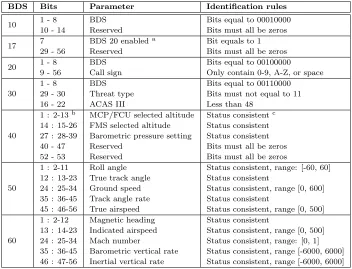
One key capability ofpyModeSis the ability to infer common types of Comm-B messages. For instance, all the BDS codes from Figure1can be inferred usingpyModeS. It uses a combination of heuristic and probabilistic methods to infer the possible BDS codes of a message. As a summary, Table 1 shows the heuristic logic that is designed as the primary BDS inference method.
Table 1: BDS code identification rules
BDS Bits Parameter Identification rules
10 1 - 8 BDS Bits equal to 00010000
10 - 14 Reserved Bits must all be zeros
17 7 BDS 20 enabled
a Bit equals to 1
29 - 56 Reserved Bits must all be zeros
20 1 - 8 BDS Bits equal to 00100000
9 - 56 Call sign Only contain 0-9, A-Z, or space
30
1 - 8 BDS Bits equal to 00110000
29 - 30 Threat type Bits must not equal to 11
16 - 22 ACAS III Less than 48
40
1 : 2-13b MCP/FCU selected altitude Status consistentc
14 : 15-26 FMS selected altitude Status consistent 27 : 28-39 Barometric pressure setting Status consistent 40 - 47 Reserved Bits must all be zeros 52 - 53 Reserved Bits must all be zeros
50
1 : 2-11 Roll angle Status consistent, range: [-60, 60] 12 : 13-23 True track angle Status consistent
24 : 25-34 Ground speed Status consistent, range [0, 600] 35 : 36-45 Track angle rate Status consistent
45 : 46-56 True airspeed Status consistent, range [0, 500]
60
1 : 2-12 Magnetic heading Status consistent
13 : 14-23 Indicated airspeed Status consistent, range [0, 500] 24 : 25-34 Mach number Status consistent, range: [0, 1] 35 : 36-45 Barometric vertical rate Status consistent, range [-6000, 6000] 46 : 47-56 Inertial vertical rate Status consistent, range [-6000, 6000]
aBDS 20 is the code that has to be enabled for all transponders to provide the minimum
Mode S capabilities.
bThis format b1:b2-b3 indicates the status bit at b1 with value bits from b2 to b3. cConsistency indicates that when a status bit is zero, all value bits must also be zeros.
be identified with both BDS 50 and 60. The probabilistic method in pyModeS allows further examination of this type of message by taking into consideration the ground speed information from ADS-B and wind (if known). The details of this inference step can be found in [11].
3
Working with OpenSky Mode S data
The OpenSky historical database collects different types of Mode S messages through its network of receivers. Among these, ADS-B messages are decoded, and only the decoded data is stored. The majority of the remaining messages, including DF 4/5 and DF 20/21 messages, are stored with the raw format. Together with the raw messages, only corresponding altitude or identity codes are decoded. Other information included in DF 20/21 messages is not directly available in this database.
Given any raw message, the ICAO address can be found with a recovery process involving the parity data [2]. It is also possible to make use of the potential ICAO address, BDS code, and parity bits to validate the correctness of the messages [11]. In the OpenSky, the ICAO address has already been computed and stored along with the raw data.3 Having the corresponding
3In some cases, the stored raw messages are modified, and the parity is replaced by computed ICAO address.
Table 2: Parameter decoded automatically bypymodes-openskylibrary
(a) EHS parameters
BDS Parameters variable
40
MCP/FCU selected altitude FMS selected altitude Barometric pressure setting
selalt40mcp selalt40fms p40baro
50
Roll angle True track angle Ground speed Track angle rate True airspeed roll50 trk50 rtrk50 gs50 tas50 60 Magnetic heading Indicated airspeed Mach number
Barometric altitude rate Inertial vertical velocity
hdg60 ias60 mach60 vr60baro vr60ins
(b) Meteorological parameters
BDS Parameters variable
44
Wind speed Wind direction Static air temperature Average static pressure Turbulence Humidity wind44spd wind44dir temp44 p44 turb44 hum44 45 Turbulence Wind shear Microburst Icing Wake vortex
Static air temperature Average static pressure Radio height turb45 ws45 mb45 ic45 wv45 temp45 p45 rh45
ICAO addresses saved alongside the messages enables the fast extraction of flight information using thepymodes-openskylibrary.
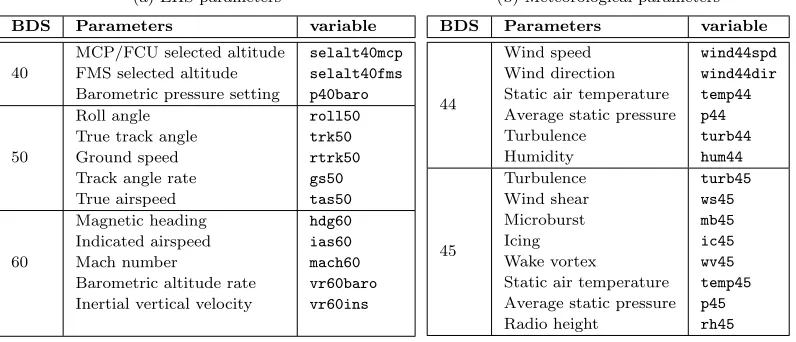
Among all raw messages, the most interesting part of the information for many ATM stud-ies are included in EHS messages, which contain the intent, turn rates, and various types of airspeeds. This type of information is also most desired by air traffic controllers. Hence, most commonly interrogated by the SSR in many regions. Meteorological reports are not often inter-rogated. However, whenever they are available, they can provide valuable information such as wind, air pressure, and air temperature. Both EHS and meteorological messages from OpenSky can be conveniently processed bypymodes-opensky. Table 2is a list of parameters from EHS and meteorological reports directly supported by thepymodes-openskylibrary.
The library provides a set of interfaces connecting the Mode S decoder with the OpenSky historical data. Specifically, it allows users to automatically extract and discover information contained in EHS and meteorological reports if they are available. The library has two levels of interfaces to the OpenSky historical database, both through the Impala shell. The lower level interface returns data directly (with some extra columns) from the database. The query supports the extraction of both decoded ADS-B information (decoded by OpenSky) and raw Mode S messages. The following example code shows how to establish a low-level query using pymodes-opensky. The ICAO address and the geographical boundaries can be passed as op-tional parameters to the query. By altering the query type fromadsb to raw, one can obtain raw Mode S messages instead of decoded ADS-B data from the database.
f r o m p y m o d e s _ o p e n s k y i m p o r t O p e n s k y I m p a l a W r a p p e r
o p e n s k y = O p e n s k y I m p a l a W r a p p e r ()
df = o p e n s k y . q u e r y (
Based on the previous low-level interface, the higher-level interfaces generate queries using the combination of time and ICAO filters. After raw messages from the historical database are obtained, they are decoded automatically using theEHSHelperandMeteoHelperbased on the query results of theOpenskyImpalaWrapper. All (or a subset) of the available parameters from the previous Table2are provided directly to the users. Multiple ICAO addresses can be used in the same query to increase efficiency. By default, all BDS 40, 50, and 60 parameters are decoded. However, the desired list of BDS codes can be specified. In the following example, the process of obtained flight states contained in EHS messages is shown:
f r o m p y m o d e s _ o p e n s k y i m p o r t E H S H e l p e r
ehs = E H S H e l p e r ()
# o p t i o n a l : c h a n g e f r o m d e f a u l t B D S 40 / 50 / 60 ehs . r e q u i r e _ b d s ([" B D S 5 0 ", " B D S 6 0 "])
df = ehs . get (
i c a o 2 4= [" 4 8 4 4 C 6 "],
s t a r t=" 2019 - 10 - 01 07 : 30 : 00 " # U T C t i m e end=" 2019 - 10 - 01 09 : 30 : 00 " # U T C t i m e )
Similarly, meteorological information can also be obtained and decoded using the meteo-rological interface. By default, only BDS 44 messages, the meteometeo-rological routine reports, are obtained. However, one can enable the decoding of BDS 45 messages, the meteorological hazard reports, by providing an optional parameter to the query. An example is shown as follows:
f r o m p y m o d e s _ o p e n s k y i m p o r t M e t e o H e l p e r
m e t e o = M e t e o H e l p e r () df = m e t e o . get (
s t a r t=" 2018 - 07 - 19 15 : 00 : 00 ", end=" 2018 - 07 - 19 15 : 10 : 00 ", i c a o 2 4= [" 4 9 d 3 0 4 ", " 4 0 0 7 f 9 "], i n c l u d e 4 5= True, # o p t i o n a l )
4
Experiment and results
4.1
Demonstration with a single flight
In this section, an example flight is used to demonstrate the decoding capabilities of the
pymodes-openskylibrary. Figure 2 shows the ground track that is constructed based on the
decoded ADS-B information from OpenSky historical database through the Impala shell. A flight (KL1793) from Amsterdam to Munich on October 1st, 2019 is selected. We choose this flight due to the good receiver coverage in the areas it flew over. Thus, the trajectory data through the entire flight can be obtained.
EHAM
EDDM
Figure 2: Ground track of the demonstration flight (KL1793, October 1st, 2019)
500
1000 1500 2000 2500 3000 3500 4000 4500
Time
0
5
10
15
20
25
30
Altitude (kft)
altitude
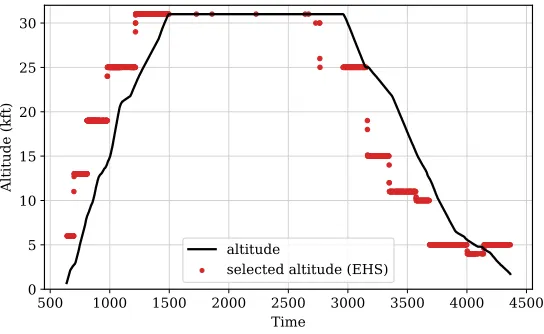
selected altitude (EHS)
Figure 3: The ground track of the demonstration flight
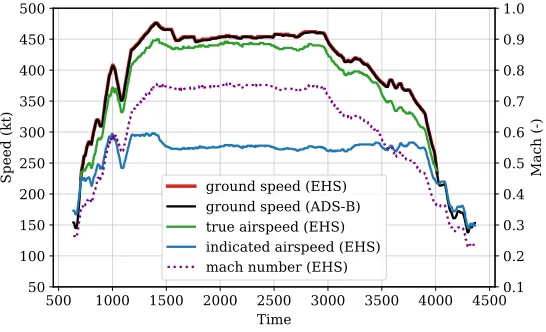
In Figure4, different types of speeds from EHS track and turn reports (BDS 50), as well as speed and heading reports (BDS 60), are plotted alongside the ground speed from the ADS-B reports. The data is filtered using the same median filter as mentioned earlier. The two ground speed profiles (in black and red) overlap with each other. All four types of speed in EHS (ground speed, true airspeed, indicated airspeed, and Mach number) can be accurately decoded using thepymodes-openskylibrary.
4.2
Comm-B statistics from a large-scale dataset
In this part of the experiment, we want to investigate the frequency of different Comm-B report types in different world regions using the raw Mode S data from the OpenSky historical database. The goal is to exploit the BDS inference capability of pyModeSto analyze the usage of ELS and EHS services at a larger scale.
500 1000 1500 2000 2500 3000 3500 4000 4500
Time
50
100
150
200
250
300
350
400
450
500
Speed (kt)
ground speed (EHS)
ground speed (ADS-B)
true airspeed (EHS)
indicated airspeed (EHS)
mach number (EHS)
0.1
0.2
0.3
0.4
0.5
0.6
0.7
0.8
0.9
1.0
Mach (-)
Figure 4: The ground track of the demonstration flight
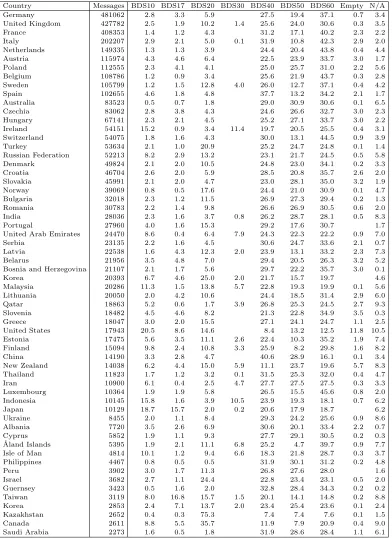
18:00 hours. Each group contains two minutes of decoded ADS-B and raw Mode S data from the entire OpenSky network. Then, the locations of the raw messages are combined with the position from the ADS-B data based on the ICAO addresses. After that, four snapshots are merged into a single dataset, where the BDS codes of all messages are inferred usingpyModeS. Finally, the statistics of the BDS distribution in different geographical regions are shown in Table 3. The message numbers only refer to the messages collected by OpenSky network. These values depend on the actual receiver coverage in different regions. For large countries with low coverage, the messages number can be much lower than smaller regions with full coverage.
In this table, only regions with more than 2000 messages are included, which filters out regions that do not actively initiate Mode S interrogations, do not have a sufficient number of flights, or do not have enough receiver coverage. Messages identified as Emptydo not contain any information (all zero bits) except the altitude or identity code. Messages identified asN/A either have multiple possible BDS codes after the inference or do not have many matching BDS codes from ELS or EHS. There exists a major difference across the continents. In Europe, the most common interrogated messages are EHS messages. However, in North America or Asia, the interrogations are different, in general, and more ELS messages are interrogated. Based on the percentages of messages with unknown types, it is likely that a greater number of other types of messages are being interrogated in these regions.
5
Conclusion
In this paper, we discussed an approach for exploring a large amount of undecoded information contained in the OpenSky historical database. Based on the existing open-source toolpyModeS, a new Python librarypymodes-opensky is developed to automatically retrieve data from the OpenSky using the Impala shell and to decode these raw Mode S messages.
Table 3: Global statistics of BDS interrogations (decimal numbers represent percentages)
Country Messages BDS10 BDS17 BDS20 BDS30 BDS40 BDS50 BDS60 Empty N/A
Germany 481062 2.8 3.3 5.9 27.5 19.4 37.1 0.7 3.4
United Kingdom 427782 2.5 1.9 10.2 1.4 25.6 24.0 30.6 0.3 3.5
France 408353 1.4 1.2 4.3 31.2 17.1 40.2 2.3 2.2
Italy 202207 2.9 2.1 5.0 0.1 31.9 10.8 42.3 2.9 2.0
Netherlands 149335 1.3 1.3 3.9 24.4 20.4 43.8 0.4 4.4
Austria 115974 4.3 4.6 6.4 22.5 23.9 33.7 3.0 1.7
Poland 112555 2.3 4.1 4.1 25.0 25.7 31.0 2.2 5.6
Belgium 108786 1.2 0.9 3.4 25.6 21.9 43.7 0.3 2.8
Sweden 105799 1.2 1.5 12.8 4.0 26.0 12.7 37.1 0.4 4.2
Spain 102655 4.6 1.8 4.8 37.7 13.2 34.2 2.1 1.7
Australia 83523 0.5 0.7 1.8 29.0 30.9 30.6 0.1 6.5
Czechia 83062 2.8 3.8 4.3 24.6 26.6 32.7 3.0 2.3
Hungary 67141 2.3 2.1 4.5 25.2 27.1 33.7 3.0 2.2
Ireland 54151 15.2 0.9 3.4 11.4 19.7 20.5 25.5 0.4 3.1
Switzerland 54075 1.8 1.6 4.3 30.0 13.1 44.5 0.9 3.9
Turkey 53634 2.1 1.0 20.9 25.2 24.7 24.8 0.1 1.4
Russian Federation 52213 8.2 2.9 13.2 23.1 21.7 24.5 0.5 5.8
Denmark 49824 2.1 2.0 10.5 24.8 23.0 34.1 0.2 3.3
Croatia 46704 2.6 2.0 5.9 28.5 20.8 35.7 2.6 2.0
Slovakia 45991 2.1 2.0 4.7 23.0 28.1 35.0 3.2 1.9
Norway 39069 0.8 0.5 17.6 24.4 21.0 30.9 0.1 4.7
Bulgaria 32018 2.3 1.2 11.5 26.9 27.3 29.4 0.2 1.3
Romania 30783 2.2 1.4 9.8 26.6 26.9 30.5 0.6 2.0
India 28036 2.3 1.6 3.7 0.8 26.2 28.7 28.1 0.5 8.3
Portugal 27960 4.0 1.6 15.3 29.2 17.6 30.7 1.7
United Arab Emirates 24470 8.6 0.4 6.4 7.9 24.3 22.3 22.2 0.9 7.0
Serbia 23135 2.2 1.6 4.5 30.6 24.7 33.6 2.1 0.7
Latvia 22538 1.6 4.3 12.3 2.0 23.9 13.1 33.2 2.3 7.3
Belarus 21956 3.5 4.8 7.0 29.4 20.5 26.3 3.2 5.2
Bosnia and Herzegovina 21107 2.1 1.7 5.6 29.7 22.2 35.7 3.0 0.1
Korea 20393 6.7 4.6 25.0 2.0 21.7 15.7 19.7 4.6
Malaysia 20286 11.3 1.5 13.8 5.7 22.8 19.3 19.9 0.1 5.6
Lithuania 20050 2.0 4.2 10.6 24.4 18.5 31.4 2.9 6.0
Qatar 18863 5.2 0.6 1.7 3.9 26.8 25.3 24.5 2.7 9.3
Slovenia 18482 4.5 4.6 8.2 21.3 22.8 34.9 3.5 0.3
Greece 18047 3.0 2.0 15.5 27.1 24.1 24.7 1.1 2.5
United States 17943 20.5 8.6 14.6 8.4 13.2 12.5 11.8 10.5
Estonia 17475 5.6 3.5 11.1 2.6 22.4 10.3 35.2 1.9 7.4
Finland 15094 9.8 2.4 10.8 3.3 25.9 8.2 29.8 1.6 8.2
China 14190 3.3 2.8 4.7 40.6 28.9 16.1 0.1 3.4
New Zealand 14038 6.2 4.4 15.0 5.9 11.1 23.7 19.6 5.7 8.3
Thailand 11823 1.7 1.2 3.2 0.1 31.5 25.3 32.0 0.4 4.7
Iran 10900 6.1 0.4 2.5 4.7 27.7 27.5 27.5 0.3 3.3
Luxembourg 10364 1.9 1.9 5.8 26.5 15.5 45.6 0.8 2.0
Indonesia 10145 15.8 1.6 3.9 10.5 23.9 19.3 18.1 0.7 6.2
Japan 10129 18.7 15.7 2.0 0.2 20.6 17.9 18.7 6.2
Ukraine 8455 2.0 1.1 8.4 29.3 24.2 25.6 0.9 8.6
Albania 7720 3.5 2.6 6.9 30.6 20.1 33.4 2.2 0.7
Cyprus 5852 1.9 1.1 9.3 27.7 29.1 30.5 0.2 0.3
˚
Aland Islands 5395 1.9 2.1 11.1 6.8 25.2 4.7 39.7 0.9 7.7
Isle of Man 4814 10.1 1.2 9.4 6.6 18.3 21.8 28.7 0.3 3.7
Philippines 4467 0.8 0.5 0.5 31.9 30.1 31.2 0.2 4.8
Peru 3902 3.0 1.7 11.3 26.8 27.6 28.0 1.6
Israel 3682 2.7 1.1 24.4 22.8 23.4 23.1 0.5 2.0
Guernsey 3423 0.5 1.6 2.0 32.8 28.4 34.3 0.2 0.2
Taiwan 3119 8.0 16.8 15.7 1.5 20.1 14.1 14.8 0.2 8.8
Korea 2853 2.4 7.1 13.7 2.0 23.4 25.4 23.6 0.1 2.4
Kazakhstan 2652 0.4 0.3 75.3 7.4 7.4 7.6 0.1 1.5
Canada 2611 8.8 5.5 35.7 11.9 7.9 20.9 0.4 9.0
indicated airspeed, Mach number, magnetic heading, roll angle, and turn rate. Meteorological information in Mode S can also be obtained using a similar interface, whenever these reports are available.
One of the primary limitations discovered during the study of this paper is the time needed to obtain query results through the Impala shell. It can take a long time to process large queries through the Impala shell interface. Thus, the ICAO address filter is mandatory in the higher-level interface, which acts as a measure to reduce the size of query results. This end user-orientated approach is also not efficient for the community as a whole, as the same raw data may need to be downloaded and decoded by different users. A potential future recommendation is to integratepyModeSon the receiver side so that Mode S messages can be decoded and transmitted to OpenSky directly.
Currently, one of the optimal use cases for thepymodes-openskylibrary is to obtain addi-tional information for specific trajectories, as shown in section4.1of this paper. Furthermore, in section 4.2, the inference capability of pyModeS library is verified with the experiment us-ing the global data set. A future improvement to these libraries will be focused on increasus-ing decoding speed and providing more customized interfaces for Mode S decoding.
References
[1] John L Baker, VA Orlando, WB Link, and WG Collins. Mode s system design and architecture. Proceedings of the IEEE, 77(11):1684–1694, 1989.
[2] Jeffrey L Gertz. Fundamentals of mode s parity coding. Technical report, Massachusetts Institute of Technology, Lincoln Laboratory, 1984.
[3] Robert D Grappel, Garrett S Harris, Mark J Kozar, and Randall T Wiken. Elementary surveillance (els) and enhanced surveillance (ehs) validation via mode s secondary radar surveillance. Project Report ATC-337, Lincoln Lab., MIT, 2008.
[4] ICAO. Annex 10 to the Convention on International Civil Aviation, Aeronautical Telecommuni-cations. International Civil Aviation Organization, 2002.
[5] ICAO. Technical Provisions for Mode S Services and Extended Squitter. International Civil Avi-ation OrganizAvi-ation, 2008.
[6] ICAO.Technical Provisions for Mode S Services and Extended Squitter, 2nd Edition. International Civil Aviation Organization, 2012.
[7] Xavier Olive. traffic, a toolbox for processing and analysing air traffic data. Journal of Open Source Software, 4(39):1518, 7 2019.
[8] Matthias Sch¨afer, Martin Strohmeier, Vincent Lenders, Ivan Martinovic, and Matthias Wilhelm. Bringing up opensky: A large-scale ads-b sensor network for research. InProceedings of the 13th international symposium on Information processing in sensor networks, pages 83–94. IEEE Press, 2014.
[9] Junzi Sun, Henk AP Blom, Joost Ellerbroek, and Jacco M Hoekstra. Particle filter for aircraft mass estimation and uncertainty modeling. Transportation Research Part C: Emerging Technologies, 105:145–162, 2019.
[10] Junzi Sun, Jacco M Hoekstra, and Joost Ellerbroek. Aircraft drag polar estimation based on a stochastic hierarchical model. In8th International Conference on Research in Air Transportation, 2018.