Iranian Rehabilitation Journal, Vol. 13, Issue 4, Winter 2015
Original Article
The Effectiveness of Verbal Self-Instruction Training on Math
Problem-Solving of Intellectually Disabled Students
Masoume Pourmohamadreza-Tajrishi Pediatric Neurorehabilitation Research Center
University of Social Welfare and Rehabilitation Sciences, Tehran, Iran Mohammad Ashori; Seyede Somaye Jalil-Abkenar*
University of Tehran, Tehran, Iran
Objectives: Self-instruction training assists students to organize thinking patterns, learning, assessment, and awareness. This study was aimed to determine the effectiveness of verbal self-instruction training on math problem-solving of intellectually disabled male students in Tehran Provinces.
Methods: This study was an experimental research with pre-test and post-test design with control group. 30 intellectually disabled male students were selected randomly through cluster sampling method from 9th grade students. They were assigned to experimental and control group equally. Experimental group participated in 8 sessions and were trained by verbal self-instruction program but control group did not. All students answered to a teacher-made math problem-solving test before and after the training sessions. Data were analyzed by analysis of covariance.
Results: Findings showed that there was a significant difference between two groups according to math problem-solving performance (p<0.002).
Discussion: As the performance of math problem-solving of experimental group promoted after the intervention sessions in comparison to control group, it seems that verbal self-instruction has led students to use thinking skills for acquiring and retention of fundamental mathematics facts. It can conclude that verbal self-instruction training probably leads to promote math problem-solving performance of intellectually disabled boy students.
Key words: Boy Students, Intellectually Disabled, Math Problem-solving, Verbal Self-Instruction
Submitted :16 September 2015 Accepted: 6 November 2015
Introduction
Intellectual disability refers to people who have significant limitations in intellectual functions and adaptive behavior and their problems begin before 18 years old (1). Its prevalence is 2 or 3 percent in a community. In most communities, they have been trained as same as normal children, but they are not able to learn successfully. Their failure might relate to their special characteristics (such as attention, memory, and language problems), also teaching methods (2). One of the most important factors for promoting the education of a country is paying attention to students with intellectual disability (3). As these children have retardation in comparison with normal children, they cannot take advantage of mainstream training (4). Math problem-solving is a skill which is more relating to memory and thinking. Processes such as observation, measurement,
analysis, inference, and comparison help us to perceive information and models precisely. Problem solving requires analysis of problem, evaluation of program before its implementation, and evaluation of its consequences. These issues are not only limited to thinking and knowledge organization, but also include arrangement, planning, revising and evaluating of the consequences (5).
self-concept, and depression, this might be lead to absence and escape from school. Therefore, planning appropriate teaching methods is essential and important for improving scholastic skills in students with intellectual disability.
In recent years, training with the purpose of enhancement and encouragement of self-instruction skills has been emphasized (7). Self-instruction training assists students to organize thinking patterns, learning, assessment, and awareness (8). The main purpose of verbal self-instruction is that learners are converting to independent individuals in order to supervise and modify their cognitive and learning processes toward specific objectives (9). Self-instruction has been used in a wide range of academic skills. Some evidence show that the programs based on self-instruction are effective on improving learning of students with intellectual disability (10). Such programs have been used for a wide range of areas, including academic skills (i.e., reading and math), behaviors relating to classroom (i.e., selective attention relating to a task), emotional skills (i.e., causal attribution) and social skills (11). Self-instruction focuses on a set of self-guiding instructions about how to do a task, besides of emphasizing on helping students revising and coordinating their activities.
Self-instruction is a set of modeling and exercises which involve these steps: 1) cognitive modeling; 2) overt external guidance; 3) overt self-guidance; 4) decreasing self-guidance; 5) latent self-instruction (12). Comprehensive studies have done on verbal self-instruction at different ages and various areas. Osborn is paying attention to the studies which done about the effectiveness of learning strategies and stated that it is possible to teach various strategies to the students. It is helpful for them to act consciously when they are learning or thinking, so they are able to use profitable strategies when facing with different learning tasks and academic problems (13). Many studies have confirmed the effectiveness of verbal self-instruction on the performance of students with learning disabilities. The findings showed that learning how to use these strategies is important for learning. Such strategies facilitate the acquirement of knowledge, skills, and knowledge organization (14). Some research showed the positive effect of self-instruction training on the performance of students with learning disabilities. For example; Brayant (15), Teong (16), Wiltz (17), Slavin (18) have confirmed the positive effects of
self-instruction on enhancement of math problem-solving and learning motivation of students with learning disabilities. Montague studied the efficacy of self-instruction on math problem-solving performance in students with dyscalculia. The finding showed that the students who were trained by self-instruction, perform better in math in comparison to peers (19). Dehghani studied the effectiveness of meta-cognitive strategies training on math problem-solving of students with dyscalculia in primary school in Isfahan. Findings showed that instruction of meta-cognitive strategies has positive effect on problem-solving of student with dyscalculia (20).
Paying attention to researches which have investigated the effect of self-instruction training on students with learning disabilities, we perceive that such training is effective positively on problem-solving in students with dyscalculia. Asintellectually disabled students have delay in mental development and they are 3 or 4 years behind of normal peers to get abstract thinking, their motivational problems relating to their success and failure in academic performance, the present study tries to answer whether verbal self-instruction training is effective on math problem-solving of students with intellectual disability or not.
Methods
Wechsler Intelligence Test for Children-Revised form (WISC-R) and Math Problem-Solving Test (Teacher-Made) were used in this study. The WISC-R is composed of 12 subscales and provides three intelligence quotient (IQ) scores: verbal, nonverbal and total IQ. To assess verbal IQ, the scores of subscales: information, similarities, arithmetic, vocabulary, comprehension, and digit span were summed up. For assessing nonverbal IQ, the scores of subscales: performance, picture completion, picture arrangement, block design, object assembly, coding, and mazes were calculated. Total IQ was calculated by the summation of verbal and nonverbal IQs. The reliability and validity of WISC-R was measured and reported 0.73 for its reliability and correlation quotients for verbal, nonverbal and total IQs were 0.84, 0.74, and 0.85 respectively (21). The Math Problem-Solving Test (Teacher-Made) is established based on math problems of 9th grade special for students with intellectual disability. This test is composed of 2 parallel forms (A and B) which were made by department of mathematics with collaboration of expert teachers in 2012-2013 school
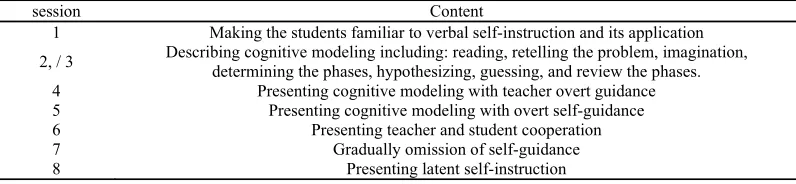
years. Criterion-related tests and the views of three math teachers were used to test its content validity. The teachers evaluated each question in three categories: useful, useless, necessary. According to teachers’ evaluation about each question, it was eliminated or confirmed (if two teachers evaluate a question as useless, the question was deleted). Validity coefficients for the forms A and B were 0.94 and 0.91 respectively. Agreement between experts was used to determine the reliability. Three evaluators considered independently the subjects’ responses. The correlation between the scores of three evaluators was considered as reliability index. The reliability coefficient of forms A, and B was 0.87, 0.93 in respect (22). In present study, the Verbal Self-Instruction Package which has proposed by Harris and Graham was used. The package was used by Bashavard for students with intellectual disability in Iran for the first time. Its validity and reliability was reported 0.89 and 0.82 respectively (23). The package was administered in 8 sessions and the content of each sessions are presented in table (1).
Table 1. The content of intervention sessions separately
session Content
1 Making the students familiar to verbal self-instruction and its application
2, / 3 Describing cognitive modeling including: reading, retelling the problem, imagination, determining the phases, hypothesizing, guessing, and review the phases.
4 Presenting cognitive modeling with teacher overt guidance
5 Presenting cognitive modeling with overt self-guidance
6 Presenting teacher and student cooperation
7 Gradually omission of self-guidance
8 Presenting latent self-instruction
Results
Descriptive indices of math problem-solving performance in experimental and control groups were shown in table (2). There was no significant difference between experimental and control group
in math problem-solving in pretest. According to table (2), the mean of math problem-solving of experimental group increased in comparison to control group in post-test.
Table 2. Mean and standard deviation of math problem-solving performance of two groups in pretest and post-test
Groups Situation Mean Standard deviation
pre-test 3.6 1.02
Experimental
post-test 17.5 0.87
pre-test 3.7 1.36
Control
post-test 4.1 1.23
Analysis of covariance (ANCOVA) was used to measure the effect of verbal self-instruction on math problem-solving performance of experimental and control group. It is required to test the assumptions of ANCOVA. The normality of variables and the
Table 3. Results of ANCOVA for comparing math problem-solving of two groups
Sourceof change SS df MS F p η2
Pre-test 0.581 1 0.581 0.487 <0.607 0.07
Group 163.655 1 163.655 62.938 <0.002 0.69
Error 43.384 27 1.606
Total 1023.044 30
As indicated in table (3), there was a significant difference (p<0.002) between experimental and control groups according to math problem-solving performance. Considering η2,, we can conclude that 69% of variation of math problem-solving can be explained by participating in verbal self-instruction training sessions.
Discussion
The present study was aimed to determine the effectiveness of verbal self-instruction on math
problem-solving of 9th grade students with
intellectual disability in Tehran Provinces. The results of ANCOVA showed that there was a significant difference between the mean of math problem-solving in experimental and control group. We can conclude that verbal self-instruction had a positive effect on improvement of math problem-solving performance in boy students with intellectual disability. The present results are consistent with some studies (i.e., (6,9,10,20,23,24). These studies showed that verbal self-instruction training is effective on improvement of academic performance in different students. One explanation for this result might be that in verbal self-instruction sessions, the teacher is a model for students to think with loud voice. Gradually the students learn how to use the model, and they are able to control their own thoughts without the supervision of a teacher. As far as, the process of teaching for students with intellectual disability requires continuous repeating, it is preferred to select the issues which are emphasizing on memory. Such instructions which are considering this aspect of education will be effective on enhancing learning skills of these students. Verbal self-instruction training is considered as a program that is able to promote the problems of the students especially their memory (25). This study limits to small sample size, boy
students and Tehran Provinces. These limitations make it difficult to generalize the findings on general population, girl students and other places except Tehran. It is recommended to investigate the effectiveness of verbal self-instruction on different student with special needs and compare these results simultaneously.
Conclusion
Considering that the performance of math problem-solving of experimental group promoted after the intervention sessions in comparison to control group, it seems that verbal self-instruction has led students to use thinking skills for acquiring and retention of fundamental mathematics facts. Therefore, it is required to teach such learning strategies to the students directly. The students who have learned these strategies are able to show high performance in math problem-solving tests (26). In sum, the present findings show the important role of these strategies on learning. To train these learning strategies will cause significant promotion in knowledge of students with intellectual disability to some extent that they will be able to control and apply these strategies while solving math problems. As a consequence, if parents, teachers, counselors and other experts will be informed about the effectiveness of verbal self-instruction, it could be expected that the academic performance of students with intellectual disability will improve.
Acknowledgement
This article is a part of research project supported by Deputy of Research and Technology of University of Social Welfare and Rehabilitation Sciences. We would like to thank Deputy of Research and Technology of the University. We also wish of thank all of the intellectually disabled male students for their valuable collaboration with this study.
References
1. Luckasson A. Evolution of the definition of intellectual disabilities. 3rd edition ed. New York: Harper Collins; 2002. 2. Woolfolk AE. Educational Psychology. 5th editions ed.
USA: Allyen and Bacon; 2001.
3. Afrooz G. Education and intellectual disabilities students. 8th edition ed. Tehran: Tehran University Publication; 2002.
4. Algozzine R, Algozzine B, Ysseldyke J, Ysseldyke JE.
Teaching students with intellectual disabilities: a practical guide for every teacher. Tehran: Roshd-e-Farhang Publication; 2006.
disabilities. Research in Developmental Disabilities. 2004;26:341-57.
6. Desoete A. Off-line meta cognition in children with
mathematics learning disabilities. Journal of Learning Disabilities. 2001;23:229-33.
7. Brown AL. Metacognition, executive control,
self-regulation, and other more mysterious mechanisms. New Jersey: Lawrence Erlbaum Associates; 1987.
8. Berine-Smith W, Patton J, Kim S. Mental retardation: An introduction to intellectual disabilities. Columbus, OH: Pearson/Merrill/Prentice Hall; 2006.
9. Geek B. Analysis of cognitive and metacognitive skills in solving mathematics problems. Journal of Applied Behavior. 2001;36:21-33.
10.Elisabeth D. Effects of metacognitive strategy instruction of the mathematical problem solving of middle school students with intellectual disabilities. Journal of Behavior Analyst. 2003;3:235-42.
11.Harrison S. Mapping The Learning styles 66 Jungle. Journal of Educational Psychology. 2002;24:445-7.
12.Allis M. Use of cognitive and metacognition strategies in discrimination training with individuals who have intellectual disabilities. American Journal on Intellectual disabilities. 2004;100:253-61.
13.Osborn GW. Measuring meta cognition in the classroom; A review of currently available measures 2002 [cited 2002. 14.Solaz J. Representations in problem solving in science.
Pacific Form on Science Learning and Teaching. 2007;8:102-6.
15.Brayant H. Intelligence of metacognitive knowledge and attitude on problem solving. Journal of Educational Psychology. 2008;82:306-10.
16.Teong SK. The effect of meta cognitive training
on-mathematical word problem solving Journal of Computer
Assisted Learning. 2003;12:422-9.
17.Wiltz J. Effectiveness of self – monitoring on the on-task behavior of students with moderate intellectual disabilities. Journal Behavioral Education. 2003;4:439-47.
18.Slavin F. Role of Cognitive Style in a Cognitive task: A case favoring the Impulsive approach to problem- solving. Journal of Educational Psychology. 2006;69:281-5.
19.Montague M. The effects of cognitive and metacognitive strategy instruction on the mathematical problem solving of middle school students with learning disabilities. Journal of Learning Disabilities. 2004;4:422-9.
20.Dehghani M. Compare of the effectiveness of attributional and instruction cognitive metacognition attributional strategies on text understanding of dyslexic girl students. Tehran: Allame Tabatabaee University 2007.
21.Shahim S. Standardization of Wechsler Intelligence Scale Revised for children in Iran. Shiraz, Iran: Shiraz University Publication, 1993.
22.Seif A. Psychology of learning and teaching. 16th edition ed. Tehran: Agah Publishing Co.; 2006.
23.Bashavard SA. Effects of cognitive and metacognitive strategies (self-instruction) mathematical problem-solving performance of intellectual disabilities students in academic year 78-79. Tehran: Tehran University; 2000.
24.Harris M, Graham P. Meta cognition and cognitive
monitoring: A new area of cognitive developmental inquiry. American Journal on Intellectual disabilities. 2003;100:365-9.
25.Hardman ML, Drew CL, Egan MW. Human exceptionality: Society, school, and family. Tehran: Danjeh Publication; 2007.