VOLUME 40, ARTICLE 27, PAGES 761
-
798
PUBLISHED 4 APRIL 2019
https://www.demographic-research.org/Volumes/Vol40/27/ DOI: 10.4054/DemRes.2019.40.27
Research Article
Age at first birth and subsequent fertility:
The case of adolescent mothers in France and
England and Wales
John Tomkinson
© 2019 John Tomkinson.
This open-access work is published under the terms of the Creative Commons Attribution 3.0 Germany (CC BY 3.0 DE), which permits use, reproduction, and distribution in any medium, provided the original author(s) and source are given credit.
1 Introduction 762
2 Background 763
2.1 Age at first birth 763
2.2 Adolescent motherhood 763
2.3 The context of fertility in France and in England and Wales 764
3 Methods and data 765
3.1 Two sources for a longitudinal analysis 765
3.2 Population studied 766
3.3 Definition of adolescent motherhood 767
4 Entry into motherhood and fertility of mothers 767
4.1 An earlier entry into motherhood in England and Wales 767
4.2 The fertility of mothers born 1959–1976 768
4.3 Adolescent mothers: A divergence between the two countries 772
5 Adolescent mothers’ subsequent fertility behaviour 773
5.1 Quantum 773
5.1.1 A higher level of fertility amongst adolescent mothers 773
5.1.2 Adolescent mothers resist the two-child norm 775
5.2 Tempo 776
5.2.1 A second child two to three years after the first, except for
adolescent mothers in England and Wales 776
5.2.2 Despite a higher quantum, a less sustained tempo amongst
adolescent mothers 779
5.3 A longer and shifted reproductive career amongst adolescent
mothers 784
6 Discussion 785
7 Summary 788
8 Acknowledgements 789
References 790
Age at first birth and subsequent fertility: The case of adolescent
mothers in France and England and Wales
John Tomkinson1
Abstract
OBJECTIVE
If adolescent mothers are the subject of much research, little interest has concentrated upon their lives following an early entry into motherhood – especially with regard to their subsequent fertility. In this study I aim to analyse how the fertility of adolescent mothers over the life course varies from that of older first-time mothers. I compare the situations in France, where adolescent motherhood is rare, and England and Wales, which has traditionally had one of the highest rates of adolescent motherhood amongst industrialised countries.
METHODS
I study the reproductive trajectories of more than 72,000 women born between 1959 and 1976 following the birth of their first child using the Insee Permanent demographic sample (EDP) in France and the Office for National Statistics (ONS) Longitudinal Study (LS) in England and Wales.
RESULTS
In both countries, the sooner a woman experiences her first birth, the more children she will have, and the youngest first-time mothers resist the norm of a two-child family. However, a higher quantum of fertility does not correspond to a rapid rhythm of childbearing. Adolescent mothers have their subsequent children at wider spaced intervals which, coupled with a higher number of children, lengthens their reproductive career.
CONTRIBUTION
1. Introduction
Adolescent mothers constitute a rare population with these youngest of first-time mothers distinguishing themselves more and more from women who enter into motherhood at a later age. If studies upon adolescent childbearing are numerous, few studies focus upon their lives following their early entry into motherhood, with longitudinal studies being extremely rare. To the author’s knowledge, only Bumpass, Rindfuss, and Janosik (1978), in the US setting, have considered fertility behaviour following a first birth during adolescence. Instead, much research has focused upon shorter-term outcomes, especially repeat adolescent births, which are thought to be extremely penalising for adolescent mothers’ future life chances (Furstenberg, Brooks-Gunn, and Morgan 1987) – often within two years of a first birth (see for example Manlove, Mariner, and Romano Papillo 2004; Boardman et al. 2006; Raneri and Wiemann 2007) – and/or in response to local programs aimed at adolescent mothers (Sangalang, Barth, and Painter 2006; Lewis et al. 2010). Considering all entries into motherhood, existing empirical studies find a negative relationship between age at first birth and progression to higher-order births (Otterblad Olausson et al. 2001; Rendall and Smallwood 2003; Gray et al. 2010; Bremhorst, Kreyenfeld, and Lambert 2016) with a faster tempo of childbearing (less spacing between births) amongst older first-time mothers (Gray et al. 2010; Gemmill and Lindberg 2013; Bremhorst, Kreyenfeld, and Lambert 2016).
In the present study I contrast the fertility behaviour of adolescent mothers – defined as women having had a first child aged 18 years old or younger – to older first-time mothers. The study goes further than the dichotomous definition of adolescent mother versus non-adolescent mother which suffers from a threshold effect and hides nuances in the spectrum of age at first birth. This is done by comparing adolescent mothers to women having had their first child aged 19–24, 25–29, and 30 years or older. Furthermore, I compare behaviours in two countries: France, where adolescent motherhood is rare, and England and Wales, which has traditionally had one of the highest rates of adolescent motherhood amongst industrialised countries.
2. Background
2.1 Age at first birth
In Europe, even if childlessness has increased amongst women born since the end of World War II (Beaujouan et al. 2017), an entry into motherhood remains an event experienced by the majority of women: More than four out of five women in the cohorts having recently finished their childbearing have had at least one child (Sobotka 2017).
However, the timing of first birth varies largely across countries (Burkimsher 2017), and socio-economic inequalities exist within countries (Rendall et al. 2009). At a national level, social norms as well as family policies can influence the timing of a first birth (Frejka and Sardon 2006). Societies also have normative ideas both concerning the ‘ideal’ age to become a parent (Van Bavel and Nitsche 2013) as well as ‘social age deadlines’ regarding whether childbearing occurs either ‘too early’ or ‘too late’ (Billari et al. 2011). The European Social Survey shows a slightly older ideal age at first birth in France (25.3 years old) compared to Great Britain (24.2) (Van Bavel and Nitsche 2013).
At an individual level, education is cited as one of the key determinants of age at entry into motherhood. Level of education is correlated with age at first birth – the least educated women entering earlier into motherhood (Ekert-Jaffé et al. 2002; Rendall and Smallwood 2003; Berrington, Stone, and Beaujouan 2015), particularly in England and Wales (Robert-Bobée et al. 2006). Inversely, participation in higher education has a negative effect upon the probability of having a first child (Kreyenfeld 2004). Employment, or specifically unemployment, is also a determinant which varies by setting. National studies show contrasting results: either a positive association between economic inactivity and entry into motherhood (Liefbroer and Corijn 1999; Andersson 2000; Schmitt 2008) or an absence of effect (Hoem 2000; Pailhé and Solaz 2012). Other factors such as cohabitation (Régnier-Loilier and Solaz 2010) and having the resources to establish an independent household (Rindfuss and Brauner-Otto 2008) can be prerequisites for a first birth.
2.2 Adolescent motherhood
and in all regions (Santelli et al. 2017). Thus today, an early entry into motherhood, and especially during adolescence, goes against these trends and increasingly represents a behaviour considered as marginal. This is especially true in Western countries where adolescent motherhood is still often perceived as problematic not only for the mother herself but also for her child and society as a whole (Wilkinson and Pickett 2010).
The mechanisms relating to an entry into motherhood are not the same for adolescent and older women. For the latter, a childbearing project is framed by the sentiments of ‘desire’ and ‘being ready’ and by certain conditions such as having formed a stable couple, completed their education, and attained stable employment (Mazuy 2009). If a desire and the feeling of being ready for motherhood are present amongst some adolescent women, although disparaged by others, other conditions do not have the same influence as for older women.
2.3 The context of fertility in France and in England and Wales
In the context of European fertility, France and England and Wales stand out for their atypical characteristics: the quantum of childbearing in France and the timing of childbearing in England and Wales. Thus, the two countries have contrasting fertility profiles (cf. Chandola, Coleman, and Hiorns 2002). If total fertility in both countries is similar, remaining high in the European context and having evolved in parallel over the last 50 years, the schedules of fertility are contrasting. Governed by stricter social norms, fertility in France is concentrated around the mean age at childbearing, whereas the fertility profile in England and Wales is characterised by a wider amplitude and its ‘double hump’ resulting from a high level of adolescent fertility (Chandola, Coleman, and Hiorns 2002; Rendall et al. 2009).
France has one of the lowest rates of childlessness in Western Europe (Miettinen et al. 2015; Beaujouan et al. 2017), and in the cohorts studied, the rate of childlessness is higher in England and Wales than in France (Sobotka 2017). For the cohorts born in the first half of the 1960s and having completed their childbearing, around 20% of English and Welsh women have not given birth (Berrington 2017). Amongst French women, the proportion remaining childless has increased over time and has reached a level of 15% for those born at the end of the 1960s (Köppen, Mazuy, and Toulemon 2017).
postponing motherhood does not incur any economic cost. On the other hand, in the United Kingdom where social provisions are means-tested, the age at which a woman enters into motherhood depends more upon labour market opportunities and thus translates into a heterogeneous age at first birth. This is reflected in the fertility curves observed in both countries.
3. Methods and data
3.1 Two sources for a longitudinal analysis
Using two data sources, the Insee Permanent demographic sample (Echantillon
démographique permanent, EDP) in France and the Office for National Statistics
(ONS) Longitudinal Study (LS) in England and Wales, I study the reproductive trajectories of more than 72,000 women born between 1959 and 1976, following from the birth of their first child until the end of 2012. These indispensable sources are the only studies which make it possible to follow such a large number of individuals over time, notably thanks to the coupling of census and vital registration data.
The EDP follows a panel of the French mainland population linking data from 1968 onwards, thus combining data from the ‘general’ French censuses, the rolling French ‘survey’ censuses, and vital registration data (Couet 2006). For the cohorts studied, the EDP consists of a representative sample of 0.5% of the population. In the same manner, the LS is a 1% sample of residents in England and Wales and contains data from decennial censuses from 1971 onwards and life events data which includes birth records.
With regard to the study of fertility, the use of these two sources offers an important advantage over the use of retrospective surveys because the estimations produced are of a higher quality and sample sizes are larger. Table 1 compares the proportion of adolescent mothers and the completed fertility of mothers by cohort calculated from these sources and the retrospective Family and Housing survey
(Enquête Familles et Logements, EFL) and the Understanding Society survey. The
2006). A slight underestimation of the quantum of fertility also exists in the LS (Robards, Berrington, and Hinde 2011).
Table 1a: Comparison of estimations of the proportion (in %) of women having had a child during adolescence by source, country, and cohort, women born 1959–1976
Cohort France England and Wales
EDP EFL LS Understanding Society
1959–1964 4.9 3.5 6.9 5.5
1965–1969 3.1 2.1 6.7 6.4
1970–1976 2.1 1.8 7.5 6.3
Source: Author’s calculations based upon the Insee Permanent demographic sample, Family and Housing survey, ONS Longitudinal Study, and Understanding Society.
Table 1b: Comparison of estimations of the completed fertility of mothers at age 36 by source, country, and cohort, women born 1959–1976
Cohorts France England and Wales
EDP EFL LS Understanding Society
1959–1964 2.08 2.01 2.03 2.04
1965–1969 2.06 1.94 1.96 2.00
1970–1976* 1.97 1.95 1.96 1.90
Note: * only mothers aged 36 years old or over at the time of the survey.
Source: Author’s calculations based upon the Insee Permanent demographic sample, Family and Housing survey, ONS Longitudinal Study, and Understanding Society.
3.2 Population studied
I study over 22,000 French and 50,000 English and Welsh mothers from the 1959–1976 birth cohorts. The data regarding the youngest cohorts is thus right censored, being unable to follow them until the end of their reproductive years (45th birthday).
A selection of mothers was made to ensure that a complete birth history was obtained. As births in only the respective countries are recorded, I aimed to include only women consistently resident during their childbearing years (from ages 13 to 452)
2 If conventionally the fertility of women is studied between ages 15 and 45, as the focus of this study is upon
based upon census enumeration (France), death records (both countries), and immigration and emigration events (England and Wales).
3.3 Definition of adolescent motherhood
In this study, I define adolescent mothers as those having had a child aged 18 years or younger. I argue that this limit, based upon a legal definition of the age of majority, is more pertinent than a definition of 19 years old or younger, which conforms to the omnipresence of five-year age groups in demography (Billari et al. 2011) as well as the definition of the word ‘teenage.’ One may argue that if using the age of majority to define adolescent mothers, that an upper limit of 17 years old should be used. However, I consider first births at 18 years old as births during ‘adolescence’ as the majority of these births were conceived as a minor.3
4. Entry into motherhood and fertility of mothers
4.1 An earlier entry into motherhood in England and Wales
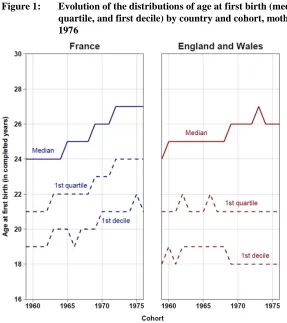
If English and Welsh women are less likely to enter into motherhood, those doing so have their first child earlier. If in both countries the median age at first birth is comparable for the women of the 1959–1976 cohorts (Figure 1), the distributions of the first quartile and first decile of first births are very different. Whilst the median age at first birth has increased in both countries, the age at which the first 25% and 10% of women enter into motherhood has remained stable and younger in England and Wales, in contrast to the evolution parallel to that of the median age in France.
3 If between the ages of 13 and 19 years old the distribution of the number of births increase exponentially
Figure 1: Evolution of the distributions of age at first birth (median, first quartile, and first decile) by country and cohort, mothers born 1959– 1976
Note: Ages are presented in completed years (discrete variable) as the exact age of mothers at their first birth (in completed years and months) cannot be calculated from data available in the ONS Longitudinal Study as the date of birth of mothers is unavailable for reasons of confidentiality.
Source: Author’s calculations based upon the Insee Permanent demographic sample and ONS Longitudinal Study.
4.2 The fertility of mothers born 1959–1976
achieved before 36 years old has decreased slightly. French mothers of the 1970–1976 cohort have a lower level of fertility at age 36 than in previous generations. The reproduction of these mothers is right censored. If the observed fertility rates for these mothers are higher at ages 36 and 37, they are lower hereafter, which suggests that their completed fertility will be lower than that of previous generations. In England and Wales the 1970–1976 cohort of mothers have already achieved the fertility levels of the older cohorts. Their fertility being more intense in their 30s, we can imagine that they will reach a higher level of completed fertility than the older cohorts.
Table 2: Cohort fertility by country, mothers born 1959–1976
Cohort
(Age reached in 2012)
France England and Wales
At end of 2012 At age 36 At end of 2012 At age 36
1959–1964 (48–53) 2.26 2.08 2.23 2.03
1965–1969 (43–47) 2.25 2.06 2.22 1.96
1970–1976 (36–42) 2.13 1.97 2.25 1.96
Source: Author’s calculations based upon the Insee Permanent demographic sample and ONS Longitudinal Study.
The fertility profiles of these birth cohorts distinguish themselves from one country to another (Figure 2). In France we see a fertility curve symmetric around the peak of fertility for each group of birth cohorts, which translates towards the right over time as a consequence of the evolution towards an increasing mean age at birth. The fertility curves in England and Wales for the cohorts 1959–1964 and 1965–1969, as in France, have a parabolic shape but with a wider amplitude and a lower peak. The fertility curve of English and Welsh mothers born between 1970 and 1976 has a different shape and is characterised by a ‘bump’ in the early part of the curve associated with adolescent fertility, which remains high in spite of increasing postponement of childbearing. This shape of curve is found in other English–speaking countries – Ireland, Australia, New Zealand, and Canada – where adolescent fertility is high (Chandola, Coleman, and Hiorns 2002).
Figure 2: Age specific fertility rates by country and cohort, mothers born 1959–1976
Source: Author’s calculations based upon the Insee Permanent demographic sample and ONS Longitudinal Study.
and 35, resulting in their cumulative fertility first catching up and then overtaking that of the previous cohorts.
The part of their fertility achieved during adolescence is for each cohort less in France than in England and Wales. For French mothers, this value falls from 2.9% to 1.3% across cohorts whilst amongst English and Welsh mothers, the proportion of their fertility achieved during adolescence increases from 4.5% for the two oldest cohorts to 5.4% for the mothers born between 1970 and 1976.
Figure 3: Cumulative fertility achieved at age x by country and cohort, mothers born 1959–1976
4.3 Adolescent mothers: A divergence between the two countries
The earlier entry into motherhood in England and Wales is highlighted by the greater proportion of women having become a mother during adolescence. Figure 4 shows that over the 1959–1976 birth cohorts, a divergence occurred between the two countries concerning an entry into motherhood during adolescence. These women experienced their adolescence in the last quarter of the twentieth century after the legalisation of abortion (in 1975 in France, 1967 in the United Kingdom4) and the liberalisation of access to contraception. Throughout these cohorts in France, the proportion of women entering motherhood during adolescence declined consistently from 5.3% of the 1960 birth cohort to less than 1 woman in 50 born in 1976 (1.7%) – adolescent mothers thus having become a very specific population. In contrast in England and Wales, following an initial decline, the proportion of women experiencing an adolescent birth stabilised before increasing from the 1964 cohort onwards and we observe that the proportion of women having become a mother as an adolescent in the 1960 cohort is equal to that in the 1976 cohort (7.5%). Thus, the gap between the two countries widened, more than four times as many women born in 1976 became adolescent mothers in England and Wales than in France.
Several reasons have been proposed for this unexpected evolution in England and Wales. Firstly, the increase in the proportion of adolescent mothers occurred during the 1980s, a decade marked by widespread unemployment, heightening poverty, and increasing inequality (Levitas 2002) – factors which are all linked to adolescent pregnancy and childbirth (Cater and Coleman 2006; Leishman and Moir 2007; Kearney and Levine 2012). This period also coincided with a lesser use of the contraceptive pill following crises in 1983 and 1986, a lower frequentation of family planning services following legal challenges to limit the access of younger adolescents, and campaigns seeking to limit access to abortion (Wellings and Kane 1999).
Figure 4: Proportion of women having entered motherhood during adolescence by country and cohort (left) and ratio between the two countries (right), women born 1959–1976
Note: Moving averages over 3 birth cohorts.
Source: Author’s calculations based upon the Insee Permanent demographic sample and ONS Longitudinal Study.
5. Adolescent mothers’ subsequent fertility behaviour
5.1 Quantum
In the birth cohorts studied, the youngest first-time mothers have 1.25 more children on average than those having had their first child aged 30 years or older, and 0.5 children more than those having had their first child aged 19–24.
Figure 5: Completed fertility by age at first birth, country, and cohort, mothers born 1959–1976
Note: Moving averages over 3 birth cohorts.
Source: Author’s calculations based upon the Insee Permanent demographic sample and ONS Longitudinal Study.
If fertility seems to fall across cohorts for the oldest first-time mothers (30 years old and older), this is an effect of the right censored data. French mothers having had their first child aged 30 and above have a stable level of achieved fertility at their 36th birthday whilst this level increases amongst the most recent English and Welsh cohorts. Amongst the oldest first-time mothers, in England and Wales the majority of their fertility occurs after the age of 36 years old, the opposite of the situation in France.
5.1.2 Adolescent mothers resist the two-child norm
For the women studied, arriving at childbearing age after the baby boom and in a context of changing fertility intentions and a control of fertility having been acquired by advances in contraception, the fall in fertility levels observed in both France and England and Wales was accompanied by an evolution towards a ‘typical’ family size of two children per mother (Pearce, Cantisani, and Laihonen 1999; Toulemon and Mazuy 2001; Toulemon 2012), which remains today the most frequent family model in all industrialised countries (Breton and Prioux 2005). The adolescent mothers studied resist this trend – in both countries the majority of these mothers have had at least a third child, compared to a quarter of 25–29 year old first-time mothers and around 1 in 10 of those having entered motherhood aged 30 years old or older. In France (Table 3a), there is a trend towards larger family sizes amongst adolescent mothers over time whereas the distribution of family size for English and Welsh adolescent mothers has remained relatively stable (Table 3b).
Table 3a: Distribution of family size (in %) by age at first birth and cohort, French mothers born 1959–1976
Age at first birth
Cohort
1959–1964 1965–1969 1970–1976
1 2 3 4+ 1 2 3 4+ 1 2 3 4+
≤ 18 years old 10.8 29.6 30.2 29.4 8.9 28.5 31.9 30.7 8.4 21.4 35.3 34.9
19–24 years old 14.1 44.8 29.7 11.5 12.7 45.2 29.9 12.2 12.7 42.0 32.2 13.2
25–29 years old 23.0 51.7 20.7 4.5 19.7 55.0 21.4 3.9 17.6 57.6 21.8 3.0
≥ 30 years old 46.3 44.1 8.2 1.4 41.2 47.8 9.1 1.9 47.0 45.2 7.0 0.8
Note: Totals may not sum to 100% due to rounding.
Source: Author’s calculations based upon the Insee Permanent demographic sample.
Table 3b: Distribution of family size (in %) by age at first birth and cohort, English and Welsh mothers born 1959–1976
Age at first birth
Cohort
1959–1964 1965–1969 1970–1976
1 2 3 4+ 1 2 3 4+ 1 2 3 4+
≤ 18 years old 11.8 30.5 29.5 28.1 10.8 25.5 30.9 32.8 10.5 29.6 29.0 30.8
19–24 years old 13.7 44.5 27.4 14.3 15.3 43.4 26.4 14.9 16.7 41.8 26.1 15.4
25–29 years old 20.5 55.6 18.8 5.1 21.6 56.3 17.8 4.4 21.0 56.0 18.5 4.6
≥ 30 years old 42.0 46.9 9.7 1.4 38.6 50.5 9.3 1.6 42.1 49.6 7.5 0.8
Note: Totals may not sum to 100% due to rounding.
Source: Author’s calculations based upon the ONS Longitudinal Study.
5.2 Tempo
5.2.1 A second child two to three years after the first, except for adolescent mothers in England and Wales
Welsh counterparts to have had a second child. The trend of the PPR1;2 decreasing over birth cohorts is the consequence of the growing proportion of late entries into motherhood.
Table 4: Parity progression ratio to second birth for mothers by age at first birth, country, and cohort, mothers born 1959–1976
Age at first birthFrance England and Wales
1959–1964 1965–1969 1970–1976 1959–1964 1965–1969 1970–1976
≤ 18 years old 0.891 0.911 0.916 0.882 0.892 0.895
19–24 years old 0.859 0.873 0.873 0.863 0.847 0.833
25–29 years old 0.770 0.803 0.824 0.795 0.784 0.790
≥ 30 years old 0.537 0.588 0.530 0.580 0.614 0.579
All 0.790 0.801 0.764 0.779 0.771 0.747
Source: Author’s calculations based upon the Insee Permanent demographic sample and ONS Longitudinal Study.
The probability that a mother has a second child is higher in the years immediately following the birth of her first child (Figure 6). In general, the highest parity progression ratio to second birth for the vast majority of mothers studied occurs between two and three years after first birth – the only exception being English and Welsh adolescent mothers for whom the probability is highest between one and two years after their first birth. This peak probability is highest for mothers having had their first child aged between 19 and 29 years old. Following this peak, progression to a second birth falls rapidly as the time since first birth increases.
Figure 6a: Parity progression ratio to second birth for mothers by years since first birth, age at first birth, and cohort, French mothers born 1959– 1976
Note: The curves are sometimes interrupted due to omitted values in order to conserve confidentiality (where fewer than ten cases).
Figure 6b: Parity progression ratio to second birth for mothers by years since first birth, age at first birth, and cohort, English and Welsh mothers born 1959–1976
Source: Author’s calculations based upon the ONS Longitudinal Study.
5.2.2 Despite a higher quantum, a less sustained tempo amongst adolescent mothers
Figure 7 indicates the rhythm of reproduction of mothers in the studied birth cohorts by their age at first birth. The gradients of the curves represent the tempo at which they have had their children following their first birth. At first glance, we observe a reproductive rhythm over the medium and long term (five years or more after the first birth) which is faster and more sustained amongst adolescent mothers. There also exists a clear link between age at first birth and the tempo of subsequent fertility: As age at first birth increases, this tempo decreases.
Figure 7a: Cumulative fertility achieved by years since first birth, age at first birth, and cohort, French mothers born 1959–1976
Figure 7b: Cumulative fertility achieved by years since first birth, age at first birth, and cohort, English and Welsh mothers born 1959–1976
Source: Author’s calculations based upon the ONS Longitudinal Study.
However, at equal family size we notice the opposite: The average interval between two successive births is longer amongst adolescent mothers (Table 5). This is particularly true in France for the interval between the first two births (i1;2). For mothers having had two or three children, adolescent mothers wait between 15 and 41 months longer to progress to a second birth (depending upon the birth cohort) than first-time mothers aged 30 years or older.
1970–1976 cohort having had two and three children than the oldest first-time mothers, compared to 18 and 21 months respectively in the 1959–1964 cohort.
Amongst French mothers, the association is stronger when family size is lower. In the respective cohorts, the median intervals between the first two births are respectively 21, 31, and 41 months longer for adolescent mothers than those having had their first child aged 30 or above for those having had exactly two children, compared to 15, 15, and 28 months longer for those having had exactly three children.
Table 5a: Median birth intervals (in months) between successive births of order one to four by age at first birth, number of children, and cohort, French mothers born 1959–1976
Number of children
Age at first birth
Cohort
1959–1964 1965–1969 1970–1976
i1;2 i2;3 i3;4 i1;2 i2;3 i3;4 i1;2 i2;3 i3;4
2 ≤ 18 years old 55 67 75
19–24 years old 46 47 48
25–29 years old 43 43 41
≥ 30 years old 34 36 34
3 ≤ 18 years old 41 50 45 52 53 58
19–24 years old 34 48 38 54 38 52
25–29 years old 32 48 32 47 31 42
≥ 30 years old 26 35 30 34 25 29
4+ ≤ 18 years old 29 34 47 34 33 44 30 35 52
19–24 years old 28 35 48 30 35 52 29 33 40
25–29 years old 27 36 36 25 32 40 24 31 34
≥ 30 years old * * * * * * * * *
Table 5b: Median birth intervals (in months) between successive births of order one to four by age at first birth, number of children, and cohort, English and Welsh mothers born 1959–1976
Number of children
Age at first birth
Cohort
1959–1964 1965–1969 1970–1976
i1;2 i2;3 i3;4 i1;2 i2;3 i3;4 i1;2 i2;3 i3;4
2 ≤ 18 years old 50 35 28
19–24 years old 36 29 24
25–29 years old 35 28 23
≥ 30 years old 32 26 21
3 ≤ 18 years old 53 47 40 51 27 58
19–24 years old 39 45 32 45 25 50
25–29 years old 37 39 29 39 26 39
≥ 30 years old 32 31 26 31 23 29
4+ ≤ 18 years old 56 33 36 42 34 38 28 32 35
19–24 years old 47 32 36 36 36 37 27 38 35
25–29 years old 38 30 31 30 30 30 24 29 28
≥ 30 years old 30 30 34 24 23 27 * * *
Notes: (i) in;n+1 = interval in months between births of order n and n+1; (ii) * = value omitted as calculated upon less than 50 cases. Source: Author’s calculations based upon the ONS Longitudinal Study.
We observe an example of time squeeze: The oldest mothers at first birth dispose of less time to achieve their desired fertility (before the biological limit of fertility) and so progress faster to a second birth (Kreyenfeld 2002).
5.3 A longer and shifted reproductive career amongst adolescent mothers
The combined effects of a greater quantum and a reduced tempo of childbearing following a first birth for adolescent mothers result in a longer and shifted reproductive career. By observing fertility rates following a first birth (fertility rates of second-order and higher births) by age at first birth, we can distinguish two phases of fertility: the phase before the peak of subsequent fertility and the phase after (Figure 85). Firstly, this peak varies in both its intensity and the moment at which it occurs: the peak being higher for those women having become a mother for the first time during adolescence, reaching over 200 births per 1,000 mothers at the age of 20 in England and Wales and around 21–22 years old in France. We observe a relation between age at first birth and maximum fertility. This arrives earlier in the reproductive careers of adolescent mothers compared to older first-time mothers (the gradient preceding this peak of fertility is steeper). In the second part of their subsequent fertility, the decline in the level of fertility occurs at a slower rate amongst adolescent mothers that we observe by the longer tail of their fertility curve. This slowly falling fertility is due to the fact that adolescent mothers have more children and also to the fact that they have more variable birth intervals between first and second order births compared to older first-time mothers. These traits are observed amongst both French and English and Welsh mothers.
Even if the reproductive career of adolescent mothers is longer, the majority of their fertility takes place at a moment in life different to that of older first-time mothers. This is due to two factors: on one hand the mechanical result of age at first birth, and on the other, reinforcement by the usual transition towards a second child two to three years following the entry into motherhood, which accounts for the peak in fertility.
Figure 8: Age specific fertility rates (second order births and higher) by age at first birth and country, mothers born 1959–1964
Note: The curves are sometimes interrupted due to omitted values in order to conserve confidentiality (where fewer than ten cases).
Source: Author’s calculations based upon the Insee Permanent demographic sample and ONS Longitudinal Study.
6. Discussion
My results add to existing knowledge by highlighting continuously differing behaviours over the life course following entry into maternity. Not only do adolescent mothers resist the norm of increasing age at first birth but also the two-child family norm – the majority having three children or more.
If the proportion of women becoming a mother during their adolescence is far greater in England and Wales compared to France, cross-country variations in childbearing behaviour are less evident following their entry into maternity. This result reinforces the importance of the selection into adolescent maternity in both countries, whilst the different proportions of women entering into maternity during adolescence highlights how the mechanisms of this selection vary in France and England and Wales. For women in both countries, it is especially their behaviours with regard to two of the proximate determinants of fertility before the entry into maternity and the size of the select populations of adolescent mothers which differ far greater than their subsequent fertility behaviours. We can conceptualise the selection into adolescent maternity as a three stage process: first the selection into sexual activity during adolescence, then the selection into pregnancy, and lastly the selection into maternity. The selection at each of these subsequent stages becomes more and more discriminant. If in England and Wales sexual activity during adolescence is more prevalent, it is the norm in both countries and the wider western world (Madkour et al. 2010). It is thus a less frequent recourse to contraception, and to abortion in the case of pregnancy (Tomkinson 2016), that accounts for the greater proportion of women entering into motherhood during adolescence in England and Wales.
The shifted reproductive career of adolescent mothers hints at the importance of the status of motherhood. If as observed, a first birth during adolescence does not, at a aggregate level, coincide with a rapid transition to second birth – as negative stereotypes surrounding adolescent mothers often suggest – the majority of their childbearing is a continuous process. If a first birth during adolescence represents a rupture with a normative transition to adulthood, once the identity of motherhood is acquired, it seems that the family formation process associated with motherhood takes place in the same manner as with older first-time mothers: The age-specific fertility curves of second order and higher parity births have, irrespective of age at first birth, broadly the same shape in the short and medium terms following entry into motherhood.
employment (Lee 2010) or low-status and lowly paid work (Luong 2008). With regard to housing, adolescent mothers are both more likely to live in social housing and less likely to live in an owner-occupied household (Ermisch and Pevalin 2003). It is important to consider childbearing and socio-economic trajectories of adolescent mothers as interlinked pathways. Effectively, some of these difficulties, as for example, access to employment or home ownership, are linked to the temporality of the entry into motherhood which occurs at a moment in the life where resources (economic and human capital) are weaker, reinforcing somewhat the idea of a paradox between adolescence and motherhood.
As highlighted in Section 3.3, I have defined adolescent mothers as those having had their first child aged 18 years old or younger. A sensitivity analysis was run to ensure that the results presented in this study are not just an artefact of the definition used. Analyses were run using alternative definitions of adolescent mothers: firstly as those having given birth aged 17 years old and younger and secondly as those having given birth aged 19 years old and younger. These adolescent mothers were then compared to the next youngest group of first-time mothers, respectively aged 18–24 and 20–24 years old. The results of this sensitivity analysis (see Tables A-1 and A-2 in the Appendix) show that for both of these definitions, the results hold true to those reported when defining adolescent mothers as those aged 18 years or younger at first birth. In both countries and for each definition, adolescent mothers have higher fertility levels, are less likely to conform to the ‘normal’ family size of exactly two children, and transition to subsequent births at a slower tempo. Analyses by single year of age at first birth (Tables A-3 and A-4) report that these outcomes have a broadly linear relationship with age at first birth and thus changing the definition of adolescent motherhood has only a small impact upon the magnitude of the effects reported.
2012). On the other hand, more unstable and thus a higher parity of unions could lead to a higher quantum of fertility at the individual level if there is a desire for further children with a new partner as a means of consolidating a new union (Griffith, Koo, and Suchindran 1985; Vikat, Thomson, and Hoem 1999; Thomson 2004).
It is also important to consider potential selection bias. In prospective studies, a key question is how to untangle causality due to pre-existing situations (Hotz, Williams McElroy, and Sanders 2005). In the present study the differing fertility behaviours following a first birth may be a reflection of underlying socio-economic characteristics. Reverse causality may also be an issue. That the quantum of childbearing is inversely proportional to age at entry into motherhood may be a result of conscious decisions upon when to commence childbearing based upon desired family sizes.
It is difficult to precisely respond to these questions, as it is impossible to know how the women studied would have behaved if they had postponed first childbirth. Several strategies have been used to measure or circumvent selection effects. Kohler, Skytthe, and Christensen (2001) evaluate Danish identical twins to account for unobserved characteristics and find a 3% reduction in completed fertility for each year of postponement of entry into motherhood. Elsewhere, studies upon the socio-economic impacts of adolescent motherhood have made comparisons between pairs of sisters, one of whom had experienced a maternity during adolescence (Geronimus and Korenman 1992; Holmlund 2005), whilst economists have frequently favoured an approach using instrumental variables. Hotz, Mullin, and Sanders (1997) compare adolescents having experienced a live birth with adolescents whose pregnancy ended in a miscarriage. Other studies (Ermisch and Pevalin 2003, 2005; Ashcraft and Lang 2006; Fletcher and Wolfe 2008) have used similar approaches to compare adolescent mothers to those having terminated a pregnancy during their adolescence. The majority of these studies report an overestimation of the effects of an adolescent maternity when not controlling for factors such as social origin or family background. The data used in the present study do not allow for the use of similar techniques. Data on siblings is absent due to the nature of the sample selection (based upon specific date of births7), whilst only details of live births, and not complete pregnancy histories, are available.
7. Summary
In this study I have recalled the higher proportion of women having entered into motherhood during adolescence in England and Wales compared to France and have demonstrated the diverging ratio in the birth cohorts studied. French adolescent mothers
7 A study of twins would be possible, although the prevalence of twins would lead to an inadequate sample
are thus rarer and represent a more specific reproductive behaviour, whereas in England and Wales adolescent mothers resist the trend of postponed entry into motherhood.
Concerning fertility following a first birth, in France as in England and Wales, the sooner a woman experiences her first birth, the more children she will have. The youngest first-time mothers resist the norm of a two-child family, over half having three or more children. However, a higher intensity of fertility does not necessarily mean a more sustained rhythm of childbearing. Adolescent mothers are not subjected to a ‘time squeeze’ effect, and as a result they have their subsequent children at wider spaced intervals which, coupled with a higher number of children, lengthens their reproductive career compared to older first-time mothers. Finally, adolescent mothers experience the majority of their fertility at a stage in their lives different to that of older first-time mothers, which poses questions about the existence of consequences upon their familial, social, and professional trajectories.
8. Acknowledgements
This research has benefitted from the financial support of the labex iPOPs, organised by the Institut national d’études démographiques (INED), under the reference ANR-10-LABEX-0089, in the context of heSam Université; of a public grant overseen by the French National Research Agency (ANR) as part of the “Investissements d’avenir” program (reference: ANR-10-EQPX-17 – Centre d’accès sécurisé aux données – CASD); and of the Big_Stat project funded by the French National Research Agency (grant “ANR-16-CE41-0007-01”).
The permission of the Office for National Statistics (ONS) to use the Longitudinal Study is gratefully acknowledged, as is the help provided by the staff of the Centre for Longitudinal Study Information and User Support (CeLSIUS). CeLSIUS is supported by the ESRC Census of Population Programme (Award Ref: ES/K000365/1). The author alone is responsible for the interpretation of the data.
This work contains statistical data from ONS which is Crown Copyright. The use of ONS statistical data in this work does not imply the endorsement of the ONS in relation to the interpretation or analysis of the statistical data. This work uses research data sets which may not exactly reproduce National Statistics aggregates.
References
Andersson, G. (2000). The impact of labour-force participation on childbearing behaviour: Pro-cyclical fertility in Sweden during the 1980s and the 1990s.
European Journal of Population 16(4): 293–333. doi:10.1023/A:100645490
9642.
Ashcraft, A. and Lang, K. (2006). The consequences of teenage childbearing. Cambridge: National Bureau of Economic Research (NBER Working Paper 12485).doi:10.3386/w12485.
Beaujouan, E. (2012). Repartnering in France: The role of gender, age and past fertility.
Advances in Life Course Research 17(2): 69–80.doi:10.1016/j.alcr.2012.03.001.
Beaujouan, E., Sobotka, T., Brzozowska, Z., and Zeman, K. (2017). Has childlessness peaked in Europe?Population and Societies 540: 1–4.
Berrington, A. (2017). Childlessness in the UK. In: Kreyenfeld, M. and Konietzka, D. (eds.). Childlessness in Europe: Contexts, causes, and consequences. Cham: Springer International: 57–76.doi:10.1007/978-3-319-44667-7_3.
Berrington, A., Diamond, I., Ingham, R., Stevenson, J., Borgoni, R., Cobos Hernández, M.I., and Smith, P.W.F. (2005). Consequences of teenage parenthood: Pathways which minimise the long term negative impacts of teenage
childbearing. Southampton: University of Southampton.
Berrington, A., Stone, J., and Beaujouan, E. (2015). Educational differences in timing and quantum of childbearing in Britain: A study of cohorts born 1940−1969.
Demographic Research 33(26): 733–764.doi:10.4054/DemRes.2015.33.26.
Berthoud, R. and Robson, K. (2001). The outcomes of teenage motherhood in Europe. Florence: Unicef (Innocenti Working Paper 86).
Billari, F.C. (2004). Becoming an adult in Europe: A macro(/micro)-demographic perspective. Demographic Research S3(2): 15–44. doi:10.4054/DemRes.2004. S3.2.
Billari, F.C., Goisis, A., Liefbroer, A.C., Settersten, R.A., Aassve, A., Hagestad, G., and Speder, Z. (2011). Social age deadlines for the childbearing of women and
men.Human Reproduction 26(3): 616–622.doi:10.1093/humrep/deq360.
Billari, F.C., Liefbroer, A.C., and Philipov, D. (2006). The postponement of childbearing in Europe: Driving forces and implications. Vienna Yearbook of
Boardman, L.A., Allsworth, J., Phipps, M.G., and Lapane, K.L. (2006). Risk factors for unintended versus intended rapid repeat pregnancies among adolescents.Journal
of Adolescent Health 39(4): 597.e1–597.e8. doi:10.1016/j.jadohealth.2006.03.
017.
Bremhorst, V., Kreyenfeld, M., and Lambert, P. (2016). Fertility progression in Germany: An analysis using flexible nonparametric cure survival models.
Demographic Research 35(18): 505–534.doi:10.4054/DemRes.2016.35.18.
Breton, D. and Prioux, F. (2005). Deux ou trois enfants? Influence de la politique familiale et de quelques facteurs sociodémographiques.Population 60(4): 489– 522.doi:10.2307/4150780.
Bumpass, L.L., Rindfuss, R.R., and Janosik, R.B. (1978). Age and marital status at first birth and the pace of subsequent fertility. Demography 15(1): 75–86.
doi:10.2307/2060491.
Burkimsher, M. (2017). Evolution of the shape of the fertility curve: Why might some countries develop a bimodal curve? Demographic Research 37(11): 295–324.
doi:10.4054/DemRes.2017.37.11.
Cater, S. and Coleman, L. (2006).‘Planned’ teenage pregnancy. Bristol: Policy Press. Chandola, T., Coleman, D.A., and Hiorns, R.W. (2002). Distinctive features of
age-specific fertility profiles in the English-speaking world: Common patterns in Australia, Canada, New Zealand and the United States, 1970–1998.Population
Studies 56(2): 181–200.doi:10.1080/00324720215929.
Couet, C. (2006). L’échantillon démographique permanent de l’Insee. Courrier des
Statistiques117–119: 5–14.
Ekert-Jaffé, O., Joshi, H., Lynch, K., Mougin, R., and Rendall, M. (2002). Fécondité, calendrier des naissances et milieu social en France et en Grande-Bretagne: Politiques sociales et polarisation socio-professionnelle.Population 57(3): 485– 518.doi:10.3917/popu.203.0485.
Ermisch, J. and Pevalin, D.J. (2003). Does a ‘teen-birth’ have longer-term impacts on the mother? Evidence from the 1970 British Cohort Study. Colchester: Institute for Social and Economic Research, University of Essex (ISER Working Papers 2003-28).
Fletcher, J.M. and Wolfe, B.L. (2008). Education and labor market consequences of teenage childbearing: Evidence using the timing of pregnancy outcomes and community fixed effects. Cambridge: National Bureau of Economic Research (NBER Working Paper 13847).
Frejka, T. and Sardon, J.-P. (2006). First birth trends in developed countries: Persisting parenthood postponement.Demographic Research 15(6): 147–180.doi:10.4054/ DemRes.2006.15.6.
Furstenberg, F.F. (2005). Non-normative life course transitions: Reflections on the significance of demographic events on lives.Advances in Life Course Research
10: 155–172.doi:10.1016/S1040-2608(05)10005-7.
Furstenberg, F.F., Brooks-Gunn, J., and Morgan, S.P. (1987). Adolescent mothers in
later life. Cambridge: Cambridge University Press. doi:10.1017/CBO9780511
752810.
Gemmill, A. and Lindberg, L.D. (2013). Short interpregnancy intervals in the United States. Obstetrics and Gynecology 122(1): 64–71.doi:10.1097/AOG.0b013e31 82955e58.
Geronimus, A.T. and Korenman, S. (1992). The socioeconomic consequences of teen childbearing reconsidered. The Quarterly Journal of Economics 107(4): 1187– 1214.doi:10.2307/2118385.
Goldscheider, F. and Kaufman, G. (2006). Willingness to stepparent: Attitudes about partners who already have children. Journal of Family Issues 27(10): 1415– 1436.doi:10.1177/0192513X06289646.
Gray, E., Evans, A., Anderson, J., and Kippen, R. (2010). Using split-population models to examine predictors of the probability and timing of parity progression.
European Journal of Population 26(3): 275–295.
doi:10.1007/s10680-009-9201-2.
Griffith, J.D., Koo, H.P., and Suchindran, C.M. (1985). Childbearing and family in remarriage.Demography 22(1): 73–88.doi:10.2307/2060987.
Hobcraft, J. and Kiernan, K. (2001). Childhood poverty, early motherhood and adult social exclusion. British Journal of Sociology 52(3): 495–517. doi:10.1080/00 071310120071151.
Hoem, B. (2000). Entry into motherhood in Sweden: The influence of economic factors on the rise and fall in fertility, 1986–1997. Demographic Research 2(4).
Holmlund, H. (2005). Estimating long-term consequences of teenage childbearing: An examination of the siblings approach.The Journal of Human Resources 40(3): 716–743.doi:10.3368/jhr.XL.3.716.
Hotz, V.J., Mullin, C.H., and Sanders, S.G. (1997). Bounding causal effects using data from a contaminated natural experiment: Analysing the effects of teenage childbearing. The Review of Economic Studies 64(4): 575–603. doi:10.2307/ 2971732.
Hotz, V.J., Williams McElroy, S., and Sanders, S.G. (2005). Teenage childbearing and its life cycle consequences: Exploiting a natural experiment.Journal of Human
Resources 40(3): 683–715.doi:10.3368/jhr.XL.3.683.
Ivanova, K., Kalmijn, M., and Uunk, W. (2013). The effect of children on men’s and women’s chances of re-partnering in a European context. European Journal of
Population 29(4): 417–444.doi:10.1007/s10680-013-9294-5.
Kearney, M.S. and Levine, P.B. (2012). Why is the teen birth rate in the United States so high and why does it matter?Journal of Economic Perspectives 26(2): 141– 166.doi:10.1257/jep.26.2.141.
Kohler, H.-P., Skytthe, A., and Christensen, K. (2001). The age at first birth and completed fertility reconsidered: Findings from a sample of identical twins. Rostock: Max Planck Institute for Demographic Research (MPIDR Working Paper WP-2001-006).
Köppen, K., Mazuy, M., and Toulemon, L. (2017). Childlessness in France. In: Kreyenfeld, M. and Konietzka, D. (eds.). Childlessness in Europe: Contexts,
causes, and consequences. Cham: Springer International: 77–95. doi:10.1007/
978-3-319-44667-7_4.
Kreyenfeld, M. (2002). Time squeeze, partner effect or self-selection? An investigation into the positive effect of women’s education on second birth risks in West Germany.Demographic Research 7(2): 15–48.doi:10.4054/DemRes.2002.7.2. Kreyenfeld, M. (2004). Fertility decisions in the FRG and GDR: An analysis with data
from the German Fertility and Family Survey.Demographic Research S3(11): 275–318.doi:10.4054/DemRes.2004.S3.11.
Leishman, J. and Moir, J. (2007). Pre-teen and teenage pregnancy: A twenty-first century reality. Keswick: M&K.
Lesthaeghe, R. and van de Kaa, D.J. (1986). Twee demografische transities? In: van de Kaa, D. and Lesthaeghe, R. (eds.). Bevolking: Groei en krimp. Deventer: Van Loghum Slaterus: 9–24.
Levitas, R. (2002). Pauvreté, exclusion sociale et redistribution: La réponse britannique.
Raisons politiques 6(2): 7–21.
Lewis, L.N., Doherty, D.A., Hickey, M., and Skinner, S.R. (2010). Predictors of sexual intercourse and rapid-repeat pregnancy among teenage mothers: An Australian prospective longitudinal study. Medical Journal of Australia 193(6): 338–342.
doi:10.5694/j.1326-5377.2010.tb03944.x.
Liefbroer, A.C. and Corijn, M. (1999). Who, what, where, and when? Specifying the impact of educational attainment and labour force participation on family formation. European Journal of Population 15(1): 45–75. doi:10.1023/A: 1006137104191.
Luong, M. (2008). Que sont devenues les mères adolescentes?L’emploi et le revenu en
perspective9(5): 5–15.
Madkour, A.S., Farhat, T., Halpern, C.T., Godeau, E., and Gabhainn, S.N. (2010). Early adolescent sexual initiation as a problem behavior: A comparative study of five nations.Journal of Adolescent Health 47(4): 389–398.doi:10.1016/j.jadohealth. 2010.02.008.
Manlove, J., Mariner, C., and Romano Papillo, A. (2004). Subsequent fertility among teen mothers: Longitudinal analyses of recent national data.Journal of Marriage
and Family 62(2): 430–448.doi:10.1111/j.1741-3737.2000.00430.x.
Masson, L. (2013). Avez-vous eu des enfants? Si oui, combien? In: France, Portrait Social. Paris: Insee: 93–109.
Mazuy, M. (2009). Avoir un enfant: Être prêts ensemble?Revue des Sciences Sociales
41: 30–41.
Miettinen, A., Rotkirch, A., Szalma, I., Donno, A., and Tanturri, M.-L. (2015). Increasing childlessness in Europe: Time trends and country differences. Stockholm: Stockholm University (FamiliesAndSocieties Working Paper 33). Neyer, G. (2003). Family policies and low fertility in Western Europe. Rostock: Max
Otterblad Olausson, P., Haglund, B., Ringbäck Weitoft, G., and Cnattingius, S. (2001). Teenage childbearing and long-term socioeconomic consequences: A case study in Sweden.Family Planning Perspectives 33(2): 70–74.doi:10.2307/2673752. Pailhé, A. and Solaz, A. (2012). The influence of employment uncertainty on
childbearing in France: A tempo or quantum effect? Demographic Research
26(1): 1–40.doi:10.4054/DemRes.2012.26.1.
Pearce, D., Cantisani, G., and Laihonen, A. (1999). Changes in fertility and family size in Europe.Population Trends 95: 33–40.
Raneri, L.G. and Wiemann, C.M. (2007). Social ecological predictors of repeat adolescent pregnancy. Perspectives on Sexual and Reproductive Health 39(1): 39–47.doi:10.1363/3903907.
Régnier-Loilier, A. and Solaz, A. (2010). La décision d’avoir un enfant: Une liberté sous contraintes.Politiques sociales et familiales100: 61–77.
Rendall, M.S. and Smallwood, S. (2003). Higher qualifications, first-birth timing, and further childbearing in England and Wales.Population Trends 111: 18–26. Rendall, M.S., Ekert-Jaffé, O., Joshi, H., Lynch, K., and Mougin, R. (2009). Universal
versus economically polarized change in age at first birth: A French–British comparison.Population and Development Review 35(1): 89–115.doi:10.1111/j. 1728-4457.2009.00262.x.
Rindfuss, R.R. and Brauner-Otto, S.R. (2008). Institutions and the transition to adulthood: Implications for fertility tempo in low-fertility settings. Vienna
Yearbook of Population Research 2008: 57–87. doi:10.1553/populationyear
book2008s57.
Robards, J., Berrington, A., and Hinde, A. (2011). Estimating fertility rates using the ONS Longitudinal Study: What difference does the inclusion of non-continually resident members make? Population Trends 144(1): 33–47. doi:10.1057/pt. 2011.10.
Robert-Bobée, I. (2006). Eudier la fécondité en France à l’aide de l’échantillon démographique permanent.Courrier des Statistiques 117–119: 15–20.
Sangalang, B.B., Barth, R.P., and Painter, J.S. (2006). First-birth outcomes and timing of second births: A statewide case management program for adolescent mothers.
Health and Social Work 31(1): 54–63.doi:10.1093/hsw/31.1.54.
Santelli, J.S., Song, X., Garbers, S., Sharma, V., and Viner, R.M. (2017). Global trends in adolescent fertility, 1990–2012, in relation to national wealth, income inequalities, and educational expenditures. Journal of Adolescent Health 60(2): 161–168.doi:10.1016/j.jadohealth.2016.08.026.
Schmitt, C. (2008). Gender-specific effects of unemployment on family formation: A cross-national perspective. Berlin: Deutsches Institut für Wirtschaftsforschung (SOEP Papers on Multidisciplinary Panel Data Research 127).
Sobotka, T. (2017). Childlessness in Europe: Reconstructing long-term trends among women born in 1900–1972. In: Kreyenfeld, M. and Konietzka, D. (eds.).
Childlessness in Europe: Contexts, causes, and consequences. Cham: Springer
International: 17–53.doi:10.1007/978-3-319-44667-7_2.
Thomson, E. (2004). Step-families and childbearing desires in Europe. Demographic
Research S3(5): 117–134.doi:10.4054/DemRes.2004.S3.5.
Tomkinson, J. (2016). Fewer teenage births in England and Wales: A convergence towards Europe?Population and Societies 536: 1–4.
Toulemon, L. (2012). Évolution des fratries: Les enseignements de la démographie.
Informations sociales 5(173): 24–31.
Toulemon, L. and Mazuy, M. (2001). Les naissances sont retardées mais la fécondité est stable.Population 56(4): 611–644.doi:10.3917/popu.104.0611.
Van Bavel, J. and Nitsche, N. (2013). ‘The proper age for parenthood’ and second birth rates in Europe. European Sociological Review 29(6): 1149–1161.doi:10.1093/ esr/jct003.
van de Kaa, D.J. (1987). Europe’s second demographic transition.Population Bulletin
42(1): 1–59.
Vikat, A., Thomson, E., and Hoem, J.M. (1999). Stepfamily fertility in contemporary Sweden: The impact of childbearing before the current union. Population
Studies 53(2): 211–225.doi:10.1080/00324720308082.
Wellings, K. and Kane, R. (1999). Trends in teenage pregnancy in England and Wales: How can we explain them?Journal of the Royal Society of Medicine 92(6): 277– 282.doi:10.1177/014107689909200603.
Appendix
Table A-1: Difference in subsequent fertility indicators between adolescent mothers (three different definitions) and the next youngest group of first-time mothers, French mothers born 1959–1976
Cohort Age at first birth comparison
Number of children per mother (end of 2012)
Percentage with family size of exactly 2 children
i1;2 for those
with exactly 2 children
i1;2 for those
with exactly 3 children
i1;2 for those
with exactly 4 children
1959–1964 ≤ 17 vs. 18–24 0.68 –15.8 12 8 2
≤ 18 vs. 19–24 0.59 –15.2 9 7 1
≤ 19 vs. 20–24 0.54 –15.4 5 4 –1
1965–1969 ≤ 17 vs. 18–24 0.67 –14.8 * * *
≤ 18 vs. 19–24 0.68 –16.7 20 7 4
≤ 19 vs. 20–24 0.54 –17.2 22 2 2
1970–1976 ≤ 17 vs. 18–24 0.76 –21.3 * * *
≤ 18 vs. 19–24 0.69 –20.6 * 15 1
≤ 19 vs. 20–24 0.54 –16.2 23 7 2
Notes: (i) i1;2 = interval in months between births of order 1 and 2; (ii) * = value omitted as calculated upon less than 50 cases.
Interpretation: For French mothers born between 1959 and 1964, those having had their first child aged 17 years old or under have on average 0.68 children more (3.13 vs. 2.46 children), are 15.8% less likely to have a family size of exactly 2 children (28.1 vs. 44.0%), and, for those having had exactly two children, had a longer duration between their first two births by 12 months (58 vs. 46 months) when compared to those having had their first child aged between 18 and 24 years old.
Source: Author’s calculations based upon the Insee Permanent demographic sample.
Table A-2: Difference in subsequent fertility indicators between adolescent mothers (three different definitions) and the next youngest group of first-time mothers, English and Welsh mothers born 1959–1976
Cohort Age at first birth comparison
Number of children per mother (end of 2012)
Percentage with family size of exactly 2 children
i1;2 for those
with exactly 2 children
i1;2 for those
with exactly 3 children
i1;2 for those
with exactly 4 children
1959–1964 ≤ 17 vs. 18–24 0.50 –15.0 19 9 5
≤ 18 vs. 19–24 0.46 –14.0 14 14 1
≤ 19 vs. 20–24 0.42 –14.0 12 5 3
1965–1969 ≤ 17 vs. 18–24 0.63 –17.4 16 10 4
≤ 18 vs. 19–24 0.59 –17.9 6 8 4
≤ 19 vs. 20–24 0.56 –18.1 8 4 0
1970–1976 ≤ 17 vs. 18–24 0.56 –14.0 9 7 3
≤ 18 vs. 19–24 0.56 –12.1 4 3 1
≤ 19 vs. 20–24 0.51 –11.4 9 6 1
Note: i1;2 = interval in months between births of order 1 and 2. Interpretation: For English and Welsh mothers born between 1959 and
1964, those having had their first child aged 17 years old or under have on average 0.5 children more (3.03 vs. 2.53 children), are 15.0% less likely to have a family size of exactly 2 children (28.3 vs. 43.3%), and, for those having had exactly two children, had a longer duration between their first two births by 19 months (55 vs. 36 months) when compared to those having had their first child aged between 18 and 24 years old.
Table A-3: Subsequent fertility indicators by age at first birth, French mothers born 1959–1976
Cohort Age at first birth
Number of children per mother (end of 2012)
Percentage with family size of exactly 2 children
i1;2 for those with
exactly 2 children
i1;2 for those with
exactly 3 children
i1;2 for those with
exactly 4 children
1959–1964 ≤ 17 3.13 28.1 58 42 29
18 2.91 30.9 55 39 26
19 2.80 32.3 47 34 25
20 2.65 38.7 49 36 29
1965–1969 ≤ 17 3.18 29.4 * * *
18 3.12 27.8 * * *
19 2.78 30.6 73 38 32
20 2.72 36.9 55 38 30
1970–1976 ≤ 17 3.31 19.8 * * *
18 3.12 22.9 * * *
19 2.83 32.3 64 44 32
20 2.88 31.9 56 38 31
Notes: (i) i1;2 = interval in months between births of order 1 and 2; (ii) * = value omitted as calculated upon less than 50 cases.
Interpretation: For French mothers born between 1959 and 1964, those having had their first child aged exactly 18 years old have on average 2.91 children, 30.9% have a family size of exactly 2 children, and, for those having had exactly two children, had a median duration between their first two births of 55 months.
Source: Author’s calculations based upon the Insee Permanent demographic sample.
Table A-4: Subsequent fertility indicators by age at first birth, English and Welsh mothers born 1959–1976
Cohort Age at first birth
Number of children per mother (end of 2012)
Percentage with family size of exactly 2 children
i1;2 for those with
exactly 2 children
i1;2 for those with
exactly 3 children
i1;2 for those with
exactly 4 children
1959–1964 ≤ 17 3.03 28.3 55 38 29
18 2.86 32.9 45 32 25
19 2.74 34.9 44 30 25
20 2.61 40.6 42 30 24
1965–1969 ≤ 17 3.17 24.2 56 43 29
18 2.98 27.0 52 35 25
19 2.83 31.1 42 33 23
20 2.67 37.7 44 36 25
1970–1976 ≤ 17 3.11 26.6 57 44 30
18 2.97 33.2 55 41 27
19 2.72 35.8 53 38 27
20 2.65 37.4 48 38 27
Note: i1;2 = interval in months between births of order 1 and 2. Interpretation: For English and Welsh mothers born between 1959 and
1964, those having had their first child aged exactly 18 years old have on average 2.86 children, 32.9% have a family size of exactly 2 children, and, for those having had exactly two children, had a median duration between their first two births of 45 months.