MODIFIED DIFFERENTIAL TRANSFORM METHOD FOR SINGULAR LANE-EMDEN EQUATIONS IN INTEGER AND FRACTIONAL
ORDER
H. R. MARASI1, N. SHARIFI1, H. PIRI1, §
Abstract. In the present work the modified differential transform method, incorporat-ing the Adomian polynomials into the differential transform method(DTM), is used to solve the nonlinear and singular Lane-Emden equations in integer and fractional order. Numerical examples with different types are solved. The results show that this method is very effective and simple.
Keywords: Differential transform method, Adomian polynomials, singular Lane-Emden equation.
AMS Subject Classification: 35A15, 35A20
1. Introduction
In recent years, the study of singular initial value problems modelled by second order nonlinear ordinary differential equations[1, 2] has attracted many mathematicians and physicists. One of the important equations in this literature is the Lane-Emden type equation of the form
∂2u ∂t2 +
2 t
∂u
∂t +f(u) = 0 (1)
with initial conditions
u(0) =a, u′(0) =b, (2)
wheref is a given function of u and a,b are constants. Lane-Emden type equations, first published by Janathan Homer Lane in 1870 [3] and further explored in detail by Emden[4]. Lane-Emden type equation was used the model the thermal behavior of a spherical cloud of gas acting under the mutual attraction of its molecules and subject to the classical lows of thermodynamics. So, a substantial amount of work has been done on this type of problems. In astrophysics, the Lane-Emden equation is Poisson’s equation for the grav-itational potential of a self-gravitating spherically symmetric polytropic fluid. Also, this is a type of equations have many applications in the fields of radioactiviely colling and in the mean-field treatment of a phase transition in critical adsorption or in the modelling of clusters of galaxies.
In most differential equations with variable coefficients it is impossible to obtain an exact solution, so one must resort to various approximation methods of solution, such as as-ymptotic techniques[11, 12, 13], analytical[14, 15] and numerical methods[16]. Analytical
1 Department of Mathematics, University of Bonab, Bonab 5551761167, Iran.
e-mail: [email protected]; § Manuscript received: July 31, 2014.
TWMS Journal of Applied and Engineering Mathematics, Vol.5, No.1; c⃝I¸sık University, Department of Mathematics, 2015; all rights reserved.
techniques have been dominated by perturbation methods and have found many applica-tions in science, engineering and technology. However, like other analytical techniques, perturbation methods require the presence of a small parameter in the nonlinear equation. Selection of small parameter requires a special skill and very important. Therefore, analyt-ical methods which do not require a small parameter are welcome. Because of singularity behavior at the origin and nonlinearity, the Lane-Emden equations may not be solved by standard semi-analytical methods, such as the homotopy perturbation method[17], vari-ational iteration method[7, 8] and Adomian decomposition method[6, 5]. The basic idea of differential transform method was initially introduced by Zhou[18]. The DTM is an alternative procedure for getting Taylor series solution of the equation. This method re-duces the size of computations of taylor coefficients. The motivation for presenting this work comes from the aim of introducing a reliable framework that combines the powerful differential transform method and Adomian decomposition method.
Many physical problems can be described by mathematical models that involves fractional differential equations. There are several mathematical definitions about the generalizing of the notion of differential to fractional orders e.g. Riemann-Lioville, Grunuald-Letinikow, Caputo and generalized functions approach.
Definition 1.1. A real function f(t), t >0, is said to be in the spaceCµ, µ∈R, if there exist a real numberp≥µ such that f(t) =tpf1(t) where f1(t)∈C(0,∞) and it is said to be in the space Cµm if f(m)∈Cµ, m∈N.
Definition 1.2. For a continuous function f : [0,∞) → R, the Caputo derivative of fractional orderα is defined by
cDαf(t) = 1
Γ(n−α)
∫ t
0
(t−s)n−α−1f(n)(s)ds,
where n−1< α < n, n= [α] + 1and [α]denotes the integer part of α.
Definition 1.3. The Riemann- Liouville fractional derivative of orderα for a continuous functionf is defined by
Dαf(t) = 1 Γ(n−α)(
d dt)
n ∫ t
0
f(s)
(t−s)α−n−1ds, n= [α] + 1,
where the right-hand side is pointwise defined on(0,∞).
Definition 1.4. Let[a, b]be an interval inRandα >0. The Riemann-Liouville fractional order integral of a function f ∈L1([a, b], R) is defined by
Iaαf(t) = 1 Γ(α)
∫ t
a
f(s) (t−s)1−αds, whenever the integral exists.
2. The fractional differential transform method(FDTM)
In the FDTM the analytic functionu(t) is expanded in terms of a fractional power series in the form
u(t) = ∞
∑
k=0
U(k)(t−t0) k θ,
for practical applications, the transformation of the initial conditions is defined as follows
U(k) =
1 (kθ)![
∂kθ ∂tkθ
u(t)]t=t0,
k θ ∈Z
+,
0, k
θ ̸∈Z +,
(3)
wherek= 0,1,· · · ,(αθ−1) and α is the order of the fractional diffential equation being considered. Thusθ should be chosen such that αθ is a positive integer. Here we present some basic properties of the FDTM. Let u(t), v(t) and w(t) be functions of time t and U(k), V(k) andW(k) are their corresponding fractional differential transforms with order of fractionθ. Then for constantc and pthe followings hold,
i: If u(t) =v(t)±w(t), then U(k) =V(k)±W(k).
ii: Ifu(t) =cv(t), thenU(k) =cV(k).
iii: Ifu(t) =Dtαv(t), thenU(k) = Γ(α+1+ k θ)
Γ(1+kθ) V(k+αθ).
We consider the case of a nonlinear functionf(u) that is approximated by the series
f(u) = ∞
∑
n=0 An,
where theAn are the Adomian polynomials determined by the definitional formula
An=
1 n![
dn dλn[f(
∞
∑
i=0
λiui)]]λ=0, n= 0,1,· · ·.
For the nonlinear fractional differential equation of the form
Dαu=f(u),
wheref(u) denotes a nonlinear function, we apply recurrence scheme of the form
Γ(α+ 1 + kθ)
γ(1 +kθ) U(k+αθ) = ˜Ak,
where ˜Akare obtained from the Adomian polynomials of f(u) by replacing eachu(k) and
Dβuk byU(k) and
Γ(α+1+kθ)
γ(1+kθ) U(k+αθ), respectively [20].
3. Numerical Applications
The Lane-Emden equation has been used to formulate several phenomena in mathe-matical physics and astrophysics. This equation encounters wide applications in modeling of the thermal behaviour of a spherical cloud of gas acting under a mutual attraction of its molecules and subject to the classical laws of thermodynamics. In this section, we solve three differential equations, the so-called Lane-Emden equation, to demonstrate the effectiveness and the validity of the present method.
Example 3.1. Consider the fractional Lane-Emden equation
Dβu+2
tut=−u, 1< β≤2, (4)
subject to the initial conditions
Taking the fractional differential transform and choosingθ= 2β, we write the recurrence scheme
Γ(1 + (k+ 1)β2)
Γ(1 + (k−1)β2 U(k+ 1) + 2(k+ 1)U(k+ 1) =−U(k−1), k= 1,2,· · ·. (6) So, we will get the approximations
U(0) = 1, U(1) = 0, U(2) =− 1
4 + Γ(1 +β), U(3) = 0,
U(4) = 1
4 + Γ(1 +β)·
Γ(1 +β)
Γ(1 + 2β) + 8Γ(1 +β), U(5) = 0,· · ·. Here, if we putβ = 2 then we will get the following solution
u(t) = 1− 1 3!t
2+ 1 5!t
4− 1 7!t
6+· · ·
which is the Taylor expansion of the exact solutionu(t) = sintt of the problem in this case. Example 3.2. Consider the fractional non-linear Lane-Emden equation
Dβu+2
tut=−u
5, 1< β≤2, (7)
subject to the initial conditions
u(0) = 1, ut(0) = 0. (8)
By taking the fractional differential transform and choosing θ = 2β, we obtain the recurrence scheme
Γ(1 + (k+12 )β)
Γ(1 +k−21β) U(k+ 1) + 2(k+ 1)U(k+ 1) =− ˜
Ak−1, k= 1,2,· · · (9) where ˜Ak are DTM’s of the Adomian polynomials, Ak, for the non-linear term, u5, as
follows
A0= (u0)5, A˜0 = (U(0))5, A1= 5(u0)4u1, A1˜ = 5(U(0))4U(1),
A2= 5(u0)4u2+ 10(u0)3(u1)2, A˜2 = 5(U(0))4U(2) + 10(U(0))3(U(1))2, A3= 5(u0)4u3+ 20(u0)3u1u2+ 10(u0)2(u1)3, A˜3= 5(U(0))4U(3) + 20(U(0))3U(1)U(2) + 10(U(0))2(U(1))3,
.. .
Then, we have the following approximations
U(0) = 1, U(1) = 0, U(2) =− 1
Γ(1 +β) + 4, U(3) = 0,
U(4) = 5Γ(1 +β)
6(Γ(1 + 2β) + 8Γ(1 +β)), U(5) = 0, U(6) =− 420 864
Γ(1 + 2β)
Γ(1 + 3β) + 12Γ(1 + 2β),· · · So
u(t) = 1− 1 Γ(1 +β) + 4t
2+5 6
Γ(1 +β)
Γ(1 + 2β) + 8Γ(1 +β)t 4−420
864
Γ(1 + 2β)
Γ(1 + 3β) + 12Γ(1 + 2β)t 6+... When the limit of the series solution as β approaches 2 is evaluated, we obtain
u(t) = 1−1 6t
2+ 1 24t
4− 5 432t
6+· · ·= √ 1 1 +t32
which is the exact solution of the problem in this case.
Example 3.3. Now, we consider the following fractional non-linear Lane-Emden equation
Dβu+ 2
tut=−e
u, 1< β≤2, (10)
subject to conditions
u(0) = 0, u(1) = 0. (11)
Taking the fractional differential transform and choosingθ= 2β we write the recurrence scheme
Γ(1 + (k+12 )β)
Γ(1 +k−21β) U(k+ 1) + 2(k+ 1)U(k+ 1) =− ˜
Ak−1, k= 1,2,· · · (12)
where ˜Akare obtained from the Adomian polynomials for the nonlinear term,eu, as follows
A0=eu0 A˜0=eU(0), A1=u1eu0, A˜1=U(1)eU(0), A2= (u2+(u1)2
2 )e
u
0, A2˜ = (U(2) +
(U(1))2
2 )e
U(0), A3= (u3+u1u2+(u1)
3
3! )e
u0 A˜
3= (U(3) +U(1)U(2) +(U(1))
3
3! )e
U(0), ..
.
Then, we can obtain the following values
U(0) =U(1) =U(3) = 0, U(2) =− 1
Γ(1 +β) + 4, U(4) = 1 6
Γ(1 +β)
Γ(1 + 2β) + 8Γ(1 +β),
U(5) = 0, U(6) =− 8 5!×3×
Γ(1 + 2β)
Γ(1 + 3β) + 12Γ(1 + 2β),· · · This yields the series solution
u(t) = −1 Γ(1 +β) + 4t
2+1 6
Γ(1 +β)
Γ(1 + 2β) + 8Γ(1 +β)t 4− 8
360
Γ(1 + 2β)
Γ(1 + 3β) + 12Γ(1 + 2β)t 6+... When the limit of the series solution asβ approaches 2 is evaluated, we obtain
u(t) =− 1 3×2!t
2+ 1 5×4!x
4− 8 21×6!t
6+ 122 81×8!t
8− · · · (13)
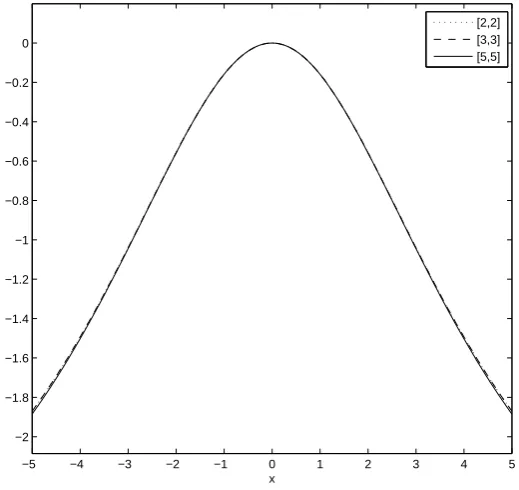
which is the same solution obtained in [19] by modified homotopy perturbation method for the case β = 2. Using the Matlab symbolic code, we plot the Pade approximations of[2,2], [3,3] and [5,5] in fig.1. This shows the trend of convergence of the solution for these three approximants. Shown in fig.2 are the modified FDTM solution of the problem with 5 components as parametrized byβ.
4. Conclusion
−5 −4 −3 −2 −1 0 1 2 3 4 5 −2
−1.8 −1.6 −1.4 −1.2 −1 −0.8 −0.6 −0.4 −0.2 0
x
[2,2] [3,3] [5,5]
Figure 1. Plots of the [2,2], [3,3], [5,5] Pade approximants for Example(3.3).
0.1 0.2 0.3 0.4 0.5 0.6 0.7 0.8 0.9 1 t
(6234590327124965 t27/10)/288230376151711744 −...− (2561942702991429 t9/2)/2305843009213693952 β=2
β=1.95
β=1.9
β=1.85
Figure 2. Plots of the FDTM Solution with 5 components for Example(3.3) as
parametrized by β.
References
[1] Agarwal, R. P., Regan, D. O. and Lakshmikanthamr, V., (2001), Quadratic forms and nonlinear non-resonant singular second order boundary value problems of limit circle type, Zeitschrift fur Analysis und ihre Anwendungen, 20, pp. 727-737.
[2] Agarwal, R. P. and Regan, D. O., (2001), Existence theory for single and multiple solutions to singular positone boundary value problems, J. Diff. Equ., 175(2), pp. 393-414.
[4] Emden, R., (1907), Gaskugeln, Teubner, Leipzig and Berlin.
[5] Marasi, H. R. and Nikbakht, M., (2011), Adomian decompositiom method for boundary value prob-lems, Aus. J. Basic. Appl. Sci., 5, pp. 2106-2111.
[6] Adomian, G., (1994), Solving frontier problems of physics: The decomposition method, Kluwer Aca-demic, Dordrecht.
[7] Marasi, H.R. and Karimi, S., (2014), Convergence of variational iteration method for solving fractional Klein-Gordon equation, J. Math. Comp. Sci., 4, pp. 257-266.
[8] Assas, L. M. B., (2008), Variational iteration method for solving coupled-KdV equations, Chaos Solitons Fractals., 38(4), pp. 1225-1228.
[9] Kilbas, A. A., Srivastava, H. M. and Trujillo, J. J., (2006), Theory and applications of fractional differential equations, North-Holland Mathematics Studies., 204, pp. 7-10.
[10] Podlubny, I., (1999), Fractional differential equations, Academic Press, New york.
[11] Marasi, H. R. and Jodayree Akbarfam, A., (2007), On the canonical solution of indefinite problem with m turning points of even order, J. Math. Anal. Appl., 332, pp. 1071-1086
[12] Marasi, H. R., (2011), Asymptotic form and infinite product representation of solution of a second order initial value problem with a complex parameter and a finite number of turning points, J. Cont. Math. Anal., 4, pp. 57-76
[13] Marasi, H. R. and Jodayree Akbarfam, A., (2012), Dual equation and inverse problem for an indefnite Sturm-Liouville problem with m turning points of even order, Math. Modell. Anal., 17(5), pp. 618-629. [14] Chowdhury, M. and Hashim, I., (2009), Solutions of Emden-Fowler equations by homotopy
perturba-tion method, Non-Linear Analysis: Real World Applicaperturba-tion., 101, pp. 104-115.
[15] Yildirim, A. and Ozi, T., (2009), Solutions of singular IVPs of Lane-Emden type by the variational iteration method, Nonlinear Analysis: Theory, Methods Applications, 70(6), pp. 2480-2484.
[16] Parand, K. and Pirkhedri, A., (2010), Sinc-collocation method for solving astrophysics equations, New Astronomy, 15(6), pp. 533-537.
[17] He, J., (2006), Homotopy perturbation method for solving boundary value problems, Phys. Lett. A., 350, pp. 87-88.
[18] Zhou, J. K., (1986), Deferential transformation and its application for electrical circuits, Huazhong University Press, Wuhan China.
[19] Nazari-Golshan, A., Nourazar, S. S., Ghafoori-Fard, H., Yildirim, A. and Campo, A., (2013), A modified homotopy perturbation method coupled with the Fourier transform for nonlinear and singular Lane-Emden equations, Appl. Math. Lett., http://dx.doi.org/10.1016/j.aml., pp. 2013.05.010. [20] Elsaid, A., (2012), Fractional differential transform method combined with the Adomian polynomials,
Apll. Math. Comput., 218, pp. 6899-6911.
Hamidreza Marasiwas born in 1972 in Leilan-Azerbaijan, Iran. He received the B.Sc., M.Sc. and Ph.D. degrees from Tabriz University, Tabriz, Iran, in 1998, 2000 and 2008 respectively. He is currently working as an Associate Professor at the Department of Applied Mathematics, University of Bonab, Bonab, Iran. His major research areas are Asymptotic Theory, Eigenvalue Problems, Analytical and Numerical methods.