
Short-term control of a storage hydropower under flood
risk by multi-stage stochastic optimization
Gökçen Uysal1, Aynur Şensoy1, Dirk Schwanenberg2, Rodolfo
Alvarado-Montero3
1 Anadolu University, Department of Civil Engineering, Eskisehir, 26555, Turkey 2 KISTERS AG, Business Unit Water, 52076, Aachen, Germany
3 Deltares, Operational Water Management, Delft, The Netherlands
Corresponding author: [email protected]
Abstract. The short-term, optimal management of storage reservoirs is challenging due to multiple objectives, i.e. hydropower, water supply or flood mitigation, and inherent uncertainties of forecasts for inflow and water demand. Model Predictive Control (MPC) provides an online solution for this management problem by combining a process model, forecasts and the formulation of objectives in an objective function and its solution by an optimization algorithm. This anticipatory management has many advantages, but may suffer from forecast uncertainty. In practice, there are several sources of forecast uncertainty, which can jeopardize control decisions. In this study, hindcast experiments integrating deterministic and probabilistic streamflows in a closed-loop mode of MPC are tested to mimic a real-time flood mitigation case. Probabilistic inflow forecasts in combination with multi-stage stochastic optimization model are used with tree-based reduction techniques. According to the results, tree-based MPC proposes less spillway discharges during a real-time control of a major flood case by incorporating longer the forecast horizon and consideration of forecast uncertainty in the decision process. On the other hand, energy generation is compared with deterministic method, and the results are promising to be used without compromising the energy production.
Keywords: flood control; hydropower; model predictive control; reservoir operation; stochastic optimization
Engineering
EPiC Series in Engineering
Volume 3, 2018, Pages 2120–2126
HIC 2018. 13th International Conference on Hydroinformatics
1 Introduction
Water resources management is becoming more crucial under increasing population, urbanization, and changing climate. It is reported that still one billion people do not have access to safe drinking water and two billion people have no access to electricity [1]. Reservoirs created by dams are one of the most important elements of integrated water resources management. Storage hydropower play an important role as being one of the main renewable resource for electricity production both for base and peak load. Operation them require proper tactical management due to their multiple objectives i.e. continuous availability of water supply, load balancing, maximization of hydropower production, flood mitigation etc. Optimization is also complex as a result of having various physical components and variables. Besides, stochasticity is inherent due to randomness of unregulated inflows, water requirements, energy needs. Implicit and explicit stochastic optimization techniques has been applied in the literature [2]. However, most of them are offline techniques and do not directly reflect a real time operation problem and forecast uncertainty.
Model Predictive Control (MPC) is an advance process control technique which considers dynamic system, optimization algorithm and future states [3]. In several decades, it has been using for different water resources related problems. However, the forecast might be wrong and this leads operator to wrong control decisions. The proper solution is explicit consideration of forecast uncertainty by probabilistic ensemble forecasts, but it is not studied in detail. In this study, deterministic and stochastic MPC are tested and compared in a real-time reservoir operation case having hydropower assets. The real time control is employed under closed-loop hindcasting configuration.
2 Multi-stage Stochastic Tree-Based Model Predictive Control Deterministic MPC considers a discrete time-dynamic system according to
(1)
(2)
where , , , are the state, dependent variable, control and disturbance vectors, respectively. Also, and are functions representing an arbitrary linear or nonlinear water resources model. Under the assumption of knowing the realization of the disturbance d over the time horizon, the simultaneous (aka collocated) MPC has below objective function and constraints:
) , , ,
( k 1 k k k
k f x x u d
x =
-) , , ( k k k
k g x u d
y =
x y u d ()
f g()
Short-Term Control of a Storage Hydropower under Flood Risk by ... G. Uysal et al.
(3)
(4)
(5)
where is a cost function associated with each state transition, is an additional cost function related to the final state condition, and are hard constraints on control variables and states, respectively. In this case, the related model (herein, reservoir simulation equations) becomes an equality constraint of the optimization problem in Equation 5.
The problem is extended through multi-stage stochastic set-up by changing with where denotes the ensemble index and denotes the time instant
.
(6)
where stands for the probability of the ensemble member, stands for the number of the ensembles.
Definition of control variable identifies the approach for stochastic MPC set-up. At this point, multi-stage stochastic optimization (so called Tree-based MPC, TB-MPC) is dedicated way which uses scenario trees for disturbance, states and control trajectories [4].
We apply deterministic MPC using DSF data and TB-MPC using PSF data, respectively. The models are tested in closed-loop mode to mimic the real-world reservoir decision generation and implementation which is called as hindcast experiments.
{
}
1 1 min ( , , ) ( , , ) , 0,..., Nk k k N N N
k
J x u d E x u d
u x T
-= + Î
å
N k d u y xh( k, k, k, k)£0, =1,...,
0 ) , , , ( =
- k k k k
k f x x u d
x
()
J E()
() h k d k j
d j (j=1,..., )M k
(k =1,..., )N
{
}
1 1 1 min ( , , ) ( , , ) , 0,..., M Nk k k N N N
j j j j j j j
j k
p J x u d E x u d
u x T
-= = + Î
å å
j p M k j uShort-Term Control of a Storage Hydropower under Flood Risk by ... G. Uysal et al.
3 Study Area, Data and Model
The pilot reservoir of Yuvacik located in Turkey requires a challenging gate management due to water supply and flood control targets. Spillages must be avoided as much as possible, and it should be less than maximum 200 m3/s in order to protect
downstream industrial region. Uysal et al. [5] proposed a short-term operation strategy considering these objectives in variable Guide Curve (GC) in combination with closed-loop MPC set-up. Later, Uysal et al. [6] extended this methodology through multi-stage stochastic MPC with tree-based reduction in order to include forecast uncertainty in decision mechanism. Besides these, in this study we include a fictitious hydropower plant in the downstream to assess the system performance under energy generation.
The system is considered as a mass balance equation as:
(7)
where, is the storage of the reservoir, is the volume of inflow into reservoir, is the released volume from gated spillway, is the withdrawn volume for water supply, is the released volume for the hydropower turbine and is time index.
The objectives are: maximizing water supply and hydroelectric generation while minimizing the spillway discharges. The constraints are based on residuum of mass-balance, reservoir level boundaries, spillway discharges and turbine flows. Turbine flows are restricted by below equation as:
(8)
where, is the turbine flow. Therefore, indirectly becomes the optimization variable of the problem with respect to the mass balance equation.
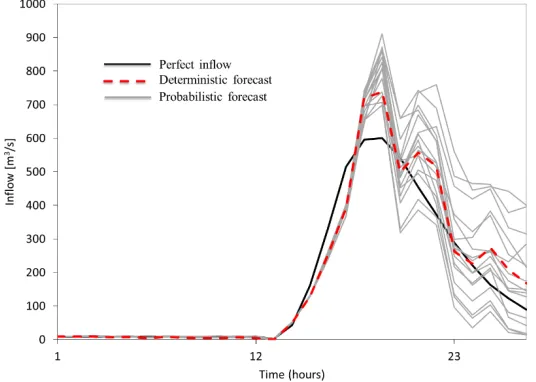
In the study, both deterministic (DSF) and probabilistic (PSF) streamflow hourly data are used as input to MPC closed-loop mode. Forecast data are synthetically generated from major flood hydrograph (Q100) which has 100 years return period. Note that,
hourly data are updated in each receding horizon (1 hour) having lead-time of 48 hours. An example of forecast data for a selected time step is given in Figure 1. The hindcasting period cover 96 hours in May, 2012. The optimization problem is also designed for 48 hours forecast horizon and 16 tree branches are used in TB-MPC set-up.
1
k k k k k k
i s ws t s =s - +s - -s s -s
s si ss
ws s
t
s k
3 3
10m s Q/ £ t £20m s/
t
Q Qt
Short-Term Control of a Storage Hydropower under Flood Risk by ... G. Uysal et al.
Figure 1 An exemplary of inflow forecasts (perfect, deterministic and probabilistic) for a selected time step
4 Optimization Results and Discussion
Preliminary results are given for both deterministic and stochastic cases in comparison (Figure 2). The hindcasting experiments are conducted for both MPC modes. This means each time step the model is optimized for finite (forecast) horizon (48 hours) and only the first control is applied to the system, the rest are discarded. However, system states are updated with observed inflows and the same procedure is repeated in the next time step until the whole hindcasting period is completed. In the figures, DHE stands for deterministic hindcasting experiment results and PHE stands for probabilistic hindcasting experiment results.
The results are investigated with three different variables (reservoir level, spillway discharges and turbine flow). PHE presents spillway policy with much more pre-releases and lower reservoir level in advance compared to DHE, because of uncertainty spread in ensemble forecasts and their properly consideration in TB-MPC. According to that, DHE shows higher damage at the downstream in terms of spillway discharges (above 200 m3/s). This is mainly due that DHE offers more conservative
reservoir storage and exceeds flooding threshold when inflows are underestimated. It is important to note that PHE also provides same reservoir level at the end of the event, even though it provides larger flood control pool before the event. Thus, PHE results do not conflict with water supply targets at the end of the flood event. According to the turbine flow graph, PHE offers also very similar energy generation performance (R2=0.96) in comparison with deterministic forecast data based model results (DHE).
Short-Term Control of a Storage Hydropower under Flood Risk by ... G. Uysal et al.
Figure 2 Deterministic MPC and TB-MPC hindcast experiment results (a) Reservoir level [m] (b) Spillway flows [m3/s] (c) Turbine flow for energy generation [m3/s]
Short-Term Control of a Storage Hydropower under Flood Risk by ... G. Uysal et al.
5 Conclusions
Assessment of forecast uncertainty is still lack in real time operation of water resources optimization. In this study, the operation of multi-purpose dam reservoir having water supply, flood control and energy generation from a hydropower targets is tested in a real-time operation against a major flood scenario. To that end, Model Predictive Control (MPC) models are developed to mimic a real-time control via hindcast experiments. Synthetic deterministic and probabilistic hourly streamflows with 48 hours lead-time are employed in deterministic and stochastic MPC models, respectively. Multi-stage stochastic MPC using scenario trees referred to as Tree-based MPC is selected because of including forecast uncertainty consideration in the decision system. The preliminary results of TB-MPC are promising in terms of downstream region safety compared to deterministic MPC without compromising the energy production and water supply targets. In the future studies, the developed framework can be tested with numerical weather prediction based forecasts.
6 Acknowledgement
The first author would like to acknowledge The Scientific and Technological Research Council of Turkey (TÜBİTAK) for the scholarship (2214A program). This study is also supported by Anadolu University Scientific Research Projects Commission under the grant No: 1506F502.
Reference
[1] World Commission on Dams. (2000) Dams and Development: A New Framework for Decision-making: the Report of the World Commission on Dams. Earthscan.
[2] Labadie, JW (2004). Optimal operation of multireservoir systems: state-of-the-art review. Journal of water resources planning and management, 130(2), 93-111.
[3] Morari M, Lee JH (1999) Model predictive control: past, present and future. Comput Chem Eng 23:667–682.
[4] Fan, FM, Schwanenberg, D, Alvarado, R, dos Reis, AA, Collischonn, W, Naumman, S (2016) Performance of Deterministic and Probabilistic Hydrological Forecasts for the Short-Term Optimization of a Tropical Hydropower Reservoir. Water Resour Manag, 30(10), 3609-3625.
[5] Uysal, G, Schwanenberg, D, Alvarado-Montero, R, Şensoy, A (2018a) Short Term Optimal Operation of Water Supply Reservoir under Flood Control Stress using Model Predictive Control. Water Resources Management, 32(2), 583-597.
[6] Uysal, G, Alvarado-Montero, R, Schwanenberg, D, Şensoy, A (2018b) Real-time Flood Control by Tree-Based Model Predictive Control including Forecast Uncertainty: A Case Study Reservoir in Turkey. Water, 10(3), 340.
Short-Term Control of a Storage Hydropower under Flood Risk by ... G. Uysal et al.
![Figure 2 Deterministic MPC and TB-MPC hindcast experiment results (a) Reservoir level [m] (b) Spillway flows [m3/s] (c) Turbine flow for energy generation [m3/s]](https://thumb-us.123doks.com/thumbv2/123dok_us/8880474.1819468/6.612.154.463.106.639/figure-deterministic-hindcast-experiment-reservoir-spillway-turbine-generation.webp)
