www.geosci-model-dev.net/5/355/2012/ doi:10.5194/gmd-5-355-2012
© Author(s) 2012. CC Attribution 3.0 License.
Geoscientific
Model Development
Development of the high-order decoupled direct method in three
dimensions for particulate matter: enabling advanced sensitivity
analysis in air quality models
W. Zhang1, S. L. Capps2, Y. Hu3, A. Nenes1,2, S. L. Napelenok4, and A. G. Russell3
1School of Earth and Atmospheric Sciences, Georgia Institute of Technology, Atlanta, Georgia, USA 2School of Chemical and Biomolecular Engineering, Georgia Institute of Technology, Atlanta, Georgia, USA 3School of Civil and Environmental Engineering, Georgia Institute of Technology, Atlanta, Georgia, USA 4US Environment Protection Agency, Research Triangle Park, North Carolina, USA
Correspondence to: W. Zhang ([email protected])
Received: 5 August 2011 – Published in Geosci. Model Dev. Discuss.: 4 October 2011 Revised: 21 February 2012 – Accepted: 24 February 2012 – Published: 23 March 2012
Abstract. The high-order decoupled direct method in three dimensions for particulate matter (HDDM-3D/PM) has been implemented in the Community Multiscale Air Qual-ity (CMAQ) model to enable advanced sensitivQual-ity analy-sis. The major effort of this work is to develop high-order DDM sensitivity analysis of ISORROPIA, the inor-ganic aerosol module of CMAQ. A case-specific approach has been applied, and the sensitivities of activity coefficients and water content are explicitly computed. Stand-alone tests are performed for ISORROPIA by comparing the sensitiv-ities (first- and second-order) computed by HDDM and the brute force (BF) approximations. Similar comparison has also been carried out for CMAQ sensitivities simulated us-ing a week-long winter episode for a continental US do-main. Second-order sensitivities of aerosol species (e.g., sul-fate, nitrate, and ammonium) with respect to domain-wide SO2, NOx, and NH3 emissions show agreement with BF results, yet exhibit less noise in locations where BF results are demonstrably inaccurate. Second-order sensitivity analy-sis elucidates poorly understood nonlinear responses of sec-ondary inorganic aerosols to their precursors and competing species. Adding second-order sensitivity terms to the Tay-lor series projection of the nitrate concentrations with a 50 % reduction in domain-wide NOx or SO2emissions rates im-proves the prediction with statistical significance.
1 Introduction
Airborne particulate matter (PM), or aerosol, is a major pol-lutant in the atmosphere. Studies have shown that PM im-pairs visibility (Watson, 2002), may cause harmful effects
on ecosystems (Galloway et al., 2004), and affects human health (e.g., Zanobetti et al., 2000; Kaiser, 2005). In re-sponse, control strategies are designed to lower the concen-trations of anthropogenic PM in the atmosphere (US EPA, 2004). Historically, multiple air quality model simulations using different sets of emissions have been used to evaluate the expected benefit of different strategies (e.g., Bergin et al., 2008). This approach is resource-intensive (Dunker, 1984), and the numerical precision of models limits the size of emis-sions changes that can be actually evaluated (Hakami et al., 2004). An alternative approach is to use sensitivity analysis tools integrated in the simulation.
Sensitivity analysis reveals the relationship of model out-puts (e.g., pollutant concentrations) to model input param-eters (e.g., emissions rates, initial or boundary conditions, and chemical reaction rates). Several different sensitivity analysis methods quantitatively express partial derivatives as the “sensitivity coefficients”. One approach is the brute force (BF) approximation; using central finite difference approximation, first- and second-order sensitivities are ex-pressed as:
Sij(1),BF=Ci |p
j+1pj−Ci|pj−1pj 21pj
(1)
Sijj(2),BF=Ci |p
j+1pj−2Ci|pj+Ci|pj−1pj
(1pj)2
(2)
whereSij(1),BFandSijj(2),BFrepresent the brute force first-order and second-order sensitivities, respectively of speciesiwith respect to parameterpj (e.g., emissions, initial or boundary
conditions, or reaction rates). Ci represents the
the values of the input parameter at which the concentrations are evaluated. Computational requirements for BF sensitiv-ity analysis scale with the number of parameters investigated. Obviously, BF becomes resource-intensive with an increas-ing number of parameters of interest or with increasincreas-ing or-der (e.g., second oror-der or higher) of sensitivities. In addi-tion to being computaaddi-tionally inefficient, the BF sensitivities are prone to considerable numerical noise. One reason for the numerical noise is the truncation errors, which are in-troduced by omitting the higher-order terms when deriving Eqs. (1) and (2) from the Taylor series expansion. The trun-cation error is a function of both the perturbation size (1p)
and the magnitude of higher-order sensitivities. If the system is highly nonlinear, even a small perturbation can cause siz-able truncation error (Hakami et al., 2004). Another reason for the numerical noise of BF is due to the modeling accu-racy and precision. For example, incomplete convergence in iterative solvers will cause such errors. Both types of errors for second-order BF sensitivities are amplified compared to first-order BF sensitivities. Actually, as the order of sensitiv-ities increase, BF approximations become significantly less accurate (Hakami et al., 2004).
An alternative approach to BF is the decoupled direct method in three dimensions (DDM-3D). This method op-erates integrally within a chemical transport model (CTM) and simultaneously computes local sensitivities of pollutant concentrations to perturbations in input parameters (Dunker, 1984; Yang et al., 1997; Cohan et al., 2005, 2010; Napelenok et al., 2006). DDM-3D sensitivities are calculated by solv-ing sensitivity equations that are the derivatives of the partial differential equations governing the CTM. DDM-3D is com-putationally efficient for three or more sensitivity parameters and is subject to considerably less numerical noise than BF. The difference in numerical cost has been studied by Nape-lenok et al. (2006). CPU time required by the two approaches to compute the same set of sensitivities is compared, with the number of sensitivity parameters ranging from 1 to 8. The CPU time needed by BF is almost twice that needed by DDM-3D if two or more parameters are considered. For 8 sensitivity parameters, the CPU time for BF is 27 min and DDM-3D 15 min. DDM-3D has been implemented in CTMs (e.g., CMAQ (Byun and Schere, 2006), CAMx (ENVIRON, 2005), URM (Boylan et al., 2002)) to conduct source impact analysis for ozone and PM (Yang et al., 1997; Mendoza-Dominguez and Russell, 2000; Odman et al., 2002; Nape-lenok et al., 2006; Koo et al., 2007). Initially, DDM-3D was applied to calculate first-order sensitivities, which are the lo-cally linear responses of pollutant concentrations to changes in model inputs and parameters (e.g., emissions, and initial and boundary conditions) at the conditions currently mod-eled.
DDM-3D has been extended to calculate high-order sen-sitivities of gaseous species by Hakami et al. (2003) within the Multiscale Air Quality Simulation Platform (MAQSIP) (Odman and Ingram, 1996). They calculated second- and
third-order sensitivities using DDM-3D and showed that the approach could accurately capture the nonlinear response of ozone concentration to NOx and VOC emission changes. They also investigated the efficiency of DDM-3D in calcu-lating high-order sensitivities. An important outcome of that work was that higher than second order sensitivities are not necessary for the majority of potential applications. More re-cently, the high-order approach for gaseous species has also been implemented in the Community Multiscale Air Qual-ity (CMAQ) model (Cohan et al., 2005) and the Compre-hensive Air Quality with extensions (CAMx) (Koo et al., 2010). High-order sensitivity calculations of gaseous species have been applied to source apportionment and air qual-ity model uncertainty analysis (Cohan et al., 2005; Tian et al., 2010). Although nonlinear effects of aerosol precursors on aerosol concentrations have been of concern in the past decade (Ansari and Pandis, 1998; West et al., 1999), devel-oping HDDM for PM has not yet been undertaken due to the discontinuous, highly nonlinear solution surface of the inor-ganic aerosol thermodynamics. Only now has the challeng-ing task of extendchalleng-ing high-order, direct sensitivity analysis to particulate matter species been accomplished. HDDM-3D/PM is implemented in the Community Multidimensional Air Quality model, version 4.5 (CMAQ4.5).
2 Model description
CMAQ is an Eulerian air quality model (Byun and Schere, 2006) that simulates emissions, deposition, transport and chemical transformation of atmospheric species primarily by solving the advection-diffusion-reaction equations:
∂Ci
∂t = −∇(uCi)+ ∇(K∇Ci)+Ri+Ei (3)
whereCi is the concentration of thei-th species,uthe fluid
velocity, K the turbulence diffusivity,Ri the net chemical
reaction rate of all chemical reactions that affect the concen-tration of theith species, andEi the emission rate for thei-th
species (Seinfeld and Pandis, 2006). The chemicals species can be in gas phase or aerosol form.
2006). The concentration of PM2.5is highly dependent on gas phase species concentrations because of the significant fraction of secondary aerosol in this size range. CMAQ4.5 assumes the secondary inorganic aerosols are in thermody-namic equilibrium with surrounding gases, and uses ISOR-ROPIAv1.7 (Nenes et al., 1998a; Fountoukis et al., 2007) to simulate their condensation and evaporation. A dynamic equilibrium approach has also been used by CMAQ4.7+ to simulate the chemical interactions between coarse particles and gas-phase pollutants (Kelly et al., 2010). CMAQ4.5 partitions SOA between gas and condensed phase based on the two-product model of Odum et al. (1997) using empiri-cally derived coefficients from chamber experiments (Schell et al., 2001). The algorithm to compute SOA concentrations is similar to that of photochemical reactions. Studies show that the thermodynamic coupling between SOA and the inor-ganic species can impact the total aerosol water content and the aerosol nitrate concentrations (Ansari and Pandis, 2000). This would result in a greater sensitivity of aerosol water content and nitrate concentrations to SOA precursors (e.g., monoterpenes and xylene). However, such a coupling is not parameterized in CMAQ4.5, so DDM sensitivities do not re-flect these effects. Thus, this work mainly focuses on the sen-sitivities of inorganic aerosol species to SO2, NOx, and NH3. The SOA representations in CMAQ are being updated (Ed-ney et al., 2007 and Carlton et al., 2010), and further inter-actions between inorganic and organic aerosol frinter-actions are likely to be included in future updates. The implementation of HDDM and DDM sensitivity analysis can be modified ac-cordingly.
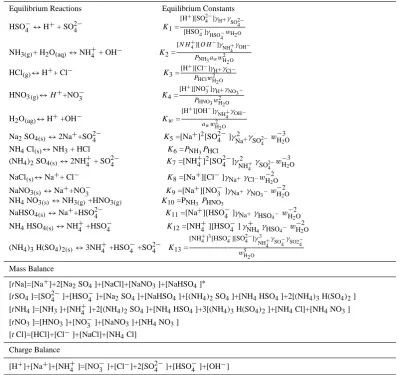
ISORROPIA assumes that equilibrium exists between gas phases and aerosol species and uses thermodynamics to cal-culate the composition of inorganic aerosols and concentra-tions of surrounding gases. Inputs to ISORROPIA include the total (gas and aerosol) concentrations of five inorganic precursor species (i.e., sulfate, nitrate, ammonium, sodium, and chloride), temperature, and relative humidity. To deter-mine the aerosol composition at equilibrium, ISORROPIA first identifies the solution regime of the given system based on sulfate ratio (i.e., the ratio of total ammonium and sodium to total sulfate). Then, the appropriate set of equilibrium and mass and charge conservation relationships are solved to calculate the phase state and equilibrium concentrations (Ta-ble 1). Each of ten subcases has its own solution procedure and a distinct set of possible species at equilibrium.
3 Development of HDDM-3D/PM
HDDM-3D/PM directly computes the high-order DDM sen-sitivity coefficients of PM concentrations to input parame-ters, such as emissions rates, and initial or boundary condi-tions, by solving derivatives of the original equilibrium and
conservation equations. First- and second-order sensitivity coefficients are defined as
sij(1)=∂Ci
∂pj
(4)
sij k(2)= ∂
2C i
∂pj∂pk
(5)
wheres(ij k2)denotes second-order sensitivity of speciesito pa-rameters j andk; Ci denotes the ambient concentration of
speciesi; andpj andpkdenote any two input parameters of
interest.
HDDM-3D/PM calculates semi-normalized sensitivity co-efficients, expressed in the same units as concentration and which allows for easier interpretation and application:
Sij(1)=∂Ci
∂εj
(6)
Sij k(2)= ∂
2C i ∂εj∂εk
(7)
whereεj andεk are relative perturbations in parameterspj
andpk, and they are related to the absolute perturbation of a
parameter byδε=δp p.
The fundamental steps to obtain high-order DDM-3D sen-sitivities for PM from CMAQ are similar to those for the gaseous species. Taking second-order derivatives of the gov-erning equation results in a similar equation which can be solved for second-order sensitivity of PM:
∂Sij k(2)
∂t = −∇(uS (2)
ij k)+ ∇(K∇S (2)
ij k) (8)
+JiS(j k2)+f (Ci,Sij(1),Sik(1),u,K,Ri,Ei)
Sij k(2)is the second-order sensitivity of speciesiwith respect to parameterspjandpk;Sij(1)andS
(1)
ik are first-order
sensitiv-ities of speciesito parameterspjandpk, respectively;Jiis
thei-th row of Jacobian matrix defined asJik=∂Rik/∂Ck. k is thekth species in the concentration vector. Sj k(2) is the vector of second-order sensitivity coeffiients.f is a function primarily ofCi,Sij(1), andSik(1). It can also be related tou,K, Ri, andEi, depending on the types of sensitivity parameters.
Table 1. Equilibrium Relations, mass and charge balance of ISORROPIA.
Equilibrium Reactions Equilibrium Constants
HSO−4 ↔H++ SO24− K1=
[H+][SO2−
4 ]γH+γ
SO24−
[HSO−4]γHSO−
4
wH2O
NH3(g)+ H2O(aq)↔NH+4 + OH
−
K2=
[N H+4][OH−]γ
NH+4γOH−
PNH3aww2H2O
HCl(g)↔H++ Cl− K3=
[H+][Cl−]γ
H+γCl−
PHClw2H2O HNO3(g)↔H++NO−3 K4=
[H+][NO−
3]γH+γNO3−
PHNO3w2
H2O
H2O(ag)↔H++OH− Kw=
[H+][OH−]γ
NH+4γOH−
awwH2O2
Na2SO4(s)↔2Na++SO24− K5=[Na+]2[SO24−]γNa2+γSO2−
4 w−H3
2O NH4Cl(s)↔NH3+ HCl K6=PNH3PHCl
(NH4)2SO4(s)↔2NH+4 + SO42− K7=[NH+4]2[SO24−]γNH2 +
4 γSO2−
4 w
−3 H2O
NaCl(s)↔Na++ Cl− K8=[Na+][Cl−]γNa+γCl−w−2
H2O NaNO3(s)↔Na++NO−3 K9=[Na+][NO−3 ]γNa+γNO
3−w
−2 H2O NH4NO3(s)↔NH3(g)+HNO3(g) K10=PNH3PHNO3
NaHSO4(s)↔Na++HSO24− K11=[Na+][HSO−4 ]γNa+γHSO
4−w
−2 H2O NH4HSO4(s)↔NH+4 +HSO
−
4 K12=[NH+4 ][HSO
−
4 ]γ
+
NH4γHSO4−w
−2 H2O
(NH4)3H(SO4)2(s)↔3NH+4 +HSO
−
4 +SO 2−
4 K13=
[NH+4]3[HSO−
4][SO 2−
4 ]γNH3 +
4
γSO−
4
γSO2−
4
w5
H2O
Mass Balance
[tNa]=[Na+]+2[Na2SO4]+[NaCl]+[NaNO3]+[NaHSO4]∗ [tSO4]=[SO24−]+[HSO
−
4 ]+[Na2SO4]+[NaHSO4]+[(NH4)2SO4]+[NH4HSO4]+2[(NH4)3H(SO4)2] [tNH4]=[NH3]+[NH4+]+2[(NH4)2SO4]+[NH4HSO4]+3[(NH4)3H(SO4)2]+[NH4Cl]+[NH4NO3]
[tNO3]=[HNO3]+[NO−3 ]+[NaNO3]+[NH4NO3]
[tCl]=[HCl]+[Cl−]+[NaCl]+[NH4Cl]
Charge Balance
[H+]+[Na+]+[NH+4 ]=[NO−3 ]+[Cl−]+2[SO24−]+[HSO−4 ]+[OH−]
*All quantities in [ ] denote molar concentrations, the unit is mol m−3air.
species is necessary to implement HDDM-3D/PM when us-ing ISORROPIA.
The implementation of HDDM in ISORROPIA involves differentiation of the equilibrium reactions that are involved in determining the concentrations of each species. For exam-ple, the equilibrium reaction for the balance between nitric acid gas (HNO3(g))and nitrate ion (NO−3) is
HNO3,(g)↔H++NO−3 (9)
The corresponding equilibrium expression is
K=
[H+][NO−3]γH+γ NO−3 PHNO3w
2 H2O
(10) whereK is the equilibrium constant; [A] denotes the mo-lar concentration ofA;γH+ andγ
NO−3 are the activity coef-ficients of H+ and NO−3; PHNO3 is the partial pressure of
HNO3gas;wH2Ois the water content.
SinceγHNO2
3=γH+γNO−3 andPHNO3
= [HNO3]RT,
K=
[H+][NO−3]γHNO2 3
[HNO3]w2H
2ORT
(11)
where γHNO3 is the mean activity coefficient of H
+ and
NO−3;Ris the universal gas constant; andT is temperature. Taking the logarithmic derivative of Eq. (11) with respect to the first parameter of interest (p1, where for brevity, T is assumed constant) leads to the expression of first-order sen-sitivity equation:
SH(1+),p
1
[H+] +
S(1) NO−3,p1 [NO−3]
−
SHNO(1) 3,p1 [HNO3]
+
2Sγ(1HNO3) ,p1 γHNO3
−
2SH(1) 2O,p1 wH2O
Differentiating Eq. (12) with respect to the second parameter of interest (p2) gives the equation for second-order sensitiv-ity:
S(2)
H+,p
1,p2
[H+] +
S(2) NO−
3,p1,p2
[NO3−] − S(2)
HNO3,p1,p2
[HNO3] +2S
(2) γHNO3,p
1,p2 γHNO3 −
2SH2O(2) ,p 1,p2 wH2O
= S(1)
H+,p1S (1) H+,p2
[H+]2 + S(1)
NO−3,p1S (1)
NO−3,p2
[NO−3]2 − S(1)
HNO3,p1S
(1)
HNO3,p2
[HNO3]2 +2S
(1) γHNO3,p
1S
(1) γHNO3,p
2 γ2
HNO3
−2S
(1)
H2O,p1S
(1)
H2O,p2 w2
H2O
(13)
Repeating the same process with the other equilibrium re-actions involved in the system gives similar expressions to Eq. (13). Combining them with mass and charge balance equations leads to a system of linear equations (Table 1) with which second-order sensitivities can be calculated. In this implementation, the available options for the two parameters
pj andpk are emission rates, reaction rate constants, initial
conditions, and boundary conditions. The approach can be extended to parameters in ISORROPIA such as equilibrium coefficients, which would require minor modification to the right hand side of Eqs. (12) and (13).
Calculating second-order DDM-3D sensitivities depends on the corresponding first-order sensitivities, so second-order sensitivities are computed sequentially following the first-order sensitivities in the same model run. Comparing Eqs. (12) and (13), identical coefficient terms multiplying the sensitivities are found on the left-hand sides, which re-duces computational cost by allowing the two systems of lin-ear equations to share the same coefficient matrix. Overall, the computational cost of second-order sensitivities is very close to that of first-order because the main computing pro-cesses (mainly transport) are the same for each sensitivity.
In ISORROPIA, the mean activity coefficients are deter-mined by Bromley’s formula (Bromley, 1973). Sensitivities of the mean activity coefficients,Sγ(1,)
HNO3p1 andS (2) γ,
HNO3p1,p2 in
Eqs. (12) and (13), are calculated by directly differentiating Bromley’s formulas. As the activity coefficients are func-tions of the ion concentrafunc-tions, their sensitivities are finally expressed as the combinations of sensitivities of relevant ion concentrations.
The liquid water content of aerosols is computed by the Zdanovskii-Stokes-Robinson (ZSR) relationship (Stokes and Robinson, 1966):
[H2O] = X
i Ei m0i
(14) whereEi is concentration of thei-th electrolyte in the
mul-ticomponent solution; m0i is the molality of a solution with
only thei-th electrolyte and the same water activity as the multicomponent solution. Sensitivities of the liquid water content are obtained by differentiating Eq. (14). Because the
concentrations of electrolytes are calculated from the equi-librium ion concentrations, both first- and second-order sen-sitivities of liquid water content can be ultimately expressed as a function of ion sensitivities:
SH(1) 2O,p1=
X i 1 moi X j ∂Ei ∂Aj
SA(1)
j,p1 (15)
SH(2)
2O,p1,p2=
X i 1 moi X j ∂Ei ∂Aj
SA(2)
j,p1,p2 (16)
whereAj represents thejth ionic species in the system.
ISORROPIA uses different algorithms to treat neutralized and acidic aerosol, so this work applied a case-specific ap-proach when implementing HDDM-3D sensitivity analysis. Depending on the acidity of the aerosol, each subcase has its own solution routine and assumptions. For example, the neutralized aerosol algorithm assumes that bisulfate ions are minor species, and its concentration is adjusted after solving the equilibrium reactions of nitrate, nitric acid gas, ammo-nium, and ammonia gas. Alternately, the acidic algorithm assumes that either ammonia or nitric acid gas is a minor species and resolves its final concentration after determin-ing aerosol concentrations of their counterparts. This fea-ture was usually neglected in previous implementations of DDM in ISORROPIA, which caused discrepancies between BF and DDM sensitivites. The problem is now solved by the case-specific approach, which exactly follows the treatment of ISORROPIA for different aerosols during HDDM imple-mentation.
4 Results and discussion
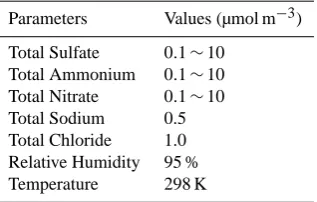
The performance of HDDM-3D/PM is evaluated in both the stand-alone ISORROPIA and the CMAQ model for inor-ganic species. In the stand-alone ISORROPIA, the HDDM-3D/PM sensitivities were compared to brute-force sensitivi-ties (first- and second- order) calculated by Eqs. (1) and (2), using a relative perturbation of 1 %. The input concentra-tions of total sulfate, ammonium, and nitrate range from 0.1 to 10 µmol·m−3with an incremental of 0.1 µmol·m−3. The input concentrations of total sodium and chloride are 0.5 and 1 µmol·m−3, respectively (Table 2). These inputs are con-sistent with the typical chemical composition of inorganic aerosols (Nenes et al., 1998b) and are also over a wide range allowing each subcase in ISORROPIA to be tested. The in-organic aerosol species are assumed to be in metastable state in CMAQ4.5, so the aerosols with the same chemical com-position but different relative humidities are treated using the same algorithm. Therefore, we used a fixed relative humidity of 95 % for stand-alone testing.
We first compared the first-order DDM-3D and BF sen-sitivities of the five major ions (i.e., H+, NH+
4, SO 2−
Table 2. Input cases for testing of HDDM-PM using stand-alone
ISORROPIA.
Parameters Values (µmol m−3)
Total Sulfate 0.1∼10
Total Ammonium 0.1∼10
Total Nitrate 0.1∼10
Total Sodium 0.5
Total Chloride 1.0
Relative Humidity 95 %
Temperature 298 K
species (slope = 1 andR2=0.99), which is essential for eval-uating the second-order sensitivities due to the dependence of second-order DDM-3D and BF sensitivities on the first-order counterparts.
The same comparison was conducted for second-order BF and DDM-3D sensitivities (Fig. 2). Although most of the points fall on the one-to-one line (slope = 1,R2=0.95), discrepancies were found for some second-order sensitivi-ties (Fig. 2). This is due to the noisy behavior of BF. As mentioned above, as the order of sensitivity coefficients in-creases, the two types of errors of BF approximations can become significantly larger. In other words, a lower degree of agreement between DDM-3D and BF are expected for second-order sensitivities. Our investigation into the noisy behavior of order BF sensitivities shows that second-order BF sensitivities vary dramatically with various sizes of perturbation (1p) and the convergence criteria of the ISOR-ROPIA solution algorithm (1η)(Fig. 3). This has also been demostrated by Capps et al. (2012). Further investigation into the charge balance for second-order BF and DDM-3D sensitivities revealed that the charge balance for BF sensitiv-ities is not satisfied when they exhibit a noisy behavior. On the other hand, the charge balance is satisfied for DDM-3D sensitivities. These results strongly suggest that the HDDM-3D sensitivity coefficients are much more stable, while the BF second-order sensitivity coefficients are subject to signif-icant numerical noise.
HDDM-3D/PM is applied to simulate a winter episode: 1–7 January 2004. Winter episodes have higher nitrate levels, which is a more stringent test of HDDM-3D/PM. The modeling domain covers the entire continental United States and portions of Canada and Mexico (Fig. 4) using a 36-km horizontal grid-spacing and thirteen vertical lay-ers extending about 16 km above the ground. The meteo-rological fields were developed using the Fifth-Generation PSU/NCAR Mesoscale Model (MM5) (Grell et al., 1994). Emissions were prepared using the Sparse Matrix Op-erator Kernel Emissions (SMOKE) model (CEP, 2003). SAPRC99 AE4 AQ was selected as the chemical mecha-nism (Carter, 2000; Binkowski and Roseelle, 2003).
The sensitivities of aerosol sulfate, nitrate, and ammonium to domain-wide SO2, NOx, and NH3emissions are studied in this simulation. During a single simulation, HDDM-3D/PM provides all the sensitivities of interest for each grid at each time step. The spatial patterns of first- and second-order DDM sensitivities of aerosol sulfate to SO2 show that the most sensitive area is the Eastern US (Fig. 4); since this re-gion is the area with the highest SO2 emissions, these sen-sitivities were expected. Spatial distributions of first- and second-order sensitivities are found to be consistent. The magnitudes of the second-order sensitivities are smaller, and usually opposite in sign, but still indicate a significant contri-bution to the total response.
Fig. 1. Comparison of first-order DDM and BF sensitivity coefficients of the five major ions (i.e.,H+, NH4+, SO42−, HSO4−, and NO−3)
to the change of total sulfate (TS), total ammonia (TA), and total nitrate (TN) in the stand-alone ISORROPIA. Each plot corresponds to the comparison of one sensitivity coefficient that is labeled on the upper left of the plot. For example, (a) shows the comparison of first-order sensitivity of hydrogen ion (H+) to total sulfate predicted by DDM and BF. The overall slope (i.e., correlation of DDM sensitivities with stand-alone ISORROPIA BF first-order sensitivities) is 1, and the overall coefficient of determination (R2) is 0.99. The dashed line is the one-to-one line for reference of perfect agreement.
Fig. 2. Comparison of second-order DDM and BF sensitivity coefficients of the five major ions (i.e.,H+, NH4+, SO24−, HSO
−
4, and NO
−
3)
Fig. 3. Second-order sensitivity coefficients of aerosol nitrate to total sulfate in stand-alone ISORROPIA calculated by (a) BF and (b) HDDM
under three conditions: (1) base case, where the perturbation used by BF (1p)= 1 % and the convergence criteria of ISORROPIA (1η)= 1×10⁻¹⁰; 2) control case 1 (blue squares) with1p= 1 % and1η=1×10⁻³; and 3) control case 2 (red diamonds) with1p=0.1 % and
1η=1×10⁻¹⁰. The default value of the convergence criteria for ISORROPIA is 1×10⁻⁶. Results from the two control cases are compared to those from the base case. The dashed line is the one-to-one line.
Fig. 4. Spatial distribution of 24-h averages of (a) simulated
con-centration of sulfate, (b) first- and (c) second-order sensitivities of sulfate to SO2at surface layer on 3 January 2004.
first-order BF and DDM-3D sensitivities compared well. BF sensitivities become less accurate when the system is quite nonlinear. This also implies the significance of the nonlinear response and the necessarity of performing high-order sensi-tivity analysis.
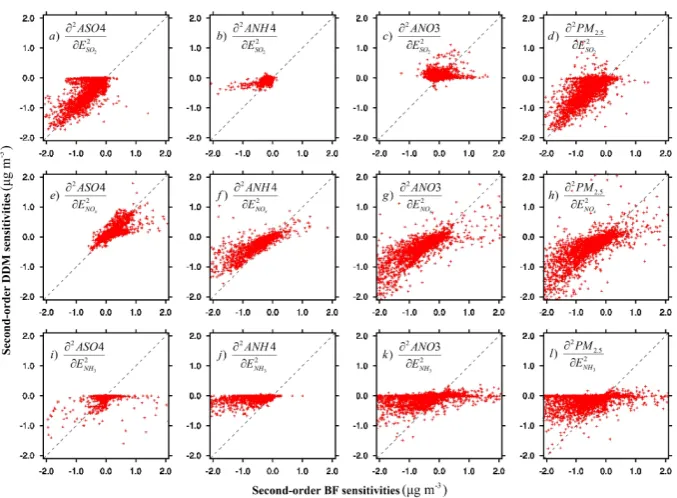
Second-order DDM-3D sensitivities are also evaluated using BF. Good agreement is found for S(SO2)=
4,SO2,SO2, SSO(2)=
4,NOx,NOx,S (2)
NH+4,NOx,NOx, andS (2)
NO−3,NOx,NOx (Fig. 6a, e,
f, and g) while the correlations are relatively low for some sensitivities, such asS(2)
NO−3,SO2,SO2
andSSO(2)=
4,NH3,NH3 (Fig. 6c
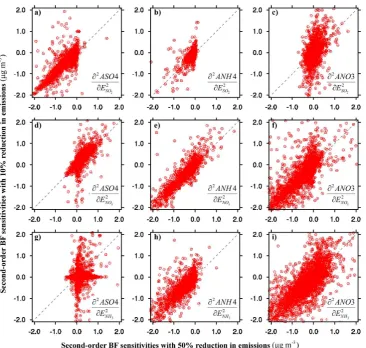
and i, Table S2). As mentioned above, second-order BF sen-sitivities for stand-alone ISORROPIA are strongly affected by the size of the perturbation. Here, we also investigated the impact of perturbation size to second-order BF sensitiv-ities. For each second-order sensitivity of interest, we com-pared the BF results with 10 % and 50 % emission reduction. The noisy behavior of second-order BF sensitivities is evi-dent (Fig. 7). The two BF scenarios in particular show little consistency for second-order sensitivity of sulfate to NH3, which suggests that BF sensitivities directly computed from Eqs. (1) and (2) may not be reliable (Fig. 7g). The plot for second-order sensitivity of nitrate to SO2also shows that the BF results vary significantly (Fig. 7c). Thus, BF is not able to accurately approximate second-order local sensitivities of PM in CMAQ. Given the good performance of HDDM in the stand-alone ISORROPIA, and the great scatter between implementing BF with different perturbations, the direct ap-proach is expected to provide more reliable results.
Fig. 5. Comparison of first-order sensitivities of sulfate, ammonium, nitrate, and PM2.5to SO2, NOx, and NH3calculated by
HDDM-3D/PM and BF at surface layer on 2 January 2004. ASO4, ANH4, and ANO3 denote aerosol sulfate, aerosol ammonium, and aerosol nitrate, respectively. Each plot represents one sensitivity coefficient that is labeled on the upper left of the plot. The dashed line is the one-to-one line indicating perfect agreement.
Fig. 6. Comparison of second-order sensitivities of sulfate, ammonium, nitrate, and PM2.5to SO2, NOx, and NH3calculated by
Fig. 7. Comparison of second-order BF sensitivities calculated with 10 % and 50 % perturbation in emissions using CMAQ simulation on
2 January 2004 at surface layer. ASO4, ANH4, and ANO3 denote aerosol sulfate, aerosol ammonium, and aerosol nitrate, respectively.
Fig. 8. Comparisons of model simulation and predictions using Taylor series expansions for concentrations of nitrate at 16:00 EDT on
2 January 2004, with (a) a 50 % reduction in NOxand (b) a 50 % reduction in SO2. The solid lines reflect the linear regression of the Taylor
Fig. 9. Comparisons of model simulation and predictions using Taylor series expansions with HDDM and BF sensitivities for concentrations
of nitrate with (a) 20 % and (b) 100 % reductions in domain-wide SO2emissions rates and concentrations of sulfate with (c) 20 % and (d) 100 % reductions in domain-wide NH3emissions rates at 16:00 EDT on 2 January 2004. BF sensitivities are from a 50 % perturbation. The
solid lines reflect the linear regression of the Taylor series predictions against the CMAQ simulation results; the dotted lines represent the area of perfect agreement.
Therefore, the time required by matrix factorization and transport-related computations is almost the same for first-and second-order sensitivities. An indirect cost associated with the second-order sensitivity calculation is that all rele-vant first-order sensitivities should also be calculated, which is generally of interest anyway in any application involving high-order sensitivity (Hakami et al., 2003). On the other hand, BF needs more than one simulation, and its computa-tional cost increases directly with the order and the number of sensitivity parameters. HDDM-3D/PM provides an effi-cient approach to conduct high-order sensitivity analysis as it computes high-order sensitivities at a similar computational effort as first-order sensitivities.
HDDM-3D/PM has many practical applications, most of which are based on Taylor series expansion (Hakami et al., 2003):
C(1ε)=C(0)+1εS(1)(0)+1ε 2
2 S
(2)(0)+higher order terms (17)
Taylor series expansions derived using HDDM sensitivity coefficients enable efficient evaluation of emission control strategies. One CMAQ-HDDM simulation would be suf-ficient to estimate the changes in pollutant concentrations with respect to emission reductions. Predictions of nitrate concentrations with 20 % and 100 % reductions in total SO2 emission using HDDM sensitivities compare well with the CMAQ model simulation. The slope from linear regression analysis is close to 1 (Fig. 9a and b). Predictions driven by BF sensitivities are close to the CMAQ simulation at 20 % reductions and are a little off the one-to-one line for 100 % reductions (Fig. 9b). The BF sensitivities used here are re-sults of a 50 % perturbation. BF sensitivities prepared us-ing a 10 % perturbation were also tested (not shown here), but suffered from more numerical noise. Simulated sulfate concentrations with 20 % and 100 % reductions in total NH3 emissions also exhibit good agreement with model simula-tion (Fig. 9c and d).
The reduction in concentrations that would occur if the sources of interest did not exist is called the zero-out source contribution (ZOC) (Cohan et al., 2005). The advantage of using Eq. (17) to calculate ZOC is that it is based on an air quality model with relevent physical and chemical pro-cesses included. Indirect effects, such as source contributions of SO2 emissions to nitrate and NH3 emissions to sulfate (Fig. 9b and d), can be reasonablely evaluated. The ZOC can also be applied to a combination of source emissions. Con-sider two emission sources (pj and pk) that are perturbed
simultaneously. The expression of ZOC of speciesi(ZOCi)
can be obtained from Eq. (17) with multiple sensitivity pa-rameters:
ZOCi(pj,pk)≈(Si,j(1)−0.5S (2) i,j,j)+(S
(1) i,k−0.5S
(2) i,k,k)−S
(2)
i,j,k (18) The cross sensivitity, the last term on the right-hand-side of Eq. (18), is able to quantify the interactions between the two emissions.
5 Conclusions
The high-order decoupled direct method in three dimen-sions for particulate matter (HDDM-3D/PM) has been imple-mented in the Community Multiscale Air Quality (CMAQ) model. The implementation of HDDM-3D/PM into ISOR-ROPIA applied a case-specific approach and explicitly com-putes the sensitivity of activity coefficients. Comparisons of the results with the traditional BF approach generally give good agreement. The BF sensitivities are found to be depen-dent on the perturbation sizes and the model accuracy, which leads to noisy behavior, especially for high-order sensitivi-ties (Figs. 3 and 7). The direct assessment of second-order sensitivities with HDDM-3D/PM avoids the apparent pitfalls of the BF approach that cause this noise.
HDDM-3D/PM has similar computational cost to the pre-vious DDM-3D/PM. The CPU time required by the aerosol
module to conduct a one-day simulation with one first-order and one second-order sensitivity parameter are 9 and 11 min, respectively. This is another advantage over the BF approach, for which computational time increases more with the order of the sensitivities computed.
The implementation of HDDM-3D/PM provides a pow-erful extension to the CMAQ model, as allowing efficient assessment of control strategy effectiveness, source contri-bution quantification, and model uncertainty analysis. Initial studies show that Taylor series expansions with the second-order term predict the model response to various emission levels very well. HDDM-3D/PM can be easily implemented into other versions of CMAQ, as well as other chemical transport models that already include DDM.
Supplementary material related to this article is available online at:
http://www.geosci-model-dev.net/5/355/2012/ gmd-5-355-2012-supplement.pdf.
Acknowledgements. This research was made possible by
fund-ing from Conoco-Phillips Inc. and US EPA (Grant numbers:
RD83215910, RD83362601, RD83096001, RD82897602, and RD83107601).
Edited by: K. Gierens
Disclaimer. The contents of this publication are solely the
respon-sibility of the grantee and do not necessarily represent the official views of the US EPA. Further, US EPA does not endorse the pur-chase of any commercial products or services mentioned in the pub-lication.
References
Ansari, A. S. and Pandis, S. N.: Response of inorganic PM to pre-cursor concentrations, Environ. Sci. Technol., 32, 2706–2714, 1998.
Ansari, A. S. and Pandis, S. N.: Water absorption by secondary organic aerosol and its effect on inorganic aerosol behavior, En-viron. Sci. Technol., 34, 71–77, 2000.
Bergin, M. S., Russell, A. G., Odman, M. T., Cohan, D. S., and Chameldes, W. L.: Single-Source Impact Analysis Using Three-Dimensional Air Quality Models, J. Air Waste Manag. Assoc., 58, 1351–1359, 2008.
Binkowski, F. S. and Roselle, S. J.: Models-3 community
multiscale air quality (CMAQ) model aerosol component – 1. Model description, J. Geophys. Res.-Atmos., 108, 4183, doi:10.1029/2001JD001409, 2003.
Boylan, J. W., Odman, M. T., Wilkinson, J. G., Russell, A. G., Doty, K. G., Norris, W. B., and McNider, R. T. : Development of a comprehensive, multiscale “one-atmosphere” modeling system: application to the Southern Appalachian Mountains, Atmos. En-viron., 36, 23, 3721–3734, 2002.
Byun, D. and Schere, K. L.: Review of the Governing Equa-tions, Computational Algorithms, and Other Components of the Models-3 Community Multiscale Air Quality (CMAQ) Model-ing System, Appl. Mech. Rev., 59, 51–77, 2006.
Capps, S. L., Henze, D. K., Hakami, A., Russell, A. G., and Nenes, A.: ANISORROPIA: the adjoint of the aerosol thermody-namic model ISORROPIA, Atmos. Chem. Phys., 12, 527–543, doi:10.5194/acp-12-527-2012, 2012.
Carlton, A. G., Bhave, P. V., Napelenok, S. L., Edney, E. D., Sarwar, G., Pinder, R. W., Pouliot, G. A., and Houyoux, M.: Model rep-resentation of secondary organic aerosol in CMAQv4.7, Environ. Sci. Technol., 44, 8553–8560, 2010.
Carter, W. P. L.: Documentation of the SAPRC99 chemical mecha-nism for VOC and reactivity assessment, Air Pollution Research Center and College of Engineering, Center for Environmental Research and Technology, University of California, Riverside, CA, 2000.
CEP: Sparse Matrix Operator Kernel Emissions Modeling System (SMOKE) User manual; Carolina Environmental Program, 2003. Cohan, D. S., Hakami, A., Hu, Y. T., and Russell, A. G.: Nonlinear response of ozone to emissions: Source apportionment and sen-sitivity analysis, Environ. Sci. Technol., 39, 6739–6748, 2005. Cohan, D. S., Koo, B., and Yarwood, G.: Influence of uncertain
reaction rates on ozone sensitivity to emissions, Atmos. Environ., 44, 3101–3109, 2010.
Dunker, A. M.: The Decoupled Direct Method For Calculating Sen-sitivity Coefficients in Chemical Kinetics, J. Chem. Phys., 81, 2385–2393, 1984.
ENVIRON: Users’ Guide, Comprehensive Air Quality Model with Extensions (CAMx), Version 4.20; ENVIRON International Cor-poration, 2005.
Edney, E. O., Kleindienst, T. E., Lewandowski, M., and Offenberg, J. H.: Updated SOA chemical mechanism for the Community Multi-Scale Air Quality model, EPA 600/X-07/025, US EPA, Research Triangle Park, NC, 2007.
Fountoukis, C. and Nenes, A.: ISORROPIA II: a
com-putationally efficient thermodynamic equilibrium model for K+Ca2+Mg2+NH4+Na+SO24-NO−3Cl−H2O aerosols, Atmos.
Chem. Phys., 7, 4639–4659, doi:10.5194/acp-7-4639-2007, 2007.
Galloway, T. S., Brown, R. J., Browne, M. A., Dissanayake, A., Lowe, D., Jones, M. B., and Depledge, M. H.: A multibiomarker approach to environmental assessment, Environ. Sci. Technol., 38, 1723–1731, 2004.
Grell, G., Dudhia, J., and Stauffer, D.: A description of the Fifth-Generation Penn State/NCAR Mesoscale Model (MM5), NCAR, NCAR/TN 398+STR, 1994.
Hakami, A., Odman, M. T., and Russell, A. G.: High-order, direct sensitivity analysis of multidimensional air quality models, Env-iron. Sci. Technol., 37, 2442–2452, 2003.
Hakami, A., Odman, M. T., and Russell, A. G.:
Nonlin-earity in atmospheric response: A direct sensitivity
anal-ysis approach, J. Geophys. Res.-Atmos., 109, D15303,
doi:10.1029/2003JD004502, 2004.
Kaiser, J.: Mounting evidence indicts fine-particle pollution, Sci-ence, 307, 1858–1861, 2005.
Kelly, J. T., Bhave, P. V., Nolte, C. G., Shankar, U., and Foley, K. M.: Simulating emission and chemical evolution of coarse sea-salt particles in the Community Multiscale Air Quality (CMAQ) model, Geosci. Model Dev., 3, 257–273, doi:10.5194/gmd-3-257-2010, 2010.
Koo, B., Dunker, A. M., and Yarwood, G.: Implementing the decou-pled direct method for sensitivity analysis in a particulate matter air quality model, Environ. Sci. Technol., 41, 2847–2854, 2007. Koo, B., Wilson, G., and Yarwood, G.: High-order Decoupled
Di-rect Method (HDDM) Radical Output Improvements in the Com-prehensive Air-quality Model with Extensions (CAMx), 582-7-84005-FY10-27, 2010.
Mendoza-Dominguez, A. and Russell, A. G.: Iterative inverse mod-eling and direct sensitivity analysis of a photochemical air duality model, Environ. Sci. Technol., 34, 4974–4981, 2000.
Napelenok, S. L., Cohan, D. S., Hu, Y. T., and Russell, A. G.: Decoupled direct 3D sensitivity analysis for particulate matter (DDM-3D/PM), Atmos. Environ., 40, 6112–6121, 2006. Nenes, A., Pandis, S. N., and Pilinis, C.: ISORROPIA: A new
ther-modynamic equilibrium model for multiphase multicomponent inorganic aerosols, Aquat. Geochem., 4, 123–152, 1998a. Nenes, A., Pilinis, C., and Pandis, S. N.: Continued
Develop-ment and Testing of a New Thermodynamic Aerosol Module for Urban and Regional Air Quality Models, Atmos. Environ., 33, 1553–1560, 1998b.
Odman, M. T. and Ingram, C. L.: Multiscale Air Quality Simulation Platform (MAQSIP): Source code documentation and validation, Environmental Programs, North Carolina Supercomputing Cen-ter, Research Triangle Park, NC, 1996.
Odman, M. T., Boylan, J. W., Wilkinson, J. G., Russell, A. G., Mueller, S. F., Imhoff, R. E., Doty, K. G., Norris, W. B., and McNider, R. T.: Integrated modeling for air quality assessment: The Southern Appalachians mountains initiative project, Journal De Physique Iv, 12, 211–234, 2002.
Odum, J. R., Jungkamp, T. P. W., Griffin, R. J., Forstner, H. J. L., Flagan, R. C., and Seinfeld, J. H.: Aromatics, reformulated gaso-line, and atmospheric organic aerosol formation, Environ. Sci. Technol., 31, 1890–1897, 1997.
Schell, B., Ackermann, I. J., Hass, H., Binkowski, F. S., and Ebel, A.: Modeling the formation of secondary organic aerosol within a comprehensive air quality model system, J. Geophys. Res.-Atmos., 106, 28275–28293, 2001.
Seinfeld, J. H. and Pandis, S. N.: Atmospheric Chemistry and Physics: From Air Pollution to Climate Change, 2 ed., Wiley, New York, 2006.
Stokes, R. H. and Robinson, R. A.: Interactions in aqueous nonelec-trolyte solutions I: Solute-solvent equilibria, J. Phys. Chem.-US, 70, 2126, 1966.
Tian, D., Cohan, D. S., Napelenok, S., Bergin, M., Hu, Y. T., Chang, M., and Russell, A. G.: Uncertainty Analysis of Ozone For-mation and Response to Emission Controls Using Higher-Order Sensitivities, J. Air Waste Manag. Assoc., 60, 797–804, 2010. US EPA: Air quality criteria for particulate matter,
EPA/600/P-99/002aF, 2004.
West, J. J., Ansari, A. S., and Pandis, S. N.: Marginal PM2.5: Non-linear aerosol mass response to sulfate reductions in the Eastern United States, J. Air Waste Manag. Assoc., 49, 1415–1424, 1999. Yang, Y. J., Wilkinson, J. G., and Russell, A. G.: Fast, direct sensi-tivity analysis of multidimensional photochemical models, Env-iron. Sci. Technol., 31, 2859–2868, 1997.
Zanobetti, A., Schwartz, J., and Dockery, D. W.: Airborne