Comparison of named entity recognition
methodologies in biomedical documents
Hye‑Jeong Song
1,2, Byeong‑Cheol Jo
1,2, Chan‑Young Park
1,2, Jong‑Dae Kim
1,2and Yu‑Seop Kim
1,2*From
International Conference on Biomedical Engineering Innovation (ICBEI) 2016 Taichung, Taiwan.
28 October–1 November 2016
Background
Named entity recognition (NER) assigns a named entity tag to a designated word by using rules and heuristics. The named entity, which presents a human, location, and an organization, should be recognized [1]. Named entity recognition is a task that extracts nominal and numeric information from a document and classifies the word into a per-son, an organization, or a date category [2]. NER classifies all words in the document into existing categories and “none-of-the-above”.
Biomedical named entity recognition is very important in language processing of bio-medical texts, especially in extracting information of proteins and genes such as RNA or DNA from documents. Finding named entities of genes from texts is a very important and difficult task [3]. Finding a gene name in texts corresponds to finding a company name or a human name in newspapers. Recognizing biomedical named entities seems to be more difficult than recognizing normal named entities [4]. Numerous research
Abstract
Background: Biomedical named entity recognition (Bio‑NER) is a fundamental task in handling biomedical text terms, such as RNA, protein, cell type, cell line, and DNA. Bio‑ NER is one of the most elementary and core tasks in biomedical knowledge discovery from texts. The system described here is developed by using the BioNLP/NLPBA 2004 shared task. Experiments are conducted on a training and evaluation set provided by the task organizers.
Results: Our results show that, compared with a baseline having a 70.09% F1 score, the RNN Jordan‑ and Elman‑type algorithms have F1 scores of approximately 60.53% and 58.80%, respectively. When we use CRF as a machine learning algorithm, CCA, GloVe, and Word2Vec have F1 scores of 72.73%, 72.74%, and 72.82%, respectively. Conclusions: By using the word embedding constructed through the unsupervised learning, the time and cost required to construct the learning data can be saved. Keywords: Biomedical named entity recognition (Bio NER), Recurrent neural network (RNN), Conditional random fields (CRFs), Word embedding
Open Access
© The Author(s) 2018. This article is distributed under the terms of the Creative Commons Attribution 4.0 International License (http://creat iveco mmons .org/licen ses/by/4.0/), which permits unrestricted use, distribution, and reproduction in any medium, provided you give appropriate credit to the original author(s) and the source, provide a link to the Creative Commons license, and indicate if changes were made. The Creative Commons Public Domain Dedication waiver (http://creat iveco mmons .org/publi cdoma in/zero/1.0/) applies to the data made available in this article, unless otherwise stated.
RESEARCH
*Correspondence: [email protected]
2 Bio‑IT Research Center,
studies have recognized named entities by using supervised learning algorithms based on many rules [5].
Supervised learning approaches have used Hidden Markov Models (HMMs) [6],
decision trees [7], support vector machines (SVMs) [8], and conditional random fields (CRFs) [9, 10]. Supervised learning methods normally train with data of many features based on various linguistic rules, and evaluate the performance with test data that could not be found in the training data.
In this paper, we compare the performances of recurrent neural networks of deep learning with conditional random fields. A recurrent neural network (RNN) uses a Jor-dan-type algorithm and an Elman-type algorithm. We also measure the performance of conditional random fields using word embedding as their features. Word embedding has increased performance in natural language processing, machine translation, voice rec-ognition, and so on [11]. Word embedding has been used as features in natural language processing and is mapped from a word in the higher-dimensional space into a real-num-bered vector in the lower-dimensional space. Word2Vec, canonical correlation analysis (CCA), and global vector (GloVe) are used as word embedding methodologies in this paper. We compared two RNN algorithms and CRFs using three word embedding meth-ods for named entity recognition in biomedical literature.
In the rest part of “Background”, we explain named entity recognition, particularly for biomedical texts. We introduce detailed methodologies and basic features used in this paper in “Methods”. “Results and discussion” shows the experimental results and evalua-tions, and “Conclusion” is our conclusion.
Biomedical named entity recognition
Named entity recognition (NER) classifies all unregistered words appearing in texts and is a subtask of information extraction. Normally, NER uses eight categories—location, person, organization, date, time, percentage, monetary value, and “none-of-the-above” [12, 13]. NER first finds named entities in sentences and declares the category of the entity. In the sentence:
“Apple [organization] CEO Tim Cook [Person] Introduces 2 New, Lager iPhones, Smart Watch at Cupertino [Location] Flint Center [Organization] Event [14].” “Apple” is recognized as an organization name instead of a fruit name in terms of its context. The words “Tim” and “Cook” are altogether recognized as a single word hav-ing a meanhav-ing of CEO of the Apple Company and a person’s name. “Cupertino” is a city name in California and is recognized as a location name, and “Flint” and “Center” are considered as a single name and recognized as an organization name.
named entities appearing in real sentences. Although rule-based approaches can use context to solve the problem of multiple named entities, every rule should be written before it is actually used. The third approach, the machine learning-based approach, tags the named entities to words even when the words are not listed in the dictionary and the context is not described in the rule set. For these approaches, support vector machines (SVMs) [18], Hidden Markov Models (HMMs) [6, 19], Maximum Entropy Markov Mod-els (MEMMs) [20], and conditional random fields (CRFs) [9, 10] are mainly utilized.
Natural language processing researchers have been interested in the information extraction of genes, cancer, and protein from biomedical literature [21–24]. Biomedical named entity recognition, which is essential to biomedical information extraction, has been treated as the first stage of text mining in biomedical texts. For years, recognizing technical terms in the biomedical area has been one of the most challenging tasks in nat-ural language processing related to biomedical research [25]. In this paper, we use five categories (protein, DNA, RNA, cell type, and cell line) instead of the categories used in the ordinary NER process. An example of the NER tagged sentence is as follows:
“IL-2 [B-protein] responsiveness requires three distinct elements [B-DNA] within the enhancer [B-DNA].”
Biomedical NER faces difficulties for five reasons. First, because of current researches, the number of new technical terms is rapidly increasing. It is very difficult to build a gaz-etteer that includes all of the new terms. Second, the same words or expressions could be classified as differently named entities in terms of their context. Third, the length of an entity is quite long, and the entity could include control characters such as hyphens (e.g., “12-o-tetradecanoylphorbol 13-acetate”). Fourth, abbreviation expressions are fre-quently used in the biomedical area, and they experience sense ambiguity. For exam-ple, “TCF” could refer to “T cell factor” or to “Tissue Culture Fluid” [26, 27]. Finally, in biomedical terms, normal terms or functional terms are combined, which is why a biomedical term can become too long. For example, infected” and “HTLV-I-transformed” include the normal terms “I”, “infected”, and ““HTLV-I-transformed”. It is difficult for biomedical NER to segment the sentence with named entities. Spelling changes also cre-ate a problem [28]. In addition, the named entity of one category could subsume another named entity of another category [29].
Methods
We perform named entity recognition for words in a sentence by using CRFs and RNN, and compare the performance of each method. We use a BioNLP/NLPBA 2004 corpus [30, 31] of 22,402 sentences. We use 18,546 sentences as a training data set, and 3856 sentences as a test data set. The corpus are tagged with “protein”, “DNA”, “RNA”, “cell line”, and “cell type” categories. The next section describes CRFs and word embedding, and the rest explains RNN.
Conditional random fields
predicts a label for a single sample without regard to “neighboring” samples, a CRF can take context into account [33]. The reason why CRFs are more effective than HMMs is that CRFs use the conditional probability property instead of the independence assump-tion mainly used in HMMs. CRFs also avoid label bias problems and avoid the weak-nesses of other Markov models derived from MEMMs and graphic models. CRFs show better performance than MEMMs and HMMs in bioinformatics, computational linguis-tics, and voice recognition. CRFs are also used for the prediction and analysis of labels for data in natural language writing. Features can be chosen randomly, and they are to be normalized to obtain solution [32, 34].
In this model, X= {x1,x2,x3,. . .xT} are the input data in which components are con-nected in sequence, and Y=y1,y2,y3,. . .yT
are the labels for each component of the input data. In other words, when a new x is given, a y value is predicted using the follow-ing model:
where z(x) standardizes the probability value, and fk is a feature function, which is a characteristic function on feature k. This function returns 1 when the given input
yt,yt−1,xt includes a feature k, and returns 0 otherwise. ωk is the weight of the feature. In this study, a CRF suite [35] was used to make predictions by using the average percep-tron generated by the CRF algorithm.
Word embedding
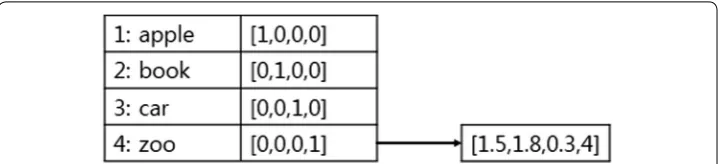
Word embedding is also called word representation or distributed representation. It learns vector representation for every word appearing in the corpus. Previous research studies represented a word as a one-hot representation. The one-hot representation uses a vocabulary-sized vector, and takes a 1 when the word appears in the document and
0 when it does not [36]. Word embedding reduces the dimensions and sparseness of
the original vector and fills the vector with real numbers. Figure 1 shows the difference between one-hot representation and word embedding.
(1) py|x= 1
z(x)
T
t=1
exp
k
k=1 ωkfk
yt,yt−1,xt
(2) z(x)=
y exp
k
ωkfk
y,x
,
Word2Vec
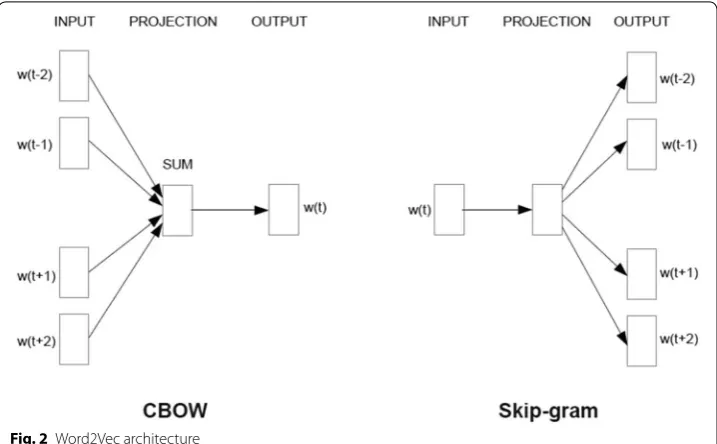
Word2Vec assumes that the words sharing the same context could have similar mean-ings. It classifies words near to the given word into related words and learns the words using artificial neural networks. Word2Vec has two structures: Continuous Bag of Words (CBOW) and skip gram architectures. Figure 2 shows the Word2Vec architecture [37].
The CBOW side has surrounding words w(t − 2), w(t − 1), w(t + 1), and w(t + 2) as input, and predicts w(t) as output. The skip-gram side uses w(t) as its input and predicts w(t − 2), w(t − 1), w(t + 1), and w(t + 2) as output.
Global vector (GloVe)
GloVe is an unsupervised learning algorithm for obtaining vector representations for words. Training is performed on aggregated global word-word co-occurrence statis-tics from a corpus, and the resulting representations showcase interesting linear sub-structures of the word vector space [38]. GloVe considers the global context as well as the local context [39].
where X is a word co-occurring in a matrix, Xij is the frequency of the co-occurrence
of word i and word j, and Xi=vkXik is the total number of occurrences of word i in the corpus. The occurrence probability of a word j in the context of a word i is
Xij=P
j|i=Xij/xi . e is word embedding, and e is a separate-context word
embed-ding. fXij indicates the weight and has three conditions. First, f(0)= 0. Second, f(x) does not decrease not to give weights to very rarely co-occurring words. Third, f(x) should be
(3) v
i,j=1 fxij
relatively smaller than the large value of x so it does not give weight to frequently co-occurred words.
Canonical correlation analysis (CCA)
Canonical correlation analysis (CCA) was introduced by Hotelling [40]. CCA is a sta-tistical method to investigate the relationship between two variable sets, and it can concurrently examine the correlation of variables belonging to different sets. CCA finds correlations between two variable sets (X, Y), and also finds parameters that maximize the correlation coefficients [41]. CCA can be calculated directly from the data set, and can also be calculated after transforming the data sets into covariance matrices. These two methods are represented based on singular value decomposition. In [42, 43], if CCA is used to predict labels in data, string theory guarantees the cor-respondence to lower-dimensional embedding. CCA tries to find two projection vec-tors to maximize the correlation. Using random variables (X, Y∈R), where X is a word representation and Y is its related context representation, CCA tries to find k -dimen-sional projection vectors that maximize the correlation between two variables [44].
Assuming that we have two variables x∈Cd1, y∈Cd2 , CCA can be defined as a problem to maximize the correlation between two variables on X and Y vectors. With a pair of vectors x= ˆwxTx, y= ˆwyTy , we can use the following correlation expression:
where Cxy=E
xyT, Cxx=E
xxT, andCyy=E
yyT . The first eigenvectors wˆx1,wˆy1 can be the first correlation P1, and the second eigenvectors can be the second correlation
P2 [45].
Recurrent neural network
In machine learning and cognitive science, artificial neural networks (ANNs) are a fam-ily of models inspired by biological neural networks that are used to estimate or approxi-mate functions that can depend on a large number of inputs and are generally unknown [46]. ANNs work well in nonlinear functions and pattern recognition. Many researchers working in data mining, artificial intelligence, and bioinformatics have been interested in ANNs for its diverse applications [47].
Figure 3 [48] shows a simple ANN structure. ANNs use an activation function with a combination function of input variables and input values. The input layer takes input values for its training, and the hidden layer is located between the input layer and the output layer. Training is performed mainly in the hidden layer and tries to find the opti-mum weight value set labeled on each edge. A sigmoid function is used on each node to calculate each node’s output after summing its inputs.
A recurrent neural network (RNN) has connections between nodes to form a directed cycle. Unlike normal feedforward networks, RNN can also use feedback systems [49]. RNN has shown outstanding performance in various natural-language processing tasks. The basic idea of RNN comes from the mechanism of sequential labeling. Normal ANNs
(4) p= E[xy]
x2Ey2
= w
T xCxywy
wT
assume independence between their inputs and outputs. RNN applies the same tasks to every component of the sequence, and the output is affected by the previous calculation results. In other words, the network is designed so that input xt of time t and the
previ-ous hidden layer’s output of time t− 1 can contribute to the hidden layer’s output of time t. Although RNN can be applied to any sequence length, shorter sequences show better performance [50].
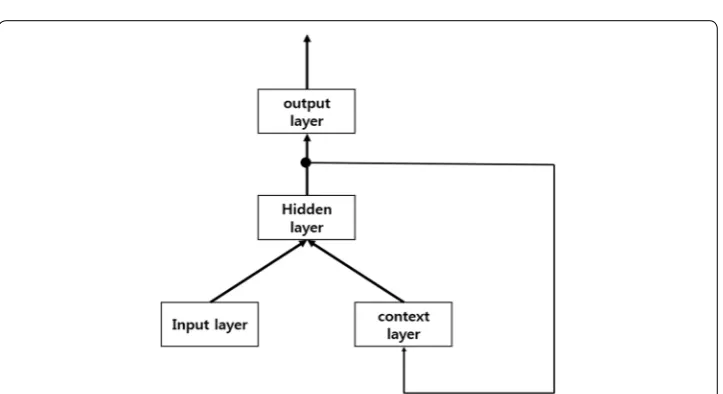
We apply an RNN algorithm by using an RNN tutorial [51]. RNN has two types: the Elman-type network [52] and the Jordan-type network [53]. The Elman-type network adds a context layer to the normal RNN and feeds back the hidden layer’s output to the context layer’s input. This network feeds back the output value to the hidden layer rather than the input layer. The hidden layer of this network plays the same role as the input layer of a normal RNN. Figure 4 shows the basic structure of the Elman-type RNN. The output of the hidden layer, a sigmoid function of each node, and the output value of this network are explained below:
Fig. 3 Simple neural network. This network takes x values as its inputs and makes o values as its outputs. This network is composed of an input layer, a hidden layer, and an output layer
In (5), which shows the output of the hidden node, U is a matrix of raw input values and current hidden nodes, and V is a matrix of the context node and the previous hid-den node. Expression (6) shows a sigmoid function, and (7) shows the output value.
The Jordan-type network shown in Fig. 5 is very similar to the Elman-type network, except that the feedback is coming from the output layer rather than the hidden layer. The hidden layer’s output is calculated by the following expression:
We use negative log-likelihood as a loss function. The gradient descent uses the mini-batch gradient descent method. This method does not apply the gradient descent method to each data, but calculates the gradient by batch and reflects it to the next learning. We apply a mini-batch gradient descent to one batch in one sentence. Because the length of the sentences in the corpus are all different, this method works well.
(5)
h(t)=f(Ux(t)+Vh(t−1))
(6) f(x)= 1
1+e−x
(7) yt=g(Wh(t))
(8)
h(t)=fUx(t)+Vy(t−1)
Fig. 5 Jordan‑type network. Feedback starts from output layer, not the hidden layer
Table 1 N-Gram description
Feature Description
Unigram wi−2, wi−1, wi, wi+1, wi+2
Feature
This study uses n-Gram features for a baseline experiment of the conditional random fields. Recurrent neural networks use raw word sequences for their inputs. Table 1 lists the unigrams, bigrams, and trigrams used in this study.
For the sentence, “Tumor and serum beta-2-microglobulin expression in women with breast cancer”, let us assume that wi is “breast”. Then, wi−2, wi−1, wi+1 and wi+2 are
“women”, “with”, “cancer” and “.”, respectively. wi−1|wi of the bigram is “with|breast”,
and wi−2|wi−1|wi is “with|breast|cancer”.
Results and discussion
We use a BioNLP/NLPBA 2004 shared corpus for the experiment. In this experiment, we compare the performance of RNN and CRFs with word embedding. For the base-line, only n-Gram (unigram, bigram, trigram) features of CRFs are utilized. The Jor-dan-type RNN and Elman-type RNN are compared, and at the same time, Word2Vec, GloVe, and CCA of the CRFs are also compared. For performance evaluation, we set the word embedding dimension to 100, the window size to 5, the number of hidden units to 100, and the number of hidden layers to 1.
We use the F1 score as the performance measurement. The F1 score is calculated by the following expression:
where the precision is a ratio of true positives from the positive side, and recall is a ratio of true positives from the true side.
In this experiment, the Jordan-type RNN shows an F1 value of 60.75%, and the Elman-type RNN has an F1 value of 58.80%. For the CRFs’ performance measure-ment, we apply various dimensions of word embedding (10, 30, 50, 80, 100), window sizes (3, 5, 7, 9, 11), and the minimum frequency (3).
(9)
F1 score= 2∗precision*recall
precision+recall ,
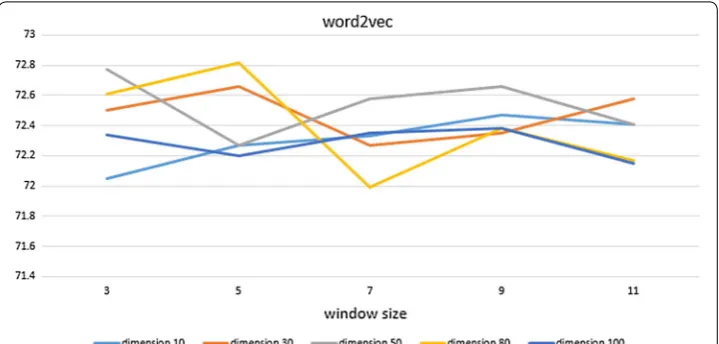
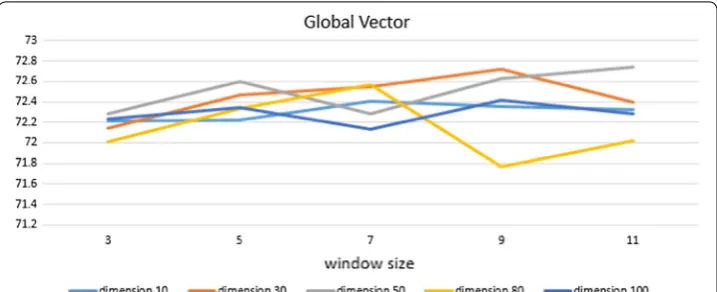
Figures 6, 7 and 8 show the experimental results of each word embedding method with various dimensions and window sizes.
Word2Vec shows the highest performance when the dimension size is 80 and the window size is 5. However, the same line shows the lowest performance when the window size is changed to 7. In Fig. 6, the line with dimension size of 50 shows a rela-tively stable and high performance for all window sizes. Word2Vec does not seem to need high-dimensional representation, and lower-dimensional representations show an increase in performance proportional to the window size. Higher-dimensional rep-resentations do not exhibit particular characteristics in Word2Vec.
In GloVe, a representation of 50 dimensions and 11 window sizes shows the highest performance. Like Word2Vec, GloVe also shows relatively stable and high performance when its size of dimension is 50. Of course, the 30-dimensional representation also shows a good result.
Figure 8 shows that lower-dimensional cases have relatively higher performance than higher-dimensional cases when CCA is used for word embedding.
Fig. 7 Experimental results of Global Vector in CRFs. The X‑axis indicates window size, and Y‑axis indicates performance. Five lines correspond to five dimension sizes
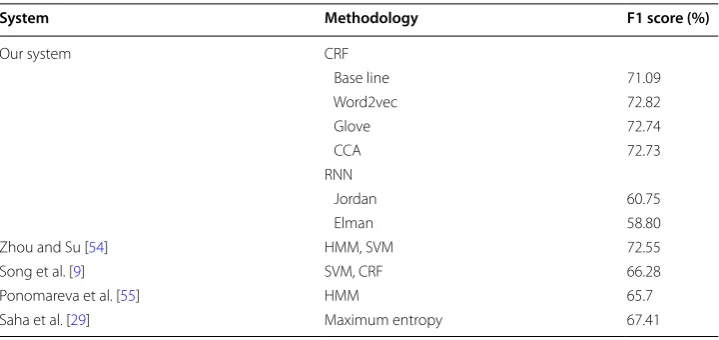
Table 2 lists the results compared with well-known former research results. Our sys-tem shows an F1 score of up to 72.82%, which is the highest of all the results in Table 2,
when CRFs of Word2Vec are used. Zhou et al. [54] used HMM and SVM to achieve
72.55% for the BioNLP/NLPBA shared task 2004, and their achievement has been the highest until now. At the same competition, Song et al. achieved 66.28% by using HMM and CRF. Ponomareva et al. [55] used HMM and achieved 65.7%, and Saha et al. [29] used Maximum Entropy to obtain an F1 score of 67.41%. Findel et al. [56], Settles [57], and Tsai et al. [58] reported scores of 69.8% to 70.2%, which could not overcome the results from Zhou and Su. Our system shows a maximum score of 72.82%, which is approximately 0.3% points higher than Zhou and Su’s scores when using Word2Vec-based CRFs. Word embedding is also advantageous in that it is automatically con-structed through the unsupervised learning, while the existing methodology uses data that is directly labeled by a person. Our approach does not require any domain knowl-edge, a dictionary, or other outside resources, but we were able to show the highest per-formance of all tested methods.
Conclusion
Bio-NER has more difficulties than normal NER because technical terms in biomedical texts have unusual characteristics. We compared various machine-learning approaches based on CRFs and RNN. In this research, RNN exhibited a lower performance than CRFs. The disadvantage of RNN is that it does not remember old information. Also, since we did not find the optimal activation function and initialization method, RNN has lower performance than CRFs. We use a single hidden layer. However, RNN could be a very useful method in Bio-NER because of its unsupervised learning property. From an experiment, our method shows the highest performance of all the other experiments.
For the future study, our research will proceed in three directions. First, we will design a more optimized deep artificial neural network structure for the Bio-NER. Because we had limited knowledge and experience in deep artificial neural network, this study used a relatively simple model. Therefore, we will develop deep artificial neural network spe-cialized on this problem based on accumulated knowledge and technology. Second, we
Table 2 Performance comparison by using BioNLP/NLPBA 2004 corpus
System Methodology F1 score (%)
Our system CRF
Base line 71.09
Word2vec 72.82
Glove 72.74
CCA 72.73
RNN
Jordan 60.75
Elman 58.80
Zhou and Su [54] HMM, SVM 72.55
Song et al. [9] SVM, CRF 66.28
Ponomareva et al. [55] HMM 65.7
would like to develop unsupervised learning methods for the Bio-NER. The lack of an annotated corpus is a barrier to new research. Although it has unsupervised learning properties, RNN requires an annotated corpus. We should develop fully- or semi-super-vised learning methods for Bio-NER. Third, various linguistic resources for domain knowledge should be built for performance development. Gazetteers, word embedding methods, and other resources should be developed.
Abbreviation
NER: named entity recognition; RNN: recurrent neural network; CRF: conditional random fields; CCA : canonical correla‑ tion analysis; GloVe: global vector; SVM: support vector machines; HMM: Hidden Markov Models; MEMM: Maximum Entropy Markov Models; NLP: natural language processing.
Declarations
Authors’ contributions
Song took parts in deep learning design and implementation. Jo prepared for the whole experiment, including data and programming. Park advised Jo in implementing CRFs and CNN. J Kim expertized in biomedical IT convergence research. He analyzed input and output data. Y Kim is a corresponding author. He design this research and directed this research team. All authors read and approved the final manuscript.
Author details
1 School of Software, Hallym University, Chuncheon, South Korea. 2 Bio‑IT Research Center, Hallym University,
Chuncheon, South Korea.
Acknowledgements Not applicable.
Competing interests
The authors declare that they have no competing interests.
Availability of data and materials
The datasets used and/or analysed during the current study available from the corresponding author on reasonable request.
Consent for publication Not applicable.
Ethics approval and consent to participate Not applicable.
Funding
This research was supported by Basic Science Research Program through the National Research Foundation of Korea (NRF) funded by the Ministry of Science, ICT and future Planning (2015R1A2A2A01007333), and (NRF‑ 2017M3C4A7068188). The publication charge for this article was funded by the first grant and the second grant sup‑ ported a part of this research.
About this supplement
This article has been published as part of BioMedical Engineering OnLine Volume 17 Supplement 2, 2018: Proceedings of the International Conference on Biomedical Engineering Innovation (ICBEI) 2016. The full contents of the supplement are available online at https ://biome dical ‑engin eerin g‑onlin e.biome dcent ral.com/artic les/suppl ement s/volum e‑17‑suppl ement ‑2.
Publisher’s Note
Springer Nature remains neutral with regard to jurisdictional claims in published maps and institutional affiliations.
Published: 6 November 2018
References
1. Sang EFTK, Meulder FD. Introduction to the CoNLL‑2003 shared task: language‑independent named entity recogni‑ tion. In: Proceedings of the seventh conference on natural language learning at HLT‑NAACL, vol. 4. 2003. p. 142–7. 2. Isozaki H, Kazawa H. Efficient support vector classifiers for named entity recognition. In: Proceedings of the 19th
international conference on computational linguistics. Association for Computational Linguistics, vol. 1. 2002. p. 1–7. 3. Leaman R, Gonzalez G. BANNER: an executable survey of advances in biomedical named entity recognition. Pac
Symp Biocomput. 2008;13:652–63.
5. Rau LF. Extracting company names from text. In: Proceedings of the conference on artificial intelligence applications of IEEE, vol. 1. 1991. p. 29–32.
6. Zhao S. Named entity recognition in biomedical texts using an HMM model. In: Proceedings of the international joint workshop on natural language processing in biomedicine and its applications. Association for Computational Linguistics. 2004. p. 84–7.
7. Sekine SN. Description of the Japanese NE system used for Met‑2. In: Proceedings of the message understanding conference. 1998. p. 1314–9.
8. Lee KJ, Hwang YS, Rim HC. Two phase biomedical NE recognition based on SVMs. In: Proceedings of the ACL 2003 workshop on natural language processing in biomedicine. Association for Computational Linguistics, vol. 13. 2003. p. 33–40.
9. Song Y, Kim E, Lee GG, Yi B. POSBIOTM‑NER in the shared task of BioNLP/NLPBA 2004. In: Proceedings of the international joint workshop on natural language processing in biomedicine and its applications. Association for Computational Linguistics. 2004. p. 100–3.
10. McCallum A, Li W. Early results for named entity recognition with conditional random fields, features induction and web‑enhanced lexicons. In: Proceedings of the seventh conference on natural language learning at HLT‑NAACL, vol. 4. Association for Computational Linguistics. 2003. p. 188–91.
11. Qiu L, Cao Y, Nie Z, Yu Y, Rui Y. Learning word representation considering proximity and ambiguity. In: Twenty‑eighth AAAI conference on artificial intelligence. 2014. p. 1572–8.
12. Borthwick A. A maximum entropy approach to named entity recognition. Doctoral dissertation. New York: New York University; 1999.
13. Santos CN, Milidiú RL. Entropy guided transformation learning: algorithms and applications. New York: Springer; 2012.
14. Adam W. Named entity recognition at RAVN‑part 1. https ://www.ravn.co.uk/named ‑entit y‑recog nitio n‑ravn‑part‑1/. Accessed Apr 2016.
15. Cohen KB, Hunter L. Natural language processing and systems biology. Artificial intelligence and systems biology. New York: Springer; 2005. p. 145–73.
16. Liu H, Hu Z, Torii M, Wu C, Friedman C. Quantitative assessment of dictionary‑based protein named entity tagging. J Am Med Inform Assoc. 2006;13:497–507.
17. Fukuda K, Tsunoda T, Tamura A, Takagi T. Toward information extraction: identifying protein names from biological papers. Pac Symop Biocomput. 1998;707:707–18.
18. Kazama J, Makino T, Ohta Y, Tsujii J. Tuning support vector machines for biomedical named entity recognition. In: ACL‑02 workshop on natural language processing in biomedical applications, vol. 3. 2002. p. 1–8.
19. Cutting D, Kupiec J, Pedersen J. Sibun P. A practical part‑of‑speech tagger. In: Proceedings of the third conference on applied natural language processing. 1992. p. 133–40.
20. McCallum A, Freitag D, Pereira FC. Maximum entropy Markov models for information extraction and segmentation. ICML. 2000;17:591–8.
21. Aronson AR, Rindflesch TC, Browne AC. Exploiting a large thesaurus for information retrieval. Proc RIAO. 1994;94:197–216.
22. Baker PG, Goble CA, Bechhofer S, Paton NW, Stevens R, Brass A. An ontology for bioinformatics applications. Bioinfor‑ matics. 1999;15:510–20.
23. Blaschke C, Miguel AA, Ouzounis C, Valencia A. Automatic extraction of biological information from scientific text: protein–protein interactions. ISMB. 1999;7:60–7.
24. Craven M, Kumlien J. Constructing biological knowledge bases by extracting information from text sources. ISMB. 1999;7:77–86.
25. Krauthammer M, Nenadic G. Term identification in the biomedical literature. J Biomed Inform. 2004;37:512–26. 26. Wang H, Zhao T, Tan H, Zhang S. Biomedical named entity recognition based on classifiers ensemble. IJCSA.
2008;5:1–11.
27. Campos D, Matos S, Oliveira JL. Biomedical named entity recognition: a survey of machine learning tools. New York: INTECH Open Access Publisher; 2012.
28. Tsai RTH, Sung C, Dai H, Hung H, Sung T, Hsu W. NERBio: using selected word conjunctions, term normalization, and global patterns to improve biomedical named entity recognition. BMC Bioinform. 2006;7:11.
29. Saha SK, Sarkar S, Mitra P. Feature selection techniques for maximum entropy based biomedical named entity recognition. J Biomed Inform. 2009;42:905–11.
30. Jin‑Dong K. Report on Bio‑Entity Recognition Task at BioNLP/NLPBA 2004. http://www.nacte m.ac.uk/tsuji i/GENIA / ERtas k/repor t.html. Accessed Apr 2016.
31. Kim JD, Ohta T, Tsuruoka Y, Tateisi Y. Introduction to the bio‑entity recognition task at JNLPBA. In: Proceedings of the international joint workshop on natural language processing in biomedicine and its applications. Association for Computational Linguistics. 2004. p. 70–75.
32. Lafferty J, McCallum A, Pereira F. Conditional random fields: probabilistic models for segmenting and labeling sequence data. In: Proceedings of the eighteenth international conference on machine learning, vol. 1, ICML. 2001. p. 282–289.
33. Wikipedia. https ://en.wikip edia.org/wiki/Condi tiona l_rando m_field . Accessed Apr 2016.
34. Mahmoud A, Pattar A, Hamdulla A. Uyghur stemming using conditional random fields. Int J Sign Process Image Process Pattern Recognit. 2015;8:43–50.
35. Naoaki Okazaki. CRFsuite. http://www.chokk an.org/softw are/crfsu ite/. Accessed April 2016.
36. Collobert R, Weston J, Bottou L, Karlen M, Kavukcuogle K, Kuksa P. Natural language processing (almost) from scratch. J Mach Learn Res. 2011;12:2493–537.
37. Mikolov T, Chen K, Corrado G, Dean J. Efficient estimation of word representations in vector space. In: ICLR. 2013. 38. Pennington J, Socher R, Manning CD. Glove: global vectors for word representation. https ://nlp.stanf ord.edu/proje
• fast, convenient online submission •
thorough peer review by experienced researchers in your field • rapid publication on acceptance
• support for research data, including large and complex data types •
gold Open Access which fosters wider collaboration and increased citations maximum visibility for your research: over 100M website views per year •
At BMC, research is always in progress.
Learn more biomedcentral.com/submissions
Ready to submit your research? Choose BMC and benefit from:
39. Pennington J, Socher R, Manning CD. Glove: Global vectors for word representation. In: Proceedings of the empirical methods in natural language processing. EMNLP. 2014. p. 1532–43.
40. Hotelling H. Relations between two sets of variates. Biometrika. 1936;28:321–77.
41. Härdle W, Simar L. Canonical correlation analysis. In: Applied multivariate statistical analysis. 2007. p. 321–30. 42. Kakade SM, Foster DP. Multi‑view regression via canonical correlation analysis. Learning theory. Berlin: Springer;
2007. p. 82–96.
43. Sridharan K, Kakade SM. An information theoretic framework for multi‑view learning. In: Conference on learning theory. COLT. 2008. p. 403–14.
44. Stratos K, Collins M, Hsu D. Model‑based word embeddings from decompositions of count matrices. In: Proceedings of the annual meeting of the association for computational linguistics. 2015. p. 1282–91.
45. Johansson B, Borga M, Knutsson H. Learning corner orientation using canonical correlation. 2001. 46. Wikipedia. https ://en.wikip edia.org/wiki/Artifi cial _neura l_netwo rk. Accessed Apr 2016.
47. Hagan MT, Demuth HB, Beale MH, Jesus OD. Neural network design. Boston: PWS Publishing Company; 1996. 48. Data Mining Server (DMS). Neural Networks http://dms.irb.hr/tutor ial/tut_nnets _short .php. Accessed Apr 2016. 49. Nielsen MA. Neural networks and deep learning. http://neura lnetw orksa nddee plear ning.com. Accessed Apr 2016. 50. Mesnil G, He X, Deng L, Bengio Y. Investigation of recurrent‑neural‑network architectures and learning methods for
language understanding. Graz: INTERSPEECH; 2013. p. 3771–5.
51. Gregoire M. Recurrent neural networks with word embeddings. http://deepl earni ng.net/tutor ial/rnnsl u.html. Accessed Mar 2016.
52. Elman JL. Finding structure in time. Cognit Sci. 1990;14:179–211.
53. Jordan MI. Serial order: a parallel distributed processing approach. Adv Psychol. 1997;121:471–95.
54. Zhou GD, Su J. Exploring deep knowledge resources in biomedical name recognition. In: Proceedings of the international joint workshop on natural language processing in biomedicine and its applications. Association for Computational Linguistics. 2004. p. 96–9.
55. Ponomareva N, Pla FA, Molina A, Rosso P. Biomedical named entity recognition: a poor knowledge HMM‑based approach. New York: LNCS; 2007. p. 382–7.
56. Finkel J, Dingare S, Nguyen H, Nissim M, Manning C, Sinclair G. Exploiting context for biomedical entity recognition: From syntax to the Web. In: Proceedings of the joint workshop on natural language processing in biomedicine and its applications. 2004. p. 88–91.
57. Settles B. Biomedical named entity recognition using conditional random fields and rich feature sets. In: Proceed‑ ings of joint workshop on natural language processing in biomedicine and its applications. 2004. p. 104–7. 58. Tsai T, et al. Integrating linguistic knowledge into a conditional random field framework to identify biomedical