R E S E A R C H
Open Access
User activity recognition system to
improve the performance of environmental
control interfaces: a pilot study with patients
Arturo Bertomeu-Motos
1*, Santiago Ezquerro
1, Juan A. Barios
1, Luis D. Lledó
1, Sergio Domingo
2,
Marius Nann
4, Suzanne Martin
3, Surjo R. Soekadar
5and Nicolas Garcia-Aracil
1Abstract
Background: Assistive technologies aim to increase quality of life, reduce dependence on care giver and on the long term care system. Several studies have demonstrated the effectiveness in the use of assistive technology for environment control and communication systems. The progress of brain-computer interfaces (BCI) research together with exoskeleton enable a person with motor impairment to interact with new elements in the environment. This paper aims to evaluate the environment control interface (ECI) developed under the AIDE project conditions, a multimodal interface able to analyze and extract relevant information from the environments as well as from the identification of residual abilities, behaviors, and intentions of the user.
Methods: This study evaluated the ECI in a simulated scenario using a two screen layout: one with the ECI and the other with a simulated home environment, developed for this purpose. The sensorimotor rhythms and the horizontal oculoversion, acquired through BCI2000, a multipurpose standard BCI platform, were used to online control the ECI after the user training and system calibration. Eight subjects with different neurological diseases and spinal cord injury participated in this study. The subjects performed simulated activities of daily living (ADLs), i.e. actions in the simulated
environment as drink, switch on a lamp or raise the bed head, during ten minutes in two different modes,AIDEmode,
using a prediction model, to recognize the user intention facilitating the scan, andManualmode, without a prediction model.
Results: The results show that the mean task time spent in theAIDEmode was less than in theManual, i.e the users were able to perform more tasks in theAIDEmode during the same time. The results showed a statistically significant differences withp<0.001. Regarding the steps, i.e the number of abstraction levels crossed in the ECI to perform an
ADL, the users performed one step in the 90% of the tasks using theAIDEmode and three steps, at least, were
necessary in theManualmode. The user’s intention prediction was performed through conditional random
fields (CRF), with a global accuracy about 87%.
Conclusions: The environment analysis and the identification of the user’s behaviors can be used to predict the user intention opening a new paradigm in the design of the ECIs. Although the developed ECI was tested only in a simulated home environment, it can be easily adapted to a real environment increasing the user independence at home.
Keywords: Environment control interface, Brain-computer interface, User intention prediction, Multimodal system, Brain injury, Spinal-cord injury
*Correspondence:[email protected]
1Miguel Hernández University of Elche, Av. Universidad w/n, Ed. Innova, 03202
Elche, Spain
Full list of author information is available at the end of the article
Background
It is estimated that one in six people in the world are diagnosed with a neurological disorder and this number is expected to rise considerable due to extensions of life expectancy [1]. A neurological condition is a damage to the brain, spinal column or nerves due to illness or injury such as spinal cord injury, acquired brain damage, stroke, motor neurons disease and locked in syndrome. Neu-rological disorders are considered the primary cause of disability in modern society [1,2]. The debilitating conse-quences of neurological disorders include communication difficulties, impaired memory, inappropriate behav-ior, physical disability, restricted independence, social isolation and poor quality of life.
Assistive technologies aim to increase quality of life [3–6], reduce dependence on care giver [7] and reduce dependence on the long term care system [8]. Several studies have demonstrated the effectiveness in the use of environment control interfaces (ECI) for environment control or communication through voice commands [9], scan interfaces based on grid structure, eye tracking [10–12] or brain-computer interface (BCI) based on P300 [13], among others. These software platforms actively aid during the Activities of Daily Living (ADL) improving the independence both at home and outside. However, these platforms are based in a manual scan over the different abstraction levels of the ECIs and the scan speed only depends on the users familiarization with the system and the configuration of the grids over the different menus. Thus, introducing the user environment and behavior into this loop will help the navigation agility in the ECIs.
On the other hand, The progress of BCI research together with exoskeleton enables a person with motor impairment to interact with new elements of the environ-ment [14,15]. Thus, this progress will deliver new scenar-ios to BCI systems out of laboratories and move BCI into the domestic environment. The AIDE project1 aims to create new shared-control paradigm for assistive devices that integrates information from identification of resid-ual abilities, behaviors, emotional state and intentions of the user on one hand and analysis of the environment and context factors on the other hand. In this context, a hybrid BCI model was chosen to control the ECI. It was devel-oped as a fusion between non-invasive electroencephalog-raphy (EEG) and electrooculogelectroencephalog-raphy (EOG) system [16]. The EEG records the sensorimotor rhythms (SMR) called event-related desynchronization (ERD) and event-related synchronization (ERS) during a motor imagery (MI) task [17] whilst the EOG records the horizontal oculoVer-sion (HOV).
This paper aims to evaluate the ECI developed under the AIDE project conditions, a multimodal system developed to assist people with acquired brain damage or neuro-degenerative diseases that need a wheelchair and has low
or any upper limbs mobility in their ADLs, in a simulated environment able to detect the user intention through the environment analysis and the identification of the user’s behaviors, based on a conditional random fields (CRF) model [18]. Thus, the handling of the interface was stud-ied in two different ways, with and without the prediction of the user’s intention. Users with neurological and mus-cular diseases and spinal cord injury (SCI) tested the system on a virtual home due to the early phase of the project.
Methods
This study evaluated the ECI in a simulated scenario under the AIDE project conditions, a multimodal inter-face able to analyze and extract relevant information from the environments as well as from the identification of residual abilities, behaviors, and intentions of the user. It consisted in a two screen layout: ECI and simulated room, with an EEG and EOG data acquisition system (see Fig.1).
Environment control interface
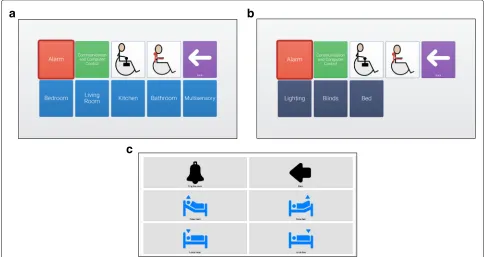
The environment control system used in this experi-mentation was based in two main software components: GRID3 from Smartbox2, a commercial augmentative and alternative communication (AAC) solution, and SHX, a specific developed software, presented in Fig2. The ECI had three different abstraction levels: 1) related with the room (room menu), 2) related to the activities that can be performed in a specific room (activity menu), and 3) related to the actions regarding a specific activity (ADL menu). The jump between two consecutive abstraction levels will be named asstep.
Levels one and two were specific grid sets, created in GRID3, to be used in the context of the experimentation. They include grids for the different rooms, communica-tion, control a wheelchair and control an exoskeleton arm. In all grids, a color code has been used: red for the alarm; green for communication, computer control and digital leisure; white for wheelchair and arm control (not used in this experimentation); light blue for the rooms; dark blue for environmental control activity. The dark blue cells are referred to environmental control activities and linked Grid3 with the SHX application. The user could scan across the different cells, select one, and then confirm or cancel the selection using the chosen signals (EOG, EEG, eye tracking, etc.).
a
b
Fig. 1Experimentation setup. The experimental setup was composed by two screens layout: ECI & Virtual home simulator, and an eye tracking placed in the bottom screen. The users performed tasks in the simulated environment (a) and they also interacted with real elements (b)
Data acquisition
The acquisition of the brain activity was performed with eight solid-gel electrodes placed according to international 10-20 system placed at F3, C3, Cz, P3, T7 and Mastoid, a reference electrode was placed on C4 and the ground on FpZ. Furthermore, two
electrodes were placed on the outer canthus of the eyes to the EOG signal recording. The EEG/EOG signal was acquired via Bluetooth through the Neuro-electrics amplifier (Enobio, NeuroNeuro-electrics, Barcelona, Spain). Skin/electrode resistance was kept below 12 kOhm.
a
c
b
A real-time SMR-based BCI was implemented using BCI2000, a freely distributed software for multipurpose standard BCI platform [19]. EEG and EOG were recorded at a sampling rate of 500 Hz, bandpass filtered at 0.4-70 Hz and pre-processed using a small Laplacian filter. Based on the maximum values for basal ERD, the ongoing EEG signal associated with the specified SMR rhythm fre-quency range (11-14 Hz) calculated from C3 electrode, a subject’s individual motor imagery discrimination thresh-old were set. The EOG discrimination threshthresh-olds were calculated regarding the average amplitudes of horizon-tal saccades. These individual parameters were obtained from the training session and used for later online BCI control [20].
Prediction model
The proposed ECI combines the environmental informa-tion and context factors together with user’s behaviors in order to detect the user intention. Thus, the input information of the prediction model was a sequence of data, the user is moving and looking at the envi-ronment, that had to be labeled. In this context, dif-ferent models were tested (time-delay neural networks, decision trees, hidden markov model (HMM)...) and the CRF model was chosen, showing the best results. The CRF model is a probabilistic model for segmen-tation and labeling sequence data. This discriminate model takes into account not only the current state but also the previous states to perform its prediction. A conditional model specifies the probabilities of pos-sible label sequences given an observation sequence in contras of the generative models that make very strict independence assumptions on the observation, for instance conditional independence given the labels as HMM [21].
In our case, the inputs of the system were: localiza-tion, objects in the environment, object that the user is looking at, temperature of the room, brightness of the room and day time; the output was the ADL menu, i.e. the most probable action that the user wanted to perform that were directly linked with a specific ADL (see Table1.
Participants
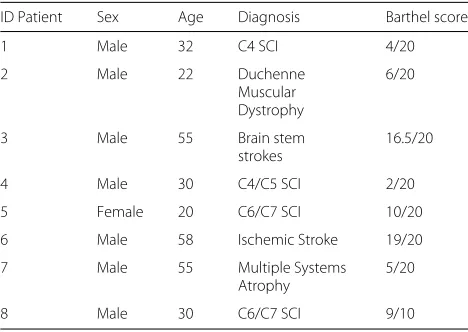
Eight persons with different neurological pathology and spinal cord injury participated in this study (37 ± 15 years old), their demographic and clinical characteris-tics are listed in (Table 2). The subjects were evalu-ated before the experiment with the barthel index [22]. All participants gave informed consent using their stan-dard communication channel prior to participation in the study. The protocol was approved by the Office Research Ethics Northern Ireland - approval granted for project (15/NE/0384).
Table 1Correlation between the ADLs and ADL menu name, in the third abstraction level
ADLs ADL menu ADLs ADL menu
Open/close fridge
Drink or eat Switch on/off air conditioner
Air conditioner
Open/close microwave
Drink or eat Brushing teeth Teeth
Eating task Eat Washing face Face
Drinking task Drink Raise/lower the
bed head
Bed
Switch on/off Music
Entertainment Raise/lower the bed feet
Bed
Switch on/off PC Entertainment Open/close the blinds
Blinds
Switch on/off TV TV Switch on/off the light
Light
Experimental protocol
Subjects were sitting in his/her own wheelchair in front of a table with two screens, as shown in Fig.1. The screens were used to show the ECI and the virtual home simula-tor. Subjects used the AIDE multimodal interface, hybrid EEG EOG system, to online control the ECI and preform specific ADLs. Two modes were tested:
A) MANUAL mode: the user had to navigate through
the three abstraction levels in order to accomplish the task showed in the virtual house. The objects related with the corresponding task were surrounded by a green color in the virtual house environment and the task appeared in the right top corner.
B) AIDE mode: in this mode the prediction model was
used. The user had to look at the objects related to the specific ADL, showed like in the other mode, and, after the user’s intention prediction, the ECI directly jumped to the corresponding ADL menu. Then the
user had to navigate likeMANUAL mode. In case of
Table 2Demographic and clinical characteristics of participants
ID Patient Sex Age Diagnosis Barthel score
1 Male 32 C4 SCI 4/20
2 Male 22 Duchenne
Muscular Dystrophy
6/20
3 Male 55 Brain stem
strokes
16.5/20
4 Male 30 C4/C5 SCI 2/20
5 Female 20 C6/C7 SCI 10/20
6 Male 58 Ischemic Stroke 19/20
7 Male 55 Multiple Systems
Atrophy
5/20
wrong prediction, the user had to manually go back, the second abstraction level, and complete the corresponding ADL. The observed objects were
online detected from the eye tracking Tobbi3PCEye
go, placed on the virtual environment screen, and the rest of the inputs were online simulated.
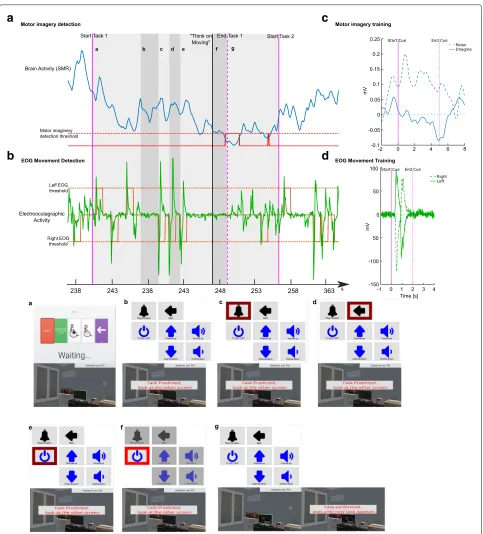
Each subject performed two experimental sessions in two consecutive days. The first session was for training and calibration purpose as well as for the familiariza-tion with the systems to be controlled. This session lasted around 60-80 min. In the last part of this session the user learned how to use the hybrid EEG/EOG interface in order to control the ECI. An example of MI and EOG movements in the training session are shown in Fig. 3c and d, respectively.
The second session lasted a maximum of 60 min. The setup and familiarization phase took approximately 15 min (subjects have already tested the system in the first session). They had 10 min to perform a predefined ADLs list in bothAIDE andManual modes (all ADLs can be observed in Table1). Each ADL can be a single action, it has a visual effect on the house simulator, e.g. swith on a lamp, or an exoskeleton action, the simulator play a short video showing the corresponding action, e.g. drink from a glass. The order of the modes was randomly selected and, before each mode, a baseline of 3 min was acquired. During the break (5 min) and at the end of this session the subjects answered the NASA task load index (tlx) questionnaire [23].
The scan in the ECI was performed through looking-right eye movements (Fig. 3b) implying a forward dis-placement of the grid marker (Fig.3a-e). Once the subject stopped at one grid a customized time, chosen in the first session, the ECI ‘switch off ’ the rest of the grids (Fig.3f ). Then, the next level or the action in the ECI was achieved by on-line ERD detection, like the subjects learned during the first session (Fig.3a). On the other hand, if the user did not want to click on this specific grid, in the phase Fig. 3f, a looking-left eye movement returns the ECI to the phase Fig.3a. When the user performs an action, a visual feedback is presented in the virtual home regarding to the action performed (Fig.3g) and he/she waited for the next task.
After both modes, they were instructed to interact with real elements through the ECI and watch a video using objects of a multi-sensory room, as can be observed in Fig.1b.
Results
The users performed simulated ADLs during 10 min in a virtual home using an ECI in both Manual and AIDE modes. The number of the performed tasks with respect to the mean time spent per user is presented
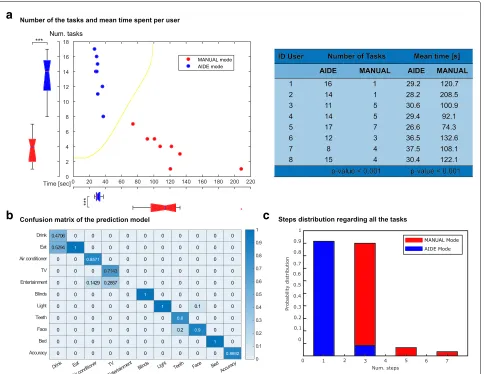
in Fig. 4a. Furthermore, it has been trained a Support Vector Machine (SVM) model with Gaussian kernel to estimate the boundary between both modes (yel-low line in Fig.4a). It should be noted that statistically significant differences between both modes in terms of number of tasks and mean tasks time is shown (p−value < 0.001 using Wilcoxon test). The steps dis-tribution that the users performed in both modes are shown in Fig. 4c. ADLs manually omitted tasks were excluded from the study due to the subject was blocked during the ECI scan caused by frustration or fatigue over a specific task.
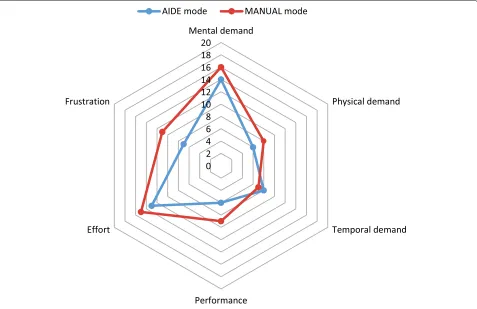
On the other hand, the AIDE mode uses a CRF model, previously trained with simulated data using the same virtual home, to predict the user intention. Thus, the confusion matrix of the prediction model regarding the ADL menus is presented in Fig.4b. In addition, the results obtained through the NASA tlx questionnaire are presented in Fig.5.
Discussion
The AIDE project aims to develop a multimodal system in order to help people with neurological diseases wearing a wheelchair. The presented environment allowed the user to navigate through a virtual house and perform several ADLs using a developed ECI. Two modes were estudied, theAIDEmode, that used a CRF model to predict the user intention and ease the ECI scan, and theManual mode, that needed a complete scan through the ECI to perform a specific ADL. The ECI was online controlled using the AIDE multimodal system based on a combination of EEG and EOG wireless acquisition system [17].
The results presented in Fig.4a show the mean time per task spent in the AIDE mode is less than in the Man-ual mode being able to perform more tasks in the same time, both modes show statistically significant differences (p< 0.001). Furthermore, both modes can be easily clas-sified by training a SVM model with Gaussian kernel, the boundary is presented with a yellow line in Fig.4a.
a
c
b
d
a
b
c
Fig. 4Environment control interface performance. The users performed two different trials with the same goal: complete as many tasks as possible in 10 min by using theManualmode and theAIDEmode (a). Both modes have been used to train a SVM model with Gaussian kernel and find the boundary between them [yellow line in (a)]. The interaction with the ECI was measured by steps that a user had to perform in order to complete the tasks (c). Furthermore, inAIDEmode the user’s intention prediction was performed through CRF model and, therefore, the confusion matrix of the model is obtained (b)
due to user confusion or lack of practice, and the user had to go back in the ECI.
The AIDE mode uses a CRF model to perform the predictions about the user’s intention. The model uses the information of the virtual home and the object that the user is looking at, acquired thought an eye tracking device. The model was previously trained with simulated data using the same virtual house environment. Thus, Fig. 4b shows the confusion matrix of the prediction model, regarding the ADL menu, with a global accuracy about 87%. The CRF model, as it takes into account not only the current state but also the previous states to per-form its prediction, it could fail in the prediction of task with common features. Therefore, the ADLs related to the Drinkmenu are sometimes predicted as the ADLs related
with theEat menu, in this case around the 50% of the trials. In addition, TV and the Teeth menus are rarely selected asEntertainmentandFacemenu, respectively, by the prediction model.
Fig. 5NASA task load index. The subjects answered the NASA tlx questionnaire after each mode
Conclusion
The presented ECI allowed the users to perform simulated ADLs with a multimodal control system. The platform was tested in two different scenarios:ManualandAIDE mode. The first one was presented as a simple ECI where the user had to achieve the corresponding ADL. The second mode used a CRF model to predict the user’s intention through the environment analysis and identifi-cation of the user’s behaviors. We conclude that, even the users do not perceive subjective differences between both modes in terms of workload, the AIDEmode helps the user to perform mode ADLs, spending less time per task, showing statistically significant differences with respect to theManual mode. This effect is caused by the user’s intention prediction as the ECI jumps directly to the last abstraction level of the ECI. The environment analysis and the identification of the user’s behaviors can be used to predict the user intention and will allow to speed up the ECIs scan opening a new paradigm in the design of these interfaces. Although the developed ECI was tested only in a simulated home environment, it can be easily adapted to a real environment increasing the user independence at home.
Endnotes
1http://aideproject.umh.es/
2http://www.thinksmartbox.com
3http://www.tobii.com
Abbreviations
AAC: Augmentative and alternative communication; ADL: Activity of daily living; BCI: Brain computer interface; CRF: Conditional random field; ECI: Environment control interface; EEG: Electroencephalography; EOG: Electrooculography; HOV: Horizontal oculoversion; MI: Motor Imagery; SMR-ERD: Sensorimotor rhythm event-related desynchronization; SVM: Support vector machine; tlx: task load index
Acknowledgments
The authors thank the subjects for their participation. In addition, we acknowledge the great support from CEDAR Foundation, Belfast, UK and the Biomedical Research Networking Center (CIBER).
Funding
This work has been supported by the AIDE project through the grant agreement no. 645322 of the European Commission and by the Ministry of Economy and Competitiveness through the project DPI2015-70415-C2-2-R.
Availability of data and materials
Authors’ contributions
ABM, SM, SRS and NGA designed the study. ABM, SE, JAB, LDL and SD collect the data. SD developed the environment control interface. LDL designed the virtual home environment. ABM, SE and JAB interpreted and analyze the data. ABM, SE created the figures. ABM, SE, JAB, LDL and SD wrote the manuscript. SM, NGA and SRS deeply revised the manuscript. ABM, SE, JAB, LDL, SE, MN, SM, SRS and NGA edited the manuscript. All authors read and approved the final manuscript.
Ethics approval and consent to participate
This study was conducted according to the declaration of Helsinki and had ethical approval by the Office Research Ethics Northern Ireland (June 2016) – approval granted for AIDE project (15/NE/0384). All subjects gave written informed consent prior to data collection.
Consent for publication
Participants gave written informed consent to data treatment in this research study and permission to publish anonymous data and results.
Competing interests
Sergio Domingo is a software developer at BJ Adaptaciones, the developer of SHX software. Sergio Domingo declares no competing interests. The rest of the authors declare no competing interests.
Publisher’s Note
Springer Nature remains neutral with regard to jurisdictional claims in published maps and institutional affiliations.
Author details
1Miguel Hernández University of Elche, Av. Universidad w/n, Ed. Innova, 03202 Elche, Spain.2BJ Adaptaciones, St Mare de Déu del Coll, 70, 08023 Barcelona, Spain.3The Cedar Foundation, 1 Upper Lisburn Road, BT10 0GW Belfast, UK. 4University Hospital of Tuebingen, Applied Neurotechnology Lab, Calwerstr. 14, D-72076 Tübingen, Germany.5Clinical Neurotechnology Laboratory, Neuroscience Research Center (NWFZ), Charité University Medicine Berlin, Charitéplatz 1, 10117 Berlin, Germany.
Received: 25 July 2018 Accepted: 18 November 2018
References
1. World Health Organization. Neurological Disorders: Public Health Challenges. Geneva: World Health Organization; 2006.http://www.who. int/iris/handle/10665/43605.
2. Winstein CJ, Stein J, Arena R, Bates B, Cherney LR, Cramer SC, Deruyter F, Eng JJ, Fisher B, Harvey RL, et al. Guidelines for adult stroke rehabilitation and recovery: a guideline for healthcare professionals from the american heart association/american stroke association. Stroke. 2016;47(6):98–169. 3. Sellers EW, Vaughan TM, Wolpaw JR. A brain-computer interface for
long-term independent home use. Amyotroph Lateral Scler. 2010;11(5): 449–55.
4. Ball MM, Perkins MM, Whittington FJ, Hollingsworth C, King SV, Combs BL. Independence in assisted living. J Aging Stud. 2004;18(4):467–83. 5. Ball MM, Perkins MM, Whittington FJ, Connell BR, Hollingsworth C, King
SV, Elrod CL, Combs BL. Managing decline in assisted living: The key to aging in place. J Gerontol B Psychol Sci Soc Sci. 2004;59(4):202–12. 6. Struijk LNA, Egsgaard LL, Lontis R, Gaihede M, Bentsen B. Wireless
intraoral tongue control of an assistive robotic arm for individuals with tetraplegia. J Neuroengineering Rehabil. 2017;14(1):110.
7. Brandt Å, Samuelsson K, Töytäri O, Salminen A-L. Activity and participation, quality of life and user satisfaction outcomes of
environmental control systems and smart home technology: a systematic review. Disabil Rehabil Assist Technol. 2011;6(3):189–206.
8. Agree EM, Freedman VA, Cornman JC, Wolf DA, Marcotte JE. Reconsidering substitution in long-term care: when does assistive technology take the place of personal care? J Gerontol B Psychol Sci Soc Sci. 2005;60(5):272–80.
9. O’Neill B, Moran K, Gillespie A. Scaffolding rehabilitation behaviour using a voice-mediated assistive technology for cognition. Neuropsychol Rehabil. 2010;20(4):509–27.
10. Lupu RG, Ungureanu F, Siriteanu V. Eye tracking mouse for human computer interaction. In: E-Health and Bioengineering Conference (EHB), 2013. IEEE; 2013. p. 1–4.https://doi.org/10.1109/EHB.2013.6707244. 11. Adjouadi M, Sesin A, Ayala M, Cabrerizo M. Remote eye gaze tracking
system as a computer interface for persons with severe motor disability. In: International Conference on Computers for Handicapped Persons. Berlin: Springer; 2004. p. 761–9. https://doi.org/10.1007/978-3-540-27817-7_113.
12. Biswas P, Langdon P. A new input system for disabled users involving eye gaze tracker and scanning interface. J Assist Technol. 2011;5(2):58–66. 13. Miralles F, Vargiu E, Rafael-Palou X, Sola M, Dauwalder S, Guger C,
Hintermuller C, Espinosa A, Lowish H, Martin S, Armstrong E, Daly J. Brain?computer interfaces on track to home: Results of the evaluation at disabled end-users? homes and lessons learnt. Front ICT. 2015;2:25. https://doi.org/10.3389/fict.2015.00025.
14. Wolpaw JR, Birbaumer N, McFarland DJ, Pfurtscheller G, Vaughan TM. Brain–computer interfaces for communication and control. Clin Neurophysiol. 2002;113(6):767–91.
15. Cincotti F, Mattia D, Aloise F, Bufalari S, Schalk G, Oriolo G, Cherubini A, Marciani MG, Babiloni F. Non-invasive brain–computer interface system: towards its application as assistive technology. Brain Res Bull. 2008;75(6): 796–803.
16. Witkowski M, Gómez C, Opisso E, Medina J, Cortese M, Cempini M, Carrozza MC, Cohen LG, Birbaumer N, Vitiello N. Hybrid eeg/eog-based brain/neural hand exoskeleton restores fully independent daily living activities after quadriplegia. Sci Robot. 2016;1(1):eaag3296.https://doi. org/10.1126/scirobotics.aag3296.
17. Soekadar SR, Witkowski M, Mellinger J, Ramos A, Birbaumer N, Cohen LG. Erd-based online brain-machine interfaces (bmi) in the context of neurorehabilitation: optimizing bmi learning and performance. IEEE Trans Neural Syst Rehabil Eng: Publ IEEE Eng Med Biol Soc. 2011;19(5):542–9. 18. Lafferty J, McCallum A, Pereira FC. Conditional random fields:
Probabilistic models for segmenting and labeling sequence data. In: Proceedings of the Eighteenth International Conference on Machine Learning (ICML ’01). San Francisco: Morgan Kaufmann Publishers Inc.; 2001. p. 282–289.http://portal.acm.org/citation.cfm?id=655813. 19. Schalk G, McFarland DJ, Hinterberger T, Birbaumer N, Wolpaw JR.
Bci2000: a general-purpose brain-computer interface (bci) system. IEEE Trans Biomed Eng. 2004;51(6):1034–43.
20. Barios JA, Ezquerro S, Bertomeu-Motos A, Nann M, Badesa FJ, Fernandez E, Soekada SR, Garcia-Aracil N. Synchronization of slow cortical rhythms during motor imagery-based brain-machine interface control. Int J Neural Syst. 2018. in press.
21. Rabiner LR. A tutorial on hidden Markov models and selected applications in speech recognition. Proc IEEE. 1989;77(2):257–86.
22. Quinn TJ, Langhorne P, Stott DJ. Barthel index for stroke trials: development, properties, and application. Stroke. 2011;42(4):1146–51. 23. Hart SG, Staveland LE. Development of nasa-tlx (task load index): Results