https://doi.org/10.5194/gmd-11-3409-2018 © Author(s) 2018. This work is distributed under the Creative Commons Attribution 4.0 License.
Simulation of the performance and scalability of message passing
interface (MPI) communications of atmospheric models running
on exascale supercomputers
Yongjun Zheng and Philippe Marguinaud
Centre National de Recherches Météorologiques, Météo France, Toulouse, France Correspondence:Yongjun Zheng ([email protected])
Received: 28 November 2017 – Discussion started: 22 January 2018 Revised: 2 July 2018 – Accepted: 17 July 2018 – Published: 22 August 2018
Abstract. In this study, we identify the key message pass-ing interface (MPI) operations required in atmospheric mod-elling; then, we use a skeleton program and a simulation framework (based on SST/macro simulation package) to sim-ulate these MPI operations (transposition, halo exchange, and allreduce), with the perspective of future exascale ma-chines in mind. The experimental results show that the choice of the collective algorithm has a great impact on the per-formance of communications; in particular, we find that the generalized ring-k algorithm for the alltoallv operation and the generalized recursive-kalgorithm for the allreduce oper-ation perform the best. In addition, we observe that the im-pacts of interconnect topologies and routing algorithms on the performance and scalability of transpositions, halo ex-change, and allreduce operations are significant. However, the routing algorithm has a negligible impact on the perfor-mance of allreduce operations because of its small message size. It is impossible to infinitely grow bandwidth and reduce latency due to hardware limitations. Thus, congestion may occur and limit the continuous improvement of the perfor-mance of communications. The experiments show that the performance of communications can be improved when con-gestion is mitigated by a proper configuration of the topology and routing algorithm, which uniformly distribute the con-gestion over the interconnect network to avoid the hotspots and bottlenecks caused by congestion. It is generally believed that the transpositions seriously limit the scalability of the spectral models. The experiments show that the communi-cation time of the transposition is larger than those of the wide halo exchange for the semi-Lagrangian method and the allreduce in the generalized conjugate residual (GCR) itera-tive solver for the semi-implicit method below 2×10⁵MPI
processes. The transposition whose communication time de-creases quickly with increasing number of MPI processes demonstrates strong scalability in the case of very large grids and moderate latencies. The halo exchange whose commu-nication time decreases more slowly than that of transpo-sition with increasing number of MPI processes reveals its weak scalability. In contrast, the allreduce whose communi-cation time increases with increasing number of MPI pro-cesses does not scale well. From this point of view, the scala-bility of spectral models could still be acceptable. Therefore it seems to be premature to conclude that the scalability of the grid-point models is better than that of spectral models at the exascale, unless innovative methods are exploited to miti-gate the problem of the scalability presented in the grid-point models.
1 Introduction
Current high-performance computing (HPC) systems have thousands of nodes and millions of cores. According to the 49th TOP500 list (https://www.top500.org, last access: 16 August 2018) published on 20 June 2017, the fastest ma-chine (Sunway TaihuLight) had over 10 million cores with a peak performance of approximately 125 PFlops (1 PFlops=
perfor-mance approaches to or is beyond 1 EFlops (1 EFlops=103 PFlops), will become available (Engelmann, 2014; Lagada-pati et al., 2016). Exascale HPC poses several challenges in terms of power consumption, performance, scalability, pro-grammability, and resilience. The interconnect network of exascale HPC system becomes larger and more complex, and its performance which largely determines the overall per-formance of the HPC system is crucial to the perper-formance of distributed applications. Designing energy-efficient cost-scalable interconnect networks and communication-efficient scalable distributed applications is an important component of HPC hardware/software co-design to address these chal-lenges. Thus, evaluating and predicting the communication behaviour of distributed applications is obligatory; it is only feasible by modelling the communications and the underly-ing interconnect network, especially for the future supercom-puter.
Investigating the performance of distributed applications in future architectures and the impact of different ar-chitectures on the performance by simulation is a hard-ware/software co-design approach to pave the way to ex-ascale HPCs. Analytical interconnect network simulation based on an analytical conceptual model is fast and scalable, but it comes at the cost of accuracy owing to its unrealis-tic simplification (Hoefler et al., 2010). Discrete event simu-lation (DES) is often used to simulate the interconnect net-work, and it provides high fidelity since the communication is simulated at a more detailed level (e.g., flit, packet, or flow levels) to take into account congestion (Janssen et al., 2010; Böhm and Engelmann, 2011; Dechev and Ahn, 2013; Acun et al., 2015; Jain et al., 2016; Wolfe et al., 2016; Degomme et al., 2017; Mubarak et al., 2017). Sequential DES lacks scalability owing to its large memory footprints and long ex-ecution time (Degomme et al., 2017). Parallel DES (PDES) is scalable since it can reduce the memory required per node, but its parallel efficiency is not very good because of fre-quent global synchronization of conservative PDES (Janssen et al., 2010) or high rollback overhead of optimistic PDES (Acun et al., 2015; Jain et al., 2016; Wolfe et al., 2016). Generally, the simulation of distributed applications can be divided into two complementary categories: offline and on-line simulations. Offon-line simulation replays the communica-tion traces from the applicacommunica-tion running on a current HPC system. It is sufficient to understand the performance and discover the bottleneck of fully distributed applications on the available HPC system (Tikir et al., 2009; Noeth et al., 2009; Núñez et al., 2010; Dechev and Ahn, 2013; Casanova et al., 2015; Acun et al., 2015; Jain et al., 2016; Lagadap-ati et al., 2016); however, is not very scalable because of the huge traces for numerous processes and limited extrap-olation to future architecture (Hoefler et al., 2010; Núñez et al., 2010). Online simulation has full scalability to future systems by running the skeleton program on top of simula-tors (Zheng et al., 2004; Janssen et al., 2010; Engelmann, 2014; Degomme et al., 2017), but it has the challenge of
developing a skeleton program from a complex distributed application. Most simulations in the aforementioned liter-ature have demonstrated the scalability of simulators. The simulator xSim (Engelmann, 2014) simulated a very sim-ple message passing interface (MPI) program, which only calls MPI_Init and MPI_Finalize without any communica-tion and computacommunica-tion, up to 227processes. For collective MPI operations, Hoefler et al. (2010) obtained an MPI_Allreduce simulation of 8 million processes without consideration of congestion using LogGOPSim, Engelmann (2014) achieved an MPI_Reduce simulation of 224processes, and Degomme et al. (2017) demonstrated an MPI_Allreduce simulation of 65 536 processes using SimGrid. For simulations at appli-cation level, Jain et al. (2016) used the TraceR simulator based on CODES and ROSS to replay 4.6×10⁴ process traces of several communication patterns that are used in a wide range of applications. In addition, Mubarak et al. (2017) presented a 1.1×10⁵ process simulation of two multigrid applications. However, to the best of our knowledge, there is no exascale simulation of complex communication pat-terns such as the MPI transposition (Multiple simultaneous MPI_Alltoallv) for the spectral method and the wide halo exchange (the width of a halo may be greater than the subdo-main size of its direct neighbours) for the semi-Lagrangian method used in atmospheric models.
With the rapid development of increasingly powerful su-percomputers in recent years, numerical weather predic-tion (NWP) models have increasingly sophisticated phys-ical and dynamphys-ical processes, and their resolution is get-ting higher and higher. Nowadays, the horizontal resolution of a global NWP model is in the order of 10 km. Many operational global spectral NWP models such as IFS at ECMWF, ARPEGE at Météo France, and GFS at NCEP are based on the spherical-harmonics transform method that in-cludes Fourier transforms in the zonal direction and Leg-endre transforms in the meridional direction (Ehrendorfer, 2012). Moreover, some regional spectral models such as AROME at Météo France (Seity et al., 2011) and RSM at NCEP (Juang et al., 1997) use the bi-Fourier transform method. The Fourier transforms can be computed efficiently by fast Fourier transform (FFT) (Temperton, 1983). Even with the introduction of fast Legendre transform (FLT) to re-duce the growing computational cost of increasing resolution of global spectral models (Wedi et al., 2013), it is believed that the global spectral method is prohibitively expensive for very high resolution (Wedi, 2014).
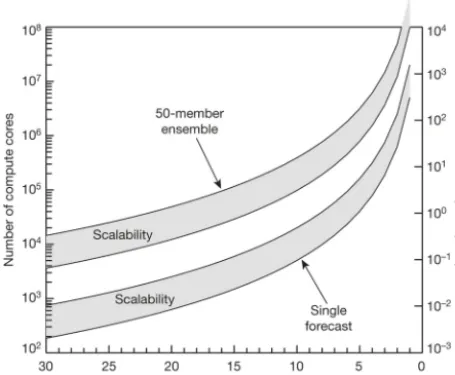
Figure 1. CPU and power requirements as a function of NWP model resolution, adapted from Bauer et al. (2015). The left and right yaxes are the number of cores and the power (in megavolt amps), respectively, required for a single 10-day model forecast (the lower shaded area including its bounds) and a 50-member ensemble forecast (the upper shaded area including its bounds) as a function of model resolution based on current model code and compute tech-nology. The lower and upper bounds of each shaded area indicate perfect scaling and inefficient scaling, respectively.
a single horizontal direction for the parallelization of spec-tral transforms, there is a transposition between the specspec-tral transforms in the zonal direction and meridional directions. MPI transposition is an all-to-all personalized communica-tion which can cause significant congescommunica-tion over an intercon-nect network when the number of MPI tasks and the amount of exchanged data are large, and this results in a severe com-munication delay. Bauer et al. (2015) estimated that a global NWP model with a 2 km horizontal resolution requires 1 mil-lion compute cores for a single 10-day forecast (Fig. 1). With 1 million compute cores, the performance and scalability of the MPI transposition become of paramount importance for a high-resolution global spectral model. Thus, evaluating and predicting the performance and scalability of MPI transpo-sition at the exascale is one of the foremost subjects of this study.
The semi-Lagrangian (SL) method is a highly efficient technique for the transport of momentum, heat, and mass in the NWP model because of its unconditional stability which permits a long time step (Staniforth and Côté, 1991; Hortal, 2002). However, it is known that the MPI exchange of wide halo required for the interpolation at the departure point of high wind-speed particles near the boundary of the subdo-main causes significant communication overhead as resolu-tion increases towards the kilometre scale and the HPC sys-tems move towards the exascale. This communication over-head could reduce the efficiency of the SL method; thus,
modelling the performance and scalability of wide halo ex-change at the exascale is essential and is another subject of this study.
With a consideration of the efficiency of the Legendre transform and the scalability of MPI transposition that may arise in the global spectral model on exascale HPC systems, a couple of global grid-point models have recently been de-veloped (Lin, 2004; Satoh et al., 2008; Qaddouri and Lee, 2011; Skamarock et al., 2012; Dubos et al., 2015; Zangl et al., 2015; Smolarkiewicz et al., 2016). Since spherical harmonics are eigenfunctions of the Helmholtz operator, the semi-implicit (SI) method is usually adopted in order to im-plicitly handle the fast waves in the global spectral model to allow stable integration with a large time step (Robert et al., 1972; Hoskins and Simmons, 1975). However, for a grid-point model, the three-dimensional Helmholtz equation is usually solved using Krylov subspace methods such as the generalized conjugate residual (GCR) method (Eisenstat et al., 1983), and a global synchronization for the inner prod-uct in Krylov subspace methods may become the bottleneck at the exascale (Li et al., 2013; Sanan et al., 2016). As it is not clear whether the three-dimensional Helmholtz equation can be solved efficiently in a scalable manner, most of the afore-mentioned models use a horizontally explicit, vertically im-plicit (HEVI) scheme. The HEVI scheme typically requires some damping for numerical stability (Satoh et al., 2008; Skamarock et al., 2012; Zangl et al., 2015), and its time step is smaller than that of the SI method (Sandbach et al., 2015). Therefore, it is desirable to know whether the SI method is viable or even advantageous for very high-resolution grid-point models running on exascale HPC systems. Thus, it is valuable to explore the performance and scalability of global synchronization in solving the three-dimensional Helmholtz equation using Krylov subspace methods; this forms the third subject of this study.
2 Simulation environment
2.1 Parallel discrete event simulation
Modelling application performance on exascale HPC sys-tems with millions of nodes and a complex interconnect net-work requires that the simulation can be decomposed into small tasks that efficiently run in parallel to overcome the problem of a large memory footprint and long simulation time. PDES is such an approach for exascale simulation. Each worker in PDES is a logical process (LP) that mod-els a specific component such as a node, a switch, or an MPI process of the simulated MPI application. These LPs are mapped to the physical processing elements (PEs) that actu-ally run the simulator. An event is an action such as sending an MPI message or executing a computation between consec-utive communications. Each event has its start and stop times, so the events must be processed without violating their time ordering. To model the performance of an application, PDES captures time duration and advances the virtual time of the application by sending timestamped events between LPs.
PDES usually adopts conservative or optimistic paral-lelized strategies. The conservative approach maintains the time ordering of events by synchronization to guarantee that no early events arrive after the current event. Frequent syn-chronization is time-consuming so the efficiency of the con-servative approach is highly dependent on the look-ahead time; a larger look-ahead time (that means less synchro-nization) allows a much greater parallelism. The optimistic approach allows LPs to run events at the risk of ordering violations. Events must be rolled back when time-ordering violations occurs. Rollback not only induces signif-icant overhead but also requires extra storage for the event list. Rollback presents special challenges for online simu-lation, so SST/macro adopts a conservative approach (Wike and Kenny, 2014).
2.2 SST/macro simulator
Considering that the offline trace-driven simulation does not provide an easy way for extrapolating to future architec-tures, the online simulator SST/macro is selected here to model the communications of the atmospheric models for fu-ture exascale HPC systems. SST/macro is a coarse-grained parallel discrete event simulator which provides the best cost/accuracy trade-off simulation for large-scale distributed applications (Janssen et al., 2010). SST/macro is driven by either a trace file or a skeleton application. A skeleton appli-cation can be constructed from scratch or from an existing application manually or automatically by source-to-source translation tools. SST/macro intercepts the communications issued from the skeleton program to estimate their time rather than actually execute it by linking the skeleton application to the SST/macro library instead of the real MPI library. Since the purpose of this study is to investigate the performance
and scalability of communications in an atmospheric model, we construct the communication-only skeleton program from scratch by identifying the key MPI operations taking place in the atmospheric models.
Congestion is a significant factor that affects the perfor-mance and scalability of MPI applications running on exas-cale HPC systems. SST/macro has three network models: the analytical model transfers the whole message over the net-work from point-to-point without packetizing and estimates the time delay1t predominantly based on the logP approxi-mation
1t=α+βN, (1)
whereαis the communication latency,βis the inverse band-width in second per byte, and N is the message size in bytes; the packet-level model PISCES (Packet-flow Intercon-nect Simulation for Congestion at Extreme Scale) divides the message into packets and transfers the packets individ-ually; the flow-level model will be deprecated in the future. Compared to the SimGrid simulator, the packet-level model of SST/macro produces almost identical results (figure not shown). Acun et al. (2015) also found that the SST/macro online simulation is very similar to the TraceR simula-tion. Thus, we adopt the PISCES model with a cut-through mechanism (SNL, 2017) to better account for the conges-tion. SST/macro provides three abstract machine models for nodes: the AMM1 model is the simplest one which grants ex-clusive access to the memory; the AMM2 model allows mul-tiple CPUs or NICs (network interface controllers) to share the memory bandwidth by defining the maximum memory bandwidth allocated for each component; the AMM3 model goes one further step to distinguish between the network link bandwidth and the switch bandwidth. In this paper, the AMM1 model with one single-core CPU per node is adopted since simulation of communications is the primary goal.
(a)
(b)
Group 1
Group 0 Group 2
(c)
Compute nodes Switch
0 Switch1 Switch2 Switch3 Switch4 Switch5 Switch6 Switch7 Switch
8 Switch9 Switch10 Switch11 Switch12 Switch13 Switch14 Switch15 Switch
16 Switch17 Switch18 Switch19 Switch20 Switch21 Switch22 Switch23 Switch
24 Switch25 Switch26 Switch27 Switch28 Switch29 Switch30 Switch31
0 1 2 3 4 5 6 7 8 9 10 11 12 13 14 15
Figure 2.Topology illustration:(a),(b), and(c)are the torus, dragonfly, and fattree topologies, respectively. Adapted from SNL (2017).
of two levels: the routers at the first level are divided into groups and routers in each group form a two-dimension mesh of which each dimension is an all-to-all connected network; at the second level, the groups as virtual routers are con-nected in an all-to-all manner (Alverson et al., 2015). There are three available routing algorithms for dragonfly topology in SST/macro:
minimal transfers messages by the shortest path from the source to the destination. For example, messages travel from the blue router in group 0 to the red router in group 2 via the right corner in group 0 and the bottom-left corner in group 2 (Fig. 2b).
valiant randomly picks an intermediate router and then uses a minimal routing algorithm to transfer messages from the source to the intermediate router and from the in-termediate router to the destination. For example, the arrow path from the blue router in group 0 to the red
router in group 2 goes via the intermediate yellow node in group 1 in Fig. 2b.
ugal checks the congestion and either switches to the valiant routing algorithm if congestion is too heavy or other-wise uses the minimal routing algorithm.
Table 1.Summary of the network topologies: the geometry of a torus topology specifies the size of each dimension; the first and second number in the geometry of a fattree topology are the number of layers and descendant ports per switch, respectively; the first two numbers and the last number in the geometry of a dragonfly topology indicate the group mesh size and the number of groups, respectively.
Name Geometry Switches Nodes per switch Nodes
Torus-M 25,25,25 15 625 25 390 625
Fattree-M 4,25 46 875 25 390 625
Dragonfly-MM 25,25,25 15 625 25 390 625
Dragonfly-SL 25,25,125 78 125 5 390 625
Dragonfly-LS 125,125,5 78 125 5 390 625
Torus-L 75,25,25 46 875 25 1 171 875
Fattree-L 4,33 107 811 33 1 185 921
Dragonfly-ML 25,25,75 46 875 25 1 171 875
mesh with five nodes per switch and a small number (=5) of groups. The dragonfly-ML configuration has a medium group of a 25×25 mesh with 25 nodes per switch and a large number (=75) of groups. The fattree configuration has a sig-nificantly larger number of switches than other topologies for the same number of nodes and the same nodes per switch, which indicates that fattree is not cost- or energy-efficient. All the configurations with 390 625 nodes are used for simu-lating transposition for the spectral transform method. Torus-L, fattree-Torus-L, and dragonfly-ML with more than 1 million nodes are used for the cases of halo exchange and allre-duce communication since we cannot finish the simulation of transposition for the spectral transform method (multiple si-multaneous all-to-all personalized communications) on such a large configuration within 24 h (see Sect. 3 for three key MPI communications in the atmospheric model).
2.3 Reduce the memory footprint and accelerate the simulation
Although SST/macro is a parallel discrete event simulator that can reduce the memory footprint per node, its paral-lel efficiency degrades if more cores are used. Even with an MPI transposition of 105 processes, this all-to-all per-sonalized communication has almost 1010 discrete events, which consumes a considerable amount of memory and takes a very long time for simulation. Furthermore, almost every MPI program has a set-up step to allocate memory for stor-ing the set-up information such as the parameters and the domain decomposition of all processes, which each process must know in order to properly communicate with other pro-cesses. Therefore, it needs to broadcast the parameters to and synchronize with all processes before actual communi-cations and computation. Even if the set-up information for a single process needs only 102 bytes of memory, a sim-ulation of 105 processes MPI transposition will need 1 TB (102×105×105=1012bytes) of memory, which is not eas-ily available on current computers if the simulator runs on a single node. In addition, the MPI operations in the set-up step are not only time-consuming but also affect subsequent
communications. A common way to eliminate this effect is to iterate many times to obtain a robust estimation of com-munication time; however, one iteration is already very time-consuming for simulation. To circumvent the issue of set-up steps, we use an external auxiliary program to create a shared memory segment on each node running SST/macro and ini-tialize this memory with the set-up information of all the sim-ulated MPI processes. Then, we modified SST/macro to cre-ate a global variable and attach the shared memory to this global variable; this method not only reduces the memory footprint and eliminates the side effect of communications in the set-up step, but it also avoids the problem of filling up the memory address space if each simulated process attaches to the shared memory.
A large-scale application needs a large amount of memory for computation; and in some cases, such as a spectral model, the whole memory for computation is exchanged between all the processes. Even when computation is not considered, a large amount of memory for the message buffers is usually required for MPI communications. Fortunately, the simula-tor only needs message size, the source/destination, and the message tag to model the communication; thus, it is not nec-essary to allocate actual memory. Since SST/macro can op-erate with null buffers, the message buffer is set to null in the skeleton application, which significantly reduces the size of memory required by the simulation of communication of the high-resolution atmospheric model.
3 Key MPI operations in atmospheric models 3.1 Transposition for the spectral transform method A global spectral model generally uses a spherical-harmonics transform on the horizontal with triangular truncation. The backward spherical-harmonics transform is
f (θ, λ)=
M
X
m=−M eimλ
M
X
n=|m|
fnmPnm(cosθ )
!
where θ andλ are the colatitude and longitude,fnm is the spectral coefficients of the fieldf, andPnmis the associated Legendre polynomials of degreemand ordern. Moreover, the forward spherical-harmonics transform is
fnm=1
2 1
Z
−1
Pnm(cosθ )
1 2π
2π
Z
0
f (θ, λ)e−imλdλ
dcosθ. (3)
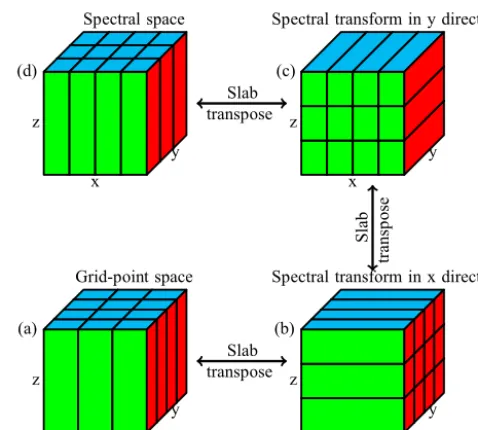
In Eq. (2), the backward Legendre transform of eachmcan be computed independently; then, the same applies to the backward Fourier transform of each θ. Similar in Eq. (3), the forward Fourier transform of eachθcan be computed in-dependently; then, the same applies to the forward Legendre transform of each m. This leads to a natural way to paral-lelize the spectral transforms. If we start with the grid-point space (Fig. 3a), which is decomposed bycx/cycores in the x/y direction,cy-simultaneousxz slab MPI transpositions lead to the partition (Fig. 3b) withcy/cxcores in they/z di-rection, and a spectral transform such as a forward FFT can be performed in parallel since data with regard toλare local to each core. Then, cx-simultaneous xy slab MPI transpo-sitions lead to the partition (Fig. 3c) withcy/cxcores in the x/zdirection, and a spectral transform such as a forward FLT can be computed in parallel because data with regard toθare now local to each core. Finally,cy-simultaneousyzslab MPI transpositions lead to the spectral space (Fig. 3d) withcy/cx cores in the x/y direction, where the semi-implicit scheme can be easily computed because spectral coefficients belong-ing to the same column are now local to the same core. The backward transform is similar. It is of paramount importance that the partition of the four stages described in Fig. 3 must be consistent so that multiple slab MPI transpositions can be conducted simultaneously, which significantly reduces the communication time of MPI transpositions from one stage to another. It is worth noting that the number of grid points in one direction is not always a multiple of the number of cores in the corresponding direction; thus, the partition shown in Fig. 3 can use as many as possible compute cores without any limit oncxorcyprovidedcx×cy=ncpu andcxorcyis not greater than the number of grid points in the corresponding direction. It is generally believed that the MPI transpositions from one stage to another pose a great challenge to the scala-bility of spectral models because each slab MPI transposition is an all-to-all personalized communication which is the most complex and time-consuming all-to-all communication.
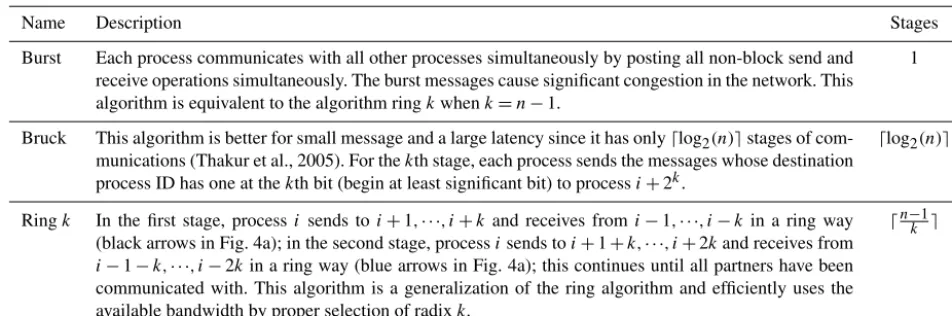
There are different algorithms for all-to-all personalized communication. Table 2 lists the three algorithms for all-to-all personalized communication, whose performance and scalability are investigated in this study. Algorithm ringkis our proposal algorithm for all-to-all personalized communi-cation which is a generalized ring alltoallv algorithm. In al-gorithm ringk, each process communicates with 2×k pro-cesses to reduce the stages of communications and make
ef-x
y z
Grid-point space
(a)
x
y z
Spectral transform in x direction
(b) x
y z
Spectral transform in y direction
(c)
x
y z
Spectral space
(d)
transpose Slab transpose
Slab
transp
ose
Slab
Figure 3.Parallel scheme of regional spectral model:(a)2-D de-composition of 3-D grid field withcx/cycores in thex/ydirection, (b)2-D decomposition of 3-D grid field withcy/cxcores in they/z direction,(c)2-D decomposition of 3-D grid field withcy/cxcores in thex/zdirection, and(d)2-D decomposition of 3-D grid field withcy/cxcores in thex/ydirection. Transposition between(a) and(b) can be conducted bycy-independent xzslab MPI trans-positions, transposition between(b)and(c)can be conducted by cx-independentxy slab MPI transpositions, and transposition be-tween(c)and(d)can be conducted bycy-independentyzslab MPI transpositions.
ficient use of the available bandwidth and thus reduces the total communication time.
3.2 Halo exchange for semi-Lagrangian method The SL method solves the following transport equation: Dφ
Dt = ∂φ ∂t +u
∂φ ∂x+v
∂φ ∂y +w
∂φ
∂z =0, (4)
where the scalar fieldφ is advected by the 3-D windV=
(u, v, w). In the SL method, the grid-point value of the scalar fieldφat next time stept+1t can be found by integrating Eq. (4) along the trajectory of the fluid parcel (Staniforth and Côté, 1991; Hortal, 2002):
t+1t
Z
t Dφ
Dtdt=0→φ
t+1t=φt
d, (5)
Table 2.Three algorithms for all-to-all personalized communication.
Name Description Stages
Burst Each process communicates with all other processes simultaneously by posting all non-block send and receive operations simultaneously. The burst messages cause significant congestion in the network. This algorithm is equivalent to the algorithm ringkwhenk=n−1.
1
Bruck This algorithm is better for small message and a large latency since it has onlydlog2(n)estages of com-munications (Thakur et al., 2005). For thekth stage, each process sends the messages whose destination process ID has one at thekth bit (begin at least significant bit) to processi+2k.
dlog2(n)e
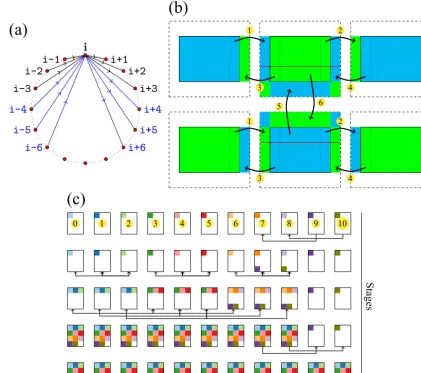
Ringk In the first stage, processi sends toi+1,· · ·, i+kand receives fromi−1,· · ·, i−k in a ring way (black arrows in Fig. 4a); in the second stage, processisends toi+1+k,· · ·, i+2kand receives from i−1−k,· · ·, i−2kin a ring way (blue arrows in Fig. 4a); this continues until all partners have been communicated with. This algorithm is a generalization of the ring algorithm and efficiently uses the available bandwidth by proper selection of radixk.
dn−1
k e
with any grid point, so the value ofφdt is obtained by inter-polation using the surrounding grid-point valuesφtat timet. The departure pointdis determined by iteratively solving the trajectory equation (Staniforth and Côté, 1991; Hortal, 2002)
Dr
Dt =V(r, t )→r
t+1−rt d=
t+1t
Z
t
V(r, t )dt, (6)
wherert+1t andrt
d are the position of the arrival and the departure point, respectively. From Eq. (6), it is obvious that the departure point is far from its arrival point if the wind speed is large. Thus, the departure point of one fluid parcel at the boundary of the subdomain of an MPI task is far from its boundary if the wind speed is large and the wind blows from the outside. To facilitate the calculation of the depar-ture point and its interpolation, MPI parallelization adopts a “maximum wind” halo approach so that the halo is suffi-ciently large for each MPI task to perform its SL calculations in parallel after exchanging the halo. This “maximum wind” halo is named “wide halo” since its width is significantly larger than that of the thin halo of finite difference methods whose stencils have compact support. With numerous MPI tasks, the width of a wide halo may be larger than the sub-domain size of its direct neighbour, which implies that the process needs to exchange the halo with its neighbours and its neighbours’ neighbours, which may result in a significant communication overhead which counteracts the efficiency of the favourite SL method and poses a great challenge to the scalability of the SL method.
Figure 4b demonstrates the halo exchange algorithm adopted in this paper. First, the algorithm posts the MPI non-block send and receive operations 1–4 simultaneously for the x-direction sweep. After thex-direction sweep, ay-direction sweep is performed in a similar way but the length of halo is extended to include the left and right halo in thex direction so that the four corners are exchanged properly. This algo-rithm needs two stages of communications but is simple to
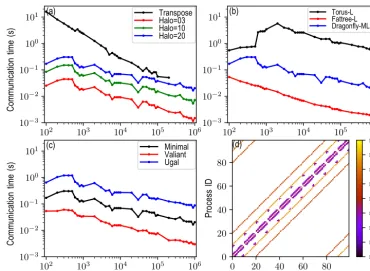
implement, especially for the wide halo exchange, owing to its fixed regular communication pattern (Fig. 9d). In Fig. 9d, the pixels (purplish colour) tightly attached to the diagonal are due to the exchange in thex direction; the pixels of the same colour but off-diagonal are because of the periodicity in x direction; the pixels (reddish orange colour) off-diagonal are due to the exchange in they direction; and the pixels of the same colour but far off the diagonal are because of the periodicity in they direction. This algorithm also applies to the thin halo exchange for finite difference methods, which is extensively used in the grid-point models. The study empha-sizes the wide halo exchange, but the thin halo exchange is also investigated for comparison (see the red line in Fig. 9a). 3.3 Allreduce in Krylov subspace methods for the
semi-implicit method
The three-dimensional SI method leads to a large linear sys-tem which can be solved by Krylov subspace methods:
Ax=b, (7)
where A is a non-symmetric sparse matrix. Krylov sub-space methods find the approximationx iteratively in a k-dimensional Krylov subspace:
K=span(r,Ar,A2r,· · ·,Ak−1r), (8) wherer=b−Ax. To accelerate the convergence, precondi-tioning is generally used:
M−1Ax=M−1b, (9)
iteration; thus, it has 2Nallreduce operations if the GCR it-erative solver reaches convergence inNiterations. Allreduce is an all-to-all communication and becomes expensive when the number of iterations becomes larger in GCR solver with numerous MPI processes.
Figure 4c demonstrates the recursive-k algorithm for the allreduce operation, which is a generalization of the recursive doubling algorithm. The radixkis the number of processes in a group for the recursive-kalgorithm. Letp= blogk(ncpu)c. This algorithm haspstages of communications if the num-ber of processes is a power of radix k; otherwise it has two extra stages of communications in the beginning and ending of the algorithm. The following description of the recursive-k algorithm applies to any number of processes; that is, the first and last stage are not necessary when the number of processes is a power of radixk. In the first stage with stage IDj=0 (the first row in Fig. 4c), each remain-ing process whose ID i6∈ [0, kp−1]sends its data to pro-cessi−(ncpu−kp)for the reduce operation. For the stage of stage IDj∈ [1, p](rows between the first row and second last row in Fig. 4c), all the processes with the same value of mod(i, kj−1)form a list of processes in ascending order of i, wherei∈ [0, kp−1]is the process ID and mod(i, kj−1) is the remainder of i divided by kj−1. Then, every k pro-cesses in this ordered list form a group of propro-cesses; i.e., the first kprocesses form the first group, the secondk pro-cesses form the second group, etc. Each group of propro-cesses performs its allreduce operation independently. In the final stage with stage IDj=1+p(the second last row in Fig. 4c), each process whose IDi6∈ [0, kp−1]receives its final result from processi−(ncpu−kp). The recursive-kalgorithm uses large radixkto reduce the stages of communications and the overall communication time.
4 Experimental results 4.1 Experiment design
In the next decade, it is estimated that the resolution of global NWP models will approach the kilometre scale and the HPC will move towards the exascale. What would the performance of a global NWP model with a very high resolution on ex-ascale HPC be? In this paper, we are especially interested in the strong scaling of an atmospheric model, that is, how does the atmospheric model with fixed resolution (such as the one presented in Table 3) behave as the number of processes increases? In this study, these strong scalings of the three key MPI operations in the atmospheric model are assessed for 102,2×10²,· · ·,9×102,103,2×103,· · ·,9×103,104,2×
104,· · ·,9×104,105,2×105,· · ·,9×105,106MPI tasks; but the maximum number of processes is 2×10⁵ for the MPI transposition owing to the hard time limitation in our cluster. Table 3 presents a summary of the three-dimensional grid for assessing the communication of the kilometre-scale
at-Table 3.A three-dimensional grid for assessing the communication of the atmospheric model.1xand1yare given as if this grid is a uniform global longitude–latitude grid. In fact, this grid resembles the grid of a regional spectral atmospheric model or the uniform longitude–latitude grid used by some global models.
nx ny nz 1x 1y Grid points
28 800 14 400 256 0.0125◦ 0.0125◦ >100 billion
Memory size Max. processes
>800 GB per double field 3 686 400 for a 2-D partition
mospheric model. The number of grid points of this grid is beyond 100 billion, and one field of double-precision vari-ables for this grid requires more than 800 gigabytes of mem-ory. Only with such a large grid is it possible to perform a 2-D domain decomposition for a spectral model with more than 1 million processes so that modelling the communication of the atmospheric model at exascale HPC becomes possible.
Besides the topology and its configuration, the routing al-gorithm, and the collective MPI algorithm; the bandwidth and the latency of the interconnect network of an HPC sys-tem have a great impact on the performance of communi-cations. First, we simulate the transposition for the spectral transform method in the simulator for three topologies (torus-M, fattree-(torus-M, and dragonfly-MM in Table 1), three config-urations of dragonfly topology (MM, dragonfly-SL, and dragonfly-LS in Table 1), three routing algorithms (minimal, valiant, and ugal), and three alltoallv algorithms (Table 2). In addition, we compare the simulations of the transposition for the spectral transform method between four interconnect bandwidths (100, 101, 102, and 103GB s−1) and between four interconnect latencies (101, 102, 103, and 104ns). After a thorough investigation of the transposition for the spectral transform method, we test the halo exchange for the SL method with different halo widths (3, 10, 20, and 30 grid points), three topologies (torus-L, fattree-L, and dragonfly-ML in Table 1), and three routing algorithms (min-imal, valiant, and ugal). Finally, the allreduce operation in Krylov subspace methods for the SI method is evaluated on different topologies (torus-L, fattree-M, and dragonfly-ML in Table 1), and the statistics of the optimal radix of recursive-k algorithms for allreduce operations are presented.
pro-Algorithm 1Preconditioned GCR returns the solutionxiwhen convergence occurs wherex0
is the first guess solution andkis the number of iterations for restart.
1: procedureGCR(A,M,b,x0, k)
2: r0←b−Ax0
3: u0←M−1r0
4: p0←u0
5: s0←Ap0
6: γ0←<u0,s0 >, η0←<s0,s0> .Allreduce(sum) of two doubles 7: α0← γη00
8: fori= 1,· · ·,until convergencedo 9: xi←xi−1+αi−1pi−1
10: ri←ri−1−αi−1si−1 11: ui←M−1ri
12: forj= max (0, i−k),· · · , i−1do
13: βi,j← −ηj1 <Aui,sj> .Allreduce(sum) of min(i,k) doubles
14: pi←ui+
Pi−1
j=max(0,i−k)βi,jpj
15: si=Api
16: γi←<ui,si>, ηi←<si,si> .Allreduce(sum) of two doubles 17: αi←γηii
18: return xi
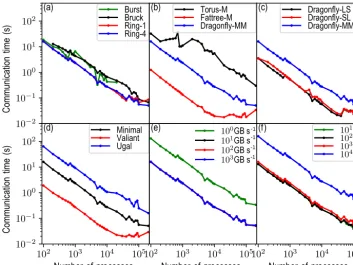
cesses because the burst messages result in huge events and a large memory footprint. The communication time of the bruck algorithm is significantly larger than that of the ring-k algorithm for fewer than 105MPI processes; however, for a greater number of processes, it is better than the ring-1 al-gorithm since the bruck alal-gorithm is targeted for small mes-sages, and the more processes, the smaller the message for a fixed-size problem. The performance of these alltoallv algo-rithms is confirmed by actually running the skeleton program of transposition for the spectral transform method with 104 MPI processes on the research cluster (Beaufix) of Météo France, which shows that the ring-4 algorithm is even better than the INTEL native MPI_Alltoallv function (Fig. 6).
The differences in the communication times of the trans-positions between the topology torus-M, fattree-M, and dragonfly-MM can be an order of magnitude (Fig. 5b). Mes-sages have to travel a long distance in the topology torus-M which is a 3-D torus, so its communication time is the largest. The best performance of the topology fattree-M can be attributed to its non-blocking D-mod-krouting algorithm, but its communication time gradually increases as the num-ber of MPI processes increases beyond 104. The performance of topology dragonfly-MM is between that of torus-M and fattree-M (Fig. 5b); it can achieve a better performance by tuning the configuration of the dragonfly topology (Fig. 5c). By comparing Fig. 5b and c, we can see that the topolo-gies of dragonfly-SL and dragonfly-LS are still not as good as the fattree-M, but their performance is very close to that of fattree-M and they lose less scalability than fattree-M for more than 5×10⁴MPI processes.
con-(a)
i
i+1
i-1
i+2
i-2
i+3
i-3
i+4
i-4
i+5
i-5
i+6
i-6
(b)
1 2
3 4
1 2
3 4
5 6
(c)
0 1 2 3 4 5 6 7 8 9 10
S
tages
Figure 4. Algorithms for three key MPI operations:(a)is the ring-k algorithm with k radix for all-to-all personalized communication generalized from ring alltoallv algorithm,(b)is the halo exchange algorithm, and(c)is the recursive-kalgorithm withkradix generalized from the recursive doubling algorithm.
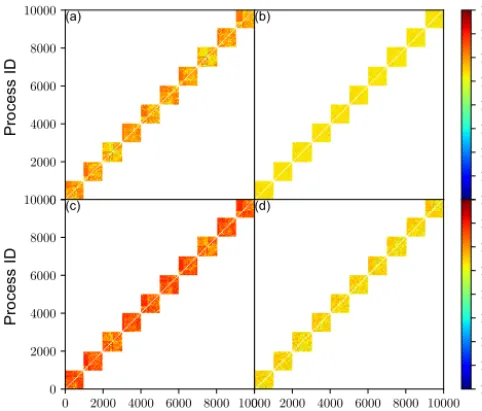
firms this that a high percentage of delay events has a delay time of fewer than 30 µs using the valiant routing algorithm for the dragonfly-MM topology and the minimal routing al-gorithm for the dragonfly-SL topology; however, the mini-mal routing algorithm for the dragonfly-MM topology has a significant percentage of events that delays by more than 50 µs, especially there are a large number of events delayed by more than 100 µs using the ugal routing algorithm for the dragonfly-MM topology. Thus, the configuration of the in-terconnect network and the design of its routing algorithm should make the congestion as uniform as possible if con-gestion is inevitable.
Although the communication time with a bandwidth of 100GB s−1 is apparently separated from those with band-widths of 101, 102, and 103GB s−1, the curves describing the communication times with bandwidths of 101, 102, and 103GB s−1overlap (Fig. 5e). The communication times with latencies of 101and 102ns are almost identical; that with a
Fig-10−2
10−1
100
101
102
Communication
time
(s)
(a) Burst
Bruck Ring-1 Ring-4
(b) Torus-M
Fattree-M Dragonfly-MM
(c) Dragonfly-LS
Dragonfly-SL Dragonfly-MM
102 103 104 105
Number of processes
10−2
10−1
100
101
102
Communication
time
(s)
(d) Minimal
Valiant Ugal
102 103 104 105
Number of processes
(e) 100GB s
101GB s
102GB s
103GB s
102 103 104 105
Number of processes
(f) 101ns
102ns
103ns
104ns
-1 -1
-1
-1
Figure 5.Communication times of transposition for(a)alltoallv algorithms,(b)topologies,(c)configurations of the dragonfly topology, (d)routing algorithms for the dragonfly topology,(e)bandwidth, and(f)latency. The circle markers indicate the numbers of processes of the corresponding simulations.
ure 8b and c show the distributions of the delay caused by congestion for different bandwidths and different latencies, respectively. In Fig. 8b, the distributions of the delay for bandwidths of 101, 102, and 103GB s−1 are almost identi-cal, which explains their overlapped communication times in Fig. 5e; and the distribution of the delay for a bandwidth of 100GB s−1is distinct from the rest since near 20 % of events are delayed by fewer than 10 µs but a significant percentage of events are delayed more than 100 µs, which accounts for its largest communication time in Fig. 5e. In Fig. 8c, the dis-tributions of the delay for latencies of 101and 102ns are the same; the distributions of the delay for a latency of 103ns is slightly different from the formers; but the distributions of the delay for a latency of 104ns has a large percentage of events in the right tail, which resulted in the longest commu-nication time; these are consistent with their commucommu-nication times in Fig. 5f.
In summary, the alltoallv algorithm, the topology and its configuration, the routing algorithm, the bandwidth, and the latency have great impacts on the communication time of transpositions. In addition, the communication time of trans-positions decreases as the number of MPI processes increases in most cases; however, this strong scalability is not appli-cable for the fattree-M topology (the red line in Fig. 5b), the dragonfly-SL and dragonfly-LS topologies (red and black lines in Fig. 5c), and the valiant routing algorithm (the red line in Fig. 5d) when the number of MPI processes is large.
0.0 0.5 1.0 1.5 2.0 2.5 3.0
Communication time in seconds
Burst Bruck Ring-4
INTEL MPI_Alltoallv
Figure 6.Actual communication time of transposition for the spec-tral transform method with 104MPI processes run on the Beaufix cluster in Météo France.
0 2000 4000 6000 8000 10000 P ro ce ss ID (a) (b)
0 2000 4000 6000 8000 10000
Process ID 0 2000 4000 6000 8000 10000 P ro ce ss ID (c)
0 2000 4000 6000 8000 10000
Process ID (d) 101 102 103 104 105 106 107 108 100 101 102 103 104 105 106 107 108
Figure 7. Congestion of transposition using (a)minimal routing algorithm for the dragonfly-MM topology,(b)valiant routing algo-rithm for the dragonfly-MM topology,(c)ugal routing algorithm for the dragonfly-MM topology, and(d)minimal routing algorithm for the dragonfly-SL topology.
4.3 Halo exchange for the semi-Lagrangian method The most common application of the wide halo exchange is the SL method. For the resolution of 0.0125◦in Table 3 and a time step of 30 s, the departure is approximately five grid points away from its arrival if the maximum wind speed is 200 m s−1; therefore, the width of the halo is at least seven grid points using the ECMWF quasi-cubic scheme (Ritchie, 1995); there are more grid points if a higher-order scheme such as the SLICE-3D (Semi-Lagrangian Inherently Con-serving and Efficient (SLICE) in three dimensions) (Zer-roukat and Allen, 2012) is used. In Fig. 9a, the communica-tion time of the halo exchange decreases more slowly with an increasing number of processes than that of transposition for the spectral transform method. This is because the message size decreases more slowly than that of transposition owing to the fixed width of the halo (figure not shown). If the com-munication time of the transposition (halo exchange) contin-ues its decreasing (increasing) trend in Fig. 9a, they meet at certain number of MPI processes; then, the communication time of the halo exchange is larger than that of the transpo-sition. In addition, it can be seen that the wider the halo, the longer the communication time. The halo exchange of a thin halo of three grid points, such as for the sixth-order central difference Fi0=−Fi−3+9Fi−2−45Fi−1+45Fi+1−9Fi+2+Fi+3
601 (the
red line in Fig. 9a), is significantly faster than that of wide halo for the SL method (green and blue lines in Fig. 9a). Thus, the efficiency of the SL method is counteracted by the overhead of the wide halo exchange where the width of the halo is determined by the maximum wind speed. Wide
0 20 40 Pe rc en t
(a) Minimal dragonfly-MM
Valiant dragonfly-MM Ugal dragonfly-MM Minimal dragonfly-SL 0 20 40 Pe rc en t (b)
100GB s
101GB s
102GB s
103GB s
0 20 40 60 80 100 120 140 160 180
Delay time (µs) 0 20 40 Pe rc en t (c)
101ns
102ns
103ns
104ns
-1 -1 -1 -1
Figure 8. Distribution of delayed events of transposition for the spectral transform method with 104MPI processes using(a) dif-ferent routing algorithms and topology configurations,(b)different bandwidths, and(c)different latencies, simulated by SST/macro.
halo exchange for the SL method is expensive at the exas-cale, especially for the atmospheric chemistry models where a large number of tracers need to be transported. On-demand exchange is a way to reduce the communication of halo ex-change for the SL method and will be investigated in a future study.
Significant differences in the communication times of the wide halo exchange of 20 grid points for topology torus-L, fattree-L, and dragonfly-ML are shown in Fig. 9b. It can be seen that topology torus-L performs the worst, fattree-L is the best, and the performance of dragonfly-ML is between that of torus-L and fattree-L. The communication time of the wide halo exchange of 20 grid points for the topology tour-L abruptly increases at approximately 103MPI processes and then gradually decreases when the number of MPI tasks be-comes larger than 3×10³MPI processes. The impact of the routing algorithm on the communication time of the wide halo exchange of 20 grid points (Fig. 9c) is the same as on that of transposition (Fig. 5d): the routing algorithm valiant performs the best, the routing algorithm ugal performs the worst, and the routing algorithm minimal is between valiant and ugal.
4.4 Allreduce in Krylov subspace methods for the semi-implicit method
com-102 103 104 105 106
10−3
10−2
10−1
100
101
Communication
time
(s)
(a) Transpose
Halo=03 Halo=10 Halo=20
102 103 104 105 106
10−3
10−2
10−1
100
101 (b) Torus-LFattree-L
Dragonfly-ML
102 103 104 105 106
Number of processes
10−3
10−2
10−1
100
101
Communication
time
(s)
(c) Minimal
Valiant Ugal
0 20 40 60 80
Process ID
0 20 40 60 80
Pr
oc
es
s
ID
(d)
104.0
104.2
104.4
104.6
104.8
105.0 105.2
105.4
105.6
Figure 9.Panel(a)is the communication times of the halo exchange with a halo of 3 (red line), 10 (green line), and 20 (blue line) grid points, and the communication time of transposition for the spectral transform method is shown for comparison (black line). Panel(b)is the communication times of the halo exchange with a halo of 20 grid points for the topology of torus-L (black line), fattree-L (red line), and dragonfly-ML (blue line). Panel(c)is the communication times of the halo exchange with a halo of 20 grid points for the routing algorithm of minimal (black line), valiant (red line), and ugal (blue line). Panel(d)illustrates the communication pattern of the halo exchange with a wide halo. The circle markers in(a)–(c)indicate the numbers of processes of the corresponding simulations.
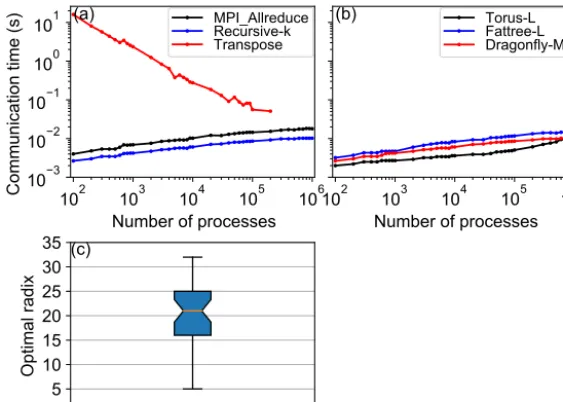
munication time of GCR increases as the number of MPI processes increases. Following the trend, the communication of a single GCR call may be similar to or even larger than that of a single transposition when the number of MPI pro-cesses approaches to or is beyond 1 million. Although it is believed that the spectral method does not scale well ow-ing to its time-consumow-ing transposition, it does not suffer from this expensive allreduce operation for the SI method be-cause of its mathematical advantage that spherical harmonics are the eigenfunctions of Helmholtz operators. In this sense, a grid-point model with the SI method in which the three-dimensional Helmholtz equation is solved by Krylov sub-space methods may also not scale well at the exascale unless the overhead of allreduce communication can be mitigated by overlapping it with computation (Sanan et al., 2016).
Figure 10b shows the communication times of allreduce operations using the recursive-kalgorithm on the topologies of torus-L, fattree-L, and dragonfly-ML. The impact of topol-ogy on the communication performance of allreduce opera-tions is obvious. The topology of torus-L has the best perfor-mance but is similar to that of dragonfly-ML for more than 5×10⁵MPI processes; fattree-L has the worst performance. However, the three routing algorithms (minima, valiant, and
ugal) for the dragonfly-ML topology have a negligible im-pact on the communication performance of allreduce oper-ations (figure not shown); this may be because of the tiny messages (only three doubles for the restart numberk=3) communicated by the allreduce operation.
model. However, for a given resolution of NWP model and a given HPC system, fortunately, the number of processes, bandwidth, and latency are fixed; thus, it is easy to perform experiments to obtain the optimal radix.
5 Conclusion and discussion
This work shows that it is possible to make simulations of the MPI patterns commonly used in NWP models using very large numbers of MPI tasks. This opens up the possibility of examining and comparing the impact of different factors such as latency, bandwidth, routing, and network topology on response time. We have provided an assessment of the per-formance and scalability of three key MPI operations in an atmospheric model at the exascale by simulating their skele-ton programs on an SST/macro simulator. After optimization of the memory and efficiency of the SST/macro simulator and construction of the skeleton programs, a series of ex-periments was carried out to investigate the impacts of the collective algorithm, the topology and its configuration, the routing algorithm, the bandwidth, and the latency on the per-formance and scalability of transposition, halo exchange, and allreduce operations. The experimental results show the fol-lowing:
1. The collective algorithm is extremely important for the performance and scalability of key MPI operations in the atmospheric model at the exascale because a good algorithm can make full use of the bandwidth and re-duce the stages of communication. The generalized ring-kalgorithm for the alltoallv operation and the gen-eralized recursive-k algorithm for the allreduce opera-tion proposed herein perform the best.
2. Topology, its configuration, and the routing algorithm have a considerable impact on the performance and scalability of communications. The fattree topology usually performs the best, but its scalability becomes weak with a large number of MPI processes. The drag-onfly topology balances the performance and scalability well, and can maintain almost the same scalability with a large number of MPI processes. The configurations of the dragonfly topology indicate that a proper configu-ration can be used to avoid the hotspots of congestion and lead to good performance. The minimal routing al-gorithm is intuitive and performs well. However, the valiant routing algorithm (which randomly chooses an intermediate node to uniformly disperse the communi-cation over the network to avoid the hotspots of conges-tion) performs much better for heavy congestion. 3. Although they have an important impact on
commu-nication, bandwidth and latency cannot be infinitely grown and reduced owing to the limitation of hardware. Thus, it is important to design innovative algorithms to
make full use of the bandwidth and to reduce the effect of latency.
4. It is generally believed that the transposition for the spectral transform method, which is a multiple simul-taneous all-to-all personalized communication, poses a great challenge to the scalability of the spectral model. This work shows that the scalability of the spectral model is still acceptable in terms of MPI transposi-tion. However, the wide halo exchange for the semi-Lagrangian method and the allreduce operation in the GCR iterative solver for the semi-implicit method, both of which are often adopted by the grid-point model, also face the stringent challenge of scalability at the exas-cale.
In summary, both software (algorithms) and hardware (characteristics and configuration) are of great importance to the performance and scalability of the atmospheric model at the exascale. The software and hardware must be co-designed to address the challenge of the atmospheric model for exascale computing.
102 103 104 105 106 Number of processes 10 3
10 2 10 1 100 101
Communication time (s)
(a) MPI_Allreduce Recursive-k Transpose
102 103 104 105 106
Number of processes (b) Torus-L Fattree-L Dragonfly-ML
0 5 10 15 20 25 30 35
Optimal radix
(c)
Figure 10.Panel(a)is the communication times of the allreduce operation using the MPI_Allreduce (black line) and the recursive-k algo-rithm (blue line), and the communication time of transposition for the spectral transform method is shown for comparison (red line). Panel (b)is the communication times of the allreduce operation using the recursive-k algorithm for the topology torus-L (black line), fattree-L (blue line), and dragonfly-ML (red line). Panel(c)is the statistics of the optimal radices for the recursive-kalgorithm. The circle markers in (a)–(b)indicate the numbers of processes of the corresponding simulations.
for the complex hierarchical architectures, but the scalability might be affected. The more MPI processes, the less compu-tation per node if there is only one single-core CPU per node; thus, computation is not considered in this paper. Because multi-core or many-core processors share a memory bus, it is possible for a memory-intensive application (such as an atmospheric model) to saturate the memory bus and result in degraded performances of all the computations running on that processor. The assessment of computations is currently underway and a detailed paper will be presented separately; the purpose of this subsequent study is to model the time re-sponse of a time step of a model such as the regional model (AROME) used by Météo France.
Code availability. The code of the SST/macro simulator is publicly available at https://github.com/sstsimulator/sst-macro (Sandia National Laboratories, 2018). The skeleton pro-grams, scripts, and our modified version of SST/macro 7.1.0 for the simulations presented in this paper are available at https://doi.org/10.5281/zenodo.1066934 (Zheng, 2017).
Competing interests. The authors declare that they have no conflict of interest.
Acknowledgements. This work was supported by the ESCAPE (Energy-efficient Scalable Algorithms for Weather Prediction at Exascale) project. The ESCAPE project has received funding from the European Union’s Horizon 2020 research and innovation
programme under grant agreement no. 671627. Our sincere gratitude goes to two anonymous reviewers and the topical editor David Ham for their thoughtful comments and suggestions that have helped improve this paper substantially.
Edited by: David Ham
Reviewed by: two anonymous referees
References
Acun, B., Jain, N., Bhatele, A., Mubarak, M., Carothers, C. D., and Kale, L. V.: Preliminary Evaluation of a Parallel Trace Replay Tool for HPC Network Simulations, Springer International Pub-lishing, Cham, 417–429, 2015.
Ajima, Y., Sumimoto, S., and Shimizu, T.: Tofu: A 6D Mesh/Torus Interconnect for Exascale Computers, Computer, 42, 36–40, 2009.
Alverson, B., Froese, E., Kaplan, L., and Roweth, D.: Cray XC Se-ries Network, Cray Inc., 2015.
Barros, S. R. M., Dent, D., Isaksen, L., Robinson, G., Mozdzynski, G., and Wollenweber, F.: The IFS model: a parallel production weather code, Parallel Comput., 21, 1621–1638, 1995.
Bauer, P., Thorpe, A., and Brunet, G.: The quiet revolution of nu-merical weather prediction, Nature, 525, 47–55, 2015.
Böhm, S. and Engelmann, C.: xSim: The extreme-scale simulator, in: 2011 International Conference on High Performance Com-puting Simulation, 280–286, 2011.
Dechev, D. and Ahn, T. H.: Using SST/Macro for Effective Analy-sis of MPI-Based Applications: Evaluating Large-Scale Genomic Sequence Search, IEEE Access, 1, 428–435, 2013.
Degomme, A., Legrand, A., Markomanolis, G. S., Quinson, M., Stillwell, M., and Suter, F.: Simulating MPI Applications: The SMPI Approach, IEEE T. Parall. Distr., 28, 2387–2400, 2017. Dubos, T., Dubey, S., Tort, M., Mittal, R., Meurdesoif, Y., and
Hour-din, F.: DYNAMICO-1.0, an icosahedral hydrostatic dynami-cal core designed for consistency and versatility, Geosci. Model Dev., 8, 3131–3150, https://doi.org/10.5194/gmd-8-3131-2015, 2015.
Ehrendorfer, M.: Spectral numerical weather prediction models, SIAM, 482 pp., https://doi.org/10.1137/1.9781611971996, 2012. Eisenstat, S. C., Elman, H. C., and Schultz, M. H.: Variational it-erative methods for nonsymmetric systems of linear equations, SIAM J. Numer. Anal., 20, 345–357, 1983.
Engelmann, C.: Scaling to a million cores and beyond: using light-weight simulation to understand the challenges ahead on the road to exascale, Future Gener. Comp. Sy., 30, 59–65, 2014. Hoefler, T., Schneider, T., and Lumsdaine, A.: LogGOPSim –
Sim-ulating Large-Scale Applications in the LogGOPS Model, in: Proceedings of the 19th ACM International Symposium on High Performance Distributed Computing, 597–604, ACM, 2010. Hortal, M.: The development and testing of a new two-time-level
semi-Lagrangian scheme (SETTLS) in the ECMWF forecast model, Q. J. Roy. Meteor. Soc., 128, 1671–1687, 2002. Hoskins, B. J. and Simmons, A. J.: A multi-layer spectral model and
the semi-implicit method, Q. J. Roy. Meteor. Soc., 101, 637–655, 1975.
Jain, N., Bhatele, A., White, S., Gamblin, T., and Kale, L. V.: Eval-uating HPC Networks via Simulation of Parallel Workloads, in: SC16: International Conference for High Performance Comput-ing, NetworkComput-ing, Storage and Analysis, 154–165, 2016. Janssen, C. L., Adalsteinsson, H., Cranford, S., Kenny, J. P., Pinar,
A., Evensky, D. A., and Mayo, J.: A Simulator for Large-Scale Parallel Computer Architectures, International Journal of Dis-tributed Systems and Technologies, 1, 57–73, 2010.
Juang, H. H., Hong, S., and Kanamitsu, M.: The NCEP regional spectral model: an update, B. Am. Meteorol. Soc., 78, 2125– 2143, 1997.
Kanamitsu, M., Kanamaru, H., Cui, Y., and Juang, H.: Parallel im-plementation of the regional spectral atmospheric model, Tech. rep., Scripps Institution of Oceanography, University of Califor-nia at San Diego, and National Oceanic and Atmospheric Admin-istration for the California Energy Commission, PIER Energy-Related Environmental Research, cEC-500-2005-014, 2005. Kim, J., Dally, W. J., Scott, S., and Abts, D.: Technology-Driven,
Highly-Scalable Dragonfly Topology, in: 2008 International Symposium on Computer Architecture, 77–88, 2008.
Lagadapati, M., Mueller, F., and Engelmann, C.: Benchmark Gener-ation and SimulGener-ation at Extreme Scale, in: 2016 IEEE/ACM 20th International Symposium on Distributed Simulation and Real Time Applications (DS-RT), 9–18, 2016.
Leiserson, C. E.: Fat-trees: Universal networks for hardware-efficient supercomputing, IEEE T. Comput., C-34, 892–901, 1985.
Li, L., Xue, W., Ranjan, R., and Jin, Z.: A scalable Helmholtz solver in GRAPES over large-scale multicore cluster, Concurr. Comp.-Pract. E., 25, 1722–1737, 2013.
Lin, S.-J.: A “vertically Lagrangian” finite-volume dynamical core for global models, Mon. Weather Rev., 132, 2293–2307, 2004. Mubarak, M., Carothers, C. D., Ross, R. B., and Carns, P.: Enabling
Parallel Simulation of Large-Scale HPC Network Systems, IEEE T. Parallel Distr., 28, 87–100, 2017.
Noeth, M., Ratn, P., Mueller, F., Schulz, M., and de Supinski, B. R.: ScalaTrace: Scalable compression and replay of communication traces for high-performance computing, J. Parallel Distr. Com., 69, 696–710, 2009.
Núñez, A., Fernández, J., Garcia, J. D., Garcia, F., and Carretero, J.: New techniques for simulating high performance MPI appli-cations on large storage networks, J. Supercomput., 51, 40–57, 2010.
Qaddouri, A. and Lee, V.: The Canadian global environmental mul-tiscale model on the Yin-Yang grid system, Q. J. Roy. Meteor. Soc., 137, 1913–1926, 2011.
Ritchie, H.: Implementation of the Semi-Lagrangian Method in a High-Resolution Version of the ECMWF forecast model, Mon. Weather Rev., 123, 489–514, 1995.
Robert, A., Henderson, J., and Turnbull, C.: An implicit time inte-gration scheme for baroclinic models of the atmosphere, Mon. Weather Rev., 100, 329–335, 1972.
Sanan, P., Schnepp, S. M., and May, D. A.: Pipelined, flexible krylov subspace methods, SIAM J. Sci. Comput., 38, C441– C470, 2016.
Sandbach, S., Thuburn, J., Vassilev, D., and Duda, M. G.: A Semi-Implicit version fo the MPAS-atmosphere dynamical core, Mon. Weather Rev., 143, 3838–3855, 2015.
Satoh, M., Matsuno, T., Tomita, H., Miura, H., Nasuno, T., and Iga, S.: Nonhydrostatic icosahedral atmospheric model (NICAM) for global cloud resolving simulations, J. Comput. Phys., 227, 3486– 3514, 2008.
Seity, Y., Brousseau, P., Malardel, S., Hello, G., Bénard, P., Bouttier, F., Lac, C., and Masson, V.: The AROME-France Convective-Scale Operational Model, Mon. Weather Rev., 139, 976–991, 2011.
Skamarock, W. C., Klemp, J. B., Duda, M. G., Fowler, L. D., and Park, S.-H.: A multiscale nonhydrostatic atmospheric model us-ing centroidal voronoi tesselations and C-grid staggerus-ing, Mon. Weather Rev., 140, 3090–3105, 2012.
Smolarkiewicz, P. K., Deconinck, W., Hamrud, M., Kühn-lein, C., Mozdzynski, G., Szmelter, J., and Wedi, N. P.: A finite-volume module for simulating global all-scale atmospheric flows, J. Comput. Phys., 314, 287–304, https://doi.org/10.1016/j.jcp.2016.03.015, 2016.
SNL, L. C.: SST/macro 7.1: User’s Manual, Sandia National Labs, Livermore, CA, 2017.
Staniforth, A. and Côté, J.: Semi-Lagrangian integration schemes for atmospheric models–a review, Mon. Weather Rev., 119, 2206–2223, 1991.
Temperton, C.: Self-sorting mixed-radix fast Fourier transforms, J. Comput. Phys., 52, 1–23, 1983.
Thakur, R., Rabenseifner, R., and Gropp, W.: Optimization of Col-lective Communication Operations in MPICH, Int. J. High Per-form. Comput. Appl., 19, 49–66, 2005.
Wedi, N. P.: Increasing horizontal resolution in numer-ical weather prediction and climate simulations: illu-sion or panacea?, Philos. T. R. Soc. A, 372, 20130289, https://doi.org/10.1098/rsta.2013.0289, 2014.
Wedi, N. P., Hamrud, M., and Mozdzynski, G.: A fast spherical harmonics transform for global NWP and climate models, Mon. Weather Rev., 141, 3450–3461, 2013.
Wike, J. J. and Kenny, J. P.: Using Discrete Event Simulation for Programming Model Exploration at Extreme-Scale: Macroscale Components for the Structural Simulation Toolkit (SST), Tech. rep., Sandia National Laboratories, sAND2015-1027, 2014. Wolfe, N., Carothers, C. D., Mubarak, M., Ross, R., and Carns,
P.: Modeling a Million-Node Slim Fly Network Using Parallel Discrete-Event Simulation, in: Proceedings of the 2016 Annual ACM Conference on SIGSIM Principles of Advanced Discrete Simulation, 189–199, ACM, 2016.
Zahavi, E., Johnson, G., Kerbyson, D. J., and Lang, M.: Optimized InfiniBand™ fat-tree routing for shift all-to-all communication patterns, Concurr. Comp.-Pract. E., 22, 217–231, 2010.
Zangl, G., Reinert, D., Ripodas, P., and Baldauf, M.: The ICON (icosahedral non-hydrostatic) modelling framework of DWD and MPI-M: description of the non-hydrostatic dynamical core, Q. J. Roy. Meteor. Soc., 141, 563–579, 2015.
Zerroukat, M. and Allen, T.: A three-dimensional monotone and conservative semi-Lagrangian scheme (SLICE-3D) for transport problems, Q. J. Roy. Meteor. Soc., 138, 1640–1651, 2012. Zheng, Y.: Performance and Scalability of Communications in
Atmospheric Model for Exascale Supercomputer, Zenodo, https://doi.org/10.5281/zenodo.1066934, 2017.