Approach of Solving Dual Resource Constrained
Multi-Objective Flexible Job Shop Scheduling Problem Based
on MOEA/D
https://doi.org/10.3991/ijoe.v14i07.8966Li Xixing
Hubei University of Technology, Wuhan,China
Liu Yi!!"
Wuhan Donghu University, Wuhan, China
Abstract—With considering the scheduling objectives such as makespan, machine workload and product cost, a dual resource constrained flexible job shop scheduling problem is described. To solve this problem, a multi-objective evolutionary algorithm based on decomposition (MOEA/D) was proposed to simplify the solving process, and an improved differential evolution algorithm was introduced for evolving operation. A special encoding scheme was de-signed for the problem characteristics, the initial population was generated by the combination of random generation and strategy selection, and an improved crossover operator was applied to achieve differential evolution operations. At last, actual test instances of flexible job shop scheduling problem were tested to verify the efficiency of the proposed algorithm, and the results show that it is very effective.
Keywords—RFID; agricultural automation; sugarcane; growth monitoring
1
Introduction
to the rational use of resources, and is more in line with the actual conditions of work-shop production; so many scholars at home and abroad have studied this problem.
Elmaraghy et.al[1] studied the use of a genetic algorithm (GA)-based scheduling
so-lution to solve the DRCFJSP, and constructed an experimental method for determin-ing the employee level, machine, and worker configuration. Based on this, it is pro-posed that the six distribution rules and GA have been tested on single-resource-constrained shop scheduling and double-resource-single-resource-constrained shop scheduling prob-lems. The results show that the proposed method and model can effectively solve the DRCFJSP. Li et.al[2] designed a hybrid algorithm combining ant colony algorithm and
simulated annealing algorithm for DRCFJSPs with different workers' capabilities. An adaptive control mechanism based on ant path flow was also proposed to improve global search capabilities. Cao et.al[3] proposed an immune genetic algorithm to solve
DRCFJSPs. This algorithm can effectively avoid premature problems under high selection pressure and improve the ability to search for optimal solutions, while accel-erating the speed of convergence. Simulation experiments show that the algorithm can effectively obtain the optimal solution of DRCFJSP. Liang et.al[4] constructed a
DRCFJSP model with the goal of minimizing the maximum completion time using petri nets, and proposed a hybrid algorithm based on GA and tabu search (Tabu Serch, TS) to solve the model. Lei et.al [5] proposed to use variable neighborhood
search algorithm to solve DRCFJSP, and designed different variable neighborhood search strategies for two different sub-problems in DRCFJSP. Huang et.al[6] proposed
a three-layer dynamic scheduling system based on time window including dynamic perturbation analysis, dynamic perturbation evaluation and dynamic scheduling meth-od to solve DRCFJSP. Zhang et.al [7] proposed a three-layer coding scheme, and
based on discrete particle swarm optimization algorithm, simulated annealing algo-rithm and variable neighborhood search were used as local search strategies to con-struct a hybrid discrete particle swarm algorithm to solve DRCFJSP. Lei et. al[8] took
environmental factors into account in the DRCFJSP, built a scheduling model with the goal of minimizing carbon footprint and maximum completion time, and proposed a dynamic domain search algorithm to solve the problem. Yazdani et.al[9] proposed
using the simulated annealing algorithm and the shock optimization two heuristic algorithms combined with the variable neighborhood search strategy to obtain the DRCFJSP solution. The experimental results show that the two proposed hybrid algo-rithms have relatively good performance. Li et.al[10] considered the two goals of
min-imizing the maximum completion time and minmin-imizing the processing cost in the DRCJSP. The branch population genetic algorithm was used, and the compression time window strategy was used to improve the global scheduling ability. Zheng et.al[11] proposed to use knowledge-based fruit fly optimization algorithm to solve the
2
Problem description and model establishment
The research of DRCFJSP is that the
N
workpieces with multiple processes are processed byW
workers to operate theM
equipments for processing and schedul-ing optimization. In the DRCFJSP, there is a process order constraint between the different processes of the same workpiece, which can only be processed in accordance with the predetermined process sequence. Meanwhile, each processing equipment can choose different workers to operate, and each worker has different operation ability and operation efficiency. Therefore, the problem to be solved by the DRCF JSP is to obtain a scheduling scheme that optimizes the predetermined performance index by rationally arranging the processing sequence of the work pieces, completing the cessing equipment for each process, and operating the workers of the various cessing equipment under conditions that satisfy process constraints, equipment pro-cessing capacity constraints, and worker operating capacity constraints.This paper establishes a scheduling model with the goal of minimizing the maxi-mum completion time, minimizing the processing equipment load, and minimizing the production cost. The model is based on the following assumptions:
a) All processing equipment is available at time 0; b) All workpieces can be processed starting at time 0;
c) There is no process order constraint between the workpieces;
d) One device can only process one process at a time, and one worker can only oper-ate one device at a time;
e) Does not consider interruptions in the processing of the process; f) Does not consider transport time, preparation time, release time, etc.
2.1 Variable Definition Labeling
Workpiece number
{1,..., };
j
!
j
!
N
Process number
{1,..., };
jl
!
l
"
!
Device number
{1,..., };
k
!
k
!
M
Worker number
{1,..., };
r
!
r
!
W
Known variables
Quantity of workpieces
N
Quantity of processing equipment
M
Quantity of operator
W
Quantity of process in workpiece
{1,... };
j
j j
N
!
!
"
Basic processing time of process in workpiece on device
jlk
p
l
j
k
Processing efficiency of worker operates device
rkDeadline for delivery of workpiece
jd
j
Unit processing time cost of device
ke
k
Unit processing time cost when worker operating equipment
rkg
r
k
Unit time inventory cos t when workpiece is advanced
j
j
!
Unit time punishment cos t when workpiece is delay
j
j
!
Decision variables
If the process in the workpiece is processed by the device
and the worker , it is 1, otherwise it is 0
jlrk
x
l
j
k
r
SM The state of machine at time , idle is 0, being processed is 1
tkk
t
S The state of worker at time , idle is 0, being processed is 1
W
trr
t
The starting time of process in workpiece
jl
s
l
j
The end time of process in workpiece ;
jlf
l
j
The completion time of workpiece
j
c
j
2.2 Mathematical model
Based on the above problem description and variable definition, the scheduling op-timization mathematical model for DRCF JSP is established and the corresponding constraint conditions are as follows:
1 2 3
min{ , , }
f f f
(1)1
max{ }
1N j j
f
c
=
=
(2)2
1 1 1 1 j
M N W
jlk rk jlrk k j l r
f
!p
h
x
= = = =
=
####
"
"
(3)3
1 1 1 1
1
(
)
(
max{
,0}
max{
,0})
j
M N W
k rk jlk rk jlrk
k j l r
N
j j j j j j
j
f
e g
p
h
x
d c
c d
1 1
j j j
M W
j j j k j rk
k r
c
s
!p
!x
!= =
=
+
##
"
(5)( 1) ( 1) ( 1) ( 1) 0
1 1
suppose
0,
0.
M W
jl j l j l j l k j l rk j jok
k r
s
f
!s
!p
!x
!s
p
= =
"
=
+
$$
#
=
=
(6)1 1
1, ,
M W
jlrk
k r
x
j l
= =
=
!
""
(7)0,
0,
,
jl jl
s s
SM
=
SW
=
!
j l
(8)Equation (1) is the objective function of the schedule optimization. Equation (2) represents the maximum completion time, the maximum completion time is the com-pletion time of the last process of the last workpiece. Equation (3) is the total equip-ment load, that is, the sum of all processing equipequip-ment cumulative processing time. Equation (4) is the production cost, and the production cost is composed of two parts. The first part is the sum of the cost of processing equipment and workers in the pro-duction process. The second part is the sum of the lead time inventory cost and tardi-ness penalty cost after all the parts are completed. Equation (5) shows that the com-pletion time of the workpiece is the starting processing time of the last process of the workpiece plus its actual processing time. The actual processing time is determined by the basic processing time of the selected equipment and the operating efficiency of the selected operator. Equation (6) reflects the process sequence constraint, and the starting processing time of the process must be later than the processing ending time of the preceding process. Equation (7) indicates that all processes must be completed by only one piece of equipment and one worker. Equation (8) indicates that the se-lected processing equipment and workers must be in an idle state when all processes are started.
3
Multi-Objective Evolutionary Algorithm Based on
Decomposition
Multi-Objective Evolutionary Algorithm Based on Decomposition (MOEA/D) is a new multi-objective optimization framework [12]. The core idea is to decompose a
maintain-ing the dispersion of the solution, and can be globally optimized by analyzmaintain-ing the information of neighboring sub-problems to avoid falling into local optimum. Com-pared with Nondominated Sorting Genetic Algorithm II (NSGA-II), MOEA/D can obtain more accurate and better Pareto optimal solution set in faster time.
3.1 Weight vector generation and aggregation method
The main feature of MOEA/D is to deal with multi-objective optimization prob-lems in the form of solving a set of single-target sub-probprob-lems. Each single-target sub-problem has its own different weight vector. Each weight vector has one and only one individual in the current population, that is, the number of weight vectors and the population size are consistent. The generation of weight vector is an important link in the implementation of MOEA/D, and the result of using a relatively uniform weight vector is better than the non-uniform weight vector [13]. The common method is to
evenly take points on plane
f
1+
f
2+ +
...
f
m=
1
or surface2 2 2
1 2
...
m1
f
+
f
+ +
f
=
to generate a uniform weight vector. The specific implemen-tation steps are as follows: First, a positive integerH
is defined by the user, and thusa weight vector element value set
{0, , ,..., }
1 2
H
H H
H
!
=
or1
2
{0,
,
,...,
H
}
H
H
H
!
=
can be obtained. For the weight value, 1,2,..,
i
i
m
! "
#
=
in each weight vector,! "
i#
, and! !
1+
2+ +
...
!
m=
1
or2 2 2
1 2
...
m1
!
+
!
+ +
!
=
. The number of weight vectorsG
and user-defined positive integersH
, the number of sub-objective functionsm
satisfies 11 m H m
G C
!+ !
=
can beobtained from the condition that the weight vector must satisfy the sum of the unequal weights and the weight values is 1. From this we can see that in MOEA/D, the size of the population is not set at random, but is determined during the process of generating the weight vector.
After generating the uniformly distributed weight vectors through the above meth-od, the corresponding aggregation method is needed to transform the multi-objective optimization problem of the solution to a single-objective optimization problem. The choice of polymerization method has a decisive influence on the performance of MOEA/D. The most common method is the Chebyshev polymerization method. This method has the property of being insensitive to the shape of the Pareto front. This method will be used in this paper. The formula for the Chebyshev polymerization method is:
* *
min ( | , ) max{ | ( )
te|}
i i i
Where
!
x
!"
,x
!
is the solution vector,!
is solution space,z
*=
( ,..., )
z
1*z
*m Tis the reference point, for each
i
=
1,2,...,
m
, there arez
i*=
min{ ( ) |
f x x
i!"
}
! !
.
3.2 Algorithm Architecture Algorithm initial conditions: A population
x
1!"
,
x
!"!
2,...,
! "!
x
Q of size Q, wherex
i!"
is the current solution to the
cur-rent subproblem
i
;Algorithm initial conditions:
1
,...,
QFV
FV
,FV
i is the objective function value of the individualx
!"
i, i.e. foreach
i
=
1,...
Q
!FV
i=
F
(
x
i)
1
( ,..., )
Tm
z
=
z
z
!
,
z
i is the optimal value of the currently searched target;The additional population EP used to record all non-dominated solutions in the search process;
Input:
Multi-objective optimization problems;
Algorithm termination conditions, generally the maximum number of iter-ations;
H: custom positive integer, combined with the number of sub-objective function M can calculate the population size Q;
Uniformly distributed Q weight vectors:
!
1,...,
!
Q;T: the number of weight vectors in each domain, user-defined; Output: EP
Step 1: Initialization Step 1.1: Set EP=
!
.Step 1.2: Use the weight generation method to obtain a set of weight vectors, calculate the Euclidean distance between any two weight vectors, and select the nearest T weight vectors for each weight vector as its domain. For
1,...,
i
=
Q
, letB i
( ) { ,..., }
=
i
1i
T ,1
,...,
Ti i
!
!
is the nearest T weight vec-tors of!
i.Step 1.3: Initialize the population and get the population
x
!"
1,...,
! "!
x
Q.Step 1.4: Initialize the reference point
1
( ,..., )
Tm
z
=
z
z
!
,
z
i=
min{
f
i(x
!"
1),...,
f
i(
! "!
x
Q)}
. Step 2: UpdateStep 2.1: Evolutionary operations: perform differential evolution operations on subpopulations of individuals
x
i1,...,
x
iQ from B(i) to obtainnew individual y.
Step 2.2: Update Reference Point: for each j=1:m
if
z
j<
f y then z
j( ),
j=
f y
j( )
end forStep 2.3: Update the domain solution: for each
j B i
!
( )
( | , )
( | , ),
,
( )
te te
j j j j j
if g y
!
z
"
g x
!
z then x
=
y FV F y
=
end for Step 2.4: Update the EP
Remove all
F y
( )
-dominated solutions in the EP;If there is no determinant
F y
( )
in the EP, addF y
( )
in EP; end forStep 3: Determine the termination condition: meet the set termination condition, end and output EP; otherwise, go to step 2.
3.3 coding scheme
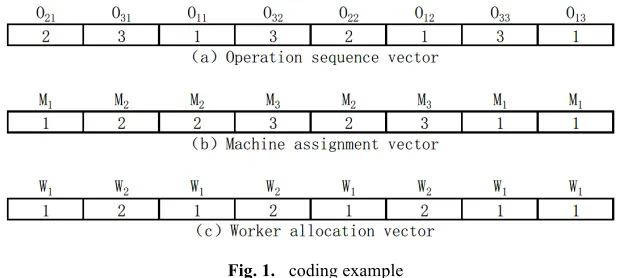
Compared with FJSP, DRCFJSP increases the choice of workers based on the con-sideration of process sequence constraints and equipment selection. Therefore, the two-layer coding of procedures and equipment commonly used in FJSP cannot be applied. This paper proposes a three-layer coding method based on double-level cod-ing in FJSP. To facilitate the description of the codcod-ing scheme proposed in this paper, a 3*3*2 dual resource constrained flexible job shop scheduling problem example is given below. The process-equipment processing time matrix is shown in Table 1, and the equipment-worker processing efficiency matrix is shown in Table 2.
Table 1. Process-equipment processing time matrix
O11 O12 O13 O21 O22 O31 O32 O33
M1 3 - 4 9 - 7 - 7
M2 7 5 3 - 4 7 6 -
M3 6 4 - 7 - 8 8 6
Table 2. Equipment-Worker Process Efficiency Matrix
M1 M2 M3
W1 0.8 0.9 -
Process-based coding. The first layer is a process-based code used to determine the sequential processing sequence. In this encoding method, the length of the
encod-ed chromosome 1
N j j
L !
=
=
"
is assigned to the same number for all steps of the same workpiece, and the sequential processing order of the steps is determined according to the different positions of the numbers. All processes of the same workpiece are as-signed the same number, and the sequential processing sequence of the process is determined according to the different positions of the number. Fig. 1(a) is an example of a process chromosome, in which two successively appearing 2 represent two dif-ferent processes of the workpiece 2. The first 2 represents the first process of the workpiece 2. The second 2 represents the second process of the workpiece 2. The processes of the workpiece 1 and the workpiece 3 are similar.
Fig. 1. coding example
Device-based coding. Device-based coding is used to determine the equipment ar-rangement for each process. Figure 1(b) shows a device-encoded chromosome in a regulation. The length of the chromosome is the same as that of the process coded chromosome, and the code of the corresponding position in the process code indicates the processing equipment number of the process. For example, if the first step of the process chromosome
o
21 represents the second workpiece, the code at the position corresponding to the coded chromosome of the device is 1, that is, the processing device with the serial number 1 is selected in the process, and the corresponding basic processing time is 9. In this way, the number of the processing equipment for all pro-cesses can be determined in turn, and the processing equipment selection must com-ply with the processing equipment constraints.Worker-based coding. Worker-based coding is similar to device-based coding. As shown in Figure 1(c), the number of the corresponding position in the encoded chro-mosome corresponding to the device encoding chrochro-mosome is the selected worker number. As shown in Figure 1(b), the first worker with the number 1 corresponds to a worker number of 1. It should be noted that the worker code should comply with the constraint.
but the quality of the obtained population is not stable. This paper uses the combina-tion of random generacombina-tion and strategy seleccombina-tion to generate the initial populacombina-tion.
Firstly, we generate chromosomes for the sorting of processes. For process-sequencing chromosomes, we use the mixed strategy proposed by Pezzella et.al[14]
and consist of the following three rules: a) Randomly select a workpiece (Random);
b) Give priority to select the workpiece with the longest remaining processing time (MWR);
c) Prioritize the workpiece with the most remaining operations (MOR).
The number of chromosomes for process sequencing generated by the above three strategies is 20%, 40%, and 40%, respectively.
Secondly, for device allocation and worker distribution of chromosomes, 50% of the chromosomes are generated randomly within the constraint set, and the other 50% are generated using the initial population positioning method proposed by Kacem et.al[15]. Take the example of generating device allocation chromosomes. The specific
operation step is to sort the processes in the chromosomes in sequence through the traversal processes, select the device corresponding to the shortest basic processing time in the set of available devices, and adds the current basic processing time to all the basic processing times of the same device (Note that only the available equipment is operated). When the subsequent equipment is selected, the updated basic processing time is referenced until the processing equipment is selected for each process to gen-erate a distribution chromosome. Workers assign chromosomes can be gengen-erated using the same method.
Evolutionary operations. Regarding the evolutionary operation in MOEA/D, this paper adopts Differential Evolution (DE) algorithm[16]. As a new type of intelligent
algorithm, it has the characteristics of simple principle, less controlled parameters, good robustness and easy implementation, and it has been successfully applied to the workshop scheduling problem[17-21], and got better results. Traditional DE mutations
and crossover operators are more suitable for continuous optimization problems and do not apply to discrete DRCFJSPs. This article has improved them to fit DRFCJSPs.
Individual Crossover Operators.Crossover operator
y
=
G
(
x
1,
x
2)
means thatin-dividuals
x x
1,
2are crossed to get new individual y. In this process, differentcrosso-ver strategies are adopted for different chromosomes in individuals. The process se-quencing chromosomes adopt the POX crossover method[22], and the device-allocated
chromosomes and worker-distribution chromosomes adopt the MPX crossover meth-od[23].
Mutation Operation. The difference mutation operation in DE is replaced by an in-dividual crossover operator. First, a subpopulation of inin-dividuals
x
i1
,...,
x
iT in neigh-borhood setB
(
i
)
of an individuali
is obtained, and three individualsx
r1
t,
x
rt2,
x
rt3are2 3 1
1
(
( , ), )
t t t t
i r r r
V
+=
F G F G x x x
!
!
(9)
Where
r
1,
r
2,
r
3!
B
(
i
)
, andr
1!
r
2!
r
3!
i
,F
!
(0,1)
. In formula (9)2 3
2 3
2
( , ),
;
( , )
,
t t r r t t
r r t
r
G x x
rand F
F G x x
x
Otherwise
!
<
"
#
=
$
"%
(10)Among them, rand is the random number on [0,1], it can be seen that the muta-tion operamuta-tion is achieved by two individual cross operamuta-tions with a certain probabil-ity.
Cross Operations. The crossover operation is also implemented with individual crossover operators. For individual
V
it+1 and individualx
i obtained from mutation
operations, the following crossover operations are performed to obtain experimental individual
U
it+1.1
1 1
1
(
, ),
(
, )
,
t t
i i
t t t
i i i t
i
G V
x
rand Cr
U
Cr G V
x
V
Otherwise
++ +
+
!
<
"
=
#
= $
"%
(11)Among them
Cr
!
(0,1)
, the experimental individual Uit+1 obtained as a newin-dividual of the evolutionary operation carries out the following updating reference points and updating the neighborhood solution.
4
Case validation and results analysis
4.1 Test examples and algorithm parameter settings
Since there is no standard test case for DRCFJSP at present, this paper selects 18 commonly used test cases for flexible job shop scheduling problems {MK2, MK4, MK6, Mk8, MK10}[24], {DP2, DP5, DP10, DP15, DP18 }[25] and {LA5, LA10, LA15,
LA20, LA25, LA30, LA35, LA40}[26]. On the basis of it, information on worker
Table 3. Random Variables
Variables Values
Number of workersW !M*0.6"
Average number of workers per unit * !W*0.5"
Equipment working hoursek U[80,120]
Worker hour feegrk U[30,50]
Advance unit time cost!j U[5,10]
Tard time per unit penalty fee" U[8,20]
Deadline U[10,50]
* The number of workers that can be operated on a single device is at least 1
Set the parameter H=13 in MOEA/D (population size Q=105), T=20, Gen=100, F=0.5, Cr=0.5. For better comparison, the population size of the NSGA-II algorithm is set to 105 for the comparison, the maximum number of iterations is set to 100, the crossover probability is set to 0.8, and the mutation probability is set to 0.1.
4.2 Calculation Results and Analysis
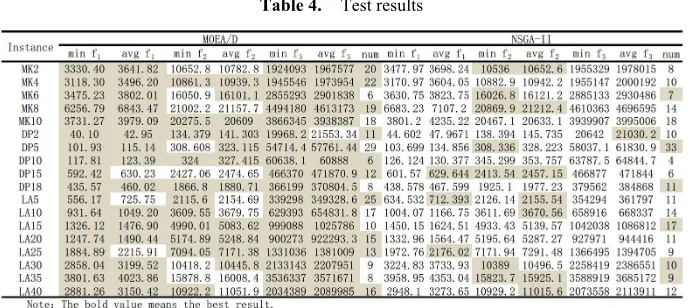
To avoid the randomness of the calculation results, five calculations are performed for each test case. Finally, the summary of the minimum value, average value, and average value of non-dominated solutions in the sub-objective function in each group of cases is summarized in Table 4.
Table 4. Test results
is large. Therefore, the proposed algorithm also has certain advantages in the distribu-tion of soludistribu-tions.
5
Conclusion
This paper proposes a scheduling model for DRCFJSPs that minimizes the maxi-mum completion time, minimizes the processing equipment load, and minimizes the production cost. It uses the MOEA/D algorithm framework integrated differential evolution algorithm to solve it. The Chebyshev polymerization method is used in MOEA/D to decompose this multi-objective problem into a single-objective problem to simplify the solution process. In the evolutionary operation, a three-layer coding method based on process ordering, equipment allocation, and worker assignment phase is designed for DRCF JSPs, and a combination of random generation and strat-egy selection is used to generate initial populations. A new crossover operator was designed and used to improve the mutation and crossover operations in the differen-tial evolution algorithm to make it suitable for solving DRCFJSPs. Finally, the com-monly used test cases of flexible job shop problems are extended to test the proposed algorithm, and the NSGA-II algorithm is used as a comparison. The results show that the proposed algorithm has advantages in the quality of solutions and the diversity of solutions.
6
Acknowledgment
This work is supported the following fund:
2015 The National Natural Science Foundation of China (51705386),
2015The youth Natural Science Foundation of Hubei Province(2016CFB366), 2017 The Fundamental Research Funds for the Central Universities (2017-IVA-016, 2016-YB-020) ,
2017 The Scientific Research Foundation for Doctoral Program of Hubei Uni-versity of Technology (BSQD2017002).
7
References
[1]Elmaraghy H A, Patel V, Abdallah I B. Scheduling of manufacturing systems under dual-resource constraints using genetic algorithms. Journal of Manufacturing Systems, 2000, 19(3): 186–201. https://doi.org/10.1016/S0278-6125(00)80011-4
[2]Li S J, Huang S, et al. Adaptive Hybrid ant colony optimization for solving Dual Resource Constrained Job Shop Scheduling Problem[J]. Journal of Software, 2011, 6(4):584-594.
https://doi.org/10.4304/jsw.6.4.584-594
[3]Cao X Z, Yang Z H. An Improved Genetic Algorithm for Dual-Resource Constrained Flexible Job Shop Scheduling. Proceedings of the 2011 Fourth International Conference on Intelligent Computation Technology and Automation, 2011(01): 42-45.
[5]Lei D, Guo X. Variable neighborhood search for dual-resource constrained flexible job shop scheduling[J]. International Journal of Production Research, 2014, 52(9):2519-2529.
https://doi.org/10.1080/00207543.2013.849822
[6]Huang Y, Yan X T, Li J Y. Dual Resource Constrained Job Shop Dynamic Scheduling with Local Time Window[J]. Advanced Materials Research, 2014, 933:708-713.
https://doi.org/10.4028/www.scientific.net/AMR.933.708
[7]Zhang J, Wang W, Xu X. A hybrid discrete particle swarm optimization for dual-resource constrained job shop scheduling with resource flexibility[J]. Journal of Intelligent Manu-facturing, 2015:1-12.
[8]Lei D, Guo X. An effective neighborhood search for scheduling in dual-resource con-strained interval job shop with environmental objective[J]. International Journal of Produc-tion Economics, 2015, 159(1):296-303. https://doi.org/10.1016/j.ijpe.2014.07.026
[9]Yazdani M, Zandieh M, Tavakkoli-Moghaddam R, et al. Two meta-heuristic algorithms for the dual-resource constrained flexible job-shop scheduling problem[J]. Scientia Iranica, 2015, 22(3):1242-1257.
[10]Li J, Huang Y, Niu X. A branch population genetic algorithm for dual-resource con-strained job shop scheduling problem[J]. Computers & Industrial Engineering, 2016, 102:113-131. https://doi.org/10.1016/j.cie.2016.10.012
[11]Zheng X, Wang L. A knowledge-guided fruit fly optimization algorithm for dual resource constrained flexible job-shop scheduling problem[J]. International Journal of Production Research, 2016(18):1-13. https://doi.org/10.1080/00207543.2016.1170226
[12]Zhang Q, Li H. MOEA/D: A Multi-objective Evolutionary Algorithm Based on Decompo-sition[J]. IEEE Transactions on Evolutionary Computation, 2007, 11(6):712-731.
https://doi.org/10.1109/TEVC.2007.892759
[13]Ishibuchi H, Sakane Y, Tsukamoto N, et al. Adaptation of Scalarizing Functions in MOEA/D: An Adaptive Scalarizing Function-Based Multi-objective Evolutionary Algo-rithm[M].Evolutionary Multi-Criterion Optimization. Springer Berlin Heidelberg, 2009:438-452.
[14]Pezzella F, Morganti G, Ciaschetti G. A genetic algorithm for the Flexible Job-shop Scheduling Problem[J]. Computers & Operations Research, 2008, 35(10):3202-3212.
https://doi.org/10.1016/j.cor.2007.02.014
[15]Kacem I, Hammadi S, Borne P. Approach by localization and multi-objective evolutionary optimization for flexible job-shop scheduling problems[J]. IEEE Transactions on Systems Man & Cybernetics Part C Applications & Reviews, 2002, 32(1):1-13.
https://doi.org/10.1109/TSMCC.2002.1009117
[16]Storn R, Price K. Differential Evolution – A Simple and Efficient Heuristic for global Op-timization over Continuous Spaces [J]. Journal of Global OpOp-timization, 1997, 11(4):341-359. https://doi.org/10.1023/A:1008202821328
[17]Wang W L, Fan L X, Xu X L, et al. Multi-objective differential evolution algorithm for flexible Job-Shop batch scheduling problem[J]. Computer Integrated Manufacturing Sys-tems, 2013, 19(10):2481-2492.
[18]Wang W L, Wang L, Wang H Y, et al. Dynamic Job Shop scheduling based on hybrid dif-ferential evolution algorithm[J]. Computer Integrated Manufacturing Systems, 2012, 18(3):531-539.
[20]Wang W L, Xin li X U, Shi L N, et al. An improved differential evolution algorithm for uncertain process shop scheduling problem[J]. Computer Integrated Manufacturing Sys-tems, 2011, 17(3):630-637..
[21]Wang S X, Zhang C Y, Liu Q, et al. Flexible job shop dynamic scheduling under different reschedule periods[J]. Computer Integrated Manufacturing Systems, 2014, 20(10):2470-2478.
[22]Zhang C Y, Rao Y Q, Pei-Gen L I, et al. An improved genetic algorithm for Job-Shop scheduling[J]. Computer Integrated Manufacturing Systems, 2004, 10(8):966-970. [23]Zhang C. Improved NSGA-II for the Multi-objective Flexible Job-shop Scheduling
Prob-lem[J]. Journal of Mechanical Engineering, 2010, 46(11). https://doi.org/10.3901/JME. 2010.11.156
[24]Brandimarte P. Routing and scheduling in a flexible job shop by tabu search[J]. Annals of Operations Research, 1993, 41(3):157-183. https://doi.org/10.1007/BF02023073
[25]Dauzère-Pérès S, Paulli J. An integrated approach for modeling and solving the general multiprocessor job-shop scheduling problem using tabu search[J]. Annals of Operations Research, 1997, 70:281-306. https://doi.org/10.1023/A:1018930406487
[26]Hurink J, Jurisch B, Thole M. Tabu search for the job-shop scheduling problem with mul-ti-purpose machines[J]. OR Spectrum, 1994, 15(4):205-215. https://doi.org/10.1007/BF0 1719451
8
Authors
Li Xixing (1990-), come from Wuhan, Hubei province. PhD, the main research di-rection for SCM, IOT.(e-mail: 736793603@ qq.com, Affiliation: Hubei Key Labora-tory of Modern Manufacturing and Quality Engineering, School of Mechanical Engi-neering, Hubei University of Technology, Wuhan, 430068,China).
Liu Yi (1983-), come from Wuhan, Hubei province. PhD, the main research direc-tion for the Intelligent Manufacture.IE (e-mail: [email protected], Affiliadirec-tion: School of Mechanical Engineering, Wuhan Donghu University, Wuhan, 430299, China).