Research on Picking Identification and Positioning
System Based on IOT
https://doi.org/10.3991/ijoe.v14i07.8988
Li Biqing
Hezhou University, Hezhou Guangxi, China
Zheng Shiyong Wuhan University, Wuhan, China
Qiu Ming!!"
Guangxi College Of Education, Nanning Guangxi, China 33044810@ qq.com
Abstract—The key and necessary condition for accurate picking are to identify and locate the target fruit accurately. This paper focuses on the devel-opment of picking robot, mainly through two aspects: software and hardware. Moreover, it mainly consists of the binocular vision system and the camera cal-ibration model. Based on these two core components, it can complete the func-tion of identificafunc-tion and posifunc-tioning. The results show that it can accurately lo-cate the target location in the aspect of recognition function. What is more, its error is no more than 8mm, and its picking rate is over 96%. It shows high pre-cision and efficiency, which plays a decisive role in the realization of picking automation.
Keywords—picking robot; vision system; target fruit; positioning;IOT
1
Introduction
2
The overall design of the system
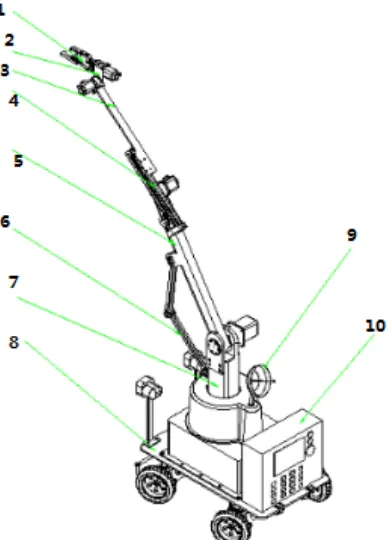
This research mainly focuses on developing the visual recognition system for pick-ing robots. It chiefly provides intelligent service for pickpick-ing fruits in agriculture. What is more, its essential function is to identify and pick fruits from trees. The work flow of the whole robot includes: The advanced identification and location of targets, which mainly rely on CCD cameras. The system will process the captured images and locate the objects according to the information processed, and make sure the specific coordinates of the objects can be quantified. After receiving the coordinate infor-mation of the object, the control system will control the motor to prepare for picking activities. Later on, the target is picked up under the command of the system. The hardware part of the whole system (see Figure 1) mainly includes: the end-effector, the CCD camera, the main arm, the servo motor, the main control part, the sensor module, the vehicle acoustic carrier, the large arm auxiliary component, the large arm component, the small arm component and so on.
1. The end-effector 2. The CCD camera 3. The small arm component 4. The servo motor 5. The large arm component 6. The larger arm auxiliary component 7.the main arm8. The vehicle
2.1 System hardware planning
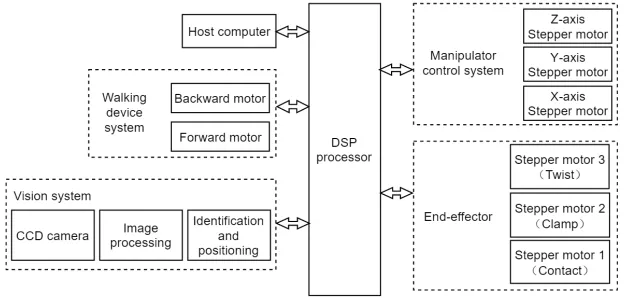
The whole picking robot consists of two parts (see Figure 2), including a platform with mechanical components, and the most significant control system. In the system hardware, the acquisition of objects is accomplished through visual sensors. After that, image analysis and processing the coordinate information of the acquired ob-jects, which through the professional software that collocated in the system. In this way, to complete the identification and positioning work, which lays the foundation for picking.
Fig. 2. The schematic diagram of the fruit recognition system for the target of the picking robot
In the picking robot system, the end-effector is responsible for picking. It com-pletes the picking of objects by working with the manipulator control system. The whole picking process is combined with the main controller and the servo drive. In this study, the core processor type of hardware accessories (see Figure 3) is DSP. It includes six parts: vision system, mechanical arm, end-effector, a host computer and mobile device.
2.2 System software design
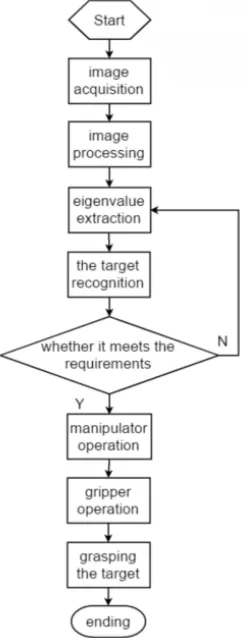
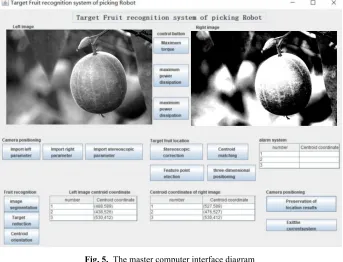
In this study, the control of picking robot occurred by remote control. The devel-opment of control software completed in the QT environment. The software can assist the operator to remote control the robot to pick the target. Detailed reference related to the development and use of software refer to Figure 4 and Figure 5.
Fig. 4. The schematic diagram of the software flow of the intelligent picking robot system
3
Machine vision system design
Fig. 5. The master computer interface diagram
Fig. 6. The work frame diagram of visual system for picking robot
4
Camera calibration model and identification and positioning
of target fruits
4.1 Camera calibration model
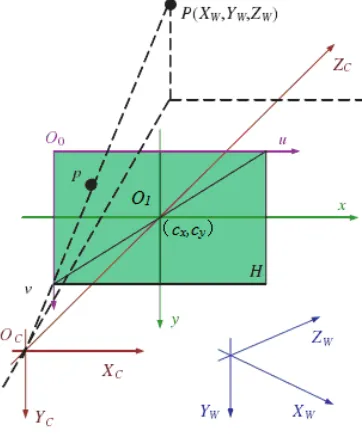
Two-dimensional projection of objects and their surrounding 3D scenes is carried out by using image transformation. This is the imaging principle of the camera. Usu-ally, this model consists of two components, which are the linear model and the non-linear model. The most typical non-linear model is pinhole imaging model. What is more, the imaging model used in this study is pinhole imaging model. The specific calcula-tion of different spatial fields through projeccalcula-tion to plane points and corresponding three-dimensional coordinates is made of reference to Figure 7. The way of realiza-tion is as follows:
Fig. 7. The imaging model of 3D image
1.First of all, the determination of the camera coordinate system OCXCYCZC! 2.Complete the creation of reference world coordinate system XW,YW,ZW! 3.Construction and determination of imaging coordinate system!x,y,z"!
4.u-o-v completes the building of the image coordinate system, mainly based on pix-els in the image.
!
!
!
"
#
$
$
$
%
&
!
!
!
!
!
!
"
#
$
$
$
$
$
$
%
&
=
!
!
!
"
#
$
$
$
%
&
1
1
0
0
1
0
1
1
' ' 0 0y
x
v
d
u
s
d
v
u
v u (1)u0 and v0 are used as the central coordinates of the image. However, du and dv rep-resent the objective physical size of the pixels in different units, length of the projec-tion on the X and Y axes respectively. There is a dip angle between the optical axis and the coordinate system. In this paper, use the slope factor s to calculate this dip angle. The following formula can be used to complete the transformation from image coordinates to pixel coordinates.
!
"
#
=
=
$
=
=
$
z
y
f
z
y
fs
v
v
z
x
f
z
x
fs
u
u
y y x x/
/
/
/
0 0 (2)In this formula,
f
x=
fs
x"f
y=
fs
yrepresent the equivalent focal length of differ-ent pixels on the X and Y axes. Through the linear model calculation method, the final homogeneous coordinate transformation formula is:!
!
!
!
"
#
$
$
$
$
%
&
!
"
#
$
%
&
!
!
!
"
#
$
$
$
%
&
=
!
!
!
"
#
$
$
$
%
&
1
1
0
1
0
0
0
0
0
0
1
W W W T y y x x CZ
Y
X
O
t
R
c
f
c
f
v
u
Z
(3)[
]
! ! ! " # $ $ $ % & ' = ( ) ( ) ) ( ) * ( ) * ) * ( ) * ( ) * ) * cos cos sin cos sin cos sin sin sin sin sin cos sin cos sin cos sin sin cos cos cos 3 21 r r
r R
(4)
(
)
Tz y
x
t
t
t
T
=
,
,
(5)In this formula, ! represents the inclination angle; " represents the pitch angle; #
4.2 identification and positioning of target fruits
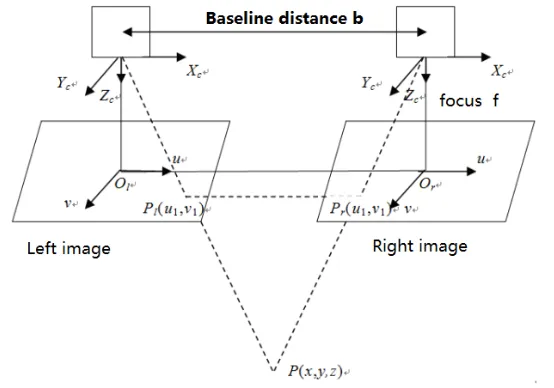
Most animals have two eyes, and there is a distance between them. This will cause differences in the images observed by the two eyes. This difference can be used to locate the target. The design of binocular vision system is based on this principle to complete the identification and positioning of objects. First of all, a dual CCD camera is used to photograph the target simultaneously. After that, the system for information retrieval and data model calculation is based on the two different images that have filmed at the same time. Finally, the system constructs the 3D model of the object and calculates its three-dimensional information. The specific way of accomplishment shown in Figure 8.
Fig. 8. Fig.8 The schematic diagram of the principle of binocular vision positioning
The two cameras used in the system are identical in type, shooting parameters and so on. They shooting objects at the same time, respectively. Therefore, it can get the coordinates of the target information as
pl
(
ul
,
ul
)
p
r(
ur
,
ur
)
. Because different CCD cameras installed at the same height, the target P can formYl
=
Yr
=
Y
in differ-ent imaging systems. It is known that the fixed distance between these differdiffer-ent cam-eras is d and the focal length is f, according to the Pythagorean theorem:(
)
! ! ! " !! ! # $
=
%
= =
z y f Y
z b x f X
z x f X
r l
After conversion, the three-dimensional coordinates of P can be calculated:
!
!
!
"
!
!
!
#
$
%
=
%
=
%
=
d
u
u
f
z
d
u
u
v
y
d
u
u
u
x
r l
r l
l r l
l
(7) In this camera calibration, d = 56mm, f = 1268 pixels, and bring into (7), that is, the three-dimensional coordinates of P.
5
Analysis of experimental results
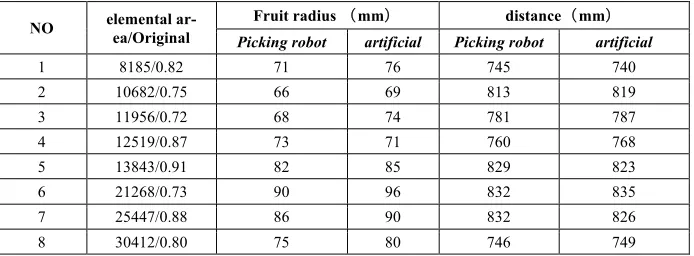
In the field test of the developed system, the primary test index is the feasibility level and the accuracy level of the picking robot, the experimental site is an apple plantation, and the test time is!"#$!!!!!" ! !"! !!. Before starting the test, light treatment for apples with more obscured light, and then conduct two experiments which are toward the light and against the light. The specific records of the experi-mental data are shown in Table 1 and Table 2.
Table 1. The localization test results of target fruit
NO elemental ar-ea/Original Fruit radius mm distancemm Picking robot artificial Picking robot artificial
1 8185/0.82 71 76 745 740
2 10682/0.75 66 69 813 819
3 11956/0.72 68 74 781 787
4 12519/0.87 73 71 760 768
5 13843/0.91 82 85 829 823
6 21268/0.73 90 96 832 835
7 25447/0.88 86 90 832 826
8 30412/0.80 75 80 746 749
Table 2. The picking experimental results
environmental aspect phototropic in shadow
Number of ripe fruits /each 183 178
Number of successful picking/each 162 165
Recognition success rate /% 92.3 89.5
Localization success rate /% 90.6 88.7
The experimental data shows that the picking robot has excellent picking effect in both two experimental environments. The recognition accuracy is high, and the posi-tioning is accurate. In all posiposi-tioning data, the error is no more than 8mm, which fully accords with the requirement of fruit picking for robots. In the aspect of recognition function, it can realize accurate positioning of the target. What is more, its error is no more than 8mm, and its picking rate exceeds 96%. In other words, it shows high pre-cision and efficiency. And it plays a decisive role in the realization of picking automa-tion.
6
Conclusion
This paper focused on the development of the picking robot, mainly through the two aspects of software and hardware to complete the research. It primarily consists of the binocular vision system and camera calibration model. Based on these two core components, achieve the function of identification and positioning. The research re-sults show that: In the aspect of recognition function, it can realize accurate position-ing of the target. What is more, its error is no more than 8mm, and its pickposition-ing rate exceeds 96%. In other words, it shows high precision and efficiency. And it plays a decisive role in the realization of picking automation.
7
Acknowledgment
This work is supported the following fund:
2015 special topic of education informatization work of Guangxi Education Sci-ence 12th Five-Year plan :” Research on training monitoring and evaluation of Infor-mation technology capability upgrading project in Primary and secondary schools in Guangxi”(No, 2015zky25)
2016 Guangxi higher education undergraduate teaching reform project:” Reform and practice of integrated teaching mode based on mixed workshop “(No, 2016JGA404)
2017 The student work subject program of Hezhou university:”college students' network addiction of the student work service research”(No,hzxysz201707).
2016 The higher education research subject project project of Hezhou universi-ty:”between collaborative innovation research of entrepreneurial talent cultivation system”.
2017 college students' innovative entrepreneurial project:”The agricultural robot autonomous operations research based on machine vi-sion”(No,201711838096)&&”Multi-functional autonomous agriculture robot devel-opment”(No,201711838121).
2018 Project of improving basic ability of Young and Middle-aged Teachers in Guangxi Universities: ”design and implementation of picking Robot based on Internet of things”(No,2018KY0556).
8
Reference
[1] B.Q LI, Y.F LING, M TIAN, S.Y ZHENG: Design and implementation of sugarcane growth monitoring system based on RFID and ZigBee. International Journal of Online En-gineering, 3(14),134, (2018).
[2] B.Q LI, M TIAN, S.Y ZHENG,Y.F LING : Design and research of picking manipulator obstacle avoidance system based on IOT. International Journal of Online Engineering, 3(14), 96, (2018).
[3] B.Q LI, Y.F LING, H.Y ZHANG, S.Y ZHENG: The Design and Realization of Cherry Tomato Harvesting Robot Based on IOT. International Journal of Online Engineering, 12(12), 23, (2016). https://doi.org/10.3991/ijoe.v12i12.6450
[4] B.Q LI, W.L GUAN, S.Y Zheng, X.G Yue: OPTIMISATION DESIGN OF CORN PRECISION SEEDER BASED ON MULTI-ROUTE AND MULTI-CHANNEL CONTROL. Journal of The Balkan Tribological Association, 21(4A), 1215, (2015). [5] U. A. SHAABAN, M. T. AFIFY, G. E. HASSAN, Z. A. EL-HADDAD: Development of a
Vacuum Precision Seeder Prototype for Onion Seeds. Misr J. Ag. Eng, 26(4), 1751, (2009).
[6] B.Q LI, X.M YANG GUAN, S.Y ZHENG#Internet of Things-based Simulation Study on Lijiang River Water Environment Monitoring. Journal of Coastal Research,79, 1-5, (2017). [7] Y. A. SHAABAN: Development of an Appropriate Pneumatic Planter for Small Holding
in Egypt. Colg Agric, Bha Uni, 46(8), 1999, (2010).
[8] P. K. AGARWAL, J. BASCH, L. J. GUIBAS, J. HERSHBERGER, L. ZHANG: Deform-able Free Space Tiling for Kinetic Collision Detection. Proc. 4th Wsp Alg Fd. Rbt, 54(3), 245, (2000).
[9] P. K. AGARWAL, J. ERICKSON, L. J. GUIBAS: Kinetic Binary Space Partitions for In-tersecting Segments And Disjoint Triangles. Proc. 9th ACM-SIAM , 44(6), 578, (1998). [10] Z.B. BARUT, A. OZMERZI: Effect of Different Operating Parameters on Seed Holding in
the Single Seed Metering Unit of a Pneumatic Planter. Turk. J. Agric, 28, 435, (2004). [11] M. J. ATALLAH: Some Dynamic Computational Geometry Problems. Comp. Math. Appl,
11(12), 1171 (1985). https://doi.org/10.1016/0898-1221(85)90105-1
[12] J. BARRAQUAND, J. C. LATOMBE: Robot Motion Planning: A Distributed Representa-tion Approach. Int. J. Rbt. Res, 10, 628, (1991). https://doi.org/10.1177/0278364991 01000604
[13] M. BERN, P. PLASSMANN: Mesh generation. In J.-R. Sack and J. Urrutia, editors, Handbook of Computational Geometry. Els Sci Pub B.V. Ams, 16(4), 566, (2000).
https://doi.org/10.1016/B978-044482537-7/50007-3
[14] A. VASS-VARNAI, R. BORNOFF: Thermal Simulations and Measurements – a Com-bined Approach for Package Characterization. ICEP, Jpn,76(4), 886, (2000).
[15] V. THIYAGARAJAN, K. KALAICHELVAN, K.SRINIVASAN,S. VENUGOPAL, R. VIJAY: Influence of Specific Heat Capacity on Hybrid Non-asbestos Brake Pad Formula-tion. J. Balkan Tribol. Asc, 10(8), 102, (2015).
[17] D. KARAYEL, Z.B. BARUT, A. OZMERZI: Mathematical Modeling of [18] Vacuum Pressure on a Precision Seeder. Byst. Eng, 87(4), 437, (2004).
[19] X.G. YUE, G. ZHANG, Q. WU, F. LI, X.F. CHEN, G.F. REN, M. LI: Wearing Prediction of Stellite Alloys Based on Opposite Degree Algorithm. Rare Metals, 34(4), 125, (2015).
https://doi.org/10.1007/s12598-014-0430-0
[20] Z. ZONGMING: Research on Wearing Prediction of the Cylinder Surface Based on Time Series Autoregressive (AR) Model. ICMTMA, Hong Kong, 12(1), 960, (2013).
https://doi.org/10.1109/ICMTMA.2013.239
[21] S. SPINU: Numerical Simulation of Viscoelastic Contacts. Part 1. Algorithm Overview. J. Balkan Tribol. Assoc, 10(5), 269, (2015).
9
Authors
Li Biqing (1984-),come from Nanning, Guangxi province. master degree, senior engineer , the main research direction for broadband MINO, IOT,Big data analysis. (e-mail: 318281853@ qq.com, affiliation: School of Information and Communication Engineering, Hezhou University, Hezhou Guangxi 542899, China).
Zheng Shiyong (1983-), come from Guilin, Guangxi province. PhD student, senior engineer , the main research direction for network marketing, IOT.(e-mail: 29291838@ qq.com, affiliation: Wuhan University, Wuhan 430070, China).
Qiu Ming(*)(1978-),come from Beiliu, Guangxi province. Master of Science,
as-sociate professor , the main research direction for Educational technology, Computer science and technology .(e-mail: 33044810@ qq.com, affiliation: Department of Computer and Information Sciences, Guangxi College Of Education, Nanning Guangxi 530023, China).