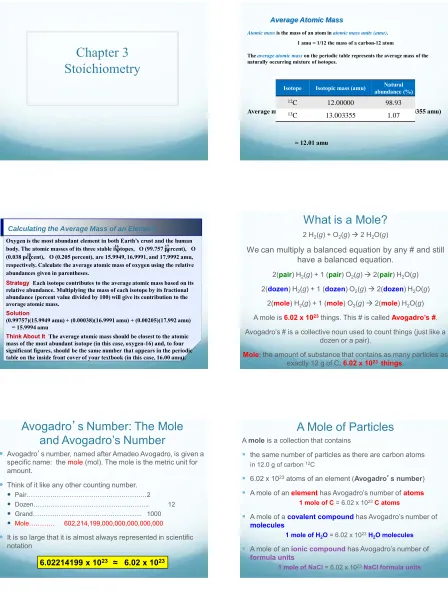
Chapter 3
Stoichiometry
Average Atomic Mass
Atomic massis the mass of an atom in atomic mass units (amu). 1 amu = 1/12 the mass of a carbon-12 atom
The average atomic masson the periodic table represents the average mass of the
naturally occurring mixture of isotopes.
Average mass (C) = (0.9893)(12.00000 amu) + (0.0107)(13.003355 amu)
Isotope Isotopic mass (amu) abundance (%) Natural
12C 12.00000 98.93
13C 13.003355 1.07
= 12.01 amu
Oxygen is the most abundant element in both Earth’s crust and the human body. The atomic masses of its three stable isotopes, O (99.757 percent), O (0.038 percent), O (0.205 percent), are 15.9949, 16.9991, and 17.9992 amu, respectively. Calculate the average atomic mass of oxygen using the relative abundances given in parentheses.
Calculating the Average Mass of an Element
Solution
(0.99757)(15.9949 amu) + (0.00038)(16.9991 amu) + (0.00205)(17.992 amu) = 15.9994 amu
16
8 17 8
18 8
Think About It The average atomic mass should be closest to the atomic mass of the most abundant isotope (in this case, oxygen-16) and, to four significant figures, should be the same number that appears in the periodic table on the inside front cover of your textbook (in this case, 16.00 amu).
Strategy Each isotope contributes to the average atomic mass based on its relative abundance. Multiplying the mass of each isotope by its fractional abundance (percent value divided by 100) will give its contribution to the average atomic mass.
What is a Mole?
2 H2(g) + O2(g) 2 H2O(g)
We can multiply a balanced equation by any # and still
have a balanced equation.
2(pair) H2(g) + 1 (pair) O2(g) 2(pair) H2O(g)
2(dozen) H2(g) + 1 (dozen) O2(g) 2(dozen) H2O(g)
2(mole) H2(g) + 1 (mole) O2(g) 2(mole) H2O(g)
A mole is 6.02 x 10²³things. This # is called Avogadro’s #.
Avogadro’s # is a collective noun used to count things (just like a dozen or a pair).
Mole: the amount of substance that contains as many particles as exactly 12 g of C; 6.02 x 10²³things.
Avogadro
’
s Number: The Mole
and Avogadro’s Number
Avogadro’s number, named after Amadeo Avogadro, is given a specific name: the mole (mol). The mole is the metric unit for amount.
Think of it like any other counting number.
Pair……….. 2 Dozen………... 12 Grand………... 1000 Mole………… 602,214,199,000,000,000,000,000
It is so large that it is almost always represented in scientific notation
A Mole of Particles
A moleis a collection that contains
the same number of particles as there are carbon atoms
in 12.0 g of carbon 12C
6.02 x 10²³ atoms of an element (Avogadro’s number)
A mole of an element has Avogadro’s number of atoms
1 mole of C = 6.02 x 10²³C atoms
A mole of a covalent compound has Avogadro’s number of
molecules
Avogadro’s Number May Be Used as a
Conversion Factor to Convert
Particles
Moles
Avogadro’s number (6.02 x 10²³) can be written as an
equality and two conversion factors.
Equality:
1 mole = 6.02 x 10²³ particles
Conversion Factors:
6.02 x 10²³ particles and 1 mole
1 mole 6.02 x 10²³ particles
Using Avogadro’s Number to Convert
Between Moles and # of Particles
How many Cu atoms are in 0.50 mole of Cu?
0.50 mole Cu x 6.02 x 10²³ Cu atoms
1 mole Cu = 3.0 x 10²³ Cu atoms
How many moles of CO2 are in 2.50 x 1024 molecules of CO2?
2.50 x 1024 molecules CO2 x 1 mole CO2
6.02 x 10²³ molecules CO
2
= 4.15 moles of CO2
Subscripts in Formulas and Moles
The subscriptsin a formula give the relationship of atoms in the formula
the moles of each element in 1 mole of a compound
Example: carbon dioxide, CO2
1 molecule contains 1 C atom, and 2 O atoms
1 mole of CO2contains 1 mole C atoms, 2 moles O atoms
Example: glucose, C6H12O6
1 molecule contains 6 atoms C, 12 atoms H, 6 atoms O 1 mole C6H12O6 contains 6 moles C, 12 moles H, 6 moles O
Factors from Subscripts
Subscripts used for conversion factors
relate moles of each element in 1 mole compound
for aspirin, C9H8O4 ,can be written as:
9 moles C 8 moles H 4 moles O
1 mole C9H8O4 1 mole C9H8O4 1 mole C9H8O4
and
1 mole C9H8O4 1 mole C9H8O4 1 mole C9H8O4
9 moles C 8 moles H 4 moles O
Using Avogadro’s Number to Convert
Between Moles and # of Particles
How many Ca2+ ions are in a mole of CaCl2? How many Cl– ions?
1 CaCl2 formula unit contains 1 Ca2+ ion, and 2 Cl– ions.
(1 mol Ca2+ ions)(6.02 x 10²³ ions/mol) = 6.02 x 10²³ Ca2+ ions
(2 mol Cl– ions)(6.02 x 10²³ ions/mol) = 1.20 x 1024 Cl– ions
1 mole CaCl2 formula units contain 1 mole Ca2+ ions, 2 moles 2 Cl– ions.
Now convert from moles to numbers by multiplying by Avogadro’s number.
Practice Using Avogadro’s Number to
Convert Between Moles and # of Particles
How many O atoms are in 0.150 mole of aspirin, C9H8O4?
Write a plan: moles aspirin moles of O atoms of O
Molecular Mass is the Mass of
One Molecule of a Compound
To calculate the molecular mass of a compound, add the atomic masses of all the atoms in the formula in terms of the atomic mass
unit.
Remember that amu is also represented as just u.
mass of
hydrogen mass of oxygen
2´1.008
(
)
+ 1(
´16.00)
= 18.02 u (or amu)Fe2O3
2´55.85
(
)
+ 3(
´16.00)
= 159.7 u(
)
= 159.70 u (or amu)CaCO3
1´40.08
(
)
+ 1(
´12.01)
+ 3(
´16.00)
= 100.09 u (or amu) H2OThe Mole is a Connection Between the
Atomic-Molecular Scale and the Real World
The molar mass is the mass of one mole of a substance in grams; numerically equal to the atomic or molecular mass.
1 u = 1/12 the mass of a carbon-12 atom 1 u = 1 g/mol
Atomic weight of carbon = 12.01 u = 12.01 g/mol
Therefore, 1 mole of carbon atoms weighs 12.01 g.
Molecular weight of CaCO3 = 100.09 u =100.09 g/mol
1 mole of CaCO3 weighs 100.09 g.
For a Compound, the Molar Mass is the
Sum of the Molar Masses of the Elements
in the Formula
What is the molar mass of ammonium dichromate, (NH4)2Cr2O7?
In other words, what is the mass (in grams) of 1 mole of ammonium dichromate?
(2 x 14.0) + (8 x 1.0) + (2 x 52.0) + (7 x 16.0) = 252.0 g/mol
nitrogen hydrogen chromium oxygen
Therefore, 1 mol of ammonium dichromate
weighs
252.0 g
Molar Mass May Be Used as a
Conversion Factor to Convert
Moles
Mass
Molar Mass can be written as an equality and two conversion factors.
Equality:
1 mole F = 19.0 g F
Conversion Factors:
19.0 g F and 1 mole
1 mole 19.0 g F
Using Molar Mass to Convert Between
Moles and Mass
Juglone is a dye that is produced from the husks of black walnuts. It is also a natural herbicide (weed killer) that kills off competative plants around the black walnut tree but does not affect grass and other
noncompetative plants. The formula for Juglone is C10H6O3. A
sample of 1.56 x 10⁻² g of juglone
was extracted from black walnut husks. How many moles of juglone
Using Molar Mass to Convert Between
Moles and Mass
Calcium carbonate (CaCO3), also known as calcite, is the
principal mineral found in limestone, marble, chalk, pearls, and the shells of marine animals such as clams.
Avogadro’snumber
Mass/Moles/Particles Conversions
Grams of
Substance Substance Moles of or Molecules # of Atoms
molar mass
Avogadro’s number
molar mass
Divide by Molar Mass to Convert
Mass to Moles
Caffeine has the formula C8H10N4O2. If an average cup
of coffee contains approximately 125 mg of caffeine, how many moles of caffeine are in one cup?
125 mg 1000 mg/g æ è
ç ö
ø
÷
194.20 g/mol = 6.436663234´10 -4
(
)
= 6.44´10-4 molGrams of
Substance Substance Moles of
molar mass
# of Atoms or Molecules
Avogadro’s number
Avogadro’s number
molar mass
Multiply by Molar Mass to Convert
Moles to Mass
What is the mass in grams of
0.0015 mol of aspirin, C
9H
8O
4?
Grams of
Substance Substance Moles of
molar mass
# of Atoms or Molecules
Avogadro’s number
Avogadro’s number
molar mass
0.0015 mol
(
)
(
180.15 g/mol)
= 0.27 gTo Convert Mass to Particles you
Must Go Through Moles!
Isopentyl acetate (C7H14O2) is the compound responsible for the
scent of bananas. Bees release about 1 mg (1 x 10⁻³ g) of this
compound when they sting. The resulting scent attracts other bees to join the attack. How many molecules of isopentyl acetate
are released in a typical bee sting?
Avogadro’snumber
To Convert Mass to Particles you
Must Go Through Moles!
A silicon chip used in an integrated circuit of a microcomputer has a mass of 5.68 mg.
How many silicon (Si) atoms are present in the chip?
Grams of
Substance Substance Moles of or Molecules # of Atoms
mol. wt.
Avogadro’s number
mol. wt.
How Many Atoms in a Given Mass?
g
mol
atoms
Consider that a diamond in a jewelry item is made of only carbon atoms. If the diamond had a mass of 0.20 grams (about 1 carat),
how many atoms of carbon would be present?
1. 12
2. 2.4
3. 1.0 1022
Calculate Mass of Atoms
atoms
mol
g
Since atoms are so very small there will be a large number even in a small sample of an element. For example, if you just received 10 billion atoms of gold would this be better than winning a lottery prize?
Prove by reporting the mass of gold.
1. The mass of gold would be 1970 grams.
2. The mass of gold would be 3 10–22 grams.
3. The mass of gold would be 1.7 10–17 grams.
4. The mass of gold would be 3 10–12 grams.
Calculate Mass of Element From
Mass of Compound
The compound Cr2O3 (chromium (III) oxide) is one of the key components responsible for the red color of ruby gems.
If you had 34.8 grams of Cr2O3, how many grams of chromium (atomic number = 24) metal would be present?
1. 11.9 grams of Cr
2. 5.85 grams of Cr
3. 23.8 grams of Cr
4. 69.8 grams of Cr
Percent Composition
Mass percent of an element:
For iron in iron (III) oxide, (Fe2O3)
mass mass of element in compound mass of compound
% 100%
mass%Fe .
. .
11169
159 69 100% 69 94%
Percentage Composition
Percent composition: the mass % of each element in acompound
Calculate the percentage composition of borax, Na2B2O7, used
in commercial laundry processes.
% Na =
( )
2(
22.99)
179.60 ´100% = 25.60%
% B =
( )
2(
10.81)
179.60 ´100% = 12.04%
% O =
( )
7(
16.00)
179.60 ´100% = 62.36%
Note: sum of the percentages equals 100%
% element =( number of atoms of that element )( atomic weight of element ) molecular weight of compound ´100%
Calculating Percent By Mass of
Elements in a Compound
Morphine, derived from opium plants, has the potential for use and abuse. It’s formula is C17H19NO3. What percent, by mass,
is the carbon in this compound?
1. 42.5%
2. 27.9%
3. 71.6%
4. This cannot be solved until the mass of
Determining the Formula of a
Compound
Molecular and Empirical Formulae
molecular formula = (empirical formula)n [n = integer]molecular formula = (CH)6 = C6H6 [n = 6] Molecular Formula
The chemical formula that gives the actual numbers and types of atoms in a molecule.
Empirical Formula
The chemical formula of a compound written with the smallest integer subscripts.
Example: benzene
C
6H
6CH
Substances Whose Empirical
and Molecular Formulas Differ
Empirical Formula Problem #1
Calculate the empirical formula of glucose, a simple sugar, if a certain sample contains 393.4 g of carbon,66.07 g of hydrogen, and 524.2 g of oxygen.
There is a saying to help you remember the steps to follow to solve this problem:
Percent to mass Mass to moles Divide by small Multiply till whole
Empirical Formula Problem
#1
Calculate the empirical formula of glucose, a simple sugar, if a certain sample contains 393.4 g of carbon, 66.07 g of hydrogen,
and 524.2 g of oxygen.
We can skip percent to mass and convert each of the masses to moles.
393.4 12.01 æ è
ç öø÷ = 32.76 mol C
66.07 1.008 æ è
ç öø÷ = 65.55 mol H
524.2 16.00 æ è
ç ö
ø
÷ = 32.76 mol O
Empirical Formula Problem
#1
Calculate the empirical formula of glucose, a simple sugar, if a certain sample contains 393.4 g of carbon, 66.07 g of
hydrogen, and 524.2 g of oxygen.
Divide each by the smallest number of moles.
The empirical formula is CH2O.
32.76 mol C 32.76 æ è
ç öø÷ = 1.000 mol C
65.55 mol H 32.76 æ è
ç öø÷ = 2.001 mol H
32.76 mol O 32.76 æ è
ç ö
ø
Empirical Formula Problem
#2
Calculate the empirical formula of a compound composed of 52.9% carbon and 47.1% oxygen.
Step 1: “Percent to Mass” Convert the percentages to grams. Assume you have 100.0 g of the compound.
52.9% ´100.0 = 52.9 g C
47.1% ´100.0 = 47.1 g O
Empirical Formula Problem
#2
Calculate the empirical formula of a compound composed of 52.9% carbon and 47.1% oxygen.
Step 2: “Mass to moles” Convert each of the masses to moles.
52.9 12.01 æ è
ç öø÷ = 4.40 mol C
47.1 16.00 æ è
ç ö
ø
÷ = 2.94 mol O
Empirical Formula Problem
#2
Calculate the empirical formula of a compound composed of 52.9% carbon and 47.1% oxygen.
Step 3: “Divide by small” Divide each by the smallest number of moles.
4.40 mol C 2.94 æ è
ç ö
ø
÷ = 1.50 mol C
2.94 mol O 2.94 æ è
ç öø÷ = 1.00 mol O
Empirical Formula Problem
#2
Calculate the empirical formula of a compound composed of 52.9% carbon and 47.1% oxygen.
Step 4: “Multiply till whole” Find thesmallest whole-number ratio.
4.40 mol C 2.94 æ è
ç ö
ø
÷ = 1.50 mol C
2.94 mol O 2.94 æ è
ç öø÷ = 1.00 mol O
The empirical formula is C3O2.
Empirical/Molecular Formula Problem
A compound with a molecular weight of 180 u consists of 40.0% carbon, 6.70% hydrogen, and 53.3% oxygen. What is its empirical
formula? What is its molecular formula?
Step 1: “Percent to mass” Convert the percentages to grams. Assume you have 100.0 g of the compound.
40.0% ´100.0 = 40.0 g C
6.70% ´100.0 = 6.70 g H
53.3% ´100.0 = 53.3 g O
Empirical/Molecular Formula Problem
A compound with a molecular weight of 180 u consists of 40.0% carbon, 6.70% hydrogen, and 53.3% oxygen. What is its
molecular formula?
Step 2: “Mass to moles” Convert each of the masses to moles.
40.0 12.01 æ è
ç öø÷ = 3.33 mol C
6.70 1.008 æ è
Empirical/Molecular Formula Problem
A compound with a molecular weight of 180 u consists of 40.0% carbon, 6.70% hydrogen, and 53.3% oxygen. What is its
molecular formula?
Step 3:”Divide by small” Divide each by the smallest number of moles.
3.33 mol C 3.33 æ è
ç öø÷ = 1.00 mol C
3.33 mol O 3.33 æ è
ç öø÷ = 1.00 mol O
6.65 mol H 3.33 æ è
ç öø÷ = 2.00 mol H formula is CHThe empirical 2O.
Empirical/Molecular Formula Problem
A compound with a molecular weight of 180 u consists of 40.0% carbon, 6.70% hydrogen, and 53.3% oxygen. What is its
molecular formula?
Step 4: Determine the mass of the empirical formula and compare it to the molecular formula.
Empirical formula CH2O 30.03 u
180
30.03 = 5.99 » 6