An Eclectic Professional Development Proposal for English Language
Teachers
Una propuesta ecléctica de formación docente para profesores de inglés
Orlando Chaves
1*
Maria Eugenia Guapacha
2**
Universidad del Valle, Cali, ColombiaThis article reports a mixed-method research project aimed at improving the practices of public sector English teachers in Cali (Colombia) through a professional development program. At the diagnostic stage surveys, documentary analysis, and a focus group yielded the teachers’ profile and professional needs. The action phase measured the program’s impact via surveys, evaluation formats, a focus group, researchers’ journal, and documentary analysis. Findings revealed that an eclectic approach tailored to the participants’ needs and interests and a practice-reflection-theory cycle improved the teachers’ quality.
Key words: English teachers’ profile, professional development, teacher quality.
Este artículo versa sobre una investigación mixta que buscaba mejorar la enseñanza de un grupo de profesores de inglés del sector público en Cali (Colombia) a través de un programa de desarrollo profesional. En el diagnóstico, encuestas, análisis documental y un grupo focal arrojaron el perfil y las necesidades profesionales de los docentes. La implementación evaluó el impacto del programa a través de encuestas, formatos de evaluación, grupo focal, diario de investigación y análisis documental. Los resultados revelaron que un enfoque ecléctico ajustado a las necesidades e intereses de los participantes y un ciclo de práctica-reflexión-teoría fortalecieron la calidad de los profesores.
Palabras clave: calidad de los profesores, desarrollo profesional, perfil de docentes de inglés.
* E-mail: [email protected]
** E-mail: [email protected]
How to cite this article (APA, 6th ed.): Chaves, O., & Guapacha, M. E. (2016). An eclectic professional development proposal for English
language teachers. PROFILE Issues in Teachers’ Professional Development, 18(1), 71-96. http://dx.doi.org/10.15446/profile.v18n1.49946.
This article was received on April 1, 2015, and accepted on July 28, 2015.
Introduction
Recent language education policies in Colombia have ignited interest about the English teacher quality. Although policies are necessary to support coordinated teachers’ professional development actions, studies about teachers’ needs and quality are still scarce in our scholastic milieu and most of them refer to primary schools (Bastidas & Muñoz Ibarra, 2011; Cadavid Múnera, McNulty, & Quinchía Ortiz, 2004; McNulty & Quinchía Ortiz, 2007) or are based on only language test results (Sánchez Jabba, 2013). This article reports a quantitative-qualitative (QUAN-QUAL) sequential explanatory study about the impact of a professional development program (PDP) for English teachers in public schools in Cali, Colombia. The diagnostic stage was a survey study that allowed identifying the teachers’ profile and professional needs on the bases of which a PDP was further designed, implemented, and evaluated in a qualitative action stage.
Literature Review
Teacher Quality
Teacher quality (TQ) is a common concern in daily life, education policies, and academic literature. The literature review about TQ in English teaching involves qualifications, experience, methodology/ teaching practice, knowledge, beliefs, and attitudes. Some external factors are also linked to TQ like students’ attitudes, available resources, adequate time-on-task, class size, and teacher work assignment (Darling-Hammond & Bradsford, 2005; Hanushek & Rivkin, 2007; Johnson, 2006; Wright, 2012).
In education discourse, TQ often has different definitions. Kennedy (2008) points out that TQ has become a ubiquitous term without clear meaning and mentions five different connotations: (a) tested ability, test scores used as an indicator of TQ for recruitment; (b) credentials, in the form of licenses and certificates that prove knowledge and experience; (c) quality of
classroom practices, referring to the work teachers do inside their classrooms; (d) teachers’ effectiveness in raising the level of student achievement; and (e) beliefs and values.
Likewise, there are three different but widespread terms associated with a quality teacher: good teacher,
effective teacher, and highly qualified teacher (Paone, Whitcomb, Rose, & Reichardt, 2008). The first term is germane to daily school discourse and refers to teachers who “teach well.” However, the concept of good teacher is not limited to what he/she does in the classroom. The second term—teacher effectiveness— is common in education researchers and authorities referring to students’ achievement on tests resulting from teaching (Clotfelter, Ladd, & Vigdor, 2006; Coggshall, 2007; Darling-Hammond, 1999; Harris & Ó Duibhir, 2011; Rivkin, Hanushek, & Kain, 2005; Valentine, Rakes, & Canada, 2010). This is a very narrow conception of effectiveness (Kennedy, 2008) and there is still lack of agreement on how best to identify and measure effective teaching (Kane, Taylor, Tyler, & Wooten, 2011). This widespread view linking TQ to students’ and teachers’ results on language tests, especially in the public sector, is prominent in the current Colombian bilingualism policies (Cely, 2009; Sánchez Jabba, 2013). The third term—highly qualified teacher—is also usual in educational legislation and stakeholders’ discourse. This teacher “possesses the sophisticated content knowledge and familiarity with appropriate pedagogical and assessment strategies” (National Council of Teachers of English [NCTE], 2004, p. 1). In our scholastic system TQ is associated with qualifications.
expertise, and the like), the qualities of what they do or should do (e.g., assessment), and the results they obtain in their students.
A step ahead in the comprehension of TQ is given by Kunter et al. (2013) who propose the concept of
professional competence as “the skills, knowledge, attitudes, and motivational variables that form the basis for mastery of specific situations” (p. 3). Locally, this notion has been studied by Kostina and Hernández (2007).
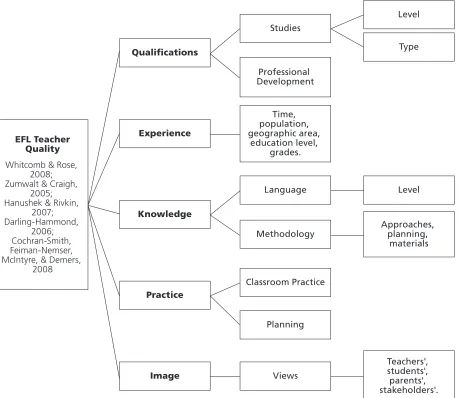
In general, TQ refers to the various teacher-related characteristics associated with positive educational results. Figure 1 summarizes the diverse perspectives of TQ. Nonetheless, it is necessary to keep in mind Kennedy’s (2008) assertion about this complex matter of TQ:
True understanding of teacher quality requires us to recognize that these many facets are distinct, not always overlapping, and not always related to one another. Moreover, we aren’t even sure how they influence and interact with one another when they do. (p. 60)
Figure 1. Literature Review Mind Map
Qualifications
Studies
Level
Type
Professional Development
Teachers', students', parents', stakeholders'.
Level Language
Approaches, planning,
materials Methodology
Classroom Practice
Planning
Views Time, population, geographic area,
education level, grades. Experience
EFL Teacher Quality Whitcomb & Rose,
2008; Zumwalt & Craigh,
2005; Hanushek & Rivkin,
2007; Darling-Hammond,
2006; Cochran-Smith, Feiman-Nemser, McIntyre, & Demers,
2008
Knowledge
Practice
In this study, TQ components were summarized in four categories: qualifications, knowledge, practices (methodology), and image (personal traits and professional attitudes, values, and beliefs). TQ components were analyzed in depth in order to support a sound characterization of the teachers to whom the PDP was addressed. The bottom line was that professional development is a good means to assure TQ.
Professional Development of Language Teachers
Professional development (PD) on the whole is the development of a person in his/her professional role (Reimers, 2003). According to Villegas-Reimers, the notion of PD is linked to two similar but narrower concepts: career development, as the maturity teachers attain through their professional career, and
staff development, as the in-service programs aimed at promoting the growth of teachers.
For Richards and Farrell (2005), PD is one of the two views derived from two general objectives in teacher education: training and development. Training encompasses the initial or pre-teaching teacher education, in a BA program, for instance; development refers to the in-service and long-term development of teachers. For the authors, teacher training usually establishes short-term goals linked to the teachers’ present or immediate needs. Teacher training typically involves comprehending theory, and then applying it to teaching until skills in demonstrating the principles and practice are developed and observed. In turn, teacher development is designed for long-term periods whose goal is to facilitate teachers’ self-understanding and to include a reflective component as a basis of the program. PD improves the performance of teachers, students, and the school itself which Richards and Farrell consider a bottom-up process.
Furthermore, regarding the distinction between teacher training or education and teacher development, Edge (as cited in Wallace, 1991), asserts that: “the distinction is that training or education is something that can be presented or managed by others; whereas development is something that can be done only by and for oneself ” (p. 3). Wallace (1991) discusses two previous models of professional education: craft and applied science, and proposes his own, reflective. The craft model is based on experiential PD; in it, expertise is demonstrated by a master practitioner and imitated or practiced by the young trainee. This imitative practice is supposed to lead to professional competence. Wallace criticized this model as simple, static, imitative, and disregarding the growth of relevant scientific knowledge. Schön’s (1987) applied science model analyzed teaching problems using scientific knowledge to achieve clear objectives, underscoring theory and seeing practice as instrumental. Wallace disapproved this model because it separates theory (research) and practice.
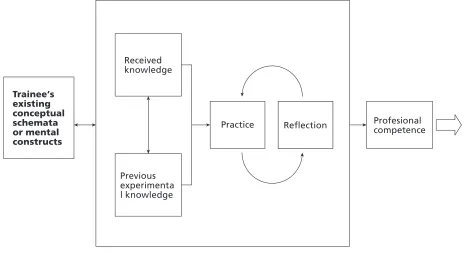
In opposition to those models, Wallace (1991) proposed the reflective model that balances both experience and scientific bases of teaching carrying out professional development through a combination of “received” and “experiential” knowledge; the first one includes the disciplinary theory that supports language, teaching, and learning, while the second one is related to the teachers’ ongoing experience and expertise. Figure 2 summarizes this model.
aims at fixing teaching practice deemed outdated or somehow defective; it is focused on the academic knowledge to be transmitted by the teachers and its methodology seeks that the teachers apply in their settings the knowledge learned in the training courses. The cooperative-process perspective pursues the relationship between theory and practice, giving importance to reflection and building teachers’ analytical and critical awareness.
Specifically, teachers’ PD is “the professional growth a teacher achieves as a result of gaining increased experience and examining his or her teaching systematically” (Villegas-Reimers, 2003, p. 11), comprises formal (e.g., attendance of workshops) and informal experiences (e.g., reading professional publications), and it is necessary to consider the experiences, processes, and the contexts in which teachers’ PD takes place.
Recent trends in PD are based on constructivism rather than on transmission-oriented models (Villegas-Reimers, 2003). It means that, in PDPs, teachers are active learners. Likewise, for Darling-Hammond (1998) a PDP is related to the daily activities of teachers and learners and it should be based on schools.
To summarize, we consider that professional development of language teachers should involve permanent reflection, theory and practice, knowledge and skill, learning and re-learning, science and craft in any combination as proposed in the various abovementioned perspectives.
Method
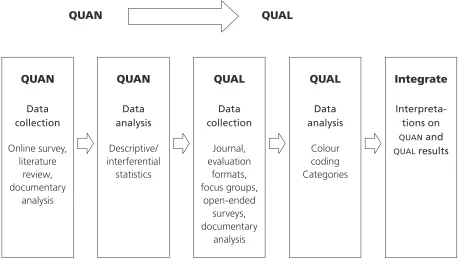
A mixed-method research design (Creswell, 2009) was adopted, specifically, a sequential explanatory QUAN-QUAL design (Creswell, 2012; Figure 2. The Reflective Model of Professional Development (Wallace, 1991, p. 49)
Trainee’s existing conceptual schemata or mental constructs
Received knowledge
Previous experimenta l knowledge
Practice Reflection Profesional competence
Stage 1 (Pre-training)
Stage 2
(Professional education/development)
Creswell & Plano Clark, 2007). In the diagnostic stage, a quantitative survey research (Creswell, 2012) led to an in-depth description of the English teachers in Cali in order to analyze and understand their background and present status. Free association exercise, literature review, focus group, and documentary analysis contributed to get the profile and professional needs of the subjects. In the action stage, a qualitative action-research (Carr & Kemmis, 1986; Cohen, Manion, & Morrison, 2007) was carried out to evaluate the impact of the PDP by means of a research journal, focus groups, evaluation formats, and documentary analysis. Thus, the following cycle was pursued:
(1) Planning: design of workshops tailored to the teachers’ needs (whole program: 150 hours). (2) Acting: a pilot PDP course of 45 hours (nine workshops, 5 hours each) was carried out; twelve teachers participated (see Appendix for a workshop
sample). (3) Observing: recorded observations in researchers’ journals and format evaluations. (4)
Reflecting: examination of positive aspects and aspects to improve upon. This cycle was repeated throughout the intervention. Figure 3 recapitulates the research design process.
Participants
Diagnostic stage: 63 out of 301 public sector English teachers in Cali, 57 students from eighth and eleventh grades, five parents, and nine school administrators belonging to a total of 40 out of 92 public schools in Cali. Action stage: 12 out of 30 public sector English teachers attended the PD pilot program.
Data Collection and Instruments
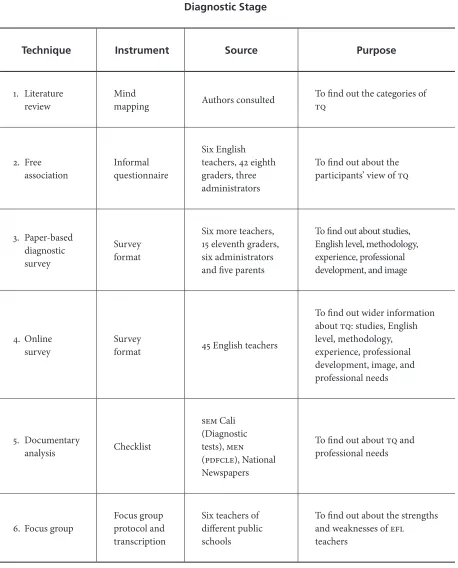
Table 1 shows the instruments used to collect data in diagnostic, action, and evaluation stages. Figure 3. Sequential Explanatory QUAN-QUAL Design (Adapted From Creswell & Plano Clark, 2007)
Integrate
Interpreta-tions on QUAN and QUAL results
QUAN QUAL
QUAL
Data analysis
Colour coding Categories QUAL
Data collection
Journal, evaluation
formats, focus groups,
open-ended surveys, documentary
analysis QUAN
Data collection
Online survey, literature
review, documentary
analysis
QUAN
Data analysis
Descriptive/ interferential
Table 1. Data Collection Instruments for Diagnostic, Action, and Evaluation Stages
Diagnostic Stage
Technique Instrument Source Purpose
1. Literature
review Mind mapping Authors consulted To find out the categories of TQ
2. Free
association Informal questionnaire
Six English teachers, 42 eighth graders, three administrators
To find out about the participants’ view of TQ
3. Paper-based diagnostic survey
Survey format
Six more teachers, 15 eleventh graders, six administrators and five parents
To find out about studies, English level, methodology, experience, professional development, and image
4. Online
survey Survey format 45 English teachers
To find out wider information about TQ: studies, English level, methodology, experience, professional development, image, and professional needs
5. Documentary
analysis Checklist
SEM Cali (Diagnostic tests), MEN (PDFCLE), National Newspapers
To find out about TQ and professional needs
6. Focus group Focus group protocol and transcription
Six teachers of different public schools
To find out about the strengths and weaknesses of EFL
Action and Evaluation Stages
Technique Instrument Source Purpose
1. Journaling Two column diary format Researchers
To monitor and evaluate the ongoing process and interventions of the researchers in the PDP
2. Surveying Three survey formats (initial, mid, and final)
The 12 English teachers
Initial survey
To find out the teachers’ interest and expectations about the PDP (needs analysis)
Mid-term survey
To evaluate the ongoing process to make improvements
Final survey
To evaluate the impact of the PDP
3. Surveying Evaluation questionnaire The 12 English teachers To evaluate the ongoing process and permanent impact of the PDP
4. Focus group Focus group protocol and transcription
The 12 English
teachers To evaluate the impact of the PDP
5. Documentary
analysis Checklist
Lesson plans, recordings, needs analysis, and blogs of the 12 English teachers
To evaluate the impact of the PDP pilot course on the teachers’ practices
Note. SEM = Municipal Secretary of Education, MEN = National Ministry of Education, PFPCLE = Program for the strengthening of foreign language competences.
Findings
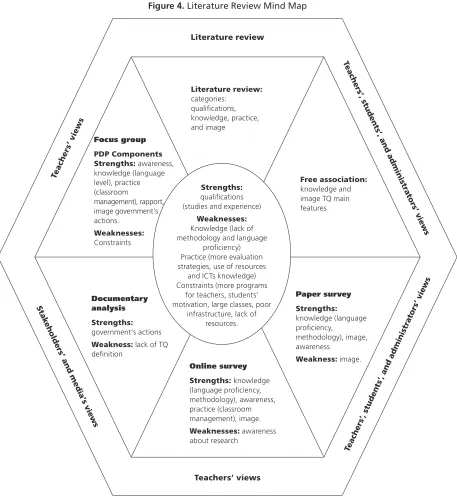
Four main categories were derived from the research questions: (1) Teachers’ Main Quality Features, (2) Teachers’ Professional Needs, (3) PDP Components, and (4) Impact of PDP on Teachers’ Practices. The diagnostic stage addressed the first
Figure 4. Literature Review Mind Map
Teachers’ Main Quality Features
A data base, paper and online surveys, a focus group, and documentary analysis yielded the information. Most English teachers in the public schools in Cali are a mature population with long experience teaching English in high school; they
abide by traditional approaches; research is either absent or is not central in their curriculum; they are not fully acquainted with the use of information and communication technologies (ICT), and they resort to traditional resources. Table 2 shows features regarding teachers’ methodology, evaluation, and resources.
Literature review Teac her s’ v iew s Stak eh old er
s’ an d m ed ia ’s view s Teachers’ views Teac her
s’, s tud
ents ’, an
d ad min
istr ato
rs’ v iew s Te ac he rs
’, stud en
ts ’, an
d ad m in istra to rs ’ v iew s Literature review: categories: qualifications, knowledge, practice, and image Free association: knowledge and image TQ main features Focus group
PDP Components Strengths: awareness, knowledge (language level), practice (classroom management), rapport, image government’s actions. Weaknesses: Constraints Documentary analysis Strengths: government’s actions
Weakness: lack of TQ definition
Strengths:
qualifications (studies and experience)
Weaknesses:
Knowledge (lack of methodology and language
proficiency) Practice (more evaluation strategies, use of resources
and ICTs knowledge) Constraints (more programs
for teachers, students’ motivation, large classes, poor
infrastructure, lack of resources.
Online survey
Strengths: knowledge (language proficiency, methodology), awareness, practice (classroom management), image.
Weaknesses: awareness about research Paper survey Strengths: knowledge (language proficiency, methodology), image, awareness
Table 2. Online Survey: Summary of Teachers’ Answers
More frecuent Less frecuent
Activities
Oral/written questions, grammar exercises, reading texts, role plays, and textbooksa.
Translation, audios, presentations, videos, songs, rhymes, poems, dramatizations, ludic activities, board games, writing exercises, projects, culture (literature and celebrations), role plays and textbooks.
Evaluation techniques
Oral/written questions, grammar exercises, reading comprehension, quizzes, exams, homework, class participation, attitudes, and notebook.
Translation, listening comprehension, presentations, role plays, textbook, songs, rhymes, poems, writing exercises, projects, and culture.
Resources Notebook and photocopies
Flashcards, video beam, smart boards, videos, cameras, DVD, CD player, TV set, games, Internet, readers, audio books, English lab, and textbook.
aFifty percent of participants answered that role plays and textbooks were among the less frequent activities they used and the remaining 50%
asserted that those were their more frequent activities.
A lack of graduate studies in the city related to English teaching has made teachers resort to PDPs, methodology, and language courses. On the other hand, the predominant teachers’ language level according to their answers, B1 (Council of Europe, 2001), was confirmed with the results of the language tests administered by the Ministry of Education. This fact reflects the teachers’ awareness about their level. This level corresponds to the reality of a monolingual Spanish speaking society. Another interesting finding was related to the teachers’ vocation; they permanently pursue the improvement of their students.
Teachers’ Professional Needs
This second category was divided into five elements: knowledge, practice, image, awareness, and
situational constraints.
a. Knowledge: Teachers needed to improve language proficiency, methodology (knowledge of modern approaches), and views of language and language learning.
b. Practice: Teachers needed to strengthen lesson planning, students’ motivation, classroom management, use of resources, implementation of modern methods and approaches, and assessment. c. Image: Teachers needed to enhance their
motivation, attitudes, values, and rapport with students, colleagues, parents, and school stakeholders. The teachers’ level of qualification, experience, language proficiency, and methodology also required improvement as perceived by themselves and by others.
systematic reflection and research about their context, which is necessary to introduce changes in their settings.
e. Situational constraints: lack of resources, insufficient time on task, large class size, students’ demotivation, lack of parents’, principals’, co- ordinators’, and stakeholders’ support, few PDPs that address their professional needs, and scarce time availability. All these constraints impede undertaking research, reading and writing on professional experience, and undermine both the teachers’ internal and external image. The paper and online surveys were the instruments that yielded more information about the areas that the teachers needed to improve upon (see Figure 5 and Table 3).
PDP Components
The components emerged from the surveys, focus group (see Table 3), and needs analysis survey
Figure 5. Participants’ Answers About Areas to Be Improved Upon by Teachers (Paper Survey)
(see Table 4). They included current methods, ICTs, and rapport with students. It was surprising to learn about the teachers’ low curiosity on classroom research and standards. Nevertheless, classroom research, in the form of reflection and needs analysis, was incorporated as a cross component of the PDP, while standards were integrated in lesson planning and evaluation.
The PDP contents and objectives were negotiated with the teachers; the eclectic approach followed a practice-reflection-theory cycle that allowed the teachers to learn, apply, and reflect on the contents and the theory. The materials and resources were up-to-date, affordable, available, and handy; finally, the instructors and teachers’ attitudes contributed to a good learning environment. The PDP design responded to the teachers’ needs and interests opposing the common parameters of previous PDPs taken by the teachers, not separating theory from practice and proceeding in a non-linear sequence.
31%
21%
27%
25%
38% 37% 37%
50%
31%
42%
36%
25%
0% 10% 20% 30% 40% 50% 60%
Teachers Students Administrators Parents
Table 3. Summary of the Answers Provided by the Focus Group
Components of a PDP
A good PDP should integrate practical and theoretical foundations (from practice to theory), let teachers learn by doing, provide practical and successful ideas, activities and demonstrations, foster reflection, research and teaching-sharing, include ICTs, be conducted in English, be long, and follow up the teachers’ advances.
Table 4. Initial Needs Analysis Survey Results Teachers’ Personal and Professional Strengths
• High rated strengths: teamwork, innovation, storytelling, methodology, planning, and creation of materials. • Low rated strengths: course management, use of ICTs, evaluation, and rapport or connection with students.
Teachers’ Areas of Interest Knowledge about methods
• They want to learn: tasks, CBI, and PBI
Knowledge about ICTs
• They want to learn: educational games and videogames, blogs, wikis, avatars, video makers, puzzle makers, tests makers, online surveys, and online teaching and learning resources.
Interests
• More interest in: ICTs, new methods, planning, needs analysis, materials and resources, evaluation, classroom management, and cultural aspects.
• Less interest in: teachers’ values, standards, reflection, research, and autonomous learning.
Teachers’ Needs or Areas to Improve Upon
• Teachers’ professional needs: methodology, to improve students’ motivation, use of ICTs, materials design, classroom management, curriculum planning, evaluation of skills, knowledge about methods, grouping techniques.
• They mentioned that they need less about use of standards.
Characteristics of the PDP Methodology and evaluation
• More activities based on: group work, class participation, ICTs based-activities, and demonstrations. • Fewer activities based on: oral and written tests, portfolios, individual work, written reflections and journals.
Based on the data gathered, we can now briefly summarize the components of the designed PDP:
1. Knowledge regarding methodology and language proficiency: current methodologies (Content and Language Integrated Learning [CLIL] and Task Based Learning [TBL]) and motivation strategies (rhymes, games, tongue twisters). The program was conducted in English to increase the teachers’ language level.
2. Practice involving planning, evaluation, use of resources, classroom management: needs analysis, use of standards, planning, use and creation of resources (board games and electronic materials), use of ICTs, and evaluation strategies.
3. Awareness: reflection and classroom research.
4. Image: rapport, values, and professional attitudes.
Impact of PDP on Teachers’ Practices
This section includes the fourth category subdivided into knowledge, practice, image, and
awareness.
a. Knowledge of current methods (TBL and CLIL) was evident in the teachers’ class performance, lesson plans and class recordings.
b. Language level progress was noticed as teachers started using more English and incorporating terminology related to tasks and CLIL; their accuracy in pronunciation and vocabulary increased
c. Practice of new methods and strategies and
use of new materials and resources were also observed through the documents teachers provided and through the design of new digital materials, such as PowerPoint games, the use of ICTs, and the introduction of warm-up activities in their lessons.
d. Rapport with students and self-image as persons and professionals were noticed in teachers’
higher motivation, autonomous learning, commitment, eagerness to implement and report the new strategies they applied, and in the acquisition of new resources for the English class like video beams, TV set, and a classroom for this subject. The motivation arose from the teachers’ fulfillment of their expectations and the development of their abilities.
e. Awareness to evaluate their practices and their effectiveness on students’ learning by implementing needs and interests analysis with their students. The teachers highlighted the importance of collecting data with this tool, which allowed them to evaluate their students’ and their own needs, interests, and performance.
The action and evaluation stages also let us identify the successful features and dif-ficulties of the PDP piloting. Its most fruitful components were the needs analysis, contents, objectives, methodology, materials, evaluation, the instructors, and the participants’ attitudes. These findings were drawn from the work-shops evaluation formats, focus group, and documentary analysis.
Figure 6. Fulfillment of Objectives
Figure 7. The Session Allowed Me to Reflect on My Teaching Percentage of teachers who evaluated the workshops
25% 23%
40%
63% 10%
23% 13%
75% 77% 60% 37% 90% 77% 100%
87% 100%
0% 20% 40% 60% 80% 100%
Workshop 1 Workshop 2 Workshop 3 Workshop 4 Workshop 5 Workshop 6 Workshop 7 Workshop 8 Workshop 9
1 (low)
2
3
4
5 (high)
Percentage of teachers who evaluated the workshops
23% 10%
37% 22%
77% 100% 90% 63% 100% 88% 100% 100% 100%
0% 20% 40% 60% 80% 100%
Workshop 1 Workshop 2 Workshop 3 Workshop 4 Workshop 5 Workshop 6 Workshop 7 Workshop 8 Workshop 9
1 (low)
2
3
4
Figure 8. I Learnt Theory Useful for My Teaching
Figure 9. I Learnt Practical Knowledge Useful for My Teaching Percentage of teachers who evaluated the workshops
12% 10%
11%
25% 22% 20%
46% 19%
11% 27% 23%
75% 66% 70% 54% 81% 78% 83% 87% 100%
0% 20% 40% 60% 80% 100%
Workshop 1 Workshop 2 Workshop 3 Workshop 4 Workshop 5 Workshop 6 Workshop 7 Workshop 8 Workshop 9
1 (low)
2
3
4
5 (high)
Percentage of teachers who evaluated the workshops
13% 23% 20%
46% 23%
17%
87% 77% 80% 54% 100% 77% 83% 100% 100%
0% 20% 40% 60% 80% 100%
Workshop 1 Workshop 2 Workshop 3 Workshop 5
Workshop 4 Workshop 6 Workshop 7 Workshop 8 Workshop 9
1 (low)
2
3
4
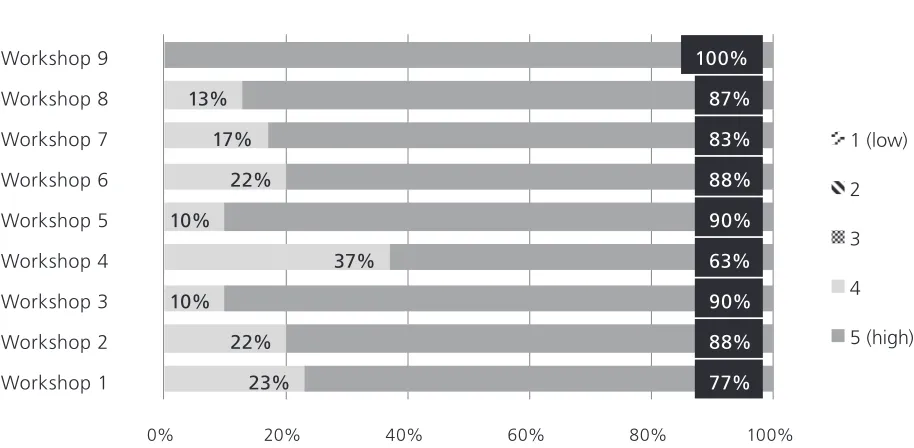
The fact that most teachers gave a score of 5 and 4 showed that the PDP braced the teachers’ needs and expectations. The teachers reported in Section 2 what they learned:
a. About ICTs:creation of blogs, Voki avatars, the use of computer and programs in general. b. Teaching strategies: design and use of resources,
be creative, apply games, needs analysis survey design, rhymes, tell stories, explore a commercial program, and rubrics design.
c. Theoretical and practical background on methods: theory on methods, tasks, CLIL, TBL, lesson plans, how to integrate CLIL, TBL and ICTs.
d. Teachers’ awareness, motivation and learning: The workshops let the teachers reflect on and share their teaching practices and learning strategies, learn from their mistakes, enjoy the classes, motivate the students, think of the necessity of being a creative teacher, integrate topics to teach, learn, and improve their lessons, plan better lessons, and have a different view of language as a communication tool.
e. Features of the course and instructors: The course was dynamic and creative; the instructors were patient and clear.
The final survey (Table 5) also evaluated the impact of the PDP.
Table 5. Online Final Survey
Fulfillment of the Teachers’ Expectations
91% of the teachers reported that their expectations were fulfilled. Figure 10. Impact on My Teaching
Percentage of teachers who evaluated the workshops
23% 22% 10%
37% 10%
22% 17% 13%
77% 88% 90% 63% 90% 88% 83% 87% 100%
0% 20% 40% 60% 80% 100%
Workshop 1 Workshop 2 Workshop 3 Workshop 4 Workshop 5 Workshop 6 Workshop 7 Workshop 8 Workshop 9
1 (low)
2
3
4
Evaluation of the PDP’s Components
• Impact of the PDP: They all affirmed that the program impacted their formation.
• Positive aspects: the methodology; strategies; the topics (CLIL, TBL, ICTs, lesson planning, etc.); the materials; the instructors’ willingness, values, and attitudes; the PDP encourages teachers to improve their lessons, their views, to be motivated and to motivate the students, and to reflect on their views.
• Aspects to improve upon: more time for the PDP and more focus on ICTs and methods, to manage the time better, and to give strategies to teach songs.
• Objectives: all the participants said that the objectives were relevant, realistic, practical, and clear. • Contents: the course contents were useful and the time devoted to them was adequate. The teachers
highlighted the special usefulness of ICTs, TBL, and the reflective practice, followed by CLIL, materials design, needs analysis, planning, rhymes, and evaluation strategies.
• Contents suggested by teachers: autonomous learning, TPR, daily life topics, pre-school materials.
• Methodology: The methodology promoted participation, discussion, reflection, class work, and homework; it provided and connected theory and practice about methods, included varied activities, was student-centered and innovative; it promoted challenging tasks, let teachers scaffold gradually, considered learning styles, and it had an adequate rhythm.
• Materials: The teachers considered that all the materials implemented (photocopies, readings, videos, digital resources, etc.) were adequate and relevant for achieving the objectives.
• Evaluation and assessment: The teachers agreed that the evaluation process was fair, assessed the learning styles, provided proper and timely feedback, let teachers scaffold gradually; it was varied, and demanding.
Assessment of Teachers and Instructors
• Instructors’ performance: The teachers evaluated positively the instructors’ didactics, dedication, rapport, instructions, motivation, content mastery, responsibility, creativity, and the fostering of reflection. They did not give any suggestion to improve.
• Teachers’ performance: Their performance improved in terms of attendance, responsibility, punctuality, participation, commitment, and critical thinking.
• Aspects that teachers need to improve: They said that they still need to improve their methodology, their language skills, knowledge about CLIL and TBL, lesson planning, use of ICTs, to be creative, and to dedicate more time to study.
• How much they learned: The teachers reported that they learned about blogs, Vokis, theory and practice of TBL and CLIL, motivation strategies, reflective practice, planning, evaluation, and improved their language skills. However, they need to learn more about designing surveys and the creation of handmade and digital materials.
Teachers’ Implementation
Implementation so far
The main learning they applied consisted of the motivation strategies such as rhymes, stories, tongue twisters and songs. Then the planning integrating CLIL, TBL involving all language skills, and then, the use of board games and digital resources.
What will you implement?
The teachers said that they would implement everything they learned.
What you won’t implement:
Results of the Focus Group The teachers’ answers were paraphrased.
1. Why did you decide to come and stay in this program? They came because:
• They were interested in learning.
• They wanted to improve their teaching practices and language skills.
• They had good recommendations about the instructors.
• The group had a good atmosphere and created good relationships.
They stayed because:
• They enjoyed and learned throughout the course.
• They achieved their expectations.
• The program offered practical ideas, strategies, and real life situations to implement in the classroom.
• They were getting more practice.
• They wanted to improve for the students. • They were open-minded to new changes. 2. Could you tell us what you have implemented so
far and the results?
Teacher 1: She has used more English in her classroom; she has changed her views about grammar; she has noticed the effects of tongue twisters on students’ motivation, and she showed her blog to her students.
Teacher 2: He has implemented the tongue twisters; he bought his own video beam; he asked for and got a room for the English class; he has changed his mind, he said: “The teacher who talks the more in class, is a bad teacher.”
Teacher 3: She has implemented the needs analysis survey; she shared her new knowledge with other colleagues.
Teacher 4: She has implemented TBL; she has involved more communication in her classes.
Teacher 5: She has implemented warm up activities; she has changed her attitudes; she has implemented games, and she was teaching content.
Teacher 6: She has fostered new changes in the school; the teachers talked to the principal to a get a TV set, an English classroom, air conditioning, a sound system, and a PC.
3. What did you improve in this program? They said that they improved their English level and the way of teaching in a communicative way; they also improved their methodology and lesson planning.
Documentary Analysis Results Three random samples of each document, except for the class recordings, were taken to follow up on the teachers’ implementation of the new learning. Table 6 shows this implementation as seen in the documentary analysis.
Table 7 presents the aspects to improve from the evaluation formats, focus group, and researchers’ journal.
Table 6. Documentary Analysis Needs analysis
surveys Lesson plans Implementation of blogs recordingClass
1 2 3 1 2 3 1 2 3 1 2
1 Considers students’ needs
and interests ✓ ✓ ✓ ✓ ✓ ✓ ✓ ✓ ✓ ✓ ✓
2 Promotes communication
and real life situations ✓ ✓ ✓ ✓ ✓ ✓ ✓ ✓ ✓ ✓ ✓
3 Integrates language skills ✓ ✓ ✓ ✓ ✓ ✓ ✓ ✓ ✓ ✓ ✓
4 Integrates content ✓ ✓ ✓ ✓ ✓ ✓ ✓ ✓ ✓ ✓ ✓
5 Integrates ICTs ✓ ✓ ✓ ✓ ✓ ✓ ✓ ✓ ✓ x x
6 Integrates motivational strategies (rhymes, tongue
twisters, warm up, etc.) x x x ✓ x ✓ ✓ ✓ ✓ ✓ ✓
7 Provides different ways of
assessment ✓ ✓ x ✓ ✓ ✓ ✓ ✓ ✓ ✓ ✓
Table 7. Aspects to Improve for the PDP
Evaluation formats Focus group Researchers’ journal
• More time for theory and demonstrations on CLIL and TBL. • To provide teachers
with more webpages, games, poems, videos, and ICTs.
To assign more time to CLIL, TBL, and evaluation. They also proposed to include autonomous learning as a topic, and continue to foster the teachers’ values and reflection.
Lack of teachers’ digital literacy:
• No teacher knew the definition of blog and its purposes, so we explained them the uses of this technological tool.
• It was surprising to know that many of these teachers are not familiarized with the basic knowledge of computers’ use.
• They were not familiar with the technical vocabulary about computers like tabs, account, open a tab, close a tab, etc.
Teachers’ outdated views of language:
• They are still thinking of grammar and traditional views for teaching language. • It’s difficult for them to relate grammar with
real situations.
Lack of resources at teachers’ schools:
• It’s sad to know that most of the schools where these teachers work don’t offer the necessary conditions and resources to teach English. • They also express the necessity of
implementing the ICTs, but they regret that their schools lack devices such as a video beam, a TV set, audio, etc.
Conclusions and Pedagogical Implications
This study allowed the researchers to understand that a PDP should impact the teachers’ teaching practices and views, raise their personal and professional awareness, increase their motivation and attitudes toward their own learning and teaching processes, and improve their language proficiency. To do so, the PDP should be constructed from the teachers’ needs, interests, learning styles, and learning pace combining the experts’ guidance, the sharing among participant teachers, and autonomous exploration. Conditions of time, group size and availability of resources are crucial for the effectiveness of PDPs.
A key result of this study is that practical and theoretical usefulness (applicability) is a powerful motivational source for teachers since their chief wish is to learn strategies and tools they can try in their classrooms. In-depth knowledge on current trends instead of historical overviews of methods is well received by the teachers. Rhymes, stories, games and tongue twisters result to be motivational and effective teaching strategies that represent a different view to teach vocabulary, structures, pronunciation, and fluency.
The integration of topics, resources, and methodology in every session is a good alternative to the linear sequence of separate courses for language, methodology, culture, and research that usual PDPs adopt. Furthermore, practical applicability is directly related to the impact of PDP. If theoretical or practical knowledge is considered useful by the teachers, it will probably be incorporated by them in their teaching.
The practice-reflection-theory cycle means an inductive approach to theory allowing teachers to infer the principles behind practice. Starting sessions with practical demonstrations followed by reflection and ending with theory prove to be effective in promoting teachers’ critical analysis and comprehension of their practices and in allowing them to connect them with
underlying principles. This sequence is more coherent with the TBL communicative approach adopted.
Modern PDPs should aim at catering the 21st
century challenges for teachers. Blending CLIL, TBL, and ICTs represents an effective way to help teachers improve their students’ motivation and learning of English. ICTs, being both content and tools, are necessary for conducting a PDP. Moreover, the teachers’ digital literacy should be tested first since most of them are challenged by the advanced technology changes. Then, an introductory basic workshop on computer management is required.
Additionally, a PDP requires enough time to let instructors and teachers fulfill their expectations and let both participants work on a number of practical demonstrations and microteachings. Furthermore, the key to success of a PDP lies not only in its contents and methodology, but also in the participants’ attitudes and factors such as motivation, commitment, punctuality, attendance, willingness to change, and open-mindedness to try new things. In a nutshell, the effectiveness and impact of a PDP should be reflected on, first, the instructors’ and teachers’ achievement of goals; second, the impact of this new learning on students’ performance, and third, the support by parents and school administrators.
It should be noted, however, that the findings, implications, and recommendations in this research refer to a particular setting, that of a small group of teachers who were especially motivated towards their professional growth. Further studies about PDP in other settings like bigger groups of teachers, or teachers in only the public or only the private sector, or teachers with a different proficiency level, or with a different level of literacy might reach different outcomes. Likewise, longer PDPs, or ones with less resources, or taught by a single instructor or by teams of instructors can obtain other results. Generalizations are hardly to be extracted from these findings, although some of them are of great value like the eclectic and inductive theoretical and methodological approach to PDP. Instructors’ direct observations are also required to follow the teachers’ implementation in order to support them.
References
Bastidas, J. A., & Muñoz Ibarra, G. (2011). A diagnosis of English language teaching in public elementary schools
in Pasto, Colombia. HOW, 18(1), 95-111.
Cadavid Múnera, I. C., McNulty, M., & Quinchía Ortiz, D. I. (2004). Elementary English language instruction:
Colombian teachers’ classroom practices. PROFILEIssues
in Teachers’ Professional Development, 5(1), 37-55.
Cárdenas Beltrán, M. L., & Nieto Cruz, M. C. (2010). El
tra-bajo en red de docentes de inglés [Teachers of English
and their network]. Bogotá, CO: Universidad Nacional
de Colombia.
Carr, W., & Kemmis, S. (1986). Becoming critical: Education,
knowledge and action research. London, UK: Deakin
University Press.
Cely, R. M. (2009, September). Perfil del docente de inglés
[The profile of a teacher of English]. Lecture given at the First National Congress on Bilingualism, Armenia, Colombia.
Clotfelter, C. T., Ladd, H. F., & Vigdor, J. L. (2006). Teacher-student matching and the assessment of teacher
effectiveness. The Journal of Human Resources, 41(4),
778-820.
Cochran-Smith, M., Feiman-Nemser, S., McIntyre, J., &
Demers, K. (Eds.). (2008). Handbook of research on
teacher education: Enduring questions in changing
con-texts. (3rd ed.). Philadelphia, PA: Taylor and Francis.
Coggshall, J. G. (2007). Communication framework for
mea-suring teacher quality and effectiveness: Bringing
coher-ence to the conversation. Washington, DC: National
Comprehensive Center for Teacher Quality.
Cohen, L., Manion, L., & Morrison, K. (2007). Research
methods in education. (6th ed.). London, UK: Routledge
Falmer.
Council of Europe. (2001). Common European Framework
for Languages: Learning, teaching, assessment.
Cam-bridge, UK: Cambridge University Press.
Creswell, J. W. (2009). Research design: Qualitative,
quan-titative, and mixed methods approaches. Los Angeles,
CA: Sage.
Creswell, J. W. (2012). Qualitative inquiry and research
design: Choosing among five approaches. Los Angeles,
CA: Sage.
Creswell, J. W., & Plano Clark, V. L. (2007). Designing and
conducting mixed methods research. Thousand Oaks,
CA: Sage.
Darling-Hammond, L. (1998). Teachers and teaching: Testing policy hypotheses from a national
commis-sion report. Educational Researcher, 27(1), 5-15. http://
dx.doi.org/10.3102/0013189X027001005.
Darling-Hammond, L. (1999). Teacher quality and student
achievement: A review of State policy evidence.
Wash-ington, DC: University of Washington, Center for the
Study of Teaching and Policy.
Darling-Hammond, L. (2006). Powerful teacher education:
Lessons from exemplary programs. San Francisco, CA:
Jossey-Bass.
Darling-Hammond, L., & Bradsford, J. (Eds.), (2005).
Pre-paring teachers for a changing world: Report of the com-mittee on teacher education of the national academy of
Hanushek, E. A., & Rivkin, S. G. (2007). Pay, working
con-ditions, and teacher quality. Future Child, 17(1), 69-86.
http://dx.doi.org/10.1353/foc.2007.0002.
Harris, J., & Ó Duibhir, P. (2011). Effective language teaching:
A synthesis of research. Dublin, IE: National Council for
Curriculum and Assessment, NCCA.
Johnson, S. M. (2006). The workplace matters: Teacher
quality, retention, and effectiveness. Washington, DC:
National Education Association, NEA.
Kane, T. J., Taylor, E. S., Tyler, J. H., & Wooten, A. L. (2011).
Evaluating teacher effectiveness. Education Next, 11(3),
55-60.
Kennedy, M. (2008). Sorting out teacher quality.
Phi Delta Kappan, 90(1), 59-63. http://dx.doi.
org/10.1177/003172170809000115.
Kostina, I., & Hernández, F. (2007). Competencia profe-sional del docente de lenguas extranjeras [Profesprofe-sional competence of the foreign languages teacher]. In A.
Aragón, I. Kostina, M. Pérez, G. Rincón, (Eds.)
Pers-pectivas sobre la enseñanza de la lengua materna, las
lenguas y la literatura (pp. 81-99). Cali, CO: Facultad de
Educación de la Pontificia Universidad Javeriana. Kunter, M., Klusman, U., Baumert, J., Richter, D., Voss,
T., & Hachfeld, A. (2013). Professional competence of teachers: Effects on instructional quality and student
development. Journal of Educational Psychology, 105(3),
805-820. http://dx.doi.org/10.1037/a0032583.
McNulty, M., & Quinchía Ortiz, D. I. (2007). Designing a holistic professional development program for
elemen-tary school English teachers in Colombia. PROFILEIssues
in Teachers’ Professional Development, 8(1), 131-143.
National Council of Teachers of English (NCTE). (2004).
Teacher quality. Retrieved from http://www.ncte.org/ governance/teacherQuality.
Paone, J., Whitcomb, J., Rose, T., & Reichardt, R. (2008).
Shining the light II: State of teacher quality, attrition and
diversity in Colorado 2008. Colorado, US: The Alliance
for Quality Teaching.
Richards, J. C., & Farrell, T. S. C. (2005). Professional
devel-opment for language teachers: Strategies for teacher
learning. Cambridge, UK: Cambridge University Press.
http://dx.doi.org/10.1017/CBO9780511667237.
Rivkin, S. G., Hanushek, E. A., & Kain, J. F. (2005). Teachers, schools, and academic
achieve-ment. Econometrica, 73(2), 417-458. http://dx.doi.
org/10.1111/j.1468-0262.2005.00584.x.
Sánchez Jabba, A. (2013). Bilingüísmo en Colombia
[Bilin-gualism in Colombia]. Cartagena, CO: Centro de
Estu-dios Económicos Regionales del Banco de la República.
Schön, D. A. (1987). Educating the reflective practitioner. San
Franciso, CA: Jossey-Bass.
Valentine, J. C., Rakes, C. R., & Canada, D. (2010).
Pre-dicting student outcomes from information knowable
at the time of hire: A systematic review. Louisville, KY:
University of Louisville.
Villegas-Reimers, E. (2003). Teacher professional
develop-ment: An international review of the literature. Paris,
FR: UNESCO, International Institute for Educational Planning.
Wallace, M. J. (1991). Training foreign language teachers: A
reflective approach. Cambridge, UK: Cambridge
Uni-versity Press.
Whitcomb, J., & Rose, T. (2008). Teacher quality: What
does the research tell us? In J. Paone (Ed.), Shining the
light II: Illuminating teacher quality, diversity, and
attri-tion in Colorado (pp. 5-35). Denver, CO: Alliance for
Teacher Quality.
Wright, A. C. (2012). A literature review on the determinants
of teacher performance. Santa Barbara, CA: University
of California.
Zumwalt, K., & Craig, E. (2005). Teachers’ characteristics: Research on the indicators of quality. In M.
Cochran-Smith & K. M. Zeichner (Eds.), Studying teacher
edu-cation: The report of the AERA panel on research and
teacher education (pp. 157-260). Mahwah, NJ: Laurence
About the Authors
Orlando Chaves holds a BA in Philology and Languages (Universidad Nacional de Colombia), an MA in
Spanish and Linguistics (Universidad del Valle, Colombia) and an MA in English Teaching (Universidad de Caldas, Colombia). His professional interests are applied linguistics, EFL Didactics and TD. He is a member of EILA research group and ASOCOPI.
Maria Eugenia Guapacha holds a BA in Foreign Languages (Universidad del Valle, Colombia) and an
Appendix: Sample of a PDP Workshop
Workshop 5
Two New Best Friends in my Lessons: CLIL and TBL Time: 5 Hours
Topics: CLIL and TBL Objectives:
ȟ To provide teachers with clear illustrations and concepts on the way CLIL and TBL work in class. ȟ To have teachers contrast traditional and current methodologies.
ȟ To encourage teachers to incorporate CLIL and TBL in their teaching. ȟ To improve the teachers’ teaching and learning of the four skills.
Activities:
Activity 1: Warm up
Reviewing theory about CLIL and TBL
The session will start with review questions about CLIL and TBL ȟ What do CLIL and TBL stand for?
ȟ What are the principles of CLIL? ȟ What is a Task?
ȟ What is the structure of a Task?
Activity 2: Going deeper into tasks concept
The teachers will watch a video about TBL to complement the theory about this method. They will receive a handout followingapre-, while- and post- sequence to support their comprehension (http://www.you-tube.com/watch?v=d-YEwo8FTqk). At the end of the video, the teachers will share their answers.
Instructions: Follow a pre-, while- and post- sequence to support the teachers’ comprehension of the
video. Pause appropriately to let the teachers complete the handout.
Activity 3: Going deeper into the concept of CLIL
The teachers will watch two more videos about CLIL to complement the theory about this method. They will answer these questions:
Video 1: http://www.youtube.com/watch?v=uIRZWn7-x2Y
ȟ When implementing CLIL, what is more important: language or content? Or, do they both have the same status?
ȟ Which authors support CLIL?
Video 2: http://www.youtube.com/watch?v=xiQRbB9_1zs Say true or false:
ȟ CLIL involves experiential learning ȟ Students learn more than language
Explain the example given in the video about the carrot diagram.
Activity 4: Illustrating the use of tasks and CLIL
First, the instructors will illustrate how to integrate tasks, language, and content through an example:
Topic: the circulatory system
Content: function of the circulatory system and illnesses
Language: vocabulary related to the topic such as veins, blood, system, arteries, etc. Expressions like it is
composed of, verbs like run, circulate, etc.
Tasks: doing diagrams, posters, presentations on other body systems.
Then, the instructors will provide a list of topics for teachers to form groups of three and design a poster following the pattern given (topic, content, language, task).
ȟ Group 1: Creating shopping lists for (a) a birthday party, (b) breakfast, and (c) lunch ȟ Group 2: Healthy food
ȟ Group 3: Creating a mini-brochure about Cali: where to go for cultural activities, where to go for fun, where to practice sports, where to eat typical food, etc.
ȟ Group 4: Presenting animal species in danger of extinction
After having designed the lessons, the group of teachers will present the poster to the whole class. They will receive feedback from the instructors and classmates as well.
Activity 5: Closing, reflection and evaluation: CLIL and tasks in our EFL teaching
In pairs (Teachers A and B) will talk about the advantages and disadvantages of both CLIL and TBL, as well as their application in our schools. Teacher A will report advantages and Teacher B disadvantages. The instructors will wrap up the teachers’ comments, and will conclude by (a) remarking on the need of changing current predominant emphasis on grammar-centered views, and (b) on the possibility of inte-grating tasks and CLIL.
Instructions: Mention that TBL requires careful planning of the tasks; the final product of each task must
be clear for the students. Note the usefulness of teamwork required by tasks for large classes. Regarding CLIL, highlight the option of working collaboratively with teachers from other subject areas or of taking topics from those areas to “recycle” them in English, profiting from the fact that the topic is already known to the students. Refer the teachers to read the following authors: Jane Willis, David Nunan, and Jack Richards to complement their background on their own.
Resources: A computer room, video beam or TV set, copies (evaluation formats) and handouts, board,
markers, and online videos.
Evaluation: Teachers’ participation will be used to assess their general comprehension of the concepts of
The instructors will evaluate the teacher’s knowledge and comprehension on CLIL and TBL principles and procedures when planning tasks and CLIL in groups.
As usual, the teachers will also self-evaluate their progress and achievements through their reflections in the workshop evaluation format.
Homework: The teachers will bring a lesson plan and syllabi for Session 7. They will work in groups