Dimensionless variable groups for the free-fall grain dryer
Supitchar Meesukchaosumran
*,
Tawit Chitsomboon
(School of Mechanical Engineering, Suranaree University of Technology, Nakhon Ratchasima, 30000, Thailand)
Abstract: Dimensionless variable groups (DGs) of free-fall grain dryer were developed by using the characteristic scaling
method and engineering intuition. These DGs were intended for the analyses of drying characteristics and sizes of this dryer. Experiments of the free-fall rough rice dryer were carried out using different drying chambers (small and medium scales), drying air temperatures (100°C-150°C), and drying air speeds (1-3 m/s). Experimental data were used to study relationships and to validate similarities among these DGs. The results of the study showed the five appropriate dimensionless variables representing and describing the drying mechanism of the free-fall dryer. These DGs could be applied to design and analyze scaling up the dryer. In addition, the dimensionless correlation was established to predict the moisture contents of rough rice while being dried by the free-fall dryer. The predicted values from this correlation were in relatively good agreement with the experimental data under the proposed drying conditions (R2=0.989, MRD=1.82% and RMSE=0.0168).
Keywords: dimensionless variable, similarity, free-fall dryer, rough rice DOI: 10.25165/j.ijabe.20191204.4188
Citation: Meesukchaosumran S, Chitsomboon T. Dimensionless variable groups for the free-fall grain dryer. Int J Agric &
Biol Eng, 2019; 12(4): 197–204.
1 Introduction
Drying process is one of the most complicated procedures because it concerns a simultaneous combination of mass, momentum, and heat transfer. The changes of moisture phases and grain compositions are also involved. Furthermore, the process depends on drying medium, drying techniques and the scales of the dryers[1]. To achieve a preferable grain dryer, many interacting design variables of drying process must be well understood and analyzed. Usually, dryers are developed in a small scale first and later upscale into an industrial scale. Due to scale effects, this upgrading scale causing problems is the concentration of this study.
The dimensional analysis method (DMA) focuses on mixing the effects of various primitive variables to form fewer dimensionless variables (DVs). In this manner, the primitive variables are scaled to exhibit similar effects on physical models of different sizes and others[2]. Additional benefit of DMA is the reduction in number of independent variables, resulting in fewer experimental trials required to scale up the operation and analyze the performance of the equipment[3].
The studies on DMA for ‘drying’ characteristics of grain dryer have been scantly conducted. Commonly, they often rely on drying conditions, grain types and drying media but do not account for the dryers’ sizes and geometries. Thus, the common DVs in drying field existing in engineering and applied mathematics literatureare usually involved in one or more sub-phenomena in conventional drying process such as heat and mass transfer, fluid
Received date: 2018-02-19 Accepted date: 2019-05-07
Biographies: Tawit Chitsomboon, PhD, Associate Professor, research interest: renewable energy (wind & solar), drying technology, heat & mass transfer simulation, Email: [email protected].
*Corresponding author: Supitchar Meesukchaosumran, PhD Candidate,
research interest: drying technology (rough rice drying), grain drying simulation, automatic control system, School of Mechanical Engineering, Suranaree University of Technology, 111 University Avenue, Nakhon Ratchasima, 30000, Thailand. Tel: +66-44 22 4410, Fax: +66-44 22 4413, Email: supitchar.meesuk@ gmail.com.
flow, evaporation, sublimation, moisture flow in materials, and equilibrium relationships. Two or more common DVs can be used to model a dimensionless correlation for describing a specific drying process[3]. In addition, the simultaneous heat and mass transfer equations in non-steady state for food and grain drying can be rewritten in terms of the common DVs. The magnitude orders of these DVs define the controlled mechanism both in heat and mass transfer which can be used to predict food and grain drying behavior[4]. However, they cannot be statically used to describe the effect of dryer scaling on drying behavior.
number, Reynolds number, moisture ratio and temperature ratio are investigated in the form of a non-dimensional correlation equation to predict the energy and exergy efficiency of wheat and corn drying[6].
Although there have been some studies on the dryers’ sizes and the geometries, researchers have found only the application for deep bed (batch) dryers and rotary dryers. For a batch dryer, grain bed thickness is the geometric parameter more influencing on drying characteristics and scaling up of the dryer. Kachru and Matthes[7] have presented a prediction equation for drying time and instantaneous moisture content of rough rice within a deep-bed dryer using similitude and dimensional analysis. This equation was created from five DVs including drying ratio (moisture ratio), depth ratio, relative humidity, velocity ratio and temperature ratio. The validation results showed its relatively good agreement between the experimental data and the prediction results[7]. In the case of animal feed drying within batch dryers, DVs were obtained from the analysis of mass, momentum and energy transfers. The drying chamber size effect and the animal feed were taken into account in the dimensional analysis steps. The experiment of the animal feed drying in the batch dryer was conducted to obtain the results to ascertain the similarity of the proposed DVs. The results indicated that the proposed DVs were moderately appropriate for obtaining similarities between different drying conditions and sizes of the batch dryer[1]. Zare et al.[8], for deep bed drying of rough rice, have presented eight DVs from which General dimensionless model of rough rice drying was created by the partial differential equations (PDEs) analyzed by the dimensional analysis of Buckingham theorem. The simulation results of validated PDE model were used to acquire coefficients of the general dimensionless model and evaluate the accuracy of its predicted values (R2=0.866, MRD=6.85% and RMSE=0.01468). For a rotary dryer, drying chamber dimensions (rotary cylinder length and diameter) and flight number influencing scaling parameters of the dryer, Zheng et al.[9] have studied alfalfa drying by a rotary dryer using improved DMA to develop a non-dimensional equation to predict drying capacity. This equation consisted of four DVs i.e. capacity number, temperature number, velocity number and flight number.
The free-fall grain dryer has been invented and experimentally proven by rough rice drying application. The experimental results revealed that this dryer was fast and energy efficient. It also produced high product qualities (such as head rice yields and whiteness when compared to other types of dryers[10].
The purpose of this study was to use dimensional analysis methodology to establish DG, representing drying characteristics of a rough rice dryer based on counter -flow free-fall drying techniques. The similarities between the small-scale dryer (called the model) and the medium-scale dryer (called the prototype) were verified by the experimental results of the free-fall dryer obtained from our previous studies[11,12]. The dimensionless correlation equation was also developed to predict the moisture content of rough rice during drying process.
2 Free-fall grain dryer
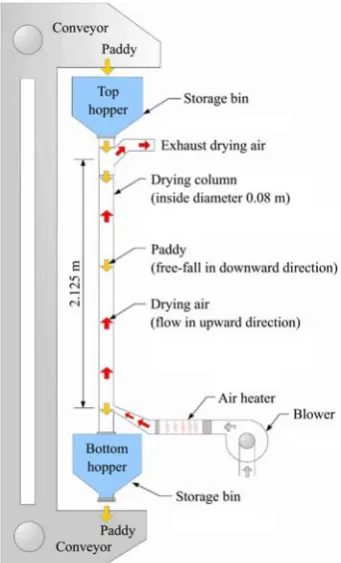
From the schematic as depicted in Figure 1, the heated drying air flows through the vertical drying column in the upward direction opposite to the downward free fall direction of the grain being dried. Grains are fallen down by gravity force from the top hopper into the drying tube without any obstruction from the frontal grain layer (unlike the stack flow pattern). This is the
unique design which is different from conventional counter-flow grain dryer. As a result, grain velocity and grain bulk porosity inside free-fall grain dryer are higher than those of conventional grain dryer. The high porosity of the column of the free falling grain (about 0.96-0.98), together with the highly relative velocity between the air and the grain (about 4-6 m/s), helps enhance heat and moisture transfer processes[11]. Furthermore, churning and turbulence additionally boost transfer enhancement. Therefore, the moisture content uniformity of the grain bulk at the end of drying process can be expected while it is not found in fixed deep bed drying[13]. The contacting time between the grain and the air is typically very short. In case of rough rice drying, the contacting time is only about 0.5 s for the 1.15 m long drying column[11]. Despite the short contacting time, it is expected that in an industrial scale dryer, where the drying column length is typically 5 m, the exhausted air would be fully utilized in terms of its drying potentiality which is essential to be further studied because partial recycling of exhausted air is necessary for an economical operation in case of industrial fluidized bed paddy dryer[14,15].
This free-fall dryer has a built-in rest period; much like the spouted bed dryer, as the grains leaving the drying column has to wait in the storage bin for the conveyor to carry them into the next round of drying in the drying column. The duration of this rest period depends on the size of storage bins and the feed/conveying rates. It should be noted that this bin rest is not exactly the same as the tempering rest since the environment is not controlled to be airtight and adiabatic.
Figure 1 Schematic of the medium scale free-fall dryer
3 Materials and methods
3.1 Dimensionless analysis
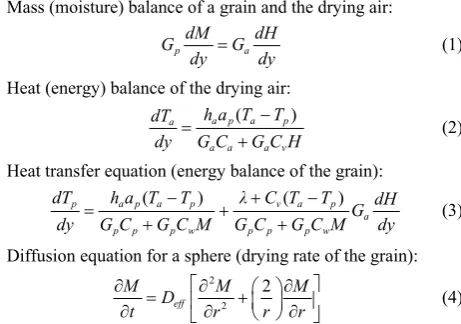
Mass (moisture) balance of a grain and the drying air:
p a
dM dH
G G
dy = dy
(1)
Heat (energy) balance of the drying air:
( )
a p a p a
a a a v
h a T T dT
dy G C G C H
− =
+ (2) Heat transfer equation (energy balance of the grain):
( ) ( )
p a p a p v a p a p p p w p p p w
dT h a T T λ C T T dH
G dy G C G C M G C G C M dy
− + −
= +
+ + (3)
Diffusion equation for a sphere (drying rate of the grain): 2
2 2 eff
M M M
D
t r r r
⎡ ⎤ ∂ = ∂ +⎛ ⎞∂ ⎢ ⎜ ⎟ ⎥ ∂ ⎣∂ ⎝ ⎠ ∂ ⎦ (4)
where, the indispensable variables, which were used to solve this system of equations, included initial and boundary conditions namely the initial moisture content (Mi), the initial grain temperature (Tpi), the initial drying air temperature (Tai), the initial absolute humidity (Hi) and the initial grain mass (m). In addition, geometric variables of the free-fall dryer, including the length (L) and the diameter (D) of the drying tube, should be incorporated to obtain DVs.
By observing the above governing equations and boundary conditions, with the assumption that thermal properties of grain and drying air were quite constant in the range of the desired air-grain flow regime, the primitive variables involved in this study were proposed to be: M, Mi, m, H, Hi, Ta, Tai, Tp, Tpi, Gp, Ga, r, L, D, t and y. Perhaps the simplest and the most important DV to be proposed was the moisture ratio (MR) since it has been widely used in the literature, therefore,
1 eq i eq M M MR M M − ∏ = =
− (5)
where, equilibrium moisture content (Meq) is the minimum moisture content limited at which a grain can be dried under a given set of drying conditions. Meq depends on grain species, grain variety, the temperature and the humidity of the drying air. Henderson’s model [16] was implemented to predict Meq
2
1
1 ,
1 log(1 )
100 C eq a abs RH M C T ⎛ − ⎞ = ⎜⎜ ⎟⎟
⎝ ⎠ (6) where, the values of product constants, C1 and C2, for rough rice moisture desorption (RD23 varieties) were –3.146×10⁻⁶ and 2.464,
respectively[17]. RH was calcula * 2 eff
r t
D
= ted from Ta, and H.
Since Meq incorporated the effects of drying air temperature and humidity together, therefore, Ta, Tai, H and Hi can be removed out of the list of primitive independent variables.
Grain moisture content (M) in free-fall dryer varies depending on the bed coordinate (y) in drying tube/resting bin and the drying time (t), M(y,t). To simplify the number of variables, grain moisture content was considered at the outlet of the bottom hopper where the grains were more convenient to collect and their properties were easier to measure during the drying process and at its end. Therefore, the distance or bed coordinate (y) was ignored; it was also discarded from the group in this study.
In most cases of rough rice drying, the rate of moisture content reduction mostly reduces in the ‘falling rate’ drying period, when the internal diffusion resistance is the main controlling mechanism of drying[18]. Therefore, diffusivity is an important parameter representing internal moisture diffusion ability. The grain moisture
diffusivity (Deff) is usually presented in the Arrhenius-type equation as a function of grain temperatures[16].
2 1exp 3600 p eff C C T D ⎛ ⎞ ⎜ ⎟ ⎜ ⎟ ⎝ ⎠
= (7)
For rough rice drying temperature, it was in the range of 20οC-100οC, the constant coefficients, C1 and C2, were 33.6 and –6420, respectively[19].
Seven steps in DMA in this study were listed as follows: Step 1: Propose the variables affecting the moisture ratio as:
MR=fn(m, G
a, Gp, r, L, D, t, Deff)
Step 2: Use mass (α), length (β) and time (γ) as the fundamental dimensions (FD).
Step 3: The dimensions of the listed variables were expressed in multiple powers of α,β, γas shown in Table 1.
Table 1 Powers of primitive variables in terms of fundamental dimensions
MR m Ga Gp r L D t Deff
Mass (α) 0 1 1 1 0 0 0 0 0
Length (β) 0 0 –2 –2 1 1 1 0 2
Time (γ) 0 0 –1 –1 0 0 0 1 –1
Step 4: Choose m, L, r and Deff as the scaling (repeating) variables. The choice of scaling variables is quite arbitrary if they form a complete independent basis. However, engineering interpretation can help a judicious selection.
Step 5: The scaling method was used to form dimensionless groups. In this method, ‘pure’ dimensions were extracted from ‘compound’ dimensions embedded in the fundamental variables by combining them together. This method could be analogous to chemical reaction process in extracting pure substances[20]. (Note: This method which has been applied for DG investigation of solar chimney power plant[2] and animal feed drying[1]. It yielded the same result as Buckingham’s pi theorem.
α=m
(8) β=L (9)
2
eff
r γ
D
= (10)
Generally, the pure dimensions can be simply extracted by observation, without the solutions of algebraic equations. In rare cases, solving all relevant algebraic equations might be necessary, but the equations need to be solved only once and for all.
Step 6: The DG of Ga is α1γ–1β–2 and it can be easily determined.
The scaling variable obtained was mDeff/r2L2. Therefore the DG for this is:
2 2
2
Π a
eff
G r L m D
= (11)
The same procedure was repeated for Gp, t and D, hence, additional DGs are obtained as follows:
2 2
3
Π p
eff
G r L m D
= (12)
4 2
Π t Deff
r
= (13)
5
Π D
L
6
Π a
p
G G
= (15)
This ratio implies the magnitude of (1) the velocity ratio between the grain velocity and the drying air speed in drying tube and/or (2) the bulk porosity of the moving bed in the drying tube. As the velocity ratio indicated the intensity of drying air flow through the moving bed and the porosity represented the grain surface area that contacts with the surrounding air, this directly affected the heat and mass transfer rate between the grain and the air in the drying tube.
The fourth DG (Π4) was interpreted as the time ratio of the drying time to the time for moisture diffusion from inside to the grain surface. This time ratio had the same value as the Fourier number for mass transfer[3]. The fifth DG (Π5) was the geometric ratio indicating the slenderness of the drying tube. The size of the width was linked to the capability of the grain flow, which was related to the porosity in the moving bed.
Step 7: Finally, the functional relationship of all DGs is
Π1=fn(Π6, Π4, Π5) or:
2
, ,
eq n a eff
i eq p
M M f G t D D
M M G r L
⎛ ⎞
−
= ⎜⎜ ⎟⎟
− ⎝ ⎠ (16)
3.2 Experimental drying kinetics
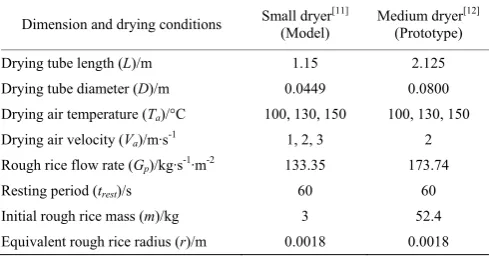
To study the relation between the moisture ratios (Π1) with dependent DGs of the free-fall dryer, it is necessary to conduct a rough rice drying experiment on the free-fall dryer. The experimental data were collected from previous studies in a small scale dryer, called the model[11], and a medium scale dryer, called the prototype[12]. The dimensions of the dryers and the selected drying conditions were shown in Table 2.
Table 2 Dimensions and drying conditions of small and medium free-fall dryers
Dimension and drying conditions Small dryer[11] (Model)
Medium dryer[12] (Prototype)
Drying tube length (L)/m 1.15 2.125
Drying tube diameter (D)/m 0.0449 0.0800
Drying air temperature (Ta)/°C 100, 130, 150 100, 130, 150 Drying air velocity (Va)/m·s-1 1, 2, 3 2
Rough rice flow rate (Gp)/kg·s-1·m-2 133.35 173.74
Resting period (trest)/s 60 60
Initial rough rice mass (m)/kg 3 52.4
Equivalent rough rice radius (r)/m 0.0018 0.0018 The fresh rough rice with moisture content of 27% d.b. was poured into the hopper mounted on top of the drying column. The shutter at the top of column was then opened to let the rough rice free-falling down. The drying air stream was blown in opposite direction of the falling rough rice and a timer was started. The rough rice was emptied from the hopper and enriced in the bucket at the bottom of the drying column. The bulk temperature of the rough rice pile was then measured, a sample of rough rice was collected (for moisture measurement), and the rough rice was rested in the hopper for 60 s resting period. The drying was repeated until the moisture level of the paddy reached 16% d.b. [11]
4 Results and discussion
4.1 Characteristics and similarities of the dimensionless variable groups (DG)
Figures 2-4 represent the drying behavior of the model obtained by plotting the normalized moisture content of rough rice
(moisture content in dry basis scale divided by initial moisture content) against drying duration, at the drying air velocity of 1 m/s, 2 m/s and 3 m/s, respectively. It was observed that all the distributions were quite linear with different slopes. The moisture content reduction curves were close to linear fashion because the same rest period resulted in approximately the same amount of rough rice moisture evaporation in all drying rounds. In this free-fall dryer, most moisture evaporated from rough rice in the drying column in which rough rice lost only moisture around its surface due to the short contact time between rough rice and hot air. Then, in the resting hopper (rest period), moisture diffused from inside to the surface of rough rice leading to more moisture level at a rough rice surface. Then the rough rice’s surface moisture was ready to evaporate in the drying column in the next drying round. It was also observed that the higher air temperatures and the higher air speeds tended to produce progressively faster drying while still maintaining the linear characteristics of drying curves. The drying characteristics of free-fall dryer were very different from the fluidized bed technique in which the drying curve showed the exponential decay fashion[21].
Moreover, Figures 2-4 showed the effect of the glass transition temperature to the drying rate of rough rice. It was observed that the increasing of drying air temperature from 100°C to 130°C increased drying rate substantially when compared with the increasing of drying air temperature from 130°C to 150°C. Because the rice grain has higher grain temperature than its glass transition temperature (Tg) when using the drying air at 130°C, the starch structure within the grain transforms from the glassy state to the rubbery state. At this state, moisture can diffuse much faster from the grain core to the grain surface than in case of glassy state region. As a result, moisture content of rough rice would be reduced in a drying tube faster. However, a rice grain was in the rubbery state during drying at 130°C and 150°C drying air temperature. Therefore, the raising of drying air temperature from 130°C to 150°C can be increased drying rate moderately due to the reduction of heat and mass transfer resistance at the grain surface. Moreover, the faster drying air speed can be increased more moisture reduction clearly. For more discussions were presented in Meesukchaosumran and Chitsomboon[11].
Figure 2 Drying curve for the model dryer at 1 m/s of drying air velocity[11]
Figure 3 Drying curve for the model dryer at 2 m/s of drying air velocity[11]
Figure 4 Drying curve for the model dryer at 3 m/s of drying air velocity[11]
Figure 5 Drying curve for the prototype dryer at 2 m/s of drying air velocity[12]
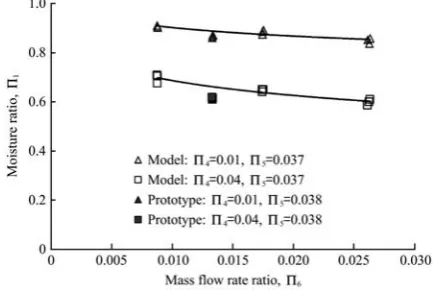
Figure 6 shows the distributions of the moisture ratio (Π1), computed from the experimental data, as related to the mass flow
rate ratio (Π6) at the corresponding time ratios (Π4 = 0.01, 0.04) and the geometry ratios (Π5 = 0.37, 0.38) of both the model and the prototype drying experiments. The relationship of Π1 and Π6 was a non-linear function. The moisture ratio (Π1) decreased as the mass flow rate ratio (Π6) increased. This inverse correlation was based on heat and mass transfer principles. Mass flow rate ratio (Π6) could be increased with increasing in the drying air mass flow rate flux (Ga) and/or decreasing in rough rice mass flow rate flux (Gp). The increasing of Ga results in reduction of the boundary layer resistance which induces grain moisture evaporated faster. In addition, the residence time of the rice grain in drying tube would be longer because using higher drying air speed cause increasing in the counter flow direction between grain and drying air which induce higher aerodynamic drag. The decreasing of Gp leads to increase porosity in the drying-moving bed that increases the contact surface area between rice grain and drying air in drying tube which allows better heat and mass transfer.
In addition, the relation of the moisture ratio (Π1) and the mass flow rate ratio (Π6) from the prototype data showed comparable values with the relation from experimental data of the model which exhibited the similarity of these DVs (Π1 and Π6).
Figure 6 Effect of the mass flow rate ratios (Π6) on the moisture ratios (Π1)
Figure 7 shows the relation of the moisture ratio with the time ratio from the model and the prototype at different drying air temperatures. Clearly, the moisture ratio data from different drying air temperature conditions collapsed onto straight lines, and suggested a similarity. In addition, the moisture ratio (Π1) reduced as the time ratio (Π4) increased. The increase in drying air temperature induced high grain temperature that changed the grain internal pore structure and increased the grain internal vapor pressure, resulting in greater internal moisture diffusion[21]. Since the ability of the moisture to diffuse is greater, the diffusion coefficient becomes larger, and the time scale value (r2/D
eff) is smaller. Meanwhile, the high vapor pressure difference between the grain interior side and the environment was generated, and thus the grain moisture was rapidly evaporated. This reduced the drying time. Accordingly, the increase in the drying air temperature reduced both the drying time and the time scale at the same proportion, and thus the time ratios of different drying air temperatures were equal (Figure 7).
ratios of the prototype and the model were considerably close. According to engineering intuition, the moisture ratio reduction of the model should be faster than that of the prototype; nonetheless, this concept was not consistent with the experimental result. For this reason, other DVs should be established.
Figure 7 Effect of the time ratios (Π4) on the moisture ratios (Π1) at various drying air temperatures
After a grain left the drying column, it had to sit in the storage bin, which was not controlled to be airtight and adiabatic, for the conveyor to carry the grain to the next round of drying in the drying column. In the storage bin, the moisture within the grain equalized due to diffusion, and some moisture was evaporated from the grain surface to the environment. The mechanism controlling the evaporation rate was the vapor pressure difference between the grain surface and the environment, which was inversely related to the relative humidity of the environment. Although this mechanism had slower evaporation rate in the storage bin than in the drying chamber, it still affected the overall drying rate because the ratio of the resting time in the storage bin to the drying time in the drying tube was large, about one minute in the storage bin against one second in the drying tube. For this reason, the relative humidity of the environment was added to the DG.
Π7=RHamb (17) Then, the final functional relationship is Π1=fn(Π6, Π4, Π5, Π7).
2
, , ,
eq n a eff
amb i eq p
M M G t D D
f RH
M M G r L
⎛ ⎞
−
= ⎜⎜ ⎟⎟
− ⎝ ⎠
(18)
Because of the limitation of laboratory and the lack of controller equipment, ambient relative humidity around the dryer could not be controlled to be constant value throughout the drying process. The relative humidity of the environment was in the ranges of 60%-66% and 53%-56% for the model and the prototype, respectively. The data indicated that the moisture ratio reduction of the prototype would be slightly faster than that of the model because the lower relative humidity of the environment helped increase the rate of moisture evaporation in the storage bin.
4.2 Development of the dimensionless correlation equation
To obtain the dimensionless correlation for rough rice drying in the free-fall dryer by using the DG presented above and the experimental data from literature [11], the geometry ratio (Π5) and the ambient relative humidity (Π7) were discarded from the dimensionless correlation development due to the lack of sufficient data of these two DVs from the literature. Thus, the final functional relationship was reduced to Π1=fn(Π6, Π4).
In Figure 8, the relationship of the three DVs was considered, and the relationship between the moisture ratio (Π1) and the time
ratio (Π4), when the mass flow rate ratio (Π6) was constant, was found to be as an exponential decay function:
4 4
( Π)Π 1
Π =eCoefficient of (19)
Figure 8 Effect of the time ratios (Π4) on the moisture ratios (Π1) at various mass flow rate ratios (Π6)
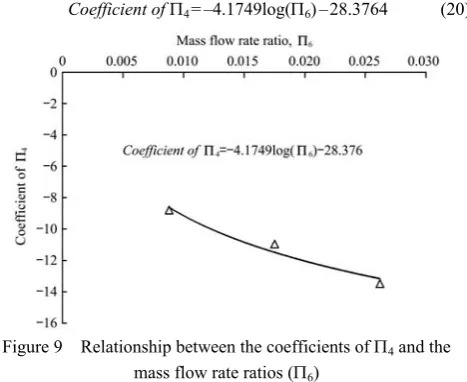
The coefficients of Π4, as shown in Figure 9, were –13.4973, –10.9699 and –8.8080, when the mass flow rate ratios were 0.0262, 0.0175 and 0.0088, respectively. The relationship between the coefficients of Π4 and the mass flow rate ratios from Figure 8 were presented in Figure 9. The coefficient of Π4 was less negative or increased when the mass flow rate ratio (Π6) were decreased, this imply that lower drying rate could be achieved when using lower air speed and/or higher feed rate. The equation of a coefficient of Π4 was obtained as:
Coefficientof Π4=–4.1749log(Π6)–28.3764 (20)
Figure 9 Relationship between the coefficients of Π4 and the mass flow rate ratios (Π6)
Substituting Equation (20) into Equation (19) gives:
6 4
( 4.1749 log(Π) 28.3764)Π 1
Π =e− − (21)
Then, the dimensionless correlation for rough rice drying in the free-fall dryer was:
2
exp 4.1749log 28.3764
eq a eff
i eq p
M M G t D
M M G r
⎛⎛ ⎛ ⎞ ⎞ ⎞
− = ⎜⎜− − ⎟⎛ ⎞⎟
⎜ ⎟ ⎜ ⎟
⎜ ⎟
⎜ ⎟
⎜ ⎟
− ⎝⎝ ⎝ ⎠ ⎠⎝ ⎠⎠ (22)
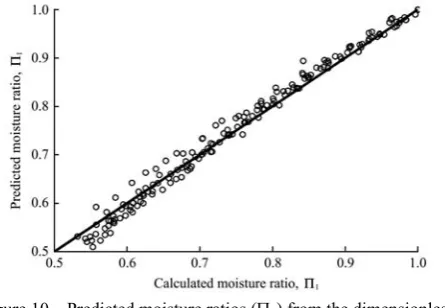
Figure 10 Predicted moisture ratios (Π1) from the dimensionless correlation vs. calculated moisture ratios (Π1) from the
experimental data.
Further studies with various geometric ratios may be necessary to reveal the complete correlation for scaling up the design of the free-fall dryer. While the ambient relative humidity was considered in this study, this variable could be discarded from the DG because the ambient relative humidity had a small effect on the moisture ratio and was hard to be controlled in a practical drying setting due to the fluctuation of the environment.
5 Conclusions
This study was proposed, for the free-fall grain dryer, to obtain five dimensionless variables (DVs) with similarities, which have been proved to be valid both in the model and the prototype dryers by using experimental data from different drying chamber (small and medium scale), drying air speed (1-3 m/s) and temperatures (100°C-150°C). The DVs included the moisture ratio, the mass flow rate ratio, the time ratio, the geometric ratio and the ambient relative humidity. The time ratio incorporated the effect of different drying air temperatures in the moisture ratio. The moisture ratio decreased as the mass flow rate ratio increased due to the higher air flow and/or the higher bulk porosity. The geometric ratio revealed the similarity of the data between the model and the prototype of other DVs. Due to the long resting period in the storage bin, the ambient relative humidity could have an effect on the moisture ratio reduction. This effect, however, may not be crucial when compared to the effect of other DVs. The dimensionless correlation equation of rough rice drying by the free-fall dryer was developed from the drying experimental data. The results showed that this correlation could significantly predict the rough rice moisture contents.
Acknowledgement
This research is sponsored by the Royal Golden Jubilee (RGJ) Ph.D. Program of the Thailand Research Fund (TRF).
Nomencalture
Symbols
ap particle surface area, m2/m3 ca specific heat of dry air, J/(kg·K) cp specific heat of particle, J/(kg·K) cv specific heat of vapor, J/(kg·K) cw specific heat of water, J/(kg·K) D diameter of drying tube, m
Deff effective diffusion coefficient, m2/s Ga mass flow rate flux of drying air, kg/(s·m2) Gp mass flow rate flux of particle, kg/(s·m2)
ha heat transfer coefficient, J/(m2·K·s) H absolute humidity of air, kg/kg
L length of drying tube, m
m initial mass of particle, kg
M moisture content (dry basis, decimal)
Meq equilibrium moisture content (dry basis, decimal) MR moisture ratio content (decimal)
r equivalent radius of particle, m
RH relative humidity of air (decimal)
t drying time, s
trest resting time per drying interval, s Ta drying air temperature, K Tp particle temperature, K
y depth in bed from particle inlet, m
Greek Letters
α fundamental dimension of mass, kg β fundamental dimension of length, m γ fundamental dimension of time, s λ latent heat of vaporization, J/kg
Π dimensionless variable
Subscripts
i initial
amb ambient
Abbreviations
CFD computational fluid dynamic DEM discrete element method DG dimensional variable group DMA dimensional analysis method DV dimensionless variable PDE partial differential equation
[References]
[1] Chitsomboon T, Rung K. Dimensionless variables in drying process. In Proceedings of the 12th Conference of National Mechanical Engineering Network of Thailand, Bangkok, Thailand, 1998.
[2] Koonsrisuk A, Chitsomboon T. Dynamic similarity in solar chimney modelling. Solar Energy, 2007; 81: 1439–1446.
[3] Hall C W. Dimensionless numbers and groups for drying. Drying Technology, 1992; 10: 1081–1095.
[4] Pavon-Melendez G, Hernandez J A, Salgado M A, Garcia M A. Dimensionless analysis of the simultaneous heat and mass transfer in food drying. Journal of Food Engineering, 2002; 51: 347–353.
[5] Topuz A, Hamzacebi C. Moisture ratio prediction in drying process of agricultural products: A new correlation model. Applied engineering in agriculture, 2010; 26(6): 1005–1011.
[6] Inaba H, Husain S, Horibe A, Haruki N. Heat and mass transfer analysis of fluidized bed grain drying. Memoirs of the Faculty of Engineering, Okayama University, 2007; 41: 52–62.
[7] Kachru R P, Matthes R K. Kinetics of batch drying of deep-bed rough rice using dimensional analysis. Cereal Chemistry, 1976; 53: 61–71. [8] Zare D, Jayas D S, Singh C B. A generalized dimensionless model for
deep bed drying of paddy. Drying Technology, 2012; 30: 44–51. [9] Zheng X, Yubin L, Wang J, Dong H, Process analysis for an alfalfa rotary
dryer using an improved dimensional analysis method. International Journal of Agricultural and Biological Engineering, 2009; 2(3): 76–82. [10] Chitsomboon T, Khaengkarn S, Pechnumkheaw K. Free-fall-paddy rice
dryer: A fast and energy efficient dryer. In Proceedings of the 2nd Conference on Energy Technology Network of Thailand, Nakhon Ratchasima, Thailand, July 27-29, 2006.
[11] Meesukchaosumran S, Chitsomboon T. Effects of resting periods, air temperatures and air velocities on free-fall paddy dryer performances. Suranaree Journal of Science and Technology, 2018; 25(1): 11–26. [12] Khaengkarn S, Meesukchaosumran S, Chitsomboon T. Genetic algorithm
[13] Sarker M S H, Ibrahim M N, Ab Aziz N, Mohd Salleh P. Energy and rice quality aspects during drying of freshly harvested paddy with industrial inclined bed dryer. Energy Conversion and Management, 2014; 77: 389–395.
[14] Prachayawarakorn S, Tia W, Poopaiboon K, Soponronnarit S. Comparison of performances of pulsed and conventional fluidised-bed dryers. Journal of Stored Products Research, 2005; 41: 479–497. [15] Sarker M S H, Ibrahim M N, Ab Aziz N, Mohd Salleh P. Energy and
exergy analysis of industrial fluidized bed drying of paddy. Energy, 2015; 84: 131–138.
[16] Brooker D B, Bakker-Arkema F W, Hall C W. Drying and storage of grains and oilseeds. New York: Van Nostrand Reinhold, 1992; 3p.
[17] Soponronnarit S. Drying grain and some food. Bangkok: King Mongkut’s University of Technology Thonburi, 1997; 75p.
[18] Elbert G, Tolaba M P, Aguerre R J, Suarez C. A diffusion model with a moisture dependent diffusion coefficient for parboiled rice. Drying Technology, 2001; 19: 155–166.
[19] Teffe J F, Singh R P. Diffusion coefficient for predicting rice drying behavior. Journal of Agricultural Engineering Research, 1982; 27: 489–493. [20] Chitsomboon T. Fluid mechanics. Bangkok:McGraw-Hill/Top, 2003;
pp.176–189.