Application of wireless technologies to forward predict crop
yields in the poultry production chain
Patrick Jackman
1*, Shane Ward
1, Liam Brennan
1, Gerard Corkery
2and Ultan McCarthy
3(1. Biosystems Engineering, University College Dublin, Belfield, Dublin, Ireland; 2.Department of Applied Sciences, Dundalk Institute of Technology, Louth, Ireland; 3.Intelligent Mechatronics and RFID Gateway, Tralee Institute of Technology, Kerry, Ireland.)
Abstract: Average bird weight is the primary measure of crop yield and is the basis for calculating payment for the grower by the wholesaler. Furthermore the profit per bird is very small. Thus very tight control of growing process that is essential to ensure average bird weight is maximised. The important factors (air temperature, air humidity, carbon dioxide concentration and ammonia concentration) that affect the intake of feed and water must be kept at their optimum during the progress of the growing cycle. These factors can be influenced by activating burners and opening the vents on walls of the growing house. It then follows that the burning and venting strategy will be influential on the average bird weight of the crop.
Currently the burning and venting strategy is based on notional ideal levels and data from wall mounted sensors. This suffers from two fundamental problems: firstly the strategy is determined by ideals that may not be suitable for all growing houses and secondly the data are not measured from the chickens own airspace. Thus the management strategy is based on a model that may not reflect reality and on data that may not reflect reality
The “BOSCA” project addresses these problems by placing wireless environmental sensors into the chickens own airspace. This provides for direct measurement of the air experienced by the chickens and reports the recorded data in near real-time to a cloud based data management system. The sensor data are merged with the data from the growing house weighing scales in the cloud repository so a predictive model of average bird weight from the measured environmental data can be calibrated and validated. Furthermore, a time shift can be applied to the environmental data during model calibration and validation so the average bird weight can be forward predicted by 72 h(R2up to 0.89 with neural networks). This gives the grower advance notice of a deviation from ideal feeding and watering conditions and the likely consequences of failing to take remedial action such as turning on the burners or venting the house.
Keywords: environmental control, productivity, average bird weight, wireless agricultural sensors, cloud computing
Citation: Jackman, P., S. Ward, L. Brennan, G. Corkery, and U. McCarthy. 2015. Application of wireless technologies to forward predict crop yields in the poultry production chain. Agric Eng Int: CIGR Journal, 17(2):287-295.
1 Introduction
1It is anticipated that there will be very strong growth
in the global poultry market into the next decade (Mulder,
2012), thus it is essential that anyone wishing to maintain
or grow their market share will have adopt the best
standards and practices. Specifically it will be necessary
for producers to maximise their average bird weights by
maintaining high feed and water conversion efficiencies
Received date: 2014-09-23 Accepted date:2015-04-08
*Corresponding author: Patrick Jackman. Biosystems Engineering, University College Dublin, Belfield, Dublin, Ireland. Email: [email protected]
throughout the production cycle (Van Horne and Bondt,
2013).It should be noted that in a typical production cycle
(five to six week period) average bird weights can
increase from 50 g to 2.2 kg(Hall and Sandilands, 2007).
The comfort and the contentment of the broiler
chickens depend on the control of the house environment.
More specifically this means that the air temperature,
humidity, carbon dioxide (CO2) and ammonia (NH3) must
be within acceptable parameters (Aviagen, 2009). These
parameters can be maintained by an in-house
environmental control system (Rotem, 2014) which
controlling the use of heaters, air conditioning and
external vents and other environmental manipulation
devices. However, burners that use gas or liquid diesel
fuel to generate additional heat at the cost of also
introducing additional CO2 into the house environment.
The gas concentrations and importantly the house
temperature and humidity can be lowered by opening
vents on the walls of the house to allow fresh air to enter
the house and stale air to escape (Aviagen, 2009).
However, venting due to excessive gas concentrations or
humidity may mean that the heaters need to be activated
to maintain temperature.
In addition to the economic requirements for close
control of poultry house environments there is a legal
requirement in respect of animal welfare and workers
healthcare (Corkery et al., 2013) and it is insufficient to
merely reduce flock density to guarantee animal welfare
(Jones et al., 2005) so additional welfare supports
arerequired. The trend in regulation is towards
progressively stricter limits on the house environment but
equally the grower does not want use the environmental
manipulation mechanisms as they are costly to use
(Jones-Hamilton, 2014). Thus, the solution is the
optimum use of the environmental manipulation
mechanisms, which is a type of Precision Livestock
Farming (PLF), towards a reduction in production losses
(Mollo et al., 2009) leading to better incomes, reduced
environmental impact, increased product quality, earlier
diagnosis of health risks and improved waste
management (Hocquette and Chatellier, 2011). The
principal characteristics of good PLF systems are
continuous adequate sensing, dynamic mathematical
models, target values for outputs and model based
predictive controllers (Wathes et al., 2008).
To implement a PLF solution, poultry growers
typically install an automatic environmental control
system which uses standard curves and the growers’
inputs to make process decisions. However, these systems
suffer from a number of shortcomings in that they use
mounted sensors and thus they are not in direct contact
with the chickens own airspace. Hence, the
environmental control algorithms must make their
decisions based on data that may be unrepresentative.
Similarly the decision making algorithms are generic may
not be appropriate to the unique characteristics of the
particular growing house.Another weakness is that there
is no cloud sharing of data meaning the data is only
available locally.
Thus, there is an industry gap for a new PLF solution
for poultry houses that can avail of data directly measured
from the chickens own airspace so decisions can be made
based on truly representative data. There is a further gap
in using decision algorithms that are tailored to the
uniqueness of the growing house in question that can be
quickly calibrated and validated from a small number of
training crops.
In particular what be of great value would be a
predictive facility that could estimate the likely impact of
a loss of environmental control or a failure to maintain
optimum environmental conditions. This would be an
advance on the traditional predictive models of bird
weight that estimate future weights based on past weights
during that crop cycle. Thus such an environmental model
could be optimised on a house by house basis after a
period of training and testing. The traditional bird weight
gain models do not have this capacity for optimisation
nor do they have the ability to incorporate environmental
data into their predictions.
The decision making algorithms must have a
substantial forward prediction capability so there is
enough time to take remedial action before the problem
becomes irrecoverable. Furthermore the longer the
forward prediction period the better as there is more time
for a manual intervention by the grower if required. The
sharing of all of this data on a cloud platform will greatly
enhance its usefulness as all interested parties will be able
to benefit including the wholesaler, the retailer and the
2 Materials and methods
2.1 BOSCA design
Bespoke environmental sensing boxes suitable for use
in poultry houses (each known as a “BOSCA”) were
constructed by Shimmer Sensing (Dublin, Ireland); these
consisted of a robust box design, sensors, a sensor board,
a Raspberry Pi and a 3G communication device. The
BOSCAs were programmed with appropriate firmware
and software to record readings as comma separated
values and to allow transmission over the 3G network.
The environmental sensors chosen for suitability for the
task were: a Sensirion (London, United Kingdom) SHT21
temperature and humidity sensor, an Elektronik (Bremen,
Germany) EE891 carbon dioxide sensor and a Winsensor
(Zhengzhou, China) MQ137 ammonia sensor. Two
variants of the sensor boxes were constructed; a “BOSCA-MOR” or big box which contains all the elements described and a “BOSCA-BEAG” or small box
which does not contain gas sensors and a 3G
communication device. The BOSCA-BEAGs
communicated their data to any BOSCA-MORs within
range.
Calibration experiments were performed to verify the
calibration curves that were embedded in the BOSCA
firmware. The sensor boxes were placed into a culture
cabinet (Binder, Tuttlingen, Germany) where
temperature, humidity and gas concentrations could be
manipulated. Inside the cabinet were a Davis Vantage
Pro2 weather station (Davis, Hayward, California, USA)
and a Geotech G100 CO2 gas detector (Geotech,
Leamington Spa, United Kingdom). Special NH3 rich air
was supplied by BOC gases (Dublin, Ireland) at 25mg/kg
and 50 mg/kg. As a result some adjustments to the
BOSCA firmware were required to edit the calibration
polynomials.
2.2 BOSCA deployments
The BOSCAs were deployed in a growing house in
County Monaghan, Ireland for two crop cycles. The
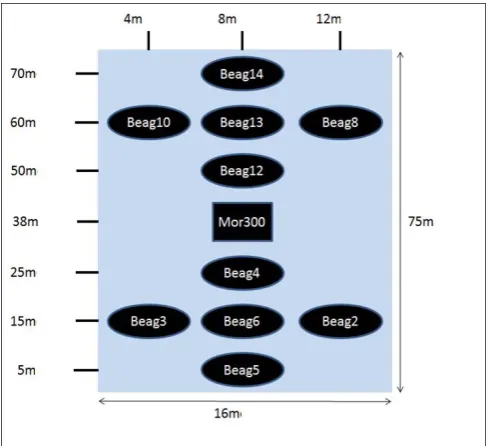
schematics are shown in Figures 1 and 2. Each BOSCA
was placed in this location for the full cycle. The data
recorded were condensed into comma separated values
(.csv) every 1 min for the BOSCA-MORs and every 10
min for the BOSCA-BEAGs. The .csv files were
immediately uploaded to a cloud server via the 3G
connection using a standard file transfer protocol (ftp)
process. A local copy of the sensor data repository was
made on a Linux server in University College Dublin
where the .csv were parsed by bespoke Python and Bash
scripts to facilitate their entry onto a PostgreSQL
database suitable for forensic queries and web portal
interface.
Figure 1Planar schematic of placement of sensor boxes in
Figure 2 Planar schematic of placement of sensor boxes
in the growing house for the second crop cycle
2.3 Data processing
Time series data for each BOSCA and each sensor
within the BOSCAs were extracted from the PostgreSQL
database with standard SQL queries (e.g. SELECT
VALUE from READINGS where SENSOR_ID = …)
with a Python for Linux interface. The time series data
were saved as an excel spreadsheet where it was joined
with the daily average bird weight data provided by the
chicken grower. To make the data comparable all of the
time series were grid interpolated into hourly readings.
The hourly readings were copied into the statistical
software MINITAB (Minitab Inc, Cologne, Germany) for
analysis by partial least squares regression (PLSR) and by
neural networks (NN) in Matlab (The Mathworks, Natick,
Massachusetts, United States of America). Sensor
redundancy analysis was performed and both internal
comparison and cross comparison predictive models of
average bird weight in 72 hours’ time were generated.
3 Results and discussion
3.1 Sensor spatial redundancy
A vital question for sensor deployment is the spatial
density required to capture trends and patterns within the
area of interest. Deploying too high a density is a waste of
resources and could also add error to the data stream,
conversely too low a density will cause potentially
important variability in the area to be missed and
consequently important process control decisions to be
distorted. Redundancy in the time series data can be
estimated by a correlation matrix and by extracting the
eigenvalues from a principal component analysis of the
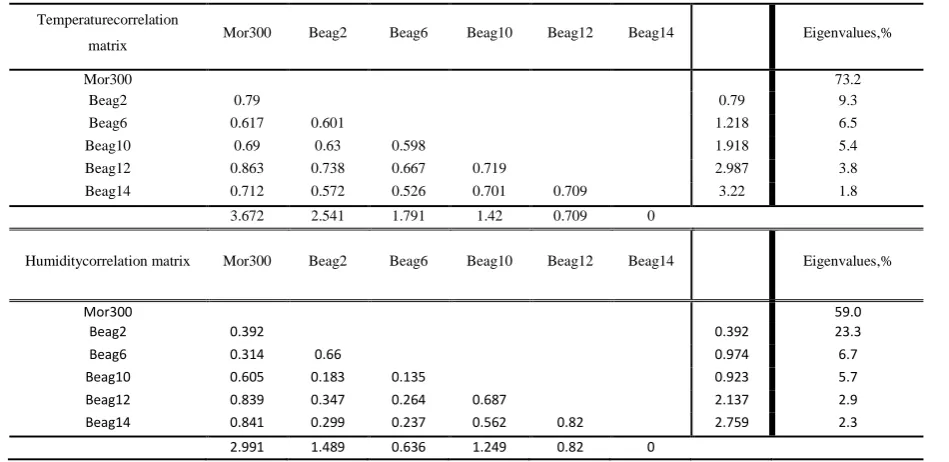
time series matrix. This was performed for both crops 1
and 2 and the results are shown in Tables 1 and 2. The
correlation matrix shows the linear correlation between
any pair of sensors for temperature and humidity, it also
shows the average cross correlation for each sensor. The
eigenvalues for each matrix is shown alongside the
correlation matrix, this shows how much variance is
explained by each successive principal component. It is
important to note that BOSCA-BEAG8 in crop 1 and
BOSCA-MOR200 in crop 2 only performed
intermittently and their data were thus excluded from
3.2 Sensor type redundancy
The inclusion of an ammonia sensor comes at
significant financial cost and thus if it was possible to
estimate ammonia by other means the financial cost of
the BOSCA-MORs could be substantially reduced.
Experience of the industry is that ammonia levels track
humidity levels as the crop progresses. To test this
hypothesis a PLSR model was built using humidity,
temperature and time elapsed as predictors of humidity.
To account for possible non-linearity squared, cubic and
Table 1Temperature and humidity correlation matrices and eigenvalues for the first crop
Temperaturecorrelation matrix
Mor300 Beag2 Beag3 Beag4 Beag5 Beag6 Beag10 Beag12 Beag13 Beag14 Eigenvalues,%
Mor300 93.0
Beag2 0.905 0.905 3.4
Beag3 0.936 0.96 1.896 1.1
Beag4 0.93 0.929 0.954 2.813 0.8
Beag5 0.882 0.941 0.944 0.905 3.672 0.5 Beag6 0.926 0.975 0.975 0.968 0.957 4.801 0.5 Beag10 0.921 0.906 0.936 0.917 0.862 0.923 5.465 0.3 Beag12 0.941 0.934 0.962 0.959 0.897 0.955 0.948 6.596 0.2 Beag13 0.932 0.882 0.921 0.955 0.844 0.925 0.953 0.962 7.374 0.1 Beag14 0.851 0.884 0.865 0.885 0.804 0.892 0.905 0.9 0.907 7.893 0.1
8.224 7.411 6.557 5.589 4.364 3.695 2.806 1.862 0.907 Humiditycorrelation
matrix Humid Correlation Matrix
Mor300 Beag2 Beag3 Beag4 Beag5 Beag6 Beag10 Beag12 Beag13 Beag14 Eigenvalues-Humid Eigenvalues,%
Mor300 93.4
Beag2 0.937 0.937 2.5
Beag3 0.894 0.945 1.839 1.2
Beag4 0.934 0.964 0.907 2.805 0.8
Beag5 0.899 0.943 0.973 0.901 3.716 0.6 Beag6 0.897 0.944 0.973 0.907 0.98 4.701 0.5 Beag10 0.938 0.95 0.952 0.94 0.947 0.946 5.673 0.3 Beag12 0.924 0.942 0.944 0.957 0.943 0.952 0.962 6.624 0.2 Beag13 0.948 0.952 0.937 0.942 0.939 0.939 0.976 0.957 7.59 0.2 Beag14 0.859 0.869 0.909 0.845 0.92 0.941 0.908 0.909 0.915 8.075 0.1
8.23 7.509 6.595 5.492 4.729 3.778 2.846 1.866 0.915
Table 2Temperature and humidity correlation matrices and eigenvalues forthe second crop
Temperaturecorrelation
matrix Mor300 Beag2 Beag6 Beag10 Beag12 Beag14 Eigenvalues,%
Mor300 73.2
Beag2 0.79 0.79 9.3
Beag6 0.617 0.601 1.218 6.5
Beag10 0.69 0.63 0.598 1.918 5.4
Beag12 0.863 0.738 0.667 0.719 2.987 3.8 Beag14 0.712 0.572 0.526 0.701 0.709 3.22 1.8
3.672 2.541 1.791 1.42 0.709 0
Humiditycorrelation matrix Mor300 Beag2 Beag6 Beag10 Beag12 Beag14 Eigenvalues,%
Mor300 59.0
Beag2 0.392 0.392 23.3
Beag6 0.314 0.66 0.974 6.7
Beag10 0.605 0.183 0.135 0.923 5.7
Beag12 0.839 0.347 0.264 0.687 2.137 2.9
Beag14 0.841 0.299 0.237 0.562 0.82 2.759 2.3
interaction terms were included. The PLSR model was
validated by 10-fold cross validation. In parallel a NN
was developed using humidity, temperature and time
elapsed as a predictor of ammonia. The NN was validated
and tested with a 70-15-15 split of the data. The results of
the PLSR predictive models are shown in Figure 3. The
corresponding NN model could on average predict
ammonia with an R2of 0.94.
Similarly the inclusion of a carbon dioxide sensor also
comes at noticeable financial cost although less than for
an ammonia sensor and thus its elimination would reduce
the overall costs. As with ammonia, experience within the
industry is that there is a substantial tracking of humidity
levels as the crop progresses. Identical PLSR models and
NN were thus developed to test for redundancy of the
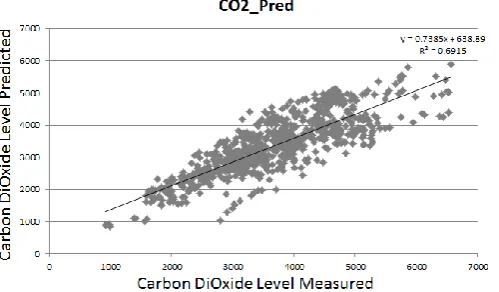
carbon dioxide sensor. The results of the PLSR predictive
models are shown in Figure 4. The corresponding NN
model could on average predict carbon dioxide with an
R2of 0.84.
3.3 Forward predictions of average bird weight
The most useful outcome for a big data would be to
provide an alert system for potential deviations from
weight gain targets for the crop based on parameters that
can be adjusted by the grower. The further into the future
this model could predict the better but industry
experience is that a few days would be adequate. Thus a
72 h time shift was applied to the average bird weight
data so sensor readings were matched to average bird
weight 72 h into the future. The time series were then
used for PLSR and NN modelling in two contexts. The
first was where the data from both crops was merged to
form a single dataset; this would produce a growing
house specific model that may not generalise well in Figure 3 Results of a PLSR model of ammonia level in mg/kgfrom linear, squared, cubic and interaction terms
of humidity, temperature and time elapsed
other growing houses. The second was where a model
calibrated from one dataset was applied on the other and
vice versa, this would produce more conservative results
but would generalise better. The PLSR models were
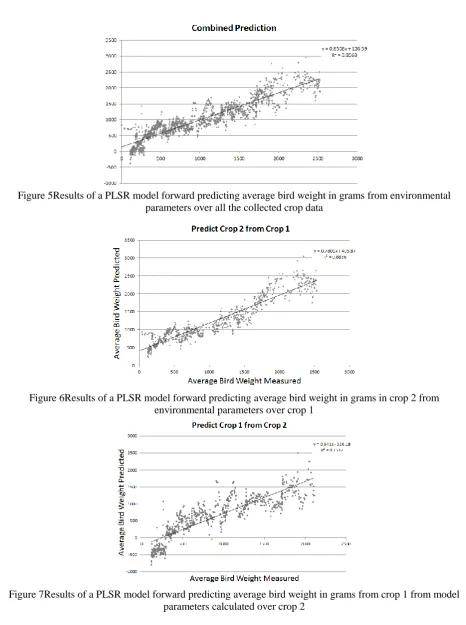
validated by 10-fold cross validation. The PLSR results
are shown in Figures 5, 6and 7. The corresponding NN
models were again validated and tested with a 70-15-15
split of the data. The NN model predictions were R2 =
0.89 for the combined crop dataset, R2 = 0.89 for
forward predicting the crop 2 average bird weight from a
model developed from the crop 1 data and finally R2 =
0.79 for forward predicting the crop 1 average bird
Figure 5Results of a PLSR model forward predicting average bird weight in grams from environmental parameters over all the collected crop data
Figure 6Results of a PLSR model forward predicting average bird weight in grams in crop 2 from environmental parameters over crop 1
weight from a model developed from the crop 2 data.
3.4 Discussion
The key question of sensor spatial redundancy has
been investigated in detail. The spatial arrangement in the
first crop places all BOSCAs in areas that have good air
circulation and are free from major obstructions. Thus it
is no surprise that there is a very strong intra sensor
correlation and very high proportions of variance are
expressed in the first few eigenvalues. This would
support the view that where air can move freely a very
low density of BOSCAs will be adequate to capture the
trends and patterns of air temperature and humidity.
The spatial arrangement in the second crop places
some BOSCAs in the corners of the house where there
would be less free circulation of air and some large
obstructions are present. In this case the intra sensor
correlations were much weaker except for the BOSCAs in
the centre of the house. Similarly the proportion of
variance expressed in the first few eigenvalues is much
smaller. This would support the view that it is essential to
have sensors deployed in the corners of the house to fully
characterise the trends and patterns in the house.
The results for predicting ammonia from the other
environmental parameters and other crop data are
adequate to replace the ammonia sensor in the
BOSCA-MORs and to estimate the ammonia levels in the
BOSCA-BEAGs. Additional gas calibration experiments
to take place in the laboratories of University College
Dublin can further refine the signal produced by the
ammonia sensor to increase the robustness of the
prediction equations.
The results for predicting carbon dioxide from the
other environmental parameters and other crop data
would not be adequate to replace the carbon dioxide
sensor for two main reasons. Firstly the carbon dioxide
sensor will be substantially cheaper than an ammonia
sensor and secondly poultry farmers and poultry house
managers in Ireland place a very high importance on
direct carbon dioxide readings in their experience when
determining the correct moment to open the house vents,
thus any predictive model of carbon dioxide would need
to be extremely accurate to warrant replacement of a
direct carbon dioxide measurement.
The ability to forward predict by 72 hthe average bird
weight based on current environmental data has ranged
from good to excellent. Where the data from both crops
were envisaged as a single dataset an excellent correlation
with measured average bird weight was found. This
would suggest that it is realistic to attempt to build house
specific models of crop progression, these would not be
expected to generalise well and it would be necessary to
carry out similar experiments in each new house.
Where the data from the crops were treated as distinct
the results were mixed, an excellent prediction of the
progression of crop 2 was possible based on a model
developed with the crop 1 data, however the converse
was not the case and it was more difficult to predict the
progression of crop 1 based on a model developed with
the crop 2 data. These models would be more likely to
generalise as they have had to deal with fully external test
data. The mixed results would suggest that it may be too
ambitious to produce generalised models of crop
progression based on environmental data as the
differences between houses may be too difficult to
capture without a vast program of experiments and the
inclusion of house infrastructural features into the
predictive models.
The benefits of artificial intelligence based modelling
approaches are marginal as the NN model prediction
statistics are only a few percent at best beyond the
classical multivariate statistical model predictions. As
such it is recommended to use explicit methods that can
be more clearly understood rather than opaque artificial
intelligence methods.
Further experimental data arebeing collected in the
same chicken growing house and in other chicken
data which can enhance and refine the results found in
this series of experiments. Similarly additional calibration
experiments are being carried out with ammonia rich gas
mixtures to further refine the ammonia sensor signal.
4 Conclusions
A comprehensive series of experimental work has
been carried out to collect environmental data from a
typical chicken growing house in Ireland. Key questions
of sensor spatial deployment and which sensors are
necessary to characterise the trends and patterns in the
house that lead to weight gain in the crop have been
substantially addressed. Important questions of how
current environmental data can be used to forward predict
crop weight gain have been explored and it has been
proven possible to build a house specific predictive model
that can forecast a few days into the future giving the
grower enough time to take mitigating action.
ACKNOWLEDGEMENTS
This research was carried out with funding from
Science Foundation Ireland and with the support of
Carton Group PLC
References
Aviagen.2009. Ross Broiler Management Manual, Aviagen Group, Huntsville, AL, USA.
Corkery, G., S.Ward, C.Kenny, andP.Hemmingway. 2013. Incorporating Smart Sensing Technologies into the
Poultry Industry. World's Poultry Research, 3(4): 106-128.
Hall, C.,andV.Sandilands. 2007. Public attitudes to the welfare of broiler chickens. Animal Welfare, 16(3): 499-512. Hocquette, J.F.,andV.Chatellier. 2011. Prospects for the European
beef sector over the next 30 years. Animal Frontiers, 1(1): 20-28.
Jones, T.A.,C.A. Donnelly, andM.S.Dawkins. 2005. Environmental and management factors affecting the welfare of chickens on commercial farms in the United Kingdom and Denmark stocked at five densities. Poultry Science, 84(6): 1155-1165.
Jones-Hamilton.2014. Cost Effective Poultry House Ventilation, Jones-Hamilton Agriculture, Walbridge, OH, USA. Mollo, M.N., O.Vendrametto, andM.T.Okano. 2009. Precision
Livestock Tools to Improve Products and Processes in Broiler Production: A Review. Brazilian Journal of Poultry Science, 11(2): 211-218
Mulder, N.-D.2012. Outlook for the Global, European and Irish poultry industry, Rabobank International, Utrecht, Netherlands.
Rotem.2014. Platinum Plus Controller Manual. Rotem Control and Management. Petach-Tikva, Israel.
Van Horne, P.L.M.,andN.Bondt.2013.Competitiveness of the EU poultry meat sector. Wageningen Press, Wageningen, Netherlands.