Creating a Teacher Development Program Linked
to Curriculum Renewal
Creación de un programa de desarrollo profesoral para una renovación curricular
Erica Ferrer Ariza*
Paige M. Poole**
Universidad del Norte, Barranquilla, Colombia
This paper presents one Colombian university English as a foreign language program’s in-house teacher development program for curriculum renewal. This program is an innovative attempt to prepare teachers for implementing a new curriculum and, simultaneously, engages them in professional development activities. The program is a response to the lack of existing teacher and professional development models that fit certain specific contextual needs, including preparation for implementing new curriculum as well as emphases in the updating of particular teaching practices. In addition to presenting the program, the article also describes the integration of key aspects of various existing models of teacher and professional development into one program that meets contextual needs while encouraging positive change among faculty and students.
Key words: Curriculum renewal, English as a foreign language, professional development, teacher development.
Este artículo presenta un programa de desarrollo profesoral de una universidad colombiana para acompañar una renovación curricular. Este modelo se presenta como una iniciativa innovadora para preparar profesores en implementar un nuevo currículo y, simultáneamente, involucrarlos en actividades de desarrollo profesional. El modelo se da en respuesta a la carencia de modelos existentes de desarrollo profesoral que respondan a las necesidades particulares de un contexto, que incluyan preparación para la implementación de un nuevo currículo, así como un énfasis en la actualización de las prácticas de enseñanza. Adicionalmente, el artículo describe la integración de aspectos clave de modelos existentes en un solo modelo que responda a las necesidades contextuales y al mismo tiempo promueva cambios positivos en los docentes, estudiantes y programas.
Palabras clave: desarrollo profesional, desarrollo profesoral, inglés como lengua extranjera, renovación curricular.
* E-mail: [email protected] ** E-mail: [email protected]
How to cite this article (APA, 6th ed.): Ferrer Ariza, E., & Poole, P. M. (2018). Creating a teacher development program linked to curriculum renewal. Profile: Issues in Teachers’ Professional Development, 20(2), 249-266. https://doi.org/10.15446/profile.v20n2.67937.
This article was received on September 25, 2017 and accepted on March 12, 2018.
Introduction
Teachers engage in development for various reasons (Bailey, Curtis, & Nunan, 2001). Sometimes it happens as a consequence of teachers’ intrinsic motivation to improve the quality of their teaching practices, gain respect and recognition, become a more effective educator, or to increase individual satisfaction in pursuit of a successful teaching career. In other cases, it comes about as a consequence of extrinsic motivation from a teacher brought on by factors such as maintaining a job or position, obtaining a better salary, accessing higher quality jobs in the field, or getting a promotion. Heystek and Terhoven (2015) explain that both types of motivation can be important for sustainable and participative teacher development, especially connected to curriculum. In the same way, teacher development can be motivated by institutional needs such as increased teacher awareness, updating of teacher knowledge, and adoption of new teaching practices, among many others. In this way, the institution can play a key role in transforming teacher development into a “process of ‘we are developing’ rather than a process of ‘you must develop’ because you are underperforming” (Heystek & Terhoven, 2015, p. 629). In this paper, we reflect on the process of building and implementing a teacher development program (tdp) linked to curriculum renewal in a university English as a foreign language (efl) program on the Caribbean coast of Colombia. In detailing the process, we explain how university and program faculty were involved in reflecting, analyzing, and making informed decisions about their teaching practices within the framework in order to better design and implement the new curriculum.
Contextual Background
The specific context in which this tpd was designed is that of an eight-level, undergraduate efl program that serves around 12,000 students annually and relies on approximately 60 teachers, most of whom are Colombian. Students in the program belong to a variety
of majors ranging from graphic design or engineering to psychology or social communication. Throughout the program, teachers are expected to help students develop a b2 level of language proficiency according to the Common European Framework of Reference (cefr) (Council of Europe, 2001).
Based on systematic classroom observations at all levels of the program, we found students were not devel-oping their language proficiency at the expected level. Careful analysis of students’ grades and exit exam results corroborated these observations and showed that more than 50% of the students were not achieving a b2 level. In order to address this situation, the language institute initiated a curriculum development project (cdp) based on backwards design, using desired learning outcomes to guide the construction of a new curriculum (Wiggins & McTighe, 2005). The cdp aimed to identify needs in the program as well as propose a new curriculum that would take into account aspects such as: course goals and outcomes, course materials, student performance, teacher performance, and assessment in a more comprehensive and structured way than before. After a needs analysis was carried out, a preliminary design created, and new course materials chosen, a major challenge arose: working with teachers to reflect on, evaluate, and implement the new curriculum in the classroom.
To respond to this challenge, a tpd was designed to prepare teachers for and involve them in curricu-lum implementation through taking into account their perceptions and making corresponding adjustments.
Creating a Program for Teacher Development
Institutional Needs
In the efl program in question, there were several institutional needs that motivated the cdp and the tpd. These needs included: fewer and more succinct objectives in course syllabi, a clear progression of student learning outcomes (slos), increased awareness among teachers of the content of each level, as well as a need to standardize assessment practices.
Professional Needs
The tpd also took into account varied professional needs of the teachers within the efl program who would be implementing the new curriculum, the most important of which were: teaching practice update, especially regarding skills instructions, sharing of good classroom practices with their colleagues, and reflection as a professional tool.
General Program Objectives
In an attempt to address all of the abovementioned needs, the following general objectives were formulated for the tpd:
• To involve teachers in the process of evaluating designed curriculum and making suggestions for improvements.
• To improve teacher receptiveness and openness to curricular ideas pre, during, and post-curriculum implementation.
• To provide teachers with spaces to learn about and practice using tools for implementing the new curriculum effectively.
• To facilitate spaces for voicing and addressing teachers’ concerns.
• To facilitate spaces for reflecting on curriculum implementation.
• To promote problem-solving and critical thinking teamwork among teachers.
It is important to clarify that while the program had clear general objectives, it was not a fixed program from the start. As new needs arose or established needs
changed during curriculum implementation, the planned activities were evaluated and adjusted to assure they continued meeting the needs identified.
Teacher Development
It is important to note that there is a distinction between teacher training and teacher development. Richards and Farrell (2005) define teacher training as involving “activities directly focused on a teacher’s present responsibilities and . . . aimed at short-term immediate goals” (p. 3) in order to prepare the teacher to accept new responsibilities or positions in their unique context. Teacher development, on the other hand, tends to focus on “general growth not focused on a specific job [and] serves a longer-term goal” (p. 4) that involves a teacher reflecting on their teaching practice. Both concepts are critical for understand-ing a teacher’s continued growth in and outside the classroom.
More specifically, teacher development is regarded as “the process whereby teachers’ professionalism and/ or professionality may be considered to be enhanced” (Evans, 2002, p. 131). Evans (2002) identifies two key elements of teacher development: attitudinal develop-ment and functional developdevelop-ment. Whereas the former is concerned with the process through which teachers modify their attitudes towards their work, the latter is concerned with the process through which teach-ers’ professional work may be improved. From this perspective, teachers may experience changes either in their intellectual or motivational development and/ or in their general teaching practice.
Impact on Institutions
studies related to elementary school teachers carried out by rel Southwest (Yoon, Duncan, Lee, Scarloss, & Shapley, 2007), teachers that receive approximately 50 hours of teacher development were shown to increase their students’ scores on achievement tests by 21 percen-tile points. Likewise, Hanbury, Prosser, and Rickinson (2008) conclude from their study of the impact of professional development programs in higher educa-tion that benefits at a departmental level were related to: developments in educational practices, enhanced profile for teaching and learning, inter-departmental links, staff induction and mentoring. In the same way, Chalmers and Gardiner (2015) claim, based on their extensive review of studies concerning the impact of teacher development on teaching and learning, that “it is possible to evidence changes in teacher understanding, knowledge, skills and practices, and the consequential effect of these on student engagement and approaches to learning” (p. 83).
Impact on Professors
In regard to the impact on professors, Richards and Farrell (2005) explain that
The need for ongoing renewal of professional skills and knowledge is not a reflection of inadequate training but simply a response to the fact that not everything teachers need to know can be provided at pre-service level, as well as the fact that the knowledge base of teaching constantly changes. (p. 1)
Therefore, teacher development not only serves to update theoretical and practical knowledge among educators, but it also serves as an expansion of the learning that took place in their formal, pre-service training and education (Mizell, 2010). Hanbury et al. (2008) also confirm, through a review of several empiri-cal and investigative studies, that teacher development can have positive benefits on teachers’ approaches to learning, especially regarding a move away from teacher-centered approaches and a move towards student-centered approaches.
Characteristics of Good Professional Development
In general, the following characteristics are con-sidered as some of the most important for successful, good, quality, and effective teacher and professional development.
• It is connected to the particular context of the institution or program where it is implemented. • It involves collaboration and cooperation among
teachers as well as the specific educational community.
• It promotes the construction of a support system among teachers and the learning community. • It is planned and carried out over time in a
sustainable way.
• It places emphasis on the teacher as an active and reflective learner throughout the process.
• It involves active learning connected to program objectives and student learning. (Cohen & Hill, 2001; Desimone, Porter, Garet, Yoon, & Birman, 2002; Diaz-Maggioli, 2004; Generation Ready, 2013; sedl, 1997; unesco, 2015)
Ultimately, “effective professional development should be understood as a job-embedded commitment that teachers make in order to further the purposes of the profession while addressing their own particular needs” (Diaz-Maggioli, 2004, p. 5). Teachers should, therefore, be placed at the center of their own professional development, perceived as life-long learners involved in activities that emphasize growth that will impact both their short-term and long-term teaching in the classroom and overall development as educators.
directly relevant to their role as teachers in the efl program who were implementing the new curriculum. Likewise, the model connected with their role as always evolving teachers in the field of education. In this way, teachers were able to receive and share knowledge, tools, and experiences to prepare them for and involve them in curriculum implementation while at the same time developing skills and acquiring knowledge that would serve them in future educational contexts.
Teacher Development Models
Aiming to best incorporate the previously mentioned characteristics, teacher professional development has, over the last 20 years, gained a lot of momentum. As Villegas-Reimers (2003) argues: “for years, the only form of ‘professional development’ available to teachers was ‘staff development’ or ‘in-service training,’ usually consisting of workshops or short-term courses that would offer teachers new information on a particular aspect of their work” (p. 11). Today, teacher professional development is rather understood as extended and continuous improvement in which teachers should engage as they advance in their career. It is not a one-day, one-time learning unrelated experience, but the combination of progressive, diversified, and relevant learning that teachers gather throughout their work in teaching contexts. Different authors have proposed models or frameworks to guide institutions, programs, policy makers, and teachers to undertake teacher development aimed at improving teachers’ pedagogical
foundations and practices and, therefore, improving students’ learning.
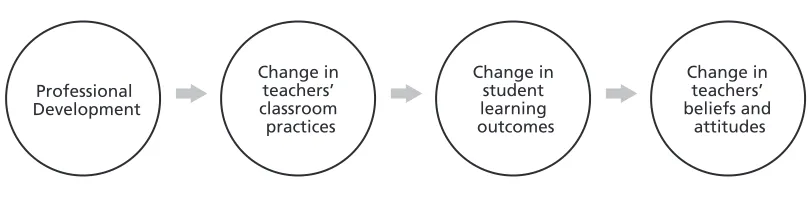
One of these authors is Guskey (2002), who places changes in students learning at the center of effec-tive teacher development (p. 383). In this way, student change is a triggering factor for actual teacher change as represented by Figure 1.
Guskey (2002) argues that “significant change in teachers’ attitudes and beliefs occurs primarily after they gain evidence of improvements in stu-dent learning (p. 383).” Regardless of the nature of the teacher development process carried out, this will be internalized by teachers when they observe evidence that their adjustments or implementations have worked and can be observed through changes in students’ learning. According to Guskey, without observation of these changes, teachers will make no use of the opportunities.
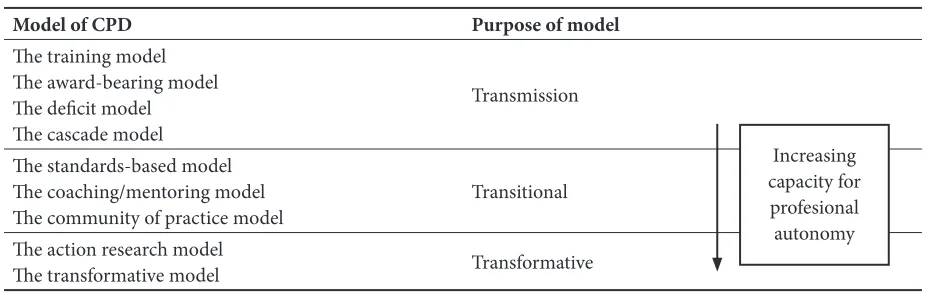
Likewise, Kennedy (2005) argues that since the purpose of continuing professional development is to empower teachers with the necessary foundations to become critical individuals who shape their own practice, who make informed decisions in the class-room, and who interpret policies with a critical eye, models for teacher development should be progres-sively selected and implemented depending on the needs and characteristics of the context. According to these ideas, teachers should be given the opportunity to increase their professional autonomy moving from controlling models to more constructive-creative ones as demonstrated in Figure 2.
Figure 1. Guskey’s Model of Teacher Change (2002, p. 383)
Professional Development
Change in teachers’ classroom
practices
Change in student learning outcomes
Change in teachers’ beliefs and
Figure 2. Spectrum of CPD Models (Kennedy, 2005, p. 248)
Model of CPD Purpose of model
The training model The award-bearing model The deficit model The cascade model
Transmission
The standards-based model The coaching/mentoring model
The community of practice model Transitional
The action research model
The transformative model Transformative
• Transformational: The last two models mentioned by Kennedy push teachers to become researchers in their contexts (action-research model) and to transform themselves as teachers (transformative model). Both models require teachers to be aware of their practices and the conditions of their teaching-learning contexts and to use these aspects to better themselves as teachers.
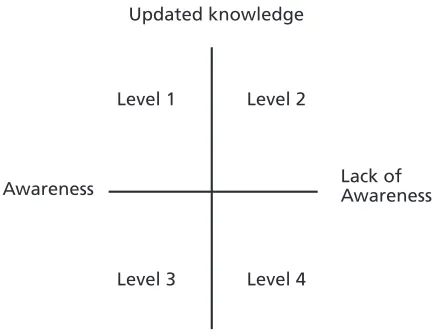
Another model for teacher development is the one proposed by Diaz-Maggioli (2004) where teacher development is understood as a collaborative and con-tinuous process in which teachers are expected to enrich and strengthen their practices by analyzing students’ needs and adjusting their teaching styles accordingly. What makes this model different from those previously mentioned is the conscious identification of teacher’s awareness of needs and lack of knowledge in establish-ing a teacher development framework. In other words, the more aware teachers are of their lacks in knowledge and their needs in improving teaching effectiveness, the more targeted and defined the professional devel-opment plan can be to meet these specific needs and lacks. Figure 3 represents “the Four Quadrants of the Teacher’s Choice Framework” which guides the design of a teacher development plan based on this model (Diaz-Maggioli, 2004).
The models in Figure 2 can be summarized in the following way (Kennedy, 2005, pp. 236-237):
• Transmission: The first two models in this category emphasize the teacher as being a passive receiver of information whether it is through training carried out by an expert (training model) or the completion of a course offered by an external institution (award-bearing model). The last two models place more responsibility on the teacher by asking the teacher to work on particular identified weaknesses (deficit model) or by participating in a professional development activity and sharing what was learned with fellow colleagues (cascade model). • Transitional: The transitional models move away
from focusing only on the teacher and begin to involve students as well as the teaching community. The standards-based model places importance on making empirical connections between teacher professional development (tpd) and students’ achievement. A bit different, the coaching/mentoring model and the community of practice model both stress teachers’ roles in their professional community as key. In the first, more experienced teachers are placed as mentors with less-experienced teachers. In the second, the entire teaching community works together to achieve a common tpd goal set by the community or institution.
Figure 3. The Four Quadrants of the Teacher’s Choice Framework (Diaz-Maggioli, 2004, p. 15)
Updated knowledge
Lack of knowledge Level 2 Level 1
Awareness Lack ofAwareness
Level 4 Level 3
According to Figure 3, there are four levels at which teachers can be placed depending on their own analysis and reflections on their strengths and areas of improve-ment. For instance, more experienced teachers, aware of their teaching foundations and context, can mentor less experienced colleagues, or they can prepare in-house training workshops or document their successful experiences as a point of reference for other teachers. The experienced teachers would classify at level one while less experienced teachers, not aware of their lacks and needs, would place at level four, with professional development consisting of participation in in-house workshops or processes of mentoring (Diaz-Maggioli, 2004).
In the same way, two of the most relevant factors that characterize this model are the expected willingness teachers should have for continuous improvement and the high value placed on collaborative work in the form of learning communities. For this model to be successful, teachers should demonstrate an intrinsic commitment and willingness to engage in development activities as well as a positive disposition towards collaborative work with peers in their context.
Teacher Development and Curriculum
According to unesco (2015),
Curriculum change is a dynamic and challenging process, and its success depends on all stakeholders having the capacity to develop or adopt a shared vision, positive attitudes and commitment. Moreover, they need to develop the necessary professional competencies in the various aspects of curriculum change. (para. 6)
Even so, there is sufficient evidence to argue that, when a new curriculum is implemented, few teachers actually change the way they are teaching to match what the curriculum calls for in terms of teaching practices in the classroom (Cohen & Hill, 2001; Cuban, 1990; Hardman & A-Rahman, 2014; Sargent, 2011; Yan, 2012), whether it be due to insufficient knowledge of the curriculum, lack of few professional development or training opportunities (Nunan, 2003), effects of poor leadership (Brooks & Gibson, 2012), or other contextual factors. Sargent (2011) reports on a study in China that looked at the effects of curriculum renewal on teachers’ beliefs and classroom practices, educa-tional structures, and learning outcomes. Although teachers were utilizing some of the teaching methods required for the new curriculum to be effectively implemented, in the analysis of classroom practices post-curriculum implementation, data showed that there was still frequent use of traditional teaching methods such as memorization and recitation and lecture style teaching. Consequentially, professional development and training opportunities, such as peer observations, local trainings and workshops, research activities, and learning communities, for teachers were considered prerequisites to a successful implementa-tion of the new curriculum proposed.
needed to solve problems and implement change” (para. 7). Capacity building activities, then, work to both inform all parties involved of the curriculum to be implemented through the improvement and development of necessary competencies and also to change the attitudes and perceptions of those teachers who may oppose the curriculum change. Through capacity building activities, teachers and teacher educators should be able to:
• understand their changing roles as curriculum changes;
• comprehend curriculum objectives and national curriculum standards;
• master subject matter and pedagogical skills to deliver subject-specific content;
• have a positive attitude to curriculum change and be an agent of change;
• break down isolation and develop team spirit; • engage in continued professional learning and
development. (unesco, 2015, para. 10)
Capacity building activities can include: training sessions, workshops, follow-up activities, and observa-tions on which feedback is received, and so on, which in the best case scenario make up part of a customized teacher development program that meets the contextual needs of the educational institution and its community (teachers, learners, administrators, local community, etc.) (unesco, 2015).
In a study carried out with teachers in California, Cohen and Hill (2001) found that teacher development related to new curriculum and policy implementation was more effective when it focused on activities aimed at developing pedagogical strategies directly related to the curriculum and involved materials that could be used with the curriculum in question rather than activities that focused on generalized pedagogical strategies or materials. In the same way, according to a study in Canada, teachers involved in the implementation of a new curriculum acknowledge
the importance and the positive impact curriculum-linked professional development can have (Brooks & Gibson, 2012).
Similarly, when incorporating elements of the new curriculum into teacher development activities, Penuel, Fishman, Yamaguchi, and Gallagher (2007) highlight the advantages of having teachers work collaboratively and participate as a group to foster a system of trust and support as they navigate the new curriculum together. Teachers in Brooks and Gibson’s (2012) study also highlighted the importance of hav-ing this support system and collegial community as they engaged in professional development for new curriculum implementation.
Throughout the process of designing and imple-menting the tpd for the efl program in question, capacity building was a key element in designing and carrying out activities and affording experiences to participating teachers. Likewise, the curriculum design team was conscious of engaging teachers in collaborative activities as well as using elements of the newly designed curriculum in as many of the teacher development activities as possible. This aimed to ensure teacher exposure to and experience with the curriculum before and during its implementation in order to provide teachers with more personalized and relevant skills and tools together with a network of peer support.
Teacher Development Program Linked to Curriculum Renewal
model that could more effectively meet the needs of the institution, program, teachers, and students. It is a curriculum renewal-linked professional development program that focuses on “how to enact pedagogical strategies, use materials, and administer assessments associated with particular curricula” (Penuel et al., 2007, p. 928).
In this way, the model being described here com-bines and integrates elements of various models and aims to find an adequate balance between teacher-centered and context-specific teacher development in such a way that teachers are able to expand their formal knowledge, engage in job-embedded learn-ing opportunities, participate in reflective teachlearn-ing activities, and carry out transformative practice, all of which address both the immediate needs related to the new curriculum as well as the short and long-term professional needs of teachers.
Process of Designing Teacher Development Program
In designing the curriculum renewal linked teacher development program, the following steps were followed: 1. Execution of a two-pronged needs analysis with
teachers and students
2. Exploration of existing frameworks for curriculum implementation
3. Creation of objectives for the teacher development framework
4. Choice and design of teacher development activities 5. Confirmation of final program design
6. Implementation of tpd
Structure of Teacher Development Program
In order to achieve the general objectives set forth, the teacher development for curriculum renewal pro-gram included a variety of capacity building activities: • efl program meetings with all teachers in the
program
• Introductory curriculum open houses • Teacher-led meetings
• In-house workshops
• Teacher presentations of their best practices • Workshops by textbook authors
• Workshops by international experts • Reflective article discussions
• Teacher observations and feedback sessions
Overall, the program was organized in such a way that every semester began and ended with a general, but tailored activity for all teachers as well as in a way that allowed for constant and individualized activities throughout the semester.
Types of Activities Used in the Program
In order to provide teachers with as many oppor-tunities as possible to prepare them for and guide them through curriculum implementation, a variety of activi-ties were included in the tpd including both teacher-led as well as expert-led activities.
First, information sessions were included in the program at several moments, used principally to share important and succinct information with teachers and the institutional community. These sessions were mostly occupied with presenters explaining and presenting information to teachers with some time allotted for short question and answer sessions.
externally. Internally designed workshops included those that were: institutional led, teacher led, and curriculum design team led, while externally designed workshops included those that were led by invited textbook authors, skills experts, and teacher develop-ment experts in the efl field.
At the same time, there were several reflective type sessions incorporated into the teacher develop-ment program as spaces for teachers to be exposed to learning moments that focused on reflection and discussion with colleagues guided by an internal col-league and/or an external expert where reflection was seen as “the process through which teachers compre-hend and learn from their teaching experiences and assign significance to their teaching practices” (Zhao, 2012, p. 57). All of these sessions aimed to encour-age teachers to reflect critically on their practices in the classroom both during and after the curriculum implementation.
In the same way, several opportunities for both individual teacher observations as well as peer observations were included in the program. Individual teachers were observed by curriculum design team members and also by their level coordinators in the program, not to evaluate their teaching, but to observe how the new curriculum was being implemented and identify any areas that might need attention. These observations helped to assure that the needs of teachers in the early stages of curriculum implementation were continued to be met within the tpd.
Peer observations are
collaborative, developmental activit[ies] in which professionals offer mutual support by observing each other teach; explaining and discussing what was observed; sharing ideas about teaching; gathering student feedback on teaching effectiveness; reflecting on understandings, feelings, actions and feedback and trying out new ideas. (Bell as cited in Bell & Mladenovic, 2008, p. 736)
They can help create a sense of community among teachers by allowing them to give and receive support from their colleagues, which is important for teachers involved in new curriculum implementation (Brooks & Gibson, 2012). All of the peer observations carried out in this tpd were designed for developmental purposes rather than evaluative, just as the individual teacher observations, which were to try and lower resistance to observations as well as avoid any possible negative perceptions of this process (Lomas & Nicholls, 2005). Likewise, peer observations were used in a way similar to those in Bell and Mladenovic’s study (2008), which allowed teachers to discuss the observations and any challenges related to them in a collaborative and sup-portive environment.
Overall, the activities included in the tpd were based on the curriculum to be implemented as this connection makes the professional development more meaningful and helpful (Brooks & Gibson, 2012).
Table 1.
Teacher Development Program Linked to Curriculum Renewal
Ac tiv ity D es cri pt io n o f A ct iv ity Par tic ip an ts Sp ecifi c Ob je ct iv es Ph as e: Pr e-I m pl em en ta tio n Refle ct iv e Ses sio n i: Pr ep ar in g f or cur ric ul ar ren ewa l Thi s s es sio n wa s h eld a lo ng w ith t he ini tia l in sti tu tio na l m eet in g f or t he s em es ter . D ur in g t he s es sio
n, a dra
ft ide a of t he n ew c ur ric ul um wa s a nn oun ce d. S ubs eq uen tly , te ac her s w er e o rga nize d in to sm al l g ro
ups (5-6) in
w hic h t he y di sc us se d q ues tio ns r el at ed t o h ow t he n ew cur ric ul um co uld b en efi t t he p rog ra m a s w el l a s w ha t ch al len ges t he y co uld f or es
ee in i
ts im plem en ta tio n. W hi le e ac h g ro up s ha re d i ts a nsw er
s in a w
ho le g ro up di sc us sio n, a t t he en d o f t he s es sio n, e ac h g ro up a lso su bmi tte
d a w
rit ten s umm ar y o f t heir ide as a nd o pinio ns to t he c ur ric ul um desig n t ea m w ho u se d t hes e r es po ns es to b et ter addr es s a ny p os sib le c ha llen ges iden tifie d b y te ac her s. Le ader s: Cur ric ul um desig n t ea m Pa rt ici pa nts: A ll te ac her
s in t
he efl pr og ra m • To en ga
ge in r
efle ct io n a bo ut h ow t he c ur ric ul ar ren ewa l co uld h elp b et ter ac hie ve p rog ra m ob jec tiv es /sl os • To p osi t p os sib le c ha llen ges t o t he im plem en ta tio n o
f a n
ew c ur ric ul um • To exp lo re p os sib le s ol ut io ns t o p ot en tia l ch al len ges t o t he im plem en ta tio n o
f a n
ew cur ric ul um • To de ve lo
p a s
en se o f co mm uni ty a nd co op era tiv e w or
k in a
nt ici pa tin g a nd s ol vin g pr ob lem s Cur ric ul um pi lo tin g Bef or e t he n ew c ur ric ul um wa s im plem en te
d, a sm
al l gr ou p o f t eac her s p ilo te d t he ini tia l v er sio n o f t he cur ric ul
um in o
ne le ve l o f t he p rog ra m. Th es e t eac her s pi lo te d t he n ew sy lla bu s, n ew a ss es sm en ts, t extb oo k op tio ns, s up plem en ta ry m at er ia ls a s w el l a s s tuden t le ar nin g o ut co m es a nd ga ve co ns ta nt f ee db ac k t o t he cur ric ul um desig n t ea m t hr oug h t eac her j our na ls a nd fe ed bac k s es sio ns. 6 t eac her s f ro m the efl p rog ra m, in cludin g 2 te ac her s f ro m th e c ur ric ul um desig n t ea m • To s tren gt hen co op era tio n b et w een c ur ric ul um desig n t ea m a nd exp er ien ce d t eac her s f ro m lo ca l co nt ext • To g en era te ac tiv e t eac her in vo lv em en t in cur ric ul um desig n • To fa mi lia rize limi te d g ro ups o f t eac her
s in t
he pr og ra m w ith t he n ew c ur ric ul um • To iden tif y a re as o f im pr ov em en
t in c
ur ric ul um bef or e m as s im plem en ta tio n • To co nfir m a ss es sm en t f ra m ew or k a nd t extb oo k to b e u se d w ith n ew c ur ric ul um Fo rm al pr es en ta tio n o f ne w c ur ric ul um Th e f or m al a nd co m plet e p res en ta tio n o f t he n ew cur ric ul um wa s h eld d ur in g t he in sti tu tio na l c losin g m eet in g o f t he s em es ter . A t t hi s t im e, t he c ur ric ul um desig n t ea m p res en te d a n o ver vie w o f t he n ew c ur ric ul um, hig hlig ht in g t he sy lla bu s co ns tr uc tio n, a ss es sm en t fra m ew or k, in str uc tio na l m at er ia ls, a nd s tuden t le ar nin g ou tco m es f or e ac h le ve l o f t he p rog ra m. Cur ric ul um desig n t ea m, in stit ut ion al Ac ademic C ommi tte e, a ll efl p rog ra m te ach ers • To f or m al ly p res en t t he s tr uc tur e a nd f un ct io n of n ew c ur ric ul um t o a ll t eac her
s in t
Refle ct iv e Ses sio n ii: Pos t-p ilo tin g exp er ien ces Thi s s es sio n wa s h eld dir ec tly a fter t he f or m al p res en ta tio n of n ew c ur ric ul um. Thi s s es sio n in vo lv ed s pli ttin g t eac her s in to sm al l g ro ups, e ac h o ne le d b
y 1-2 t
eac her s in vo lv ed in th e p ilo tin g o f t he c ur ric ul um. I n e ac h g ro up , t he t eac her(s) fro m t he p ilo tin g s ha re d t heir exp er ien ces w ith t eac her s in th e p rog ra m a nd p res en te d exa m ples o f s tuden t a ss es sm en t per fo rm an ce , a s m an y t eac her s w er e co ncer ne d w ith h ow ne w a ss es sm en ts w ou ld fa re w ith s tuden ts. Th er e wa s a lso a sp ace f or t eac her s t o hig hlig ht co ncer ns o r r es er va tio ns t he y m ay h av e h ad a bo ut t he n ew c ur ric ul um a nd g et f ee db ac k fro m t eac her
s in t
he p ilo tin g a bo ut t hem. Le ader s: T eac her s w ho p ilo te d t he cur ric ul um Pa rt ici pa nts: A ll t eac her s w ho w ou ld b e te ac hin g w ith t he ne w c ur ric ul um • To h av e t eac her s f ro m t he p ilo tin g s ha re t heir exp er ien ces w ith o th er t eac her
s in t
he p rog ra m an d m edi at e a s m en to rs • To faci lit at
e a s
pace f or t eac her s t o v oice pos sib le co ncer ns a bo ut t he n ew c ur ric ul um • To in tro duce t eac her s t o t he n ew a ss es sm en t fra m ew or k w ith r es ul ts f ro m p ilo tin g Cur ric ul um op en h ou se To g iv e t eac her
s a b
et ter c ha nce t o fa mi lia rize t hem se lves wi th t he n ew c ur ric ul um a nd r es ol ve a ny do ub ts t he y m ay ha ve h ad a bo ut i ts im plem en ta tio n, t he c ur ric ul um desig n te am r eadie
d a s
pace w her e t eac her s co uld co m e exp lo re a nd per us e c ur ric ul ar do cum en ts s uc h a s co ur se sy lla bi , s am ple as ses sm en ts f or e ac h le ve l o f t he p rog ra m, s up plem en ta ry m at er ia ls, a nd n ew t extb oo ks f or t he le ve ls a s w ell a s t alk t o th e c ur ric ul ar desig n t ea m a bo ut a ny q ues tio ns o r co ncer ns th ey h ad t ha t h ad n ot b een de alt w
ith in t
he R efle ct iv e Ses sio n ii: P os t-p ilo tin g exp er ien ces. Th e c ur ric ul um o pen ho us e wa s h eld o n t hr ee diff er en t o cc asio ns t o m ak e s ur e a ll te ac her s h ad t he c ha nce t o p ar tici pa te . Le ader s: Cur ric ul um desig n t ea m Pa rt ici pa nts: A ll t eac her s w ho w ou ld b e te ac hin g w ith t he ne w c ur ric ul um • To s ha re a ll n ew c ur ric ul ar do cum en ts w ith te ach ers • To h av e t eac her s fa mi lia rize t hem se lv es w ith ne w t extb oo ks, s up plem en ta ry m at er ia ls, a nd as ses sm en ts f or t he p rog ra m • To p ro
vide a s
pace f or t eac her s t o a sk cur ric ul um desig n t ea m q ues tio ns a bo ut o r ad vice f or im plem en tin g t he n ew c ur ric ul um Ph as e: I m pl em en ta tio n In-h ou se sk ill s-ba sed in str uc tio n w ork sho ps Th e t hr ee m em ber s o f t he c ur ric ul um desig n t ea m cr ea te
d a s
et o f in-h ou se w or ks ho ps f oc us ed o n h ow t o te ac h diff er en t s ki lls w ithin t he n ew c ur ric ul um u sin g th e c us to mize d m et ho d “ Em ph asi s o n S ki lls w ithin a n In teg ra te d A pp ro ac h.” S es sio ns w er e h eld a t t he b eg innin g, midd le, a nd en d o f t he s em es ter . W ork sho p faci lit at or s: Cur ric ul um desig n t ea m Pa rt ici pa nts: A ll te ac her s t eac hin g w ith t he n ew cur ric ul um • To r efle ct o n a nd s ha re co ncep ts o f t eac hin g sk ill
s in t
Ben chm ar kin g ses sio ns (co nd uc te d p er le ve
l in t
he efl pr og ra m) Th es e s es sio ns w er e c ar rie d o
ut in s
es sio ns o rga nize d w ith te ac her s f ro m e ac h le ve l o f t he p rog ra m a nd t heir le ve l co or din at or . L ev el co or din at or s cr ea te d b en chm ar kin g ac tiv ities f or t he n ew w rit in g a nd s pe ak in g a ss es sm en ts bein g im plem en te d. T eac her s co m plet ed t he ac tiv ities a t ho m e, a nd , t hen, co m pa re d t heir e va lu at io ns a nd co mm en ts tog et
her in a g
ro up s es sio n w ith a ll t eac her s f ro m t he le ve l an d t he le ve l co or din at or t o r eac
h a co
ns en su s o n h ow t o grade t he a ss es sm en ts w ithin t he n ew c ur ric ul um. Faci lit at or s: L ev el co or din at or s in th
e efl p
rog ra m Pa rt ici pa nts: A ll te ac her
s in t
he efl p rog ra m te ac hin g w ith t he ne w c ur ric ul um • To b en chm ar k a nd g iv e f ee db ac k o n n ew as ses sm en ts • To w or k co lle ct iv ely o n a ss es sm en t li terac y Imp ro mp tu te ac her obs er va tio ns D ur in g t he fir st s em es ter o f im plem en ta tio n, t he cur ric ul um desig n t ea m a nn oun ce d im pr om pt u obs er va tio ns t o m oni to r c ur ric ul um im plem en ta tio n. Th e fo cu s wa s o n h ow t eac her s a nd s tuden ts w er e in terac tin g w ith t he c ur ric ul um. I nf or m at io n ga th er ed f ro m t hes e obs er va tio ns wa s u se d t
o guide t
he f oc us a nd t op ics o f di sc us sio
n in le
ve
l m
eet
in
gs in t
he efl p rog ra m. O bs er ver s: Cur ric ul um desig n t ea m Te ac her s obs er ve d: A ll te ac her
s in t
he efl pr og ra m • To o bs er ve in terac tio n w ith n ew c ur ric ul um • To iden tif y s tren gt hs a s w el l a s a re as f or im pr ov em en
t in t
he n ew c ur ric ul um • To iden tif y a re as f or t eac her de ve lo pm en t A ss es sm en t an d e va lu at io n w ork sho p Th e w or ks ho p in tro duce d k ey p rin ci ples o f e va lu at io n an d a ss es sm en t a s w el l a s in vo lv ed t eac her
s in h
an ds-on, cr itic al t hin kin g ac tiv ities r el at ed t o a ss es sm en t a nd eva lu at io n w ithin t he n ew c ur ric ul um. Le ader : E xt er na l, in ter na tio na l, eva lu at io n a nd as ses sm en t exp er t Pa rt ici pa nts: A ll te ac her
s in t
he efl pr og ra m • To ra ise a wa ren es s o f a ss es sm en t a nd e va lu at io n pr in ci ples a nd t ec hniq ues • To iden tif y a nd a pp ly k ey e va lu at io n a nd as ses sm en t p rin ci ples f or a pp lic at io n w ith t he ne w c ur ric ul um Cur ric ul um feed ba ck ses sio ns At t he en d o f t he fir st s em es ter o f im plem en ta tio n, te ac her s m
et in g
ro ups b as ed o n t he le ve l t he y w er e te ac hin g a nd p ar tici pa te
d in a f
ee db ac k s es sio n w ith le ve l co or din at or s. Th e s es sio ns w er e di vide d in to t w o pa
rts: a g
ro up di sc us sio n w ith le ve l co or din at or a nd a n an on ym ou s w rit ten s ur ve y r es po ns e. B ot h p ar ts cen ter ed on iden tif yin g s tren gt hs o f t he n ew c ur ric ul um a s w el l a s ar ea s f or im pr ov em en t t ha t co uld b e b et ter ed b ef or e t he se co nd s em es ter o f im plem en ta tio n. M odera to rs: Le ve l co or din at or s Pa rt ici pa nts: A ll te ac her
s in t
he efl p rog ra m • To e va lu at e s tren gt hs a nd a re as o f im pr ov em en t of n ew c ur ric ul um • To g en era te r efle ct io n o n t eac hin g p rac tices a nd studen t le ar nin
g in t
he n ew c ur ric ul um • To p ro
vide a s
Bes t p rac tices pr es en ta tio ns D ur in g t he s eco nd s em es ter o f c ur ric ul um im plem en ta tio n, cer ta in t eac her s v ol un te er ed t o p res en t exa m ples o f s ucces sfu l t as ks, ac tiv ities, s tra teg ies, t oo ls, or m at er ia ls t he y h ad u se d w ith t he n ew c ur ric ul um. Th es e t eac her s s ha re d t heir p rac
tices in le
ve l co or din at io n m eet in gs, w her e t eac her s o f t he s am e le ve l w er e p res en t. Le ader s: T eac her s fro m t he efl pr og ra m Pa rt ici pa nts: A ll te ac her
s in t
he efl p rog ra m, o n a le ve l b asi s • To s ha re s ucces sfu l a sp ec ts o f t eac hin
g in t
he ne w c ur ric ul um • To en co ura ge t eac her -le d p ro fes sio na l de ve lo pm en t ac tiv ities • To co ns olid at e r es our ce b an ks o f u sef ul inf or m at io n a nd p rac tices f or e ac h le ve l o f t he pr og ra m Sk ill s w ork sho ps At t he b eg innin g o f t he t hir d s em es ter o f c ur ric ul um im plem en ta tio n, t w o e duc at io na l exp er ts a nd a ut ho rs o f on e o f t he t extb oo ks b ein g u se d w ith t he n ew c ur ric ul um le
d a s
er ies o f w or ks ho ps cen ter ed o n s tra teg ies a nd ac tiv ities p er tin en t f or s ki ll-b as ed in str uc tio n. Th es e w or ks ho ps f oc us ed n ot o nl y o n ac tiv ities a nd s tra teg ies us ef ul f or im pr ov in g t eac hin g a nd le ar nin g w ithin t he n ew cur ric ul um, b ut a lso f or u pd at in g t eac her s’ k no w le dg e a nd awa ren es s o f n ew p ed ag og ic al p rac
tices in t
he fie ld . Le ader s: Ed uc at io na l exp er ts a nd textb oo k a ut ho rs Pa rt ici pa nts: A ll te ac her
s in t
he efl p rog ra m • To u pd at e p ed ag og ic al p rac tices a nd k no w le dg e re la te d t o t he t eac hin g o f s pe cific s ki lls • To s ha re in str uc tio na l t oo ls a nd s tra teg ies f or im plem en tin g t he n ew c ur ric ul um Pe er obs er va tio ns Thr oug ho ut t he t hir d s em es ter o f c ur ric ul um im plem en ta tio n, t eac her s p ar tici pa te
d in p
eer obs er va tio ns. D ue t o s ch ed ule co nflic ts, s ev era l c la ss es w er e fi lm ed a nd u se d f or p eer o bs er va tio n ac tiv ities. E ac h te ac
her in t
he le ve l o bs er ve
d a p
eer b y wa tc hin g t he fi lm ed cla ss a nd p ar tici pa tin
g in a g
ro up di sc us sio n w ith t he le ve l co or din at or a
s a m
odera to r. E ac h o bs er va tio n wa s t ai lo re d
to a s
pe cific a sp ec t o f t eac hin g o r le ar nin g w ithin t he n ew cur ric ul um. Pa rt ici pa nts: A ll te ac her
s in t
he efl p rog ra m • To f os ter c los er r el at io ns hi ps a m on g t eac her s in th e s am e le ve ls o f t he p rog ra m • To a na lyze k ey a sp ec ts o f c ur ric ul um im plem en ta tio
n in ac
tio n • To p ro vide s paces f or t eac her s t o o bs er ve va rie d fo rm s o f im plem en tin g t he n ew c ur ric ul um • To en co ura ge di sc us sio n o f c ur ric ul um im plem en ta tio n a m on g t eac her
s in sm
aller g ro ups Refle ct iv e Ses sio n iii : Refle ct iv e te ac hin g a nd pr of es sio na l de ve lo pm en t At t he en d o f t he t hir d s em es ter o f c ur ric ul um im plem en ta tio n, a n in ter na tio na l exp er
t in r
efle ct iv e te ac hin g p rac tices c ar rie d o
ut a w
or ks ho p d ur in g w hic h te ac her s exp lo re d wa ys o f in cludin g r efle ct io
n in t
heir prac tice . W hi le t hi s s es sio n h ad cer ta in t ies t o t he n ew cur ric ul um, i ts m ain f oc us wa s t o ra ise t eac her s’ a wa ren es s of t he im po rt an ce o f r efle ct in
g in t
heir p
rac
tice in g
en era l. Le ader : In ter na tio na l exp er t Pa rt ici pa nts: A ll te ac her
s in t
he efl p rog ra m • To ra ise a wa ren es s o f r efle ct iv e t eac hin g prac tices • To en co ura ge r efle ct iv e t eac hin g p rac
tices in t
share ideas and opinions from your coordinator and colleagues teaching the same level.
• I learned new strategies to isolate the skills. • I think this is a worthwhile experience that has
contributed enormously to my professional development.
• This was a great semester of growth for me as a teacher.
Similarly, through the implementation of this model, teachers became more conscious of the local and con-textual curricular and teacher development needs that had been identified together with those needs that were being met through the new curriculum itself. This awareness of needs was generated specifically through the involvement of professors in the construction of the tpd and the activities that it involved. In a focus group at the end of the first semester of curriculum implementation, teachers concluded:
• This approach [to curriculum implementation] considers different learning styles, highlighting areas that one is most experienced in and challenging you to work on those areas where you have difficulty. • The curriculum implementation has represented a
challenge for teachers in that it obligates them to rethink their teaching methodology and strengthen their own weaknesses in the skills (reading, writing, listening, and speaking) to better favor an integral learning experience for students.
Likewise, in the end of semester program evalu-ation focus groups, informal feedback sessions with coordinators, and wrap-up questionnaires after the implementation of the development framework, teach-ers expressed the feeling that one of the strengths of the program had become the professional develop-ment activities and support for teachers offered by the program. Professors also commented that, due to the program, they were exposed to a constant process of evaluation and self-evaluation focused on
improve-Impact in the EFL Program
In many cases, institutions and programs bring in external experts to implement tpds or activities (Kennedy, 2005). However, in the case of this tpd, the institution created the framework internally, relying primarily on local teachers and staff to design and implement development activities and counted on external experts on very few occasions.
With the use of this model, the institution was not only able to directly prepare its professors for the curriculum renewal, but was also able to observe a variety of positive effects related to the implementa-tion of the teacher development program linked to curriculum renewal.
The major positive effects of the tpd observed were: increased consistency in curriculum implemen-tation by teachers, increased understanding of new professional and practical roles of teachers within the new curriculum, and a new vision of coordination meetings within the program.
In terms of the impact on teachers, one of the most important effects observed was the alignment of teachers’ understanding and implementation of the new curriculum. At the same time, and perhaps more importantly, teachers’ conceptualization and practice of their role within said curriculum also became clearer. Both of these effects were noted in the observations carried out as part of the framework as well as in formal and informal feedback sessions with teachers. Not only did teachers feel they better understood how to teach within the new curriculum, but they also felt more comfortable in their role as teachers. Below are a few comments from teachers on a questionnaire administered in the curriculum feedback sessions that reflect the impact the tpd had on them:
• I am getting familiar with this new methodology and I find it an enriching experience.
ment in their teaching practice. These comments demonstrate the positive effects the framework had on teachers’ perceptions of the program they work in as well as the program’s concern for their profes-sional growth.
In the same way, the tpd developed initiated posi-tive changes in the overall structure of the coordination and faculty meetings carried out not only for the efl program, but for the language institute as well. Thanks to the changes within the tpd, level coordination meet-ings were strengthened and took on a more practical, collaborative, and reflective focus where coordinators and teachers not only discussed important information but also shared ideas and challenges, reflected on ways to improve the level, and worked on collaborative projects.
Conclusions
The teacher development program linked to curriculum renewal designed and presented in this paper represents one efl program’s attempt to prepare teachers for implementing a new curriculum, make the implementation more successful, and, at the same time, engage teachers in professional development activities and opportunities. While no tpd is perfect and can cover everything, through the careful combination and integration of key aspects of various models of teacher and professional development, institutions and programs can design and implement models that best meet their local and contextual needs to generate positive change among faculty, students, programs, and even the institution at large.
References
Bailey, K. M., Curtis, A., Nunan, D., & Fan, D. (2001). Pursuing
professional development: The self as source. Beijing, cn:
Foreign Language Teaching and Research Press. Bell, A., & Mladenovic, R. (2008). The benefits of peer
observation of teaching for tutor development. Higher
Education, 55(6), 735-752. https://doi.org/10.1007/
s10734-007-9093-1.
Brooks, C., & Gibson, S. E. (2012). Teachers’ perspectives on the effectiveness of a locally planned professional development program for implementing new curriculum.
Teacher Development, 16(1), 1-23. https://doi.org/10.1080
/13664530.2012.667953.
Chalmers, D., & Gardiner, D. (2015). An evaluation framework for identifying the effectiveness and impact of academic teacher development programmes. Studies in
Educational Evaluation, 46, 81-91. https://doi.org/10.1016/j.
stueduc.2015.02.002.
Cohen, D. K., & Hill, H. C. (2001). Learning policy:
When state education reform works. New Haven,
us: Yale University Press. https://doi.org/10.12987/ yale/9780300089479.001.0001.
Council of Europe. (2001). Common European Framework of Reference for Languages: Learning, teaching, assessment. Cambridge, uk: Cambridge University Press.
Cuban, L. (1990). Reforming again, again, and again.
Educational Researcher, 19(1), 3-13. https://doi.
org/10.3102/0013189X019001003.
Desimone, L. M., Porter, A. C., Garet, M. S., Yoon, K. S., & Birman, B. F. (2002). Effects of professional development on teachers’ instruction: Results from a three-year longi-tudinal study. Educational Evaluation and Policy Analysis, 24(2), 81-112. https://doi.org/10.3102/01623737024002081. Diaz-Maggioli, G. (2004). Teacher-centered professional
development. Alexandria, us: Association for Supervision
and Curriculum Development.
Evans, L. (2002). What is teacher development? Oxford
Review of Education, 28(1), 123-137. https://doi.
org/10.1080/03054980120113670.
Generation Ready. (2013). Raising student achievement through
professional development [White paper]. Retrieved
from http://www.generationready.com/wp-content/ uploads/2013/10/PD-White-Paper.pdf.
Guskey, T. R. (2002). Professional development and teacher change. Teachers and Teaching, 8(3), 381-391. https://doi. org/10.1080/135406002100000512.
programmes on academics’ approaches to teaching.
Studies in Higher Education, 33(4), 469-483. https://doi.
org/10.1080/03075070802211844.
Hardman, J., & A-Rahman, N. (2014). Teachers and the implementation of a new English curriculum in Malaysia.
Language, Culture, and Curriculum, 27(3), 260-277.
https://doi.org/10.1080/07908318.2014.980826. Heystek, J., & Terhoven, R. (2015). Motivation as critical factor
for teacher development in contextually challenging underperforming schools in South Africa. Professional
Development in Education, 41(4), 624-639. https://doi.
org/10.1080/19415257.2014.940628.
Kennedy, A. (2005). Models of continuing professional development: A framework for analysis. Journal of
In-service Education, 31(2), 235-250. https://doi.
org/10.1080/13674580500200277.
Lomas, L., & Nicholls, G. (2005). Enhancing teaching quality through peer review of teaching. Quality
in Higher Education, 11(2), 137-149. https://doi.
org/10.1080/13538320500175118.
Mizell, H. (2010). Why professional development matters. Oxford, us: Learning Forward. Retrieved from https:// learningforward.org/docs/pdf/why_pd_matters_ web.pdf.
Nunan, D. (2003). The impact of English as a global language on educational policies and practices in the Asia-Pacific region. tesol Quarterly, 37(4), 589-613. https://doi. org/10.2307/3588214.
Penuel, W. R., Fishman, B. J., Yamaguchi, A., & Gallagher, L. P. (2007). What makes professional development effective? Strategies that foster curriculum implementation.
American Educational Research Journal, 44(4), 921-958.
https://doi.org/10.3102/0002831207308221.
Richards, J. C., & Farrell, T. S. C. (2005). Professional development for language teachers: Strategies for teacher
learning. Cambridge, uk: Cambridge University Press.
https://doi.org/10.1017/CBO9780511667237.
Sargent, T. C. (2011). New curriculum reform implementation and the transformation of educational beliefs, practices, and structures: A case study of Gansu Province.
Chi-nese Education and Society, 44(6), 47-72. https://doi.
org/10.2753/CED1061-1932440604.
sedl. (1997). Professional development for language teachers implementing the Texas essential knowledge and skills for
languages other than English. Austin, us: Texas Education
Agency. Retrieved from http://www.sedl.org/loteced/ products/profdev.pdf.
unesco. (2015). Training tools for curriculum development:
A resource pack (Module 6). Retrieved from http://
www.ibe.unesco.org/fileadmin/user_upload/COPs/ Pages_documents/Resource_Packs/TTCD/sitemap/ Module_6/Module_6.html.
Villegas-Reimers, E. (2003). Teacher professional development:
An international review of the literature. Paris, fr: unesco,
International Institute for Educational Planning. Wiggins, G. P., & McTighe, J. (2005). Understanding by
design. Alexandria, va: Association for Supervision and
Curriculum Development.
Yan, C. (2012). “We can only change in a small way”: A study of secondary English teachers’ implementation of cur-riculum reform in China. Journal of Educational Change, 13(4), 431-447. https://doi.org/10.1007/s10833-012-9186-1. Yoon, K. S., Duncan, T., Lee, S. W.-Y., Scarloss, B., & Shapley,
K. L. (2007). Reviewing the evidence on how teacher
profes-sional development affects student achievement (Issues &
Answers Report, rel 2007 - No. 033). Washington, dc: u.s. Department of Education, Institute of Education Sciences, National Center for Education Evaluation and Regional Assistance, Regional Educational Laboratory Southwest. Retrieved from http://ies.ed.gov/ncee/edlabs. Zhao, M. (2012). Teachers’ professional development from
the perspective of teaching reflection levels. Chinese
Education and Society, 45(4), 56-67. https://doi.org/10.2753/
About the Authors
Erica Ferrer Ariza is a teacher-coordinator of the ma in English language teaching program at the
Universidad del Norte. Her research interests include curriculum development and discourse analysis. She holds a ba in Education (Universidad de Atlántico, Colombia) and an ma in language teaching and learning (University of Liverpool, uk).
Paige M. Poole holds an ma in tesol studies (University of Leeds, England). She currently works as the