A Data Classification Algorithm of Internet of Things
Based on Neural Network
https://doi.org/10.3991/ijoe.v13i09.7587
Zhenjun Li
Hunan Radio and TV University, Hunan, China [email protected]
Abstract—To alleviate the pressure of data size, data transmission and data processing in the huge data dimension of the Internet of things., data classifica-tion is realized based on back propagaclassifica-tion (BP) neural network algorithm. The working principle is deduced in detail. For the shortcomings of slow conver-gence and easy to fall into the local minimum, the combination of variable learning and momentum factors is used to improve the traditional back propaga-tion algorithm. The results show that the optimized algorithm improves the convergence speed of the network to a certain extent. Therefore, it is concluded that the back propagation neural network has higher classification success rate when classifying multidimensional data in Internet of things.
Keywords—Internet of things, data classification, BP neural network, algo-rithm research
1
Introduction
cate-gories. The first is the use of statistical principles, such as vector machines, regression models, Bayesian networks and other methods. The second is the use of the principle of connection, such as the proposed artificial neural network algorithm. The third kind is the classification of some specific rules, such as rough set theory, association rules and decision tree [6].
2
State of the art
So far, many researchers have made great achievements in the field of data classi-fication. Among them, it includes the Bias classification and the decision tree classifi-cation. After that, the researchers found that feedforward neural networks can be used in data classification. At the same time, it has the advantages of high classification accuracy, strong anti-interference ability and fast classification. The feedforward neural network is quickly applied to data mining data classification. At present, alt-hough we cannot fully explain all the reasons for the learning and data classification of feedforward neural networks, the super generalization and learning ability allow feed-forward neural networks to quickly learn the raw data rules [7]. In practical ap-plications, some data warehouse software providers have begun to develop data clas-sification tools based on the principle of feed forward neural networks. Neural net-work is a complex netnet-work system composed of many simple neurons, and they are widely connected with each other. Its design philosophy stems from the organization-al structure of the human brain. Therefore, it has many features of human brain func-tion, and can simulate human brain activity simply. With the rapid development of Internet of things and the maturity of cloud computing technology, the application of feed-forward neural network to the Internet of things with large amounts of data has become a new research hotspot. In addition, the classification of high-dimensional data is also an important and challenging topic in itself.
3
Methodology
3.1 The basic principle of BP neural network
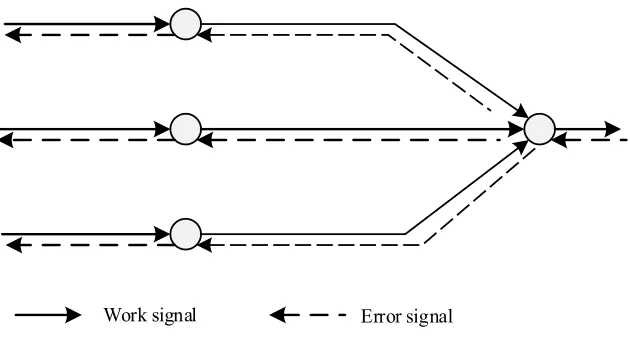
Among the various feedforward neural networks, the widely used training algo-rithm is the error back propagation algoalgo-rithm, that is, the BP algoalgo-rithm. In general, feedforward neural networks that use the BP algorithm for training are called BP neural networks. In the feedforward neural network learning problem, the BP algo-rithm has good performance. According to statistics, in the actual application of artifi-cial neural networks, 80% to 90% of the artifiartifi-cial neural network model uses BP net-work. It is also the core part of the forward network, which embodies the best part of the artificial neural network. The learning process of BP algorithm can be divided into two stages. They are the training input data forward propagation stage and the error signal back propagation stage, as shown in Figure 1.
Work signal Error signal
Fig. 1. Signal transmission of BP algorithm
Forward propagation phase of training data. The raw input data is imported from the input layer. Then, it is processed by hidden layer neurons. Finally, the output data is generated by the output layer. In the forward transmission of data (from left to right in the figure), the connection weights between the layers of the BP neural network do not change. The weights of each layer of neurons affect only the subsequent state of the neurons that are connected between the neurons after the data is passed. If the output data is not consistent with the expected prediction, the BP neural network is not fully trained, and then, it shifted to the error signal back propagation stage.
3.2 Comparison of network training results and algorithm improvement Once the data has been normalized, the neural network can be trained. First, the BP neural network structure needs to be selected. According to the structural analysis of the data set, this experiment should choose 10 contacts as the input layer, 6 basis points as the output layer, and the number of hidden layer selection to the current has not yet determined the formula. Different hidden nodes will have an impact on the experimental results. This article first set to 21, that is, about 2 times the input layer. In the later experiment, this paper will compare the convergence speed and classifica-tion error of the number of different hidden nodes, so as to determine the optimal network structure. Once the structure of the BP network is initially determined, the network is trained by the input and output sample sets. The threshold and weights of the network are learned and corrected, so that the network implements a given input-output mapping relationship.
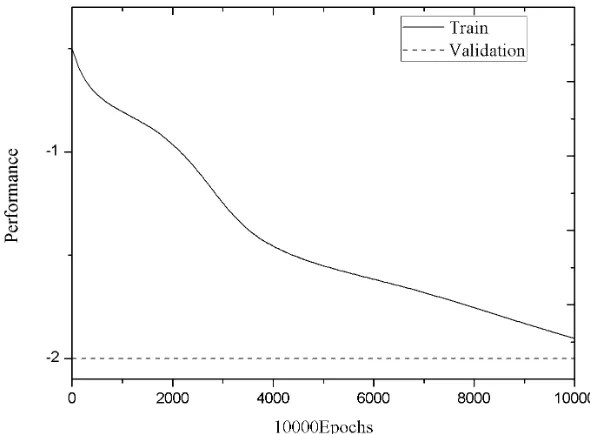
Before the start of the training, the experimental system also requires the user to enter the target network accuracy and maximum number of training. When the trained BP neural network reaches one of these two conditions, the entire training will be terminated. The network accuracy of this experiment is 0.01, and the maximum num-ber of training is 10000 times. When the training BP network button is clicked, the system begins to train the configured BP network. The result is shown in Figure 2.
Fig. 2. BP network training convergence graph
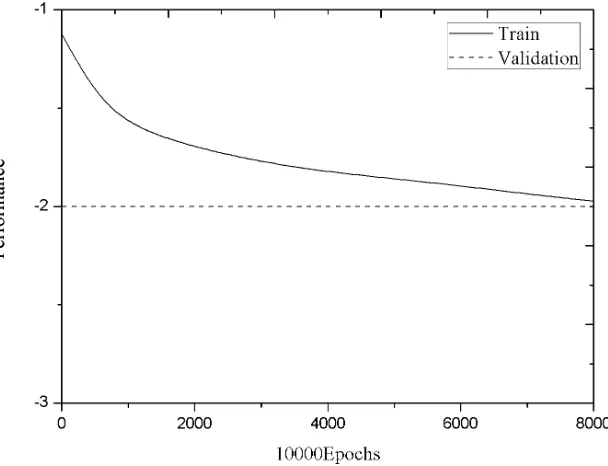
the training times are between 200 and 2500 times. However, after exceeding the number of times, network accuracy has shown a rapid drop phenomenon. Obviously, the training of the network undergoes a weight correction flat area between 200 and 2500 intervals. In this case, the network should speed up the learning step, so as to achieve convergence as soon as possible. In this experiment, through the use of neural network experiment box tool provided by MATLAB, the implementation of the above improved algorithm is completed. In the system interface, first, the trained network action is clicked to select the training options using the improved algorithm. Then, the training BP network button is clicked again, and the system begins to train with the improved BP algorithm. The selected BP network structure and training parameters are consistent with the previous training, and the training results are shown in Figure 3.
Fig. 3. The training convergence graph of the improved BP algorithm
Table 1. Comparison of network learning rate and training frequency
Number of network iterations 100 500 1000 5000 10000 20000 50000
BP algorithm network accuracy 0.4411 0.3212 0.1823 0.0782 0.01223 0.00452 0.00282
Improved BP algorithm
net-work accuracy 0.4524 0.2721 0.1084 0.0578 0.00892 0.00354 0.00258
From the final results, it can be seen that the improved algorithm improves the convergence performance of BP neural network to a certain extent. In addition, the two training results show that the BP neural network converges faster at the beginning of training. With the increase of training times, the convergence speed is obviously slow. When the training is more than 50000 times, the accuracy of the network is very small under the two algorithms. In this interval, the convergence speed of the im-proved algorithm does not show obvious advantages. Thus, when the BP neural net-work error is reduced to a certain extent, the learning rate must be maintained at a lower value. At this point, excessive increase in learning rate is likely to occur con-cussion.
3.3 Data classification and cross validation
The trained BP network can be used to classify the detected data. In order to better analyze the error, the threshold range of the 6 output contacts is set at [0,1]. The final classification result is represented by a combination of 6 output contact values, and the prediction type result depends on the largest one in the final output value. If the output value is [0.1,0.0,0.9,0.0,0.1,0.0], the classification result is type 3 with an error of -0.1. To facilitate the presentation of the results, we add a value of 1 less to the predicted result value. The final result is recorded as 2.9. Thus, the original six-dimensional vector becomes one-six-dimensional, and it can be compared with the actual data type on the coordinate map. In addition, in error analysis, we stipulate that the maximum error shall not exceed 1. Because the biggest error for both categories is to completely determine the error, so the error is greater than 1 and meaningless. There-fore, if the actual value in the above example is 4 (that is, the error is 1.1), then we calculate the error automatically converted into 1.
4
Result analysis and discussion
4.1 Determination of the number of hidden layer junctions
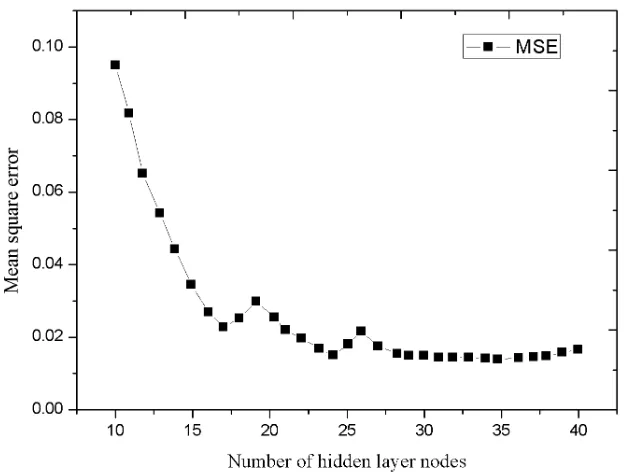
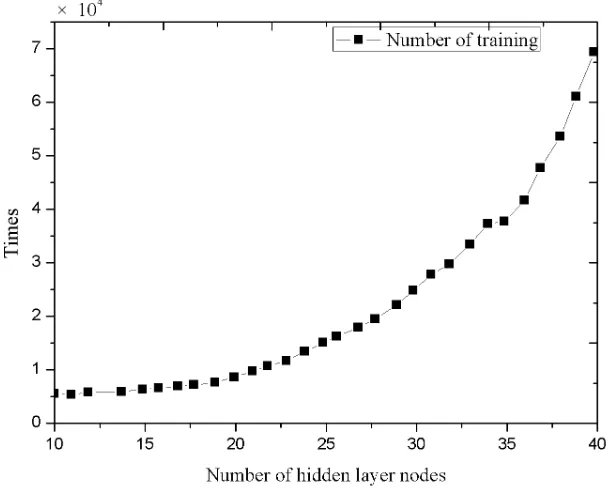
In this experiment, by training BP networks with different hidden layer nodes, they can achieve the same target network accuracy of 0.01. The network accuracy in train-ing is only the network error for the traintrain-ing sample set, and each time the value is derived from the classification bias of a single sample. Therefore, it cannot represent the whole network performance. Through the error of the classification results and the training times of the target network accuracy, the optimal classification structure suit-able for the data set is calculated. In the whole process, the mean square error of the hidden layer from 10 to 40 nodes is MSE. The result is shown in Figure 4.
Fig. 4. Relation between number and variance of hidden layer junction
Fig. 5. Relation between the number of hidden layer nodes and training times
In fact, the training times of different network structures reflect the speed of con-vergence of different network structures. From the training times curve, it can be found that the number of required training increases exponentially with the increase of the number of hidden layer nodes. Therefore, it is necessary to weigh the choice of the topology of the BP network rather than the minimization of the mean square of the experimental results.
4.2 Experimental result analysis
Table 2. Comparison of network learning rate and training frequency
Experimental data
set Classification type Training set Test set
The number of the correct classification Classification accuracy KJ2010D110K First
classifica-tion result 1000 1000 981 98.1% Cross validation
results 1000 1000 989 98.9%
In the whole classification experiment, the time consumed by the single machine executing 11710 times of BP network training is about 257s. The time that spent in classifying the 1000 sets of test sets is less than 1s.
5
Conclusion
In order to verify the effectiveness of the improved BP algorithm, this paper im-plements a data classification system in the Internet of Things. Through the system, a lot of classification experiments were carried out. The results show that the improved BP algorithm can accelerate the convergence speed of the network in a certain train-ing interval. The BP neural network is used to classify the data set in the Internet of Things. The success rate of classification is as high as 98%, that is, it can meet the requirement of general data classification. By analyzing the error surface of a single neuron, it is found that the network is not trapped in the local minimum. Obviously, the improved BP algorithm can improve the performance of BP neural network to a certain extent.
The introduction and development of the Internet of things has brought great op-portunities and challenges to the existing Internet system. Faced with the increasingly mature clustering technology, many algorithms are expected to break through its computing bottlenecks. Although this paper puts forward the data classification exper-iment scheme under the Internet of Things system, there are still some problems that need further study. The Internet of things is too broad. A data classification scheme or model is difficult to apply to all situations. Especially in dealing with large amounts of high-dimensional data, the existing BP network algorithms need to be proved.
6
References
[1]Perera, C., Zaslavsky, A., Christen, P., & Georgakopoulos, D. (2014). Context aware com-puting for the internet of things: A survey. IEEE Communications Surveys & Tutorials, 16(1), 414-454. https://doi.org/10.1109/SURV.2013.042313.00197
[2]Khan, M. A., Khan, S., Shams, B., & Lloret, J. (2016). Distributed flood attack detection mechanism using artificial neural network in wireless mesh networks. Security and Com-munication Networks, 9(15), 2715-2729. https://doi.org/10.1002/sec.1204
[4]Luo, X., Lv, Y., Zhou, M., Wang, W., & Zhao, W. (2016). A laguerre neural network-based ADP learning scheme with its application to tracking control in the Internet of Things. Personal and Ubiquitous Computing, 20(3), 361-372. https://doi.org/10.1007/s00779-016-0916-x
[5]Botta, A., De Donato, W., Persico, V., & Pescapé, A. (2016). Integration of cloud compu-ting and internet of things: a survey. Future Generation Computer Systems, 56, 684-700. https://doi.org/10.1016/j.future.2015.09.021
[6]Ren, C., An, N., Wang, J., Li, L., Hu, B., & Shang, D. (2014). Optimal parameters selec-tion for BP neural network based on particle swarm optimizaselec-tion: A case study of wind speed forecasting. Knowledge-Based Systems, 56, 226-239. https://doi.org/10.1016/j.kno sys.2013.11.015
[7]Yu, F., & Xu, X. (2014). A short-term load forecasting model of natural gas based on op-timized genetic algorithm and improved BP neural network. Applied Energy, 134, 102-113. https://doi.org/10.1016/j.apenergy.2014.07.104
7
Author
Zhenjun Li is with Hunan Radio and TV University, Hunan, China (e-mail: [email protected]).